PART II. NEW DATA.
Reading edition
WHITE.
(Plate II, figure 11.)
The recessive character white eye-color, which appeared in May 1910, was the first sex-linked mutation in Drosophila (Morgan, 1910a, 1910b). Soon afterwards (June 1910) rudimentary appeared, and the two types were crossed (Morgan, 1910c). Under the conditions of culture the viability of rudimentary was extremely poor, but the data demonstrated the occurrence of recombination of the factors in the ovogenesis so that white and rudimentary, though both sex-linked, were brought together into the same individual. The results were not fully recognized as linkage, because white and rudimentary are so far apart in the chromosome that they seemed to assort freely from each other.
Owing to the excellent viability and the perfect sharpness of separation, white was extensively used in linkage experiments, especially with miniature and yellow (Morgan, 1911a; Morgan and Cattell, 1912 and 1913). White has been more extensively used than any other character in Drosophila, though it is now being used very little because of the fact that the double recessives of white with other sex-linked eye-colors, such as vermilion, are white, and consequently a separation into the true genetic classes is impossible. The place of white has been taken by eosin, which is an allelomorph of white and which can be readily used with any other eye-color.
The locus of white and its allelomorphs is only 1.1 units from that of yellow, which is the zero of the chromosome. Yellow and white are very closely linked, therefore giving only about one cross-over per 100 flies.
All the published data upon the linkage of white with other sex-linked characters have been collected into table 65.
RUDIMENTARY.
Rudimentary, which appeared in June 1910, was the second sex-linked character in Drosophila (Morgan, 1910c). Its viability has always been very poor; in this respect it is one of the very poorest of the sex-linked characters. The early linkage data (Morgan, 1911a) derived from mass cultures have all been discarded. By breeding from a single F1 female in each large culture bottle it has been possible to obtain results which are fairly trustworthy (Morgan, 1912g; Morgan and Tice, 1914). These data appear in table 65, which summarizes all the published data.
The locus of rudimentary is at 55.1, for a long time the extreme right end of the known chromosome, though recently several mutants have been found to lie somewhat beyond it.
Fig. A. a. rudimentary wing; b. the wild fly for comparison.
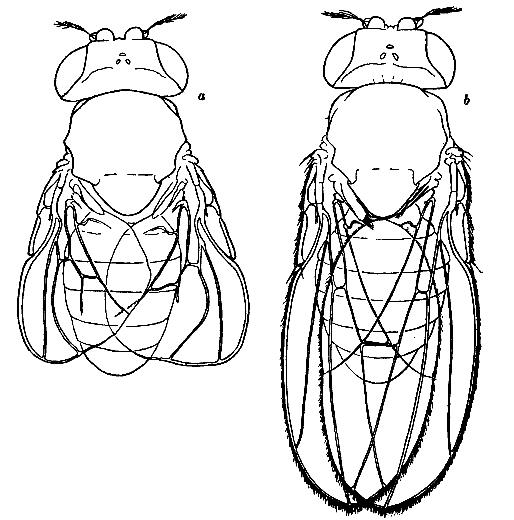
The rudimentary males are perfectly fertile, but the rudimentary females rarely produce any offspring at all, and then only a very few. The reason for this is that most of the germ-cells cease their development in the early growth stage of the eggs (Morgan, 1915a).
MINIATURE.
(Plate II. figures 7 and 8.)
The recessive sex-linked mutant miniature wings appeared in August 1910 (Morgan, 1911b and 1912a). The viability of miniature is fair, and this stock has been used in linkage experiments more than any other, with the single exception of white. While the wings of miniature usually extend backwards, they are sometimes held out at right angles to the body, and especially in acid bottles the miniature flies easily become stuck to the food or the wings become stringy, so that other wing characters are not easy to distinguish in those flies which are also miniature. At present vermilion, whose locus is at 33, in being used more frequently in linkage work. The locus of miniature at 36.1 is slightly beyond the middle of the chromosome.
VERMILION.
(Plate II. figure 10.)
The recessive sex-linked mutant vermilion eye-color (Morgan, 1911c and 1912a) appeared in November 1910, and has appeared at least twice since then (Morgan and Plough, 1915). This is one of the best of the sex-linked characters, on account of its excellent viability, its sharp distinction from normal with very little variability, its value as a double recessive in combination with other sex-linked eye-colors, and because of its location at 33.0, very near to the middle of the known chromosome.
YELLOW.
(Plate I. figure 5.)
The recessive sex-linked mutant yellow body and wing-color appeared in January 1911 (Morgan, 1911c and 1912a). Its first appearance was in black stock; hence the fly was a double recessive, then called brown. Later the same mutation has appeared independently from gray stock. Yellow was found to be at the end of the X chromosome, and this end was arbitrarily chosen as the zero or the "left end," while the other gens are spoken of as lying at various distances to the right of yellow. Recently a lethal gen has been located less than one-tenth of a unit (-0.04) to the left of yellow, but yellow is still retained as the zero-point.
The viability of yellow is fairly good and the character can be separated from gray with great facility, and in consequence yellow has been used extensively, although at present it is being used less than formerly, since eosin lies only 1.1 units distant from yellow and is generally preferred.
ABNORMAL ABDOMEN.
(Plate I. figure 4.)
The dominant sex-linked character abnormal abdomen appeared in July 1911 (Morgan, 1911d). It was soon found that the realization of the abnormal condition depended greatly upon the nature of the environment (Morgan, 1912). Recently a very extensive study of this character has been published (Morgan, 1915). As this case has been reviewed in the introduction, there is little further to be said here. Because of the change that takes place as the culture grows older (the abnormal changing to normal), this character is not of much value in linkage work. The location of the factor in the X chromosome at 2.4 has been made out from the data given by Morgan (1915b). These data, which in general include only the abnormal classes, are summarized in table 1.
Table 1.—Linkage data, from Morgan, 1915b.
Gens. Total. Cross- overs. Cross-over values.
Yellow white 28,018 334 1.2
Yellow abnormal 15,314 299 2.0
White abnormal 16,300 277 1.7
EOSIN.
(Plate II, figures 7 and 8.)
The recessive sex-linked mutation eosin eye-color appeared in August 1911 in a culture of white-eyed flies (Morgan 1912a). The eye-color is different in the male and female, the male being a light pinkish yellow, while the female is a rather dark yellowish pink. Eosin is allelomorphic to white and the white-eosin compound or heterozygote has the color of the eosin male. There is probably no special significance in this coincidence of color, since similar dilutions to various degrees have been demonstrated for all the other eye-colors tested (Morgan and Bridges, 1913). Since eosin is allelomorphic to white, its locus is also at 1.1. Eosin is the most useful character among all those in the left end of the chromosome.
BIFID.
The sex-linked wing mutant bifid, which appeared in November 1911, is characterized by the fusion of all the longitudinal veins into a heavy stalk at the base of the wing. The wing stands out from the body at a wide angle, so that the fusion is easily seen. At the tip of the wing the third longitudinal vein spreads out into a delta which reaches to the marginal vein. The fourth longitudinal vein reaches the margin only rarely. There is very often opposite this vein a great bay in the margin, or the whole wing is irregularly truncated.
The stock of bifid was at first extremely varied in the amount of this truncation. By selection a stock was secured which showed only very greatly reduced wings like those shown in figures a, b. Another stock (figs. c, d) was secured by outcrossing and selection which showed wings of nearly normal size and shape, which always had the bifid stalk, generally the spread positions (not as extreme), and often the delta and the shortened fourth longitudinal vein. We believe that the extreme reduction in size seen in the one stock was due to an added modifier of the nature of beaded, since this could be eliminated by outcrossing and selection.
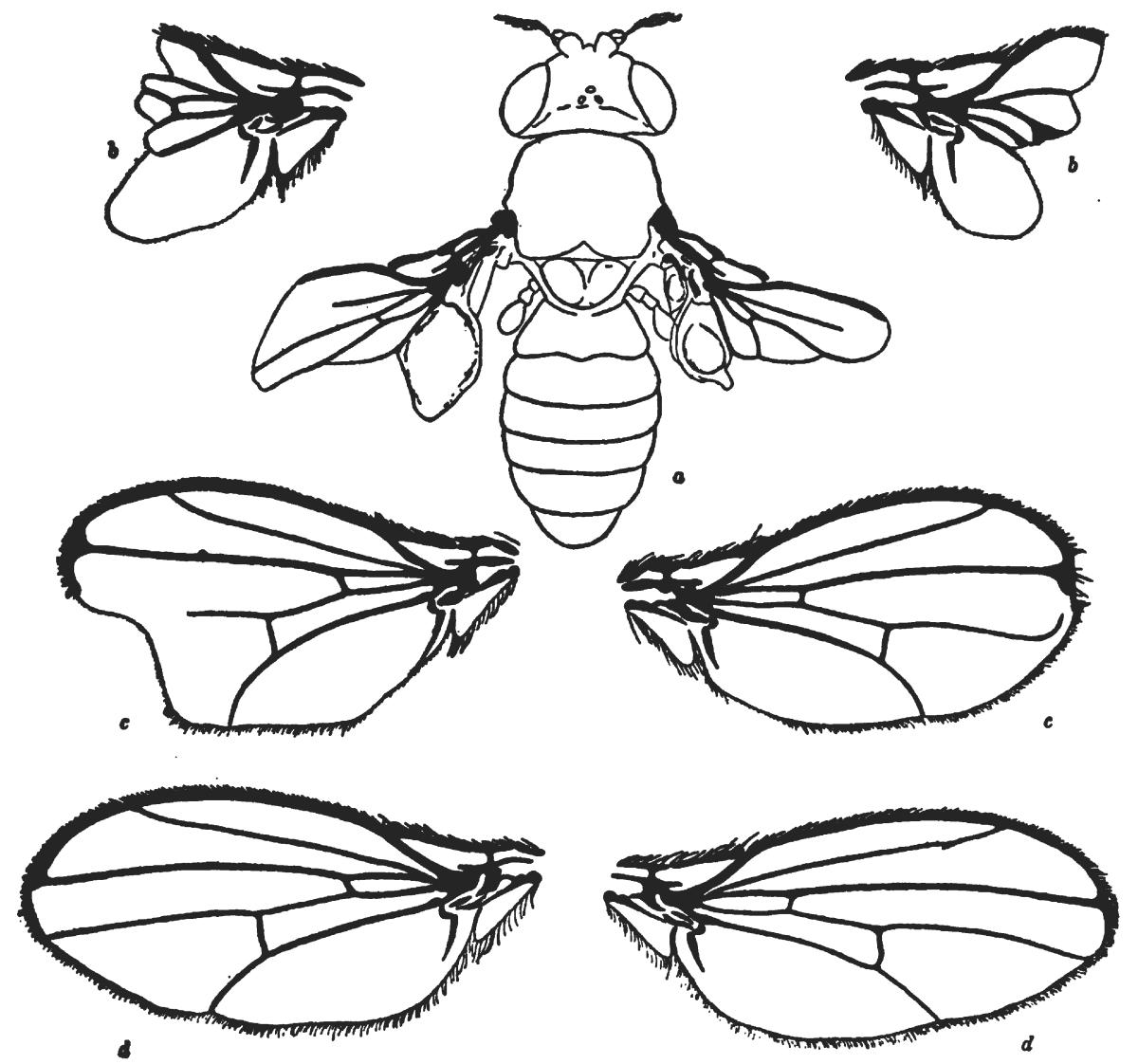
Fig. B.—Bifid wing. c and d show the typical condition of bifid wings. All the longitudinal veins are fused into a heavy stalk at the base of the wing. a shows the typical position in which the bifid wings are held. The small size of the wings in a and b is due to the action of a modifier of the nature of "beaded" which has been eliminated in c, d.
LINKAGE OF BIFID WITH YELLOW, WITH WHITE, AND WITH VERMILION.
The stock of the normal (not-beaded) bifid was used by Dr. R. Chambers, Jr., for determining the chromosome locus of bifid by means of its linkage relations to vermilion, white, and yellow (Chambers, 1913). We have attempted to bring together in table 2 the complete data and to calculate the locus of bifid.
Table 2.—Linkage data, from Chambers, 1913.
Gens. Total. Cross- overs. Cross-over values.
Yellow bifid 3,175 182 5.8
White bifid 20,800 1,127 5.3
Bifid vermilion 2,509 806 32.1
In the crosses between white and bifid there were 1,127 cross-overs in a total of 20,800 available individuals, which gives a cross-over value of 5.3. In the crosses between yellow and bifid there were 182 cross-overs in a total of 3,175 available individuals, which gives a cross-over value of 5.8. In crosses between bifid and vermilion there were 806 cross-overs in a total of 2,509, which gives a cross-over value of 32.1. On the basis of all the data summarized in table 65, bifid is located at 6.3 to the right of yellow.
LINKAGE OF CHERRY, BIFID, AND VERMILION.
In a small experiment of our own, three factors were involved—cherry, bifid, and vermilion. A cherry vermilion female was crossed to a bifid male. Two daughters were back-crossed singly to white bifid males. The female offspring will then give data for the linkage of cherry white with bifid, while the sons will show the linkage of the three gens, cherry, bifid, and vermilion. The results are shown in table 3.
Table 3.—P1 cherry vermilion ♀ ♀ × bifid ♂ ♂. B. C.[2] F1 wild-type ♀ × white bifid ♂ ♂.
Refer- ence. F2 females. F2 males.
Non-cross- overs. Cross-overs.


White- cherry Bifid. White- cherry bifid. Wild- type. Cherry ver- milion. Bifid. Cherry bifid. Ver- milion. Cherry. Bifid ver- milion. Cherry bifid vermilion. Wild- type.
262 40 46 1 2 45 38 3 2 11 13 .. ..
263 47 45 3 3 30 50 1 3 8 10 1 ..
Total. 87 91 4 5 75 88 4 5 19 23 1 0
Both males and females give a cross-over value of 5 units for cherry bifid, which is the value determined by Chambers. The order of the factors, viz, cherry, bifid, vermilion, is established by taking advantage of the double cross-over classes in the males. The male classes give a cross-over value of 20 for bifid vermilion and 24 for cherry vermilion, which are low compared with values given by other experiments. The locus of bifid at 6.3 is convenient for many linkage problems, but this advantage is largely offset by the liability of the bifid flies to become stuck in the food and against the sides of the bottle. Bifid flies can be separated from the normal with certainty and with great ease.
REDUPLICATED LEGS.
In November 1912 Miss Mildred Hoge found that a certain stock was giving some males whose legs were reduplicated, either completely or only with respect to the terminal segments (described and figured, Hoge, 1915). Subsequent work by Miss Hoge showed that the condition was due to a sex-linked gen, but that at room temperature not all the flies that were genetically reduplicated showed reduplication. However, if the flies were raised through the pupa stage in the ice-box at a temperature of about 10° to 12° a majority of the flies which were expected to show reduplication did so. The most extremely reduplicated individual showed parts of 14 legs.
In studying the cross-over values of reduplicated, only those flies that have abnormal legs are to be used in calculation, as in the case of abnormal abdomen where the phenotypically normal individuals are partly genetically abnormal. Table 4 gives a summary of the data secured by Miss Hoge.
Table 4.—Summary of linkage data upon reduplicated legs, from Hoge, 1915.
Gens. Total. Cross- overs. Cross-over values.
White reduplicated 418 121 29.0
Reduplicated vermilion 667 11 1.7
Reduplicated bar 583 120 20.6
The most accurate data, those upon the value for reduplicated and vermilion, give for reduplicated a distance of 1.7 from vermilion, either to the right or to the left. The distance from white is 29, which would place the locus for reduplication to the left of vermilion, which is at 33. The data for bar give a distance of 21, but since bar is itself 24 units from vermilion, this distance of 21 would seem to place the locus to the right of vermilion. The evidence is slightly in favor of this position to the right of vermilion at 34.7, where reduplicated may be located provisionally. In any case the locus is so near to that of vermilion that final decision must come from data involving double crossing-over, i. e., from a three-locus experiment.
LETHAL 1.
In February 1912 Miss E. Rawls found that certain females from a wild stock were giving only about half as many sons as daughters. Tests continuing through five generations showed that the sons that appeared were entirely normal, but that half of the daughters gave again 2 : 1 sex-ratios, while the other half gave normal 1 : 1 sex-ratios.
The explanation of this mode of transmission became clear when it was found that the cause of the death of half of the males was a particular factor that had as definite a locus in the X chromosome as have other sex-linked factors (Morgan, 1912e). Morgan mated females (from the stock sent to him by Miss Rawls) to white-eyed males. Half of the females, as expected, gave 2 : 1 sex-ratios, and daughters from these were again mated to white males. Here once more half of the daughters gave 2 : 1 sex-ratios, but in such cases the sons were nearly all white-eyed and only rarely a red-eyed son appeared, when under ordinary circumstances there should be just as many red sons as white sons. The total output for 11 such females was as follows (Morgan, 1914b): white ♀, 457; red ♀, 433; white ♂, 370; red ♂, 2. It is evident from these data that there must be present in the sex-chromosome a gen that causes the death of every male that receives this chromosome, and that this lethal factor lies very close to the factor for white eyes. The linkage of this lethal (now called lethal 1) to various other sex-linked gens was determined (Morgan 1914b), and is summarized in table 5. On the basis of these data it is found that the gen lethal 1 lies 0.4 unit to the left of white, or at 0.7.
Table 5.—Summary of linkage data upon lethal 1, from Morgan, 1914b, pp. 81-92.
Gens. Total. Cross- overs. Cross-over values.
Yellow lethal 1 131 1 0.8
Yellow miniature 131 45 34.4
Lethal 1 white 1,763 7 0.4
Lethal 1 miniature 814 323 39.7
White miniature 994 397 39.9
LETHAL 1a.
In the second generation of the flies bred by Miss Rawls, one female gave (March 1912) only 3 sons, although she gave 312 daughters. It was not known for some time (see lethals 3 and 3a) what was the cause of this extreme rarity of sons. It is now apparent, however, that this mother carried lethal 1 in one X and in the other X a new lethal which had arisen by mutation. The new lethal was very close to lethal 1, as shown by the rarity of the surviving sons, which are cross-overs between lethal 1 and the new lethal that we may call lethal 1a. There is another class of cross-overs, namely, those which have lethal 1 and get lethal 1a by crossing-over. These doubly lethal males must also die, but since they are theoretically as numerous as the males (3) free from both lethals, we must double this number (3 × 2) to get the total number of cross-overs. There were 312 daughters, but as the sons are normally about 96 per cent of the number of the females, we may take 300 as the number of the males which died. There must have been, then, about 2 per cent of crossing-over, which makes lethal 1a lie about 2 units from lethal 1. This location of lethal 1a is confirmed by a test that Miss Rawls made of the daughters of the high-ratio female. Out of 98 of these daughters none repeated the high sex-ratio and only 2 gave 1 ♀ : 1 ♂ ratios. The two daughters which gave 1 : 1 ratios are cross-overs. There should be an equal number of cross-overs which contain both lethals. These latter would not be distinguishable from the non-cross-over females, each of which carries one or the other lethal. In calculation, allowance can be made for them by doubling the number of observed cross-overs (2 × 2) and taking 98 - 2 as the number of non-cross-overs. The cross-over fraction {6 + 4}/{300 + 96} gives 2.6 as the distance between the two lethals. Lethal 1a is probably to the right of lethal 1 at 0.7 + 2.6 = 3.3.
SPOT.
(Plate II, figures 14 to 17.)
In April 1912 there was found in the stock of yellow flies a male that differed from yellow in that it had a conspicuous light spot on the upper surface of the abdomen (Morgan, 1914a). In yellow flies this region is dark brown in color. In crosses with wild flies the spot remained with the yellow, and although some 30,000 flies were raised, none of the gray offspring showed the spot, which should have occurred had crossing-over taken place. The most probable interpretation of spot is that it was due to another mutation in the yellow factor, the first mutation being from gray to yellow and the second from yellow to spot.
Spot behaves as an allelomorph to yellow in all crosses where the two are involved and is completely recessive to yellow, i. e., the yellow-spot hybrid is exactly like yellow. A yellow-spot female, back-crossed to a spot male, produces yellows and spots in equal numbers.
In a cross of spot to black it was found that the double recessive, spot black, flies that appear in F2 have, in addition to the spot on the abdomen, another spot on the scutellum and a light streak on the thorax. These two latter characters ("dot and dash") are very sharply marked and conspicuous when the flies are young, but they are only juvenile characters and disappear as the flies become older. The spot flies never show the "dot and dash" clearly, and it only comes out when black acts as a developer. These characters furnish a good illustration of the fact that mutant gens ordinarily affect many parts of the body, though these secondary effects often pass unnoticed.
In the F2 of the cross of spot by black one yellow black fly appeared, although none are expected, on the assumption that spot and yellow are allelomorphic. Unless due to crossing-over it must have been a mutation from spot back to yellow. Improbable as this may seem to those who look upon mutations as due to losses from the germ-plasm, yet we have records of several other cases where similar mutations "backwards" have taken place, notably in the case of eosin to white, under conditions where the alternative interpretation of crossing-over is excluded.
SABLE.
(Plate I, figure 2.)
In an experiment involving black body-color[3] a fly appeared (July 19, 1912) whose body-color differed slightly from ordinary black in that the trident mark on the thorax was sharper and the color itself was brighter and clearer. This fly, a male, was mated to black females and gave some black males and females, but also some gray (wild body-color) males and females, showing not only that he was heterozygous for ordinary recessive black, but at the same time that his dark color must be due to another kind of black. The gray F1 flies when mated together gave a series of gray and dark flies in F2 about as follows: In the females 3 grays to 1 dark; in the males 3 grays to 5 dark in color. The result indicated that the new black color, which we call sable, was due to a sex-linked factor. It was difficult to discover which of the heterogeneous F2 males were the new blacks. Suspected males were bred (singly) to wild females, and the F2 dark males, from those cultures that gave the closest approach to a 2 gray ♀ : 1 gray ♂ : 1 dark ♂, were bred to their sisters in pairs in order to obtain sable females and males. Thus stock homozygous for sable but still containing black as an impurity was obtained. It became necessary to free it from black by successive individual out-crossings to wild flies and extractions.
This account of how sable was purified shows how difficult it is to separate two recessive factors that give closely similar somatic effects. If a character like sable should be present in any other black stock, or if a character like black should be present in sable, very erratic results would be obtained if such stocks were used in experiments, before such a population had been separated into its component races.
Sable males of the purified stock were mated to wild females and gave wild-type (gray) males and females. These inbred gave the results shown in table 6.
No sable females appeared in F2, as seen in table 6. The reciprocal cross gave the results shown in table 7.
The F1 males were sable like their mother. The evidence thus shows that sable is a sex-linked recessive character. Our next step was to determine the linkage relations of sable to certain other sex-linked gens, namely, yellow, eosin, cherry, vermilion, miniature, and bar.
Table 6.—P1 wild ♀ ♀ × sable ♂. F1 wild-type ♀ ♀ × F1 wild-type ♂ ♂.
Reference.[4] Wild-type ♀. Wild-type ♂. Sable ♂.
88 C 218 100 70
143 C 245 108 72
146 C 200 115 82
Total 663 323 224
Table 7.—P1 sable ♀ × wild ♂ ♂. F1 wild-type ♀ × F1 sable ♂.
Reference. Wild-type ♀. Wild-type ♂. Sable ♀. Sable ♂.
4 I 10 10 6 10
LINKAGE OF YELLOW AND SABLE.
The factor for yellow body-color lies at one end of the known series of sex-linked gens. As already stated, we speak of this end as the left end of the diagram, and yellow as the zero in locating factors.
When yellow (not-sable) females were mated to (not-yellow) sable males they gave wild-type (gray) daughters and yellow sons. These inbred gave in F2 two classes of females, namely, yellow and gray, and four classes of males, namely, yellow and sable (non-cross-overs), wild type and the double recessive yellow sable (cross-overs). From off-spring (F3) of the F2 yellow sable males by F2 yellow females, pure stock of the double recessive yellow sable was made up and used in the crosses to test linkage.
In color the yellow sable is quite similar to yellow black, that is, a rich brown with a very dark brown trident pattern on the thorax. Yellow sable is easier to distinguish from yellow than is yellow black, even when the flies have not yet acquired their adult body-color.
Yellow sable males were bred to wild females and F1 consisted of wild-type males and females. These inbred gave the results shown in table 8.
Table 8.—P1 wild ♀ ♀ × yellow sable ♂ ♂. F1 wild-type ♀ ♀ × F1 wild-type ♂ ♂.
Reference. Wild- type ♀. Non-cross-over ♂. Cross-over ♂. Total males. Cross-over value.
Yellow sable. Wild- type. Yellow. Sable.
44 I 292 110 43 75 36 264 42
45 I 384 104 58 71 60 293 45
Total 676 214 101 146 96 557 43
Some of the F1 females were back-crossed to yellow sable males and gave the data for table 9.
Table 9.—P1 wild-type ♀ ♀ × yellow sable ♂ ♂. B. C. F1 wild-type ♀ × yellow sable ♂ ♂.
Reference. Non-cross-overs. Cross-overs. Total. Cross-over value.
Wild-type. Yellow sable. Yellow. Sable.
31 I 108 51 58 56 273 42
49 I 265 175 161 169 770 43
Total 373 226 219 225 1,043 43
In these tables the last column (to the right) shows for each culture the amount of crossing-over between yellow and sable. These values are found by dividing the number of cross-overs by the total number of individuals which might show crossing-over, that is, males only or both males and females, as the case may be. Free assortment would give 50 per cent of cross-overs and absolute linkage 0 per cent of cross-overs. Except where the percentage of crossing-over is very small these values are expressed to the nearest unit, since the experimental error might make a closer calculation misleading.
The combined data of tables 8 and 9 give 686 cross-overs in a total of 1,600 individuals in which crossing-over might occur. The females of table 8 are all of one class (wild type) and are useless for this calculation except as a check upon viability. The cross-over value of 43 per cent shows that crossing-over is very free. We interpret this to mean that sable is far from yellow in the chromosome. Since yellow is at one end of the known series, sable would then occupy a locus somewhere near the opposite end. This can be checked up by finding its linkage relations to the other sex-linked factors.
LINKAGE OF CHERRY AND SABLE.
The origin of cherry eye-color (Plate II, fig. 9) has been given by Safir (Biol. Bull., 1913). From considerations which will be discussed later in this paper we regard cherry as allelomorphic to white in a quadruple allelomorph system composed of white, eosin, cherry, and their normal red allelomorph. Cherry will then occupy the same locus as white, which is one unit to the right of yellow, and will show the same linkage relations to other factors as does white. A slightly lower cross-over value should be given by cherry and sable than was given by yellow and sable.
When cherry (gray) females were crossed to (red) sable males the daughters were wild type and the sons cherry. Inbred these gave the results shown in table 10.
Table 10.—P1 cherry ♀♀ × sable ♂♂. F1 wild-type ♀ × F1 cherry ♂ ♂.
Reference. Wild- type ♀. Cherry ♀. Non-cross- over ♂. Cross-over ♂. Total males. Cross- over value.
Cherry. Sable. Cherry sable. Wild- type.
24 I 94 105 51 42 20 43 156 40
55 I 101 131 63 52 38 48 201 43
55′ I 96 94 52 31 29 30 142 42
Total 291 330 166 125 87 121 499 42
The percentage of crossing-over between cherry and sable is 42. Since cherry is one point from yellow, this result agrees extremely well with the value 43 for yellow and sable. Since yellow and eosin lie at the left end of the first chromosome, the high values, namely, 43 and 42, agree in making it very probable that sable lies near the other end (i. e., to the right). Sable will lie farther to the right than vermilion, for vermilion has been shown elsewhere to give 33 per cent of crossing-over with eosin. The location of sable to the right of vermilion has in fact been substantiated by all later work.
LINKAGE OF EOSIN, VERMILION, AND SABLE.
Three loci are involved in the next experiment. Since eosin is an allelomorph of cherry, it should be expected to give with sable the same cross-over value as did cherry. When eosin (red) sable females were crossed to (red) vermilion (gray) males, the daughters were wild type and the males were eosin sable. Inbred these gave the classes shown in table 11.
Table 11.—P1 eosin sable ♀ × vermilion ♂♂. F1 wild-type ♀♀ × F1 eosin sable ♂♂.
Reference. F2 females. F2 males.


Eosin sable. Wild- type. Eosin. Sable. Eosin sable. Ver- milion. Eosin ver- milion. Sable. Eosin. Ver- milion sable. Eosin ver- milion sable. Wild- type.
26 I 132 171 113 109 127 163 75 76 37 14 2 5
26′I 96 146 86 78 74 128 76 59 18 21 4 3
Total. 228 317 199 187 201 291 151 135 55 35 6 8
If we consider the male classes of table 11, we find that the smallest classes are eosin vermilion sable and wild type, which are the expected double cross-over classes if sable lies to the right of vermilion, as indicated by the crosses with eosin and with yellow. The classes which represent single crossing-over between eosin and vermilion are eosin vermilion, and sable, and those which represent single crossing-over between vermilion and sable are eosin and vermilion sable. These relations are seen in diagram II.

Diagram II.—The upper line represents an X chromosome, the lower line its mate. The cross connecting lines indicate crossing-over between pairs of factors.
Non-cross-overs Eosin sable.
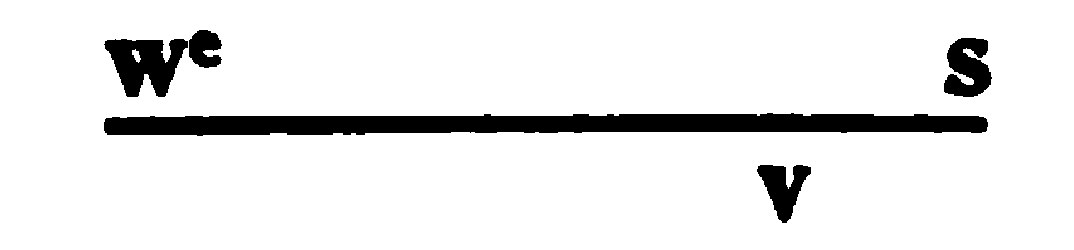

Vermilion.
Single cross-overs Eosin vermilion.
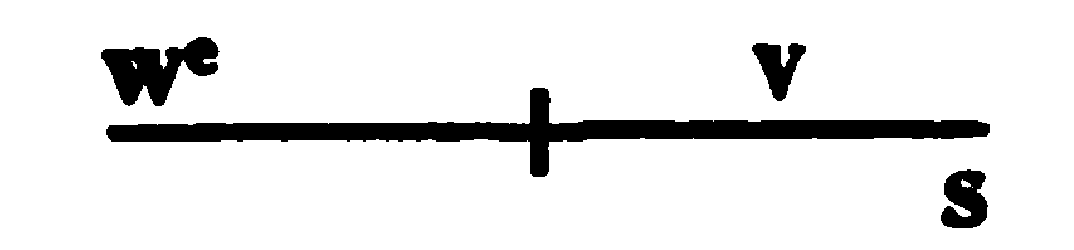
Sable.
Eosin.
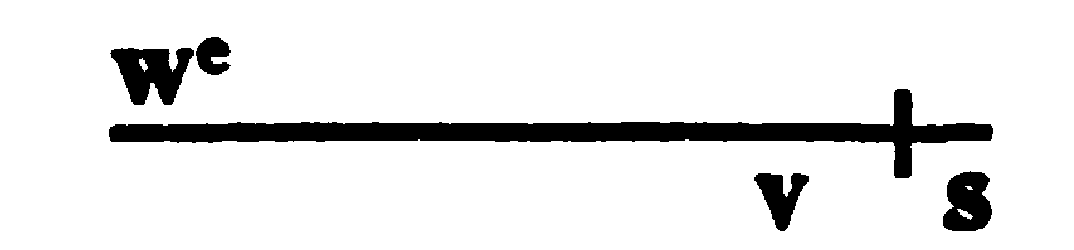
Vermilion sable.
Double cross-overs Eosin vermilion sable.
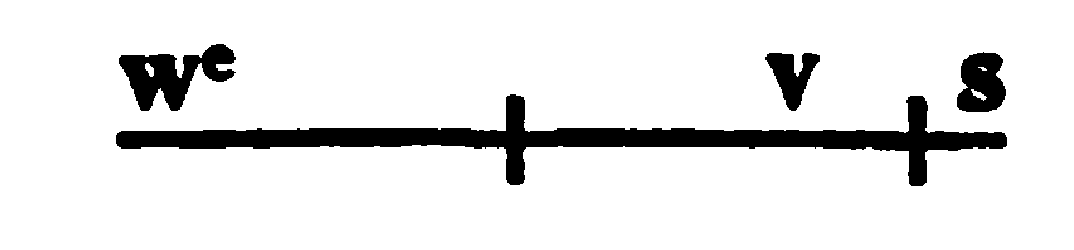
Wild-type.
If we consider the female classes of table 11, we get information as to the cross-over value of eosin and sable, namely, 42 units. The male classes will be considered in connection with the cross that follows.
The next experiment involves the same three gens which now enter in different relations. A double recessive, eosin vermilion (gray) female was mated to (red red) sable males and gave 202 wild-type[5] females and 184 eosin vermilion males. Two F1 pairs gave the results shown in table 12 (the four classes of females not being separated).
Table 12.—P1 eosin vermilion F1 wild-type ♀ × F1 eosin vermilion ♂ ♂.
Reference. F2 females. F2 males.
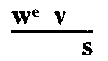
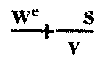
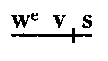
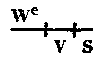
Eosin Ver- milion ♂. Sable ♂. Eosin sable ♂. Ver- milion. ♂. Eosin Ver- milion sable ♂. Wild- type ♂. Eosin ♂. Ver- milion sable ♂.
59 C 133 40 33 7 16 5 5 2 1
61 C 101 34 26 8 11 3 7 1 0
Total 234 74 59 15 27 8 12 3 1
If we combine the data for males given in table 12 with those of table 11, we get the following cross-over values. Eosin vermilion, 32; vermilion sable, 12; eosin sable, 41.
LINKAGE OF MINIATURE AND SABLE.
The miniature wing has been described (Morgan, Science, 1911) and the wing figured (Morgan, Jour. Exp. Zool., 1911). The gen for miniature lies about 3 units to the right of vermilion, so that it is still closer to sable than is vermilion. The double recessive, miniature sable, was made up, and males of this stock were bred to wild females (long gray). The wild-type daughters were back-crossed to double recessive males and gave the results (mass cultures) shown in table 13.
Table 13.—P1 wild ♀ ♀ × miniature sable ♂ ♂. B. C. F1 wild-type ♀ ♀ × miniature sable ♂ ♂.
Reference. Non-cross-overs. Cross-overs. Total. Cross- over value.
Miniature sable. Wild-type. Miniature. Sable.
38 I 245 283 15 17 560 6
43 I 191 236 13 18 458 7
46 I 232 274 24 21 551 8
Total 668 793 52 56 1,569 7
Since the results for the male and the female classes are expected to be the same, the sexes were not separated. The combined data give 7 per cent of crossing-over between miniature and sable.
LINKAGE OF VERMILION, SABLE, AND BAR.
Bar eye has been described by Mrs. S. C. Tice (1914). It is a dominant sex-linked character, whose locus, lying beyond vermilion and sable, is near the right end of the chromosome series, that is, at the end opposite yellow.
In the first cross of a balanced series of experiments for the gens vermilion, sable, and bar, vermilion (gray not-bar) entered from one side (♀) and (red) sable bar from the other (♂). The daughters were bar and the sons vermilion. The daughters were back-crossed singly to the triple recessive males vermilion sable (not-bar), and gave the data included in table 14.
In the second cross, vermilion sable (not-bar) went in from one side (♀) and (red, gray) bar from the other. The daughters were bar and the sons were vermilion sable. Since these sons have the three recessive factors, inbreeding of F1 is equivalent to a triple back-cross. The results are given by pairs in table 15.
Table 14.—P1 vermilion ♀ ♀ × sable bar ♂ ♂. B. C. F1 bar ♀ × vermilion sable ♂ ♂.
Reference. Total. Cross-over values.


Ver- milion. Sable bar. Ver- milion sable bar. Wild- type. Ver- milion bar. Sable. Ver- milion sable. Bar. Ver- milion sable. Sable bar. Ver- milion bar.
147 I 81 66 12 15 15 18 207 13 16 29
148 I 103 108 4 19 11 11 256 9 9 18
149 I 97 88 10 8 17 17 1 1 239 8 15 22
150 I 95 75 10 11 21 22 1 1 236 10 19 27
151 I 116 96 11 15 23 26 2 289 10 18 26
89 89 94 10 19 15 11 1 239 13 11 23
90 49 50 4 8 15 14 140 9 21 29
91 104 88 13 15 12 12 244 11 10 21
Total. 734 665 74 110 129 131 3 4 1,850 10 14 24
Table 15.—P1 vermilion sable ♀ ♀ × bar ♂ ♂. B. C. F1 bar ♀ × vermilion sable ♂ ♂.
Reference. Total. Cross-over values.


Ver- milion sable. Bar Ver- milion bar. Sable. Ver- milion sable bar. Wild- type. Ver- milion. Sable bar. Ver- milion sable. Sable bar. Ver- milion bar.
105 I 41 75 10 4 5 11 146 10 11 21
106 I 59 122 16 13 11 17 238 12 12 24
107 I 92 98 8 12 16 10 236 9 11 20
116 I 111 149 19 16 20 19 1 335 11 12 22
117 I 92 117 16 14 15 18 272 11 12 23
126 I 96 160 13 13 17 35 334 8 15 23
127 I 117 124 13 25 24 30 1 334 12 16 28
Total 608 845 95 97 108 140 1 1 1,895 10 13 23
In the third cross, vermilion (gray) bar entered from one side (♀) and (red) sable (not-bar) from the other (♂). The daughters are bar and the sons vermilion bar. The daughters were back-crossed singly to vermilion sable males and gave the data in table 16.
Table 16.—P1 vermilion bar ♀ ♀ × sable ♂ ♂. B. C. F1 bar ♀ × vermilion sable ♂ ♂.
Reference. Total. Cross-over values.


Ver- milion bar. Sable. Ver- milion sable. Bar. Ver- milion. Sable bar. Ver- milion sable bar. Wild- type. Ver- milion sable. Sable bar. Ver- milion bar.
129 I 132 147 15 15 19 21 1 1 351 9 12 20
130 I 194 168 21 17 28 25 .. 1 454 9 12 20
131 I 121 89 10 20 26 11 1 1 279 12 14 24
137 I 139 113 19 12 33 14 .. 1 331 10 15 24
138 I 131 128 11 11 28 24 1 .. 334 7 16 22
139 I 83 79 4 12 17 12 .. .. 207 8 14 22
Total. 800 724 80 87 151 107 3 4 1,956 9 14 22
In the fourth cross, vermilion sable bar entered from one side, and (red gray not-bar) wild type from the other. The daughters were bar and the sons vermilion sable bar. The daughters were back-crossed singly to vermilion sable males, with the results shown in table 17.
Table 17.—P1 vermilion sable bar ♀ ♀ × wild ♂ ♂. B. C. F1 bar ♀ × vermilion sable ♂ ♂.
Reference. Total. Cross-over values.


Ver- milion sable bar. Wild- type Ver- milion. Sable bar. Ver- milion sable. Bar. Ver- milion bar. Sable. Ver- milion sable. Sable bar. Ver- milion bar.
132 I 95 108 10 13 24 22 .. .. 272 9 17 25
133 I 112 150 18 16 26 16 1 2 341 11 13 22
134 I 84 95 14 7 15 16 .. 1 232 10 14 22
135 I 100 86 16 17 19 22 .. 1 261 13 16 28
152 I 73 88 12 8 14 18 .. .. 213 9 15 24
153 I 114 138 12 12 17 17 .. .. 310 8 11 19
154 I 63 90 10 8 8 15 .. .. 194 9 12 21
Total. 641 755 92 81 123 126 1 4 1,823 10 14 23
In tables 14 to 17 the calculations for the three cross-over values for vermilion, sable, and bar are given for the separate cultures and for the totals. The latter are here repeated.
From— Vermilion sable. Sable bar. Vermilion bar.
Table 14 10 14 24
15 10 13 23
16 9 14 22
17 10 14 23
The results of the different experiments are remarkably uniform. There can be no doubt that the cross-over value is independent of the way in which the experiment is made, whether any two recessives enter from the same or from opposite sides.
Table 18.—Linkage of vermilion, sable, and bar with balanced viability.
Total.


Wild-type 755 110 140 4
Vermilion 734 92 151 1
Sable 724 97 131 4
Bar 845 87 126 4
Vermilion sable 608 80 123 3
Vermilion bar 800 95 129 1
Sable bar 665 81 107 1
Vermilion sable bar 641 74 108 3
Total 5,772 716 1,015 21 7,524
Percentage 76.7 9.53 13.49 0.28
In table 18 the data from each of the four separate experiments have been combined in the manner explained, so that viability is canceled to the greatest extent. The amount of each kind of cross-over appears at the bottom of the table. The total amount of crossing-over between vermilion and sable is the sum of the single (9.53) and of the double (0.28) cross-overs, which value is 9.8. Likewise the cross-over value for sable bar is 13.49 + 0.28 (= 14), and for vermilion bar is 9.53 + 13.49 (= 23). By means of these cross-over values we may calculate the coincidence involved, which is in this case
0.0028 × 100 = 20.8
0.0953 + 0.0028 × 0.1349 + 0.0028
This value shows that there actually occurs only about 21 per cent of the double cross-overs which from the values of the single cross-overs are expected to occur in this section of the chromosome. This is the result which is to be anticipated upon the chromosome view, for if crossing-over is connected with loops of the chromosomes, and if these loops have an average length, then if the chromosomes cross over at one point it is unlikely they will cross over again at another point nearer than the average length of the loop.
The calculation of the locus for sable gives 43.0.
DOT.
In the F2, from a cross of a double recessive (white vermilion) female by a triple recessive (eosin vermilion pink) male, there appeared, July 21, 1912, three white-eyed females which had two small, symmetrically placed, black, granular masses upon the thorax. These "dots" appeared to be dried exudations from pores. It did not seem possible that such an effect could be inherited, but as this condition had never been observed before, it seemed worth while to mate the three females to their brothers. In the next generation about 1 per cent of the males were dotted. From these females and males a stock was made up which in subsequent generations showed from 10 to 50 per cent of dot. Selection seemed to have no effect upon the percentage of dot. Although the stock never showed more than 50 per cent of dot, yet it was found that the normal individuals from the stock threw about the same per cent as did those that were dotted, so that the stock was probably genetically pure. The number of males which showed the character was always much smaller than the number of dotted females; in the hatches which produced nearly 50 per cent of dot, nearly all the females but very few of the males were dotted. Quite often the character showed on only one side of the thorax.
Since this character arose in an experiment involving several eye-colors an effort was made by crossing to wild and extracting to transfer the dot to flies normal in all other respects. This effort succeeded only partly, for a stock was obtained which differed from the wild type only in that it bore dot (about 30 per cent) and in that the eyes were vermilion. Several attempts to get the dot separated from vermilion failed. Since this was only part of the preliminary routine work necessary to get a mutant stock in shape for exact experimentation, no extensive records were kept.
LINKAGE OF VERMILION AND DOT.
When a dot male with vermilion eyes was bred to a wild female the offspring were wild-type males and females. These inbred gave the data shown in table 19.
Table 19.—P1 vermilion dot ♂ × wild ♀ ♀. F1 wild-type ♀ ♀ × F1 wild-type ♂ ♂.
Reference. F2 females. Wild-type ♂. Vermilion ♂. Vermilion dot ♂. Dot ♂.
7 345 151 130 0 0
8 524 245 220 3 0
Total. 869 396 350 3 0
Only three dot individuals appeared in F2, but since these were males the result indicates that the dot character is due to a sex-linked gen. These three males had also vermilion eyes, indicating linkage of dot and vermilion. The males show no deficiency in numbers, therefore the non-appearance of the dot can not be due to its being semi-lethal. It appears, therefore, that the expression of the character must depend on the presence of an intensifying factor in one of the autosomes, or more probably, like club, it appears only in a small percentage of flies that are genetically pure for the character.
The reciprocal cross (dot female with vermilion eyes by wild male) was made (table 20). The daughters were wild type and the sons vermilion. Not one of the 272 sons showed dot. If the gen is sex-linked the non-appearance of dot in the F1 males can be explained on the ground that males that are genetically dot show dot very rarely, or that its appearance is dependent upon the intensification by an autosomal factor of the effect produced by the sex-linked factor for dot.
Table 20.—P1 vermilion dot ♀ × wild ♂.
First generation. Second generation.
Reference. Wild- type ♀. Ver- milion ♂. Reference. Wild- type ♂. Wild- type ♀. Ver- milion ♂. Ver- milion ♀. Ver- milion dot ♂. Ver- milion dot ♀. Dot ♂. Dot ♀.
137 C. 44 45 19 211 198 228 206 20 3 0 0
138 C. 77 62 22 266 220 227 227 16 0 0 0
124 124 28 143 149 125 124 14 1 0 0
57 41 Total. 620 567 570 557 50 4 0 0
Total. 291 272
The F2 generation is given in table 20. The dot reappeared in F2 both in females and in males, but instead of appearing in 50 per cent of both sexes, as expected if it is simply sex-linked, it appeared in 4.0 per cent in the females and in only 0.4 per cent in the males. The failure of the character to be fully realized is again apparent, but here, where it is possible for it to be realized equally in males and females, we find that there are 50 females with dot to only 4 dot males. This would indicate that the character is partially "sex-limited" (Morgan, 1914d) in its realization. The dot appeared only in flies with vermilion eyes, indicating extremely strong linkage between vermilion and dot.
The evidence from the history of the stock, together with these experiments, shows that the character resembles club (wing) in that it is not expressed somatically in all the flies which are homozygous for it. In the case of club we were fortunate enough to find a constant feature which we could use as an index, but, so far as we have been able to see, there is no such constant accessory character in the case of the dot. Unlike club, dot is markedly sex-limited in its effect; that is, there is a difference of expression of the gen in the male and female. This difference recalls the sexual dimorphism of the eosin eye.
BOW.
In an F2 generation from rudimentary males by wild females there appeared, August 15, 1912, a single male whose wings instead of being flat were turned down over the abdomen (fig. c). The curvature was uniform throughout the length of the wing. A previous mutation, arc, of this same type had been found to be a recessive character in the second group. The new mutation, bow, is less extreme than arc and is more variable in the amount of curvature. When the bow male was mated to wild females the offspring had straight wings.
Fig. C.—Bow wing.
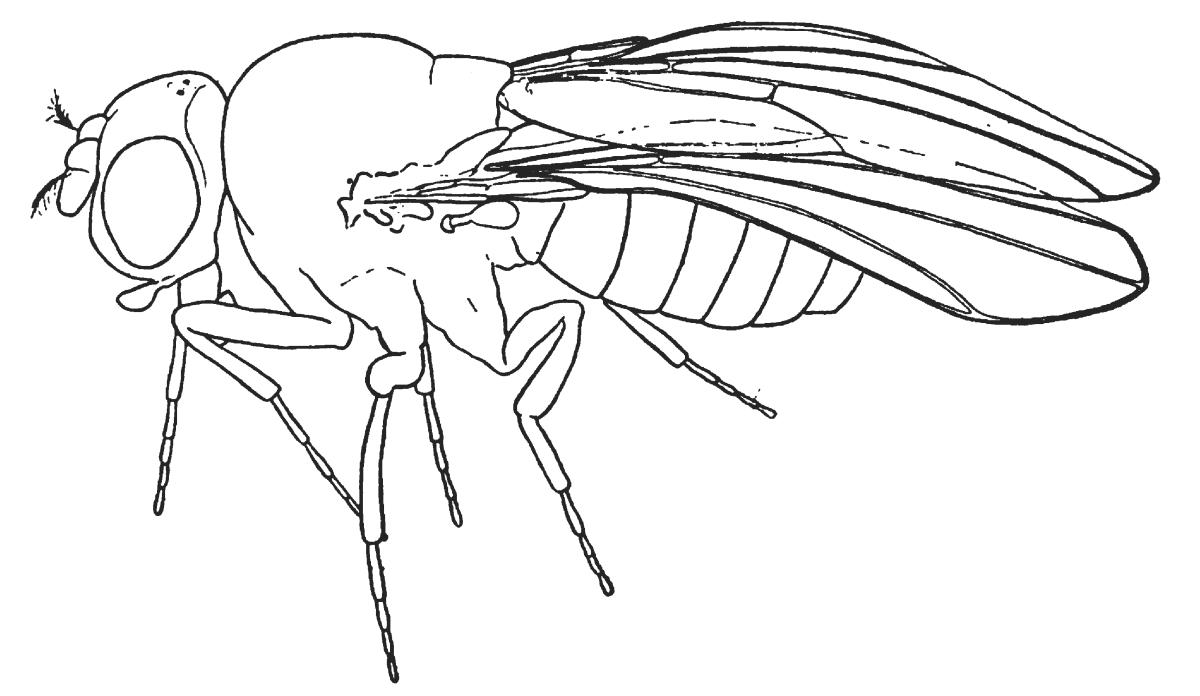
Table 21.—P1 bow ♂♂ × wild ♀♀.
First generation. Second generation.
Reference. Wild-type ♀♀. Wild-type Reference. Wild-type ♀♀. Wild-type ♂♂. Bow ♂♂.
169 C. 17 17 18 I. 193 145 67
21 I 182 100 49
Total. 375 245 116
The F2 ratio in table 21 is evidently the 2:1:1 ratio typical of sex-linkage, but with the bow males running behind expectation. This deficiency is due in part to viability but more to a failure to recognize all the bow-winged individuals, so that some of them were classified among the not-bow or straight wings. In favor of the view that the classification was not strict is the fact that the sum of the two male classes about equals the number of the females.
BOW BY ARC.
When this mutant first appeared its similarity to arc led us to suspect that it might be arc itself or an allelomorph of arc. It was bred, therefore, to arc. The bow male by arc females gave straight (normal) winged males and females. The appearance of straight wings shows that bow is not arc nor allelomorphic to arc. When made later, the reciprocal cross of bow female by arc male gave in F1 straight-winged females but bow males. This result is in accordance with the interpretation that bow is a sex-linked recessive. Further details of these last two experiments may now be given. The F1 (wild-type) flies from bow male by arc female were inbred. The data are given in table 22.
Table 22.—P1 bow ♂ × arc ♀.
First generation. Second generation.
Reference. Wild-type ♀ ♀. Wild-type ♂ ♂. Reference. Straight. Not- straight.
71 C. 48 43 71 C. 179 133
75 C. 28 27
Total. 76 70
Bow and arc are so much alike that they give a single rather variable phenotypic class in F2. Therefore the F2 generation is made up of only two separable classes—flies with straight wings and flies with not-straight wings. The ratio of the two should be theoretically 9:7, which is approximately realized in 179:133.
If the distribution of the characters according to sex is ignored, the case is similar to the case of the two white races of sweet peas, which bred together gave wild-type or purple peas in F1 and in F2 gave 9 colored to 7 white. If sex is taken into account, the theoretical expectation for the F2 females is 6 straight to 2 arc, and for the F2 males 3 straight to 1 arc to 3 bow to 1 bow-arc.
The F1 from bow females by arc male and their F2 offspring are given in table 23.
Table 23.—P1 bow ♀ × arc ♂.
First generation. Second generation.
Reference. Wild-type ♀ ♀. Bow ♂ ♂. Reference. Straight. Not- straight.
72 C. 22 19 3 I. 56 69
73 C. 12 10 3.1 I. 46 62
5 I. 22 21 5 I. 56 68
74 C. 56 52 5.1 I. 90 108
Total. 112 102 Total. 248 307
In this case the F2 expectation is 6 straight to 10 not-straight. Since the sex-linked gen bow entered from the female, half the F2 males and females are bow. The half that are not-bow consist of 3 straight to 1 arc, so that both in the female classes and in the male classes there are 3 straight to 5 not-straight or in all 6 straight to 10 not-straight. The realized result, 248 straight to 307 not-straight, is more nearly a 3:4 ratio, due probably to a wrong classification of some of the bow as straight.
LEMON BODY-COLOR.
(Plate I, figure 3.)
A few males of a new mutant with a lemon-colored body and wings appeared in August 1912. The lemon flies (Plate II, fig. 3) resemble quite closely the yellow flies (Plate II, fig. 4). They are paler and the bristles, instead of being brown, are black. These flies are so weak that despite most careful attention they get stuck to the food, so that they die before mating. The stock was at first maintained in mass from those cultures that gave the greatest percentage of lemon flies. In a few cases lemon males mated with their gray sisters left offspring, but the stock obtained in this way had still to be maintained by breeding heterozygotes, as stated above. But from the gray sisters heterozygous for lemon (bred to lemon males) some lemon females were also produced.
LINKAGE OF CHERRY, LEMON, AND VERMILION.
In order to study the linkage of lemon, the following experiment was carried out. Since it was impracticable to breed directly from the lemon flies, virgin females were taken from stock throwing lemon, and were mated singly to cherry vermilion males. Only a few of the females showed themselves heterozygous for lemon by producing lemon as well as gray sons. Half the daughters of such a pair are expected to be heterozygous for lemon and also for cherry and vermilion, which went in from the father. These daughters were mated singly to cherry vermilion males, and those that gave some lemon sons were continued, and are recorded in table 24. The four classes of females were not separated from each other, but the total of females is given in the table.
Table 24.—P1 lemon (het.) ♀ × cherry vermilion ♂ ♂. F1 wild-type ♀ × cherry vermilion ♂ ♂.
Females. Total ♂♂.


Cherry ver- milion. Lemon. Cherry lemon. Ver- milion. Cherry Lemon ver- milion. Cherry lemon ver- milion. Wild type.
71 42 19 2 6 3 6 0 0 78
88 26 19 2 8 8 4 0 0 67
36 28 7 0 2 1 0 0 0 38
51 12 22 0 4 4 4 0 0 46
98 29 35 0 8 5 1 0 0 78
47 17 11 0 1 3 2 0 0 34
46 23 20 1 6 5 2 0 0 57
437 177 133 5 35 29 19 0 0 398
There are three loci involved in this cross, namely, cherry, lemon, and vermilion. Of these loci two were known, cherry and vermilion. The data are consistent with the assumption that the lemon locus is between cherry and vermilion, for the double cross-over classes (the smallest classes) are cherry lemon vermilion and wild type. The number of single cross-overs between cherry and lemon and between lemon and vermilion are also consistent with this assumption. Since lemon flies fail to emerge successfully, depending in part upon the condition of the bottle, the classes involving lemon are worthless in calculating crossing-over and are here ignored. In other words, lemon may be treated as though it did not appear at all, i. e., as a lethal. The not-lemon classes—cherry, vermilion, cherry vermilion, and wild type—give the following approximate cross-over values for the three loci involved: Cherry lemon, 15; lemon vermilion, 12; cherry vermilion, 27. The locus of lemon, calculated by interpolation, is at about 17.5.
LETHAL 2.
In September 1912 a certain wild female produced 78 daughters and only 16 sons (Morgan, 1914b); 63 of these daughters were tested and 31 of them gave 2 females to 1 male, while 32 of them gave 1:1 sex-ratios. This shows that the mother of the original high sex-ratio was heterozygous for a recessive sex-linked lethal. In order to determine the position of this lethal, a lethal-bearing female was bred to an eosin (or white) miniature male, and those daughters that were heterozygous for eosin, lethal, and miniature were then back-crossed to eosin miniature males. The daughters that result from such a cross give only the amount of crossing-over between eosin and miniature (as 29.7), but the males give the cross-over values for eosin lethal (9.9), lethal miniature (15.4), and eosin miniature (25.1). The data for this cross are given in table 25.
Table 25.—Total data upon linkage of eosin, lethal 2, and miniature, from Morgan, 1914b.
Females. Males.
Total. Cross-overs. Cross-over value. Cross-over values.


Eosin lethal 2. Lethal 2 miniature. Eosin miniature.
15,904 4,736 29.7 5,045 653 1,040 14 9.9 15.4 25.1
A similar experiment, in which eosin and vermilion were used instead of eosin and miniature, is summarized in table 26.
Table 26.—Total data upon the linkage of eosin, lethal 2, and vermilion, from Morgan, 1914b.
Females. Males.
Total. Cross-overs. Cross-over value. Cross-over values.


Eosin lethal 2. Lethal 2 vermilion. Eosin vermilion.
2,656 729 27.5 902 124 227 6 10.3 18.5 27.9
Considerable data in which lethal was not involved were also obtained in the course of these experiments and are included in the summary of the total data given in table 27.
Table 27.—Summary of all data upon lethal 2, from Morgan, 1914b.
Gens. Total. Cross-overs. Cross-over values.
White lethal 2 8,011 767 9.6
White vermilion 6,023 1,612 26.8
White miniature 36,021 11,048 30.7
Lethal 2 vermilion 1,400 248 17.7
Lethal 2 miniature 6,752 1,054 15.4
The amount of crossing-over between eosin and lethal is about 10 per cent and the amount of crossing-over between lethal and miniature is about 18 per cent. Since the amount of crossing-over between eosin and miniature is over 30 per cent, the lethal factor must lie between eosin and miniature, somewhat nearer to eosin. It is impossible at present to locate lethal 2 accurately because of a real discrepancy in the data, which makes it appear that lethal 2 extends for a distance of about 5 units along the chromosome from about 10 to about 15. Work is being done which it is hoped will make clear the reason for this. For the present we may locate lethal 2 at the midpoint of its range, or at 12.5.
CHERRY.
(Plate II, figure 9.)
The origin of the eye-color cherry has been given by Safir (Biol. Bull., 1913).
Cherry appeared (October 1912) in an experiment involving vermilion eye-color and miniature wings. This is the only time the mutant has ever come up, and although several of this mutant (males) appeared in Safir's experiment, they may have all come from the same mother. It is probable that the mutation occurred in the vermilion stock only a generation or so before the experiment was made, for otherwise cherry would be expected to be found also in the vermilion stock from which the mothers were taken; however, it was not found.
A SYSTEM OF QUADRUPLE ALLELOMORPHS.
Safir has described crosses between this eye-color and red, white, eosin, and vermilion. We conclude for reasons similar to those given by Morgan and Bridges (Jour. Exp. Zool., 1913) for the case of white and eosin, that cherry is an allelomorph of white and of eosin. This is not the interpretation followed in Safir's paper, where cherry is treated as though absolutely linked to white or to eosin. Both interpretations give, however, the same numerical result for each cross considered by itself. Safir's data and those which appear in this paper show that white, eosin, cherry, and a normal (red) allelomorph form a system of quadruple allelomorphs. If this interpretation is correct, then the linkage relations of cherry should be identical with those of white or of eosin.
LINKAGE OF CHERRY AND VERMILION.
The cross-over value for white (eosin) and vermilion, based on a very large amount of data, is about 31 units. An experiment of our own in which cherry was used with vermilion gave a cross-over value of 31 units, which is a close approximation to the cross-over value of white and vermilion. The cross which gave this data was that of a cherry vermilion (double recessive) male by wild females. The F1 wild-type flies inbred gave a single class of females (wild-type) and the males in four classes which show by the deviation from a 1:1:1:1 ratio the amount of crossing-over involved.
In one of the F2 male classes of table 28 the simple eye-color cherry appeared for the first time (since the original mutant was vermilion as well as cherry). Safir has recorded a similar cross with like results.
Table 28.—P1 cherry vermilion ♂ ♂ × wild ♀ ♀. F1 wild-type ♀ ♀ × F1 wild-type ♂ ♂.
Reference. Wild- type ♀♀. Non-cross-over ♂. Cross-over ♂. Total ♂♂ Cross- over value.
Cherry vermilion. Wild- type. Cherry. Ver- milion.
160 C 188 57 61 32 34 184 36
161 C 256 85 93 40 52 270 34
162 C 251 78 78 20 37 213 26
163 C 229 76 95 34 33 238 28
Total 924 296 327 126 156 905 31
Some cherry males were bred to wild females. The F1 wild-type males and females inbred gave the results shown in table 29. Some of the cherry males thus produced were bred to their sisters. Cherry females as well as males resulted; and it was seen that the eye-color is the same in the males and females, in contradistinction to the allelomorph eosin, where there is a marked bicolorism (figs. 7, 8, Plate II). The cherry eye-color is almost identical with that of the eosin female, but is perhaps slightly more translucent and brighter.
Table 29.—P1 cherry ♂ ♂ × wild ♀ ♀. F1 wild-type ♀ ♀ × F1 wild-type ♂ ♂.
Reference. Wild-type ♀. Wild-type ♂. Cherry ♂.
15 I 266 120 100
COMPOUNDS OF CHERRY.
In order to examine the effect of the interaction of cherry and white in the same individual (i. e., white-cherry compound) cherry females were crossed to white males. This cross should give white-cherry females and cherry males. These white-cherry females were found (table 30) to be very much lighter than their brothers, the cherry males. The color of the pure cherry females and males is the same, but the substitution of one white for one cherry lowers the eye-color of the female below that of the cherry male. In eosin the white also lowers the eye-color of the compound female about in the same proportion as in the case of cherry. In the eosin the female starts at a higher degree of pigmentation than the male and dilution seems to bring her down to the level of the male. But this coincidence of color between eosin male and white-eosin compound female is probably without significance, as shown by the results with cherry.
Table 30.—P1 cherry ♀♀ × white ♂♂.
Reference. First generation.
White-cherry compound ♀. Cherry ♂.
9 M 321 302
Eosin-cherry compound was also made. An eosin female was mated to a cherry male. The eosin-cherry daughters were darker than their eosin brothers. Inbred they gave the results shown in table 31.
Table 31.—P1 eosin ♀ × cherry ♂.
First generation. Second generation.
Reference. Eosin-cherry compound ♀♀. Eosin ♂♂. Reference. Eosin and eosin-cherry compound ♀♀. Cherry ♂. Eosin ♂.
43C 71 58 1I 154 99 62
2I 174 74 77
328 173 139
Although in the F2 results there are two genotypic classes of females, namely, pure eosin and eosin-cherry compound, the eye-colors are so nearly the same that they can not be separated. The two classes of males can be readily distinguished; of these, one class, cherry, has the same color as the females, while the other class, eosin, is much lighter. Such an F2 group will perpetuate itself, giving one type of female (of three possible genotypic compositions, but somatically practically homogeneous) and two types of males, only one of which is like the females.
FUSED.
In a cross between purple-eyed[6] males and black females there appeared in F2 (Nov. 4, 1912) a male having the veins of the wing arranged as shown in text-figure D b. It will be seen that the third and the fourth longitudinal veins are fused from the base to and beyond the point at which in normal flies the anterior cross-vein lies. The cross-vein and the cell normally cut off by it are absent. There are a number of other features (see fig. D c) characteristic of this mutation: the wings are held out at a wide angle from the body, the ocelli are very much reduced in size or entirely absent, the bristles around the ocelli are usually small. The females are absolutely sterile, not only with their own, but with any males.
Fused males by wild females gave wild-type males and females. Inbred these gave the results shown in table 32. The fused character reappeared only in the F2 males, showing that it is a recessive sex-linked character.
Table 32.—P1 fused ♂ × wild ♀♀.
First generation. Second generation.
Reference. Wild-type ♀♀. Wild-type ♂♂. Reference. Wild-type ♀♀. Wild-type ♂♂. Fused ♂♂.
4I 66 43 190C 258 96 115
14I 239 105 90
Total 497 201 205
The reciprocal cross was tried many times, but is impossible, owing to the sterility of the females. Since the fused females are sterile to fused males, the stock is kept up by breeding heterozygous females to fused males.
By means of the following experiments the position of fused in the X chromosome was determined. A preliminary test was made by mating with eosin, whose factor lies near the left end of the X chromosome series.
LINKAGE OF EOSIN AND FUSED.
Fused (red-eyed) males mated to eosin (not-fused) females gave wild-type daughters and eosin sons, which inbred gave the classes shown in table 33.
Table 33.—P1 eosin ♀♀ × fused ♂♂. F1 wild-type ♀♀ × F1 eosin ♂♂.
Reference. Females. Non-cross-over ♂♂. Cross-over ♂♂. Total males. Cross- over value.
Eosin. Fused. Eosin fused. Wild- type.
56I 496 131 113 82 104 430 43
The data give 43 per cent of crossing-over, which places fused far to the right or to the left of eosin. The latter position is improbable, since eosin already lies very near the extreme left end of the known series. Therefore, since 43 per cent would place the factor nearly at the right end of the series, the next step was to test its relation to a factor like bar that lies at the right end of the chromosome. By mating to bar alone we could only get the linkage to bar without discovering on which side of bar the new factor lies, but by mating to a fly that carries still another sex-linked factor, known to lie to the left of bar, the information gained should show the relative order of the factors involved. Furthermore, since, by making a back-cross, both males and females give the same kind of data (and need not be separated), the experiment was made in this way. In order to have material for such an experiment double mutant stocks of vermilion fused and also of bar fused were made up.
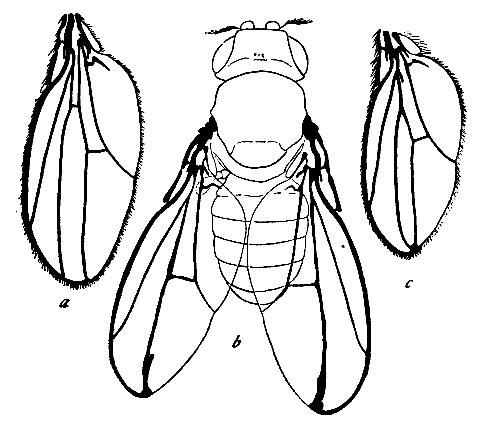
Fig. D.—a, normal wing; b and c, fused wings. c shows a typical fused wing. The most striking feature is the closure of the cell between the third and fourth longitudinal veins with the elimination of the cross-vein; the veins at the base of the wing differ from those in the normal shown in a. b shows the normal position in which the fused wings are held. The fusion of the veins in b is unusually complete.
LINKAGE OF VERMILION, BAR, AND FUSED.
Males from the stock of (red) bar fused were mated to vermilion (not-bar, not-fused) females, and produced bar females and vermilion males. The bar F1 daughters were back-crossed to vermilion fused males and produced the classes of offspring shown in table 34.
Table 34.—P1 vermilion ♀ ♀ × bar fused ♂ ♂. B. C. F1 bar ♀ × vermilion fused ♂ ♂.
Reference. Total. Cross-over values.


Ver- milion. Bar fused. Ver- milion bar fused. Wild- type. Ver- milion fused. Bar. Ver- milion bar. Fused. Ver- milion bar. Bar fused. Ver- milion fused.
140 I 137 130 35 40 5 8 .. .. 355 21 4 25
141 I 144 137 38 41 4 2 .. .. 366 22 2 23
142 I 153 120 43 58 6 7 1 .. 388 26 4 29
143 I 153 92 44 41 3 7 3 1 344 26 4 28
145 I 69 62 29 19 1 .. 1 .. 181 27 1 27
146 I 96 103 30 34 7 3 .. .. 273 23 4 26
156 I 62 45 25 27 1 4 .. .. 164 32 3 35
157 I 93 57 11 31 2 2 .. 2 198 22 3 23
Total. 907 746 255 291 29 33 5 3 2,269 24 3 27
The data show that the factor for fused lies about 3 units to the right of bar. This is the furthest point yet obtained to the right. The reasons for locating fused to the right of bar are that, if it occupies such a position, then the double cross-over classes (which are expected to be the smallest classes) should be vermilion bar and fused, and these are, in fact, the smallest classes. The order of factors is, then, vermilion, bar, fused. This order is confirmed by the result that the number of cross-overs between fused and vermilion is greater than that between bar and vermilion.
In order to obtain data to balance viability effects, the following experiment was made:
Vermilion (not-bar) fused males were bred to (red) bar (not-fused) females. The daughters and sons were bar. The daughters were back-crossed, singly, to vermilion fused males and gave the results shown in table 35. Each female was also transferred to a second culture bottle, so that for each female there are two broods given consecutively (82, 82′, etc.) in table 35.
The results given by the two broods of the same female are similar. The values are very near to those given in the last experiment, and confirm the conclusions there drawn. The combined data give the results shown in table 36.
Table 35.—P1 bar ♀ ♀ × vermilion fused ♂ ♂. B. C. F1 bar ♀ × vermilion fused ♂ ♂.
Reference. Total. Cross-over values.


Ver- milion fused. Bar. Ver- milion bar. Fused. Ver- milion. Bar fused. Ver- milion bar fused. Wild- type. Ver- milion bar. Bar fused. Ver- milion fused.
82 165 165 63 57 8 7 1 .. 466 263 29
82′ 104 87 26 24 .. 4 .. .. 245 202 22
83 128 164 51 39 6 4 .. .. 392 233 26
83′ 100 94 28 30 4 4 .. .. 260 223 25
89 85 105 23 24 5 2 .. .. 244 193 22
89′ 78 91 21 27 1 2 .. 1 221 222 23
90 86 85 30 28 5 .. .. .. 234 252 27
90′ 33 38 22 14 4 1 .. 1 113 335 36
91 125 107 41 31 1 1 .. .. 306 241 24
91′ 91 95 31 25 5 1 .. 2 250 233 25
92 109 136 41 24 4 2 .. .. 316 212 23
92′ 100 105 29 29 .. 1 .. 1 265 221 22
93 75 67 19 20 .. 1 .. .. 182 211 22
93′ 68 94 31 17 1 1 .. .. 212 231 24
94 84 96 31 35 8 1 .. .. 255 264 29
94′ 61 73 20 22 5 4 .. .. 185 235 28
95 84 102 27 26 3 3 .. .. 245 222 24
96 144 148 43 34 1 2 .. 1 373 211 21
97 81 96 25 20 5 3 .. .. 230 204 23
98 107 112 39 33 1 2 .. .. 294 251 26
Firsts 1,273 1,383 433 371 47 28 1 1 3,537 232 25
Seconds 635 677 208 188 20 18 .. 5 1,751 233 25
Total.1,908 2,060 641 559 67 46 1 6 5,288 23 2.3 25
Table 36.—Linkage of vermilion, bar, and fused with balanced viability.
Total.


5,621 1,756 175 15 7,567
Percentage 74.3 23.19 2.31 0.2
Some additional data bearing on the linkage of vermilion and fused were obtained. Males of (red) fused stock were bred to vermilion (not-fused) females, and gave wild-type females and vermilion males, which inbred gave the results shown in table 37.
The percentage of cross-overs between vermilion and fused is here 27, which is in agreement with the 26 per cent of the preceding experiment.
The converse experiment, namely, red (not-fused) females by vermilion fused males also gave, when the wild-type daughters were back-crossed to vermilion fused males, a linkage value of 27 units. Two 10-day broods were reared from each female. The data given in table 38 show that the percentage of crossing-over does not change as the flies get older. The locus of fused on the basis of all of the data is at 59.5.
Table 37.—P1 vermilion ♀ ♀ × fused ♂ ♂. F1 wild-type ♀ ♀ × F1 vermilion ♂ ♂.
Reference. Females. Non-cross-over ♂ ♂. Cross-over ♂ ♂. Total ♂ ♂. Cross- over values.
Vermilion. Fused. Vermilion fused. Wild- type.
79 I 299 93 96 37 36 262 28
80 I 245 93 60 28 27 208 26
81 I 263 101 63 22 40 226 27
Total. 807 287 219 87 103 696 27
Table 38.—P1 wild ♀ ♀ × vermilion fused ♂ ♂. F1 wild-type ♀ × F1 wild-type ♂ ♂.
Reference. Females. Non-cross-over ♂ ♂. Cross-over ♂ ♂. Total ♂ ♂. Cross- over values.
Vermilion fused. Wild- type. Vermilion. Fused.
52 96 25 30 16 11 82 33
52′ 176 59 64 24 19 166 26
53 60 20 22 9 6 57 26
53′ 76 21 27 11 10 69 31
54 88 35 38 14 16 103 29
54′ 60 22 20 8 9 59 29
57 61 22 20 7 11 60 30
57′ 170 47 54 24 19 144 30
58 128 37 55 14 10 116 21
58′ 144 38 64 16 15 133 23
Firsts 433 139 165 60 54 418 27
Seconds 626 187 229 83 72 571 27
Total 1,059 326 394 143 126 989 27
FORKED.
On November 19, 1912 there appeared in a stock of a double recessive eye-color, vermilion maroon, a few males which showed a novel form of the large bristles (macrochætæ) upon the head and thorax. In this mutation (text-fig. E) the first of several which affect the shape and distribution of the bristles, the macrochætæ, instead of being long, slender, and tapered (see Plate 1, fig. I), are greatly shortened and crinkled as though scorched. The ends are forked or branched, bent sharply, or merely thickened. The bristles which are most distorted are those upon the scutellum, where they are sometimes curled together into balls.
LINKAGE OF VERMILION AND FORKED.
Fig. E.—Forked bristles.
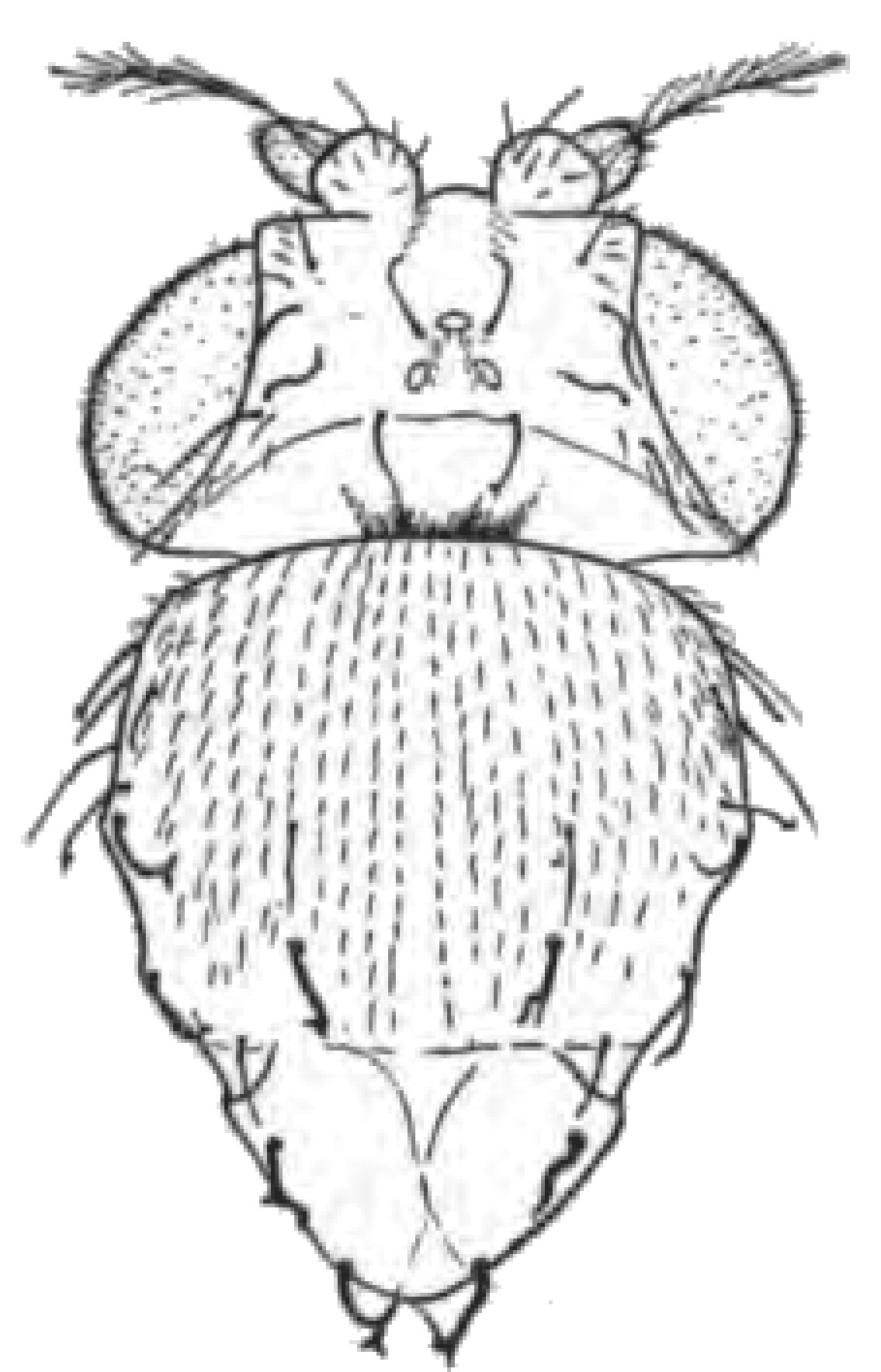
Since forked arose in vermilion stock, the double recessive for these two sex-linked factors could be used in testing the linkage relations of the mutation. Vermilion forked males were crossed to wild females and gave wild-type males and females, which inbred gave in F2 the results shown in table 39. Forked reappeared only in the males in the following proportion: not-forked ♀, 742; not-forked ♂, 346; forked ♂, 301. The result shows that the character is a sex-linked recessive.
Table 39.—P1 wild ♀ ♀ × vermilion-forked ♂ ♂. F1 wild-type ♀ ♀ × F1 wild-type ♂ ♂.
Reference. Wild-type ♀♀. Non-cross-over ♂ ♂. Cross-over ♂ ♂. Total ♂ ♂. Cross- over values.
Vermilion forked. Wild- type. Vermilion. Forked.
9 I 366 113 123 49 41 326 28
11 I 376 116 150 42 31 339 22
Total. 742 229 273 91 72 665 25
In table 39 vermilion forked and wild-type are non-cross-overs, and vermilion and forked are cross-overs, giving a cross-over value of 25 units. The locus, therefore, is 25 units to the right or to the left of vermilion, that is, either about 58 or 8 units from the yellow locus.
LINKAGE OF CHERRY AND FORKED.
Forked males were crossed to cherry females (cherry has the same locus as white, which is about 1 unit from yellow) and gave wild-type females and cherry males. These gave in F2 the results shown in table 40. The non-cross-overs (cherry and forked) plus the cross-overs (cherry forked and wild type) divided into the cross-overs give a cross-over value of 46 units, which shows that the locus lies to the right of vermilion, because if it had been to the left, the value would have been 8 (i. e., 33-25) instead of 33+25=58. The difference between 58 and 46 is due to the expected amount of double crossing-over. In fact, for a distance as long as 58 an almost independent behavior of linked gens is to be expected.
Table 40.—P1 cherry ♀ ♀ × forked ♂ ♂. F1 wild-type ♀ ♀ × F1 cherry ♂ ♂.
Reference. Females. Non-cross-over ♂ ♂. Cross-over ♂ ♂. Total ♂ ♂. Cross- over values.
Cherry. Wild- type. Cherry. Forked. Cherry forked. Wild- type.
25 129 145 73 70 65 68 276 48
25′ 167 148 74 82 66 88 310 50
36 96 88 52 52 35 51 190 45
36′ 57 76 41 32 24 30 127 43
84 76 86 40 34 38 26 138 46
84′ 62 71 24 39 25 28 116 46
85 114 86 43 78 41 53 215 44
85′ 98 95 48 63 52 46 209 47
86 307 323 152 144 118 165 579 49
87 351 341 183 213 160 147 703 45
88 244 246 142 142 107 104 495 43
Total. 1,701 1,705 872 949 731 806 3,358 46
LINKAGE OF FORKED, BAR, AND FUSED.
This value of 58 gave the furthest locus to the right obtained up to that time, since forked is slightly beyond rudimentary. Later, the locus for bar-eye was found still farther to the right, and the locus for fused even farther to the right than bar. A cross was made involving these three gens. A forked (not-bar) fused male was bred to a (not-forked) bar (not-fused) female and gave bar females and males. The F1 females were back-crossed singly to forked fused males with the result shown in table 41.
Table 41.—P1 bar ♀ ♀ × forked fused ♂ ♂. B. C. F1 bar ♀ × forked fused ♂ ♂.
Reference. Total.


Forked fused. Bar. Forked bar. Fused. Forked. Bar fused. Forked bar fused. Wild- type.
163 45 55 .. 1 4 2 .. .. 108
164 71 90 .. .. 4 1 .. .. 166
165 97 106 .. .. 2 4 .. .. 209
11 21 35 .. .. 1 2 .. .. 59
33 15 23 .. .. .. 1 .. .. 39
Total. 250 309 .. 1 11 10 .. .. 581
The same three points were combined in a different way, namely, by mating forked females to bar fused males. The bar daughters were back-crossed to forked fused males and gave the results shown in table 42.
Table 42.—P1 forked ♀ ♀ × bar fused ♂ ♂. B.C. F1 bar ♀ × forked fused ♂ ♂.
Reference. Total.


Forked. Fused bar. Forked bar fused. Wild- type. Forked fused. Bar. Forked bar. Fused.
158 131 124 1 .. 3 3 .. .. 262
159 31 45 .. .. .. .. .. .. 76
160 29 23 .. .. 1 2 .. .. 55
161 24 11 1 .. .. .. .. .. 36
162 96 91 2 .. 1 1 .. .. 191
Total. 311 294 4 .. 5 6 .. .. 620
By combining the results of tables 41 and 42 data are obtained for cross-over values from which (by balancing the inviable classes, as explained in table 43) the element of inviability is reduced to a minimum.
Table 43.
Total.
1,164 5 32 0 1,201
Per cent. 96.9 0.42 2.7 0
The linkages involved in these data are very strong. The cross-overs between forked and bar number only 5 in a total of 1,201, which gives less than 0.5 per cent of crossing-over. There are 32 cross-overs or 2.7 per cent between bar and fused. The value for forked fused is the sum of the two other values, or 3.1 per cent.
LINKAGE OF SABLE, RUDIMENTARY, AND FORKED.
Rudimentary, forked, bar, and fused form a rather compact group at the right end of the chromosome, as do yellow, lethal 1, white, abnormal, etc., at the zero end. The following two experiments were made to determine more accurately the interval between rudimentary and the other members of this group. A sable rudimentary forked male mated to a wild female gave wild-type sons and daughters. These inbred give the results shown in table 44.
Table 44.—P1 sable rudimentary forked ♂ × wild ♀. F1 wild-type ♀ × F1 wild-type ♂ ♂.
Reference. Wild- type ♀♀.


Sable rudi- mentary forked. Wild- type. Sable. Rudi- mentary forked. Sable rudi- mentary. Forked. Sable forked. Rudi- mentary.
264 98 28 17 2 5 1 1 .. ..
265 97 29 54 4 9 .. .. .. ..
266 114 42 49 11 11 .. 2 .. ..
Total 309 99 120 17 25 1 3 .. ..
There were 265 males, of which 42 were cross-overs between sable and rudimentary and 4 between rudimentary and forked. The values found are: sable rudimentary, 16; rudimentary forked, 1.5; sable forked, 17.
LINKAGE OF RUDIMENTARY, FORKED, AND BAR.
The three gens, rudimentary, forked, and bar, form a very compact group. A rudimentary forked male was crossed to bar females and the daughters (bar) were back-crossed singly to rudimentary forked males, the results being shown in table 45.
Table 45.—P1 rudimentary forked ♂ × bar ♀. B.C. F1 bar ♀ × rudimentary forked ♂ ♂.
Reference.


Rudi- mentary forked. Bar. Rudi- mentary bar. Forked. Rudi- mentary forked bar. Wild- type. Rudi- mentary. Forked bar.
267 56 104 .. 2 1 1 .. ..
268 82 86 1 2 .. .. .. ..
269 68 101 .. .. .. 1 .. ..
Total 206 291 1 4 1 2 .. ..
The cross-over values are: rudimentary forked, 1; forked bar, 0.6; rudimentary bar, 1.6. The order of factors is rudimentary, forked, bar. On the basis of the total data the locus of forked is at 56.5.
SHIFTED.
Shifted appeared (January 1913) in a stock culture of vermilion dot. The chief characteristic of this mutant is that the third longitudinal vein (see text-fig. F) does not reach the margin as it does in the normal fly. The vein is displaced toward the fourth throughout its length, and only very rarely does it extend far enough to join the marginal vein. The cross-vein between the third and the fourth veins is often absent because of the shifting. The flies themselves are smaller than normal. The wings are held out from the body at a wide angle. The two posterior bristles of the scutellum are much reduced in size and stick straight up—a useful landmark by which just-hatched shifted flies may be recognized, even though the wings are not expanded.
LINKAGE OF SHIFTED AND VERMILION.
Since shifted arose in vermilion, the double recessive shifted vermilion was available for the following linkage experiment: shifted vermilion males by wild females gave wild-type males and females which inbred gave the data shown in table 46.
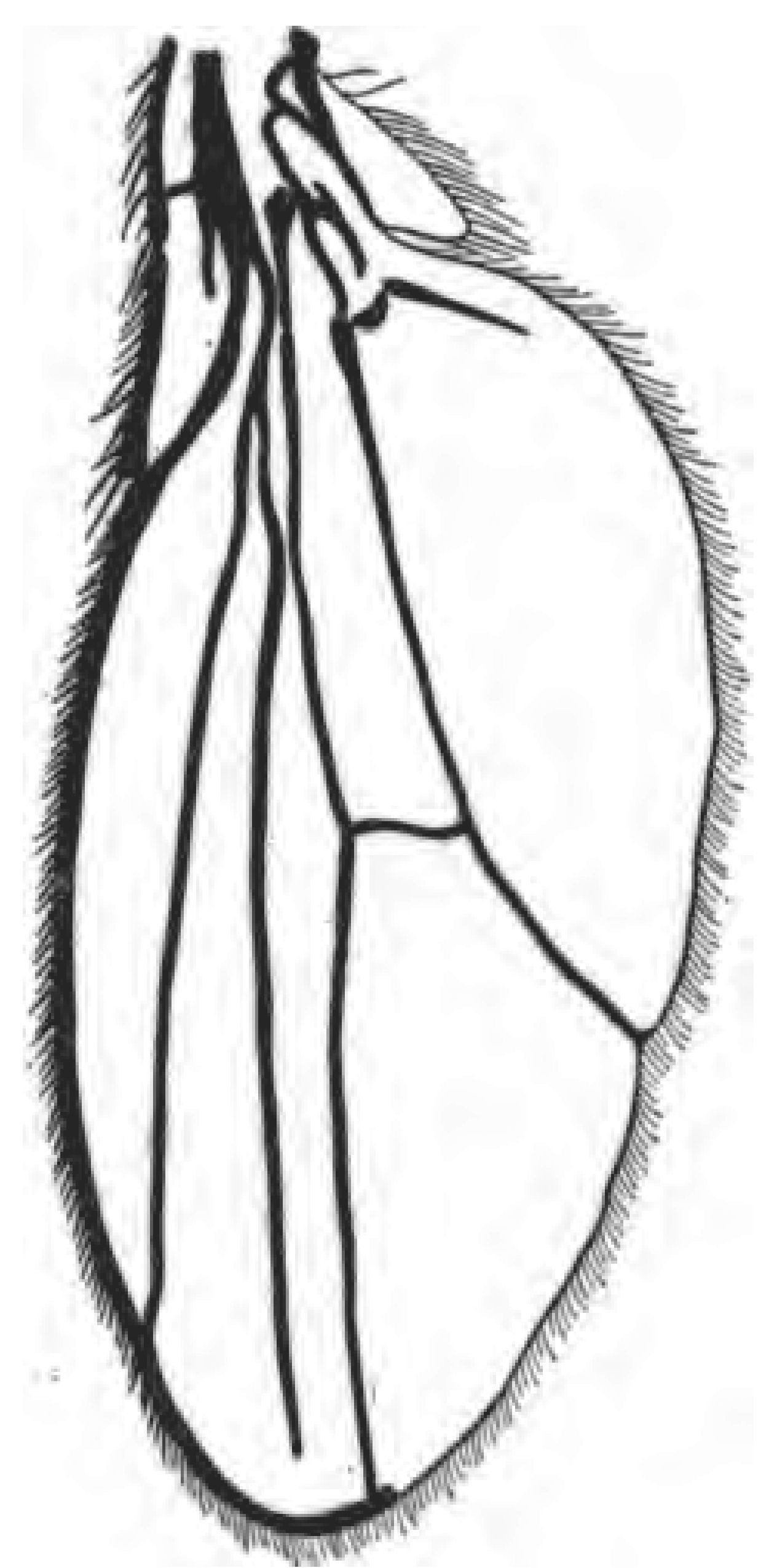
Fig. F.—Shifted venation. The third longitudinal vein is shifted toward the fourth and fails to reach the margin. Cross-vein between third and fourth longitudinal veins is lacking.
Disregarding the eye-color, the following is a summary of the preceding results: wild-type ♀, 1,001; wild-type ♂, 437; shifted ♂, 328. The result shows that shifted is a sex-linked recessive. The data of table 46 show that the locus of shifted lies about 15 units on one side or the other of vermilion, which from the calculated position of vermilion at 33 would give a position for shifted at either 18 or 48 from yellow.
Table 46.—P1 shifted vermilion ♂ ♂ × wild ♀ ♀. F1 wild-type ♀ × F1 wild-type ♂ ♂.
Reference. Females. Non-cross-over ♂ ♂. Cross-over ♂ ♂. Total ♂ ♂. Cross- over values.
Shifted vermilion. Wild- type. Shifted. Vermilion.
13 345 79 115 8 25 227 15
29 68 20 32 3 4 59 12
30 191 37 54 5 13 109 17
31 151 41 65 17 13 136 22
33 133 49 40 4 6 99 10
34 113 56 59 9 11 135 15
Total. 1,001 282 365 46 72 765 15
LINKAGE OF SHIFTED, VERMILION, AND BAR.
In order to determine on which side of vermilion shifted lies, a shifted vermilion (not-bar) female was crossed to a (not-shifted red) bar male. Three factors are involved, of which one, bar, is dominant. The shifted vermilion (not-bar) stock is a triple recessive, and a three-point back-cross was therefore possible. The daughters were bar and the sons were shifted vermilion (the triple recessive). Inbred these gave the results shown in table 46. The smallest classes (double cross-overs) are shifted and vermilion bar, which places shifted to the left of vermilion at approximately 17.8 units from yellow.
Table 47.—P1 shifted vermilion ♀ × bar ♂ ♂. F1 bar ♀ × F1 shifted vermillion ♂ ♂.
Reference. Total. Cross-over values.


Shifted ver- milion. Bar. Shifted bar. Ver- milion Shifted ver- milion bar. Wild- type. Shifted. Ver- milion bar. Shifted ver- milion. Ver- milion bar. Shifted bar.
65 56 108 15 20 8 33 1 1 242 15 18 31
The stock of shifted has been thrown away, since too great difficulty was encountered in maintaining it, because, apparently, of sterility in the females.
LETHALS SA AND SB.
The first lethal found by Miss Rawls was in a stock that had been bred for about 3 years. While there was no a priori reason that could be given to support the view that lethal mutations would occur more frequently among flies inbred in confinement, nevertheless a hundred females from each of several newly caught and from each of several confined stocks were examined for lethals (Stark, 1915). No lethals were found among the wild stocks, but 4 were found among the confined stocks. Whether this difference is significant is perhaps open to question. The first lethal was found in January 1913, in a stock that had been caught at Falmouth, Massachusetts, in 1911, and had been inbred for 18 months, i.e., for about 50 generations. This lethal, lethal sa, was recessive and behaved like the former lethals, being transmitted by half the females and causing the death of half the sons. The position of this lethal to the X chromosome was found as follows, by means of the cross-over value white lethal sa. Lethal-bearing females were mated to white males and the lethal-bearing daughters were again mated to white males. The white sons (894) were non-cross-overs and the red sons (256) were cross-overs. The percentage of crossing-over is 22.2. A correction of 0.4 unit should be added for double crossing-over, indicating that the locus is 22.6 units from white, or at 23.7.
When the work on lethal sa had been continued for 3 months, the second lethal, lethal sb, was found (April 1913) to be present in a female which was already heterozygous for lethal sa. It is probable that this second lethal arose as a mutation in the father, and that a sperm whose X carried lethal sb fertilized an egg whose X carried lethal sa. As in the cases of lethals 1 and 1a and lethals 3 and 3a, this lethal, lethal sb, was discovered from the fact that only a very few sons were produced, there being 82 daughters and only 3 sons. If, as in the other cases, the number of daughters is taken as the number of non-cross-overs and twice the number of sons as the cross-overs, it is found that the two lethals are about 7 units apart. Since the two lethals were in different X chromosomes, all the daughters should receive one or the other lethal, except in those few cases in which crossing over had taken place. Of the daughters 19 were tested and every one was found to carry a lethal. Again, if the cross-over values of the lethals with some other character, such as white eyes, be found and plotted, the curve should show two modes corresponding to the two lethals. This test was applied, but the curve failed to show two modes clearly,[7] the two lethals being too close together to be differentiated by the small number of determinations that were made. It seems probable that lethal sa and lethal sb are about 5 units apart.
The position of lethal sb was accurately found by continuing the determinations with a white lethal cross-over. A white female was found which had only one of the two lethals and the linkage of this lethal with eosin and miniature was found as follows: A female carrying white and lethal in one chromosome and no mutant factor in the homologous chromosome was bred to an eosin miniature male. The white eosin daughters carried lethal, and their sons show the amount of crossing-over between white and lethal (15.6), between lethal and miniature (19.9), and between white and miniature (32.9). The data on which these calculations are based are given in table 48.
Table 48.—Data on the linkage of white, lethal sb, and miniature, from Stark, 1915.
Total. Cross-over values.


Eosin miniature. White miniature. Eosin. White. White lethal sb. Lethal sb. miniature. White miniature.
2,421 524 685 48 3,678 15.6 19.9 32.9
The locus of this lethal is at 16.7; the locus of lethal sa was found to be at 23.7, so that the lethal at 16.7 is evidently the second lethal or lethal sb whose advent gave rise to the high sex-ratio. This interpretation is in accord with the curve which Miss Stark published, for although the mode which corresponds to lethal sa is weak, the mode at 15-16 is well marked.
The two other lethals, lethals sc and sd, which came up in the course of these experiments by Miss Stark, are treated in other sections of this paper.
BAR.
(Plate II, figures 12 and 13.)
The dominant sex-linked mutant called bar-eye (formerly called barred) appeared in February 1913 in an experiment involving rudimentary and long-winged flies (Tice, 1914). A female that is heterozygous for bar has an eye that is intermediate between the rounded eye of the wild fly and the narrow band of the bar stock. This heterozygous bar female is always readily distinguishable from the normal, but can not always be separated from the pure bar. Bar is therefore nearly always used as a dominant and back-crosses are made with normal males.
Bar is the most useful sex-linked character so far discovered, on account of its dominance, the certainty of its classification, and its position near the right end of the X chromosome. The locus of bar at 57 was determined on the basis of the data of table 65.
NOTCH.
A sex-linked dominant factor that brings about a notch at the ends of the wings appeared in March 1913, and has been described and figured by Dexter (1914, p. 753, and fig. 13, p. 730). The factor acts as a lethal for the male. Consequently a female heterozygous for notch bred to a wild male gives a 2:1 sex-ratio; half of her daughters are notch and half normal; the sons are only normal. The actual figures obtained by Dexter were 235 notch females, 270 normal females, and 235 normal males.
The location of notch in the X chromosome was not determined by Dexter, but the mutant has appeared anew three or four times and the position has been found by Bridges to be approximately at 2.6.
DEPRESSED.
Several mutations have appeared in which the wings are not flat. Of these the first that appeared was curved (second chromosome), in which the wings are curved downward throughout their length, but are elevated and held out sidewise from the body; the texture is thinner than normal. The second of these wing mutants to appear was jaunty (second chromosome), in which the wings turn up sharply at the tip; they lie in the normal position. The third mutant, arc (second chromosome), has, as its name implies, its wings curved like the arc of a circle. The fourth mutant, bow (first chromosome, fig. c), is like arc, but the amount of curvature is slightly less. The fifth mutant, depressed (first chromosome, fig. g), has the tip of its wings turned down instead of up, as in jaunty, but, as in jaunty, the wing is straight, except near the tip, where it bends suddenly. These stocks have been kept separate since their origin, and flies from them have seldom been crossed to each other, because in the succeeding generations it would be almost impossible to make a satisfactory classification of the various types. But that they are genetically different mutations is at once shown on crossing any two, when wild-type offspring are produced. For instance, bow and arc are the two most nearly alike. Mated together (bow ♂ by arc ♀), they give in F1 straight-winged flies which inbred give in F2 9 straight to 7 not-straight (i.e., bow, arc, and bow arc together).
Depressed wings first appeared (April 1913) among the males of a culture of black flies. They were mated to their sisters and from subsequent generations both males and females with depressed wings were obtained which gave a pure stock. This new character proved to be another sex-linked recessive.
LINKAGE OF DEPRESSED AND BAR.
Depressed (not-bar) males mated to (not-depressed) bar females gave bar daughters. Two of these were back-crossed singly to depressed males and gave the results shown in table 49. Males and females were not separated, since they should give the same result.
Table 49.—P1 depressed ♀ ♀ × bar ♀ ♀. B.C. F1 bar ♀ × depressed ♂ ♂.
Reference. Non-cross-overs. Cross-overs. Total. Cross- over values.
Depressed. Bar. Depressed bar. Wild- type.
66 I 48 51 21 41 161 39
67 I 85 104 44 70 303 38
Total. 133 155 65 111 464 38
Fig. G.—Depressed wing.
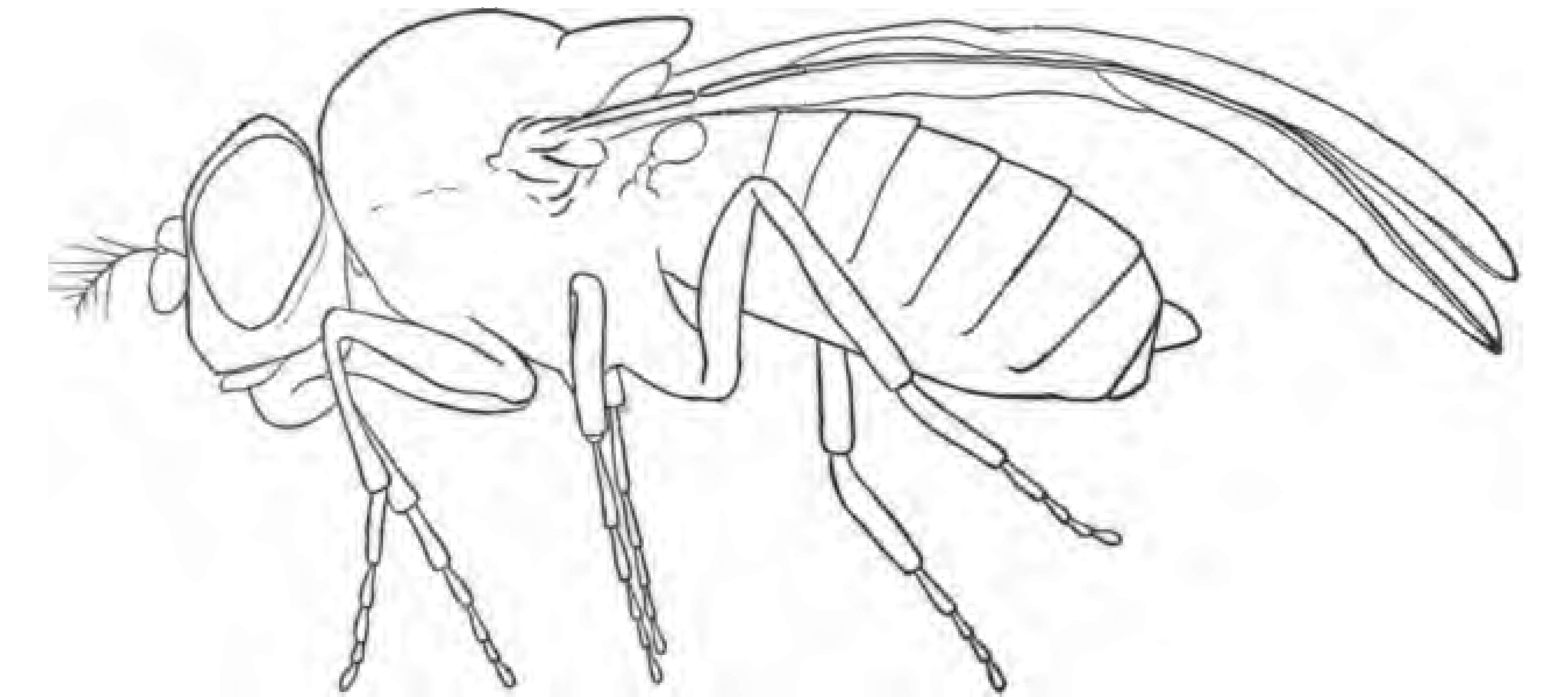
LINKAGE OF CHERRY, DEPRESSED, AND VERMILION.
The linkage value 38 (see table 49) indicates that depressed is somewhere near the opposite end of the series of sex-linked factors from bar. The locus could be more accurately determined by finding the linkage relations of depressed with gens at its end of the chromosome. Accordingly, depressed females were crossed to cherry vermilion males. F1 gave wild-type females and depressed males. The daughters bred again to cherry vermilion males gave the results shown in table 50. The data only suffice to show that the locus of depressed is about midway between cherry and vermilion, or at about 15 units from yellow.
The F1 males in the last experiment did not have their wings as much depressed as is the condition in stock males, and in F2 most of the depressed winged males were of the F1 type, although a few were like those of stock. This result suggests that the stock is a double recessive, i. e., one that contains, in addition to the sex-linked depressed, an autosomal factor that intensifies the effect of the primary sex-linked factor.
Table 50.—P1 depressed ♀ × cherry vermilion ♂ ♂.
First generation. Second generation.
Ref- erence. ♀♀.


Wild- type ♀♀. Depressed ♂♂. Cherry ver- milion ♂. De- pressed ♂. Cherry de- pressed ♂. Ver- milion ♂. Cherry ♂. De- pressed ver- milion ♂. Cherry de- pressed ver- milion ♂. Wild- type ♂.
21 31 19 I 59 23 24 6 6 5 5 0 0
CLUB.
In May 1913 there were observed in a certain stock some flies which, although mature, did not unfold their wings (text-fig. Ha). This condition was at first found only in males and suspicion was aroused that the character might be sex-linked. When these males were bred to wild females the club-shaped wings reappeared only in the F2 males, but in smaller number than expected for a recessive sex-linked character. The result led to the further suspicion that not all those individuals that are genetically club show club somatically. These points are best illustrated and proven by the following history of the stock:
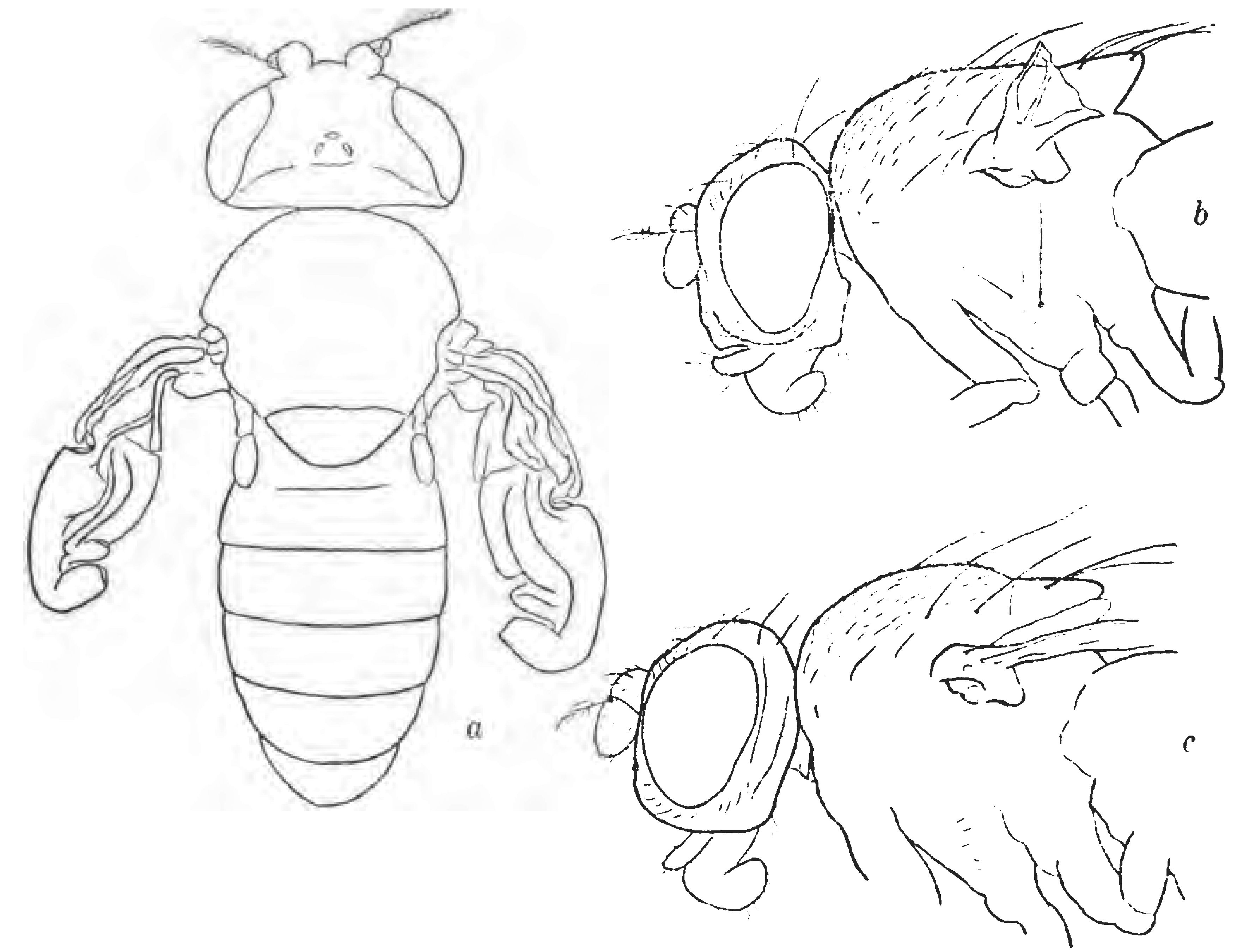
Fig. H.—Club wing. a shows the unexpanded wings of club flies; c shows the absence of the two large bristles from the side of the thorax present in the normal condition of the wild, b.
Club females were obtained by breeding F2 club males to their F2 long-winged sisters, half of which should be heterozygous for club. 5,352; wild-type ♂, 4,181; club ♂, 236. The wild-type males include, of course, those club males that have expanded wings (potential clubs).
Club females by wild males gave in the F2 generation (mass cultures): wild-type ♀, 1,131; wild-type ♂, 897; club ♀, 57; club ♂, 131.
It is noticeable that there were fewer club females than club males, equality being expected, which might appear to indicate that the club condition is more often realized by the male than by the female, but later crosses show that the difference here is not a constant feature of the cross.
Long-winged males from club stock (potential clubs) bred to wild females gave in F2 the following: wild-type ♀, 521; wild-type (and potential club) ♂, 403; club ♂, 82.
Club females by club males of club stock gave in F2: potential club ♀, 126; potential club ♂, 78; club ♀, 95; club ♂, 81. These results are from 8 pairs. The high proportion of club is noticeable.
Potential club females and males from pure club stock (i. e., stock derived originally from a pair of club) gave in F2 the following: potential club ♀, 1,049; potential club ♂, 666; club ♀, 450; club ♂, 453.
GENOTYPIC CLUB.
Accurate work with the club character was made possible by the discovery of a character that is a constant index of the presence of homozygous club. This character is the absence of the two large bristles (text-fig. Hc) that are present on each side of the thorax of the wild fly as shown in figure Hb. All club flies are now classified by this character and no attention is paid to whether the wings remain as pads or become expanded.