Front matter (continued 8)
Reading edition
In 1860 the capital was $3,323,000, specie $1,917,000, circulation $5,753,000, deposits $1,186,000.
Mr. Manufacturer: I can tell you all about the Kentucky banks myself—and I want to tell you there were no better then and there are no better anywhere today.
The Legislature of Kentucky in the session of 1833-4 granted a charter to the Bank of Kentucky with $5,000,000 of capital and the privilege of six branches. Charters were also granted to the Northern Bank of Kentucky, with a capital of $3,000,000, and the Bank of Louisville, with a capital of $5,000,000, each institution having the power or right to issue credit notes to double the amount of their capital.
While the Northern Bank of Kentucky liquidated in 1898 and the Bank of Louisville was merged into the Southern Bank in 1899, the Bank of Kentucky had in the latter year a capital of $1,645,000 and a surplus of $1,103,000, giving indubitable proof that no one had ever suffered because of its power of note issue. And there the Bank of Kentucky stands today, occupying the building it purchased from the United States Bank, a monument to the sound principles upon which it was founded.
It may be most fittingly observed before passing, that when in May, 1837, the blighting wave of suspension swept from New York across the country, these three banks of Kentucky held $1,900,000 in specie against $3,300,000 of notes in circulation—an object lesson for those who may possibly fear that the banks cannot obtain sufficient gold today to protect the notes they are permitted to issue.
The panic of 1857, which was severe in many parts of the country, and which caused great alarm in Kentucky, produced no ill effects on the banks, all of them continuing to pay in specie, even after the New York banks had suspended.
In 1860 the capital of these banks was $12,660,000 and the circulation was $13,520,000.
Mr. Banker: The record made by the Kentucky banks was excellent, but for organization the State Bank of Iowa, like that of the State of Indiana, has had no superior anywhere in the world, and humanly speaking, the administration and working of both was practically perfect. Iowa in the morning of her statehood was opposed to banking as a business; her first constitution provided that "the general assembly shall provide for the organization of all other corporations except with banking privileges, the creation of which is prohibited."
The Constitution also provided, that "the general Assembly shall prohibit any person or persons, association, company, or corporation from exercising the privilege of banking or creating paper to circulate as money," the penalty for each offense being one year in the county jail and a fine.
During the intervening years down to 1857, when the new Constitution was framed, Iowa had suffered so severely from the bond-secured circulation of Illinois in particular, known as "Wild Cat," "Red Dog" and "Yellow Dog" money that a provision was incorporated permitting the legislature to create corporations with banking power, subject, however, to a vote of the people, and also to establish a State Bank with branches founded on actual specie basis.
I want to call the attention of you fellows to the fact that they had a referendum, a state referendum, in Iowa in those days.
It was provided that the branches should be mutually responsible for each other's notes; that the stockholders should be liable for an additional amount equal to their stock; that the bank could issue pure credit notes for double the amount of the paid-up capital; that in case of insolvency the bill holders should have a prior lien over other creditors and that specie redemption must be maintained.
To secure this solvency beyond peradventure, each branch was required to deposit with the State Bank either coin, United States stocks or interest-bearing state stocks at their market value in New York, but in no case above par. This deposit was equal to 12½ per cent of the note issue, and was known as "the Safety Fund" to redeem the notes of the branches in case any of them failed to do so. In addition each branch must have on hand an amount of coin, equal to 25 per cent of its notes outstanding and deposits held. Here is a replica of the banking system of the Bank of the State of Indiana, and it contains all of the prerequisites of a well-nigh perfect banking system; and the result proved the soundness of the plan.
This bank was prohibited from paying interest upon deposits. The parent bank was not a bank of issue or of deposit. It transacted no business, except with and for the branches.
Certainly there is no bank in the United States today with so good a charter as that of the State Bank of Iowa.
By an act approved in February, 1862, County Treasurers and the State Treasurer were authorized to accept the notes of these branches in payment of taxes, and by an Act approved March 10, 1864, payment of taxes and the interest and principal on the school fund might be paid in United States Treasury Notes, National Bank Notes, or Notes of the State Bank of Iowa, thus showing the unquestionable value of the State Bank Circulating Notes.
When the National Banking System was established in 1865, and the 10 per cent tax on circulation was imposed, the life was choked out of one of the most perfect banking systems that had ever existed; and every note of the $1,439,000 outstanding on Jan. 2, 1865, was redeemed without the loss of a single cent to the holders.
The capital was $1,048,000; specie, $389,800; circulation, $1,439,000; deposits, $2,851,000.
Mr. Lawyer: In 1898 I heard an attorney from Richmond speak upon the State Banks of Virginia so boastfully, that out of pure suspicion I investigated them, not believing anything he said at the time.
About 1800 there sprung into life in Virginia a system of state banks based on the old Scotch system under which a half dozen banks of issue were authorized, with numerous branch banks in every part of the state. The charter provisions of these banks were the basis of the few laws that have been enacted in relation to banking since that day.
The first of the banks to be established under state control was the Bank of Virginia, incorporated by the General Assembly, Jan. 13, 1804, with a capital stock of $1,500,000 in shares of $100 apportioned; three thousand seven hundred and fifty shares to Richmond, three thousand to Norfolk, two thousand two hundred and fifty to Petersburg, one thousand to Fredericksburg, five hundred and twenty-five to Winchester, four hundred and fifty to Staunton and five hundred and twenty-five to Lynchburg.
The Charter provided that the banks should hold real estate and other effects to the value of $3,500,000, including the capital stock. The cashier was required to give bond for $50,000; the total amount of notes to be put into circulation by the banks, together with the debts, were restricted to $4,500,000, over and above the money actually deposited in the bank; that is, the issue could be three for one on its cash capital, and this was the established rate for this class of banks.
The bank was well managed and was highly successful. Its notes, all payable in gold, had a wide circulation and were at only one-fourth of 1 per cent discount in New York.
Five other banks were established with the power of establishing branches. These mother banks, six in number, were great institutions, and held the complete confidence of the people. The law did not require that they should keep any reserves and they kept none, except the specie held in their vaults to redeem their notes.
The law provided that the total amount of paper circulation of these banks should never exceed five times the amount of the coin in possession and actually the property of the bank. If the coin of the bank was reduced below one-fifth of its circulation, it was required to stop all discounts until the ratio was restored. As a matter of fact some of the banks issued as high as 8 to 1.
The banks at such times kept their coin reserve up by keeping the discounts down.
The banks of Virginia from 1827 to 1860 had a prosperous period, keeping on an average $10,000,000 of notes in circulation without loss.
It is reported that occasionally drafts drawn on New York were placed in the safe to make up a balance, and called "coin." Be that as it may, there is no case on record where a bank of circulation and deposit failed, and it is claimed by those acquainted with the banking of that day that no one ever lost a dollar by a Virginia bank note previous to the war of 1861, and they were at a discount of only one-quarter of one per cent in New York.
On Jan. 31, 1860, the capital was $16,000,000, specie was $2,943,000, circulation was $9,812,000, deposits $7,729,000.
The Bank of the State of Missouri was started in 1837, with authority to issue notes at the ratio of three to one for the specie in its vaults, and with a branch at each of five considerable towns in different sections of the state; Lexington, Fayette, Palmyra, Cape Girardeau and Springfield. Its capital was $3,450,000.
In 1856, when the population of Missouri was eight hundred and forty thousand and that of St. Louis one hundred and twenty-five thousand, and the indications of substantial prosperity were to be seen in every department of business, the bank circulation was only $2,200,000, although its stock of $1,400,000 specie warranted notes to the amount of $4,200,000, and a considerable part of its circulation was doing duty in California, Oregon and New Mexico, whither it had been carried by emigrants and traders. It is no wonder that under these circumstances Missouri offered an inviting field for the "Wild Cat" money issued so profusely by banks in other western states and that its people became victims of an inconvertible and unreliably currency, which the bank note reporter quoted at a discount all the way from 5 to 25 per cent.
So valuable were the notes of the banks of the State of Missouri in California in the '50's that a gang of counterfeiters took advantage of their popularity, and struck off imitations of them in large quantities.
It was a remedy for this evil, which had become unendurable, and in response to the persistent demands of the important commercial interests of the chief city of the state that the legislature, in 1857, chartered seven banks of issue, with branches conveniently located for the accommodation of business.
These banks were promptly organized in the spring of 1857, immediately after the Act authorizing them was passed; for the state was prosperous, and offered a fair field for legitimate investment. The monetary crisis which was impending but not discerned fell upon the country shortly after they had opened for business; but they stood the strain well; two of them, the Mechanics and the Exchange of St. Louis, refused to suspend specie payment, and continued to redeem in coin through the panic; and when the Civil War broke upon the country four years later, these two banks again refused to join in the general suspension, and maintained coin payment under all conditions that followed.
The system of banks organized under the Act of 1857 rendered the important service of partially displacing the uncertain and variable currency issued by the banks of other states and territories which had found so easy a field in Missouri. The legislature had also authorized the old banks in the state to establish additional branches and to issue notes for $5.00, and in a short time every considerable town in the state had a bank, and the notes of Missouri banks, issued at the rate of $3.00 to every dollar of specie on hand, afforded a local currency better than that brought in from the outside, which had for years almost monopolized the field. The "Wild Cat" money nevertheless made a stubborn contest, and the last of it did not disappear until the National Bank Act went into operation.
In the wild, reckless period, when almost anything in the shape and appearance of an engraved bill, with the name of a bank on it, was good enough to buy public land with, and good enough, therefore, for all other purposes—and in the latter period when other western states authorized banks to issue notes based on various kinds of bonds with the place of redemption out of the way and difficult of access—sometimes in a forest or in a swamp—the legislature of Missouri refused to charter institutions to multiply such currency within the limits of the state.
The notes of the Bank of the State of Missouri were preferred to specie in New Mexico, Utah and on the Pacific coast, and the same high character marked the issues of the system of banks authorized by the general law of 1857.
The capital in 1863 was $11,247,000; specie, $3,666,000; circulation, $4,037,000; deposits, $3,434,000.
Everything I have just said I have taken from John Jay Knox's "History of Banking."
During all this varied experience in the west and south, there was a most conspicuous illustration of a complete banking system demonstrating and proving every economic principle that is involved in constructing a financial and banking system for the United States. It was the Suffolk System of New England. Here were six states, the laws varying in each. Portions of these states were far more remote from Boston in those days than any part of the United States is from any other part today, so far as business relations and convenience are concerned.
There were no railroads, nor telegraph lines, nor long distance telephones. Indeed, almost every essential to anything like a sound banking system as conceived and observed from the standpoint of today was wanting. There was no law requiring a uniform reserve. There was no law requiring coin redemption. There was no law requiring bona fide capital. There was no check upon the amount of notes that might be issued if a bank was dishonestly inclined.
There were, in 1848, three hundred and six banks, deriving their authority from six states, and one hundred and fifty-nine of them did not possess an average capital of $100,000; nor was the average capital outside of Boston more than $160,000, and including that city, it was not more than $206,000.
By 1860 there were five hundred and four banks. There are only seven hundred and forty banks today in the same states. Can any fair-minded, impartial man deny that the conditions today are vastly in favor of better results than they were then? One law for all; a bona fide capital; a required reserve; a system of redemption established by law; notes furnished by the United States Government; a common national supervision. These all unite to compel the admission that any system that could prove its adequacy under such adverse conditions as existed from 1840 to 1860 would certainly approximate perfection today.
Nowhere in the whole range of banking experience have so many things, which the student of this subject wants to know, been demonstrated beyond cavil.
To all intents and purposes the possible issues were without limit. The actual circulation in 1840 was only 23 per cent of that permitted. The circulation of 1850 was only 40 per cent of that permitted; and the circulation in 1860 was only 36 per cent of that permitted.
During every year from 1840 to 1860, except one, the note issues were greater (and usually nearly double) than the deposits, illustrating with what certainty and perfect nicety such a system adapted itself to the ever varying needs of the people who were fortunate enough to have it, and how it invariably, with peculiar fitness, met the needs of the rural districts where currency and not checks was especially required.
The States of New Hampshire and Vermont had bank capital amounting to $8,150,000 in 1850, and notes outstanding amounting to $7,300,000, while Boston with $33,200,000 of capital had only $7,500,000 of notes outstanding.
A marvelous exhibition of this interplay and interchange of bank book credits and bank note credits occurred in the six New England States as a result of the panic of 1857. The authorized note issue of the five hundred and ten banks constituting the Suffolk System with capital ranging all the way from $25,000 to $500,000 each was $131,000,000. In 1856, the year before the panic, the note issue amounted to $50,000,000, and the deposits amounted to $32,000,000. In 1857, as the result of the panic, the note issue rose to $55,000,000 and the deposits dropped to $25,000,000; in 1858, one year after the panic, the note issue had fallen to $36,000,000, and the deposits had risen to $47,000,000, or there had been a conversion of $20,000,000 of bank note debts into deposit debts. The exigency for cash had disappeared and the depression had come.
Do not fail to observe three important facts in this connection:
First: That although the banks were authorized to issue $131,000,000, they never exceeded $57,000,000, which was the highest point of circulation, and that was reached as the result of the panic of 1857, and that they averaged $43,000,000 from 1840 to 1860.
Second: That there was a perfect adaptation of the deposits and note issues to the peculiar and ever changing demands of the people during the panic, and during the depression in trade that followed the panic.
Third: That the number of banks in New England in 1856, the year before the panic, was four hundred and ninety-five, and in the year 1858, the year after the panic, there were four hundred and ninety-nine banks, or four more banks the year after the panic than there were the year preceding the panic, an unquestionable tribute to the principle of current coin redemption.
Now, mark this, that the very heart and the very soul of the Suffolk System was in the fact that the notes were redeemed in Boston in coin. So good were these notes considered to be throughout the entire west, that at Buffalo, Chicago, Milwaukee and all commercial points in the then far west, they were always taken at a premium of from 1 to 5 per cent. It was not the size of the bank of issue that made them good and desirable, but the fact that they were redeemed in coin in Boston.
When the soundness of this system is tested by a comparison with that of the national banks, the result more than justifies the assertion that the Suffolk Bank System of New England was incomparably better than the National Bank System; for, when the conditions during the twenty years from 1840 to 1860 are compared with those of the past thirty years, all must admit that argument is futile and the conclusion is inevitable.
Mark this, that while a tax of one-eighth of 1 per cent of all the notes in circulation would have paid all the notes of the banks that failed under the Suffolk System from 1840 to 1860, it would have taken a tax of one-fifth of 1 per cent on all the notes outstanding issued by the national banks to pay the notes of the failed national banks.
In confirmation of what I have said in praise of the Suffolk System let the bank commissioners of Connecticut, Vermont, Maine, Massachusetts and the New York Courier and Enquirer testify.
"The currency of this state is of the first order and can not be improved, being equal to gold and silver. This is strong language, we admit, yet perfectly true, for every bill holder can on demand convert his bills into coin." (Connecticut Bank Commissioners' Report, 1841.)
"The bills of any country bank, redeemed at par in any commercial city, will always be current throughout the extent of region whose business channels flow to that city. Hence, New England money is worth more in the cities of New York and Philadelphia than the bills of their own country banks. Vermont bills have uniformly borne a premium in the eastern cities without loss, while bills of their own states are at a heavy discount." (Vermont Bank Commission's Report, 1852.)
"The 'Suffolk System,' though not recognized in our banking law, has proved to be the great safeguard to the public. Whatever objections may exist to this 'system' in theory, its practical operation is to keep the circulation of our banks within the bounds of safety. No sound bank can have any well-founded reason for refusing to redeem its bills in Boston, and a bank that is not sound can not long do business under that system and ceases to be in good credit when it is 'thrown out at the Suffolk.'" (Maine Commissioners' Report, Dec. 31, 1857.)
"If there was no check upon circulation there might be some danger, but the frequent redemptions at the Suffolk Bank and the rapid communications between different parts of the country will prevent any greater circulation than the natural business wants of the country will sustain.... Indeed, this system of par redemption seems to be a most perfect regulator upon all the New England banks. It would seem somewhat surprising that something has not been adopted in other parts of the country that should produce the same beneficial results." (Connecticut Bank Commissioners' Report, 1848.)
"The charters of the banks have been renewed. If the laws by which they are constituted the agents of the people to provide a currency, and by which their faithfulness in the discharge of such agency is secured, remain unchanged, there is every reason to believe that the currency of Massachusetts will be for the next twenty years what it has been for the twenty years past—as perfect as any in existence, as perfect as in the nature of things it can be. No reasonable man, no practical man, no man who is not bound hand and foot in the fetters of mere theory, can desire for the people a currency better adapted to meet all the circumstances of a business community than that which has been furnished by the banks of Massachusetts for the last quarter of a century." (James B. Congdon, cashier Merchants' Bank, New Bedford, in memorial to Governor of Massachusetts, 1851.)
"We said that the Massachusetts currency was apparently unsecured. In reality their bank paper is well secured. The experience of the last fifteen years has demonstrated that the losses from bank issues in the State of New York are four or five times greater than in Massachusetts. The system of the latter is better than our own." (New York Courier and Enquirer, 1854.)
"It is by no means wonderful that a system which has stood the test of time and struck its roots so deep as to have become incorporated with and formed a part of our banking system should be abandoned with hesitation for one which is new and untried." (Maine Bank Commissioners' Report, 1865.)
"The State parts with these objects of her care and solicitude with many regrets, but with a just pride in their career, inspired by the belief that their capital has been highly instrumental in promoting the prosperity of the state, and that they have furnished as good a paper currency, based on individual credit, as any part of the country has ever enjoyed." (Massachusetts Banking Report, 1865.)
Mr. Lawyer: If, as we have gradually come to understand and firmly believe, the true service of a bank is to furnish credit to its customers, as they want it, and in such form as they need it, then these institutions which you have been describing were certainly far better suited to the purposes of their day than any banks we now have in existence.
Two things seem to have been present in all of these various institutions: ample coin reserves, which ranged from 20 to 33 per cent, to meet any demand for credit redemption and perfect freedom in changing bank credits from the form of book credit to the form of note credit, and the form of note credit to the form of book credit, according to the desires and needs of the customers of those banks.
As a result of interchangeability of book and note credits, a bank could always protect its coin reserve, for if the customer was just as well satisfied to take the bank's notes, instead of coin, or its reserves, it must be apparent to all of you that the cost to the bank would only be from one-sixth to one-fourth as great, and that the bank would have several times as much credit to loan, and at the same time be in a much stronger position.
Let me illustrate what I mean by calling your attention to what happens over in New York every fall. Let us suppose that the New York banks owe the country banks, say $500,000,000 and that the country banks call for it from July to January for the purpose of moving the crops. The banks of New York with the right kind of a currency system would not need to disturb the situation in New York at all because they could send their correspondents their credit notes, or cashier's checks, for $500,000,000. You see the New York banks would simply convert a deposit credit subject to check or draft into a note credit. The amount of the debt would remain the same, the amount of the reserves would remain exactly the same; but, instead of the country banks continuing to keep the deposits subject to check at the banks, they would take the notes which would serve their purpose, because they could in turn send the notes into the corn and cotton fields, to help harvest and gather the crop; and, just as soon as the notes had served their purpose, they would be returned to the country banks and by them in turn sent on to the New York banks, and would have been reconverted into book credits. Not a single dollar of actual money would have been used in the whole transaction, and yet the country would have been served just as well, as though every bank note sent out had been a gold certificate.
On the other hand, if the New York banks should continue to be as they are today compelled to ship the $500,000,000, they would have to call loans and shift conditions until they could scrape up $500,000,000 with as little injury as possible to their customers and send it west; nearly every dollar so sent out is reserve money of some form, gold certificates, silver certificates and United States notes. Now mark this, the credit notes cost the bank only the interest on the reserves behind the notes; but when the banks ship out their reserves, the cost must necessarily be four or five times as much, to say nothing of the injury they have done to the business conditions in New York. And so this same principle runs on throughout all of our banking business today from one end of the country to the other.
Mr. Merchant: Well, Mr. Lawyer, your entire argument goes to demonstrate with mathematical certainty that the country banks would never have any occasion whatever to send to New York for currency, as they would create their own currency by converting bank book credits into bank note credits to meet all ordinary demands, a fact that not only accentuates, but proves more conclusively what you are saying, and reinforces your argument.
Should we be fortunate enough to secure a right kind of banking system in this respect, we could almost double our bank reserves, that is, make them twice as large, and yet make two or three times as much profit on that part of the banking business, growing out of the substitution of credit notes for reserves, and at the same time be vastly better able to protect the balance of our business from disturbance due to the fact that we are compelled to use reserve money for currency purposes. This now seems to me a very simple matter when you once have grasped it.
Mr. Banker: In this connection I want to call your attention to this fact, and I want to note that it is a very important fact which was so obvious in connection with every single statement of capital, specie, circulation and deposit, that has been given, when referring to the banking systems before the war, and that's this: that the note issues did not begin to average one-half the authorized amounts, proving conclusively that the currency of these banks invariably adapted itself to the exact needs of the people.
Notes Outstanding. Possible Issue was. Per Cent of Possible Issue. Specie Held. Deposits.
Louisiana
$11,579,000 No limit except 33% Coin Reserve $12,115,000 $19,777,000
Ohio
$9,057,000 $10,000,000 About Par $9,057,000 $11,697,000
Indiana
$5,753,000 No limit but 12½% penalty for failure to redeem in coin $1,917,000 $1,186,000
Iowa
$1,439,000 $2,096,000 70% $389,800 $2,851,000
Virginia
$9,821,000 $14,725,000 70% $2,943,000 $7,729,000
Missouri
$4,037,000 $10,998,000 38% $3,666,000 $3,434,000
Suffolk System
$44,000,000 $131,000,000 30% $10,058,995 $41,208,000
Can anyone doubt, after noting these figures, that the note issues of the various banking systems kept as perfect pace with the requirements of trade, as checks and drafts do? Certainly it is perfectly evident that the bank notes came and went precisely as all bank credit should.
Mr. Lawyer: While all these splendid banking systems were snuffed out by the 10 per cent tax upon circulation, the sound principles upon which they were all founded are still most successfully exemplified by the Canadian Banking System which you will remember took its charter from the statutes of Massachusetts.
There are today 27 banks in Canada, with 2,000 branches. The general principle of the Canadian Banking System is identical with that of the Virginia, Kentucky, Louisiana, Indiana, Ohio, Iowa and Missouri banks. It is true there are some differences in matters of detail. The amount of notes that can be issued regularly is that of the capital of the bank. The notes are a first lien upon the assets of the bank, including a double liability of the stockholders; the bank notes are also secured by a guarantee fund of 5 per cent, which is contributed by the banks issuing the notes; there is a provision that the notes shall bear interest at the rate of 5 per cent until notification of redemption. No holder of a Canadian bank note has ever lost a cent since these provisions have been in force.
You remember that we have a chart which shows very graphically with what marvelous accuracy, year in and year out, month in and month out, day in and day out, the Canadian Bank note currency meets the actual requirements of trade; no more, no less, but always just adequate.
The precision with which the currency rises and falls with the demands of trade is the result of the daily redemption of all bank notes, concurrently with the checks and drafts, through the Clearing Houses, or over the counters of the banks, or at the points fixed by law for note redemption for the purpose of keeping the notes at par, all over Canada.
We want to keep this diagram here on file, because it speaks louder than words possibly can.
Mr. Banker: One striking characteristic of the Bank of the State of Indiana and the State Bank of Iowa was that the parent, or home institution, did no business at all, except for the branches, and examined and supervised them. Hugh McCulloch, the president of the Bank of the State of Indiana, said, "that the soundness of the bank was due to the frequent examinations."
Another feature to be found in both these systems, and so far as I know peculiar to them, was this: that all the branches were responsible for the failure of any one of them; but the branches did not share in each other's profits. The result of this law was to make every branch the watch dog of every other branch; there was only one instance in which the home, or parent institution, took charge of a branch in either state, and that was in 1860. The executive committee of the State Bank of Iowa having heard that one of the branches had made some unsafe investments, "promptly took charge of its affairs, and authorized a reorganization, calling upon other branches for such aid as was required, which was given so that the branch, with no delay, and without loss of a cent to its customers, or note holders, or suspension even of its legal business, was again put on a firm and solvent basis."
Undoubtedly this plan of supervision by the parent, or home institution, which did no business, was a wise precaution. Mark this, it is precisely the same principle put into operation that is now being followed by twenty of our Clearing Houses, and was then, and as I believe it will prove now, a practical guarantee of all the liabilities of all the banks that are subject to such examinations and supervision.
The most significant fact, and the one to be noted particularly, is that the parent, or home institution, like the Clearing House, only acted for the branches, precisely as the Clearing House acts for its members, and examined and supervised them. Economically this principle is absolutely sound. Historically, it is of essential importance because here history is repeating itself, after a lapse of fifty years, and in both instances this protective principle and practice has grown out of precisely the same conditions—the unsound and dangerous methods of certain members of the banking fraternity itself.
Mr. Merchant: Gentlemen, the astounding thing to me is that when this country had once learned and practiced so sound, complete and perfect a banking system, it should have lost it.
Mr. Manufacturer: I don't think that that is at all strange when you remember that it only existed in a few states and consider just how we lost it. You will remember that the Virginia banks which were founded upon the old Scotch system started in 1804, and worked perfectly until the war broke out. The other banks, or systems of banks, were established from time to time, some of them as late as 1857, and as Mr. Banker remarked several nights ago, modeled very largely after the two United States banks, the charter of the last of which expired only in 1837.
From a close study one can discover both of these two systems combined in some instances. In this way we were gradually working out a national system precisely as we are today under new and vastly more varied conditions, but the war coming on, destroyed all that had been done.
You will remember that Secretary Chase, desiring to sell Government bonds for the purpose of carrying on the war, secured legislation which put a tax of 10 per cent upon all bank note issues and compelled banks desiring to issue currency to buy Government bonds as a basis of their circulation. As a result, he produced a currency of uniform appearance that was of equal value everywhere and a great blessing to the country. This condition was a very great and most agreeable change in the currency experience of the country, because there had been practically no legislation except in a few states that in any way controlled banking practices, or currency issues. The result was that we had "Blue Pup Money," "Red Dog Money," "Wild Cat Money," "Yellow Dog Money" and every other kind of "Dog Gone Money," that could be gotten up with paint and paper to fool and defraud the people. On top of this situation there arose a terrific political prejudice engendered through political controversy toward a Central Bank. The conditions brought about by the legislation, secured by Chase, have kept up the present régime until it has become so utterly intolerable, because utterly unsound economically, and so disturbing to the general welfare as to compel immediate consideration and reconstruction.
It is really the first time since the Civil War that the finances and banking of the country have become a serious question outside of the acute phases presented in the Government issues, or the Greenback craze of 1875 and the silver hallucination of 1896. Today, the question is not a specific one, or a mere detail, but one of fundamental principles and of a most comprehensive character. It involves the whole subject of governmental finance and banking and it is well that it should; for our business is so vast now, almost 50 per cent of the banking power of the world being within our borders. Our annual productions are approximately thirty-five billions. Our annual clearings will pass the fabulous mark of $170,000,000,000 (one hundred and seventy billions). So that every recurring financial disaster will be worse, if possible, than the one going before it.
Mr. Banker: Right you are, Mr. Manufacturer, and this is true because the principles involved are as fundamental and immutable as the law of gravitation; and if we persist in our folly, when dealing with these enormous volumes of credit, the destruction that is sure to follow will be on a scale with that of worlds in collision.
Mr. Merchant: That seems to describe the situation somewhat graphically and impressively, but I must say truthfully. We are undoubtedly "up against it" as the boys say. Only the other day I was talking with a president of one of the largest national banks in the country, and he told me that unless something was done very soon, he would get out of the business, because he could not stand the strain; but the bankers' troubles are no worse than those of every business man, and it seems to me as though we were on a perpetual strain, and living in a sort of terror of what may happen at almost any time. The business atmosphere is unnatural. Certainly this cannot be necessary.
Mr. Laboringman: Well, I don't see anything very strange or unnatural about this thing, if it is as you have already stated that there have been no changes in your banking laws worth speaking of, since 1863. Look at your railroad development. Fifty years ago the locomotive that weighed thirty-five tons was a whopper, but now they turn them out weighing one hundred and thirty-five tons. We used to have thirty-five and fifty-pound rails, and our ties forty inches apart. Now we have a hundred-pound rail, yes, one-hundred-and-fifteen-pound rail, with the ties twenty-five inches apart. The other day, I counted one hundred cars with one hundred thousand pounds capacity each, every one loaded full in a single train. Now, what would you think of running a hundred-ton engine, and that kind of a train of cars over a railroad built fifty years ago? Ties only eight inches thick and forty inches apart, on a corresponding road-bed. Why, men, I can tell you we don't want a single-track railroad of that character now, with a switch out every ten miles to let trains pass; but we want a four-track road, with twelve to fifteen-inch ties, only twenty-five inches apart, and equipped with signal and block systems of the latest type, and most perfect automatic operation.
Uncle Sam: Gentlemen, when it comes to getting down to brass tacks, and hitting the thing plump square between the eyes, Mr. Laboringman gets away with all of you. Now, can you beat that as an illustration of our financial and banking needs? If you will construct a banking system up-to-date, and just add to these domestic requirements the necessary provisions growing out of the fact that I am now a world power, I should have said, I am the world power, and prepare an international financial and banking system, we shall meet the demands of this new century; but otherwise I shall find myself wholly incapable of protecting the very foundation of commercial credit, my gold reserves, when the test comes.
Mr. Banker: Mr. Laboringman and Uncle Sam have laid down the right kind of a program in telling terms, if not explicit. It is clearly up to us to work out a plan as comprehensive and perfectly adapted to our needs today, as were the banking systems of Louisiana, Ohio, Indiana, Kentucky, Virginia, Iowa, Missouri and the Suffolk Banking System of New England was to the needs of those various sections of the United States at that time; for they were practically perfect from the standpoint of economic principles and the needs of those times. The principles upon which they were founded are eternal and are just as applicable today as they were then. The principles have not changed, although the conditions have, and that most amazingly.
FIFTEENTH NIGHT
OUTLINE OF BILL
Uncle Sam: For nearly four months, for this is our fifteenth night, we have been studying the principles of economics and the practices of banking, and we have gone over with the greatest care the experiences of American banking institutions from the beginning.
No body of men could have been more faithful in attendance, nor more sincere in their desire to know the facts, and understand the fundamental principles as they are; nor more determined to get to the bottom of things; nor more ready to yield, and renounce even hoary-headed fallacies when it was demonstrated that you were wrong, than you have been.
All of you seem to have possessed that high moral courage essential to the progress of the world, ready acknowledgment of error, even though the confession bore heavily upon the stability of your opinions. You seem to have utterly forgotten, if you ever possessed it, that false sense of courage that ever impels us to deny that we are wrong, however apparent our error may be. You have pursued the only course that leads on to progress. Your inquiries have always been: What are the facts? What are the principles involved? What does experience show? What is it wise to do under the circumstances? What principles, practices and methods will give us the very best financial and banking system in the world?
Mr. Merchant: Uncle Sam, if our work under your tutelage has inspired you with the belief that our aims and purposes have been unselfish and patriotic, as you have just intimated, the measure of our achievement will be limited only by our capacity for the great task in hand. Certainly without unselfish devotion, and a sincere desire to do patriotic service, however great our abilities, our work should, and would in the long run, be a failure; even though it might upon the surface seem to be suited to the ends sought, because ulterior motives and selfish purposes, like murder would soon out.
Mr. Banker: It's a source of satisfaction to me to have had a part in this work so far and I shall be content if the public will only accord us their confidence in our good faith, and afterwards show their interest in the public welfare by the same persistent study of this question that we have given it.
Two things are perfectly clear to my mind. First, this question will never be settled upon right principles until the public takes it up in earnest, and discusses it to a finish, as they did the gold standard in 1896. Congress will never legislate upon this question broadly as they should, until they are convinced that the people are practically agreed and are behind some well established principles and at least approve the outline of some well considered plan for a financial and banking system for this country.
Mr. Manufacturer: I believe that is literally true, with the exception that if all of us business men and farmers sit idly down until we have another panic, then the men who have been behind Nelson W. Aldrich will take advantage of the opportunity afforded by the conflagration of credit and like the looters, human ghouls, jackals and hyenas that robbed the dead and dying, after the San Francisco fire, will rush in, and, before the public are aware of it, will put something over, probably the same old scheme, concocted in behalf of the special interests of this country, fooling the people by changing its name, and having it introduced by some innocent member of Congress from an out of the way place, and under unsuspected auspices. Such a possibility makes it our duty to present in concrete form the result of our study.
Mr. Banker: That is a true prophecy; if the people of this country remain indifferent, and allow another panic to come, without having made a study of this question, these conspirators will undoubtedly carry out their plot yet. Therefore, I agree with Mr. Manufacturer that it is our duty to start such a discussion, if possible, as will save the people from such a dire calamity.
Mr. Farmer: I suppose that I shall be largely responsible for the measure of interest the farmers take in this subject. I want to tell you now that this band of political pirates, and the secret forces of the special interests, are not going to board this ship, without ample warning, so far as I am personally concerned.
Mr. Banker: Before we get down to business and actually attempt to draw a bill, I think we should review the facts and situation from beginning to end, so that we may have a sort of sky line to guide us in that work.
The banking situation before 1860, the growth of the business of the country since and the development by the slow processes of evolution of that great mass of practices without the aid of law, and to some extent in absolute defiance of law, constitute the condition to which we must apply those great fundamental principles of economic law, if we would be wise, and hope to succeed in so great an undertaking by convincing the people, not only of our sincerity, but of our wisdom as well.
It is estimated that there was in the United States in 1860 approximately $300,000,000 of gold, and that our banking resources were approximately three billion dollars ($3,000,000,000); in other words, that the gold represented about 10 per cent of our banking resources. Today we have banking resources in excess of twenty-five billion dollars ($25,000,000,000) and our gold is only one billion eight hundred and fifty million dollars ($1,850,000,000), or our gold represents only about 7 per cent of our banking resources. In other words, our gold reserves today are not as strong as they were in 1860 by at least 33 per cent.
Another matter of importance about which I am sure we all agree is this: that there were in several of the states in 1860, banking systems which were vastly superior to anything we have today. This was particularly true of the banks of Virginia, Indiana, Iowa, Ohio, Kentucky, Missouri and the Suffolk System of New England. As a proof of this contention, which no man who knows anything about the subject will attempt to controvert, I have only to state that identically the same banking principles are in operation in Canada today that were in operation in those states. Canada, you will remember, took her system from the statutes of Massachusetts. Will any man in the United States deny that Canada has a vastly superior banking system to anything we have in the United States? Will any man assert that any country in the world has a better banking system than Canada has today? If so, let him name it. All the Canadian people, and all the Canadian bankers, so far as I have been able to learn, are completely satisfied, indeed, proud of their system. Is there one single business man, or one single banker, in the United States, who would have the audacity to expose his ignorance by stating upon a public platform that we have any banking system at all in the United States? And if he did, would he not be compelled to admit that it was one of the worst in the world, and as a panic breeder that it easily stands in first place?
Mr. Merchant: I do not see how it could be otherwise, when you recall some of the facts brought to our attention during these talks.
The National Bank Act was passed Feb. 23, 1863, just fifty years ago, and we have literally refused to pass a single paragraph that would enable the bankers of the country to adjust themselves to the vastly changed conditions. Think of it, then we had only three billion of banking resources! Today we have more than twenty-five billion. Then our savings were comparatively a mere pittance, while they are today six billion five hundred million dollars ($6,500,000,000). The trust feature of the banking business, as followed today, had not even been heard of. Then by a tax of 10 per cent, we destroyed the natural note-issuing function of the banks simply because Secretary Chase wanted money to carry on the war. There were no laws to regulate banking in this country, except in a few of the states, where they had developed banking systems as perfect as any that have ever existed anywhere. The United States Government would have been just as much within its rights and power, and just as wise, economically speaking, if it had at the same time, and for the same purposes, imposed a tax upon the deposits that were not made in the national banks. For, as we have seen, there is absolutely no difference between bank book credits and bank note credits. A bank is just as fit to issue a bank note as it is to take a deposit. If a bank is not fit to issue a note, which is nothing but a cashier's check, it is unfit to take a deposit.
Again, however important it may have been to pass suitable banking laws in the past, there has never been a time when action was so necessary as now, because of the almost incomprehensible increase in our banking resources.
The Comptroller of the Currency, you will remember, has just made a report showing that the increase in our banking resources for the four years preceding June 14, 1912, reached the surprising and startling figures of five billion four hundred and three million dollars ($5,403,000,000). The significant meaning of these figures cannot be appreciated without recalling the fact that the Comptroller's office shows that the total banking resources of the United States in 1890 were estimated at only five billion four hundred and fifty million dollars ($5,450,000,000) or only $47,000,000 more. In other words, the increase in our banking resources in four years ending with June 14, 1912, were almost equal to the entire accumulation of our banking resources from the first settlement at Jamestown in 1607, two hundred and eighty-three years ago.
Mulhall, the English statistician, stated that the banking resources of the entire world in 1890, including the United States, were a little less than seventeen billion dollars ($17,000,000,000), and estimated that our banking resources at that time were a little less than seven billion dollars ($7,000,000,000), or about two-fifths of the total banking power of the world. Today our banking power exceeds twenty-five billion dollars ($25,000,000,000), while that of the entire world is estimated at about fifty-five billion dollars ($55,000,000,000). In other words, we now have more than 45 per cent of the total banking power of the world.
Commercially speaking, the last fifty years has been the most marvelous period in the history of the human race, and the most surprising and most surpassing period of this most marvelous period are the years from 1890 to 1912.
We now have more than twenty-five million toilers. Our productions in 1912 will exceed thirty-five billion dollars ($35,000,000,000). Our foreign trade will reach four billion dollars ($4,000,000,000). Our bank clearings will probably pass the one hundred and seventy billion dollar ($170,000,000,000) mark. Our total transactions (of all kinds) will approximate five hundred billion dollars ($500,000,000,000).
Any business expressed in these stupendous figures, and involving every dollar of our capital, both the commercial and our vast investment funds, and every day's labor from ocean to ocean, and from Canada to the Gulf, ought to be commanding most serious attention on the part of every intelligent and patriotic man. This is more especially so when we look into the present situation, and discover upon what dangerous ground we stand, and how imminent a commercial explosion is, and that our very prosperity at the present time is our greatest peril. Indeed, that as our prosperity comes on apace, with equal certainty are we moving onward toward a commercial cataclysm.
Since we have just passed a more or less critical stage, it may be well to call attention to the fact that any single, untoward incident of any great importance might have produced a business tragedy, even so soon after the commercial earthquake of 1907, which hardly left a single brick undisturbed in the edifice of the most prosperous time in the history of this or any other country.
The national banks have been confined from the outset to a single kind or phase of banking, properly known as commercial banking. This was practically all there was in the way of banking in the United States in 1863, except the mutual savings banks, of which there are today six hundred and thirty in the whole country. It's a most remarkable fact that only thirty-one of these are west of Buffalo.
There are today one thousand two hundred and ninety-two stock savings banks, with $76,000,000 of capital, owing individual deposits of $842,000,000. There are thirteen thousand three hundred and eighty-one state banks, with $459,000,000 of capital, owing individual deposits of $2,912,000,000, with $250,000,000 additional liabilities. There are one thousand four hundred and ten loan and trust companies, with $419,000,000 capital, owing individual deposits of $3,674,000,000, with $450,000,000 additional liabilities.
Here are sixteen thousand eighty-three stock savings banks, state banks and trust companies, with $904,000,000 capital, owing individual deposits of $7,428,000,000. These do not include one thousand ninety-one private banks reporting to the comptroller of the currency, nor the mutual savings banks, which bring the total number up to seventeen thousand, eight hundred and four and the individual deposits up to $11,198,000,000.
The capital of the national banks is $1,033,570,000; their individual deposits are $5,825,000,000 and the amount due to banks is $2,178,000,000.
These vast banking resources are without any general organization whatever and yet consists of four distinct economic functions, and our great danger lies in the fact that there is no harmonious development and unification that we can call a system under one influence and control. This is absolutely necessary for the safety of banking and commerce at home, and the protection of our reserves, especially against adverse influences in unfavorable times from abroad.
Mr. Merchant: To simplify the matter, so that we can follow it through to the end, I suggest that we begin with the unit of a banking system: the bank as we know it today, the individual, independent bank, and note just what changes we should make in the organization of a bank, to make it the perfect and complete machine that the people demand, that they may be served as well today as they were in certain sections of the United States before the war.
Mr. Banker: That's a good idea; indeed, the only way to be thorough, and get results. As was pointed out last Wednesday evening, banking today consists of four distinct functions.
A COMMERCIAL BUSINESS A SAVINGS BUSINESS A TRUST BUSINESS A NOTE ISSUE BUSINESS
First: The commercial business: The use of capital in the production and distribution of consumable commodities—food and clothing and all the incidental tools and machinery.
Second: The savings bank business: The accumulation of the money saved by the working people of the country. This is distinctly a trust fund, and belongs to the investment fund of the country, and should be treated or handled as such.
Third: The trust company business: The execution of wills, and the care of estates; the execution of mortgage trusts, such as railroads or corporations create; the representation of others in the capacity of agent or attorney in the complicated business affairs of today; all such funds are of a distinctly trust character, and the investment of the money accumulating and growing out of such transactions in many of the states are specifically provided for by statutes. Such business cannot be included in the commercial affairs of the country, economically speaking, because they are essentially trust transactions, and the funds, generally, belong to the investment class.
Fourth: The note issue business: The provision of all the currency of the country, except the gold coin and gold certificates, which, while they constitute all of the money of our country, are also used for currency; and except the subsidiary coin and token coins of the country.
True bank credit currency is economically identical with checks upon deposits held by a bank. The bank note is the check of the cashier against the credit of the bank, while the deposit check is the check of the depositor against the credit of the bank. The bank note, for the convenience of the people, is always in even amounts, and passes without indorsement, while the check of the depositor is for any amount, odd or even, that may be involved in a transaction, and almost universally passes only by indorsement.
The people have just as much right to demand that the banks provide them with a true bank currency, as to meet their checks in any other way, by cash payment or by draft on some distant city.
Some people have the very erroneous idea that a bank is creating money when it issues bank notes. It is doing nothing of the kind; on the other hand, it is only doing something for the convenience and accommodation of its customers, and serving the public in the matter of protecting its reserves and so strengthening its credit by increasing its reserves against its deposits.
A bank makes less profit in issuing bank notes than it does in taking deposits and loaning them out. Now, follow me, gentlemen, and I will demonstrate this to you beyond a doubt. You gentlemen all know that the capital of our bank is one hundred thousand dollars; suppose that I had the right to issue an amount of credit notes equal to my capital and that I had to pay the Government a tax of 2 per cent upon the one hundred thousand dollars of notes that I issue. Now, suppose that I exchange these bank notes for the notes of the farmers and merchants, who are customers of my bank, which bear 6 per cent interest; it is clear that outside of other expenses, my profits will be 4 per cent on one hundred thousand dollars, or four thousand dollars. But, you must remember this, that I will have to pay the Government for engraving a bank note plate, $85.00, and will then have to pay the Government in addition for the transmission of the notes about twenty cents per $1,000. Now if I should receive deposits amounting to one hundred thousand dollars and should pay interest on them at the rate of 2 per cent per annum, and should loan them out at the rate of 6 per cent to some of my customers, my profits would be 4 per cent, or four thousand dollars; identically the same profit that I made upon the one hundred thousand dollars of bank notes; but I do not have the extra expense of the engraved plate and the cost of the transmission of the notes. Of course, you understand that the reserves that I carry in both cases are identically the same—15 per cent; that is, I am carrying fifteen thousand dollars ($15,000) against the deposits and also fifteen thousand dollars ($15,000) against the one hundred thousand dollars of notes. You will see, therefore, that I will make less on the one hundred thousand dollars of bank credits in the form of bank notes than upon the one hundred thousand dollars bank credits in the form of deposits.
Mr. Merchant: Mr. Banker, I want to thank you for this very clear explanation of what a bank note really is and why a bank should have the power to issue it, and more especially for your explanation of the fact that a bank makes less upon that form of bank credits than upon a corresponding amount of deposits. I do not believe there is one person in a million who understands this question at all. I know we've all had the insane idea that the right of note issue was some kind of a special privilege to the bank out of which it would make some enormous profit; when, as a matter of fact, it is nothing of the kind; but on the contrary, only a great convenience and accommodation to the people themselves. Furthermore, in as much as it will enable the bank to protect its reserves, by paying out its notes, instead of paying out its reserves, it will reduce the expense of the bank to that extent and so reduce the interest rates upon its loans. It will probably at some time or other of great stress save the bank from closing its doors, because it can create or obtain cash to meet the local demand, while otherwise it would have to suspend, although the bank might be absolutely sound. You see, don't you, that the bank in issuing credit currency is doing precisely the same thing that the banks did when they issued cashiers' checks, or Clearing House certificates, in 1893 and 1907.
Mr. Manufacturer: Mr. Banker, your explanation has certainly been an eye-opener to me, too. How simple all truth is when you get to it. It is our ignorance and prejudices that are our curse. Just think what the application of this simple principle would mean to the United States as a whole. Every community could be supplied by the local banks with the necessary currency just as well as deposit facilities and at a cost not to exceed one-fifth of what it costs today, and not to exceed one-fifth of what it would cost if the banks had to buy their currency from some central institution.
Mr. Banker: Well, gentlemen, I was just going to state, when Mr. Merchant interrupted me, and I am glad that he did, that while a true bank note and a deposit are economically identical, yet it is a distinct feature or function of banking, nevertheless, and in working out our plan should be treated as such.
Mr. Merchant: If I have followed you, Mr. Banker, and grasped the situation at our last Wednesday night meeting, banking in the United States should be carried on in the future like any other business of four distinct departments; that is, a departmental business. The accounts should all be kept separate and apart, so that a bank statement would show the amount of deposits in the commercial department; the amount of deposits in the savings department; the amount of deposits in the trust department; and the amount of notes outstanding at any time.
Mr. Banker: That is it precisely, and the only way that this can be accomplished is by granting the specific power to the national banks of the country:
First: To continue to do a commercial business.
Second: To do a savings business.
Third: To do a trust company business.
Fourth: To do a note issue business.
This step taken, no bank in the United States, with the rarest exception, can afford to remain out of the system, and the result will be to bring the banking business of the United States into one harmonious whole. The present conglomerate condition will be wiped out. Holding companies, which are probably the most prolific source of business iniquity and a curse to the country, generally will cease to mark American banking as a game of jugglery and sharp practice wherever the managers of double-headed or triple-headed banks are inclined that way. Furthermore, unless this is done, you will in the future as in the past, know little or nothing of the true condition of the banks of this country as a whole. For what can you know about the true inwardness of a bank, which is composed of three distinct institutions: a national bank on one block, with the stock of a trust company located on another block, and the stock of a savings bank located on still another block, and the stock of the two institutions lodged in the strong box of the national bank. The managers of the national bank may be of the very highest character, and of unquestionable and absolute integrity, and they might manage their business just as well as if there were no laws at all. But laws are made for the lawless, not for men of this class. Laws are made to compel the greedy, the over ambitious, the foolish and the unscrupulous to toe the line, and maintain certain standards, which have been established by the highest class of men of the banking world.
You can readily see that a national bank, under national supervision, with two other institutions under its control, which might be under state supervision, or under no supervision at all, could engage in practices that no upright man would stand for; and practices, too, that usually result in terrific losses, and consequently breed panics.
These powers having been granted to the national banks, the law should then compel the separation and complete segregation of all these various accounts, as they are all distinct in their nature or character, economically speaking. Part of them are active capital, and belong to the commercial fund of the country, while the others are passive capital, and belong to the investment fund of the country.
It may be objected by some self-satisfied, selfish, ignorant and unpatriotic banker, who is doing all of these things now in some way with ample or even more than satisfactory profits, that the combination of these different forms of the banking business is theoretically wrong. But let it be distinctly understood and observed, and remembered, that we are not dealing with a theory now. Nor are we organizing something new. We are dealing with an actual, serious and most dangerous fact, and that is, that the banks of the country are now doing all these things in a conglomerate way, largely unsupervised and uncontrolled.
Our unit of banking, the individual, independent bank, should have its parts coördinated, unified and brought into a system, and under one common supervision and control. That supervision should not be political, but should be a supervision of the banks by the banks in the interest of the people and the banks themselves.
Now we are also dealing with another most dangerous fact. It is this: First, the national banks are carrying cash reserves amounting to 17 per cent. The reserves of all the other banks amount to only 5 per cent; and, excluding the mutual savings banks, the reserves of all the remaining banks amount to only 7 per cent. The cash reserves of the banks of the United States should under no circumstances fall below 15 per cent, and under some circumstances they should amount to at least 30 per cent. Second, the reserves, such as they are, are all broken up into small fragments, and scattered broadcast over the land.
The result is that our reserves lack the element of true reserves, and are robbed of their efficiency, which is essential to commercial safety. The highest degree of efficiency and utility of reserves can only be secured by a centralization of 50 or 60 per cent of our cash reserves, or say 10 per cent of our individual deposits, and 5 per cent of our time deposits or savings accounts. In this way, we shall centralize and mobilize about $1,250,000,000 of our gold, which now exceeds $1,850,000,000.
It will be observed that the reform here proposed is in perfect accord with the evolution of all our Anglo-Saxon law. It is merely putting into statutory form the present universal practices of the country which have grown up as a result of those new conditions which are peculiar to ourselves, and compelling conformity with those great economic laws that cannot be violated or disregarded without suffering the consequent penalty. Again, it is the only way that each bank can be compelled to carry its share of the burden of our commerce, and furnish its share of insurance to the business interests of the country, so far as sufficient and uniform reserves will do it.
The second great reform, then, that is essential is also in perfect harmony and accord with the most approved practices of the banking world.
It will be noticed that here, too, a method or system from approved practices has grown up, not only without the sanction of law, but in part actually in defiance of law. I refer to the fact:
First: That there is no law in any state authorizing the organization of the Clearing House, and yet there are over two hundred and fifty of them in the United States.
Second: That there is no law authorizing any Clearing House Committee to examine the banks composing it. But in twenty cities at least the Clearing Houses are not only examining their own members, but go even further than that and insist that no bank shall clear through any Clearing House bank which does not submit to an examination by the examiner appointed by the Clearing House. This has been found essential to the safety of the banking situation in these cities, but is no more essential in these twenty cities than in five hundred or one thousand other cities; in fact, essential throughout, and all over every state of the Union. This has come to be an established practice, and is being taken up rapidly, all over the United States, and yet there is no law whatever that authorizes it, suggests it, or by implication justifies it.
Third: With the consent and approval of public officials, both State and national, but without authority of law, the banks of many of our Clearing Houses are carrying at all times a large part of their reserves at their Clearing Houses for their convenience and as an aid to commerce. Undoubtedly they are doing just what they should do. It is stated upon high authority that the amount of reserves that are now centralized and mobilized at the Clearing Houses today will exceed $200,000,000. This practice is the result of experience, not only in the times of panic, such as 1893 and 1907, but also for the daily needs of their gigantic transactions.
Fourth: In like manner, not only without law, but actually in defiance of law, these self-contained, self-centred, self-governing Clearing Houses, whenever necessity calls for it, very wisely and properly issue a true credit currency, in principle, at least in the form of Clearing House certificates which serve all the purposes of legal currency itself. They are issued in $1 certificates, $2 certificates, $5 certificates, $10 certificates, $20 certificates, $50 certificates and in denominations of $100, $1,000, $10,000, and on up to as many or more millions. All this is done not only without the authority of law, but in the latter case in actual defiance of law.
Here then again we have purely as a result of evolution in modern American banking the second naturally developed unit, the Clearing House, by combining, coördinating and unifying all the banks, or simple units, coming within its jurisdiction. They exist without law and operate without law, and in one respect, as I have just said, in defiance of law.
This Clearing House unit consists of the following elements:
FINANCIAL CENTRE (with one hundred banks), CLEARING HOUSE COMMITTEE (without law), CLEARING HOUSE BANK EXAMINER (without law), CLEARING HOUSE RESERVES (without law), CLEARING HOUSE CERTIFICATES (in defiance of law).
If this system has been the means of purging the banks coming within its influence and jurisdiction and strengthening the situation, wherever adopted, and if no city where it has been in practice, of which there are now more than twenty, would not give it up, let any man say why this safe principle should not now be extended until every bank in the United States is brought within its beneficial influence. However, this result can only be attained by having a uniform and truly national banking system.
As was pointed out only a moment ago, that if the national banking powers mentioned are granted to the national banks, no bank can afford to remain outside of the system, because the advantages gained by going into it are so great.
However, if there are bankers, who by running double-headed or triple-headed institutions believe that they cannot then do some things that they are now doing, and which they, therefore, probably should not do, should undertake to argue that banking cannot be brought under national supervision and control, let them consider the following facts:
First: That the United States Government put a tax of 10 per cent upon all State bank notes and that they died a natural death. Of course, it is true they were suffocated. But would any one go back to the days when they had to pay exchange upon a bank note every time they crossed a State line? Would anybody take a step that would substitute a local currency for a national currency of uniform character and quality? Let every antagonist mark this, and remember it well that the same power that put a tax of 10 per cent upon bank note issues can also put a tax of 10 per cent upon deposits for any one of a number of good reasons; for example, it could and should impose such a tax, if necessary, to compel all the banks of the country to carry their part of the commercial burden in the shape of equal and adequate reserve.
Second: Can any one give a single reason, valid reason, why the postal savings bank was made a national institution that would not apply with equal, if not greater, force to the $17,000,000,000 individual deposits of which $6,480,000,000 are savings?
Third: Can any one deny that it is interstate commerce for note brokers to ship millions, yes billions upon billions, of promissory notes, or so-called commercial paper, from one State to another by express, mail or freight? Will any one deny that promissory notes are property? Will any one assert that shipping promissory notes differs in the slightest degree from shipping eggs, apples, potatoes, cotton, grain or live stock on the ground that promissory notes are not property, but that eggs, apples, potatoes, cotton, grain and live stock are property?
Will any one deny that the same power that passed the "food and drugs act," giving the Government power to stop the use of poisons in medicines and food; the "insecticide act," giving the Government power to prescribe the character of poison to be used to kill bad bugs; the "plant quarantine act," giving the Government the right to stop lice from traveling across a State line; the "meat inspection act," giving the Government power to insist upon decent meat; the "live stock quarantine act," giving the Government the right to prevent a man from driving his cattle under certain conditions over a State line; the "twenty-eight hour law," requiring shippers to treat cattle humanely; the "employers' liability act," the "safety appliance act," the "white slave act," the "hours of service act," the act regulating the transportation of explosives; will any one deny, I say, that the same power that passed all these acts cannot be exercised to protect forty-seven States in the Union against such bank practices in the forty-eighth State, as will at any moment throw the entire country into a panic and destroy all public confidence in our banks and bring in its wake the destruction of credit and consequently the destruction of vast property values?
Certainly no one will deny that any State has the power, and that it is its duty to compel every person, firm or corporation using the word "banker" or "bank" to submit themselves to jurisdiction, supervision and control of that State. Every State has the power to protect any of its citizens against the wrongdoings of other citizens, and one bank or banker against the evil practices of other banks or bankers.
In eighteen States no bank reserves are now required by law, and in many States there is no supervision whatever of State banking institutions by the State. Is it possible that the National Government has no power to act in the light of these facts when the banking business of the country is essentially not only one kind of a business, but, indeed, one single business, each one being a wheel in the great credit machine?
It is so interlaced, and so interwoven that one rotten spot map prove as dangerous to the whole fabric of credit as a box of dynamite under one's chair. Is it possible, I say, in the light of all these facts, that there is no redress, no protection to our vast commerce, and to labor through the National Government? Is it possible that we could be compelled to continue for a thousand years in the midst of our present terrors from bad supervision and want of adequate reserves?
The manufacturers, the merchants, the farmers, the laboring men, and business interests of every kind have a right to demand and undoubtedly will demand protection, and demand it now. Unless I misunderstand the present temper of the American people, they will now demand that their interests be safeguarded, and that they be protected against the always impending dangers growing out of the present conglomerate condition of the banking business.
I assert that this end can only be achieved by extending the same organization which many of the larger cities have already adopted to all the natural, financial centres of the country and include with them all the territory naturally tributary to such centres; in other words, that we should now extend the same organization to every commercial zone of the country of which these natural financial centres are the dominating commercial cities. This diagram will indicate more forcibly just what I mean than words can convey.
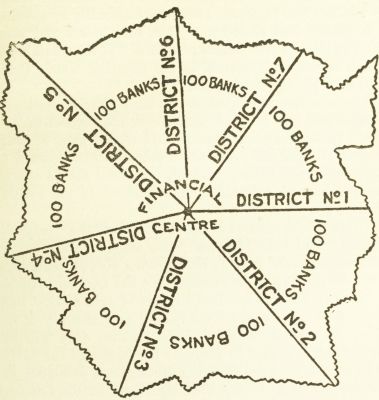
Diagram Illustrating District System of Bank Organization to Give Stability in Commercial Zones.
The straight lines are drawn from some centre in a city arbitrarily, and purposely so, in order to eliminate all political machinations and gerrymandering in forming the districts for any reason that may arise from time to time. They are so drawn as to divide the whole number of banks in the entire commercial zone into seven equal districts. That is, if there should be seven hundred banks in the commercial zone there would be one hundred banks in each district.
The one hundred banks in each district organize in precisely the same way, and as follows:
First: Upon coming together the one hundred banks of District No. 1 proceed to organize formally by electing a president and secretary. Then they select and elect their portion of the "bankers' council" of the whole zone, which corresponds exactly to the Clearing House Committee of the financial centre.
The one hundred bankers of each district elect one banker and one business man from the respective districts, or seven bankers and seven business men, or fourteen in all, and the fourteen so selected then proceed to select and elect their president, who shall not be one of the fourteen so selected by the bankers of the several districts.
These fifteen men so selected constitute the "bankers' council," and bear identically the same relation to the whole commercial zone as the Clearing House Committee bears to the banks which constitute the Clearing House.
Second: The one hundred bankers of each district then proceed to select and elect a banker as a member of the board of control, or seven in all, whose duty will be, among other things, to examine the banks of the entire zone precisely as the Clearing House bank examiner examines the banks of the Clearing House of the financial centre; provided, however, that the district from which the bankers' council have selected their president shall accept such president as their member of the board of control.
Will any one say that with such supervision as this board of control will give to the banks of the commercial zone, each bank having been compelled to qualify in the outset—will any one say, I repeat, that such supervision will not absolutely prevent bank failures?
This is not only important to the depositors of the country but also to the general business of the country as well.
Thereupon all banks of the zone will transfer to the board of control a part of their required reserves; that is, 7 per cent of their deposits and 7 per cent of their note issues will be deposited with the board of control. Later this should be increased to 10 per cent.
Let us assume that this 7 per cent of their deposits and 7 per cent of the notes issued amount to $100,000,000, which will be the central or economic reserve of the commercial zone and be under the control and management of the board of control.
You will recall that the bankers' council, which bears the same relation to the commercial zone that the Clearing House Committee bears to the financial centre of the zone, was composed of seven business men and seven bankers, who selected their own president. These fifteen men will select a representative from their respective zones. So that we shall have a board of directors representing the thirty or forty commercial zones directly and not indirectly. Each zone will be represented alternately by a business man and a banker, so that the board at Washington would always consist of fifteen or more business men and fifteen or more bankers; the business interests and banking interests equally, the inside and outside of the bank counter; the depositors and the banks or the trustees of the depositors.
The next logical and necessary step is a national central gold reserve if we hope to prevent our gold leaving us at the will of foreigners, and also if we hope to serve the whole nation, just as the Clearing House is serving its members today, and as the commercial zone will be able to serve all of its members, when it has been once organized. Therefore, as a sequel to the organization of the commercial zones, say thirty or forty of them in the United States, they in turn will all unite their gold in one great central gold reserve, which will amount to approximately $1,250,000,000 (one billion two hundred and fifty million dollars). We should then have the "American Reserve Bank." The amount of gold held by this institution would be twice that held by any other in the world, and would be under the control of a board of directors which I have just hastily described; I have used and suggest the name "American Reserve Bank," because we are known the world over as "The Americans," and, therefore, I think it peculiarly fit to use the name "American Reserve Bank."
This institution, with the specific powers granted to the individual banks as outlined, will be able not only to protect each individual bank, but to protect the reserves of all the banks; that is, the reserves of the United States against the drafts of the world, precisely as the Bank of England protects her gold, or adds to it by a rate of discount; that is, by fixing a price for the use of gold.
Mr. Manufacturer: By the way, before I forget it, I want to make one suggestion right here, because it seems to me as though this was the right place to bring it in, and that is this: I am firmly convinced that a bank like yours, and all commercial banks, should be allowed to write their acceptance across the face of notes or drafts, and so develop what is called a discount market in the United States, such as they have in other countries.
Mr. Banker: Mr. Manufacturer, I am glad that you have spoken of that matter, and here is just the place to discuss it. A great many people are deluding themselves about the matter of acceptances. It must be remembered that the banks are not going to increase their own capital by increasing their liabilities through acceptances. Indeed, this practice would only add fuel to a conflagration of their credits, unless the banks should confine themselves to accepting only such paper as had grown out of actual transactions in which the goods had been sold and delivered, or were actually in transit. Moreover, by way of assurance, every piece of such paper so accepted by a bank should state upon its face that the goods for which it was given had been sold and delivered, or were in transit.
Such acceptances are absolute agreements to pay a specific sum of money upon a specific day, and therefore are just as much a liability as a deposit subject to check, with this disadvantage, that the property is not within the control of the bank, as the deposits are, against which a check is drawn, and therefore every bank should carry precisely the same reserve against its acceptances that it carries against its deposits.
Acceptances of the approved sort will not necessarily, if at all, greatly increase production; but they will create a new form of investment, that is, a guaranteed commercial paper of which billions of the single name sort are being sold today. Of course, two-name paper with the acceptance of a bank of high standing will soon bring into being here, just as it has in London and other financial centres of Europe, new capital. That is, capital will be attracted to the business of buying and selling such high-class paper. It will be a profitable investment for the idle funds of merchants and manufacturers at those seasons of the year when all of their capital is not occupied in their business, and also for the banks of the country at those times of the year when the local demands are not equal to their supply of funds. It is undoubtedly true that such paper would also soon find a market abroad, as well as at home, and to that extent would facilitate American manufacture and commerce. But we must not deceive ourselves about the fact that the banks will just to that extent increase their liabilities while they have not increased their actual capital to the extent of a single cent.
Mr. Manufacturer: I must confess that I have misapprehended the effect of an acceptance, but you are certainly right with regard to it, and unless we should keep the business of the country in a sound condition, the acceptance business might prove a two-edged sword, and this emphasizes the fact that we must keep a close watch upon what our commercial fund is all the time, and prevent it from being transferred and absorbed in fixed investments, which is always a bane to the commerce of a country.
We must not forget these three important factors which are always present here in the United States: first, the vast, undeveloped resources of our country, and the ever-inviting opportunities; second, the intelligence, the ambition, the impulsiveness and the optimism of our people; third, the peculiar, local relations of our twenty-five thousand, individual, independent banks, which are always in close sympathy with and affected by the growth and development of their locality and the varied interests, and the enthusiasm of the people. The vision of our local banker is largely confined to his immediate vicinity.
Mr. Farmer: How absolutely true that is, and therefore how great must be our caution in opening up the flood gates of credit, before we know that we have guarded the situation at every point. I notice that those banks before the war were all so sound and successful because they had to get the coin to make redemption with. Here is something I read in a book yesterday, and it strikes me that it is right in point now: "Redemption is the breath of life to all credit." You bet I have found it's death to a fellow who's got to, and can't pay.
Mr. Banker: Yes, and when you realize that credit is the very soul of trade and commerce, as it is carried on today, how absolutely essential it becomes that credit be kept within the limits of certain coin redemption, if we are to have sound business conditions.
Mr. Merchant: Well, Mr. Banker, how do you propose to keep credit within safe boundaries, and so insure sound business conditions all the time?
Mr. Banker: In just two ways:
First: By having the reserves of gold on hand in the various banks, sufficient at all times to prove all commercial credits, say from 5 to 20 per cent, according to the peculiar business and varying responsibility of the banks to their banking obligations; and in addition, such a central gold reserve as will to all intents and purposes be unlimited, so far as any possible demands may be made upon it—say 10 per cent ultimately of all individual deposits and 5 per cent of savings deposits. This would give us at the present time about one billion dollars ($1,000,000,000) of cash reserve, and about one billion two hundred and fifty million dollars ($1,250,000,000) of gold in a central reserve to meet the emergencies of commerce.
Second: Such a supervision of the banks by the banks themselves as will keep their assets in liquid form, at least to the extent that their assets are commercial assets and are liable for individual deposits on demand.
In this connection I want to call your attention to the fact that not a single bank has yet failed which has been under the supervision of a clearing house. You will remember that this principle was adopted in Chicago in 1906, and that today the banks in at least twenty of our leading cities are under clearing house supervision.
Gentlemen, I have been a banker, as you know, for about forty years. I have never been favorably impressed with any of the methods yet proposed for the guarantee of bank deposits, however desirable the end sought is, because they have none of them involved the matter of such supervision as would insure sound banking, and compel every bank to carry its part of the commercial burden in the way of equal and adequate reserves. But I am absolutely convinced that there never need be a bank failure again in this country, if we will only organize ourselves throughout the length and breadth of the land, precisely as the Clearing Houses have to protect themselves against the unsound practices that are always creeping into the banking business particularly.
Mr. Laboringman: Well, Mr. Banker, if that is true, if a bank cannot fail under the supervision of your proposed organization it will not cost anything to insure your depositors. Why not relieve the millions of depositors from the anxiety they always feel about their money in the banks? For my part, I cannot see the slightest difference between a workman's compensation act, an employer's liability act and a bank insurance act. To me they are on all fours with each other. The business in each case should bear the burden. This is the settled social policy of the country, and is in perfect harmony with that social and economic philosophy that has been gaining ground so rapidly throughout the world in recent years. I cannot see how you can escape it. I appeal to you men; am I not right about this matter?
Mr. Manufacturer: That point has never occurred to me in this connection, but I must say I cannot see any difference whatever between my carrying an insurance policy to protect my workmen and Mr. Banker carrying insurance to protect his depositors. Can you, Mr. Banker? Before you answer me, I want you to do two things: I want you to forget for the moment that you are a banker and I want you to think twice before you speak.
I have been so deeply impressed with the points that Mr. Laboringman has just made, that to me his arguments are unanswerable.
Mr. Banker: I am ready to answer right now and ready to admit that his arguments are unanswerable.
Mr. Farmer: I am glad that you all practically agree upon this very important, all important, point. I want to tell you something that happened during the past week. I tackled Mr. Lawyer about a week ago upon this point and he declared that the guarantee of bank deposits was an absurdity and unthinkable because it would cost too much.
I went home and wrote to the Treasury department to give me the average annual deposits in the National banks since 1863 down to date and also the average annual loss due to bank failures. I have a letter from the Comptroller of the Currency, gentlemen, which shows this astounding fact, that an annual tax of 35/1000 of one per cent upon the average deposits would have paid all the losses due to the failure of National banks. Think of it! Only a little over 3/100 of one per cent.
Mr. Laboringman: 3/100 of one per cent. Jehoshophat! Think of the misfortune and suffering that might have been saved by the payment of that mere pittance. It is an infinitesimal nothing. Think of it: It is only 3½ cents on every $100; only one-third of one cent on $10, and one-third of one mill on $1. You would not believe it. But, as I told you, I am good at figures and you can bet your life that I am right.
Mr. Farmer: I want to read the letter of the Comptroller to you men.
Treasury Department, Washington, January 25, 1913. Mr. Joshua Farmer, Loraine, New York.
Dear Sir: Your letter of January 22d is received and in compliance with your request I take pleasure in furnishing you the following information with respect to aggregate deposits of active National banks and the liability of insolvent National banks:
The annual deposits for forty-nine years in active National banks average $2,555,700,000. The losses sustained by creditors of failed National banks (actual for closed receivership and estimated for those not closed) will approximate $44,100,000, or an annual average loss of $900,000. The average annual loss is, therefore, 0.0352 per cent of the annual average deposits in active banks.
Of the 525 National banks placed in the charge of receivers, the affairs of 478 have been finally closed and the losses to creditors definitely determined.
The liabilities of 478 insolvent National banks the affairs of which have been finally closed amounted to $219,357,100
Creditors received in dividends, offsets, etc. 181,215,826
——————
Loss to creditors $38,141,274
Creditors, therefore, received an average of 82.50 per cent, the loss averaging 17.41 per cent.
There are now (September 30, 1912) 47 insolvent banks in process of liquidation by receivers, with liabilities of $34,314,633