Front matter (continued 2)
Reading edition
You are also, of course, familiar with Gresham's law, so-called, under the operation of which, the poorer money always drives out the better. I assert without any fear whatever of successful contradiction, that if you had paid off these United States Notes in 1879, you would not only have saved $340,000,000 by so doing, but that today there would be in the United States in our banks, and in circulation among the people, $346,000,000 more gold than we now have. In other words, instead of our gold amounting to $1,850,000,000, it would now amount to $2,196,000,000.
Uncle Sam: Well, you have certainly demonstrated that I have made some very expensive mistakes. Let's see just what the net result of this blundering has been. I have lost $340,000,000 on account of the greenbacks and I have lost the great advantage of having $346,000,000 more gold to further strengthen the commercial credit of the country; and yet, I still owe every cent of these due bills and what seems to me equally certain is this: that if I should get into a great war, these very greenbacks will make me more trouble by injuring my credit in the future to a much greater extent than they ever have done at any time in the past. There is no doubt whatever about that. By the eternal, something must be done to get me out of this apparently bottomless pit.
But you have not told us yet why these I.O.U.'s of mine, or United States Notes, are not fit for currency, as you declare. You know that you sort of hurt my feelings, and for half a minute I was fighting mad, but as I said I am from forty-seven states, besides Missouri, and therefore I am ready to be shown.
Mr. Banker: I am coming to their use as currency right now. There are three distinct reasons why the United States Notes are a bad form of currency.
First: Any Government issue of bills, or of I.O.U.'s such as these are, must be very limited, if they are kept as good as gold.
Second: The United States Notes do not spring into existence in connection with business transactions, as the right kind of a currency always does.
Third: It costs those who use it, as currency, five times as much as currency should.
It is precisely as Mr. Manufacturer over there asserted a moment ago. Any system of currency that is of necessity limited in amount, and fixed as these United States Notes must be from the very nature of the case, breeds panics, because everybody realizing that the amount is limited, begins to scramble for cash upon the first intimation that there is any business trouble brewing. For this reason, they are utterly unfit as a system of currency.
Again, a right currency system is the natural product of business, and the amount of the currency will always rise and fall with the demands of trade. This can never be the case with the United States Notes, and they are on that account utterly unfit for currency.
And finally, certainly, if they cost the users of currency five times as much as the right kind of currency would, then we should replace them at once with the right kind of currency. Now, let me illustrate and demonstrate this.
If, over at my bank, we are compelled to furnish an average of $10,000 in currency a week, our average expense for the year will undoubtedly be $10,000 invested for that purpose. And if money is worth 6 per cent interest, it will cost us $600 to supply that amount of currency. If we can buy United States Notes as cheap as any other kind of currency, and we should carry them in stock, they will cost us $600 per annum. Now, our bank, being a country bank, we carry 15 per cent of all our deposits to meet current demands. Is it not a perfectly simple and self-evident fact that if instead of being compelled to buy this $10,000 of United States Notes every week, and so keep $10,000 invested all the year around at a cost to us of $600, the interest on $10,000, we could convert $10,000 of our deposit debts into $10,000 note debts of the bank it would only cost us 6 per cent on $1,500, the amount we are carrying as reserve against our deposits of $10,000, or only $90. In other words, we would save $510 on the transaction. Of course, if we have to pay out $510 more in the one way than in the other, we will have to get it back from Mr. Merchant here, Mr. Manufacturer, Mr. Lawyer, Mr. Farmer and Mr. Laboringman; and if we should collect it from Mr. Merchant and Mr. Lawyer, they will in turn take it out of Mr. Farmer and Mr. Laboringman.
Mr. Farmer: You bet they will. We always get the gaff in the end.
Mr. Laboringman: Where do I come in? I don't come in anywhere except to carry the load, as usual. I come out at the little end of the horn, as always heretofore.
Uncle Sam: Well, fellows, you see, don't you, that everything gets back, sooner or later, to the producer? He carries the load.
Mr. Merchant: But we carry the worry.
Mr. Banker: I wish you did. You would have an easy time then, but—
Mr. Laboringman: You needn't say "but" to me. You have it on all of us. There is no doubt about that. However, Mr. Banker, I'm not going back on you, for you have helped me out of several tight pinches.
Uncle Sam: Well, it does really look to me as if I had been living in a fool's paradise. Those dear old greenbacks they have been about as much of a fraud as the dollar of our daddies. I do declare this whole thing makes me half sick. But if you are actually finding out what really ails me, I'll get over that pretty soon, and, boys, if we stick to this job, and play fair and honest, we'll have the best banking system in the world yet, and don't you forget it.
But you forgot to tell me about the safest and best banking system in the world because every bank note was secured by one of my Government bonds. That's what they've been telling me, you know. Now, what about that?
Mr. Banker: Well, I could not interfere with your confession that you had been living in a fool's paradise, and dreaming dreams about making something out of nothing, while your credit was in peril, and you were losing hundreds of millions and furnishing the country a currency that was costing the people five or six times as much as the right kind of currency would.
Now, a word about your bond-secured bank note illusion, and I will be through. Uncle Sam, you remember that during the war, you were looking around in every direction to find some new method for obtaining means to carry on the war. You had busted your credit wide open with your United States Note issue, and the question was how to find some new resource. Your Secretary of the Treasury, Mr. Chase, concocted this scheme of giving the banks the right of issuing notes if they purchased Government bonds, and deposited them to secure the payment of the notes. It is very strange, but he did not get much from this source, as there were only $98,896,488 of notes out when the war closed. However, the scheme was started, and has been going ever since, precisely as it was inaugurated, a bond investment scheme. The amount of notes in circulation has never borne any direct relation to the demands of trade, as you can see by the following facts: In 1880 the notes outstanding amounted to $352,000,000, and in 1891, eleven years afterwards, they amounted to only $162,000,000, or about $100,000,000 less, although the country was growing and business expanding all the while. We ought always to expand our currency during the fall months about $300,000,000, and we ought to contract it during the succeeding months, or during the springtime just as much. But a careful investigation shows that these bond-secured notes have decreased as often in the fall months as they have increased, and have increased in the spring months as often as they have decreased. This proves conclusively that the amount of notes outstanding has never borne any relation whatever to the requirements of trade. The scheme is today precisely what it was when first concocted, purely a bond investment affair.
Uncle Sam: Well, well, now that is mighty strange, but my greatest Chief Justice, John Marshall, pointed out the necessity of having a currency directly related to the business of the country, when upholding the constitutionality of the Act incorporating the second United States Bank. He said: "The currency which it circulates by means of its trade with individuals is believed to make it a more fit instrument of government than it could otherwise be." One of my presidents, James A. Garfield, used this language: "No currency can meet the wants of this country that is not founded on business." Boys, both of these great men must have referred to credit currency, and declared that it was essential to our business.
Mr. Banker: Furthermore, Uncle Sam, these bond-secured Bank Notes are indirectly just that much more of a burden resting upon the United States Treasury, upon you, if you want to know the truth, as I explained to you last Wednesday night.
The fact is, these bond-secured Bank Notes are only another form of Government credit put into circulation through the disguise of Government bonds.
Every single criticism and objection that I have made tonight to the United States Notes are applicable equally to these bond-secured Bank Notes.
First: For all banking purposes, economically speaking, they are practically rigid and inflexible, at least so far as current needs go.
Second: These bond-secured notes do not spring into existence, or into being, as checks and drafts do in connection with some business transaction, but are tied up with a bond speculation.
Third: They cost those who use them as currency from five to six times as much as the right kind of currency would.
Fourth: If we adopt the right kind of a currency system, it will set free $750,000,000 of capital which is now tied up in these Government bonds, and this vast sum which would be realized from the sale of the bonds will assist to an amazing degree in supplying much needed capital to the commerce of the country.
Mr. Merchant: How is that?
Mr. Banker: The banks could then sell all the bonds now deposited to secure these bond-secured Bank Notes. They amount to $750,000,000.
That these bond-secured Bank Notes are a monument of our stupendous folly, and have been a curse to the business interests of the country, I am sure no one here will attempt to deny.
Mr. Lawyer: The Japanese, thinking that we were a smart people, copied this bond-secured bank scheme from us, but immediately discovered that it was worse than worthless and repudiated it. No one else has been foolish enough to adopt it.
Mr. Banker: I challenge anyone here to urge a single reason in favor of either the United States Notes, or the bond-secured Bank Notes, which are only another form of United States Notes. No one can meet the objections raised to them. In fact, there are two objections to the bond-secured notes, in addition to those urged against the United States Notes. First, as stated, they have tied up $750,000,000 in the bonds. Second, they have proved such a successful delusion as to prevent any sane legislation until sad experience has driven us to take the matter up seriously and compelled us to act.
Uncle Sam: Well, boys, so far as I am concerned, I am thoroughly convinced that you don't want any of my I.O.U.'s for currency. Nor do we want any bond-secured Bank Notes, which are really only another form of my I.O.U.'s. But I am still from Missouri, as I have not yet been convinced what we ought to do by way of a substitute. Mr. Banker has told us something about credit currency, and he declares that it is the only real thing in the way of currency.
Now, I suggest that we take that matter up next Wednesday night, and decide definitely whether we want to adopt that principle, and substitute that system, or some other. What do you all say to that?
Mr. Merchant: I think that should be the programme. In the meantime, let us all dig into the question and go to the very bottom of it, and if possible stump Mr. Banker.
Mr. Banker: All right, gentlemen, I am ready for you, and if I don't convince you that the only thing for us to do is to adopt a credit currency system, I will retire in favor of anybody you name. Possibly you'll select Nelson W. Aldrich.
Uncle Sam: No, you won't do anything of the kind. We'll look around a long time before we'll take him on. It is my candid opinion that he don't know a thing on earth about the question. I have known Nelse about thirty years. He came to my house after he had been engaged in the grocery jobbing business, and he has been a jobber ever since. A man who could stay in Congress for thirty years, declaring that we had the best banking system in the world, would not recognize an economic principle, on a cloudless day, walking down the middle of Pennsylvania avenue at noon time. Now, as I said, Nelse has always been a jobber, and he would detect a crooked political deal crawling down a gutter, lizard-like, in the densest fog at midnight. He was prominent in a way in my home town, but it was only as a broker in senatorial favors. He kept books with the rest of his associates, his fellow senators. He was the clearing house of the United States Senate. That's all. He would be the very last man in the United States, the very last to join in clear, intelligent, unselfish, patriotic thinking. He just couldn't do it. Why, boys, he had rather go down a ram's horn than a gun barrel. He likes the twisting sensation. We don't want him at any price. Mark my word. What we want is honesty, intelligence, patriotism, unselfish devotion to duty and some good hard work.
Let us hope that we shall find a way out.
Good Night.
FOURTH NIGHT
BANK CREDIT CURRENCY
Uncle Sam: When we parted last Wednesday night, we had an understanding that everybody would give all the time he could to looking up Credit Currency. Now, I think before we take up that subject, it might be well to recall and review what we've settled among ourselves up to the present time.
First: We learned that gold is our standard of value.
Second: We all agreed that our money consisted of our gold coin alone.
Third: We agreed that our money, which consists of gold coin, is identical in amount with our gold currency; that they are one and the same thing.
Fourth: We found that we had at present a large amount of other currency, consisting of subsidiary coins (including the silver dollar), the United States Notes and our bond-secured Bank Notes.
Fifth: We came to the conclusion, however, after our last talk, that neither the United States Notes nor the bond-secured Bank Notes were fit for currency; and, in our quest for the best substitute possible, Mr. Banker proposed a Credit Currency currently redeemed in gold coin as the form of currency best suited to our condition. Indeed he asserted that it was the only form of currency we should think of.
I have gone over the road we have traveled so far and called attention to all the mile posts so that we should become perfectly familiar with them; for unless there is a complete harmony between our conclusions reached from time to time, our talks will in the end lead us to no practical results.
At our last talk it was decided, you will remember, that both on account of the peril to my credit, and because the United States Notes and the bond-secured Bank Notes were unfit for currency, we should tonight consider Credit Currency as a substitute.
Mr. Merchant: Uncle Sam, I am more than gratified that you have called our attention tonight to just those things we have agreed upon, because unless we keep all these points constantly in mind, we will have trouble in the end in reconciling our views. On the other hand, it has began to dawn on me that possibly what we have always considered beyond our comprehension may after all prove a comparatively simple matter, because I have discovered, since our talks began, that truth here as in all other subjects is simple when we arrive at and comprehend it. Our great problem in this connection is to disentangle the great or fundamental truths and make each one stand out in bold relief. So far, I think we have succeeded to a remarkable degree.
Mr. Manufacturer: We must have done so, for we have not yet struck a single point upon which we have not unanimously agreed. Let us hope that we shall be as successful in the future. At present, I must say I am a little dubious about the results of tonight's discussion, for I have run up against a snag or two, which I half fear will stump Mr. Banker, when he tries to pull them. However, he has been pretty successful so far in holding his own, and he may surprise us tonight.
Mr. Banker: I have no desire, or hope, of surprising you, but I have perfect confidence in convincing all of you, that there is only one system of currency for us to adopt, or even think of adopting, and that is a pure Credit Currency.
Let us assume that two men, A and B, who are of equal and unquestioned standing in some country town, start in the banking business at the same time.
A begins by taking the deposits of his neighbors, and continues until he has received $100,000, and has loaned the same out to the people of the community. He now owes $100,000 subject to check, and he has $100,000 owing to him, as he has loaned out all his deposits.
B starts a banking business, but upon an entirely different plan, or basis. He takes no deposits in the ordinary way, but if anyone comes to him desiring to borrow, or sell him promissory notes, he will lend his credit, and take all good notes and checks offered him, and in exchange give his own notes in such denominations and form as are suitable for circulation as currency, until he has exchanged $100,000 of his notes for $100,000 of the notes of the same people who have borrowed the $100,000 from the other banker.
Now, this is not a strange thing for B to do, because the bankers of Scotland did this for one hundred and forty years before they took deposits subject to check.
Now, let us return to A and B. As a matter of course, some of these notes of B will be deposited in A's bank, and B will have taken in some of the checks on A's bank. At 10 o'clock each morning A and B meet; A presents B's notes for redemption and B presents checks upon A for redemption, and the one pays the other the difference. Sometimes the balance is due to A and sometimes it is due to B. At the end of six months or a year, it will be at a stand off. A has paid B as much as B has paid A.
Now, can anyone of you men here tell me what difference there is in the transactions of A and B, except this, that the notes of B amounting to $100,000 payable to bearer on demand are outstanding, while the deposits at A's bank amounting to $100,000 and payable to order are outstanding. Those notes of B's amounting to $100,000 are a bank Credit Currency. They are issued against, or upon B's credit. They pass from person to person, from hand to hand and are currently redeemed every day. While the deposits at A's bank amounting to $100,000 are against A's credit, and the checks against them are redeemed every day. It is perfectly evident that if the capital of A and B combined is ample to meet the business requirements of that town, the form of credit offered by them will also adapt itself to the peculiar needs of each citizen. In other words, on a limited scale, you have a perfect banking system in that country town; bank credit being given to each person in precisely the form he wants it.
Now, let us go a step further. Let A and B unite and incorporate the A-B Bank with a paid-up capital of $100,000, each man paying in $50,000 and the bank, so organized, taking over the liabilities.
The one bank could then furnish the people of that community their deposit, or order credit, and their current credit, or currency at exactly the same cost to the bank; for the amount of the reserve will determine the cost of the note credit as well as the book credit. The bank being a country bank will carry a 15 per cent reserve, or $15,000 cash, to protect the deposit of $100,000 subject to check, and also a 15 per cent reserve, or $15,000 cash, to protect the $100,000 of demand notes outstanding. The actual cost to the bank in each case is 6 per cent on the reserve of $15,000 or $900 per annum.
If this bank should be located in the cotton-growing section of the country, and from August until January, the people needed more currency than at any other time of the year to pay for picking and handling the crop, and the customers of the bank came in and drew their checks for $50,000 and asked the bank for currency for that amount, and the bank should, as it ought to be able to do, under such circumstances change its deposit debt of $50,000 to a note debt of $50,000, so that instead of owing $100,000 in deposits, it owed only $50,000 in deposits, and instead of owing only $100,000 in notes, it owed $150,000, would it make any difference whatever to the bank except the trouble of making a few book entries?
In the springtime, probably, the situation would be just the reverse. The notes having served the convenience of the cotton-planters would be returned to the bank by various people, and deposited to the credit of the depositors, so that now the deposits are $150,000, and the notes outstanding, or note debts, are only $50,000; the total debt of the bank being precisely the same all the time, $200,000. It has made no difference whatever to the bank, but the customers of the bank, and all the people of that community, have been perfectly accommodated at the smallest possible expense to them. Now, if that bank had been compelled to go to some financial centre and buy that $150,000 of currency in the form of United States Notes, bond-secured bank notes, or the notes of a central bank, it would have cost the bank at the rate of 6 per cent per annum on $150,000, or $9,000; whereas, it has only cost the bank 6 per cent on the reserves carried to protect the $150,000, at the rate of $15,000 for each $100,000, or six per cent on $22,500. The cost to the bank you will see would be only $1,550, as against $9,000, if compelled to buy the currency, or would result in an actual saving to the bank of $7,450, an item, gentlemen, well worth saving.
Mr. Merchant: Mr. Banker, as I understand your contention from the illustration you have just completed, it is this, that there is absolutely no difference whatever, either in principle or in practice, between a bank book credit and a bank note credit, except as a mere matter of bookkeeping. That it is wholly immaterial whether there are 1,000 men walking about the streets of a town, each having a $10 bank note of the local bank in their pockets, or a thousand men walking about with check books from which they can issue 1,000 checks for $10 each. It is wholly a question of having a banking system that will adjust itself every hour of the day, and every day in the year, to the requirements of trade in that town, at the least possible expense to the people.
Mr. Banker: You comprehend my contention perfectly.
Mr. Lawyer: I will agree that your plan is structurally perfect to accomplish this purpose; but, before I can concede that the plan is all that can be desired, and all that we must insist upon having, I must know that your plan contemplates the current redemption of these bank notes in gold coin. For, as we have already agreed, our currency must be as good as gold coin, and this can only be demonstrated by daily gold coin redemption.
Mr. Banker: These bank notes or this Credit Currency will always be interchangeable with the deposits of the bank of issue, and, like the checks against the bank, will be daily redeemed over the counter of the bank, and also at some clearing house centre. The life of the notes will probably not exceed on the average thirty days. I hold that it is the duty of the bank to supply its customers with exactly that form of credit, either current credit in the form of notes, or book credits subject to check, which their business demands, and that both forms of credit must be kept as good as gold by giving gold if gold is demanded.
Mr. Lawyer: With this point of current gold redemption covered and settled, I am willing to agree that theoretically you have completely convinced me. Now, what have you to offer in support of your theory by the way of any practical illustrations?
Mr. Banker: I am glad that you have demanded illustration and proof by way of banking experience; but, before taking up the historical evidence in support of my condition, I want to define a Credit Currency, so that you will have a concrete idea, if I may express myself that way, in your mind.
I define a Credit Currency as follows: a note issued by a bank against its credit, without depositing United States Bonds, or any other kind of security, to guarantee its payment, is bank Credit Currency.
In speaking of the marvelous prosperity of Scotland, MacLeod used this language in 1860 about the effect of Credit Currency in Scotland, where it has now been in use 217 years.
"All these marvelous results which have raised Scotland from the lowest state of barbarism up to her proud position in the space of 170 years are the children of pure credit."
The great achievement of the Scotch system of credit notes is exceedingly well stated by Mr. Charles A. Conant in these words:
1. It has provided Scotland with an elastic currency adapted to the condition of her industries and adequate in volume to their changing needs.
2. It has enabled the people to carry on numerous commercial and agricultural transactions for which they could not have found the necessary quantity of coin, and has economized the locking up of capital in the precious metal.
3. It has made the use of notes of small denomination familiar and popular, and has taught the people the distinction between bank notes as the representatives of credit, and the precious metals as the measures of value.
4. It has brought into active use the available savings and capital of the country.
5. It has afforded an opportunity for entering upon business to thousands of poor, but honest men, and enabled them to lay the foundation of a comfortable home, and in many cases of a fortune.
6. It has convinced the people so conclusively of the value and safety of the banking currency system that no serious panic has ever lasted beyond a few days, or has ever affected any of the banks, except those which were justly the subject of distrust.
Horace White, describing the Scotch system, says:
"Notes are issued in denominations of five dollars, or one pound, and upwards. They are exchanged daily at the Edinburgh Clearing House, and settlements are made between banks by drafts on London. The notes remain in circulation on the average eighteen days after issue, the whole circulation being redeemed twenty times each year. Noteholders have a prior lien on the assets."
That is, if a bank should fail, the noteholders are paid first, and before anyone else gets anything.
Mr. Merchant: What is that? Did you say that the noteholder had a first lien on the assets of the Scotch Bank: that is, that the noteholders are paid in full before anyone else gets anything?
Mr. Banker: Yes, sir, and for the very best reasons in the world.
Mr. Lawyer: Certainly, the noteholders should have a first lien upon the assets of the bank issuing them, because bank notes are a public convenience. Bank deposits, on the other hand, primarily are a private convenience. It is a matter of public importance that bank notes should flow through the channels of trade, pass from person to person and hand to hand unquestioned by any member of the public, and have ready as well as general acceptance. The man who selects his bank for the purpose of making deposits has time to investigate and decide deliberately which one he will choose. While a man in a transaction must accept the currency of the country offhand. At all events, it is a matter of the greatest public importance that he should do so without hesitation, and yet be protected, be absolutely safe in doing so.
Mr. Merchant: Come to think it over, I believe you are absolutely right. Our present bank notes are made a first lien upon the assets of the bank issuing them. We were talking about that the other day over at the bank, and while I had never thought of it before, the cashier of the bank explained the matter fully to me, and gave the same reason for making bank notes a first lien that Mr. Lawyer has. When I told him that I did not quite understand the thing as he did, he satisfied me completely by using his own bank as an illustration.
He said, you will remember that we were a State Bank until about a year ago, when we became a National Bank. Our capital of $100,000 is all invested in this bank building which we occupy. Our deposits were $500,000. We took $100,000 of our deposits and purchased $100,000 of Government Bonds, which we deposited with the United States Government, and received in return $100,000 bank notes which we have put out, or, as we say, put into circulation. Now, since we actually took $100,000 of our deposits to buy the bonds with, and then placed the bonds up as collateral, to guarantee the payment of $100,000 of notes, it is perfectly clear that the noteholders will get their money, in case of our failure whether anybody else gets anything or not.
I then asked him this question: Suppose, for the sake of the argument, that the $100,000 of the United States Government Bonds should not sell for $100,000? Say they sold for only $75,000, would the noteholders lose the other $25,000, and he replied as follows:
"No, if the bonds should sell for only $75,000, the remaining $25,000 due the noteholders would be taken out of our assets, before any depositor got a cent."
You see, therefore, gentlemen, that our National Bank Notes are a first lien upon the assets of the banks that issue them, and that they will always be paid in full, before the depositors get anything.
Mr. Manufacturer: I am very glad this point came up, and has been explained so completely and satisfactorily, because during the week when I was studying up this question of a credit currency, that matter came up, but I found no explanation or reasons given for making the notes a first lien. It seems to me to be a fundamental principle that they should be, and the reasons are the soundest for making them a first lien. The bank note is a tool or instrument of trade for the benefit of the public, and is of general importance, while the bank deposit is a tool or instrument for the benefit of the individuals composing that general public, and primarily of individual importance. The distinction between the two must be very clear to all of you as it is to me.
Mr. Laboringman: That is just as it should be. The working people should always have a currency as good as gold, something that will not turn to ashes during the night; that cannot deteriorate to the extent of a single cent; for we are all practically compelled to take whatever is in circulation, or comes along, in the way of currency. It should certainly be as good as gold. I don't care how you fix it, but I do insist upon that. I say that it is one of the very first duties of the Government to the people; for, of all the ways of doing the laboring masses out of their earnings, and cheating them, a depreciated currency is positively the worst. Make your currency redeemable in gold, and so safe that no toiler can lose by holding it any length of time.
Mr. Manufacturer: I am quite sure that we all agree that not only should the bank notes be currently redeemed in gold coin, but to make them doubly safe, safe beyond any peradventure, they ought also to be a first lien upon the assets of the bank issuing them.
During the week I read somewhere that the Scotch Banks had been in operation 217 years, and that they did not start the deposit and checking system until they had been in operation for 140 years. During all that time they simply exchanged their notes for the notes of the farmers, the shopkeepers, the manufacturers and anybody who was entitled to credit.
Mr. Banker: Now, if you will allow me, I will produce some further historical evidence.
The greatest financial genius that the United States has produced, and one of the greatest the world has produced, drew the charter of the first United States Bank upon which the second was modeled. Both of these banks were pure credit currency banks, and were founded upon the very soundest banking principles; but both of them were the victims of political strife and party feud. No man who has ever lived more clearly comprehended the principle of credit than did Alexander Hamilton.
The highest note issue of the first United States Bank was $5,900,000, and deposits were $5,000,000.
The highest note issue of the second United States Bank was $23,000,000, and the deposits were $2,600,000.
In 1800, under the inspiration of Napoleon Bonaparte, undoubtedly as great an economist as soldier, the Bank of France was organized, and is the most striking single example in all history of the bank credit currency principle. It has to all intents and purposes always had the right of unlimited note issue, as the limit is always fixed far beyond the requirements of trade. The amount of the notes outstanding are usually ten times as large as the deposits. The notes now exceed $1,000,000,000, while the deposits are only about $100,000,000. In a single week there has been a conversion of $75,000,000 of deposits into notes, and a reconversion of a corresponding amount of notes into deposits.
As a result of the destruction of the second United States Bank by a veto of President Jackson, there were established in various states of the Union banking institutions, largely modeled upon the work of Hamilton. These institutions showed remarkable strength and rendered most significant service to those sections of the country where located.
Probably the most noted of them all was the State Bank of Indiana, organized in 1834, which continued its almost matchless career until 1866. It was a pure credit currency bank, marvelously suited to serve the people of Indiana, under the conditions in which they lived. Its capital was $3,300,000; its maximum of note issue was $5,700,000, always currently redeemed in coin. In 1857, during the crisis when every bank in the State of Indiana, and all the banks in New York, except the Chemical, closed their doors, the State Bank of Indiana kept on redeeming its notes in coin. This Indiana State Bank had thirteen branches. The central office was at Indianapolis. Hugh McCullough, afterwards one of the wisest secretaries of the Treasury we have ever had, was President of the Fort Wayne Branch. He wrote this interesting paragraph:
"Fort Wayne was three good days' ride from Indianapolis, mostly through the woods. For fifteen years I made this journey on horseback, and alone, with thousands of dollars in my saddle bag, without the slightest fear of being robbed. I was well known upon the road, and it was well known that I had money with me, and a good deal of it; and yet, I rode unharmed through the woods, and stopped for the night at the taverns and cabins on the way in perfect safety."
Another most signal success of the same credit currency principle was the Bank Act of Louisiana, which was passed in 1842. It was a model, not only for those times, but for these as well. All the banks had to settle their balances every Saturday night in coin. In 1860 Louisiana, as a result of this law, held more specie than any other state in the Union except one. The very day that Gen. Butler took possession of New Orleans, the banks were redeeming their notes in coin.
I might, if it were profitable, describe in detail the Bank of the State of Ohio; the Banks of the State of Kentucky; the Banks of Virginia; the Bank of the State of Missouri; the Bank of the State of Iowa. Everyone of them were signal successes, and everyone of them models worthy of imitation, and all of them were established and operated successfully as credit currency banks.
But I want particularly to rivet your attention upon the Suffolk Bank System of New England, which was purely the product of experience, and I may say a perfect development of the law of evolution in banking.
Mr. Merchant: My recollection is that the Suffolk System covered all the six New England States, and that there were then over 500 banks in the system, with capital varying all the way from $25,000 to $700,000 each. Two other facts must be kept constantly in mind in this connection; they are these: 1st, the combined authorized note issue of these 500 banks was $131,000,000, absolutely unlimited to all intents and purposes; 2d, there was then no means of communication or transportation except the stage lines and horseback mail carriers. There were no telephones in those days, nor telegraph lines, nor even railroads.
Mr. Banker: I am more than pleased, Mr. Merchant, that you have brought out these points, before I proceeded to explain what actually happened in the course of the development of what I regard as the most marvelous exhibition the world has yet furnished us with, what in principle was practically a perfect banking system, and what was in practice as nearly perfect as any human institution could be under the circumstances.
Mr. Manufacturer: Well, Mr. Banker, that is unqualified, literally unmeasured praise. If we ever had so good a banking system actually in operation in this country, I don't see why we did not have sense enough to keep it. I hope you will be good enough to tell us why we lost it.
Mr. Banker: That is a very important and most pertinent question, and certainly most natural that you should ask it. I should have covered that point before, but it will do just as well now.
Uncle Sam, you will remember that when you passed the National Bank Act in order to get the advantage of all the bank note circulation and so increase the sale of United States Bonds, you put a tax of 10 per cent on all bank notes for the purpose of preventing any bank from issuing them, except National Banks. The result was that you killed the State Bank of Indiana and all the other banks to which I have referred, which were then issuing notes in the United States, including the 500 banks in the Suffolk System.
Mr. Manufacturer: I ought to say right here, before you go on, that the 10 per cent tax on Bank Note issues, while doing a world of harm, precisely as you say, did some good, too, because it prevented a lot of banks that were not properly organized, and were not compelled to redeem their notes in coin, from issuing a good deal of worthless paper, or comparatively worthless paper. It is usually known as "red dog," or "blue pup," or some other kind of dog paper.
There are two things that resulted from the National Bank Act that I think should not be overlooked, though the act may have proved an economic failure. It gave us a uniform currency throughout the country, and it was of equal value everywhere, passing without charge, and at no time worth less than the credit of the Government, or the current value of the United States Note.
Therefore, if we are wise enough to take advantage of these two important results, our experience will not be wholly in vain. That is, we want a uniform currency throughout the country, in all the different states, passing in at every bank window, at face value, without charge, and unquestioned by anybody, because currently redeemed in gold coin everywhere.
Mr. Banker: These interruptions have been splendid and I thank you for them. You fellows have undoubtedly been studying up on this question, as we used to say at school, "You've been cramming up."
Now, returning to the Suffolk System, I want to assert there is not a question that can be asked by anyone, nor a point that can be made by anyone in favor of a banking system, that the Suffolk System does not answer and illustrate and exemplify.
Let me outline the situation:
1. It covered six different states.
2. It covered a large territory.
3. The facilities for communication were bad. Some parts of New England were as far from Boston then as San Francisco is now.
4. There were 500 individual, independent banks.
5. There was no branch banking.
6. The permissive note issue to all intents and purposes was unlimited. The possible amount of issue was $131,000,000, but the maximum amount of notes out at any time did not reach 50 per cent of this total, while the average amount did not exceed 33 per cent of it.
7. The Bank Notes of the Suffolk System were universally accepted at par throughout New England.
8. They were redeemed every day at Boston, in coin by the Suffolk Bank.
9. They were accepted in all commercial centers of the West, Buffalo, Cincinnati, Chicago, Milwaukee and St. Louis at a premium of from 1 to 5 per cent, because redeemed at Boston in coin.
The Suffolk Bank was the clearing house for all the bank notes of New England, and they were accepted at par, and redeemed in coin if demanded.
Horace White says:
"It was the underlying principle of the Suffolk Bank system that any bank issuing circulation should keep itself at all times in a condition to be able to redeem it; that it should measure the amount by its ability so to do; and that the exercise at any time of the right to demand specie of a bank for its bills was something of which the issuing bank had no right to complain....
"Under the Suffolk System of Bank Note redemption specie was seldom asked for, but it was always paid when demanded; the metallic reserve was the touchstone of the whole business."
The following is Mr. White's description of the operation of the bank:
"In 1824 two clerks could do all the work. In 1855 seventy were required, and the redemptions reached $400,000,000 per year. As the circulation of the New England banks at that time was about $40,000,000, the whole amount was redeemed ten times each year, or about once in five weeks.
"Any person engaged in a legitimate trade in any part of New England could exchange his promissory note, running 60 or 90 days, for the notes of a bank with which he could pay the wages of his employees, or buy the materials for his industry in any part of the United States or Canada. The notes would remain in circulation about five weeks, and then find their way to the Suffolk Bank, where they were offset by the notes of other banks which took their rise in the same way. The man whose promissory note the bank had discounted, and by means of which it had put its own notes in circulation, had meanwhile sold his products. If he had sold them in Boston, his draft on the Boston merchant would pay his note at the local bank, and this would enable the latter to keep its balance good at the Suffolk. If he had sold them in New York or Chicago, he would get his pay in a draft on Boston, which would answer the same end. If he had sold them at home, and had received New England Bank Notes in exchange for them, the local bank could use these to keep its balance good at the Suffolk. New England trade was carried on by an endless chain of offsets and book balances at the Suffolk Bank. The security for the notes consisted of the bank's assets, and the banker's moral character and business sagacity. Both notes and deposits rested upon the same security that deposits rest upon now, and the volume of both was determined by the wants of trade."
The interplay of bank book credit and bank note credit under the Suffolk System in the panic of 1857 is nowhere equaled in the history of banking; and that demonstration of the perfect adaptability of bank credit to the most sensitive, and at the same time the most extreme situation that can possibly arise, leaves no question unanswered as to its fitness under all circumstances to meet the requirements of the people.
A year before the panic, the note issue stood at $50,000,000, and the deposits were $32,000,000. As a result of the panic, there was an exigent demand for currency, and the note issue rose from $50,000,000 to $56,000,000, and the deposits fell at the same time from $32,000,000 to $25,000,000, showing a conversion of about $6,000,000 of book credits into note credits, or of deposits into currency.
A year afterwards, when this exigent demand for currency had subsided, and the reaction had set in, the notes fell from $56,000,000 to $35,000,000, and the deposits increased from $35,000,000 to $46,000,000. In other words, $21,000,000 of notes were deposited and took the form of deposits, subject to check.
I do not need to state the fact, except for the purpose of calling your attention to it, that this currency did not cost the people of New England any more than deposits; for the two were constantly changing places with each other, strictly in accordance with the needs of trade.
Mr. Merchant: Mr. Banker, I think we are all under the very greatest obligation to you for this elaborate explanation. This splendid illustration, yes, absolute demonstration of the perfect adaptation of bank credit to our currency needs. I want to compliment you upon another thing, and that is, your position that it is the bank's business to make provision for coin redemption. What do we have our banks for except to furnish us credit in just the form we need it to carry on our business, and to keep that credit, in whatever form it takes, just as good as gold. That is the natural business of a bank. I never caught on to that fact before, and therefore could not appreciate it.
Mr. Manufacturer: Mr. Banker, I have been greatly interested. Now, if that plan worked so perfectly in New England, I cannot see for the life of me, why every other section of the country cannot work out the same system. If the New Englander could coin currency out of bank credit, based on codfish and cloth, why cannot the western man coin currency out of bank credit, based on cattle, cotton and corn?
The crux of the whole matter, the very heart of the thing, the vital part is, that the bank be ready to redeem its notes in gold. Why shouldn't it, that's the question?
Mr. Banker: Well, it should, that is the answer to your question, and the bankers around every natural financial center in the United States should get together, and form just what those 500 bankers had in New England before the war, a perfect banking system of their own.
Mr. Merchant: Mr. Manufacturer, that's sound and looks mighty good to me. Do you see any objection to it, any flaw in it?
Mr. Manufacturer: No, I do not, except to persuade the people, as Mr. Banker has persuaded and converted us. Of course we will be up against some legal difficulties, won't we, Mr. Lawyer?
Mr. Lawyer: I imagine that we shall have no serious difficulties about the legal questions involved, if we can persuade Congress. You see we are up against Congress and for about every thought the average Congressman has concerning a question of this kind, he has several about how he is going to get back into Congress at the next election; that's the real difficulty.
Uncle Sam: Well, we'll see about that when we get this worked out, and we'll put it up to them before election, and find out where they stand. They must study this question just as we have, and if they can't show us a better way, they will have to come over, or they won't get over, that is all there is about that.
Mr. Banker: Well, gentlemen, when it comes to putting up an argument to the Congressman, we will shove the Canadian currency system under his nose, and keep it there until he gives in.
Mr. Merchant: Are the Canadians using this credit currency system?
Mr. Banker: That's what they are. They started by copying the Massachusetts Bank Act, as it existed before the war, and have gone on making some changes from time to time since. The banks are authorized to issue regularly an amount of currency equal to their capital. The amount of capital has not been increased in proportion to their business, because there are only a few banks there now, 27 in all, with about 2,000 branches.
Here is a chart I had prepared to show you, because it illustrates so perfectly how the currency expands and contracts every Fall. You see that in the month of October every year they have an increase of about $3.80 per capita over the minimum amount, and that just as soon as the crops are disposed of, the currency again takes the form of a deposit.
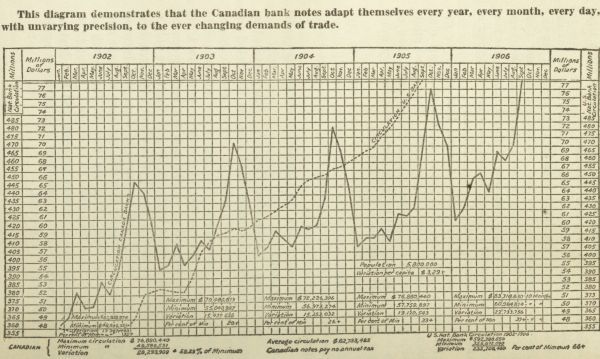
This diagram demonstrates that the Canadian bank notes adapt themselves every year, every month, every day, with unvarying precision, to the ever changing demands of trade.
Total circulation of the chartered banks of Canada for each month of 1912 to Nov. 30th.
January $88,065,521
February 88,920,598
March 95,918,404
April 95,145,371
May 93,819,333
June 102,011,848
July 95,827,534
August 101,501,270
September 104,334,287
October 110,696,877
November 115,473,098
Maximum issue 115,473,098
Minimum issue 88,065,521
—————
Amount of Expansion $27,407,577
Population of Canada 7,204,838
Per Capita Expansion $3.80
Same expansion in the United States would amount to $380,000,000
Under present conditions we do not have any note expansion whatever. Not one single dollar. Every "Fall" we have a tragedy, because we are compelled to use our reserve money to meet the increased demands for currency.
The above figures correspond in their expansion and contraction with the figures for many years previous, with one significant change in the date of maximum circulation, which has changed with the later farm demands due to the tremendous development in the great north-western territory. No stronger proof could be added to the marvelous way in which this bank credit currency automatically adjusts itself to any and every condition as it arises.
This currency goes to the Clearing House every day, precisely as the checks and drafts do, for redemption. And in those cities where there are no Clearing Houses, the banks present the notes they take in, to each other, and the notes are redeemed every day by the respective banks issuing them.
Mr. Merchant: Gentlemen, isn't it marvelous how that currency adapts itself to the demands of the Canadian crop moving period? Why, if we had such a system working here, you would have an increase of currency every Fall exactly equal to our demands, probably $300,000,000. I have heard the amount variously estimated from $200,000,000 to $300,000,000. At all events, this principle would give us exactly the amount needed to meet the demands of trade.
Mr. Banker: That is precisely what would happen, and there would be no shipping currency to and fro, backward and forward from New York to Chicago and St. Louis, and then from these cities to a thousand other points; and then when the crops had been moved the currency must be shipped from the thousand points to St. Louis and Chicago and then on again to New York. The banks in every locality would create their own currency according to their respective needs, and at a cost of about one-fifth of what it costs them today.
As the matter now stands, gentlemen, if I want $10,000 currency I bundle up $12,000 or $15,000 of my commercial paper, and take it to my correspondent, and get the currency by giving my bank's note, and leaving the $12,000 or $15,000 of paper as collateral. Now, if you should ask my correspondent upon what he had loaned me $10,000 he would say, "my bank's credit and the commercial paper I left with him." But, gentlemen, why could I not issue $10,000 of my bank notes against my bank credit, and keep the $12,000 or $15,000 of commercial paper? Certainly if my bank's credit and the commercial paper were good enough for my correspondent bank to let me have $10,000 upon, they ought to be good enough to issue my own notes upon. The present situation is simply absurd and most troublesome, as well as most expensive.
Mr. Manufacturer: I agree with you, it certainly is. I was talking the other day with a Congressman about the Canadian Currency system, and he said, "yes, it works fine up there, but they have a branch banking system up there, and only 27 banks." Well, I said, it works just as well in France with one bank. It has been working in Scotland just as well with 12 banks for 217 years. It worked in Indiana with one bank and 17 branches. It was just as efficient and successful in Louisiana under a General Bank Act, where several banks were incorporated. And it worked in New England under the Suffolk system with 500 individual independent banks—why won't it work here? All he could say was, "Well, I don't know."
Uncle Sam: Pinhead. Didn't know the difference between a principle and a fact, and he didn't even know the fact.
Now, boys, I am completely satisfied and if any one here is not, let him speak up, or forever hold his peace. I believe you must all be satisfied.
You must all be on time next Wednesday night so that we will not have to wait as we did tonight.
Good Night.
FIFTH NIGHT
WHAT IS EXCHANGE?
Uncle Sam: Now, boys, let us see just what we have settled during the four nights we have been talking this matter over.
The first night we learned that gold was the standard of value, the whole world around.
The second night we agreed that gold coin was the only money we had.
The third night we agreed that the only currency that we had and ought to have was gold coin, the foundation and redeemer of all other currency and our token or subsidiary coins. We came to the conclusion and unanimously agreed that neither the United States Notes nor bond-secured bank notes were fit for currency, because not related to business transactions in their origin, that they were unresponsive to the demands of trade, and were five times as expensive as the right kind of currency.
The fourth night we agreed that the only true or correct currency was a credit bank note, currently redeemed in gold coin.
In other words, we agreed that gold was our standard of value, gold coin our money, and that our currency should consist of gold coin, the subsidiary coins and bank credit currency.
Tonight we want to find out, if we can, what Exchange is. This is a mighty important question for probably 90 per cent or nine-tenths of all our business is transacted in some form of Exchange. Mr. Lawyer, I want to put it up to you first. What is Exchange?
Mr. Lawyer: Well, Uncle Sam, the best definition I can give, is to take one thing for or in the place of another. It is illustrated in a way by the old saw, "a fair exchange is no robbery." That describes the act of exchange, but I imagine that what you have in mind is the system or practice of exchange, as carried on today. That practice or system is only a multiplication of transactions where one man takes one thing in place of another. In this connection it means to take one credit in place of another credit; to take one debt in place of another debt. As now developed and applied to the commerce of the world, I would say that the science of exchange is to substitute one credit for another credit, or to make one debt pay another debt.
A debt is what is due from one person to another person. I have a deposit with Mr. Banker there, and I owe Mr. Farmer $20 for a load of potatoes; if I draw a check upon Mr. Banker for $20 in favor of Mr. Farmer, and hand it to him, I have paid my debt to Mr. Farmer with Mr. Banker's debt to me.
Mr. Merchant: Now, Mr. Lawyer, just hold on a minute until I find out a thing or two before we go any further. In fact, I am sure everyone here would like in the outset to find out the same things, except possibly Uncle Sam, who ought to know everything, and is probably omniscient, Mr. Banker, who deals in these things, and you, Mr. Lawyer, who are presumed to know about them, and must know them, as a matter of necessity in your practice. What I want to know is:
1. What is a promissory note?
2. What is a check?
3. What is a draft?
4. What is an acceptance?
5. What is a bill of exchange?
Until we know precisely what these various terms signify, or mean in banking, when put into use, we shall soon be so far out at sea that we will not know what we are saying, because we do not know the meaning of the words we are using. This will be true of some of us at least. We must familiarize ourselves with these words, or terms.
Mr. Banker: If you will allow me, I will try and explain and tell you what these various terms mean, and what use we make of these several instruments in writing.
First: A Promissory Note is a written promise to pay some one a sum of money. It may be either to pay it immediately, or on demand, or at some future day; to pay it either with or without interest; or to pay it at some particular place.
Mr. Merchant: It is just a written acknowledgment of a debt, isn't it?
Mr. Banker: It is a written acknowledgment of a debt, coupled with a promise to pay it. If A owes B $1,000, and gives his note for that amount, and B sells the note to C, the note has become exchange. It is not the usual form of what is called exchange, but is nevertheless just as truly exchange; for suppose that C owes A $1,000, he can then cancel the debt by delivering him the note for $1,000. C has paid his debt to A with A's debt to B.
Second: A check is a written order on a bank to pay money on demand. It may be drawn to cash, or it may be drawn to bearer, or it may be drawn to the order of some one. If A owes B $1,000 and A has a deposit at a bank for that amount, A can cancel his debt to B by giving him a check on the bank for $1,000. The check is exchange, though not in the usual form of what is known as exchange, for A has canceled his debt to B by giving B the bank's debt to him.
Third: A draft is a written order from one person to another to pay a third person a sum of money.
An acceptance is to write across the face of a draft, payable at a future time, the word "accepted," and the signature of the person accepting it.
If A is owing B $1,000 and C is owing A $1,000, the debt to B can be paid by A's draft upon C. The draft is identical in every respect with the check, the difference is in form only, and the use of them. A check is only used when the order to pay money is upon a bank. A draft may be, and often is used when the order to pay money is upon a bank. A check, properly or correctly speaking, is never used in an order to pay money upon an individual or corporation, but a draft is invariably used in such cases.
The transactions are identical in effect, though the conditions, or circumstances, are different. Both the check and the draft are exchange.
Fourth: When a draft has been accepted, it becomes the promissory note of the one accepting it, as he promises to pay it on the day named in the draft. An accepted draft is only another form of a promissory note, for if A owes B $1,000, and B draws upon A for that amount, and A accepts the draft, A is in precisely the same position as he would have been if he had sent B his promissory note for $1,000.
In the banking world a draft, after it has been accepted, is often called and known as an "Acceptance."
Fifth: A Bill of Exchange in its ordinary or usual sense, is an order of one person upon another to pay a third person a sum of money.
Mr. Manufacturer: That is precisely what you said a draft was.
Mr. Banker: Just wait a moment, please, until I finish, and you will note the difference. The Bill of Exchange is the medium of settling accounts or debts between parties residing at a distance from each other, without the intervention of money by exchanging checks or drafts.
Mr. Manufacturer: Then they are identically the same thing except a bill of exchange acquires its name from the fact that it settles debts at a distance.
Mr. Banker: That is the exact distinction, if one is to be made at all, and I think it will be well for us to make this distinction to save confusion in our conversation, although in the ordinary and usual language of the street, or the business world, the terms, or words, "draft," "acceptance" and "Bill of Exchange" are used indiscriminately the one for the other.
If the definition of Mr. Lawyer stands, and I think it is a very good one, when he said "the science of exchange is to make one debt pay another debt," the science of Bills of Exchange is to make one debt pay another debt at a distant point. This is not a distinction fully without a difference, because it helps us to classify the transactions and distinguish them in a way as we go along.
A simple illustration is this: A, who lives in Boston, owes B, who lives in San Francisco, $1,000, and C, who lives in San Francisco, owes D, who lives in Boston, $1,000. B and D could exchange drafts with each other; then B and D could collect each other's drafts. But B could sell his draft on A to C for $1,000 and C could pay his debt of $1,000 to D by forwarding him the draft on A. D would then collect the draft on A. It will be seen at once that this transaction has saved the expense of sending $1,000 in money from Boston to San Francisco, and also of sending $1,000 in money from San Francisco to Boston at great expense by express. This transaction between Boston and San Francisco is known and called a transaction in Domestic Exchange.
If A, who lives in New York, owes B, who lives in London, $1,000, and if C, who lives in London, owes D, who lives in New York, $1,000, B, the resident of London, can draw on A in New York, and sell the draft to C, who resides in London, and C could pay his debt to D, who resides in New York, by forwarding B's draft to D, who resides in New York. D could then collect the draft from A. It is perfectly clear that by means of this transaction, the expense of sending $1,000 in gold from New York to London, and also the expense of sending $1,000 in gold from London to New York, has been saved.
This draft would be Foreign Exchange, because the cities are in two different countries.
Mr. Merchant: According to your illustration, Mr. Banker, if our sales of cotton, grain and meat to Great Britain should amount to $1,000,000,000 a year, and the sales of Great Britain to us of woolens, silks, cotton and cloth and other manufacturies should amount to $1,000,000,000, we would not have to transmit a single dollar of gold either way, because the debts would just cancel each other. If the debtors in the United States could find out who the debtors in Great Britain were, then they could exchange debts with each other. The debts of the two countries would just offset each other.
Mr. Banker: That is absolutely true, and it is entirely possible that the $2,000,000,000 worth of goods in the two countries could be bought and sold without moving a single dollar's worth of gold either way across the Atlantic.
Mr. Manufacturer: Well, that is just what we want to do and save the expense and trouble of transmitting the money, and it is up to you, Mr. Banker, to explain just how we are to accomplish this trick or feat, because it will save a tremendous expense, if this can be done.
Mr. Banker: Yes, and will bring other advantages to the business interests of the country of almost incalculable importance, as we shall soon see. Now, the question is how to gain these ends. Two things must be accomplished in this connection, if we are to profit by every advantage that can possibly be taken in our trade with each other, as well as in our trade with other countries.
First: The Bills of Exchange must be of such a high character as to invite those, who need them to pay debts with, to take them unhesitatingly.
Second: The Bills of Exchange must become known to those who may want to use them to pay debts with, instead of shipping the actual money.
Mr. Merchant: Of course, you gentlemen are aware that our debts abroad are being settled in just this way today to a very large extent, and I do not think that you need worry very much about the Bills of Exchange not becoming known to those who need them to pay debts with, if they are made of such a high character as to command a market, for the market will at once develop and make itself felt. That is, I mean a general market for Bills of Exchange of unquestioned character. The only thing for us to do is to give our Bills of Exchange such a standing as to command ready and general acceptance in the commercial world. How can we do that?
Mr. Banker: That can be accomplished in a very simple, easy and natural way, if we will only adopt it. Let me illustrate what I mean.
Today, A, living in this country, sells a bill of goods, say for $50,000, to some one in Great Britain; the purchaser in Great Britain arranges with his bank to accept a 60 or 90 day bill drawn on it by the American shipper. Such drafts are drawn on well-known bankers, and when accepted become virtually a time-deposit at the bank, and therefore can always be disposed of at the lowest current rate of interest. This arrangement is a very great advantage to the English business man, as it enables him to use the high credit of the bank in carrying on his business.
At the present time our National Banks are not authorized to accept drafts made in this way, but if they were authorized to do so, the credit of our banks would be given to the drafts made by one business man upon another whether the drafts were domestic or foreign. Such an obligation is the most desirable one for a bank or an investor to hold, as a temporary investment for the following reasons:
First: The draft arises out of a transaction where goods passing from buyer to seller are equal in value to the face of the draft. The goods are actually in transit, and the draft is economically a title to the goods.
Second: The seller is invariably good, or at least thought to be.
Third: The buyer is invariably good, or thought to be.
Fourth: The bank accepting the draft is invariably good, or believed to be. But above and beyond that no bank will engage in such a transaction, without making itself absolutely safe in some way.
Mr. Merchant: Mr. Banker, if we should adopt that principle in this country, we would at once make every dollar's worth of goods in transit, or ready for shipment, a liquid asset, practically a cash asset, as we shall see, for the American merchant and manufacturer; because a large amount of capital would at once be attracted to this field for steady employment, or temporary investment.
Mr. Manufacturer: There is nothing so essential to relieve the constant strain upon individual credit and mobilize the really liquid wealth of the country, as the creation of the kind of paper you have just described. Think of it for a moment; there are the goods in transit, the shipper, the buyer and the banker back of the paper that will be coming due within the next sixty or ninety days. You can hardly imagine anything safer, and more quickly convertible into cash.
Money available for the purchase of such paper would come from many sources, among them the following:
First: Corporations would immediately be organized to deal in such paper.
Second: All strong business houses, merchants and manufacturers would prefer to hold such paper instead of stocks or bonds, for their surplus funds during their slack seasons.
Third: Bankers of all classes, both in the country and city, would find such paper preferable to any other form of investment for a secondary reserve, and for their surplus funds during slack periods in their respective sections.
Fourth: If acceptances are limited as they should be to goods in transit, or on the road to consumption, the adoption of this principle will mark, indeed will accentuate, the strong, the fundamental difference between liquid assets and the more fixed forms of investment, such as bonds and stocks. Banking capital employed in this way can far more readily adjust itself to the exigent demands of liquidation in the case of a panic, or a commercial crisis.
Fifth: Undoubtedly, to a very large degree, foreign capital would be attracted to our market for this kind of paper, because its strength and liquidity has already been proved to the bankers and capitalists on the other side of the Atlantic. And whenever capital was required, the rate of interest would be such as to be inviting. In other words, the rates of interest would rise, correspondingly with our needs, and the entire commercial world would be our possible market for the commercial paper representing the economic title to the five or six billions of finished goods that are always passing from the producer to the consumers in this country, and to the consumers abroad.
Mr. Banker: Undoubtedly, we should soon have right here a general market to take care of all this kind of paper; and it ought to become soon the strongest and broadest market in the world for this kind of an investment, considering our vast commercial resources. All of our Bills of Exchange would be drawn in dollars, not francs, marks or pounds sterling, and we would put upon them the stamp of the eagle, and not the lion and the unicorn.
Uncle Sam: I like that. It stirs my blood, warms the cockles of my American heart. That's business.
Mr. Manufacturer: I understand that for such Bills of Exchange, those accepted by banks, there has grown up in London, Paris, Berlin, Amsterdam and many other European centers, a large market, known as a discount market. Indeed, that this form of paper constitutes a very essential feature of the commercial transactions of all European financial centers.
Mr. Banker: That is true, and unless we follow them and adopt the same principle, and facilitate in the same way the protection, transportation and distribution of our commodities, needed for current consumption, we will continue to work under a very great handicap, as compared with our foreign competitors. Moreover, we will again find it difficult, if not impossible, to adjust ourselves to those periods of contraction which must come from time to time, without almost immeasurable losses, and the consequent stagnation in business that is sure to follow.
Mr. Merchant: I appreciate what Mr. Banker has just said. I am confident from my observation during the panics of 1893 and 1907 that our greatest injury came from the shock to business due to the fact that there seemed to be no real relief from the strain until there was an actual breakdown all along the line. Now it is evident that if a large amount of capital were employed in the economic titles, as it were, to our consumable commodities in the form of Bills of Exchange and the market for them extended to the financial centers of Europe, as seems probable, indeed certain, whenever the rate of interest was high enough, we should pass through any future strain, without the usual tragic results. Of course this added facility to the investment of our Bills of Exchange will not be a cure-all, but it will certainly correct an obvious and a very great defect in our present method of doing business.
Mr. Banker: Certainly it will not be a cure-all, because it is only an added facility in our credit system, and therefore must be provided for precisely as a corresponding amount of loans should be. You see, don't you, that an acceptance by a bank is practically the same thing as a loan to the buyer and seller of the goods jointly, or to one of them with the other as an endorser. The only difference is this: that if a loan is made the money would be placed at once to the credit of one of them, subject to his check, while the acceptance is an agreement to pay the amount on a future day. The bank must take precisely the same precaution in securing or protecting itself, and should carry identically the same reserve against acceptances that it does against its deposits subject to check.
Mr. Lawyer: That is true, for if the buyer and seller fail to make good, and meet the draft, the bank must pay it precisely as a bank must pay the checks of its depositors, even though the borrowers of those deposits do not pay their promissory notes when due. In reality and in fact the results are identically the same, therefore I agree with you, Mr. Banker, that a bank should carry the same reserve against its acceptance liability as against its deposit liability.
Mr. Manufacturer: Mr. Banker, have Bills of Exchange and bank acceptances been used very long, or are they something quite new and modern?
Mr. Banker: The Lord only knows how ancient they are. However, it is undoubtedly true that the use of them, especially acceptances, has grown enormously in recent years. For it is now a universal practice at all financial centers throughout Europe.
The bank liabilities of the whole world were only $16,000,000,000 in 1890, while today they are upwards of $50,000,000,000, possibly as much as $55,000,000,000. This almost appalling increase is due not only to the growth of international trade and the expansion of the credit system in foreign trade, but to domestic production as well. Of course an acceptance is the natural counterpart of a Bill of Exchange.
Bills of Exchange, or something accomplishing the same purpose, were in use among the Greeks. The history of the subject is buried in much obscurity.
It is stated upon high authority that among the bankers of the Roman world there existed a certain method or means of effecting payments abroad.
Mr. Lawyer: Here is what one author, Wilbur Aldrich, says:
"From the beginning of the Christian era the Jews became dispersed and, shut out from other trades and occupations, became usurers, or money-lenders at interest, a business which by the Canon law was forbidden to Christians. The Jews were united by such strong ties that their business assumed almost a corporate aspect. They bought, sold and transferred for collection part of the many debts constantly owed to them, and became practically an international exchange community. Their practice gradually evolved the Bill of Exchange.
"Rivals of the Jews, and more given to money changing, Lombard and other Italians naturally also became exchangers. Many large Italian houses included whole families, and had branches in many cities widely separated. The financiers from each city in Italy and from associated leagues of such cities, frequently united for exchange purposes. Italian finance thus grew into a great system of international exchange. Among the great fairs of the Middle Ages, under the influence of the Italians, some became connected chiefly with the business of exchange; Piazenca, the most noted of the fairs of exchange, was practically a clearing house for foreign exchanges.
"The Bill of Exchange was already in frequent use in the middle of the thirteenth century, but at this time its form was that of a document certified before a notary. At the end of the fourteenth century, it had approached the form now in use. It should be added that the Bill of Exchange was drawn only by the money changers and the bankers that had branches or agents.
"The business of bill broking grew up in England towards the end of the fourteenth century. The issuance of Bills of Exchange, based upon genuine business sales of goods, was recognized as a legitimate source of gain by the Canonists; or the ecclesiastic lawyers."
Mr. Banker: You see, Mr. Manufacturer, from what Mr. Lawyer has just read, Bills of Exchange, in practically the same form that we now have them, have been in use about 500 years. However, we are not now so much interested in a post mortem of the Bill of Exchange as we are in its place in our commerce. What we are most interested in is, just what part the Bill of Exchange is playing in the trade and commerce of today. What we want to get clearly fixed in our minds is what it is, and what it does, as distinguished from other instruments of trade.
First: For the purpose of a definite idea of just what exchange is, let us remember that exchange includes every written promise or order to pay money that is used to substitute one credit for another credit, or to make one debt pay another debt.
Second: That Bills of Exchange (sometimes called drafts, or acceptances, indiscriminately) are promises or orders to pay money which are used to substitute one credit for another credit, or to make one debt pay another debt, at some distant city. If the cities are in the same country, the Bills of Exchange are called Domestic Exchange. If the cities are in different countries, the Bills of Exchange are called Foreign Exchange.
Third: Let us agree, gentlemen, that so far as we are concerned we should not, and shall not, consider the acceptance of any draft by a bank as legitimate, unless the draft has grown out of an actual sale and shipment of goods. In other words, what I want to impress upon you is that if the draft is the economic title to goods, which are moving from the producer to the consumer, the liability of a bank upon an acceptance is reduced to a minimum. Acceptances of drafts growing out of sales and shipments of goods will never be a source of dangerous expansion, because they will liquidate, or pay themselves out, as the goods will be wanted to eat, to wear, to use, or to go into other manufactures, almost immediately.
Fourth: I want to nail one fact down right here so that no one of you will ever overlook it, or forget it; and that fact is this: An acceptance is just as much a bank liability as a deposit subject to check, for if the seller and buyer, or the drawer and the drawee, don't pay the debt on the day named, the bank will have to pay it, just as much as it will have to pay the checks against its deposits, although the people who borrowed the deposits have not paid their notes. It is clear, therefore, that the same reserve should be carried to protect acceptances as deposits.
Mr. Lawyer: I am convinced of that, and I think we cannot insist upon this conclusion too strongly for two reasons. First, the credit facilities for trading, or carrying on business, are increasing at a tremendous rate, and this particular form of credit is probably increasing at a greater pace just now than any other. Second, there is no form of credit more indirect, subtle and liable to mislead than this; therefore, it will require double diligence to keep it as good as gold. We must remember that since gold is our standard of value, gold alone is the touchstone of all credit, acceptances as well as deposits and bank notes.
Mr. Banker: There is no question whatever about that. If we want an absolutely sound and impregnable financial and banking system, we must meet checks and acceptances with gold just as well as bank notes, for they are all identical and the same thing—only in different forms—bank credit. Gentlemen, if you place our banks in a position where they can pay gold no one will ever ask for gold, except for some special purpose like that of export.
Mr. Merchant: Is it not a fact that credit transactions in business are increasing every year?
Mr. Manufacturer: Mr. Merchant, I presume you mean, relatively. That is, that the proportion of business transactions in credit as distinguished from cash is greater now than formerly.
Mr. Merchant: That is precisely what I mean, of course. I am aware that there is on the average a great increase of business every year.
Mr. Banker: In some localities credit transactions are increasing, but in others they are practically at a standstill. For example, I suppose if you should take some country town in a cotton-growing district, the amount of cash used from August to January might be 75 per cent of all the transactions; for the planter pays the pickers and all the laborers cash, and they in turn pay the storekeeper; during other periods of the year, when accounts are running, the cash used is much smaller. The average amount of cash used gradually falls as the people come to use banks more and more, the bank checks taking the place of currency. Generally speaking, however, the average country community does about 60 per cent of its business with currency, while the medium sized cities, or towns, do possibly as much as 60 per cent of the business with checks. In the largest cities as much as 90 per cent of the business is done with checks, while the clearing houses settle their differences or balances with about 5 per cent of actual money, where money is used. Sometimes the differences or balances at the clearing houses are settled by checks or drafts on a financial center.
While we have no definite figures that justify a positive statement, it is generally estimated that about 90 per cent of all the business of the country is done with some form of credit instrument, checks, drafts, or bills of exchange.
Mr. Merchant: Then all forms of exchange, promissory notes, checks, drafts and bills of exchange are really mediums of exchange in precisely the same sense that gold coin and currency are mediums of exchange.
Mr. Banker: Certainly they are all just as efficient as mediums of exchange, as gold coin and other forms of currency, although not as facile for small trade. But, in large transactions they are far more expeditious, more convenient, cost much less, and involve less risk. These are the reasons they are used instead of cash to so large an extent.
Uncle Sam: Boys, from the attention that you have given this subject it is evident that you are mightily interested, for you have had to work a good deal harder to understand what you were talking about than usual. But we have arrived, we have really gotten somewhere, difficult as Exchange is generally thought to be.
Now, in order to fix in your minds just what progress we have made during these five talks, I want to review what we have accomplished, or agreed to.
The first night we found out that our standard of value was gold. The second night we decided that our money was gold coin and that nothing else would do. The third night we found out that our currency was gold coin, token money, United States Notes and bond-secured notes; we also found out that the United States Notes and bond-secured bank notes were not fit for currency. The fourth night we determined that the only currency in addition to our gold coins and token coins worth considering for our purpose was a credit bank note, or bank credit currency. Tonight we have found out what Exchange is and that nine-tenths of our business is done in some form of it; but that we must keep it as good as gold by holding adequate reserves to protect this form of credit as well as any other.
Now, I call that going some.
Mr. Manufacturer: Uncle Sam, last Wednesday evening, during our discussion, Mr. Banker frequently used the word "reserve" in connection with our currency, and insisted that the reserves should be such as to protect the currency, and tonight he has again used the word "reserve" in the same way in connection with exchange. While I know in a general way what he means, I am not at all sure that I comprehend fully what a reserve is in its true and broader sense.
Mr. Farmer: Nor do I, and to confess the truth I am a little dazed on that very point, and I want to suggest that we spend the next night finding out what a bank reserve is. If all that Mr. Banker has been saying is true the reserve is certainly the hub of this wheel, and I want to tell you now that unless the hubs of your wheels are all right, you won't have much of a wagon when you get through.
Mr. Banker: That's right. Your reserves are the very heart of the whole question, the hub of the wheel.
Uncle Sam: Well, then, we'll have reserves up next Wednesday, and let us hope that our reserves will never get down, at least to a dangerous point.
Good Night.
SIXTH NIGHT
VALUE, PRICE, WEALTH, PROPERTY, CREDIT
Uncle Sam: Well, boys, what about reserves?
Mr. Lawyer: Uncle Sam, soon after we departed the other night, I began to think over the subject of reserves; but soon found myself considering several other points, which, it seemed to me, we should take up before reserves. Therefore, without consulting you, I telephoned Mr. Merchant, Mr. Banker, Mr. Manufacturer, and I saw Mr. Laboringman and talked the matter over with him. We all agreed that there were several other points that we should discuss tonight instead of reserves. I knew that Mr. Farmer lived on a Rural Free Delivery route, and that I could reach him by noon the next day or Thursday morning; so here we are ready to talk about something else. And we came to this conclusion without even consulting you, for which possibly we ought all of us now to beg your pardon.
Uncle Sam: Well, there you go again. Really, I feel as though I were in about the same position that one of my wisest Presidents, Abraham Lincoln, said he was in, with regard to his influence over his Cabinet. You will remember he once said, "I don't believe I have any influence with the present administration, anyway." Of course, we all know that was one of Honest Abe's sly drives, because he knew deep down in his soul that in the end he was always the master of ceremonies. However, what is it that you want to talk about? Of course, you understand, that under the circumstances, having made the arrangement to talk about reserve, "I am completely upsot."
Mr. Farmer: Well, I'm the fellow that suggested that we talk about reserves tonight; but I am sure that the change made was most advisable. To use an ugly illustration, possibly ugly to this august assembly, we now have our horses representing the standard of value hitched up to our wagon which represents our currency and exchange, the things that carry the value, wealth, property, and all commodities that go by price, the trades having been made on credit, but calling for capital. I think with Mr. Lawyer that we had better find out just what these various words or terms mean before going any further. Otherwise we will certainly be using words whose meaning we do not know, or, at least, do not properly appreciate.
Mr. Merchant: Now just what did you say; value, wealth, property, capital and credit? That all sounds very well, but I suggest that you include one more word that has always been a source of annoyance to me when I want to buy anything, and most unsatisfactory when I want to sell anything, and that is "price."
Mr. Farmer: Oh, I had that in all right, but I will admit, in a sort of backhanded way.
Mr. Banker: All right, then, let us include price in the list; then the programme for tonight is, value, price, wealth, property, capital and credit.
Mr. Laboringman: Just what do you mean by the value of anything? That is, what is value anyway?
Mr. Manufacturer: I have been studying over that very thing, and I believe I can give you a definition that will wash. The value of anything is measured by the use to which it is put, and is expressed in anything for which it is exchanged.
Mr. Farmer: I have been mulling over this question of value a little myself, and I think that Mr. Manufacturer has that about right. I worked it out this way: I have an old horse down on the farm that I traded for, giving Hiram Johnson, my neighbor, a mule. That mule was a mighty handy animal. I could do anything with him on the farm, but he was a little too handy with his hind legs occasionally, so I traded him off to let him practice on my neighbor Johnson. Now the value of that mule was that horse that I got in exchange for it; and the value of that horse was the mule. So, too, if I traded a hog for a sheep the value of the hog is the sheep, and the value of the sheep is the hog.
Mr. Merchant: Hold on just a minute before you go any further, as I want to know whether anyone here can tell me what intrinsic value is. We heard so much about that during the campaign of 1896; and I want to know whether there is anything in it or not. I ran up against the same expression in one of the books that I thumbed away back in 1896. And today you sometimes hear men say that gold has intrinsic value. Now, according to your definition, if no one could use gold, or rather did not use it and you could not exchange it for anything else, it would not have value.
Mr. Banker: Precisely so. Nothing is more absolutely true than that. Gold, like everything else, gets its value from the demand for it, which comes from its use and its consequent exchangeability.
Mr. Lawyer: That is undoubtedly true, all the value that gold has arises from its use and exchangeability, and its exchangeability arises from its universal use.
It may be said, possibly, that the value of anything is measured by the use to which it can be put; but I believe that it is all covered by the latter part of the definition given by Mr. Manufacturer: The value of anything is any other thing for which it can be exchanged. Anything has value when it is exchangeable; when it is not exchangeable it has no value. What is really more in keeping with our common everyday language, is the definition of the Roman Law, "The value of anything is what it can be sold for."