George Manville Fenn (continued 3)
Reading edition
“Why, Gwen, lass!” cried I, “you ain’t never afeard of Hugh Anwyl?”
She was afeard, though; and she’d good cause, too.
“How’s Rhoda?” asks I. I ought to hae mentioned my father, but my mind ran, like a ship in a whirlpool, to one centre.
“Oh,” says Gwen, turning away her head, “she’s still ill!”
“What d’ye mean?” I sings out, clutching her arm tight.
“Don’t!” says she. “You sailors are so rough, indeed.”
“You speak the truth, then!” cries I; for I guessed from her look and the queer colour in her darned figurehead, that something was tarnation wrong with my Rhoda.
She looks at me as steady as a gunner taking aim.
“Hugh,” she says, “you’ll have to hear what will hurt you sooner or later. Rhoda is married to David!”
I didn’t speak. Neither did a tear escape my eye. But I sat down on a stone by the roadside, and I felt as if I’d been struck by a flash of lightning.
Gwen went on talking; and at last, when she saw what was up, she ran and fetched my father, and the old lubber hoisted me somehow indoors, and shoved me into a hammock. I rather think I was what ye may call mad.
How long my mind remained so affected I can’t rightly judge. My first recollection is of seeing a pale face sitting by my side, and I heard a sound which brought me to.
It was Rhoda. Although she’d been forced into a marriage with that lubber David, she’d not forgotten me; and she’d come to tell me all. Yes, indeed. And what’s more, she’d come none to soon; for if Hugh Anwyl was somewhere in the latitude of lunacy, Rhoda was in the longitude of decline. She was dying! Yes, indeed!
She told me how they had hatched up a lie about my having made love to Gwen. To prove this, David had plotted to make me walk that evil night with his false sister to the Clwm Rock. Rhoda had at first refused to believe their story. But when she saw us—for she lay concealed behind the rock—pass by as if we were lovers, with Gwen’s darned face resting on my bosom, she was cheated into thinking me false. Still she would have heard me, and learned the truth before I left Glanwern, but her old father interfered; and when I was gone, and Gwen had never delivered my letter, she consented to wed David—just, as you may say, for the sake of peace—believing the yarn they invented, that I had run away to sea and would never come back. It was not, indeed, until she received my letter from Aberdeen that she learned how wickedly she had been deceived. From that moment she fell ill, and nothing would please her but to return to Miller Howell’s house. As for David, indeed, she would not look at him, or speak to him; and she did but sit still and wait for death, hoping, as she told me, that Hugh Anwyl might return before the end came.
My lads, her sweet voice somehow steadied my brain. I saw the whole spider’s web unfolded. Gwen and David had plotted to sink our craft, and there we lay waterlogged.
“Shall I smash the pair of them?” I said.
“For my sake, no, indeed,” she answered. “Let us forget them. It is too late, Hugh Anwyl.”
Mates, I rose from that hammock that very instant, a strong, hale seaman once more. My life was wrecked, in so far as happiness goes. But the strength remained to me. Not so, poor little Rhoda. Her cheek was hollow, and the bright eyes shone like the evening stars in the southern seas. So weak was she, that I had to support her back to Miller Howell’s house.
“Come in, Hugh Anwyl,” says the old, greedy father, looking as if he could drop down dead from shame and sorrow on the doorstep. “Come in. This is stormy weather.”
I couldn’t speak to the man. I would not reproach him with having been the cause of this wreck—for his features, indeed, displayed the punishment he had received. But I came in, and I sat down by Rhoda’s side on the sofa.
In a minute or two, the door opens, and a figure intrudes itself.
Rhoda put her hands in front of her face, as if she was shamed beyond all bearing, indeed. I started to my legs, for I could have killed the man.
It was David Thomas!
Yes, mates, David Thomas, come to see his lawful wife, Rhoda Thomas, who was married to him six months ago.
Rhoda put her finger on my arm, and I sat down like a lamb. It was impossible to avenge her wrong.
“Be off out of this house, which you have brought ruin into!” says Miller Howell, speaking to his son-in-law.
The lubber sheered off.
My mates, I can tell no more. We sat as we was, on that there sofa, till sunset; and then—and then, poor Rhoda died in my arms!
Yes, mates, she dropped off to sleep; and, for all her miserable end, she died happy indeed!
As for Hugh Anwyl, he went back to sea. But after every voyage he returns to Glanwern churchyard, and he puts a bunch of flowers on a grassy mound—for that is his only home.
“Yes, that’s all very pretty,” cried the doctor, who had listened attentively; “but in the name of Owen, Darwin, and Huxley; Hudson, Franklin, Bellot, and Scoresby, how did you—Confound it! was ever anything so provoking?”
“He ain’t left so much as a tooth behind,” said Binny Scudds, looking down at the ice.
“But he had not discovered the Pole, my man. Here, search round; we may find one who has been there; but I hope not. I believe, my lads, that there is no Pole. That hollow there leads right into the centre of the earth; or, through it, to the South Pole.”
“Easily prove that ere, sir,” said Binny Scudds.
“How, my man—how?” exclaimed the doctor, eagerly. “You unlettered men sometimes strike upon rich veins.”
“You go and stand by the mouth of the hole at the South Pole, while we roll a big piece of ice down here. You could see, then, if it comed through.”
“Yes, we might try that, certainly,” said the doctor, thoughtfully. “But then I ought to be at the South Pole, and I’m here, you see. We might roll that block down, though, and see the effect. Here, altogether, my lads—heave!”
We all went up to a block about seven foot square; but it was too big and heavy, and we could not make it budge an inch.
“Hold hard a minute,” I said, and I scraped a hole beneath it, and poured in a lot of powder.
“That’s good,” said the doctor. “That’s scientific,” and he stood rubbing his hands while I made a slow match; connected it; lit it; and then we all stood back, till, with a loud bang, the charge exploded, lifting the block of ice up five or six feet, and then, in place of splitting it in two as I meant, it came down whole, and literally fell into powder.
“I say, don’t do that!” said a thick voice, and there, to our utter astonishment, sat among the broken ice, a heavy-looking, Dutch-built sailor, staring round, and yawning. “I’d have got up, if you had called me,” he continued, “without all that row.”
“How did you get there?” said the doctor.
“There? Where?” said the Dutchman.
“In that block of ice,” said the doctor.
“Stuff about your block of ice,” said the Dutchman. “I lay down to sleep last night on the snow, while our lads were trying for seal, off Greenland. But I’ll tell you all about it. Haven’t seen them, I suppose?”
“No,” said Bostock, winking at us, “we haven’t.”
“They’ll be here directly, I dare say, when they miss me,” said the Dutchman.
“I say, matey,” said Binny Scudds, “we’ve ’bout lost our reckoning. What’s to-day?”
“To-day,” said the Dutchman; “to-day’s the twenty-fourth of July, eighteen hundred and forty-two.”
“Thank you, my man,” said the doctor. “But perhaps you’ll tell us whom you are.”
“Certainly,” said the Dutchman; “but keep a look-out for my mates,” and he began.
Chapter Six.
The Dutch Sailor’s Yarn.
As for my name, it is Daal, Van Daal; and if there be any of my kinsfolk going about saying that they have the right to put a “Van” before their name, and that they come of the Van Daals, who were a great family in the seventeenth century, and one of whom was boatswain of Admiral Van Tromp’s flag-ship, all I can answer is that they say the thing that is not; and that people who say such things deserve to be beaten by the beadle all up and down the United Provinces. When I was a little boy, and went to school to the Reverend Pastor Slagkop, there was a boy named Vries—Lucas Vries—who did nothing but eat gingerbread and tell lies. Well, what became of him? He was hanged before he was thirty—hanged at the yard-arm of a Dutch seventy-four at Batavia for piracy, mutiny, and murder: to which shameful end he had clearly been brought by eating gingerbread and telling fibs. Mind this, you little Dutch boys, and keep your tongues between your teeth and your stuyvers in your pockets, when you pass the cake shops, if you wish to escape the fate of Lucas Vries.
And yet I dare say that—ah! so many years ago—I was as fond of gingerbread as most yunkers of my age, and that I did not always tell the strict truth either to my parents at home, or to the Reverend Pastor Slagkop at school (he was a red-headed man who always hit you with his left hand, and he had but one eye, which glared viciously upon you while he beat you). But now that I am old, it is clear that I have a right to give good advice to the young: even to the warning them not to be guilty of the transgressions of which I may have been guilty ever so many years ago; because I have seen so much of the world, and have passed through so many dangers and trials, and have not been hanged. And this has always been my motto. When you are young, practise just as much or as little as you are able; but never forget to preach, whenever you can get anybody to listen to you. To yourself, you may do no good; but you may be, often, of considerable service to other people. A guide-post on the dyke of a canal is of some use, although it never goes to the place the way to which it points out.
That which is now the Kingdom of the Netherlands (Heaven preserve the King thereof, and the Crown Prince, and all their wives and families, and may they live long and prosper: such is the hope of Jan Daal, who drinks all their good healths in a tumbler of Schiedam) was in old times known (as you ought to be well aware, little boys) as the Republic, of the United Provinces; and there was no King—only a kind of ornamental figurehead, not very richly gilt, who was a Prince of the House of Orange, and was called the Stadtholder: the real governors and administrators of the Confederation being certain grand gentlemen called Their High Mightinesses. And very high and mighty airs did they give themselves; and very long robes, and very large periwigs, as flowing as a ship’s mainsail, did they wear, so I have heard my old father say many a time, ever so many years ago. Mynheer Van Bloomersdaal, in his “Pictures of the Glories of Holland”—how I hated that book when I had to learn a page of it, every day, by heart, and how I love it, now that nobody can compel me to remember even a line of it; but I do so for my own pleasure,—Mynheer Van Bloomersdaal, I say, has told us that the United Provinces are seven in number, and consist of Holland Proper, with Gueldres, Zealand, Friesland, Utrecht, Groningen, and Over-Yssel. By the deep, seven. Always be sure that you are right in your soundings; and take care to put fresh tallow in your lead, to make sure what bottom you are steering to.
I think that I must have been born some time toward the end of the last century, or the beginning of the present one, in the great city of Amsterdam, which, after all, has the greatest right to be called the capital of Holland; for The Hague, where the King lives and the Chambers meet, is, though a mighty fine place, only a big village, and a village is not a city any more than a treykschuyt is a three-decker, or a boatswain an admiral. At the same time, mind you, if I was put on my oath before a court-martial, I would not undertake to swear that I may not have been born at Rotterdam, at Dordrecht, at Leyden, at Delft, or even at The Hague itself; for, you see, my father was a peddler, and was continually wandering up and down the country (or rather the canals, for he mostly travelled by treykschuyt), selling all kinds of small matters to whomsoever would buy, that he might keep his wife and small children in bread, cheese, and salt herrings: which were pretty well all we had to live upon. But what does it matter where a fellow was born? The great thing is to be born at all, and to take care to keep your watch, and to turn cheerfully out of your bunk when the hands are turned up to reef topsails in a gale.
I know that, when I first began to remember anything, we were living in the city of Amsterdam, and in the very middle of the Jews’ quarter, which I shall always bear in mind as having five distinct and permanent smells—one of tobacco, one of Schiedam, one of red herrings, one of bilge-water, one of cheese, and one of Jews. At Cologne, on the Rhine, they say there are seventy smells, all as distinct from one another as the different ropes of a ship; but I have not travelled much on the Rhine, and know much more about Canton than of Cologne. Although we lived among the Jews, my father was no Israelite:—far from it. He was a good Protestant of the Calvinistic persuasion; and, in the way of business, sold many footwarmers (little boxes of wood and wire, to hold charcoal embers), for the churches. He chose to live among the Jews, because their quarter was a cheap one; and he could pick up the things he wanted more easily there than anywhere else; and, besides, Jews, for all the hard things that may be said about them, are not a bad sort of people to do business with. They are hard upon sailors, it is true, in the way of cheating them; yet they will always let a poor tar have a little money when he wants any; and they are always good for a bite of biscuit, a cut of salt junk, and a rummer of Schiedam. I wish I could say the same of all the Christians I could name, who are by no means bad hands at cheating you, and then turn you out of doors, hungry and thirsty, and without a shoe to your foot. I don’t say that a Jew won’t swindle you out of your shoes, and your stockings, too, in the way of business; but he will always give you credit for a new set of slops, and this I have often said to our pursers aboard. Note this: that pursers are the biggest thieves that ever deserved to be flogged, pickled, tarred, keel-hauled, and then hanged.
I had six brothers and sisters—so we might have called ourselves the Seven United Daals if we had had the wit to do so. There was Adrian, the eldest. He was a clever yunker, and was bound ’prentice to a clock-maker. He went to England, and I have sometimes heard made a great deal of money there; but he never sent us any of it—and what is the good of having a rich brother if he doesn’t let you share in his pay and prize-money? My messmates always shared in my rhino when I had any; and if your brother is not your messmate I should like to know who is. Another of my brothers, too, the second, Hendrik by name, did very well in life; for being very quick at figures and ready with his pen, old Mr Jacob Jacobson, the Israelitish money-changer, took a fancy to him and made him his clerk. He went away when he grew up, and for many long years I heard nothing about him; but it chanced once that, being at New York, to which port I had shipped from Macao, I had a draft for a hundred and fifty dollars to get cashed; and the draft was on a firm of bankers who had their shop down by the Bowling Green, by the name of Van Daal, Peanut, and McCute. The “Daal” struck me for a moment; but seeing the “Van” before it I concluded that the name could not belong to any of my folk, and took no more notice of it. I presented my bit of writing at the counter, and the paymaster’s clerk—a chap with a copper shovel in his flipper, as if he kept gold and silver by the shovelful in the hold—he gives me back the pay-note, and he says, “Sign your name here, my man.” So I sign my name “Jan Daal, mariner.” So he takes it into a little caboose behind the counter; and by-and-by out comes a short fat man with big whiskers, dressed as fine as a supercargo going out to dinner with his owner, and with a great watch-chain and seals, and his fingers all over diamond rings. “You have an odd name, my friend,” he says, looking at me very hard. “It is Jan Daal,” I says, “and it is that which was given to me at the church font.” He reddened a little at this, and goes on, “What church?” “Saint Niklas,” I reply, “in the good city of Amsterdam, so I have heard my mother (rest her soul) say.” “And I, too,” he begins again, reddening more than ever, “was christened at the Oude Sant Niklas Kerke; and I am of the Daals of Amsterdam, and I am your brother Hendrik.” On this he embraced me; and I went along with him to the caboose behind the shop; and he gave me crackers and cheese, and a dram of Schiedam, and a pipe of tobacco to smoke. We had a long talk about old times, and he told me how well he had got on in the world, and what great bankers he and his partners, Peanut and McCute (one a Scotchman, t’other a Yankee, and both a match for all the Jacobsons that ever cheated you out of ten stuyvers in the guilder) were; but when I told him that I had met with no very great luck in life, and that the hundred and fifty dollars I was going to draw was all the money I had in the world, he did not seem quite so fond of me as before. “And what do you call yourself Van Daal, brother of mine, for,” says I. “It’s not fair sailing. There are no more Vans in our family than in a brood of Mother Cary’s chickens.” At this he looks very high and mighty, and talks about different positions in society, and industry and integrity, and all the rest of it. “If that’s the course you mean to steer, brother,” says I, “I wish you the middle of the stream, and a clear course, and a very good morning; only take you good care that you don’t run foul of some bigger craft than yourself that’s really called Van, and will run you down and send you to the bottom with all hands.” I was always a crusty old fellow, I dare say; but I like neither ships nor skippers that give themselves names that don’t belong to them. If a ship’s name is the Mary Jane, let her sail as the Mary Jane, and not as the Highflier. If she changes her name, ten to one there’s something the matter with her. So I went back to the office, and says I to the clerk, “Now, old Nipcheese,”—I called him “Nipcheese,” for he looked like a kind of purser—“I want my hundred and fifty dollars—and that’s what’s the matter with me!” He paid me, looking as sour as lime-juice that has been kept too long, and deducting (the stingy old screw!) four and a half per cent, for “commission;” and I went away, and spent my money like a gentleman, mostly in the grog-shops down by Greenwich Street. You may be sure that when it was all gone I didn’t go for any more to my high and mighty brother, Mynheer Van Daal. No, no; I went down to the wharf, and shipped on board a brigantine bound for New Orleans. I heard afterward that my brother the banker, with his messmates, Peanut the Yankee and McCute the Scotchman, all went to Davy Jones’s locker—that is to say, they were bankrupt, and paid nobody. Now, I should like to know which of us was in the right? If I squandered my hundred and fifty dollars (less the four and a half per cent, for commission—and be hanged to that mouldy old Nipcheese, with his copper shovel!), it was, at least, my own cash, and I had worked hard for it; but here were my fine banker-brother and his partners, who go and spend a lot of money—more than I ever heard of—that belonged to other people!
I was the third son. There was a fourth, called Cornelius, but he died when he was a baby. Then came three girls—Betje, Lotje, and Barbet. Lotje was a steady girl, who married a ship chandler at Rotterdam. He died poor, however, and left her with a lot of children. I am very fond of the yunkers, and try to be as kind to them (although I am such a crusty old fellow) as I can. Betje was a pretty girl, but too flighty, and a great deal too fond of dancing at kermesses. She died before she was eighteen of a consumption which was brought on, I fancy, more by her going out in silk stockings and thin shoes to dance at a kermesse at the Loost Gardens of the Three Herrings at Scheveningen, than by anything else. For ours is a damp country, where there is more mud than solid earth, and more water than either; and you should take care to go as thickly shod as you can. But in winter time all is hard and firm; and with a good pair of skates to your heels, a good pipe of tobacco in your mouth (though I like a quid better), and a good flask of Schiedam in your pocket, there’s no fear of your catching cold. Unfortunately, my poor Lotje could not smoke, and liked sweetmeats better than schnapps; and so, with the aid of those confounded silk stockings and dancing-pumps, she must needs die, and be buried in the graveyard of the Oude Sant Niklas Kerke. It nearly broke my poor mother’s heart, and my father’s, too; although he was somewhat of a hard man, whose heart took a good deal of breaking. But now that I am an old, old man, I often think over my pipe (I smoke at night instead of chewing) and my grog, about pretty Lotje, with her fair hair curled up under a scalp of gilt plating, and her great blue eyes,—of her plump white arms, and her trim little feet, which she was all too fond, poor lass! of rigging up in silk stockings and pumps. But I should never have a word to say against kermesses, quotha! for I must, in time, have danced away some thousands of dollars to the sound of a fiddle, and with a buxom jungvrauw for my partner, in pretty nearly all the grog-shops at pretty nearly every port on the map. For it was always my motto that when a man’s heels feel light he should forthwith begin to foot it in a hornpipe; and when he feels thirsty, and has any rhino in his looker, he should pipe all hands for grog. This, the wiseacres will tell me, is the way to ruin one’s health, and die poor; but I am very old, and if I had any riches I couldn’t take them away with me to Fiddler’s Green, could I? Say!
My youngest sister, Barbet, was not pretty, but she was very kind, and good, and quiet, and although she had been brought up in the very strictest principles of Protestantism (that is to say, she used to get a sound whipping, as all of us did, if she went to sleep in church or forgot the text of the sermon), she took it into her head, when she grew up, to turn Romanist, and became a nun. She went away to a convent at Lille, in French Flanders (which, like Belgium, ought to belong to the Dutch), and we heard no more of her—only once, many years ago—when, for once in my life, I had made a little noise in the world by saving some poor fellow from drowning in a shipwreck, which led to the Minister of Marine sending me a gold medal and a purse full of guilders, and my name being published in the printed logs—I mean the newspapers—my poor sister Barbet (she had changed her name to Sister Veronica, I think, but that is all ship-shape in a nunnery) sent me a beautiful letter, saying that she always prayed for me, and enclosing me a pretty little image of Sant Niklas, worked in coloured wools, on a bit of canvas. I was glad to hear from my sister Barbet, and to hear that Oude Sant Niklas was a Catholic as well as a Protestant saint (as a good ship, you see, is as tight a craft under one flag as under another); and I wore the image, and wear it now, next my heart, as a charm against drowning, instead of the child’s caul which I bought when I was young in High Street, Wapping, England. It cost me ten pounds, but the dealer took it out half in “swop;” that is to say, I gave him two pounds in silver, two Spanish doubloons, a five-pound note, a green parrot, that swore quite beautifully, a coral necklace, and a lot of uncut jewels, I picked up in the Black Town at Calcutta, and that must have come to about the value of ten pounds, I reckon.
(It would seem that the dealer in High Street, Wapping, got slightly the better of honest Jan Daal in this transaction. But business is business. Ed.)
You may wonder, when I have told you of the humble way of business in which my father was, of the number of yunkers he had to keep, and all out of the slender profits of a peddler’s pack, and of the poor way we lived, that we went to church, or to school, at all. But my dad was a highly respectable man, who never drank more schnapps than was good for him, except when he had the ague, which was about once every spring and autumn, and once in the winter, with, perhaps, a touch of it in the middle of the summer; and my mother was a notable housewife, who scrubbed her three rooms and her seven children, her pots and pans, and her chairs and tables, all day, and, on Saturdays, nearly all night, long. It is fortunate for such things as pots and pans, and chairs and tables, that they haven’t any human feelings—at least, I never heard a table talk, although I have read in the newspapers of their spinning precious long yarns for fools and madmen to listen to (but what can you expect from newspapers but lies?)—or they would have squalled for certain, as we used to do under our mother’s never-ending scrubbing and scouring. When the soap got into our eyes, we used to halloa, and then she used to dry our tears with a rough towel—I mean a towel made of a bunch of twigs, tied together at one end with some string. My mother was the most excellent woman that ever lived; but she had a strange idea in her head that all children wanted physic, and that the very bast doctor’s stuff in the world was a birch rod, and plenty of it. Perhaps my physickings did me no harm; at least, they prepared me for the precious allowances of kicks, cuffs, and ropes-endings I got when I went to sea.
I went to sea, because, when I was about ten years old, my father thought that I had had enough schooling. I thought that I had had enough to last me for a lifetime; for the Reverend Pastor Slagkop had a monstrous heavy hand; but at least he had taught me to read and write, and to cast accounts—and that it was about time for me to set about earning my own livelihood, which my elder brothers were already doing. I was quite of his way of thinking, for I was a hard-working boy, and was tired of eating the bread of idleness; only my dad and I didn’t exactly agree as to the precise manner by which I should earn a living. He wanted me to wander with him, mostly by treykschuyt, or canal-boat, up and down the United Provinces, helping him to carry his pack, and trying to sell the clocks, watches, cutlery, spoons, hats, caps, laces, stockings, gloves, and garters, in which, and a hundred things besides, he traded. But I didn’t like the peddler business. I was never a good hand at making a bargain, and when I had to sell things, I was just as bad a salesman. I let the customers beat me down; and then my father, who was a just man, but dreadfully severe, beat me. Besides, to make a good peddler, you must tell no end of lies, and the telling of lies (although sailors are often said to spin yarns as tough as the chairs and tables pretend to do) was never in my line. Again, although I was of a roving disposition, and delighted in change, my native country had no charms for me. At the seaports, where there were big ships, I was as pleased as Punch; but, inland, the country seemed to me to be always the same—flat, marshy, and stupid, with the same canals, the same canal-boats, the same windmills, the same cows, the same farmhouses, the same church steeples, the same dykes, the same dams, and the same people smoking the same pipes, or sliding to market in winter time, when the canals were frozen, on the same skates. To make an end of it, a peddler’s life was to me only one degree above that of a beggar; for you had to be always asking somebody to buy your goods; and I have always hated to ask favours of people. I told my father so; but he would not hear of my turning to any trade, and there being no help for it, I had to help him at peddlering for a good two years, although I fancy that he lost more money than he gained by my lending him a hand. But, when I was twelve years of age, and feeling stouter and stronger—and I was taller for my age than most Dutch boys are—I told my father flatly that I had had enough of peddlering, and that if he did not let me try to find some other calling, I would run away. He told me, for an ungrateful young hound as I was, that I might run away to Old Nick if I chose—not the Sant Niklas of the Oude Kerke, but a very different kind of customer. “Thank you, father,” said I, beginning to tie up my few things in a bundle. “Stop,” says he. “Here’s five guilders for you. I don’t want you to starve for the first few days, while you are seeking for work, graceless young calf as you are!”—“Thank you, father, again,” I says, pocketing both the guilders and the compliment. “And stop again, my man,” he says; “and take this along with you, with my blessing, for your impudence!” With this, he seizes me by the collar, gets my head between his legs, and, with the big leathern strap he used to bind his pack with, he gives me the soundest thrashing I ever had in my life. That’s the way to harden boys! It was in the middle of January, and pretty sharp weather, when we had this explanation. It was at our home at Amsterdam; and my good mother sat crying bitterly in a corner, with my little sisters clinging to her, and squalling; but as I walked out of the house forever, I felt as hot all through me as though it had been the middle of July.
I walked from Amsterdam to Rotterdam steadily, bent upon going to sea. Of course, I had never as yet made a voyage, even in a fishing-boat; but I had been up and down all the canals in Holland ever since I was a child; and I fancied that the ocean was only a very large canal, and that a sea-going ship was only a very big treykschuyt. In a large port like Rotterdam I thought that there would be no difficulty in finding a craft, the skipper of which would give me a berth aboard; and, indeed, throughout a very long life I have usually found that it does not matter a stuyver how poor, ignorant, and friendless a boy may be, there is always room for him at sea, if he sets his mind steadily on finding a ship. Mind, I don’t say that he won’t be the better sailor for the book-learning he may have been lucky enough to pick up. I never despised book-learning, although no great scholar myself; but a boy should learn to use his hands as well as his eyes. He should have a trade, never mind what it is; but it must be a trade that he can earn pay, and lay a little prize-money by, now and then; and a scholar without a trade is but a poor fellow. He may turn parson, or schoolmaster, to be sure; but it would be a mighty queer ship, I reckon, aboard which the captain was a parson, and the bo’sun a schoolmaster, and the crew a pack of loblolly-boys, with their brains full of book-learning, and nothing else.
I wasn’t so very quick, though, as I thought, in my boyish foolishness, that I should be, in finding a ship at Rotterdam. Indeed, when I got down to the Boompjes, and boarded the craft lying at anchor there, I think I must have tried five-and-twenty before I could find a skipper who would as much as look at me, much less offer me a berth. “If you please, do you want a boy?” was my invariable question. Some of the skippers said that they had more boys than they knew what to do with; others, that boys were more trouble than they were worth, which worth did not amount to the salt they ate. Off the poop of one ship I was kicked by a skipper, who had had too much Schiedam for breakfast; from the gangway of another I was shoved ashore by a quartermaster, who didn’t like boys; one bo’sun’s mate gave me a starting with a rope’s-end, as he swore that I had come aboard to steal something; and another pulled my ears quite good-naturedly (although he made my ears very sore), and told me to go back to school, and mind my book, and that a sailor’s life was too rough for me. There was one captain—he was in the China trade—who said that he would take me as a ’prentice if my father would pay a hundred and fifty guilders for my indentures; and another, who offered to ship me as cook’s mate; but I knew nothing about cooking, and had to tell him so, with tears in my eyes. I was nearly reduced to despair, when one skipper—he was only the master of a galliot, trading between Rotterdam and Yarmouth, in England—seeing that I was a stout, bright-eyed lad, likely to be a strong haul on a rope, and a good hand at a winch or a windlass, told me that he would take me on first for one voyage, and see what wages I was worth when we came back again. He advanced me a guilder or two, to buy some sea-going things; so that, with the trifle my father had given me, when he dismissed me with his blessing and a thrashing, I did not go to sea absolutely penniless.
I have been at sea sixty years; yet well do I recollect the first day that I shipped on board the galliot Jungvrauw, at Rotterdam, bound for Great Yarmouth, England. When I got on board the vessel was just wearing out of port, and, thinking that about the best thing I could do was to begin to make myself useful at once, I tailed on to a rope that some of the crew were hauling in; and the next thing I began to learn was to coil a rope. There’s only two ways to do it—a right one and a wrong one. The right way is to coil it the way the sun goes round. And then I learned that about the surest manner in which a young sailor can get a knowledge of his trade is to watch how his shipmates set about doing their work. He may be laughed at, grumbled at, or sworn at, but at last he’ll learn his duty, and that’s something.
If I were to tell you all the wonderful things that have happened to me, man and boy, as carpenter, bo’sun, third mate, second mate, and first mate—I never had the luck to rise to be a skipper—I am afraid that you wouldn’t believe half the yarns I could spin for you. I’ve been in both the Indies, and in both the Americas, and in our own Dutch Colony of Java, and in China and Japan (where the Dutch used to have a mighty fine factory) over and over again. I’ve been in action; and was wounded once by a musket-ball, which passed right through the nape of my neck. I’ve been a prisoner of war, and I was once nearly taken by a Sallee rover. I’ve had to fight with the Dutch for the French, and with the French against the Dutch, and with the Dutch for the English. I’ve had the yellow fever over and over again. I’ve had my leg half bitten off by a shark; and if anybody tells you that a shark won’t eat niggers, tell him, with my compliments, that he doesn’t know what he’s talking about, for I saw a shark bite a nigger that had fallen overboard, right in two, in the harbour of Havana. I don’t say that the shark doesn’t like white flesh best. The black man, perhaps, he locks upon as mess beef, not very prime; but the white man he considers as pork or veal, and the nicer of the two. At all events he’ll eat nigger if he’s hungry, and a shark’s always hungry.
Perhaps the strangest thing that ever happened to me in the coarse of all my voyages was in connection with a lot of swallows, and I’ll wind up my yarn with this one, first because it’s short, and next because I think it’s got something that’s pretty about it, and will please the yunkers and the vrauws; and, old man-like, I always like to please them. It was about thirty years ago, and in the middle of September, that I signed articles at Liverpool as second mate of a brig bound to Marseilles, Barcelona, in Spain, Gibraltar (that belongs to the Englanders), Oran, and Algiers. The middle of September mind. The name of the brig was the Granite, and the skipper, Captain Marbles, a Yorkshireman, was about the hardest commander I ever sailed under. He never swore at the men,—that they wouldn’t have much minded; but he was always turning up the hands for punishment; and punishment in the merchant service, thirty years ago, was little less severe than it was in the navy. Indeed, it was often more unjust, and more cruel; for when a merchant skipper flogged a man he was generally drunk, or in a fearfully bad temper; whereas on board a man-o’-war a sailor was never punished in cold blood, and had at least some show of a trial. I must do Captain Marbles the credit to say that he was never half seas over; but on the other hand he was always in a bad temper. On me he dared not lay a finger, for I was an officer, and I would have knocked him down with a marlinspike had he struck me; but he led the foremast-men and the boys, of whom we had at least half a dozen aboard—principally, I fancy, because the Captain liked to torture boys—a terrible life. Well, we had discharged cargo at Marseilles, and taken in more at Barcelona. We had put in at Gibraltar, and after clearing out from the Rock were shaping our course with a pretty fair wind for Gran, when, one evening—now what in the world do you think happened?
The swallow, you know, is a bird that, like our stork, cannot abide the cold. He is glad enough to come and see us in summer, when the leaves are green, and the sun shines brightly; but so soon as ever the weather begins to grow chilly, off goes Mr Swallow to the Pyramids of Egypt, or the Desert of Sahara, or some nice, warm, comfortable place of that kind. He generally arrives in our latitudes about the second week in April; and he cuts his stick again for hot winter quarters toward the end of September. I’ve heard book-learned gentlemen say that the birds almost always fly in a line, directly north and south, influenced, no doubt, by the magnetic current which flows forever and ever in that direction. Well, on the afternoon to which my yarn relates, our course was due south, and, just before sunset, we saw a vast space of the sky astern absolutely darkened by the largest flight of birds I ever saw, winging their way together. As a rule, I’ve been told, the swallows don’t migrate in large flocks, but in small families. This, however, must have been an exception to the rule, for they appeared absolutely to number thousands; and what should they do when they neared us but settle down in their thousands on the masts and rigging of the brig Granite. They were tired, poor things, no doubt, with long flying; and I have been told that it is a common custom for them to rest themselves on the riggings of ships. But there were so many of them this time that the very deck was covered with them, and vast numbers more fluttered below, into the forecastle and the captain’s cabin. The skipper ordered the hatches to be battened down, and all was made snug for the night. In the morning the birds on the deck and the rigging were gone, but we had still hundreds of swallows in the hold and in the cabin, and the noise the poor creatures made to be let out was most pitiable—indeed, it was simply heartrending. It was like the cry of children. It sounded like, “For God’s sake, let us go free!” Captain Marbles—I have said so before—was a hard man, but he could not stand the agonised twittering of the wretched little birds; and as he ordered me to have the hatches opened, I noticed that there were two great tears coursing down his stern, weather-beaten cheeks. He had, for the first time in his life, perhaps, become acquainted with a certain blessed thing called PITY. Nor did we fail to notice afterward that he was not half so hard on the boys we had aboard. Perhaps he remembered the cry of the swallows.
That’s my yarn. There’s nothing very grand about it; but, at least, it’s true. As true, I mean, as old sailors’ yarns usually are.
“Gone!” cried the doctor, as the Dutchman, a minute before solid in appearance, suddenly collapsed into air and moisture, which directly became ice. “If I hadn’t been so polite I might have stopped him. I suppose the effort of telling their histories exhausts them.”
“Well, sir, it’s jolly interesting!” said Bostock.
“Yes, my man,” said the doctor; “but there’s no science in it. What is there in his talk about how he came here, or for me to report to the learned societies?”
“Can’t say, I’m sure, sir,” I said; “only, the discoveries.”
“Yes, that will do, Captain. But come, let’s find another?”
We all set to eagerly, for the men now thoroughly enjoyed the task. The stories we heard enlivened the tedium, and the men, far from being afraid now, went heartily into the search.
“Shouldn’t wonder if we found a nigger friz-up here, mates,” said Binny Scudds.
“Or a Chine-hee,” said one of the men.
“Well, all I can say,” exclaimed Bostock, “is this here, I don’t want to be made into a scientific speciment.”
“Here y’are!” shouted one of the men. “Here’s one on ’em!”
“Get out!” said Binny Scudds, who had run to the face of a perpendicular mass of ice, where the man stood with his pick. “That ain’t one!”
“Tell yer it is,” said the man. “That’s the ’airs of his ’ead sticking out;” and he pointed to what appeared to be dark threads in the white, opaque ice.
“Tell you, he wouldn’t be standing up,” said Binny Scudds.
“Why not, if he was frozen so, my men?” said the doctor. “Yes; that’s a specimen. This ice has been heaved up.”
“Shall we fetch him out with powder,” said Bostock.
“Dear me, no!” said the doctor. “Look! that ice is laminated. Try driving in wedges.”
Three of the men climbed onto the top, and began driving in wedges, when the ice split open evenly, leaving the figure of what appeared to be a swarthy-looking Frenchman, exposed as to the face; but he was held in tightly to the lower half of the icy case, by his long hair.
“Blest if he don’t look jest like a walnut with one shell off!” growled Scudds; but he was silent directly, for the Frenchman opened his eyes, stared at us, smiled, and opened his lips.
“Yes; thank you much, comrades. You have saved me. I did not thus expect, when we went drift, drift, drift north, in the little vessel, with the rats; but listen, you shall hear. I am a man of wonderful adventure. You take me for a ghost?”
Bostock nodded.
“Brave lads! brave lads!” said the Frenchman; “but it is not that I am. I have been taken for a ghost before, and prove to my good friends that I am not. I prove to you I am not; but a good, sound, safe, French matelot!—sailor, you call it.”
“I should like to hear you,” said Binny Scudds, in a hoarse growl.
“You shall, my friend, who has helped to save me.”
“Let it be scientific, my friend,” said the doctor.
“It shall, sir—it shall,” said the Frenchman.
Chapter Seven.
The French Sailor’s Yarn.
I am master of the yacht Zéphire; at least I was her master. A hundred fathoms of green water roll over her masts now. Fishes of monstrous shape feed on our good stores. For anything I know, a brood of young sea-serpents is at this moment in possession of my hammock. Let be, I will tell the story of the Zéphire. Ten years ago an American vessel lay off the little port of Bénévent, in the south of France. The time was high noon; the month, August. The day was bright. The sunbeams danced over the white spray and green waves. A boat put off for the shore. I, Pierre Crépin, sat in the stern and held the rudder-lines. My heart was full of joy. I had been born in Bénévent; my friends were there—if they were alive. My mother, with good Aunt Lisette, in the little cottage by the hill-side. My old companions drinking white wine at “The Three Magpies.” All the old faces I knew—had known from childhood—loved better than anything else in the world. I could throw a stone to where they sat. I could almost hear them talk. “Pull, my comrades, pull!” I grow impatient; I, the lost found; I, the dead returned to life; I, Pierre Crépin, back in Bénévent. Who will believe it? For some time I must seem the ghost of myself. My old companions will put down their glasses and stare. Then they will till them to the brim and drink the health of Pierre Crépin, till the roof-tree of “The Three Magpies” echoes with “Pierre—Pierre Crépin, welcome back!” And my mother, she will know the footsteps of her son on the pebbles. She will rush out to fold me to her heart. And good Aunt Lisette! She is feeble—it will be almost too much for her. And—
The boat’s keel grates harshly on the shingle. “Steady!” say the seamen. I make my adieux tenderly, for they have been too kind to me. I wring their hands; I leap ashore. They go back to their ship. I turn my steps first to the little whitewashed cottage on the hill-side.
Is it necessary for me to tell how my mother embraces me. Poor Aunt Lisette! She knows I am back; but she is not here to welcome me. She is at rest. At last I have told all. It is night now, and I am free to go to the kitchen of “The Three Magpies.”
There it is. “Mon Dieu!” “Impossible; it is his ghost!” I soon convince them that it is, indeed, I myself. The news spreads over the market place. “Pierre Crépin is come back to Bénévent. After all, he is not drowned; he is alive and well.” The kitchen of “The Three Magpies” will not hold the crowd. Antoine, the drawer, cannot pull the corks fast enough. My eyes fill with tears. The brave fellows are too good to me. I must tell them my story. Pouches are drawn out; pipes and cigars are lighted; glasses are tilled for the twentieth time. I begin my yarn.
You see me, my good friends, safely back in Bénévent. It is four years since I parted from you. The ship in which I sailed from Marseilles was wrecked on a coral reef. All hands were lost. The last I saw alive was Marc Debois. He had seized a spar, and was struggling manfully for life. There are sharks in those seas. The waves ran high, and the foam of the breakers blinded me. I was safe on the land. I could not help Marc, but I watched him. A great wave came. It rolled on toward my feet.
There was a patch of blood on the water, mingling with the white foam of the breakers, then disappearing. Poor Marc had met his fate. All was over. I saw him no more. The spar to which he had clung was washed ashore at my feet. I was alone, wet, cold, wretched. I envied Marc. Shaking myself, I ran along the shore, to restore to my drenched limbs heat and life. Then I climbed a precipitous crag—one of a line that stretched along the shore as far as the eye could see. But I must not become tedious with my tale.
“Go on, Pierre Crépin!” they all cried.
Well, then, I continued, the island was desolate, uninhabited. There were fruits and berries, turtles, young birds in nests. Long times of dry weather under a tropical sun. In this I made a fire day after day by rubbing sticks together till I could kindle the dry leaves. Then came seasons of wet of weeks together. In these I had no fire, and had to subsist on berries and fruits, and the eggs of sea-fowl. I was there, as it seemed, an age. It was three years. I had long given up all hope of seeing Bénévent or men again. My island was about nine leagues round. On the highest hill, by the shore, I raised a mast. In a cleft in it I struck a piece of plank. On the plank I wrote, with white chalk—
“Au Secours! Pierre Crépin!”
This I renewed as the rains washed out my characters. At last help came. Unshaven, ragged, unkempt, I was taken on board an American vessel that had been driven by stress of weather far out of her course. And I am here.
My narrative ended, I was plied with a thousand questions, and it was not until mine host closed his doors for the night, and thrust us good-humouredly into the street, that I was able to bid my friends good-night, and turn my steps toward my mother’s cottage—that cottage where the dear soul awaited me with the anxiety of a mother who has mourned her only son as lost. That cottage where the soft bed of my boyish days, spread for me, with snowy linen, by the kindest of hands, had been ready for me these three hours. But I was not unattended. My friends, some dozen of them, would see me home to my mother’s door—would wring her hand in hearty congratulation at my return.
In the morning you may be sure I had plenty of callers. It was like a levée. They began to come before I was up, but my mother would not suffer that I should be waked. And I, who had not slept in a Christian bed for years, slept like a top, and slept it out.
I was sitting at my breakfast of cutlets, omelette, and white wine, when Cécile knocked at the door of the cottage.
“Enter!” said my mother.
“Ah, Cécile!” I cried; “but not the Cécile I left at Bénévent when I went away.”
For she was altered. She had grown more matronly. The loveliness of her girlhood had gone. It had given place to the more mature beauty of womanhood. What a difference four years makes to a girl!
“Pierre,” she cries, “we are so glad to see you back! You bring us news—the news we all want that I want.”
She looked impatiently toward me. Perhaps her eyes expressed more to me than her words; for her mother was Spanish, and Cécile had her mother’s great, black, saucer eyes, with their long fringe of jet lashes. Still, her look was not what I had expected to see. She wore sad-coloured draperies, but she was not in mourning. Her dress was rich, of Lyons silk, and this surprised me; for her people were poor, and a sailor’s widow is not always too well off at Bénévent. Seamen are, not uncommonly, judges of merchandise. Do we not trade with the Indies, and a thousand other outlandish places? In this way it came about that I involuntarily counted up the cost of Cécile’s costly habit and rich lace. But this mental inventory took hardly a second—certainly, less time than it takes me to tell.
“Cécile,” I said, “my poor girl, I wish that I could tell you good news. Your husband sailed with me. It was his lot to be one of the less lucky ones. Marc—”
“Is dead!” said Cécile, calmly. “I knew it all along—these three years. I felt it. Something told me long ago Marc was dead!”
She said this so quietly that I was astonished—perhaps a little shocked. Sailors’ widows in Bénévent mourn their husbands’ loss for years. My mother was a sailor’s widow ever since I knew her. No offer of a new ring could ever tempt her to throw aside the old one. She was true as Love.
I replied, with something of choking in my throat, but with hardness in my face, “Marc is dead, Cécile! He was drowned!”—for I could not bring myself to tell this beautiful woman, whom he had loved as only an honest sailor can love, the story of his fate, as I had told it to the comrades in the kitchen of “The Three Magpies” the night before. I desired to spare her this.
“So Marc is dead!” Cécile repeated, impassively. “Dead—as I always thought and said he was dead! Drowned! You saw it, Pierre?”
“The good God forgive me!” I said, “I saw it!”
As I said before, I held a levée that day in the parlour of my mother’s cottage. It gladdened my eyes, who would have worked my finger-nails below the quicks to save her from wanting anything—to see that the good soul was surrounded by the signs of plenty. She had wanted for nothing. Old Jean had tilled her piece of garden-ground to some purpose, and had never taken a sou as recompense for his work. Everybody had been kind to her. It brought tears into my eyes to hear of it. Her kitchen told a tale of plenty. From the smoke-blackened oak beams hung hams and flitches of bacon more than one would take the trouble to count. Bunches of garlic and strings of onions were there in plenty; and the great black kettle hanging always over the pine-wood fire, sent forth savoury steams, that made your heart leap into your mouth. The Widow Crépin’s was a pot-au-feu worth eating, I can tell you. Nor did we fail to wash down our food with draughts of good wine on every day of the week. I gave a supper that night to some of my friends. I had not quite forgotten the impression Cécile had made upon me in the morning. For Marc, the second officer, had been my friend ever since I could recollect sweetstuff. But we were merry together, talking of the old times, of my adventures in the desert island, of the good ship that had brought me safely back to Bénévent, and of other things.
Presently the name of Cécile was mentioned.
I shuddered involuntarily.
I knew bad news was coming from the tone of the speakers.
I guessed what it would be, and blew angry clouds from my long wooden pipe.
“Pierre—Pierre Crépin, has Cécile Debois been here to see you?”
“She has. She was here this morning.”
“She is well off!” said one.
“She has to want for nothing!” said another.
And they shook their heads wisely, as those do who know more than they say.
“What of Cécile?” I asked, with somewhat of anger in my tone.
“Do you not know?”
“Did she not tell you?”
“I know she is poor Marc’s widow. She told me nothing.”
“Ah, ah! She wanted the news of Marc’s death! She will be married to M. André, the merchant! There has this long while been a talk of them in Bénévent, and, for the matter of that, for miles round!”
“M. André!” I cried. “But he is elderly—old enough to be her father!”
“‘Old men—old fools,’ as the saying is!” put in Father Lancrac. He was old enough to know. I did not gainsay him. It is well to treat one’s elders with respect. And old M. Lancrac, my mother’s good friend and kinsman, was in his dotage. Besides, now others aimed their darts at her, I felt inclined to excuse Cécile.
“It is well,” I said. “Women many again in Bénévent, I suppose, as anywhere else in the world. Why not Cécile?”
Hearing me say this, and marking some sternness in my tone, they all said, “Ay, ay! Why not? She is a fine woman, and is to make a good match that we all ought to be proud of! Poor Marc is dead!” And so forth.
We puffed our pipes some time in silence, those of us who smoked. The others counted my mother’s hams and flitches of bacon, and the strings of onions throwing flickering shadows in the lamplight. But old age will not be silent.
Father Lancrac said, for his part, he wished he was Merchant André. He would marry again. Who would have him? He was better than most of the young ones now.
And the women folk laughed.
Lawyers are adroit. After this, the notary, Gaspard, who had honoured us with his company he had known my father—turned the conversation. He asked me questions about my adventures in the island, my mode of life, how I counted time, my subsistence, and such things. In this way our evening passed away, and we parted, as good friends should part—merry.
But it happened sooner than I had expected. Cécile and M. André were married a fortnight after. That was a scene, indeed, which will not soon be forgotten. The bride looked lovely, and M. André, worthy man, wore an appearance ten years younger than his real age, he was so happy.
Madame André! I thought of her as the wife of my old comrade, Marc. I recalled the humble nuptials of six years before. I seemed to see her as she stood before us then—girlish, beautiful, graceful, in her home-made bridal gown. Now her own friends were not grand enough to be bidden to the feast. But M. André’s well supplied their place. We, however, were permitted to look on—to cheer, huzza, and wish them both joy.
Her mother’s house was too small for her to be married from. She was taken to the Mairie by her second spouse from the house of one of his relatives; and, in her white dress and veil, she looked more dazzlingly lovely than any woman I had ever seen.
After the ceremonial at the church, there was a dejeuner, to which all the best people of Bénévent were invited. The newly married pair were to spend their honeymoon at a château of M. André’s, some three leagues from Bénévent, in the hills, overlooking the sea. A carriage and pair of horses, with a postilion in a gay jacket, waited to take them there. Bound the carriage, on the footway and in the road, was a crowd of people, curious to see all that there was to be seen, and desirous of giving bride and bridegroom “God-speed!” when they drove off.
I passed the place by accident, for I had not intended to be there. I had taken my stout stick in my hand, meaning to try a walk up the hills, by the coach road.
By chance I had passed the house where the bride and bridegroom were breakfasting. By chance I had found myself one of the crowd. A crowd impresses upon one its sympathies. I loitered among them—not long;—long enough to see a man, with a beard and tanned face, hurriedly asking some questions. I could not get near him for the people. Then, as hurriedly, he strode away, with great, heavy strides.
The face I did not know—I had caught but a hurried glance of it; but the broad shoulders, the strong limbs, the walk of the man, I did know.
A terrible feeling came over me.
My knees trembled under me.
My face was white as paper.
I could have fallen to the ground.
For I knew the walk was the walk of Marc!
And these three years he had been dead!
With the emotions called forth by this untimely apparition, do you suppose that I remained in the crowd in the narrow street?—that I desired to “huzza!” as M. André and Cécile drove away? I was stifled. I wanted air—to breathe—to breathe! I sought it, by turning my steps to the hills as fast as my trembling limbs would carry me.
It was the road he had taken.
Should I see him again?
I gathered strength. I walked fast—faster. I ran till I was out of breath. I stopped and sat down on a great moss-grown stone.
A lovely landscape spread out below me. It was years since I had seen it. The rivers flowing through a champagne country to the sea. The white houses and thatched roofs of the villages: the red-brick streets of Bénévent. How well I knew it all! It recalled memories of the past. The thought flashed upon me in an instant.
The last time I was here was with Marc. We desired again to take our walk—to see our old haunts of bird’s-nesting and berry-gathering. It was the day before he married Cécile.
I rose, wiped the perspiration from my brow, and continued my ascent. I reached the highest level of the coach road, where, for half a league, it takes its course through a narrow defile between two precipitous hills, whose rocky sides no time can change. I looked back.
The open carriage containing Cécile and her husband I could see on the road, far in the distance. They were driving at a good pace. “They will pass me in the defile,” I said, and hurried on. Why, I knew not. Presently the sound of wheels on the soft, sandy road was plain enough to the ear.
Nearer and nearer came the rumble. There were some juniper bushes of giant growth a little further on the road. It was a question which would reach them first, the chaise or I.
I had the start; but horses are quicker on their legs than men.
As it turned out, we reached them almost, together. I was slightly in advance, however.
The road here was very narrow. Two vehicles could hardly pass. I took to the rough grass. Pushing aside the boughs of a bush that was directly in my path, and intending to take my stand before it, and wave my hat as the carriage passed, I came suddenly upon—Marc!
It was he!
He stood with a wild fire of jealousy in his eyes, his hat on the grass beside him; his arm raised, a pistol in his hand, his finger on the trigger!
It was a supreme moment.
My courage did not desert me. I was calm.
The carriage was passing.
I made a dash at his arm, to strike the weapon from his hand. I stumbled and fell at his feet. Instantly I looked up. I wished to shout, but my tongue refused its office. It was glued, parched, to the roof of my mouth. There would be murder! Cécile would be killed—and by Marc! My eyes were riveted on the trigger of his pistol! He pulled it! There was a tiny flash—a tiny puff! No more! The weapon had missed fire. We were concealed by the bushes. The carriage drove by at a rapid pace. Cécile was saved for the time!
I gave a sigh of relief. Then came upon me the feeling of wonder that Marc was back. Marc, whom I had seen three years before to meet with his end—whom I had mourned as dead.
All this flashed across my mind in an instant. I rose to my knees, to my feet. I placed my hand on his arm. I looked into his eyes. His face was changed; there was terrible emotion in it.
“Marc,” I said, as quietly and with as much self-command as I could summon.
He suffered my hand to remain on his shoulder, and continued to look in the direction the chaise had taken; toward M. André’s château. We stood thus a second or so. Then, turning upon me, he gasped, in low, choked, guttural accents of reproach and of the deepest despair, “Cécile! Cécile!”
What could I say? My conscience smote me heavily. I had told my best friend’s wife that her husband was dead! That I knew it—had seen him meet his death! And upon my testimony she had acted. Marc and M. André—she was the wife of both! It was terrible to witness the agony of the wretched man. It was not for me to break in upon that sacred passion of grief.
“Cécile!” he murmured, as the pistol dropped from his hand, and he sank fainting in my arms.
I placed him gently on the rough grass by the roadside, raising his head, and loosening the collar of his shirt.
For an hour he remained in a swoon, broken only by incoherent cries, that at rare intervals fashioned themselves into language. Then it was always “Cécile!”
I had a flask of brandy in my pocket. I got water from a little mountain spring close by. I bathed my poor comrade’s temples, and gave him a reviving draught of the spirit and water. I rubbed his cold hands, and beat them, to restore him to consciousness.
At last he came to. How can I describe my joy when I found that he was, to all appearance, sane. For the attempt to shoot the unfortunate woman was the act of a madman. That attempt had happily been frustrated. What was now to be done? You will see, from my coolness and presence of mind in this danger, that I am able to act in an emergency. While Marc lay swooning on the grass by my side, I had had time to think. My course, my duty, were alike clear to me. I had been innocently—though I can never forgive myself—the cause of Cécile’s second marriage. I must not conceal this from Marc. My shoulders are broad. The truth must be told. I must tell it.
“Just now, Marc,” I said, shaking him gently by the hand, “you were not Marc Debois. You were a madman intent on murder—the murder of her whom he loved best in the world!”
“Name her not!” he burst out, throwing up his head and pressing his hands to his eyes; “faithless—false wretch!”
“Through me.”
“Through you?”
“Listen. A fortnight ago I was put ashore at Bénévent, after three years’ existence, for I will not call it life, in that island, on whose shores I thought I saw you swallowed up by the sharks. Cécile—”
He started back a few paces from me at the mention of her name.
I continued, however.
“Cécile came to me; questioned me. I told her you were dead. It is my fault. You see, Marc, all the fault is mine. She had been faithful to her marriage vow, till certain news of your death reached her. Then she was free to marry. Alas! that mine was the tongue that gave her the freedom!”
“Curse you, Pierre Crépin!”
He was becoming terribly excited. I begged him to be calm.
“I am a man, Marc. I can die like one. If you were reasonable, you would know that I have always been your good friend. You are unreasonable—”
“I am unreasonable? I shall live only for vengeance! First, I will kill you; then greybeard André; then—then her!”
“And then, Marc?”
“Myself!”
“You have your pistol. I have no weapon. You will not shoot me in cold blood? That is not Marc Debois, even now!”
“Fetch one!” he shouted, imperatively. “No! Stay! I cannot trust you! We will draw lots for this!”
It was useless to reason, to expostulate, to advise. He was mad. It remained to fight. I commended the issue to Providence, and prayed that neither of us, unfit for death, miraculously saved and brought back to the sound of human voices, might fall.
He pulled two bents from a tuft of the mountain grass growing on a hillock near us—one shorter, one longer,—and presented them to me for choice.
“You can trust me!” he said, with a wildly ironical smile.
To hesitate was to be shot in cold blood. I felt this, and acted with resolution.
“I can trust you, Marc.”
“Short fires first!”
I pulled, and drew the short bent.
He took a cap from a small cylindrical metal case he carried in his pocket, and fixed it on the nipple of his pistol. Then he handed the weapon to me.
I took it from him, examined it with the greatest care—I see it now; it was an old-fashioned firearm of Spanish make,—stood a pace only back from him, fixed my eye on his, with a sudden jerk flung the pistol fifty paces behind me, and throwing myself upon Marc, bore him to the ground, and held him there in a vice!
Then began our struggle for life!
At first, the advantage was mine. I was a-top. In strength we had always been pretty equally matched. Sometimes I had been able to throw Marc, sometimes he had thrown me. Now the contest was unequal. It is true I had the advantage of fighting for life, but the struggle was with the supernatural strength of a madman. I had dropped my stick before taking the pistol from the hand of Marc. In this tussle it would have been of no service to me. This was man to man.
I pinned mad Marc to the ground, my hands on his arms, my knees on his chest. He writhed, and tore, and struggled under me. No word was spoken between us. The advantage was with me. Thus we continued for what seemed an immense length of time—for what was, perhaps, a quarter of an hour. It was an incessant struggle with us both; with me to keep Marc Debois down—with Marc to master me.
I felt my strength giving way. My joints were stiffening, my fingers becoming numb with the pressure. Besides this, I was in a profuse sweat, caused by the violent exertion, and partly by the alarm at what would happen if I should, in turn, be under the giant frame of Marc. It was to the accident of throwing him first, by my sudden and unexpected attack, that I owed the last fifteen minutes of my life. If I spoke, I found it made him more violent in his efforts to master me. I thought the sound of my voice maddened him the more.
My brain seemed clogged. At first, thought had followed thought with painful rapidity. My life had passed before me in panoramic procession. Now I had a novel feeling, such as I had never experienced before. Was I—the thought was terrible!—was I, under the horrible fascination of Marc’s eye—losing my reason? I made an effort to think. To rouse myself I multiplied fifteen by sixty. Nine hundred—nine hundred seconds of my life had passed in this fearful struggle with a madman! How many more seconds had I to live? How much longer could I hold my own? Not long! I was rapidly becoming exhausted. I commended myself to the Almighty.
Hark! wheels—coming.
Marc hears the sound, too. I am weak now. He makes one gigantic effort. I am overcome. His great fingers fasten with a desperate clutch upon my throat. He will tear out my gullet.
I become insensible.
When I come to myself I am seated on the box of the carriage which had conveyed Cécile and M. André to the château. It had passed us on its way back.
We are near Bénévent.
It is three strong men’s work inside the chaise to restrain Marc and keep him from murdering them.
We drive to the office of police. A little crowd follows us. I am able to give some formal evidence. Then I am taken home. The unfortunate man is placed under proper restraint. There is a great buzz of excitement in Bénévent.
Nobody recognises Marc; he is so changed. I do not disclose his name. It is better to wait the course of events.
After the fearful peril of the last hour, I am astonished to find myself alive. I am alive, and thankful.
After the struggle in the defile I was unable to leave my bed for some days. I had been much tried both in mind and body; but I received the kindest attention from the good friends around me.
In these little places every trifle creates a mighty stir. All Bénévent came to inquire after my health. I had been killed. No; well, then, nearly done to death by a murderous assassin escaped from the galleys. The police knew him. It was the same man who five years before had attempted the life of the Emperor. He had a homicidal mania. There were a hundred different reports—none of them true.
I was examined and re-examined; examined again, and cross-examined. You have formed the conclusion that I am a witness, if I choose, out of whom not much can be got. I battled the Maire, the prefect, the police. I had been attacked by a man who carried a pistol, and I was rescued by some persons returning from M. André’s château in a chaise. What could be more simple? And these are the facts duly entered—wrapped in plenty of official verbiage—in police record.
I had everybody’s sympathy. I had something better. Sympathy one can’t spend; francs one can. A subscription was raised for my benefit. I was compelled to accept the money—a thousand francs of it. The rest—some odd hundreds of francs and a bundle of warm clothing, intended for me by some Bénévent valetudinarian, together with thirteen copies of religious books and two rosaries—I presented to the cure for distribution among the poor of his parish.
But I had a weight on my mind even francs could not remove—Marc and Cécile.
She, poor woman, was happy in being rich; in having fine dresses and gaiety; in being an old man’s idol. It is so with women. She was, I found, the donor of some of the religious books and of one of the two rosaries. Perhaps, then, at the château all was not happiness for the mistress. At times she still mourned for Marc.
And Marc?
After months of the greatest anxiety on my part, lest in his ravings he should betray himself, he was happily restored to reason.
The doctor said it happened through his seeing me.
He knew me as I sat in the room with him. His keepers said he had raved always of “Cécile, Cécile!” What of it? It led to no suspicion of his identity with Marc Debois. Are there not hundreds of Céciles?
The wretched man’s memory was a blank. As I had done him a most terrible injury, I tried to repair—in some slight degree—to atone.
He was lodged with me in my dear mother’s cottage. I used to lead him about like a child. I took him every day to the sea to see the shipping. This by degrees brought back his memory of his profession.
At last all came back, save the scene in the defile. He told me he had also been on a desolate island. Whether the same as mine, or an adjacent desert, I shall never know. A ship took him off, too, and landed him at Marseilles. He tramped it to Bénévent, and arrived there in time to see Cécile just married to M. André.
No wonder that his mind gave way.
He implored my forgiveness.
I implored his.
He was silent, sullen. No one knew his name. I explained that he was an old shipmate. This hardly satisfied the people. At Bénévent they love a mystery.
Marc solved it for them. He disappeared, without saying good-by. I guessed that he had gone to sea again.
He had said, the night before he left us, “Pierre, I will not wreck her life as she has wrecked mine. I will not seek her; but God save her if she crosses my path in this life.”
I was right; he had gone to sea. I got a letter a week after, with the Marseilles postmark on it.
“I am mate of the Lépante,” Marc said.
Months had passed since their marriage—about a year. Cécile was a mother. She called upon me in her carriage one day. A nurse was in attendance upon her, carrying in her arms a little child. It was a girl, two months old. Cécile was proud; but M. André chuckled incessantly, as old cocks will. I, with my terrible secret, could hardly bear to look at her.
“You are not friendly with me now, M. Crépin,” she said; “not as you used to be. I desire to keep all my old friends, and to make as many new ones as I can.”
I replied as well as I could; for I was thinking of Madame Debois, and not of Madame André, as she was now called.
“I have come to ask a favour. Say you will grant it me?”
Like a Frenchman, I bowed complaisantly.
Cécile went on, like a Frenchwoman, flatteringly, “Pierre—for I will call you by the old name; I like it best—I cannot be so stiff with an old friend as to keep calling you Monsieur Crépin; but, if you will let me, I will call you Captain Crépin.”
Again I bowed, slightly mystified.
“Captain Crépin, you are—you are brave. All Bénévent knows it. You are an able and experienced seaman.”
“Madame is too good.”
“Not a bit,” put in my mother, who would have heard me called angel with pleasure.
“I love the sea. M. André does not; but he humours me in everything. I have made him buy a fine yacht—large, strong, swift, of English build. You have seen her. I have called her the Zéphire. She lies in the harbour there, and wants a captain and a crew. You must be the captain, P-i-e-r-r-e!”
You know how women wheedle—handsome, especially?
“This summer,” continued Cécile, “we intend to cruise north. I long to see new countries. I am tired of life here. I long to skim over the waves and feel the cool breezes of northern seas.”
“Madame, I will consider. I must have time. You must give me time.”
“You will not refuse me—nobody would. I shall feel safe only with you in command of our yacht. What answer shall I give M. André, who is all impatience to know?”
“I will answer myself to M. André to-morrow.”
When she was gone, my good mother pressed me to go—though she would a thousand times rather have kept me at home. But she knew that it is necessary for a man to be doing something. Ah, she is a woman, indeed!
“This will be an easy berth, Pierre,” she said. “You will be at home with me here all the winters, with the Zéphire safely laid up in dock.”
The next day I called upon M. André at his office.
“I accept the command of your yacht, monsieur,” I said. “I shall always do my best for you, I hope.”
The wages were liberal. I was to choose a crew of picked men—all old sailors.
“We wish to sail in a week,” said M. André. “Can you be ready by then?”
“I can,” was my answer.
It was not the wheedling of Cécile; it was not my mother’s urging me; it was not the beautiful yacht of M. André’s, nor his good wages, that made me decide to become captain of the Zéphire.
It was because the Lépante had gone north.
The Zéphire was as fine a craft as ever seaman handled. She was perfect, from keel to mast, from bow to stern.
Those English know how to build ships.
I had under me a crew of six picked men. We had, besides, a cook, a real chef, for M. André was something of a gourmet, and would have the hand of an artist in his dishes, not the bungling of a scullion.
Monsieur and Madeline, with the little Cécile and their servants, came on board on Sunday morning, as the people were going to mass; for we would sail on a seaman’s lucky day. We weighed anchor. There was wind enough in the bay to fill our new white sails. All went without a hitch: we were off!
We had two months of the finest weather. Cécile’s cheeks wore new colour, and her black eyes sparkled with delight, as we sped along ten knots an hour. M. André was not dissatisfied. He saw Madame pleased. That is something for an elderly husband. He dined well, and he slept undisturbed under an awning on deck, or in his cabin. But this could not last forever. We were three days from the last port we had touched at, in a northerly latitude, and I could see we were going to have some weather. The sunset was angry; black clouds rose; the wind freshened into a stiff breeze. M. André called it an infernal gale.
The sea became rough for a landsman; and Monsieur not unnaturally felt squeamish. Dinner was served under difficulties that evening, and Monsieur could not taste even the soup.
I took every precaution. Sails were reefed, and all was made taut.
“Bad weather coming, sir!” said my mate.
“Do you think so?” I answered, not wishing my own opinion to get to the ears of Cécile, as she would be frightened enough before morning.
But I stepped aft, and told M. André. The brave merchant groaned, and wished he was in bed at Bénévent. But wishing will not take one there.
It was in the small hours. We men were all on deck. We were driving along at a fearful rate under bare poles. The waves were huge mountains. The storm raged with fury. The night was pitchy dark. Thunder and lightning did not serve to make things more agreeable. Not a seaman on board had ever seen such a night. It was necessary to lash oneself to the vessel to avoid being washed overboard.
Of a sudden there was a terrific crash!
The women below shrieked and prayed.
The chef wanted to jump overboard.
M. André cried, “We have struck on a rock! We are lost!”
“Have courage!” I cried. “Fetch the women on deck. There is not an instant to be lost. The yacht is filling!”
We had come into collision with a large vessel. I could see her lights. She had just cleared us. A flash of blue lightning showed me the name painted in white letters on her stern.
She was the Lépante, of Marseilles.
There was a lull in the storm.
There remained one chance for life—to get on board the vessel. The yacht was filling fast, and in a few minutes would settle down.
Except one or two tried sailors—old comrades of mine—everybody on board was paralysed.
It was for me to act—to choose for all.
The choice was—Death or the Lépante.
I chose the Lépante.
A Frenchman stays at the post of duty.
As captain, I was responsible for the lives of all on board. I was, therefore, the last to leave the sinking Zéphire. Cécile was hoisted up the side of the Lépante first. I heard a shriek. In the just-beginning twilight I could see two figures.
A man’s and a woman’s. I knew them.
Marc had raised Cécile on to the deck of the Lépante, and had recognised her, and she him.
The horrors of the storm, of the shipwreck, the prospect of death, were to me as nothing to this meeting.
Marc and Cécile!
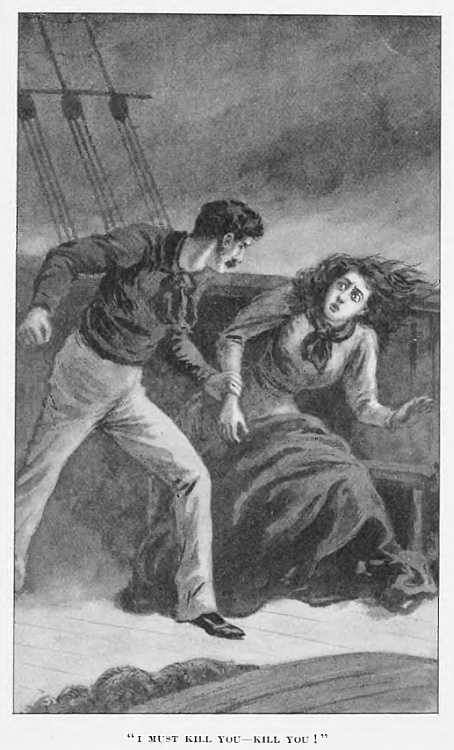
In a few seconds I was safe on the deck of the Lépante.
M. André, the crew, the spectators, were horror-struck.
A man goes mad in an instant. Marc was again raving, as he had raved in the madhouse at Bénévent. But the sight of Cécile had given purpose to his language.
“Vengeance—vengeance! Fiend! The time has come! Fate—fate has brought us together! I could not escape you! I must kill you—kill you! We must be damned together! Hark at the roar of the waters! Hark at the wailing of the winds! Our shroud!—our dirge!—our requiem! that tells us of hell! for I am a murderer, and you—”
He had the strength of ten strong men.
It took that number to hold him.
The wretched André fell prone in a swoon.
Cécile’s women called on the Virgin and the saints.
We all held Marc.
Cécile turned upon me.
“You told me he was dead,” she said.
Then, to the captain of the Lépante—“I am innocent—innocent—innocent!”
But, in moments of supreme danger, men’s ears are deaf to other people’s business.
It was save himself who can.
A leak had been sprung in the Lépante by the collision with our yacht. The pumps could not hold their own with the waters.
There was a panic on board.
The storm had abated. The boats were got ready. All rushed to them.
“Place aux dames!” I cried; and, with the spasmodic strength of great crises, I held back the men, and got the women off first. Then men enough to take charge of the boat.
M. André was in it; the first that was lowered. Another followed, filled with the crew of the Lépante. Her captain was the first to leap into it.
And Marc, freed from the arms that held him, dashed over the side into the foaming waters, to swim after Cécile.
His vengeance was not in this world.
As for me, I was left alone on the Lépante—with the rats.
I am a sailor, and have a sailor’s prejudices, fears, hopes, beliefs.
I saw the rats. They had not left the ship. I accepted the omen. I knew the Lépante was not doomed, if they stayed.
To take to such a sea in an open boat seemed certain death.
I preferred to stay with my friends, the rats.
Rudderless, dismasted, we still floated.
And drifted—drifted—drifted—
Northward, into the ice.
Into the ice-bound, ice-bearing sea that is round the North Pole.
I know no more.
“Gone again, sir!” I said, for just as the doctor made a lurch at the Frenchman, he melted away like the others.
“I never knew anything so provoking,” cried the doctor. “But never mind, we must find another, and keep to my old plan—cut him out in a block, and take him home frozen, like a fly in amber. What a sensation!”
“What! being friz?” said Scudds.
“No, my man. What a sensation it will make at the Royal Society, when I uncover my specimen, pointing to it like a huge fly in amber. It will be the greatest evening ever known.”
He gave us no peace till we found another specimen, which we did, and cut out by rule, and at last had it lying there by the tent, as clear as glass, and the doctor was delighted.
“Not a very handsome specimen, doctor,” I said, looking through the ice at a lean, long, ugly Yankee, lying there like a western mummy, with his eyes shut, and an ugly leer upon his face, just as if he heard what we said, and was laughing at us.
“No, not handsome, Captain, but a wonderful specimen. We must give up the North Pole, and go back to-morrow. I wouldn’t lose that specimen for worlds.”
I gave my shoulders a shrug like the Frenchman did, and said nothing, though I knew we could never get that block over the ice, even if it did not melt.
Just then I saw the doctor examining the glass, and before long a most rapid thaw set in. The surface ice was covered with slushy snow, and for the first time for days we felt the damp cold horribly, huddling together round the lamp, and longing for the frost to set in once more.
We had not stirred outside for twelve hours, a great part of which had been spent in sleep, when suddenly the doctor exclaimed—
“Why, it will be thawed out!”
“What will?” I said.
“My specimen!” he exclaimed.
“Here it is!” I said; and we all started, in spite of being used to such appearances; for just then the tent opening was dragged aside, and the tall Yankee, that we had left in the ice slab, came discontentedly in, and just giving us a nod, he stood there staring straight before him in a half-angry, spiteful way.
I never could have believed that tobacco would have preserved its virtue so long, till I saw that tall, lean, muscular Yankee begin slowly to wag his jaw in a regular grind, grind, grind; when, evidently seeing their danger, our men backed away. For our friend began coolly enough to spit about him, forming a regular ring, within which no one ventured; and at last, taking up his position opposite the lamp, he would have put it out in about a couple of minutes, had not the doctor slewed him round, when, facing the wind, we all set to wondering at the small brown marbles that began to fall, and roll about on the ice, till we saw that it was freezing so hard again that the tobacco-juice congealed as it left his lips.
“I like grit—I do like a fellow as can show grit!” he kept on muttering in a discontented kind of way, as he took a piece of pine-wood out of his pocket, and then, hoisting a boot like a canoe upon his knee, he sharpened his knife, and began to whittle.
“Where did you get that piece of wood?” said the doctor, then.
The Yankee turned his head slowly, spat a brown hailstone on to the ice, and then said—
“Whar did I get that thar piece o’ wood, stranger? Wall, I reckon that’s a bit o’ Pole—North Pole—as I took off with these here hands with the carpenter’s saw.”
“I’ll take a piece of it,” said the doctor, and turning it over in his hands, “Ha, hum!” he muttered; “Pinus silvestris.” Then aloud—“But how did you get up here, my friend?”
“Wall, I’ll tell you,” drawled the Yankee. “But I reckon thar’s yards on it; and when I begin, I don’t leave off till I’ve done, that I don’t, you bet—not if you’re friz. Won’t it do that I’m here?”
“Well, no,” said the doctor; “we should like to know how you got here.”
“So,” said the Yankee sailor, and, drawing his legs up under him, firing a couple of brown hailstones off right and left, and whittling away at so much of the North Pole as the doctor had left him, he thus began.
Chapter Eight.
The Yankee Sailor’s Yarn.
I warn’t never meant for no sailor, I warn’t; but I come of a great nation, and when a chap out our way says he’ll du a thing, he does it. I said I’d go to sea, and I went—and thar you are. I said I’d drop hunting, and take to mining, and thar I was; and that’s how it come about.
You see, we was rather rough out our way, where Hez Lane and me went with our bit of tent and pickers, shooting-irons, and sech-like, meaning to make a pile of gold. We went to Washoe, and didn’t get on; then we went to Saint Laramie, and didn’t get on there. Last, we went right up into the mountains, picking our way among the stones, for Hez sez, “Look here, old hoss, let’s get whar no one’s been afore. If we get whar the boys are at work already, they’ve took the cream, and we gets the skim milk. Let’s you and me get the cream, and let some o’ the others take the skim milk.”