George Manville Fenn (continued 2)
Reading edition
As he spoke, he rose, went stealthily to the door, opened it, and looked out.
“There’s nothing to be afraid of, it’s naither the peelers nor the sogers, it’s frinds that’s coming.”
As he wint back to his sate, a fine, handsome young fellow brought in a lovely girl, exclaiming, as he entered, “God save all here.”
“Amen for that same kindly wish,” was our answer.
They were ould frinds and playmates, the son and daughter of two of the snuggest farmers on the estate; and I well knew before I sailed for Amerikay they were engaged to be married.
“I wasn’t wrong,” said the young man, as he looked hard at me, “it is Phil himself. How’s every bit of you? sure it’s right glad I am to see you here this blessed night.”
“And me, too, Phil,” said pretty Mary Sheean, as she took the hand young O’Rourke left free, and shook it warmly.
We sat for, maybe, an hour or more, talking over ould times; and it was with a sad heart I listened to the bad news—for bad enough it was!
O’Rourke tould me the rason of his visit was to let me know he and Mary had made up their minds to sail for Amerikay, where they had some frinds doing well, and it was agreed they would go as steerage passengers with me, three days after date, in the clipper ship, George Washington.
As they rose to depart, and were bidding us a kind good-night, a low whistle outside caused us all to start. O’Rourke drew himself up, and compressed his lips tightly, as he listened for a repetition of the signal.
Mary turned deathly pale, and clutched her sweetheart’s arm convulsively.
The whistle was repeated.
Miles stooped down, kissed the trembling girl’s forehead, and, addressing me, hastily said, “Phil, tired as you must be, I know I can trust to you to see Mary safe home.”
“Why not do so yourself?” asked I.
“Because I am called, and must obey.”
“Are the boys out to-night?” inquired my father.
“They are, and will be till—”
“When?—where?” demanded my mother.
“No matter,” said O’Rourke, “you will know soon enough. Perhaps too soon.”
The whistle was heard for the third time. O’Rourke rushed from the cottage, exclaiming, “Heaven guard you all!”
After the lapse of a few minutes, I started with Mary for her father’s house. As I left her, looking very sad, at the door, I told her to be sure to see that O’Rourke was not too late to sail wid me.
“Little fear of that,” said she; “since his father has been ordered to quit the farm, to make way for a friend of the new agent’s, he’ll be glad to lave the place forever.”
I turned to go home, with a sad heart.
It was the end of harvest-time; the weather was very sultry, and the night cloudy and overcast.
I thought, as I hurried home, we should soon have a heavy thunder-storm, and fancied the summer lightning was more vivid than usual.
Just as I reached my father’s door, I was startled by the sudden flashing of a fierce flame in the direction of the mansion of the new heir to the splendid estate he inherited from his uncle.
I doubted for a moment, but then was perfectly sartain the Hall was on fire.
I dashed off at the top of my speed, taking the nearest cut across the fields to the scene of the conflagrashun.
As I was pelting along, I heard the fire-bell sounding from the police barracks, but I got to the place before the sogers or peelers had a chance of reaching it.
A glance convinced me the ould place was doomed; the flames had burst through the lower windows, and were carried by the lattice-work, that reached high above the portico, to the upper story.
While I was looking at the blazing pile, a horseman galloped at full speed up the avenue. Just as he had almost reached the Hall door, and was reining in his horse to dismount, four or five dark figures appeared to spring suddenly out of the ground, and I heard the report of fire-arms—two distinct shots I could swear to. At the first, one of the party, who sought to intercept the mounted man, fell; at the second, the rider rolled from his saddle heavily to the ground, and then the other figures disappeared as suddenly as they had at first sprung up.
I was so thunderstruck, that for some few minutes I could not stir from the spot.
Seeing no sign of the approach of the military or police, curiosity, or some strong feeling, got the better of my prudence, and I hurried forward to the scene of slaughter, for such in my heart I felt it was—in the case of at least of one of the fallen men. And there, with the lurid light of the burning building flashing across his deathlike face, and the purple blood welling up from a wound in his chest through his cambric shirt-frill, lay, stretched in death, the newly appointed agent, and, close beside him, O’Rourke, still living, but drawing every breath with such difficulty that I felt certain his last hour had come.
I raised his head, and spoke to him. He knew my voice, and, by a superhuman effort, managed to support himself on his elbow, as he took a small purse from his breast-pocket; he placed it in my hand, and said, “Phil, darlin’, I know you’ve the brave and thrue heart, though it’s only a boy you are. Listen to my last words. Kape my secret, for my sake; never let on to man or mortial you saw me here. Give that purse to Mary—take her to her frinds in Amerikay—she’ll never hear of this there, and may larn in time to forget me. Tell her we shall meet in a better place; and hark! my eyes are growing dark, but I can hear well enough, there are futsteps—they are coming this way; run, for your life; if you are found here, you will die on the gallows, and that would break your poor old father and mother’s hearts! Bless you, Phil, alanna! Remember my last words, and, as you hope for mercy, do my bidding!”
He drew a deep sigh, fell heavily from my arms, rolled over on his side, and there—with the dead agent’s fixed and glassy eyes staring the frightful stare of death straight at him—lay cowld and still!
The sound of the futsteps came nearer and nearer. I started at my best speed for home. When I stepped into the house, the children had been put to bed, but the ould people were still talking by the dim light of the nearly burnt-out turf fire. I wished them good-night, plading fataigue, and reached my small room without their having an opportunity of noticing the state of alarm and agitation I was in.
The next day was an awful one for me. The violent death of the middleman was in every one’s mouth; but it was some relief to find no mention was made of the finding the corpse of poor O’Rourke.
I concluded the footsteps we had both heard were those of some of his associates, and that they had carried off and concealed his body.
I fulfilled O’Rourke’s wishes to the best of my power; saw Mary Sheean safe on boord ship, put her in the care of a dacent, middle-aged countrywoman of her own—and as I was assuring her, in O’Rourke’s words, that he would soon join her, all I had to say was cut short by the arrival of a parcel of peelers on boord, and the rason of their coming was the assassination of the agent had been discovered. O’Rourke was missing, and so suspicion fell on him—and there was a reward of two hundred pounds offered for him. It was thought possible he might be on boord the George Washington, and they had come, with a full description of his person, to sarch the ship.
The passengers—and it was a tadeous job—were all paraded—over three hundred in the steerage, let alone the cabin and the crew—every part of the ship was overhauled, but, as may naturally be supposed, no Miles O’Rourke was found.
I need scarcely tell yez, boys, what a relief that was to pretty Mary Sheean and myself.
When the police-officers had left the George Washington, she beckoned me to her, and whispered, “Thanks be to the Lord he was not on boord! though I know he would never take any man’s life; still, as he was out that night, it would have gone hard wid him. But, never fear, he’ll come by the next ship; and so I’ll wait and watch for him at New York. There’s his box—take care of it for him till we get there; and see, here’s the kay—mind that, too; maybe I’d lose it.”
I hadn’t the heart to undecaive her, so I answered her as cheerfully as I could, put the kay in my pocket and the box in my locker, and went about my business, wid a mighty heavy heart entirely.
All went on smoothly enough—but about the tenth day after we sailed, a report got afloat that the ship was haunted.
At first, the captain only laughed at such an absurd rumour; but finding the men believed it, and went unwillingly about their duty after dark, unless in couples, he set to work to find out who had been the first person to circulate the story.
After a deal of dodging and prevarication, it was traced to black Sam, the nigger cook.
The skipper called the ould darky up to the quarter-deck, and then, in the hearing of the cabin-passengers and most of the crew, the cook stated, afther we had been at say for a few days, that one night, as he was dozing in the caboose, he was startled by the appearance of a tall figure, with a face as pallid as death, noiselessly entering through the half-open door. The ghost—for such Sam was willing to swear it was, to use his own words, “on a stack of bibles as high as the main topmast”—had on a blood-stained shroud. It slowly approached the terror-stricken cook, who, fearing it intended to do him some bodily harrum, sprang from his bunk, and yell’d loudly for assistance. At the first sound of Sam’s voice, the lamp wint out of itself, and the ghost vanished.
Several sailors bore testimony to hearing the cook screaming for help—to the fearful state of fright he was in; and, as they could see no trace of the apparition Sam so minutely described, confirmed his report as to the sudden disappearance of the supernatural intruder.
This was the origin of the report; but, some days after, at least half a dozen seamen declared they had seen the self-same spectre gliding about the deck soon after midnight; and among them the boatswain, as brave a fellow as ever brandished a rope’s-end, declared that, upon waking suddenly one night, he saw the ghost sated on his locker, either imitating the action of a person ating voraciously, or making a series of such horribly ugly grimaces as would have done honour to Vanity Fair itself.
The whole affair was considered a good joke by the skipper and cabin-passengers; but those in the steerage and the ship’s crew placed implicit confidence in the cook’s narrative, corroborated and supported as it was by the sailors and the boatswain.
For my part, I had no faith in any worse sperrits than those than that come out of a bottle, or, maybe, a hogshead, and I lost no chance of trotting out the friends of the ghost.
But my turn had to come—and come it did, with a vingeance.
One night, boy-like, I had been braggin’ mightily loud about my courage. Ould Sam offered to bet his three days’ grog against mine I daren’t slape in the caboose he had deserted since he saw the sperrit that same night.
The wager was made, and I turned in, thinking what a laugh I should have against the ould darky when I handed him back his complement of rum.
I’ll do the ould nagur the justice to say, whin I accepted the wager, he offered to let me off; and, when he found I was determined to stick to it, he warned me, with a sigh that sounded like a groan, I had much better not; but anyway, happen what might, he hoped I would hould him harmless, and forgive him for my misfortune, if any should overtake me.
Wid a smile, bedad! I promised to do so, and, when the time came, turned into the bunk, and was soon fast aslape.
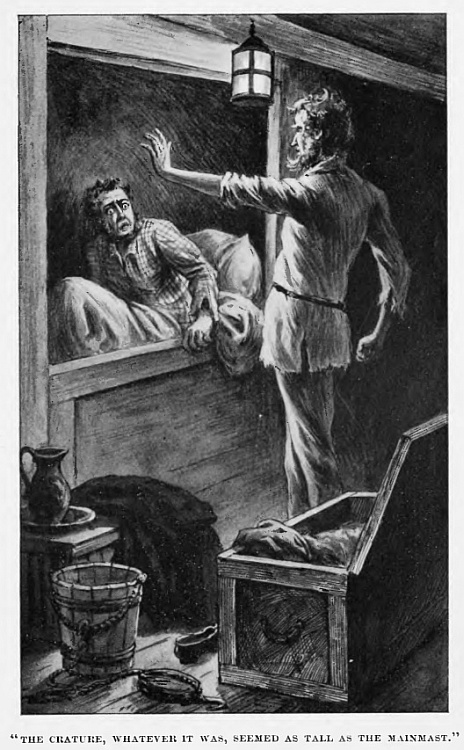
How long this lasted, I don’t know; but I was suddenly awoke by feeling a cowld, clammy hand passing over my face, and whin I opened my pay-pers, judge of my dread whin I saw the lank spectre I had been making a joke of standing by my side. Bedad! if Saint Patrick’s Cathedral was stuck in my throat, I couldn’t have felt more nearly choked. The crature, whatever it was, seemed as tall as the manemast, and as thin as a rasher of wind.
Every hair on my head sprang up, and my eyes seemed starting out of their sockets to meet those of the ghost, which were as big as saucers, and were fixed on mine with a look that seemed to go through and through them, and come out at the back of my head.
I tried to cry out, but I couldn’t; but if my tongue couldn’t chatter, my teeth could. If the big skeleton’s bones had been put in an empty cask, and well shuck up by a couple of strong min, they couldn’t have made a bigger noise than my jaws did.
I tried my hardest to remimber and reharse a prayer; but sorrow the taste of one would come into my head. Shure, everything dacent was frightened clane out of it. The only good thing I could call to mind was what my mother taught me to say before males. I thought that was better than nothing, so I whispered out, while I was shivering with the fear that was upon me, “For what I am going to recave, may the Lord make me truly thankful!”
Whin I had done, the ghost’s jaws moved, and, in a voice so hoarse and hollow, that it might have come from the bottom of a churchyard vault, half-moaned, half-groaned, “It’s grace you’re saying, you imperint young blaggard!”
“It is,” says I, trimbling all over. “That is, if it’s not displasing to your honour’s lordship.”
“That depinds,” says he, “upon what you are going to give me to ate after it.”
“Ate!” says I. “Why, thin, be good to us! can you ate?”
“Thry me,” says he, “and you’ll see whether I can or not; and make haste, for my time’s short! I must go down agin almost immadiately, and it isn’t the bit or sup I’ve had for near onto five days; and by rason of that, although I was a strong man once, it’s nearly gone I am!”
“Gone where?” I asked.
“To my grave,” says he.
“Bad cess to them, whoever they were, that ought to have done it, and didn’t! Haven’t they buried you yet?” I inquired.
“What would they bury me for?” says he.
“It’s customary with corpses where I come from,” I answered.
“I come from the same place,” says he. “They are bad enough there, in all conscience—more particularly, by the same token, the middlemen, tithe-proctors, and excisemen; but they didn’t bury live min in my time,” says he.
“But they did dead ones,” says I.
“Of coorse,” he assented. “And it’s you that will have to bury me mighty soon, unless—”
“Unless what?” I demanded, in a bigger fright than ever at the thought of having to turn sexton to a sperrit.
“Well, unless you give me something to ate and drink,” says he.
“Take all there is in that locker,” says I, “and welcome—and be off out of this.”
“Don’t say it agin,” says he; and he opened the locker, and walked into the cook’s store like a shark that had been kaping a six weeks’ fast.
It was wonderful to see how the tears stood in the poor ghost’s eyes, how his jaws worked, and his throat swelled, as he swallowed mouthful after mouthful, the bigness of a big man’s fist. In a few minutes he turned to me, and said, “Take my blessing for this, Phil!”
I was startled to hear the ghost call me by my own name; but as I didn’t want to encourage him to kape on visiting terms, I thought it wouldn’t do to let him become too familiar, so I said, mighty stiff like, “Fill yourself, honest spirit, as much as you plase, but don’t be Phil-ing me—I don’t like such freedom on a short acquaintance—and you are no friend of mine,” says I.
“I was onct,” he replied.
“When?” asked I.
“When we were in the ould counthry,” says he. “When you tuck the purse from me for Mary Sheean, and promised to spake the last words I spoke to her.”
When I heard him say that, all my ould fears came over me fifty times stronger than ever, for hadn’t I broken my promise to O’Rourke? And I could see now, from the family likeness, this was his spirit; and instead of telling her all he said, only given half his message to poor Mary!
“Oh, be me sowl, good ghost!” says I.
“If I’m a ghost, I’m—”
He made a long pause, so I spoke.
“Never mind what,” says I. “I don’t want to axe any post-mortem questions—”
“Blest!” says he.
“That’s a great relief entirely,” says I. “But if you are blessed, I’m no fit company for you; so never mind your manners—don’t stay to bid me good-by, but go at onct!”
“You don’t want me to stay?” says he.
“I don’t,” I replied.
“You are more changed than I am,” he added.
“I shouldn’t wonder,” says I, “seeing the sort of company I am in.”
“Do you find fault with my company?” asked he.
“I do,” says I.
“And you wish me to go—down below again?”
“As soon as convanient,” says I.
“Well, Philip Donavan,” says he, “aither I or you are mortially changed.”
“It’s you,” says I. “My turn hasn’t come yet, but it will, all in good time.”
“Phil Donavan, do you know who you are spaking to?”
“Faix I do, to my sorrow!” says I; “to Miles O’Rourke’s ghost!”
“Miles O’Rourke’s ghost!” says he.
“Dickens a doubt of it!” says I. “Didn’t I see his body lying stark and dead, wid the blood welling out in gallons from his heart?”
“It wasn’t my heart, man alive—it was my shoulder; and shure it was the loss of that same that made me faint! Take a hould of my hand, if you doubt me! There’s little left of it but skin and bone; but it’s human still!”
It was moightily against my own wish,—and wid a cowld shiver running down my back, I did as he asked; but whin I did catch a hould of his fist, ghost or no ghost, he nearly made mine into a jelly wid the squeeze he gave it.
“Murther alive!” says I.
“Hould your whist! Remember, I’m a ghost!” says he.
“That’s thrue for you!” says I; “and you must continue one for the rest of the voyage, or maybe you will be trated as something worse!”
“What’s that?” he asked.
“A stowaway!” says I. “The skipper’s a good man enough; but if he discovers you, the way he’ll sarve you will be awful!”
“What will he do?” inquired he.
“Give you thirty-nine and land you!” says I.
“Land me where?”
“In the middle of the say!” says I.
“Murther!” says he.
“Moighty like it,” says I; “but he’ll do it!”
“I’d have to give up the ghost then!” says he.
“You would, in airnest!” I tould him. “But you mustn’t do it yet. Tell me how you come on boord?”
“I will,” says he. “When the boys found me, I had only a flesh wound, and had fainted from loss of blood. They got a car, and smuggled me down to Cork. I had scarcely set my fut on deck, as the peelers came rowing up the side. When the order was given to muster all hands, I made my way to the hould, and hid myself in the straw in an empty crate in the darkest corner of the place. The men searched pretty closely, but, as good luck would have it, they passed by my hiding-place.”
“You must go back to it. But now, Miles O’Rourke, answer me one question, and, as you are a man, answer it truly!”
“What is it?”
“Did you kill the agint?”
Wake as was O’Rourke, he stood grandly up; the ould honest, proud look came into his pale, wasted, but still handsome face; and pointing his long, thin finger to heaven, he said, in a deep, low tone, the earnestness of which I shall never forget to my dying day, “As I hope for justice some day here, and mercy hereafter, I did not!”
The hug I gave him would have broken many a strong man’s ribs, let alone a ghost’s; but I couldn’t help it. Bedad, if I had been a Roosian bear itself, that hug would have been a credit to me.
“What on earth am I to do?” asked Miles.
“Anything you plase,” says I, “whin you get there! But you are on the water now, worse luck—and that’s what bothers me. I wouldn’t give a thrawneen for your life, if you are discovered and recognised as Miles O’Rourke. There’s two hundred pounds reward offered for you, and the evidence seems pretty strong against you.”
“How would they know me?” says he. “You didn’t—and no wonder! Shure whin I came on boord I weighed fourteen stone; and now, ten stone in the one scale would pitch me up to the ceiling out of the other!”
“That’s thrue enough,” says I; “but you must bear in mind I tuck you for somebody else’s ghost, and didn’t make any allowance for the starving you have had, which, particularly as a stowaway, they would be sure to do. But now you must get back to the hould. I’ll contrive to drop half my rations and a trifle of grog down every day—see Mary, and consult with her. Shure, one woman’s wit is worth a dozen men’s in a case like this.”
“But—” says he.
“Hush!” says I; “I hear futsteps. We are in a tight place now! There’s only one chance for us: I’m aslape, and you’re a ghost again!”
I fell back in my bunk, and began snoring like a porker wid the influenzey, just as the door opened, and the ould nagur poked in his black woolly mop.
Miles stood up to his full height, and raised his hands above his head, as if he was going to pounce upon him.
The poor cook, terrified beyond measure, fell down as flat as a flounder on his face, shrieking out at the top of his voice, “The ghost!—the ghost!”
O’Rourke stepped over his body, and hurried back to his hiding-place, unseen by the bewildered sailors.
I pretended to awake from a sound slape, and had the pleasure of hearing the toughest yarn that ever was spun, from Sam, in which he gave a soul-thrilling description of his encounter and hand-to-hand fight with the dreadful apparition.
I saw Mary the next morning, and broke the news of O’Rourke’s being on board as gently as I could. Our plans were soon laid. By the time we came to an anchor off New York, I contrived to drop, unseen by any one, a bundle, containing a suit of O’Rourke’s clothes, shaving materials, and a small looking-glass, down the hold.
When the passengers were paraded, the police-officer, who had remained on board, was too much engaged reading the following description of a supposed murderer to pay much attention to pretty Mary Sheean, or the poor, pale, stooping invalid she was supporting.
“Two hundred pounds reward for the apprehension of Miles O’Rourke. Description.—Florid face, curling brown hair, large and muscular limbs, finely developed chest. Height, about six feet; weight, rather under fourteen stone.”
Unlike as the half-starved wreck was to what he had been when he came on boord, I was in an agony of fear, until I saw Mary safely landed on the Battery, convulsively grasping the hand of the Ship’s Ghost.
“Yes, Paddy,” says the doctor, “that’s all very cheerful and entertaining, but decidedly unscientific, and you didn’t tell us how you got here.”
“Not he!” said Scudds, growling; “I thought it war going to be a real ghost.”
“I say, look at him!” said Bostock.
But nobody would stop to look at him; the men shuffling off once more—all but the doctor and myself—as that figure regularly melted away before our eyes—body, bones, clothes, everything; and at the end of five minutes there was nothing there but a little dust and some clear ice.
“It’s very wonderful!” the doctor said; “but it won’t do. We must find another, take him up carefully, and not thaw him out, but get him back to Hull in his ice, like a glass case.”
“Come back, lads; the Irishman’s gone,” I said; and they came back slowly; and we had to set up the tent in a fresh place, and, while we did it, the doctor found another body, and set us to work to get it out.
We got this one out capitally; the ice running like in a grain; and after six hours’ hard work, there lay the body, like an ornament in a glass paper-weight, and the doctor was delighted.
About two hours after, as we were all sitting together in the tent, we heard a sharp crack, and started; but the doctor said it was only the ice splitting with the heat of the sun; and so it proved, for five minutes after, in came a gaunt, weird-looking figure, with a strange stare in his glimmering, grey eyes; a wild toss in his long yellow hair and beard, both of which were dashed with patches of white, that looked as though the colour had changed by damp or mildew, or the bitter, searching cold. With such a dreamy, far-off gaze, he looked beyond the men who sat opposite, that they turned involuntarily and glanced over their shoulders, as though they expected to see something uncanny peering at them from behind. His long limbs and wiry frame, together with this strange, eerie expression, give him the air of some old viking or marauding Jute come to life again, and ready to recite a Norse rune, or to repeat a mystic saga of the deep, impenetrable North.
“Eh,” he said, “I was just thinkin’ a bit aboot the time when I went wi’ Captain Parry to his expedition.”
“Why, you weren’t with Captain Parry?” said the doctor.
“It’s aboot mysel’ I meant to tel ye, if ye’ll no’ be so clever wi’ contradictin’, and I say once more—(here he glowered into space, as though he saw something a long way off)—I was thinking about a man I met wi’ in about eighty-two degrees o’ latitude, when I was out wi’ Captain Parry on the third expedition of the Hecla, in 1827, at which time I was no more than forty year old.”
“Forty in 1827!” said the doctor. “Why, how old do you make yourself?”
“I’ll no mak’ mysel’ any age; but let us—no’ to be particular to a year or so—put me down at seventy-six or seventy-eight.”
“Ho! ho! ho!” laughed Scudds. “Why, man, you’re not above fifty.”
“Weel, if ye maun tell my story yersels—maybe ye’ll gi’e me leave to turn in, or light my pipe. I’ll no’ speak if ye’ve no wish to hear; but now I mind that I’m eighty-four year old last Thursday was a week, for I was four-and-twenty when I first had ten years’ sleep at Slievochan.”
The man’s eyes were fixed on space, as though he saw all that he was about to narrate going on in some strange way in the dim distance; and except an occasional grunt of interest, a deep-drawn breath, or the refilling and relighting of a pipe, all was still as he went on.
Chapter Four.
The Scotch Sailor’s Yarn.
All about Slievochan, there was no lassie like Maggie Miller. Her father was a kind o’ overlooker to the Laird o’ Taggart, and so was reckoned weel-to-do. He was an elder o’ the kirk, too, mind ye, and had a farm o’ his ain—or what was called a farm, though it was no mair than might be a sma’ holding, with a kye or twa, and fowls and live-stock, and a bit o’ pasture, and eneugh to butter the bannocks and give a flavour to the parritch; so that he was called a weel-to-do man. I doubt if any of ye know Slievochan; and it’s no deal likely ye would, for it’s but a by-place where, down to the village, a few fisher-bodies live; and up beyant the hills an’ the cliff is the sma’ farmers and the laird’s folk, with just the kirk an’ the bit shops, and beyond that the kirk itself, weel out o’ sight o’ the little whusky shop; and beyant the widow Gillespie’s “Herrin’ Boat Inn,” where our fishers go at times, when they ha’e drunk out the ale at their own place, “The Coil,” or, maybe, tasted a runnel o’ hollands or brandy, that has no paid the exciseman, or got the King’s mark upo’ it.
For there’s strange ways amang the fisherfolk? and between them and the village is a wide difference; though you’ll mind that some o’ the bodies wi’ a boat o’ their ain and a cottage that’s as well keepit as they that was built by the laird himsel’—and perhaps a store o’ claes and linen, and household goods, and a bit o’ siller put by at interest—may hold up their heads even wi’ men like Donald Miller, or may speer a word to the minister, or even ask him to taste a glass of eau-de-vie, when he gaes doon for pastoral veesitation. But, hoot! I’m clavering o’ the old place as it was above fifty years ago, when I was workin’ wi’ my uncle, Ivan Dhu, and my Aunt Tibby sat at the door, knit, knit, knitting, as she watched for our comin’ hame, and went in to make the parritch or skim the sheep’s-head broth, directly the jib o’ the Robert Bruce cocked over the ridge, and came tackin’ round the Ness o’ Slievochan, with uncle and me looking to the tackle and the gear, and my braw young cousin Rab at the tiller, wi’ his bonnie fair face an’ clustering curls, all blowing in the breeze that lifted us out o’ the surf, and sent us in with a whistle an’ a swirl, till the keel was ready to grate upon the beach. Rab was only eighteen, and we were great friends—though I was an orphan bairn, and Uncle Ivan had taken me and brought me up—so that his boy might have been jealous, but there was no jealousy in him. Uncle was a bachelor when I first went to him, a little raw lad, from Inverness, and I’d learnt to manage a boat and do fisherman’s work before Rab came, so that I grew to be a strapping lad, and was able to teach him in his turn. We loved each other weel, Rab and I; and quiet Auntie Tibbie used to sit knitting, and watch us both with a smile; and silent Uncle Ivan, with his great limbs, and dark face, and black locks—though he gave me to know that Rab would have the boat one day, if not a bigger one or two—would grip my hand and say, “Stick to the laddie, if aught suld happen, Sandy; for if ye’re no my son, ye’re next to him, and not much further frae my heart.”
Weel—but about Maggie Miller! Her father, you observe, was a man o’ some substance, and one trusted by the laird; so that the minister, and the bailie o’ the nearest town, an’ Mrs Gillespie, an’ the farmers all, ca’d him Mister; and my Uncle Ivan, who had his pounds away in the bank, ca’d him Mister, too, and would send me or Rab up with a creel o’ fish when we had a fine take, now and then; so that we were on a footing of visitors; and Maggie would stand and laugh and talk with me, and would gie Rab a blink, and a rose-blush, and a smile that made us all laugh taegither, till I used to wonder why it was that I wasn’t one of Maggie’s lovers—of which she had three already, not counting Rab, who was two years younger than she, and, of course, was lookin’ at her as a boy of eighteen always looks at a girl of twenty, too shy to speak, and too much in love to keep silent, and so talking to anybody who’ll listen to him, which in Rab’s case was me.
It wasn’t much in my mind that the boy loved her, but someway I’d got used to thinking of him and her at the same time; and many a time I’ve brought her home some trifle that I got from one of the coastmen—when they brought in a runlet or two of spirits, or lace, and tabacker—some French gewgaw or a handkerchief; and a good deal of my spare money went that way, for Uncle Ivan kept us pretty short of spending. It was like giving it to Rab, I thought; but yet I noticed once or twice that the boy looked serious when I showed him anything to give to Maggie, though I often asked him if he’d give it to her himself.
Maybe I’d ha’ been less easy if there had seemed to me more than a lad’s liking and a lassie’s pleasure, that meant little of lasting; for there were two men, if not three, hankering about Donald Miller’s house such times as they could make excuse to gae there, an’ one o’ them made believe often enough, for he was head keeper to the laird on some shootin’s that lay an hour’s stout walking from Slievaloch; an’ now it was a couple o’ rabbits for Mistress Miller, or a word or twa with Donald about the bit cover for game beyond the big house; but a’ the time he sat an’ smoked his tabacker, or took a sup o’ parritch or sowans, or a dish o’ herrin’, he’d have an eye to Maggie. An evil eye it was, too, for he was a lowerin’ carl, and ’twas said that he was more poacher than keeper; while some folk (and I was one) knew well that there was anither business brought him round toward Slievaloch. I shame to say it, but at that time—ye ken I speak of nigh sixty year ago—there was a smoke to be seen coming out frae a neuk i’ the hills at a wild place where there seemed to be naething but granite and bracken, and a shanty or two, for shelter to the men quarrying the granite. But it wasna frae the huts that the smoke rose. A good two mile awa’ there was a stone cottie, more like a cave, as though it had been burrowed out by wind and water, and got closed in wi’ boulders o’ rock, and covered with earth and broom, so that naebody could see how it led by a hole i’ the prong o’ the hill to just sic anither hut, and neither of the twa to be seen, except by goin’ o’er the hill-side. In this second one there was a fire smoulderin’ under a furnace, and a’ the place dark and smoky, and fu’ o’ the reek o’ sma’-still whisky, that had nae paid the king’s duty; an’ on a cowhide i’ the corner crouched auld Birnie, as blear and withered as a dried haddie, waitin’ for his wife to come trudgin’ back wi’ silver shillin’s and the empty leather bottle of twa gallons that she’d carried out full i’ the mornin’, under her lang, patched cloak, or hid awa’ in the loose kindlin’ wood at the bottom o’ the ricketin’ cart. It was suspected that Rory Smith, the keeper, was in league wi’ auld Birnie in this sma’ still, and that both he an’ the o’erseer o’ the quarrymen—a Welsh body o’ the name o’ Preece—knew weel enough what went wi’ the whisky. The two men were as unlike as a raven and an owl; Smith bein’ suspectit of half gipsy blood—though few men daur say so to his face, for he’d a heavy hand an’ a look in his face that boded mischief—while Preece was a slow, heavy-eyed, quiet body, short an’ square-built, and wi’ a still tongue an’ decent, careful ways, that yet kept his rough men in order, and got him speech of the tradefolk at the village where he lodged such times as he wasna’ up at the quarry.
These were the twa that went each in his own fashion to visit Donald Miller, and to cast an eye on Maggie; but neither o’ them could boast of much encouragement, least of all the keeper, who saw that the lassie shrank from him, and would hae no word to say when he tried to win her wi’ owches, an’ fairin’s, an’ even costlier gifs frae Edinbro’ itsel’, which she refused, sayin’ he maun keep them till he foun’ a lassie o’ his ain. Preece thought it mare prudent to wait till Smith was out o’ the way; an’ both of them, as I foun’ out after long years, were jealous o’ me for seemin’ to find mair favour wi’ Maggie, an’ carryin’ her the little presents that I told ye of, though never a word o’ love-making passed my lips; and perhaps baith o’ us thought more o’ my cousin Rab than o’ each other, though had it nae been for Rab, mind ye, I’ll no say that there’d been so clear a stage for the other twa if Maggie had been as winsome when I went to pay my respects to her parents, and laughed wi’ her at the door.
Weel, it was just on one o’ the occasions when I was on my way to the house, one evening in the airly summer, carrying with me a gaudy necklace o’ shining beads that I’d bought of a packman at Farmer Nicol’s shearin’, whaur I’d been the day before. I’d shown the toy to my step-mother, and uncle, and to Rab too, and had asked him to take it to Maggie himsel’; but he put me off, sayin’ that he’d rather not be amang them that was gi’en and gi’en sma’ things, for he’d gied her the best o’ himsel’ a’reedy. It was, maybe, to ponder over these words that I took the way up the steep bye-path that led up the beach, an’ so zig-zag along the cliff’s edge. There was a sort o’ neuk beside a turn o’ this path, where was a big stane, that one might sit upon, and so lose sight o’ everything but the distant sea an’ the beach below, to which the rocks shelved down, rugged an’ bare in places, an’ in others wi’ a toss an’ tangle o’ weed and brushwood, where there was a hollow in the face of the cliff.
There I sat, an’ sat, and felt all strange an’ drowsy, dreamin’ about Rab an’ Maggie, but not rightly thinking o’ anything; but holding in my hand the bauble that I had taken out o’ my pocket to look at. Night was comin’ down quick out at sea, and the mist was creepin’ over the hills, when I heard a man’s footstep on the path, and stood up to see who came.
No need to look twice; ’twas Rory Smith, the keeper, trampling quick and heavy, and with a heavy cudgel in his clenched hands—a murderous look in his eyes.
He turned upon me, clutching his stick.
“Whaur are ye goin’?” he said, “and who’s that for?” pointin’ to the necklace that hung on my fingers.
“I’m no here to answer questions,” answered I; “but ye can know for a’ that, or ye can turn back, and see for yoursel’.”
“Go, if ye daur!” he shrieked; “for it shall be but one o’ us, if ye’ll no turn about the way I’m walkin’. It’s through you, is it, that Maggie flouts me, an’ throws back my gifts, that are o’ mair cost than ye can earn, ye loupin’ beggar?”
“Hand off!” I shouted; “or I’ll no answer for mysel’,” for he was pressin’ on, an’ there was no room for a struggle between the rock an’ the road’s edge. “Haud off, or not one, but baith, may make a turn too many.”
“Gie me that trash,” he said, making a snatch toward the necklace. “Gie it me, and go no more to Maggie’s house—you nor your baby cousin Rab. Gie it me, I say!”
He was upon me before I could answer him, mad wi’ passion and wi’ whisky, and dealt me a heavy blow upon the head; but I was quicker and stronger than he, and, before he could repeat it, had him by wrist and shoulder. As I’ve said, ’twas no place to wrestle in, and when we both came to grips, we had but one scuffle, and then our footing was gone, and I lost him and myself, too—lost sense, and hearing, and a’ things.
The sun was high in the sky, when I came to myself—shining like a golden shield over the blue sea, and the wavin’ grass and heather; and I could just see the ripple o’ the waves and the fleece o’ white clouds far away, but naething else.
It was a while before I could do that, for I seemed to be covered wi’ dried grass and leaves above my chin as I lay there in a deep cleft in the cliff side, mid a tangle of stalks an’ roots, and dry driftsand, that had got into my claes, and tilled my ears and eyes. I was like a man paralysed, too; and had to move an inch at a time, till I could rub, first my arms, an’ then, when I had got upon one elbow, give my legs a turn, and then my back. The first thing I did was to feel if the necklace was on my wrist still; but it had gone; dropped off and lost in the scuffle. Next I crawled to the edge of the hole, and peered down the cliff side, and all round, as far as I could see, to look for the body of Rory Smith, living or dead.
I could not tell how he had fallen; but unless he had clutched at the long weed, or reached a cliff lower down, he’d hardly be alive after a whole night; for, had he fallen on the beach, and been disabled, his body was now under the water, above which the sea-birds wheeled and piped in the bright morning air.
Perhaps he had cried out, and help had come, while I lay senseless. However it was, I must get to the village and see what could be done. The quickest way was to climb up to the path again, and so get toward the long street o’ Slievochan, nearer than going back to find uncle an’ Rab, who’d most likely be at Donald Miller’s to look for me.
It was strange to think that I should have been fightin’ for Maggie, an’ all the time was the only one that made no claim to be her lover. I began to wonder whether, after all, the lassie might have understood me different, and had been waitin’ for me to speak out, preferrin’ me to Rab even, and wonderin’ why I had his name always foremost. The thought wasna’ a good one, for I felt a kind of sudden fancy to win the girl, even though I couldna say I loved her; indeed, I’d thought of her only as a winsome child; and, lately, had never spoke of her to Rab, except wi’ caution, for I could see that the puir laddie was sair in airnest. Somehow, the thought o’ my bein’ Maggie’s lover, though I put it frae me, caused me for a moment to wonder what she’d say to me if she saw me all dusty, and with torn clothes and grimy face. This made me look at my clothes, and, wi’ a sort o’ wonder, I found that my pilot coat had got all brown at the back, where I lay upon it, and broke as though it had been scorched. My shoes, too, were all dry and stiff; and as I began to climb the cliff, very slowly an’ painfully, my shirt an’ trousers gave way at knees and elbows. I sat down on the bank of the path after I’d reached it, a’most dead with faintness an’ hunger, so put my hand in my pocket to find my pipe. It was there, sure enough, along wi’ my steel bacca-box, and there was bacca there too, an’ a bit o’ flint to get a light. The bacca was dry as powder, but it eased the gnawin’ of my limbs, and I tottered on.
On to the first cottages, leading to the main street, where I meant to go first to Mrs Gillespie’s, and find some of the fishermen to search the cliff for the keeper. As I came nearer to those cottages, I could see that something was stirring in the village, for women an’ bairns were all out in the street, an’ in their best claes; and across the street farther away was a rope bearin’ a great flag an’ bunches of heather, an’ the people all about Mrs Gillespie’s door, an’ the by-way leadin’ toward Donald Miller’s cottage, and so right up to the kirk. I could see a’ this only when I got closer; but I could na’ turn up the high street. A kind o’ fear an’ wonder kept me back, an’ more than once I shut my e’en, and stretchit oot my arms all round, to feel whether I was na’ dreamin’ it all in the hole of the cliff side, or, maybe, in my bunk at hame, or on the deck of the Robert Bruce, wi’ Rab at the tiller, an’ uncle smoking forrard.
I turned up a by-way, and got near to the church itsel’, where a man and woman—strangers to me—were leanin’ against the wall, talkin’. I thought I knew everybody in the place; but these people had just come out o’ a cottage that belonged to auld Nannie Dun, and had turned the key o’ the door as though they lived there, at the sicht o’ me coming along the path.
They eyed me over, too, as I came near, and answered wi’ caution, when I asked what was goin’ on the day.
“Weel, it’s a weddin’ in the kirk,” says the wife, “an’ sae lang waited for that it’s little wonder a’ the toon is oot to give joy to the bonnie bride an’ groom. Ye’re a stranger, and where may ye come frae?”
“Nae, nae,” I said, between a laugh an’ a fright. “Ae body kens me hereabout; but where’s auld Nannie, that ye’ve come to see to-day; she’ll know me.”
The couple looked skeerit. “Auld Nannie Dun was deed an’ buried six years ago come July,” said the woman. “Ye’ve been long away frae this toon, I’m thinkin’.”
“Frae this village,” says I. “Slievochan’s na’ a toon.”
“’Deed, but it is, though, since the auld laird’s death, and the new street was built, two years’ ago; when Donal’ Miller an’ Ivan Dhu bought the land that it stands on for a portion for son an’ daughter—but there they come.”
“Just one moment,” I cried, clutching the man by the arm. “Will ye kindly tell me the day an’ the year?”
“What day, mon?” says he, lookin’ at me in doubt.
“This present day o’ the month and the year. Is it auchteen hunnerd saxteen?”
“Hoot, mon!” cried the fellow, gettin’ away frae me. “Nae; but the third June, auchteen hunnerd twenty-sax. Ha’e ye been asleep these ten years?”
I had!
It rushed upon me a’ o’ a sudden. My claes like tinder; the bed o’ dry leaves; my shrivelled boots; the bacca in powder. There, in that cave o’ the cliff I’d slept in a trance, with ne’er a dream to know o’, an’ the world had gone round while I stoppit still. There was a soun’ o’ talking an’ laugh in’ at the kirk door, an’ then a shout, as a band o’ fishermen came out, all in their best rig; an’ then a shoal of pretty lassies, an’ then my uncle Ivan, an’ Mistress Miller—(Old Donald was deed, then, I thought); and then the bailie an’ my Aunt Tibbie; and, after all, Rab an’ Maggie—he looking a grand, noble man, for he was no longer a boy; but wi’ his father’s strength, and Aunt Tibbie’s soft, tender smile; an’ she—Maggie, I mean—older an’ paler; but wi’ a light in her een, an’ a lovin’ look upon her face, that made me forget mysel’ in joy to think how they had come together at last, whatever might have happened in the ten years.
But what would happen if I should be seen by the bailie, starin’ there at the church porch, in my rags and unkempt hair an’ beard—I, that had perhaps been sought for, and might be suspectit?—Ah! that was dreadfu’!—suspectit o’ murder! for where was Rory Smith?—and who could tell the true tale but me?
I might be recognised in a minute; for how did I know whether I was altered?—and I could remember half the men who were there shouting, and half the women claverin’ in the kirkyard. I crept away.
The best thing I could do was to make off down to the fisher village on the beach; for everybody had come up to the wedding, and I could gain my uncle’s house without meeting any one that I knew. So crammin’ what was left of my bacca into my pipe, I turned down a lane, and could see the man and woman that I’d spoken to stopping to look after me.
I was wrong in the thinking that I should reach my uncle’s house unknown. At all events, I was known after I’d entered the house, though there was naebody there. The first thing I did was to stir up the embers o’ the fire, for I was chilled, though it was a warm summer’s day; then I cut a slice from the loaf, and took a mug o’ milk from the pan; an’ then went to the ben, to see after washing myself, and go on to my ain auld room, to look what had come o’ my claes.
The room was altered, but the chest was there; and though my men’s claes had gone, some of my boy’s claes were there; an’ even some of them that I wore as a child, when Aunt Tibbie made me a new suit. I was thocht to be dead, then, but wasna’ forgotten.
If a mon can cry, it does him a world o’ good at times—that is, if he doesna’ cry much nor often. I cried, and it did me good. Then I went up to the little bit o’ broken glass that was nailed to the wa’ to speer what like I was. My hair had began to whiten—bleached, maybe, by the sea air. I had a strange, wild look, for hair and beard had grown all tangled, and my face was grey instead of red-brown, as it once was. Would my uncle know me?
When I went down again to eat some more bread, and to look for a little whisky to put wi’ the milk, there was a man’s face peerin’ through the window; and before I could stir, the door-latch clicked, and in walked my uncle Ivan. I had started to my feet, and my uncle strode in, with his hand uplifted, as if to strike me.
I never stirred, but looked at him full in the eyes.
His hand fell to his side.
“What brings ye here frae the dead, or from waur than the dead, Sandy Macpherson?” he exclaimed, hoarsely.
“I’ve no been that far; if they that I’d have looked for had looked for me,” I answered. “If Rory Smith is alive, he can tell ye about it; or if his dead body’s been found, I’ll tell my story over that afore all Slievochan.”
“Then it was you, after all?” said my uncle, sinking into a seat, and leaning his head on his hands. “An’ I’ve stood up for ye, and swore that if there was foul play ’twas he, and not you—or maybe Preece, as your aunt thocht at first, because he had the necklace. Can ye, an’ will ye, clear up this dreadfu’ mystery?”
“Uncle Ivan,” I said, takin’ him by both hands; “look at my face and hair; look close at my claes and shoon! Come wi’ me, and bring others too, to the cliff face below the sitting-stone in the turn o’ the path—and then it’s just possible, but it’s no likely, ye’ll believe what I have to tell. First, let me say to ye, I’m innocent o’ any crime. Do ye believe that?”
My uncle lookit at me long and hard, and I grippit his hands tight.
“I do,” he said, at last.
A weight sprung off my heart.
“Uncle, did I ever tell ye a lee?”
“Never that I ken.”
“Never—never! I kenned he wud come back!” said another voice.
It was Aunt Tibbie, and she took me in her arms. “I believed ye to be innocent, Sandy; and sae did Rab, and a many more,” she said. “But where ha’ ye been?”
“Ye’ll no believe me, gin’ I tell ye. I don’t wonder at that. Ye can’t believe it, mebbe, but I’ll tell ye.”
“It’s naething wrong, Sandy?” said Aunt Tibbie.
“Nae, naething but laziness, an’ I couldna help that. I’ve been asleep—in a traunce—in a stupor—like a toad in a stane, for a’ these years, an’ have come to life this verra day!”
Then I told them all about it; and sic things as traunces—though not, maybe, to last as long as mine—had been heard o’ before, and they could not but believe it; but they were awa’ again to Rab’s wedding, frae which they’d come hame only to fetch a silver cup, that was to drink the healths o’ the bride and bridegroom.
“Auntie! where’s my silver mug, that I won at the games at the laird’s hair’st?” I asked.
“Safe put away wi’ the chaney, lad, an’ noo it’s yours again.”
“Auntie, wad ye tak it as my gift ta Maggie? and, uncle, will ye gie my message to Rab, that I’ll no’ stay here to bring an ill name or suspicion on him or his; but if he’d come an’ gie me his hand before I’m awa’?—t’will be little to him, and much to me, though I’ve been true to him for a whole lifetime—what’s gane of it, at least.”
So auntie took the silver mug, and they both left me; but not till I had heard how, twa days after I had gane, David Preece had been to Donald Miller’s cottage an’ offered Maggie a necklace o’ gaudy beads, and how Maggie handed them back tae him, though he told her he was to leave Slievochan next day. Aunt Tibbie heard o’ this: and when Maggie told what was the like o’ the bauble, there was a cry for Preece, till it was heard how Rory Smith hadna’ been seen for those three days, and that I hadna’ been found or heard o’.
So, ye ken, it was which o’ us should come back first wad be ca’d to find the other twa.
I sat brood—broodin’, waiting for aunt and uncle to return. Eatin’ and drinkin’, and smokin’ (for there was beef an’ whisky, and a cold pie o’ auntie’s making); but I wadna’ change my claes till they should gae wi’ me to the cliff face.
Before the sun was off the sea, I heard a sound of voices outside; and in a minute I had a hand o’ Rab, and a hand o’ Maggie and her mither, an’ half-a-dozen o’ our fishers round us who’d known me from a laddie; and then uncle said, “Now let us away to the cliff path before any o’ the rest come back fra the wedding. While they think Rab and Maggie hae gone off o’ the sly, as, indeed, they hae, and are ganging ower to the island in the new boat to Rab’s cottie.”
“’Twas gran’ o’ ye, Rab, and o’ ye, too, Maggie, to come to see me on your weddin’-day,” I said. “I’ll no forget it when I’m far awa.”
“I would ha’ been no gran’ not to ha’ come,” said Rab, “to tell our brither that we stan’ against a’ that daur accuse him o’ wrang. Why need ye gae, Sandy? Stay and tak’ the brunt o’t.”
“An’ for why, Rab? To bring trouble an’ cold looks upo’ them that I’d as sune die as cause grief to, an’ that when there’s no need o’ me to work here. Nae, nae, I’m awa’ to sea, Rab; an’ when I come hame, only friends need know who ’tis, except, indeed, I suld find Rory Smith alive in my travels; and, who knows, but I may find puir David Preece, and get my necklace back.”
“Dinna touch it—dinna touch it!” said Aunt Tibbie, shudderin’.
So we a’ went to the cliff, and there, standin’ by the stane, in my withered claes and puckered shoon, and wi’ my whitened face an’ a’, I told them again; and we men went down to the hole on the cliff side, while the women sat on the stane above, and we shook hands all round.
That same evening, two boats shot out o’ our little bay, the first one a new craft, Rab’s ain, wi’ a gran’ flag flying, and carrying him an’ his bonnie bride hame. Auntie and Mistress Miller were with us; uncle sitting by me while I stood at the tiller, and two men forward. Behind it was a row-boat, wi’ a piper at the prow, playin’ the bride hame. In this boat we a’ went back to Slievochan, except Rab and Maggie; and once more I slept in my old room till mornin’; when, wi’ a fit-out o’ claes, and some money that I was to repay as soon as I could draw my wages, I set out for England.
It was when the Polar Expedition of 1827 was getting ready, and I was one o’ them that joined it, though ye may not know my name.
I’ll no’ describe onything o’ that voyage, sin’ ye will ha’ it that I’m repeatin’ frae book; but I’m near to the end o’ my yarn now. When we met the last o’ the natives near to the Pole, there was a party came out to barter with us, and one man came forward to speak English, which he did sae weel that we lookit hard at him. We had little to barter at that time, but presently this fellow pulls out something frae his pouch, an’ holds it up by the end, and ye’ll no believe it, but there was the row o’ beads that had nigh lost me my life, and had quite lost me my hame above ten years before! Up to him I strode. “David Preece,” I shouted in his ear, “ye can gae back to Slievochan; for ’twas no you that killit Rory Smith, nor that stole my present, meant for Maggie Miller.”
“No,” said Preece, slowly, after looking round to see whether any of the Esquimaux noticed him; “and I’ll tell you, for your comfort, that you didn’t kill Rory Smith neither; for when I went to the great American plains, after leaving Scotland, and finishing a job in Cornwall, I went across with a party of trappers and Indians, and there was Rory sitting on a mustang, and looking for all the world like a Mexikin. I shall come home with you now, and bring this necklace with me. The people here think it’s a charm.”
As Sandy Macpherson ceased, and his eyes came back out of space, the men found their tongues.
“And did he come back, Sandy?”
“Yes; but not with me.”
“And did you go back to what d’ye call it—Slievochan?”
“Of course I did, and left a nest-egg for Rab and Maggie’s eldest boy.”
“And that was how long ago?”
“Above thirty years.”
“And have you been since?”
“Of course; to leave a dowry for his eldest girl.”
“And how long’s that ago?”
“Say ten years.”
“Then you haven’t been to sleep since?”
“Haven’t I though! I’ve had thirty years of it, in three different times; else how should I be eighty year old, and yet out here.”
“Well, of all the yarns—” began Bostock.
“Hoot! of a’ the yarns and a’ the yarns! What’s wrang wi’ ye? Wad ye hae a Scot’s yarn wi’out plenty o’ twist tae’t?”
“Here, stop!” cried the doctor—“stop, man! You haven’t told us how you got frozen in here. Don’t say you found the North Pole?”
“No fear, doctor,” I said, as a cold wind seemed to fill the tent, and the place of the Scotch sailor was taken up by a thin, blue, filmy mist.
“But I wanted—” began the doctor.
“Don’t; pray don’t try to call him back, uncle,” said his nephew.
“But he’s told us nothing about his being frozen in,” said the doctor.
“And won’t now,” growled Binny Scudds. “I say, lads, do you know I like this here. We’ll have another one out to-morrow.”
“Let’s go outside and look,” said the doctor.
We did, and there was the square block of ice neatly open, leaving the shape of the Scotch sailor perfect, even to the place where his long, thin nose had been.
“Well, turn in, lads,” said the doctor; “we’ll hunt out another to-morrow.”
“So we will,” said the lads. “Who’s afeard?”
“Nobody!” growled Bostock. “I say, doctor, what’s the difference between these and ghosts?”
“These, my men,” began the doctor, “are scientific specimens, while your ghost is but a foolish hallucination of the—Bless me, how rude!—the fellow’s asleep.”
And the rest were soon in the same condition. Early the next morning, though, the doctor gave the order, “Strike tents!” and we journeyed on a couple of miles along the edge of the great crater, looking curiously down the mysterious slope, at the pale, thin mist far below.
“I should like to go down,” said the doctor, looking longingly at the great hollow; “but it won’t do; there’s the getting back, and I should be such a loss to the scientific world. Hallo! here’s another.”
He pointed to the clearly-seen figure of a man underneath the ice, and the men, having now become familiar to such sights, set to laughingly, and were saved much trouble, for the ice cracked away from the figure, and after a few strokes they were able to lift the body out, and lay it in the sun, where, before many minutes had passed, it made the motion of taking snuff, and then ejaculated—
“Declare to goodness!”
“Take a nip, mate,” said Abram Bostock, handing a tot of rum; but the figure waved it away.
“Who are you?” said the doctor. “How did you get here? Don’t say you’ve already discovered the North Pole.”
“Pole? North Pole?” said the figure, sleepily. “I know nothing about the North Pole. No, indeed!”
“Well, who are you?” said the doctor. “Come, give us a scientific account;” and the stranger began.
Chapter Five.
The Welsh Sailor’s Yarn.
My name aboard ship is registered John Jones. Yes, indeed. Though, to confess exactly, I was born the son of Hugh Anwyl, miner, of the parish of Glanwern, in the county of Merioneth, and my father baptised me by his own name; so that John is Hugh, and Jones is Anwyl, indeed. I mention this at starting, to prevent my yarn being waterlogged before it reaches mid-ocean.
Well, mates, a beautiful spot is the village of Glanwern. The broad river Mawdach, which runs between the clefts of the mountains, d’ye see, and is overhung with silver birch on either side, separates us—that is, the Glanwernians, indeed—from the town of Barmouth.
It’s a many year since these eyes beheld that familiar spot; yet, my lads, I never got becalmed, or down with a fever, or otherwise on my beam-ends, but what my thoughts turned to old Glanwern—for it’s the brightest place, with the darkest memories, I ever knew.
Yes, indeed, I think I see it now. And you won’t go for to suppose, because my eyes are all a-leak, like a brace of scuppers, that I’ve therefore lost my trim. After all, ’tain’t Glanwern. It’s what happened to me there, when I was a youth as gay as a poppy, with the hand of a man and the face of a girl.
That’s the mischief, messmates.
’Twould have been happier for Hugh Anwyl if he’d been as ugly in those days as John Jones is at this moment; for, you see, my lads, when I was quite young, I got rather to like a girl called Gwen—Gwendoline that is; we, indeed, called her Gwen—Thomas. She was next-door neighbour to my old dad’s cottage, and she’d a deuce of a knack of fondling on you without so much as touching a button of your coat.
Yes, Gwen was one of the sort that act like magnets to a seaman’s lips. I never loved her, d’ye see; but I was flattered by such a smart craft coming alongside, and—well, indeed,—I played the fool. I kissed her, because it seemed to do her good. And she—darn her cunning head!—she meant it all! I know that she’d have done anything, indeed, if I’d but have passed the word. But I didn’t. I never so much as talked about the parson.
It was about a year after this, that Rhoda Howell, the miller’s daughter, came home from the boarding-school at Dolgelly, full of music, and English, and French, and all them things.
My stars! she was a picture, she was! I—that’s to say, Hugh Anwyl, you know—was taken all aback, and felt something or other dance the double-shuffle under my waistcoat pocket.
Well, mates, we fell to what you may call flirting. I asked her to go for a walk, and she, indeed, consented; and so it went on, as you might say, from better to best.
Yes, indeed, I could not give those days a truer name than best; for I am sure that they were the only real sunshine either of us ever felt in our lifetimes.
Ye see, Rhoda loved me. Why, heaven only knows. And I—I could have died for her.
There wasn’t a bright lad in Glanwern that didn’t envy the luck of Hugh Anwyl; and, rightly enough, too; for I swear, though I’ve travelled north, south, east, and west, and have met with women of all nations, not once have I ever found the equal of Rhoda Howell. I almost shrink from speaking her name. It seems—well, sacred! Poor Rhoda! like a flower of spring, you died early! Yes, indeed, ours ain’t one of them love tales which comes all right at t’other end of the book. She’s in heaven; and Hugh Anwyl—he ain’t just exactly in the other place; but he’s not so very far off neither, being afloat, and registered John Jones, A.B.
To come back to my yarn, indeed.
One clear autumn evening, when the sun was lighting up the heather on the sides of Cader Idris, you might, if you’d a-happened to be there, have beheld a scene which the whole world don’t show out of North Wales, me and my girl, Rhoda, was walking, cosy-like, through a quiet bit of wood, where none could hear, and I don’t think I ever felt my heart so swell with joy as I did that moment, when she says, says she, beating her foot on the grass, “Shall I tell you a secret?”
“Yes,” I answers, just glancing at her, and seeing her lips come over pale.
“Will you promise me,” she asks, “to keep it?”
“Promise!” I cries out; “I’ll swear!” You see, I was getting curious.
She looks at me serious—yes, indeed, very serious. Then she whispers, quite confidential-like, “I’ve got a lover!”
“What!” I bellows, quite savage. It didn’t take much to make me jealous; and I felt as if I would have killed a rival ker-slap.
She smiles, in a faint sort of a fashion. Then she mutters, just as if the trees were all a-listening to us with ears instead of leaves, “I shan’t say, unless you’ll agree to be sensible.”
A kind of a sulky feeling come over me, my boys, at her teasing words; but I told her I’d always do exactly, indeed, as she wished.
“Then,” says she, with a wry face, “it’s David Thomas. He’ve been to father this morning, and asked for me. Yes, indeed!”
“I—I’ll fight the lubber!” I sings out, forgetful of my promise.
“Hush!” she whispers, as soft as a wind which don’t so much as shake the canvas; “I don’t think I’m going to marry any one; but I’m certain sure I won’t have David Thomas!”
Whereat she fell a-beating her little foot again upon the dead leaves.
Well, mates, I didn’t quite like that prophecy of hers; but ’twas better than to hear her say she’d allow herself to be driven into wedlock with such a one as David. So I held my peace. Yes, indeed. Yet I felt as if a thunderbolt were placed aloft, right over my head, or as if a volcano were a-going to spring up under my feet. My brain began to wobble like bilge-water in a ship’s hold, when all of a sudden an idea struck me. Yes, indeed! What’s more, my bearings was right for once.
“It’s that girl, Gwen,” I says, “as is at the bottom of this rig. David Thomas is a sawny landlubber. He’d never have the courage to speak of his own accord. Particular when he’s received no encouragement from you.”
But Rhoda didn’t exactly see through Hugh Anwyl’s glasses. She wasn’t a sort of girl to think Gwen a snake, being herself as innocent of wrong as the snow which falls straight from Paradise.
Says she, quite solemn, “You must not go to charge Gwen Thomas with them things. Gwen’s my dear friend, indeed.”
Well, my lads, if I hadn’t got narvous, I’d have told her that me and Gwen had been just a trifle free with each other’s lips. But, I tell ye, I feared to say the words. She was chuck full of a sort of what you may call a romance. Often and often she’ve said, that she felt so happy in having picked the first flower of my heart—whereby she meant that she’d got the whole of my love. And so she had. Yes, indeed. May I be shrivelled to a mummy if she hadn’t. Only, ye see, if I’d gone to tell her that Gwen and I had been playing the fool, she’d mayhap have thought different. So I kept my own counsel.
“Now,” says she, in a wheedling, coaxing way no lubber ever could resist, “it will all come right in the end, if you won’t go to act foolish. Yes, indeed. Father likes David, but father loves Rhoda. And when David asks me, and I says, ‘no,’ father ain’t the kind of man to say, ‘you must.’”
“Ay, ay!” I answered her; “but ain’t he the boy to say ‘you mustn’t,’ in case a lubber of the name of Anwyl should put that there same curious question?”
Well, my lads, Rhoda, at this, went off on the starboard tack, for fear I should make out the cut of her jib. She daren’t face me; for she couldn’t deny that Miller Howell was a cranky lot, indeed. So she took to picking blackberries, as if they was so many hot-house grapes, instead of being as red as currants, and as sour as verjuice.
“You can’t deny it, Rhoda!” I sings out, feeling vexed indeed.
Then she turns round from her blackberrying, and I spied a tear in the corner of her eye. So I knew what I said was the cause of her hiding her head, and I held my tongue, being ashamed.
As we was walking homeward, later on, the brace of us tongue-tied and melancholy as an albatross before a cyclone comes on, Rhoda whispers in my ear, “Can’t you trust a girl’s wit? I’m a match for any two of ’em!”
“Right, sweetheart!” says I, gripping her hand. For all that, a notion, indeed, crossed my brain, “that she who is better than two mayn’t be good enough to tackle three.” And so it proved.
Well, mates, it might have been two or three days later on that I chanced to be in Barmouth, and there, in the porch of “The Wynn Arms,” I came into collision, as you might say, with one Evan Evans, an old shipmate of mine, who worked on the Anna Maria Sett alongside of me, and could handle a pick as cleverly as our boatswain the rope’s-end. Evan, indeed, when he claps eyes on me, sings out, right cheerily, “A drain of grog, my boy!”
“With you,” I answers, “Evan, yes, indeed!”
So we turns into the bar-parlour of “The Wynn Arms,” and he orders two goes of rum punch, hot.
When we was sat down comfortable, I began to twig, d’ye see, that his rig was that of a seafaring man. His arms was tattooed, and his kit looked smart.
“Avast!” I sings out,—“avast, Evan Evans! Surely, you’ve never joined the horse-marines?”
“Mate,” he replies, giving me a slap on the shoulder, like a true seaman, “there’s a better mine, containing richer mineral than the old Anna Maria, and that’s the open sea!”
Faith, mates, when he spake them words, I mistook him for one of them land-lubbers who dresses up in seaman’s rig, and takes nurses and babbies out for a run in a pleasure-boat.
Yes, indeed. But Evan soon put matters straight.
“Hugh Anwyl,” he says, pulling out a leather case, “this ere holds a hundred and fifty pounds, beside gold and silver.”
“Take care of it, Evan, then,” says I—for I knew he was a light-headed sort of craft; “or,” says I, “your master will be pulling of you up on account of losing his moneys, indeed.”
“Master!” he sings out, with a roar of laughter like a fusillade—“master! I ain’t got no master! Them’s the property of Evan Evans.”
“My lad,” I cried, in a sort of a serious voice, “I’m sorry to hear it. I always took ye for a honest lubber.”
Whereat, for a second, he looked mighty wrathful. Yes, indeed. Then, as he perceived that I was what ye may call all abroad, he burst out laughing again as if his sides would burst.
“Evan,” says I, “I’ve lost my bearings.”
“So you have,” he answers; “for the fact of the matter is, you don’t understand what you’re a-talking about.”
Well, my lads, with that he cooled down a bit, and forthwith commenced to relate how he’d been on a whaling expedition to Greenland, and had met with luck. The conditions was that all was to share and share alike—skipper, crew, and all. They had a hard time of it. One of ’em lost a nose, another a finger or two, and some of ’em their toes. Yes, indeed; the cold in them latitudes is mighty thieving of prominent parts of the human frame.
But then, if the risk’s considerable, the gain’s even more so. Now, my lads, this shipmate’s good fortune set me a-thinking—as, indeed, was but nat’ral. David Thomas didn’t own so much as one hundred and fifty pounds—not he. His old father might be worth that sum, if his possessions was all sold. But in the principality, where money’s scarce, a little goes a long way; and I calculated, on that account, if I could draw anything approaching so heavy an amount of pay on a single venture, Miller Howell would not stand in the way of my wedding his daughter Rhoda.
“So,” says I, “Evan, my old shipmate, you and I have always been the best of comrades. I’d like to enjoy a similar slice of good fortune. Not as though I’d be greedy, Evan. Give me my ship’s biscuit and my share of grog, and I’m content. But, Evan, there’s a pretty craft that wants to moor alongside of me, and her skipper won’t agree, because I haven’t got a shot in my locker. That’s it, indeed!”
Evan, he looks at me steady; then he holds out his fist with all the grace of a port-admiral, just as if he meant to serve double grog or give leave to go ashore.
“Hugh,” says he, “the day after to-morrow I sail again for the North Seas. For my mother, Hugh, she’s old and she’s sick, and this ’ere pocket-book, with its contents, is for her. Join our crew, my hearty, and I’ll promise ye fair play and a sailor’s greeting. You’ll bring back with ye enough to satisfy your lass’s skipper, and I’ll dance at your wedding.”
Up I springs to my feet, and, though I was short of money, I orders another grog. And then Evan and I struck our bargain; and, I tell ye, I felt another and a stronger man.
“Now, Evan,” I sings out, “I’ll be off home to tell my lass.”
“Avast,” says my shipmate, “you’ll need to see about your kit. It’s darned cool up in them latitudes!”
“Ay, ay,” I replied—“to-morrow will do for that.”
“Right,” he answers; “we’ll meet at this very spot to-morrow, by your leave.”
Well, mates, with a swelling heart, I crossed the Mawdach River, and began to trudge back to Glanwern. About a mile or so to the north of the village, I ran athwart Gwen Thomas, with a roll of music under her arm, and a broad grin on her deceitful face.
“You’re quite a stranger, Hugh,” she says, dropping a curtsey, as if I were the parson, or Sir Watkin himself. “Yes, indeed; now Rhoda Howell’s come back to Glanwern, you’ve lost your eyes for every one else. If I wasn’t good-tempered, I’d take offence.”
Now, my lads, I was a bit in the wrong about this girl Gwen. I don’t say that she wasn’t most to blame of the two, yet conscience made me feel uncomfortable as regards the part I had played toward her. So I couldn’t be otherwise than civil, when she met me so pleasant like, instead of being out of temper, as I expected.
Says I, “Gwen, lass, mayhap I do care more for Rhoda than for most others; I’m not ashamed to own it. Anyhow, for her sake, I’m going on a long voyage.”
“What?” she cries, anxiously, her lips turning pale indeed.
So, when the girl passed the question to me, I up and told her the whole tale, and how that, in forty-eight hours, I should be afloat on the briny ocean, with the ship’s bows standing for the North Sea.
She heard me out, quite dazed like. Then she says, says she, in a very quiet, demure fashion, “You’ll come to the singing-class to-night, if it’s only to wish us all a farewell? Rhoda will be there, but she will walk with the miller; so, if you like to keep me company for the last time, you may.”
In those old days, Hugh Anwyl boasted a tenor voice. Yes, indeed. And this girl Gwen got the reputation of being a prime musician, and used to train our class. They had her all the way off to Llangollen, to perform at an Eistedfodd, as they call it in the principality, for she sang like a nightingale. Well, when she asked me to walk with her, I thought it churlish to refuse. So, like a simpleton, I said, “Yes;” and away she tripped, with an odd laugh, as if she was mighty pleased.
I did not know it at the time, nor did I hear it until long after, but Gwen’s brother David, that same afternoon, had been to see my Rhoda.
He told her that Miller Howell expected that she would have him for a husband, and had given him permission to ask her, and that Hugh Anwyl cared for too many girls to love her.
However, in the evening I called for Gwen, and we two walked together to the waterfall.
Nobody had arrived before us; so we sat down on the cromlech, and began to sing what you may call a duet—that is, a stave for two voices.
But my heart was all with Rhoda Howell; and, as I sat singing alongside of that artful craft, Gwen Thomas, I thought of nothing but the good news I had to tell, and how it would joy the girl I loved so dearly.
It might have been ten minutes or more—at last, however, I spied the old miller, and behind him his pretty daughter, arm-in-arm with David Thomas.
Rhoda’s face was unusual white, and her eyes didn’t quite look straight ahead, but seemed to tack about, as if the wind had shifted to a stormy quarter.
Not much was said by any one, and that little not worth remembering. After a bit, Gwen pulls out her pitch-pixie, and starts off with “Hail, smiling morn!”—a very proper ditty; then “Hop-a-derry-dando,” “The Men of Harlech,” and a lot more—we men singing tenor and bass to the girls’ treble voices.
Ah, lads! I think I bear that harmony roll away with the waterfall. I’ve never forgotten it. The first storm in mid-ocean and the last song your love sings—these, my boys, are sounds which stick to your ears like barnacles to the bottom of a hulk, or limpets to the rocks on the shore.
In the middle of this sing-song, as you may call it, I spied Rhoda—who wouldn’t so much as look or smile at me—whisper to her father, the old miller; and presently they both left. I wish now that I’d given them a stern chase, and boarded, like a bold buccaneer. But, you see, I couldn’t rightly make out Rhoda’s looks. Something was amiss. That I guessed. And I thought that the sky being so ugly and overcast, I’d better wait for the chance of clear weather on the morrow.
As soon as the singing was over, I saw that lubber David—who I could have kicked all the way to Dolgelly with pleasure, indeed—I saw him catch Gwen by the buttonhole, and give her some sort of a tip. She looked earnestly at him, and smiled. Then she turned away, quite composed, indeed.
My lads, I can guess what it was that deceitful varmint said to his minx of a sister. They was laying a trap for me, the two of them. Ay! Yes, indeed! And they caught me, as clean as a shark a sailor’s leg!
“Rhoda’s got a bad headache,” says Gwen, sidling up to me.
“How do you know?” asks I, none too civil, for I was downright savage with myself and every one else all round.
“She told me so,” answered Gwen, as glib as an eel.
“I didn’t see her speak to you,” says I; nor did I, indeed.
“She complained of it this afternoon,” remarked Gwen.
I didn’t say no more. I was out of temper and out of sorts.
“Don’t be angry with Rhoda!” whispers Gwen, quite kindly like. “She’s as true as steel!”
My lads, them words were designed to play me like a fish with a bait; but they sounded so soft and consoling as to make me feel ashamed for my rudeness to this girl.
“Thank’ee, Gwen!” says I. “You’re a good sort! I did hope to have told Rhoda of my luck to-night. But ’tain’t to be, and I must just wait till to-morrow!”
“The news will do her a power of good,” whispers Gwen, quite confidential. “Yes, indeed. David wanted to have her, but she won’t wed aught but Hugh Anwyl; and when you’ve got your money, you know, her father will give his consent.”
Now, you’d say, any man Jack of you, that these were fair and, to use a figure of speech, sisterly words. By George, lads! when I heard them, I caught hold of her hand and shook it hearty. It seemed to me that she was handling me better than I handled her.
“Gwen,” says I, “I’ve plighted my troth to Rhoda Howell, so I won’t offer to kiss you; but I do thank you, as a true friend to us both.”
Bless you, you should have heard her laugh. It wasn’t a clear, merry, innocent sort of laugh, like my poor Rhoda’s, but a kind of a nasty sneer. It made me thrill again.
“I don’t bear malice, Hugh Anwyl,” she cries. “Not I! You and I were better friends before Rhoda came—that’s all!”
I was just a little puzzled by her words. By now, however, she had gathered up her music, and began to walk away.
“Dear, dear!” she cried, as we got into the road which leads from Glanwern to Dolgelly; “why, I declare, it’s quite dark indeed, and I’ve got to go to Llanbrecht to fetch some butter from Farmer Jenkins, and I’m deadly afeard to pass the Clwm Rock, because of Evan Dhu!”
You see, that we’d got a Davy Jones in them parts, a sort of a ghost. The folks called it “Evan Dhu,” or “Evan the Black.”
Says I, quite quietly, “If you’re afeard of Evan Dhu, why don’t you ask David to go along with you?”
“He’s out in the fields by now,” she answers, “taking care of the calves.”
“Wait till he’s done with the calves, then,” I observes, a-yawning.
Whereupon, dang me! if the girl didn’t commence to whimper.
“Shiver my timbers, lass!” cries I, “if you’re that frightened of the ghost, dash me if I don’t go with ye!”
This was just what this Jezebel wanted.
We walked together through the village of Glanwern, and I looked up anxiously at the windows of Miller Howell’s house, if perchance, indeed, I might catch a glimpse of Rhoda. As we approached, I fancied I saw her face in the top garret window. Perhaps I didn’t. Anyhow, it wasn’t visible when we passed.
We trudged on slowly through the silence of that mountainous district, our path lying through clefts and brushwood, till at length the black Clwm Rock towered in front of us, like a hideous monster, in the moonlight.
Suddenly I felt my arm gripped. The feeling, my lads—I give you the word of honour of an old sailor,—was so strange, that I imagined Evan Dhu had arrested me. Yes, indeed! It startled me. But I was in error. It was not Evan Dhu. It was the false girl, Gwendoline Thomas.
“Ugh!” gasped she, as if she were terrified to hear the sound of her own voice,—“ugh! I saw him, dear Hugh! Yes, indeed.”
“What?—who?” I asked.
“Hush—hush!” she whispered. “Speak not another word! We are in peril! He will kill us!”
“Don’t be a fool, Gwen!” says I, unceremonious-like, for she was clinging to me quite desperate.
“Silence,” she whispers, “or you’ll provoke him! I tell you he is watching me! There—there!”—a-pointing with her hand at the rock.
I’ll own that at that particular moment I felt rum indeed—especially when Gwen began to shake like an aspen, and seemed as if she’d fall down. To save her, I clasped her resolutely round the waist; and thus, with her head leaning on my shoulder, we passed the dreaded Clwm Rock, the moon all the while shining full on us.
We had but just turned the corner toward Llanbrecht, when, I take my solemn oath, I heard a deep-drawn sigh!
“Run!” whispered Gwen. “That’s him!”
My lads, we did run every step of the way to Llanbrecht: and when Farmer Jenkins heard our story, he had out his trap indeed, and drove us home, four miles round by the road, so that Gwen should not be frightened a second time.
“Don’t talk about it,” said Gwen; “folks will laugh.”
“I’ll tell Rhoda, and no one else,” was my plain answer.
On the morrow I rose with the dawn, and ran round to the miller’s door. Every other day, for the past six months, Rhoda was out and about at that hour, scrubbing the steps or feeding the chickens. There was no Rhoda then; so I wended my way to “The Wynn Arms,” Barmouth, where I waited for upward of four long hours. Then at last Evan Evans lurches up, a full three sheets in the wind, and as thick-headed as the thickest landsman.
Well, messmates, it took me a sight of time to see about that there kit. Ye see, I hadn’t too many shots in the locker, and wanted to do the thing cheap. But this lubber, Evan Evans, was more harm than good, having lost every atom of his tongue except the part that’s constructed to do the swearing. That was lively enough, and woke up the storekeepers.
It was quite dusk before I returned to Glanwern, and I had, as you remember, to leave by daylight on the morrow. Now, indeed, thought I, the time has come when I must speak to Rhoda; so I marches for the third time boldly up to Miller Howell’s door, and spies about for my poor dove, who I loved more than life.
The door, my boys, was shut, and locked, too; which, by the bye, ain’t much of a custom in that part of North Wales, where “Taffy ain’t a thief,” and we can trust our neighbours as ourselves.
“Rhoda!” I calls out, quite gently, yet so as she must hear, unless she’s out of the house, or gone deaf, indeed.
None answered. No, indeed, none. My dear boys, I felt desperate; so, with a firm hand, I knocked at the door-handle.
In a jiffy, out comes Miller Howell, with a face like the mast of a rakish yacht, long, and thin, and yallow.
“What d’ye want, Hugh Anwyl?”
The words was spoken harsh indeed, and angry. I started as if he had struck me across the face, or ordered me into irons.
“Master,” says I, “I’m going away for along journey, perhaps never to come back again; and I wish to say good-by to your daughter Rhoda.”
He looks at me from top to toe, and up again from toe to top. The man’s features were as hard and pitiless as if they had been cut out of a block of Welsh granite. Then, without a word, he slams the door in my face.
Friends and messmates, I’m a Welshman, with the hot blood of Caedmon in my veins. I couldn’t bear this, indeed; so I stood outside and cried, at the top of my voice, “Rhoda—Rhoda Howell, I, Hugh Anwyl, beg and pray you to come and wish me a farewell! Rhoda, answer me, for I am going away!”
Silence! She would have come out, indeed, but was prevented. That I heard afterward. So I left—I’m not ashamed to own the truth—with the tears a-streaming down my cheeks and my heart breaking. I could have gone straight and drownded myself, I was so distraught. Presently I felt a finger on my sleeve.
“Hugh!” whispers a soft voice, “I’m downright grieved for you.”
It was Gwen Thomas.
I didn’t answer, mates—for why? Because I couldn’t; my eyes was leaking, and my timbers all of a shiver, and I seemed without so much as a helm. But I suffered her to lead me into the back room of old Thomas’s cottage, not knowing for what port I was being steered. Then I sat down, and she clasped my hand quite tender.
“Hugh Anwyl,” she says, “whatever I am—and I know I’m not as good-looking as others—I’m a true, sincere friend. Being so, I tell ye, I am grieved to see ye thus wrecked within sight of land.”
I couldn’t talk to her; but, after a bit, she got me calmed down, and I quite felt as if I must try to please her—in a sort of a tame-cat fashion.
At last, she says, quite as if the thought had come into her false head accidental indeed, “Write Rhoda a letter, and I’ll promise you she shall have it safe. I’ll give it her myself.”
I was that excited, I took the girl in my arms and embraced her. Then I sat down and I wrote to Rhoda, telling her the whole tale, and how, for her sake, I was going to risk my life on a whaling expedition; and praying her to keep single for me till I came back again with money in my hand so as to buy the consent of her father.
When I done that, my lads, I gave it, sealed careful, to Gwen Thomas; and, kissing the girl, who cried, as I thought, uncommon unaccountably, I lurched forth, and turned my back upon Glanwern.
Here I ought to pull up and rest a bit, for there’s what you may call a break in my yarn. I was far away from the girl I loved, toiling, as we mariners only toil, for the cursed gold which should make two miserable souls happy.
To cut my story short, however, I was gone, as near as may be, twelve months. Our first venture failed. We met with nothing but bad luck, and ran into Aberdeen harbour as empty-handed as we went. So, as I wouldn’t come home without the necessary money, I just slips a short line into the post to let Rhoda know that Hugh Anwyl was alive, and to beg her to be patient. Then, indeed, I joined a second expedition, which was fortunate. We brought back with us a fine cargo of sealskins, besides whalebone; and when I drew my share, it amounted, all told, to nigh upon two hundred pounds, together with some furs, and a few curiosities.
I ran down straight from Aberdeen, travelling night and day by the railway, just such another autumn night as the one when I started. I rolled, unsteady like, into Glanwern village, and the first soul I meets was Gwen Thomas. My stars! you should have heard her give tongue. If I’d been Evan Dhu himself in the guise of a seafaring man, she couldn’t have looked more terrified.