PART I: TEXTS (continued 4)
Reading edition
XI. HIC DICENDUM EST DE PROPHETA
“As for piece x.” Described under VIII, Poema Morale.
[M]issus 4. After erat ṣṭ MS. 10. for] fro MS. est ieremias in puteum ⁊ stetit ibi usque ad os. Qui cum aliquamdiu ibi stetisset; debilitatum est corpus eius. ⁊ tandem dimissis funibus subtractus est. Et cum eorum duriciam. quia debilis erat sustinere non posset. allati sunt panni de domo regia ⁊ 5 circumpositi sunt funibus ne [e]orum duricia lederetuR. Leofemen we uindeð in halie boc. þ̵. ieremie þe prophete stod in ane putte. ⁊ þ̵ in þe uenne up to his muðe ⁊ þa he hefede þer ane hwile istonde. þa bi com his licome swiðe feble. ⁊ me nom rapes ⁊ caste in to him for to draȝen hine ut of þisse putte. 10 Ah his licome wes se swiðe feble; þ̵ he ne mihte noht iþolie þe herdnesse of þe rapes. þa sende me claðes ut of þes kinges huse for to bi winden þe rapes. þ̵ his licome þe feble wes ne sc`e´olde noht wursien. Leofemen þeos ilke weord þe ic habbe her iseit habbeð muchele bi tacnunge [f. 19 r] ⁊ god ha beoð to heren and muchele 15 betere to et halden. Is hit god for to hiheren godes weordes and heom athalden? ȝe fuliwis. for ure lauerd godalmihtin seið in þan halie god spelle. Beati qui audiunt uerbum dei ⁊ custodiunt illud. Ædie ⁊ blessede beon alle þeo þe ihereð godes weordes ⁊ heom athaldeð. Nu ȝe habbeð iherd wulc hit is for to iheren godes 20 weordes ⁊ heom ethalden. Nu we sculen heow sceawen hwilc hit is heom for to heren ⁊ nawiht for to ethalden. for seint gregori seið. Melius est uiam ueritatis non agnoscere; quam post agnitam retroire. Betre hit is þ̵ mon ne iknawe noht þe wei to godalmihtin þe he hine icnawe ⁊ seodðe hine for hoȝie; and on oðer 25 stude he seið. Qui obturat aures suas ne audiat legem dei; oracio eius erit execrabilis. Þe mon þe tuneð his eren in halie chirche to ȝeines godes laȝe and nule noht iheren þe weordes þe of 28. goḷdes MS. 34. liggeð] i above ẹ MS. him beoð. his beoden beoð aweriede ⁊ unwurðe gode. Puteus est peccati profunditas. quia quam diu stas in luto; tam diu 30 iaces in mortali peccato. Þes put bitacneð deopnesse of sunne. for alse longe alse we liggeð in heueð sunnen; al þa hwile we sto[n]deð in þe putte. ⁊ þ̵ in þe uenne up to þe muðe al se þeos men doð þe liggeð inne eubruche ⁊ ine glutenerie ⁊ ine manaðas. ⁊ ineprude. ⁊ ine oðre fule sunnen. ⁊ þ̵ beoð riche men [f. 19 v] alremest 35 þe habbeð þas muchele prude in þis world. þe habbeð fe`i´re huses. ⁊ feire hames. ⁊ feire wifes. ⁊ feire children. feire hors ⁊ feire claþes. heauekes ⁊ hundes. castles ⁊ tunes. her uppon heo þench`e´ð muchele mare þen uppon godalmihtin þe al þis heom haueð isend þa þe liggeð inne swilc sunne. ⁊ ne þencheð noht for to arisen; heo delueð 40 deihwamliche heore put deoppre ⁊ deoppre. vnde propheta. Non claudit super te puteus os suum nisi clauseris os tuum. þe prophete seið. þ̵ þe put ne tuneð noht lihtliche his muð ouer us bute we tunen ure muð. ah ȝif we tuneð ure muð; 44. we] þe MS. 46. After haueð, ạḷ MS. 49. Before grace, ḷụụẹ MS. þenne do we alse þe mon þe delueð ene put feower daȝe`s´ oðer fiue ⁊ þenne 45 he haueð hine alra lengest idoluen; þenne ualleð he þer inne. þ̵. him brekeð þe sweore. þ̵. is þ̵ he ualleð in to helle pine þer neuer eft ne cumeð of bote. Ah leofemen godalmihtin haueð isceaweð us wel muchele grace. þenne he haueð geuen us to beon mud freo. þ̵. we maȝen mid ure muðe bringen us ut of þisse putte; þe 50 bitacneð þeo deopnesse of sunne. ⁊ þ̵ þurh þreo herde weies þe þus beoð ihaten. Cordis contricione. Oris confessione. Operis satisfactione. þurð heorte bireusunke . þurh muðes openunge. þurh dede wel endinge. Cordis contritione moritur peccatum. [f. 20 r] oris confessione defertur ad tumulum. operis satisfactione 55 tumulatur in perpetuum. þe[nne] we beoð sari in ure heorte þ̵ we isuneged habbeð þenne slage we ure sunne; þene we to sunbote cumeð. þenne do we bi ure sunne al swa me deað bi þe deade. for efterþan þ̵ þe mon bið dead me leið þene licome in þere þruh. Al swa þu leist þine sunne in þare þruh; hwenne þu 60 scrift underuongest of þe sunnen þe þu idon hauest to ȝeines godes wille. þenne þu hauest þine sunnen ibet; efter þines scriftes wissunge. þenne buriest þu þine sunnen and bringest heom ut of þine on walde. Per ieremiam notatur quilibet peccator qui in suo peccato moram facit. Bi ieremie þe prophete we aȝen to understonden 65 ulcne mon sunfulle. þ̵. lið in heuie sunne ⁊ þurh soðe scrift his sunbendes nule slakien. funiculi amaritudines penitencie significant. Þe rapes þe weren icast to him; bitacneð þe herdnesse of scrifte. for nis nan of us se strong þe hefde idon þre hef[ed] sunnen þ̵ his licome nere swiðe feble er he hefde idreȝen þet 70 scrift þe þer to bilimpeð. panni circumpositi funibus; ecclesie sacramenta significant. quibus penitencie duricia mitigatur. 73, 74. MS. defective. 75. Before halie ureisuns, ạ. þas kinges hus bitacneð hali chirch[e. þa] claðes þ̵ weren isende ut of þ[es kinges huse] for to binden þe rapes [f. 20 v] mid; bitacnet þe halie ureisuns þe me singeð in halie ch`i´rche. ⁊ þe halie sacramens 75 þe me sacreð in alesnesse of alla sunfulle. Leofemen nu ȝe habbeð iherð of þis putte þe bitacninge þe ic habbe embe ispeken. ⁊ þe bitacninge of þe prophete. ⁊ þ̵. þe rapes bitacneð. ⁊ hwat þa claðes bi tacneð þe þe rapes weren mide biwunden. Ihereð nuðe whulche þinges wunieð in þisse putte. þer wunieð fower cunnes 80 wurmes inne. þ̵ fordoð nuðe al þeos midelerd. þer wunieð in ne faȝe neddren. ⁊ beoreð atter under heore tunge. Blake tadden ⁊ habbeð atter uppon `heore´ heorte. ȝeluwe froggen. ⁊ crabben. Crabbe is an manere of fissce in þere sea. þis fis is of swulc cunde. þ̵. euer se he mare strengðdeð him to 85 sw[i]mminde mid þe watere; se he mare swimmeð abac. ⁊ þe alde crabbe seide to þe ȝunge. hwi ne swimmest þu forð warð in þere sea alse oðer fisses doð `⁊´ heo seide. leofe moder swim þu foren me ⁊ tech me hu ic scal swimmen forðward ⁊ [heo] bi gon to swimmen forðward mid þe streme. ⁊ swam hire þer aȝen. þas 90 faȝe neddre bitacneð þis faȝe folc þe wuneð in þisse weor`l´de. þe speket alse feire bi foren heore euencristen`e´ [f. 21 r] alse heo heom walde in to heore bosme puten. ⁊ swa sone se hi beoð iturnd awey from heom; heom to twiccheð ⁊ to draȝeð mid ufele weordes. Hii eciam sunt doctores ⁊ falsi xpistiani. Þos men þe þus 95 to draȝeð heore euencristene bi hinden heo habbeð þe nome of cristene ah þah heo beoð cristes unwines ⁊ beoð monslaȝen for heo slaȝeð heore aȝene saule. ⁊ bringeð heon in to þare eche pine of helle. þos blaca tadden þ̵ habbeð þ̵ atter uppon heore heorte. bi tacneð þes riche men þe habbeð þes mucheles weorldes ehte ⁊ na 100 maȝen noht itimien þar of to eten ne to drinken ne na god don þer of for þe luue of godalmihtin þe haueð hit heom al geuen. 103. ḥeorðe MS. 107. þeos ȝeolowe claþes MS. 108. iṣ is MS. 109. lumeð] luuieð MS. 111. sclode MS. ah liggeð þer uppon alse þe tadde deð in þere eorðe þ̵ neure ne mei itimien to eten hire fulle; swa heo is afered leste þeo eorðe hire trukie. þeos ilke ehte þe þeos þus ouerliggeð heom turneð to swart 105 atter for heo falleð þer þurh in to þer stronge pine þet na mon ne mei tellen. Þeos ȝeol`e´we [froggen bi tacneð þeos wimmen þe claþeð heom mid ȝeoluwe] claþe. for þe ȝeolewe clað is þes deofles helfter. þeos wimmen þe þus lumeð beoð þes deofles musestoch iclepede. for þenne þe mon wule tilden his musestoch he bindeð 110 uppon þa swike chese ⁊ bret hine for þon þ̵ he scolde swote smelle. and þurh þe [f. 21 v] sweote smel of þe chese; he bicherreð monie mus to þe stoke. Alswa doð monie of þas wimmen heo smurieð heom mid blanchet þ̵ is þes deofles sape ⁊ claþeð heom mid ȝeoluwe claþe þ̵ is þes deofles helfter. ⁊ seodðan heo lokieð 115 in þe scawere. þ̵ is þes deofles hindene. Þus heo doð for to feiren heom seoluen. ⁊ to draȝen lechurs to ham. ah heo fuleð heom soluen þer mide. Nu leofemen for godes lufe witeð how wið þes deofles musestoch ⁊ witeð eow þet ȝe ne beo noht þe foaȝe neddre. ne þe blake tadde. ne þe ȝolewe frogge. þe feder. ⁊ þe sune. ⁊ þe 120 halie gast. iscild us þer wið. ⁊ wið alle sunnen a buten ende. per omnia secula seculorum. AmeN.
XII. SERMONS FOR PALM SUNDAY AND EASTER DAY
“Trinity College, Cambridge, B. 14. 52. See [VIII, Poema Morale].”
Quia Mitis Sum et Humilis Corde
A. Dominica Palmarum
[f. 42 v]
Turbe que precedebant dominum. ⁊ que sequebantur clamabant dicentes. osanna filio dauid; benedictus qui uenit in nomine domini. It is custume þ̵ ech chirchsocne goð þis dai aproce`ssi´on. ⁊ þis wune haueð þe biginnigge of þe holie procession. þe ure [f. 43 r] helende makede 5 to ward te stede þer he wolde deð þolen. Et cum uenisset bethfage ad montem oliuarum. Mittens [duos] de discipulis iussit adduci asinam ⁊ sedit super eam. Þo þe com to bethfage Swo hatte þe þrop þe preste one wunien. bi sides ierusalem on þe fot of þe dune þe men clepen munt oliuete. þo sende tweien of hise diciples 10 in to þe bureh of ierusalem. ⁊ bed hem bringen á wig one te riden. noðer stede. ne palefrei. ne fair mule. ac þeh he [were] alre louerdes louerd. ⁊ alre kingene ki[n]g. naþeles he sende after þe alre unwurþeste wig one to riden. ⁊ þ̵ is asse. ⁊ gaf us forbisne of admodnesse on his dede. alse he doð on oðre stede on his speche þus 15 queðinde. Discite a me; quia mitis sum ⁊ humilis corde. lerneð of me for þ̵ ich am milde ⁊ admod on herte. ⁊ þo tweien sander bodes ferden ⁊ cudden in þe bureh. þ̵ þe helende was þider ward. ⁊ funden an asse mid fole. ⁊ ledden hit to genes him. ⁊ þe holie apostles leiden he`re´ cloþes þer uppe ⁊ ure helende rod þer one; 20 into þe holie burh. 21. folc added in margin in different ink. ⁊ þ̵ burh`folc´ hihten þe hege strete ⁊ bihengen it mid palmes. ⁊ mid oðre riche wedes. þer he wolde þurh faren to þe holi temple. ⁊ wenden ut togenes him. ⁊ beren on here honde blostme sum palm twig. ⁊ sum boh of oliue alse þe holie boc seið. Occurrunt turbe cum floribus ⁊ palmis redemtori o[b]uiam. 25 ⁊c’. Ðet [f. 43 v] folc com to genes him. mid blostmen. ⁊ mid palmes. ⁊ understoden him mid procession. swo me ki[n]g shal. ⁊ þo þe ferden biforen him. ⁊ ðo þe after him comen. remden lude stefne þus queðinde. [O]sanna filio dauid benedictus qui uenit in nomine domini. Silof dauiðes bern blesced bie he þe cumeð a godes name. 30 ⁊ þo children þe weren biforen diden alse þe godspel seið. Pueri hebreorum vestimenta prosternebant ⁊c’ Þe children briggeden þe wei biforen ure drihten. sume mid here cloðes. ⁊ sume mid boges þe hie breken of þe trewes ⁊ swo him brohten in to þe holie temple. alse in his heorðliche heg settle. Þus makede ure helende his holie procession. 35 fro betfage to ierusalem. ⁊ elhc cristene man makeð þis dai procession fro chirche to chirche. ⁊ eft agen. ⁊ bitocneð þe holie procession þe he makede þis dai. ⁊ þ̵ mai ech man understonden. þe wot wat bitocneð þese tweie names. betfage. ⁊ ierusalem. Betfage interpretatur domus bucce. uel buccarum siue maxillarum. ⁊ significat 40 ecclesiam in qua bucce funguntur officio suo peccata confitendo ueniam postulando. deum laudando. Carnem xpisti manducando. ⁊ sanguinem eius bibendo. gratias agendo. Betfage is cleped on englisse muðene hus. ⁊ bitocneð holie chirche. þ̵ men noten inne here muðes wike. þanne hie seien 45 here sinnes. ⁊ forgiuenesse bidden. ⁊ ure louerd ihesu xrist herien. ⁊ bruken his fles ⁊ his blod. þ̵ his þe holi husel. ⁊ him [f. 44 r] þanken. Ierusalem interpretatur uisio pacis ⁊ item significat ecclesiam. in qua pax uera uidetur. dum passio xristi recolitur. et pacis osculum datur. Ierusalem is cleped soð of sahtnesse. 50 ⁊ bitocneð holie chirche þer bileffulle men inne beð sehte. þenne prest cristes þroweinge minegeð. ⁊ of þe calice understondeð tocne of sehtnesse. þ̵ is messe cos. ⁊ þe folc sent. ⁊ þer mide bitocneð þ̵ ure drihten is þureh þe holie loc wið bileffulle men maked sehte. ⁊ þerfore chirche haueð þe tocninge of bethphage þenne 55 þe proession ut goð of ierusalem. ⁊ eft þenne it in cumeð. Nime we þenne geme gif ure procession bi maked after ure helendes procession. On his procession ferde sume biforen him ⁊ makede his weie to ward ierusalem. ⁊ sume briggeden þe asse mid here cloðes. ⁊ sume mid boges þe hie breken of þe trewes. Ðo þe þe weie 60 makeden biforen him. bien folkes lorþeawes. bisshopes ⁊ prestēs. þe mid here wise lore rideð. 62. maked MS. 64. hereweldede MS. ⁊ makeð godes weie in to mannes heorte. Ðo þe briggeden þe asse mid here cloðes. ben þo þe wisseð þe folc mid faire forbisne of here weldede. Ðo þe briggeden þe asse mid þe brokene boges. ben þo þe leren þe folc to understonden god noht mid 65 wel dede. ac mid wise speche. þo þe after him comen ben þo þe here lif [leden] alse here lorðeawes hem lereð. þo þe bisides weren on his riht half. ben þo þe clene lif leden to quemende gode; noht for hereworde. þo þe on his lift hond comen ben þo þe clenliche liuen [f. 44 v] noht forto quemende gode; ac for hereword to hauen. Ðe 70 asse þe ure helende uppe set. ben þo forsinegede þe hauen al here þonc uppen eorðliche richeise. ⁊ sinne hem is loð to leten. ⁊ unwill[i]che to bete. for hem þincheð þ̵ godes hese heuieliche semeð. ⁊ naðeles gif hie ful don hie shulen on heuene endelese mede fon. Ure louerd ihesu xrist þe makede into ierusalem þis dai his holie procession. þe ech chirche to dai minegeð. wisse ⁊ fulste us swo to folgen his holi eorliche procession þ̵ we mo ben on þe holie procession þe he wile maken adomes dai mid hise chosene; fro þe dome in to heuene. Quod nobis prestet qui secla per omnia regnat. 80
B. In Die Pasche
Panis Angelicus Fit Panis Hominum
Hec 86. bidded MS. est dies quam fecit dominus exultemus ⁊ letemur in ea. Þis dai haueð ure drihten maked to gladien. ⁊ to blissen us þonked wurðe him. ⁊ giarked þ̵ holie gestninge. þe he offe spe`c´ð þus queðinde. Ecce prandium meum paratum. Mi bord 85 is maked. ⁊ us biddeð alle þer to þus seggende. Venite prandium. Cumeð to borde ⁊ understondeð bred. ac er þenne þe holie bord bugen. ⁊ þ̵ bred understonde do we alse þe apostel bad. seiende þus. Probet autem se ipsum homo. ⁊ sic de pane illo edat ⁊ de calice bibat. Proue ech man him seluen. ⁊ gif he feleð 90 þ̵ he is wurðe þer to; þenne understonde he þ̵ husel. ⁊ drinke of þe calice. þe man hit understondeð wurðliche þe cumeð þerto on bicumeliche wise. ⁊ mid bicumeliche wede. ⁊ on bicumeliche time. On bicumeliche wise [f. 45 r] cumeð þe man þe Erest sheweð preste his sinnes ⁊ forleteð ⁊ bimurneð ⁊ nimeð þerof god wissinge. ⁊ oðer 95 siðe þe holie acxen uppen his heued. ⁊ þe six pinen þe þerto bilien. scilicet vigilias. labores. saccum. inedia. sitim. þ̵ is wecche ⁊ swinch. harde cloðes. smerte dintes. selde eten ⁊ lesse drinken. Þridde siðe palm sunedeies procession. feorðe siðes shereðuresdaies absolucio[n] þe liðe þe sinne bendes. þe fifte siðe crepe to cruche on 100 lange fridai[.] sixte siðe on ester euen gon abuten þe fantston. þe bitocneð þe holie sepulcre. ⁊ þe seueðe siðe þ̵ holie bord bugen ⁊ þ̵ bred bruken. bicumeliche wede ben tweire kinne. lichamliche ⁊ gostliche. þe lichamliche wedes ben manie kinnes. ac of hem ne speke ich noht ac do of þe gostliche. þe ben ec fele kinnes. ⁊ alle hie bien 105 faire him þe þe husel underfoð. ac two þer offe ben swiche þ̵ no man ne mai under fo. him seluen to hele bute he haue here oðer on him. þe ben þus clepede. Vestis innocencie. Vestis misericordie. an is loðlesnesse oðe`r´ sinbote. Vestis innocencie restituitur in baptismo dicente sacerdote. [A]ccipe uestem candidam ⁊ 110 immaculatam. loðlesnesse understondeð þe man at his folcninge. ⁊ þ̵ bitocneð þe crisme cloð. þe þe prest bi windeð þ̵ child mide. ⁊ þus seið. Underfo shrud wit ⁊ clene. þis shrud haueð ech man on him after his fulcninge. alle þe wile þe he him beregeð þ̵ he ne do ne ne queðe. ne ne ðenche no þing for þat he bie unwurðere gode; 115 [f. 45 v] ne loðere men; þe iuele is soule. Þis wede is wel bicumeliche ⁊ biheue ech man to hauen þenne he husel underfoð. Ðet oðer gostliche shrud ich embe spece; is mildhertnesse. þe is nemed ec; armhertnesse armheorted is þe man. þe swiðere reoweð his sinne. ⁊ he hem for let ⁊ bet. ⁊ milce bit. alse ure drihten bad seien þus. 120 Miserere anime tue placens deo. haue reoðe of þin ogen sovle. þenne likeste gode. Mildheorted beð þe man þe reouð his nehgebures unselðe. ⁊ likeð here alre selðe ⁊ ofþinð sore wrecche mannes wanrede. ⁊ freureð hem mid his wel dede. 125. þise] þis MS. No man þe sineged haueð ne mai wið uten þise wedes holi husel underfon; bute to eche harme 125 his soule ⁊ lichame ⁊ ech man þe hit underfoð wið uten eiðer þese wedes shal ben shameliche driuen ut of þis holi gestninge. ⁊ bunden togedere his honden. ⁊ his fet. ⁊ worpen in to þe ateliche pit of helle bi ure drihtenes word þe seið to swiche men. Amice quomodo huc intrasti non habens uestem nupcialem. ⁊c hwu come þu ider 130 in mid unbicumliche weden. þis dai is bicumelich time husel to underfon. Quia hec dies quam fecit dominus. non quod magis hanc quam alias. sed quia maiora quam in aliis á morte resurgendo. ⁊ nos á morte resuscitando. for þ̵ þis makede ure drihten þe makede alle oðre. ac he kidde oðerluker his mihte. 135 ⁊ mankin more milce dide on þis dai; þanne on ani oðre. Ðo he aros of deaðe [⁊] rerde us mid him. Vnde exultemus ⁊ letemur in ea. he us fette ut of helle wowe. ⁊ þer mide us gledede. ⁊ gif we him folgieð he gifð us heuene wele ⁊ þer mide. us blisseð to dai þonked. wurðe him. for þi þis dai is cleped estrene dai. þ̵ is aristes dai. for 140 þ̵ þe he þis dai aros of deaðe. ⁊ we alle don; [f. 46 r] þanne we holi husel unde`r´nimen. gif we ben þe[r] togenes on clene liflode. ⁊ on rihte leue. ⁊ wið alle men sehte. Ure louerd þe us bit to þis gestninge. ⁊ bringe us to `his´ holi fleis ⁊ to his holi blod ⁊ leue us hem to bruken. ⁊ þus quedinde. Accipite ⁊ commedite ex hoc omnes 145 hic est enim calix sanguinis mei novi. ⁊ c’ Understondeð þis ⁊ brukeð it alle. for it is mi lichame þe giu shal alle lesen. he bet us ec his holi blod þe shal ben shad giu to lesende ⁊ seið þ̵ þese two þing bien ure bileue. Caro mea uere est cibus ⁊ sanguis meus uere est potus. Mi fleis is wis mete. ⁊ mi blod iwis drinke ⁊ after þ̵ 150 he seið. Nisi manducaueritis carnem filii hominis ⁊ biberitis eius sanguinem non habebitis uitam in uobis. Ne muge hauen no lif on giu bute ge liuen bi mi fleis ⁊ bi mi blod. þ̵ husel þe ge understonden; is his holi fleis ⁊ his blod. Erest it beð ouelete ⁊ win. ⁊ þureh þe holi word þe ure helende him self seide mid his holi 155 muð; ⁊ efter him prest hem seið atte swimesse turneð þe bred to fleis ⁊ þe win to blod. Set in carne remanet forma color ⁊ sapor. ac on þe holi fleis bileueð þe shap ⁊ hiu. ⁊ smul of ouelete. ⁊ on þe holi blod héw ⁊ smul of win. More mihte doð ure helende þenne þe holi word þe he þurh his muð spec. þanne he giueð mannes cuinde. 160 [his fleis ⁊ his blod.] ⁊ Naþeles þanne man eteð ⁊ drinkeð þureh þe lichames cunde þ̵ bred wurð to fleis. ⁊ þe drinke to blod. for þi mai godes word turnen þe ouelete to fleis. ⁊ þ̵ win to blod. ⁊ swo doð. ⁊ þ̵ is þe felefolde heste. þe is alre hestene heste þ̵ alle cristene men agen to dai to noten. for þ̵ þis dai is cleped estre dai 165 þ̵ is estene da[i]. ⁊ te este is husel. ⁊ no man ne mai seien husel; wu god it is. Quia est precium mundi. for it is wurð al þe wereld. ⁊ betere þene [f. 46 v] al þe wereld. þis is þe holi manne þe ure drihten sende alse snow sleðrende alse þe prophete seið. Pluit illis manna ad manducandum ⁊ panem celi dedit eis. 170 [P]anem angelorum manducauit homo. he let hem reine manne to bi liue. ⁊ gef hem bred of heuene. ⁊ men eten englene [bred]. Manna interpretatur. quid est hoc? Manne bitocneð wat is tis; ⁊ þo ure drihten sende þis mete fro heuene þe israelisse folke; it warð on eches muð wat mete se he mest luuede. ⁊ bitocneð holi 175 husel; þe ech cristeman understont nuðe. þe is þe manne hegeste sweteste este þe is of sinne clensed. oðer bigunne to clensende. ⁊ alre bitere biterest eches mannes soule þe ne haueð alle michele sinnes forleten. ⁊ bet. 179. þe] þa MS. 189. driste] d corr. out of e. oðer bigunnen alse þe apostel seið. Qui manducat corpus domini ⁊ bibit ⁊c. Ech þe understandeð þ̵ holi husel 180 unwurðliche he understant him seluen eche pine. ⁊ endelese wowe. Nime we nu geme ure ech agen him seluen. gif we bien cumen on bicumeliche wise. þ̵ is to soð shrifte. to hol[i] axen a palm sunedai; to procession. a shereðursdai to absoluciun. a langefridai to holi cruche. an ester euen to procession. ⁊ gif we ben cumene mid 185 bicumeliche wede. of lodlesnesse þ̵ is clensinge. swo þ̵ we hauen ure sinnes forleten. ⁊ bi shriftes wissenge bet. oðer bigunnen to beten. ⁊ milce bidden. þanne muge we bicumeliche to godes bord; bugen. ⁊ his bode wurðliche bruken. ⁊ þureh þe holi este cumen to driste. Quod nobis prestet qui hodie surrexit ⁊ uiuit cum deo patre 190 in unitate spiritus sancti.
XIII. VICES AND VIRTUES
“Stowe 34, British Museum: of the early part of the thirteenth century; written on vellum, 223 × 160 mm., by three scribes, with numerous corrections by at least three other hands.”
A. The Ark of Holy Church
[f. 14 v]
Ðe gastliche hierdes ðe sculen boðe lokin ⁊ stieren. ðo ðe bieð in ðare woreld; ⁊ ec `ðo´ ðe bieð ute. hie folȝið noe ðane gode stieres mann ðe gode was swiðe lief. ⁊ ȝecweme. For ðare muchele hersumnesse ðe he maniȝe wintre swanc. ær he `ða´ arche mihte habben ȝemaked. ⁊ seððen hie swa stierde on ðe muchele 5 wilde flode. ðe ouerȝiede all middeneard. mang stronge windes ⁊ stormes ðat he ðarof ne forleas naþing. ðe godd him hadde betaht to liue ⁊ to londe to bringen. 8. gastliche] e above erasure. 14. lokieð MS. 19. gewer] w above ụ̇. Body text has ȝewer. rad] d above erasure. 21. seid MS. Swa scule ða gastlich`e´ stieres menn. `steren´ ða arche of ðe hali cherche ðat hie ðarof ne for liesen ne lichame ne saule. For none winde of mannliche fandinge. [f. 15 r] 10 Ne for none storme of dieuliche fandinge. ⁊ eft on faire wedere ne bien hie naht to sikere. forðan swo maniȝe litle dropes of maniȝes kennes ȝemeleastes mihten cumen in to ðe saule bote ðat hie mihten sinken. mid alle hire biȝeates. Ac lokien hie alle ðe wið innen scipes borde wuniȝeð. þ̵ hie bien hersum. ⁊ leðebeiȝe here stieres manne. 15 swa swa hie willeð cumen to ðe liuiende lande mid saule ⁊ mid lichame. And hlesteð hwat ðe hlauerd seið. ðe ðat scip auh to ðe stieresmannen ⁊ to alle ðe ðar inne wuniȝeð. Qui uos audit me audit. Se ðe ȝe`w´er ra`d´ hlest he seið. he hlest me seluen. ⁊ se ðe ȝew forsakþ ⁊ ȝewere lare he forsakþ fullȝewiss me seluen. Þis he 20 seið to ða stieresmannen. On michele hahte we fareð alle ðe fareð in hoc mare magnum. on ðessere michele sea of ðare bitere woreld. Of ure stieresman is ȝewriten Ascendunt usque ad celos. ⁊ descendunt usque ad abissos. Hie stieð up to heuene mid here gastliche þohtes for to sceawin ðe michele merhðe of heuene riche. 25 for to sceawin ðe windes ⁊ ðe euele stormes. ðe cumeð of deules blastes ⁊ for us te warnin þ̵ ure ropes ne to breken. ðe bieð i broiden mid þrie strænges. Of rihte ileaue. ⁊ of faste hope te gode. And of ðare soðe luue ðe is ihoten carite ðe Crist mæst luueð. 30. nielnesse] on margin abissos. 35. tobrekd MS.: in lower margin, qui cum in forma dei e`s´set non rapinam arbitratus est semet. 42. Ȝif] ȝ corr. out of G. 44. bowes] w corr. out of u. Eft hit seið ðat hie stikð niðer in to nielnesse mid here ðohtes. for us eft to 30 warnin wið ðo stanroches of ðe harde hierte ðe næure ne wile nexin. for none watere of wisdome. Ac ȝif ðar cumþ scip to hit tobrekð. Alswo doð ðat unwise mann ðe cumþ to ðan unbiliefde manne ðe ne wile ne ne mai godes lare understanden for his herte hardnesse[.] he tobrekð ȝif he ani god wille hafð. forðan he hert his gode wille 35 ⁊ hie tobrecþ. [f. 15 v] mid þelliche wordes. Hwat dest þu; he seið ðu dalst al ðat tu hafst. Wile ðu hlesten. spelleres. ⁊ pr`i´estes. ⁊ munekes. ⁊ þese hadede mannen. Ne scalt ðu næure habben god; Hie wolden for`i´swelȝen all ðe woreld ȝif hie mihten. be trewe mann ⁊ halt tin god. þu finst feawe ðe wile ȝiuen ðe ani þing. bute 40 hie witen hwarfore. Ðe unware mann ðe ðis ȝeherð. ðingþ ðat he seið him god rad. Ȝif he arrer dede litel te gode. ðar after he doð michel`e´ lasse. ⁊ swo he forfarð. for ðan ðe he his priestes lare ne his ræd lesten ne folȝin ne wile Carite sprat his bowes on bræde ⁊ on lengðe swiðe ferr. Hie me haueð idon speken. forðer ðane ic 45 hadde ȝeþouht. Ac nu ic wile wænden to ðe hali mihtes al swo ich ær hadde iȝunnen be godes fultume. Ac me þincþ ðat tu lokest aweiward ⁊ heuiliche latst. And hit is me to muchel iswinch ðar embe to þennken oðer to speken, bute ȝif ðu woldest mid god wille ðar to lhesten. ⁊ hes understanden. 50
Hu andswereð ðe saule ⁊ seið :
Ich 54. tæche] c corr. out of s. ðe bidde for ðan ilche hlauerd ðe ðe iscop me to helpe. ðat alswo ðu hauest ȝegunnen ⁊ ðane grundwall ileid. Of ðese hali mihtes ðat tu hes forð bringe ⁊ me hes tæche. forðan hie bieð me swiðe unbecnawe for ðe maniȝe unðeawes ðe ic mid me to longe 55 habbe ihafd. Ac nu ic hes wile leten. ⁊ mid godes fultume of hem ȝeswiken. And min ȝeþanc to ðine lore healden. For ðare hali mihte ðe cariteð is icleped ic ðe beseche ⁊ bidde ðat tu ðese halwende lore on write sette. for ðan ic am michel þenchinde ðar hwile ðe ic on ðese wrecche lichame am wuniende. ⁊ ofte forȝete ðat me god; wære 60 te healden. and ec sum oðer saule hit wile helpen.
f. 16 r] Hu andswereð scadwisnesse. ⁊ þus seið.
Ðas 67. seid MS. 71. wid MS. þe me þincþ þu wilt godes lore bliðeliche understonden. ⁊ liernin. ⁊ ðat me likeð swiðe wel. forði ðat hit seið on ðe hali godspelle. Qui est ex deo uerba dei audit. Se ðe is of gode he 65 harkeð bleðeliche godes wordes. Nu me cumþ on iþanke an forbisne. þe sanctus Gregorius us seið : Qui uirtutes sine humilitate congregat quasi in uento puluerem portat. Se ðe gadereð mihtes wiðuten eadmodnesse he seið. he is ilich ðo manne ðe berð dust amidewarde ðe winde. For ði me þingþ þ̵ is wisdom ðat we 70 alre ðinge arst speken of ðessere hali mihte wið uten hwam non ne mai bien wið healden te none freme ne te none gode.
B. f. 47 r] Of teares.
Wite 73. speked MS. 74. inede] n corr. out of h. 80. is corr. out of þ. ðu to soðe ðat þese teares ðe we embe spekeð hie bieð iwis godes ȝiue. ⁊ swiðe niedfulle to ðan inede þat iherd sculen [bien] of gode. Of hem sade ðe prophete : Fuerunt mihi 75 lacrime me[e] panes die ac nocte. Mine teares he sade me waren bred daiȝ ⁊ niht swa gode hie þouhten. Of oþres kennes teares he sade : Lacrimis meis stratum meum rigabo : Ich scal watrien min bedd mid mine teares. Ðies bedd tacneð þe consciencia. þat is þat inȝied wiðinnen. Þar ðe gode sawle 80 haueð hire reste; þar haueð se eule sawle hire pine. For þi he sade þat he wolde mid teares wascen þat inȝied þar of ðe his herte him wreiȝede. Ne finde we nawher þat godd wernde ani þing ðe ani mann mid teares him besouhte. Godd sante to Ezechie þe kinge be his prophete. ⁊ sade : Dispone domui tue quia morieris ⁊ tu 85 ⁊ non uiues. Becweð þine [f. 47 v] cwide he sade. for ðan þu scalt bien dead. ⁊ naht ne scalt tu libben. Ðe king warð sari. 88. lað] ð corr. out of d. 89. þat on an erasure. 97. god] MS. gode, with e partly erased. 102. ȝif] Gif MS. alswa richeise is lað to laten ⁊ swiðe lef to libben. He wante þo to ðe wauȝe ⁊ dede þat betste. `a´ hlauerd godd sade he þench nu ðat ich ðe habbe ȝe luued. ⁊ for þine luue bliðeliche idon. ⁊ ȝif me ȝiet 90 a litel ferst for þine godnesse. Ðies was god inȝied. þ̵ he mihte his gode dade forðsceawin þa þe he niede hadde. For þi him ȝeherde godd ⁊ sade to is prophete ðe was ham ward. Wand aȝean cwað he ⁊ sai to þe kinge. Vidi lacrimam tuam. Ich iseih cwað he þine tear. ⁊ ich iherde þine bene. Þu scalt ȝiet libben fiftene ȝear. 95 Swa michel ich habbe ieiht þi lif. Ðanne ðu on michele niede gode wilt beseken þanne is ðe wel god þ̵ þu muȝe forðdraȝen sume gode dade. þin hierte bieð ðe gladdere. ⁊ ðe sikerliker ðu miht bidden. Segge we nu forð mid þe prophete Ciba nos pane lacrimarum. Hlauerd fed us mid ðo breade of swete teares. ⁊ potum da nobis 100 in lacrimis in mensura. ⁊ ȝif us drinken of oðreskennes teares ⁊ ðat mid imete. Ðat ich wile þat ðu wel be iwarned. ȝif godd ðe ȝifð þese swete teares þat non win in ðare world nis swa swete. ⁊ alswa alswa man to michel mai drinken of ðare wine alswa mai ðe mann to michel wepen. þeih hie swete bien. ⁊ for ði þe is god 105 þ̵ þu beseke at gode one mihte. ðe hatte discrecio. þat is [f. 48 r] sckelewisnesse.
Hie 115. herborȝin] ȝ on erasure. 118. eldest] hole in MS. 121. ði on erasure. is swiðe beheue mang alle ðe oðre mihtes. Ðis ðe hali faderes seggeð Hie is moder of alle ðe oðre mihtes. ðar ðe he rixið ne mai naure man forfaren. þe hire wile rixin ⁊ folȝin. Hit 110 seið in uitas patrum. ðat at sume sal waren ðe hali faderes to gedere igadered. ⁊ waren spekinde betwen hem on `h´williche wise me mihte rihtist ⁊ sikerest to gode cumen. Sum sade þurh fasten. sum þurh wacchen. sum ðurh bede. sum sade þurh hersumnesse. sum sade ðurh annesse. sum sade ðurh herborȝin 115 wrecche menn. ⁊ feden ⁊ screden. Sum sade ðurh seke menn to lokin. ⁊ on manieskennes wisen hie namden after ðan þe þat hali goddspell seið. Ða sade on of ða eldes[t] ⁊ on of ða wisest. Ðurh alle ðesen we habbeð iseȝen ⁊ iherd swiðe maniȝe ȝeborȝen. ⁊ manie of alle ðesen inamde mihten forfaren for þi ðat hem trukede 120 discrecio. þat is scadwisnesse and skele. For ði sume deden michel mare þan hie mihtin wel andin Sume deden to litel. Sume deden euele. ⁊ wenden wel don. Sume wel a gunnen ⁊ euele andeden. Ac naure ne ȝeseiȝe we manne þat hadde þese hali mihte mid him þat he aure misferde[.] beȝete se ðe muge. 125
Perseuerancia 128. ihoten] io corr. by erasure. 129. Before ðe, ðe erased. The word ðe occurs twice in line 129. 132. On margin Ewangelista in red. 133. ðurȝ] durȝ MS. 134. `hwat´ on erasure. hatte an hali mihte. Hie nis naht [f. 48 v] to laten for ðan hie makeð ðanne man ðe godd `h´is. to sant þ̵ he þurwuneð on his godnesse. On ðare ealde laȝe hit was i[h]oten þ̵ alle dier. ðe me gode scolde offrin þat hie lokeden wel ðat ðe tail ware on auriche netene. Þat tocneð ðat ilke mann ðe gode ani seruise 130 offreð. þat he þar on þurȝwunie[.] on ðessere newe laȝe sade crist. Qvi perseuerauerit usque in finem hic saluus erit. Se ðurȝ wuneð on his godnesse ðe he hafð agunnen he worð iborȝen ⁊ naht elles for none gode þe he don hafð. hwat `hwat´ it is.
Ratio dicit anime :
135
Lieue 136. habbe above write deleted. 137. þ̵] þ̵ạ MS. 138. ȝif] Gif MS. 139. alche] c corr. out of l. `saule´, ðis little writt ic `habbe´ sare beswonken he it wat þ̵ wot alle þing for ðe to wissin. for ðe to warnin. ⁊ for ðe to helpen ⁊ for ðe to berȝin. ȝif ðu wilt wel hit understonden ⁊ liernin ⁊ folȝin ⁊ [h]ealden wið uten alche twene þu miht mid godes felste ðe berȝen ⁊ heuneriches merchþe mid þese halie mihtes sike`r´liche 140 iwinnen.
Nunc autor loquitur finaliter.
Hvte 142. þankin] a over ẹ. 146. swunken] u over ị. 148. liueð] i over ẹ. 149. forȝeit] i over erasure. we nu þ`a´nkin ⁊ herien ure hlauerde almihtin gode of ðese witte and of ðese wisdome. ðe we hier habbeð igadered of `h´ishorde. ⁊ of maniȝes [f. 49 r] haliȝes mannes ȝeswinkes þe michel 145 sw`u´nken for ðe luue of gode. ⁊ for us to wissin. Hit is riht ðat we heriȝen ⁊ þankin ⁊ bledscin fader ⁊ sune ⁊ hali gast on ða hali þrinnesse. se ðe is on soð godd in onnesse. se ðe l`i´ueð ⁊ rixeð aure ma a woreld. amen. Ðat ne forȝeit ðu naure. þat ðu godd ne heriȝe. ⁊ þanke of alle gode. Alswa swa we habbeð niede him to bidden be 150 daiȝ ⁊ be nihte. ⁊ ofte ⁊ ȝelome alswa hit is niede; him to heriȝen. Amen.
Veni creator spiritus mentes tuorum uisita implet superna gracia que tu creasti p`e´ctora.
XIV. LAȜAMON
The Brut (MS. Caligula)
i. Cotton Caligula A 9, British Museum (C); on vellum, 216 × 153 mm.; 192 folios in double columns of 32 to 34 lines, written by two scribes in the first quarter of the thirteenth century. It is bound up with another manuscript containing the Owl and the Nightingale and other pieces.
ii. Cotton Otho C 13, British Museum (O); injured in the fire of 1731; on vellum; 145 folios in double columns of 38 lines; written in one hand, of the third quarter of the thirteenth century.
.... Mistakes common to both versions have been derived from an intermediate manuscript X.
MS. Otho Parallel Texts
f. 81 r2 Vnder þan comen tiðende; to vortiger þan kinge. þ̵ ouer sæ weoren icumen; swiðe selcuðe gumen. Jnne þere Temese; to londe heo weoren icummen. þreo scipen gode; comen mid þan flode. 5 þreo hundred cnihten; Alse hit weoren kinges. wið uten þan scipen monnen; þe weoren þer wið innen. þis weoren þa færeste men; þat auere her comen. Ah heo weore hæðene; þ̵ wes hærm þa mare. Uortiger heom sende to; And axede hu heo weoren idon. 10 Ȝif heo grið sohten; ⁊ of his freond scipe rohten. heo wisliche and swerden; Swa heo wel cuðen. ⁊ seiden þ̵ heo walden; speken wið þan kinge. ⁊ Leofliche him heren; ⁊ hælden hine for hærre. And swa heo gunnen wenden; fforð to þan kinge. 15 Þa wes Uortigerne þa king; In Cantuarie buri. þer he mid his hirede; Hæhliche spilede. þer þas cnihtes comen; Bi foren þan folc kinge. f. 81 v1 Sone swa heo | hine imetten; fæire heo hine igrætten. ⁊ seiden þat heo him wolden; hæren iþisse londe. 20 ȝif he heom wolde; mid rihten at halden. Þa and swerede vortiger; of elchen vuele he wes war. An alle mine iliue; þe ich iluued habbe. bi dæie no bi nihtes; ne sæh ich nauere ær swulche cnihtes. for eouwer cumen ich æm bliðe; ⁊ mid me ȝe scullen bilæfuen. 25. bimi ne MS. 25 ⁊ eouwer wille ich wulle driȝen; bi mine quicke liuen. Ah of eou ich wulle iwiten; þurh soðen eouwer wurð scipen. whæt cnihten ȝe seon; ⁊ whænnenen ȝe icumen beon. 27. whæt] whahæt MS. ⁊ whar ȝe wullen beon treowe; alde ⁊ æc neowe. þa answerede þe oðer; þat wes þe aldeste broðer. 30 lust me nu lauerd king; ⁊ ich þe wullen cuðen. what cnihtes we beoð; ⁊ whanene we icumen seoð. I ch hatte henges; hors is mi broðer. we beoð of alemainne; aðelest alre londe. of þat ilken ænde; þe angles is ihaten. 35 Beoð in ure londe; selcuðe tiðende. 36. his] hī MS. vmbe fiftene ȝer; þat folc hi[s] isomned. Al ure iledene folc; ⁊ heore loten werpeð. 38. falled] faled MS. vppen þan þe hit fal[l]ed; he scal uaren of londe. f. 81 v2 Bilæuen scul | len þa fiue; þa sexte scal forð liðe. 40 ut of þan leode; to u[n]cuðe londe. Ne beo he na swa leof mon; uorð he scal liðen. For þer is folc swiðe muchel; mære þene heo walden. þa wif færeð mid childe; swa þe deor wilde. Æueralche ȝere; heo bereð child þere; 45 þ̵ beoð an us feole; þat we færen scolden. Ne mihte we bilæue; for liue ne for dæðe. Ne for nauer nane þinge; for þan folc kinge. þus we uerden þere; ⁊ for þi beoð nu here. 49. luste MS. to sechen vnder lufte; lond ⁊ godne lauerd. 50 Nu þu hæfuest iherd lauerd ki[n]g; Soð of us þurh alle þi[n]g. Þa answarede vortiger; of alc an vfele he wes war. Ich ileue þe cniht; þ̵ þu me sugge soð riht. ⁊ wulche beoð æoure ileuen; þ̵ ȝe on ileueð. ⁊ eoure leofue godd; þe ȝe to luted. 55 þa and swarede Hænges; cnihtene alre fæirest. 56. muchel over erasure. Nis in al þis kine lond; cniht swa muchel ne swa strong. We habbeð gode`s´ gode; þe we luuieð an ure mode. 58. mid mid MS. þa we habbeð hope to; ⁊ heoreð heom mid mihte. Þe an hæhte phebus; þe oðer Saturnus. 60 þe þridde hæhte woden; þ̵ is an weoli godd. f. 82 r1 þe feorðe hæh | [te] Jupiter; of alle þinge he is whar. þe fifte hæhte Mercurius; þat is þe hæhste ouer us. 62. is] us MS. þæ sæxte hæhte appollin; þ̵ is a godd wel idon. þe seoueðe hatte teruagant; an hæh godd in ure lon. 65 Ȝet we habbeð anne læuedi; þe hæh is ⁊ mæhti. 64. seoðueðe MS. heh heo is ⁊ hali; hired men heo luuieð for þi. heo js ihate Frææ; wel heo heom dihteð. 67. dihteð] ð corr. out of s. Ah for alle ure goden deore; þa we scullen hæren. Woden hehde þa hæhste laȝe; an ure ælderne dæȝen. 70 he heom wes leof; æfne al swa heore lif. he wes heore walden; And heom wurðscipe duden. þene feorðe dæi iþere wike; heo ȝifuen him to wurðscipe. Þa þunre heo ȝiuen þunres dæi; for þi þat heo heom helpen mæi. Freon heore læfdi; heo ȝiuen hire fridæi. 75 Saturnus heo ȝiuen sætterdæi; þene sunne heo ȝiuen sonedæi. 76. Monenen heo ȝifuenen MS. Monen heo ȝifuen mone dæi; Tidea heo ȝeuen tis dæi. þus seide hæ[n]gest; cnihten alre hendest. Þa answerede vortiger; of ælchen vfel he wæs wær. Cnihtes ȝe beoð me leofue; ah þas tiðende me beoð laðe. 80 eouwer ileuen beoð vnwraste; Ȝe ne ileoueð noht an criste. | f. 82 r2 Ah ȝe ileoueð a þene wurse; þe godd seolf awariede. 80. ileuen written over ilauerd deleted. cristre MS. eoure godes ne beoð nohtes; In helle heo niðer liggeð. Ah neoðeles ich wulle eou at hælde; An mine anwalde. for norð Beoð þa Peohtes; swiðe ohte cnihtes. 85 þe ofte ledeð in mine londe; ferde swiðe stronge. ⁊ ofte dod me muchele scome; ⁊ þerfore ich habbe grome. ⁊ ȝif ȝe me wulleð wræken; ⁊ heore hæfden me biȝeten. Ich eou wullen ȝeuen lond; muchel seolueR ⁊ gold. Þa andswerede hængest; cnihtene alre feirest. 90 Ȝif hit wulle saturnus; al hit scal iwurðe þus. 86. me] e corr. out of u. ⁊ Woden ure lauerd; þe we on bi liueð. Hengest nom læue; ⁊ to scipen gon liðe. þer wes moni cniht strong; heo droȝen heore scipen uppe þe lond. forð wenden dringches; to vortigerne þan kenge. 95 Biuoren wende hengest; ⁊ hors him alre hændest. 93. uppe on an erasure. Seoððen þa alemainisce men; þa aðele weoren an deden. ⁊ seoððen heo senden him to; heore sæxisce cnihtes wel idon. hengestes cunnesmen; of his aldene cudðe. heo comen in to halle; hændeliche alle. 100 Bett weoren iscrudde; ⁊ bed weoren iuædde. f. 82 v1 hængest | swaine; þene vortigernes. þeines. 100. Bett corr. out of Bette. þa wes vortigernes hired; for hehne ihalden. 102. ihaldenḍẹ MS. Bruttes weoren særi; for swulchere isihðe. Nes hit nawiht longe; þat ne comen to þan kinge. 105 Cnihtes sunen uiue; þa i faren hafden biliue. heo sæiden to þan kinge; neowe tiðenden. nu forð rihtes; Icumen beoð þa peohtes. þurh þi lond heo ærneð; ⁊ hærȝieð ⁊ berneð. ⁊ al þene norð ænde; iuald to þan grunde. 110 her of þu most ræden; oðer all we beoð dæden. Þe king hine bi þohte; whæt he don mihte. he sende to þan innen; after al his monnen. þer com hengest þer com hors; þer com mani mon ful oht. þer comen þa saxisce men; hengestes cunnes men. 115 ⁊ þa Alemainisce cnihtes; þe beoð gode to fihte. þis isæh þe king vortiger; bliðe wes he þa þer. Þa peohtes duden heore iwune; a þas hælf þere humbre. heo weoren icume. ⁊ þe king VortigeR; of heore cume wes ful war. To gadere heo comen; ⁊ feole þer of sloȝen. 120 þer wes feht swide strong; Comp swiðe sturne. f. 82 v2 Þe Peohtes weoren ofte iwuned; Vortige[r]ne to ouer | cumen. ⁊ þa heo þohten a[l]swa; Ah hit ilomp an oðer þa. for hit wes heom al hele; þat hængest wes þere. ⁊ þa cnihtes stronge; þe comen of saxelonde. 125 ⁊ þa ohte alemanisce; þe þider comen mid horse. Swiðe monie peohtes; heo sloȝen iþan fehte. 113. muni MS. feondliche heo fuhten; feollen þa fæie. 116. þa þa MS. Þa þe non wes icumen; þa weoren Peohtes ouer cumen. ⁊ swuðe heo awæi floȝen; an ælche helue heo forð fluȝen. 130 ⁊ alle dai heo fluȝen; monie ⁊ vnnifoȝe. Þe king vortigerne; wende to herberwe. ⁊ æuere him weoren on uast; Hors ⁊ hængest. Hængest wes þan kinge leof; ⁊ him lindesaȝe ȝef. and he ȝæf horse; madmes inoȝe. 135 ⁊ alle heore cnihtes; he swiðe wel dihte. 133. leof; ⁊ him linde over an erasure. ⁊ hit gode stunde; stod a þan ilke. Ne durste nauere peohtes; cumen i þan londes. no ræueres no utlaȝen; þ̵ heo neoren sone of slæȝen. ⁊ hængest swiðe fæire; herede þane king. 140 Þa ilomp hit in ane time; þ̵ þe king wes swiðe bliðe. 137. peohtestes MS. An ane hæȝe dæie; imong his duȝeðe monnen. Hengest hine bi þohte; what he don mihte. f. 83 r1 for he wolde wið þan kinge; holden | runinge. þan kinge he eode to; foren; ⁊ fæire hine gon greten. 145 Þe king sone up stod; ⁊ sætte hine bi him seoluen. 144. gonḍẹ MS. heo drunken heo dremden; blisse wes among heom. 146. heoṇ dremden MS. Þa queð hengest to þan kinge; lauerd hærcne tiðende. ⁊ ich þe wulle ræcchen; deorne runen. ȝif þu mine lare; wel wult lusten. 150 ⁊ noht halden to wraððe; þat ich wel leare. þe king answarede; swa henges hit wolde. Þa sæide hængest; cnihten alre fæirest. lauerd ich habbe moni a dæi; þine monscipe ihæȝed. ⁊ þin holde mon ibeon; i richen þine hirede. 155 ⁊ in ælche fæhte; hæhst of þine cnihten. ⁊ ich habbe ofte ihærd; hohfulle ronen. Imong þine hired monnen; heo hatieð þe swiðe. 156. ronenen MS. In to þan bare dæðe; ȝif heo hit dursten cuðe. Ofte heo stilleliche spækeð; ⁊ spilieð mid runen. 160 of twam ȝunge monnen; þat feor wunieð hennen. 159. stilledliche MS. þe an hæhte VtheR; þe oðer ambrosie. þe þridde hæhte Co[n]stance; þes wes king i þisse `lond´. ⁊ he her wes of slaȝen; þurh swicfulle laȝen. Nu wulleð cume þa oðere; ⁊ wræken heore broðer. f. 83 r2 Al forbær | nen þi lond; ⁊ slæn þine leoden. 166 þe seoluen ⁊ þine duȝeðen; driuen ut of londe. ⁊ þus suggeð þine men; þer heo somned sitteð. for þa twene broðere; beoð `beyne´ kine borne. Of androeinnes kunne; þas aðele bruttes. 170 ⁊ þus þine duȝeðe; stille þe fordemed. 168. beyne added in margin, beoren deleted. Ah ich þe wulle ræde; Of muchele þire neode. þ̵ þu bi ȝite cnihtes; þa gode beoð to fihte. ⁊ bi tache me ænne castel; Oðer ane kineliche burh. 172. cnihtes] mihtest MS. þat ich mai inne ligge; þa while þa ich libbe. 175 Ic am uor þe iuaid; þær fore ic wene beon dæd. fare þer ic auer fare; næm ich næuere bute care. Buten ich ligge faste; biclused inne castle. ȝif þu þis me wult don; Ich hit wulle mid luue a fon. ⁊ ich wulle biliue; senden after mine wiue. 180 þat is a sexisc wimmon; of wisdome wel idon. ⁊ after rouwenne; mire dohter; þe me is swiðe deore. Þenne ich habbe mi wif; ⁊ mine wine maies. ⁊ ich beo i þine londe; fulliche at stonde. þa bet ich wullen hiren þe; ȝif þu þis ȝettest me. f. 83 v1 Þa answerede vortiger; Of ælchen vuele he wes | war. 186 Nim cnihtes biliue; ⁊ send æfter þine wiue. ⁊ æfter þine children; þan ȝungen ⁊ þan olden. ⁊ æfter þine cunnen; ⁊ afeoh heom mid wunne. þenne heo to þe cumeð; þu scat habben gærsume. 190 hæhliche heom to ueden; ⁊ wurðliche scruden. Ah nulle ich castel na burh; nane þe bi techen. for men me wolden scenden; I mine kine lond. for ȝe haldeð þa hæðene laȝe; þat stod on eoure ælderen dæȝe. 192. kine kine lond MS. ⁊ we haldeð cristes laȝe; ⁊ wulleð auere an ure dæȝe. 195 Þa ȝet spæc hængest; cnihten alre hendest. lauerd ich wulle þin iwil; driȝen her ⁊ ouer al. 197. don ḍoṇ MS. ⁊ don al mine dæde; æfter þine ræde. Nu ic wulle biliue; sende afteR mine wiue. ⁊ æfter mire dohter; þe me is swa deore. 200 ⁊ æfter ohte monnen; þa bezste of mine cunne. And þu ȝif me swa muchel lond; to stonden a mire aȝere hond. Swa wule anes bule hude; Ælches weies ouer spræden. feor from ælche castle; amidden ane ualde. þenne ne mai þe atwite; þe hæne ne þe riche. f. 83 v2 þ̵ þu æi hæhne | burhȝe; hæðene monne habbe bi tæht. 206 Þe king him iȝette; swa hengest ȝirnde. Hengest nom læue; ⁊ forð he gon liðe. ⁊ æfter his wiue sende sonde; to his aȝene londe. ⁊ he seolf wende ȝeond þis lond; to sechen ænne bræ[d]ne fæld. 210 þer he mihte wel spræde; On his feire hude. He com æn enne ende; In enne fæire uelde. he hafde ane hude; bi ȝite to his neode. 207. nom corr. out of mom. o ane wilde bule; þe wes wunder ane strong. He hæfden ænne wisne mon; þe wel cuðe a craften. 215 þe nom þas hude; ⁊ a bord leide. and whætte his særes; alse he schæren wolde. Of þere hude he kærf enne þwong; swiðe smal ⁊ swiðe long. Nes þe þwong noht swiðe bræd; buten swulc a twines þræd. 217. swal MS. þa al islit wes þe þong; He wes wunder ane long. 220 a buten he bilæde; muche del of londe. He bigon to deluen; dic swiðe muchele. þer uppe stenene wal; þe wes strong oueral. ane burh he arerde; muchele ⁊ mare. Þa þe burh wes al ȝare; þa scop he hire nome. 225 he hæhte heo ful iwis; KaeR Carrai an Bruttisc. f. 84 r1 ⁊ ænglis | ce cnihtes; heo Cleopeden þwong Chastre. Nu and auere mare; þe nome sto[n]deð þere. 224. wes] wel MS. ⁊ for nan odere gome; næueden þæ burh þene nome. a þet come densce men; and driuen ut þa bruttes. 230 þene þridde nome heo þer sætte; ⁊ lane castel hine hæhten. ⁊ for swulche gomen; þæ tun hafde þas þreo nomen. Vnder þan com liðen hider; hengestes wif mid hire scipen. heo hæfde to iueren; fiftene hundred ridern. mid hire comen to iwiten; muchele æhtene scipen. 235 þer comen inne; muchel of hengestes cunne. 233. hūd’ed MS. ⁊ Rouwen his dohter; þe him we`s´ swide deore. Hit wes umbe while; þ̵ com þe ilke time. þ̵ iȝarked wes þa burh; mid þan alre bezste. Hengest com to þan kinge; ⁊ bad him gistninge. 240 ⁊ seide þ̵ he hafde an in; Iȝarked to ȝeines him. ⁊ bad þat he come þer to; ⁊ he scolde beon fæire under fon. ⁊ þe king him ȝette; swa hengest hit wolde. Hit com to þan time; þ̵ þe king gon forð liðe. Mið þan deoreste monnen; of alle his duȝeðe. f. 84 r2 forð he gon buȝen; | þ̵ he to burh com. 246 he bi heold þene wal; up and dun ouer al. al him wel likede; þ̵ he on lokede. He wende in to halle; ⁊ his heleðes mid him alle. Bemen heo bleowen; gomen men gunnen cleopien. 250 Bord heo hetten breden; cnihtes setten þer to. heo æten heo drunken; dræm wes iburhȝen. þa þe duȝeðe hafde iȝeten; þa wes heom þa bet iloten. Hængest eode in to þan inne; þer wunede Rouwenne. he heo lette scruden; mid vnime`te´ prude. 255 al þ̵ scrud þe heo hafde on; heo weoren swiðe wel ibon. 255. swiðe] iwiðe MS. heo weoren mid þan bezste; ibrusted mid golde. heo bar an hire honde; Ane guldene bolle. I uulled mid wine; þe wes wunder ane god. hæȝe iborenne men; heo lædden to hallen. 260 biuoren þan kinge; fæirest alre þinge. Reowen sæt acneowe; ⁊ Cleopede to þan kinge. ⁊ þus ærest sæide; In ænglene londe. lauerd king wæs hæil; for þine kime ich æm uæin. 260. farrest MS. Þe king þis ihærde; ⁊ nuste what heo seide. 265 þe king vortigerne; fræinede his cnihtes sone. what weoren þat speche; þe þ̵ maide spilede. f. 84 v1 Þa andswere | de Keredic; a cniht swiðe sellic. he wes þe bezste latimer; þat ær com her. lust me nu lauerd king; ⁊ ich þe wulle cuðen. 270 whæt seið Rouwenne; fæirest wimmonnen. Hit beoð tiðende; Inne sæxe londe. 272. gladẹieð MS. whær swa æi duȝeðe; gladieð of drenche; þat freond sæiðe to freonde; Mid fæire loten hende. leofue freond wæs hail; þe oðer sæið drinc hail. 275 þe ilke þat halt þene nap; he hine drinkeð up. oder uul me þideR fareð; ⁊ bi techeð his iueren. 273. sæiðe] ð corr. out of d. þenne þat uul beoð icumen; þenne cusseoð heo þreoien. 276. bi thecheð MS. þis beoð sele laȝen; Inne saxe londe. ⁊ Inne alemaine; heo beoð ihalden aðele. 280 Þis iherde uortiger; of alchen uuele he wes war. ⁊ seide hit an bruttisc; ne cuðe he nan ænglisc. maiden Rouwenne; drinc bluðeliche þenne. Þat maide dronc up þat win; ⁊ lette don oðer þer in. ⁊ bi tæhten þan kinge; ⁊ þrien hine custe. 285 ⁊ þurh þa ilke leoden; þa laȝen comen to þissen londe. wæs hail ⁊ drinc hæil. moni mon þer of is fain; Rouwenne þe hende; sat bi þan kinge. þe king heo ȝeorne biheold; heo was him an heorte leof. ofte he heo custe; ofte he heo clupte. 290 Al his mod ⁊ his main; halde to þan mæidene. 280. alchel MS. f. 84 v2 Þe wurse wes þer | ful neh; þe in ælche gomene iS ful ræh. þe wurse ne dude næuere god; he mæingde þas kinge`s´ mod. he murnede ful swiðe; to habben þat mæiden to wiue. Þat wes swide ladlic þing; þat þe cristine king. 295 luuede þat haðene maide; leoden to hærme. þ̵ maiden wes þan kinge leof; æfne alse his aȝene lif. he bad hengest his dring; ȝiuen him þat maide child. Hengest funde an his ræd; to don þ̵ þe king him bed. he ȝef him Rouwenne; wimmon swiðe hende.
LAȜAMON
The Brut (MS. Otho)
MS. Caligula (above) Parallel Texts
Line numbers are taken from the longer Caligula text. In the original, they were printed in the gutter, between the two versions.
f. 65 v1 vnder þan com tẏdinge : to vortiger þan kinge. þat ouer séé weren icome; swiþe selliche gomes. þreo sipes gode; i come were mid þan flode 5 þar on þreo hundred cnihtes; alse hit were kempes. þes weren þe faireste men þat euere come here. ac hii weren heþene þat was har[m] þe more. þeos comen to þan kinge and faire hine grette. and seide þat hii wolde; him sarui in his londe 20 ȝif vs þou wolle; mid rihte at holde. þo answerede vortiger; þat of eche vuele he was war. In al mine lifue; þat ich ileued habbe; Bi dai no bi nihte; Ne seh ich soche cnihtes. for ȝou ich ham bliþe; and mid me ȝe solle bi lefue. Ac forst ich wolle wite; for ȝoure mochele worsipe. f. 65 v2 wat cnihtes | beo ȝeo; and wanene ȝeo i comen beo. þo answerede þe oþer; þat was þe elder broþer. Ich hatte Hengest; Hors hatte min broþer. we beoþ of Alemaine; of one riche londe. of þan ilke hende þat Ænglis his ihote. 35 Beoþ in vre londe wonder þenges gonde. bi eche fiftene ȝer. þat folk his i somned. And werpeþ þare hire lotes; fo[r] to londes seche. 38. vp] vt MS. vp wan þat lot falleþ; he mot neod wende. Ne beo he noht so riche; he mot lond seche. For þe wifues goþ þare mid childe; alse þe deor wilde. bi euereche ȝere; hii goþ mid childe þere. 45 Þat lot on vs ful; þat we faren solde. Ne moste we bi lefue; for life ne for deaþe. þus hit fareþ þere; þar fore we beoþ nou here. 50 Nou þou hauest ihord louerd king; soþ of vs and no lesing. þo saide vortiger þat was wis and swiþe war. And woche beoþ ȝoure biléue; þat ȝeo an bi léfeþ. We habbeþ godes gode; þe we louieð in mode. þe on hatte phebus; þe oþer Saturnus 60 þe þri[d]de hatte Woden; þat was a mihti þing. þe feorþe hatte Jubiter of alle þinges He his war. | f. 66 r1 þe fifþe hatte Merchurius; þat his þe hehest ouer vs. 63. þe] e partly destroyed. þe sixte hatte appolin; þat his a god of gret win. þe soueþe hatte Teruagant; an heh god in vre lond. 65 Ȝet we habbeþ an leafdi; þat heh his and mihti. ȝeo his i hote frea. heredmen hire louieþ. To alle þeos godes we worsipe wercheþ. And for hire loue; þeos daȝes we heom ȝefue. Mone we ȝefue monedaẏ. Tẏdea we ȝefue tisdei. Woden we ȝefue wendesdei. Þane þonre we ȝefue þorisdai. Frea þane fridaẏ. Saturnus þane sateresdai. þus saide Hengest; cniht alre hendest. þo answerede vortiger; of alle harme he was war. Cnihtes ȝeo beoþ me leofue; ac ȝoure bilefues me beoþ loþe. Ac ich wolle ou at holde; in min anwolde. For norþ beoþ þe peutes; swiþe ohte cnihtes. þat ofte doþ me same; and þar vore ich habbe grame. And ȝef ȝe wolleþ me wreke; of [hire] wiþere dedes; Ich ȝou wolle ȝeue; ȝeftes swiþe deore. þo saide Hengest; al hit sal iworþe þus. Hengest nam lefue; and to sipe gan wende. f. 66 r2 And al hire | godes; hii beore to londe. Forþ hii wende alle; to vortiger his halle. 100 Bed weren i scrud; and bet weren ived. 101. swenise MS. Hengestes sweines; þane vortiger his cnihtes. Bruttes weren sori; for þan ilke sihte. Nas noht longe; þat ne come tẏdinge. þat þo forþ rihtes icomen were þe peutes. Oueral þin lond hii erneþ; and sleaþ þin folk and bearneþ. and alle þane norþ ende; hii falleþ to þan grunde. 110 her of þou most reade; oþer alle we beoþ deade. Þe king sende his sonde; to þeos cnihtes hinne. þat hii swiþe sone to him seolue come. þar com Hengest and his broþer; and manian oþer. þat þe king vortiger; bliþe was þo þer. Þe Peutes dude hire wone; a þis half vmbre hii were icome. And þe king vortiger; of hire come was war. To gadere hii comen; and manie þar of sloȝen. þe peutes weren ofte iwoned; vortiger to ouercome. And þo iþohten al so; ac hit bi ful oþerweies þo. for hii hadde mochel care; for Hengest was þare. for swiþe manie peutes; hii sloȝen in þan fihte. þo þat non was icome; þo were Peutes ouer come. f. 66 v1 And swiþe hii awey | floȝe. on euereche side. and vortiger þe king; wende aȝen to his hin. and to hengest an his cnihtes he ȝef riche ȝeftes. Ne dorste neuere peutes; come in þisse londe. þat hii nere sone of slaȝe; and idon of lifdaȝe. and Hengest swiþe hendeliche; cwemde þan kinge. 140. After þe, ṛeṇ MS. 140 Þo hit bi ful in on time; þat þe king was swiþe bliþe. Hengest wolde wiþ þan kinge; holde rouning. þane kinge he come bi vore and faire hine grette. Þo saide hengest to þan kinge; louerd hercne tẏdinge. And ich þe wolle telle; of deorne rouninges. ȝef þou mine lore wel wolt i hure. 150 And noht holde to wraþþe; ȝef ich þe wel leore. And þe king answerede; alse Hengest hit wolde. louerd ofte ich habbe ihord; among þine cnihtes. þat hii þe hatieþ swiþe; into þare bare deathe. Ofte hii stille spekeþ. of two ȝonge cheldren. þe on hatte vther; þe oþer Aurelie. þe þridde hehte Constance; þat þou dedest to deaþe. Nou wolleþ come þe oþer; and wreken hire broþer. f. 66 v2 Al for bearne þi lond; and slean þine leo | de. 167 And þus seggeþ þine men; stille bi twine heom. Ac ich þe wolle reade; of mochele þine neode. þat þou biȝete cnihtes; þat gode beon to fihte. And bi tak me one castel; þat ich mai on wonie. 175 For ich ham for þe i veiþed; þat ich wene beo dead. þare ware ich euere vare; nam ich neuere boute care. Bote ihc ligge faste; bi clused in on castle. Ȝef þou þis woldes don; Mi wif solde come sone. and mi dohter Rowenne; and moche of mine cunne. Wan we þos beoþ in londe; folliche at stonde. þe bet we wolleþ cweme þe; ȝef þou þis wolt granti me. 185 þo answerede vortiger; þat of ech vuele was war. Nim cnihtes swiþe; and send after þine wifue. And after þine children; þe ȝong and þe heoldre And after þine cunne; and onderfang heom mid winne. wane hii to þe comeþ; þou salt habbe garisome. 190 hehliche heom to fede; and worþliche to scrude. Ac nelle ich Castel ne Borh; nanne þe bi take. For men me wolde sende; in mine kinelonde. f. 67 r1 ȝef | ich heþene men; londes bi toke. 195 þe ȝet spac hengest; cniht alre hendest. louerd nou ich wolle; don al þine wille. Nou ich wolle bliue; sende after mine wifue. And þou ȝef me so mochel lond; to stonde on min owe hond. Ase wole a Bole hude; in grene ouer sprede. For fram eche Castle; a midde one felde. þanne ne mai þe atwite; þe pore no þe riche. 205 þat þou eni heh Borh; heþene Man bi takest. And þe king him ȝaf; þat lutel þat he ȝornde. Hengest nam lefue; and forþ he gan wende. And after his wifue he sende sonde; to his owene londe. And him seolf wende; oueral to bi holde. 210 ware he mihte wel sprede; his Bole hude. Hengest hadde one wisneman; þat wel couþe of crafte. 215 He nam þeos bole hude; and a borde laide. þar of he makede ane þwang; swiþe smal and swiþe lang. 218. atwined MS. Nas þe þwang noht brod bote ase hit were a twined þred. 220 A boute þar mid he leide; moche deal of londe. He lette þo delue; on euerech halue. f. 67 r2 þar vppe stonene wal; swiþe | strong oueral. ane castel he arerde; fair to bi holde. þo þe Borh was al ȝarue; þo sette he hire name. 225 he hehte hire foliwis; Caẏr Karri in Bruttesse. and Englisse cnihtes; Þwangchestre. Nou and euere more; þe name stondeþ þ[are]. forte þat Dence men driuen vt þe cnihtes. 230 þane þridde name þar sette; and leane Castel hine cleopede. vnder þan com liþe hider; Hengestes wif mid hire sipes. ȝeo hadde to ivere; fiftene hundred Rideres. And Rowen his dohter; þat was him swiþe deore. Hit was bi on wile; þat com þe ilke time. þat `i´ȝarked was þe borh; mid þan alre beste. And Hengest wende to þan kinge; and bad hine to gẏstninge. 240 And seide þat he hadde on In; hi makede to ȝenes him. And þe king him grantede; alse Hengest wolde. 245 Forþ hii gonne wende; þat hii come to þan ende. þe king bi heold þane wal; vp and dun oueral. Al him wel likede; þat he on lokede. He wende in to halle; and his cnihtes mid him alle. 250 Bordes hii lette sprede; cnihtes þar to sete. f. 67 v1 hii eoten | hii drongken; blisse was a mang heom. Hengest wende to þe inne; þar Rowenne was hinne. he hire lette scrude; mid onimete prude. Ȝeo bar in hire hond; ane goldene bolle. Hi fulled mid w[i]ne; ne mihte non be rich[ere]. Hehȝe ibore men; hire ladde in to halle. 260 bi vore þan kinge; fairest alle þing. Rowenne sat a cnouwe; and seide to þan kinge. þus erest ȝeo spac; in Englene lond. Louerd king wassaẏl; for * þine comes me beoþ hail. Þe king hit ihorde; and nuste wat ȝeo saide. 265 þe king vortigerne; haxede his cnihte`s´. wat were þe speche; þat þe maide speke. Þo answerede; Keþereh; cniht mid þe wisest. 268. wone MS. he was þe beste latimer; þat euere wone[de] her. Lust nou mi louerd king; and ich þe wolle cuðen. 270 wat seiþ Rowenne; fairest of al wommanne. Hit his þe wone; Ine sax londe. 273. dringe] MS. defective here. þat freond saiþ to his freond; wane he sal [dri]nge. leofue freond wassail; þe oþer saiþ dringhail. 275 þe ilke þat halt þane nap; þane dringe dringþ vp. 276. aȝeines] MS. defective here. And aȝ[ein]es me hine fulþ; and takeþ his ivere. f. 67 v2 Þis beoþ þe | lawes; ine sax londe. 280 þis ihorde vortiger; of eche vuele he was war. And saide hit on Bruttesse; ne couþe he noht on Œnglisse. Maẏde Rowenne; dring bloþeliche þanne. Þat maide drong vt þat win; and lette don oþer þar in. And bi tahte þan kinge; and he hit vp swipte. 285 And þorh þisne ilke game; þe lawe come to londe. wassaẏl and dring haẏl; þat mani men lofuieþ. Þe faire Rowenne; sat bi þan kinge. þe king hire ȝeorne bi heold; ȝeo was him leof on heorte. Ofte he hire custe; and ofte he hire clupte. Þe worse was þare wel neh; þat to soche game his wel sleh. þe worse þat neuere ne doþ god; he meẏnde þare þes kinges mod þe king mornede swiþe; for habbe hire to wifue. þat was swiþe loþlich þing; þat þe cristene king. 295 louede þat Maide heaþene; folk to harme. To Hengest bad þe king; þat he þat maide ȝefue him. Hengest funde on his Reade; don þat þe king him beade. He ȝef him Rowenne; womman swiþe hende.
LAȜAMON The Brut: Parallel Versions
MS. Caligula MS. Otho
Each line of verse has been split at the caesura.
MS. Caligula MS. Otho Vnder þan comen tiðende; to vortiger þan kinge. þ̵ ouer sæ weoren icumen; swiðe selcuðe gumen. Jnne þere Temese; to londe heo weoren icummen. vnder þan com tẏdinge : to vortiger þan kinge. þat ouer séé weren icome; swiþe selliche gomes. þreo scipen gode; comen mid þan flode. 5 þreo hundred cnihten; Alse hit weoren kinges. wið uten þan scipen monnen; þe weoren þer wið innen. þreo sipes gode; i come were mid þan flode þar on þreo hundred cnihtes; alse hit were kempes. þis weoren þa færeste men; þat auere her comen. Ah heo weore hæðene; þ̵ wes hærm þa mare. þes weren þe faireste men þat euere come here. ac hii weren heþene þat was har[m] þe more. Uortiger heom sende to; And axede hu heo weoren idon. 10 Ȝif heo grið sohten; ⁊ of his freond scipe rohten. heo wisliche and swerden; Swa heo wel cuðen. ⁊ seiden þ̵ heo walden; speken wið þan kinge. ⁊ Leofliche him heren; ⁊ hælden hine for hærre. And swa heo gunnen wenden; fforð to þan kinge. 15 Þa wes Uortigerne þa king; In Cantuarie buri. þer he mid his hirede; Hæhliche spilede. þer þas cnihtes comen; Bi foren þan folc kinge. Sone swa heo hine imetten; fæire heo hine igrætten. ⁊ seiden þat heo him wolden; hæren iþisse londe. 20 ȝif he heom wolde; mid rihten at halden. Þa and swerede vortiger; of elchen vuele he wes war. An alle mine iliue; þe ich iluued habbe. bi dæie no bi nihtes; ne sæh ich nauere ær swulche cnihtes. for eouwer cumen ich æm bliðe; ⁊ mid me ȝe scullen bilæfuen. 25 ⁊ eouwer wille ich wulle driȝen; bi mine quicke liuen. þeos comen to þan kinge and faire hine grette. and seide þat hii wolde; him sarui in his londe ȝif vs þou wolle; mid rihte at holde. þo answerede vortiger; þat of eche vuele he was war. In al mine lifue; þat ich ileued habbe; Bi dai no bi nihte; Ne seh ich soche cnihtes. for ȝou ich ham bliþe; and mid me ȝe solle bi lefue. Ah of eou ich wulle iwiten; þurh soðen eouwer wurð scipen. whæt cnihten ȝe seon; ⁊ whænnenen ȝe icumen beon. ⁊ whar ȝe wullen beon treowe; alde ⁊ æc neowe. Ac forst ich wolle wite; for ȝoure mochele worsipe. wat cnihtes beo ȝeo; and wanene ȝeo i comen beo. þa answerede þe oðer; þat wes þe aldeste broðer. 30 lust me nu lauerd king; ⁊ ich þe wullen cuðen. þo answerede þe oþer; þat was þe elder broþer. what cnihtes we beoð; ⁊ whanene we icumen seoð. I ch hatte henges; hors is mi broðer. we beoð of alemainne; aðelest alre londe. of þat ilken ænde; þe angles is ihaten. 35 Beoð in ure londe; selcuðe tiðende. vmbe fiftene ȝer; þat folc hi[s] isomned. Al ure iledene folc; ⁊ heore loten werpeð. vppen þan þe hit fal[l]ed; he scal uaren of londe. Bilæuen scul len þa fiue; þa sexte scal forð liðe. 40 ut of þan leode; to u[n]cuðe londe. Ich hatte Hengest; Hors hatte min broþer. we beoþ of Alemaine; of one riche londe. of þan ilke hende þat Ænglis his ihote. Beoþ in vre londe wonder þenges gonde. bi eche fiftene ȝer. þat folk his i somned. And werpeþ þare hire lotes; fo[r] to londes seche. vp wan þat lot falleþ; he mot neod wende. Ne beo he na swa leof mon; uorð he scal liðen. For þer is folc swiðe muchel; mære þene heo walden. Ne beo he noht so riche; he mot lond seche. þa wif færeð mid childe; swa þe deor wilde. Æueralche ȝere; heo bereð child þere; 45 þ̵ beoð an us feole; þat we færen scolden. Ne mihte we bilæue; for liue ne for dæðe. Ne for nauer nane þinge; for þan folc kinge. For þe wifues goþ þare mid childe; alse þe deor wilde. bi euereche ȝere; hii goþ mid childe þere. Þat lot on vs ful; þat we faren solde. Ne moste we bi lefue; for life ne for deaþe. þus we uerden þere; ⁊ for þi beoð nu here. to sechen vnder lufte; lond ⁊ godne lauerd. þus hit fareþ þere; þar fore we beoþ nou here. 50 Nu þu hæfuest iherd lauerd ki[n]g; Soð of us þurh alle þi[n]g. Þa answarede vortiger; of alc an vfele he wes war. Ich ileue þe cniht; þ̵ þu me sugge soð riht. Nou þou hauest ihord louerd king; soþ of vs and no lesing. þo saide vortiger þat was wis and swiþe war. ⁊ wulche beoð æoure ileuen; þ̵ ȝe on ileueð. ⁊ eoure leofue godd; þe ȝe to luted. 55 þa and swarede Hænges; cnihtene alre fæirest. Nis in al þis kine lond; cniht swa muchel ne swa strong. And woche beoþ ȝoure biléue; þat ȝeo an bi léfeþ. We habbeð gode`s´ gode; þe we luuieð an ure mode. þa we habbeð hope to; ⁊ heoreð heom mid mihte. We habbeþ godes gode; þe we louieð in mode. Þe an hæhte phebus; þe oðer Saturnus. 60 þe þridde hæhte woden; þ̵ is an weoli godd. þe feorðe hæh [te] Jupiter; of alle þinge he is whar. þe fifte hæhte Mercurius; þat is þe hæhste ouer us. þæ sæxte hæhte appollin; þ̵ is a godd wel idon. þe on hatte phebus; þe oþer Saturnus þe þri[d]de hatte Woden; þat was a mihti þing. þe feorþe hatte Jubiter of alle þinges He his war. þe fifþe hatte Merchurius; þat his þe hehest ouer vs. þe sixte hatte appolin; þat his a god of gret win. þe seoueðe hatte teruagant; an hæh godd in ure lon. 65 Ȝet we habbeð anne læuedi; þe hæh is ⁊ mæhti. heh heo is ⁊ hali; hired men heo luuieð for þi. þe soueþe hatte Teruagant; an heh god in vre lond. Ȝet we habbeþ an leafdi; þat heh his and mihti. heo js ihate Frææ; wel heo heom dihteð. Ah for alle ure goden deore; þa we scullen hæren. ȝeo his i hote frea. heredmen hire louieþ. To alle þeos godes we worsipe wercheþ. And for hire loue; þeos daȝes we heom ȝefue. Mone we ȝefue monedaẏ. Tẏdea we ȝefue tisdei. Woden hehde þa hæhste laȝe; an ure ælderne dæȝen. 70 he heom wes leof; æfne al swa heore lif. he wes heore walden; And heom wurðscipe duden. þene feorðe dæi iþere wike; heo ȝifuen him to wurðscipe. Þa þunre heo ȝiuen þunres dæi; for þi þat heo heom helpen mæi. Woden we ȝefue wendesdei. Þane þonre we ȝefue þorisdai. Freon heore læfdi; heo ȝiuen hire fridæi. 75 Saturnus heo ȝiuen sætterdæi; þene sunne heo ȝiuen sonedæi. Monen heo ȝifuen mone dæi; Tidea heo ȝeuen tis dæi. Frea þane fridaẏ. Saturnus þane sateresdai. þus seide hæ[n]gest; cnihten alre hendest. Þa answerede vortiger; of ælchen vfel he wæs wær. Cnihtes ȝe beoð me leofue; ah þas tiðende me beoð laðe. 80 eouwer ileuen beoð vnwraste; Ȝe ne ileoueð noht an criste. Ah ȝe ileoueð a þene wurse; þe godd seolf awariede. eoure godes ne beoð nohtes; In helle heo niðer liggeð. þus saide Hengest; cniht alre hendest. þo answerede vortiger; of alle harme he was war. Cnihtes ȝeo beoþ me leofue; ac ȝoure bilefues me beoþ loþe. Ah neoðeles ich wulle eou at hælde; An mine anwalde. for norð Beoð þa Peohtes; swiðe ohte cnihtes. 85 þe ofte ledeð in mine londe; ferde swiðe stronge. Ac ich wolle ou at holde; in min anwolde. For norþ beoþ þe peutes; swiþe ohte cnihtes. ⁊ ofte dod me muchele scome; ⁊ þerfore ich habbe grome. ⁊ ȝif ȝe me wulleð wræken; ⁊ heore hæfden me biȝeten. Ich eou wullen ȝeuen lond; muchel seolueR ⁊ gold. Þa andswerede hængest; cnihtene alre feirest. 90 Ȝif hit wulle saturnus; al hit scal iwurðe þus. ⁊ Woden ure lauerd; þe we on bi liueð. þat ofte doþ me same; and þar vore ich habbe grame. And ȝef ȝe wolleþ me wreke; of [hire] wiþere dedes; Ich ȝou wolle ȝeue; ȝeftes swiþe deore. þo saide Hengest; al hit sal iworþe þus. Hengest nom læue; ⁊ to scipen gon liðe. þer wes moni cniht strong; heo droȝen heore scipen uppe þe lond. forð wenden dringches; to vortigerne þan kenge. 95 Biuoren wende hengest; ⁊ hors him alre hændest. Hengest nam lefue; and to sipe gan wende. And al hire godes; hii beore to londe. Seoððen þa alemainisce men; þa aðele weoren an deden. ⁊ seoððen heo senden him to; heore sæxisce cnihtes wel idon. hengestes cunnesmen; of his aldene cudðe. heo comen in to halle; hændeliche alle. 100 Bett weoren iscrudde; ⁊ bed weoren iuædde. hængest swaine; þene vortigernes. þeines. þa wes vortigernes hired; for hehne ihalden. Forþ hii wende alle; to vortiger his halle. Bed weren i scrud; and bet weren ived. Hengestes sweines; þane vortiger his cnihtes. Bruttes weoren særi; for swulchere isihðe. Nes hit nawiht longe; þat ne comen to þan kinge. 105 Cnihtes sunen uiue; þa i faren hafden biliue. heo sæiden to þan kinge; neowe tiðenden. Bruttes weren sori; for þan ilke sihte. Nas noht longe; þat ne come tẏdinge. nu forð rihtes; Icumen beoð þa peohtes. þurh þi lond heo ærneð; ⁊ hærȝieð ⁊ berneð. ⁊ al þene norð ænde; iuald to þan grunde. 110 her of þu most ræden; oðer all we beoð dæden. þat þo forþ rihtes icomen were þe peutes. Oueral þin lond hii erneþ; and sleaþ þin folk and bearneþ. and alle þane norþ ende; hii falleþ to þan grunde. her of þou most reade; oþer alle we beoþ deade. Þe king hine bi þohte; whæt he don mihte. he sende to þan innen; after al his monnen. Þe king sende his sonde; to þeos cnihtes hinne. þat hii swiþe sone to him seolue come. þer com hengest þer com hors; þer com mani mon ful oht. þer comen þa saxisce men; hengestes cunnes men. 115 ⁊ þa Alemainisce cnihtes; þe beoð gode to fihte. þar com Hengest and his broþer; and manian oþer. þis isæh þe king vortiger; bliðe wes he þa þer. Þa peohtes duden heore iwune; a þas hælf þere humbre. heo weoren icume. þat þe king vortiger; bliþe was þo þer. Þe Peutes dude hire wone; a þis half vmbre hii were icome. ⁊ þe king VortigeR; of heore cume wes ful war. To gadere heo comen; ⁊ feole þer of sloȝen. 120 þer wes feht swide strong; Comp swiðe sturne. And þe king vortiger; of hire come was war. To gadere hii comen; and manie þar of sloȝen. Þe Peohtes weoren ofte iwuned; Vortige[r]ne to ouer cumen. ⁊ þa heo þohten a[l]swa; Ah hit ilomp an oðer þa. for hit wes heom al hele; þat hængest wes þere. ⁊ þa cnihtes stronge; þe comen of saxelonde. 125 ⁊ þa ohte alemanisce; þe þider comen mid horse. þe peutes weren ofte iwoned; vortiger to ouercome. And þo iþohten al so; ac hit bi ful oþerweies þo. for hii hadde mochel care; for Hengest was þare. Swiðe monie peohtes; heo sloȝen iþan fehte. feondliche heo fuhten; feollen þa fæie. for swiþe manie peutes; hii sloȝen in þan fihte. Þa þe non wes icumen; þa weoren Peohtes ouer cumen. ⁊ swuðe heo awæi floȝen; an ælche helue heo forð fluȝen. 130 ⁊ alle dai heo fluȝen; monie ⁊ vnnifoȝe. þo þat non was icome; þo were Peutes ouer come. And swiþe hii awey floȝe. on euereche side. Þe king vortigerne; wende to herberwe. ⁊ æuere him weoren on uast; Hors ⁊ hængest. and vortiger þe king; wende aȝen to his hin. Hængest wes þan kinge leof; ⁊ him lindesaȝe ȝef. and he ȝæf horse; madmes inoȝe. 135 ⁊ alle heore cnihtes; he swiðe wel dihte. ⁊ hit gode stunde; stod a þan ilke. and to hengest an his cnihtes he ȝef riche ȝeftes. Ne durste nauere peohtes; cumen i þan londes. no ræueres no utlaȝen; þ̵ heo neoren sone of slæȝen. ⁊ hængest swiðe fæire; herede þane king. 140 Þa ilomp hit in ane time; þ̵ þe king wes swiðe bliðe. An ane hæȝe dæie; imong his duȝeðe monnen. Ne dorste neuere peutes; come in þisse londe. þat hii nere sone of slaȝe; and idon of lifdaȝe. and Hengest swiþe hendeliche; cwemde þan kinge. Þo hit bi ful in on time; þat þe king was swiþe bliþe. Hengest hine bi þohte; what he don mihte. for he wolde wið þan kinge; holden runinge. þan kinge he eode to; foren; ⁊ fæire hine gon greten. 145 Þe king sone up stod; ⁊ sætte hine bi him seoluen. heo drunken heo dremden; blisse wes among heom. Hengest wolde wiþ þan kinge; holde rouning. þane kinge he come bi vore and faire hine grette. Þa queð hengest to þan kinge; lauerd hærcne tiðende. ⁊ ich þe wulle ræcchen; deorne runen. ȝif þu mine lare; wel wult lusten. 150 ⁊ noht halden to wraððe; þat ich wel leare. þe king answarede; swa henges hit wolde. Þa sæide hængest; cnihten alre fæirest. lauerd ich habbe moni a dæi; þine monscipe ihæȝed. ⁊ þin holde mon ibeon; i richen þine hirede. 155 ⁊ in ælche fæhte; hæhst of þine cnihten. Þo saide hengest to þan kinge; louerd hercne tẏdinge. And ich þe wolle telle; of deorne rouninges. ȝef þou mine lore wel wolt i hure. And noht holde to wraþþe; ȝef ich þe wel leore. And þe king answerede; alse Hengest hit wolde. ⁊ ich habbe ofte ihærd; hohfulle ronen. Imong þine hired monnen; heo hatieð þe swiðe. In to þan bare dæðe; ȝif heo hit dursten cuðe. louerd ofte ich habbe ihord; among þine cnihtes. þat hii þe hatieþ swiþe; into þare bare deathe. Ofte heo stilleliche spækeð; ⁊ spilieð mid runen. 160 of twam ȝunge monnen; þat feor wunieð hennen. Ofte hii stille spekeþ. of two ȝonge cheldren. þe an hæhte VtheR; þe oðer ambrosie. þe on hatte vther; þe oþer Aurelie. þe þridde hæhte Co[n]stance; þes wes king i þisse `lond´. ⁊ he her wes of slaȝen; þurh swicfulle laȝen. þe þridde hehte Constance; þat þou dedest to deaþe. Nu wulleð cume þa oðere; ⁊ wræken heore broðer. 165 Al forbær nen þi lond; ⁊ slæn þine leoden. þe seoluen ⁊ þine duȝeðen; driuen ut of londe. Nou wolleþ come þe oþer; and wreken hire broþer. Al for bearne þi lond; and slean þine leo de. ⁊ þus suggeð þine men; þer heo somned sitteð. for þa twene broðere; beoð `beyne´ kine borne. Of androeinnes kunne; þas aðele bruttes. 170 ⁊ þus þine duȝeðe; stille þe fordemed. And þus seggeþ þine men; stille bi twine heom. Ah ich þe wulle ræde; Of muchele þire neode. þ̵ þu bi ȝite cnihtes; þa gode beoð to fihte. ⁊ bi tache me ænne castel; Oðer ane kineliche burh. þat ich mai inne ligge; þa while þa ich libbe. Ac ich þe wolle reade; of mochele þine neode. þat þou biȝete cnihtes; þat gode beon to fihte. And bi tak me one castel; þat ich mai on wonie. 175 Ic am uor þe iuaid; þær fore ic wene beon dæd. fare þer ic auer fare; næm ich næuere bute care. Buten ich ligge faste; biclused inne castle. ȝif þu þis me wult don; Ich hit wulle mid luue a fon. ⁊ ich wulle biliue; senden after mine wiue. 180 þat is a sexisc wimmon; of wisdome wel idon. For ich ham for þe i veiþed; þat ich wene beo dead. þare ware ich euere vare; nam ich neuere boute care. Bote ihc ligge faste; bi clused in on castle. Ȝef þou þis woldes don; Mi wif solde come sone. ⁊ after rouwenne; mire dohter; þe me is swiðe deore. Þenne ich habbe mi wif; ⁊ mine wine maies. and mi dohter Rowenne; and moche of mine cunne. ⁊ ich beo i þine londe; fulliche at stonde. þa bet ich wullen hiren þe; ȝif þu þis ȝettest me. 185 Þa answerede vortiger; Of ælchen vuele he wes war. Nim cnihtes biliue; ⁊ send æfter þine wiue. ⁊ æfter þine children; þan ȝungen ⁊ þan olden. ⁊ æfter þine cunnen; ⁊ afeoh heom mid wunne. þenne heo to þe cumeð; þu scat habben gærsume. 190 hæhliche heom to ueden; ⁊ wurðliche scruden. Ah nulle ich castel na burh; nane þe bi techen. for men me wolden scenden; I mine kine lond. for ȝe haldeð þa hæðene laȝe; þat stod on eoure ælderen dæȝe. ⁊ we haldeð cristes laȝe; ⁊ wulleð auere an ure dæȝe. Wan we þos beoþ in londe; folliche at stonde. þe bet we wolleþ cweme þe; ȝef þou þis wolt granti me. þo answerede vortiger; þat of ech vuele was war. Nim cnihtes swiþe; and send after þine wifue. And after þine children; þe ȝong and þe heoldre And after þine cunne; and onderfang heom mid winne. wane hii to þe comeþ; þou salt habbe garisome. hehliche heom to fede; and worþliche to scrude. Ac nelle ich Castel ne Borh; nanne þe bi take. For men me wolde sende; in mine kinelonde. ȝef ich heþene men; londes bi toke. 195 Þa ȝet spæc hængest; cnihten alre hendest. þe ȝet spac hengest; cniht alre hendest. lauerd ich wulle þin iwil; driȝen her ⁊ ouer al. ⁊ don al mine dæde; æfter þine ræde. louerd nou ich wolle; don al þine wille. Nu ic wulle biliue; sende afteR mine wiue. ⁊ æfter mire dohter; þe me is swa deore. 200 ⁊ æfter ohte monnen; þa bezste of mine cunne. Nou ich wolle bliue; sende after mine wifue. And þu ȝif me swa muchel lond; to stonden a mire aȝere hond. Swa wule anes bule hude; Ælches weies ouer spræden. feor from ælche castle; amidden ane ualde. þenne ne mai þe atwite; þe hæne ne þe riche. 205 þ̵ þu æi hæhne burhȝe; hæðene monne habbe bi tæht. Þe king him iȝette; swa hengest ȝirnde. Hengest nom læue; ⁊ forð he gon liðe. ⁊ æfter his wiue sende sonde; to his aȝene londe. ⁊ he seolf wende ȝeond þis lond; to sechen ænne bræ[d]ne fæld. 210 þer he mihte wel spræde; On his feire hude. He com æn enne ende; In enne fæire uelde. he hafde ane hude; bi ȝite to his neode. o ane wilde bule; þe wes wunder ane strong. And þou ȝef me so mochel lond; to stonde on min owe hond. Ase wole a Bole hude; in grene ouer sprede. For fram eche Castle; a midde one felde. þanne ne mai þe atwite; þe pore no þe riche. þat þou eni heh Borh; heþene Man bi takest. And þe king him ȝaf; þat lutel þat he ȝornde. Hengest nam lefue; and forþ he gan wende. And after his wifue he sende sonde; to his owene londe. And him seolf wende; oueral to bi holde. ware he mihte wel sprede; his Bole hude. He hæfden ænne wisne mon; þe wel cuðe a craften. 215 þe nom þas hude; ⁊ a bord leide. and whætte his særes; alse he schæren wolde. Hengest hadde one wisneman; þat wel couþe of crafte. He nam þeos bole hude; and a borde laide. Of þere hude he kærf enne þwong; swiðe smal ⁊ swiðe long. Nes þe þwong noht swiðe bræd; buten swulc a twines þræd. þa al islit wes þe þong; He wes wunder ane long. þar of he makede ane þwang; swiþe smal and swiþe lang. Nas þe þwang noht brod bote ase hit were a twined þred. 220 a buten he bilæde; muche del of londe. He bigon to deluen; dic swiðe muchele. þer uppe stenene wal; þe wes strong oueral. ane burh he arerde; muchele ⁊ mare. Þa þe burh wes al ȝare; þa scop he hire nome. 225 he hæhte heo ful iwis; KaeR Carrai an Bruttisc. ⁊ ænglis ce cnihtes; heo Cleopeden þwong Chastre. Nu and auere mare; þe nome sto[n]deð þere. ⁊ for nan odere gome; næueden þæ burh þene nome. A boute þar mid he leide; moche deal of londe. He lette þo delue; on euerech halue. þar vppe stonene wal; swiþe strong oueral. ane castel he arerde; fair to bi holde. þo þe Borh was al ȝarue; þo sette he hire name. he hehte hire foliwis; Caẏr Karri in Bruttesse. and Englisse cnihtes; Þwangchestre. Nou and euere more; þe name stondeþ þ[are]. a þet come densce men; and driuen ut þa bruttes. forte þat Dence men driuen vt þe cnihtes. 230 þene þridde nome heo þer sætte; ⁊ lane castel hine hæhten. ⁊ for swulche gomen; þæ tun hafde þas þreo nomen. þane þridde name þar sette; and leane Castel hine cleopede. Vnder þan com liðen hider; hengestes wif mid hire scipen. heo hæfde to iueren; fiftene hundred ridern. mid hire comen to iwiten; muchele æhtene scipen. 235 þer comen inne; muchel of hengestes cunne. vnder þan com liþe hider; Hengestes wif mid hire sipes. ȝeo hadde to ivere; fiftene hundred Rideres. ⁊ Rouwen his dohter; þe him we`s´ swide deore. Hit wes umbe while; þ̵ com þe ilke time. þ̵ iȝarked wes þa burh; mid þan alre bezste. Hengest com to þan kinge; ⁊ bad him gistninge. 240 ⁊ seide þ̵ he hafde an in; Iȝarked to ȝeines him. ⁊ bad þat he come þer to; ⁊ he scolde beon fæire under fon. And Rowen his dohter; þat was him swiþe deore. Hit was bi on wile; þat com þe ilke time. þat `i´ȝarked was þe borh; mid þan alre beste. And Hengest wende to þan kinge; and bad hine to gẏstninge. And seide þat he hadde on In; hi makede to ȝenes him. ⁊ þe king him ȝette; swa hengest hit wolde. Hit com to þan time; þ̵ þe king gon forð liðe. Mið þan deoreste monnen; of alle his duȝeðe. And þe king him grantede; alse Hengest wolde. 245 forð he gon buȝen; þ̵ he to burh com. he bi heold þene wal; up and dun ouer al. al him wel likede; þ̵ he on lokede. He wende in to halle; ⁊ his heleðes mid him alle. Bemen heo bleowen; gomen men gunnen cleopien. Forþ hii gonne wende; þat hii come to þan ende. þe king bi heold þane wal; vp and dun oueral. Al him wel likede; þat he on lokede. He wende in to halle; and his cnihtes mid him alle. 250 Bord heo hetten breden; cnihtes setten þer to. heo æten heo drunken; dræm wes iburhȝen. þa þe duȝeðe hafde iȝeten; þa wes heom þa bet iloten. Bordes hii lette sprede; cnihtes þar to sete. hii eoten hii drongken; blisse was a mang heom. Hængest eode in to þan inne; þer wunede Rouwenne. he heo lette scruden; mid vnime`te´ prude. 255 al þ̵ scrud þe heo hafde on; heo weoren swiðe wel ibon. heo weoren mid þan bezste; ibrusted mid golde. Hengest wende to þe inne; þar Rowenne was hinne. he hire lette scrude; mid onimete prude. heo bar an hire honde; Ane guldene bolle. I uulled mid wine; þe wes wunder ane god. hæȝe iborenne men; heo lædden to hallen. 260 biuoren þan kinge; fæirest alre þinge. Reowen sæt acneowe; ⁊ Cleopede to þan kinge. ⁊ þus ærest sæide; In ænglene londe. lauerd king wæs hæil; for þine kime ich æm uæin. Þe king þis ihærde; ⁊ nuste what heo seide. Ȝeo bar in hire hond; ane goldene bolle. Hi fulled mid w[i]ne; ne mihte non be rich[ere]. Hehȝe ibore men; hire ladde in to halle. bi vore þan kinge; fairest alle þing. Rowenne sat a cnouwe; and seide to þan kinge. þus erest ȝeo spac; in Englene lond. Louerd king wassaẏl; for * þine comes me beoþ hail. Þe king hit ihorde; and nuste wat ȝeo saide. 265 þe king vortigerne; fræinede his cnihtes sone. what weoren þat speche; þe þ̵ maide spilede. Þa andswere de Keredic; a cniht swiðe sellic. he wes þe bezste latimer; þat ær com her. lust me nu lauerd king; ⁊ ich þe wulle cuðen. 270 whæt seið Rouwenne; fæirest wimmonnen. Hit beoð tiðende; Inne sæxe londe. whær swa æi duȝeðe; gladieð of drenche; þe king vortigerne; haxede his cnihte`s´. wat were þe speche; þat þe maide speke. Þo answerede; Keþereh; cniht mid þe wisest. he was þe beste latimer; þat euere wone[de] her. Lust nou mi louerd king; and ich þe wolle cuðen. wat seiþ Rowenne; fairest of al wommanne. Hit his þe wone; Ine sax londe. þat freond sæiðe to freonde; Mid fæire loten hende. leofue freond wæs hail; þe oðer sæið drinc hail. 275 þe ilke þat halt þene nap; he hine drinkeð up. oder uul me þideR fareð; ⁊ bi techeð his iueren. þenne þat uul beoð icumen; þenne cusseoð heo þreoien. þat freond saiþ to his freond; wane he sal [dri]nge. leofue freond wassail; þe oþer saiþ dringhail. þe ilke þat halt þane nap; þane dringe dringþ vp. And aȝ[ein]es me hine fulþ; and takeþ his ivere. þis beoð sele laȝen; Inne saxe londe. ⁊ Inne alemaine; heo beoð ihalden aðele. Þis beoþ þe lawes; ine sax londe. 280 Þis iherde uortiger; of alchen uuele he wes war. ⁊ seide hit an bruttisc; ne cuðe he nan ænglisc. maiden Rouwenne; drinc bluðeliche þenne. Þat maide dronc up þat win; ⁊ lette don oðer þer in. ⁊ bi tæhten þan kinge; ⁊ þrien hine custe. 285 ⁊ þurh þa ilke leoden; þa laȝen comen to þissen londe. wæs hail ⁊ drinc hæil. moni mon þer of is fain; Rouwenne þe hende; sat bi þan kinge. þe king heo ȝeorne biheold; heo was him an heorte leof. ofte he heo custe; ofte he heo clupte. 290 Al his mod ⁊ his main; halde to þan mæidene. þis ihorde vortiger; of eche vuele he was war. And saide hit on Bruttesse; ne couþe he noht on Œnglisse. Maẏde Rowenne; dring bloþeliche þanne. Þat maide drong vt þat win; and lette don oþer þar in. And bi tahte þan kinge; and he hit vp swipte. And þorh þisne ilke game; þe lawe come to londe. wassaẏl and dring haẏl; þat mani men lofuieþ. Þe faire Rowenne; sat bi þan kinge. þe king hire ȝeorne bi heold; ȝeo was him leof on heorte. Ofte he hire custe; and ofte he hire clupte. Þe wurse wes þer ful neh; þe in ælche gomene iS ful ræh. þe wurse ne dude næuere god; he mæingde þas kinge`s´ mod. he murnede ful swiðe; to habben þat mæiden to wiue. Þat wes swide ladlic þing; þat þe cristine king. 295 luuede þat haðene maide; leoden to hærme. þ̵ maiden wes þan kinge leof; æfne alse his aȝene lif. Þe worse was þare wel neh; þat to soche game his wel sleh. þe worse þat neuere ne doþ god; he meẏnde þare þes kinges mod þe king mornede swiþe; for habbe hire to wifue. þat was swiþe loþlich þing; þat þe cristene king. louede þat Maide heaþene; folk to harme. he bad hengest his dring; ȝiuen him þat maide child. Hengest funde an his ræd; to don þ̵ þe king him bed. he ȝef him Rouwenne; wimmon swiðe hende. To Hengest bad þe king; þat he þat maide ȝefue him. Hengest funde on his Reade; don þat þe king him beade. He ȝef him Rowenne; womman swiþe hende.
XV. ORM
The Ormulum
“Junius 1, Bodleian Library, Oxford: an oblong folio, written in double columns on 118 leaves of parchment varying considerably in size, the largest being 508 × 200 mm.; about 1210 A.D., and an autograph, but corrected by a second and third hand.”
Further detail from Notes volume:
“Orm supplemented the current graphic methods by devices of his own. Thus he systematically doubled a consonant after a short vowel in a closed syllable, so tunnderrstanndenn 109. Whether he meant thereby to indicate shortness of the vowel or length of the consonant is disputed.... Where the consonant after an open syllable is in fact short, Orm often places a breve over the preceding short vowel.... Likewise he uses very seldom an almost horizontal accent to indicate vowel length, as á 174, but more frequently, as if to emphasize his warning against possible error, doubles it ... even for greater insistence trebles it ... mostly before final t.
“Furthermore, Orm invented a special symbol {g} with a flat top projecting on both sides for the guttural stop g, reserving the continental g for the dzh sound in such words as egge (edge), leggen, seggen: the latter occurs in this extract only in gluternesse 167, and that by mistake.”
This page image shows all three “g” forms, with Orm’s unique {g} in the first line, and insular “g” in the third. Note that the ordinary (“continental”) “g” form is regularly used in “ng”.
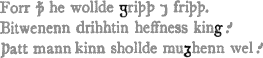
In this e-text, ordinary capital G was used for capital insular g (ᵹ), because font support for the correct form Ᵹ (hex A77D) is extemely limited. The printed linenotes almost always use yogh (ȝ) for insular g (ᵹ), plain g for Orm’s unique {g}. Lines have been split at the caesura for cleaner display.
F orrþrihht anan se iesu crist. Wass borenn off hiss moderr; ᵹho wand himm sone iwinndeclū́t. ⁊ leᵹᵹde himm inn a`n´ cribbe. Acc uss birrþ wĭtenn þ̵ he warrþ. All wiþþ hiss aᵹhenn wille. Vnnorne. ⁊ wrecche ⁊ usell child; Inn ure mennisscnesse : 5. heffness] erasure of o after he; so also in hefennlike, l. 8; werelld, l. 9, &c.; see notes. 5 Forr þ̵ he wollde inn heffness ærd; Vss alle makenn riche. ¶ ⁊ he þ̵ all þiss middellærd. Onn alle wise shrideþþ; f. 34 v1 He wollde wundenn | ben forr uss. I wrecche winnde clutess. Forr þ̵ he wollde shridenn uss; Wiþþ hefennlike wæde· ¶ ⁊ he þ̵ all þiss werelld shop· ⁊ alle shaffte stereþþ; 10 He lēt himm baþe bindenn her. Wiþþ bandess fēt ⁊ hande; Forr þ̵ he wollde unnbindenn uss. Off hellepiness bandess. ¶ ⁊ heffne. ⁊ lifft. ⁊ land. ⁊ sæ. Wiþþ {g}oddcunndnesse filleþþ; 13. full naru over an erasure. Þatt illke child. tatt tær wass leᵹᵹd. Inn an full naru cribbe; Forr þ̵ he wollde ᵹifenn uss. All heffness rume riche. 15 ¶ ⁊ he þ̵ fedeþþ enn{g}le þed. ⁊ alle cwike shaffte; He laᵹᵹ all alls hiss wille wass. Biforenn asse i cribbe. Swa summ he wære ᵹifenn himm; To wurrþenn himm to fode. Forr þ̵ he wollde brinn{g}enn uss; Vpp inntill heffness blisse. ⁊ ᵹifenn uss himm sellfenn þær; Wiþþ enn{g}less eche fode. 20 ¶ Þuss {g}odess sune allmahhtiᵹ {g}odd; Warrþ wrecche mann onn erþe. Forr swa to brinngenn mann kinn onn; To ᵹernenn affterr litell. Forr þ̵ he lufeþþ alle þa; þ̵ hise laᵹhess haldenn. ⁊ lufenn forr þe lufe off himm; To libbenn her onn erþe. Full wrecchelike inn uselldom; Off metess. ⁊ off claþess. 25 ¶ ⁊ tatt te laferrd iesu crist. Wass leᵹᵹd inn asse cribbe. Þatt tacneþþ uss. þ̵ he comm her. To wurrþenn mann onn erþe. Wiþþ mannkinn. þ̵ wass stunnt. ⁊ dill; ⁊ skill læs swa summ asse. ¶ ⁊ asse. þohh itt litell be. Itt hafeþþ mikell afell. To berenn upp well mikell sæm; Giff mann itt doþ þæronne. 30 ⁊ swa wass neh all follc þ̵ daᵹᵹ. Þatt crist comm her to manne. Neh all itt wass þa strang inoh. To þewwtenn laþe {g}astess. To berenn upp þ̵ laþe sæm; To don all þeᵹᵹre wille. ¶ ⁊ þurrh þ̵ {g}odd wass wurrþenn mann. Forr ure miccle nede; 34. þatt witt tu wel substituted at bottom of column for þatt seȝȝþ þe boc in text. 37. kald over an erasure. Þurrh þ̵ wass he. `þatt witt tu wel.´ All wiþþ hiss lefe wille. f. 34 v2 Niþþredd. ⁊ wannsedd wunnderrliᵹ. ⁊ laᵹhedd inn himm | sellfenn. 36 Forr o þ̵ hallf þ̵ he wass mann; Mann mihhte himm fon. ⁊ pinenn. Wiþþ hāt. ⁊ kald. wiþþ nesshe. ⁊ harrd· Wiþþ pine off þrisst. ⁊ hunngerr. ⁊ cwellenn himm mann mihhte wel; Inn ure mennisscnesse. ⁊ {g}odd wass wurrþenn swa forr uss; Gḗt lasse þann an enn{g}ell. 40 Forr mann ne maᵹᵹ nohht enn{g}ell sen; Ne tăkenn himm ne bindenn. 41. pinenn] i over an erasure. næfre] r changed into n by erasure. 42. godd warrþ over an erasure. 45. unorneliȝ with erasure over the first n. Ne pinenn himm. ne cwellenn himm. Forr he ne deᵹeþþ næfre. Acc drihhtin {g}odd warrþ her forr þe Gēt lasse þann hiss enn{g}ell. ⁊ lahᵹhre inoh. forr þi þatt he; Þe wollde ᵹifenn bisne. Þatt te birrþ aᵹᵹ þe sellfenn her; Þurrh soþ mecnesse laᵹhenn. 45 ⁊ lætenn swiþe unorneliᵹ; ⁊ litell off þe sellfenn. ¶ Þ att hirdess wokenn o þ̵at nahht. Þatt crist wass borenn onne; Þatt wass swa summ hiss wille wass. Forr þ̵ itt shollde tacnenn. Þatt he forr þi wass wurrþenn mann; Forr þ̵ he wollde sammnenn. An flocc off menn till cristenndom; ⁊ till þe rihhte læfe. 50 Þatt sholldenn wurrþenn hise shep; Þurrh here unnshaþiᵹnesse. ⁊ sholldenn habbenn oferr hemm; Bisscopess. prestess. dæcness Forr þ̵ teᵹᵹ sholldenn hirdess ben; To ᵹemenn hemm. ⁊ {g}ætenn. ⁊ ec forr þ̵ he wollde ben. Himm sellf ūt numenn hirde. 55 Swa þ̵ he wollde hiss aᵹhenn lif; Forr hise shep forrlætenn. ¶ Þatt {g}odess enn{g}ell comm o nihht. Swa summ ðe {g}oddspell kiþeþþ. To spekenn wiþþ þa wake menn. Þatt wokenn heore faldess; ⁊ tatt he comm þ̵ nihht till hemm. Wiþþ heoffness lihht. ⁊ leome. ⁊ tatt teᵹᵹ wærenn forr þ̵ lihht. ⁊ forr ðatt enn{g}less sihhþe. Forr dredde swiþe fasste anan. Swa summ þe {g}oddspell kiþeþþ; 60 ⁊ ec þatt {g}odess enn{g}ell toc. To frofrenn hemm wiþþ worde. f. 35 r1 All þ̵ wass don | þurrh iesu crist. Forr mikell þin{g} to tacnenn. ¶ Itt tacneþþ uss þatt ure {g}odd. Well offte senndeþþ enn{g}less. Inn till þiss middell ærd. tatt iss. All full off þessterrnesse : Þatt iss off all þ̵ ifell iss; Inn alle kinne sinne; 65 Itt tacneþþ þ̵ he senndeþþ hemm; Inn till þiss þeossterrnesse. To frofrenn þa þ̵ wakenn wel; Onnᵹæness laþe {g}astess. ⁊ stanndenn inn to shildenn hemm; Fra deofless swikedomess. ⁊ all þ̵ flocc þ̵ hemm iss sētt; To ᵹemenn. ⁊ to {g}ætenn. To frofrenn swillke senndeþþ {g}odd. Enn{g}less. ⁊ hallᵹhe sawless. 70 ⁊ aᵹᵹ þeᵹᵹ cumenn dun till þa; Wiþþ heoffness lihht. ⁊ leome. Þatt iss wiþþ witt. ⁊ {g}od innsihht; Inn alle kinne þin{g}e. Forr drihhtin ᵹifeþþ her hiss þeww; {g}od witt. ⁊ mahht. ⁊ wille. To stanndenn ᵹæn þe laþe {g}ast. ⁊ ᵹæn all þ̵ he læreþþ. Acc aᵹᵹ þeᵹᵹ sinndenn þohh swa þehh; Well swiþe sare off dredde. 75 Off domess daᵹᵹes starrke dom; ⁊ off þe demess irre. All all swa summ þa wăke menn; Well swiþe offdredde wærenn. Off heoffness brihhte lihht ⁊ lem ; ⁊ off þ̵ enn{g}less sihhþe. Ace hihht. ⁊ hope o drihhtin {g}odd. ⁊ onn hiss mildheorrtnesse; Þatt frofreþþ hemm. ⁊ beldeþþ hemm; To follᵹhenn {g}odess lare. 80 To fandenn ᵹiff þeᵹᵹ muᵹhenn swa; ðe demess are winnenn. ⁊ tatt wass uss bitacnedd wel; Þurrh ðatt tatt {g}odess enn{g}ell. Toc sone anan wiþþ milde word; ða wăke menn to frofrenn. Forr þ̵ he wisste wel þ̵ teᵹᵹ; Off himm forrdredde wærenn. Forr {g}odess enn{g}ell frofreþþ mann; Giff þ̵ he seþ himm færedd. 85 Forr {g}odess enn{g}ell iss full mec; ⁊ soffte. ⁊ milde. ⁊ bliþe. ¶ ⁊ defell iss all full off niþ; ⁊ full off {g}rammcunndnesse. ⁊ full off hĕte towarrd mann; ⁊ full off modiᵹnesse ⁊ ᵹiff he seþ þe mann forrdredd; He wile himm skerrenn mare. ⁊ ræfenn himm hiss rihhte witt; ⁊ shetenn inn hiss herrte. | f. 35 r2 Acc whas itt iss þ̵ wæpnedd iss. Wiþþ fulle trowwþe o criste; 91 Þohh þ̵ he {g}risliᵹ defell seo. Niss he rihht nohht forrfæredd. ¶ Þatt enn{g}ell seᵹᵹde ðatt he wass; Þa cumenn forr to kiþenn. O {g}odess hallfe þær till hemm. A`n´ swiþe mikell blisse. Þatt shollde ben till all þe follc. Þatt seᵹᵹde he forr þ̵ tanne; 95 Wass cumenn i þiss middellærd. Full mikell blisse. ⁊ sellðe. Till alle `þa´ þ̵ sholldenn wel; O {g}odess sune lefenn. O iesu crist. tatt borenn wass. þ̵ illke nahht to manne. ¶ He seᵹᵹde þ̵ te laferrd crist. Wass borenn her to manne. Nohht o þe nahht. acc o þe daᵹᵹ. Forr mikell þing to tacnenn. 100 Forr daᵹᵹess lihht bitacneþþ uss; All eche lifess blisse ⁊ nahht bitacneþþ all þ̵ wa; Þ̷ iss inn helle pine. ⁊ crist wass borenn i þiss lif; To lesenn uss off helle. Forr þ̵ he wollde ᵹifenn uss; Wiþþ enn{g}less eche blisse. ¶ ⁊ tatt wass uss bitacnedd ec. Þurrh þ̵ tatt {g}odess enn{g}ell. 105. awwredd in MS. 105 Wass awwnedd till ða wăke menn; Wiþþ heffness lihht ⁊ leme. Forr {g}odess sune iesu crist; Wass wurrþenn mann onn erþe. To ᵹifenn heoffness lihht. ⁊ lem; Þ̷ follc. þ̵ shollde himm follᵹhenn. ¶ Þatt {g}odd all mahhtiᵹ wurrþenn wass. Gun{g} child inn ure kinde. ⁊ wrecche child. off wrecche kinn; ðatt doþ uss tunnderrstanndenn. 110 Þatt uss birrþ mikell lufenn crist. ⁊ lofenn himm ⁊ wurrþenn. Off þatt he wollde himm sellfenn swa; Forr ure lufe laᵹhenn. ⁊ off þatt he warrþ wrecche mann; Forr uss to makenn riche. Wiþþ enn{g}less upp inn heoffness ærd; Wiþþ utenn ende i blisse. Annd þurrh þ̵ tatt tær awwnedd wass. An here off {g}odess enn{g}less. 115 Þatt time þ̵ te laferrd crist. Wass borenn her to manne; Þurrh þ̵ wass uss don þær full wel. To sen. ⁊ tunnderrstanndenn. Þatt enn{g}less stanndenn aᵹᵹ occ aᵹᵹ. To lofenn {g}odd ⁊ wurrþenn. f. 35 v1 ¶ ⁊ þurrh þ̵ illke wass uss ec. Don full wel tunnderrstanndenn. Þatt uss birrþ lofenn drihhtin aᵹᵹ; Wiþþ innwarrd herrtess tunge. 120 ⁊ þannkenn himm þ̵ miccle {g}od; Þatt he doþ uss onn erþe. ¶ ⁊ þurrh þ̵ illke wass uss ec. Don full wel tunnderrstanndenn. Þatt crist all enn{g}le þede kin{g}. Wass borenn her to manne. Alls iff he ᵹæn þe laþe {g}ast. Wiþþ hĕre wollde fihhtenn. 124. walde] After l, l erased. To winnenn adam. ⁊ hiss kinn; V̋t off þe defless walde. 125 ⁊ settenn enn{g}less oferr hemm; To ᵹemenn hemm ⁊ {g}ætenn. ⁊ forr to shildenn hemm onn ᵹæn; ðe deofless laþe wiless. ¶ Annd {g}odess enn{g}less wærenn þa; Well swiþe glade wurrþenn. Off ðatt tatt {g}odd wass wurrþenn mann. Forr þ̵ teᵹᵹ wisstenn alle. Þatt teᵹᵹre {g}en{g}e shollde ben; Wiþþ {g}ode sawless ekedd. 130 ⁊ wurrþedd ec. ⁊ all forrþi; Þeᵹᵹ wærenn swiþe bliþe. ⁊ all forr þi þeᵹᵹ sun{g}enn þa. ðiss san{g} wiþþ mikell blisse. Si drihhtin upp inn heffness ærd; Wurrþshipe. ⁊ loff. ⁊ wullderr. ⁊ upp onn erþe {g}riþþ. ⁊ friþþ; Þurrh {g}odess mildherrtnesse. Till iwhillc mann þ̵ habbenn shall; {g}od herte ⁊ `aᵹᵹ´ {g}od wille. 135 ¶ Þiss sun{g}enn þeᵹᵹ. forr þi þ̵ teᵹᵹ. Full wel þær unnderrstodenn. 134. aᵹᵹ added in margin and god corrected out of gode, so too in ll. 147, 154. Þatt teᵹᵹre {g}en{g}e shollde ben; Þurrh hallᵹhe sawles. ekedd. Þurrh whatt biforenn drihhtin {g}odd· Giff þ̵ itt waxenn mihhte. Wurrþshipe ⁊ wullderr shollde ben; Swa summ itt waxenn wære. ⁊ ec forr þatt teᵹᵹ wisstenn wel. Þatt {g}odd comm her to manne. 140 Forr þ̵ he wollde {g}riþþ ⁊ friþþ. ⁊ soþ sahhtnesse settenn. Bitwenenn drihhtin heffness king; ⁊ mannkinn her onn erþe. Þatt mann kinn shollde muᵹhenn wel; Vpp cumenn inn till heffne. Þatt heffness here mihhte swa; Þurrh hallᵹhe sawless waxenn. Þurrh whatt bi forenn drihhtin {g}odd; Wurrþshipe waxenn shollde. 145 Giff þ̵ himm mihhte waxenn ohht; ⁊ wurrþenn bettre ⁊ mare. ¶ Þatt {g}riþþ wass sett till alle þa. Swa summ þe {g}oddspell kiþeþþ. f. 35 v2 Þatt sholl | denn wurrþenn {g}ode menn; ⁊ habbenn `aᵹᵹ´ {g}od wille. Till þa þ̵ sholldenn unnderrfon; Wiþþ blisse cristess come. ⁊ nohht till þa þ̵ sholldenn himm; Forrhoᵹhenn ⁊ forrwerrpenn. 150 Forr niss nohht {g}odess {g}riþþ wiþþ þa; Þ̷ wiþþrenn {g}odd onn ᵹæness. Acc helle wawenn iss till þa; All affterr þeᵹᵹre wrihhte. ¶ ⁊ her mann unnderrstanndenn maᵹᵹ; Whillc mann iss drihhtin cweme. Þatt illke mann iss drihhtin lef; Þ̷ hafeþþ {g}ode wille. Forr wha se itt iss þatt illke mann Þatt hafeþþ `aᵹᵹ´ {g}od wille 155 Þatt illke mann ne sinnᵹheþþ nohht. Ne {g}illteþþ hise þannkess. Ne towarrd {g}odd· ne towarrd mann; Giff þ̵ he maᵹᵹ himm lokenn. ⁊ ᵹiff þ̵ iss þ̵ he missdoþ. Onn aniᵹ kinne wise; Itt reweþþ himm. ⁊ sone anan; He stannt itt inn to betenn. 159. enngell comm o nahht over an erasure. ¶ Þatt {g}odess enn{g}ell comm o nahht. Wiþþ heffness lihht onn erþe; 160 Þatt tacneþþ þ̵ tiss middellærd. Wass full off þessterrnesse. Þurrh illkess kinness hæþenndom. Inn iwhillc unnclænnesse; Þatt time þ̵ te laferrd crist. Wass borenn her to manne. To ᵹifenn heffness lihht. ⁊ lem; Þ̷ follc þ̵ shollde himm cwemenn. ¶ ⁊ tatt tatt enn{g}ell nohht ne comm. Till kin{g}ess ne till erless. 165 Ne till þ̵ laþe riche flocc. Þatt follᵹheþþ modiᵹnesse; Þatt doþ uss tunnderrstanndenn wel; Þ̷ drihhtin {g}odd forrwerrpeþþ. All modiᵹleᵹᵹc. ⁊ {g}reditleᵹᵹc : ⁊ irre. ⁊ gluterrnesse. ⁊ all þ̵ follᵹheþþ horedom. ⁊ swikedom onn erþe. Þatt mann maᵹᵹ findenn allre mast. I þa þ̵ sinndenn riche. 170. þatt] between þ and a an erasure. 170 þatt {g}odess enn{g}ell awwnedd wass. In aness weress hewe; Þatt wass forr þi þ̵ enn{g}ell maᵹᵹ. Wiþþ hiss drihhtiness wille. Himm awwnenn alls he wære a mann. I manness limess alle. I bodiᵹ. þ̵ he doþ himm inn; Off hefennlike kinde. 174. Added lengthwise on the margin. ¶ `⁊ {g}odd wiþþ enn{g}less gife uss. á. To brukenn heffness blisse.´ Amæn.