Front matter (continued 3)
Reading edition
[fig 130]
Fig. 130. Pentacta frondosa; expanded about one third the natural size.
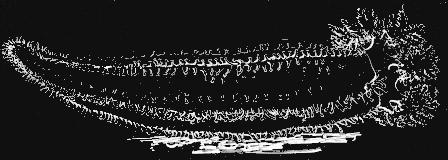
The correspondence between the different phases of growth in the young Pentacta, and the adult forms of the orders described above, the Synapta, Caudina, Cuvieria, and Pentacta itself, is a striking instance of the way in which embryonic forms illustrate the relative standing of adult animals. In the earlier stages of its development, the ambulacral tubes alone are developed in the Pentacta; in this condition it recalls the lower orders of Holothurians, as the Synapta and Caudina; then a sole is formed by the greater development of three of the ambulacra, and in this state it reminds us of the next in order, the Cuvieria, while it is only in assuming its adult form that the Pentacta develops its other ambulacra, with their many suckers.
The Pentacta resembles the Trepang, so highly valued by the Chinese as an article of food, and forms a not unsavory dish, having somewhat the flavor of lobster.
ECHINOIDS.
Sea-urchin. (Toxopneustes drobachiensis Ag.)
[fig 131]
Fig. 131. Toxopneustes from above, with all the appendages expanded; natural size.
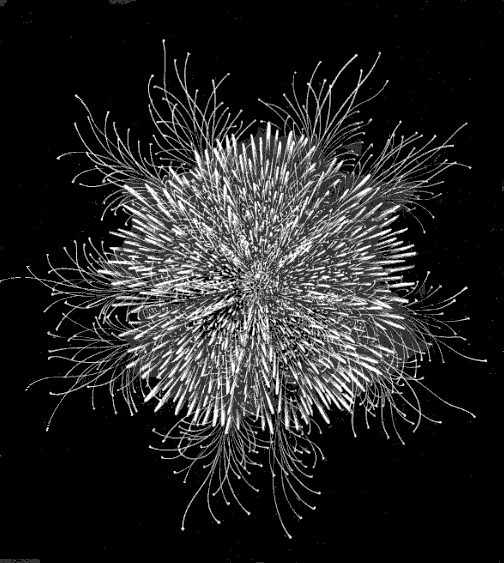
Sea-urchins (Fig. 131) are found in rocky pools, hidden away usually in cracks and holes. They like to shelter themselves in secluded nooks, and, not satisfied even with the privacy of such a retreat, they cover themselves with sea-weed, drawing it down with their tentacles, and packing it snugly above them, as if to avoid observation. This habit makes them difficult to find, and it is only by parting the sea-weed, and prying into the most retired corners in such a pool, that one detects them. Their motions are slow, and they are less active than either the Star-fish or the Ophiuran, to both of which they are so closely allied.
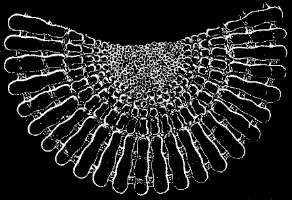
Let us look at one first, as seen from above, with all its various organs fully extended. (Fig. 131.) The surface of the animal is divided by ten zones, like ribs on a melon, only that these zones differ in size, five broad zones alternating with five narrower ones. The broad zones, representing the interambulacral system, are composed of large plates, supporting a number of hard projecting spines, while the narrow zones, forming the ambulacral system, are pierced with small holes, arranged in regular rows, (Fig. 132,) through which extend the tentacles terminating with little cups or suckers. These zones converge towards the summit of the animal, meeting in the small area which here represents the dorsal system; this area is filled by ten plates, five larger ones at the extremity of the interambulacral zones, and five smaller ones at the extremity of the ambulacral zones. (Fig. 132.) In the five larger plates are the ovarian openings, so-called because each one is pierced by a small hole through which the eggs are passed out, while in the five smaller plates are the eye-specks. The ovaries themselves consist of long pouches or sacs, carried along the inner side of each ambulacrum; one of these ovarian plates is larger than the others, and forms the madreporic body, being pierced with many minute holes; here, as in the Star-fish, it is placed between two of the ambulacral rows, and opposite the fifth or odd one. Looked at from the under or the oral side, as seen in Fig. 134, the animal presents the mouth, a circular aperture furnished with five teeth in its centre; these five teeth opening into a complicated intestine to be presently described. From the mouth, the ten zones diverge, curving upward to meet in the dorsal area on the summit of the body. (Fig. 133.)
[fig 132]
[fig 133]
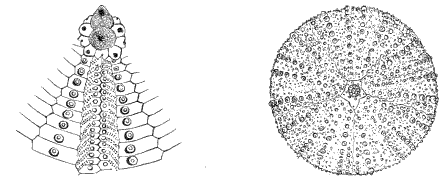
Fig. 132. Portion of shell of Fig. 131, with spines rubbed off. (Agassiz.)
Fig. 133. Sea-urchin shell with all the spines removed. (Agassiz.)
Let us now examine the appearance and functions of the various appendages on the surface. The tentacles have a variety of functions to perform; they are the locomotive appendages, and for this reason, as we have seen, the zones along which they are placed are called the ambulacra, while the intervening spaces, or the broad zones, are called the interambulacra. It should not be supposed, however, that the locomotive appendages are the only ones to be found on the ambulacra, for spines occur on the narrow as well as on the broad zones, though the larger and more prominent ones are always placed on the latter. The tentacles are also subservient to circulation, for the water which is taken in at the madreporic body passes into all the tentacles, sometimes called on that account water-tubes. Beside these offices the tentacles are constantly busy catching any small prey, and conveying it to the mouth, or securing the bits of sea-weed with which, as has been said, these animals conceal themselves from observation. It is curious to see their fine transparent feelers, fastening themselves by means of the terminal suckers on such a floating piece of sea-weed, drawing it gently down and packing it delicately over the surface of the body. As locomotive appendages, the tentacles are chiefly serviceable on the lower or oral side of the animal, which always moves with the mouth downward. About this portion of the body the tentacles are numerous (Fig. 134) and large, and when the animal advances it stretches them in a given direction, fastens them by means of the suckers on some surface, be it of rock, or shell, or the side of the glass jar in which they are kept, and being thus anchored it drags itself forward. The tentacles are of a violet hue, though when stretched to their greatest length they lose their color, and become almost white and transparent; but in their ordinary condition the color is quite decided, and the rows along which they occur make as many violet lines upon the surface of the body.
[fig 134]
[fig 135]
Fig. 134. Sea-urchin seen from the mouth side. (Agassiz.) Fig. 135. Magnified spine.
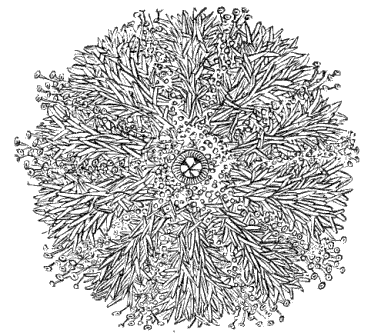

Almost the sole function of the spines seems to be that of protecting the animal, and enabling it to resist the attacks of its enemies, the force of the waves, or any sudden violent contact with the rocks. The spines, when magnified, are seen to be finely ribbed for nearly the whole length (Fig. 135), the bare basal knob serving as the point of attachment for the powerful muscles, which move these spines on a regular ball-and-socket joint, the ball surmounting the tubercles (seen in Fig. 132), which fit exactly in a socket at the base of the spine. In a transverse section of a spine (Fig. 136), we see that the ribs visible on the outside are delicate columns placed closely side by side, and connected by transverse rods forming an exceedingly delicate pattern. Beside the tentacles and the spines, they have other external appendages, of which the function long remained a mystery, and is yet but partially explained; these are the so-called pedicellariæ; they consist of a stem (s, Fig. 137), which becomes swollen (p, Fig. 137) into a thimble-shaped knob at the end (t, Fig. 137); this knob may seem solid and compact at first sight, but it is split into three wedges, which can be opened and shut at will. When open, these pedicellariæ may best be compared to a three-pronged fork, except that the prongs are arranged concentrically instead of on one plane, and, when closed, they fit into one another as neatly as the pieces of a puzzle.
[fig 136]
[fig 137]
Fig. 136. Transverse section of spine; magnified. Fig. 137. Pedicellariæ of Sea-urchin; s stem, p base of fork, t fork.
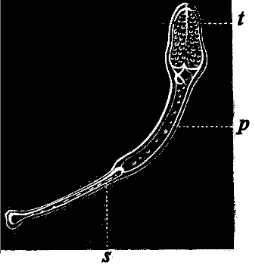
If we watch the Sea-urchin after he has been feeding, we shall learn, at least, one of the offices which this singular organ performs in the general economy of the animal. That part of his food which he ejects passes out at an opening on the summit of the body, in the small area where all the zones converge. The rejected particle is received on one of these little forks, which closes upon it like a forceps, and it is passed on from one to the other, down the side of the body, till it is dropped off into the water. Nothing is more curious and entertaining than to watch the neatness and accuracy with which this process is performed. One may see the rejected bits of food passing rapidly along the lines upon which these pedicellariæ occur in greatest number, as if they were so many little roads for the conveying away of the refuse matters; nor do the forks cease from their labor till the surface of the animal is completely clean, and free from any foreign substance. Were it not for this apparatus the food thus rejected would be entangled among the tentacles and spines, and be stranded there till the motion of the water washed it away. These curious little organs may have some other office than this very laudable and useful one of scavenger, and this seems the more probable because they occur over the whole surface of the body, while they seem to pass the excrements only along certain given lines. They are especially numerous about the mouth, where they certainly cannot have this function; we shall see also that they bear an important part in the structure of the Star-fish, where there are no such avenues on the upper surface, for the passage of the refuse food, as occur on the Sea-urchin.
[fig 138]
Fig. 138. Teeth of Sea-urchin, so-called Lantern of Aristotle.
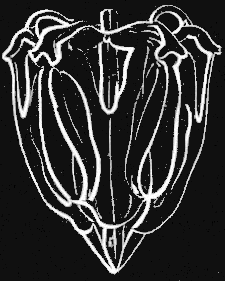
On opening a Sea-urchin, we find that the teeth (Fig. 138), which seem at first sight only like five little conical wedges around the mouth (Fig. 134), are connected with a complicated intestine, which extends spirally from the lower to the upper floor of the body, festooning itself from one ambulacral zone to the next, till it reaches the summit, where it opens. This intestine leads into the centre of the teeth, the jaws themselves, which sustain the teeth, being made up of a number of pieces, and moved by a complicated system of muscular bands. When the intestine is distended with food, it fills the greater part of the inner cavity; the remaining space is occupied in the breeding season by the genital organs. In a section of the Sea-urchin, one may also trace the tube by which the supply of water, first filtered through the madreporic body, is conveyed to the ambulacra; it extends from the summit of the body to the circular tube surrounding the mouth.
Echinarachnius. (Echinarachnius parma Gray.)
[fig 139]
Fig. 139. Echinarachnius, seen from above, with the spines on part of the shell; a ambulacral zone, i interambulacral zone.
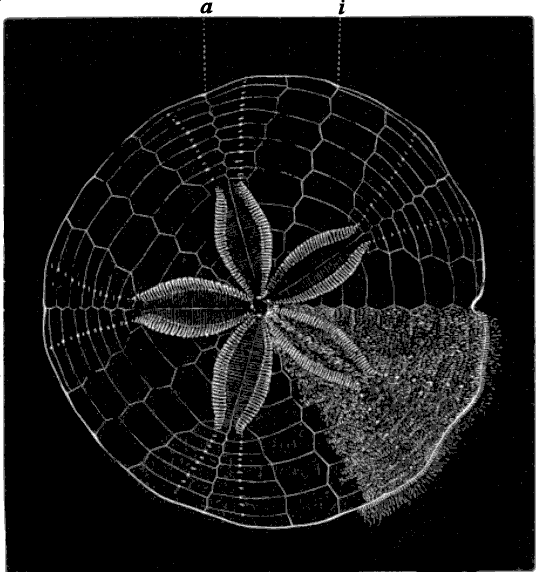
Beside the Toxopneustes (Fig. 131) described above, we have another Sea-urchin very common along our shores. Among children who live near sandy beaches, they are well known as "sand-cakes" (Fig. 139), and indeed they are so flat and round, that, when dried and deprived of their bristles, they look not unlike a cake with a star-shaped figure on its surface. (Fig. 139.) When first taken from the water they are of a dark reddish brown color, and covered with small silky bristles. The disk is so flat, being but very slightly convex on the upper side, that one would certainly not associate it at first sight with the common spherical Sea-urchin or Sea-egg, as the Toxopneustes is sometimes called. But upon closer examination the delicate ambulacral tubes or suckers may be seen projecting from along the line of the ambulacra, as in the spherical Sea-urchin; and though these ambulacra become expanded near the summit into gill-like appendages, forming a sort of rosette in the centre of the disk, they are, nevertheless, the same organs, only somewhat more complicated. When such a disk is dried in the sun, and the bristles entirely removed, the lines of suture of the plates composing it, and corresponding exactly to those of the spherical Sea-urchin, may very readily be seen. (a and i, Fig. 139.)
[fig 140]
Fig. 140. Transverse section of Echinarachnius; o mouth, e e ambulacra, c m ambulacral ramifications, w w interambulacra. (Agassiz.)
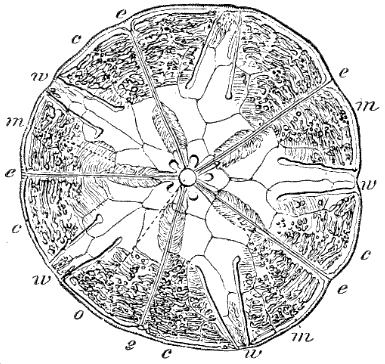
This flat Sea-urchin or Echinarachnius, as it is called, belongs to a group of Sea-urchins known as Clypeastroids (shield-like Sea-urchins). In a section (Fig. 140) exposing the internal structure, one cannot but be reminded by its general aspect of an Aurelia. Could one solidify an Aurelia it would present much the same appearance; another evidence that all the Radiates are built on one plan, their differences being only so many modes of expressing the same structural idea. The teeth or jaws in this flat Sea-urchin are not so complicated as in the Toxopneustes, being simply flat pieces, arranged around the mouth (o, Fig. 140), without the apparatus of muscular bands by means of which the teeth are moved in the other genus. It is a curious fact, considered in relation to the general radiate structure of these animals, that the teeth, instead of moving up and down like the jaws in Vertebrates, or from right to left like those of Articulates, move concentrically, all converging towards the centre.
STAR-FISHES.
Star-fish. (Astracanthion berylinus Ag.)
[fig 141]
Fig. 141. Star-fish ray, seen from mouth side. (Agassiz.)
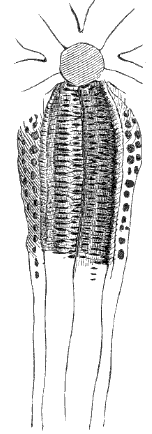
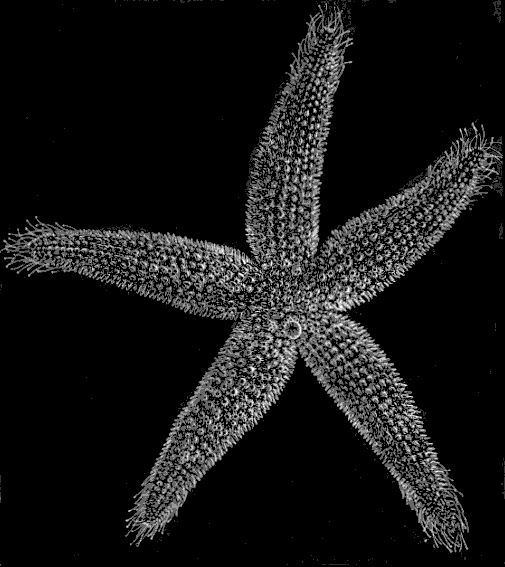
Although there is the closest homology of parts between the Star-fish and the Sea-urchin, the arrangement of these parts, and the external appearance of the animals, as a whole, are entirely different. The Star-fish has zones corresponding exactly to those of the Sea-urchin, but instead of being drawn together, and united at the summit of the animal, so as to form a spherical outline, they are spread out on one level in the shape of a star. This change in the general arrangement brings the eye-specks to the extremities of the arms, and places the ovarian openings in the angles between the arms. The madreporic body is situated on the upper surface of the disk (Fig. 142), at the angle between two of the arms, and consequently between two of the ambulacra, and opposite the odd one. The tube into which it opens, runs vertically from the upper floor of the disk to the lower, where it connects with the circular tube around the mouth, and thus communicates with all the ambulacral rows. The ambulacral zones which, in the Star-fish, have the shape of a furrow, run along the lower side of each ray (Fig. 141); the interambulacral zones are divided, their plates being arranged in rows along either side of the ambulacral furrows. The ambulacral furrow, like the ambulacral zone in the Sea-urchin, is pierced with numerous holes, alternating with each other in a kind of zigzag arrangement, one hole a little in advance, the next a little farther back, and so on, and through these holes pass the tentacles, terminating in suckers, as in the Sea-urchins, and serving as in them for locomotive organs. The most prominent and strongest spines are arranged upon the large interambulacral plates on both sides of the ambulacral furrows; but the upper surface of the animal is also completely studded with smaller spines, scattered at various distances, apparently without any regular arrangement. (Fig. 142.)
[fig 142]
Fig. 142. Star-fish; natural size, seen from above.
The position of the pedicellariæ is quite different from that which they occupy in the Sea-urchin, where they are scattered singly between the spines and tentacles, though more regularly and closely grouped along the lines upon which the refuse food is moved off. In the Star-fish, on the contrary, these singular organs seem to be grouped for some special purpose around the spines, on the upper surface of the body. Every such spine swells near its point of attachment, thus forming a spreading base (Fig. 143), around which the pedicellariæ are arranged in a close wreath, in the centre of which the summit of the spine projects; they differ also from those of the Sea-urchin in having two prongs instead of three. Other pedicellariæ are scattered independently over the surface of the animal, but they are smaller than those forming the clusters and connected with the spines. The function of these organs in the Star-fish remains unexplained; the opening on the upper surface, through which the refuse food is thrown out, is in such a position that they evidently do not serve here the same purpose which renders them so useful to the Sea-urchin. Occasionally they may be seen to catch small prey with these forks, little Crustacea, for instance; but this is probably not their only office. The Star-fish has a fourth set of external appendages in the shape of little water-tubes. (Seen in Fig. 143.) The upper surface of the back consists of a strong limestone network (Fig. 144), and certain openings in this network are covered with a thin membrane through which these water-tubes project. It is supposed that water may be introduced into the body through these tubes; but while there can be no doubt that they are constantly filled with water, and are therefore directly connected with the circulation through the madreporic body (Fig. 145), no external opening has as yet been detected in them. The fact, however, that when these animals are taken out of their native element, the water pours out of them all over the surface of the back, so that they at once collapse and lose entirely their fulness of outline, seems to show that water does issue from those tubes. The ends of the arms are always slightly turned up, and at the summit of each is a red eye-speck. The tentacles about the eye become very delicate and are destitute of suckers.
[fig 143]
[fig 144]
[fig 145]
Fig. 143. Single spine of Star-fish, with surrounding appendages; magnified. Fig. 144. Limestone network of back of Star-fish.
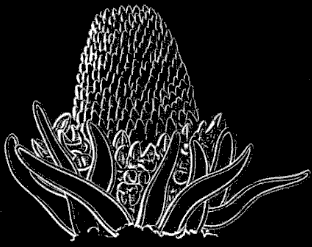
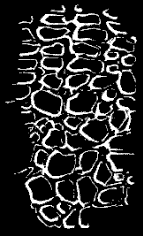
Fig. 145. Madreporic body of Star-fish; magnified.
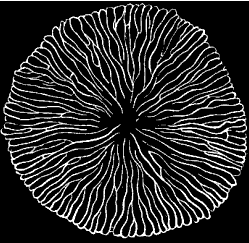
These animals have singular mode of eating; they place themselves over whatever they mean to feed upon, as a cockle-shell for instance, the back gradually rising as they arch themselves above it; they then turn the digestive sac or stomach inside out, so as to enclose their prey completely, and proceed leisurely to suck out the animal from its shell. Cutting open any one of the arms we may see the yellow folds of the stomach pouches which extend into each ray; within the arms, extending along either side of the upper surface, are also seen the ovaries, like clusters of small yellow berries. Immediately below these, along the centre of the lower floor of each ray, runs the ridge formed by the ambulacral furrow, and upon either side of this ridge are placed the vesicles, by means of which the tentacles may be filled and emptied at the will of the animal; the rest of the cavity of the ray is filled by the liver. The mouth, which is surrounded by a circular tube, is not furnished with teeth, as in the Sea-urchin; but the end of each ambulacral ridge is hard, thus serving the purpose of teeth.
Cribrella. (Cribrella oculata Forbes.)
Our coast, as we have said, is not rich in the variety of Star-fishes. We have two large species, one of a dark-brown color (Fig. 132), the Astracanthion berylinus, and the other, the A. pallidus, of a pinkish tint; then there is the small Cribrella, inferior in structural rank to the two above mentioned. (Fig. 146.) This pretty little Star-fish presents the greatest variety of colors; some are dyed in Tyrian purple, others have a paler shade of the same hue, some are vermilion, others a bright orange or yellow. A glass dish filled with Cribrellæ might vie with a tulip-bed in gayety and vividness of tints.
[fig 146]
Fig. 146. Cribrella from above; natural size.
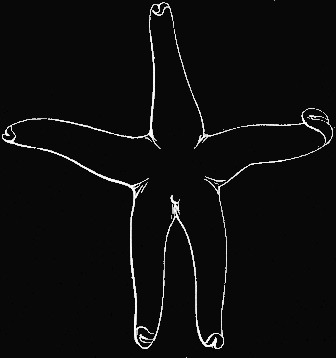
The disk of the Cribrella is smooth, instead of being covered, like the larger Star-fishes, with a variety of prominent appendages. The spines are exceedingly short, crowded like little warts over the surface. It is an interesting fact, illustrating again the correspondence between the adult forms of the lower orders and the phases of growth in the higher ones, that these spines have an embryonic character. One would naturally expect to find that these small spines of the adult Cribrella would differ from those of the other full-grown Star-fishes chiefly in size, that they would be a somewhat modified pattern of the same thing on a smaller scale; but when examined under the microscope, they resemble the spines of the higher orders in their embryonic condition; it is not, in fact, a difference in size merely, but a difference in degree of development. The Cribrella moves usually with two of the arms turned backward, and the three others advanced together, the two posterior ones being sometimes brought so close to each other as to touch for their whole length.
Hippasteria. (Hippasteria phrygiana Ag.)
Beside these Star-fishes we have the pentagonal Hippasteria (Hippasteria phrygiana Ag.), like a red star with rounded points, found chiefly in deep water, though it is occasionally thrown up on the beaches. It has but two rows of large tentacles, terminating in a powerful sucking disk. The pedicellariæ on this Star-fish resemble large two-pronged clasps, arranged principally along the lower side. The pentagonal Star-fishes of our coast are in striking contrast to the long-armed species we have just described; they are edged with rows of large smooth plates, and do not possess the many prominent spines so characteristic of the ordinary Star-fishes.
Ctenodiscus. (Ctenodiscus crispatus D. & K.)
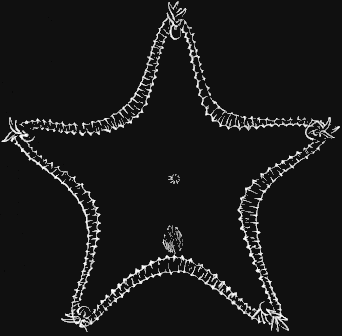
The Ctenodiscus (Ctenodiscus crispatus D. & K., Fig. 147), an inhabitant of more northern waters, but seeming also to be at home here occasionally, is another pentagonal Star-fish. It lives in deep water, and frequents muddy bottoms. The peculiar structure of their ambulacra has probably some reference to this mode of living, for they are entirely wanting in the sucking disks so characteristic of the other members of this class, and their tentacles are pointed, as if to enable them to work their way through the mud in which they make their home. The pointed tentacles of this genus are characteristic of a large group of Star-fishes, and it is an important fact, as showing their lower standing, that this feature, as well as the pentagonal outline, obtains in the earlier stages of growth of our more common Star-fishes, while in their adult condition they assume the deeply indented star-shaped outline, and have suckers at the extremities of the tentacles.
[fig 147]
Fig. 147. Ctenodiscus, seen from above; natural size.
Solaster. (Solaster endeca Forbes.)
We find also among Star-fishes the same tendency to multiplication of parts so common among the Polyps and Acalephs. Our Solaster (Solaster endeca/ Forbes), for instance, has no less than twelve arms; it inhabits more northern latitudes, though sometimes found in our Bay; on the coast of Maine it is quite common, and occurs in company with another many-rayed species, the Crossaster papposa M. & T. The color of both of these Star-fishes is exceedingly varied; we find in the Solaster as many different hues as in the Cribrella, which it resembles in the structure of its spines, while in the Crossaster bands of different tints of red and purple are arranged concentrically, and the whole surface of the back is spotted with brilliantly-tinged tiny wreaths of water-tubes, crowded round the base of the different spines, which are somewhat similar to those of the Astracanthion.
OPHIURANS.
Ophiopholis. (Ophiopholis bellis Lym.)
[fig 148]
Fig. 148. Ophiopholis, from above; natural size.
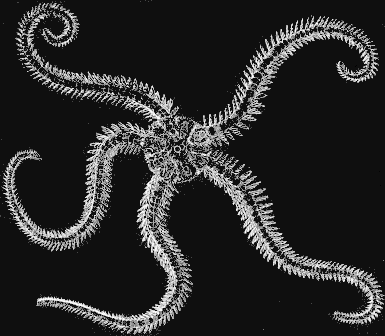
There are but two species of the ordinary forms of Ophiurans in Massachusetts Bay; the white Amphiura (Amphiura squamata Sars), with long slender arms, and the spotted Ophiopholis (Fig. 148), with shorter and stouter arms, and in which the disk is less compact than in the Amphiura, and not so perfectly circular. All Ophiurans are difficult to find, from their exceeding shyness; they hide themselves in the darkest crevices, and though no eye-specks have yet been detected in them, they must have some quick perception of coming danger, for at the gentlest approach they instantly draw away and shelter themselves in their snug retreats.
They differ from the Star-fishes in having the disk entirely distinct from the arms; that is, the arms, instead of merging gradually into the disk, start at once from its margin. They have no interambulacral spaces or plates; but the whole upper surface is formed of large hard plates, which extend from the back over the sides of the arms to their lower surface, where they form a straight ridge along the centre. (Fig. 149.) The sides of these plates are pierced with holes, through which the tentacles pass; these have not, like those of the Star-fishes and Sea-urchins, a sucker at the extremity, but are covered with little warts or tubercles (Fig. 150); they are their locomotive appendages, and their way of moving is curious; they first extend one of the arms in the direction in which they mean to move, then bring forward two others to meet them, three arms being thus usually in advance, and then they drag the rest of the body on. They move with much more rapidity, and seem more active, than the Star-fishes; probably owing to the greater independence of the arms from the disk. The spines project along the margin of the arms, and not over the whole surface, the back of the arms being perfectly free from any appendages, and presenting only the surface of the plates. The madreporic body is formed by a plate on the lower side of the disk, in a position corresponding to that which it occupies in the young Star-fish; this plate is one of the large circular shields occupying the interambulacral spaces around the mouth. (Fig. 149.) On each side of the arms, where they join the disk, are slits opening into the ovarian pouches. They have no teeth; but the hard ridge at the oral end of the ambulacra, extending toward the mouth in Star-fish, is still more distinct and sharper in the Ophiurans, approaching more nearly the character of teeth.
[fig 149]
[fig 150]
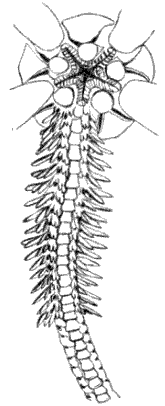
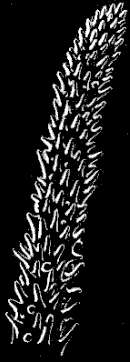
Fig. 149. One arm of Fig. 148; from the mouth side. Fig. 150. Ambulacral tentacle of Ophiopholis; magnified.
Astrophyton. (Astrophyton Agassizii Stimp.)
[fig 151]
Fig. 151. Astrophyton, Basket-fish; in a natural attitude. Click on image to view larger size.
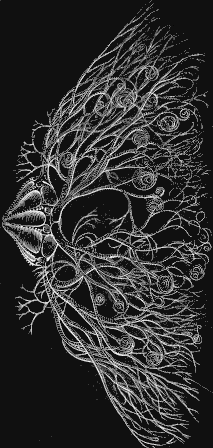
A singular species of Ophiuran, known among fishermen as the "Basket-fish," (Fig. 151,) is to be found in Massachusetts Bay. Its arms are very long in comparison to the size of the disk, and divide into a vast number of branches. In moving, the animal lifts itself on the extreme end of these branches, standing as it were on tiptoe (Fig. 151), so that the ramifications of the arms form a kind of trellis-work all around it, reaching to the ground, while the disk forms a roof. In this living house with latticed walls small fishes and other animals are occasionally seen to take shelter; but woe to the little shrimp or fish who seeks a refuge there, if he be of such a size as to offer his host a tempting mouthful; he will fare as did the fly who accepted the invitation of the spider. These animals are exceedingly voracious, and sometimes, in their greediness for food, entangle themselves in fishing lines or nets. When disturbed, they coil their arms closely around the mouth, assuming at such times a kind of basket-shape, from which they derive their name.
This Basket-fish is honorably connected with our early colonial history, being thought worthy, by no less a personage than John Winthrop, Governor of Connecticut, who, as he says, "had never seen the like," to be sent with "other natural curiosities of these parts" to the Royal Society of London, in 1670. He accompanies the specimen with a minute description, omitting "other particulars, that we may reflect a little upon this elaborate piece of nature." His account is as graphic as it is accurate, and we can hardly give a better idea of the animal than by extracting some portions of it. "This Fish," he says, "spreads itself from a Pentagonal Root, which incompasseth the Mouth (being in the middle), into 5 main Limbs or branches, each of which, just at issuing out from the Body, subdivides itself into two, and each of these 10 branches do again divide into two parts, making 20 lesser branches; each of which again divide into two smaller branches, making in all 40. These again into 80, and these into 160; and these into 320; these into 640; into 1280; into 2560; into 5120; into 10,240; into 20,480; into 40,960; into 81,920; beyond which the further expanding of the Fish could not be certainly trac'd";—a statement which we readily believe, wondering only at the patience which followed this labyrinth so far.
In a later letter, after having had an interview with the fisherman who caught the specimen, and, as he says, "asked all the questions I could think needful concerning it," the Governor proceeds to tell us that it was caught "not far from the Shoals of Nantucket (which is an Island upon the Coast of New England)," and that when "first pull'd out of the water it was like a basket, and had gathered itself round like a Wicker-basket, having taken fast hold upon that bait on the hook which he" (the fisherman) "had sunk down to the bottom to catch other Fish, and having held that within the surrounding brachia would not let it go, though drawn up into the Vessel; until, by lying a while on the Deck, it felt the want of its natural Element; and then voluntarily it extended itself into the flat round form, in which it appear'd when present'd to your view." The Governor goes on to reflect in a philosophical vein upon the purpose involved in all this complicated machinery. "The only use," he says, "that could be discerned of all that curious composure wherewith nature had adorned it seems to be to make it as a purse-net to catch some other fish, or any other thing fit for its food, and as a basket of store to keep some of it for future supply, or as a receptacle to preserve and defend the young ones of the same kind from fish of prey; if not to feed on them also (which appears probable the one or the other), for that sometimes there were found pieces of Mackerel within that concave. And he, the Fisherman, told me that once he caught one, which had within the hollow of its embracements a very small fish of the same kind, together with some piece or pieces of another fish, which was judged to be of a Mackerel. And that small one ('tis like) was kept either for its preservation or for food to the greater; but, being alive, it seems most likely it was there lodged for safety, except it were accidentally drawn within the net, together with that piece of fish upon which it might be then feeding." The account concludes by saying, "This Fisherman could not tell me of any name it hath, and 'tis in all likelihood yet nameless, being not commonly known as other Fish are. But until a fitter English/ name be found for it, why may it not be called (in regard of what hath been before mentioned of it) a Basket-Fish, or a Net-Fish, or a Purs-net-Fish?" And so it remains to this day as the Governor of Connecticut first christened it, the Basket-fish.
CRINOIDS.
The Crinoids are very scantily represented in the present creation. They had their day in the earlier geological epochs, when for some time they remained the sole representatives of their class, and were then so numerous that the class of Echinoderms, with only one order, seemed as full and various as it now does with five. The different forms they assumed in the successive geological periods are particularly instructive; these older Crinoids combined characters which foreshadowed the advent of the Ophiurans, the true Star-fishes, and the Sea-urchins; and so prominently were their prophetic characters developed, that many of them are readily mistaken for Star-fishes or Sea-urchins.
[fig 152]
Fig. 152. Fossil Pentacrinus.
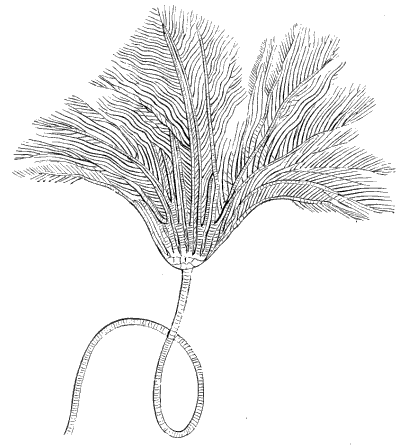
In later times the group of Crinoids has been gradually dwindling in number and variety. Its present representatives are the Pentacrini of Porto Rico and the coast of Portugal, the lovely little Rhizocrinus of the Atlantic, dredged first by the younger Sars on the coast of Norway, attached throughout life to a stem, and the Comatula, which has a stem only in the early stages of its growth, but is free when adult. The Pentacrinus bears the closer relation to the more ancient Crinoids (Fig. 152), which were always supported on a stem, while it is only in more recent periods that we find the free Crinoids, corresponding to the Comatula.
Comatula. (Alecto meridionalis Ag.)
One large species of Comatula (Alecto Eschrichtii M. & T.) is known on our coast, off the shores of Greenland, where it has been dredged at a depth of about one hundred and fifty fathoms, and young specimens of the same species have been found as far south as Eastport, Maine. The species selected for representation here, however, (Fig. 153,) is one quite abundant along the shores of South Carolina. It is introduced instead of the northern one, because the latter is so rare that it is not likely to fall into the hands of our readers. The annexed drawing (Fig. 154, magnified from Fig. 153) represents a group of the young of the Charleston Comatula, still attached to the parent body by their stems, and in various stages of development. At first sight, the Comatula, or, as it is sometimes called, the feather-star, resembles an Ophiuran; but on a closer examination we find that the arms are made up of short joints; and along the sides of the arms, attached to each joint, are appendages resembling somewhat the beards of a feather, and giving to each ray the appearance of a plume; hence the name of feather-star. On one side the arms are covered with a tough skin, through which project the ambulacræ, and on the same side of the disk are situated the mouth and the anus; the latter projects in a trumpet-shaped proboscis. On the opposite side of the disk the Comatula is covered with plates, arranged regularly around a central plate, which is itself covered with long cirri.
[fig 153]
[fig 154]
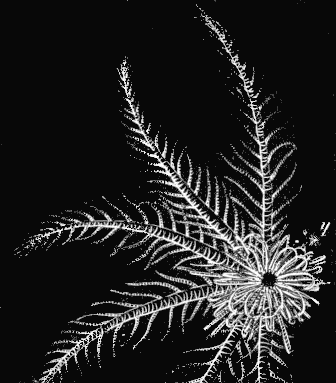
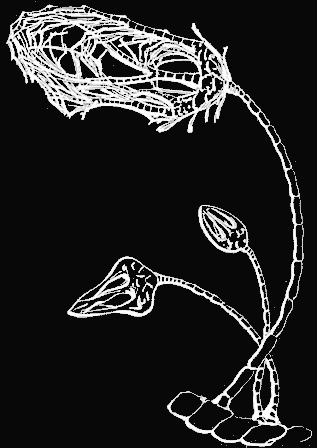
Fig. 153. Comatula (Living Crinoid) seen from the back; a group of young Comatulæ attached to parent. Fig. 154. Magnified view of the group of young Comatulæ of Fig. 153.
We are indebted to Thompson for the explanation of the true relations of the young Comatula to the present Pentacrinus and the fossil Crinoids. Supposing these young to be full-grown animals, he at first described them as living representatives of the genus Pentacrinus; it was only after he had watched their development, and ascertained by actual observation that they dropped from their stem, to lead an independent life as free Comatulæ, that he fully understood their true connection with the past history of their kind, as well as with their contemporaries. In Fig. 153, a faint star-like dot (y) may be seen attached to the side of the disk by a slight line. In Fig. 154, we have that minute dot as it appears under the microscope, magnified many diameters; when it is seen to be a cirrus of a Comatula, with three small Pentacrinus-like animals growing upon it, in different stages of development. In the upper one, the branching arms and the disk, with its many plates, are already formed; and though in the figure the rays are folded together, they are free, and can be opened at will. In the larger of the two lower buds, the plates of the disk are less perfect, and the arms are straight and simple, without any ramifications, though they are free and movable, whereas, in the smaller one, they are folded within the closed bud.
EMBRYOLOGY OF ECHINODERMS.
All Radiates have a special mode of development, as distinct for each class as is their adult condition, and in none are the stages of growth more characteristic than in the Echinoderms. In the Polyps, the division of the body into chambers, so marked a feature of their ultimate structure, takes place early; in the Acalephs, the tubes which traverse the body are hollowed out of its mass in the first stages of the embryonic growth, and we shall see that in the Echinoderms also, the distinctive feature of their structure, viz. the enclosing of the organs by separate walls, early manifests itself. This peculiarity gives to the internal structure of these animals so individual a character, that some naturalists, overlooking the law of radiation, as prevalent in them as in any members of this division, have been inclined to separate them, as a primary division of the animal kingdom, from the Polyps and Acalephs, in both of which the body-wall furnishes the walls of the different internal cavities, either by folding inwardly in such a manner as to enclose them, as in the Polyps, or by the cavities themselves being hollowed out of the general mass, as in the Acalephs.
Star-fish. (Astracanthion.)
[fig 155]
[fig 156]
[fig 157]
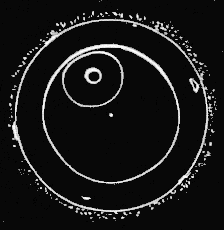
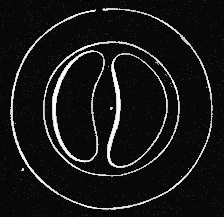
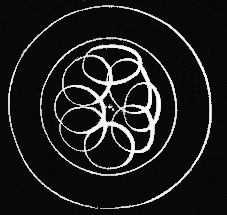
Fig. 155. Egg of Star-fish. Fig. 156. Egg of Star-fish in which the yolk has been divided into two segments. Fig. 157. Egg in which there are eight segments of the yolk.
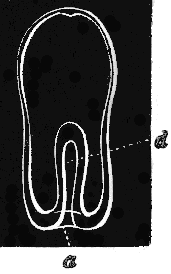
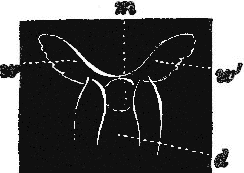
The egg of the Star-fish, when first formed, is a transparent, spherical body, enclosing the germinative vesicle and dot. (See Fig. 155.) As soon as these disappear, the segmentation of the yolk begins; it divides first into two portions (see Fig. 156), then into four, then into eight, and so on; but when there are no more than eight bodies of segmentation (see Fig. 157), they already show a disposition to arrange themselves in a hollow sphere, enclosing a space within, and by the time the segmentation is completed, they form a continuous spherical shell. At this time the egg, or, as we will henceforth call it, the embryo, escapes and swims freely about. (See Fig. 158.) The wall next begins to thin out on one side, while on the opposite side, which by comparison becomes somewhat bulging, a depression is formed (m a, Fig. 159), gradually elongating into a loop hanging down within the little animal, and forming a digestive cavity. (d, Fig. 160.) At this stage it much resembles a young Actinia. The loop spreads somewhat at its upper extremity, and at its lower end is an opening, which at this period of the animal's life serves a double purpose, that of mouth and anus also, for at this opening it both takes in and rejects its food. We shall see that before long a true mouth is formed, after which this first aperture takes its place opposite the mouth, retaining only the function of the anus. Presently from the upper bulging extremity of the digestive cavity, two lappets, or little pouches, project (w/ w' Fig. 161); they shortly become completely separated from it, and form two distinct hollow cavities (w w', Fig. 162). Here begins the true history of the young Star-fish, for these two cavities will develop into two water-tubes, on one of which the back of the Star-fish, that is, its upper surface, covered with spines, will be developed, while on the other, the lower surface, with the suckers and tentacles, will arise. At a very early stage one of these water-tubes (w', Fig. 163) connects with a smaller tube opening outwards, which is hereafter to be the madreporic body (b, Fig. 163). Almost until the end of its growth, these two surfaces, as we shall see, remain separate, and form an open angle with one another; it is only toward the end of the development that they unite, enclosing between them the internal organs, which have been built up in the mean while.
[fig 158]
[fig 159]
[fig 160]
[fig 161]
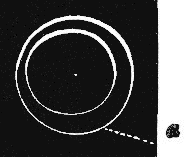
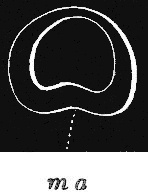
Fig. 158. Larva just hatched from egg; a thickened pole. Fig. 159. Larva somewhat older than Fig. 158; m a depression at thickened pole.
Fig. 160. Larva where the depression has become a digestive cavity d, opening at a. Fig. 161. Earlets, w w' (water-tubes), developed at the extremity of the digestive cavity d; m mouth.
[fig 162]
[fig 163]
[fig 164]
Fig. 162. More advanced larva; a d c digestive system, v vibratile chord, m mouth. Fig. 163. Profile view of larva; b madreporic opening, w' earlet, a d digestive system, m mouth, v v' vibratile chord. Fig. 164. Larva showing mode of formation of mouth m, by bending of digestive cavity o
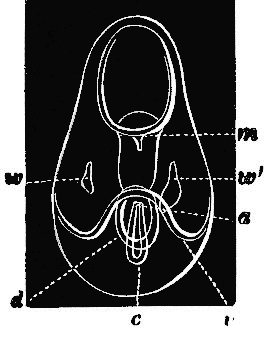
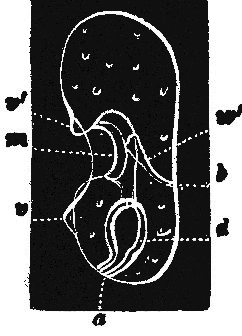
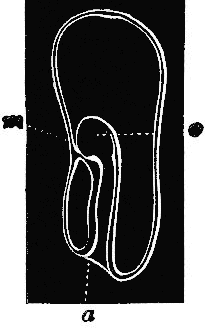
At about the same time with the development of these two pouches, so important in the animal's future history, the digestive cavity becomes slightly curved, bending its upper end sideways till it meets the outer wall, and forms a junction with it (m, Fig. 164). At this point, when the juncture takes place, an aperture is presently formed, which is the true mouth. The digestive sac, which has thus far served as the only internal cavity, now contracts at certain distances, and forms three distinct, though connected cavities, as in Fig. 163; viz. the oesophagus leading directly from the mouth (m) to the second cavity or stomach (d), which opens in its turn into the third cavity, the alimentary canal. Meanwhile the water-tubes have been elongating till they now surround the digestive cavity, extending on the other side of it beyond the mouth, where they unite, thus forming a Y-shaped tube, narrowing at one extremity, and dividing into two branches toward the other end. (Fig. 165.)
[fig 165]
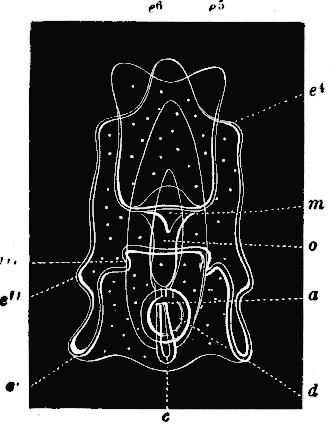
Fig. 165. Larva in which arms are developing, lettering as before; e' e'' e''' e4 e5 e6 arms, o oesophagus.
On the surface where the mouth is formed, and very near it on either side, two small arcs arise, as v in Fig. 162; these are cords consisting entirely of vibratile cilia. They are the locomotive organs of the young embryo, and they gradually extend until they respectively enclose nearly the whole of the upper and lower half of the body, forming two large shields or plastrons. (Figs. 165, 166.) The corners of these shields project, slightly at first (Fig. 165), but elongating more and more until a number of arms are formed, stretching in various directions (Figs. 166, 167), and, by their constant upward and downward play, moving the embryo about in the water.
[fig 166]
[fig 167]
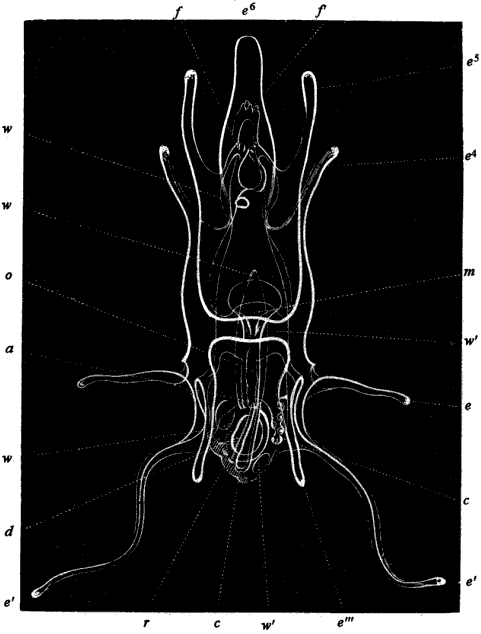
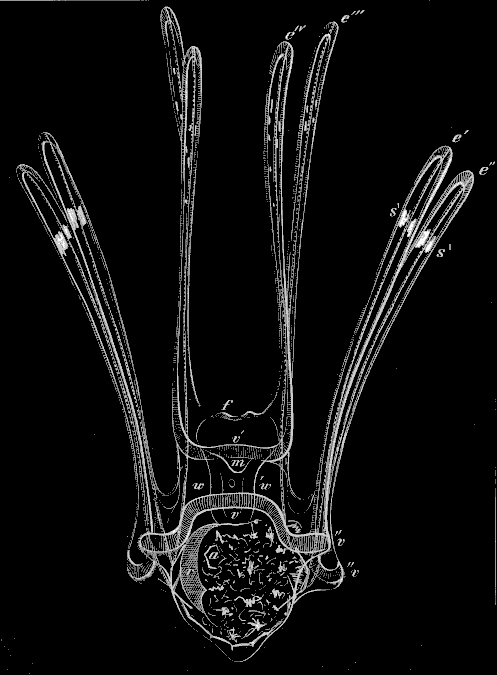
Fig. 166. Adult larva, so-called Brachiolaria, lettering as before; r back of young Star-fish, t tentacles of young Star-fish, f f' brachiolar appendages.
Click on image to view larger size.
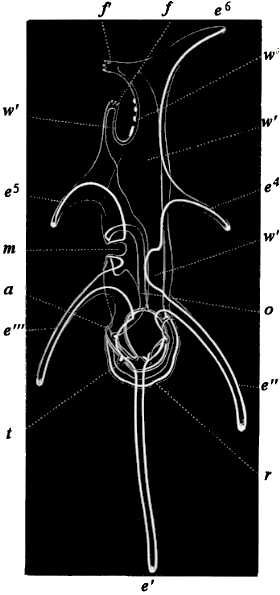
Fig. 167. Fig. 166 seen in profile, lettering as before.
[fig 168]
[fig 169]
[fig 170]
Fig. 168. Star-fish which has just resorbed the larva, seen from the back; b madreporic opening. Fig. 170. Young Star-fish which has become symmetrical, seen from the back; t' odd tentacle.
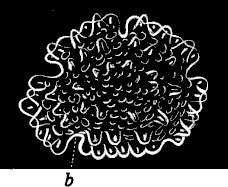
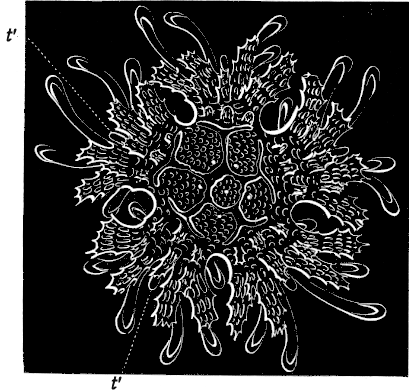
Fig. 169. Fig. 168, seen from the mouth side; m mouth, t tentacles.
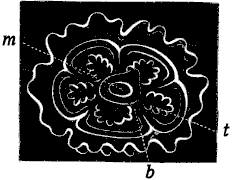
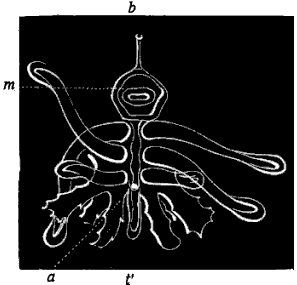
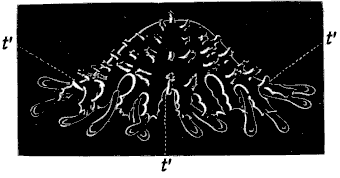
At this stage of the growth of the embryo, we have what seems quite a complicated structure, and might be taken for a complete animal; this is after all but the prelude to its true Star-fish existence. While these various appendages of the embryo have been forming, changes of another kind have taken place; on one of the two water-tubes above mentioned (w'), at the end nearest the digestive cavity, a number of lobes are formed (t, Fig. 166); this is the first appearance of the tentacles. In the same region of the opposite water-tube (w) a number of little limestone rods arise, which eventually unite to form a continuous network; this is the beginning of the back of the Star-fish (r, Fig. 166), from which the spines will presently project. When this process is complete, the whole embryo, with the exception of the part where the young Star-fish is placed, grows opaque; it fades, as it were, begins to shrink and contract, and presently drops to the bottom, where it attaches itself by means of short arms (f f', Fig. 166), covered with warts, which act as suckers, and are placed just above the mouth. As soon as the Star-fish has thus secured itself, it begins to resorb the whole external structure described above; the water-tubes, the plastrons, and the complicated system of arms connected with them, disappear within the little Star-fish; it swallows up, so to speak, the first stage of its own existence; it devours its own larva, which now becomes part and parcel of the new animal. Next the two surfaces, the back and lower surface, on which the arms are now marked out, while the tentacles, suckers, and spines have already assumed a certain prominence, approach each other. At this time, however, the arms are not in one plane; both the back and the lower surface are curved in a kind of spiral; they begin to flatten; the arms spread out on one level,—and now the two surfaces draw together, meeting at the circumference, and enclosing between them the internal organs, which, as we have seen, are already formed and surrounded by walls of their own, before the two walls of the body, close thus over them. Fig. 168 represents the upper surface of the Star-fish just before this junction takes place. The complicated structure of the Brachiolaria, as the larva of the Star-fish has been called, hitherto so essential to the life of the animal, by which it has been supported, moved about in the water, and provided with food during its immature condition, has made a final contribution to its further development by the process of resorption described above, and has wholly disappeared within the Star-fish. At this stage the rays are only just marked out, as five lobes around the margin; Fig. 169 represents the lower surface at the same moment, with the open mouth (m), around which the tentacles (t) are just beginning to appear; while Fig. 170 shows us the animal at a more advanced stage, after the two surfaces have united. It has now somewhat the outline of a Maltese cross, the five arms being more distinctly marked out, while the tentacles have already attained a considerable length (Fig. 171), and the dorsal plates have become quite distinct. Fig. 172 represents the same animal, at the same age, in profile. This period, in which we have compared the form of the Star-fish to that of a Maltese cross, is one of long duration; two or three years must elapse before the arms will elongate sufficiently to give it a star-shaped form, and before the pedicellariæ make their appearance, and it is only then that it can be at once recognized as the young of our common Star-fish. Even then, after it has assumed its ultimate outline, it lacks some features of the adult, having only two rows of tentacles, whereas the full-grown Star-fish has four.
[fig 171]
[fig 172]
Fig. 171. Lower side of ray of young Star-fish; m mouth, b madreporic body, e eye-speck. Fig. 172. Young Star-fish seen in profile; t' odd tentacle at extremity of arm.
[fig 173]
[fig 174]
[fig 175]
Fig. 173 Fig. 174
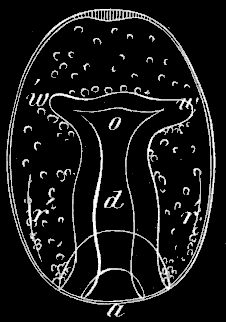
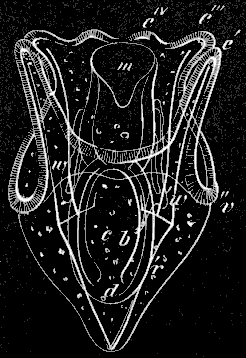
Fig. 175
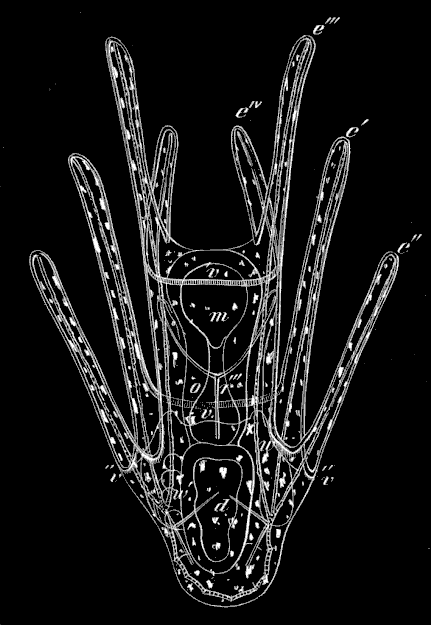
Fig. 173, 174, 175. Young larvæ of Toxopneustes in different stages of development; e'-eiv arms, v-v'' vibratile chord, w w' earlets (water-tubes), a o d c digestive system, r'-r''' solid rods of arms, m mouth, b madreporic opening.
Sea-urchins.
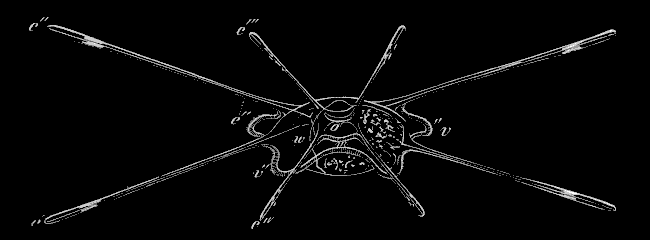
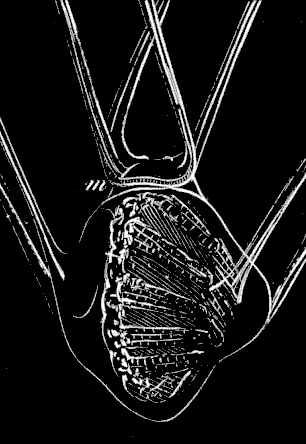
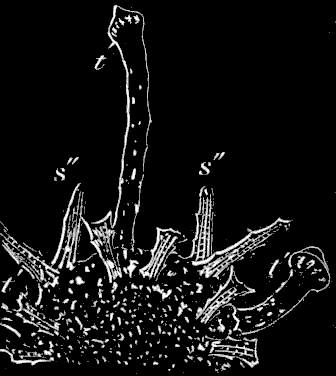
This extraordinary process of development which we have analyzed thus at length in the history of the Star-fish, but which is equally true of all Echinoderms, has been hitherto described (so far as it was known) under the name of the plutean stages of growth. In these early stages the young, or the so-called larvæ of Echinoderms, have received the name of Pluteus on account of their ever-changing forms. Let us look for a moment at the plutean stages of the Sea-urchin, as they differ in some points from those of the Star-fish. In the Pluteus of our common Sea-urchins (see Fig. 176), the arms are supported by a framework of solid limestone rods, which do not exist in that of the Star-fish, and which give to the larva of the Sea-urchin a remarkable rigidity. They are formed very early, as may be seen in Fig. 173, representing the little Sea-urchin before any arms are discernible, though the limestone rods are quite distinct. Figs. 173, 174, 175, may be compared with Figs. 160, 162, 165, of the young Star-fish, where it will be seen that the general outline is very similar, though, on account of the limestone rods, the Pluteus of the Sea-urchin seems somewhat more complicated. In Fig. 176 the young Sea-urchin has so far encroached upon the Pluteus that it forms the essential part of the body, the arms and rods appearing as mere appendages. Fig. 177 shows the same animal when we looked down upon it in its natural attitude; the Sea-urchin is carried downward, and the arms stretch in every direction around it. In Fig. 178 the Plutens is already in process of absorption; in Fig. 179 it has wholly disappeared; in Figs. 180 and 181 we have different stages of the little Sea-urchin, with its spines and suckers of a large size and in full activity. The appearance of the Sea-urchin, as soon as this larva or Pluteus is completely absorbed, is much more like that of the adult than is the Star-fish at the same stages, in which, as we have seen, there is a transition period of considerable duration.
[fig 176]
Fig. 176. Adult larva of Toxopneustes, f brachiolar appendages. Click on image to view larger size.
[fig 177] Fig. 177. Fig. 176 seen endways.
[fig 178] Fig. 178. The Sea-urchin resorbing the arms of the larva.
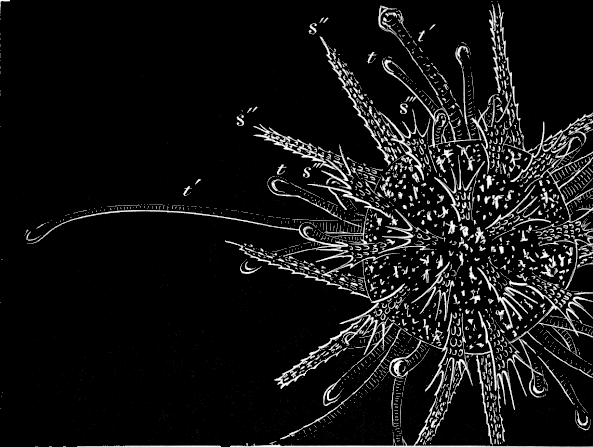
[fig 179] Fig. 179. Half a young Sea-urchin immediately after resorption of the larva; s'' s'' spines, t' t' ambulacral tentacles.
[fig 180] Fig. 180. Young Sea-urchin older than Fig. 179; t t' tentacles, s'' s''' spines.
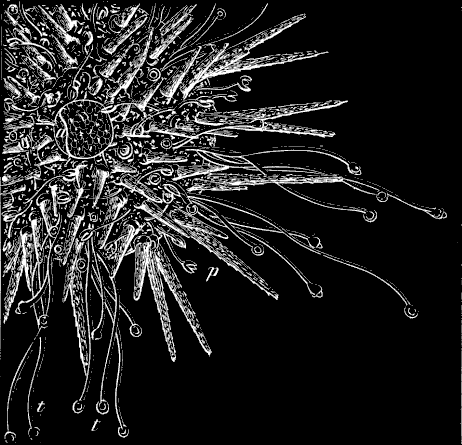
[fig 181] Fig. 181. Still older Sea-urchin; t t tentacles, a anus, p pedicellariæ; shell one sixteenth of an inch in diameter.
Ophiurans.
Fig. 183 represents an Ophiuran undergoing the same process of growth, at a period when the larva is most fully developed, and before it begins to fail. By the limestone rods which support the arms, the Pluteus of the Ophiuran, here represented, resembles that of the Sea-urchin more than that of the Star-Fish, while by the character of the water-tubes and by its internal organization it is more closely allied to the latter. It differs from both, however, in the immense length of two of the arms; these arms being the last signs of its plutean condition to disappear; when the young Ophiuran has absorbed almost the whole Pluteus, it still goes wandering about with these two immense appendages, which finally share the fate of all the rest. Fig. 182 represents an Ophiuran at the moment when the process of resorption is nearly completed, though the arms of the Pluteus, greatly diminished, are still to be seen protruding from the surface of the animal.
[fig 182]
[fig 183]
[fig 184]
[fig 185]
Fig. 182. Ophiuran which has resorbed the whole larva except the two long arms, y y' limestone rods of young Ophiuran, r middle of back, lettering as in Fig. 183.
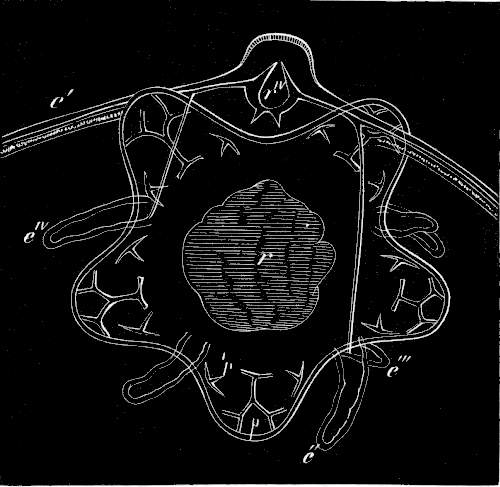
Fig. 183. Larva of Ophiuran; e'-eiv arms, r' riv solid rods, v v' vibratile chord, w w' water system, b madreporic body, a d digestive system. Fig. 184 Young Ophiuran which has resorbed the whole larva; r middle plate of back.
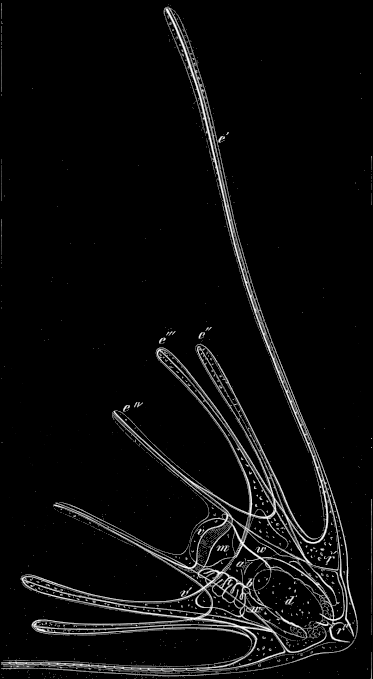
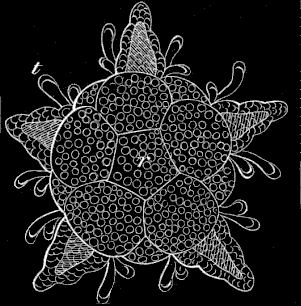
Fig. 185 Cluster of eggs of Star-fishes placed over the mouth of the parent.
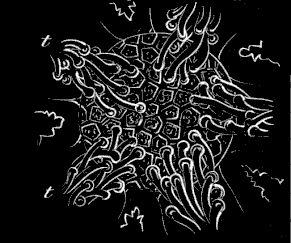
This mode of development, though common to all Echinoderms, appears under very different conditions in some of them. There are certain Star-fishes, Ophiurans, and Holothurians, passing through their development under what is known as the sedentary process. The eggs are not laid, as in the cases described above, but are carried in a sort of pouch over the mouth of the parent animal, where they remain till they attain a stage corresponding to that of Fig. 168 of the Star-fish, and having much the same cross-shaped outline, when they escape from the pouch (as the young Ophiopholis, Fig. 184), and swim about for the first time as free animals. Fig. 185 represents a cluster of young Star-fishes of the sedentary kind at about this period. But while this mode of growth seems at first sight so different, we shall find, if we look a little closer, that it is essentially the same, and that, though the circumstances under which the development takes place are changed, the process does not differ. The little Star-fish or Ophiuran, in the pouch, becomes surrounded by the same plutean structure as those which are laid in the egg; it is only more contracted to suit the narrower space in which they have to move; and the water-tubes on which the upper and lower surfaces of the body arise, the shields, spreading out into arms at the corners, exist, fully developed or rudimentary, in the one as much as in the other, and when no longer necessary to its external existence they are resorbed in the same way in both cases. This singular process of development has no parallel in the animal kingdom, although the growth of the young Echinoderm on the Brachiolaria may at first sight remind us of the budding of the little Medusa on the Hydroid stock, or even of the passage of the insect larva into the chrysalis. But in both these instances, the different phases of the development are entirely distinct; the Hydroid stock is permanent, continuing to live and grow and perform its share in the cycle of existence to which it belongs, after the Medusa has parted from it to lead a separate life, or if the latter remains attached to the parent stock, after it has entered upon its own proper functions. The life of the caterpillar, chrysalis and butterfly, is also distinct and definitely marked; the moment when the animal passes from one into the other cannot be mistaken, although the different phases are carried on successively and not simultaneously, as in the case of the Acalephs. But in the Echinoderms, on the contrary, though the aspect of the Brachiolaria, or plutean stage, is so different from that of the adult form, that no one would suppose them to belong to the same animal, yet these two stages of growth pass so gradually into one another, that one cannot say when the life of the larva ceases, and that of the Echinoderm begins.
The bearing of embryology upon classification is becoming every day more important, rendering the processes of development among animals one of the most interesting and instructive studies to which the naturalist can devote himself, in the present state of his science. The accuracy of this test, not only as explaining the relations between animals now living, but as giving the clew to their connection with those of past times, cannot but astonish any one who makes it the basis of his investigations. The comparison of embryo forms with fossil types is of course difficult, and must in many instances be incomplete, for while, in the one case, death and decay have often half destroyed the specimen, in the other, life has scarcely stamped itself in legible characters on the new being. Yet, whenever such comparisons have been successfully carried out, the result is always the same; the present representatives of the fossil types recall in their embryonic condition the ancient forms, and often explain their true position in the animal kingdom. One of the most remarkable examples of this in the type we are now considering, is that of the Comatula already mentioned. Its condition in the earlier stages of growth, when it is provided with a stem, at once shows its relation to the old stemmed Crinoids, the earliest representatives of the class of Echinoderms.
These coincidences are still more striking among living animals, where they can be more readily and fully traced, and often give us a key to their relative standing, which our knowledge of their anatomical structure fails to furnish. This is perhaps nowhere more distinctly seen than in the type of Radiates, where the Acalephs in their first stages of growth, that is, in their Hydroid condition, remind us of the adult forms among Polyps, showing the structural rank of the Acalephs to be the highest, since they pass beyond a stage which is permanent with the Polyps; while the adult forms of the Acalephs have in their turn a certain resemblance to the embryonic phases of the class next above them, the Echinoderms. Within the limits of the classes, the same correspondence exists as between the different orders; the embryonic forms of the higher Polyps recall the adult forms of the lower ones, and the same is true of the Acalephs as far as these phenomena have been followed and compared among them. In the class of Echinoderms the comparison has been carried out to a considerable extent, their classification has hitherto been based chiefly upon the ambulacral system, so characteristic of the class, but so unequally developed in the different orders. This places the Holothurians, in which the ambulacral system has its greatest development, at the head of the class; next to them come the Sea-urchins or Echinoids; then the Star-fishes; then the Ophiurans and Crinoids, in which the ambulacral system is reduced to a minimum. Another basis for classification in this type, which gives the same result, is the indication of a bilateral symmetry in some of the orders. In the Holothurians, for instance, there is a decided tendency toward the establishment of a posterior and anterior extremity, of a right and left, an upper and lower side of the body. In the Sea-urchins, in many of which the mouth is out of centre, placed nearer one side than the other, this tendency is still apparent, while in the three lower groups, the Star-fishes, Ophiurans, and Crinoids, it is almost entirely lost, in the equal division of identical parts radiating from a common centre. A comparison of the embryonic and adult forms in these orders, confirms entirely this classification based upon structural features. The Star-fishes, in their earlier stages, resemble the mature Ophiurans, while the Crinoids, the lowest group of all, retain throughout their whole existence many features characteristic of the embryonic conditions of the higher Echinoderms. In this principle of classification, already so fertile in results, we may hope to find, in some instances, the solution of many perplexing points respecting the structural rank of animals, the confirmation of classifications already established; in others, an insight into the true relations of groups which have hitherto been divided upon purely arbitrary grounds.
DISTRIBUTION OF LIFE IN THE OCEAN.
We have seen that while our bay is rich in certain species, it is wholly deficient or but scantily supplied with others, and that the character of the animals inhabiting its waters is more or less directly connected with general physical conditions. Such an area, limited though it be, gives us some insight into the laws which, in their wider application, control the distribution of marine life along the shores of the most extensive continents. The coast of Massachusetts, taken as a whole, is like that of New England generally, a rocky coast; yet it has its sandy and muddy beaches, and though it lies for a great part open to the sea, it has nevertheless its sheltered harbors, its quiet bays and snug recesses.
A comparison of these limited localities with far more extensive reaches of shore, where similar physical conditions prevail, shows that they reproduce, in fainter and less various characters of course, in proportion to their narrower boundaries, but still with a certain fidelity, the same combinations of animal and vegetable life. In other words, a sandy beach, however small, gives us some idea of the nature of the animals we may look for on any sandy coast, as, for instance, clams of various kinds, razor-shells, quahogs, snails, &c., creatures who can penetrate the sand, drag themselves through it or over it, leaving their winding trails as they go, and to whom the conditions prevailing in such spots are genial. So the narrowest mud flat on the sea-shore or muddy beach will give us the same dead and inanimate aspect which characterizes a more extensive coast of like character, where the gases always generated in mud are deadly to many kinds of animals. The beings who find a home in such localities are of closely allied species, chiefly a variety of worms, who burrow their way into the mud, and seem to court the miasma so fatal to other creatures. The same is true of any stony beach or rocky shore not more than a quarter of a mile in length; it gives us an idea of the animal population on any similar coast of greater extent.
These correspondences are of course modified by differences in climatic conditions. The animals on a sandy beach or a rocky shore, on the coast of Great Britain, for instance, are not absolutely identical with those of a sandy beach or a rocky shore on the coast of New England, but they are more or less nearly related to them. Naturalists refer to this reiteration, all the world over, of like organic combinations under similar circumstances, when they speak of "representative species." The aggregate result is the same, though the individual forms are slightly modified. And here lies one secret of the infinite variety in nature, by which the old seems ever new, and the same thought has an eternal freshness and originality, endlessly repeated, yet never hackneyed.
In this sense our bay presents, on a miniature scale, a variety of physical and organic combinations, which may be compared to those more extensive divisions in the geographical distribution of animals and plants, called by naturalists zoölogical or botanical provinces or districts, the animal and vegetable populations of which are technically designated as their faunæ and floræ. Such organic realms, as we may call them, have long been recognized on land, and the most extensive among them are easily distinguished. No one will fail to recognize the tropical zone, with its royal dynasty of palms and all the accompanying glories of a tropical vegetation, its birds of brilliant plumage, its large Mammalia, lions, tigers, panthers, elephants, and its great rivers haunted by gigantic reptiles. Nor is the representation of vegetable and animal life less characteristic in the temperate zone, where the oak is monarch of the woods, with all his attendant court of elms, walnuts, beeches, birches, maples, and the like, where birds of more sober hues, but sweeter voices, take the place of the brilliant parrots and many-tinted humming-birds of the tropical forest; while buffaloes, bears, wolves, foxes, and deer represent the larger Mammalia. In the arctic zone, though marked by peculiar and distinctive features, vegetation has dwindled to a minimum; the birds are chiefly gulls and ducks, which go there for the breeding season in the summer, and the reindeer and polar bears are almost sole possessors of the snow and ice-fields; but this meagreness in the representation of the larger land Mammalia is amply compensated in the numbers of heavy aquatic Mammalia, the whales, walruses, seals, and porpoises of the Arctic seas.
During the last half-century, since the geographical distribution of animals and plants has become a subject of more careful investigation among naturalists, these broad zones of the earth's surface, with their characteristic populations and vegetation, have been subdivided, according to more limited and special combinations of organic forms, into narrower zoölogical and botanical areas. The application of these results to marine life is however of much more recent date, and indeed it would seem at first sight, as if the water, from its own nature, could hardly impose a barrier so impassable as the land. The localization of the marine faunæ and floræ is nevertheless as distinct as that of terrestrial animals and plants, and late investigations have done much to explain the connection of this distribution with physical conditions.
A glance at the coast of our own continent, starting from the high north and making the circuit of its shores, from Baffin's Bay to Behring's Straits, will show us to what a variety of physical influences the animals who live along its shores are subjected. On the shores of Baffin's Bay, especially on the inner coast of Greenland, where the glaciers push their way down to the very brink of the water, and annually launch their southward-bound icebergs, we shall hardly expect to find a very abundant littoral fauna. On its western shore, where the ice does not advance so far, and a greater surface of rock is exposed, the circumstances are more favorable to the development of animal life. Here abound the winged Mollusks (Pteropods), often swept down to the coast of Nova Scotia by the cold current from Baffin's Bay; the "whale feed," as the fishermen call them, because the whales devour them voraciously. Here occur also many compound Mollusks, especially a variety of Ascidians, and the highly colored stocks of Bryozoa. With them is found the Comatula of the northern waters, one of the few modern Crinoids, and beside these a number of Star-fishes, Sea-urchins, and Holothurians, not differing so essentially from those already described as to require special mention.
Along the shore of Labrador and Newfoundland, the coast is wholly rocky, and especially about Newfoundland it is deeply indented with bays. Here there is ample opportunity for the growth of certain kinds of animals in sheltered nooks. The number of species is, however, much greater along the shores of Maine, Nova Scotia, and New Brunswick than in Labrador, owing no doubt to the milder climate. The beautiful shore of Maine, with its countless islands, and broken, picturesque outline, is very rich in species. Parts of this coast are remarkable for a variety of naked Mollusks, as well as for the great numbers of bright-colored Actiniæ, and also for the more brilliant kinds of Holothurians, the Cuvieria, and the like. The latter are especially abundant in the Bay of Fundy, and here also occurs the only Northern representative on our coast of the Sea-fans or Gorgoniæ, so common on the shores of Florida.
Farther south, from Cape Cod to Cape Hatteras, the character of the coast changes; it becomes more sandy, and though here and there the aspect is varied by a rocky promontory or a stony beach, yet the general character is flat and sandy. With this new character of the shore, the fauna is also greatly modified, and it is worthy of remark, that while thus far the representative species have reflected the character of animals to the north of them, they now begin to represent rather those of the Carolina shores. South of Cape Cod come in a kind of Scallop and Periwinkle, very different from the larger Scallops found on the coast of Maine and the British Provinces; our Sea-urchin is replaced by the Echinocidaris, with its few long spines, and an entirely new set of Crustacea and Worms make their appearance on this more sandy bottom. And here we must not forget that not only is the aspect of the animal life changed, as we pass from a rock-bound to a sandy coast, but that of the vegetation also. The various many-tinted sea-weeds of the rocky shore disappear almost entirely, and their place is but poorly supplied by the long eel-grass, which is almost the only marine plant to be found in such a locality. Beside its more sandy character, the coast from Cape Cod to Cape Hatteras is affected by the large amount of fresh water poured into the sea along its whole line, greatly modifying the character of the shore animals. The Hudson, the Delaware, the Susquehanna, the Potomac, the James, the Roanoke, and the large estuaries connected with some of these rivers, give a very peculiar character to the shore, and bring down, not only a vast supply of fresh water, but also a large quantity of detritus of all sorts from the land. Under these circumstances life would be impossible for many of the animals which live farther north. The only locality on the North Atlantic shore, where the conditions are somewhat similar, is at the mouth of the St. Lawrence, that great drainage-bed through which the Canadian lakes empty their superfluous waters into the Gulf of St. Lawrence.
The whole coast of the Carolinas, from Cape Hatteras to Florida, is a sandy beach; but though in this respect it resembles that immediately to the north of it, it differs greatly in other features. Comparatively little fresh water is poured into the ocean along this shore, and its more southerly range, instead of being protected by sand-spits like Pamlico and Albemarle Sounds, or broken by estuaries and inlets like the coast of Virginia, lies broadly open to the sea. On its extensive beaches we have the large Pholas, burrowing deep below the surface, and the Cerianthus, those long, cylindrical Actiniæ, enclosed in sheaths, with their bright crowns of gayly-colored tentacles; the free colonies of Halcyonoids abound also on this coast, and a new set of Sea-urchins (Spatangoids and Clypeastroids) make their appearance.
Farther south, along the Florida coast, a new element comes in, that of the coral reefs, enclosing shallow channels near the shore, and thus providing sheltered harbors on their leeward side, while on their seaward side they slope steeply to the ocean. Beside this, the reef itself affords a home for a great variety of creatures, who bore their way into it and live in its recesses, as some insects live in the bark of trees. Perhaps a more favorable combination of circumstances for the development of marine life does not exist anywhere than about the coral reefs of Florida, and certainly nowhere is there a more rich and varied littoral fauna, especially on their western shore within the Gulf of Mexico. Here swims the Portuguese Man-of-War, borne gayly along on the surface of the water by its brilliant float, here the blue Velella sets its oblique sail to the wind, and hosts of the lighter and more brightly tinted corals fringe the shore with a many-colored shrubbery. In these waters are also found the blue and yellow Angel-fish, the Parrot-fish (Scarus), and the strange Porcupine-fish (Diodon). Vegetable life is comparatively scanty in these tropical waters, where there are scarcely any sea-weeds, except the corallines or limestone Algæ of the reefs. The shore of the Gulf of Mexico, as a whole, has much the same character as that of the Carolinas, until we reach the point where the mountains and plateau of Mexico come down to the coast. From this point to the Isthmus of Panama the coast is again rocky.
Crossing the Isthmus and following the Pacific shore of the continent northward, we find a sandy open shore alternating with rocky beaches as far north as Acapulco. Along this coast there is to be found a great variety of corals, especially Sea-fans, growing on the rocks, but no reef. The Pocillopora, an Acalephian coral, the Pacific representative of the Millepore of Florida, is especially abundant. On the peninsula of Lower California we come again upon a rocky coast, with steep bluffs, extending into the sea. Within the Gulf of California are found, on its sandy coast, peculiar kinds of Sea-urchins, Spatangoids, and Clypeastroids, which occur nowhere else on this coast. From Cape St. Lucas up to the Straits of Fuca, with the exception of the large estuary forming the Bay of San Francisco, there are scarcely a couple of harbors of any consequence. The whole shore is most inhospitable, and the violent northwest winds in summer, and the southeast winds in winter, render it still more bleak and difficult of approach. In consequence of these conditions, the fauna is scanty along a great part of the shore; the best spots for collecting are the beaches, near the head of the peninsula, opposite the islands of Santa Barbara and San Diego, and that within the harbor of San Francisco. On the former, large Craw-fishes abound (Palinurus), akin to those of Florida, though specifically different from them. In the latter, the great amount of fresh water prevents the fauna from being exclusively marine; this harbor is, nevertheless, the great centre of the viviparous fishes, and contains also a large variety of peculiarly shaped Sculpins.
Farther north, between the Straits of Fuca and the island of Sitka, the shore resembles that of Maine, with its many islands, bays, and inlets; a succession of long, narrow islands forms a barrier along the coast, enclosing the shore waters, so as almost to make them into an inland sea. But little fresh water empties upon this part of the coast, and here, where the salt water is little modified by any deposit from the land, but where the violence of the ocean is broken by this barrier of islands, there is a full development of marine life. The shores of the Gulf of Georgia, and those of Vancouver's Island, seem to be especially the home of the Star-fishes. The fauna of this locality has been but little investigated, and yet the number of species of Star-fishes known from there is greater than from any other region; many of them are of colossal size, measuring some four feet in diameter. This coast seems also very favorable for the development of Hydroids, in consequence of which its waters swarm with a variety of Jelly-fishes. The Pennatula, that pretty compound Halcyonoid, with its feather-like sprays, is another characteristic type of this fauna. Beyond this, from Sitka to Behring's Straits, the same rocky coast prevails as in Labrador and Greenland. In Behring's Straits we return again to the forests of beautiful compound Mollusks, or rather to a variety of "representative species," resembling the Bryozoa and Ascidians so abundant in Baffin's Bay. The depth of the water, however, is much less here than on the corresponding Atlantic coast, where, south of Greenland, along the shore of Labrador, the water is very deep, while in Behring's Straits the depth is not greater than from one hundred to one hundred and twenty fathoms. The respective faunæ of these two shores are also affected by the difference of temperature, the cold current from Baffin's Bay sweeping down upon the coast of Labrador, while, through Behring's Straits, the warm current from the Pacific pours into the Arctic Ocean.
Thus the whole coast of our continent is peopled more or less thickly with animals. But now arises a new set of inquiries; how far into the sea do these animals extend? how wide is their domain? Do they wander at will in the ocean, or are they bound by any law to keep within a certain distance of the shore? These questions would seem to be easily answered, for wherever we go on the surface of the sea, and as far as the eye can penetrate into its depths, we find it full of life; and yet a closer examination shows that all these beings have their appointed boundaries. Along the shores, animal and vegetable life seems to be distributed in certain definite combinations. Those who are familiar with rocky beaches readily recognize the different bands of color produced by the various kinds of sea-weed growing at given distances between high and low-water-mark. First comes the olive green rockweed (the Fucus), and with it are found barnacles and small Crustacea, myriads of which are to be seen hopping about in this rockweed when the tide is out. Below these are the brown crispy Rhodersperms and Melanosperms, and associated with them are Star-fishes, Crabs, and Cockles. Next in order is the Laminarian zone. Here we have the broad fronds of the Laminaria, the "devil's aprons," as the fishermen call them; in this zone is the home of the Sea-urchin, and here will be found also a few small fishes. Lastly we have the Coralline zone, so-called on account of the lime deposit in the sea-weeds, giving them the rigidity of corals; among these the Lobsters make their appearance, and here are to be found also numerous clusters of Hydroids, the nurses of the Jelly-fishes.
This distribution is not casual; these belts of animal and vegetable life are sharply defined and so constantly associated, that they must be controlled by the same physical laws. The first important investigations on this subject were made by Örsted, the distinguished Danish naturalist. He undertook a complete topographical survey of the coast near which he lived, carrying his soundings to a depth of some twelve fathoms, and found that both the fauna and flora of the shore were divided, according to the depth of the water, into bands of vegetable and animal life, corresponding very nearly with those given above. His observations were, however, limited, not extending beyond the neighborhood of his home. It is to Edward Forbes, the great English naturalist, whose short life was so rich in results for science, that we owe a more complete and extensive investigation of the whole subject.
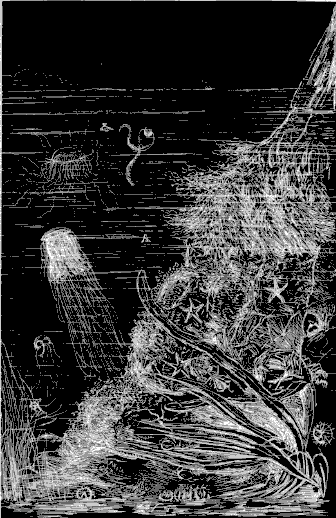
Diagram of a rocky beach. Click on image to view larger size.
Aided by a friend, Captain McAndrew, who placed his yacht at his disposal, he made a series of observations on the British, Scandinavian, and Danish coasts, and explored also with the same object the shores of the Mediterranean. Not content with sounding the present ocean, he sunk his daring plummet in the seas of past geological ages, and by comparing the nature and position of their fossil remains with those of living marine faunæ, he measured the depths of the water along their shores. He collected a vast amount of material, and the results of his labors have formed the basis of all subsequent generalizations upon this subject. Nevertheless he arrived at some erroneous conclusions, which, had he lived, he would no doubt have been the first to correct. Dredging from low-water-mark outward, he found that, from the Laminarian and Coralline zone, the animals began gradually to decrease in number, and that, at a depth of two or three hundred fathoms, the dredge always came up nearly empty. He inferred that at a certain depth the weight of water became too great to be endured by animals, and that the ocean beyond this line, like the land beyond the line of perpetual snow, was barren of life. This result seemed the more probable on account of the immense pressure to which animals are subjected, even at a comparatively moderate depth. A column of water thirty-two feet high is equal to one atmosphere in weight; this pressure being increased to the same amount for every thirty-two feet of depth, it follows that a fish one hundred and twenty-eight feet, or some twenty fathoms below the surface, is under the pressure of almost four atmospheres plus that of the air outside. Wherever tides run high, as in the Bay of Fundy, for instance, where an animal is under the pressure of one atmosphere at low tide, and of three atmospheres at high tide, we see that marine animals are uninjured by great changes of pressure. Yet it seems natural to suppose that there is a limit to this power of resistance; and that there must exist barren areas at the bottom of the ocean, as destitute of life as the regions on the earth which are above the line of perpetual snow. No doubt pressure does influence the distribution of life in the ocean; but it would seem, from subsequent observations, that the boundaries assigned by Forbes were far too narrow, and that the structure of many marine animals enables them to live under a weight, the one hundredth part of which would be fatal to any terrestrial animal.
For some years Forbes's theory was very generally accepted, and the results of Darwin's and Dana's investigations, showing that corals could not live beyond a depth of fifteen fathoms, seemed to confirm it. But, quite recently, facts derived from new and unlooked-for sources of information have given a check to this theory. Commerce has come to the aid of science (rewarding her for the gift first received at her hands), and the telegraph cables, alive with the secrets of sea and land, have brought us tidings from the deep. Dr. Wallich, the naturalist who in 1860 accompanied the expedition to explore the bed of the Atlantic, previous to laying the telegraphic cable, first called attention again to this subject. He brought up various animals, highly organized, from a depth of about nineteen hundred fathoms.
Yet, in spite of this positive evidence added to the former observations of Ehrenberg, and to those of Sir James Ross, who, in the Antarctic Sea, brought up an Euryale on a sounding-line from a depth of eight hundred to a thousand fathoms, naturalists were slow to believe that the distribution of animal life in the ocean was not limited to the shallow depths assigned by Edward Forbes. In the Mediterranean and in the Red Sea, from depths of eighteen hundred to two thousand fathoms, living animals have been brought up on the telegraph wires, not of doubtful infusorial character, hovering on the border-land between animal and vegetable life, but of considerable size, as, for instance, one or two kinds of Crustacea, Cockles, stocks of Bryozoa and tubes of Annelids. When the cable between France and Algiers was taken up from a depth of eighteen hundred fathoms, there came with it an Oyster, Cockle-shells, Annelid tubes, Bryozoa and Sea-fans. As these animals were growing upon it, there could be no doubt that they had their normal life and development at this depth, and since they are carnivorous, they tell also of the existence of other animals with them on which they feed.
The dredge, which thus far has played an important part in zoölogical researches, is destined to revolutionize many of our accepted theories, if we can judge of its future by the brilliant results of the last few years.
From 1861 to the present time the Swedish government has sent several expeditions to Spitzbergen and Greenland. They carried on dredging operations most successfully to a depth of twenty-six hundred fathoms. For some years past Lovén, Koren, and Danielssen, the elder and younger Sars, and other Scandinavian naturalists, have made systematic dredgings along the coast of Norway, which, though not extending below four hundred fathoms or thereabouts, have yet furnished most astounding results.
The United States Coast Survey has, in connection with an exploration of the Gulf Stream, been the first to establish a systematic series of dredgings at great depths, continued during several years. The results have proved conclusively that there exists everywhere, in the deep sea, modified, of course, according to the nature of the bottom and the temperature, a most varied fauna, totally distinct from that characteristic of the shores and of shallower waters. Since 1867 Count Pourtales has had charge of these investigations, first established many years ago by Professor Bache and continued by his successor Professor Peirce. He has dredged across the Gulf Stream between Florida and Cuba to a depth of about seven hundred fathoms, collecting an immense number of marine animals entirely unknown before, and characteristic of the different belts of depth, having a most extraordinary geographical distribution, many of the species being found in Florida, the Azores, the Faroe Islands, and the west coast of Norway.
The English Admiralty has for two summers detailed a vessel admirably fitted for such purposes, intrusting the scientific direction of the expedition to Dr. Carpenter, Professor Thomson, and Mr. Jeffreys. Their dredgings, carried on to the enormous depth of two thousand four hundred and thirty-five fathoms, have in every respect corroborated the conclusions drawn from the collections made by Count Pourtales and the Scandinavian naturalists, who, not content with so thoroughly exploring their own coast, have even sent a ship of war to dredge across the whole Atlantic.
These discoveries only show how much yet remains to be done before we shall fully understand the laws of marine life. But we already have ample evidence that the same beneficent order controls the distribution of animals in the ocean as on land, appointing to all its inhabitants their fitting home in the dim waste of waters.
SYSTEMATIC TABLE OF THE ANIMALS DESCRIBED IN THIS VOLUME
RADIATA Cuv.
CLASS I.—POLYPI Lam.
Order I.—ACTINARIA Edw. Metridium marginatum Edw. Rhodactinia Davisii Ag. Bicidiumparasiticum Ag. Arachnactis brachiolata A. Ag. Halcampa albida Ag. Order II.—MADREPORIA Ag. Astrangia Danæ Ag. Order III.— HALCYONARIA Edw. Halcyonium carneum Ag.
CLASS II.—ACALEPHÆ Cuv.
Order I.—HYDROIDEA Johnst. Velella mutica Bosc. Physalia Arethusa Til. Nanomia cara A. Ag. Millepora alcicornis Lin. Hydractinia polyclina Ag. Tubularia Couthouyi Ag. Hybocodon prolifer Ag. Coryne mirabilis Ag. Turris vesicaria A. Ag. Bougainvillia superciliaris Ag. Dysmorphosa fulguransA. Ag. Dynamena pumila Lamx. Dyphasia rosacea Ag. Lafoea cornutaLamx. Melicertum campanula Pér. et Les. Ptychogena lactea A. Ag. Laomedea amphora Ag. Zygodactyla groenlandica Ag. Tima formosa Ag. Eucope diaphana Ag. Clytia bicophora Ag. Oceania languida A. Ag. Order II.—DISCOPHORÆ Esch. Haliclystus auricula Clark. Trachynema digitale A. Ag. Campanella pachyderma A. Ag. Cyanea arctica Pér. et Les. Aurelia flavidula Pér. et Les. Order III.—CTENOPHORÆ Esch. Idyia roseola/ Ag. Pleurobrachia rhododactyla Ag. Bolina alata Ag.
CLASS III.—ECHINODERMATA Klein.
Order I.—CRINOIDEA Mill. Pentacrinus, Alecto Eschrichtii M. & T. Alecto meridionalis Ag. Order II.—OPHIURIDEA Forbes. Amphiura squamata Sars. Ophiopholis bellis Lym. Astrophyton AgassiziiStimp. Order III.—ASTERIDEA Forbes. Ctenodiscus crispatus D. & K. Hippasteria phrygiana Ag. Cribrellaoculata Forbes. Solaster endeca Forbes. Crossaster papposa M. & T. Astracanthion pallidus Ag. Astracanthion berylinus Ag. Order IV.—ECHINIDEA Lam. Toxopneustes drobachiensis Ag. Echinarachnius parma Gray. Order V.—HOLOTHURIDEA Brandt. Caudina arenata Stimp. Synapta tenuis Ayres. Cuvieria squamata D. & K. Pentacta frondosa Jäg/.
INDEX.
Abbreviations of authors' names, xii
Acalephs, 21
Actinia, 7
Actinoids, 7
Alecto Eschrichtii, 121
Alecto meridionalis, 121
Amphiura squamata, 115
Arachnactis brachiolata, 14
Astracanthion berylinus, 108
Astracanthion pallidus, 112
Astrangia Danæ, 16
Astrophyton Agassizii, 117
Aurelia flavidula, 42
Bicidium parasiticum, 15
Bolina alata, 31
Bougainvillia superciliaris, 69
Campanella pachyderma, 44
Campanularians, 49
Caudina arenata, 97
Circe, 45
Clytia bicophora, 56
Comatula, 121
Coryne mirabilis, 68
Cribrella oculata, 112
Crinoids, 120
Crossaster papposa, 114
Ctenodiscus crispatus, 113
Ctenophoræ, 26
Cuvieria squamata, 98
Cyanea aretica, 38
Development of Melicertum, 64
" " Tima, 64
Discophoræ, 37
Distribution of Life in the Ocean,
Dynamena pumila,
Dyphasia rosacea, 67
Dysmorphosa fulgurans, 75
Echinarachnius parma, 106
Echinoderms, 91
Echinoids, 101
Embryology of Astracanthion, 124
" " Ctenophoræ, 34
" " Echinoderms, 123
" " Ophiurans, 135
" " Sea-urchins, 130
" " Star-fishes, 124
Eucope diaphana, 50
Halcampa albida, 16
Halcyonium carneum, 19
Halcyonoids, 19
Haliclystus auricula, 46
Hippasteria phrygiana, 113
Holothurians, 95
Hybocodon prolifer, 74
Hydractinia polyclina, 73
Hydroids, 49
Idyia roseola, 32
Lafoea cornuta, 67
Laomedea amphora, 65
Lucernaria, 46
Madreporians, 16
Melicertum campanula, 63
Metridium marginatum, 7
Millepora alcicornis, 22
Mode of catching Jelly-fishes, 85
Nanomia cara, 76
Oceania languida, 53
Ophiurans, 115
Ophiopholis bellis, 115
Pentacrinus, 121
Pentacta frondosa, 99
Pleurobrachia rhododactyla, 27
Polyps, 52
Ptychogena lactea, 86
Physalia Arethusa, 83
Radiates, 1
Rhodactinia Davisii, 13
Sarsia, 68
Sea-urchin, 101
Sertularians, 66
Solaster endeca, 114
Star-fishes, 108
Synapta tenuis, 95
Systematic Table, 152
Tima formosa, 60
Toxopneustes drobachiensis, 101
Trachynema digitale, 45
Tubularia Couthouyi, 72
Tubularians, 67
Turris vesicaria, 69
Velella mutica, 84
Zygodactyla groenlandica, 57
THE END.
Cambridge: Stereotyped and Printed by Welch, Bigelow, & Co.
Transcriber's Note
The original spellings and gramatical constructs have been preserved as far as possible. With the exception of the typographical corrections detailed below, the text is that published in the original document. The image captions were moved directly below its image from the bottom of each page.
Images were placed in approximately the same location as in the original text. Figure 177 was rotated 90° as it fit better in this version and the lettering suggests that it may have originally been intended to be presented in this orientation. The image sizes vary from that of the original printed volume and so any notation retained from the original text regarding the same may not be accurate. Variations in the display properties of various monitors and user preferences would tend to also result in images which are not to scale with the original printed version.
Typographical Corrections
Page xi:Ophiopolis => Ophiopholis
Page 4:diferent => different
Page 21, 101, 127, 131, 148:so called => so-called