Home Lessons in Nursing Sick Children.
Reading edition
1. Mismanagement.—Every doctor knows that a large share of the ills to which infancy is subject are directly traceable to mismanagement. Troubles of the digestive system are, for the most part due to errors, either in the selection of the food or in the preparation of it.
2. Respiratory Diseases.—Respiratory diseases or the diseases of the throat and lungs have their origin, as a rule, in want of care and judgment in matters of clothing, bathing and exposure to cold and drafts. A child should always be dressed to suit the existing temperature of the weather.
3. Nervous Diseases.—Nervous diseases are often aggravated if not caused by over-stimulation of the brain, by irregular hours of sleep, or by the use of "soothing" medicines, or eating indigestible food.
4. Skin Affections.—Skin affections are generally due to want of proper care of the skin, to improper clothing or feeding, or to indiscriminate association with nurses and Children, who are the carriers of contagious diseases.
5. Permanent Injury.—Permanent injury is often caused by lifting the child by one hand, allowing it to fall, permitting it to play with sharp instruments, etc.
6. Rules and Principles.—Every mother should understand the rules and principles of home nursing. Children are very tender plants and the want of proper knowledge is often very disastrous if not fatal. Study carefully and follow the principles and rules which are laid down in the different parts of this work on nursing and cooking for the sick.
7. What a Mother Should Know:
I. INFANT FEEDING.—The care of milk, milk sterilization, care of bottles, preparation of commonly employed infant foods, the general principles of infant feeding, with rules as to quality and frequency.
II. BATHING.—The daily bath; the use of hot, cold and mustard baths.
III. HYGIENE OF THE SKIN. Care of the mouth, eyes and ears. Ventilation, temperature, cleanliness, care of napkins, etc.
IV. TRAINING OF CHILDREN in proper bodily habits. Simple means of treatment in sickness, etc.
8. The Cry of the Sick Child.—The cry of the child is a language by which the character of its suffering to some extent may be ascertained. The manner in which the cry is uttered, or the pitch and tone is generally a symptom of a certain kind of disease.
9. Stomachache.—The cry of the child in suffering with pain of the stomach is loud, excitable and spasmodic. The legs are drawn up and as the pain ceases, they are relaxed and the child sobs itself to sleep, and rests until awakened again by pain.
10. Lung Trouble.—When a child is suffering an affection of the lungs or throat, it never cries loudly or continuously. A distress in breathing causes a sort of subdued cry and low moaning. If there is a slight cough it is generally a sign that there is some complication with the lungs.
11. Disease of the Brain.—In disease of the brain the cry is always sharp, short and piercing. Drowsiness generally follows each spasm of pain.
12. Fevers.—Children rarely cry when suffering with fever unless they are disturbed. They should be handled very gently and spoken to in a very quiet and tender tone of voice.
13. The Chamber of the Sick Room.—The room of the sick child should be kept scrupulously clean. No noise should disturb the quiet and rest of the child. If the weather is mild, plenty of fresh air should be admitted; the temperature should be kept at about 70 degrees. A thermometer should be kept in the room, and the air should be changed several times during the day. This may be done with safety to the child by covering it up with woolen blankets to protect it from draft, while the windows and doors are opened. Fresh air often does more to restore the sick child than the doctor's medicine. Take the best room in the house. If necessary take the parlor, always make the room pleasant for the sick.
14. Visitors.—Carefully avoid the conversation of visitors or the loud and boisterous playing of children in the house. If there is much noise about the house that cannot be avoided, it is a good plan to put cotton in the ears of the patient.
15. Light in the Room.—Light has a tendency to produce nervous irritability, consequently it is best to exclude as much daylight as possible and keep the room in a sort of twilight until the child begins to improve. Be careful to avoid any odor coming from a burning lamp in the night. When the child begins to recover, give it plenty of sunlight. After the child begins to get better let in all the sunlight the windows will admit. Take a south room for the sick bed.
16. Sickness in Summer.—If the weather is very hot it is a good plan to dampen the floors with cold water, or set several dishes of water in the room, but be careful to keep the patient out of the draft, and avoid any sudden change of temperature.
17. Bathing.—Bathe every sick child in warm water once a day unless prohibited by the doctor. If the child has a spasm or any attack of a serious nervous character in absence of the doctor, place him in a hot bath at once. Hot water is one of the finest agencies for the cure of nervous diseases.
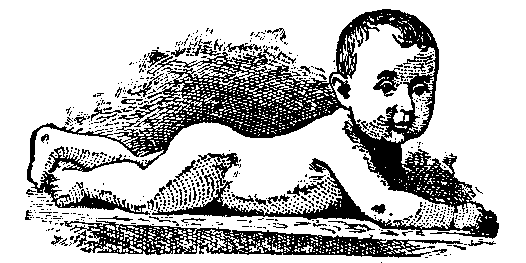
18. Scarlet Fever and Measles.—Bathe the child in warm water to bring out the rash, and put in about a dessertspoonsful of mustard into each bath.
19. Drinks.—If a child is suffering with fevers, let it have all the water it wants. Toast-water will be found nourishing. When the stomach of the child is in an irritable condition, nourishments containing milk or any other fluid should be given very sparingly. Barley-water and rice-water are very soothing to an irritable stomach.
20. Food.—Mellin's Food and milk is very nourishing if the child will take it. Oatmeal gruel, white of eggs, etc. are excellent and nourishing articles. See "How to cook for the Sick."
21. Eating Fruit.—Let children who are recovering from sickness eat moderately of good fresh fruit. Never let a child, whether well or sick, eat the skins of any kind of fruit. The outer covering of fruit was not made to eat, and often has poisonous matter very injurious to health upon its surface. Contagious and infectious diseases are often communicated in that way.
22. Sudden Startings with the thumbs drawn into the palms, portend trouble with the brain, and often end in convulsions, which are far more serious in infants than in children. Convulsions in children often result from a suppression of urine. If you have occasion to believe that such is the case, get the patient to sweating as soon as possible. Give it a hot bath, after which cover it up in bed and put bags of hot salt over the lower part of the abdomen.
23. Symptoms of Indigestion.—If the baby shows symptoms of indigestion, do not begin giving it medicine. It is wiser to decrease the quantity and quality of the food and let the little one omit one meal entirely, that his stomach may rest. Avoid all starchy foods, as the organs of digestion are not sufficiently developed to receive them.
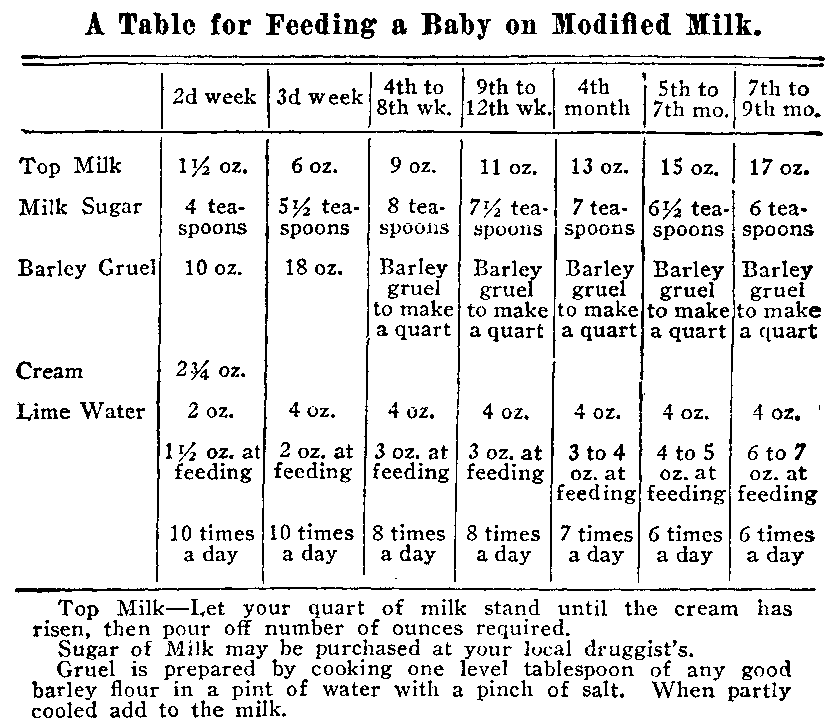
Table for Feeding Modified Milk
TABLE FOR FEEDING MODIFIED MILK
2d week:
Top Milk 1-1/2 oz.
Milk Sugar 4 teaspoons
Barley Gruel 10 oz.
Cream 2-3/4 oz.
Lime Water 2 oz.
1-1/2 oz. at feeding
10 times a day
3d week:
Top Milk 6 oz.
Milk Sugar 5-1/2 teaspoons
Barley Gruel 18 oz.
Lime Water 4 oz.
2 oz. at feeding
10 times a day
4th to 8th week:
Top Milk 9 oz.
Milk Sugar 8 teaspoons
Barley Gruel to make a quart
Lime Water 4 oz.
3 oz. at feeding
8 times a day
9th to 12th week:
Top Milk 11 oz.
Milk Sugar 7-1/2 teaspoons
Barley Gruel to make a quart
Lime Water 4 oz.
3 oz. at feeding
8 times a day
4th month:
Top Milk 13 oz.
Milk Sugar 7 teaspoons
Barley Gruel to make a quart
Lime Water 4 oz.
3 to 4 oz. at feeding
7 times a day
5th to 7th month:
Top Milk 15 oz.
Milk Sugar 6-1/2 teaspoons
Barley Gruel to make a quart
Lime Water 4 oz.
4 to 5 oz. at feeding
6 times a day
7th to 9th month:
Top Milk 17 oz.
Milk Sugar 6 teaspoons
Barley Gruel to make a quart
Lime Water 4 oz.
6 to 7 oz. at feeding
6 times a day
Top Milk--Let your quart of milk stand until the cream has risen, then pour off number of ounces required.
Sugar of Milk may be purchased at your local druggist's.
Gruel is prepared by cooking one level tablespoon of any good barley flour in a pint of water with a pinch of salt. When partly cooled add to the milk.
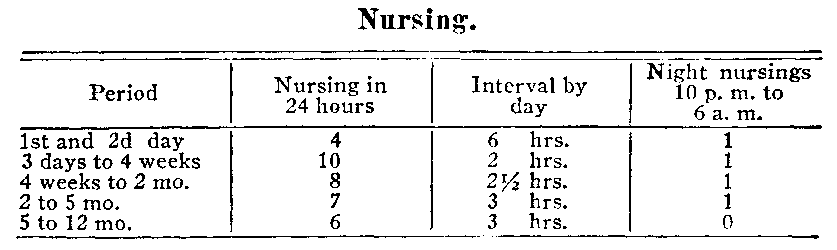
Table for Nursing
NURSING.
Period: 1st and 2d day
Nursing in 24 hours: 4
Interval by day: 6 hrs.
Night nursings 10 p.m. to 6 a.m.: 1
Period: 3 days to 4 weeks
Nursing in 24 hours: 10
Interval by day: 2 hrs.
Night nursings 10 p.m. to 6 a.m.: 1
Period: 4 weeks to 2 mo.
Nursing in 24 hours: 8
Interval by day: 2-1/2 hrs.
Night nursings 10 p.m. to 6 a.m.: 1
Period: 2 to 5 mo.
Nursing in 24 hours: 7
Interval by day: 3 hrs.
Night nursings 10 p.m. to 6 a.m.: 1
Period: 5 to 12 mo.
Nursing in 24 hours: 6
Interval by day: 3 hrs.
Night nursings 10 p.m. to 6 a.m.: 0
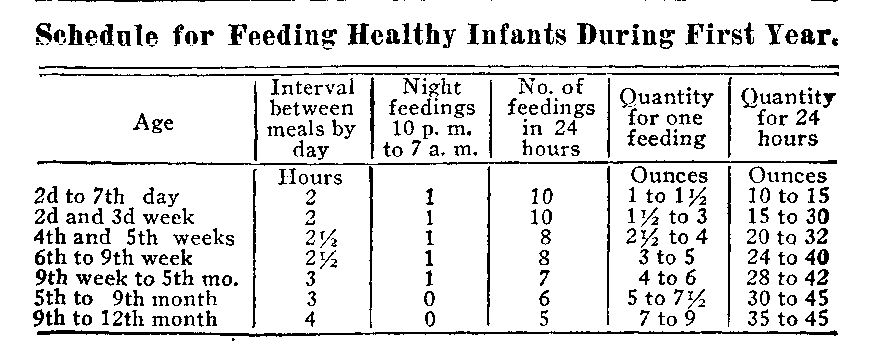
Tables for Feeding During the First Year
SCHEDULE FOR FEEDING HEALTHY INFANTS DURING FIRST YEAR
Age: 2d to 7th day
Interval between meals by day: 2 hours
Night feedings 10 p.m. to 7 a.m.: 1
No. of feedings in 24 hours: 10
Quantity for one feeding: 1 to 1-1/2 ounces
Quantity in 24 hours: 10 to 15 ounces
Age: 2d and 3d week
Interval between meals by day: 2 hours
Night feedings 10 p.m. to 7 a.m.: 1
No. of feedings in 24 hours: 10
Quantity for one feeding: 1-1/2 to 3 ounces
Quantity in 24 hours: 15 to 30 ounces
Age: 4th and 5th weeks
Interval between meals by day: 2-1/2 hours
Night feedings 10 p.m. to 7 a.m.: 1
No. of feedings in 24 hours: 8
Quantity for one feeding: 2-1/2 to 4 ounces
Quantity in 24 hours: 20 to 32 ounces
Age: 6th to 9th week
Interval between meals by day: 2-1/2 hours
Night feedings 10 p.m. to 7 a.m.: 1
No. of feedings in 24 hours: 8
Quantity for one feeding: 3 to 5 ounces
Quantity in 24 hours: 24 to 40 ounces
Age: 9th week to 5th mo.
Interval between meals by day: 3 hours
Night feedings 10 p.m. to 7 a.m.: 1
No. of feedings in 24 hours: 7
Quantity for one feeding: 4 to 6 ounces
Quantity in 24 hours: 28 to 42 ounces
Age: 5th to 9th month
Interval between meals by day: 3 hours
Night feedings 10 p.m. to 7 a.m.: 0
No. of feedings in 24 hours: 6
Quantity for one feeding: 5 to 7-1/2 ounces
Quantity in 24 hours: 30 to 45 ounces
Age: 9th to 12th month
Interval between meals by day: 4 hours
Night feedings 10 p.m. to 7 a.m.: 0
No. of feedings in 24 hours: 5
Quantity for one feeding: 7 to 9 ounces
Quantity in 24 hours: 35 to 45 ounces
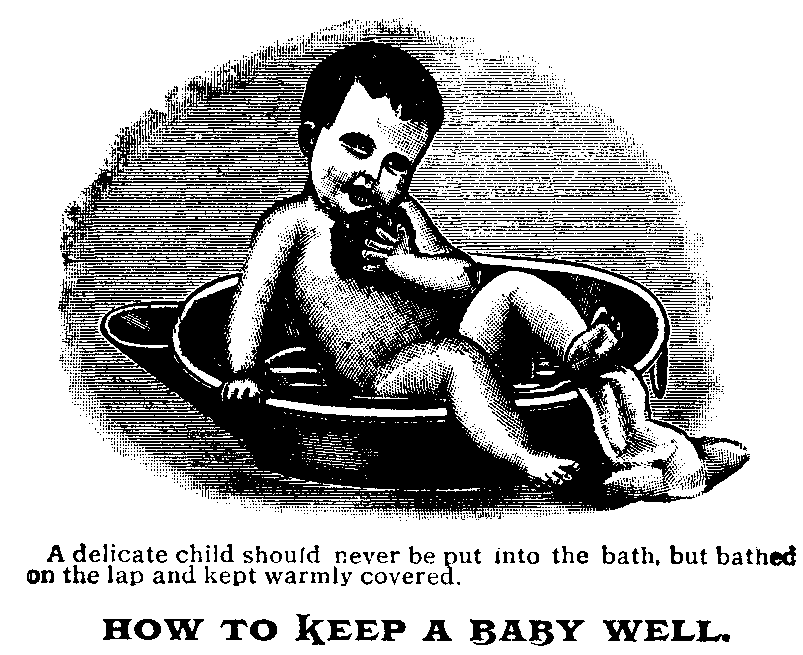
A delicate child should never be put into the bath but bathed on the lap and kept warmly covered.