CONVERSATION.
Reading edition
Some men are very entertaining for a first interview, but after that they are exhausted, and run out; on a second meeting we shall find them very flat and monotonous; like hand-organs, we have heard all their tunes.—COULTON.
He who sedulously attends, pointedly asks, calmly speaks, coolly answers, and ceases when he has no more to say, is in possession of some of the best requisites of man.—LAVATER.
Beauty is never so lovely as when adorned with the smile, and conversation never sits easier upon us than when we know and then discharge ourselves in a symphony of Laughter, which may not improperly be called the Chorus of Conversation.—STEELE.
The first ingredient in Conversation is Truth, the next Good Sense, the third Good Humor, and the fourth Wit.—SIR WILLIAM TEMPLE.
Home Lessons in Conversation.
Say nothing unpleasant when it can be avoided.
Avoid satire and sarcasm.
Never repeat a word that was not intended for repetition.
Cultivate the supreme wisdom, which consists less in saying what ought to be said than in not saying what ought not to be said.
Often cultivate "flashes of silence."
It is the larger half of the conversation to listen well.
Listen to others patiently, especially the poor.
Sharp sayings are an evidence of low breeding.
Shun faultfindings and faultfinders.
Never utter an uncomplimentary word against anyone.
Compliments delicately hinted and sincerely intended are a grace in conversation.
Commendation of gifts and cleverness properly put are in good taste, but praise of beauty is offensive.
Repeating kind expressions is proper.
Compliments given in a joke may be gratefully received in earnest.
The manner and tone are important parts of a compliment.
Avoid egotism.
Don't talk of yourself, or of your friends or your deeds.
Give no sign that you appreciate your own merits.
Do not become a distributer of the small talk of a community. The smiles of your auditors do not mean respect.
Avoid giving the impression of one filled with "suppressed egotism."
Never mention your own peculiarities; for culture destroys vanity.
Avoid exaggeration.
Do not be too positive.
Do not talk of display oratory.
Do not try to lead in conversation looking around to enforce silence.
Lay aside affected, silly etiquette for the natural dictates of the heart.
Direct the conversation where others can join with you and impart to you useful information.
Avoid oddity. Eccentricity is shallow vanity.
Be modest.
Be what you wish to seem.
Avoid repeating a brilliant or clever saying.
THINKING ONLY OF DRESS
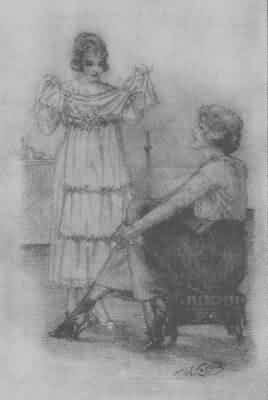
If you find bashfulness or embarrassment coming upon you, do or say something at once. The commonest matter gently stated is better than an embarrassing silence. Sometimes changing your position, or looking into a book for a moment may relieve your embarrassment, and dispel any settling stiffness.
Avoid telling many stories, or repeating a story more than once in the same company.
Never treat any one as if you simply wanted him to tell stories. People laugh and despise such a one.
Never tell a coarse story. No wit or preface can make it excusable.
Tell a story, if at all, only as an illustration, and not for itself. Tell it accurately.
Be careful in asking questions for the purpose of starting conversation or drawing out a person, not to be rude or intrusive.
Never take liberties by staring, or by any rudeness.
Never infringe upon any established regulations among strangers.
Do not always prove yourself to be the one in the right. The right will appear. You need only give it a chance.
Avoid argument in conversation. It is discourteous to your host.
Cultivate paradoxes in conversation with your peers. They add interest to common-place matters. To strike the harmless faith of ordinary people in any public idol is waste, but such a movement with those able to reply is better.
Never discourse upon your ailments.
Never use words of the meaning or pronunciation of which you are uncertain.
Avoid discussing your own or other people's domestic concerns.
Never prompt a slow speaker, as if you had all the ability. In conversing with a foreigner who may be learning our language, it is excusable to help him in some delicate way.
Never give advice unasked.
Do not manifest impatience.
Do not interrupt another when speaking.
Do not find fault, though you may gently criticise.
Do not appear to notice inaccuracies of speech in others.
Do not always commence a conversation by allusion to the weather.
Do not, when narrating an incident, continually say, "you see," "you know."
Do not allow yourself to lose temper or speak excitedly.
Do not introduce professional or other topics that the company generally cannot take an interest in.
Do not talk very loud. A firm, clear, distinct, yet mild, gentle, and musical voice has great power.
Do not be absent-minded, requiring the speaker to repeat what has been said that you may understand.
Do not try to force yourself into the confidence of others.
Do not use profanity, vulgar terms, words of double meaning, or language that will bring the blush to anyone.
Do not allow yourself to speak ill of the absent one if it can be avoided. The day may come when some friend will be needed to defend you in your absence.
Do not speak with contempt and ridicule of a locality which you may be visiting. Find something to truthfully praise and commend; thus make yourself agreeable.
Do not make a pretense of gentility, nor parade the fact that you are a descendant of any notable family. You must pass for just what you are, and must stand on your own merit.
Do not contradict. In making a correction say, "I beg your pardon, but I had the impression that it was so and so." Be careful in contradicting, as you may be wrong yourself.
Do not be unduly familiar; you will merit contempt if you are. Neither should you be dogmatic in your assertions, arrogating to yourself such consequences in your opinions.
Do not be too lavish in your praise of various members of your own family when speaking to strangers; the person to whom you are speaking may know some faults that you do not.
Do not feel it incumbent upon yourself to carry your point in conversation. Should the person with whom you are conversing feel the same, your talk may lead into violent argument.
Do not try to pry into the private affairs of others by asking what their profits are, what things cost, whether Melissa ever had a beau, and why Amarette never got married? All such questions are extremely impertinent and are likely to meet with rebuke.
Do not whisper in company; do not engage in private conversation; do not speak a foreign language which the general company present may not understand, unless it is understood that the foreigner is unable to speak your own language.
IMPORTANT RULES.
1. Good Appearance.—The first care of all persons should be for their personal appearance. Those who are slovenly or careless in their habits are unfit for refined society, and cannot possibly make a good appearance in it. A well-bred person will always cultivate habits of the most scrupulous neatness. A gentleman or lady is always well dressed. The garment may be plain or of coarse material, or even worn "thin and shiny," but if it is carefully brushed and neat, it can be worn with dignity.
2. Personal Cleanliness.—Personal appearance depends greatly on the careful toilet and scrupulous attention to dress. The first point which marks the gentleman or lady in appearance is rigid cleanliness. This remark supplies to the body and everything which covers it. A clean skin—only to be secured by frequent baths—is indispensable.
3. The Teeth.—The teeth should receive the utmost attention. Many a young man has been disgusted with a lady by seeing her unclean and discolored teeth. It takes but a few moments, and if necessary secure some simple tooth powder or rub the teeth thoroughly every day with a linen handkerchief, and it will give the teeth and mouth a beautiful and clean appearance.
4. The Hair and Beard.—The hair should be thoroughly brushed and well kept, and the beard of men properly trimmed. Men should not let their hair grow long and shaggy.
5. Underclothing.—The matter of cleanliness extends to all articles of clothing, underwear as well as the outer clothing. Cleanliness is a mark of true utility. The clothes need not necessarily be of a rich and expensive quality, but they can all be kept clean. Some persons have an odor about them that is very offensive, simply on account of their underclothing being worn too long without washing. This odor of course cannot be detected by the person who wears the soiled garments, but other persons easily detect it and are offended by it.
6. The Bath.—No person should think for a moment that they can be popular in society without regular bathing. A bath should be taken at least once a week, and if the feet perspire they should be washed several times a week, as the case may require. It is not unfrequent that young men are seen with dirty ears and neck. This is unpardonable and boorish, and shows gross neglect. Occasionally a young lady will be called upon unexpectedly when her neck and smiling face are not emblems of cleanliness. Every lady owes it to herself to be fascinating; every gentleman is bound, for his own sake, to be presentable; but beyond this there is the obligation to society, to one's friends, and to those with whom we may be brought in contact.
7. Soiled Garments.—A young man's garments may not be expensive, yet there is no excuse for wearing a soiled collar and a soiled shirt, or carrying a soiled handkerchief. No one should appear as though he had slept in a stable, shaggy hair, soiled clothing or garments indifferently put on and carelessly buttoned. A young man's vest should always be kept buttoned in the presence of ladies.
8. The Breath.—Care should be taken to remedy an offensive breath without delay. Nothing renders one so unpleasant to one's acquaintance, or is such a source of misery to one's self. The evil may be from some derangement of the stomach or some defective condition of the teeth, or catarrhal affection of the throat and nose. See remedies in other portions of the book.
A YOUNG MAN'S PERSONAL APPEARANCE.
Dress changes the manners.—VOLTAIRE. Whose garments wither, shall receive faded smiles.—SHERIDAN KNOWLES. Men of sense follow fashion so far that they are neither conspicuous for their excess nor peculiar by their opposition to it.—ANONYMOUS.
1. A well-dressed man does not require so much an extensive as a varied wardrobe. He does not need a different suit for every season and every occasion, but if he is careful to select clothes that are simple and not striking or conspicuous, he may use the garment over and over again without their being noticed, provided they are suitable to the season and the occasion.
2. A clean shirt, collar and cuffs always make a young man look neat and tidy, even if his clothes are not of the latest pattern and are somewhat threadbare.
3. Propriety is outraged when a man of sixty dresses like a youth or sixteen. It is bad manners for a gentleman to use perfumes to a noticeable extent. Avoid affecting singularity in dress. Expensive clothes are no sign of a gentleman.
4. When dressed for company, strive to appear easy and natural. Nothing is more distressing to a sensitive person, or more ridiculous to one gifted with refinement, than to see a lady laboring under the consciousness of a fine gown or a gentleman who is stiff, awkward and ungainly in a brand-new coat.
5. Avoid what is called the "ruffianly style of dress" or the slouchy appearance of a half-unbottoned vest, and suspenderless pantaloons. That sort of affectation is, if possible, even more disgusting than the painfully elaborate frippery of the dandy or dude. Keep your clothes well brushed and keep them cleaned. Slight spots can be removed with a little sponge and soap and water.
6. A gentleman should never wear a high hat unless he has on a frock coat or a dress suit.
7. A man's jewelry should be good and simple. Brass or false jewelry, like other forms of falsehood, is vulgar. Wearing many cheap decorations is a serious fault.
The Dude of the 17th Century

8. If a man wears a ring it should be on the third finger of the left hand. This is the only piece of jewelry a man is allowed to wear that does not serve a purpose.
9. Wearing imitations of diamonds is always in very bad taste.
10. Every man looks better in a full beard if he keeps it well trimmed. If a man shaves he should shave at least every other day, unless he is in the country.
11. The finger-nails should be kept cut, and the teeth should be cleaned every morning, and kept clear from tarter. A man who does not keep his teeth clean does not look like a gentleman when he shows them.
Dress
START HERE