The Model
Reading edition
I
It was getting too dark to work, and the artist, a cigarette between his lips, was sitting restfully at the open window, lazily scanning through his half-closed lids the languid life of the old Italian city below. As the objects in his studio retired farther and farther into the shadows, he arose, and taking his hat from a peg, passed slowly down the long staircase into the street. The air, which had been almost stifling during the day was now freshening, and he passed from street to street with the aimless enjoyment of the man to whom the mere exercise of his cramped limbs is a luxury.
Standing idly at a lighted corner preparatory to turning back, his gaze fell upon a middle-aged woman of poor appearance who was passing. He started violently, and in an undecided fashion stood gazing after her retreating figure until it disappeared down a small by-street. Then, on a sudden impulse, he threw away his cigarette and started in pursuit.
At first he gained but little on her, and once or twice nearly lost her in the rapidly increasing darkness, but in the end his youth and strength told, and the woman, who had been conscious for some time that her steps were dogged, slackened her pace and walked with her hand pressed to her side, breathing distressfully. In the centre of the old stone bridge which leads from the narrow streets of the town to the open country beyond, he overtook her.
“Pardon, signora,” he said softly.
The woman halted, her hand on the low stone parapet, and confronted him.
“You walk fast,” he continued, smiling.
She murmured an indistinct something, and made as though to go.
“No, I have followed you some distance,” said the artist, “I can’t afford to lose you. Will you let me see your face? I have a reason for the request.”
With a startled gesture, and not without looking right and left as though for assistance, should it be needed, she threw her head back, her pale features showing clearly in the light of an adjoining lamp.
“Beautiful!” said the artist joyfully, “beautiful!”
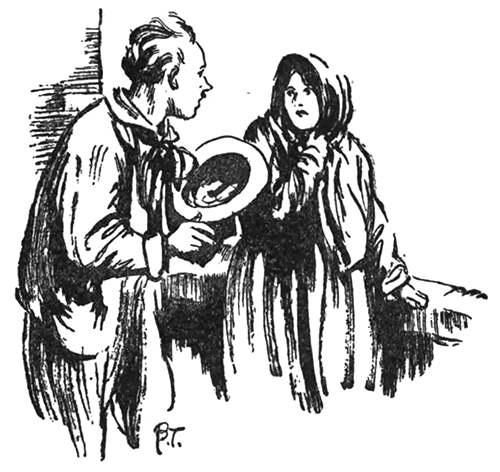
“BEAUTIFUL,” SAID THE ARTIST JOYFULLY, “BEAUTIFUL!”
“Signor,” said the woman with dignity, conscious of forty years and sundry wrinkles, “you mock me.”
“By no means,” he said anxiously; “you have the face I have sought for years. You will sit for me, will you not?”
“The signor is an artist then,” said the woman, breathing more freely.
He nodded, and for the first time perceived that he had frightened her. “I was too abrupt,” he said regretfully. “I saw your face and forgot all else.”
The woman smiled faintly, a slight glow tinged her face and her eyes brightened. “I shall be pleased to sit, if I am any use.”
“Can you come to-morrow?” asked the enthusiast.
“Yes.”
“At eleven then, to this address. You will not fail me.”
Smiling at his earnestness, she gave the desired assurance, and with a soft good-night left him, and passed swiftly over the bridge into the darkness beyond.
For a moment the artist glanced after her as though desirous of obtaining further pledges of fidelity, and then abandoning the idea, seated himself on the parapet, and, lighting another cigarette, fell into a smoker’s reverie. The river went by with a soft swish against the piles of the old bridge, the air was cool and the ghostly outlines of the old buildings on either bank, indistinct in the darkness, appeared to be nodding in sleep. All these drowsy influences combined were beginning to have a soporific effect upon the smoker, the buildings nodded more violently than ever, the river murmured more sweetly.
“He who sleeps on the parapet awakes in the stream,” said a voice at his elbow in feigned solemnity.
“Ah! Rossa,” said the artist, slipping to his feet, and smiling as he recognised the speaker, “I was just wishing for company home. I have news for you; at last I have been successful in my search, and my picture can be finished.”
“It is time,” remarked the other as he walked by his side; “and where is she who has succeeded in satisfying your exacting fancy?”
“I parted from her on the bridge,” replied his friend. “Such a face, such an expression, the perfect type of bereaved maternity.”
“Charming!” said Rossa drily. “It must have been a pleasant task, the acquiring of that self-same expression.”
The artist, somewhat nettled at his tone, made no reply, and they traversed the narrow ill-lighted streets almost in silence until they reached his dwelling. Then with a hearty handshake Rossa took his leave, and the other climbed the steep stairs which led to his bed to lie awake half the night, thinking of his great work and the face of his model.
II
The woman was tired and hot when she reached his studio, for the sun was nearly at its height, and its heat, imprisoned in the narrow street, was stifling to those wayfarers who could not move at leisure and take advantage of such shade as offered. She greeted the artist timidly, and gazed, not without curiosity, at the littered floor and the sketches upon the walls.
“That is what I want you for,” said the artist, indicating with a nod a large unfinished canvas which stood upon an easel in the full light of the window.
His visitor crossed over, and stood looking at the roughly outlined figure of a woman upon her knees, bending over the calm, awful face of the dead Christ. She stood for some time in silence, and then as she understood what her part was to be, turned to the artist to receive his instructions.
And never had man a more devoted model.
True to time, cheerful and willing, she appeared day by day, and it required but little discernment on the part of the artist to see that her heart was in the work. Quiet and undemonstrative in manner, it was yet easy to see her devout joy at the fact that her face should have been chosen to represent that of the Virgin. Slowly but surely the work grew in strength and clearness, bit by bit the shadowy figure of the woman took life, and a weary earth-worn face now bent over the crucified Saviour.
It was while sitting at the window one morning, waiting for the appearance of his model, that the artist was surprised by a visit from his friend Rossa.
“Are you amiable to visitors this morning?” inquired the latter.
“It depends upon their criticisms,” replied the artist smiling.
“I feel at peace with all mankind at present,” said Rossa.
“In that case you are welcome,” said the other, “but you are the only man I allow to see it in its unfinished state.”
“Always hungry for my suggestions,” murmured Rossa complacently, as he advanced to the easel.
“Well?” asked the artist impatiently, after allowing plenty of time for his friend’s praises.
“It is the best you have done, as good as you will ever do,” said Rossa with gratifying energy. “Ah! when will you cease wasting your strength on these old-world superstitions, and use your brush on nobler themes?”
“There is none nobler,” said the other gravely.
Rossa shrugged his shoulders and smiled scornfully. “Bah! you spend your strength in painting advertisements for the priests, and what do the smug-faced black-gowns do for you in return? Give you their blessing, or recommend you to wealthy patrons? Are there no noble deeds of to-day to bring the blood to a man’s cheek and the water to his eyes, that you must go back to that hackneyed theme of eighteen centuries ago?”
“You are speaking too freely,” said the artist sternly.
“Freely!” repeated Rossa. “You paint pictures to foster and encourage ideas which are against all reason, and one may not even speak of it. And the materials, bah! Do you ask for certificates of character from the women you paint as Madonnas, or do you take the first that suits?”
“To tell the truth, I have never thought of it,” said the other, “but in this case the woman’s face is her best certificate.”
“It certainly supported her for many years,” said Rossa drily.
“What, do you know her? She told me she had never sat before,” said the artist in surprise.
“Years ago I knew her well,” said his friend, “but not as a model. It was in Naples. She had a large circle of acquaintances, and was commonly known as ‘The Doll.’ Even to an atheist there seems to be an incongruity somewhere in painting her in this character.”
“Is this a jest?” asked the artist, struggling between amazement and anger.
“Ask her,” said Rossa quietly. “Poor devil; I’m sorry I spoke though. She certainly has got a sad face, and I suppose it doesn’t matter to you how she got it.”
The artist shook his head.
“Come,” said the repentant Rossa, “don’t spoil your picture and rake up this poor thing’s past for nothing; perhaps I am mistaken.”
His friend smiled faintly, and bidding his visitor “good-bye” sat himself down in the window-seat in a brown study. A devout man, his heart was troubled. Art and religion strove within him for the mastery. He sat in perplexity until a light tap at the door announced the arrival of the model.
“It is hot, signor,” said she, smiling—“scarce a breath of air in the streets, but it is cool here.”
True to the minute, interested in his work, she had toiled through the heat. He looked at her coarse, work-stained hands and gentle face, and faltered.
“I told you that the picture is intended for a gift to the cathedral, did I not?” he inquired after a pause.
“Surely, signor.” She smiled again. Already she saw her face and that other looking down from the cathedral wall on to the hushed crowd beneath.
“I chose your face,” continued the artist, “because it seemed to me to contain all that I required for my subject; but there is one little matter of which I should have spoken before. The face that I have chosen for the Holy Mother, which is to remind the people of her divine goodness and great sorrow, must be that of a good woman. I dare not portray any other.”
There was no smile on the woman’s lips now, and in her face, pale one moment and flushed with shame the next, he saw that she guessed the extent of his knowledge.
“I did not think it mattered,” she said at length in a low voice. “I never thought of it. There—there were two Marys, signor, and He loved both.”
She looked at him humbly, with blurred eyes, but he had averted his face. He raised it at length at the sound of a door closing, and found that he was alone.
For a long time he sat motionless. At last, with the air of a man who has an unpleasant task before him, he arose and looked long and close at the nearly finished picture. Then he took it from the easel, and placing it on the floor with its face to the wall, he too went out.
III
Since the woman left the studio a year had passed. The neglected canvas still stood on the floor, its place on the easel being filled by a picture of “The Draught of Fishes.” The artist, disappointed in his favourite work, had done little that was worthy since, though he was as determined as ever not to complete it. Of the woman he had seen nothing, and he had abandoned as hopeless the task of finding a substitute.
He was sitting listlessly before his easel, brush in hand, when he was interrupted by a gentle tap at the door. It opened, and a priest—an old man with white hair and brown, rugged face—entered and stood on the threshold.
“The Signor Paoli?” he inquired.
The artist rose and bowed.
“I’m afraid I intrude,” said the old man. “You are busy, I see. I desired to see your pictures. Perhaps another time——”
“I am not busy,” said the artist, throwing down his brush. “There are but few here. I wish there were more.”
He closed the door, and stood by the old man’s side as he inspected the studies on the walls and such few completed works as were left in the studio. He paused at length before the easel, and after inspecting the canvas there, turned and pointed with his stick at the one which leaned against the wall.
“May I see it?” he asked.
“It is not finished,” said the artist. He hesitated a moment, and then removing the canvas from the easel, crossed the room, and returning with the other, silently placed it before his visitor.
An exclamation of delight burst from the old priest’s lips as he leaned on his stick and gazed on it.
“A noble work,” he murmured at length, without removing his eyes. “A noble work. When will you finish it?”
“It is not to be finished,” said the artist. “I discovered by accident that the woman who sat to me had led an infamous life; that the lines which I thought were caused by bereavement owed their birth to sin; that the woman who I thought mourned her dead children mourned instead her dead innocence.”
“She will sin no more,” said the priest gently. “Nay, I hope and believe she will mourn no more. She died last night.”
“Last night,” said the startled artist. “You know of the affair, then—she told you?”
“I have known her for years,” said the old man; “known her and loved her. She came to this city, and left her wickedness like a soiled garment behind her. Her father cursed her, and her mother bewailed the hour she was born; brothers and sisters forgot that she had ever been. Years ago, weary of sin, she came here, and maintained herself by hard and ill-paid toil.”
“Her hands said so,” muttered the artist.
“For a long time,” continued the priest without noticing the interruption, “she lived alone, without the love or sympathy of a single soul; and lived a good life. But one day she saw in the streets a blind, weary old man, hustled by boys. Him she took home and nursed and fed. He told her that he had lost wife and children, wealth and sight, and had no man left to call him friend; and yet, for fear that he should not accept her bounty, she never told him that he had one child left. So that he might be fed she worked late into the night and rose with the dawn, always haunted by the fear—for her early life had left in her the seeds of death—that he might outlive her and become destitute.”
He paused and looked at the artist.
“So it went on, and only I knew the story. Last night she lay dying, and the old man on his knees by her bedside kissed her hand and said that she was to him as a beloved daughter, and prayed to God for sight that he might behold her ere she died.”
“It must have been a painful moment when she made herself known,” said the artist.
“It might have been,” answered the priest; “who knows? But she died with her poor lips sealed, though I think it was almost more than she could bear. I have seen many sad sights, may God in His mercy keep me from such another.”
“Why not have told him, then?” inquired the artist after a long pause.
“There was a reason,” said the old man; “she had scraped together a small sum for her father’s use when she should no longer be able to work for him. It was possible, at least she thought so, that he might refuse it if he knew the donor.”
The air in the room was close, and the artist opened the window. He came back to the canvas and sat for some time slowly regarding it. More slowly still he filled his brush with colour and leaned forward. Then checking himself suddenly, he looked up at the priest.
The priest smiled.