The Blindness of Captain Ferguson
Reading edition
I
From outside the house looked desolate enough. It stood alone where the grass of the marshes met the sand of the shore. On one side a view of marsh and cattle, dykes and gates, on the other the waters of the North Sea.
Inside, in the cosy sitting-room, the Captain sat and fumed. The fire was burning low and he had mislaid his pipe, while his wife, to whom he usually looked to adjust these matters, was upstairs with the sick girl from London, who had come home in search of rest and health.
“The women are all alike,” grumbled the Captain, as he rose and felt cautiously along the mantelshelf for the missing pipe, “gossiping as usual.”
His fumbling hands struck against a china shepherdess and wrecked her on the fender, for blindness had come upon him late in life and his huge gnarled fists lacked the touch usually associated with those who have lost their sight. With a rueful grumble he sank back into his chair again as his wife entered the room.
“Jenny, I’ve smashed something,” said the offender humbly. “I was looking for my pipe.”
“Here’s your pipe, Jem,” she replied, as she thrust it into his hands. “I must leave you a little while longer. Edith is not quite so well.”
“I’ll come up and talk to her,” said the Captain, with the air of one who possessed a sovereign remedy.
“No, you mustn’t,” said his wife, pushing his great form back into the chair, “she’s not well enough to talk much. I’ll be back soon.”
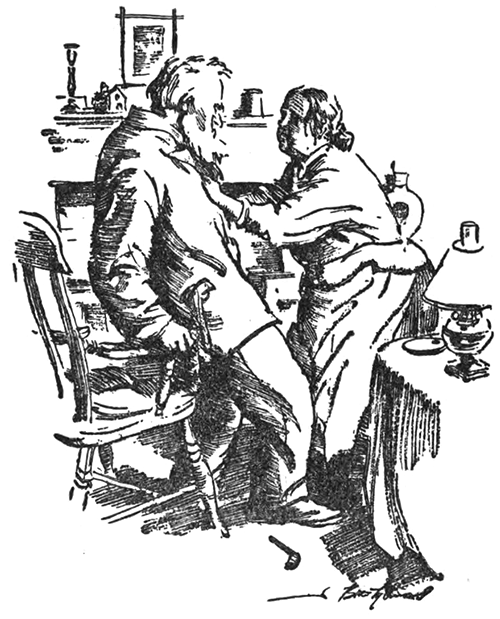
“NO, YOU MUSTN’T,” SAID HIS WIFE, PUSHING HIS GREAT FORM BACK INTO THE CHAIR.
The Captain, impelled by that small but resolute arm, stayed where he had fallen, and lighting his pipe fell to smoking with much enjoyment, listening to the beating of the surf and the wind, which was blowing almost a gale. The combination was so soothing that he fell asleep at length with the pipe between his teeth.
He awoke with a start and a vague confused idea that somebody had called him. Certainly a cry of some sort still rang in his ears, and placing his pipe on the table, he rose and stood with one hand on the back of his chair listening. At first only the wind and the surf, then mixed with it the faint wailing of a child. The Captain felt his way to the door and called excitedly to his wife.
“Jenny! Jenny!”
“All right, go back,” called his wife quickly, from the top of the stairs. “I’m coming down now.”
“I heard a cry outside,” said the Captain. “The cry of a child.”
“Nonsense, you’ve been dreaming.”
“I tell you I heard it,” repeated the Captain, as he threw open the house door. “Listen!”
“There!” said the Captain, holding up a warning finger. “I heard it again.”
“So did I,” said his wife. “It’s outside.”
“Get a shawl and come after me, my lass,” said the Captain, taking down a coil of line made fast to the staple of the door, which he used for short wanderings. “Hallo, there! Hallo!”
He walked slowly in the darkness, listening eagerly while his wife turned her white face upwards and in broken accents thanked Heaven for her husband’s blindness. Then she came downstairs, and with the agility of a girl ran by her husband.
The Captain paying out his line, and treading softly, heard her stop and cry out suddenly, and then, with an indistinct cry to him, speed back to the house.
“I’ve got it,” she cried. “I’ve got it.”
He turned and followed rapidly. Inside he closed the door and stood in the hall listening to the crying of a child, which now sounded through the house, and the hurried footsteps of his wife as she moved about in the room above.
“It’s a baby, Jim,” said his wife, coming half-way down the stairs and closely watching her husband’s face as it showed in the light from the sitting-room. “Just a little child, wrapped in an old shawl and left to die. Only a few days old, by the look of it.”
“Ay, ay,” said the Captain, very slowly. “Go upstairs, my dear. Go upstairs.”
He turned and, closing the door after him, groped his way back to his chair, leaving his wife, after a moment’s irresolution, to do his bidding. The fire was out and the room chill before she came down again, and the tears sprang to her tired eyes as she saw the strong, helpless man patiently awaiting her return.
“How’s Edith?” he asked, without turning his head.
“She’s not very well, I think,” said his wife, in a low, frightened voice, “but she has just fallen asleep. I don’t think I’d disturb her to-night, Jim, if I were you.”
“I won’t,” said the Captain quietly. “I’ll get to bed, too, I think. Good-night.”
He went slowly up the stairs and into his room, his wife following him noiselessly, and not until the door had closed behind him did she relax her watchfulness; then, in a dazed condition, she made her way to her daughter and fell half-fainting across her bed.
In the morning, in the cool salt air and the sunshine, her flagging spirits revived and she greeted her husband in almost her usual cheery fashion as he came in from his tethered walk along the shore to breakfast.
“Edith not coming down?” he inquired, as he took his seat at the table.
“Not to breakfast,” she replied, watching him.
“Best not, if she doesn’t feel strong,” said the Captain briskly. “I’ve been thinking about that child.”
“Ah,” said his wife, and the cup she was passing him rattled in the saucer.
“If nobody claims it,” continued the Captain, “take it up to London and let old Sparling’s widow have it. She’ll take it if we pay her. I suppose we can’t send it to the workhouse?”
“We can’t keep it?” suggested his wife timidly.
“No,” said the Captain, with a mirthless laugh, “we’re too old to be plagued with children.”
His wife said no more, but later in the morning informed him that she had written to London to make arrangements, and that Edith would not be up that day, but would come down the next.
More than a week, however, elapsed before she put in an appearance, and then very pale and trembling she came down and took her accustomed seat. To her father’s great relief she came alone, yet she was but indifferent company, her thoughts being with her mother and the child who had just started on their journey to London.
After this the time passed slowly and uneventfully to the dwellers in the cottage. Edith, quiet and patient, felt her life bounded by the sea and marsh, and never looked beyond. Only her mother fretted as she thought of her beautiful daughter and her wasted life. For his part the Captain seemed not to think at all, except that once when his daughter threw out a feeble suggestion of seeking employment, he drew her to his knee, and encircled her with an arm of iron.
The child was never alluded to, though many and various were the plans mother and daughter considered for its future. The child itself solved the problem; it died, and its mother, weeping bitterly over the ill-written scrawl which conveyed the news to her, prayed for death too.
If anything, she became quieter than before, despite the efforts of her father to arouse her. Sometimes it was a long walk with the blind man along the shore, at another they would put to sea in the Captain’s small skiff and stay for hours on the lonely waste of waters.
Then suddenly things changed. One day, after a longer walk than usual, they were astonished as they neared the house by the unwonted sounds of a man’s voice. It was a full, hearty voice, and it was evident from the animated conversation within that the stranger was feeling very much at home.
“Jem,” said his wife, as he entered, “you remember George Merrick, but he’s grown from a boy to a man since we saw him.”
“And from apprentice to master,” said the stranger, as he rose and gripped the other’s hand. “All your teaching, Cap’n, all your teaching.”
“You’ve got a ship, my lad?” inquired the Captain, as he returned the shake.
“A brand new one,” replied the other. “But I’ve got to wait a couple of months for her and I thought I’d spend the holiday looking up my friends. I got your address from your old owners, and here I am.”
“And here you’ll stay till your ship’s ready,” said the Captain cordially. “That is if you can put up with an old blind man and his household. Lord, it’s good to hear the voice of a friend in this desolate place.”
“Sure I shan’t be a nuisance?” asked Merrick. “You know of old how noisy I am.”
“Not a bit of it, you’ll liven us all up,” replied the other. “It’ll be a boon to me to have somebody to talk over old times with.”
“Well, when you are tired of me tell me to go,” laughed Merrick, and so the matter was settled.
II
With the introduction of a visitor from the outside world dullness fled from the cottage, and in a very short time George Merrick was on the happiest terms with all of them; the Captain remarking with surprise conversational powers on the part of his wife he had long since thought defunct.
All this the Captain heard, but he was a sense short. He could not see the honest admiration with which Merrick eyed the daughter while he talked to the mother, nor the subtle joy of the latter in the knowledge of it.
A sharper man might have remarked the deference in the visitor’s tones when he addressed the daughter, but he did not, nor when Merrick and his daughter were from the room did it occur to him that they might be together.
It was three weeks after Merrick’s arrival before his eyes were opened. The visitor had gone on an errand to the neighbouring town, and his host was sitting at the open window, smoking and listening to the clicking of his wife’s needles as she knitted a mammoth sock.
“Jem,” said his wife, suddenly suspending her work, “I think George Merrick wants a little talk with you this afternoon.”
“He may have it,” said the Captain affably.
“You—you don’t seem to understand,” said his wife, her voice shaking a little; “you men are all alike, I think. He wants Edith.”
“What?” shouted the Captain.
“He spoke to me this morning,” continued his wife, “and, of course, I referred him to you.”
“Has he spoken to her?” inquired the Captain.
“He spoke to her last night,” was the reply, “and she accepted him. I saw all along that they were taken with each other.”
“And you never stopped it,” said the Captain. “You let it go on.”
“Of course,” said his wife, in surprised tones. “Why not?”
“Your memory is failing,” said her husband. “Think—go back three years; go back to the night the child came.”
“Jem,” said his wife, in a frightened whisper. “What do you mean?”
“Have you told him what you told me, or have you told him the truth?” pursued the other sternly.
His wife, breathing rapidly, made no reply.
“I have never referred to it before,” said the Captain, more gently. “I never would have referred to it but for this. To save my poor girl’s pride—and my own—I pretended to believe the lie you told me, for I am a blind man, my dear, and harmless. When a man loses his sight he should die, for he is a moving, dangerous man no longer. He is a derelict, and can only hurt that which runs against him.”
“It is all past and over,” murmured his wife brokenly.
“So I had thought,” replied the husband. “I never thought to have told my daughter’s shame to another man.”
“You will not,” cried his wife wildly. “I will never forgive you if you do. Hasn’t my darling suffered enough? We did wrong in sending such a child to that great, wicked city. And she loves him. If you tell him that, it will kill her.”
“I am a proud man,” said the Captain sternly, as he rose, “and no man shall enter my family under false pretences. I will tell him. If he likes to overlook it, well and good. Nobody will be happier than I shall.”
“Overlook it!” repeated his wife. “To save your pride, you were content to keep your eyes shut—why do you wish to open his? Do you think he will thank you for the information?”
“Where is he?” asked the Captain.
“He is out with Edith,” said his wife, crossing over and falling on her knees beside him. “Jem, don’t tell him; for pity’s sake let things be. Edith refused him at first, she has pride, too. She would not listen to him. But I told him before her that she loved him and after that he would not be denied. She is a good girl—you know she is a good girl—and if you ruin her life like this, you will break my heart.”
Before the Captain could reply or disengage his hands from hers, voices were heard in the hall, and Merrick entered the room and looked significantly at his hostess.
“Captain,” he said in a strong voice, “I suppose Mrs. Ferguson has told you that I have asked your daughter to be my wife. I——”
“Sit down,” said the Captain quietly. “Jenny, Merrick and I will settle this.”
His wife rose helplessly to her feet. “Not now, Jem,” she cried piteously, “not now; think first.”
The Captain shook his head, and his wife, avoiding the gaze of the astonished Merrick, left the room and went upstairs to her daughter. Ten minutes later, through blinding tears, she saw Merrick quit the house and walk like a drunken man along the sands.
“He has gone,” she whispered, “gone without a word.”
Edith rose, pale and dry eyed and crossed over to the window; then flushing darkly she bent over her mother and kissed her.
“I should not love him if he had stayed,” she said.
For the rest of that day she kept her room, only going downstairs when she heard her mother’s bedroom door close. Her father sat by the window, his unsmoked pipe by the sill and his hands clasped before him.
“Good night, father,” she said, quietly, as she crossed over to him and placed her arms about his neck. “And thank you, for—everything.”
“We’ll—we’ll be the same as before, my girl,” said the Captain, as he drew her soft cheek on to his shoulder. “It was best for you, best for him.”
“You have been wonderfully good to me,” said the girl, in a low voice. “I thank you and love you for it.”
She disengaged herself from his arms and rose, pausing at the door to bid him good night again, and passed upstairs.
An hour later, when the house was still and dark, she crept down again. It was a warm summer’s night, but she shivered slightly and caught her breath when the door rattled, under the touch of her shaky fingers, as she opened it. Then she closed it behind her, and with a slight sob at the pity of it all, walked towards the sea. For a minute she paused irresolute, and a man who had walked down for a last look at the house which contained her, stepped from its shadow and stood miserably watching. Then, as he heard the grating of the boat’s keel on the beach, he sprang forward eagerly, crying her name.
He was just too late; the boat floated and the girl, with a stroke of the oars, sent it from the shore. Without further parley he threw off his coat and shoes, and wading in, struck out in pursuit.
“Go back,” cried the girl from between her teeth. “Go back.”
There was no reply, but a slight splashing in the wake of the boat spoke for itself. She bent to the oars, the noise getting fainter and fainter as she widened the distance between them.
With her face white and set, she kept on her way until, despite herself, her heart failed her, and she stopped rowing to listen. At first there was a dead silence, then she fancied she could still hear him striving to reach her.
“Go back!” she cried piteously, “go back!”
“I can’t,” he shouted, calmly, “it’s too far.”
The girl sat motionless, peering through the gloom. Across the water came the sound of quick, distressed breathing, and weak, rapid strokes. With a great cry, she turned the boat’s head round and pulled in the direction of the swimmer.
“Where are you?” she cried, wildly; “call out.”
At the faintness of the response she increased her efforts until she came alongside something which struggled manfully in the dark water, and strove to keep its white face above it. Just in time she leaned over, and, grasping it by the shoulder, drew it to the stern of the boat and held it fiercely and strongly to her breast.
“If you want to die, dear,” gasped the man, as he lay a little later in the bottom of the boat, holding her hands, “pull out the plug and we’ll go down together, but living or dead, you shall not go from me again.”