GENTLEMEN Be Seated Minstrel Program of Pack 18, Prospect Park, Pa.
Reading edition

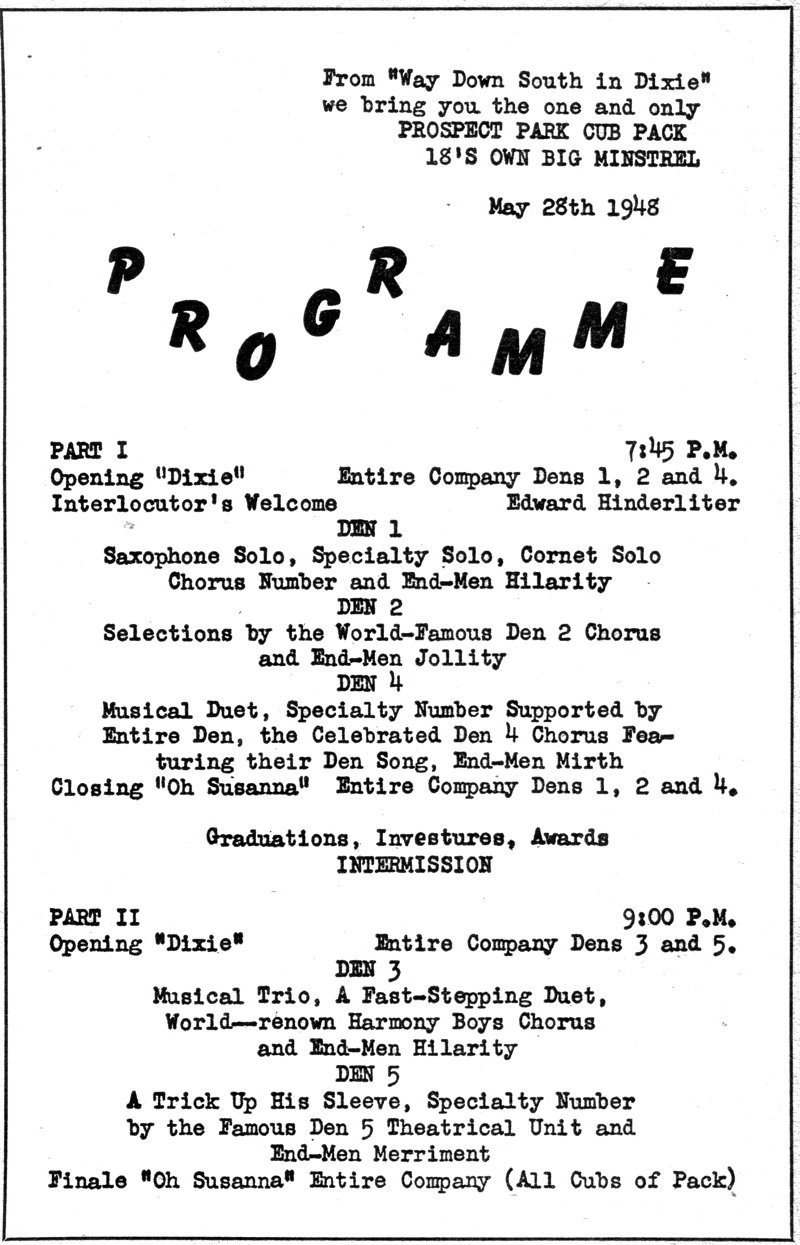
Tips For Your Pack Minstrels
◆ Program and Publicity: Plan an attractive mimeographed announcement for your show, and deliver it to parents in advance.
Costumes: Almost anything goes. In some minstrels all actors are blackface. This appeals to boys, although it presents problems for the make-up crew. Blackface make-up may be bought at most drug stores. Burnt cork is an old favorite. In many minstrel shows the cast remains in white-face with simple costumes, while the end men wear bright, comic costumes and blackfaces. Either way is good, so take your choice.... It’s a good idea to have all boys except the end men dressed alike. If they are to be blackfaced, have each bring a black sock which can be pulled tight over the head to hide the hair. A white shirt with a black tie (cloth or paper), black trousers and socks, and dark shoes complete the costume. It also adds a nice effect if every boy can wear white gloves. Even white canvas work gloves will serve nicely.
Stage Setting: If you have a fairly good-sized stage, try to arrange chairs or benches on different levels so that all performers can be seen. Decorate the back of the stage with large paper musical notes pasted on a background of paper, and perhaps a sign reading “Welcome.”... Footlights and spotlights help the show but are not necessary for success. You can buy spot bulbs at hardware stores.... Even without a stage, you can arrange your chairs or benches on different levels so that you have the effect of a stage.
Program: Plan your program so you don’t need the entire Pack at rehearsals. Features which will be participated in by the entire cast (for example, opening and closing chorus), can be rehearsed by each Den, then sung together at the show. Here are some good numbers for your opening chorus: “Dixie,” “Minstrel Days,” “We’re Here For Fun” (see page 6, Cub Scout Song Book), “Hello, Hello, Hello,” “When You Wore A Tulip,” “Down South,” etc.... Each Den can prepare whatever acts time will allow, and ought to supply at least two solos, either vocal or instrumental. Solos can be alternated with the Den stunts. The stunts can include such items as homemade orchestras, Den chorus, Den tap dance, Den skits, etc.... Much of the success depends upon the end men. Two or four sit on each side of the front line and pass jokes and stories back and forth with the interlocutor. The interlocutor can be either an adult or boy, and it is his job to keep the show running smoothly and to prompt those who forget their cues. Most libraries have several books on minstrel shows, and you will find some good stories in them. Give them a local twist and they will seem funnier.
Remember: Your minstrel show can succeed without rehearsals of the entire cast if you plan carefully. It won’t be quite so polished as a professional minstrel show might be, but your parents and guests will enjoy it all the same, and will appreciate the fact that you did not require the boys to go out for special rehearsals.
17MUSICAL INSTRUMENTS
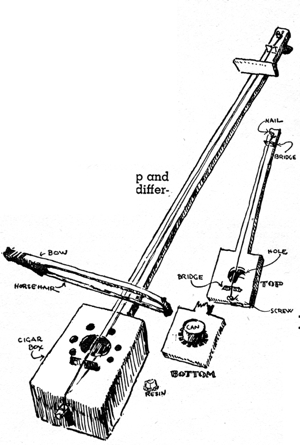
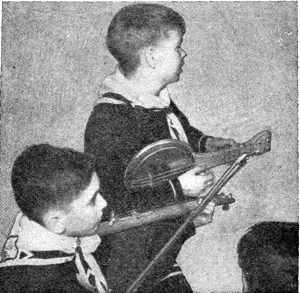
UNICORD
A cigar box and four-foot stick, an “E” string, an old fiddle bow and a few nails will make it.
Be sure to remove paper from cigar box so it will sound. Make a bow out of stick and horse hair with resin on it, or borrow an old fiddle bow.
Slide flat metal bar up and down string to make different notes.
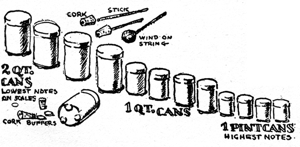
MUSICAL CANS
Four 2-qt., four 1-qt. and four 1-pt. cans with different amounts of water to make a musical scale.
The more water and the larger the can the lower the note. The less water and the smaller the can, the higher the note.
Put three pieces of sliced cork on the bottom of each can to lift it above table top. Strike with cork hammer.
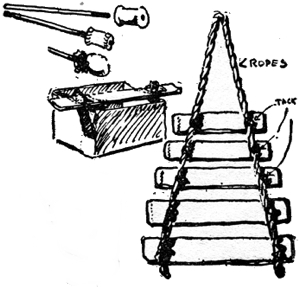
MARIMBA STICKS OR SLATS
Dry California Redwood or poplar slats are good. The longer or thicker they are, the lower the note or pitch. The shorter or thinner they are, the higher the note or pitch.
Cut shorter or thin down the slats until you have a musical scale.
Lay tuned slats across a cardboard box.
Sprinkle sawdust on them.
Strike lightly and rapidly in center. The sawdust will gather in two places. These are the spots where there is practically no vibration. Drive your nails through these spots in attaching to ropes.
Hold rope by loop and strike slats with hammer made from a stick and a spool padded with cloth.
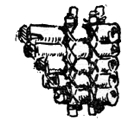
BAMBOO PAN PIPES Bamboo tubes with diameter from ⅜ in. to ¼ in. 1st tube about 7 in. long.
Leave joint at bottom to close it. Grind and cut bamboo tubes shorter and shorter until you get the right note when blown.
Another way: Test tubes bound together and partly filled with clay will give different depths and different notes of the scale.
18