DOIN’ IT RIGHT
Reading edition
By William H. Wadsworth Asst. Scout Executive, Onandaga Council, Syracuse, N.Y.
⚜ There are two ways to get the know-how of winter camping. One is the hard way, by trial and error, the other is profiting by the experience of others. We did it the hard way, which has certain advantages; once you learn a trick, you don’t forget it. But, we’re happy to let you in the easy way, so let’s take first things first:
Packing
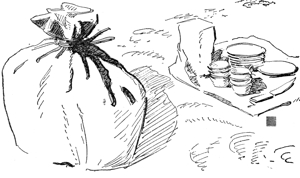
We usually have each Patrol get personal equipment together and lay it out in neat piles. Patrol equipment and food is divided equally into as many piles as Scouts in the Patrol. We consider both weight and bulk, and try to even it up.
It’s a good idea to fill your cook pots (we use five No. 10 cans) with food or small articles which might possibly be greasy, or break or freeze, and place in the top of your pack. If blankets are on the outside (get them inside if possible) protect them from the weather by rolling in waterproof groundcloth. Don’t have the end of your blanket roll exposed. (We found we could keep the Patrol canteen from freezing by putting it in the middle of a bedroll.)
Clothing and Equipment
As you travel and begin to heat up, peel off layers of clothing. Several layers are warmer than a few heavy pieces. This goes for socks as well as shirts. Air space gives good insulation. If it’s raining or snowing, be sure to wear a water-repellent outer garment, removing the inner layers and packing them in the flap of your pack. You’ll want them—dry—later at night. In snow country, specially after a fresh snowfall, you’ll find a large amount of snow constantly dropping off trees onto your pack, your back, and down your neck. Carry a small stiff brush to remove it. Keep the brush handy in an outside pocket for removing snow from clothes and equipment. “It’s easier to keep ’Em dry than to dry ’Em out!”
Damp socks may be dried during the night by laying them flat across your stomach outside whatever night clothing you are wearing. In cold country, shoes should be dried before the fire and placed inside or under your bedroll for the night. I’ll never forget the time we had the first really cold night and left our ski boots outside the bedroll. They were like rocks and it took some time to soften them enough to get our feet in them.
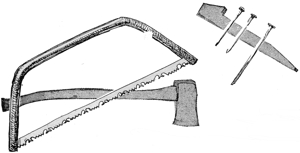
We are strong believers in the Swedish bow saw in country where we do a great deal of wood cutting. We cut bed logs to hold the dead leaves, boughs, or grass. We cut poles for our tents and reflector fires. We cut large base logs on which to build the fire to keep it from burning itself out of sight in deep snow. I’ll never forget the day we “lost our fire” when we were on a day hike. We were in a large frozen swamp and had made fires to cook our lunch. You should have seen the expression on one face when, with a hiss and sputter of steam, his fire disappeared into the water, leaving his hot dog dangling above floating charcoal.
One reason for emphasis on the bow saw, is that it does twice the work with half the energy. Wood fills with frost in winter and axes bounce instead of cut, no matter how sharp they may be.
In winter look for just the opposite type of campsite you would select in summer. Instead of a shaded open knoll, seek low lands, if they are frozen, where trees are thick and provide good windbreak. Places you never visit in summer suddenly come into their own for winter camping.
A small roll of copper wire will come in handy for many things. One fellow always carries about 27four wire pothooks of varying sizes. Oh yes, he can make a wood pothook, but that takes time, and often when we have made camp a little late because of a long trip or late start, his pothooks come in mighty handy. He also added pot bags to our list. Strange as it may seem, we don’t have one Scout who likes to wash the black off pots; thus, if we are making only one camp, we just crush the #10 cans and bury them. When we use a regular pot, we just wash the inside, pack it full of other food and equipment, and slip on the pot bag, which prevents it from dirtying up our pack.
by Remington Schuyler
Tents
Tentage is a story in itself. We use the Tab tent (Scouting, December, 1947), which is a rectangular, suspended tent. It has thirty-seven tabs which give us a chance to pitch it in many different ways, each providing twenty-inch walls, which make for more room and efficient use of the tent’s interior. For winter camping we pitch it with an open front in either winter baker, forester, or explorer style, using forty-penny nails or logs to anchor it on frozen ground, or logs or sticks buried in deep snow. We like logs best; the same logs can be used for bed logs with the Tab tent. We bank the tent well with grass, leaves, or snow—for that wind can whistle under an open edge too easily.
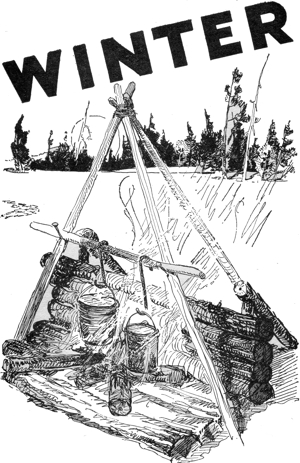
We have a favorite tripod fire crane which works perfectly under any conditions—frozen ground, in snow, or mud. It eliminates cutting crotched sticks and pounding them into hard or frozen ground. The three uprights may be dead or live wood fastened at the top with a small piece of rope, wire, or even a neckerchief. The lug pole is green wood about an inch in diameter. This rig can be easily moved as your fire changes, and works well with any type of fire lay.
Don’t forget a small food cloth for keeping food and cooking equipment off the ground. Keep one pot on the fire for a constant hot water supply; it will come in handy in a dozen ways and is an excellent first aid precaution. It is easier to melt snow in water than in a bare pot where it must be stirred to keep from burning. Let each individual prepare his own beverage with boiling water and the beverage powder he prefers. This saves tying up another pot.
A good ground cloth is essential. Make it large enough to go under and over your bedroll. Build your bed of dried leaves, grass, or boughs. Don’t rely on that summer sleeping bag alone—extra blankets are necessary. Newspapers are good insulation. Sleep with your head to the highest part of the tent so that your breath won’t freeze and form a hoarfrost on the tent and fall off onto your blankets.
One fellow hit on a good idea on our last trip. At night he prepared his tinder, kindling, and firewood in three neat piles inside his tent. When morning came, he extended one arm, in went the kindling, a match, and it’s lighted, with him still in bed. A stick or two of wood and things began to warm up. By the time he had to get up, he didn’t miss his warm blankets ... well, not much.
We carry two pairs of long underwear. The one worn during the day is taken off and dried at night when going to bed and when it is warm. The next morning clothes are put on over the set of underwear worn during the night, eliminating too much exposure of bare skin—an important point, especially when you are inside that bare skin.
First aid precautions in cold weather differ from regular summer first aid; shock is greatly intensified in cold weather. Blankets and canteen hot water bottle are handy. How to treat for frostbite is required knowledge. Make preparations against snow blindness in northern regions. Temporary sunglasses may be made with cardboard, cloth, or wood with slits cut through, fastened in place with adhesive tape. Watch out for your feet. Wear several layers of light wool socks with large sized waterproof shoes, shoe packs, or ski boots. Tight-fitting ski boots will cause you trouble. Lay down boughs or branches around your fire; you can walk on them and thus keep your feet out of wet snow or mud caused by the fire’s heat.
You’ll pick up other ideas as you go along. It’s not difficult, and you don’t need special equipment or skill. All you need is the spirit of adventure—the spirit your Scouts have—and the desire to try something different. It’s fun.
28