PROPOSED CREMATION TEMPLE.
Reading edition
Cremation, in this country at least, is not popular. For a time, it occupied here some public attention, but only in a sensational way; and the sober discussion of the subject, which followed after its novelty had worn off, led to the general opinion that, while every one might be quite willing to see his dead neighbors cremated, no one would acquiesce in the disposal of his friends and relatives in so abnormal a manner. Hence, with the single exception of the late revolting exhibition in Pennsylvania, which we alluded to at the time, the dead in this country have continued to be deposited in their hallowed resting places, and have not been packed away, in an incinerated state, in labeled urns. In Europe, however, cremation still finds many warm adherents; and during last summer a congress of the "Friends of Cremation" (a society which, we are informed by Engineering, whence we take the annexed engravings, has branches in various parts of the world), was held in Dresden. Before this meeting, a large number of designs for cremation and mortuary buildings were brought in competition, and finally the prize was awarded to Mr. G. Lilienthal, a Berlin architect, for the imposing structure illustrated herewith.
This will be the grand temple of cremation when it is erected—a proceeding to take place in the dim future: when or where not stated. On each side of a central chapel there is a circular memorial hall; and extending so as to inclose the garden of the establishment, on the sides of the halls are wings containing a large number of niches for the reception of funeral urns.
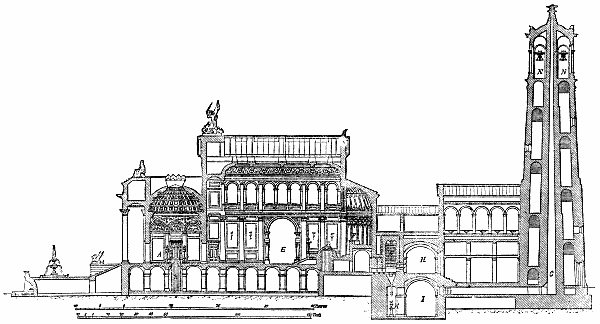
The cremation ceremony is proposed to be as follows: The body, having been brought into the hall, is subjected to the usual medical examination; or when an inquest is necessary, it is removed to offices in another part of the building, where the required investigation can be held. When all is ready, the body, placed on the platform, B, Fig. 2, is raised by a lift into the hall, A, where visitors are gathered, and here the result of the medical examination is declared, and whatever preliminary religious ceremonies that are desired are performed. The body is then transported to the chapel, E, in front of the pulpit, F, where the burial service is performed. The bier is afterward lowered mechanically, and brought to the furnaces, which are arranged in a semicircle and partitioned for the reception of several biers. The ashes are subsequently placed in an urn, on which the name, etc., of the deceased are recorded, and which is set up in a suitable niche.
Fig. 1.—DESIGN FOR A CREMATION TEMPLE
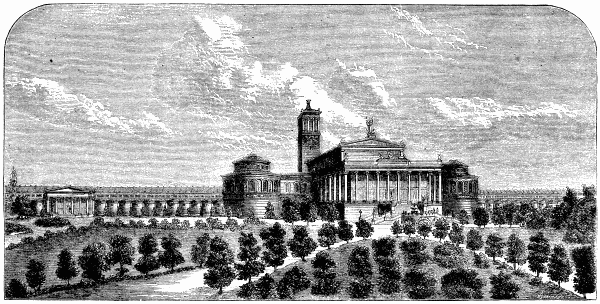
The building, which we illustrate both in elevation, Fig. 1, and in plan, Fig. 2, is designed to contain 100,000 urns, and is adapted for a town of 200,000 inhabitants. The architect has certainly exhibited much taste in his design for the building, and has provided every convenience in the internal arrangement for carrying on a large business in the cremation line.
Fig. 2.—SECTION OF A CREMATION TEMPLE.
How to Rejuvenate an Old Rose Bush.
Never give up a decaying rose bush till you have tried watering it two or three times a week with soot tea. Make the concoction with boiling water, from soot taken from the chimney or stove in which wood is burned. When cold, water the bush with it. When it is used up, pour boiling hot water on the soot a second time. Rose bushes treated in this way will often send out thrifty shoots, the leaves will become large and thick, the blossoms will greatly improve in size and be more richly tinted than before.—D.H. Jacques.
A Clock Collector.
One of those odd geniuses, who spend their lives and means in collecting curious and rare articles, lately died. His name was Sylvester Bonaffon, a retired merchant of Philadelphia. His elaborate collections were sold at auction, and their oddity has attracted general attention. His chief mania was for clocks, which literally covered every portion of available space in his apartments, whether they were placed on chairs, tables, shelves, or hung against the wall. Some of these timepieces were of unique construction. One clock was made to run for 400 days after one winding; another was set in the dashboard of his carriage, and he used Mr. Bonaffon also had an especial fondness for electrical apparatus. His windows were provided with ingenious burglar alarms, his rooms with fire alarms, and he ignited his gas always by electricity. His place of business, his stable, the Continental Hotel where he dined, were all connected with instruments in his room; and he even had perfected arrangements so that he could set at home and send his own messages to California. Besides the clocks and electric apparatus, there was an immense collection of bric-a-brac of every conceivable variety, which was sold at the auction—as is usually the case—at prices much below those paid by its late owner.
Fertilizing Influence of Snow.
Snow is often called the "poor man's manure;" and if it is true that it has any manurial value, the farmer's prospects for the next season are certainly flattering. The body of snow upon the ground in all the Northern and Middle States is very great, and millions of acres of land are covered by it as with a blanket of the whitest wool. It is probable that seldom, perhaps never, has so wide an area of our country been covered as during this month of January, 1877. The question whether snow is capable of affording to lands any of the elements of fertility is one often asked; and in reply, the Boston Journal of Chemistry says that it probably is. The atmosphere holds ammonia and some other nitrogenous products, which are without doubt brought to the soil by snowflakes as well as by rain drops. Experiments both here and abroad would seem to prove the truth of this conclusion.
Rains are not only valuable for the moisture which they supply, but for what they bring to us from the atmosphere. During a thunderstorm nitric acid is produced in considerable quantities; and dissolved in the rain drops to a high degree of attenuation, its effects upon soils are highly salutary, as the nitrogen permeates the entire soil.
Action of Sea Water on Lead.
The Journal of the Chemical Society says that freshly cut strips of lead were kept in a bottle of sea water for four days, the bottle being frequently shaken. No trace of lead could be detected in the water, but the bright surface of the strips was coated with an insoluble lead compound. Hence lead pipes may be used in marine aquaria without any fear of injury to their inhabitants.