Communications.
Reading edition
The Frost Plant of Russia.
To the Editor of the Scientific American:
Mr. Charles Williams, of Winoa, Ohio, has written a letter to that veteran botanist, Humphrey Marshall, of Chester county, Pa., on the subject of the abovenamed plant, and my opinion concerning it has been asked for. Seeds of this plant were obtained by citizens of Boston, who had snow brought from the White Mountains and from the coast of Labrador, and who stated that they have "now the most unbounded satisfaction and pleasure of announcing that all signs are favorable to the realization of their fondest hopes." This wonderful plant, it seems, was found amid the perpetual snows of the northern boundaries of Siberia, in 1863, by Count Swinoskoff, the eminent Russian botanist, and it was by him cultivated at St. Petersburgh. The account sent me is very vague, and is evidently not from the pen of a botanist. It is stated that it comes forth on the first day of the year, grows to the height of three feet, and flowers on the third day. It continues in bloom for twenty-four hours, then dissolves itself, being of the finest snow; it has a stalk one inch in diameter, and leaves, three in number, 1½ inches wide, covered with infinitesimal frost or snow cones. The flower is of the shape of a star, with petals 3 inches long and ½ inch wide at the broadest part, forming a basketwork of frost. The seeds are like a pin's head. This is about all that can be gleaned from the description, and is by no means satisfactory. Allow me to present my humble views of an analogous discovery of frostwork on December 6, 1856, in a sandy loam in Chester county, Pa., near the Paoli monument. In the Horticultural Journal of Philadelphia, then edited by J. Jay Smith (New Series, volume vii., page 73, 1857), an account was published of my observations then. These I have since more fully confirmed. The common dittany (cunila Mariana) is frequently met with in December, with the base of the stem surrounded with shellwork of ice, of a pearly whiteness. Dr. Darlington, in his "Flora Cestrica" published in 1853, page 199, under the article cunila, observes: "In the beginning of winter, after a rain, very curious ribbons of ice may be observed, attached to the base of the stems, produced, I presume, by the moisture of the earth rising in the dead stems by capillary attraction, and then being gradually forced out horizontally, through a slit, by the process of freezing. The same phenomenon has been observed in other plants. See observations on helianthemum, page 27." Had the doctor given a more extended investigation, I fancy he would have agreed with me as to the cause. I found hundreds of diversified specimens. I am not aware that it was after a rain, but I took up a number of the plants, and always found a vigorous scaly root bud, undergoing development at this early season under ground, to produce a new stem the following spring. I came to the conclusion that, as the temperature was below freezing and snow was on the ground, the expanding bud, in close proximity to the surface, gave out sufficient caloric or warmth to generate vapor from the moist soil. This vapor rising around the stem of the plant, and attracted by it, becomes congealed into what we term hoar-frost, in numerous forms; some like shellwork, others like tulips, with radiated petals, variously contorted, and often as symmetrical as snowflake crystals.
Root-bud and frost-flower of the Cunila Mariana (Maryland Dittany). A, the developing or budding root. B, the old stem of the previous year. C, the congealed vapor or hoarfrost, forming the first flower of various shapes.
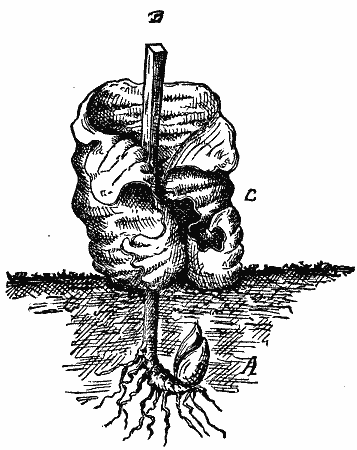
That plants in germinating have the power of generating heat was proved by Mr. Hunter and by Lamarck. Experiments of Hales and Du Hamel show that vegetation is not wholly suspended, however cold it may be; and that there is a regular and gradual progress till the returning warmth of spring gives a greater degree of velocity to the juices, rendering their development more vigorous and apparent. If the crystallization takes place when the air is calm, the crystals will be regularly formed; otherwise, when windy, I have seen them like a shell within a shell, very thin, of a pearly whiteness. Professor Tyndall has shown in a very beautiful manner that ice is but an agglomeration of snow crystals: the transparency of the former being due to the expulsion of the air, entrapped in and causing the whiteness and opacity of the latter. There is a formation called the snow plant of California, which arises to some height, and has been compared to various things, a fountain convoluted and enlarged above, a crystallized small bushy shrub, etc.; but on closer inquiry, I have failed as yet to get any definite ideas to its true character. Some bulbs in the soil might cause such formations by the congelation of vapor deposited successively upon itself, or the stems of the previous year's growth yet remaining, and thus give them a sheathing of frosting.
The shape of a star is common in snow crystals, which we all know assume the most beautiful forms, and which are illustrated in various publications. The eminent botanist Count Swinoskoff should give us some clue as to the genus or character of the plant, the flower of which, we are told, melted away on being touched, and as to the stamens, the diamond seeds like a pin's head, etc. The whole needs further explanation.
I trust those Bostonians who are in such hope will edify the public as to the final result of their experiment. What has that veteran in botany, Dr. Asa Gray, to say about it? Let some one well qualified tell us more about this frost flower of Russia.
J. Stauffer.
Lancaster, Pa.
Patent Matters in Washington, D.C.
To the Editor of the Scientific American:
From the report of the Commissioner of Patents, just issued, it appears that its surplus revenue for the past year amounts to over one hundred and five thousand dollars, and that there is nearly a million dollars in the United States Treasury to the credit of the Patent Office; and yet, notwithstanding that this enormous amount is lying idle, our pseudo-economists at the Capitol refuse to grant the Office sufficient of its own funds to carry on its business promptly. So much is the work behindhand in some of the departments that, as the Commissioner states in his report, some of the attorneys who require certified copies of papers have been obliged to employ their own clerks to do office copying, and then had to pay the full legal rate of ten cents per hundred words, the same as though the Office had done the work. This style of economizing, by making inventors pay two prices for their work, may be "reform" in the eyes of the average Democratic Congressman; but speaking for myself, as one of those who have had to pay twice, I would prefer to dispense with this style of "retrenchment and reform," and therefore ask you, Messrs. Editors, in behalf of the inventors of the United States, to so stir up our legislators that they will allow the Office sufficient of its own funds to do its work properly, and not delay the work of the inventor—work that he has to pay for in advance—and so prevent the discouragement and trouble which these delays always cause.
As the Patent Office has been doing a good business lately, there appears to be some attempt at rivalry at the Capitol, as the following list of applications for extension will show:
LIST OF APPLICANTS FOR EXTENSIONS OF PATENTS NOW BEFORE CONGRESS.
—— Reynolds, power loom brake. Strong & Ross, scales. Wm. & W.H. Lewis, photographic plates. T.A. Weston, differential pulley. S.S. Hartshorn, buckles. H.A. Stone, making cheese. N. Whitehall, cultivator. J.R. Harrington, carpet lining. H.L. Emery, cotton gins. J. Stainthorp, moulding candles. Walter Hunt's heirs, paper collars. A.B. Wilson, sewing machines. S.A. Knox, plows. Rollin White, firearms. Aikin A. Felthousen, sewing machines. H. Woodman, stripping cotton cards. L. Hall, heel trimmer. J.A. Conover, wood splitter. J. Dyson, carding engine. G. Wellmann, card strippers. E. Brady, safety valves. Jearum Atkins, harvester rakes. John Thomas, re-rolling railroad rails. Thomas Mitchell, hair brushes. Stephen Hull, harvesters. T.R. Crosby, wiring blind slats. G.W. Laban, mitre cutting machine. T.A. Whitenack, harvesters. J.J. Vinton, furnaces. A. Fuller, faucets. D. Baker, pitcher spouts and lids. G.F. Chandler, refining sugar. G.H. Nott, boiler furnace. William Hall, lightning rods. B.F. Rice, paper bag machines. S.D. Nelson, shovels. E.T. Russell, car springs. Hubbell & Conant, steam pumps. C.A. Chamberlain, shovels. C.A. Adams, locks. E.A. Leland, paint can.
In addition to the above, I find the following names as applicants for extensions, but the inventions covered by the patents sought to be extended is not mentioned: S.S. Turner, Arculous Wyckoff, De Witt C. Cummings, Moses Marshall, J.W. Fowler, and Holloway & Graham. Many of the applicants have apparently given up their cases for this session, but they may be only lying back to its close in hopes that in the final rush their "little bills" may slip through easily.
Several bills tinkering at the patent laws are before Congress, and one of these (House Bill, No. 3,370) passed the House on the 30th ult. It has one section that may be made to work great harm to inventors, as it prevents infringers being sued for more than one year's damages previous to notice of infringement being given. By this bill, if it is allowed to become a law, a person will be able to build and use patented machines or processes for years in some out of the way place where the inventor cannot easily find him; and should he be discovered, he can only be sued for one year's damages. There are other sections in this bill which will bear ventilating.
Another bill, introduced into the Senate by Mr. Paddock, provides that all appeals from the Board of Appeals shall be direct to the Supreme Court of the District of Columbia, instead of to the Commissioner as heretofore; and that the fees shall be the same as now paid to the latter official.
Mr. Sampson has introduced into the House a bill changing section 4886 so that it shall read as follows: "SEC. 4886. Any person who has discovered any new or useful art, machine, manufacture or composition of matter, or any new or useful improvement thereof, not known or used by others in this country, and not patented or described in any printed publication in this or any foreign country, before his invention or discovery thereof, and not in public use or on sale for more than two years prior to his application, unless the same is proved to have been abandoned, may, upon payment of the fees required by law, and other due proceedings had, obtain a patent therefor: Provided, That the manufacture or composition of drugs as a medicine shall not be patentable." The change is the addition of the words in italics.
The Smithsonian Institute has sent to Congress a memorial setting forth that the present Institute building is already too small for the vast amount of articles already placed there on exhibition; that at the late Centennial Exposition the Commissioners of various countries presented their entire collection of exhibits to the United States, which had delegated their care to the Smithsonian Institute, and they had no place for them; that the armory building was being fitted up for the reception of the United States Centennial collection, and they therefore asked that a building be erected for the foreign collection, which could be used as a national museum, or otherwise we should have to offend the donors by keeping their valuable gifts stowed away in cellars and other rubbish receptacles.
Mr. Eads, who is now here on the lookout for his pay for his work on the South Pass of the Mississippi's mouth, has received intelligence from the resident engineer at the jetties that the channel through the shoal at the head of the South Pass is now twenty-two feet deep, and that the least width at which twenty feet depth is found is one hundred and ten feet. The principal works to improve this shoal were constructed during the last six months. The low stage and feeble current of the river has delayed their effect until the recent flood from the Ohio reached them, and the problem of deepening the shoal has been fully solved by the rapid scouring away of the obstruction. It is stated that the channel is quite straight and is deepening rapidly. The channel through the jetties at the mouth of the Pass is twenty-one feet deep. The entrance from the sea through the jetties is one thousand feet wide, and through the works at the head of the Pass eight hundred feet.
A recent telegram from Nevada states that the Sutro Tunnel (of which I gave you some particulars in one of my letters) has now progressed a total distance of 15,565 feet and has fairly entered the mineral belt, and will soon help to increase the already vast products of the Comstock lode.
While on the subject of mining, I will state that the amount of quicksilver produced in California has increased so immensely during the last two years that it has attracted the attention of all interested in the article throughout the world. The receipts for the year have been 63,928 and the exports 48,010 flasks. In addition to the receipts there, probably about six thousand flasks were shipped direct from the mines to Nevada, thus bringing up the total production to over 70,000 flasks, a gain in round numbers of from twelve thousand to fifteen thousand flasks over 1875. The exports in that year were 34,844 flasks, or 13,666 less than in 1876.
Occasional.
Tyrian Purple Ink For Marking Linen.—Von Bele gives the following method for preparing an ink for marking linen and cotton: Neutralize 75 grains of carbonate of ammonia with pure nitric acid, and triturate 45 to 60 grains of carmine with the solution. Mordant the fabric with a mixed solution of acetate of alumina and tin salt, and write upon it, when it is perfectly dry, with the ink.