Volume 37 — UTILIZATION OF TIN SCRAP.
Reading edition
Messrs. Charles A. Catlin and George F. Wilson, of Providence, R. I., have patented, May 8, 1877, a new process of utilizing tin scrap, whereby they claim the tin is recovered, either as a valuable salt of that metal or in the metallic form, and the iron or other metal is left as a scrap at once available for reworking.
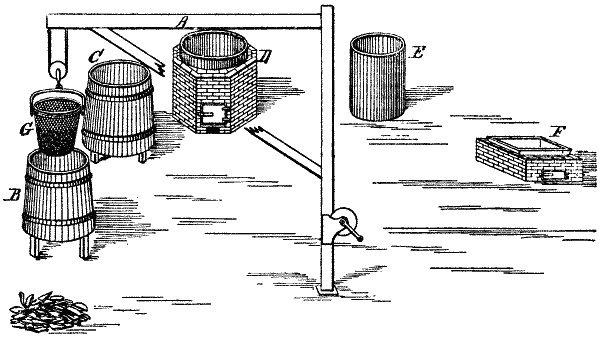
CALLIN AND WILSON'S PROCESS OF UTILIZING TIN SCRAP.
In any suitable building, a crane, A, is erected and placed in the sweep of that crane; in any convenient order are a boiler, D, two tanks, B and C, an evaporating pan, F, and an additional tank, E. From the crane is suspended a wire basket to contain the scrap to be treated, so perforated as to admit of the ready entrance of the liquid when submerged in, and its ready escape when withdrawn from, the boiler, D, in which boiler is put a sufficient quantity of the solution of caustic soda or potash to allow of a complete submersion therein of the basket and its contents. The basket, G, is then filled with the material to be treated, sprinkling in during the filling the requisite quantity of common salt or other chloride and nitrate of soda or other nitrate, using these dry, not in solution, either previously mixed or shaken in together in the proportion of from three to five pounds each to every hundred pounds of scrap, the requisite quantity depending upon the thickness of the tin plate to be removed. The loaded basket, being elevated by the crane, A, is then swung round, and, by lowering, submerged in the hot or boiling solution of caustic soda or potash in the iron boiler, D, which may hold in solution a further proportion of the chloride and nitrate used, the heat of which solution is maintained by a fire beneath the boiler, or in any other and ordinary way. In the ensuing reaction the oxygen of the nitrate combines with the tin to form stannic acid, and this, in turn, combining with the alkali present, forms a stannate of that base, which, entering into solution, leaves the before-plated metal tin-free, the chloride present assisting in the reaction. A further and more complex reaction takes place, by which copious fumes of ammonia are evolved, which may be utilized by proper appliances. When the reaction is complete, the basket containing the now tin-freed scrap is withdrawn from the boiler, and suspended above it long enough to drain. It is then swung over the tank, C, containing water, in which it is washed by submerging and withdrawing several times, and in like manner the washing completed in the water of the tank, B. The contents of the basket being now discharged, it is again filled with fresh scrap in the manner already described, and the process repeated. The loss by evaporation from the boiler, D, is supplied by the wash water in the tank, C; this, in turn, being supplied by the wash water in the tank, B, to which fresh water is supplied as required. When the caustic solution is sufficiently charged with the tin salt, it is allowed to deposit the impure crystals, which, being removed and drained, are redissolved in water in the iron tank, E. This solution in the iron tank, E, after filtration or decantation, is again concentrated in the evaporating pan, F, the crystals of stannate being removed from time to time, drained and dried; or the impure crystals obtained in the boiler, D, may be mixed with fine charcoal or other reducing agent, and subjected to the requisite heat for the reduction of the tin to the metallic form.

New Alloy.
A very beautiful new alloy, intended to replace brass in various ornamental uses, especially in window and door furniture, has been invented by W. A. Hopkins, of Paris. The alloy is composed of copper, tin, spelter, or zinc and lead, which metals are manipulated. A crucible is placed in the furnace and fired to red heat, and into the crucible thus heated the metals are placed in the proportions of—tin 1⅛ (say) 1 oz., spelter or zinc ½ oz., lead 5⁄16 of an ounce. These are the proportions he prefers to use, as he has found them to give excellent and satisfactory results, but he does not intend to confine himself rigidly to the precise proportions named, as they may, perhaps, be slightly varied in some particulars without materially detracting from the beautiful color of the alloy which it is intended to produce. The molten metals are kept well stirred, and any impurities therein should be removed. When thoroughly mixed, this alloy, which is termed the first alloy, is poured off into ingot moulds and left to cool. Copper, in the proportion of eight parts to one of this first alloy, is then placed in the crucible and brought to melting heat, when the tin or first alloy is added and intimately mixed with the copper, for which purpose the molten mass must be well stirred for several minutes; it is then poured into ingot moulds for sale in the form of ingots, or it may be poured into pattern moulds so as to produce the articles required. This is the mode of manipulation which it is preferred to employ, as an opportunity is thus afforded of removing any impurities from the first alloy before mixing it with the copper; but all the metals may, if preferred, be mixed together in the proportions given and melted at one operation. By this means an alloy is obtained of great strength, and of a very beautiful appearance, and which is particularly suitable for small work, such, for instance, as window and door furniture and other house furniture which is usually made in brass or other alloy of copper, though it is not intended to confine its use to such articles.