NAVIGATION IN FOGS.
Reading edition
The disastrous collision of the Sound steamers Narragansett and Stonington was quickly followed by one at sea, by which two great passenger ships escaped instant destruction almost by a hair's breadth.
Shortly after noon, Monday, June 12, the National Line steamship Queen, bound from London to New York, and within 300 miles of her journey's end, ran into the Anchor Line steamship Anchoria, on the way from New York to Glasgow. The bow of the Queen struck the Anchoria on the port side, about twenty feet abaft the foremast, smashing a great hole through the iron hull. Two compartments of the Anchoria filled immediately, but the partitions stood firm, and the other compartments sufficed to keep the vessel afloat. The bow of the Queen was badly crushed, and her forward compartment was flooded. Fortunately the bulkhead proved stanch, and the ship was saved. The fog was very thick, and both ships were going at full speed. It is said that the captain of the Anchoria mistook the whistle of the Queen for that of the Anchoria's companion vessel, the Victoria, which left New York at the same time, and was probably not far away, and before the error was discovered the ships were too close to avoid the catastrophe. Had the sea been rough or the partitions less stanch, both ships must have gone to the bottom almost instantly.
The passengers of the Anchoria were transferred to the Queen, which was least hurt, and the two ships sailed together for New York, arriving Tuesday noon.
These two collisions, coming in such quick succession and imperiling so many lives, give terrible emphasis to the dangers attending navigation in foggy weather. They make very pertinent also the query whether the means now employed for discovering the position and nearness of unseen vessels are at all commensurate with the necessities of the case, or with the means already known, and known to be well calculated to prevent such dangers. In a dense fog the ordinary ship's light is visible scarcely more than a ship's length; and as it proved in the case of the Narragansett and Stonington, the time between thus sighting an approaching vessel and the instant of collision is fatally brief. The recent test of electric headlights for ships in this harbor clearly demonstrated the possibility of projecting a beam of electric light through the densest fog for a thousand feet or more, and through ordinary fogs a distance several times as great.
Except in very rough weather the steam whistle can be heard a long distance, but it is liable to be a treacherous guide. It is not always possible to determine by the ear alone the direction from which a sound comes; and it would seem that a mistake of this nature was made on the Stonington, since the order intended to change her course away from that of the Narragansett only served to precipitate the collision. Had the whistle of the Queen signaled her course it could not have been mistaken for that of a ship sailing in the opposite direction, and the safety of two great floating hotels and their occupants would not have been imperiled thereby.
Means for the better penetration of fogs, for determining the direction of unseen sources of sounds, and for enabling steamers to announce to all within hearing the course they are pursuing, seem therefore to be imperative necessities on shipboard. The first is furnished by the electric headlight, with a system of projection similar to but more efficient than that used on locomotives. The last would be provided by an efficient code of whistle signals to indicate the several points of compass. The second need is supplied by the instrument figured in the accompanying illustration.
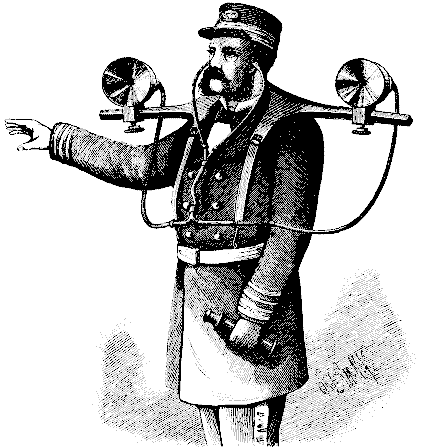
PROFESSOR MAYER'S TOPOPHONE.
The aim of the topophone, which was invented and patented by Professor A. M. Mayer, last winter, is to enable the user to determine quickly and surely the exact direction and position of any source of sound. Our figure shows a portable style of the instrument; for use on ship-board it would probably form one of the fixtures of the pilot-house or the "bridge," or both. In most cases arising in sailing through fogs, it would be enough for the captain or pilot to be sure of the exact direction of a fog horn, whistling buoy, or steam whistle; and for this a single aural observation suffices.
Every one has twirled a tuning fork before the ear, and listened to the alternate swelling and sinking of the sound, as the sound waves from one tine re-enforce or counteract those from the other tine. The topophone is based upon the same fact, namely, the power of any sound to augment or destroy another of the same pitch, when ranged so that the sound waves of each act in unison with or in opposition to those of the other.
Briefly described, the topophone consists of two resonators (or any other sound receivers) attached to a connecting bar or shoulder rest. The sound receivers are joined by flexible tubes, which unite for part of their length, and from which ear tubes proceed. One tube, it will be observed, carries a telescopic device by which its length can be varied. When the two resonators face the direction whence a sound comes, so as to receive simultaneously the same sonorous impulse, and are joined by tubes of equal length, the sound waves received from them will necessarily re-enforce each other and the sound will be augmented. If, on the contrary, the resonators being in the same position as regards the source of sound, the resonator tubes differ in length by half the wave length of the sound, the impulse from the one neutralizes that from the other, and the sound is obliterated.
Accordingly, in determining the direction of the source of any sound with this instrument, the observer, guided by the varying intensity of the sound transmitted by the resonators, turns until their openings touch the same sound waves simultaneously, which position he recognizes either by the great augmentation of the sound (when the tube lengths are equal), or by the cessation of the sound, when the tubes vary so that the interference of the sound waves is perfect. In either case the determination of the direction of the source of the sound is almost instantaneous, and the two methods may be successively employed as checks upon each other's report.
It is obvious that with such a help the pilot in a fog need never be long in doubt as to the direction of a warning signal; and if need be he can without much delay, by successive observations and a little calculation, determine, approximately at least, the distance of the sounding body.
