Fires in New York.
Reading edition
The report of the Board of Fire Commissioners, just printed, shows that during the year 1879 there were in this city 1,551 fires, of which 1,029 were discovered by persons not connected with the Fire or Police Department. In 1,456 cases the fires were confined to the buildings in which they originated. Twenty-five buildings were totally destroyed, and 69 were greatly damaged. Of all the fires, 1,001 were extinguished by buckets of water and fire extinguishers. The total estimated loss by fire during the year was $900,280 on buildings and $4,771,300 on stock, making a total of $5,671,580. The estimated insurances on the buildings were $7,276,446, and on stock, $14,525,264, making a total of $21,801,710. The estimated uninsured loss was $180,060. In three cases the loss was between $100,000 and $115,000; in one case $168,908; in one case $352,185; in one case $333,900; and in one case $1,978,991. In 1,066 cases the loss was less than $100.
Nearly a quarter of all the fires were caused by carelessness, and 100 are attributed to children playing with matches and fire. Forty fires were caused by the spontaneous combustion of oily rags and other materials, and 93 by exploding kerosene lamps. Four members of the department and 12 citizens died of injuries received at fires during the year, and 139 firemen and 54 citizens were more or less injured.
There are 729 uniformed members of the department The pay roll of the whole department for 1879 was $1,030,822.14, and the appropriation for all expenses was $1,254,970. The appropriation for the present year is $1,307,670. The department now possesses 233 horses, 1 marine steam fire engine, 58 steam fire engines, of which 5 are self propelling, 10 chemical engines, 24 hook and ladder trucks, 108 chemical fire extinguishers, and 4 aerial ladders, together with other fire apparatus.
The annual inspection of the department showed that the quickest average time in hitching a team was 3.17 seconds, and in hitching a single horse, 5.66 seconds. The general average in hitching all apparatus was, in 1879, 9.54 seconds; in 1878, 10.26 seconds; and in 1877, 13.03 seconds.
During the year, $30,300 was collected for licenses for the sale of kerosene oil, each license costing $10. The Fire Department Relief Fund now amounts to $422,569.07, and the insurance fund to $12,780.

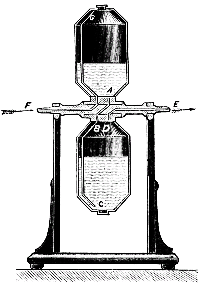
ASPIRATOR AND COMPRESSOR.
Professor Marangoni, of Pavia, has invented an aspirator for measuring gases which is much simpler than many now in use in laboratories, which latter have the defect that the air or gas ascends through the descending liquid and makes thus the measuring of the former uncertain. The improved apparatus is shown in our illustration. It consists of two vessels attached to a fixed horizontal shaft, FE, which is placed upon two upright supports. This shaft has several ways or passages made in it which performs the functions of the taps. The water of the upper receptacle passes into the lower one by the passage, A, and thence through the tube, BC, issuing at its lowest extremity at C. The air contained in the lower vessel is thus emitted by the channel DE, cut into the shaft, while the air or gas is aspirated in the same ratio by the passage and tube, FG. The apparatus acts thus at the same time as aspirator and compressor. It is simple, and will be a useful addition to the laboratory.
New Photoglyptic Process.*
* A communication to the Photographic Society of France.
Walter B. Woodbury.
It is now thirteen years since I had the honor of introducing in France my new photoglyptic process, which, up to the present time, has remained in the hands of very few, owing to the great expense hitherto necessary to start the working of it. For some time I have been engaged in making experiments with a view to discover a system which should be at the same time simple and inexpensive; and the process which I have this evening the honor to bring before your notice is the result of my researches.
The summary of the new system is as follows:
To obtain from negatives reliefs on glass similar to transparencies by the carbon process, but modified in the quantity of materials used.
To attach, and keep in absolute contact with the relief so obtained, a sheet of tin foil.
To solidify this sheet of tinfoil by coating it with copper; then backing it up with another sheet of plate glass covered with a composition; and then to detach the whole from the first relief—the result being a mould ready to place in the press and print one thousand or more proofs.
I commence by showing you the relief made from the negative, and explaining how this is obtained.
I take a sheet of plate glass of a convenient size, and place it in hot water, together with a sheet of paper a little smaller; then, having driven out the excess of water by means of a squeegee, I place it on a leveling stand. Having prepared a solution composed of gelatine 200 parts, water 1,000 parts, glycerine 20 parts, white sugar 30 parts, with a little Indian ink, and filtered the same, I pour a sufficient quantity on the paper and spread it up to the corners with the finger. These plates are then dried in a dry place and can be kept until wanted.
To sensitize the plates I employ a bath of bichromate of potash of six per cent, and again dry them. Without doubt this method is rather long; but one should consider that each proof made is capable of giving five or ten thousand prints if necessary, as the same relief will make many printing moulds. I tried, with the aid of the Autotype Company, of London, to get a suitable tissue; but as this requires a uniform thickness of half a millimeter the ordinary system did not succeed. When the sensitized plate is dry the edges are cut with a knife, the glasses serving over and over again. I show you a piece of this prepared paper.
As in the carbon process, it is necessary to place a border of black paper at the back of the negative, and to cut the sensitized tissue a little larger than the opening.
After the exposure the gelatine is fixed on a collodionized glass by placing them both in water and squeegeeing the surface; but in dry weather it is as well to use albumen in place of collodion, as used by M. Ferrier for his transparencies in carbon. The glass holding the gelatine is now placed in a hot water bath heated to 42° Centigrade, and left till the paper comes away from the gelatine, when it is placed in this apparatus by the frame holding the grooves.
By means of this small gas regulator the temperature is kept always the same, namely, 50° Centigrade. The water should be now and then agitated by lifting up and down the frame holding the glasses.
After a space of three or four hours the reliefs will be sufficiently washed, and can be taken out and placed in alcohol to dry quickly and sharp at the same time. In this stage of the process all spots or scratches that may have been on the negative can be removed (being in relief on the gelatine) by means of a piece of glass. The relief is now ready to be covered with the tin. You will observe that up to the present the operations have been almost the same as those necessary to produce a transparency in carbon.
As it is of the first necessity that the tin should be kept in absolute contact with the gelatine relief, I prepare the latter by rubbing it over with a piece of flannel charged with a greasy matter (pomatum answers as well as anything). I then make a border of India-rubber in benzine round the glass. The effect of this is to prevent any air from returning between the tin and the relief when once it has been driven out.
Taking care that the back of the glass is perfectly clean, it is now placed on the steel or glass bed of a rolling-press. A sheet of tin foil (without holes) that has been smoothed on a sheet of glass by a soft brush is now laid on it, and then three or four thicknesses of blotting paper. The whole is then passed under the cylinder several times, each time increasing the pressure. The surface of the tin is now ready to place in the electrotyping cell, but must first be cleaned with a solution of caustic potash to remove any grease, and bordered with shellac varnish to prevent the copper from depositing where not required.
Electric contact is made by means of the small apparatus, on removing a small proportion of the lac varnish. After two or three hours sufficient copper will have been deposited, and after drying can be then attached to another glass, on which it will remain.
This glass is covered while hot with a composition of shellac, resin, and Venice turpentine, and can be prepared in advance, using an iron plate heated direct by the gas flame. The same iron plate is employed to again soften the composition and attach it to the copper; but this time heated only by boiling water, this temperature being sufficient to soften it until it enters into all the hollows of the copper. On placing a weight on the two glasses the excess of the composition is forced out at the edges. When cold the glass plate on which the copper and tin are now attached can be separated from the relief, which can then be used over and over again to produce fresh matrices.
The matrix or intaglio is now ready to place in the printing press, and the remaining operations of printing are exactly the same as those used in the old process of photoglyptic printing.
In placing the mould in the press it is advisable to place one or two thicknesses of stout blotting paper, previously wetted, under the mould to give to it a slight amount of elasticity and, at the same time, to keep it in place.
As in all other mechanical processes a reversed or pellicle negative is required; but it is very simple to print upon a specially prepared transfer paper, and, instead of mounting the print with the face uppermost, to attach it under water to the mount, and when dry to detach the paper on which the print has been made. By this means there remains only one thickness of paper instead of two, thus doing away with an objection which has often been found in mounted photographs for book illustration.
NEW INVENTIONS.
An improved combined cutting and clinching tool has been patented by Mr. Peter D. Graham, of Black Hawk, Col. The object of this invention is to provide a new, useful, and convenient tool for cutting and clinching horseshoe nails.
Mr. John J. Berger, of Brooklyn, N. Y., has patented an improved hand perforating or check stamp of the class which are used to cut or perforate the paper with figures and letters as a safeguard against alterations of the check; and the object of this improvement is to perforate the check with needle points, and at the same time ink the perforations, whereby the numbers may be clearly marked without cutting large openings in the paper.
An improved apparatus for the manufacture of nitric acid has been patented by Mr. Paul Marcelin, of Black Rock, Conn. The object of this invention is to furnish apparatus for manufacturing nitric acid so constructed that the stronger acid may be separated from the weaker acid as the acid passes from the retort to the receiving bottles, to obtain a strong acid suitable for use in manufacturing nitro-glycerine.
Mr. Max Rubin, of New York city, has patented an improved shawl strap, so constructed that either strap may be wound up alone, or both may be wound up together, or one may be wound up tighter than the other, by adjusting the handle.
Mr. Ambrose Madden, of Asbury Park, N. J., has patented an attachment for use with halters for preventing horses from cribbing and to cure them of that pernicious habit; and the invention consists in a combination of rigid arms and straps hung upon the halter and carrying a spiked plate, which is retained beneath the animal's under lip in such manner that the motions of the horse in the act of cribbing cause the spikes to prick.

The Charge for Insertion under this head is One Dollar a line for each insertion; about eight words to a line. Advertisements must be received at publication office as early as Thursday morning to appear in next issue.
The publishers of this paper guarantee to advertisers a circulation of not less than 50,000 copies every weekly issue.

Lubricene, Gear Grease, Cylinder and Machinery Oils. R. J. Chard, 6 Burling Slip, New York.
Telephones repaired, parts of same for sale. Send stamp for circulars. P. O. Box 205, Jersey City, N. J.
The genuine Asbestos Liquid Paints are the purest, finest, richest, and most durable paints ever made for structural purposes. H. W. Johns M'f'g Co., 87 Maiden Lane, sole manufacturers.
The Finger Annunciator, and all other electr. apparatus, by Finger Annunciator Co., 73 Cornhill, Boston.
The most popular Pens in use are those of the Esterbrook Steel Pen Company. For sale everywhere. Everybody send Circular to R. K. Teller, Unadilla, N. Y.
A few pat. Centering and Squaring Attachments for Lathes, made by R. E. State & Co., entirely new, for sale cheap. J. & W. State, Lock Box 291, Springfield, Ohio.
Soapstone and Empire Gum Core Packing, the best for Railroads. Greene, Tweed & Co., New York.
Our new Stylographic Pen (just patented), having the duplex interchangeable point section, is the very latest improvement. The Stylographic Pen Co., Room 13, 169 Broadway, N. Y.
Shaw's U. S. Standard of Pressure. Mercury Gauges, all pressures, Steam, Hydraulic, and Vacuum. Best for pumping stations and pipe lines. 915 Ridge Ave., Philadelphia, Pa.
For Sale low—52 x 17 feet Sidewheel Boat, and one 23 x 5½ feet Launch; best condition. S. E. Harthan, Worcester, Mass.
Wanted.—Farm Engine, with Steam Plow Attachment. Address P. O. Box 18, Reinbeck, Iowa.
Advertising of all kinds in all American Newspapers. Special lists free. Address E. N. Freshman & Bros., Cincinnati, O.
Patent for Sale Cheap.—Entire Patent or State Rights. Just the thing for the summer. Money can be made out of it. Other business prevents owner from handling it. A. H. Watkins, 294 Harrison Ave., Boston, Mass.
We keep a full assortment of Esterbrook's, Gillott's, Spencerian, Perry's, and Lamar's Pens. Send for price list to J. Leach, 86 Nassau St., New York.
For Sale.—A Baltimore City Fire Department Steam Fire Engine, in complete working order. Address P. O. Box 676, Baltimore, Md.
Metallic Piston Rod Packing Company, 773 Broad St., Newark, N. J. Agents wanted; terms liberal.
Skinner & Wood, Erie, Pa., Portable and Stationary Engines, are full of orders, and withdraw their illustrated advertisement. Send for their new circulars.
Asbestos Board on Chimneys prevents their heat from affecting the temperature of rooms through which they pass. Asbestos Pat. Fiber Co., lim., 194 Broadway, N. Y.
Sweetland & Co., 126 Union St., New Haven, Conn., manufacture the Sweetland Combination Chuck.
Power, Foot, and Hand Presses for Metal Workers. Lowest prices. Peerless Punch & Shear Co., 52 Dey St., N. Y. The Brown Automatic Cut-off Engine; unexcelled for workmanship, economy, and durability. Write for information. C. H. Brown & Co., Fitchburg, Mass.
Corrugated Traction Tire for Portable Engines, etc. Sole manufacturers, H. Lloyd, Son & Co., Pittsburg, Pa.
For the best Stave, Barrel, Keg, and Hogshead Machinery, address H. A. Crossley, Cleveland, Ohio.
Best Oak Tanned Leather Belting. Wm. F. Forepaugh, Jr., & Bros. 531 Jefferson St., Philadelphia, Pa.
National Steel Tube Cleaner for boiler tubes. Adjustable, durable. Chalmers-Spence Co., 40 John St., N. Y.
Split Pulleys at low prices, and of same strength and appearance as Whole Pulleys. Yocom & Son's Shafting Works, Drinker St., Philadelphia, Pa.
Stave, Barrel, Keg, and Hogshead Machinery a specialty by E. & B. Holmes, Buffalo, N. Y.
Solid Emery Vulcanite Wheels—The Solid Original Emery Wheel other kinds imitations and inferior. Caution.—Our name is stamped in full on all our best Standard Belting, Packing, and Hose. Buy that only. The best is the cheapest. New York Belting and Packing Company, 37 and 38 Park Bow. N. Y.
For Separators, Farm & Vertical Engines, see adv. p. 382.
Walrus Leather, Emery, and Polishing Goods. Greene, Tweed & Co., 118 Chambers St., New York.
Nickel Plating.—Sole manufacturers cast nickel anodes, pure nickel salts, importers Vienna lime, crocus, etc. Condit, Hanson & Van Winkle, Newark, N. J., and 92, and 94 Liberty St., New York.
Presses, Dies, and Tools for working Sheet Metal, etc. Fruit & other can tools. Bliss & Williams, B'klyn, N. Y.
Bradley's cushioned helve hammers. See illus. ad. p. 397.
Instruction in Steam and Mechanical Engineering. A thorough practical education, and a desirable situation as soon as competent, can be obtained at the National Institute of Steam Engineering, Bridgeport, Conn. For particulars, send for pamphlet.
Hydraulic Jacks, Presses and Pumps. Polishing and Buffing Machinery Patent Punches, Shears, etc. E. Lyon & Co., 470 Grand St., New York.
Forsaith & Co., Manchester, N. H., & 207 Centre St., N. Y. Bolt Forging Machines, Power Hammers, Comb'd Hand Fire Eng. & Hose Carriages, New & 2d hand Machinery. Send stamp for illus. cat. State just what you want.
For Mill Mach'y & Mill Furnishing, see illus. adv. p. 381.
Air Compressors, Blowing Engines, Steam Pumping Machinery, Hydraulic Presses. Philadelphia Hydraulic Works, Philadelphia, Pa.
For Patent Shapers and Planers, see ills. adv. p. 380.
For Pat. Safety Elevators, Hoisting Engines, Friction Clutch Pulleys, Cut-off Coupling, see Frisbie's ad. p. 316.
Machine Knives for Wood-working Machinery, Book Binders, and Paper Mills. Large knife work a specialty. Also manufacturers of Soloman's Parallel Vise. Taylor. Stiles & Co., Riegelsville, N. J.
For Alcott's Improved Turbine, see adv. p. 297.
Mineral Lands Prospected, Artesian Wells Bored, by Pa. Diamond Drill Co. Box 423, Pottsville, Pa. See p. 381.
Rollstone Mac. Co's Wood Working Mach'y ad. p. 380
Improved Solid Emery Wheels and Machinery, Automatic Knife Grinders, Portable Chuck Jaws. Important, that users should have prices of these first class goods. American Twist Drill Co., Meredithville, N. H.
For Standard Turbine, see last or next number.
Burgess' Non-conductor for Heated Surfaces; easily applied, efficient, and inexpensive. Applicable to plain or curved surfaces, pipes, elbows and valves. See p. 284.
Diamond Saws. J. Dickinson, 64 Nassau St., N. Y.
Steam Hammers, Improved Hydraulic Jacks, and Tube Expanders. R. Dudgeon, 24 Columbia St., New York.
Wanted—The address of 40,000 Sawyers and Lumbermen for a copy of Emerson's Hand Book of Saws. New edition 1880. Over 100 illustrations and pages of valuable information. Emerson, Smith & Co., Beaver Falls, Pa.
Eagle Anvils, 10 cents per pound. Fully warranted.
For Wood-Working Machinery, see illus. adv. p. 413.
Eclipse Portable Engine. See illustrated adv., p. 413.
Tight and Slack Barrel machinery a specialty. John Greenwood & Co., Rochester, N. Y. See illus. adv. p. 413.
Elevators, Freight and Passenger, Shafting, Pulleys and Hangers. L. S. Graves & Son, Rochester, N. Y.
$400 Vertical Engine, 30 H.P. See page 413.
Best American Shot Gun made is the "Colts." Far superior to any English guns for the same price. For description, see Sci. American of May 29. Send for circular to Hodgkins & Haigh, Dealers in General Sporting Goods, 300 Broadway, New York.
Telephones.—Inventors of Improvements in Telephones and Telephonic Apparatus are requested to communicate with the Scottish Telephonic Exchange, Limited, 34 St. Andrew Square, Edinburgh, Scotland. J. G. Lorrain, General Manager.
Pat. Steam Hoisting Mach'y. See illus. adv., p. 413.
Hydraulic Cylinders, Wheels, and Pinions, Machinery Castings; all kinds; strong and durable; and easily worked. Tensile strength not less than 65,000 lbs. to square in. Pittsburgh Steel Casting Co., Pittsburgh, Pa.
C. J. Pitt & Co., Show Case Manufacturers, 226 Canal St, New York. Orders promptly attended to. Send for illustrated catalogue with prices.
For best low price Planer and Matcher, and latest improved Sash, Door, and Blind Machinery, Send for catalogue to Rowley & Hermance, Williamsport, Pa.
Elevators.—Stokes & Parrish, Phila., Pa. See p. 412.
Penfield (Pulley) Block Works. See illus. adv. p. 413.
4 to 40 H.P. Steam Engines. See adv. p. 413.