STANDARDS AND METHODS FOR THE POLARIMETRIC ESTIMATION OF SUGARS.1
Reading edition
STANDARDS AND METHODS FOR THE POLARIMETRIC ESTIMATION OF SUGARS.1
Section 1, paragraph 231, of the act entitled "An act to reduce revenue and equalize duties on imports and for other purposes," approved October 1, 1890, provides:
"231. That on and after July 1, eighteen hundred and ninety-one, and until July 1, nineteen hundred and five, there shall be paid, from any moneys in the Treasury not otherwise appropriated, under the provisions of section three thousand six hundred and eighty-nine of the Revised Statutes, to the producer of sugar testing not less than ninety degrees by the polariscope, from beets, sorghum, or sugar cane grown within the United States, or from maple sap produced within the United States, a bounty of two cents per pound; and upon such sugar testing less than ninety degrees by the polariscope, and not less than eighty degrees, a bounty of one and three-fourth cents per pound, under such rules and regulations as the Commissioner of Internal Revenue, with the approval of the Secretary of the Treasury, shall prescribe."
It is the opinion of this Commission that the expression "testing ... degrees by the polariscope," used with reference to sugar in the act, is to be considered as meaning the percentage of pure sucrose the sugar contains, as ascertained by polarimetric estimation.
It is evident that a high degree of accuracy is necessary in the examination of sugars by the Bureau of Internal Revenue, under the provisions of this act, inasmuch as the difference of one-tenth of one per cent. in the amount of sucrose contained in a sugar may, if it is on the border line of 80°, decide whether the producer is entitled to a bounty of 1¾ cents per pound (an amount nearly equivalent to the market value of such sugar) or to no bounty whatever. It is desirable, therefore, that the highest possible degree of accuracy should be secured in the work, for while many sugars will doubtless vary far enough from either of the two standard percentages fixed upon in the act, viz., 80° and 90°, to admit of a wide margin of error without material consequences, yet a considerable proportion will approximate to them so closely that a difference of a few tenths of a degree in the polarization will change the classification of the sugar.
A very high degree of accuracy may be obtained in the optical estimation of sugars, if the proper conditions are observed. Such conditions are (1) accurately graded and adjusted instruments, weights, flasks, tubes, etc.; (2) skilled and practiced observers; (3) a proper arrangement of the laboratories in which the work is performed; and (4) a close adherence to the most approved methods of manipulation.
On the other hand, if due observance is not paid to these conditions, the sources of error are numerous, and inaccurate results inevitable.
We will endeavor to point out in this report the best means of meeting the proper conditions for obtaining the highest degree of accuracy consistent with fairly rapid work. It would be manifestly impossible to observe so great a refinement of accuracy in this work as would be employed in exact scientific research.
This would be unnecessary for the end in view, and impossible on account of the amount of time that would be required.
I.—INSTRUMENTS AND APPARATUS.
It is of the greatest importance that the polariscopes and all apparatus used in the work shall be carefully and accurately adjusted and graduated, and upon a single and uniform system of standardization. Recent investigations of the polarimetric work done in the customs branch of the Treasury Department have shown that a very considerable part of the want of agreement in the results obtained at the different ports was due to a lack of uniformity in the standardization of the instruments and apparatus.
(a.) The Polariscope.—There are many different forms of this instrument used. Some are adapted for use with ordinary white light, and some with monochromatic light, such as sodium ray. They are graduated and adjusted upon various standards, all more or less arbitrary. Some, for example, have their scales based upon the displacement of the polarized ray produced by a quartz plate of a certain thickness; others upon the displacement produced by an arbitrary quantity of pure sucrose, dissolved and made up to a certain volume and polarized in a certain definite length of column. It would be very desirable to have an absolute standard set for polariscopic measurements, to which all instruments could be referred, and in the terms of which all such work could be stated. This commission has information that an investigation is now in progress under the direction of the German imperial government, having for its end and purpose the determination of such data as will serve for the establishment of an absolute standard. When this is accomplished it can easily be made a matter of international agreement, and all future forms of instruments be based upon it. This commission would suggest that the attention of the proper authorities should be called to the desirability of official action by this government with a view to co-operation with other countries for the adoption of international standards for polarimetric work. Until this is done, however, it will be necessary for the Internal Revenue Bureau to adopt, provisionally, one of the best existing forms of polariscope, and by carefully defining the scale of this instrument, establish a basis for its polarimetric work which will be a close approximation to an absolute standard, and upon which it can rely in case of any dispute arising as to the results obtained by the officers of the bureau.
For the instrument to be provisionally adopted by the Internal Revenue Bureau, this commission would recommend the "half shadow" instrument made by Franz Schmidt & Haensch, Berlin. This instrument is adapted for use with white light illumination, from coal oil or gas lamps. It is convenient and easy to read, requiring no delicate discrimination of colors by the observer, and can be used even by a person who is color blind.
This form of instrument is adjusted to the Ventzke scale, which, for the purposes of this report, is defined to be such that 1° of the scale is the one hundredth part of the rotation produced in the plane of polarization of white light in a column 200 mm. long by a standard solution of chemically pure sucrose at 17.5° C. The standard solution of sucrose in distilled water being such as to contain, at 17.5° C. in 100 c.c., 26.048 grms. of sucrose.
In this definition the weights and volumes are to be considered as absolute, all weighings being referred to a vacuum.
The definition should properly be supplemented with a statement of the equivalent circular rotation in degrees, minutes, and seconds that would be produced by the standard solution of sugar used to read 100° on the scale. This constant is now a matter of investigation, and it is thought best not to give any of the hitherto accepted values. When this is established, it is recommended that it be incorporated in a revision of the regulations of the internal revenue relative to sugar, in order to make still more definite and exact the official definition of the Ventzke scale.
The instruments should be adjusted by means of control quartz plates, three different plates being used for complete adjustment, one reading approximately 100° on the scale, one 90°, and one 80°.
These control quartz plates should have their exact values ascertained in terms of the Ventzke scale by the office of weights and measures by comparison with the standard quartz plates in possession of that office, in strict accordance with the foregoing definition, and should also be accompanied by tables giving their values for temperatures from 10° to 35°.
(b.) Weights.—The weights used should be of solid brass, and should be standardized by the office of weights and measures.
(c.) Flask.—The flasks used should be of such a capacity as to contain at 17.5° C. 100.06 cubic centimeters, when filled in such a manner that the lowest point of the meniscus of the surface of the liquid just touches the graduation mark. The flasks will be standardized to contain this volume in order that the results shall conform to the scale recommended for adoption without numerical reduction of the weighings to vacuo. They should be calibrated by the office of weights and measures.
(d.) Tubes.—The tubes used should be of brass or glass, 200 and 100 millimeters in length, and should be measured by the office of weights and measures.
(e.) Balances.—The balances used should be sensitive to at least one milligramme.
II.—SKILLED OBSERVERS.
The commission recommends that the work of polarizing sugars be placed in the hands of chemists, or at least of persons who are familiar with the use of the polariscope and have some knowledge of the theory of its construction and of chemical manipulations. To this end we would suggest that applicants for positions where such work is to be done should be obliged to undergo a competitive examination in order to test their fitness for the work that is to be required of them.
III.—ARRANGEMENT OF LABORATORIES.
The arrangement of the rooms in which polarizations are performed has an important bearing upon the accuracy of the results obtained.
Polariscopic observations are made more readily and accurately if the eye of the observer is screened from diffused light; therefore, a partial darkening of the room, which may be accomplished by means of curtains or hangings, is an advantage. On the other hand, the temperature at which the observation is made has a very considerable influence upon the results obtained, so that the arrangements for darkening the room must not be such as will interfere with its proper ventilation. Otherwise the heat from the lamps used, if confined within a small room, will cause considerable variations in the temperature of the room from time to time.
The proper conditions will best be met, in our opinion, by placing the lamps either in a separate room from that in which the instruments are, and perforating the wall or partition between the two rooms for the light to reach the end of the instruments, or in a ventilated hood with the walls perforated in a like manner. By lining the wall or partition on both sides with asbestos paper, and inserting a plate of plane glass in the aperture through which the light passes, the increase of temperature from the radiation of the lamp will be still further avoided. With the lamps separated from the instruments in this manner, the space in which the instruments are contained is readily darkened without much danger of its temperature being unduly raised.
Some light, of course, is necessary for reading the scales, and if artificial light is employed for this purpose, the sources chosen should be such that as little heat as possible will be generated by them. Small incandescent electric lights are best for such purpose. Refinements of this kind cannot always be used, of course, but the prime requisite with reference to the avoidance of temperature errors is that all operations—filling the flasks and tubes, reading the solutions, controlling the instrument with standard quartz plates, etc.—should be done at one and the same temperature, and that this temperature be a constant one, that is, not varying greatly at different hours of the day. For example, the room should not be allowed to become cold at night, so that it is at low temperature in the morning when work is begun, and then rapidly heated up during the day. The polariscope should not be exposed to the direct rays of the sun during part of the day, and should not be near artificial sources of heat, such as steam boilers, furnaces, flues, etc.
The tables upon which the instruments stand should be level.
IV.—METHODS OF MANIPULATION.
The methods of manipulation used in the polarization of sugar are of prime importance. They consist in weighing out the sugar, dissolving it, clarifying the solution, making it up to standard volume, filtering, filling the observation tube, regulating the illumination, and making the polariscopic reading.
The proper conduct of these processes, in connection with the use of accurately graduated apparatus, is the only surety against the numerous sources of error which may be encountered. Different sugars require different treatment in clarification, and much must necessarily be left to the judgment and experience of the operator.
The following directions are based upon various official procedures such as the one used in the United States custom houses, the method prescribed by the German government, etc. They embody also the result of recent research in regard to sources of error in polarimetric estimation of sugar:
DIRECTIONS FOR THE POLARIZATION OF SUGAR.
1.—Description of Instrument and Manner of Using.
The instrument employed is known as the half shadow apparatus of Schmidt and Haensch. It is shown in the following cut.
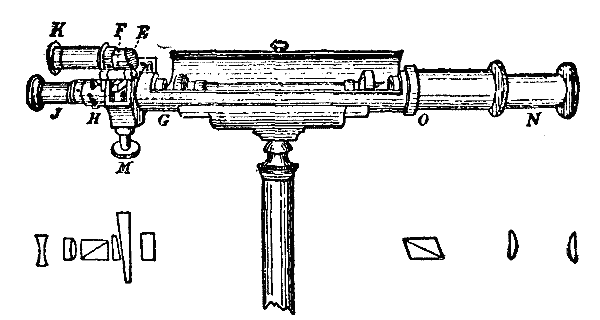
The tube N contains the illuminating system of lenses and is placed next to the lamp; the polarizing prism is at O, and the analyzing prism at H. The quartz wedge compensating system is contained in the portions of the tube marked F, E, G, and is controlled by the milled head M. The tube J carries a small telescope, through which the field of the instrument is viewed, and just above is the reading tube K, which is provided with a mirror and magnifying lens for reading the scale.
The tube containing the sugar solution is shown in position in the trough between the two ends of the instrument. In using the instrument the lamp is placed at a distance of at least 200 mm. from the end; the observer seats himself at the opposite end in such a manner as to bring his eye in line with the tube J. The telescope is moved in or out until the proper focus is secured, so as to give a clearly defined image, when the field of the instrument will appear as a round, luminous disk, divided into two halves by a vertical line passing through the center, and darker on one half of the disk than on the other. If the observer, still looking through the telescope, will now grasp the milled head M and rotate it, first one way and then the other, he will find that the appearance of the field changes, and at a certain point the dark half becomes light, and the light half dark. By rotating the milled head delicately backward and forward over this point he will be able to find the exact position of the quartz wedge operated by it, in which the field is neutral, or of the same intensity of light on both halves.
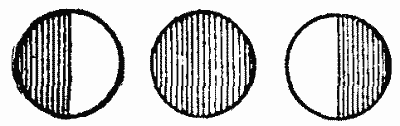
The three different appearances presented by the field are best shown in the above diagram. With the milled head set at the point which gives the appearance of the middle disk as shown, the eye of the observer is raised to the reading tube, K, and the position of the scale is noted. It will be seen that the scale proper is attached to the quartz wedge, which is moved by the milled head, and attached to the other quartz wedge is a small scale called a vernier which is fixed, and which serves for the exact determination of the movable scale with reference to it. On each side of the zero line of the vernier a space corresponding to nine divisions of the movable scale is divided into ten equal parts. By this device the fractional part of a degree indicated by the position of the zero line is ascertained in tenths; it is only necessary to count from zero, until a line is found which makes a continuous line with one on the movable scale.
With the neutral field as indicated above, the zero of the movable scale should correspond closely with the zero of the vernier unless the zero point is out of adjustment.
If the observer desires to secure an exact adjustment of the zero of the scale, or in any case if the latter deviates more than one-half of a degree, the zero lines are made to coincide by moving the milled head and securing a neutral field at this point by means of the small key which comes with the instrument, and which fits into a nipple on the left hand side of F, the fixed quartz wedge of the compensating system. This nipple must not be confounded with a similar nipple on the right hand side of the analyzing prism, H, which it fits as well, but which must never be touched, as the adjustment of the instrument would be seriously disturbed by moving it. With the key on the proper nipple it is turned one way or the other until the field is neutral. Unless the deviation of the zero be greater than 0.5°, it will not be necessary to use the key, but only to note the amount of the deviation, and for this purpose the observer must not be content with a single setting, but must perform the operation five or six times, and take the mean of these different readings. If one or more of the readings show a deviation of more than 0.3° from the general average, they should be rejected as incorrect. Between each observation the eye should be allowed 10 to 20 seconds of rest.
The "setting" of the zero having been performed as above, the determination of the accurate adjustment of the instrument by means of the "control" quartz plates is proceeded with. Three such plates will be furnished with each polariscope, which have "sugar values" respectively approximating 80°, 90°, and 100°. These values may vary with the temperature, and tables are furnished with them which give their exact value at different temperatures, from 10° to 35° C.
One of these plates is placed in the instrument, and the field observed; it will be seen that the uniform appearance of the field is changed. The milled head is turned to the right until the exact point of neutrality is re-established, just as described above in setting the zero. The scale is read, the observation repeated, the reading taken again, and so on until five or six readings have been made. The average is taken, readings being rejected which show a divergence of more than 0.3, and the result corrected for the deviation of the zero point, if any was found, the deviation being added if it was to the left, and subtracted if to the right. If the adjustment of the instrument be correct, the result should be the value of the control plate used, as ascertained from the table, for the temperature of 20°. Each of the three plates is read in the instrument in this way. A variation of 0.3 from the established values may be allowed for errors of observation, temperature, etc., but in the hands of a careful observer a deviation greater than this with one of the three plates, after a careful setting of the zero, shows that the instrument is not accurately adjusted.
The complete verification of the accurate adjustment of the polariscope by means of three control plates, as given above, should be employed whenever it is set up for the first time by the officer using it, whenever it has sustained any serious shock or injury, and whenever it has been transported from one place to another. It should also be done at least once a week while the instrument is in active use.
After the complete verification has been performed as described, further checking of the instrument is done by means of one control plate alone, the one approximating 90°, and the setting of the zero point is dispensed with, the indication of the scale for sugar solutions being corrected by the amount of deviation shown in the reading of the 90° control plate from its established value as ascertained from the table, at the temperature of the room.
For example: A sugar solution polarizes 80.5; the control plate just before had given a polarization of 91.4, the temperature of the room during both observations being 25° C. According to the table the value of the control plate at 25° C. is 91.7; the reading is, therefore, 0.3 too low, and 0.3 is added to the reading of the sugar solution, making the corrected result 80.8. The temperature of the room should be ascertained from a standardized thermometer placed close to the instrument and in such a position as to be subject to the same conditions.
PREPARATION OF THE SUGAR SOLUTION FOR POLARIZATION.
If the sample is not entirely uniform it must be thoroughly mixed before weighing out, after all the lumps are broken up, best with a mortar and pestle. Then 26.048 grammes are weighed out on the balance in the tared German silver dish furnished for this purpose. Care must be taken that the operations of mixing and weighing out are not unduly prolonged, otherwise the sample may easily suffer considerable loss of moisture, especially in a warm room. The portion of sugar weighed out is washed by means of a jet from a wash bottle into a 100 c.c. flask, the dish being well rinsed three or four times and the rinsings added to the contents of the flask. The water used must be either distilled water or clear water which has been found to have no optical activity. After the dish has been thoroughly rinsed, enough water is added to bring the contents of the flask to about 80 c.c. and it is gently rotated until all the sugar has dissolved. The flask should be held by the neck with the thumb and finger, and the bulb not handled during this operation. Care must be taken that no particle of the sugar or solution is lost. To determine if all the sugar is dissolved, the flask is held above the level of the eye, in which position any undissolved crystals can be easily seen at the bottom. The character of the solution is now observed. If it be colorless or of a very light straw color, and not opalescent, so that it will give a clear transparent liquid on filtration through paper, the volume is made up directly with water to the 100 c.c. mark on the flask. Most sugar solutions, however, will require the addition of a clarifying or decolorizing agent in order to render them sufficiently clear and colorless to polarize. In such case, before making up to the mark, a saturated solution of subacetate of lead is added.
The quantity of this agent required will vary according to the quality of the sugar; for sugar which has been grained in the strike pan and washed in the centrifugals, from 3 to 15 drops will be required; for sugar grained in the strike pan but not well washed in the centrifugals, that is, sugar intended for refining purposes, from 15 to 30 drops will be required; for sugar not grained in the strike pan, that is, "wagon" or "string sugar," "second sugar," etc., from 1 to 3 c.c. will be required. After adding the solution of subacetate of lead the flask must be gently shaken, so as to mix it with the sugar solution. If the proper amount has been added, the precipitate will usually subside rapidly, but if not, the operator may judge of the completeness of the precipitation by holding the flask above the level of the eye and allowing an additional drop of subacetate of lead to flow down the side of the flask into the solution; if this drop leaves a clear track along the glass through the solution it indicates that the precipitation is complete; if, on the other hand, all traces of the drop are lost on entering the solution, it indicates that an additional small quantity of the subacetate of lead is required. The operator must learn by experience the point where the addition should cease; a decided excess of subacetate of lead solution should never be used.
The use of subacetate of lead should, in all cases, be followed by the addition of "alumina cream" (aluminic hydrate suspended in water)2 in about double the volume of the subacetate solution used, for the purpose of completing the clarification, precipitating excess of lead, and facilitating filtration. In many cases of high grade sugars, especially beet sugars, the use of alumina alone will be sufficient for clarification without the previous addition of subacetate of lead.
The solution is now made up to the mark by the addition of distilled water in the following manner. The flask, grasped by the neck between the thumb and finger, is held before the operator in an upright position, so that the mark is at the level of the eye, and distilled water is added drop by drop from a siphon bottle or wash bottle, until the lowest point of the curve or meniscus formed by the surface of the liquid just touches the mark. If bubbles hinder the operation, they may be broken up by adding a single drop of ether, or a spray from an ether atomizer, before making up to the mark. The mouth of the flask is now tightly closed with the thumb, and the contents of the flask are thoroughly mixed by turning and shaking. The entire solution is now poured upon the filter, using for this purpose a funnel large enough to contain all the 100 c.c. at once, and a watch glass is placed over the funnel during filtration to prevent a concentration of the solution by evaporation.
The funnel and vessel used to receive the filtrate must be perfectly dry. The first portion of the filtrate, about 20 to 30 c.c., should be rejected entirely, as its concentration may be affected by a previous hygroscopic moisture content of the filter paper. It may also be necessary to return subsequent portions to the filter until the liquid passes through perfectly clear.
If a satisfactory clarification has not been obtained, the entire operation must be repeated, since only with solutions that are entirely clear and bright can accurate polarimetric observations be made.
When a sufficient quantity of the clear liquid has passed through the filter, the 200 mm. observation tube is filled with it. The 100 mm. tube should never be used except in rare cases, when notwithstanding all the means used to effect the proper decolorization of the solution, it is still too dark to polarize in the 200 mm. tube. In such cases the shorter tube may be used, and its reading multiplied by two. The zero deviation must then be determined and applied to the product. This will give the reading which would have been obtained if a 200 mm. tube could have been used, and it only remains to apply the correction determined by the use of the control plate as previously described.
Example:
Solution reads in 100 mm. tube47.0
Multiplied by 22.0
——
Product94.0
Zero reads plus 0.30.3
——
Solution would read in 200 mm. tube93.7
Reading of control plate90.4
Sugar value of control plate90.5
——
Instrument too low by0.1
Add 0.1 to93.7
——
Correct polarization of solution93.8
Before filling the tube it must either be thoroughly dried by pushing a plug of filter paper through it, or it must be rinsed several times with the solution itself. The cover glasses must also be clean and dry, and without serious defects or scratches. Unnecessary warming of the tube by the hand during filling should be avoided; it is closed at one end with the screw cap and cover glass, and grasped by the other end with the thumb and finger. The solution is poured into it until its curved surface projects slightly above the opening, the air bubbles allowed time to rise, and the cover glass pushed horizontally over the end of the tube in such a manner that the excess of liquid is carried over the side, leaving the cover glass exactly closing the tube with no air bubbles beneath it, and with no portion of the liquid upon its upper surface. If this result is not attained, the operation must be repeated, the cover glass being rubbed clean and dry, and the solution again brought up over the end by adding a few more drops. The cover glass being in position, the tube is closed by screwing on the cap. The greatest care must be observed in screwing down the caps that they do not press too tightly upon the cover glasses; by such pressure the glasses themselves may become optically active, and cause erroneous readings when placed in the instrument. It should therefore be ascertained that the rubber washers are in position over the cover glasses, and the caps should be screwed on lightly. It must also be remembered that a cover glass, once compressed, may part with its acquired optical activity very slowly, and some time must be allowed to elapse before it is used again.
The polariscopic reading may now be taken, an observation on the 90° control plate having been made immediately before as previously described. Then without altering the position of the instrument relative to the light, or changing the character of the latter in any way, the tube filled with the sugar solution is substituted for the control plate. The telescope is adjusted, if necessary, so as to give a sharply defined field, which must appear round and clear. (This condition must be fulfilled before the observation is performed, as it is essential to accuracy.) The milled head is turned until the neutral point is found, and the reading is taken exactly as previously described, the operation repeated five or six times, the average taken with the rejection of aberrant readings, the average figure corrected for the deviation shown by the control observation from the sugar value of the control plate at the temperature of observation as given in the table, and the result taken as the polarization of the sugar. When a series of successive polarizations is made under the same conditions as regards temperature, position of the instrument with relation to the high intensity, of the light, etc., the control observation need not be made before each polarization, one such observation being sufficient for the entire series. The control must be repeated at least once an hour, however, and oftener when the operator has reason to think that any of the factors indicated above have been altered, for any such alteration of conditions may change the zero point of the instrument.
In the polarization of the quartz plates, as also in the polarization of very white sugars, difficulty may be experienced in obtaining a complete correspondence of both halves of the field. With a little practice this may be overcome and the neutral point found, but when it cannot, the ordinary telescope of the instrument may be replaced by another, which is furnished with the polariscope and which carries a yellow plate. This removes the difficulty and renders it possible, even for one not well accustomed to the instrument, to set it at the exact point of neutrality.
SUMMARIZED SOURCES OF ERROR.
The following principal sources of error must be especially guarded against:
1. Drying out of sample during weighing.
2. Excess of subacetate of lead solution in clarification.
3. Incomplete mixing of solution after making up to mark.
4. Imperfect clarification or filtration.
5. Concentration of solution by evaporation during filtration.
6. Undue compression of the cover glass.
7. Alteration of the temperature of room, position of instrument, or intensity of light while the observation or control observation is being performed.
8. Performances of polarization with a cloudy, dim, or not completely round or sharply defined field.
In closing this report the members of this commission hereby signify their intention to promote uniformity and accuracy by adopting and using the standards and general plan of procedure recommended in this report in the polarimetric determinations over which, in their respective branches of government work, they have control.
[1]
Report to the United States Internal Revenue Department by C.A. Crampton, Chemist of U.S. Internal Revenue; H.W. Wiley, Chief Chemist of U.S. Department of Agriculture; and O.H. Tittmann, Assistant in Charge of Weights and Measures, U.S. Coast and Geodetic Survey.
[2]
Prepared as follows: Shake up powdered commercial alum with water at ordinary temperature until a saturated solution is obtained. Set aside a little of the solution, and to the residue add ammonia, little by little, stirring between additions, until the mixture is alkaline to litmus paper. Then drop in additions of the portion left aside, until the mixture is just acid to litmus paper. By this procedure a cream of aluminum hydroxide is obtained suspended in a solution of ammonium sulphate, the presence of which is not at all detrimental for sugar work when added after subacetate of lead, the ammonium sulphate precipitating whatever excess of lead may be present.