THE STORY OF THE UNIVERSE.1
Reading edition
THE STORY OF THE UNIVERSE.1
By Dr. WILLIAM HUGGINS.
The opening meeting of the British Association was held in Park Hall, Cardiff, August 18, where a large and brilliant audience assembled, including, in his richly trimmed official robes, the Marquis of Bute, who this year holds office as mayor of Cardiff. At the commencement of the proceedings Sir Frederick Abel took the chair, but this was only pro forma, and in order that he might, after a few complimentary sentences, resign it to the president-elect, Professor Huggins, the eminent astronomer, who at once, amid applause, assumed the presidency and proceeded to deliver the opening address.
Dr. Huggins said that the very remarkable discoveries in our knowledge of the heavens which had taken place during the past thirty years—a period of amazing and ever-increasing activity in all branches of science—had not passed unnoticed in the addresses of successive presidents; still, it seemed to him fitting that he should speak of those newer methods of astronomical research which had led to those discoveries, and which had become possible by the introduction into the observatory, since 1860, of the spectroscope and the modern photographic plate. Spectroscopic astronomy had become a distinct and acknowledged branch of the science, possessing a large literature of its own, and observatories specially devoted to it. The more recent discovery of the gelatine dry plate had given a further great impetus to this modern side of astronomy, and had opened a pathway into the unknown of which even an enthusiast thirty years ago would scarcely have dared to dream.
HERSCHEL'S THEORY.
It was now some thirty years since the spectroscope gave us for the first time certain knowledge of the nature of the heavenly bodies, and revealed the fundamental fact that terrestrial matter is not peculiar to the solar system, but is common to all the stars which are visible to us. Professor Rowland had since shown us that if the whole earth were heated to the temperature of the sun, its spectrum would resemble very closely the solar spectrum. In the nebulæ, the elder Herschel saw portions of the fiery mist or "shining fluid," out of which the heavens and the earth had been slowly fashioned. For a time this view of the nebulæ gave place to that which regarded them as external galaxies—cosmical "sand heaps," too remote to be resolved into separate stars, though, indeed, in 1858, Mr. Herbert Spencer showed that the observations of nebulæ up to that time were really in favor of an evolutional progress. In 1864 he (the speaker) brought the spectroscope to bear upon them; the bright lines which flashed upon the eye showed the source of the light to be glowing gas, and so restored these bodies to what is probably their true place, as an early stage of sidereal life. At that early time our knowledge of stellar spectra was small. For this reason partly, and probably also under the undue influence of theological opinions then widely prevalent, he unwisely wrote in his original paper in 1864, that "in these objects we no longer have to do with a special modification of our own type of sun, but find ourselves in presence of objects possessing a distinct and peculiar plan of structure." Two years later, however, in a lecture before this association, he took a truer position. "Our views of the universe," he said, "are undergoing important changes; let us wait for more facts with minds unfettered by any dogmatic theory, and, therefore, free to receive the teaching, whatever it may be, of new observations."
THE NEBULAR HYPOTHESIS.
Let them turn aside for a moment from the nebulæ in the sky to the conclusions to which philosophers had been irresistibly led by a consideration of the features of the solar system. We had before us in the sun and planets obviously not a haphazard aggregation of bodies, but a system resting upon a multitude of relations pointing to a common physical cause. From these considerations Kant and Laplace formulated the nebular hypothesis, resting it on gravitation alone, for at that time the science of the conservation of energy was practically unknown. These philosophers showed how, on the supposition that the space now occupied by the solar system was once filled by a vaporous mass, the formation of the sun and planets could be reasonably accounted for. By a totally different method of reasoning, modern science traced the solar system backward step by step to a similar state of things at the beginning. According to Helmholtz, the sun's heat was maintained by the contraction of his mass, at the rate of about 220 feet a year. Whether at the present time the sun was getting hotter or colder we did not certainly know. We could reason back to the time when the sun was sufficiently expanded to fill the whole space occupied by the solar system, and was reduced to a great glowing nebula. Though man's life, the life of the race perhaps, was too short to give us direct evidence of any distinct stages of so august a process, still the probability was great that the nebular hypothesis, especially in the more precise form given to it by Roche, did represent broadly, notwithstanding some difficulties, the succession of events through which the sun and planets had passed.
DR. WILLIAM HUGGINS, D.C.L., LL.D., PRESIDENT OF THE BRITISH ASSOCIATION.
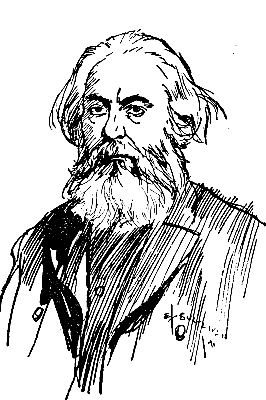
Dr. Huggins is one of the most eminent astronomers of the present day, and his spectroscopic researches on the celestial bodies have had the most important results. He is a D.C.L. of Oxford, LL.D. of Cambridge, and Ph.D of Leyden. Dr. Huggins was born in 1824 and educated at the City of London School. He continued his studies, giving much of his time to experiments in natural philosophy and physical science. In 1855 Dr. Huggins erected a private observatory at his residence on Tulse Hill, where he has carried out valuable prismatic researches with the spectroscope.—Daily Graphic.
OTHER SPECULATIONS.
The nebular hypothesis of Laplace required a rotating mass of fluid which at successive epochs became unstable from excess of motion, and left behind rings, or more probably, perhaps, lumps, of matter from the equatorial regions. To some thinkers was suggested a different view of things, according to which it was not necessary to suppose that one part of the system gravitationally supported another. The whole might consist of a congeries of discrete bodies, even if these bodies were the ultimate molecules of matter. The planets might have been formed by the gradual accretion of such discrete bodies. On the view that the material of the condensing solar system consisted of separate particles or masses, we had no longer the fluid pressure which was an essential part of Laplace's theory. Faye, in his theory of evolution from meteorites, had to throw over his fundamental idea of the nebular hypothesis, and formulated instead a different succession of events of which the outer planets were formed last, a theory which had difficulties of its own. Professor George Darwin had recently shown, from an investigation of the mechanical conditions of a swarm of meteorites, that on certain assumptions a meteoric swarm might behave as a coarse gas, and in this way bring back the fluid pressure exercised by one part of the system on the other, which was required by Laplace's theory. One chief assumption consisted in supposing that such inelastic bodies as meteoric stones might attain the effective elasticity of a high order which was necessary to the theory through the sudden volatilization of a part of their mass at an encounter, by which what was virtually a violent explosive was introduced between the two colliding stones. Professor Darwin was careful to point out that it must necessarily be obscure as to how a small mass of solid matter could take up a very large amount of energy in a small fraction of a second.
HELMHOLTZ'S DISCOVERY.
The old view of the original matter of the nebulæ, that it consisted of a "fiery mist,"
"a tumultuous cloud, Instinct with fire and niter,"
fell at once with the rise of the science of thermodynamics. In 1854, Helmholtz showed that the supposition of an original fiery condition of the nebulous stuff was unnecessary, since in the mutual gravitation of widely separated matter we had a store of potential energy sufficient to generate the high temperature of the sun and stars. We could scarcely go wrong in attributing the light of the nebulæ to the conversion of the gravitational energy of shrinkage into molecular motion. The inquisitiveness of the human mind did not allow us to remain content with the interpretation of the present state of the cosmical masses, but suggested the question—
What see'st thou else In the dark backward and abysm of time?
What was the original state of things? How had it come about that by the side of ageing worlds we had nebulæ in a relatively younger stage? Had any of them received their birth from dark suns, which had collided into new life, and so belonged to a second or later generation of the heavenly bodies?
LOOKING BACKWARD.
During the short historic period there was no record of such an event; still it would seem to be only through the collision of dark suns, of which the number must be increasing, that a temporary rejuvenescence of the heavens was possible, and by such ebbings and flowings of stellar life that the inevitable end to which evolution in its apparently uncompensated progress was carrying us could, even for a little, be delayed. We could not refuse to admit as possible such an origin for nebulæ. In considering, however, the formation of the existing nebulæ we must bear in mind that, in the part of the heavens within our ken, the stars still in the early and middle stages of evolution exceeded greatly in number those which appeared to be in an advanced condition of condensation. Indeed, we found some stars which might be regarded as not far advanced beyond the nebular condition. It might be that the cosmical bodies which were still nebulous owed their later development to some conditions of the part of space where they occurred, such as conceivably a greater original homogeneity, in consequence of which condensation began less early. In other parts of space condensation might have been still further delayed, or even have not yet begun. If light matter were suggested by the spectrum of these nebulæ, it might be asked further, as a pure speculation, whether in them we were witnessing possibly a later condensation of the light matter which had been left behind, at least in a relatively greater proportion, after the first growth of worlds into which the heavier matter condensed, though not without some entanglement of the lighter substances. The wide extent and great diffuseness of this bright-line nebulosity over a large part of the constellation of Orion might be regarded, perhaps, as pointing in this direction. The diffuse nebulous matter streaming round the Pleiades might possibly be another instance, though the character of its spectrum had not yet been ascertained.
THE MOTIONS OF THE STARS.
Besides its more direct use in the chemical analysis of the heavenly bodies, the spectroscope had given to us a great and unexpected power of advance along the lines of the older astronomy. In the future a higher value might, indeed, be placed upon this indirect use of the spectroscope than upon its chemical revelations. By no direct astronomical methods could motions of approach or of recession of the stars be even detected, much less could they be measured. A body coming directly toward us or going directly from us appeared to stand still. In the case of the stars we could receive no assistance from change of size or of brightness. The stars showed no true disks in our instruments, and the nearest of them was so far off that if it were approaching us at the rate of a hundred miles in a second of time, a whole century of such rapid approach would not do more than increase its brightness by the one-fortieth part. Still it was formerly only too clear that, so long as we were unable to ascertain directly those components of the stars' motions which lay in the line of sight, the speed and direction of the solar motion in space, and many of the great problems of the constitution of the heavens must have remained more or less imperfectly known. Now the spectroscope had placed in our hands this power, which, though so essential, had previously appeared almost in the nature of things to lie forever beyond our grasp; it enabled us to measure directly, and, under favorable circumstances, to within a mile per second, or even less, the speed of approach or of recession of a heavenly body. This method of observation had the great advantage for the astronomer of being independent of the distance of the moving body, and was, therefore, as applicable and as certain in the case of a body on the extreme confines of the visible universe, so long as it was bright enough, as in the case of a neighboring planet.
ALGOL AND SPICA.
By observations with the Potsdam spectograph, Professor Vogel found that the bright star of Algol pulsated backward and forward in the visual direction in a period corresponding to the known variation of its light. The explanation which had been suggested for the star's variability, that it was partially eclipsed at regular intervals of 68.8 hours by a dark companion large enough to cut off nearly five-sixths of its light, was, therefore, the true one. The dark companion, no longer able to hide itself by its obscureness, was brought out into the light of direct observation by means of its gravitational effects. Seventeen hours before minimum Algol was receding at the rate of about 24½ miles a second, while seventeen hours after minimum it was found to be approaching with a speed of about 28½ miles. From these data, together with those of the variation of its light, Vogel found, on the assumption that both stars have the same density, that the companion, nearly as large as the sun, but with about one-fourth his mass, revolved with a velocity of about fifty-five miles a second. The bright star of about twice the size and mass moved about the common center of gravity with the speed of about 26 miles a second. The system of the two stars, which were about 3¼ millions of miles apart, considered as a whole, was approaching us with a velocity of 2.4 miles a second. The great difference in luminosity of the two stars, not less than fifty times, suggested rather that they were in different stages of condensation, and dissimilar in density. It was obvious that if the orbit of a star with an obscure companion was inclined to the line of sight, the companion would pass above or below the bright star and produce no variation of its light. Such systems might be numerous in the heavens. In Vogel's photographs, Spica, which was not variable, by a small shifting of its lines revealed a backward and forward periodical pulsation due to orbital motion. As the pair whirled round their common center of gravity, the bright star was sometimes advancing, at others receding. They revolved in about four days, each star moving with a velocity of about 56 miles a second in an orbit probably nearly circular, and possessed a combined mass of rather more than two and one-half times that of the sun. Taking the most probable value for the star's parallax, the greatest angular separation of the stars would be far too small to be detected with the most powerful telescopes.
THE VALUE OF PHOTOGRAPHY.
Referring to the new and great power which modern photography had put into the hands of the astronomer, the president said that the modern silver bromide gelatine plate, except for its grained texture, met his needs at all points. It possessed extreme sensitiveness, it was always ready for use, it could be placed in any position, it could be exposed for hours, lastly it did not need immediate development, and for this reason could be exposed again to the same object on succeeding nights, so as to make up by several installments, as the weather might permit, the total time of exposure which was deemed necessary. Without the assistance of photography, however greatly the resources of genius might overcome the optical and mechanical difficulties of constructing large telescopes, the astronomer would have to depend in the last resource upon his eye. Now, we could not by the force of continued looking bring into view an object too feebly luminous to be seen at the first and keenest moment of vision. But the feeblest light which fell upon the plate was not lost, but taken in and stored up continuously. Each hour the plate gathered up 3,600 times the light energy which it received during the first second. It was by this power of accumulation that the photographic plate might be said to increase, almost without limit, though not in separating power, the optical means at the disposal of the astronomer for the discovery or the observation of faint objects.
TWO EXAMPLES.
Two principal directions might be pointed out in which photography was of great service to the astronomer. It enabled him within the comparatively short time of a single exposure to secure permanently with great exactness the relative positions of hundreds or even of thousands of stars, or the minute features of nebulæ or other objects, or the phenomena of a passing eclipse, a task which by means of the eye and hand could only be accomplished, if done at all, after a very great expenditure of time and labor. Photography put it in the power of the astronomer to accomplish in the short span of his own life, and so enter into their fruition, great works which otherwise must have been passed on by him as a heritage of labor to succeeding generations. The second great service which photography rendered was not simply an aid to the powers the astronomer already possessed. On the contrary, the plate, by recording light waves which were both too small and too large to excite vision in the eye, brought him into a new region of knowledge, such as the infra-red and the ultra-violet parts of the spectrum, which must have remained forever unknown but for artificial help.
A PHOTOGRAPHIC CHART.
The present year would be memorable in astronomical history for the practical beginning of the photographic chart and catalogue of the heavens which took their origin in an international conference which met in Paris in 1887. The decisions of the conference in their final form provided for the construction of a great chart with exposures corresponding to forty minutes' exposure at Paris, which it was expected would reach down to stars of about the fourteenth magnitude. As each plate was to be limited to four square degrees, and as each star, to avoid possible errors, was to appear on two plates, over 22,000 photographs would be required. A second set of plates for a catalogue was to be taken, with a shorter exposure, which would give stars to the eleventh magnitude only. The plans were to be pushed on as actively a possible, though as far as might be practicable plates for the chart were to be taken concurrently. Photographing the plates for the catalogue was but the first step in this work, and only supplied the data for the elaborate measurements which would have to be made, which were, however, less laborious than would be required for a similar catalogue without the aid of photography.
A DELICATE OPERATION.
The determination of the distances of the fixed stars from the small apparent shift of their positions when viewed from widely separated positions of the earth in its orbit was one of the most refined operations of the observatory. The great precision with which this minute angular quantity, a fraction of a second only, had to be measured, was so delicate an operation with the ordinary micrometer, though, indeed, it was with this instrument that the classical observations of Sir Robert Ball were made, that a special instrument, in which the measures were made by moving the two halves of a divided object glass, known as a heliometer, had been pressed into this service, and quite recently, in the skillful hands of Dr. Gill and Dr. Elkin, had largely increased our knowledge in this direction. It was obvious that photography might be here of great service, if we could rely upon measurements of photographs of the same stars taken at suitable intervals of time. Professor Pritchard, to whom was due the honor of having opened this new path, aided by his assistants, had proved by elaborate investigations that measures for parallax might be safely made upon photographic plates, with, of course, the advantages of leisure and repetition; and he had already by this method determined the parallax for twenty-one stars with an accuracy not inferior to that of values previously obtained by purely astronomical methods.
PHOTOGRAPHIC REVELATIONS.
The remarkable successes of astronomical photography, which depended upon the plate's power of accumulation of a very feeble light acting continuously through an exposure of several hours, were worthy to be regarded as a new revelation. The first chapter opened when, in 1880, Dr. Henry Draper obtained a picture of the nebula of Orion; but a more important advance was made in 1883, when Dr. Common, by his photographs, brought to our knowledge details and extensions of this nebula hitherto unknown. A further disclosure took place in 1885, when the Brothers Henry showed for the first time in great detail the spiral nebulosity issuing from the bright star Maia of the Pleiades, and shortly afterward nebulous streams about the other stars of this group. In 1886 Mr. Roberts, by means of a photograph to which three hours' exposure had been given, showed the whole background of this group to be nebulous.
In the following year Mr. Roberts more than doubled for us the great extension of the nebular region which surrounds the trapezium in the constellation of Orion. By his photographs of the great nebula in Andromeda, he had shown the true significance of the dark canals which had been seen by the eye. They were in reality spaces between successive rings of bright matter, which appeared nearly straight, owing to the inclination in which they lay relatively to us. These bright rings surrounded an undefined central luminous mass. Recent photographs by Mr. Russell showed that the great rift in the Milky Way in Argus, which to the eye was void of stars, was in reality uniformly covered with them.
THE STORY OF THE HEAVENS.
The heavens were richly but very irregularly inwrought with stars. The brighter stars clustered into well known groups upon a background formed of an enlacement of streams and convoluted windings and intertwined spirals of fainter stars, which became richer and more intricate in the irregularly rifted zone of the Milky Way. We, who formed part of the emblazonry, could only see the design distorted and confused; here crowded, there scattered, at another place superposed. The groupings due to our position were mixed up with those which were real. Could we suppose that each luminous point had no relation to the others near it than the accidental neighborship of grains of sand upon the shore, or of particles of the wind-blown dust of the desert? Surely every star from Sirius and Vega down to each grain of the light dust of the Milky Way had its present place in the heavenly pattern from the slow evolving of its past. We saw a system of systems, for the broad features of clusters and streams and spiral windings marking the general design were reproduced in every part. The whole was in motion, each point shifting its position by miles every second, though from the august magnitude of their distances from us and from each other, it was only by the accumulated movements of years or of generations that some small changes of relative position revealed themselves.
THE WORK OF THE FUTURE.
The deciphering of this wonderfully intricate constitution of the heavens would be undoubtedly one of the chief astronomical works of the coming century. The primary task of the sun's motion in space, together with the motions of the brighter stars, had been already put well within our reach by the spectroscopic method of the measurement of star motions in the line of sight. Astronomy, the oldest of the sciences, had more than renewed her youth. At no time in the past had she been so bright with unbounded aspirations and hopes. Never were her temples so numerous, nor the crowd of her votaries so great.
The British Astronomical Association formed within the year numbered already about 600 members. Happy was the lot of those who were still on the eastern side of life's meridian! Already, alas! the original founders of the newer methods were falling out—Kirchhoff, Angstrom, D'Arrest, Secchi, Draper, Becquerel; but their places were more than filled; the pace of the race was gaining, but the goal was not and never would be in sight. Since the time of Newton our knowledge of the phenomena of nature had wonderfully increased, but man asked perhaps more earnestly now than in his days, what was the ultimate reality behind the reality of the perceptions? Were they only the pebbles of the beach with which we had been playing? Did not the ocean of ultimate reality and truth lie beyond?
[1]
Presidential address before the British Association, Cardiff, 1891.