SUBTERRANEOUS FLORA AND FAUNA.
Reading edition
By Dr. Otto Zacharias.
It is generally correct to say that air, light and moisture form the chief conditions necessary for the development of organic plant or animal life. One of these conditions, however, namely light, is not of equal importance with the two others. For modern investigation and the discoveries made during the progress of natural sciences have shown that in the depths of the ocean, where an everlasting darkness reigns, and where the temperature is extremely low, nevertheless a great abundance of animal life is to be found, and that there exist living beings, not only of the lowest organization, but even fishes and crustaceans of very complicated structure, all of which thrive without enjoying the slightest ray of light.
A similar example of animal life in the absence of light is to be found in the fauna of caves and grottoes. This was first made known to the world by Austrian and American naturalists. The well known Adelsberg grotto in Krain, and the gigantic Mammoth Cave in Kentucky, furnished much interesting material for a detailed study of the biological conditions of subterraneous animal life. It was gradually discovered that in those dark places there existed not only insects, spiders, crustaceans, centipedes, worms, and snails, but also a kind of salamander and fishes. But what gave special interest to these discoveries was the fact, ascertained by careful study, that not all of these beings were gifted with normally developed organs of vision, but that in some these organs had undergone a retrograde development, while others were entirely blind.
Fig. 1.—THE SEMI-BLIND SALAMANDER (PROTEUS ANGUINEUS) OF THE ADELSBERG GROTTO, IN AUSTRIA.

Among the latter, the blind fish of the Mammoth Cave (Amblyopsis spelacus) is especially remarkable, because in this being the retrograde development of the organ of vision is accompanied by the production of certain ridges of skin on the body which are endowed with an extreme sensitiveness of touch, and which, according to a work lately published by Professor Von Leydig, are composed of little warts in which the nerve fibers end. Nature, therefore, has in this case compensated the amblyopsis for his loss of sight by endowing him with a highly developed organ of feeling.
A similar phenomenon is to be observed in the blind crab (Cambaras pellucidus), which is also found in the Mammoth Cave, for in this being, according to Professor Von Leydig, the little warts on the interior feelers, which constitute the organ of smell, have also received an abnormal development.
Better known than the blind fish and the blind crab of Kentucky is the Proteus anguineus, a kind of salamander, of a pale rose color, endowed with gills and found in the Adelsberg grotto in Austria. (Fig. 1.)
This amphibium has an eye which lies very deep in the body and is almost overgrown by the skin. But this eye is by no means as developed as the organ of vision, for instance, of the water salamander (the triton) or of the so-called axolotl, for it exists only in a kind of embryonic development, and contains neither a vitreous humor nor a lens for the refraction of the rays of light. As, however, the nerve of vision exists, it is possible that this salamander may be able to discern in some manner between light and darkness.
The thinking student, when discovering such imperfect organs of sight, will naturally ask how the eye of this salamander, which is so useless for its real purpose, has come into existence, and he will weigh the comparative value of the two following explanations. It may be assumed that there existed once in the Adelsberg grotto a salamander which was absolutely blind, and in which, in consequence of an innate power of evolution, an organ of vision of the lowest kind was gradually formed. But to this assumption the objection may be raised at once, why nature should have produced an organ of vision in an animal living in a grotto, where such an organ is absolutely useless, and where such a development would be quite as paradoxical and improbable as, for instance, the development of fins instead of legs in an animal living on dry land.
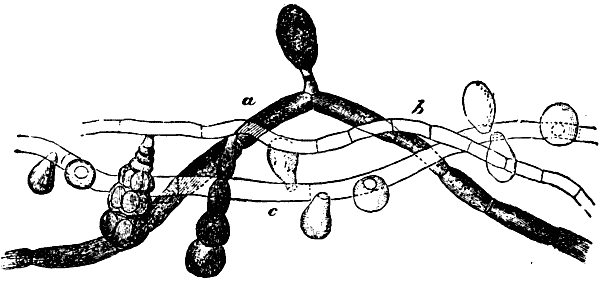
Fig.
2.—GROUP OF PYRENOMYCETES,
A SPECIES OF FUNGI FREQUENT IN THE WATERS OF MINES.
a. Found in the mines of Waldenburg; b. In the brown-coal pits near Westeregeln; c. In the Dorothea pit at Klausthal.
On the other hand, one may suppose, and this is the more probable explanation, that the Proteus anguineus is descended from a kind of salamander, which possessed perfectly developed eyes in the beginning, and that the imperfect organ of vision in the descendants living in the dark caves is the result of gradual degeneration. This is the more likely to be true as in many other cases, also, we find that organs which become useless and cannot be employed have gradually degenerated.
Our common mole furnishes an example. Its eyes also have become small and are deeply hidden in the muscles, although they are by no means as much degenerated as in the Proteus anguineus, and are still possessed of a lens and a retina. Their nerve of vision, however, has become very imperfect, and its connection with the brain is interrupted, so that the animal for this reason can have no perception of light. Notwithstanding the above, however, it is doubtful whether the degeneration and gradual disappearance of the visual organ is in all cases the result of their being no longer employed, since there exists in dark caves a kind of beetle, the Machaerites, in which species the female only is blind, while the male has a well developed organ of sight. In this case it cannot be maintained that the absence of light has been the cause of the blindness of the female beetle, because it would have acted equally upon the male. Nevertheless, no other explanation can be found for the blindness. The problem, therefore, is hitherto unsolved.
Of late the investigations of naturalists have been extended to the animal life existing not only in grottoes and caves, but also in mines and pits created by the action of man, and this has led to many interesting discoveries and remarkable results. A naturalist who has especially enlarged our knowledge with regard to the subterraneous fauna and flora is Dr. Robert Schneider, of Berlin, who made his studies in the coal mines near Waldenburg and Altwasser, in Silesia, the salt mines of Stassfurt and the metal mines of Klausthal, in the Upper Harz Mountains.
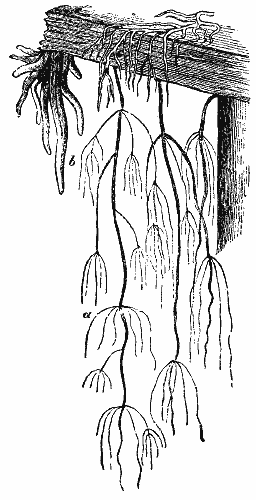
Fig.
3.
a. Rhizomorpha canalicularis of Hoffmann, b. Club fungus (Clavaria deflexa) of Hoffmann, found in the mines at Klausthal.
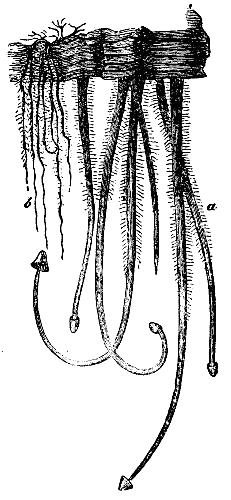
Fig.
4.
a. Agaricus myurus of Hoffmann, a subterranean fungus. b. Himantia villosa, a species of rhizomorpha found in the Upper Harz Mountains.
As regards the subterraneous flora, Dr. Schneider's investigations resulted in showing that the plants which thrive in the dark regions under ground are those which possess no chlorophyl and are sensitive to light. Those which vegetate most luxuriantly there are the fungi, and among them especially the pyrenomycetes, which are frequent in the waters of mines. Their general aspect is shown in a 480 times magnified form in Fig. 2. They resemble fine threads of delicate structure, and where found are always discovered in great abundance. Most conspicuous by their shape and considerable size are the rhizomorphæ, Fig. 3a, and they are remarkable, not only for their brilliant phosphorescence, but also for the peculiar fact that they are only found in places where light does not enter. These rhizomorphæ, though this is not easily recognizable from their external appearance, also belong to the fungi and are often seen in strings of the length of over a meter and the thickness of a quill, spreading out in peculiar branches and hanging down from moist beams in dark places. Sometimes they grow like seaweed in the water of the mines, and in this case they give much embarrassment to the miners, because they are apt to obstruct the channels constructed for leading off the superfluous water. In the mines of Freiberg these rhizomorphæ exist in great abundance, and Humboldt already mentions specimens of the length of 4½ feet. Miners in Germany call them zwirn (thread). The student of natural sciences, when encountering these peculiar forms of vegetation, will ask in how far they are the product of their surrounding circumstances (i.e., of the absence of light or the presence of moisture), and in order to find a reply to this question experiments have been made to grow these rhizomorphæ under different conditions of existence. These experiments have shown that from several species of rhizomorphæ other ordinary fungi can be developed, and that the subterraneous specimens therefore may be considered a degeneration and variation of the fungi found above the surface of the ground.
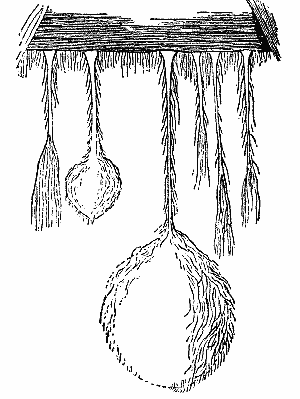
Fig. 5.—FORMS OF MOULD FUNGI FOUND IN THE BROWN-COAL MINES NEAR HALLE A. S.
In Fig. 4b the Himantia villosa is represented, a rhizomorpha found in the mines of the Upper Harz Mountains, thus showing another form of this vegetable growth. Though it is difficult, as above stated, to recognize by their shape the rhizormorphæ as fungi, the origin of the peculiar Agaricus myurus of Hoffmann (Fig. 4a) will be much easier discovered, though a retrograde development and degeneration has taken place also in this fungus. It still shows, however, the elements of a regular toadstool, only that the stem is much elongated and looks like a thread or a tube, while the cap is small, and this explains how, by gradual degeneration, the cap may disappear entirely, leaving nothing but a stem, as, for instance, in the case of the Clavaria deflexa, the club fungus, shown in Fig. 3b.
In connection with the above it may be well to speak of the fungi constituting the mould which often covers the roof and the doors in the brown-coal mines of Halle, specimens of which are shown in Fig. 5.
Fig. 6.—THE SUN INFUSORIUM (ACTINOPHRYS).
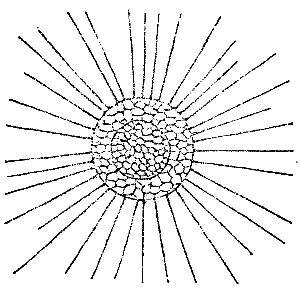
We now come to the animal life in mines and pits. This is mostly represented, of course, by lower organisms, as infusoria and worms. Thus, in the slime on the bottom of the waters in mines, several species of amœbæ are found, which consist of microscopically small animated bodies, continually floating about, nourishing themselves by absorbing organic matter, possessing sensation, propagating, etc., and, in fact, having actually the qualities of real animal nature. Further, we find in those subterraneous waters a species of the sun infusorium (Actinophrys), which is especially frequent in the mines of Klausthal. Fig. 6. shows one of these peculiar little beings. Also the Stylonychia (Fig. 7) is a characteristic inhabitant of those places, and always present there.
Fig. 7.—THE RAPACIOUS INFUSORIUM (STYLONYCHIA).
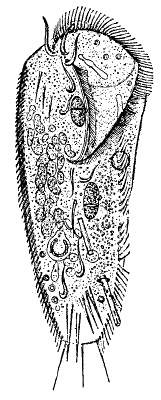
It moves with great rapidity in the water by means of the numerous hairs covering its body, can turn quickly in any direction, and thus is enabled to catch suddenly the little beings on which it lives and which it hunts; for which reason the stylonychia is called the "rapacious infusorium."
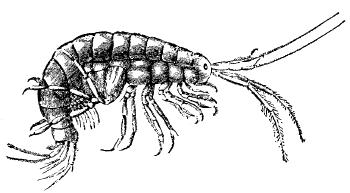
The above are organisms which can be seen only through the microscope, but the fauna of mines contains also larger organisms, though they are not found as regularly and are not as characteristic for those places as the forms mentioned hitherto. Among these organisms there are several species of worms, spiders, gnats, and, above all, crustaceans of the lower class. The most interesting of the latter is perhaps a variety of the sand flea (Fig. 8—Gammarus pulex). The crustacean found in the pits of mines, which is related to the sand flea, shows, according to Dr. R. Schneider, a slight degeneration of the organ of sight, which has taken place in consequence of its adaptation to the dark places, in which this variety of the Gammarus pulex is found, which can make no use of eyes, while the sand flea possesses them fully developed. Otherwise, however, the two varieties are almost absolutely alike, differing only in some details.
Fig. 8.—THE SAND FLEA (GAMMARUS PULEX).
From the above the reader will see that "breathing in the rosy light," as Schiller calls it, is not an absolutely necessary condition for the existence of organic beings, but that life exists everywhere, where there is air and moisture, and a temperature which is not always below freezing point, though even eternal frost does not exclude life entirely, as is proved by the existence of the glacier flea, showing that even in the icy coverings of the Alps life still is possible. Mephistopheles may therefore well say:
"From water, earth, and air unfolding, A thousand germs break forth and grow In dry and wet, and warm and chilly; And had I not the Flame reserved, why really, There's nothing special of my own to show!"
—Leipziger Illustrirte Zeitung.
[NATURE.]