ESTRADE'S HIGH SPEED LOCOMOTIVE.
Reading edition
We illustrate a very remarkable locomotive, which has been constructed from the designs of M. Estrade, a French engineer. This engine was exhibited last year in Paris. Although the engine was built, M. Estrade could not persuade any railway company to try it for him, and finally he applied to the French government, who have at last sanctioned the carrying out of experiments with it on one of the state railway lines. The engine is in all respects so opposed to English ideas that we have hitherto said nothing about it. As, however, it is going to be tried, an importance is given to it which it did not possess before; and, as a mechanical curiosity, we think it is worth the consideration of our readers.
In order that we may do M. Estrade no injustice, we reproduce here in a condensed form, and in English, the arguments in its favor contained in a paper written by M. Max de Nansouty, C.E., who brought M. Estrade's views before the French Institution of Civil Engineers, on May 21, 1886. M. Nansouty's paper has been prepared with much care, and contains a great deal of useful data quite apart from the Estrade engine. The paper in question is entitled "Memoire relatif au Materiel Roulant a Grand Vitesse," D.M. Estrade.
About thirty years ago, M. Estrade, formerly pupil of the Polytechnic School, invented rolling stock for high speed under especial conditions, and capable of leading to important results, more especially with regard to speed. Following step by step the progress made in the construction of railway stock, the inventor, from time to time, modified and improved his original plan, and finally, in 1884, arrived at the conception of a system entirely new in its fundamental principles and in its execution. A description of this system is the object of the memoir.
The great number of types of locomotives and carriages now met with in France, England, and the United States renders it difficult to combine their advantages, as M. Estrade proposed to do, in a system responding to the requirements of the constructor. His principal object, however, has been to construct, under specially favorable conditions, a locomotive, tender, and rolling stock adapted to each other, so as to establish a perfect accord between these organs when in motion. It is, in fact, a complete train, and not, as sometimes supposed, a locomotive only, of an especial type, which has been the object he set before him. Before entering into other considerations, we shall first give a description of the stock proposed by M. Estrade. The idea of the invention consists in the use of coupled wheels of large diameter and in the adoption of a new system of double suspension.
The locomotive and tender we illustrate were constructed by MM. Boulet & Co. The locomotive is carried on six driving wheels, 8 feet 3 inches in diameter. The total weight of the engine is thus utilized for adhesion. The accompanying table gives the principal dimensions:
TABLE I.
ft.in.
Total length of engine.328
Width between frames.41
Wheel base, total.169
Diameter of cylinder.16½
Length of stroke.23½
Grate surface.25 sq. feet.
Total heating surface.1,400 sq. ft.
Weight empty.38 tons.
Weight full.42 tons.
The high speeds—77 to 80 miles an hour—in view of which this stock has been constructed have, it will be seen, caused the elements relative to the capacity of the boiler and the heating surfaces to be developed as much as possible. It is in this, in fact, that one of the great difficulties of the problem lies, the practical limit of stability being fixed by the diameter of the driving wheels. Speed can only be obtained by an expenditure of steam which soon becomes such as rapidly to exhaust the engine unless the heating surface is very large.
The tender, also fitted with wheels of 8 ft. 3 in. in diameter, offers no particular feature; it is simply arranged so as to carry the greatest quantity of coal and water.
M. Estrade has also designed carriages. One has been constructed by MM. Reynaud, Bechade, Gire & Co., which has very few points in common with those in general use. Independently of the division of the compartments into two stories, wheels 8 ft. 3 in. in diameter are employed, and the double system of suspension adopted. Two axles, 16 ft. apart, support, by means of plate springs, an iron framing running from end to end over the whole length, its extremities being curved toward the ground. Each frame carries in its turn three other plate springs, to which the body is suspended by means of iron tie-rods serving to support it. This is then a double suspension, which at once appears to be very superior to the systems adopted up to the present time. The great diameter of the wheels has necessitated the division into two stories. The lower story is formed of three equal parts, lengthened toward the axles by narrow compartments, which can be utilized for luggage or converted into lavatories, etc. Above is one single compartment with a central passage, which is reached by staircases at the end. All the vehicles of the same train are to be united at this level by jointed platforms furnished with hand rails. It is sufficient to point out the general disposition, without entering into details which do not affect the system, and which must vary for the different classes and according to the requirements of the service.
M. ESTRADE'S HIGH SPEED LOCOMOTIVE.
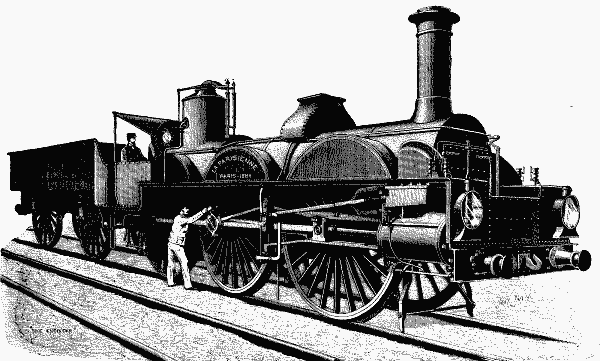
M. Nansouty draws a comparison between the diameters of the driving wheels and cylinders of the principal locomotives now in use and those of the Estrade engine as set forth in the following table. We only give the figures for coupled engines:
TABLE II.
Diameter of driving wheels.Size of cylinder.Position of cylinder.
ft. in.in. in.
Great Eastern7 018 × 24inside
South-Eastern7 019 × 26"
Glasgow and Southwestern6 118 × 26"
Midland, 18847 019 × 26"
North-Eastern7 017½ × 24"
London and North-Western6 617 × 24"
Lancashire and Yorkshire6 017½ × 26"
Nord7 017 × 24"
Paris-Orleans, 18846 817 × 23½outside.
Ouest6 017¼ × 25½"
This table, the examination of which will be found very instructive, shows that there are already in use: For locomotives with single drivers, diameters of 9 ft., 8 ft. 1 in., and 8 ft.; (2) for locomotives with four coupled wheels, diameters 6 ft. to 7 ft. There is therefore an important difference between the diameters of the coupled wheels of 7 ft. and those of 8 ft. 3 in., as conceived by M. Estrade. However, the transition is not illogically sudden, and if the conception is a bold one, "it cannot," says M. Nansouty, "on the other hand, be qualified as rash."
He goes on to consider, in the first place: Especial types of uncoupled wheels, the diameters of which form useful samples for our present case. The engines of the Bristol and Exeter line are express tender engines, adopted on the English lines in 1853, some specimens of which are still in use.1 These engines have ten wheels, the single drivers in the center, 9 ft. in diameter, and a four-wheeled bogie at each end. The driving wheels have no flanges. The bogie wheels are 4 ft. in diameter. The cylinders have a diameter of 16½ in. and a piston stroke of 24 in. The boiler contains 180 tubes, and the total weight of the engine is 42 tons. These locomotives, constructed for 7 ft. gauge, have attained a speed of seventy-seven miles per hour.
The single driver locomotives of the Great Northern are powerful engines in current use in England. The driving wheels carry 17 tons, the heating surface is 1,160 square feet, the diameters of the cylinders 18 in., and that of the driving wheels 8 ft. 1 in. We have here, then, a diameter very near to that adopted by M. Estrade, and which, together with the previous example, forms a precedent of great interest. The locomotive of the Great Northern has a leading four-wheeled bogie, which considerably increases the steadiness of the engine, and counterbalances the disturbing effect of outside cylinders. Acting on the same principles which have animated M. Estrade, that is to say, with the aim of reducing the retarding effects of rolling friction, the constructor of the locomotive of the Great Northern has considerably increased the diameter of the wheels of the bogie. In this engine all the bearing are inside, while the cylinders are outside and horizontal. The tender has six wheels, also of large dimensions. It is capable of containing three tons and a half of coal and about 3,000 gallons of water. This type of engine is now in current and daily use in England.
M. Nansouty next considers the broad gauge Great Western engines with 8 ft. driving wheels. The diameters of their wheels approach those of M. Estrade, and exceed considerably in size any lately proposed. M. Nansouty dwells especially upon the boiler power of the Great Western railway, because one of the objections made to M. Estrade's locomotive by the learned societies has been the difficulty of supplying boiler power enough for high speeds contemplated; and he deals at considerable length with a large number of English engines of maximum power, the dimensions and performance of which are too well known to our readers to need reproduction here.
Aware that a prominent weak point in M. Estrade's design is that, no matter what size we make cylinders and wheels, we have ultimately to depend on the boiler for power, M. Nansouty argues that M. Estrade having provided more surface than is to be found in any other engine, must be successful. But the total heating surface in the engine, which we illustrate, is but 1,400 square feet, while that of the Great Western engines, on which he lays such stress, is 2,300 square feet, and the table which he gives of the heating surface of various English engines really means very little. It is quite true that there are no engines working in England with much over 1,500 square feet of surface, except those on the broad gauge, but it does not follow that because they manage to make an average of 53 miles an hour that an addition of 500 square feet would enable them to run at a speed higher by 20 miles an hour. There are engines in France, however, which have as much as 1,600 square feet, as, for example, on the Paris-Orleans line, but we have never heard that these engines attain a speed of 80 miles an hour.
Leaving the question of boiler power, M. Nansouty goes on to consider the question of adhesion. About this he says:
Is the locomotive proposed by M. Estrade under abnormal conditions as to weight and adhesion? This appears to have been doubted, especially taking into consideration its height and elegant appearance. We shall again reply here by figures, while remarking that the adhesion of locomotives increases with the speed, according to laws still unknown or imperfectly understood, and that consequently for extreme speeds, ignorance of the value of the coefficiency of adhesion f in the formula
fP = 0.65 p d 2 I ———— D - R
renders it impossible to pronounce upon it before the trials earnestly and justly demanded by the author of this new system. In present practice f = 1/7 is admitted. M. Nansouty gives in a table a resume of the experience on this subject, and goes on:
"The English engineers, as will be seen, make a single axle support more than 17 tons. In France the maximum weight admitted is 14 tons, and the constructor of the Estrade locomotive has kept a little below this figure. The question of total weight appears to be secondary in a great measure, for, taking the models with uncoupled wheels, the English engines for great speed have on an average, for a smaller total weight, an adhesion equal to that of the French locomotives. The P.L.M. type of engine, which has eight wheels, four of which are coupled, throws only 28.6 tons upon the latter, being 58 per cent. of the total weight. On the other hand, that of the English Great Eastern throws 68 per cent. of the total weight on the driving wheels. Numerous other examples could be cited. We cannot, we repeat, give an opinion rashly as to the calculation of adhesion for the high speed Estrade locomotive before complete trials have taken place which will enable us to judge of the particular coefficients for this entirely new case."
M. Nansouty then goes on to consider the question of curves, and says:
"It has been asked, not without reason, notably by the Institution of Civil Engineers of Paris, whether peculiar difficulties will not be met with by M. Estrade's locomotive—with its three axles and large coupled wheels—in getting round curves. We have seen in the preceding tables that the driving wheels of the English locomotives with independent wheels are as much as 8 ft. in diameter. The driving wheels of the English locomotives with four coupled wheels are 7 ft. in diameter. M. Estrade's locomotive has certainly six coupled wheels with diameters never before tried, but these six coupled wheels constitute the whole rolling length, while in the above engines a leading axle or a bogie must be taken into account, independent, it is true, but which must not be lost sight of, and which will in a great measure equalize the difficulties of passing over the curves.
"Is it opposed to absolute security to attack the line with driving wheels? This generally admitted principle appears to rest rather on theoretic considerations than on the results of actual experience. M. Estrade, besides, sets in opposition to the disadvantages of attacking the rails with driving wheels those which ensue from the use of wheels of small diameter as liable to more wear and tear. We should further note with particular care that the leading axle of this locomotive has a certain transverse play, also that it is a driving axle. This disposition is judicious and in accordance with the best known principles."
A careful perusal of M. Nansouty's memoir leaves us in much doubt as to what M. Estrade's views are based on. So far as we understand him, he seems to have worked on the theory that by the use of very large wheels the rolling resistance of a train can be greatly diminished. On this point, however, there is not a scrap of evidence derived from railway practice to prove that any great advantage can be gained by augmenting the diameters of wheels. In the next place, he is afraid that he will not have adhesion enough to work up all his boiler power, and, consequently, he couples his wheels, thereby greatly augmenting the resistance of the engine. He forgets that large coupled wheels were tried years ago on the Great Western Railway, and did not answer. A single pair of drivers 8 ft. 3 in. in diameter would suffice to work up all the power M. Estrade's boiler could supply at sixty miles an hour, much less eighty miles an hour. On the London and Brighton line Mr. Stroudley uses with success coupled leading wheels of large diameter on his express engines, and we imagine that M. Estrade's engine will get round corners safely enough, but it is not the right kind of machine for eighty miles an hour, and so he will find out as soon as a trial is made. The experiment is, however, a notable experiment, and M. Estrade has our best wishes for his success.—The Engineer.
[1]
M. Nansouty is mistaken. None of the Bristol and Exeter tank engines with. 9 ft. wheels are in use, so far as we know. Ed. E.