THE "METEOROLOGISKE INSTITUT" AT UPSALA, AND CLOUD MEASUREMENTS.
Reading edition
The Meteorological Institute at Upsala has gained so much fame by the investigations on clouds which have been carried on there during the last few years, that a few notes on a recent visit to that establishment will interest many readers.
The Institute is not a government establishment; it is entirely maintained by the University of Upsala. The personnel consists of Prof. Hildebrandsson, as director; M. Ekholm and one other male assistant, besides a lady who does the telegraphic and some of the computing work.
The main building contains a commodious office, with a small library and living apartments for the assistant. The principal instrument room is a separate pavilion in the garden. Here is located Thiorell's meteograph, which records automatically every quarter of an hour on a slip of paper the height of the barometer, and the readings of the wet and dry thermometers. Another instrument records the direction and velocity of the wind.
This meteograph of Thiorell's is a very remarkable instrument. Every fifteen minutes an apparatus is let loose which causes three wires to descend from rest till they are stopped by reaching the level of the mercury in the different tubes. When contact is made with the surface of the mercuries, an electric current passes and stops the descent of each wire at the proper time. The downward motion of the three wires has actuated three wheels, each of which carries a series of types on its edge, to denote successive readings of its own instrument. For instance, the barometer-wheel carries successive numbers for every five-hundredth of a millimeter—760.00, 760.05, 760.1, etc.; so that when the motion is stopped the uppermost type gives in figures the actual reading of the barometer. Then a subsidiary arrangement first inks the types, then prints them on a slip of paper, and finally winds the dipping wires up to zero again.
An ingenious apparatus prevents the electricity from sparking when contact is made, so that there is no oxidation of the mercury. The mechanism is singularly beautiful, and it is quite fascinating to watch the self acting starting, stopping, inking, and printing arrangements.
We could not but admire the exquisite order in which the whole apparatus was maintained. The sides of the various glass tubes were as clean as when they were new, and the surfaces of the mercuries were as bright as looking glasses.
The university may well be proud that the instruments were entirely constructed in Stockholm by the skillful mechanic Sorrenson, though the cost is necessarily high. The meteograph, with the anemograph, cost £600, but the great advantage is that no assistant is required to sit up at night, and that all the figures wanted for climatic constants are ready tabulated without any further labor.
But the Institute is most justly celebrated for the researches on the motion and heights of clouds that have been carried on of late years under the guidance of Prof. Hildebrandsson, with the assistance of Messrs. Ekholm and Hagström.
The first studies were on the motion of clouds round cyclones and anticyclones; but the results are now so well known that we need not do more than mention them here.
Latterly the far more difficult subjects of cloud heights and cloud velocities have been taken up, and as the methods employed and the results that have been obtained are both novel and important, we will describe what we saw there.
We should remark, in the first instance, that the motion of the higher atmosphere is far better studied by clouds than by observations on mountain tops, for on the latter the results are always more or less influenced by the local effect of the mountain in deflecting the wind and forcing it upward.
The instrument which they employ to measure the angles from which to deduce the height of the clouds is a peculiar form of altazimuth that was originally designed by Prof. Mohn, of Christiania, for measuring the parallax of the aurora borealis. It resembles an astronomical altazimuth, but instead of a telescope it carries an open tube without any lenses. The portion corresponding to the object glass is formed by thin cross wires: and that corresponding to the eye piece by a plate of brass, pierced in the center by a small circular hole an eighth of an inch in diameter. The tube of the telescope is replaced by a lattice of brass work, so as to diminish, as far as possible, the resistance of the wind. The vertical and horizontal circles are divided decimally, and this much facilitates the reduction of the readings.
The general appearance of the instrument is well shown in the figure, which is engraved from a photograph I took of Mr. Ekholm while actually engaged in talking through a telephone to M. Hagström as to what portion of a cloud should be observed. The latticework tube, the cross wires in place of an object glass, and the vertical circle are very obvious, while the horizontal circle is so much end on that it can scarcely be recognized except by the tangent screw which is seen near the lower telephone.
Two such instruments are placed at the opposite extremities of a suitable base. The new base at Upsala has a length of 4,272 feet; the old one was about half the length. The result of the change has been that the mean error of a single determination of the highest clouds has been reduced from 9 to a little more than 3 per cent. of the actual height. At the same time the difficulty of identifying a particular spot on a low cloud is considerably increased. A wire is laid between the two ends of the base, and each observer is provided with two telephones—one for speaking, the other for listening. When an observation is to be taken, the conversation goes on somewhat as follows: First observer, who takes the lead—"Do you see a patch of cloud away down west?" "Yes." "Can you make out a well-marked point on the leading edge?" "Yes." "Well, then; now." At this signal both observers put down their telephones, which have hitherto engaged both their hands, begin to count fifteen seconds, and adjust their instruments to the point of cloud agreed on. At the fifteenth second they stop, read the various arcs, and the operation is complete.
But when the angles have been measured the height has to be calculated, and also the horizontal and vertical velocities of the cloud by combining the position and height at two successive measurements at a short interval. There are already well-known trigonometrical formulæ for calculating all these elements, if all the observations are good; but at Upsala they do far more. Not only are the observations first controlled by forming an equation to express the condition that the two lines of sight from either end of the base should meet in a point, if the angles have been correctly measured and all bad sets rejected; but the mean errors of the rectangular co-ordinates are calculated by the method of least squares.
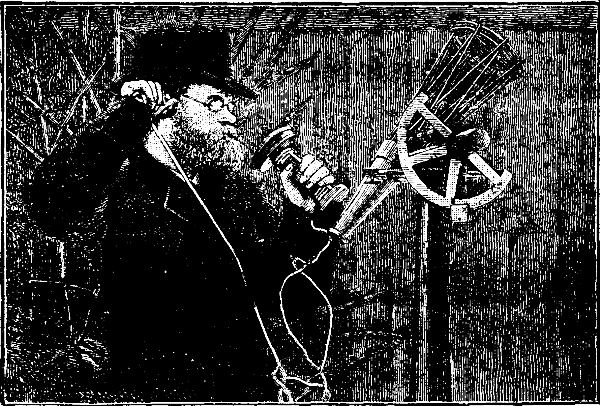
N. EKHOLM MEASURING CLOUDS.
This figure shows the peculiar ocular part of the altazimuth, with the vertical and horizontal circles. It also shows the telephonic arrangement.
The whole of the calculations are combined into a series of formulæ which are necessarily complicated, and even by using logarithms of addition and subtraction and one or two subsidiary tables—such as for log. sin²(θ/2) specially constructed for this work—the computation of each set of observations takes about twenty minutes.
Before we describe the principal results that have been attained, it may be well to compare this with the other methods which have been used to determine the height of clouds. A great deal of time and skill and money have been spent at Kew in trying to perfect the photographic method of measuring the height of clouds. Very elaborate cloud cameras, or photo-nephoscopes, have been constructed, by means of which photographs of a cloud were taken simultaneously from both ends of a suitable base. The altitude and azimuth of the center of the plate were read off by the graduated circles which were attached to the cameras; and the angular measurements of any point of cloud on the picture were calculated by proper measurements from the known center of the photographic plate. When all this is done, the result ought to be the same as if the altitude and azimuth of the point of the cloud had been taken directly by an ordinary angle measuring instrument.
It might have been thought that there would be less chance of mistaking the point of the cloud to be measured, if you had the pictures from the two ends of the base to look at leisurely than if you could only converse through a telephone with the observer at the other end of the base. But in practice it is not so. No one who has not seen such cloud photographs can realize the difficulty of identifying any point of a low cloud when seen from two stations half a mile or a whole mile apart, and for other reasons, which we will give presently, the form of a cloud is not so well defined in a photograph as it is to the naked eye.
At Kew an extremely ingenious sort of projector has been devised, which gives graphically the required height of a cloud from two simultaneous photographs at opposite ends of the same base, but it is evident that this method is capable of none of the refinements which have been applied to the Upsala measures, and that the rate of vertical ascent or descent of a cloud could hardly be determined by this method. But there is a far greater defect in the photographic method, which at present no skill can surmount.
We saw that the altazimuth employed at Upsala had no lenses. The meaning of this will be obvious to anyone who looks through an opera glass at a faint cloud. He will probably see nothing for want of contrast, and if anything of the nature of a telescope is employed, only well-defined cloud outlines can be seen at all. The same loss of light and contrast occurs with a photographic lens, and many clouds that can be seen in the sky are invisible on the ground glass of the camera. Cirrus and cirro-stratus—the very clouds we want most to observe—are always thin and indefined as regards their form and contrast against the rest of the sky, so that this defect of the method is the more unfortunate.
But even when the image of a cloud is visible on the focusing glass, it does not follow that any image will be seen in the picture. In practice, thin, high white clouds against a blue sky can rarely be taken at all, or only under exceptional circumstances of illumination. The reason seems to be that there is very little light reflected at all from a thin wisp of cirrus, and what there is must pass through an atmosphere always more or less charged with floating particles of ice or water, besides earthy dust of all kinds. The light which is scattered and diffused by all these small particles is also concentrated on the sensitive plate by the lens, and the resulting negative shows a uniform dark surface for the sky without any trace of the cloud. What image there might have been is buried in photographic fog.
In order to compare the two methods of measuring clouds, I went out one day last December at Upsala with Messrs. Ekholm and Hagström when they were measuring the height of some clouds. It was a dull afternoon, a low foggy stratus was driving rapidly across the sky at a low level, and through the general misty gloom of a northern winter day we could just make out some striated stripes of strato-cirrus—low cirro-stratus—between the openings in the lower cloud layer. The camera and lens that I use habitually for photographing cloud forms—not their angular height—was planted a few feet from the altazimuth with which M. Ekholm was observing, and while he was measuring the necessary angles I took a picture of the clouds. As might have been expected under the circumstances, the low dark cloud came out quite well, but there was not the faintest trace of the strato-cirrus on the negative. MM. Ekholm and Hagström, however, succeeded in measuring both layers of cloud, and found that the low stratus was floating at an altitude of about 2,000 feet high, while the upper strato-cirrus was driving from S. 57° W. at an altitude of 19,653 feet, with a horizontal velocity of 81 and a downward velocity of 7.2 feet per second. This is a remarkable result, and shows conclusively the superiority of the altazimuth to the photographic method of measuring the heights of clouds.
Whenever opportunity occurs, measures of clouds are taken three times a day at Upsala, and it may be well to glance at the principal results that have been obtained.
The greatest height of any cloud which has yet been satisfactorily measured is only 43,800 feet, which is rather less than has usually been supposed; but the highest velocity, 112 miles an hour with a cloud at 28,000 feet, is greater than would have been expected. It may be interesting to note that the isobars when this high velocity was reported were nearly straight, and sloping toward the northwest.
The most important result which has been obtained from all the numerous measures that have been made is the fact clouds are not distributed promiscuously at all heights in the air, but that they have, on the contrary, a most decided tendency to form at three definite levels. The mean summer level of these three stories of clouds at Upsala has been found to be as follows: low clouds—stratus, cumulus, cumulo-nimbus, 2,000-6,000 feet; middle clouds—strato-cirrus and cumulo-cirrus, 12,900-15,000 feet; high clouds—cirrus, cirro-stratus, cirro-cumulus, 20,000-27,000 feet.
It would be premature at present to speculate on the physical significance of this fact, but we find the same definite layers of clouds in the tropics as in these high latitudes, and no future cloud nomenclature or cloud observations will be satisfactory which do not take the idea of these levels into account.
But the refinements of the methods employed allow the diurnal variations both of velocity and altitude to be successfully measured. The velocity observations confirm the results that have been obtained from mountain stations—that, though the general travel of the middle and higher clouds is much greater than that of the surface winds, the diurnal variation of speed at those levels is the reverse of what occurs near the ground. The greatest velocity on the earth's surface is usually about 2 p.m.; whereas the lowest rate of the upper currents is about midday.
The diurnal variation of height is remarkable, for they find at Upsala that the mean height of all varieties of clouds rises in the course of the day, and is higher between 6 and 8 in the evening than either in the early morning or at midday.
Such are the principal results that have been obtained at Upsala, and no doubt they surpass any previous work that has been done on the subject. But whenever we see good results it is worth while to pause a moment to consider the conditions under which the work has been developed, and the nature and nurture of the men by whom the research has been conducted. Scientific research is a delicate plant, that is easily nipped in the bud, but which, under certain surroundings and in a suitable moral atmosphere, develops a vigorous growth.
The Meteorological Institute of Upsala is an offshoot of the Astronomical Observatory of the university; and a university, if properly directed, can develop research which promises no immediate reward in a manner that no other body can approach.
If you want any quantity of a particular kind of calculation, or to carry on the routine of any existing work in an observatory, it is easy to go into the labor market and engage a sufficient number of accurate computers, either by time or piece work, or to find an assistant who will make observations with the regularity of clockwork.
But original research requires not only special natural aptitudes and enthusiasm to begin with, but even then will not flourish unless developed by encouragement and the identification of the worker with his work. It is rarely, except in universities, that men can be found for the highest original research. For there only are young students encouraged to come forward and interest themselves in any work for which they seem to have special aptitude.
Now, this is the history of the Upsala work. Prof. Hildebrandsson was attached as a young man to the meteorological department of the astronomical observatory, and when the study of stars and weather were separated, he obtained the second post in the new Meteorological Institute. From this his great abilities soon raised him to the directorship, which he now holds with so much credit to the university. M. Ekholm, a much younger man, has been brought up in the same manner. First as a student he showed such aptitude for the work as to be engaged as assistant; and now, as the actual observation and reduction of the cloud work is done by him and M. Hagström, the results are published under their names, so that they are thoroughly identified with the work.
Upsala is the center of the intellectual life of Sweden, and there, rather than at Stockholm, could men be found to carry out original research. It redounds to the credit of the university that it has so steadily supported Prof. Hildebrandsson, and that he in his turn has utilized the social and educational system by which he is surrounded to bring up assistants who can co-operate with him in a great work that brings credit both to himself, to themselves, and to the institute which they all represent.
Ralph Abercromby.
[Continued from Supplement, No. 610, page 9744.]
[Journal Of The Society Of Chemical Industry.]