THE ANALYSIS OF URINE.
Reading edition
INTRODUCTION.
Whatever may be the position of British pharmacists in comparison with those of other countries, it cannot be said that they have paid the attention to the analysis of urine which the subject has received from pharmacists on the Continent. Considering the importance of the subject, this curious neglect can only be attributed to the fact that the pharmacist in Great Britain is but slowly attaining the position of chemical expert to the physician, which his foreign confrere has so long held with credit and even distinction. In France, for example, M. Méhu, whose name is familiar to readers of this journal, is looked upon as one of the leading authorities on morbid urine and its analysis, and yet a list of goodly pharmaceutical papers shows that, as the medical analyst, he has not forgotten his connection with pure pharmacy.
There are several points about urinary analysis which entitle it to a very high position in the estimation of pharmacists. In the first place, the physician is no more likely to be fonder of the test tube than of the pestle, of analyzing urine than of compounding his own medicines. Leading men in the profession are more and more setting their faces against the dispensing doctor, and there are numbers among them who admit that they succeed no better as analysts than they do as dispensers.
Some old fashioned practitioners trouble themselves very little about their patients' urine, except, perhaps, in respect of sugar and albumen. On the other hand, numbers of leading physicians, including especially those highly educated gentlemen who cultivate a consulting practice, are in the habit of pushing urinary analysis almost to an excess. One well-known specialist of the writer's acquaintance, with an extensive West End practice, makes quantitative determinations of urea, uric acid, and total acidity, in addition to conducting other diagnostic experiments, on every occasion that he interviews his patients. By this means he has accumulated in his case books a mass of data which he considers most valuable as an aid to diagnosis, and through that to successful treatment.
Pharmacists are proverbially neat-handed, as Mr. Martindale would say, and their habit of conducting dispensing operations which involve the dexterous manipulation of very small quantities of material fit them admirably to undertake volumetric and other rapid analytical determinations. Compared with the doctor there is no doubt that in this matter the chemist is facile princeps, and from the nature of their respective occupations such could only have been expected. A few chemists throughout the country lay themselves out to save their local doctors from unwelcome test tube practice, and these almost to a man find it pay. Some charge a handsome fee to patients, and a small one when the analysis comes through the physician. Others find it to their interest to furnish medical men with qualitative reports on sugar or albumen gratuitously. Although this practice has certain obvious drawbacks, if a doctor sends his prescriptions to a chemist, the latter is often willing to gratuitously perform his chemical work. In the present article we propose to describe briefly but fully the methods which have been found of most value in practice.
PRELIMINARY OPERATIONS.
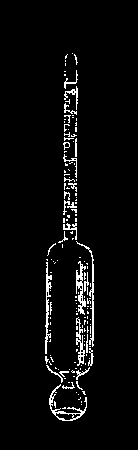
It is the practice of some physicians to direct the patient to preserve all the urine passed in twenty-four hours, and to forward this in one bottle for analysis. Others, again, merely send a small sample of "morning" and "evening" urine in separate phials, desiring only a comparative report. In the former case the volume should be accurately measured, and the quantity noted either in fluid ounces or cubic centimeters before commencing the analysis. This need not be done if small samples only are received. The color should be noted. It varies greatly, through every shade of yellow and amber to dark brown, with a tinge of green or red, if the coloring matter of bile or blood is present. Also note relative transparency or cloudiness, specific gravity, and reaction, as all these observations are useful in diagnosis. Odor is not quite so important. The specific gravity should be taken at about 60° F. in an ordinary specific gravity bottle, or more conveniently by means of a good urinometer. In the latter case it is very important to have an instrument of known accuracy, many of those in the market being valueless. Urinometers of glass, though fragile, are decidedly more cleanly and less liable to get out of order than the gilded brass instruments carried in the pocket by many physicians. Mr. J.J. Hicks, of 8 Hatton Garden, E.C., manufactures a very creditable "patent urinometer" at an extremely low cost. Healthy urine has a density of from 1.015 to 1.025; but variations from this range are common.
A fair quantity of the urine, after shaking, should be placed in a tall conical glass vessel, to allow easy collection of the precipitate for subsequent, microscopical examination. If an abundant amorphous deposit of a fawn or pink—from uroerythrin—color slowly settles and is readily diffused, urates in excess can be anticipated. Their presence is proved by the readiness with which they dissolve on warming with the supernatant urine to about the temperature of the blood. No difficulty is experienced if small quantities of albumen are present, as that body is not coagulated until the temperature rises much higher. A sandy precipitate of free uric acid will not dissolve on warming the urine, and its identity can further be determined by means of the microscope, or by applying a well-known color-reaction. A grain or so is oxidized into reddish alloxan and alloxantin by carefuly evaporating with a few drops of strong nitric acid on a piece of porcelain. A little ammonia is then added, when the fine purple murexide stain will be produced.
It is always advisable to mention the reaction to test papers of all samples received. Urine is normally acid, but there are certain diseases which render fluid neutral or alkaline. The urea of acid urine on standing is changed by a putrefactive ferment into ammonic carbonate, but this decomposition in a state of health should not take place for at least twenty-four hours. Alkalies, or organic salts of alkaline metals, when taken as medicine render the urine alkaline, and the indication is then not of much moment; but if none of these causes exist, the condition is of serious diagnostic import. Where it is desired to determine the degree of acidity of the urine voided, say, by a gouty patient, a dilute volumetric solution of caustic soda should be employed, using a few drops of an alcoholic solution of phenolphthalein as an indicator, and reporting in terms of oxalic acid. The soda solution may conveniently contain the equivalent of one milligramme of recrystallized oxalic acid (H2C2O4.2H2O) in each cubic centimeter.
UREA.
Carbamide, as it is called by systematic chemists, or urea, is next to water the largest constituent of urine, and forms about one-third of its total solids. Derived from ammonic carbonate by abstracting two molecules of the elements of water, it is readily converted by putrefaction into that salt, and the urine under these circumstances becomes strongly alkaline in reaction. Earthy phosphates then fall naturally out of solution, so that the putrid fluid is always well furnished with sediment. Nitrogen that has served its purpose as muscle or other proteid leaves the animal economy chiefly in the form of urea, and its proportion in the urine, therefore, is a fair index of the activity of wasting influences.
For its determination Knop's sodic hypobromite method, on account of its convenience, is now generally preferred. The volumetric process of Liebig, which depends on the formation of an insoluble compound of urea with mercuric nitrate, possesses no advantages and is troublesome to work. The principle of the hypobromite process is simple. In a strongly alkaline solution urea is broken up by sodic hypobromite, its nitrogen being evolved in the gaseous state, and its carbon and hydrogen oxidized to carbonic anhydride and water respectively. The volume of free nitrogen obtained bears a direct ratio to the amount of urea decomposed.
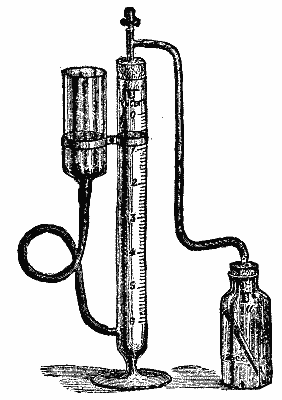
Among the number of instruments which have been introduced for the purpose of conveniently measuring the evolved gas, that of Gerrard, an illustration of which we give, is one of the simplest, cheapest, and best. The ureometer tube, b, is connected at the base with a movable reservoir, c, and by means of a rubber tube passing through a cork at the top to the generating bottle, a. To use the apparatus, fill b to zero with water and have the reservoir placed so high that it contains only an inch or so of the liquid. Replace the cork with attached tube tightly in b. Now pour into the generating bottle 25 c.c. of a solution prepared by dissolving 1 part of caustic soda in 2½ parts of distilled water, and dexterously break in the liquid a tube containing 2.2 c.c. of bromine. The tubes will be found very convenient, obviating entirely the suffocating fumes diffused in the act of measuring bromine. Allow to stand in the solution of sodic hypobromite thus prepared a test tube containing exactly 5 c.c. of the urine under examination. Cork the bottle as shown in the illustration, see that the water is at zero, and that the liquid in the reservoir is at the same level, and then allow the urine to gradually mix with the hypobromite solution. Cool the evolved gas by placing the bottle in cold water, adjust the levels of the water in the tube and reservoir (to obviate a correction for pressure), and read off the percentage of urea in terms of which the tube is graduated. Stale urine, the urea of which has largely been converted into ammonic carbonate, still yields a very fair result, that salt being also completely split up by the powerful oxidant employed. Should the urine contain albumen, it is advisable to remove it by boiling and filtering, as, although only slowly decomposed by the hypobromite solution, it communicates to the liquid such a tendency to froth that the disengagement of the nitrogen is seriously impeded. Most of those alkaloids which might possibly be present do not yield the gas when treated in this manner, and therefore may be disregarded.
SUGAR.
Glucose, so characteristic of diabetes mellitus, is not difficult of detection or estimation. The facility with which it reduces alkaline cupric, argentic, bismuthous, ferric, mercuric salts, indigo and potassic picrate and chromate solutions has been utilized for the preparation of several ready methods for its determination. Trommer's test consists in adding enough cupric sulphate to color green, then excess of alkali, and boiling. Yellow to brick-red cuprous oxide forms as a heavy precipitate if glucose is present. The organic matter of the urine prevents the precipitation of cupric hydrate on the addition of the alkali. This test is delicate and deservedly popular. Fehling's well-known solution contains sodio-potassic tartrate, which serves the purpose chiefly of retaining the copper in solution. Unfortunately, Fehling's original solution has a tendency to become hyper-sensitive if kept long, a proneness to change that is much increased on dilution. When so altered, the solution will yield a more or less copious precipitate of cuprous oxide on merely boiling, and quite independent of the presence of glucose. This decomposition is obviated by preserving the copper salt in a separate solution from the tartrate and alkali, and mixing before use. Schmiedeberg substitutes mannite and Cresswell glycerin for the Rochelle salt, in order to render the solution stable. Some prepared by the writer over twelve months ago, according to the suggestion of the latter physician, has since shown no signs of decomposition, and is now as good as it was then. For qualitative purposes the solution may be prepared thus: Dissolve 35 gm. of recrystallized cupric sulphate and 200 c.c. of pure glycerin in 100 c.c. of distilled water. Dissolve separately 80 gm. of caustic soda in 400 c.c. of water. Mix the solutions and boil for a quarter of an hour. A small amount of reduction from impurity in the glycerin takes place. Allow to stand till clear, decant, and dilute to 1,250 c.c. Ten cubic centimeters will then equal roughly 5 centigrammes of glucose. For exact quantitative determination it is necessary to standardize the solution with pure anhydrous dextrose.
To a practiced operator the indications yielded by the use of this test are of great value; but beginners are exceedingly liable to mistake its various reactions, and to report the urine as saccharine when normal traces only of sugar are present. The bismuth test of Bottger, as greatly improved by Nylander, is fairly delicate, and not so easily misread as Fehling's. A large volume of reagent being used with a comparatively small quantity of urine, the precipitate of earthy phosphates does not interfere in the least with the reaction. On boiling about 3 drachms of Nylander's solution and 20 minims of urine for a minute or two, the liquid darkens with a trace of sugar, and becomes opaque and black if the latter is present in quantity. The reagent is prepared by dissolving 494 grains of caustic soda, 247 grains of Rochelle salt, and 154 grains of subnitrate of bismuth (free from silver) in 13 fluid oz. of distilled water. It should be decanted for use from any sediment.
DR. PAVY'S APPARATUS.
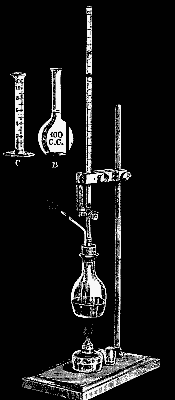
In those cases where the amount of glucose present is required to be determined, Dr. Pavy's ammonia cupric process distances all compeers for ease of application and delicacy of end-reaction, combined with considerable accuracy. His solution differs from that of Fehling in containing ammonia, which dissolves the cuprous oxide as soon as it is formed, yielding a colorless solution. It is only necessary, therefore, to note the moment that the blue color of the liquid is exactly discharged, in order to tell when all the copper present has been reduced. Pavy's solution is prepared as follows: Dissolve 356 grains of Rochelle salt and the same weight of caustic potash in distilled water; dissolve separately 73 grains of recrystallized cupric sulphate in more water with heat. Add the copper solution to that first prepared, and when cold add 12 fluid oz. of strong ammonia (sp. gr. 0.880), and distilled water to 40 fluid oz. The estimation is thus conducted: Dilute 10 c.c. of the ammoniated cupric solution—equivalent to 5 milligrammes of glucose—with 20 c.c. of distilled water, and place in a 6 or 8 oz. flask. Attach this by means of a cork to the nozzle of an ordinary Mohr's burette, b, preferably fitted with a glass stopcock, and filled previously with the diluted urine. The small tube, c, which traverses the cork is intended to permit the escape of steam. Now raise the blue liquid in the flask to active ebullition—not too violent—by the aid of a spirit lamp or small Bunsen flame. Turn the stopcock in order to allow the urine to flow into the boiling solution at the rate of about 100 drops per minute (not more or much less) until the azure tint is exactly discharged. Then stop the flow, and note the number of cubic centimeters used. That amount of dilute urine will contain 5 milligrammes of glucose. To render the determination as accurate as possible, the urine should be diluted to such an extent that not less than 4 or more than 7 c.c. are required to decolorize the solution, and the proportions necessary will be found to vary from 1 part of urine in 2½ to 1 in 30 or 40. The subsequent calculation is very simple. If you wish to give the percentage of sugar, multiply 0.005 by 100, and divide the product by the number of cubic centimeters of dilute urine employed. The figure thus obtained, multiplied by the extent of dilution—i.e., if there is 1 of urine in 10, multiply by 10—gives the required percentage. The number of grains per fluid ounce can of course be obtained by multiplying the percentage by 4.375. To observe easily the exact end-reaction a piece of white paper should be placed behind the flask. If the analyst objects to the escape of the waste ammoniacal fumes, they may be conducted by a suitable arrangement into water or dilute acid. In addition to glucose there are small quantities of other copper-reducing bodies present in all urine, which always render the reading higher than strict accuracy would demand. Their aggregate proportion, however, is, comparatively speaking, so minute that for most medical purposes their presence may be disregarded. Greater care must be exercised, though, in those instances where such a deoxidizer as chloral hydrate is accidentally present. In case of doubt, a little washed and pressed yeast should be allowed to stand with the urine for a day or two in a warm place. Alcoholic fermentation with evolution of carbonic acid gas soon sets in, and the specific gravity of the liquid is lowered considerably. This reaction points conclusively to the presence of sugar.
Based upon Braun's potassic picrate test, Dr. G. Johnson has devised a colorimetric process for the estimation of sugar. On boiling an alkaline solution of that salt with glucose, the former is reduced to deep red-brown picramate, the color of the liquid, of course, varying in intensity according to the proportion of sugar present. This solution is diluted till it corresponds in tint with a ferric acetate standard, and the percentage of sugar is then readily calculated. For those who prefer this process the convenient apparatus manufactured by Mr. Cetti, of 36 Brooke street, Holborn, is recommended, who will also furnish full particulars of the test.
ALBUMEN.
Normal urine is free from coagulable proteids, though it is admitted that albumen may sometimes occur in the absence of disease. It is always highly important, therefore, to determine accurately the presence or absence of this body. In the relentless malady named after Richard Bright, the urine always contains albumen, and if accompanied by the "casts" of the uriniferous tubules your report may amount to a sentence of certain death. The tests which we now describe are accurate and easily applied; but reliance should never be placed on any single reaction—at any rate until the operator has acquired considerable experience.
Galippe's picric acid test has within the last few years attracted much attention, chiefly through the commendation it has received from Dr. George Johnson. A saturated solution is prepared by dissolving 140 grains of recrystallized picric acid (carbazotic acid, or, more correctly, trinitrophenol) in 1 pint of water with heat, and decanting the clear solution. Some of the urine is rendered perfectly bright by filtration—repeated, if necessary—through good filtering paper, and to this an equal volume of the picric acid solution is added. In the presence of albumen a more or less distinct haze is produced, which on heating to the boiling point is rather intensified than otherwise. Peptones, if present, yield a similar haze, and quinine or other alkaloid a more or less crystalline precipitate; but in both these cases the opalescence is completely dissipated by heat. Mucin, an important constituent of some urines, is not affected by picric acid, and the test is decidedly one of great value.
The nitric acid test. Heller's contact method, which can also be used with the last-described reagent, is the best mode of applying the old-fashioned and favorite test with nitric acid. To 5 volumes of a filtered saturated solution of magnesic sulphate, prepared by dissolving 10 parts of the salt in 13 parts of distilled water, add 1 volume of strong nitric acid, and label "Sir W. Roberts' nitric acid reagent." A couple of drachms of bright filtered urine is allowed to float on an equal quantity of this solution in a test tube; care being taken that the contact line is sharply defined. In a period of time varying from a few seconds to a quarter of an hour, according to the amount of albumen present, a delicate opalescent zone forms at the point of junction, and if mucin also is present, a more diffused haze higher up in the urine. Special attention should be given to the position of the opacity. In some concentrated urines a belt of urates will appear at the line of demarkation; but these dissolve on warming. Moreover, owing to the dilution necessary in the mode of applying Galippe's picric acid test, they are not so readily shown by the latter. A ½ oz. glass syringe can very conveniently be substituted for a test tube in making analyses according to Heller's method. Some of the urine should be drawn up, and then an equal volume of the reagent. On setting aside, the albumen ring will rapidly develop.
The boiling test. This method also is very delicate and valuable. It depends on the well-known property possessed by many proteids of coagulating under the influence of heat. The urine should have an acid reaction to test paper; if alkaline, it must be cautiously neutralized with dilute acetic acid. In either case a single drop of strong acetic acid should be added to about three drachms of the bright liquid. If this precaution is omitted, there is danger of precipitating earthy phosphates on heating; and should a great excess of acid be employed, a non-coagulable form of albumen known as syntonin is formed, besides increasing the likelihood of precipitating mucin. Place the prepared urine in a narrow test-tube and hold it in a small flame so that the upper part only of the liquid approaches the boiling point. By this means very small traces of albumen are easily observed, the opalescence produced contrasting strongly with the cold and clear fluid beneath.
The ferrocyanide test. Hydroferrocyanic acid yields a precipitate immediately in the presence of much albumen, and if traces only are present, in the course of a few minutes. To apply the test, strongly acidulate with acetic acid, and then add a few drops of recently prepared potassic ferrocyanide solution. This is one of the most delicate tests known.
It is often desirable that the percentage of albumen present should be determined at frequent intervals, in order to note the success or otherwise of the physician's treatment. These quantitative determinations, being intended only for comparative purposes, do not demand any very excessive degree of accuracy, such as would be difficult to obtain in ordinary practice. The recent method of a Continental worker. Dr. Esbach, affords indications sufficiently precise for therapeutical requirements, and is at the same time extremely easy of application. The filtered acid urine is poured into the glass tube up to the mark U, and then the special reagent is added till the level of the liquid stands at R.

Mix the liquids thoroughly, without shaking, by reversing the tube a dozen times, close with a cork, and allow it to stand upright for twenty-four hours. The height at which the coagulum then stands, read off on the scale, will indicate the number of parts per thousand, or grammes of albumen in one liter. This divided by ten gives the percentage. Dr. Esbach's test solution is prepared by dissolving 10 grammes of picric acid and 20 grammes of citric acid in 900 c.c. of boiling distilled water, and then adding, when cold, sufficient water to yield 1 liter. The citric acid is only employed for the purpose of maintaining the acidity of the liquid, and is really not essential.
URIC OR LITHIC ACID.
The determination of the proportion of uric acid in urine was formerly rather neglected by physicians. There is now, however, a growing tendency in a certain class of diseases to attach considerable importance to its accurate estimation, and, as some little trouble is involved, pharmacists should be prepared to undertake the work. A rough way is to concentrate somewhat, acidulate with hydrochloric acid, and collect and weigh the precipitate thrown down on standing. There are several objections, however, to this method, and many attempts have been made to elaborate a more reliable process. One of the most recent, and which has been pronounced the most practical and successful, has been devised by Professor Haycraft. Although apparently rather detailed and elaborate, the determination is easy and extremely simple.
The following solutions must be prepared: 1. Dissolve 5 grammes of nitrate of silver in 100 c.c. of distilled water, and add ammonia until the precipitate first formed redissolves. 2. Dilute strong nitric acid with about two volumes of distilled water; boil, to destroy the lower oxides of nitrogen, and preserve in the dark. 3. Dissolve about 8 grammes of ammonic thiocyanate (sulphocyanide) crystals in a liter of water, and adjust to decinormal argentic nitrate solution, by diluting till one volume is exactly equal to a volume of the latter. Dilute the solution thus prepared with nine volumes of distilled water, and label "Centinormal ammonic-thiocyanate solution." 4. A saturated solution of ferric alum. 5. Strong solution of ammonia (sp. gr. 0.880). The uric acid estimation is conducted as follows: Place 25 per cent. of urine in a beaker with 1 gramme of sodic bicarbonate. Add 2 or 3 c.c. of strong ammonia, and then 1 or 2 c.c. of the ammoniated silver solution. If, on allowing the precipitate caused by the latter reagent to subside, a further precipitate is produced by the addition of more solution, the urine contains an iodide, and silver solution must be added till there is an excess. The gelatinous urate must now be collected, the following special procedure being necessary: Prepare an asbestos filter by filling a 4 oz. glass funnel to about one-third with broken glass, and covering this with a bed of asbestos to about a quarter of an inch deep. This is best managed by shaking the latter in a flask with water until the fibers are thoroughly separated, and then pouring the emulsion so made in separate portions on to the broken glass. On account of the nature of the precipitate and of the filter, it is necessary to use a Sprengel pump, in order to suck the liquid through. The small apparatus sold to students by chemical instrument makers will answer the purpose admirably. Having collected the precipitate of silver urate on the prepared filter, wash it repeatedly with distilled water, until the washings cease to become opalescent with a soluble chloride. Now dissolve the pure urate by washing it through the filter with a few cubic centimeters of the special nitric acid. The process is carried out thus: Add to the liquid in the beaker a few drops of the ferric-alum solution to act as an indicator, and from a burette carefully drop in centinormal ammonic thiocyanate until a permanent red coloration of ferric thiocyanate barely appears. The number of cubic centimeters used of the thiocyanate solution multiplied by 0.00168 gives the amount of uric acid in the 25 c.c. One milligramme may be added to compensate for loss, and the whole multiplied by four gives the percentage of uric acid in the urine. The whole process depends on the fact that argentic urate fails to dissolve in ammonia, but is soluble in nitric acid, and is thus easily obtained in the pure state. By determining the amount of combined silver, the percentage of uric acid can readily be calculated. The addition of sodic bicarbonate prevents the otherwise inevitable reduction of the silver salt.
BILE.
In diseases affecting the liver, the urine frequently becomes contaminated with biliary constituents. If the coloring matter of bile is present (bilirubin, etc.), the liquid is darkened considerably in tint, and may assume various shades of brown or green. Should the color be decided, the fluid will be found to foam strongly on shaking, and white blotting-paper will be stained by it yellow or greenish. These characters point to the presence of bile in fair quantity, and it is only necessary to apply a single confirmatory test. Allow some of the urine to flow carefully, according to Heller's method, over a couple of drachms of yellow nitric acid (i.e., acid containing traces of the lower oxides of nitrogen). A number of rapidly changing colors soon appear, passing through green, blue, violet, and red to yellow. The first of these tints, green, is the only one that undoubtedly points to the presence of biliary coloring matter, all the others being yielded by another constituent of urine, indican, when similarly treated. Should the color of the urine suggest the presence of only traces of bile, the best plan is not to treat the urine directly, but extract a quantity of it by shaking with chloroform. On separating the latter, and covering with yellowish nitric acid, the color changes will be observed penetrating into the chloroform. A little, also, evaporated on a slide yields reddish crystals, which exhibit a pretty play of colors under the microscope when touched with nitric acid.
It is not unfrequently considered important to test urine for the sodium salts of the conjugate biliary acids, taurocholic and glycocholic. Dr. Oliver, of Harrogate, has proposed the use of an acidulated peptone solution for this purpose, and the reaction is undoubtedly a good one. The reagent is prepared by dissolving 30 grains of flesh peptone, 4 grains of salicylic acid, and 30 minims of strong acetic acid, in sufficient water to produce 8 fluid oz. of solution. Thus prepared, the peptone shows no signs of decomposition on keeping. To use the test, mix 1 fluid drachm of the reagent with 20 minims of urine, previously diluted to a standard specific gravity of 1.003. A haze is produced, which will be found to be more or less distinct, according to the proportion of bile salts present.
CHLORIDES.
A normal and variable constituent of urine, chlorine, is not usually required to be determined. Should the estimation be considered necessary, however, Volhard's silver process, which has been noticed in treating of uric acid, possesses several advantages over other methods: 10 c.c. of urine are diluted with 60 c.c. of distilled water. To this is added 2 c.c. of pure 70 percent. nitric acid and 15 c.c. of a standard solution of silver nitrate (1 c.c. = 0.01 gramme NaCl). Shake well and make up to 100 c.c. with water. All the chlorine present will now be precipitated in the liquid as a silver salt. Filter an aliquot part (about 70 or 80 c.c.), and determine in the clear solution the excess of silver with standard ammonic thiocyanate, using the ferric alum indicator. The difference between this and the amount of silver originally present in the aliquot part has been precipitated as silver chloride (AgCl). The whole estimation should be conducted as rapidly as possible. A simple calculation will then give the proportion of chlorine in the dilute urine, and this multiplied by ten shows the percentage. It is usual to report in terms of NaCl.
PHOSPHATES.
In those cases where the pharmacist is asked to determine phosphoric acid quantitatively, the uranic-acetate method described in Sutton's "Volumetric Analysis" yields the most satisfactory results. The process requires some little experience to use it with ease, and is too lengthy for quotation here.
MICROSCOPICAL EXAMINATION.
A good microscope is one of the first necessaries of the urinary analyst. By its aid it is possible to distinguish easily many solid constituents of urine—normal and pathological; indeed, the examination of urinary deposits is often quite as important as the more elaborate wet analysis. A well-made instrument is no luxury to the pharmacist; but even those whose chief aim is bon marché can procure capital students' microscopes at exceedingly low cost. One of the cheapest, and at the same time an instrument of good quality, is the "Star," manufactured by Messrs. R. & J. Beck, of 31 Cornhill, E.C.
Equipped with a good microscope, the analyst should obtain a fair supply of typical slides for comparison. The following selection will be found sufficient for his purpose: A set of the chief varieties of uric acid, calcic oxalate, and triple phosphate; the urates and oxalurates; urea nitrate, calcic hippurate and carbonate, hippuric acid, cystin, well mounted "casts" of the tubili uriniferi, spermatozoa, etc. In doubtful cases microchemical reagents can be employed, using Professor Attfield's "Chemistry" as a guide. Where mounted objects are not at hand, reference may be made to the capitally executed plates in that work. After obtaining a little experience in the use of the microscope, no difficulty will be met with in these examinations.—The Chemist and Druggist.