THE THOMSON-HOUSTON ELECTRIC LIGHTING SYSTEM.
Reading edition
The generator is known as the "Thomson spherical," on account of the nearly spherical form of its armature, and differs radically from all others in all essential portions, viz., its field magnets, armature, and winding thereof, and in its commutator; both in principle and construction, and, besides, it is provided with an automatic regulator, an attachment not applied to other generators. The annexed view of the complete machine will convey an idea of the general appearance and disposition of its parts.
The revolving armature which generates the electrical current is made internally of a hollow shell of soft iron secured to the central portion of the shaft between the bearings, and is wound externally with a copper conducting wire, constituting three coils or helices surrounding the armature, which coils are, however, permanently joined, and in reality act as a single three-branched wire.
This wire, being wound on the exterior of the armature, is fully exposed to the powerful magnetic influence of the field poles, which inclose the armature almost completely. The armature will thus be seen to be thoroughly incased and protected, at the same time that all the wire upon it is subject to a powerful action of the surrounding magnets, resulting in an economy in the generation of current in its coils. The form of the armature being spherical, very little power is lost by air friction, and no injury can occur from increased speed developing centrifugal force. The field magnets, which surround the armature, are cast iron shells, wound outside with many convolutions of insulated copper wire, and are joined externally by iron bars to convey the magnetism. These outer bars serve also as a most efficient protection to the wire and armature of the machine during transportation or otherwise. Objects cannot fall upon or rest upon the wire coils and injure them. The coils of wire upon the field magnets surround not only the iron poles or shells, but are situated also so as to surround likewise the revolving armature, and increase the effect produced in it by direct induction and magnetism. This feature is not used in any other generator, nor does any other make use of a spherical armature. The shaft is mounted in babbitted bearings of ample size, sustained by a handsome frame therefor, and is of steel, finely turned and perfectly true. The shaft and armature together are balanced with the utmost care, and run without buzz or rumble. The armature wire is kept cool by an active circulation of air over its whole surface during revolution. The commutator, or portion from which the currents developed in the armature are carried out for use, is a beautiful piece of mechanism. It is mounted upon the end of the shaft, and has attached to it the wires, three only, coming from the armature wire through the tubular shaft.
THE THOMSON SPHERICAL.
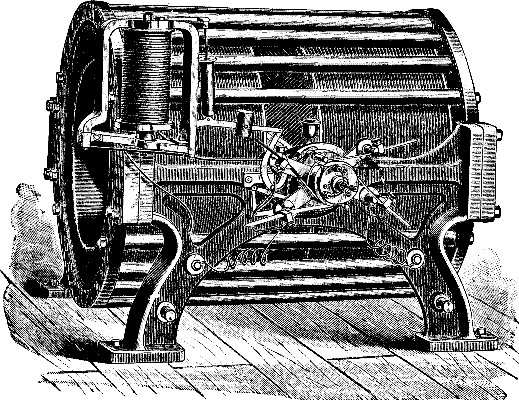
The commutator is peculiar, consisting of only three segments of a copper ring, while in the simplest of other continuous current generators several times that number exist, and frequently 120! segments are to be found. These three segments are made so as to be removable in a moment for cleaning or replacement. They are mounted upon a metal support, and are surrounded on all sides by a free air space, and cannot, therefore, lose their insulated condition. This feature of air insulation is peculiar to this system, and is very important as a factor in the durability of the commutator. Besides this, the commutator is sustained by supports carried in flanges upon the shaft, which flanges, as an additional safeguard, are coated all over with hard rubber, one of the finest known insulators. It may be stated, without fear of contradiction, that no other commutator made is so thoroughly insulated and protected. The three commutator segments virtually constitute a single copper ring, mounted in free air, and cut into three equal pieces by slots across its face. Four slit copper springs, called commutator brushes or collectors, are allowed to bear lightly upon the commutator when it revolves, and serve to take up the current and convey it to the circuit. These commutator brushes are carried by movable supports, and their position is automatically regulated so as to control the strength of the developed current—a feature not found in other systems. This feature, as well as the fact that the commutator can be oiled to prevent wear, saves attendance and greatly increases the durability of the wearing surfaces, while the commutator brushes are maintained in the position of best adjustment. The commutator and brushes, in consequence, after weeks of running, show scarcely any wear.
THE AUTOMATIC CURRENT REGULATOR.
This consists of a peculiar magnet attached to the frame of the generator, and the movable armature of which has connections to the supports of the commutator brushes for controlling their position. The regulator magnet is so formed as to give a uniform attraction upon its armature in different positions. In Thomson's improved form this is accomplished in a novel manner by making the pole of the magnet paraboloidal in form, and making an opening in the movable armature to encircle said pole.
THE CURRENT REGULATOR
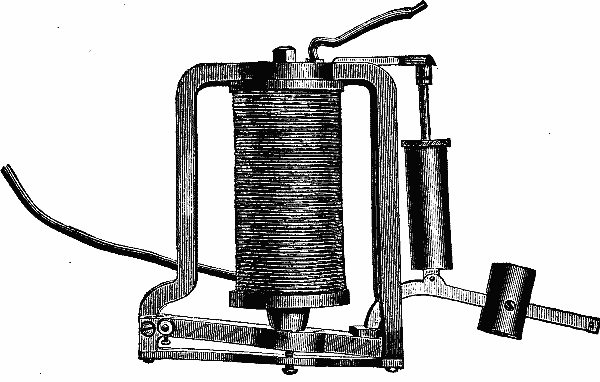
The armature is hung on pivots so as to be free to move only toward and from the regulating magnet on changes in the current traversing the latter, and being connected to the commutator brushes, automatically adjusts their position. By this means the power of the generator is adapted to run any number of lights within its limit of capacity, or may be short circuited purposely or by accident without difficulty arising therefrom; and a number of instances have occurred where the injurious effects of a short circuit accidentally formed have been entirely obviated by the presence of the regulator. In one instance four generators, in series representing over forty lights' capacity, were accidentally short circuited, and no injury or even noticeable action took place except a quick movement of the regulators in adapting themselves to the new conditions. Had this accident occurred to generators unprovided with regulators, great injury or possible destruction of the apparatus would have resulted. It is important to a full understanding of the regulation, to state that its action is independent of resistances introduced, that it saves power and carbons in proportion to lights extinguished, and that it compensates for speed variations above the minimum speed. The manner of its action is to control the generation of current at the source in the armature, and it does so by combining certain electrical actions so as to obtain a differential effect, such that when small force of current only is required it alone is furnished, and when the maximum force is needed the same shall be forthcoming.
THE CONTROLLER MAGNET.
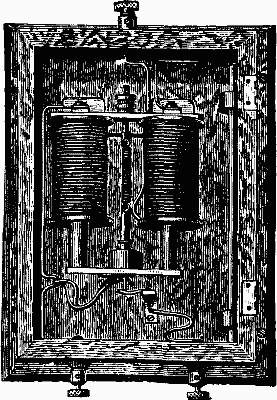
On the larger generators we combine with the regulator magnet above described an exceedingly sensitive controller magnet governing the regulation, and by whose accuracy the smallest variations of current are counteracted, and the operation of the generator rendered perfect. The controller magnet is contained in a box placed on the wall or other support near the generator, and consists of a delicate double axial magnet controlling the admission of current to the regulator, upon the generator, and its action is exceedingly simple and effective. So perfect is the action that in a circuit of twenty-five to thirty lights, lights may be removed or put out in rapid succession without apparently affecting those that remain. Besides, we have been enabled to put out even eight or ten lights together instantly, while the remainder burn as before. The features above set forth are peculiar to the Thomson-Houston system, and have been thoroughly covered by patents, and cannot therefore be adopted into other systems.
THE THOMSON ARC LAMP.
This lamp is essentially a series lamp; that is, any number of them can be put on one circuit wire, but a single lamp, used alone, burns equally well. It consists of a metal frame supporting at the bottom the holder for the globe and lower carbon, which is insulated from the frame.
The annexed figure of the plain lamp will convey an understanding of its general appearance. The upper carbon is fed downward by the mechanism contained in the box above, and is carried by a vertical round rod called the carbon holding rod.
THE THOMSON ARC LAMP.
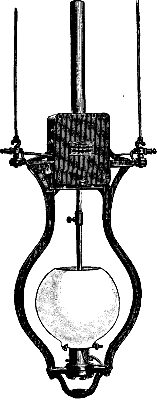
In the regulating box of the lamp there exists a simple mechanism, the result of careful study and experiment to discover the best and simplest combination of appliances, which would obviate the necessity for the use of clockwork or dash-pots, from which fluids might be accidentally spilled, for obtaining a gradual feeding of the carbon as fast as it is consumed in producing the light, and at the same time to maintain the arc or space between the carbons in burning, of such extent as to give a steady, noiseless light, of greatest possible economy.
The lamp, once adjusted, does not require any readjustment, and, in fact, is built in such a manner as to avoid the presence of adjusting devices in it. The lamp also contains an automatic safety device for preserving the continuity of the circuit in case of accidental injury to the feeding mechanism or the carbons of the lamps. This is quite important when a considerable number of lights are operated upon one circuit wire, as a break in the circuit, due to a defective lamp, would result in the extinguishment of all the lights. With the safety device mentioned, such a break does not occur, but the flow of current is preserved through the faulty lamp.
By an exceedingly simple device upon the carbon holding rod, the lamps are extinguished when the carbons are burned out, and injury by burning the holders completely avoided.
The system is based upon the joint inventions of Elihu Thomson and Edwin J. Houston, for generators, regulators, and electric lamps, and also the patents of Elihu Thomson, in generators, regulators, and electric lamps; all of which are now operated and controlled by the Thomson-Houston Electric Co., 131 Devonshire Street, Boston, Mass.