THE INFLUENCE OF EFFECTIVE BREATHING IN DELAYING THE PHYSICAL CHANGES INCIDENT TO THE DECLINE OF LIFE, AND IN THE PREVENTION OF PNEUMONIA, CONSUMPTION, AND DISEASES OF WOMEN.
Reading edition
By DAVID WARK, M.D., 9 East 12th Street, New York.
PNEUMONIA.
During the past winter inflammation of the lungs has destroyed the lives of many persons who, although they were in most cases past the meridian of life, yet still apparently enjoyed vigorous health, and, I have little doubt, would still have been alive and well had the preventive means here laid down against the occurrence of the disease from which they perished been effectively practiced at the proper time.
The most important anatomical change occurring during the progress of pneumonia is the solidification of a larger or smaller part of one or both lungs by the deposit in the terminal bronchial tubes and in the air cells of a substance by which the spongy lungs are rendered as solid and heavy as a piece of liver. The access of the respired air to the solidified part being totally prevented, life is inevitably destroyed if a sufficiently large portion of the lungs be invaded.
This deposit succeeds the first or congestive stage, and it occurs with great rapidity; an entire lobe of the lung may be rendered perfectly solid by the exudation from the blood of fully two pounds of solid matter in the short space of twelve hours or even less. The rapidity with which the lungs become solidified amply accounts for the promptly fatal results that often attend attacks of acute pneumonia. If recovery takes place, the foreign matter by which the lung tissue has been solidified is perfectly absorbed and the diseased portion is found to be quite uninjured. The only natural method by which the blood can be freed from the presence of foreign matter is by the oxidation—the burning—of such impure matters; the results being carbonic acid gas that escapes by the lungs and certain materials that are eliminated chiefly by the kidneys. But when these blood impurities exist in the vital fluid in unusually large quantities, or if the respiratory capacity be inadequate, the natural internal crematory operations are a partial failure. But nature will not tolerate the presence of such impurities in the vital fluid; if they cannot be eliminated by natural means they must by unnatural means; therefore such material is very frequently deposited in various parts of the body, the point of deposit being often determined by some local disturbance or irritation.
For instance, if a person whose blood is in fairly good condition takes a cold that settles on his lungs, he either recovers of it spontaneously or is readily cured by means of some cough mixture; but if his blood be loaded with tubercular matter, the latter is extremely liable to be deposited in his lungs; the cough that was excited in the first place by a simple cold becomes worse and persistent, in a few months his lungs show signs of disorganization, and he has consumption of the acute or chronic type, as the case may be.
On the other hand, if the impure matter by which the blood is loaded be of the kind that causes the pulmonary solidifications of pneumonia, the latter disease is very likely to be developed if a cold on the lungs be caught.
The liability of any individual to attacks of acute pneumonia is therefore determined very largely by the presence or absence in his blood of the matter already alluded to. If his blood be free from it, no cold, however severe, is competent to originate the disease.
There can be no question but that good living and sedentary habits have a strong tendency to befoul the blood; the former renders effective respiration all the more necessary for the removal from the blood of whatever nutritive matter has been taken beyond the needs of the system, and the latter inevitably diminishes the respiratory motions to the lowest point consistent with physical comfort. From these conditions originates the active predisposing cause of pneumonia, to which we have already alluded.
The disease is more fatal in the very young and in the aged; the mortality seems to bear a direct ratio to the respiratory capacity; in young subjects the breathing powers have not been fully developed like the other physical capacities, while in the old the respiratory volume has been diminished by the stiffening of the chest walls and of the lungs by the senile changes already detailed.
There can be no question but that protection from cold and judicious attention to the health generally, by suitable exercise and diet, has a powerful tendency to prevent that overloaded condition of the blood to which I believe acute pneumonia to be chiefly due; still I have no doubt but that the most active preventive measure that can be adopted is keeping up the respiratory capacity to the full requirements of the system, a precaution which is specially necessary to ease-loving and high-living gentlemen who are past the prime of life. I am of the opinion that if such persons would cultivate their breathing powers by the simple means here recommended, their liability to pneumonia would be notably reduced.
THE TRUE FIRST STAGE OF CONSUMPTION.
The progress of tubercular consumption has been divided by pathologists into three stages. The first stage being that in which a deposit of tubercular matter occurs in the lung tissue, the second is entered on when the tubercles soften, and the third when they have melted down, been expectorated, and cavities have formed. But the real beginning of this most insidious and justly dreaded disease not infrequently antedates for a long time, often for several years, the deposit of any tubercular matter. During all this time an expert examiner can detect the slight but very significant changes already taking place in the pulmonary organs. Physicians determine the condition of the lungs chiefly through the sounds elicited by percussion of the chest walls by the end of the middle finger, or a small rubber hammer adapted to the purpose, and by those produced by the respired air rushing in to and out of the bronchial tubes and air vesicles. The percussion sounds yielded by the chest during what has been aptly called the pre-tubercular stage do not differ from those elicited in health, because it is only when some morbid matter exists in the lungs that the percussion note is altered, therefore negative results only are obtained in the real first stage by this mode of examination. But important information can be obtained by interrogating the sounds due to the inspired air rushing into and distending the air vesicles. When the lungs are perfectly healthy, these are breezy and almost musical. During the pre-tubercular stage they become drier and harsher; qualities of evil omen that continue to increase as time passes, if properly directed means be not adopted to correct the evil; but so far none of the symptoms that indicate the slightest deposit of tubercle can be detected, but the breathing capacity of such persons is never up to the full requirements of the system. The reader is referred to the table already given, which exhibits the decline of the breathing capacity of persons suffering from consumption in its several stages. When the disease has made such decided progress that tubercles are already deposited in the lungs in sufficient quantity to give rise to the physical signs by which their presence is proved, this carefully compiled table shows that the diminution of the vital capacity already amounts to one-third of that considered by Dr. Hutchinson to be necessary to the maintenance of health.
During the pre-tubercular stage the breathing capacity rarely falls so much as 33 per cent. below the healthy standard, but it is never up to the normal vital volume. This fact is most significant, especially when it occurs in an individual whose relatives have succumbed to this disease; but it rarely attracts sufficient attention from such persons as to induce them to have their breathing capacity measured, much less to take effective measures to bring and keep it up to the healthy standard. So long as there are, to them, no tangible symptoms of approaching mischief, and they feel fairly well, they act as if they thought "that all men were mortal but themselves." Yet it is from among persons who have an inherited but latent tendency to tubercular disease, and whose lung power is below par, that the great army of consumptives who die every year is recruited. It is very difficult to induce persons who ought to be interested in this matter to take effective measures for their future safety when the terrible symptoms accompanying the last stages of the disease often fail to shake the sufferer's confident expectation of recovery; and we sometimes see them engaged in laying plans for the future when death is imminent. I regret deeply to be obliged to make these statements, because I am convinced that if the suggestions laid down in this work were generally reduced to practice by those who have reason to dread the development of tubercular disease, many valuable lives would be saved.
THE DEVELOPMENT OF TUBERCULAR MATTER IN THE BLOOD.
During the digestive processes the starchy, saccharine, and albuminoid elements of food are dissolved, and the fatty matters are emulsified. A uniform milky solution is thus formed, which is rapidly absorbed into the general circulation; some of it passes directly through the walls of the vessels into the blood, and some is taken up by the lacteals and reaches the vital fluid by traversing the complicated series of tubes known as the absorbent system, and the numerous glands connected with it. The chief function of the starchy and fatty food elements is to keep up the physical temperature, by being submitted to oxidation in the organism; therefore it is not necessary that they should experience any vitalizing change, but are fitted to discharge their duties in the vital domain by simply undergoing the solution that fits them for absorption. But the materials intended to enter into the composition of the body must be developed into living blood, in order to be fitted to become part and parcel of the organs by which power is evolved, and through the use of which we see, hear, feel, think, and move. This wonderful process begins and is carried forward in the absorbent system, which has been described by Dr. Carpenter as a great blood-making gland. But the vital transformation is not completed until the nutritive materials have been submitted to the action of the liver, and afterward to the influence of oxygen in the capillaries of the lungs. The food that was eaten a few hours before is thus converted into rich scarlet arterial blood, if every part of the complex vitalizing processes has been properly conducted. But the influence of oxygen is requisite, not only to complete the vitalization of the embryo blood in the lungs, it is an absolutely essential element in every step of the vitalizing process in the absorbents.
The average quantity of food required to sustain an ordinary man in health and strength, I have previously stated, is about two pounds avoirdupois daily, and an equal weight of oxygen is necessary to the integrity of the vitalizing processes undergone by the food, and to maintain the physical temperature. When the requisite supply of oxygen is reduced, the extrication of heat within the system is promptly diminished, but the vitalization of digested food is unfavorably affected much more slowly, but with equal certainty. If the quota of oxygen existing in the arterial blood of the vessels whose duty it is to supply the vital fluid to the absorbent system, be inadequate to enable these operations to go on properly, the life-giving processes must necessarily be imperfectly accomplished. Under these circumstances the digested material is imperfectly vitalized, and is therefore inadequately fitted to be used in building up and repairing the living body. But its course in the system cannot be delayed, much less stopped.
The blood possesses a definite constitution, which cannot be materially altered without the rapid development of grave, perhaps fatal consequences. The nutritive matters received into the blood must be given up by it to the tissues for their repair, whether such materials are well or ill fitted for the vital purposes. Dr. B.W. Carpenter, of London, the celebrated physiologist, makes the following pertinent statements on this subject, which I condense from his great work on physiology: "We frequently find an imperfectly organizable product, known by the designation of tubercular matter, taking the place of the normal elements of tissue, both in the ordinary process of nutrition, and still more when inflammation is set up.
From the examination of the blood of tuberculous subjects it appears that, although the bulk of the coagulum obtained by stirring or beating is usually greater than that of healthy blood, yet this coagulum is not composed or well elaborated fibriae, for it is soft and loose, and contains an unusually large number of colorless blood corpuscles, while the red corpuscles form an abnormally small proportion of it. We can understand, therefore, that such a constant deficiency in capacity for organization must unfavorably affect the ordinary nutritive processes; and that there will be a liability to the deposit of imperfectly vitalized matter, instead of the normal elements of tissue, even without any inflammation. Such appears to be the history of the formation of tubercles in the lungs and other organs.
When it occurs as a kind of metamorphosis of the ordinary nutritive processes and in this manner, it may proceed insidiously for a long period, so that a large part of the tissue of the lungs shall be replaced by tubercular deposit without any other sign than an increasing difficulty of respiration." These views are strongly corroborated by the following facts:
In making post mortem examinations of persons who have died of consumption, tubercles of different kinds are found in the same subject; some of these, having been deposited during what is called the first stage of the disease before the breathing powers were much impaired, bear evident traces of organization in the form of cells and fibers more or less obvious, these being sometimes almost as perfectly formed as living matter, at least on the superficial part of the deposit, which is in immediate contact with the living structures around.
This variety of tubercle has a tendency to contract and remain in the lungs without doing much injury. But as the disease progressed, and the breathing capacity progressively diminished, tubercular matter occurs, evincing less and less organization, showing a tendency to break down and cause inflammation in the surrounding lung tissue, until at last we find crude yellow tubercles that have become softened, and formed cavities almost as soon as they were deposited.
Some cases of chronic consumption pass in a few months through the various stages from the deposit of the first tubercle to a fatal termination.
The progress of the disease is determined largely by the nature of the tubercular matter at the time it is deposited.
The variety of matter which has been partially vitalized commonly exists in small quantity, has a strong tendency to maintain its semi-organized condition unchanged by time, and rarely causes inflammation.
A small or moderate quantity of this sort of tubercle exists in the lungs of many persons, in whom it produces no tangible symptoms, and who are therefore quite unconscious of its presence; and even when it does exist in sufficient quantity to develop the symptoms of lung disorder, the progress of the disease is slow, often continuing for many years. It constitutes a variety of consumption which is specially amenable to proper treatment. On the other hand, the soft, yellow, cheesy, tubercular matter, which is totally destitute of any vitality, is too often deposited in large quantities, acts on the adjacent lung tissue as an active irritant, causes inflammation, undergoes softening, forms cavities, defies treatment, and rapidly hurries the sufferers to a premature grave. These facts, taken in connection with the immunity from lung diseases enjoyed by those whose respiratory capacity is well developed and properly used, as well as the beneficial effects that are promptly secured in the favorable varieties of consumption by any important increase in the vital volume, I believe fully justify the statement that tubercles are the results of defective nutrition directly traceable to inadequate respiratory capacity, either congenital or acquired—in other words, tubercles are composed of particles of food which have failed to acquire sufficient life while undergoing the vital processes, because the person in whom they occur habitually breathed too little fresh air.
Persons who possess what is called the scrofulous constitution are specially liable to the occurrence of tubercular matter when their respiration is defective, or they are exposed to any other influences that favor its development in the organism. But habitually defective respiration, or the breathing of an atmosphere containing too little oxygen, which practically amounts to the same thing, has a very powerful tendency in the same direction, in persons who are apparently as free from scrofulous taint as any human being can be.
THE VALUE OF COD-LIVER OIL IN THE PREVENTION OF CONSUMPTION.
There is a broad but not commonly recognized distinction between what constitutes a medicine and a food. All the materials that normally enter into the composition of the living body, and are necessary to the maintenance of health and strength, may be property classed as foods, whether they be obtained from the animal, vegetable, or mineral kingdoms; thus the iron, sulphur, phosphorus, lime, potash, etc., required by the system usually exist in and are organically combined with the various foods in common use, and they are perhaps quite as essential to the physical well-being as albuminoid, fatty, and saccharine matters. When the system is suffering from lack of any of the above mentioned chemicals, their administration is to be regarded as the giving of nutritive substances, although they be prescribed by a physician in divided doses and procured from a pharmacist.
On the other hand, a medicine is any substance that does not naturally enter into the composition of the body, but which has the power, when skillfully used, to modify the physical processes so that physiological disorder—disease, shall be replaced by physiological harmony—health. Belladonna, hyoscyamus, opium, etc., are familiar examples of medicaments. Therefore a food is any substance that is capable of directly contributing to the nutrition of the body, and medicine is a substance competent, under proper conditions, to secure the same results indirectly. Viewed in the light of the above definition, cod-liver oil is to be regarded as a very valuable food, as well as a most effective remedy both for the prevention and cure of consumption.
I have previously stated that food is divided by physiologists into three great classes. The albuminoids are used to build up the organism, while the fatty and saccharine are burned in the body to keep it warm. Although these are the chief functions devolving on the above mentioned food elements, yet they are mutually interdependent on each other for the proper performance of their several offices. Thus the albuminoids cannot undergo the wonderful vitalizing process necessary to fit them to enter into and form part of the living body, except an adequate quantity of fatty matter be present to assist in the vital transformation. On the other hand, the assistance of the albuminoids is equally necessary to enable the fatty and saccharine foods to maintain the internal heat of the body. Of all fatty matters, whether derived from the animal or vegetable kingdom, none possesses the property of stimulating and perfecting the nutritive processes in so high a degree as cod-liver oil; it is more readily emulsified and fitted for absorption by the pancreatic secretion during intestinal digestion than any other fatty matter of which we have any knowledge. The beneficial effects of its use have been proved in myriads of cases of confirmed consumption, and if it were used for prolonged periods by persons who are losing weight, and whose breathing capacity is too little, along with effective cultivation of the latter function, many persons would escape this disease who now succumb to it.
THE INFLUENCE OF NORMAL BREATHING ON THE FEMALE GENERATIVE ORGANS.
FIG. 1.
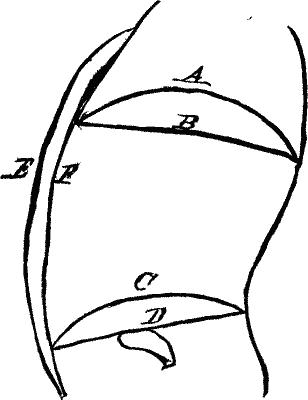
The body is divided into three separate stories by two partitions. The diaphragm, A, separates the cavity of the chest from that of the abdomen. The partition, D, forms a floor for the digestive cavity, F, and a roof for the pelvis; the pelvic cavity is occupied mainly by the generative organs. The upper part of the uterus is firmly fixed to the partition, D, by which the pelvis is covered. Now, the diaphragm, A, and the external respiratory muscles are in ceaseless motion performing the act of breathing. The diaphragm acts like the piston of a pump, both on the lungs above, and on the contents of the abdominal and pelvic cavities below. When it rises from B to A, it diminishes the size of the thoracic cavity, compresses the lungs, and assists in the expiratory part of breathing; at the same time it acts through the contents of the abdominal cavity on the pelvic roof, D, to which the uterus is attached, and raises it from D to C. When the diaphragm contracts, it descends from A to B, increases the size of the thoracic cavity, inflates the lungs, promotes the inspiratory part of breathing, pushes the walls of the chest and abdomen outward from F to E, and lowers the pelvic roof at the same time the uterus sinks from C to D. When the effect of these respiratory motions is not diminished by muscular debility, rigidity of the thoracic walls, or by unsuitable clothing, they have so direct an effect on the pelvic contents that the uterus and its appendages make two distinct motions every time a woman breathes. When the diaphragm rises and the breath is expelled, the womb is elevated from one inch to one inch and a half, because the roof of the pelvis, to which it is attached, is lifted about this distance, because of gentle suction from above. The uterus and its appendages are thus kept in constant motion, up and down, chiefly by action of the muscles by which breathing is carried on.
Several influences combine to maintain the circulation of the blood. The pumping action of the heart and the affinity of the blood for the walls of the capillary vessels require to be assisted by the motion both of the body as a whole and of its parts in order to keep the circulation flowing equably through every tissue. Therefore muscular action and the resulting bodily motion play a very important part in maintaining the general and local blood circulation. During the contraction of a muscle, the blood current flowing through it is, for the time being, retarded, but when relaxation occurs the blood flows into its vessels more freely than if no momentary cessation had taken place. When the body or any of its parts is deprived of motion, the blood circulation stagnates, and the nutrition, general or local, as the case may be, promptly becomes impaired. This is specially true of the uterus. Gentle but constant motion is absolutely essential to keep up a healthy uterine blood circulation. Nature has provided for the automatic performance of all the ceaseless internal motions that are necessary to the continuance of life and the preservation of health; thus the heart beats, the respiratory muscles act, the stomach executes a churning motion during gastric digestion, the intestines pass on their contents by worm-like contractions, automatically without our supervision and without causing fatigue, being under the control of the sympathetic system of nerves chiefly. It is equally true, but not so well recognized, that the previously described motions that are committed to the pelvic organs from the respiratory apparatus are absolutely necessary to the continued health of the uterus and its appendages. But the womb is not under the control of the voluntary muscles, therefore it cannot be directly moved by them, nor are its necessary motions influenced by the sympathetic system of nerves as are the heart, stomach, and intestines, etc., but it is fortunately under the indirect but positive control of involuntary muscles that never, as long as breathing continues, cease their work. Nature has thus made ample provision to keep the uterus in automatic motion. As before stated, the natural ceaseless heavings of the lungs, chest, and diaphragm, aided by the muscles inclosing the abdomen, have the duty assigned them of communicating automatic motion to the uterus and the other contents of the pelvis. When the diaphragm descends from A to B, and the lungs are filled with air, the uterus sinks in the pelvic cavity in obedience to the downward pressure from above, as before stated; the circulation through the uterus is then for a moment retarded, but the next instant, when the lungs are emptied of air and the diaphragm rises, the blood flows forward more freely than if it had not been momentarily obstructed. Ample provision has thus been made to maintain a healthy circulation through the uterus.
The uterine motions I have described are fully adequate for the purposes indicated. But when the natural stimulus of motion is withheld, the circulation becomes sluggish causing congestion, which may develop into inflammation. Under these conditions the uterus gradually becomes displaced, falling backward, forward or downward as the case may be. The blood vessels by which the uterus is supplied thus have their caliber diminished by bending; the circulation through them is retarded just as the flow of water in a rubber tube is obstructed by a kink. A very good idea of what occurs in the uterus under the conditions just described may be obtained by winding a string around the fingers.
As the coats of the arteries are thick, and the pressure exerted by the ligature has less power to prevent the arterial blood flowing outward past the string to the end of the finger than it has to prevent the return of the venous blood toward the heart, therefore the part beyond the ligature soon becomes congested, the blood stagnating in the capillaries. If the ligature be sufficiently tight and kept on long enough, mortification will take place, but if the circulation be only moderately obstructed, the congestion will continue until ulceration occurs. A similar condition is developed in the uterus when the necessary natural stimulus of motion fails to be communicated to it or when it is so far out of its proper place that the circulation through it is obstructed.
I believe the above described condition to be a most potent but inadequately recognized cause of the various forms of uterine diseases that distress so many women.
SHOWING HOW THE BREATHING POWERS MAY BE DEVELOPED.
When the circumference of the chest bears a due proportion to the size of the body generally; when its walls and the lungs possess a suitable degree of elasticity; when the strength of the respiratory muscles is adequate to their work, and no undue opposition is offered to the breathing motions by the clothing—then the vital volume is always up to the full requirements of the system. But when one or all of these are lacking in any important degree, the breathing capacity is proportionately diminished. If the testimony of the spirometer be corroborated by the impaired physical condition of the individual, its correction should be sought in part at least by enlarging the chest, increasing the elasticity of its walls and of the lungs, and by augmenting the strength of the respiratory muscles. These results may commonly be secured by diligent and persevering use of the following exercises:
FIG. 2.
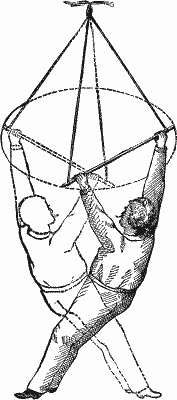
A trapeze, Fig. 2, should be suspended from the ceiling, so that the bar shall be six inches above the head of the person who is to use it; the toes should be placed under straps nailed to the floor to keep them in position. Then if the bar be grasped and the body thrown forward, the trapeze, the arms, and the body will form the segment of a circle.
The exercise is taken by causing the body to describe a complete circle in the manner indicated in the cut. Little muscular effort is required if the motion be rapid, because the momentum is sufficient to carry the body around; but if the rotation be slow, more exertion is required. This movement is specially adapted to the breathing powers of weak persons, yet the most vigorous can readily get from it all the exercise their chest and lungs require.
By means of these exercises the chest is gently but effectively expanded in every direction and the elasticity of its walls promoted, the air cells are expanded, and the lungs are rendered more permeable to the respired air, and the strength of the respiratory muscles is developed.
FIG. 3.
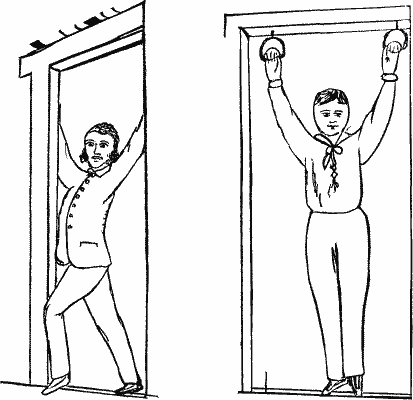
Fig. 3 illustrates an exercise for the chest that is taken without any apparatus other than an ordinary doorway. The exerciser should stand in the position indicated in the engraving, and then step forward with each foot alternately as far as possible without stretching the chest too severely. The longer the step the more vigorous the exercise will be.
FIG. 4.
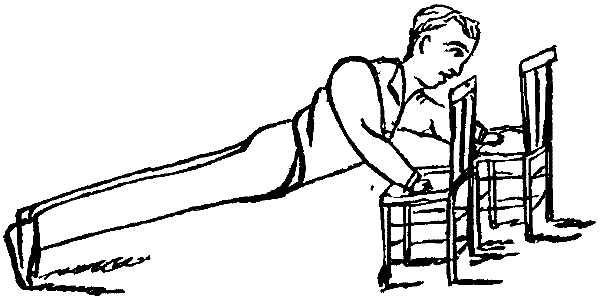
Fig. 4 shows an exercise taken between two chairs; the position indicated in the cut having been assumed, the chest is then slowly lowered and raised three to six times. This exercise is adapted to strong persons only.
THE EFFECTS OF ADEQUATE RESPIRATION IN SPECIAL CASES.
When the nutrition of the body is promoted by effective respiration, and waste matters are promptly removed, the chances that tubercle will be developed in persons who are predisposed thereto are reduced to a minimum.
Better materials are furnished by the nutritive processes to renew the tissues, so that the occurrence of those degenerations that result in various fatal affections, peculiar to the decline of life, are rendered much less probable or are prevented altogether, and the chances that death shall take place by old age is increased. The system possesses much greater resisting power against the influence of malaria and the poisons that give rise to typhoid fever, scarlatina, diphtheria, measles, etc.
When the motions of a woman's respiratory organs are normal and are properly communicated to the pelvic organs, she enjoys the greatest possible immunity attainable against the development of any diseases peculiar to the sex.