THE BAZIN SYSTEM OF DREDGING.
Reading edition
By MR. A.A. LANGLEY.
This paper, lately read before the Institution of Mechanical Engineers, London, is a description of the construction and working of a dredger on M. Bazin's system, as used by the author for the past three years in dredging sand and other material in Lowestoft Harbor. The dredger is represented in its general features on next page, Fig. 1. The total length of the hull is 60 ft., with 20 ft. beam. In the after part of the hold is placed a horizontal boiler, A, which supplies steam to a pair of inverted vertical engines, B. These engines drive, through belts and overhead pulleys, a centrifugal pump, C, which discharges into the open trough, H. The suction pipe, D, of this pump passes through the side of the dredger, and then forms an elbow bent downward at an angle of 45 deg. To this elbow is attached a flexible pipe, E, 12 in. in diameter and 25 ft. long, made of India-rubber, with a coil of iron inside to help it to keep its shape. At the lower end of this pipe is an elbow-shaped copper nozzle which rests on the bottom, and is fitted with a grating to prevent stones getting into the pump and stopping the work. The flexible tube is supported by chains that pass over the head of a derrick, F, mounted at the stern of the dredger, and then round the barrel of a steam winch. By this means the depth of the nozzle is altered, as required to suit the depth of water.
A man stands at the winch, and lifts or lowers the pipe as is required, judging by the character of the discharge from the pump. If the liquid discharged is very dark and thick the nozzle is too deep in the sand or gravel; if of a light color the pipe must be lowered. The best proportion of water to sand is 5 to 1. When loose sand is the only material to be dealt with, it can be easily sucked up, even if the nozzle is deeply buried; but at other times stones interfere with the work, and the man in charge of the flexible tube has to be very careful as to the depth to which the nozzle may be buried in the sand. The pump is shown in Figs. 2 and 3. The fan is 2 ft. diameter, and has only two blades, a larger number being less efficient. The faces of the blades, where they come in contact with the sand, are covered with flaps of India-rubber. Small doors are provided at the side of the pump for cleaning it out, extracting stones, etc. The fan makes 350 revolutions per minute, and at that speed is capable of raising 400 tons of sand, gravel, and stones per hour, but the average in actual work may be taken at 200 tons per hour. This is with a 10-horse power engine, and working in a depth of water varying from 7 ft. to 25 ft. The great advantage of this dredger is its capability of working in disturbed water, where the frames of a bucket dredger would be injured by the rise and fall of the vessel.
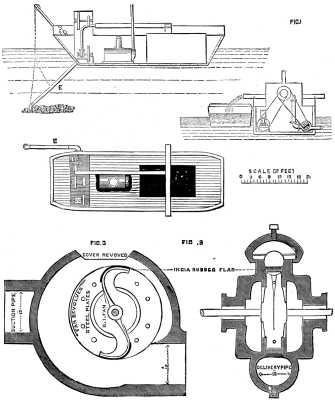
THE BRAZIN SYSTEMEM OF DREDGING.
Thus at Lowestoft bucket dredgers are used inside the harbor, and the Bazin dredger at the entrance, where there are sand and gravel, and where the water is more disturbed. The dredger does not succeed very well in soft silt, because, owing to its slow precipitation, it runs over the sides of the hopper barges without settling. Nor does it do for dredging solid clay. It gives, however, excellent results with sand and gravel, and for this work is much superior to the bucket dredger. The experience in working was then described, showing that a great many very discouraging failures preceded successful working, about a year being expended in getting good results.
COST OF WORKING.
The vessel or barge for carrying the machinery and pumps cost £600, and the contract price of the machinery and pumps was £1,200. But before the dredger was taken over by the company the alterations before enumerated had cost about £300, bringing the total for barge and dredger up to £2,100. In building a second dredger this might of course be greatly reduced. The cost of repairs for one month's working has been only £5. The contractor receives for labor alone 1-1/8d. per ton, being at the rate of about 1¾d. for the dredging and 3/8d. for taking to sea--a lead of two miles--all materials being supplied to him. The consumption of coal is at the rate of about 1 ton for 1,000 tons of sand dredged. At Lowestoft Harbor the total amount of dredging has been about 200,000 tons yearly, but this is now much reduced in consequence of the pier extension recently constructed by the author, which now prevents the sand and shingle from the sea blocking the mouth of the harbor. The total cost of working has been 2.572d. per ton. which with 10 per cent interest on capital, 0.240d., makes the total cost per ton 2.812d. The repairs to steam tug, hopper, barges, and dredger have averaged about 2d. per ton.
Before the discussion on the paper commenced, Mr. Langley remarked that attempts had been made to connect the engine direct to the pump of a Bazin dredger, but this arrangement failed, and the belt acted as a safety arrangement and prevented breakage by slipping when the pump was choked in any way. A new lock was constructed near Lowestoft a short time ago, and the dredger pump was used to empty it; when half empty the men placed a net in front of the delivery pipe and caught a cartload of fish, many of which where uninjured. In the discussion Mr. Wallick, who had superintended the use of the dredger at Lowenstoft, gave some of his experience there, and repeated the information and opinions given by Mr. Langley in the paper.
Mr. Ball, London agent for M. Bazin, said that as devised by M. Bazin the pump was placed below water level, so that the head of water outside should be utilized; but he--Mr. Ball--now placed the pump considerably above water level, as no specially formed craft was thus necessary. He also described some of the steps by which he had arrived at the present arrangements of the whole plant, and gave some particulars of its working. Mr. Crampton asked some questions, in reply to which Mr. Ball said the longest distance they had carried the material was 1,200 yards in two relays--namely, a second pump on a floating barge with special engine. The distance to which they could carry the material depended upon its character. Fine sand would travel well; mud would not, bowlders would not, though gravel would. To give the water a rotary motion he had inserted a helical piece of angle iron, and so prevented deposition.