THE FUTURE DEVELOPMENT OF ELECTRICAL APPLIANCES.
Reading edition
Prof. J. Perry lately delivered a lecture on this subject at the Society of Arts, London, which contains in an epitomized form the salient points of the hopes and fears of the more sanguine spirits of the electrical world. Prof. Perry is one of the two professors who have been dubbed the "Japanese Twins," and whose insatiate love of work induced one of our most celebrated men of science to say that they caused the center of experimental research to tend toward Tokyo instead of London. Professors Ayrton and Perry have for some time been again resident in England, but it is evident that they did not leave any of their energy in Japan, for those who know them intimately, know that they are pursuing numerous original investigations, and that so soon as one is finished, another is commenced. It would have been difficult then to have found an abler exponent of the future of electricity.
Prof. Perry, after referring to what might have been said of the great things physical science has done for humanity, plunged into his subject. The work to be done was vast, and the workers altogether out of proportion to the task.
The methods of measurement of electricity are not generally understood. Perhaps when electricity is supplied to every house in the city at a certain price per horse power, and is used by private individuals for many different purposes, this ignorance will disappear. Electrical energy is obtained in various ways, but the generators get heated; and one great object of inventors is to obtain from machines as much as possible electrical energy of the energy in the first place supplied to such machine. The lecturer called particular attention to the difference between electricity and electrical energy, and attempted to drive home the fundamental conceptions of electrical science by the analogies derivable from hydraulics. A miller speaks not only of quantity of water, but also of head of water. The statement then of quantity of electricity is insufficient, except we know the electrical property analogous to head of water, and which is termed electrical potential. A small quantity of electricity of high potential is similar to a small quantity of water at high level. The analogies between water and electricity were collected in the form of a table shown on a wall sheet as follows:
We Want to Use Water. We Want to Use Electricity. 1. Steam pump burns coal, 1. Generator burns zinc, or and lifts water to a higher uses mechanical power, and level. lifts electricity to a higher level or potential. 2. Energy available is 2. Energy available is amount of water lifted x amount of electricity x difference difference of level. of potential. 3. If we let all the water 3. If we let all the electricity flow away through channel flow through a wire from one to lower level without doing screw of our generator to the work, its energy is all other without doing work, all converted into heat because the electrical energy is of frictional resistance of converted into heat because of pipe or channel. resistance of wire. 4. If we let water work a 4. If we let our electricity hoist as well as flow through work a machine as well as channels, less water flows flow through wires, less flows than before, less power is than before, less power is wasted in friction. wasted through the resistance of the wire. 5. However long and narrow 5. However long and thin may be the channels, the wires may be, electricity water maybe brought from may be brought from any distance distance, however great, however great, to give to give out almost all its out almost all its original original energy to a hoist. energy to a machine. This requires This requires a great head a great difference of and small quantity of water. potentials and a small current.
The difference between potential and electro-motive force was explained thus: "difference of potential" is analogous with "difference of pressure" or "head" of water, howsoever produced; whereas electromotive force is analogous with the difference of pressure before and behind a slowly moving piston of the pump employed by an unfortunate miller to produce his water supply. Electricians have very definite ideas upon the subject they are working at, and especial attention is paid to the measurements on which their work depends. Examples of these measurements were shown by the following tables on wall sheets:
ELECTRICAL MAGNITUDES (SOME RATHER APPROXIMATE). Resistance of One yard of copper wire, one-eighth of an inch diameter...............................0.002 ohms. One mile ordinary iron telegraph wire, .........10 to 20 " Some of our selenium cells ............. 40 to 1,000,000 " A good telegraph insulator ........... 4,000,000,000,000 " Electro-motive force of A pair of copper-iron junctions at a difference of temperature of 1 deg. Fah......... =0.0000 volt. Contact of zinc and copper ..................... =0.75 " One Daniell's cell ............................. =1.1 " Mr. Latimer Clark's standard cell .............. =1.45 " One of Dr. De la Hue's batteries ...... =11,000 " Lightning flashes probably many millions of volts.
Current measured by us in some experiments: Using electrometer....... = almost infinitely small currents. Using delicate galvanometer =0.00,000,000,040 weber. Current received from Atlantic cable, when 25 words per minute are being sent ................ = 0.000,001 weber Current in ordinary land telegraph lines ......................... = 0.003 weber Current from dynamo machine.... = 5 to 100 weber
In any circuit, current in webers = electro-motive force in volts / resistance in ohms.
RATE OF PRODUCTION OF HEAT, CALCULATED IN THE SHAPE OF HORSE-POWER.
In the whole of a circuit=current in webers x electro-motive force in volts / 746. In any part of circuit=current in webers x difference of potential at the two ends of the part of the circuit in question / 746. Or, =square of current in webers x resistance of the part in ohms / 746.
If there are a number of generators of electricity in a circuit, whose electromotive forces in volts are E1, E2, etc., and if there are also opposing electro-motive forces. F1, F2, etc., volts, and if C is the current in webers, R the whole resistance of the current in ohms, P the total horse-power taken at the generators, Q the total horse-power converted into some other form of energy, and given out at the places where there are opposing electro-motive forces, H the total horse-power wasted in heat, because of resistance, then:


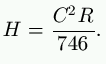
The lifting power of an electro-magnet of given volume is proportional to the heat generated against resistance in the wire of the magnet.
The future of many electrical appliances depends on how general is the public comprehension of the lessons taught by these wall sheets. If a few capitalists in London would only spend a few days in learning thoroughly what these mean, electrical appliances of a very distant future would date from a few months hence.
A number of experiments were shown, in some of which electrical energy was converted into heat, in others into sound, in others into work. At this part of the lecture reference was made to the work of Prof. Ayrton and his pupils at Cowper street (City and Guilds of London Institute Classes). They measure (1) the gas consumed by the engine, (2) the horse-power given to the dynamo machine, (3) the current in the circuit in webers, and (4) the resistance of the circuit. Thus exact calculations can now be made as to the horse power expended in any part of the circuit, and the light given out in any given period by an electric lamp. The dynamometers used in these measurements were described, but at present, in some cases, the description given is for various reasons incomplete, so that we shall take a future opportunity of writing of these instruments. To measure the light a photometer, constructed by Profs. Ayrton and Perry, is used, which obviates the necessity of large rooms, and enables the operator to give the intensity in a very short period of time. A number of measurements of the illuminating power of an electric lamp were rapidly made during the lecture with this photometer. By means of a small dynamo machine, driven by an electric current generated in the Adelphi arches, a ventilator, a sewing machine, a lathe, etc., were driven; in the latter a piece of wood was turned. "What," said the lecturer, "do these examples show you?" "They show that if I have a steam-engine in my back yard I can transmit power to various machines in my house, but if you measured the power given to these machines you would find it to be less than half of what the engine driving the outside electrical machine gives out. Further, when we wanted to think of heating of buildings and the boiling of water, it was all very well to speak of the conversion of electrical energy into heat, but now we find that not only do the two electrical machines get heated and give out heat, but heat is given out by our connecting wires. We have then to consider our most important question. Electrical energy can be transmitted to a distance, and even to many thousands of miles, but can it be transformed at the distant place into mechanical or any other required form of energy, nearly equal in amount to what was supplied? Unfortunately, I must say that hitherto the practical answer made to us by existing machines is, 'No;' there is always a great waste due to the heat spoken of above. But, fortunately, we have faith in the measurements, of which I have already spoken, in the facts given us by Joule's experiments and formulated in ways we can understand. And these facts tell us that in electric machines of the future, and in their connecting wires, there will be little heating, and therefore little loss. We shall, I believe, at no distant date, have great central stations, possibly situated at the bottom of coal-pits where enormous steam engines will drive enormous electric machines. We shall have wires laid along every street, tapped into every house, as gas-pipes are at present; we shall have the quantity of electricity used in each house registered, as gas is at present, and it will be passed through little electric machines to drive machinery, to produce ventilation, to replace stoves and fires, to work apple-parers and mangles and barbers' brushes, among other things, as well as to give everybody an electric light."
It is possible, as Prof. Ayrton first showed in his Sheffield lecture, that electrical energy can be transmitted through long distances by means of small wires, and that the opinion that wires of enormous thickness would be required is erroneous. The desideratum required was good insulation. He also showed that, instead of a limiting efficiency of 50 per cent., the only thing preventing our receiving the whole of our power was the mechanical friction which occurs in the machines. He showed, in fact, how to get rid of electrical friction. A machine at Niagara receives mechanical power, and generates electricity. Call this the generator. Let there be Wires to another electric machine in New York, which will receive electricity, and give out mechanical work. Now this machine, which may be called the motor, produces a back electromotive force, and the mechanical power given out is proportional to the back electromotive force multiplied into the current. The current, which is, of course, the same at Niagara as at New York, is proportional to the difference of the two electromotive forces, and the heat wasted is proportional to the square of the current. You see, from the last table, that we have the simple proportion: power utilized is to power wasted, as the back electromotive force of the motor is to the difference between electromotive forces of generator and motor. This reason is very shortly and yet very exactly given as follows:
Let electromotive force of generator be E; of motor F. Let total resistance of circuit be R. Then if we call P the horse-power received by the generator at Niagara, Q, the horse-power given out by motor at New York, that is, utilized; H, the horse-power wasted as heat in machines and circuit; C, the current flowing through the circuit:
C=(E-F) / R P=E(E-F) / (746 R) Q=F(E-F) / (746 R) H=(E-F)_2 / (746 R) Q:H::F:E-F
The water analogy was again called into play in the shape of a model for the better demonstration of the problem. The defects in existing electric machines and the means of increasing the E.M.F. were discussed, the conclusions pointing to the future use of very large machines and very high velocities. The future of telephonic communication received a passing remark, and attention called to the future of electric railways. The small experiments of Siemens have determined the ultimate success of this kind of railway. Their introduction is merely a question of time and capital. The first cost of electric railways would be smaller than that of steam railways; the working expenses would also be reduced. The rails would be lighter, the rolling stock lighter, the bridges and viaducts less costly, and in the underground railways the atmosphere would not be vitiated.
"About two years ago, it struck Professor Ayrton and myself, when thinking how very faint musical sounds are heard distinctly from the telephone, in spite of loud noises in the neighborhood, that there was an application of this principle of recurrent effects of far more practical importance than any other, namely, in the use of musical notes for coast warnings in thick weather. You will say that fog bells and horns are an old story, and that they have not been particularly successful, since in some states of the weather they are audible, in others not.
"Now, it seems to be forgotten by everybody that there is a medium of communicating with a distant ship, namely, the water, which is not at all influenced by changes in the weather. At some twenty or thirty feet below the surface there is exceedingly little disturbance of the water, although there may be large waves at the surface. Suppose a large water-siren like this--experiment shown--is working at as great a depth as is available, off a dangerous coast, the sound it gives out is transmitted so as to be heard at exceedingly great distances by an ear pressed against a strip of wood or metal dipping into the water. If the strip is connected with a much larger wooden or metallic surface in the water the sound is heard much more distinctly. Now, the sides of a ship form a very large collecting surface, and at the distance of several miles from such a water siren as might be constructed, we feel quite sure that, above the noise of engines and flapping sails, above the far more troublesome noise of waves striking the ship's side, the musical note of the distant siren would be heard, giving warning of a dangerous neighborhood. In considering this problem, you must remember that Messrs. Colladon and Sturn heard distinctly the sound of a bell struck underwater at the distance of nearly nine miles, the sound being communicated by the water of Lake Geneva."
The next portion of the lecture discussed the great value of a rapid recurrence of effects, the obtaining of sound by means of a rapid intermission of light rays on selenium joined up in an electric circuit being instanced as an example. Then recent experiments on the refractive power of ebonite were detailed--the rough results tending to give greater weight to Clerk-Maxwell's electro-magnetic theory of light. The index of refraction of ebonite was found by Profs. Ayrton and Perry to be roughly 1.7. Clerk-Maxwell's theory requires that the square of this number should be equal to the electric specific inductive capacity of the substance. For ebonite this electric constant varies from 2.2 to 3.5 for different specimens, the mean of which is almost exactly equal to the square of 1.7.