"A Story of City By-Ways" (continued 3)
Reading edition
Flo’s voice shook so while renouncing Scamp, that the animal himself heard her, and got up and thrust his great awkward head between her hands. She had hard work to restrain her tears, but did so, and kept her eyes steadily fixed on Mrs Jenks. That little woman sat silent for fully a moment, now returning Flo’s gaze, now softly stroking Scamp’s back—at last she spoke.
“No, Flo,” she said, “I won’t part you and Scamp—you love each other, and I think God means you to stay together. He has made you meet, and let you pass through a pretty sharp little bit of life in company, and I have no idea but that He sent you His dumb creature to be a comfort to you, and if that is so, I won’t take him away. As long as you stay he shall stay, but when you go back to your cellar he shall go too.”
Scamp, whose eyes expressed that he knew all about it, and fully believed that Mrs Jenks understood his character, looked satisfied, and licked her hand, but Flo had still an anxious frown on her face. “Ef you please, ma’am,” she said, “’tis better fur me to know how much longer am I to have the loan of your bed, ma’am?”
“Why, Flo, my dear, Mrs Potter, who lent me the mattress I sleeps on, sent me down word that she must have it to-morrow morning for her niece, who is coming to live with her, so I’ll want my bed, Flo, and ’tis too little for both of us.” Mrs Jenks paused, but Flo was quite silent.
“Well, dear,” she said cheerfully, “we’ll all three lie warm and snug to-night, and we needn’t meet to-morrow’s troubles half way. Now come over, child, and I’ll give you instruction in needlework, ’tis an hart as all women should cultivate.”
Flo, still silent and speechless, went over and received the needle into her clumsy little fingers, and after a great many efforts, succeeded in threading it, and then she watched Mrs Jenks work, and went through two or three spasmodic stitches herself, and to all appearance looked a grave, diligent little girl, very much interested in her occupation. And Mrs Jenks chatted to her, and told her what a good trade needlework was, and for all it met so much abuse, and was thought so poor in a money-making way, yet still good, plain workers, not machinists, could always command their price, and what a tidy penny she had made by needlework in her day.
And to all this Flo replied in monosyllables, her head hanging, her eyes fixed on her work.
At last Mrs Jenks gave her a needle freshly threaded, and a strip of calico, and bade her seat herself on the hearth-rug and draw her needle in and out of the calico to accustom her to its use, and she herself took up a boy’s jacket, and went on unpicking and opening the seams, and letting it out about an inch in all directions.
Night after night she was engaged over this work, and it always interested Flo immensely: for Mrs Jenks took such pains with it, she unpicked the seams and smoothed them out with such clever fingers, then she stitched them up again with such fine, beautiful stitching, and when that was done, she invariably ironed them over with a nice little iron, which she used for no other purpose, so that no trace of the old stitching could be seen. She had a very short time each day to devote to this work, seldom more than ten minutes, but she did it as though she delighted in it, as though it did her heart and soul good to touch that cloth, to draw those careful, beautiful stitches in and out of it. And every night, while so engaged, she told Flo the story of the Prodigal Son.
She began it this night as usual, without the little girl looking up or asking for it.
“Once there was a man who had two sons—they were all the children he had, and he held them very dear. One—the eldest—was a steady lad, willing to abide by his father, and be guided by him, but the other was a wild, poor fellow, and he thought the home very small and narrow, and the world a big place, and he thought he’d like a bit of fun, and to see foreign parts.
“So he asked his father for all the money he could spare, and his father gave him half his living. And then the poor foolish boy set off, turning his back on all the comforts of home, and thinking now he’d see life in earnest; and when he got to the far-off lands, wild companions, thieves, and such, came round him, and between them the good bit of money his father had given him melted away, and he had not a penny to call his own. Then he began to be hungry, to want sore, and no man gave to him, and no man pitied him; and then, sitting there in the far country, came back to the poor, desolate, foolish lad the thoughts of home, and the nice little house, and the father’s love, and he thought if he was there again, why, he’d never be dying of hunger, for in the father’s house even the servants had enough and to spare.
“And he thought, why should he not go back again? and he said to himself, ‘I will arise and go to my father, and will say unto him, Father, I have sinned against Heaven and before thee, and am no more worthy to be thy son.’
“And he got up and went back to his father. But the loving father was looking out for him, and when he saw him coming over the hill-top, he ran to meet him, and threw his arms about him; and the son said—
”‘Father, I have sinned against Heaven and before thee, and am no more worthy to be called thy son.’
“But the father said, ‘Bring forth the best robe and put it on him, and put a ring on his hand, and shoes on his feet, and let us make a feast and be merry, for this my son was dead and is alive again, he was lost and is found.’”
Night after night Flo had listened to this story, always with a question at the top of her lips, but never until to-night had she courage to put it.
“Was the best robe, a jacket and trousers and little weskit, ma’am?”
“Very like,” said Mrs Jenks, bending over a fresh seam she was beginning to unpick.
“But you hasn’t no lad comin’ back fur that ’ere jacket, ma’am?”
Mrs Jenks was silent for fully two minutes, her work had fallen from her hands, her soft, gentle eyes looked afar.
“Yes, Flo dear,” she said, “I have such a lad.”
“Wot’s ’is name, ma’am?”
“Willie,” said Mrs Jenks, “Willie’s ’is name—leastways ’is home name.”
“And is he a comin’ back any day, ma’am? Is you a lookin’ hout o’ the winder fur ’im any day?”
“No, Flo, he won’t come any day, he won’t come fur a bit.”
“Wen ’is best robe is ready, ma’am?”
“Yes; when he comes it shall be ready.”
“’Ow soon is ’ee like to walk in, ma’am?”
“I don’t know exact,” said Mrs Jenks, “but I’ll look out fur him in the spring, when the little crocuses and snowdrops is out—he’s very like to turn up then.”
As Mrs Jenks spoke she folded the jacket and put it tidily away, and then she unbandaged Flo’s foot and rubbed some strengthening liniment on it, and undressed the little girl and put her into bed, and when she had tucked her up and kissed her, and Flo hail rewarded her with a smile breaking all over her little white, thin face, something in the expression of that, face caused her to bend down again and speak suddenly.
“God has given me a message for you, child, and forgetful old woman that I am, I was near going to sleep without yer ’aving it.”
“Wot’s the message, mum?”
“The message is this, straight from God Himself—‘Certainly I will be with thee.’ Do you know what that means, my child?”
“I can part guess, ma’am.”
“Ay, I dare say you can part guess, but you may as well know the whole sweet meaning of it. ’Tis this, Flo Darrell—wherever you be, God will be with you. Back in your cellar, dark as it is, He’ll come and keep you company. If you stay with me, why He’s here too. When you go to sleep His arm is under your head; when you walk abroad, He’s by your side—He’s with you now, and He’ll be with you for ever. When you come to die He’ll be with you. You need never fear for nothing, for God will be always with you. He says ‘Certainly,’ and His certainly, is as big, and wide, and strong as eternity, Flo Darrell.”
“Yes, ma’am,” replied Flo very softly, and then Mrs Jenks went and lay down on her mattress, and was presently sleeping the sweet and heavy sleep of the hard worker.
But Flo could not sleep—she lay awake, feeling the soft white sheets with her fingers, looking with her brown eyes all round the pretty room. How bright, and pure, and fresh it all looked, with the firelight flickering over the furniture, to the beauty-loving child.
She was taking farewell of it then—she must go away to-morrow; back again to their cellar the dog and she must go—away from the sunlight of this bright little home, into the homeless darkness of their Duncan Street life.
She had not expected it quite so soon, she had thought that God would give her a little more notice, a little longer time to prepare, before he asked her to return that comfortable bed to Mrs Jenks. Well, the time had come for her to do it, and she must do it with a good grace, she must not show dear Mrs Jenks even half how sorry she was.
That little woman had done so much for her, had changed and brightened her whole existence, had been specially chosen by God Himself to do all this for her, to save her life.
Not for worlds would she look as though she expected more from Mrs Jenks. She must go away to-morrow, very, very thankful, and not too sad, otherwise the little woman would feel uncomfortable about her. She resolved that in the morning she would wear quite a cheerful face, and talk brightly of all people had made by translating. She would walk away when the time came, as briskly as her lame foot would permit, Scamp wagging his tail, and supposing he was only going for an ordinary walk, by her side.
Then they would reach the cellar, and Janey’s mother, who kept the key, would open it for them, and, perhaps Janey herself would come down and listen to all Flo’s wonderful stories.
Well; these were for to-morrow, to-night she must say farewell; to-night, with eyes too sad, and heart too heavy for childish tears, she must look around at this cleanliness, this comfort, this luxury for the last time.
Flo was a poor child, the child of low people, but she had a refined nature, a true lady’s heart beat in that little breast. All the finer instincts, all the cravings of a gentle and high spirit, were hers. Pretty things were a delight to her, the sound of sweet music an ecstasy. Born in another sphere, she might have been an artist, she might have been a musician, but never, under any circumstances, could she have led a common-place life.
The past six weeks, notwithstanding her anxiety and sorrow about Dick, had been one bright dream to her. The perfect neatness, the little rough, but no longer tattered, dress Mrs Jenks had made for her, the sense of repose, the lovely stories, had made the place little short of Paradise to the child.
And now by to-morrow night it would all be over, and the old dark life of poverty, hunger, and dirt would begin again.
As Flo was thinking this, and, leaning on her elbow, was looking sadly around, suddenly the verse Mrs Jenks had said good-night to her with darted like a ray of brightest sunshine into her soul.
“Certainly, I will be with thee.”
What a fool she was, to think Janey’s company necessary, to have any fear of loneliness. God would be with her.
Though unseen by her (she knew that much about God now), He would still be by her side. Was it likely, when He was down with her in the dark cellar, that He would allow her to want, or even have things very hard for her?
Or suppose He did allow her to go through privations? suppose He asked her to bear a few short, dark days for Him down here, He would give her a for-ever and for-ever of bright days, by and by.
After a time she grew weary, and her heavy lids closed, and she went to sleep, but her face was no longer sad, it was bright with the thought of God.
Chapter Fifteen.
Miss Mary.
The next morning Flo watched Mrs Jenks very narrowly, wondering and hoping much that she would show some sorrow at the thought of the coming parting. A shade, even a shade, of regret on the little woman’s face would have been pleasing to Flo; it would have given her undoubted satisfaction to know that Mrs Jenks missed her, or would be likely to miss her, ever so little. But though she watched her anxiously, no trace of what she desired was visible on the bright little woman’s features. She was up earlier than usual, and looked to Flo rather more brisk and happy than usual. She went actively about her work, singing under her breath for fear of disturbing Flo, whom she fancied was still asleep, some of the hymns she delighted in.
“Christ is my Saviour and my Friend, My Brother and my Love, My Head, my Hope, my Counsellor, My Advocate above,”
sang Mrs Jenks, and while she sang she dusted, and tidied, and scrubbed the little room; and as she polished the grate, and lit the small fire, and put the kettle on for breakfast, she continued—
“Christ Jesus is the heaven of heaven; My Christ, what shall I call? Christ is the first, Christ is the last, My Christ is all in all.”
No, Mrs Jenks was not sorry about anything, that was plain; there was a concealed triumph in her low notes which almost brought tears to the eyes of the listening child. Perhaps she would have sobbed aloud, and so revealed to Mrs Jenks what was passing in her mind, had not that little woman done something which took off her attention, and astonished her very much. When she had completed all her usual preparations for breakfast, she took off her old working gown, and put on her best Sunday-go-to-meeting dress.
This surprised Flo so utterly that she forgot she had been pretending to be asleep and sat up on her elbow to gaze at her.
Over the best dress she pinned a snowy kerchief, and putting on finally a clean widow’s cap, drew up the blinds and approached Flo’s side.
“I’ll just see about that poor foot now,” she said, “and then, while I am frying the herring for breakfast, you can wash and dress yourself, dearie.”
But poor Flo could not help wondering, as Mrs Jenks in her brisk clever way unbandaged her foot, and applied that pleasant strengthening lotion, who would do it for her to-morrow morning, or would she have any lotion to put. She longed to find courage to ask Mrs Jenks to allow her to take away what was left in the bottle, perhaps by the time it was finished her foot would be well.
And Flo knew perfectly, how important it was for her, unless she was utterly to starve, that that lame foot should get well. She remembered only too vividly what hard times Janey, even with a father and mother living, had to pull along with her lame foot, but she could not find courage to ask for the lotion, and Mrs Jenks, after using a sufficient quantity, corked up the remainder and put it carefully away.
“There’s an improvement here,” said the little woman, touching the injured ankle. “There’s more nerve, and strength, and firmness. You’ll be able to walk to-day.”
“I’ll try, ma’am,” said Flo.
“So you shall, and you can lean on me—I’ll bear your weight. Now get up, dearie.”
As Flo dressed herself she felt immensely comforted. It was very evident from Mrs Jenks’ words, that she intended going with her to her cellar, she herself would take her back to her wretched home.
To do this she must give up her day’s charing, so Flo knew that her going away was of some importance to the little woman, and the thought, as I have said, comforted her greatly.
She dressed herself quickly and neatly, and after kneeling, and repeating “Our Father” quite through very softly under her breath, the three—the woman, child, and dog—sat down to breakfast. It would be absurd to speak of it in any other way.
In that household Scamp ate with the others, he drew up as gravely to every meal as Mrs Jenks did herself.
His eyes were on a level with the table, and he looked so at home, so assured of his right to be there, and withal so anxious and expectant, and he had such a funny way of cocking his ears when a piece of nice fried herring was likely to go his way, that he was a constant source of mirth? and pleasure to the human beings with whom he resided.
Mrs Jenks was one of the most frugal little women in the world; never a crumb was wasted in her little home, but she always managed to have something savoury for every meal, and the savoury things she bought were rendered more so by her judicious cooking. Her red herrings, for instance, just because she knew where to buy them, and how to dress them, did not taste at all like poor Flo’s red herrings, cooked against the bars, and eaten with her fingers in the Duncan Street cellar.
So it was with all her food; it was very plain, very inexpensive, but of its kind it was the best, and was so nicely served that appetites far more fastidious than Flo’s would have enjoyed it.
On this morning, however, the three divided their herring and sipped their tea (Scamp had evinced quite a liking for tea) in silence, and when it was over, and Flo was wondering how soon she could break the ice and ask Mrs Jenks when she meant to take her to Duncan Street, she was startled by the little woman saying to her in her briskest and brightest tones—
“I wonder, child, whether I’d best trim up that old bonnet of your mother’s for you to wear, or will you go with yer little head exposed to the sun?
“The bonnet’s very old, that’s certain, but then ’tis something of a protection, and the sun’s ’ot.”
“Please, ma’am,” said Flo, “I can walk werry well wid my head bare; but ef you doesn’t mind I’d like to carry ’ome the bonnet, fur it was mother’s Sunday best, it wor.”
“Lor, child, you’re not going home yet awhile, you’ve got to go and pay a visit with me. Here, show me the bonnet—I’ll put a piece of decent brown upon it, and mend it up.” Which Mrs Jenks did, and with her neat, capable fingers transformed it into by no means so grotesque-looking an object.
Then when it was tied on Flo’s head they set off.
“A lady wishes to see you, Flo, and she wishes to see Scamp too,” explained Mrs Jenks; and calling the dog, they went slowly out of the court.
Flo had very little time for wonder, for the lady in question lived but a few doors away, and notwithstanding her slow and painful walking she got to her house in a very few moments.
It was a tiny house, quite a scrap of a house to be found in any part of the middle of London—a house back from its neighbours, with little Gothic windows, and a great tree sheltering it. How it came to pass that no railway company, or improvement company, or company of something else, had not pounced upon it and pulled it down years ago remained a marvel; however, there it stood, and to its hall door walked Mrs Jenks, Flo, and Scamp, now.
The door was opened by a neat little parlour-maid, who grinned from ear to ear at sight of Mrs Jenks.
“Is your mistress at home, Annie?”
“That she is, ma’am, and looking out for you. You’re all to come right in, she says—the dog and all.”
So Flo found herself in a pretty hall, bright with Indian matting, and some fresh ferns towering up high in a great stone jar of water.
“We was in the country yesterday, ma’am, Miss Mary and me, and have brought back flowers, and them ’igh green things enough to fill a house with ’em,” explained the little handmaid as she trotted on in front, down one flight of stairs and up another, until she conducted them into a long low room, rendered cool and summery by the shade of the great tree outside. This room to-day was, as Annie the servant expressed it, like a flower garden. Hydrangeas, roses, carnations, wild flowers, ferns, stood on every pedestal, filled twenty, thirty vases, some of rarest china, some of commonest delf, but cunningly hid now by all kinds of delicate foliage. It was a strange little house for the midst of the city, a strange little bower of a room, cool, sweet-scented, carrying those who knew the country miles away into its shadiest depths—a room furnished with antique old carvings and odd little black-legged spindle chairs.
On one of the walls hung a solitary picture, a water-colour framed without margin, in a broad gilt frame.
A masterpiece of art it was—of art, I say? something far beyond art—genius.
It made the effect of the charming little room complete, and not only carried one to the country, but straight away at once to the seashore. Those who saw it thought of the beech on summer evenings, of the happy days when they were young. It was a picture of waves—waves dancing and in motion, waves with the white froth foaming on them, and the sunlight glancing on their tops. No other life in the picture, neither ship nor bird, but the waves were so replete with their own life that the salt fresh breeze seemed to blow on your face as you gazed.
The effect was so marvellous, so great and strong, that Flo and Mrs Jenks both neglected the flowers, only taking them in as accessories, and went and stood under the picture.
“Ah! there’s the sea,” said Mrs Jenks with a great sigh, and a passing cloud, not of pain, but of an old grief, on her face.
“The sea shall give up her dead,” said a young voice by her side, and turning quickly, Flo saw one of the most peculiar, and perhaps one of the most beautiful, women she had ever looked at. Was she old? The hair that circled her low forehead was snowy white. Was she young? Her voice was round, flexible, full of music, rich with all the sympathy of generous youth.
She might be thirty—forty—fifty—any age. She had a story—who hasn’t?
She had met with sorrow—who hasn’t? But she had conquered and risen above sorrow, as her pale, calm, unwrinkled face testified. She was a brave woman, a succourer of the oppressed, a friend in the house of trouble, or mourning, as the pathetic, dark grey eyes, which looked out at you from under their straight black brows, declared. Long afterwards she told Flo in half-a-dozen simple words her history.
“God took away from me all, child—father—mother—lover—home. He made me quite empty, and then left me so for a little time, to let me feel what it was like: but when I had tasted the full bitterness, He came and filled me with Himself—brim full of Himself. Then I had my mission from Him. Go feed my sheep—go feed my lambs. Is it not enough?”
“You like my picture, Mrs Jenks,” she said now, “and so does the child,” touching Flo as she spoke with the tips of her white fingers. “Come into this room and I will show you another—there.”
She led the way into a little room rendered dark, not by the great tree, but by Venetian blinds. Over the mantel-piece was another solitary picture—again a water-colour.
Some cows, four beautifully sketched, ease-loving creatures, standing with their feet in a pool of clear water: sedgy, marshy ground behind them, a few broken trees, and a ridge of low hills in the background—over all the evening sky.
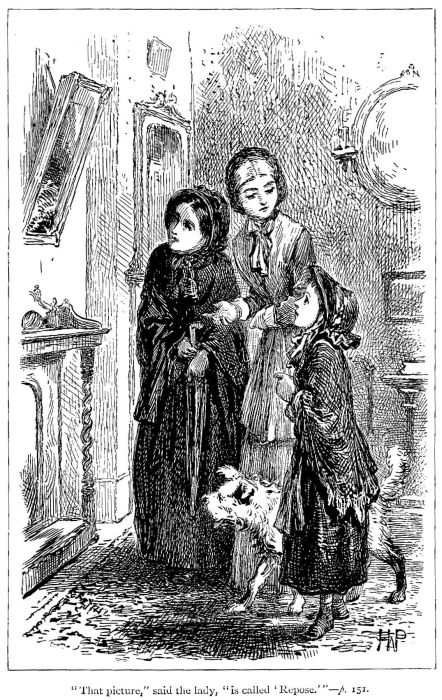
“That picture,” said the lady, “is called ‘Repose,’—to me it is repose with stagnation; I like my waves better.”
“And yet, Miss Mary,” replied the widow, “how restful and trustful the dumb creatures look! I think they read us a lesson.”
“So they do, Mrs Jenks; all His works read us a lesson—but come back to my waves, I want their breezes on my face, the day is stifling.”
She led the way back into the first room, and seated herself on a low chair.
“This is your little girl, and this the dog—Scamp, you call him. Why did you give him so outlandish a name? he does not deserve it, he is a good faithful dog, there is nothing scampish about him, I see that in his face.”
“Yes, ma’am, he’s as decent conducted and faithful a cretur as ever walked. Wot scamp he is, is only name deep, not natur deep.”
“Well, that is right—What’s in a name? Come here, Scamp, poor fellow, and you, little Flo, you come also; I have a great deal to say to you and your dog.” The child and the dog went up and stood close to the kind face. Miss Mary put her arm round Flo, and laid one shapely white hand on Scamp’s forehead.
“So God has taken away your little bed,” she said to the child, “and you don’t know where to sleep to-night.”
“Oh! yes, mum, I does,” said Flo in a cheerful voice, for she did not wish Mrs Jenks to think she missed her bed very much. “Scamp and me, we ’as a mattress in hour cellar.”
Miss Mary smiled.
“Now, Flo,” she said, “I really don’t wish to disappoint you, but I greatly fear you are mistaken. You may have a mattress, but you have no mattress in number 7, Duncan Street, for that cellar, as well as every other cellar in the street, has been shut up by the police three weeks ago. They are none of them fit places for human beings to live in.”
If Miss Mary, sitting there in her summer muslin, surrounded by every comfort, thought that Flo would rejoice in the fact that these places, unfit for any of God’s creatures, were shut up, she was vastly mistaken. Dark and wretched hole of a place as number 7, Duncan Street, was, it was there her mother had died, it was there she and Dick had played, and struggled, and been honest, and happy. Poor miserable shred of a home, it was the only home she had ever possessed the only place she had a right to call her own.
Now that it was gone, the streets or the Adelphi arches stared her in the face. Veritable tears came to her eyes, and in her excitement and distress, she forgot her awe of the first lady who had ever spoken to her.
“Please, mum, ef the cellar is shut up, wot ’ave come of my little bits o’ duds, my mattress, and table, and little cobbler’s stool?—that little stool wor worth sixpence any day, it stood so steady on its legs. Wot ’ave come o’ them, mum, and wot’s to come o’ Scamp and me, mum?”
“Ah!” said the lady more kindly than ever, “that is the important question, what is to become of you and Scamp? Well, my dear, God has a nice little plan all ready for you both, and what you have to do is to say yes to it.”
“And I ’ave brought you here to learn all about it, Flo,” said Mrs Jenks, nodding and smiling at her.
Then Miss Mary made the child seat herself on a low stool by her side, and unfolded to her a wonderful revelation. She, Flo, was no stranger to this lady. Mrs Jenks once a week worked as char-woman in this house, and had long ago told its mistress of her little charge; and Miss Mary was charmed and interested, and wanted to buy Scamp, only Mrs Jenks declared that that would break Flo’s heart. So instead she had contributed something every week to the keep of the two.
Now she wished to do something more. Miss Mary Graham was not rich, and long ago every penny of her spare money had been appropriated in various charitable ways, but about a fortnight ago a singular thing had happened to her. She received through the post a cheque for a small sum with these words inside the envelope—
“To be spent on the first little homeless London child you care to devote it to.”
The gift, sent anonymously, seemed to point directly to Flo, and Miss Graham resolved that she should reap the benefit.
Her plan for her was this,—she and Scamp were to live with Mrs Jenks for at least a year, and during that time Mrs Jenks was to instruct Flo in reading and writing, in fine sewing, and in all the mysteries of household work and cooking, and when Flo was old enough and strong enough, and if she turned out what they earnestly trusted she would turn out, she was to come to Miss Mary as her little servant, for Miss Mary expected that in a year or two Annie would be married and have a home of her own.
“Does this plan suit you, Flo? Are you willing when the time comes to try to be a faithful little servant to any master or mistress you may be with?” Whatever Flo’s feelings may have been, her answer was a softly, a very softly spoken—
“Yes, ma’am.”
“Do you know how you are to learn?”
“No, ma’am; but Mrs Jenks, she knows.”
“Mrs Jenks knows certainly, and so may you. You must be God’s little servant first—you must begin by being God’s little servant to-day, and then when the time comes you will be a good and faithful servant to whoever you are with.”
“Yes, ma’am,” answered Flo, a look of reverence, of love, of wonder at the care God was taking of her, stealing over her downcast face. Miss Mary saw the look, and rose from her seat well satisfied, she had found the child her Heavenly Father meant her to serve.
“But please, mum,” said Flo, “does yer know about Dick?”
“Yes, my dear, I know all about your little brother. Mrs Jenks has told me Dick’s story as well as yours. And I know this much, which perhaps you may not know; his stealing was a bad thing, but his being taken up and sent, not to prison, but to the good reformatory school where he now is, was the best thing that could happen to him. I have been over that school, Flo, and I know that the boys in it are treated well, and are happy. They are taught a trade, and are given a fair start in life.
“Many a boy such as Dick owes his salvation to the school he now is in.
“By the way, did you notice Annie, my little servant?”
“Yes, ma’am,” and a smile came to Flo’s face at the remembrance of the bright, pleasant-looking handmaiden.
“She has given me leave to tell you something, Flo; something of her own history.
“Once my dear, faithful Annie was a little London thief—a notorious little London thief. She knew of no God, she knew of nothing good—she was not even as fortunate as you and Dick were, for she had no mother to keep her right. When not quite ten years old she was concerned in a daring city robbery—she was taken up—convicted—and at last sentenced, first for a month to Wandsworth House of Correction, afterwards for four years to the girls’ reformatory school at that place.
“She has often told me what happened to her on the day she arrived at this school. She went there hating every one, determined never to change her ways, to remain for ever hardened and wicked.
“The matron called her aside and spoke to her thus:
”‘I know what is said of you, but I do not believe half of it—I am going to trust you.
”‘Here is a five-pound note; take this note to such a shop, and bring me back four sovereigns in gold, and one in silver.’
“That noble trust saved the girl. At that moment, as she herself said, all inclination for thieving utterly left her. (A fact.) From that day to this she has never touched a farthing that is not strictly her own. You see what she is now in appearance; when you know her better, you will see what she is in character—a true Christian—a noble woman. All the nobler for having met and conquered temptation.”
Miss Mary paused, then added softly, “What she has become, Dick may become.”
When Mrs Jenks, and Flo, and Scamp came home that morning, Flo, who after all that had happened felt sure that nothing ever could surprise her again, still could not help, when she entered the neat little room—her real home now—starting back and folding her hands in mute astonishment. The rough-looking, untidy mattress was gone, and in its place stood a tiny, bright-looking iron bedstead, on which the smallest of snowy beds was made up.
Over the bedstead, pinned against the wall, was a card with these words printed on it—
“GOD’S GIFT TO FLO.”
Chapter Sixteen.
Bright Days.
And now began a happy time in a hitherto very dark little life.
All her cares, her anxieties for Dick even, swept away, Flo had stept into a state of existence that to her was one of luxury.
The effect on many a nature, after the first burst of thankfulness was over, would have been a hardening one. The bright sunshine of prosperity, without any of the rain of affliction, would have dried up the fair soil, withered, and caused to die, the good seed.
But on Flo the effect was different; she never forgot one thing, and this memory kept all else straight within her. In counting up her mercies, she never forgot that it was God who gave them to her; and in return she gave Him, not love as a duty, but love rising free and spontaneous out of a warm, strong heart.
And He whom she loved she longed to hear more of, and Mrs Jenks, whose love for God and faith in God was as great as her own, loved to tell her of Him.
So these two, in their simple, unlearned way, held converse often together on things that the men of this world so seldom allude to, and doubtless they learned more about God than the men of this world, with all their talents and cultivated tastes, ever attain to.
It was Mrs Jenks’ simple plan to take all that the Bible said in its literal and exact meaning, and Flo and she particularly delighted in its descriptions (not imagery to them) of Heaven.
And when Mrs Jenks read to Flo out of the 21st and 22nd chapters of the Revelation, the child would raise her clear brown eyes to the autumn sky, and see with that inner sense, so strong in natures like hers, the gates of pearl and golden streets. God lived there—and many people who once were sad and sorrowful in this world, lived there—and it was the lovely happy home where she hoped she and Dick should also live some day.
“And you too, Mrs Jenks, and that poor lad of yours,” she would say, laying her head caressingly on the little woman’s knee.
But Mrs Jenks rather wondered why Flo never mentioned now that other Jenks, her namesake, who was wearing out his slow nine months’ imprisonment in the Wandsworth House of Correction.
Once Flo had been very fond of him, and his name was on her lips twenty times a day, now she never spoke of him.
Why was this? Had she forgotten Jenks? Hardly likely.
She was such a tender, affectionate little thing, interested even in that poor prodigal lad, whose best robe would soon be as ready, and as bright, and fresh, and new, as Mrs Jenks’ fingers could make it.
No, Flo had not forgotten Jenks, but she had found out a secret. Without any one telling her, she had guessed who the lad was who was expected back in the spring; who that jacket, and trousers, and vest were getting ready for. A certain likeness in the eyes, a certain play of the lips, had connected poor Jenks in prison with Mrs Jenks in this bright, home-like, little room. She knew they were mother and son, but as Mrs Jenks had not mentioned it herself, she would never pretend that she had discovered her secret. But Flo had one little fear—she was not quite sure that Jenks would come home. She knew nothing of his previous history, but in her own intercourse with him she had learned enough of his character to feel sure that the love for thieving was far more deeply engrafted into his heart than his gentle, trusting little mother had any idea of. When he was released from prison, bad companions would get round him, and he would join again in their evil ways.
He could not now harm Dick, who was safe at that good school for two or three years, but in their turn others might harm him, and the jacket and trousers might lie by unused, and the crocuses and snowdrops wither, and still Jenks might not come. He might only join in more crime, and go back again to prison, and in the end break his mother’s gentle, trusting heart.
Now Flo wondered could she do anything to bring the prodigal home. She thought of this a great deal; she lay in her little white bed, the bed God had given her, and told God about it, and after a time a plan came into her head.
Three times a week she went to Miss Mary’s pleasant house to be taught knitting by Annie, and reading and writing by that lady herself, and on one of these occasions she unfolded her idea to this kind listener, and between them they agreed that it should be carried out.
Chapter Seventeen.
Two Locks of Hair.
It was Sunday morning at Wandsworth House of Correction—a fair, late autumnal morning. The trees had on their bright, many-coloured tints, the sky above was flecked with soft, greyish-white clouds, and tender with the loveliest blue. The summer heat was over, but the summer fragrance still dwelt in the air; the summer beauty, subdued, but perhaps more lovely than when in its prime, still lingered on the fair landscape of Wandsworth common.
In the prison the walls were gleaming snowy white, but so they gleamed when the frost and snow sparkled a little whiter outside, when the hot breath of fiercest summer seemed to weigh down the air.
The symbols of the four seasons—the leafless trees, the tender, pale green trees, the drooping, heavily-laden, sheltering trees, the trees clothed in purple and gold—were unknown to those within the House of Correction.
The prisoners saw no trees from the high windows of their cells. When they walked out in that walled-in enclosure, each prisoner treading in those dreary circles five feet apart from his fellow, they saw a little withered grass, and a little sky, blue, grey, or cloudy, but no trees.
The trees are only for the free, not for men and women shut in for the punishment of their crimes.
So the seasons are felt in the temperature, but unknown to the sense of sight.
On this particular Sunday morning a warder might have been seen pacing slowly down the dismal corridor which divides the dark and light punishment cells.
He was whistling a low tune under his breath, and thinking how by and by he should be off duty, and could enjoy his Sunday dinner and go for a walk across the common with his wife and the child. He thought of his Sunday treat a great deal, as was but natural, and just a little of the prisoners, whom he apostrophised as “Poor Brutes.” Not that he felt unkindly towards them—very far from that; he was, as the world goes, a humane man, but it was incomprehensible to him how men and boys, when they were confined in Wandsworth, did not submit to the rules of the place, and make themselves as comfortable as circumstances would permit, instead of defying everything, and getting themselves shut up in those dreary dark cells.
“And this willan ’ave been in fur four days and nights now,” he soliloquised, as he stopped at the door of one. “Well, I’m real glad ’is punishment is hover, though ’ee’s as ’ardened a young chap as hever see daylight.”
He unlocked the double doors, which, when shut, not only excluded all sound, but every ray of light, and went in.
A lad was cowering up in one corner of the wooden bedstead—a lad with a blanched face, and eyes glowing like two coals. The warder went over and laid his hand on his shoulder—he started at the touch, and shivered from head to foot with either rage or fear.
“Now then, G.2.14,” in a kindly voice, “your punishment’s hover for this time, and I ’opes you’ll hact more sensible in future—you may get back to your cell.”
The lad staggered blindly to his feet, and the warder, catching hold of him, arranged his mask—a piece of dark grey cloth, having eyelet holes, and a tiny bit of alpaca inserted for the mouth—over his face.
On the back of his jacket were painted in white letters two inches long, H.C.W.S., which initials stood for House of Correction, Wandsworth, Surrey.
Staying his staggering steps with his strong arm, the warder conducted him back to his cell, into which he locked him.
Then the boy, with a great groan, or sigh of relief, threw up his mask, and looked about the little room. He had tasted nothing but bread and water for the last four days, and his Sunday breakfast, consisting of a pint of oatmeal gruel and six ounces of bread, stood ready for his acceptance, and by the side of the bread was—what?
Something that made him forget his great bodily hunger, and start forward with a ray of joy breaking all over his sullen face. This was what he saw.
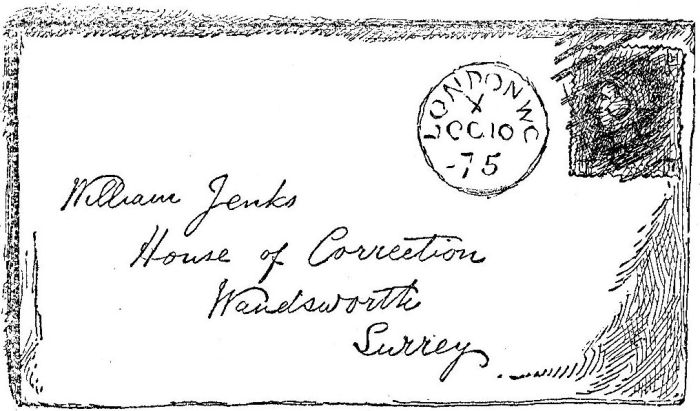
A letter was here—a letter ready for him to open.
He had heard that once in three months the Wandsworth prisoners were allowed to write and receive letters. This rule he had heard with indifference—in all his life he had never had a letter—what matter was it to him whoever else got them.
He knew how to read and write. Long ago, when a little lad, he had learned these accomplishments—he could also decipher the writing of other people, and spelt his own name now on the little oblong packet which had found its way into his cell.
Yes, it was a bonâ fide letter, it had a stamp on it, and the London post-mark. It was a bonâ fide letter, and his letter also—a letter directed to him. He gazed at it for a moment or two, then took it up and handled it carefully, and turned it round, and examined the back of it, and held it up to the light—then he put it down, and took a turn the length of his cell.
Unless we are quite dunned by creditors, and mean never to open anything that is sent to us by the post, we have a kind of interest in that sharp double knock, and a kind of pleasure in opening our various epistles.
However many we get, our pulses do beat just a quarter of a shade quicker as we unfasten the envelope. There is never any saying what news the contents may announce to us; perhaps a fortune, an advantageous proposal, the birth of a new relation, the death of an old friend, that appointment we never thought to have obtained, that prize we never hoped to have won: or perhaps, the loss of that prize, the filling up by another man of that appointment. A letter may bring us any possible or impossible news, therefore at all times these little missives, with the Queen’s head on them, are interesting.
But what if we are in prison, if we have just been confined for days and nights in the dark cell, fed on bread and water, sentenced to the horrors and silence of the tomb; if bad thoughts, and hardening thoughts, and maddening thoughts, if Satan and his evil spirits, have been bearing us company? What, if we are only addressed when spoken to at all as a number, and our human name, our Christian name, is never pronounced to us; and what if we have been going through this silent punishment, this unendurable confinement, for months, and we feel that it is right and just we should be so punished, right and just that all men should forsake us, and pass us by, and forget us—and all the time, though we know that justice is dealing with us, and we ought neither to cry out nor to complain, we know and feel also, that seven devils are entering into us, and our last state will be worse, far worse than our first?
And then, when we come back from the darkness, and feel again the blessed light of day, and the pure breeze of nature—coming in through the open window of our cell—is fanning our face, and though our spirit is still burning with mad and rebellious passions, our body is grateful for the relief of God’s own gifts of light and air, then we, who never before, never in our happiest days, received even a halfpenny wrapper’s worth through the post, see a letter—our first letter—pure, and thick, and white, awaiting us—a little dainty parcel bearing our baptismal name, and the name, unspotted by any crime, which our father bequeathed to us, lying ready for our acceptance?
Jenks had returned to his cell after all this severe punishment as hardened and bad a lad as ever walked—sullen, disobedient, defiant. The kind of boy whom chaplains, however tender-hearted, and however skilful in their modes of dealing with other men and boys, would regard as hopeless, as past any chance of reform.
He gazed at the letter, so unexpected, so welcome. At first he was excited, agitated, then he grew calm, a look of satisfaction changed utterly the whole expression of his face.
Somebody in that great, wide, outer world had not forgotten him. He sat down and ate his breakfast with appetite and relish; he could enjoy things again; he was still William Jenks to somebody—the boy felt human once more.
But he would not open his letter at once—not he. No irreverent fingers, no hasty fingers, should tear that precious envelope asunder.
When a man only gets a letter after three months of absolute silence he is never over-hasty in perusing its contents. The sweets of anticipation are very good, and must not be too quickly got over, and when a letter is once opened its great charm is more or less gone.
But the first letter of all, the first letter received in one’s entire life, and received in prison, must be made a very long pleasure indeed.
Jenks had hitherto found Sunday at Wandsworth the most unendurable day of the seven: the slow hours seemed really leaden-weighted.
On other days he had his oakum to pick, his routine of labour to get through—on this day, with the exception of chapel and meals, he had nothing whatever wherewith to wile away the long hours. True, the chaplain supplied him with books, but Jenks could not read well enough to take pleasure in reading for its own sake, and never was there a nature less studiously inclined than his.
So on Sunday he thought his darkest thoughts, and hatched his worst plots for the future, and prepared himself for the week of rebellion and punishment which invariably ensued.
But, on this Sunday all would be different, his letter would give him employment and satisfaction for many hours. He grudged the time he must spend in chapel, he wanted the whole day to hold his little missive, to gaze at the cover, to put it up to the light, to spell out the beloved direction, after a time to spell out the contents. First of all he must guess who sent it.
If it took him two hours, three hours, he must guess from whom it came.
Who could have written to him? He was popular in his way—he had too bright a manner, too merry a face, not to be that. He had a good many acquaintances, and friends and chums, lads who, with all their thieving propensities and ruffianly ways, would have shared their last crust with him, and one and all voted him a jolly good fellow.
But not one of these would write to him; he passed them over in silent contempt, at the bare possibility of their being either able or willing to write to him.
Jim Stokes, or Bob Allen, or any of those other fine daring young fellows, send him a letter! Send him too a letter looking like this, or directed like this! Why, this letter had a more genteel appearance than long ago the letters his sailor father had sent to his mother had worn. Was it likely that either Jim or Bob, or any of the companions of Jim or Bob, those ignorant lads who could hardly sign their names, would send him a letter like this? Had they wished it ever so much, the thing was impossible.
Could it be from Dick?
Well, that was certainly an unlikely guess. Dick, who was also in prison, able to write to another boy? He passed this thought by with a little laugh of derision.
His next idea was Flo.
He had been really in his own rough fashion fond of Flo, he had liked her pretty little face, and enjoyed in his flush and successful days bringing home dainties for her to cook for all their suppers. In spite of himself he had a respect for Flo, and though he might have loved her better if she had been willing to learn his trade, and help him in his thieving, yet the pluck she showed in keeping honest, roused a certain undefined respect within him.
But of all the ignorant children he ever met, he often said to himself that Flo was the most ignorant. Why she knew nothing of the world, nothing whatever.
How he had laughed at her ideas of earls and dukes and marquises—at her absurd supposition that she could be the queen.
Was there ever before in the records of man, a London child so outrageously ignorant as this same little Flo? She write him a letter! she had probably never heard of a letter.
Besides, even if she could write, would she? What were her feelings to Jenks now, that she should show him so great a kindness? He had broken his word to her, he had converted her brother, her much-loved, bright little brother, into a thief. By means of him he had tasted prison discipline, and was branded with a dishonest stain for ever. He remembered the reproach in her eyes when she stood in the witnesses’ box, and gave those funny little reluctant answers about him and Dick.
Even there too she had shown her ignorance, and proclaimed to the whole police-court that she was the greatest little simpleton that ever walked.
No, be she where she might now, poor child, it was his wildest guess of all to suppose that she could write to him.
Who wrote the letter? There was no one else left for him to guess, unless! but here his breath came quick and fast, the beads of perspiration stood on his forehead, he caught up the letter and gazed at it, a white fear stealing over him. No, thank God! He flung it down again with a gesture of intense relief—that was not her writing. She knew how to write, but not like that. She had not written to him. No, thank God!—he murmured this again fervently,—things were bad with him, but they had not come to such a dreadful pass as that. She thought him dead, drowned, come to a violent end; anyhow, done with this present life—she did not know that he, his honest, brave father’s only son, had stood in the prisoner’s dock, had slept in the dark cell, had worn the prisoner’s dress, with its mask, and distinguishing brand!
The chapel-bell rang; he started up, thrust his precious unopened letter into his pocket, adjusted his, mask, and walked with his fellow-prisoners in silent, grim, unbroken order into chapel.
Had any one looked beneath the mask, they would have seen, for the first time since perhaps his entrance into that prison, that the old sullen expression had left his face, that it wore a look of interest and satisfaction. He hugged his letter very close to his breast, and edged himself into the queer little nook allotted to him, from which he could just see the chaplain, and no one else. As a rule he either went to sleep in chapel, or made faces at the chaplain, or fired pellets of bread, which he kept concealed about him, at the other prisoners. On one occasion the spirit of all evil so far possessed him, that one of these, as hard as any shot, came with a resounding report on the mild nose of the then officiating chaplain, as he was fumbling for a loose sheet of his sermon, and nobody discovered that he was the offender. How often he had chuckled over this trick, over the discomfiture of the Rev. Gentleman, and the red bump which immediately arose on his most prominent feature; how often, how very often, he had longed to do it again. But to-day he had none of this feeling: if he had a thousand bread pellets ready, they might have lain quite harmless in his pocket. He was restless, however, and longed to get back to his cell, not to open his letter, he did not mean to do that until quite the evening, but to hold it in his hand, and turn it round and gaze at it; he was restless, and wished the hour and a quarter usually spent in chapel was over, and he looked around him and longed much to find somebody or something to occupy his attention, for Jenks never dreamed of joining in the prayers, or listening to the lessons.
The prison chapel is not constructed to enable the prisoners to gaze about them, and as the only individual Jenks could see was the chaplain, he fixed his eyes on him.
He did this with a little return of his old sullenness, for though he was a good man, and even Jenks admitted this, he was so tired of him. He had seen him so very, very often, in his cell and at chapel. After spending his life amid the myriad faces of London, Jenks had found the months, during which he had never gazed on any human countenance but that of his warder, the governor, chaplain, and doctor, interminably long.
He was sick of those four faces, sick of studying them so attentively, he knew every trick of feature they all possessed, and he was weary of watching them. But of all the four the face of the chaplain annoyed him most, perhaps because he had watched him so often in chapel. But to-day it might be a shade better to look at him than to gaze at the hard dead wood in front of his cell-like pew—so sullenly he raised his eyes to the spot where he expected to find him. He did so, then gave a start, and the sullenness passed away like a cloud; his lucky star was in the ascendant to-day—a stranger was in the chaplain’s place, he had a fresh face to study. He had a fresh face to study, and one that even in a London crowd must have occupied his attention. A man bordering on fifty, with grey hair, a massive chin, very dark, very deeply-set eyes, and an iron frame, stood before him.
Jenks hated effeminate men, so he looked with admiration at this one, and presently, the instincts of his trade being ever uppermost, began to calculate how best he could pick his pockets, and what a dreadful grip the stranger could give his—Jenks’—throat with those great muscular hands.
Suddenly he felt a grip somewhere else, a pang of remorse going right through his hardened heart. The strange chaplain, for half an instant, had fixed his deep-set eyes on him, and immediately it began to occur to Jenks what a shameful fellow he must be to allow such a man as that to speak without listening to him.
The new face was so pleasing, that for a moment or two he made an effort to rouse himself, and even repeated “Our Father” beneath his breath, just to feel what the sensation was like. Then old habits overcame him—he fell asleep.
He was in a sound, sweet sleep, undetected by the warder, when suddenly a movement, a breath of wind, or perhaps the profound silence which reigned for a moment through the little chapel, awoke him—awoke him thoroughly. He started upright, to find that the stranger was about to deliver his text.
This was the text:
“And he said, Who art thou, Lord? And the Lord said, I am Jesus, whom thou persecutest.”
The stranger’s voice was low and fervent; he looked round at his congregation, taking them all in, those old sinners, and young and middle-aged sinners, who, in the common acceptation of the term, were sinners more than other men.
He looked round at them, and then he gave it to them.
In that low fervent voice of his, his body bent a little forward, he opened out to them a revelation, he poured out on them the vials of God’s wrath. Not an idea had he of sparing them, he called things by their right names, and spoke of sin, such sin as theirs—drunkenness, uncleanness, thieving—as the Bible speaks of these things; and he showed them that every one of them were filthy and gone astray utterly.
When he said this—without ever raising his voice, but in such a manner, with such emphasis, that every word told home—he sketched rapidly two or three portraits for them to recognise if they would.
They were fancy portraits, but they were sketched from a thousand realities. The murderer’s last night in his cell—the drunkard with the legions of devils, conjured up by delirium tremens, clustering round him—the lost woman dying out in the snow. Then, when many heads were drooping with shame and terror, he suddenly and completely changed his tone.
With infinite pity in his voice he told them that he was sorry for them, that if tears of blood could help them, he would shed them for them.
Their present lives were miserable, degraded, but no words could tell what awaited them when God arose to execute vengeance.
On every man, woman, and child, that vengeance was coming, and was fully due. It was on its road, and when it overtook them, the dark cell, the whipping-post, solitary confinement for ever, would seem as heaven in comparison.
Then he explained to them why the vengeance was so sure, the future woe so inevitable.
“I am Jesus, whom thou persecutest.”
Did they know that? Then let them hear it now. Every time the thief stole, every time the drunkard degraded his reason, and sank below the level of the beasts; every time the boy and girl did the thousand and one little acts of deceit which ended so shamefully; then they crucified the Son of God afresh, and put him to an open shame.
It was Jesus of Nazareth whom they persecuted.
Would God allow such love as His Son’s love to be trampled on and used slightingly? No, surely. He had borne too long with them; vengeance was His, and He would repay.
When the minister had gone so far, he again changed his voice, but this time it changed to one of brightness.
He had not brought them to look at so dark a sight as their own sin and ruin without also showing them a remedy. For every one of them there was a remedy, a hiding-place from the wrath of God. Jesus, whom they persecuted, still loved them. Still loved them! Why, His heart was yearning over them, His pity, infinite, unfathomable, encompassing them. They were not too bad for Jesus—not a bit of it.
For such as them He died, for such as them He pleaded with His Father. If they came to Him—and nothing was easier, for He was always looking out for them—He would forgive them freely, and wash their souls in His blood, and make them ready for heaven. And while on earth He would help them to lead new lives, and walk by their sides Himself up the steep paths of virtue.
Such as they too wicked for Heaven? No, thank God. Jesus Himself led in the first thief into that holy place; and doubtless thousands such as he would yet be found around the throne of God!
There was dead silence when the preacher had finished; no eager shuffling and trooping out of chapel. The prisoners drew down their masks, and walked away in an orderly and subdued manner. No human eye could detect whether these men and women were moved by what they had heard or not. They were quieter than usual, that was all.
As for Jenks, he walked in his place with the others, and when he got to his cell, sat down soberly. His face was no longer dead and sullen, it had plenty of feeling, and excited feeling too. But the look of satisfaction he had worn when gazing at his letter was gone.
That parson had gone down straight, with his burning words, to the place where his heart used to be—had gone down, and found that same heart still there—nearly dead, it is true, but still there—and probed it to the quick.
He sat with his head buried in his hands, and began to think.
Old scenes and old memories rose up before the boy—pure scenes and holy memories. Once he had lisped texts, once he had bent his baby knees in prayer. How far off then seemed a prison cell and a criminal’s life!
Hitherto, ever since he had taken to his present career, he had avoided thought, he had banished old times. He had, even in the dark cell, kept off from his mental vision certain facts and certain events.
They were coming now, and he could not keep them off. O God! how his mother used to look at him, how his father used to speak to him!
Though he was a great rough boy, a hardened young criminal, tears rolled down his cheeks at the memory of his mother’s kiss. He wished that parson had not preached, he was thoroughly uncomfortable, he was afraid.
For the last year and more Jenks had made up his mind to be a thief in earnest. He called it his profession, and resolved to give up his life to it. The daring, the excitement, the false courage, the uncertainty, the hairbreadth escapes, all suited his disposition.
His prison episode had not shaken his resolve in the least. He quite determined, when the weary months of confinement were over, and he was once more free, to return to his old haunts and his old companions. He would seek them out, and expound to them the daring schemes he had concocted while in prison. Between them they would plan and execute great robberies, and never be taken—oh no. He, for one, had had his lesson, and did not need a second; happen what might, he would never again be taken. Not all the king’s horses, nor all the king’s men, should again lay hands on him, or come between him and his freedom.
It was nonsense to say that every thief knew what prison was, and spent the greater part of his time in prison! He would not be down on his luck like that! He would prosper and grow rich, and then, when rich, he might turn honest and enjoy his money.
This was his plan—all for the present life. He had never given the other life a thought. But now he did; now, for the first time, he reflected on that terrible thing for any unforgiven soul to contemplate—the wrath of God.
Some day, however successful he might be in this life, he must die, and his naked soul appear before God; and God would ask him so many things, such a piled-up account of sins he would have to lay to his charge. And his father and mother would look on and reproach him, and God would pass sentence on him—he could not escape. He had crucified the Son of God afresh, and put Him to an open shame!
Jenks was not ignorant, like Flo and Dick, he knew of these things. The thought in his mind became intolerable. He paced up and down his cell, and hailed with pleasure the welcome interruption of his Sunday dinner.
When it was finished, he again drew out his letter, hoping and wishing that the old feeling of satisfaction would return at sight of it. But it did not. Try as he might, it did not. He endeavoured to guess who sent it, but no fresh ideas would occur to him. He thought of Flo, and he thought of his mother—he fought against the thought of his mother, and endeavoured to push it away from him. But, struggle as he might, it would come back; and at last, in desperation, he opened the letter.
It was not a long letter when opened, but had appeared thick by reason of a little parcel it contained, a little parcel, wrapped in two or three folds of silver paper. Jenks looked at the parcel as it lay on his knee, then took it up and began to unfold it. His fingers trembled, he did not know why. He threw the parcel from him and spread out the letter to read. Not very much writing in it, and what there was, was printed in large round type. Motes began to dance before his eyes, he put down the letter, and again took up the parcel. This time he opened it, unwrapping slowly fold after fold of the soft paper. Two locks of hair fell out, a grey and a brown, tied together with a thread of blue silk. They dropped from Jenks’ fingers; he did not touch them. He gazed at them as they lay on the floor of his cell, the brown lock nearly hidden by the silver. A soft breeze came in and stirred them; he turned from them, gave them even a little kick away, and then, with a burning face, began to read his letter.
“Jenks,—
“I thot ’as yo’d like fur to no—yor mother ’ave furgiven yo, she nos as yo is a thif, and tho she may ’av freted a good bit at fust, she’s werry cherful now—she ’av the litel jackit, and trouses, and westkit, hal redy, as yo used to war wen a litel chap. She ’av them let hout hal rond, and they’l fit yo fine. She livs in the old place—wery butiful it his, and she ’av me, flo, livin’ wid ’er, and scamp to, we ’av livd yer hever sins yo and Dick was in prisin, and we both furgivs yo Jenks, wid hal our ’arts, and yor mother ses as yo is a comin’ bak wen the singin’ burds com, and the floers, and we’ll ’av a diner fur yo, and a welcom, and lov. yer mother don’t no as i is sendin’ this and i ’av kut orf a bit of ’er ’air, unknonst to ’er, and a bit of mi ’air to, widch shos as we thincs of yo, and furgivs yo; and Jenks, I wrot this mi own self, miss mary shoed me ’ow, and i ’av a lot mor in mi ’art, but no words, on’y god lovs yo, yor fond litel—
“flo.
“miss mary, she put in the stops.”
“I am Jesus of Nazareth, whom thou persecutest—it is hard for thee to kick against the pricks.”
This latter part of the text came back also to the boy’s memory; he bent his head over the odd little letter and saturated it with tears. He snatched up the two locks of hair and covered them with kisses.
His mother had forgiven him—his mother loved him.
She knew he was a thief, and she loved him.
How he had tried to keep this knowledge from her, how he had hoped that during these past three years she had supposed him dead! Her only son, and she a widow, dead! Far better—far, far better, than that she should believe him to be a thief!
He recalled now the last time he had seen her—he recalled, as he had never dared to do hitherto, the history of that parting. He had been wild for some time, irregular at school, and in many ways grieving his parents’ hearts; and his father, before he started on that last voyage, had spoken to him, and begged him to keep steady, and had entreated him, as he loved his mother, as he loved him, his father, as he loved his God, to keep away from those bad companions who were exercising so hateful an influence on his hitherto happy, blameless life. And with tears in his eyes, the boy had promised, and then his brave sailor father had kissed him, and blessed him, and gone away never to return again. And for a time Jenks was steady and kept his word, and his mother was proud of him, and wrote accounts, brilliant, happy accounts, of him to his father at sea. But then the old temptations came back with greater force than before, and the promise to his father was broken and forgotten, and he took really to bad ways.
His mother spoke to him of idleness, of evil companions, but she never knew, he felt sure, how low he had sunk, nor at last, long before he left her house, that he was a confirmed thief. He was a confirmed thief, and a successful thief, and he grew rich on his spoils.
One evening, however, as he expressed it, his luck went against him. He had been at a penny gaff, where, as usual, he had enriched himself at the expense of his neighbours. On his way home he saw a policeman dodging him—he followed him down one street and up another. The boy’s heart beat faster and faster—he had never been before a magistrate in his life, and dreaded the disgrace and exposure that would ensue. He managed to evade the policeman, and trembling, entered his home, and stole up the stairs, intending to hide in his own little bed-room. He reached it, and lay down on his bed. There was only a thin canvas partition between his tiny room and his mother’s. In that room he now heard sobs, and listening more intensely, heard also a letter being read aloud. This letter brought the account of his father’s death—he had died of fever on board ship, and been buried in the sea. His last message, the last thing he said before he died, was repeated in the letter.
“Tell wife, that Willie will be a comfort to her; he promised me before I went away to keep a faithful and good lad.”
The boy heard so far, then, stung with a maddening sense of remorse and shame, stole out of the house as softly as he had entered it—met the policeman at the door, and delivered himself into his hands; by him he was taken to the police-station, then to prison for a day or two.
But when he was free he did not return home, he never went home again. His mother might suppose him dead, drowned, but never, never as long as she lived should she know that he was a thief. For this reason he had given himself up to the policeman; to prevent his entering that house he had met him on the threshold and delivered himself up. And his only pure pleasure during the past guilty years was the hope that his mother knew nothing of his evil ways.
But now she did know, the letter said she did know. What suffering she must have gone through I what agony and shame! He writhed at the thought.
Then a second thought came to him—she knew, and yet she forgave him—she knew, and yet she loved him.
She was preparing for his return, getting ready for him.
Now that she was acquainted with the prison in which he was wearing out his months of captivity, perhaps she would even come on the day that captivity was over, perhaps she would meet him at the prison gates, and take his hand, and lead him home to the little old home, and show him the clothes of his innocent, happy childhood, ready for him to put on, and perhaps she would kiss him—kiss the face that had been covered with the prisoner’s mask—and tell him she loved him and forgave him! Would she do this, and would he go with her?
“I am Jesus whom thou persecutest.”
Back again came the sermon and its text to his memory.
“Every time you commit a theft, or even a much smaller sin, you persecute Jesus,” said the preacher.
Jenks had known about Jesus, but hitherto he had thought of Him simply as an historical character, as a very good man—now he thought of Him as a man good for him, a man who had laid down His life for him, and yet whom he persecuted.
If he went on being a thief he would persecute Jesus—that was plain. And little Flo had said in her letter that God loved him, God and Jesus loved him. Why, if this was so, if his mother loved him, and God loved him, and the old little bright home was open to him, and no word of reproach, but the best robe and the fatted calf waiting for him, would it be wise for him to turn away from it all? to turn back into that dark wilderness of sin, and live the uncertain, dangerous life of a thief, perhaps be unlucky, and end his days in a felon’s cell? And when it all was over—the short life—and no life was very long—to feel his guilty soul dragged before God to receive the full vials of the wrath of Him whom he had persecuted.
He was perplexed, overcome, his head was reeling; he cast himself full length on the floor of his cell—he could think no longer—but he pressed the grey lock and the brown to his lips.
Chapter Eighteen.
God Calls His Little Servant.
At last, carefully as they were all worked, and tedious as the job was, the jacket, vest, and trousers were finished. They were brushed, and rubbed with spirits of turpentine to remove every trace of grease, and then wrapped up carefully in a white sheet, with two pen’orth of camphor to keep off the moths, and finally they were locked up in Mrs Jenks’ box along with her Sunday gown, shawl, and bonnet.
Flo watched these careful preparations with unfeigned delight. She was quite as sure now as Mrs Jenks that the lad for whom such nice things were ready would come back in the spring. Every word of the letter her patient little fingers had toiled over had gone forth with a prayer, and there was no doubt whatever in her mind that the God who had given her her bed, and taken care of her, would do great things for Jenks also.
About this time, too, there actually came to her a little letter, a funnily-printed, funnily-worded little letter from Dick himself, in which he told her that he was learning to read and write, that his first letter was to her, that he was happy and doing well, and that never, no never, never, never would he be a thief any more; and he ended by hoping that when the spring came, Flo would pay him a little visit!
When this letter was shown to Miss Mary and to the widow, they agreed that when the spring came this should be managed, and not only Flo, but Miss Mary herself, and the widow, and Scamp, and perhaps the widow’s lad, should pay Dick a visit. And Flo pictured it all often in her mind, and was happy.
Her life was very bright just then, and in the peaceful influence of her pleasant home she was growing and improving in body and mind. She could read and write a little, she could work quite neatly, and was very tidy and clever about the various little household works that Mrs Jenks taught her; and Miss Mary smiled at her, and was pleased with her; and thought what a nice little servant she would make when Annie was married; and Flo looked forward to this time with a grave, half-wistful pleasure which was characteristic of her, never in her heart forgetting that to be a good earthly servant she must be God’s servant first.
Yes, her cup of happiness was full, but it was an earthly cup, and doubtless her Heavenly Father felt He could do better for her—anyhow the end came.
It came in this way. Since Flo arrived and Mrs Jenks had quite finished making preparations for her lad’s return, she had set her sharp wits to work, and discovered quite a famous receipt for getting up fine linen.
The secret of this receipt all lay in a particular kind of starch, which was so fine, pure, and excellent, so far beyond Glenfield’s Starch, or anybody else’s starch, that even old lace could be stiffened with it, instead of with sugar. Mrs Jenks made this starch herself, and through Miss Mary’s aid she was putting by quite a nice little supply of money for Willie when he came home—money honestly earned, that could help to apprentice him to an honest trade by and by.
But there was one ingredient in the starch which was both rare and expensive, and of all places in the world, could only be got good in a certain shop in Whitechapel Road. Mrs Jenks used to buy it of a little old Jew who lived there, and as the starch was worthless without it, she generally kept a good supply in the house.
No Londoner can forget the severe cold of last winter, no poor Londoner can forget the sufferings of last winter. Snow, and frost, and hail, bitter winds, foggy days, slippery streets, every discomfort born of weather, seemed to surround the great metropolis.
On one of these days in February, Mrs Jenks came home quite early, and as she had no more charing to get through, she built up a good fire, and set to work to make a fresh supply of starch. Flo sat at one side of her and Scamp at the other, both child and dog watching her preparations with considerable interest. She had set on a large brass pan, which she always used on these occasions, and had put in the first ingredients, when, going to her cupboard, she found that very little more than a table-spoonful of the most valuable material of all was left to her.
Here was a state of affairs! She wrung her hands in dismay; all the compound, beginning to boil in the brass pan, would be lost, and several shillings’ worth thrown away.
Then Flo came to the rescue. If Mrs Jenks stayed to watch what was boiling, she—Flo—would start off at once to Whitechapel Road, and be back with the necessary powder before Mrs Jenks was ready for it.
The widow looked out of the window, where silent flakes of snow were falling, and shook her head—the child was delicate, and the day—why, even the ’buses were hardly going—it could not be!
But here Flo overruled her. She reminded her of how all her life she had roughed it, in every conceivable form, and how little, with her thick boots on, she should mind a walk in the snow. As to the ’buses, she did not like them, and would a thousand times rather walk with Scamp. Accordingly, leading Scamp by his collar and chain, which Miss Mary had given him, she set off.
Mrs Jenks has often since related how she watched her walk across the court, such a trim little figure, in her brown wincey dress and scarlet flannel cloak—another gift of Miss Mary’s—and how, when she came to the corner, she turned round, and, with her beautiful brown eyes full of love and brightness, kissed her hand to the widow—and how Scamp danced about, and shook the snow off his thick coat, and seemed beside himself with fun and gaiety of heart.
She did not know—God help her—she could not guess, that the child and dog were never to come back.
The snow fell thickly, the wind blew in great gusts, the day was a worse one than Flo had imagined, but she held on bravely, and Scamp trotted by her side, his fine spirits considerably sobered down, and a thick coating of snow on his back. Once or twice, it is true, he did look behind him piteously, as much as to say, “What fools we both are to leave our comfortable fireside,” but he flinched no more than his little mistress, and the two made slow but sure progress to Whitechapel Road.
They had gone a good way, when suddenly Flo remembered a famous short cut, which, if taken, would save them nearly a mile of road, and bring them out exactly opposite the Jew’s shop. It led through one of the most villainous streets in London, and the child forgot that in her respectable clothes she was no longer as safe as in the old rags.
She had gone through this street before—she would try it again to-day!
She plunged in boldly. How familiar the place looked! not perhaps this place,—she had only been here but once, and that was with her mother,—but the style of this place.
The bird-fanciers’ shops, the rags-and-bones’ shops, the gutter children, and gutter dogs, all painfully brought back her old wretched life. Her little heart swelled with gratitude at the thought of her present home and present mercies. She looked round with pity in her eyes at the wretched creatures who shuffled, some of them drunken, some starving, some in rags, past her.
She resolved that when she was a woman she would work hard, and earn money, and help them with money, and if not with money, with tender sympathy from herself, and loving messages from her Father in heaven.
She resolved that she, too, as well as Miss Mary, would be a sister of the poor.
She was walking along as fast as she could, thinking these thoughts, when a little girl came directly in her path, and addressed her in a piteous, drawling voice.
“I’m starving, pretty missy; give me a copper, in God’s name.”
Flo stopped, and looked at her; the child was pale and thin, and her teeth chattered in her head. A few months ago Flo had looked like this child, and none knew better than she what starvation meant. Besides the five shillings Mrs Jenks had given her to buy the necessary powder, she had sixpence of her own in her little purse; out of this sixpence she had meant to buy a bunch of early spring flowers for her dear Miss Mary’s birthday, but doubtless God meant her to give it to the starving child.
She pulled her purse out of her pocket, and drawing the sixpence from it, put it into the hands of the surprised and delighted little girl.
“God bless yer, Missy,” she said in her high, shrill tones, and she held up her prize to the view of two or three men, who stood on the steps of a public-house hard by. They had watched the whole transaction, and now three of them, winking to their boon companions, followed the child and dog with stealthy footsteps.
Flo, perfectly happy, and quite unconscious of any danger, was tripping gaily along, thinking how lucky it was for her that she had remembered this short cut, and how certain she was now to have the powder back in time for Mrs Jenks, when suddenly a hand was passed roughly round her waist, while a dexterous blow in the back of her neck rendered her unconscious, and caused her to fall heavily to the ground.
The place and the hour were suitable for deeds of violence. In that evil spot the child might have been murdered without any one raising a finger in her behalf. The wicked men who had attacked her seemed to know this well, for they proceeded leisurely with their work. One secured the dog, while another divested Flo of her boots, warm cloak, and neat little hat. A third party had his hand in her pocket, had discovered the purse, and was about to draw it out, whereupon the three would have been off with their booty, when there came an interruption.
An unexpected and unlooked-for friend had appeared for Flo’s relief.
This friend was the dog, Scamp. We can never speak with certainty as to the positive feelings of the dumb creatures, but it is plain that ever since Flo turned into this bad street Scamp—as the vulgar saying has it—smelt a rat. Perhaps it called up too vividly before his memory his old days with Maxey—be that as it may, from the time they entered the street he was restless and uneasy, looking behind him, and to right and left of him, every moment, and trying by all means in his power to quicken Flo’s movements. But when the evil he dreaded really came he was for the first instant stunned, and incapable of action: then his perceptions seemed to quicken, he recognised a fact—a bare and dreadful fact—the child he loved with all the love of his large heart, was in danger.
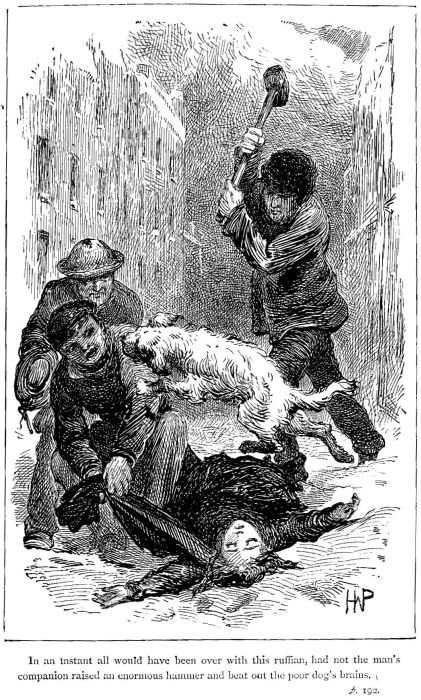
As he comprehended this, every scrap of the prudent and life-preserving qualities of his cur father and mother forsook the dog, and the blue blood of some unknown ancestor, some brave, self-sacrificing Saint Bernard, flowed through all his veins: his angry spirit leaped into his eyes, and giving vent to a great howl of rage and sorrow, he wrenched his chain out of the man’s hand who was trying to hold him, and springing on the first of the kneeling figures, fastened his great fangs into his throat. In an instant all would have been over with this ruffian, for Scamp had that within him then which would have prevented his ever leaving go, had not the man’s companion raised an enormous sledge hammer he held in his hand, and beat out the poor animal’s brains on the spot. He sank down without even a sigh at Flo’s feet, and the three villains, hearing from some one that the police were coming, disappeared with their booty, leaving the unconscious child and dead dog alone.
The little crowd which had surrounded them, at tidings of the approach of the police, dispersed, and the drifting hail and snow covered the dog’s wounds and lay on the child’s upturned face.
Just then a fire-engine, drawn by horses at full gallop, came round the corner, and the driver, in the fast-failing light, never, until too late, perceived the objects in his path. He tried then to turn aside, but one heavy wheel passed partly over the child’s body. The firemen could not stop, their duty was too pressing, but they shouted out to the tardy policemen, who at last appeared in view.
These men, after examining Flo, fetched a cab, and placing her in it, conveyed her to the London Hospital, and one, at parting, gave Scamp a kick.
“Dead! poor brute!” he said, and so they left him.
They left him, and the pure snow, falling thickly now, formed a fit covering for him, and so heavily did it lie over him in the drift into which he had fallen, that the next day he was shovelled away, a frozen mass, in its midst, and no mortal eye again saw him, nor rough mortal hand again touched him.
Thus God Himself made a shroud for His poor faithful creature, and the world, did it but know it, was the poorer by the loss of Scamp.
Chapter Nineteen.
Queen Victoria and Flo.
Flo was carried into the Buxton Ward for children.
They laid her in one of the pretty white cots, close to a little girl of three, who was not very ill, and who suspended her play with her toys to watch her.
Here for many hours she lay as one dead, and the nurses and doctors shook their heads over her—she had no broken bones, but they feared serious internal injuries.
Late in the evening, however, she opened her eyes, and after about an hour of confused wandering, consciousness and memory came fully back.
Consciousness and memory, but no pain either of mind or body. Even when they told her her dog was dead, she only smiled faintly, and said she knew ’ee’d give ’is life fur ’er! and then she said she was better, and would like to go home.
They asked her her name, and the address of her home, and she gave them both quite correctly, but when they said she had better stay until the morning, and go to sleep now, she seemed contented, and did sleep, as calmly as she had done the night before, in her own little bed, in Mrs Jenks’ room.
The next morning she again told them she was better, and had no pain, but she said nothing now about going home: nor when, later in the day, Mrs Jenks, all trembling and crying, and Miss Mary, more composed, but with her eyes full of sorrow, bent over her, did she mention it.
She looked at them with that great calm on her face, which nothing again seemed ever to disturb, and told them about Scamp, and asked them if they thought she should ever see her dog again.
“I don’t know wot belief to hold about the future of the dumb creatures,” said little Mrs Jenks, “but ef I was you, I’d leave it to God, dearie.”
“Yes,” answered Flo, “I leaves heverythink to God.”
And when Miss Mary heard her say this, and saw the look on her face, she gave up all hope of her little servant.
She was going to the place where His servants shall serve Him.
Yes, Flo was going to God.
The doctors knew it—the nurses knew it—she could not recover. What a bright lot for the little tired out London child! No more weary tasks—no more dark days—no more hunger and cold. Her friends had hoped and planned for a successful earthly life for her—God, knowing the uncertainty of all things human, planned better. He loved this fair little flower, and meant to transplant it into the heavenly garden, to bloom for ever in His presence.
But though Flo was not to recover she got better, so much better, for the time at least, that she herself thought she should get quite well; and as from the first she had suffered very little pain, she often wondered why they made a fuss about her, why Mrs Jenks seemed so upset when she came to see her, why the nurses were so gentle with her, and why even the doctors spoke to her in a lower, kinder tone than they did to the other children. She was not very ill; she had felt much, much worse when she had lain on the little bed that God had lent her—what agony she had gone through then! and now she was only weak, and her heart fluttered a good deal. There was an undefined something she felt between her and health, but soon she must be quite well.
In the pleasant Buxton Ward were at this time a great many little children, and as Flo got better and more conscious, she took an interest in them, and though it hurt her and took away her breath to talk much, yet her greatest pleasure was to whisper to God about them. There was one little baby in particular, who engrossed all her strongest feelings of compassion, and the nurses, seeing she liked to touch it, often brought it, and laid it in her cot.
Such a baby as it was! Such a lesson for all who gazed at it, of the miseries of sin, of the punishment of sin!
The child of a drunken mother, it looked, at nine months old, about the size of a small doll. Had any nourishment been ever poured down that baby’s throat? Its little arms were no thicker than an ordinary person’s fingers—and its face! Oh! that any of God’s human creatures should wear the face of that baby!
It was an old man’s face, but no man ever looked so old—it was a monkey’s face, but no monkey ever looked so devoid of intelligence. All the pain of all the world seemed concentrated in its expression; all the wrinkles on every brow were furrowed on its yellow skin.
It was always crying, always suffering from some unintelligible agony. (The writer saw exactly such a baby at the Evelina Hospital a short time ago.) The nurses and doctors said it might recover, but Flo hoped otherwise, and her hope she told to God.