"A Story of City By-Ways" (continued 2)
Reading edition
An unwonted excitement had taken possession of the little girl, the joy of a fresher, brighter life than she had hitherto ever felt, drove the blood quickly through her languid veins, she stood by her companion’s side, her large bonnet thrown back from her forehead, her cheeks flushed, her eyes quite bright with interest and pleasure.
Perhaps to her alone the beautiful, wonderful sight came without alloy—she had no high stakes at issue, nothing either to gain or to lose.
But when the race was over, and the name of Galopin, the winning horse, was in everybody’s mouth, and men, some pale and some flushed with their losses, turned broken-hearted away; and men, some pale and some ruddy with their gains, joined in the general cheer; then Flo began again to think of and miss her absent companions. Already vast numbers of tramps were returning to London—the kind little woman by her side had also expressed a wish to go, but nowhere were Jenks and Dick in sight.
They had promised to meet her in the evening, but she could neither ask her companion to wait until then, nor wait herself alone in the midst of the vast, unruly multitude.
“I will see you safe as far as our roads lie together,” said the little woman, and Flo, without a word, but no longer with an exultant, joyful heart, accompanied her.
They walked slowly, keeping close to the other walkers, but still a little apart, and by themselves. Now and then a good-natured neighbour gave them a lift, but they walked most of the way.
“’As you found ’im whom you loves, mum?” questioned Flo once; but the little woman shook her head, and shook it so sorrowfully that Flo ventured to say no more.
It was quite dusk when they got to London, or rather to the outskirts of London, for they went very slowly, and often paused on the road.
By this time they were quite a vast army, fresh tramps arriving to swell their ranks each moment.
Here too they were met by numbers of Londoners who had not gone to the races, but who now thronged the footways to see them return.
At one particular angle of the road these crowds congregated so thickly that for a few moments there was quite a block, and neither multitude could proceed.
As Flo stood by her companion’s side, two boys pushed quickly and roughly against her.
They did not recognise or look at her, but she did them—they were Jenks and Dick. She was quite overjoyed at seeing them so near her, but how funny they looked! or rather, how funny Dick looked! His face was blackened, and he had on a false nose; he carried a little fiddle which he capered about with, and pushing his way fearlessly into the very heart of the throng, made altogether such a droll appearance that many people looked at him, and laughed very heartily, and shied him halfpence Jenks, on the contrary, was grave and sober, no one minding him.
But suddenly, while all eyes and tongues were eagerly greeting some fresh arrivals, Flo observed Dick give a red-faced, stout old gentleman a tremendous push, and quick as lightning Jenks had his hand in the old man’s pocket, and out had come his purse and gold watch.
And before the terrified and astonished child had time to utter an exclamation, or to draw a breath, Police Constable 21 B. laid his hand heavily on Jenks’ shoulders, and with the other drawing Dick towards him, informed them both that they were his prisoners.
Chapter Eight.
A Ghost in the Cellar.
In the confusion that immediately ensued, Flo found herself torn away from her kind companion, and brought very near to Police Constable 21 B. and his charge. Like most children of her class she had been taught to consider policemen very dreadful people, but she had no fear of this one now: her whole desire was to save Dick. She went boldly up and laid her little dirty hand on the great tall man’s arm.
“Please—please,” said Flo, “it ain’t Dick as tuk them things. Indeed I thinks as Dick is an honest boy.”
“Oh! yes, and I suppose you are an honest girl,” said the policeman, looking down with some contempt at the queer disreputable-looking little figure. “Tell me now, what do you know about Dick? and which of the two is Dick to begin with?”
“That ’ere little chap wot yer ’ave such a grip of,” said Flo, “that’s Dick, and I be ’is sister, I be.”
“Oh! so you are his sister. And what’s the name of the big fellow? you are his sister too?”
“No, I ain’t,” said Flo, “I ain’t that, but ’ee lives wid Dick and me.”
“He does—does he? Perhaps you saw what he did just now?”
Flo had seen—she coloured and hesitated.
“You need not speak unless you wish to,” said the policeman more kindly, “but I perceive you know all about these boys, so you must appear as witness. See! where do you live?”
“Cellar number 7, Duncan Street, Saint Giles,” said Flo promptly.
“Ah!” said the policeman, “I thought those cellars was shut up. They ain’t fit for pigs. Well, my dear, ’tis a nice-sounding, respectable address, and I’ll serve you a notice to-morrow to appear as witness. Don’t you go hiding, for wherever you are I’ll find you. On Thursday morning at 10 o’clock at Q— Police-Station.” And nodding to Flo, he walked off, bearing his sullen, ashamed, crest-fallen prisoners with him.
“Come ’ome wid me, dear,” said a poor miserable-looking neighbour, an occupant of another Duncan Street cellar. “Come ’ome wid me,” she said, touching the dazed, stunned-looking child; “I’ll take care of yer the rest of the way,” and she took her hand and led her out of the crowd.
“There now,” said the woman kindly, “don’t yer fret, dearie—it ain’t so bad, and it won’t be so bad. Dick, ’ee’ll on’y get a month or two at the ’formatary, and t’other chap a bit longer, and hout they’ll come none the worse. Don’t yer fret, dearie.”
“No, ma’am,” answered Flo with a little smile, “I ain’t frettin’.” Nor was she exactly. She had an awful vision before her of mother’s dead face, that was all. During the rest of the long walk home that patient, tired face was before her. She was not fretting, she was too stunned as yet—that would come by and by.
Her neighbour tried to make her talk, tried to smooth matters for her, but they could not be smoothed, nothing could soften the awful fact that Dick was going to prison, that he had broken his word to his dying mother. It was quite dusk, past 9 o’clock, when they reached Duncan Street, and the cellar door of number 7, which the children had fastened when they had started so light-hearted and happy for the Derby the day before, was now open. Flo hardly noticed this. She ran down, eager to throw her arms round Scamp’s neck, and weep out her heart with his faithful head on her bosom.
“But—what had happened?”
Flo expected to hear his eager bark of welcome the moment she entered the cellar, but there was no sound. She called to him, no answer. She struck a match and lit the tallow candle,—Scamp’s place was empty, Scamp was gone. She stooped down and examined the spot carefully. If he had freed himself there would have been some pieces of the rope hanging to the table, but no, all trace of it was gone.
It was quite plain, then, some one had come and stolen Scamp, some one had come meanly while they were away and carried him off—he was gone. One extra drop will overflow a full cup, and this extra trial completely upset the little tired, sad child. She sat down on the floor, that damp wretched floor, surely an unfit resting-place for any of God’s creatures, and gave way to all the agony of intense desolation.
Had the dog been there he would have soothed her: the look in his eyes, the solemn slow wag of his unwieldy tail, would have comforted her, would have spoken to her of affection, would have prevented her feeling utterly alone in the world.
And this now was Flo’s sensation.
When this awful storm of loneliness comes to the rich, and things look truly hard for them, they still have their carpeted floors, and easy-chairs, and soft beds, and though at such times they profess not to value these things in the least, yet they are, and are meant to be, great alleviations.
Only the poor, the very, very poor know what this storm is in all its terrors, and the desolate little child sitting there in this dark cellar felt it in its full power that night. Dick was gone from her, Dick was a thief, he was in prison, gone perhaps never to come back—and Jenks was gone, he had done wrong and tempted Dick, and broken his word to her, so perhaps it was right for him to go—and Scamp, dear Scamp, who had done no harm whatever, was stolen away.
Yes, she was alone, alone with the thought of her mother’s face, all alone in the damp, dark, foul cellar, and she knew nothing of God.
Just then a voice, and a sweet voice too, was heard very distinctly at the mouth of the cellar.
“Sing glory, glory, glory,” tuned the voice.
“Janey,” said Flo, starting to her feet and speaking eagerly.
“Oh dear!” said the voice at the cellar door, “ain’t you a fool to be settin’ there in the dark. Strike a light, do—I’m a comin’ down.”
Flo struck a match, and lit a small end of tallow candle, and the lame girl tumbled down the ladder and squatted on the floor by her side.
“Oh dear!” she said, “ain’t this a stiflin’ ’ole? why ’tis worse nor ’ourn.”
“Wot’s ‘Read and Pray,’ Janey?” asked Flo.
“My!” said Janey, “ef yer ain’t a real worry, Flo Darrell. Read—that’s wot the Board teaches—and pray—Our—Father—chart—’eaven—that’s pray.”
“And ‘Sing Glory,’ wot’s that?” continued Flo.
“That!” laughed Janey, “why that’s a choros, you little goose. Niggers ’ave alwis choroses to their songs—that ain’t nothink else.”
“Well, ’tis pretty,” sighed Flo, “not that I cares for nothink pretty now no more.”
“Oh! yes yer will,” said Janey with the air of a philosopher. “Yer just a bit dumpy to-night, same as I wor wen I broke my leg, and I wor lyin’ in the ’orspital, all awful full o’ pain hup to my throat, but now I ’as on’y a stiff joint, and I doesn’t mind it a bit. That’s just ’ow you’ll feel ’bout Dick by and by. ’Ee’ll be lyin’ in prison, and you won’t care, no more nor I cares fur my stiff joint.”
Flo was silent, not finding Janey’s conversation comforting.
“Come,” said that young person after a pause, “I thought you’d want a bit o’ livenin’ hup. Wot does yer say to a ghost story?”
Flo’s eyes, slightly startled, were turned on her companion.
“As big a ghost story as hever was got up in any gaff,” continued Janey, her naughty face growing full of mischief, “and it ’appened in this ’ere cellar, Flo.”
“Oh! it worn’t mother come back, wor it?” asked Flo. “Just you wait heasy. No, it worn’t yer mother, ef you must know, but as real a ghost as hever walked fur all that.”
“Tell us,” said Flo, really roused and interested.
“Oh, you wants fur to know at last! Well, I must be paid. I’m poor and clemmed, and I can’t tell my tale fur nothink, not I.”
“’Ow can I pay you, Janey?”
“Oh, yer can, heasy enough. Why mother said as yer sold quite a ’eap o’ dolls to-day at the races, there! I’ll tell ’bout the ghost fur a penny, no fur three ha’pence—there!”
“Well, tell away,” said Flo, throwing the coins into her companion’s lap.
Janey thrust them into her mouth, then taking them out rubbed them bright with her pinafore, and held them firmly in her bony little hand.
“Pease puddin’ fur the ha’penny,” she said, “meat and taters fur the penny—’tis real mean o’ yer not to make it tuppence. Now I’ll begin. Were’s that ere dawg? were’s that hawful, ’owlin’ dawg?”
“Oh! I don’t know,” said Flo, “I don’t know nothink ’bout my dear Scamp.”
“Oh yes, ’ees dear Scamp to be sure,” said Janey. “Well, I’ll tell yer ’bout Scamp, and hall I ’opes is that we may never lay heyes on ’im no more.”
“Why?” asked Flo.
“There! I’m a comin’ to wy. Last night wen you, and Dick, and Jenks, and mother was orf to the Derby, and I mad like at bein’ left, which mother would do ’cause I was lame, I came hover and sat close to the cellar, a-listenin’ to Scamp, who was ’owlin’ real orfle, and I thought as it ’ud be a lark to go down into the cellar, fur I knew he wor tied, and hanger ’im a bit, and I tried the door, but it wor locked as firm as firm, so arter a bit I went away, and I got a little stool and sat up on the ground houtside our cellar, and there I dropped orf asleep. And wen I ’woke it wor dark, and on’y the ‘twinkle, twinkle, little stars’ hout, and there wor a noise, and I looked, and hout o’ your cellar, as was locked as firm as no one could move it, wor a man’s ’ead a comin’—a man wid a round ’ead, and thick body, and bandy legs, and in ’is arms, a ’owlin’ and a struggling that ’ere blessed dawg.”
“Oh! the willan!” said Flo. “’Ee stole my dawg. Did yer foller ’im, Janey?”
“No, I didn’t,” said Janey; “I foller ’im—I’d like it. Wy, Flo Darrell, ’ee worn’t a man at all. ’Ow was a man in yer locked hup cellar? No, ’ee wor a ghost—that’s wot ’ee wor. And Scamp ain’t a real dawg, but a ghost dawg, and yer well rid o’ ’im, Flo Darrell.”
Chapter Nine.
Flo in the Witness-Box.
A small knot of policemen stood outside Q— Police-Court. They chatted and talked one to another, now and then alluding to the different cases to be tried that day, now and then dwelling on the ordinary topics of the times, now and then, too, speaking to a companion of home interests, and home, and personal hopes and fears.
For these stalwart-looking myrmidons of the law are just human beings like the rest of mankind, and they are quite capable now and then even of feeling and showing pity for a prisoner.
“Any cases of interest coming on to-day?” asked a young policeman of constable 21 B.
“Nothing of moment—a few thefts committed on the Derby Day. By the way, I have just brought in the drollest figure of a child to appear as witness in one of these cases.”
Just then a little woman in a black dress, black, tight-fitting bonnet, and black veil, came up timidly to the constable and asked if she might see the trials.
“Certainly, missis; you have nothing to do but to walk in. Stay, I will show you the way to the court. May I ask if there is hany particular case as you is wanting to hear?”
“Not—not—that is, I am not a witness,” replied the little woman, whose lips trembled. “I have a curiosity to see the proceedings.”
“Well, ma’am, the affairs coming on are mostly hacts of robbery committed on the Derby day—but some of them may interest you. Walk this way, ma’am,” and the constable preceded the little woman into the court.
“There,” he said kindly, seeing that for some reason she appeared a good deal either upset or excited, “you need not stand where the crowd are, you may go up and seat yourself on that bench where the witnesses be. You’ll be more quiet and comfortable hup there, and will see heverything.”
“Thank you,” replied the little woman, and she placed herself on the extreme edge of the witnesses’ bench.
There was a case then on hand, one of those sad cases which police-courts see so many of. A woman had been brought up to be tried for that sin which, more than any other, blights homes, ruins children, spreads destruction through the land, sends souls to hell,—she was accused of drunkenness and disorderly conduct.
She stood in the prisoner’s dock with a sullen, bleared, indifferent face, her half-dead, listless eyes gazing vacantly at the magistrate. She had appeared in that court charged with the same offence forty times.
Mr Vernon, the gentleman before whom she was accused, asked her what she had to say for herself. Even at this question the indifferent countenance never woke into life.
“Nothing,” she answered listlessly, for the love of strong drink had killed all other love in that woman’s breast. She hardly listened as Mr Vernon addressed her in a few solemn but kindly words, and when her sentence—a month at Wandsworth with hard labour—was pronounced, received it with the same stoical indifference.
Then two boys were led in by the jailor, and constable 21 B. appeared as the first witness against them. As he passed into his place in the witnesses’ box he gave the little woman in black a nudge and an intelligent look, which would have told her, even if she had not known it before, that one of the Derby robbery cases had come on. Through her thick veil she looked at the two lads; one hung down his face, but the other gazed about him, apparently untroubled and unashamed. This hardened expression on the elder boy’s face seemed to cause her much pain, she turned her head away, and some tears fell on her hands. And yet, could she but have seen into their hearts, she would have perceived something which would have kindled a little hope in her soul.
Each boy, standing in this dreadful position, thought of his mother.
Dick, with that sea of faces about him, with the eyes of the judge fixed on him, felt that the memory of his mother was the hardest thing of all to bear, for the conscience of the child who had stood out against temptation for so long was by no means yet hardened, and though he knew nothing of God, his mother’s memory stood in the place of God to him. So the most ignorant among us have a light to guide us. Let us be thankful if it is a star so bright as that of mother’s love. For, strange to say, the older lad, the boy who stood in the dock with that brazen, unabashed face, the clever, accomplished London thief, who though not unknown to the police, had hitherto by his skill and cunning almost always escaped the hands of justice, he too, down deep in his heart of hearts, thought of his mother; he took one quick, furtive glance around as if to look for her, then, apparently relieved, folded his arms and fixed his bold eyes on Mr Vernon. Then the trial, in the usual form in which such trials are conducted in police-courts, went on. The prisoners’ names and ages were first ascertained.
“William Jenks, aged fourteen; Richard Darrell, aged ten,” sounding distinctly in the small room.
Then Police Constable 21 B. identified the boys as the same whom he had caught in the act of removing a gold watch and purse from a gentleman’s pocket in the midst of the crowds who thronged the streets on Tuesday. He described very accurately the whole proceedings, stating how and why his suspicions had been aroused—how he had dodged the boys for some little time, had observed them whispering together, had seen Dick buy his false nose and sixpenny fiddle, had overheard a few words which gave him a further clue to some mischief, had seen them separate, had closely noticed Dick’s antics, had watched the violent push he gave the old gentleman, and finally had laid his hand on Jenks as he drew forth the watch and purse from his victim’s pocket.
His statements, delivered slowly and impressively, were taken down by a clerk of the court, and then read over to him, and signed as quite correct; then the constable retiring, the old gentleman who had been the victim of the robbery appeared in the witness-box.
Very irate was this witness, and very indignant the glances he gave over his spectacles at the prisoners.
Those were the boys of course!
Well, he had been befooled by the small chap’s funny nose and absurd antics—any one else would have been the same. Well, he had a personal interest in the great race, and had come out to meet some friends who were returning from Epsom, he had given the small boy only a passing thought. When violently knocked by him, he had believed it to be accidental, and caused by the eagerness and swaying of the crowd—his was not a suspicious nature. No, he had felt no hand in his pocket—and knew nothing of any robbery until the policeman showed him his own purse and watch in the elder prisoner’s hand. Though obliged to the constable for his zeal, he must add he thought it shameful that such a thing could happen in any well-governed land!
“Will you tell us precisely what your purse contained, and describe its appearance?” asked Mr Vernon.
“I can do that to the letter,” replied the angry man. “I am not likely to forget my own purse or my own money.”
“We must ask you to confine your remarks to answering the questions put to you,” interfered the magistrate. “How much did your purse contain, and what kind of purse was it?”
“The purse you wish me to describe, and which I repeat I can describe, was a green Russian leather one, with silver fastenings. It contained (I know to a farthing what it contained) five sovereigns in gold, a half-sovereign, two florins, and sixpence, besides in one pocket a cheque for twenty pounds on the City Bank. The cheque was not signed.”
The purse being opened, and its contents found to answer to this description, it was handed back to the old gentleman, who was then requested to describe his watch; and on his doing so, and also getting back this property, he became much more gracious, and retired, with his anger considerably cooled, to his former place beside the little woman in black.
“If you have a watch, ma’am, hold it safely,” he whispered to her. “Even here, and surrounded by the officers of the law, we are not safe from the light fingers of these young ruffians.”
Just then there was a bustle, and a movement of fresh interest in the court. Another witness was appearing.
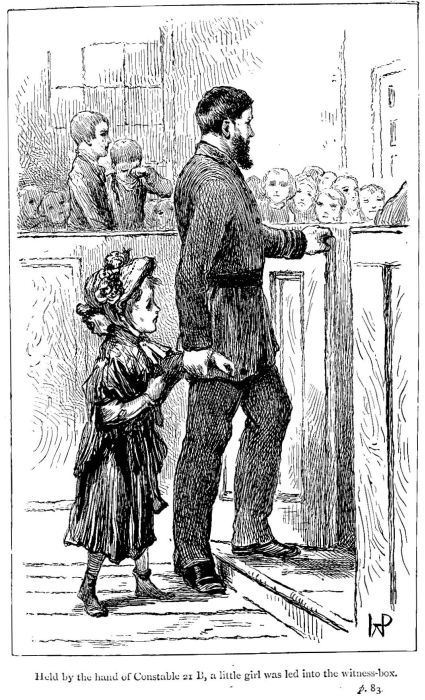
Led by the hand of Constable 21 B. a little girl was led into the witnesses’ box, a little girl with an old woman’s face, grave, worn, pale. At the sight of this witness Dick changed colour violently, and even Jenks gave way to some passing emotion.
For an instant a pair of sad dark eyes gazed steadily at both the boys. They were speaking eyes, and they said as plainly as possible—“I cannot save you. I would help you, even you, Jenks, out of this, but I cannot. I have come here to speak the truth, and the truth will, the truth must do you harm.”
Flo, with all her deep ignorance, had one settled conviction, that no one was ever yet heard of who told a lie in the witnesses’ box.
“How old is the little girl?” asked Mr Vernon.
The question was repeated to her.
“Don’t know,” she answered promptly.
“Have you no idea, child? try and think!”
“No, I doesn’t know,” said Flo. Then she added after a pause, “Mother knowed me age, and she said ef I lived till this month (ain’t this month June?) as I’d be nine.”
“Nine years old,” said the magistrate, and the clerk of the court took a note of the fact.
“Now, little girl, what is your name?”
“Darrell.”
“Darrell, do you know the nature of an oath?”
“Eh?” questioned Flo.
“Do you know who God is? You have got to take a solemn oath to God that you will speak nothing but the truth while you stand there.”
“Yes,” said Flo, “I’ll on’y speak the truth.”
“Do you know about God?”
“Mother used to say ‘God ’elp me.’ I don’t know nothink else—’cept ’bout Heve,” she added after another pause.
“What do you know about Eve?”
“She wor the first thief, she wor. She prigged the apple off God’s tree.”
A laugh through the court; but the odd little figure in mother’s old bonnet never smiled, her eyes were turned again reproachfully on Dick—he was following in the footsteps of “Heve.”
“You may administer the oath,” said the magistrate to the usher of the court, and then the Bible was placed in Flo’s hands and the well-known solemn words addressed to her.
“The Evidence you shall give to the court, shall be the truth, the whole truth, and nothing else but the truth, so help you God.”
“Yes,” answered Flo.
“Kiss the book,” said the usher.
She did so gravely, and handed it back to him. “Now, Darrell, just answer the questions put to you, and remember you are on your oath to speak the truth. Who are these boys? Do you know them?”
“Yes, yer Washup.”
Flo had heard Mr Vernon spoken to as “Your Worship,” and had adopted the name with avidity.
“What are they called?”
“Little ’un’s Dick—t’other Jenks.”
“Which of the two is your brother?”
“Little chap.”
“Do you live together—you and your brother and Jenks?”
“Yes; number seven, Duncan Street.”
“Have you a father and mother?”
“No. Father fell from a ’ouse and wor killed—he wor a mason; and mother, she died a year ago. We ’ad Scamp wid us too,” added Flo; “leastways we ’ad till the night o’ the Derby.”
“Who is Scamp?”
“My dawg.”
A laugh.
“Do not mind about your dog now, Darrell,” said the magistrate. “Tell me how you live.”
“’Ow I lives? Course I lives on wittles; and when I can’t get wittles I lives on nothink.”
“Mr Vernon means, what do you do to earn money?” explained the constable.
“Oh! I translates.”
“You translate!” said Mr Vernon, raising his eye brows in wonder that anything literary should find its way to Flo’s hands; “I did not know that you could read.”
“No, more I can—I knows nothink ’bout ‘read and pray.’ I never was glad to see that ’ere day. No—I translates; and ef they is down at the ’eel, and bust at the sides, and hout at the toes, wy I makes ’em as good as new fur hall that.”
“She cobbles old boots and shoes, your Worship,” explained the amused constable. “They call it translating down in Duncan Street.”
“Oh! Does your brother translate also, Darrell?”
“No, yer Washup; Dick ’ave a broom and crossin’. ’Ee wor doin’ a tidy lot lately wid ’is broom and crossin’.”
“Now remember you are on your oath. How did you spend your time on the Derby Day?”
“I sold small dolls to the gents.”
“Were you with your brother and the other prisoner?”
“No, yer Washup. Jenks ’ee said as we worn’t to keep company.”
“Did he tell you why?”
“’Ee said as we’d do better bis’ness apart. ’Ee was in the blackin’ line, and Dick in the fusee line.”
“Where were you at the time of the Robbery?”
“Close ahint Jenks and Dick.”
“Did they see you?”
“No.”
“What were they doing? what did you see them do?”
“Dick, ’ee ’ad a funny little red nose on, and ’ee capered about, and played the fiddle.”
“Well, go on.”
“The people, they was pressing hevery way, and the folks was cheerin’, wen—hall on a sudden—”
“Well?”
“Dick—’ee gave a great leap in the hair, and down ’ee come slap-bang ’gainst that ’ere gent,” pointing to the red-faced gentleman; “and Jenks—”
“What about Jenks? Don’t forget your oath, Darrell.”
“I’m not a forgettin’—I’m a comin’ to Jenks. No, Jenks,” suddenly turning round and addressing him, “I wouldn’t tell on you ef I wasn’t standin’ yere where no lies was hever spoke. ’Ee stepped forrard as soft as soft, and pulled hout a purse and a watch hout o’ the gent’s pocket.”
“Are these the watch and purse?”
“Yes.”
The clerk of the court then read over Flo’s evidence, and as she could neither read nor write, she was shown how to put her mark to the paper.
“You may go now,” said the magistrate; “I don’t wish to ask you anything further.”
Constable 21 B. took her arm, but she struggled against him, and held her ground.
“Please, yer Washup, I ’ave spoke the truth.”
“Indeed, I hope so.”
“May the little chap come ’ome wid me, and I’ll—” But here official authority was called to interfere, and Flo was summarily ejected from the witness-box.
She found a seat at the other side of the little woman in black, who took the child’s trembling hand in hers. A few moments of patient summing up of evidence, and then the magistrate asked the prisoners if they had anything to say for themselves.
“Please, I’ll never do it no more,” said poor little Dick, in a tone which nearly broke his sister’s heart; but Jenks, the older and more hardened offender, was silent.
Then the sentence was made known. Dick, in consideration of his youth, and its being a first offence, was only to go to a reformatory school, but Jenks was doomed to Wandsworth House of Correction for nine long months.
Chapter Ten.
The Little Woman in Black.
“Come home with me,” said the little woman by Flo’s side.
She had thrown up her veil now, and the face the child saw was nearly as pale and sad as her own. She hardly noticed it, however, she was absorbed in a recognition. The little woman in black had the gentle voice and kind eyes, the little woman in black was her friend of the Derby Day.
“My dear, I am real glad to find you again. You shall come to my house and have a bit of dinner.”
“No, ma’am,” said Flo, shaking away her hand, “I knows yer, ma’am, and you is werry kind. But I’m not a goin’ ’ome wid yer, missis; I’m not ’spectable to be in yer ’ouse. Dick, ’ee be a thief and in prison, I’m not ’spectable no more.”
Flo said this without tears, and defiantly.
“Oh, my dear, you are quite respectable enough for me. You are poor and in trouble, child—just the one that Jesus Christ wants; and surely if the King of Glory wants you, I may want you too.”
“Wot’s glory?” asked Flo.
“Glory, child; that’s where the King lives.”
“Ain’t kings and queens the same?”
“Oh! now, my dear, I see you don’t know nothing about the matter, or you wouldn’t speak of any king or queen in the breath with my King. Come and have a bit of dinner with me, and then I’ll tell you about my King.”
“I ain’t ’ungry,” said Flo; “but I’d real like to ’ear o’ that King as wants me. Would ’ee make a swell o’ me, missis?”
“He can raise you very high, little girl,” said the woman; and taking Flo’s hand, they walked together in silence.
“You was fond of poor Jenks?” said the little woman at last.
“Yes, ma’am; ’ee wasn’t a bad sort o’ a feller. But ’ee shouldn’t ’ave tempted the little chap. I don’t go fur to blame Jenks, ma’am, fur ’ee ’adn’t no mother—but ’ee shouldn’t ’ave tempted Dick.”
At these words the little woman withdrew her hand from Flo’s, and pulling out her handkerchief, applied it to her eyes; and Flo, wondering what made her cry, and what made her appear so sad altogether, walked again by her side in silence.
They passed down several streets until at last they came to one of those courts hidden away from the general thoroughfares, so well-known to London district visitors. There are Sun streets in London, where the sun never shines—there are Jubilee courts, where feasts are never held, where Satan and his evil spirits are the only beings that can rejoice.
This place was called Pine Apple Court, and doubtless a few years ago it as nearly resembled Cherry Court and May-Blossom Court as three peas resemble each other; but now, as Flo and the little woman walked into it, it really and truly, as far as sweetness and purity went, was worthy of its name. Here, in the midst of London, was actually a place where the decent poor might live in comfort and respectability. (One of Miss Octavia Hill’s courts.) The freshly-painted, white-washed houses had creepers twining against them; and before the doors was a nicely-cared-for piece of ground, where trees were planted, where the women could dry their clothes, and where, out of school-hours, the children could play.
The little woman conducted Flo across this pleasant court into one of the freshest and cleanest of the white-washed houses, where she brought her into a room on the ground floor, as bright as gay chintz curtains to the windows, neat paper on the walls, and the perfect purity which the constant use of soap and water produces, could make it. The polished steels in the grate shone again, a little clock ticked on the mantel-piece, and a square of crimson drugget stood before the fire-place. The window-sash was wide open, and on the ledge stood two flower-pots, one containing a tea-rose, the other a geranium in full blossom.
The rose was ticketed, prize 1st, and stood in a gaily ornamented pot, doubtless its prize at the last poor people’s flower show. Had Flo ever heard of Paradise she would have supposed that she had reached it; as it was she believed that she had come to some place of rest, some sweet spot where weary limbs, and weary hearts too, might get some repose. She sat down thankfully on a small stool pointed out to her by her hostess and gazed around.
“Please, ma’am,” she said presently, “wot am I to call yer?”
At this question the little woman paused, and a faint colour came into her pale cheeks.
“Why, now,” she said, “that’s a curious thing, but my name’s Jenks, same as that poor fellow they put in prison this morning—Mrs Jenks is my name, little Darrell.”
“Yes, missis,” replied Flo respectfully.
She had admired Mrs Jenks very much on the Derby Day, but now her feelings of wonder and admiration amounted almost to fear. For aught she could tell the owner of such a room might be a “Dook’s” wife in disguise.
“You sit in this chair and rest,” said Mrs Jenks, “and I’ll see about dinner.”
And Flo did rest, partly stunned by what she had witnessed and undergone, partly soothed by the novel scene now before her.
Mrs Jenks had made her take off mother’s old bonnet, and had placed her in the very softest of easy-chairs, where she could lie back and gaze at the little woman, with a wonder, a hunger of spiritual want, a sadness of some unexplained desire, all shining out of her eyes.
There were baked potatoes in a small oven at the side of the fire-place, and over the potatoes some nice pieces of hot bacon, and Mrs Jenks made coffee, fragrant coffee, such as Flo had never tasted, and toasted bread, and buttered it. Then she drew a little table up close to the open window, and placed a snowy cloth on it, then plates, and knives and forks, and then the potatoes and bacon, the coffee and toast; and when all was ready she put a chair for Flo, and another for herself.
But before they began to eat a more astonishing thing still happened. The little woman stood up, and folded her hands, and closed her eyes, and said these words:—
“I thank Thee, my God, for the dinner Thou hast given me; but more than all I thank Thee that Thou hast let me have one of thy outcast little ones to share it with.”
Then she opened her eyes, and bustled about, and helped Flo. And Flo, who had found her appetite come back in full vigour at the first smell of the coffee and bacon, ate very heartily of Mrs Jenks’ liberal helpings, leaning back in her chair when she had finished, with quite a pink flush on her thin cheeks, and the hunger of bodily want gone out of her eyes.
“Now,” said the little woman, after all the plates and dishes were washed up and put away, “Now,” she said, “I will get to my work, and you shall tell me all that story over again. All about your poor dear mother and the boys, and when that poor fellow with the same name as mine came to live with you.”
“Yes,” answered Flo, whose little heart was so drawn to Mrs Jenks, and so comforted by her, that any words she asked her to say came easily to her lips; and the story of the Derby Day was repeated with fuller confidence by the child, and listened to with fuller understanding on the part of her kind listener. Flo told over again all about her mother, and mother’s death, and the promise they had given mother—then of their own lives, and what hard work translating was, and how little Dick earned by his broom and crossing—finally how Jenks came, and how good-natured he was at first, and how glad they were to have him, and how they wondered what his trade was, and how he had promised to teach them both his trade.
Then at last, on the day she saw Regent Street and the Queen, and tasted ’ot roast goose for the first time, then too she discovered that Jenks was a thief. Then she related her interview with Jenks, and how he had promised to leave Dick alone, and not to teach him his wicked trade, and how on those terms she had allowed him to remain in the cellar; and then at last, when she was feeling so sure and so happy, he had deceived her, and now she was in great trouble, in great and bitter trouble, both the boys in prison, both thieves, and now mother could never rest any more.
Here Flo broke down and sobbed bitterly.
“I think if I were you, I would leave all that about your dear mother to God, my child,” said little Mrs Jenks. “His ways are not as our ways. If I were you, I would not fret about your mother—I would just leave her to God.”
“Who is God?” asked Flo, stopping her tears and looking up.
“Who is God?” repeated Mrs Jenks. “Why, He’s the King of Glory I had to tell you about; and now I remember, at the trial to-day you seemed to know very little about Him—nothing, in fact. Well, you shall not leave this house without knowing, I promise you that. Why, God—God, little Darrell, He’s your best friend, and your poor mother’s best friend, and Dick’s best friend, and my—that is, Jenks’ best friend too. He loves you, child, and some day He’ll take you to a place where many poor people who have been sad, and hungry, and wanting for everything down here, are having rest, and good times for ever.”
“And will God give me a good time in that place?” asked Flo.
“Yes. If you love Him He will give you a better time than the Queen has on her throne—a time so good, that you will never want to change with anybody in all the world.”
“Tell me about God,” asked Flo in a breathless voice, and she left her stool and knelt at Mrs Jenks’ feet.
“God,” said little Mrs Jenks, putting down her work and looking up solemnly, “God—He’s the Father of the fatherless, and you are fatherless. God’s your Father, child.”
“Our—Father—chart—’eaven,” repeated Flo.
“Your Father in Heaven—yes, that’s it.”
Then the little woman paused, puzzled how best to make her story plain enough and simple enough for the ignorant child. Words came to her at last, and Flo learned what every child in our England is supposed to know, but what, alas! many such children have never heard of; many such children live and die without hearing of.
Do we blame them for their social standing? do we blame them for filling their country with vice and crime?
Doubtless we do blame them, we raise our own clean skirts and pass over on the other side. In church we thank God that we are not as these men are—murderers—thieves—unclean—unholy. Let them go to prison, and to death—fit ends for such as they.
True! virtue is to them not even a name, they have never heard of it at all.
The fountain opened for sin and for uncleanness has never come in their path. Their iniquities are unpurged, their sins unpardoned.
Christ, it is certain, would wash them white enough, and give them a place in His kingdom; but they know nothing of Christ, and we who do know, to whom His name is a sound too familiar to excite any attention, His story too often read, too often heard of, to call up any emotion—we are either too lazy, or too selfish, or too ignorant of their ignorance, to tell them of Him.
Now for the first time Flo learned about God, and about God’s dear Son, our Saviour. A little too about Heaven, and a very little about prayer.
If she spoke ever so low, down in her dark cellar, God would hear her, and some day, Mrs Jenks said, He would come for her, and carry her away to live with Him in Heaven.
Only a glimmering of the great truth could be given at one time to the child’s dark mind, but there is a vast difference between twilight and thick darkness, and this difference took place in Flo’s mind that day.
She listened with hardly a question—a breathless, astonished look on her face, and when Mrs Jenks had ceased speaking, she rose slowly and tied on mother’s old bonnet.
“May I come again?” asked Flo, raising her lips to kiss the little woman.
“Yes, my child, come again to-morrow. I shall look out for you to-morrow.”
And Flo promised to come.
Chapter Eleven.
Maxey’s Young ’Un.
As Flo walked down the street, the wonderful news she had heard for the first time completely absorbed her mind, so much so that she forgot that Dick was a thief, that Dick and Jenks were both suffering from the penalty of their crime, that she was returning to her cellar alone, without even Scamp to keep her company. The news she had heard was so great, so intensely interesting in its freshness and newness, that she could think of nothing else.
She walked down, as her wont was, several by-streets, and took several short cuts, and found herself more than once in parts of the town where no respectable person was ever seen.
The gutter children working at their several wretched trades called after her as she passed, one addressing her as “old bonnet,” another asking how much she wanted a-piece for the flowers that dangled so ludicrously on her forehead.
And being a timid child, and, London bred as she was, sensitive to ridicule, she walked on faster and faster, really anxious to find any quiet place where she could sit down and think. At last, as she was passing a more open piece of ground, where a group of boys were playing pitch-and-toss, they, noticing her quickened movements, and rather frightened face, made a rush at her, and Flo, losing all presence of mind, began to run.
Little chance would she have had against her tormentors, had not just then a tall policeman appeared in sight, whereupon they considered it more prudent to give up their chase, and return to their interrupted amusements.
Poor Flo, however, still believing them to be at her heels, ran faster than ever down a narrow lane to her right, turned sharp round a corner, when suddenly her foot tripped against a cellar grating, the grating, insecurely fastened, gave way, and the child, her fall partly broken by a ladder which stood against the grating, found herself bruised, stunned, almost unconscious, on the ground several feet below the street.
For some moments she lay quiet, not in pain, and not quite insensible, but too much frightened and shaken to be capable of movement.
Then a sound within a foot or two of her caused her heart to leap with fresh fear. She sat up and listened intently.
It was a stifled sound, it was the whine of a dog.
For Scamp’s sake Flo had learned to love all dogs. She made her way, though not without pain, to this one now, and put her hand on its head.
Instead of being angry and resenting this freedom, as a strange dog might, a quiver of joy went through the animal, its tail wagged violently, its brown eyes cast melting glances of love at Flo, its small rough tongue tried to lick her face and hands, and there, gagged and tied, but well fed, as yet unhurt, and a platter of broken meat by its side, was her own dog, her lost dog, Scamp.
Flo laid her head on the head of the dog, and burst into tears of joy.
The pain of her fall was forgotten, she was very glad she had knocked against that broken grating, that by this means she had stumbled into this cellar; her dog could accompany her home—she would not be so lonely now.
With her own hands she unfastened the gag, and loosened the chain from Scamp’s neck, and the dog, delighting in his recovered freedom, danced and scampered madly round her, uttering great, deep bays of joy.
Alas! for Scamp, his foolish and untimely mirth excited undue attention to him.
His loud and no longer muffled bark brought two men quickly into the cellar.
Flo had the prudence of mind to hide behind some old boards, and Scamp with equal prudence did not follow her.
“Down, you brute,” said the short thick-set man whom Jenks on a former occasion had addressed as Maxey. “Wot a noise, ’ee’s makin’; the perleece’ll get scent of the young dawg wid his noise,” and the cruel wretch shied a great blow at Scamp, which caused the poor animal to quiver and cry out with pain.
“’Ee’ll be quiet enough afore the night is hover,” said the man’s companion, with a loud laugh. “Lor! won’t it be fun to see the bull-dawg a tearin’ of ’im? I’m comin’ to shave and soap ’im presently; but see, Maxey, some one ’as been and tumbled inter the cellar, down by the gratin’, as I’m alive! See! them two bars is broke right acrost.”
“Run and put them together, then, the best way possible,” called out Maxey, “and I’ll look round the cellar to give it to any one as is in hidin’.”
How fast Flo’s heart beat at those words, but Maxey, though he imagined he had searched in every available nook, never thought of examining behind the three thin boards almost jammed against the wall, and behind which the child had crushed her slight frame.
He believed that whoever had fallen into the cellar had beaten a hasty retreat, and after tying up Scamp more firmly than ever, took his departure.
Now was Flo’s time. She had only a few moments to effect her escape and the dog’s escape. A dreadful meaning had Maxey’s words for her—her dog’s life was in peril.
Never heeding an acute agony which had set in by this time in her right foot, she made her way to Scamp’s side, and first putting her arms round his neck, entreated him in the most pathetic voice to be quiet and not to betray them by any more barking.
If dogs cannot understand words and their meanings, they are very clever at comprehending tones and their meanings.
Perfectly did this dog’s clear intelligence take in that Flo meant them both to escape, that any undue noise on his part would defeat their purpose. He confessed to himself that in his first joy at seeing her he had acted foolishly, he would do so no more.
When she unfastened him he bounded up the ladder, and butting with his great strong head against the broken grating, removed it again from its place, then springing to the ground, was a free dog once more. Half a moment later Flo was by his side.
There were plenty of people, and idle people too, in the streets, but, strange to say, no one noticed the child and dog, and they passed on their way in safety. A few moments’ walking brought them to Duncan Street, then to their own cellar, down the ladder of which Scamp trotted with a happy, confident air.
Flo followed him feebly, and tottering across the floor, threw herself on her straw bed. Not another step could she go. She was much hurt; she was in severe pain.
Was her foot broken? Hardly that, or she could not have walked at all, but her present agony was so great, that large drops stood on her brow, and two or three sharp cries came from her patient lips.
How she longed for Dick then, or Jenks then, or Janey then. Yes, she had Scamp, and that was something—Scamp, who was lying abject by her side, pouring out upon her a whole wealth of love, who, knowing what she had done for him, would evermore do all that dog could do for her sake. She raised her hand to his head and patted him, glad, very glad that she had rescued him from an unknown but dreadful fate.
But she wanted something else, something or some one to give her ease in her terrible agony, and God, her loving Father, looking down from heaven, saw His little child’s sore need, and though as yet He sent her no earthly succour, He gave to her the blessed present relief of unconsciousness. Flo fainted away.
When she recovered an hour or two later, the scanty light that ever penetrated into the cellar had departed, and at first, when the child opened her eyes in the darkness, pain and memory of all recent events had completely left her. She fancied she was lying again by her mother’s side on that very straw mattress, she stretched out her arms to embrace her, and to ask her the question with which she had greeted her for the last three months of her life.
“Be yer werry tired, mother?”
But then the empty place, the straw where the weary form was no longer lying, brought back remembrance; her mother was not there—her mother was gone. She was resting in her quiet grave, and could never help, or succour, or protect her more.
But then again her thoughts were broken. There were rude noises outside, a frightened cry from Scamp at the foot of the bed, the cellar door was violently opened, two men scrambled down the ladder, and with many oaths and curses began tossing about the wretched furniture, and calling loudly for the missing dog.
Where was he? Not on Flo’s bed, which they unmercifully raked about, unheeding her moans of pain; not anywhere apparently. Vowing vengeance on whoever had stolen the dawg, the men departed at last.
Then again all was silence, and in a few moments a cowed-looking and decidedly sooty animal might, had any light been there to see, have been observed descending from the chimney where he had lain perdu.
Of the life-preserving qualities Scamp possessed a large share, as doubtless before this his story proves.
Perhaps his cur mother had put him up to a wrinkle or two in his babyhood; at any rate, fully determined was he to meet no violent end, to live out his appointed time, and very clever were the expedients he used to promote this worthy object.
Now he shook himself as free as he could of the encumbrances he had met with in the smoky, sooty chimney, and again approached Flo’s side.
She laid her hand on his head, praised him a little for the talent he had shown in again escaping from Maxey, and the dreadful fate to which Maxey meant to consign him; then the two lay quiet and silent.
A child and a dog!
Could any one have looked in on them that night they would have said that in all the great city no two could be more utterly alone and forsaken.
That individual, whoever he might have been, would have gone away with a wrong impression—they were not so.
Any creature that retains hope, any creature that retains faith, which is better, than hope, cannot be really desolate.
The dog had all the large, though unconscious faith of his kind in his Creator. It had never occurred to him to murmur at his fate, to wish for himself the better and more silken lives that some dogs live. To live at all was a blessed thing, to love at all a more blessed thing—he lived and he loved—he was perfectly happy.
And the child—for the first time she knew of and had faith in a Divine Father, she had heard of some one who loved her, and who would make all things right for her. She thought of this love, she pondered over it, she was neither desolate nor unhappy. God and God’s Son loved her, and loved Dick—they knew all about her and Dick; and some day their Father would send for them both and give them a home in His House in Heaven.
Flo had at all times a vivid imagination, since her earliest days it had been her dear delight to have day dreams, to build castles in the air. No well-dressed or happy-looking child ever crossed her path that she did not suppose herself that child, that she did not go through in fancy that child’s delightful life. What wardrobes had Flo in imagination, what gay trinkets adorned her brow, her arms, her neck!
What a lovely house she lived in, what heaps of shillings and sovereigns she possessed! Now and then, in her moments of most daring flight, she had even a handle to her name, and people addressed her as “Lady Flo.” But all the time, while happy in these dreams, she had always known them to be but dreams. She was only Flo, working as a translator of old boots and shoes, down in a dark cellar—she had no fine dresses, no pretty ornaments, no money, she was hungry and cold, and generally miserable, and as far as she could possibly see there was never any chance of her being anything else.
She generally came down from her high imaginings to this stern reality, with a great burst of tears, only one sad thought comforting her, to be alive at all she could never be worse than she was, she could never sink any lower.
She was mistaken.
Last night, lying all alone and waiting for Dick’s trial, lying hour after hour hoping and longing for sleep to visit her, and hoping and longing in vain, she had proved that she was mistaken. Lower depths of sorrow and desolation could be reached, and she had reached them. Through no fault of hers, the stern hand of the law was stretched out to grasp her one treasure, to take her brother away.
Dick had broken a promise sealed on dying lips—Dick was a thief. Henceforth and for ever the brand of the prison would be on him.
When, their punishment over, he and Jenks were free once again, nothing now, no power, or art, or persuasion, on her part could keep those two apart. Together they would plunge into deeper and more daring crime, and come eventually to the bad and miserable end her mother had so often described to her. It was plain that she and Dick must separate.
When the boys were released from prison, it was plain that she and they could not live together as of old. The honest could not live with the dishonest. Her mother had often told her that, had often warned her to be sure, happen what might, to choose honest companions. So Flo knew that unless she too broke her word to mother, they must part—Dick and she must part. And yet how much she loved him—how much her mother had loved him!
He was not grave like her; he had never carried an old head on young shoulders; he was the merriest, brightest, funniest boy in the world—one of those throw-all-care-to-the-winds little fellows, who invariably give pleasure even in the darkest and most shady homes. His elastic spirits never flagged, his gay heart never despaired, he whistled over his driest crusts, he turned somersaults over his supperless hours—he had for many a day been the light of two pairs of eyes. True, he had often been idle, and lately had left the brunt of the daily labour, if not all of it, to Flo. But the mother heart of the little sister, who was in reality younger than himself, accepted all this as a necessity.
Was he not a boy? and was it not one of the first laws of nature that all girls should work and all boys should play?
But now Dick must work with the hard labour the law accords to its prisoners. That bright little face must look out behind a prisoner’s mask, he must be confined in the dark cell, he must be chained to the whipping-post, he must be half-starved on bread and water. Out of prison he was half his time without the former of these necessities of life, and at his age he would not be subjected to hard labour.
But Flo knew nothing of these distinctions, and all the terrible stories she had ever heard of prisoners she imagined as happening to Dick now. So the night before the trial had been one long misery to the sensitive, affectionate child.
Now the trial was over, now Dick was really consigned to prison, or to what seemed to Flo like prison. With their eyes they had said good-bye to each other, he from the prisoners’ dock, she from her place in the witnesses’ box. The parting was over, and she was lying alone in her dark cellar, on her straw pallet, bruised, hurt, faint, but strange to say no longer unhappy, strange to say happier than she had ever been in her life before.
She had often heard of bright things—she had often imagined bright things, but now for the first time she heard of a bright thing for her.
She was not always to be in pain, she had heard to-day of a place with no pain; she was not always to be hungry, poor, and in rags—she had heard to-day of food enough and to spare, of white dresses, of a home more beautiful than the Queen’s home, of a good time coming to her who had always, always, all her life had bad times.
And Dick, though he was a thief, might share in the good time, and so might Jenks.
Our Saviour gave of His good times to thieves, and sinners, and poor people, if only they wanted them, and of course they had only to hear of them to want them.
“May I come down, Flo?” called out Janey’s voice at this juncture, at the cellar door. “Father ’ave beat me hawful; may I come down and set by yer a bit?”
The lame girl was sobbing loudly, and without waiting for Flo’s reply she scrambled down the ladder and threw herself on the bed by the child’s side.
“There now,” she said, panting out her passionate words, “’ee ’ave me hall black and blue, and my lame leg ’urt worse nor hever; and I wish ’ee wor in prison, I do; and I wish I wor dead, I do.”
“Oh! Janey,” said Flo, with a great gasp of longing, “wouldn’t it be nice to be dead?”
This corroboration of her desire startled Janey into quiet, and into a subdued—
“What, Flo Darrell?”
“To be dead, Janey, and ’avin’ a good time?”
“Well,” said Janey, recovering herself with a laugh, “wen I’m down haltogether in the dumps, as I wor a minute ago, I wishes fur it, but most times I ’ates the bear thought o’ it—ugh!”
“That’s cause yer doesn’t know, Janey, no more nor I did till to-day. Plenty of wittles, plenty of clothes, plenty of pretty things, plenty of love, all in the good time as we poor folks have arter we are dead.”
Janey gave her companion an angry push.
“There now, ef yer ain’t more than hagriwating, a comin’ on me wid yer old game of s’posin’, and me fairly clemmed wid the ’unger. There’s no good time fur me, nor never will be, I reckon,” and she again lifted up her voice and wept.
“There’s Our—Father—chart—’eaven,” began Flo, but Janey stopped her.
“I don’t want ’im—one father’s too much fur me.” Flo was silent—she would tell no more of her sweet message to unbelieving ears.
After a time she spoke in a different tone.
“Janey?”
“Well?”
“I’d like fur to ’ear the Glory song.”
Janey had a good voice, and desired nothing better than to listen to herself. She complied readily.
”‘I’m glad I hever saw the day, Sing glory, glory, glory, When first I larned to read and pray, Sing glory, glory, glory.’
“Why, Flo! my ’eart alive! Flo, ’ere’s Scamp.”
“Sing it again,” murmured Flo.
And Janey did sing it again, and again, and yet again, until the dark cellar seemed to grow full of it, and to be lit up and brightened by it, and to its music the sick and weary child went to sleep.
Chapter Twelve.
I was An Hungered and Ye Gave Me Meat.
All through the night Flo had visions of bright, and clean, and lovely things. She dreamt that she had left the cellar for ever, that all the musty, ragged boots and shoes were mended, and paid for, and gone, and that instead of earning her bread in that hard and wretched way, God had come and placed her in a beautiful room, looking out on green fields, such as mother had told her of, and given her pure white dresses to make for the angels.
And God looked so kind, and so like what she had imagined her own father to look like, that she had ventured to ask Him what had become of Dick, and God had told her that He Himself was taking care of Dick, and He Himself had placed him in a good school, and all would be well with him. And she thought she sat by the open window and made the angels dresses, and was, oh! so very, very happy; and Scamp lay at her feet, and was also happy; and Mrs Jenks was in the room, ready whenever she liked to tell her more about God, and she too was happy.
Yes, they all were happy, with a happiness Flo had never conceived possible hitherto, and she felt that it was not the nice room, nor the lovely view, nor the pleasant occupation that made her happy, but just because God was near. At last the morning came, and she awoke to find that it all was only a dream.
She was still in the cellar, she must get up as usual, she must work as usual at her old thankless work, the work that barely kept starvation from the door. She felt very faint and hungry, but she remembered that she had two shillings of the money she had earned on the Derby Day locked away in the box where she usually kept mother’s old bonnet. She would get up at once and buy some breakfast for herself and Scamp. She called the dog and told him what she was about to do, and, to judge from the way he wagged his tail and rubbed his head against her hands, he understood her, and was pleased with her intention. Nay, more, to hurry her movements, he placed himself under the ladder, mounted a few rungs, came down again, and finally darted from the ladder to her, and from her to the ladder, uttering short impatient barks.
What ailed Flo? She was hungry, very hungry, but how slowly she rose from her bed. She removed her head from the pillow, she steadied herself on her elbow—how strange, and weak, and giddy she felt. She lay down again, it was only a passing weakness; then once more she tried, back came that overpowering sense of sickness and giddiness. Well, it should not conquer her this time; happen what might, she must get up. She tried to put her right foot to the ground, but a great, sharp cry of agony brought Scamp to her side in consternation, and brought also beads of pain to her brow.
No, hungry as she was, she could not walk, by no possible means could she even stand.
She lay perfectly still for a moment or two, suffering so intensely that every breath was an agony. At last this passed, and she was able to realise her position a little. In truth it was not a pleasant one.
Even the night before, she had been in great need, she had longed much for a drink, her pain had brought on intense thirst, she had meant to ask Janey to put a cup, and a jug of cold water, by her side before she left, but the sweetness of Janey’s song had caused her to fall asleep before she had made known her request, and the lame girl had gone away unconscious that anything was the matter with her. It was highly probable that she might not pay Flo a visit for days; unless her father gave her another beating, or some quite unexpected event occurred, the chances were that she would not come.
And now Flo needed meat and drink, and nursing, as she had never needed them in all her life before. Though pale and delicate-looking, she had hitherto been possessed of a certain wiry strength, which those little withered city children, with every one of health’s necessaries apparently denied them, in some strange way seem to have.
She had never gone through severe pain before; and never, with all her privations, had she known the hunger and thirst which now tormented her.
Scamp, seeing that she had changed her mind about going out, fixed on her one or two reproachful glances, and then in a very discontented manner resigned himself to his fate, and to a few more hours’ sleep.
And Flo lay and wondered what was going to become of her. She was very ill, she knew. She was alternately hot and then cold, she was alternately tortured by pangs of the most acute hunger, and then deadly sickness seemed to make the bare thought of food insupportable.
She wondered what was to be her fate. Was she to lie there, a little more sick, a little more weak, a little more hungry and thirsty, in a little more pain, until at last she died, as mother had died? Well, what then?
Only last night she had thought dying a good thing, the best thing. It was bidding good-bye to all that now troubled her, it was beginning at once the good time God had put by so carefully for little outcast children like her. If only it would come at once, this kind, beautiful Death—if only she had not to walk the dark bit of road between now and then, between now and the blessed moment when God would take her in His arms to Heaven.
But Flo had been too long with the poor, with the very, very poor, had seen too many such die, not to know well that dying was often a very long business, a business so long, and so sad, that, though the dying were suffering just as much as she now suffered, yet many weary hours, sometimes many weary days, had to be passed before relief and succour came to them; before kind Death came and took away all their sorrows and gave them rest, and sleep, and a good time. And this long period of waiting, even though the end was such brightness, felt very terrible to the lonely child. Then, suddenly, words Mrs Jenks had said to her yesterday came into her head.
“When you want food, or anything else very bad, and you don’t know how to get it, then is the time to ask God for it. All you have to do is to say up your want, whatever it be, in as few, and small, and simple words as you like, and though you speaks down in your dark cellar, God will hear you up in Heaven, and if ’tis any way possible He’ll give you what you want.”
Flo remembered these words of Mrs Jenks’ now with great and sudden gladness. If ever a time of need and sore want had come to any one it had come to her now.
What a good thing to have a Father like God to tell it all to, what a wonderful thing that He could hear her, without her having to get up to go to Him.
Her ideas of God were misty, very misty, she had not the least conception where Heaven was, or what it was, she only knew there was a God, there was a Heaven—a God for her, a Heaven for her; and with all her ignorance, many of the gifted, and mighty, and learned of the earth do not know as much. Now for the first time she would pray. She thought of no difficulty in making her petition known to God.
No more hard to tell Him of a want than it was, when her mother lived, to tell her of a desire or longing that possessed her.
“Please, I wants fur Janey or somebody to come to the cellar afore long,” she said; “I wants a sup of water werry bad, and somethink to eat. And there is two shillings stored away in mother’s old bonnet-box. Janey’d buy lots of wittles wid it. She’d be glad to come, ’cause I’d pay ’er, and I’m werry faint like. You’d ’ave to fetch ’er, please, God, ’cause she’s not at ’ome, but away to the paper factory—but you that is real kind won’t mind that.”
Then Flo lay still and listened, and waited.
She had made her request, and now the answer would come any moment.
Any instant Janey’s quick step and the sound of her crutch might be heard outside, and she would look in with her surprised face, to say that notwithstanding her employer’s anger she had been fetched away by God Himself, and meant to wait on Flo all day.
And then Flo pictured how quickly she would send Janey out, and how eagerly and willingly, with a whole bright shilling in her greedy little hand, Janey would go; and how she would commission her to buy two large mutton bones for Scamp, and a jug of cold, cold water, and a hice—for Flo felt more thirsty than hungry now—for herself.
For half-an-hour she lay very patient, straining her ears to catch Janey’s expected footstep; but when that time, and more than that time passed, and every footfall still went by on the other side, she grew first fretful, then anxious, then doubtful. She had never prayed before, but Mrs Jenks had told her that assuredly when she did pray an answer would come.
Well, she had prayed, she had spoken to God very distinctly, and told Him exactly what she wanted, but no answer came. He was to fetch Janey to her, and no Janey arrived. She had not made a hard request of Him,—she had only begged that a little child, as poor as herself, should come and give her a cup of cold water,—but the child never appeared, and Flo’s parched lips were still unmoistened. How strange of Mrs Jenks to tell her God would hear and answer prayer—not a bit of it. At least He would not hear little prayers like hers. Very likely He was too busy listening to the Queen’s prayers, and to the great people’s prayers. The great, rich people always had the best of everything, why should they not have the best of God’s time too?
Or, perhaps—and this was a worse and darker thought—perhaps there was no God; perhaps all Mrs Jenks’ talk of yesterday had been just a pretty fable—perhaps wicked Mrs Jenks had been deceiving her all the time! The more Flo considered, the more did she believe this probable.
After all, it was very unlikely that she should have lived so long and never, until yesterday, have heard anything of God and heaven, very unlikely that her mother should have lived her much longer life without knowing of these things! If there was a good time coming, was it likely that her mother should have lived and died without ever hearing of it? Slowly and reluctantly Flo gave up the hope that had brightened and rendered endurable the last four-and-twenty hours. She had no Father in heaven, there was no God! Great sobs broke from the poor little thing, a great agony of grief seemed to rend her very life in two.
She cried her heart out, then again sank into uneasy slumber. All through the long hours of that burning summer day the child lay, now sleeping fitfully, now starting in feverish fright and expectancy. At last, as evening came on, and the air, cooler elsewhere, seemed to grow hotter and hotter in this wretched spot, she started upright, suffering more intense pangs of hunger than she had hitherto known. Be her agony what it might, she must crawl, though on her knees, to the cupboard, where she knew a very old and mouldy crust still was. She rolled herself round off the straw, and then managed to move about two or three feet on the damp floor. But further movement of any description was impossible; the agony of her injured foot was greater than the agony of her hunger; she must stay still—by no possible means could she even get back to her wretched bed. She was past all reasoning or any power of consecutive thought now; she was alive to nothing but her intense bodily suffering. Every nerve ached, every limb burned; her lips were black and parched, her tongue withered in her mouth; what words she uttered in her half-unconsciousness, could hardly be distinguished.
In a much milder degree, it is true, Scamp had also spent an uneasy day—Scamp too had tried to sleep off his great hunger. It was at its height now, as he crouched by Flo’s side on the floor. During the time of his captivity he had been well fed, he had left behind him a large platter of broken meat; since Flo had set him free neither bite nor sup had passed his lips. Hungry in the morning, without doubt he was ravenously hungry now, and being of the genus designated “knowing,” saw clearly that the time had come for him to set his wits to work. As a rule he partook of Flo’s spirit, and was, in truth, an honest dog; but he had a clause in his code of morals which taught him that when no man gave to him, then it would be right for him to help himself.
He had proved the necessity of this rule once or twice in his adventurous life, and had further proved himself a clever and accomplished thief.
He had some butchers’ shops in his mind’s eye now, some tempting butchers’ shops, that he had cunningly noticed when returning home with Flo yesterday.
From those butchers’ stalls hung pork chops, and mutton chops, ready cut, all prepared to be received into his capacious jaws. A leisurely walk down the street, a little daring, a sudden spring, and the prize would be his.
Should he go and satisfy this terrible hunger, and feel comfortable once more? Why did he not go? why did he not at once go?
Why? because he had a heart,—not a human heart, which often, notwithstanding all that is said about it, is cold, and callous, and indifferent enough, but a great faithful dog’s heart. With considerable disquietude he had watched Flo all day. Not for nothing had she lain so still, not for nothing had such piercing moans come from her lips, not for nothing did she look so pale, and drawn, and suffering now. Drooping his ears, bending his head, and frowning deeply, he reflected, in dog-fashion, how Flo too had tasted no meat and drank no water that day.
She too was hungry and in a worse plight than him—it was his bounden duty to provide her with food. What should he bring her? A bone?
Bones were delicious, but strange to say neither Flo, nor Dick, nor Jenks ever ate them!
A nice pork or mutton chop: how good they were—too good for a hungry dog to think about patiently, as he reflected that a chop, if he could get it, would be only supper, and not too large a supper, for one.
No, he must give up that butcher’s meat in which his spirit delighted and attack the bread shops.
A loaf of bread would satisfy them both!
Rising to his feet, and bestowing on Flo one or two looks of intense intelligence, looks which said as plainly as possible, “I have not an idea of deserting you, I am going for our supper,” he started off.
Up the ladder with nimble steps he went, and then, by a succession of cunning dives, along the street, until he came to the butchers’ stalls.
Here his demeanour totally changed, he no longer looked timid and cowed: the currish element very prominent when, with his tail between his legs, he had scuttled up Duncan Street, now had vanished; he walked along the centre of the road soberly and calmly, a meditative look in his eyes, like a dog that has just partaken of a good dinner, and is out for a constitutional: not one glance did he cast at the tempting morsels, so near and yet so far.
A baker’s cart turned the corner—this was what Scamp wanted, and expected. He joined the cart unknown to the baker’s boy, he walked demurely behind, to all appearance guarding the tempting, freshly-baked loaves. His eye was on them and yet not on them.
To the passers-by he looked like a very faithful, good kind of dog, who would fasten his teeth into the leg of any one who attempted to appropriate his master’s property.
More than one little hungry street gamin, on thieving intent, wished him anything but well as he passed.
The cart stopped at several doors, the bread was delivered, but still no opportunity of securing a supper for himself and Flo arose.
Scamp’s lucky star was, however, in the ascendant.
At number 14, Q— Street, Jerry, the baker’s boy, had brought Mrs Simpson’s little bill, and evinced to that worthy woman a very righteous desire to have it settled.
Mrs Simpson, whose wishes differed from Jerry’s, thought mercy, not justice, should be exercised in the matter of bills owing from herself, when owing to herself the case was different. In the dispute that ensued, Jerry stepped into the house.
Here was Scamp’s golden opportunity.
Did he lose it? Not he. Half a moment later he might have been seen at his old game of diving and scuttling, his tail again tucked under his legs, a hangdog look on his face, but victorious for all that, for Jerry’s brownest and most crusty loaf was between his teeth.
Woe to any one who attempted to dispossess Scamp of that loaf; his blood would have been up then, and serious battle would have ensued.
In safety he bore it through the perilous road, down the ladder into the cellar, and panting and delighted, looking like one who had done a good deed, which indeed he had, he laid the bread under Flo’s nose.
The smell of the good food came sweetly to the nostrils of the starving child, it roused her from the stupor into which she had been sinking, she opened her eyes, and stretched out her hot little hand to clutch at it eagerly. The dog crouched at her side, his lips watering, his teeth aching to set themselves once more into its crisp brown crust.
Just then footsteps stopped in reality at the cellar door, footsteps that had no idea of going away, footsteps that meant to come right in and find out about everything.
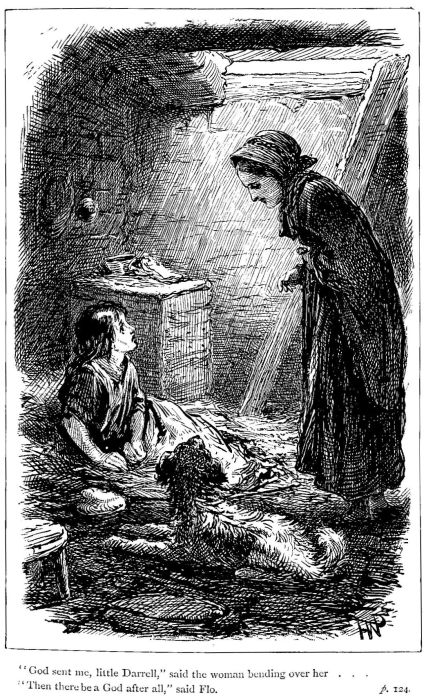
For a moment Flo’s heart stood still, then gave a great cry of joy, for little Mrs Jenks stood by her side.
“Who sent you?” asked the trembling child.
“God sent me, little Darrell,” said the woman, bending over her with, oh! such a tender, loving face.
“Then there be a God, after all,” said Flo, and in her weakness and gladness she fainted away.
Chapter Thirteen.
The Bed God Lent to Flo.
Yes, there was a God for Flo—a God and a Father.
For some wise and loving reason, all of which she should know some day, He had tested her very sorely, but in her hour of extremest and darkest need He sent her great and unexpected succour, and that night Flo left the gloomy and wretched cellar in Duncan Street, never to return to it. She was unconscious of this herself, and consequently gave the miserable place no farewell looks.
From that long swoon into which she sank she awoke with reason quite gone, so was unaware of anything that happened to her.
She knew nothing of that drive in the cab, her head pillowed on Mrs Jenks’ breast; nothing of that snowy little bed in Mrs Jenks’ room where they laid her; nothing of the kind face of the doctor as he bent over her; nothing of anything but the hard battle with fever and pain, the hard and fierce conflict with death she had got to fight. For a week the doctor and Mrs Jenks both thought that she must die, and during all that time she had never one gleam of reason, never one instant’s interval from severe pain. At the end of that time the crisis came, as it always does, in sleep. She fell asleep one evening moaning with all the exhaustion caused by fever and suffering, but the faithful little woman who sat by her side marked how by degrees her moans grew less, then ceased; her breathing came slower, deeper, calmer.
She was sleeping a refreshing, healing sleep.
Late that night Flo awoke.
Very slowly her eyes, the light of consciousness once more in them, travelled round the apartment. The last thing she remembered was lying very ill and very hungry on the damp cellar floor, the dog’s faithful face close to her, and a loaf of bread within reach of her starving lips. Where was she now?
In a pure, white, delicious bed, in a room that might have been a little room out of heaven, so lovely did it look in her eyes. Perhaps she was dead and was in heaven, and God had made her lie down and go to sleep and get rested before she did anything else.
Well, she had not had enough sleep yet, she was dreadfully, dreadfully tired still. She turned her weary head a very little—a dog was lying on the hearth-rug; a dog with the head, and back, and eyes of Scamp, and those eyes were watching her now lazily, but still intently. And seated farther away was Mrs Jenks, darning a boy’s sock, while a boy’s jacket lay on her lap.
The sight of the little woman’s pale face brought back further and older memories to Flo, and she knew that this little room was not part of heaven, but was just Mrs Jenks’ beautiful little earthly room.
How had she got here? however had she got here from that cellar where she had lain so ill and unable to move?
Perhaps after eating that bread that Scamp had brought her she had got much stronger, and had remembered, as in a kind of dream, her appointment with Mrs Jenks, and still in a dream, had got up and gone to her, and perhaps when she reached her room she had got very faint again and tired, and Mrs Jenks had put her into her little bed, to rest for a bit. But how long she must have stayed, and how at home Scamp looked! It was night now, quite night, and Mrs Jenks must want to lie down in her own nice pleasant bed; tired and weak as she was, she must go away.
“Please, mum,” she said faintly, and her voice sounded to herself thin, and weak, and miles off. In an instant the little pale woman was bending over her. “Did you speak to me, darling?”
“Please, mum,” said Flo, “ef you was to ’old me werry tight fur a bit, I’ll get up, mum.”
“Not a bit of you,” said Mrs Jenks, smiling at her, “you’ll not get up to-night, nor to-morrow neither. But you’re better, ain’t you, dearie?”
“Yes, mum, but we mustn’t stay no later, we must be orf, Scamp and me. ’Tis werry late indeed, mum.”
“Well, so it be,” said Mrs Jenks, “’tis near twelve o’clock, and wot you ’as got to do is not to stir, but to drink this, and then go to sleep.”
“Ain’t this yer bed, mum?” asked Flo, when she had taken something very refreshing out of a china mug which Mrs Jenks held to her lips; “ain’t this yer bed as I’m a lyin’ in, mum?”
“It is, and it isn’t,” replied Mrs Jenks. “It ain’t just that exactly now, fur God wanted the loan of it from me, fur a few nights, fur one of His sick little ones.”
“And am I keepin’ the little ’un out o’ it, mum?”
“Why no, Flo Darrell, you can hardly be doing that, for you are the very child God wants it fur. He has given me the nursing of you for a bit, and now you have got to speak no more, but to go to sleep.” Flo did not sleep at once, but she asked no further questions; she lay very still, a delicious languor of body stealing over her, a sense of protection and repose wrapping her soul in an elysium of joy. There was a God after all, and this God had heard her cry. While she was lying in such deep despair, doubting Him so sorely, He was busy about her, not fetching Janey, who could do so little, but going for Mrs Jenks, who was capable, and kind, and clever. He had given Mrs Jenks full directions about her, had desired her to nurse and take care of her.
She need have no longer any compunction in lying in that soft bed, in receiving all that tender and novel treatment. God meant her to have it—it was all right. When to-morrow, or the day after, she was quite well and rested again she would try and find out more about God, and thank Him in person, if she could, for His great kindness to her, and ever after the memory of that kindness would be something to cheer and help her in her cellar-life.
How much she should like to see God! She felt that God must be beautiful.
Before her confused and dreamy eyes the angels in their white dresses kept moving up and down, and as they moved they sang “Glory, glory, glory.”
And Flo knew they were surrounding God, and she tried to catch a glimpse of God Himself through their shining wings. She was half asleep when she saw them, she was soon wholly asleep; she lay in a dreamless, unbroken slumber all night. And this was the beginning of her recovery, and of her knowledge of God. When the doctor came the next day he said she was better, but though the fever had left her, she had still very much pain to suffer. In her fall she had given her foot a most severe sprain, and though the swelling and first agony were gone, yet it often ached, without a moment’s intermission, all day and all night. Then her fever had turned to rheumatic, and those little thin bones would feel for many a day the long lie they had had on the damp cellar floor. But Flo’s soul was so happy that her body was very brave to bear this severe pain; such a flood of love and gratitude was lighting up her heart, that had the ceaseless aching been worse she would have borne it with patient smiles and unmurmuring lips. For day after day, by little and little, as she was able to bear it, Mrs Jenks told her what she herself called the Story of God.
She began with Adam and Eve, and explained to her what God had done for them; she described that lovely Garden of Eden until Flo with her vivid imagination saw the whole scene; she told how the devil came and tempted Eve, and how Eve fell, and in her fall, dishonesty, and sin, and misery, all came into the world. And because sin was in the world—and sin could not remain unpunished—Adam and Eve must die, and their children must die, and all men must die. And then she further explained to the listening child how, though they were sinners, the good God still cared for them, and for their children, and for all the people that should come after them; and because He so loved the world He sent His only begotten Son into the world, that whosoever believeth in Him should not perish, but have everlasting life.
And because little Mrs Jenks loved God and Christ with all the strength of her nature in return, she told the story of the birth of Jesus, of His life, of His death, so tenderly and so solemnly, that the child wept, and only the knowledge that His sufferings were now over, that He was happy now, and that He loved her, could stay her tears. What could she give Him in return? Why, all He asked for, all He needed.
Lying there on Mrs Jenks’ little white bed which God had lent her, she offered up to the Father, to the Son, and to the Spirit, the love and obedience of her whole heart and life for time and for eternity.
Chapter Fourteen.
The Best Robe.
It took Flo a long time to get well, but when the autumn came, and the fierce summer heat had passed away, she began to pick up strength, to leave her little white bed, to hobble on her lame foot across the floor, to sit on the crimson hearth-rug and fondle Scamp; and after pondering on the fact for many days, and communicating her feelings on the subject to the dog in Mrs Jenks’ absence, she felt that, painful as it would be to them both, they must now once more go out into the world. They must say good-bye to this bright little room and its much-loved inmate, and face once more the old days of poverty and privation.
Not that they ever would be quite the old days back again.
However cold she now was, however hungry she now was, she had a hope which would charm away the hunger and cold, she had a strong Friend who in her hour of extreme need would come again, as He had come once, to her succour.
But must they both go out into the world again?
This question perplexed her very often. That Scamp should love quarters where beef and mutton bones were at least sometimes tasted, where his bed was warm, and his life easy, was not to be wondered at. Under his present gentle treatment he was growing into quite a handsome dog, a dog that really did credit to his friends. His ribs no longer stuck out in their former ungainly manner, his coat was thick and good, his eyes bright. Of course he liked the comfortable feelings which accompanied these outward signs of prosperity: still he was not the dog to desert his mistress in her need; and cheerfully, and without a murmur, would he have followed her through hunger and privation, to the world’s end.
But the question was not, would he go, but should she take him? Had she, who could do so little for him, any right to take him?
Perhaps when she had him back in her cellar, that dreadful Maxey would again find him, and carry him away to fight with his bull-dogs, and his life would be sacrificed to her selfishness.
The desolate side of the picture, which represented herself in the cellar without Scamp, she resolutely turned away from, and determined that if Mrs Jenks would be willing to keep her dog, she should have him. And Mrs Jenks loved him, and had already paid the dog-tax for him, so it was very unlikely that she would refuse his society.
Flo thought about this for several nights while lying, awake in bed, and for several days when Mrs Jenks was out, and at last one evening she spoke.
“Mrs Jenks, ma’am, is you fond of Scamp?”
Mrs Jenks had just returned after a day’s charing, and now, having washed up, and put away the tea-things, and made herself clean and comfortable, she was seated in her little arm-chair, a tiny roll of coloured calico in her lap, and a mysteriously small thimble in her hand. At Flo’s question she patted the dog’s head, and answered gently—
“Yes, dear, I loves all dumb creatures.”
“Then, Mrs Jenks, may be yer’d like fur to keep Scamp?”
“Why, my child, of course you are both on a little visit with me for the present. See, Flo, I am going to teach you needlework—it is what all women should be adepts in, dear.”
At another time Flo could not have resisted this appeal, but she was too intensely in earnest now to be put off her subject.
“I means, ma’am,” she said, rising to her feet and speaking steadily, “I means, ma’am, wen my little wisit is hover, and you ’as back yer bed, ma’am, as God gave me the loan of—I means then, ma’am, seeing as you loves my dawg, and you’ll be kind to ’im, and hall ’ee wants is no bed, but to lie on the rug, why, that you might keep my dawg.”