Front matter (continued 3)
Reading edition
THE BELLIGERENT ALLIGATORS
During the whale season we utilized the whale tank, which was empty owing to the death of the whale, by placing in it a number of alligators from Florida. Our agent had just returned from an expedition, with forty of these creatures ranging in length from one to twelve feet. Although the tank was an immense one, these forty saurians did not have as much room as they would have liked. This overcrowding was doubtless the cause of a most terrible fight between them, which occurred very soon after they were installed in their new quarters. It is impossible for me to describe this conflict. Nearly all the larger "gators" took part in it, springing at each other and locking their jaws with a resounding, crashing noise that could be heard all over the building.
While thus locked together they would toss each other about and swish their tails with such vigor as to completely destroy the tank, breaking the thick glass. Our attendants were almost paralyzed with fear and confusion at the strange battle, and vainly endeavored to separate the combatants. There seemed, however, to be no way of doing this, as they would snap at each other so violently as to break each other's jaws, and this horrible snap really sounded like the report of a gun. To prevent their escape into the exhibition room a temporary barrier was soon erected and, when they became exhausted in attempting to kill each other, we determined, for fear that returning strength would bring about a repetition of the horrible scene, to dispatch all save the smaller ones. This was done by sending bullets into their eyes. We buried the carcasses on Long Island, much to the regret of an eminent taxidermist, who would have been glad to have secured them; but we were eager to be rid of the monsters. The fight was not down on the bills and was one we were entirely unprepared for; but it was the most exciting and at the same time most terrifying combat I ever saw. Had it not been so horrible and could it have been advertised, I am sure it would have drawn together more people than a Spanish bull fight. The tank, which was totally destroyed, was made of glass one and one-fourth inches thick, embedded in cement and bound with solid iron columns. It was erected at a cost of $4,500, and yet was destroyed in ten minutes by these vicious alligators from the slimy depths of southern swamps.
I remember vividly the time when (in Winchester, Va.) Charles Dayton, the Herculean cannon ball performer and general gymnast, was attacked by hyenas just after entering the den for the street parade. Only such a man of strength, undeniable courage and great presence of mind would ever have escaped from the cage alive. Apparently for no reason whatever and without the slightest warning these hideous creatures sprang upon Dayton on this particular occasion, though he had been in the cage many times. The expression of mingled hope, fear and determination depicted on Dayton's countenance as he nobly fought his way to the rear of the cage can never be forgotten by any witness of the thrilling scene. Death stared him in the face and blood flowed in streams from his frightful wounds. Seemingly every portion of his body was lacerated. At last after a fearful battle he reached the rear of the cage and the door. The latter was quickly opened, and the brave fellow fell bleeding and exhausted into the arms of his attendants, narrowly escaping a death too horrible to contemplate. We succeeded in getting him to his hotel, where physicians were called, but they gave no hope of poor Charlie's recovery. They said the hyenas had done their awful work too thoroughly. The citizens, especially the noble women of Winchester, volunteered their aid and did everything in their power for him. We left him with our own doctor and in the hands of these good people, as we thought, to die. Notwithstanding the fact that his body was so terribly lacerated, however, in a few days Dayton gave signs of improvement and he eventually recovered. Ultimately he returned to the show.
PARROTS AND COCKATOOS
I have always watched animals with a great deal of interest, from the bulky but docile elephant to the smallest bird that flies; indeed, I believe my love for animals, especially the horse, was the incentive that led me to continue so many years in the circus business. Although I never had a natural taste for the circus, and for the details connected therewith, still I always enjoyed organizing and putting together different drawing attractions. All my other work was given to the care of assistants.
During our exhibitions in Fourteenth Street, New York, I became very much attached to many of the birds and animals, and would spend my leisure time in playing with and feeding them, besides studying their characters and dispositions, for even among the lower animals there is character just as there is in mortals.
Among my collection of parrots, there was a white cockatoo. When I entered the building in the morning he would set up such a noise and racket, unless I came immediately to speak to him for a few minutes, that he would soon have the entire menagerie in an uproar—the monkeys chattering, the lions roaring, and, in fact, a regular pandemonium. But as soon as I had complied with the wishes of the cockatoo, quiet would be restored. Some time later when I was in New Orleans, I received a telegram announcing the Fourteenth Street fire and the complete destruction of the menagerie.
These beautiful birds are very easily taught. I once knew a man named Prescott who had trained one of these white beauties to sing the Star Spangled Banner, to crow like a rooster, bark like a dog, cry like a child, and so on; and in this way he could entertain a crowd of people for hours together. Unlike most of its feathered brothers, this bird enjoyed pleasing its master, and would repeat his performance whenever called upon to do so, and he seemed to take a pride in his wonderful acts.
EDUCATED DOGS
At one time in Fourteenth Street, I had a troop of educated dogs; one of their acts was in the nature of a mock trial. One dog, a very little fellow, steals a collar of another. A trial takes place, in which there are judge, and jury advocates. The little culprit is convicted and condemned to be hung—which the dogs proceed to do. The little fellow is hung and drops apparently dead, is placed in a hearse and rolled away to the music of the "Dead March." Several complaints were made against this by citizens and kind-hearted women; and Professor Bergh, president of the Humane Society, came to me about it. I had the performance repeated for his benefit, and further said that it had been repeated twice a day for several months. After the professor saw that the dogs enjoyed it, he laughed and said no more about it, and nothing more was heard from the Humane Society.
I have seen many acts done by dogs; and, as a rule, there is nothing to appeal to their intelligence; but in this case they certainly showed reasoning powers. I wish space would permit me to give my experience with the canine family. A short time before I left the show business I heard of a dog in California that could talk. I sent for the owner, Professor Madden, and bargained for this dog. When he reached Chicago I found he could actually say, "Oh, no." Sometimes it was easier for him to speak than at others, and invariably he would have some trouble in talking the first time.
Of all the dumb creatures the dog is by far the most faithful to his master, and it is said to be the only animal that has ever died of grief on his master's grave.
A WOUNDED HORSE IN THE GRAND MARCH
In 1880 I met with a very severe railroad accident, in which many of my valuable horses were injured; and among them an "entry" horse which, being of considerable value, I ordered to be taken on the train again, after the wreck was cleared away; but we could not use him for several days as he was so bruised that he presented a horrible appearance. One day, however, just as the "grand entry" was going into the ring, our head groom was surprised at the entrance of this horse. The creature had dashed into the ring with the others of his companions, and without bridle, saddle or halter, he went through the figures as he had been in the habit of doing before he was injured. The music was stopped, and our groom wanted to have the horse taken out, but I refused. Hearing the familiar music by which he had always entered the ring and performed his acts, habit was stronger than bodily pain, and, unfastening his rope in some unaccountable way, he had burst upon us. There is no doubt that a horse does know when his particular music strikes up, for I have often watched them at that time. They will rear and prance and if secured will make every endeavor to get loose. I lost this horse later in a wreck and few similar losses have grieved me more.
Hearing once that Professor Bartholomew had some wonderful horses I determined to purchase them, although I had really retired from the circus business. I saw the owner and paid him $10,000 for the horses and exhibited them in the New York Aquarium, where they drew great crowds. Among this troupe was the well-known Nettle, the most beautiful animal I ever saw, being of a cream color and about fourteen hands high. He was remarkable more particularly for his jumping feats, being able to jump over an eight-foot gate and six horses, doing this act twice a day for four years. Finally he was able to jump over a gate and eight horses: but this feat was too great a strain and I would not allow it to be repeated. Like a human being he would never undertake this jump until he had first examined the horses carefully to see that all was as it should be, and then, with apparent pride and confidence, he would make his leap. The act performed, he would trot to his trainer with all the pride of one who had accomplished what had been expected of him.
INTELLIGENT BRONCHOS
I once concluded that it would be good policy to buy a herd of untamed bronchos and educate them for the circus business. Thereupon I hired a young fellow named George Costello and sent him to Colorado, Texas and New Mexico in search of handsome bronchos and Pintos, as this was the same breed of horses that I first owned. They are certainly the wildest and hardest to break, but with these untamed animals I concluded to make a start. It was more difficult work to find exactly what I wanted than we had hoped. Finally, at Pendleton, Oregon, we found a herd of about 3,000 head that were white and spotted and belonged to a tribe of Indians. We bought about forty of them and then shipped them to Chicago, where we sold all but sixteen. We engaged a celebrated trainer and built a training stable, where we watched them work.
The bronchos at first refused to take the food which we gave them, and would blow the oats out of the trough; but hunger finally subdued them. They were very curious, investigating everything around them, and it did not take long to learn the customs of civilization. They not only learned to eat tame hay, and whinny for their food, but each horse also learned to know his own name and those of his companions. We would place these horses in a row and call out the name of one of them. If he did not immediately respond the other bronchos would bite him to remind him that he should obey orders.
As is usual to a herd, this band of ponies looked to one of their number as the leader. The leader's name was Duke, and when the herd was turned loose in the yard for exercise Duke was evidently commander. In my experience with these wild animals I became convinced that they had different intonations to express different feelings—that they have a language of their own. Their whinnys when happy, when frightened, when angry and as a warning differed greatly, and by careful study could be easily distinguished.
THE KING OF THE HERD
Mr. Cross, a celebrated animal painter, who owns a ranch in Montana, told me that his horses had, at one time, disappeared in great numbers, much to his astonishment and wonder. He finally discovered that whenever a herd of wild horses, headed by a certain spirited stallion, came near the ranch, some of his own horses were sure to be missed. Setting a watch over them he found that the big handsome stallion was the thief. This magnificent animal would approach the tame horses and by some mute eloquence would induce them to follow him. Mr. Cross determined to capture this noble beast and thief, and procured the best lasso throwers. After following the stallion for many days they were compelled to give up the chase. Finally they decided to shoot the animal if he again interfered with the tame animals. Some weeks passed, but no more horses were lost. Suddenly, however, a number were again gone. With great compunctions of conscience, Mr. Cross at length decided that the leader must be shot. His death struggles were noble—he died as befitted a great chief whose power, strength and beauty had made him the leader of his kind. Next to the dog I believe the horse to be the most intelligent of creatures.
AN ELEPHANT'S HUMOR
The humor of elephants is sometimes almost as remarkable as their intelligence. In 1887 I purchased an elephant in New York to send to Australia, and as we were in a great hurry to catch the steamer from San Francisco, I arranged to have the animal brought as far west as Chicago by passenger train instead of freight. He was loaded in a special car which was placed just behind the baggage car, and in due time started from the depot in New York. Shortly after leaving Albany the conductor was surprised to have the bell rope pulled violently. The train, of course, stopped, but the conductor could not find that anything was wrong or discover the man who had pulled the rope. Another start was made, and when nearing Syracuse a second violent tugging brought the train to a stop. The conductor instructed the brakeman to keep strict watch on the passengers, thinking all the time that some one had been playing a joke on him. Nearing Rochester, however, the same thing occurred again, to the great fright of some of the passengers, notably one old lady, who declared the train to be haunted, and averred that spirit forms were tugging at the rope. As the rope continued to be pulled thorough investigations were now made and the train crew experienced little difficulty in tracing the cause of the trouble to the elephant. On opening the door of the last car that animal was discovered sitting on his haunches and deliberately pulling the cord, and the elephant seemed to derive as much pleasure from it as a child would from a new toy. The passengers were reassured and the old lady was convinced of her error when she learned that the spirit form that pulled the cord weighed about three tons.
In India where elephants are kept at all military barracks for transportation purposes, it is no uncommon thing for the officers to leave their children in the elephants' charge for hours together, the huge animals taking the most tender care of their little friends. Elephants have a great dread of rodents and even insects. The presence of a rat or mouse will greatly excite them, and even the gnats or fleas annoy them exceedingly.
One of our largest elephants took quite a fancy to the son of a rider, and the boy used to spend every afternoon in the menagerie lying on the hay close to the animal. The lad never displayed the slightest fear, and the elephant invariably showed its pleasure when its pet came inside the inclosure. It would entwine its trunk around him and gently draw him close, then settle back in a recumbent position, allowing the child to take whatever liberty he liked. The pair attracted great attention and were called "Beauty and the Beast."
ZULUS IN LONDON
But it is not always animals that make the success of a circus. An unfamiliar type of the human species will occasionally make the fortune of a showman. Mr. N. Berhens, one of my ablest agents and a great traveler, at the time of the breaking out of the Zulu war was connected with the Royal Westminster Aquarium in London, an institution at that time celebrated. These Zulus had made such a bold resistance to the British government that the excitement ran high and the press of the world contained daily reports of England's conflict with this now subdued people. Their bravery in battle and gallant defense of their homes attracted widespread attention and made them objects of deep interest and curiosity. Being satisfied that their exhibition would be everywhere heralded with approval, he determined to visit Africa, although at the risk of his life, and secure a band of these sable sons of the tropics, that the world might know more of their laws, customs and characteristics. He reached Africa after a very perilous voyage early in the spring of 1878, first visiting Durban, the headquarters of the English army and the coast outlet to Zululand. Letters of introduction to the British officers and the experience of three previous trips to that country soon placed him in the way of attaining his object. First securing the services of an interpreter and buying his horses and supplies he followed in the rear of the columns of the British army en route for "Ulundi," the royal Kraal of King Cetewayo of Zululand.
When the Tugela river was reached he was surprised by the sudden appearance of what proved to be a band of about four hundred Zulu men, women and children, under the leadership of Oham, brother of King Cetewayo and lieutenant-general of the Zulu army. They had come to surrender to the British authorities, having rebelled against the rule of King Cetewayo, who was then in the British prison at Cape Town, Africa. This surrender was instigated for revenge growing out of the subjugation of Oham, by the Zulu king in a strife for the rulership of the Zulu people.
This band of natives contained three genuine Zulu princesses and the daring chief Incomo. Negotiations were at once begun, and through the influence of the British officers were finally concluded. Being at the mercy of their captors a reasonable consideration was agreed upon. The following day the Prince Imperial of France was slain by the formidable assigais only a few miles from where he was stationed. On hearing of his death the Zulus exhibited signs of sincere sorrow, as he was regarded with great admiration on account of his valor. It is characteristic of this tribe to admire and applaud courage in their opponents, so much so, indeed, that they seem to take pleasure in acknowledging their masters after defeat.
Arrangements were at once made for their voyage. At first the Zulus were frightened at the idea of going on board a ship and refused to go to the "white man's country" unless they could walk. Further persuasion, however, induced them to yield, and they agreed to undertake the voyage. They embarked at Durban in May, 1878, on board the royal mail steamer "Balmoral Castle," en route for London. The length of the voyage and the absence of land filled them with superstition and fear, and they insisted that the captain had lost his way; that their food would soon be gone and themselves thrown into the sea. Indeed, so excited did they become that they visited the ship officers in a body and insisted on knowing their whereabouts. It was with great difficulty that they were pacified; they were all violently seasick and believed they were under the influence of the "evil one."
This embassy consisted of three Zulu princesses, a Zulu baby, the celebrated chief Incomo and twenty-three swarthy warriors. Their arrival in London was greeted by over one hundred thousand people on the docks and as far up the street as the eye could reach. Deafening cheers ascended as they passed through the crowd, many going so far as to pat them on the back in recognition of their bravery. Anonymous letters were received threatening death if they were exhibited.
Mr. Cross, Home Secretary of England, issued an order prohibiting their exhibition, but public opinion was so much in favor of their being shown that the authorities were defied, and they were placed on exhibition at the Royal Westminster Aquarium, London, three times a day for two years and four months. All London came to see them. Their performance consisted of songs and dances commemorative of marriage, death, hunting, joy and sorrow, changes of the moon, rain, sunshine and war. They gave exhibitions of the throwing of the assagais, that formidable weapon which is thrown with unerring precision and with a force capable of penetrating a horse at a distance of four hundred yards.
The making of fire by means of friction, produced by rubbing together two pieces of wood, was practiced nightly. Here one could see the exhibitions of the witch doctor, his means of ascertaining disease and his method of curing. They showed also their methods of fencing and of conducting battles, their sports, pastimes and strange characteristics. Among their strange customs was that of offering prayer to their king every time they smoked. Their marriage relations are strange. When a man becomes enamored of a girl he immediately begins negotiations with the parents for her purchase, the price being from six to ten cows, according to her beauty and age. A cow is worth about five dollars in our money, so a pretty and attractive Zulu maiden is worth from forty to fifty dollars. A man of any other nationality is at liberty to buy them as if he were a Zulu. A man may have as many wives as he has cows to purchase them with. Their marital laws are very strict and worthy the recognition of many races graded higher in the scale of civilization.
It was the intention to bring this group to America to join my show, but owing to their enormous success in London they were not brought until early in the spring of 1881. After their arrival in this country they were visited by many African missionaries. In this way the whereabouts of two missionary families supposed to have been killed during their war were ascertained.
IX
TRAINING ANIMALS AND PERFORMERS
The awe inspired in the breast of the average countryman by the "daring act" of the lion-tamer is well founded. Long years of familiarity with this feature of the show business have not served to dampen my sense of admiration for the grit of a man who does not flinch to enter the cage of any fierce animal and prove man's mastery over the brute creation. In justification of this sentiment I have only to point to the professional animal-trainers of long experience. If there is one of them who does not bear on his body the marks of his encounters with his savage pupils he is a rare exception to the rule. The whole fraternity is physically ragged and tattered—torn and mutilated by the teeth of beasts they have trained. I have never ceased to marvel that men will deliberately choose to follow the subjugation of animals as a profession, particularly when they have only to look upon the veterans in the business to behold a ghastly and discouraging array of ragged ears, of split noses, of shredded limbs and lacerated trunks. But at these substantial warnings the novice and the past-master in the art of "working" animals alike only laugh and scout the idea of danger or dread. At least, this is their attitude in private conversation, when not attempting to make an impression on the minds of their auditors.
If all animals subjected to training were even in disposition, and did not have their ugly moods, the same as their human lords, the principal element of danger to trainers would be removed. Unfortunately, it is the universal testimony of the men who have devoted their lives to the training of fierce creatures that the most docile, obedient and friendly carnivorous creature is sure to be in an ugly humor sooner or later, and then is the great time of test. These sudden, unexpected and abnormal moods in the animals handled are responsible for having sent scores of good trainers to early graves.
THE PERILS OF A TRAINER'S LIFE
Let us suppose an animal to be even-tempered. This means he is always at his maximum of ugliness. He shows every day the worst that is in him, and the trainer knows the limit of what to expect in that direction. But animals are not constituted that way. They are generally on their good behavior, or at least have an astonishing reserve of ferocity to be vented on the hapless trainer when the day of abnormal ill-humor comes—provided, of course, the trainer is not discerning enough to detect the gathering storm.
In no other profession is eternal vigilance so surely the price of safety. There is nothing more certain than the fate of the trainer who once relaxes the intensity of his vigilance. Just as surely as he throws himself off guard the animal he is working will get him. This is an accepted rule among those who train and perform with animals. Of course, it often appears to the outsider that the men handling ferocious animals are off their guard and nonchalantly indifferent to the creatures in the cage. But the experienced animal-man knows better. The fact that a trainer or performer allows two or three lions to pass behind his back might seem to indicate that watchfulness is not necessary, and that creatures naturally ferocious may at least sometimes be put absolutely on their good behavior—trusted with a man's life without being subjected to the slightest surveillance. In nine cases of every ten a momentary adherence to this departure would result in disaster.
WHERE STEADY NERVES ARE IN DEMAND
The best men of the profession I have ever known have all assured me that the stupidest animal is quicker to detect the slightest relaxation of a trainer's watchfulness than is the keenest trainer to observe the abnormal and hostile mood of his pupils. For this reason no trainer or performer should be allowed to enter a cage unless he is in a normal frame of mind—sober, in full command of all his faculties, and not subject to any distracting influence.
Most of the tragedies of the profession are chargeable to a disobedience to this rule. The unfailing brute instinct at once detects the fact that the trainer has let down the bars of his mind, and then comes the long-delayed attack!
Never do I tire of watching a good trainer work his animals, especially those fresh from their native wilds and full of snap and spirit. What sport more splendid and royal can man imagine than that of placing his life in imminent peril for the purpose of putting a wild beast—a creature far his superior in strength, in swiftness of movement, and in all-round fighting power—in complete subjection to his will! It is truly a sport for a king!
CAPTURED ANIMALS PREFERRED TO CAGE-BORN
The only universal rule for working animals recognized by all trainers is this: First, show the creature what you wish done; then make him do it. Easily said, but sometimes almost impossible in practice. I have yet to find any other line of human effort demanding such unwearying patience and application, shifty tact and unflagging alertness. All of these mental qualities are brought into activity during every moment that a trainer is working his animals. And not for an instant may he safely slacken his courage or control. A stout heart is his only safety. To go into a cage in a state of fear is recognized among these men as a fool-hardy undertaking.
My observation is that trainers almost universally prefer captured animals to those born in captivity, so far as working purposes are concerned. This preference is founded on practical experience—for your animal trainer is little inclined to theorize or experiment in his work. The answer which my trainers have invariably returned to questions on this point of animal nature has been: The wild animal is afraid of man, recognizes him as a strange, dangerous enemy, and is willing to make a safe retreat from him. The carnivorous beast born in captivity is accustomed to the daily sight of man, and has not the wholesome and instinctive fear of him that dwells in the breast of the free-born denizen of the jungle. On the other hand, the cage-born creature seems to retain all the mean, treacherous and savage traits of its race.
Then the trainers declare that the jungle-reared animals are more intelligent and active, and therefore make better performers. This I have no reason to doubt. Leopards are the least in favor among trainers, and the latter prefer to undertake the education of lions rather than tigers, as the former have more stability of disposition, and lack the element of treachery which seems so universally a characteristic of cat nature.
THE EDUCATION OF A YOUNG JAGUAR
The first active step which a trainer takes in the education of an animal which has never been handled is to test its temper. I recall very distinctly watching an excellent trainer working a leopard and a jaguar from start to finish. No man had ever been into the cage along with these vicious brutes before "Frenchy," as we called this crack trainer, laughingly took up his tools and slipped gracefully through the iron door which closed behind him with a sharp bang. Realizing that these animals, which were full grown, belonged to the most spiteful and treacherous of the cat kind, I scrutinized the face of Frenchy to see if I could possibly detect the slightest sign of inward anxiety or disturbance. Not the slightest evidence could I see to indicate that he approached his dangerous task with a particle more excitement than any business man feels in going to his daily work.
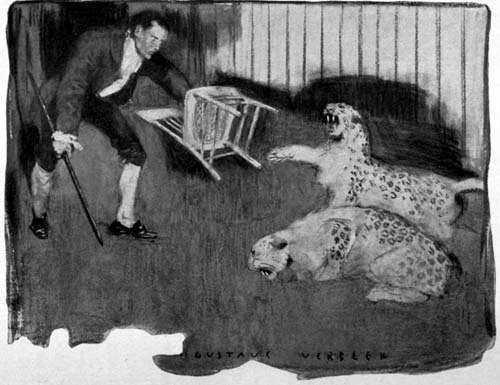
THE EARLY STEPS IN TRAINING WILD ANIMALS.
As he slipped into the cage he thrust before him an ordinary kitchen chair of light, hard wood. This was held in his left hand by gripping two of the central spindles of the back, thereby obtaining an excellent purchase which enabled him easily to hold the chair outstretched with its legs pointed directly at the animals. In his right hand he carried a short iron training-rod. The only other article which he used in his first lesson was a stout, movable bracket, which could be instantly hooked upon any of the horizontal bars which extended the length of the cage in front.
The instant the trainer faced his pupils there was a regular feline explosion—a medley of snarls, growls and hisses. And the way those spotted paws slapped and cuffed the rounds of the extended chair which served as a shield to Frenchy's legs was something to be remembered. Never before had I seen such a startling exhibition of feline quickness as in this preliminary skirmish between master and pupils. The latter's claws seemed to be everywhere in a moment and played a lively tattoo on the shield and against the point of the rod with which the trainer protected himself. During all this excitement the trainer was as calm as if standing safely outside the cage. However, he did make some lively thrusts with his rod as the leopard attempted to dash under the legs of the chair.
While one of the beasts was engaged in carrying on an offensive warfare, the other would invariably attempt to sneak behind the trainer. How alert the latter was to the movements of the creature which apparently claimed little of his attention was impressed on me by the fact that every time the crouching animal attempted to steal past the trainer he was met with the quick, sidewise thrusts of the prod, which sent him back spitting and hissing into the corner.
THE LEOPARDS AT KINDERGARTEN
In less than half an hour the leopard and the jaguar seemed to realize that they, and not the man, were on the defensive. Their savage dashes were less frequent, and they were more inclined to crouch close to the floor and lash their tails in sullen defiance. Then it was that Frenchy began his first attempt at teaching them. Hooking the movable bracket upon one of the lower rounds about three feet from the floor of the cage, he made a forward movement toward the animals, veering a little to the side opposite the bracket. The creatures had long been attempting to get past him, and now their opportunity had apparently come.
Together they made a rush to run under the projecting bracket. Quick as a flash, however, the trainer was back again in his old place, and the head of the foremost animal struck the rounds of the chair. This checked the leopard's progress for a moment, but the creature was not given a jab of the rod as before. Instead, the chair was slightly withdrawn, with the result that the spotted cat instantly bounded upon the narrow bracket—precisely the result at which the trainer had been aiming.
Before the leopard was fully aware of what was transpiring, Frenchy reached forth his training-rod and rubbed it caressingly along the creature's back from head to tail. Of course the animal struck out spitefully with its paw, but the blows were received by the chair and did no harm, while the trainer had been able to bestow upon his ferocious pupil a caressing touch of approval.
Even at that early stage in the education of the animal I fancied I could see an understanding of this commendatory stroke. Certainly within a week this sign was clearly understood, and never did one of the animals leap upon the bracket without receiving this token of approval. Before Frenchy came out of the cage on the occasion of this first experience with these two creatures his chair was splintered beyond repair. Backing out as deftly as he had entered, he leaned up against one of the posts in the winter quarters and remarked:
"Those cats will make good performers. They've got just enough fight in them. I don't mind working a leopard that's been captured, but I don't want anything to do with cats that have been born in a cage. By the time an animal has cuffed one chair to pieces I can generally size him up and get at his disposition. I don't mind a creature that's ready for war right at the start. The sulky, sullen brutes are the ones that keep a trainer in a perpetual state of suspicion."
HOW THEY PUNISH UNRULY PUPILS
Most of the training is done while the animals are in winter quarters, the cages being generally arranged in a semicircle or along the wall, while the center of the main room is occupied by a big ring or circular space inclosed by a very strong and high fence of iron bars. At first the animals are worked in their cages, later in the ring. Lounging about in front of the cages is a man with a long iron rod having a sharp point. The duty of this guard is to keep watch of all the cages where animals are being worked, and to be ready to come to the instant relief of any of the trainers who happen to get into trouble. Occasionally he assists them from the outside in various ways; as, for instance, by slipping his rod between the bars and heading off an animal which is attempting to sneak out of doing his trick. In the main, however, he is there to do heroic service in times of emergency.
Should a lion, tiger or any other savage creature get a trainer down or fasten its teeth or claws into his body, the watchful guard on the outside is expected to plunge his spear into the animal, or get into the cage with hot irons, if necessary. The use of heated irons is, of course, only justifiable in cases of extreme peril, but more than one trainer's life has been saved by recourse to this weapon, which quickly cows an infuriated creature which has had a taste of blood when nothing else will avail.
PUNISHMENT OF TREACHEROUS BEASTS
I have already cited one cardinal rule recognized by all animal workers. There is one other just as universally accepted by the fraternity of trainers. This is, that any animal which has inflicted injury on a trainer must be punished until completely subjugated. This punishment must be given, if possible, by the one whom the creature has injured.
No doubt more than one trainer who has been half killed by a treacherous animal has been inclined to overlook this chastisement after recovering from his injuries. This, however, is regarded as professional treachery, for it is practically certain that the rebellious animal that is not chastised in this manner will kill the next man who enters its cage. To neglect to show the brute which has injured you that you are its master is therefore, according to the ethics of the profession, a deed of cowardice, and a sure way of bringing disaster upon any other person having the hardihood to trust himself in the power of an animal that has "downed" its trainer.
Of course some trainers are killed outright, and others are so disabled in severe encounters that they are absolutely unable to continue in the service. Then the duty of inflicting the chastisement falls upon a new man, and you may rest assured he never looks forward to the job with any particular pleasure. There is but one course, however, and that is to beat the creature until it howls for mercy. Occasionally an animal famed for its splendid performances is suddenly and without any apparent reason retired from the program. As a performing animal is worth many times as much as one that has not been trained, this would seem a strange and unbusinesslike course on the part of the management.
The outsider would immediately ask: "Why not continue the performance with this animal so long as it does not kill a man or conduct itself more savagely than many others of its kind which have the confidence of trainers and performers?"
The answer is very simple: The man handling the animal and knowing well its character has been able to discern a radical change in its disposition. He declares that the brute is no longer to be trusted, and any wise and humane showman who receives this kind of a warning from a reliable and efficient trainer or performer will retire the brute in question to a cage and leave it there. On the other hand, some animals which have tasted blood, and even "killed their man," are continued in the service. Why? Because the trainer who goes in to chastise them believes that he has been able to beat the animal into a permanent state of penitence, humility and wholesome fear, and to effectually obliterate the sense of triumph in the mind of the creature.
A SINGLE-HAND FIGHT WITH FIVE LIONS
Occasionally a foolish and intermeddling spectator will endeavor to show his brilliancy by experimenting with the animals. More than once this tendency has well-nigh cost a performer his life. I recall one instance when a performer was doing an act in a cage containing five lions. He had just begun his work, and the lions had taken their positions. In the middle of the cage, facing him, was one large lion, and at either end sat two others. Of course a big crowd had collected in front of the cage and was pressing heavily against the guard ropes. Suddenly a countryman of the smart kind was seized with a desire to distinguish himself and attract a little attention. Slipping inside the ropes, he stooped down and took up the ragged little dog that was crouching at his heels. The instant he lifted the cur up to the level of the cage every lion gave out a roar and made a wild leap for the yellow mongrel.
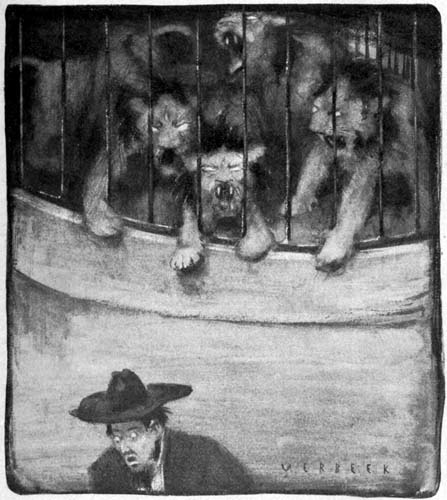
"EVERY LION GAVE A ROAR AND MADE A WILD LEAP."
For a few moments the performer was completely lost to view, buried underneath the writhing bodies of the infuriated lions. Of course the animal men outside made a rush for the cage door, but before they could reach it with their irons in hand the plucky performer was on his feet again and fighting his own battle. A tooth or a claw had split his nose and upper lip, and the tattered condition of his clothing indicated that he had suffered severely. Although his face was bathed in blood, he stood his ground and plied his rod on the heads and noses of the growling beasts until they were momentarily driven back. But they had tasted blood and were furious. Before he could reach the door they were at him again, and in the onslaught his right arm and hip were frightfully lacerated. His grit, however, was indomitable, and he struck and jabbed right and left like a gladiator. Finally the howls of pain from the lions revealed the fact that he was getting the upper hand of them, and at last they were driven howling and whining into the corners of the cage and he backed out of the door. No sooner was he safely outside the cage than he became unconscious.
It was a good thing for the countryman whose folly had stirred up the lions that he contrived to make his escape from the grounds before the circus men got hold of him. This incident is simply typical of hundreds of others perhaps more interesting and exciting. It will, however, serve to indicate the constant perils that surround the trainer or performer, many of which arise from sources over which he has no control.
I have often been asked if the training of animals does not quite generally involve considerable cruelty. This, it seems to me, may fairly be answered in the negative, although one exception should be made. Though great firmness must be shown in working wild animals, and frequent and severe chastisements are called for, there is nothing essentially cruel in the method of training. This, however, cannot be said of the methods generally followed by the trainers of horses.
I can never forget how forcibly and painfully this exception was brought home to me. In company with Mr. Costello I had brought from Texas and New Mexico a herd of beautiful pinto ponies, or bronchos. They were handsome piebald creatures, and apparently very intelligent, although desperately wild. From a herd of about forty we picked out sixteen to be educated for the ring. About ten miles out of Chicago we put up a convenient stable and engaged one of the most celebrated trainers in the United States. In the course of a few weeks the animals became accustomed to having men about them, and then I told the trainer to begin his work.
I had never watched a trainer work horses for the ring, and I was greatly interested to see how it was done. The method was so cruel that I told the trainer if he could not invent a method which inflicted less torture he might quit and we would have the horses sold. He had not the ingenuity or patience to devise a more humane method, and consequently retired from the field, leaving his assistant to work out the problem under my directions. This we finally succeeded in doing with fair results, but the method followed by the trainer is a more general one.
TEACHING A HORSE THE TWO-STEP
In teaching a horse to dance, the master would strike the poor animal above the fetlock, and this would produce a painful swelling. The result was that in a very short time the motion of the stick, in time with the music, would cause the horse to raise its foot. Before the swollen limb was healed the performance was repeated so frequently that the animal did not need the incentives of fear and pain to cause him to keep step with the music.
Jumping the rope is taught in nearly the same manner, a chain being attached to two long sticks swinging back and forth, striking the horse just below the knee. As a man was stationed on each side of him, the poor horse had no way of retreat, and was compelled to jump in order to escape the blow from the swinging bar. A horse is taught to roll an object or to push open a door in a very simple manner, and without cruelty. One man stands in front of the horse and another behind him, the three being stationed in a passageway too narrow for the horse to turn. After standing a bit in this way, the man behind the horse gently slaps him on the back and urges him forward. Instinctively the horse pushes against the man in front, and the latter quickly moves along. In this manner the horse soon learns that by pushing against an object in front of him it may readily be forced out of his way. An intelligent spectator can always tell by the attitude of a horse toward its master whether it has been ill treated. If fear seems to be the governing motive it may be depended upon that the horse has been harshly dealt with; on the other hand, the very nature of the trick performed by the animal goes far to indicate whether fear or intelligence has been the main factor in acquiring the accomplishment displayed. If you see an animal open a trunk or drawer and pick out some article for which it has been sent, you may know that this feat is the result of an appeal to the creature's intelligence and not to its fear, for no amount of punishment could ever teach a thing of this kind.
RING PERFORMERS TRAINED WITH A DERRICK
Ring horses are generally irritated when the rider first stands upon their backs. Probably the action of the foot pulls the short hair; but the irritation ceases in a short time. Riders are first trained to do their tricks on the ground. When complete masters of themselves on the ground they are put upon the back of a horse having an even gait and a reliable disposition. To the performer's belt, at the back, is attached a stout rope which runs to the end of a strong arm or beam running out from a post set in the center of the ring. This arm is swung around by a helper, who keeps the loose end of the rope in his hand in order to regulate the slack and prevent the young performer from having a heavy fall should he lose his footing. Again and again the rider is pulled up just in time to prevent him from falling under the hoofs of his horse. He is swung forward, dangling from the arm of the derrick, until he regains his balance and his footing upon the back of his horse.
To describe in detail how every feat and specialty is taught would require a volume, but on general principles it may be said that all tricks are first learned on the ground, or at a safe and minimum elevation. Then when the performer has attained absolute self-confidence and is wholly without fear he is allowed to swing higher, until he finally reaches the height required in the public performance.
CIRCUS PEOPLE A LONG-LIVED CLASS
In the old days it was the general custom for the circus proprietors to put their own children into the business, teaching them to do everything in the acrobatic line, from bare-back riding to trapeze and bar work and slack-rope and tight-rope walking. Many of them were also skilled musicians and could play several instruments in the band.
At the present day many persons not familiar with the inside life of the circus will no doubt be horrified to think that a man wealthy enough to own a big circus and menagerie would train his sons, and particularly his daughters, for the ring. Let me say on this score that I could name a long list of families in which this custom prevailed, and must say that the private and domestic life of these people was far above that of the average families in fashionable society. Almost invariably the members of each family were devoted to each other and were refined and intelligent. Many of the young women of these families married wealthy and cultured men, and retired from the circus business to become the mistresses of refined and happy homes. Many old showmen whose children were star performers carried accomplished teachers with them on the road, and the children were as well educated as if the entire time had been spent attending school.
Their training and work in the ring not only afforded them splendid physical exercise, but taught them patience, application, alertness, and many other valuable lessons which made their progress very rapid when it came to their lessons from books. It is a fact worthy of notice that the circus people are a long-lived race. I can name almost a score of famous performers who have attained an age of more than eighty years. This would tend to show that circus work is quite as healthy as any other. I may add that the charge so frequently brought against showmen, that the training of children for the circus ring is cruel, is not well founded.
While I have seen many instances of cruelty in this connection, there is nothing in the work itself which necessitates hardship or harshness. In fact, quite the reverse is true.
The child is the sooner trained into an ability to do a dangerous and daring feat through gentleness and encouragement. In other words, the more they overcome their fear in every direction the better able are they to swing from one trapeze to another, to walk the tight rope at a dizzy height, or to turn somersaults from the back of a galloping horse.
X
MOBS, CYCLONES AND ADVENTURES
In a lifetime spent with the circus I have learned the heart of the people. I have felt the pulse of the multitudes who have made the history of the West. This insight into conditions of things in the West brought me many and varied experiences, some of which were rough and severe. They had their interesting sides, however, and many of them are worth the telling, if for no other reason than to throw light upon the character of the people with whom we had to deal. That the show was appreciated by these frontiersmen there can be no doubt.
In the earlier days it was the custom to have a concert in a side tent before and after the regular performance in the circus. At one place where we stopped the people paid their money and went in and enjoyed the concert; but so well pleased were they that they insisted upon a repetition of the performance. At the point of their pistols they compelled the poor minstrels to continue their antics nearly all night, until ready to drop from sheer exhaustion.
FORCIBLE ARGUMENT WITH A CITY MARSHAL
At one time, while in Texas, we were doing an act called An Indian Chase for a Wife, in which we used several guns with blank cartridges. The act opened with a lively fusillade and the reports brought a great crowd to the tent. The Texans appeared to come from every direction, many of them with revolvers ready cocked. The fact that many of them had been drinking greatly increased the perils of our situation. After careful consideration of these facts I decided not to give a night performance, and ordered an early supper so as to be able to load by daylight and, if possible, get out of town before nightfall. The seats were soon taken out and the side wall was dropped.
I sat in the cook tent, eating dinner, when a great crowd suddenly surrounded us. The leader, who claimed to be the town marshal, had his revolver pointed directly at my head, and I could see by the inflamed condition of his features that he, like the rest, had been drinking heavily. Realizing my danger, I knocked the pistol down and it went off between my feet. This was taken as the signal for a rush toward me, the crowd evidently thinking I had shot at the marshal. The noise attracted the concourse that had just left the circus and they drew up in line with revolvers cocked. A slaughter of showmen was clearly imminent.
I leaped upon a box and tried to pacify the infuriated Texans, while receiving, at the same time, their abuse. I was entirely ignorant of the cause of the disturbance and demanded to be informed of the reason of the uprising. Getting no reply, I appealed to them as law-abiding citizens, and for the first time in my life this appeal was useless.
By this time our entire force had collected, and as the show was the "First Hippodrome" and altogether the largest circus ever in the south, we had at least five hundred attachés, three hundred of whom were powerful fellows and well armed. This was the first time that I had ever thought of permitting my people to fight. Our gang was headed by my boss canvasman, "Put." I momentarily expected the attack, but just as I got down from the box a detective who was hired to travel with the show rushed upon the scene and yelled: "In the name of the United States Government, whose officer I am, I command peace!" It was surprising to see that crowd scatter, and certainly this was a master-stroke on the part of the detective. He earned more that day than I ever paid the agency for his services. In ten minutes all was calm and peaceful.
BREAKING CAMP UNDER A HOT RIFLE FIRE
In 1859 two Philadelphia friends of mine were going to make a trip South, and offered me big inducements to join them, which I accepted. We started from Philadelphia, making our way slowly through the different States, with the usual routine of wagon-show life. No event of importance occurred until we reached Missouri. It was a most foolish trip to undertake, for the people were then so embittered by the John Brown raid that we were in constant danger. First came a tirade of the fiercest abuse and this soon led into a regular knock-down fight, which speedily developed into a shooting-scrape lasting several hours. We were compelled to defend ourselves by every method at our command. Our men were marshalled inside the tent and armed with long, heavy stakes which looked like guns and were really formidable weapons. The wagons and other available goods were grouped in a circle, and behind this pioneer fortification the men paced with their long stakes at their shoulders like the guns of sentries. In the dim light thrown by the torches they certainly looked like armed men. So formidable was our appearance the enemy thought us armed with Winchesters. By putting on this bold front the canvasmen were able to get all the loose stuff into the wagons, leaving the tents standing until the last. Finally these also were taken down and loaded. Then came the most perilous undertaking of all. To get our horses from the stables seemed at first an absolute impossibility. It was the custom, at that time, to stable our horses wherever space could be found for them, and as Granby was only a small village, nearly every stable contained one or more of our horses. We divided the men into two gangs, one of which was left to guard the property on the grounds.
Our show was situated in the public square and was thus surrounded by houses and stores, all of which were filled with armed men. By the dim light we could see our enemies running from house to house with guns in their hands. The second detachment of our men was sent to gather in the scattered horses. And a lively time they had accomplishing that business! Shot after shot was fired at them while the horses were being driven into the corral. Fortunately, however, neither man nor horse was hit.
AMBUSHED AND SHOT AT ON THE ROAD
We remained quiet until daylight, keeping constant guard, for we feared an attack at any moment; but toward daybreak we could see that the ranks of our enemy were thinning out. After careful deliberation I gave the order to march. Just as the first team was leaving the square the sharpshooters opened a vicious fire from the windows and doors of houses and stores. Practically every shot brought down a horse. Strange to say, we could not discover that a single man had been struck. Our men instantly fell into line and began firing together, but as we had only pistols the fight was against us. As our enemies were safely concealed in stores and buildings, only a few exposing themselves to our pistols, we fought at great odds. However, we kept up a rapid fusillade, and under this heavy fire we managed to get out into the open country, leaving our dead horses on the village square. Once safely outside and beyond the range of the enemy we paused for roll-call and found that three of our men were dead. This put the spirit of fight into every man in the company, and there was almost an eagerness to have another encounter.
Proceeding cautiously on our way, we came to a stream spanned by an old-fashioned bridge. The first chariot being a very heavy one, the bridge was carried down, throwing the wagon, horses, driver and men into the water twenty feet below. Soon firing was again heard, and two more horses fell. This proved my suspicion that the beams had been cut for the purpose of wrecking us and of trapping us where we could be slaughtered. The next shots brought several of my brave men to the ground—dead in their tracks! The enemy, being in ambush, had us at great disadvantage; but my men were so thoroughly aroused and so fearless that we soon drove our assailants back. This last plucky onslaught won the day for us, although at sad cost.
After a delay of several hours, during which we repaired the bridge, we were again able to proceed on our way. Hardly were we fairly started when a new difficulty was encountered in the form of big trees felled across the roadway. This work had been cleverly done by the enemy in order to retard our progress, and we had to stop and remove these obstacles before we could pass. The time lost by the first attack, by the bridge engagement and subsequent delay threw us behind a whole day.
Although the people were all anxious to see our show they had not a friendly word for us. Frequently large crowds would force their way into the tents, pointing a cocked revolver at the doorkeeper's head. Finally, however, we managed to reach the Arkansas line with comparatively small loss of life. I am surprised that we were ever able to do so, because of the extreme bitterness which then prevailed toward all Northerners.
At length we came to a town called Bucksnort, the scene of the hanging described in one of Mr. Opie Read's short stories. Nearly every man at the tavern was ready for any kind of excitement. They started the quarrel by accusing our men of stealing their hats. A fight quickly ensued; and we were forced again to defend ourselves by resort to arms. At that time we were playing Mazeppa in which we used a number of dull swords. These were instantly placed in the hands of performers and canvasmen who knew how to wield them, and the result was a terrific hand-to-hand encounter in which we came off victorious.
At Lickskillet, another place on our line, the principal building was a log tavern. We put up our tents, but shortly afterward noticed several old men with long-bladed knives cutting slits in the canvas. The canvasmen, on seeing the tent walls slashed, vigorously protested. At once bullets began to fly from the corner of the tavern. One of our men was killed at the outset of this mêlée.
Previous to this episode our men had become pretty well discouraged and would gladly have had peace, but this last outrage seemed to arouse them to a perfect frenzy. Instead of shooting they went for the gang of roughs with clubs, stakes and every other kind of weapon they could find. The encounter was a terrific one. Our men knocked the desperadoes senseless and seized their guns, and in a very few minutes we were much better prepared to defend ourselves. I think during the battle our men seized fully thirty rifles. Shotguns were seldom used in this section of the country. Most unexpectedly we succeeded in getting some recruits. A few Northern men who had come into the place to settle permanently offered their services for our protection.
THE STUDIES OF THE STUDENT TO THE CLOWN
In early days many of the young countrymen would be seized with a desire to become "actors," as they called the acrobats. This led the circus performers into the scheme of selling the ambitious wights something to make them limber. A big trade of this kind was carried on by selling an oil made from very cheap grease, the innocent victims being thoroughly convinced that they would come out full-fledged "actors" by the use of this lubricant. Frequently some young fellow would apply for the position of student to the clown. When he presented himself for tuition, the paint prepared for his make-up would be mixed with grease and thoroughly rubbed on his face and limbs. He would then be dressed in an old pair of tights and made to enter the ring, where he would be ordered by the ringmaster to "act up." He would be so embarrassed at this demand that he could not speak, whereupon the ringmaster would lay the whip upon his practically naked limbs, telling him that it was the only way by which to learn the acrobatic art.
Another trick was to toss the students to the clown in a strong blanket of canvas. I can now point to an ex-member of Congress who was thus tossed until sore and exhausted.
Among the various performances on our circus program one feat was that of placing a large stone on a man's breast, as he lay on his back, and then striking the stone with a sledge-hammer so as to break the rock. The audience was invited to furnish a man to break this stone, and although one would naturally suppose that such an act would hurt the performer on whose breast the stone rested, he would, in fact, receive no shock whatever. But one day, while exhibiting at a small town, a drunken countryman, in attempting to break the stone with a sledge-hammer, missed his mark entirely, and the poor fellow received a blow that nearly killed him. He was obliged to lie in bed and have medical aid.
The following day we were compelled to move on to the next town, as advertised, which was a keen rival of the village we were just leaving. Our principal actor being unable to perform, we came near being mobbed, for this rival town did not relish the idea that its competitor had witnessed features which it could not see. All our remonstrances were in vain; and we were finally compelled to allow the injured man to quit his bed and actually go through the performance. These rough countrymen would certainly have kept their word had we not complied with their wishes, and it would have fared very badly with us. However, the sick man went through his part as well as he could, and received the full approbation of the audience.
From this town we proceeded to a large Indian encampment. There we obtained permits from John Ross, Chief of the Cherokee Nation, and erected our tents. The government had just made an Indian payment to this tribe, all the money being in twenty-dollar gold pieces. Neither the circus treasurer nor any one in the community could change these coins for money of smaller denomination, and we were almost in despair. Meantime some of the Indians climbed into a tree, seated themselves comfortably in the branches, and prepared to witness the entire performance free of charge. This exasperated me, and, seizing an ax, I commenced hewing at the tree. Instantly I found myself the center of an incipient riot, as there was a law in the Territory forbidding a white person to cut down a tree. John Ross, however, quickly came to my rescue and saved my scalp by an adroit appeal to his people.
We adopted the plan of admitting the Indians in squads, charging them a dollar each and taking a double-eagle from every twentieth man. The Indians seemed to enjoy the performance hugely, but were highly excited by the tricks of the magician, whom they regarded as a supernatural being.
DEVOTIONAL SERVICES UPSET BY A DEMON
At a certain town in Missouri a laughable circumstance occurred. Here, for some time, a revival had been in progress. The revivalists had been abusing the circus, its surroundings and influences, and had tried to prevent us from exhibiting. However, we secured a lot adjoining the church and opened our doors. John Robinson, the chief proprietor of our show, was one of the best equestrians that ever lived, and at that time was introducing what he called his Demon Act. In this act he dressed and made up as nearly as possible like a demon. While riding his four horses at breakneck pace around the ring, he would utter a series of the most ferocious yells imaginable, at the same time working himself up to a great pitch of excitement, until, as the auditors frequently expressed it, he "looked like his Satanic Majesty himself."
On this occasion, at the close of his act, he jumped from his horses, ran out of the dressing-room and boldly entered the church, exclaiming in the stentorian voice for which he was famed: "I am victorious! I am victorious!" The effect was magical. The revivalist had been eloquently exhorting on the subject of the Prince of Darkness, and the overwrought congregation took but one glance at the theatrical Satan, and then, leaping madly through the windows and doors of the little church, broke for the woods.
At Council Bluffs, Iowa, we had exhibited to a large afternoon audience. The day was extremely hot and sultry, and in the evening, just as the people were seating themselves on the benches, a cyclone struck us without the slightest warning. In a twinkling the poles, seats and canvas were being hurled through the air in all directions. At that time we used an inflammable liquid for illuminating the tent, and this ignited and added the horror of fire to the scene.
THE WILD BEASTS LOOSE IN THE BIG CROWD
In those days our menagerie was exhibited in the same tent used for our circus performance, the seats being arranged on one side and the animal cages on the other. Imagine the scene! Several thousand terrorized and screaming men, women and children rushed wildly in all directions, the combustible tents and paraphernalia were in flames, and above all could be heard the roar of the terror-stricken animals, beating madly against their iron bars. Two of the largest dens had been placed together and the partition bars withdrawn, so as to form one big cage, wherein the lions and tigers were exercised by their keepers. The fire burned the woodwork so that this double cage came apart and liberated the ferocious animals. These lions and tigers escaped among the people and added a new element to the general pandemonium of terror. Words cannot convey an adequate idea of that awful moment.
As the tents and cages slowly burned out, total darkness came upon us. In the excitement, one of the men in the audience happened to jump on a crouching lion and yelled that he was in the clutches of the beast; however, the animal was as thoroughly frightened as the man. Some of the animals were loose all night, and one Royal Bengal tiger disappeared altogether. No trace whatever was found of his remains when the debris was examined, and he probably escaped to the nearest woods.
Near to the tent was one of those prickly osage hedges, and into this hundreds of people ran, becoming so entangled in the thorny network that it was almost impossible for them to extricate themselves. Many were badly lacerated by the brambles. There was no sleep in Council Bluffs that night.
Several of our wagons disappeared and one carriage was never afterward found. Four or five horses were lifted and blown into a lot some distance from where they had been stabled. To add still further to the misery that prevailed, the catastrophe ended with a cloud-burst and the earth was fairly deluged, so that in a short time what little remained undestroyed by wind and flame was floating around in a sea of water. Dense darkness prevailed and nothing could be done till dawn. It was then found that the cyclone had done even more damage to the city than we had at first supposed. Though the circus was a complete wreck, it was learned that both the city and its suburbs had suffered severely, and it was considered providential that the performance had attracted so great a concourse of the people from their homes.
THE MIDNIGHT STAMPEDE OF THE ELEPHANTS
When we exhibited in Kansas the country was in such a state of terror, resulting from the "border warfare," that all the towns and villages had organized military companies. At each camping place we were obliged to join these home guards, for protection. One day, while we were exhibiting at Lawrence, a detachment of militia encamped about a mile from us, the posts and guards surrounding the entire city. I had with me a friend from my old home at Delavan, Wisconsin. He was a merchant and had never seen any of the hardships of the camp or of circus life, and all this rough experience was new to him.
As we were obliged to travel through the country for weeks without daring to take off our clothes, I had a wagon snugly covered and this served as a sort of sleeping berth. In this wagon my friend and I spent our nights. At our feet slept a faithful watch dog. On this particular night we were sound asleep, when the dog made a sudden lunge, jumping upon us and instantly awakening us. The moon was hid behind a cloud, and it was, for the moment, very dark. As I jumped to my feet, I indistinctly saw what appeared to me to be a body of men coming towards us. I fired several shots from the big pistols I always carried swung from my belt; but still the mass came forward. I soon heard a most pitiful wail of grief, and then I discovered that I had shot into a herd of elephants which had stampeded.
The firing, together with the noise, alarmed the militia around the city, who, thinking the border ruffians were upon us, came to our assistance. It was some time before I could convince them of the real state of affairs, as the elephants had made a wild escape and consternation reigned. The militia hunted for the men who fired the guns, threatening dire vengeance for alarming the post, but after a full explanation we succeeded in pacifying them. Then we had a long chase after the stampeded elephants, which were finally captured.
A POLAR BEAR HUNT ON FIFTH AVENUE
One of the most exciting and amusing episodes connected with my career as a showman is that which passed into Gotham history as "the bear hunt on Fifth Avenue." And certainly nothing could be more strange and picturesque than a hot chase after a ferocious polar bear along this aristocratic thoroughfare!
In 1873 there were no polar bears in America, and I thought it would be a good stroke of business to obtain some of these beautiful and imposing animals for my menagerie. Therefore I sent an expedition to the Arctic waters to capture a pair. My men finally succeeded in landing two enormous polars in New York. In the process of shifting them from the shipping-box one of these monsters made his escape, and started on a run down the middle of Fifth Avenue. His course was marked by general consternation. Children playing on the streets, seeing an immense white bear lumbering toward them at full speed, screamed and fled in every direction for shelter; horses, frightened at this unusual spectacle, became unmanageable and ran away; nurse-maids, wheeling their small charges, were stricken helpless with terror, and even the street dogs fled howling down the cross streets and into business houses. Everywhere disorder and terror reigned supreme; the streets became suddenly deserted, and one would have supposed that a plague had instantly depopulated the city. The police were called out from every adjacent station as soon as it became known that a white bear was loose in the streets of New York. The poor animal, unaccustomed to the strange medley of metropolitan civilization, was more frightened than those who fled before him.
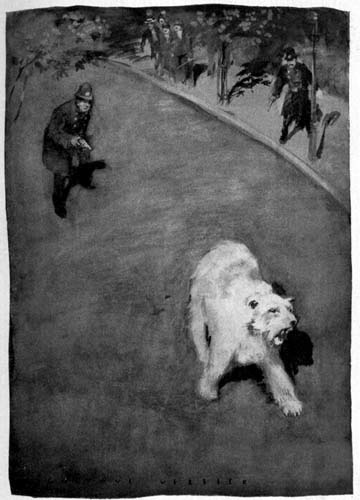
A BEAR LOOSE IN FIFTH AVENUE.
Finally, by the aid of the police and some of the braver citizens, the beast was driven into a basement of a private residence, and there shot. Had the people only realized it, the creature could easily have been captured alive; but fear reigned in every heart, from the child to the policeman, and the latter would not consider anything save instant death to the bear. The animal was very valuable and had cost me a large sum of money, not only for its capture but also for its transportation, and I was exceedingly sorry to lose him in this way. I considered myself exceedingly fortunate, however, to escape as easily as I did, for had the bear done any harm I should have had to pay heavy damages. No person fortunate enough to witness the tumult of that exciting scene can ever forget the bear hunt on Fifth Avenue!
AN EQUINE OFFICER OF ARTILLERY
At one time certain towns in Pennsylvania were greatly dreaded by all showmen, from the fact that the "tough" element there predominated, and rarely did a circus escape without a pitched battle with these desperadoes. Mahanoy City was one of the worst of these towns, and on my last visit there nothing but the sound "horse sense" of one of our trained animals saved the show from a conflict the result of which might have been deplorable. I had wired my agent, weeks before, to drop this town from the list, but he had written back that, under favorable circumstances, we were sure of taking about $10,000 there, and therefore, in accordance with my instructions, the town had been billed.
We had a fair afternoon's business, and at night, judging from the appearance of the house, we ought to have had at least $5,000 in the treasury. But, as usual in that town, the toughs had simply forced their way in without paying, and, as a consequence, only about $800 had been taken. On the outside were several hundred hoodlums clamoring for a fight, and I am bound to say that "Old Put," our boss canvasman, and his faithful followers were anxious for the same means of satisfaction, and only refrained from an outbreak because they knew that instant dismissal from my employ would follow any attempt on their part to take the initiative in any trouble.
At last, however, a fight did come off, and a hot one it was, too! Right in the midst of it one of my horses, which had been trained to fire off a cannon from its back, got loose and, fully accoutred, galloped into the thick of the mélêe. The creature seized the strap which operated the trigger and began firing blank cartridges in every direction. If ever a mob of toughs was frightened it was then! They stopped not upon the order of their going, but fairly flew in all directions.
One of them afterward told a policeman that they could fight any gang of showmen that ever traveled, but when a horse commenced to unload on them with a cannon, he knew it was time to quit.
XI
STORIES OF OLD-TIME SHOWS AND SHOWMEN
Nothing can afford a better idea of the variety and picturesqueness of a showman's life than the medley of odd incidents, of strange experiences and homely happenings that crowd the thought of a veteran when in a reminiscent mood. It is under this kind of inspiration that I have jotted down, in this scrappy and haphazard way, the episodes which sufficiently impressed me at the time of their occurrence to claim frequent rehearsal when talking over the "old days" with other pioneers of the tent and the ring. It is the clowns who in one way or another furnish most material for anecdotes, and the greatest clown America ever saw was Dan Rice, who at one time was the most famous circus performer in America, and, with the exception of John Robinson, the most daring. I have never met a more nervy man; he was without an equal in trying emergencies. He would face a mob at any time and under any circumstances. Besides being a natural fighter he was a natural orator. He had a sonorous, penetrating voice, his enunciation was clear and distinct, and he knew the secret of flattering and delighting his auditors. Dan had many competitors for the patronage of the river towns, the most prominent of whom were two veteran showmen who owned a floating palace. The "Palace" was simply a large boat fitted up as an opera house with the most elegant appointments. It would seat several hundred people and was provided with a complete stage and elaborate sets of scenery. This was towed by a tug called the "James Raymond," on which all the performers roomed and took their meals. They had, besides, a steamer called the "Banjo," on which they gave a minstrel performance.
DAN RICE'S ONE-HORSE SHOW
Dan had formerly been "featured" as one of their attractions; but, some trouble arising, he had left them and started in business on his own account. He experienced the usual ups and downs of a showman's life, finally "went broke," and was at last cleaned out to what he boldly announced as "Dan Rice's One-Horse Show." With this little affair he courageously fought his former associates and did a large business. During the performances he was in the habit of singing a song entitled My One-Horse Show, which took the popular fancy and materially helped him. In this song he told how the opposition had placed false buoys in the river, thereby misleading his pilots and throwing him on sand bars where his craft stuck for days.
For the information of those unacquainted with river travel I will say that buoys are placed by the government in dangerous parts of the river to point out the only safe channel. Now, whether or not the opposition was really guilty of this trick, Dan's verses gained him the sympathy of the people, and with that sympathy came their dollars. In fact, to such an extent did Dan work upon the sympathies of the people that, at many points, they actually refused to allow the opposition boats to land. At some of these places the opposition had themselves incurred the displeasure of the people by touching at the landing only long enough to receive their audiences, and then going into the middle of the river to give their performances, thus avoiding the payment of the license fee.
This lasted through the winter, and when summer came both shows took to their tents and traveled toward New York State. There Dan's enemies succeeded on some charge or other in getting him in jail. While in his cell he composed the song "Blue Eagle Jail," in which he described the jailer, whom he disliked, as "Dot-and-Go-One," from the fact of his having a wooden leg. This song made the one-legged jailer notorious all over the country.
One thing I must say for Dan Rice: He was the only original clown I ever heard—with the single exception of Dilly Fay. The latter was an erratic individual who actually became a clown that he might save money to complete his studies in Paris. Fay was educated and original, but lacked the physical power and deep voice of Rice. I never heard of Fay after he started for Paris, but presume he never reëntered the ring.
TAN-BARK ORATORY AND HARLEQUIN PLUCK
Once when I was with Dan Rice on the river circus we showed at Memphis. At this place a certain fellow was loud in his denunciation of Dan and the show. He was a source of great annoyance to the showman and had also made himself very unpopular by declaiming against slavery. In retaliation Dan entered the ring and returned the compliment in kind. He capped the climax by singing a song in which he described his enemy as playing cards with a negro on a log, and so boldly was this done that the people believed it and the fellow became so exasperated that he threatened to shoot Dan. The clown, however, defied him, and continued ridiculing him until the man was actually obliged to leave the city in a hurry.
Dan also had trouble at Yazoo City, Mississippi. He had, it appears, on a former visit, flogged a prominent man there, and the latter had sworn to shoot him on sight. One night when Dan was clowning in the ring the prominent citizen entered and drew his revolver to kill. A plucky bystander, however, knocked the iron from his hand and prevented bloodshed. The scene that followed I shall never forget. Dan stood undaunted in the ring, called the man a coward and dared him to shoot. His audience went into ecstacies over such an exhibition of bravery and applauded to the echo. Whereupon Dan, stimulated to further efforts, poured forth a torrent of the most stinging denunciation of cowards that ever fell from mortal lips. I have often wondered where Dan picked up such a command of language.
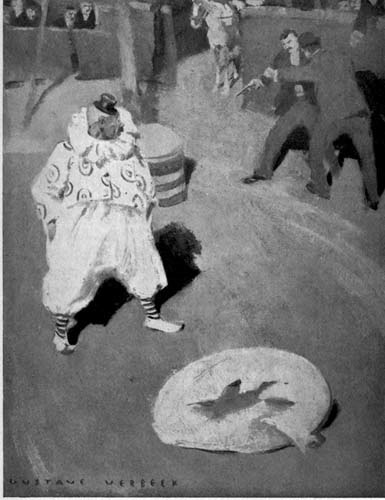
"A SPECTATOR JUMPED INTO THE RING AND TRIED TO SHOOT THE CLOWN."
At that time he was not an educated man, although years after, when visiting him at his magnificent house at Girard, Pa., I found that he had a well-stocked private library, and he had certainly become an exceedingly well-read man.
AN IMITATION PATRIOT SHOWN UP
My last experience with Dan Rice when he was in the circus business was at Elkhart, Ind. It was a very stormy day during the war. The weather was too windy to permit the hoisting of the usual flags, and one pompous young fellow, inflated with conceit, appointed himself a committee and visited Dan, demanding that the flags be hoisted. He charged that Dan had made secession speeches in the South. With an ugly mob at his heels the fellow declared that if the flags were not hoisted he would burn the whole outfit. Dan truthfully told the crowd that he had already erected, at Girard, Pa., a monument to the Union soldiers; that he owned more flags than the whole city of Elkhart, and that he would show them if they desired; but he absolutely refused to hoist a stitch of bunting upon such a demand. Threats and arguments were alike powerless to move him from his stand. I thought him rather foolish, in those exciting times, and there appeared to me great danger in his action.
Dan, however, mastered the situation. He publicly announced that at the night show he would give a full history of the leader of the mob, and did so with a vengeance. He had learned by careful inquiries something of the character of this fellow, who was a cashier in a bank, and at the evening performance, and in the actual presence of the man and his associates, Dan mounted a stool and gave his enemy such a verbal castigation as few persons have ever received. As he progressed in his speech he waxed eloquent, and in a marvelously deep, clear and penetrating voice pictured the vices and foibles of this "patriotic" cashier, until the audience was ready to mob the man. Suddenly a rush was made to where he had been sitting. But he was gone and the eloquent showman was a complete victor.
That night I roomed at the hotel where Rice was stopping, and in the morning he accompanied me to the depot, to see me off for my home in the West. While waiting there the cashier appeared and begged Dan to retract his assertions of the night before, declaring that otherwise he would be run out of town. Dan replied that if he did not immediately leave him he would receive the worst thrashing of his life—and Dan would have kept his word, to the letter, had not the fellow beat a quick retreat. I saw Rice but once after that time, but always regarded him as a prince of the circus ring.
At one time we started our show through Kentucky, where we did a splendid business. On this journey through the South our horses were all caught in a fire and so charred and burned that we had to shoot many of them. In Mississippi we were greatly troubled and delayed by the muddy roads. We were three days going a distance of only eighteen miles. At one point, where there was only one house, our tent was delayed on account of the deep mud, and we were forced to show without it, putting up the seats in the form of a circle, thus making a ring in which the performance was given. The people could see the performance without paying, but nearly all of them had principle enough to pay. A few ruffians, however, began abusing the showmen, and a genuine fight ensued, which was a repetition of most of the others, and some of the toughs were badly hurt. Our men had all gone to the farmhouse to bed, and I was alone on the grounds to look after my property, when, after midnight, a crowd began to gather and suddenly surrounded me, shoving the muzzles of their pistols and guns in my face. This crowd hung about until daylight, and I pleaded so heartily that they did not shoot. The fact that I was then little more than a boy in years was, I think, the only reason I was not instantly shot by the ruffians.
When our company began to gather in the morning these ruffians left, but I shall never forget that night sitting there surrounded by a half-drunken mob, in a drizzling fall of rain. I was completely exhausted and half frozen, and never before nor since was I so glad to see daylight come.
This trip led us through Georgia, Alabama, Florida and North Carolina. In those States we frequently traveled at night, and sometimes all night, illuminating our way by setting fire to the patches of gum on the pine trees at the spots where they had been "blazed" for their sap. In the mountains of North Carolina we encountered the "clay eaters." I was assured that they subsisted to a great extent upon a certain kind of clay which appears to be able to sustain life. The reader can imagine the character and intelligence of these beings. There was also, in a certain region, a strange people who held regular monthly fairs where they met to barter. They were said to be descendants of a certain Scottish clan, who, when they first came to this country, were fairly well civilized, but instead of settling in the fertile soils and lowlands, took up their homes in the mountains, because the latter reminded them of their native country. Here they became more and more isolated until, at length, they were governed solely by their own outlandish laws and customs, knowing nothing of the usages of civilization. Outside of the clay-eating districts these mountain people grew to an enormous stature and possessed great strength. I found them very hospitable, always treating their guests with marked kindness.
IN WHICH CUPID WAS MASTER OF THE RING
When we went to New Orleans to close up and pay off a show that had been "flooded out" in one of my earliest ventures, it was our intention to take the New Orleans company to New York, but I found it impracticable. I thereupon called all the members to my rooms at the hotel and explained to them the situation. I proposed to pay them all off and let them remain idle until the opening in the following spring. To this all agreed save two, our principal riders, a woman and a man. These positively refused to make any compromise. The woman snapped her fingers in my face and said: "No, I was engaged for a year and you will have to pay me my salary just the same. You are able to do it, and do it you shall." The man took precisely the same stand, and as they were not only our star riders, but also the best equestrians in America, I was at a loss to know what to do.
I took a little time for deliberation, and learned that both malcontents were very much in love with each other. This immediately helped me to determine what course to pursue. I first sent for the woman and told her to get ready at once to go to my farm in Wisconsin, where I intended to build a ring around a tree, to furnish her with a ringmaster, and to allow her to earn her salary by giving two performances daily to the birds and squirrels. She claimed that her contract did not call for such performances, but a reference to the contract proved that she was to ride in any part of America I might designate. Then I sent for the man and told him that he and his horses must take the next steamer for New York City. He refused to do this, but I quickly proved to him that his contract with us, though calling for transportation for himself and horses, did not specify of what nature that transportation should be; I had a perfect right to send him by sailing vessel if I chose. His refusal to go of course canceled his contract, and I accordingly left him. The woman expressed her willingness to go to Wisconsin, but I knew she could not leave her sweetheart—and I was right. In less than half an hour they proposed a compromise, but I refused. Finally I agreed to take the woman to New York and pay her half salary until the season opened.
Among the many men employed with the Barnum show was one large, handsome fellow who was superintendent of the equestrian department. As showmen are fond of having nicknames, some one called this man "Barnum." The poor fellow was wholly illiterate and tolerably fond of whisky, consequently the name was decidedly inappropriate, but, as a nickname will, it stuck to him hard and fast. One day, while Mr. Barnum was visiting the show, his namesake was lying asleep outside one of the horse tents on a pile of hay, and one of the hands, desiring to waken him, shouted at the top of his voice: "Barnum! Barnum! Wake up!" Mr. Barnum had been a witness to this scene and he came to me in a tremendous rage, saying: "Have you no respect for me at all?"
"What do you mean, Mr. Barnum?"
"What do I mean?" he replied. "Why, I wish to know your intent in calling that drunken, illiterate brute by my name."
Of course, after an explanation, Mr. Barnum's rage cooled, but I think he was never so much annoyed in his life. It well illustrates how thoroughly he hated the vice of drunkenness. After that episode strict injunctions were given to refrain from calling the man "Barnum."
On one occasion when we had run to Joplin, Mo., the train was divided into three sections, the first having been switched on a siding to wait for the other two. I was sitting at the hotel, eating breakfast, when the superintendent of the road came in and announced, "I am afraid you will not show to-day."
"Why not?" I replied.
"Well," said he, "the section of your train that has already pulled out has run wild down a steep grade over an immense trestle with nothing but zigzags and reverse curves. We have to run over them with our passenger trains at a very slow speed, and, as your cars are top-heavy, I can see nothing but complete destruction for them."
"Well," said I, "can't you send an engine after the runaway section?"
He promised to do this and, as there was nothing more I could do, I finished my breakfast at leisure.
BARNUM'S ONE UNCONQUERABLE SUPERSTITION
The locomotive went out and caught the train. It had passed safely over the trestle and had reached a heavy ascending grade. Here it naturally lost its momentum and began to back down the grade toward the city. I was unaware, at that time, that a passenger train was then due and that the superintendent fully expected a collision to take place. I can assure my readers that I drew a long breath when the operator looked up from his key and remarked: "Thank the Lord! Number Six, the passenger, is an hour late!" Thus a dreadful catastrophe was prevented. Two men were asleep on one of the platform cars of the circus train, and one of them, in the stress of excitement, jumped off and was instantly dashed to pieces one hundred feet below. The man who stuck to the train was saved, although nearly frightened to death.