Front matter (continued 2)
Reading edition
"How far can your practiced eye discern objects on a night like this?" I asked the engineer.
"Only a rod or two," he answered.
"In that case," said I, "you could never stop the train to prevent a collision should an obstruction present itself?"
"No—not with these brakes," he replied.
As he said this his face blanched and he whistled hard for down brakes. Finally I heard him exclaim: "God help us! We're running away!"
On, on we sped down the decline at a speed that was something frightful. The engine rattled and shook, and several times appeared to be almost toppling over. It was impossible to stand, and I held on by the window ledge for dear life. Down the mountain we sped altogether helpless! We had no control over the train, loaded down, as it was, with toppling chariots, with horses, animals, elephants, camels and human freight.
PANIC AMONG THE ANIMALS
Evidently the animals instinctively knew the danger, for above the rattle and roar of the train could occasionally be heard some of those strange trumpetings which proceed from an animal only in moments of danger—often just before a storm or cyclone. Momentarily I expected the whole train to be thrown from the tracks and down the mountain side. By the occasional streaks of light that flew past us I could see the blanched faces of both the engineer and fireman, and knew that they fully realized our awful danger. Both of them, however, kept perfectly cool, and I tried to imitate their example. How far I succeeded I do not know, but I do know that my nerves were strung to a higher pitch than they ever were before.
A blinding rainstorm added to the horror of the situation, and, with the speed at which we were traveling, each drop seemed to have the penetrating power of a shot. Quick as a flash the thought passed through my head: What if we meet a train? Just at that moment we sped past Blairsville at the junction of the branch road and the main line. The station lights seemed mere specks. As we struck the switch the engine jumped and almost left the track. Looking back we could see the rear lights of our train swaying in the path like a ship tempest-tossed at sea. Our speed seemed to increase as we flew along the main line.
We had gone twenty miles when a whistle was heard ahead.
"What is it?" I asked.
"Another train," replied the engineer; "it will pass us now," and as he was speaking the reflecting lights of its engine appeared, apparently not six rods from us. With lightning rapidity the trains passed each other and the "windage," to use a nautical term, nearly took my breath.
During all this time, which positively seemed hours, my thoughts were not of the pleasantest. On, on we dashed, the engine frequently jumping as it struck something on the track. It seemed to me a miracle that the train did not lurch sheer over some one of the terrible embankments. The fireman was not engaged in tending the fire. It was unnecessary. We were all mute spectators of the scene being enacted by this silent machine—the marvelous and lifelike invention of man. Gradually, at last, our speed began to slacken. We had reached a grade. The danger was past and our lives were saved!
A SINGLE TRACK AND A BROKEN RAIL
We were still moving ahead at the rate of thirty miles an hour when—crash! through the window came some object. Once more the whistle sounded "down brakes," and in less than a mile the train came to a stop. Shortly afterward we heard shouts in our rear, and the man who had flung the missile through the cab window came running breathlessly, and said that less than a mile ahead of us was a broken rail that would undoubtedly have wrecked our train. Knowing that the express train was due in about an hour he had been running back to the station to detain it, when he had met our "wild" train and, realizing the danger, had done all he could to prevent a catastrophe.
Back sped the man to the station to warn the express, leaving us between what were undoubtedly two horrors. The station was fully a mile away. Suppose he could not reach there in time! There we were on a single track, a broken rail ahead of us, an express train due at any moment behind us. Slowly we pulled up to the broken rail and at once replaced it with a new one, for we always carried extra rails on our train for cases of emergency. The track walker succeeded in getting to the station in time to stop the express, though luckily it was not quite due. We ran back to Blairsville and switched on to a side track.
There we found that the second section of our circus train was due at nearly the same, time as the express train, and it was an anxious quarter of an hour that we spent in righting things. When, however, the second section did come in, I found they had been more fortunate than the first section. They had taken the precaution to add to their train several cars belonging to the railroad company, which were fitted up with better brakes than ours, some of them being supplied with both new air and common brakes. Then as a consequence of these precautions the train had descended the mountain under perfect control. I learned a lesson from that experience, and lost no time in fitting all our cars with air-brakes. I wish I could remember the name of the engineer. A braver man never handled an engine or went into a battle.
It may not be generally known that all well-regulated roads employ a certain number of men as track walkers, whose constant duty it is to patrol every inch of the road and report the slightest irregularity of rails, road-bed, etc. On this particular night the track-walker's lantern had gone out, and the only expedient he could think of was to throw a stone through the cab window. I have often shuddered to think of what the consequences might have been had not his aim been a true one.
THE BRONCHOS' CHARMED LIFE
On another occasion, while going into Clinton, Iowa, with the biggest show I ever owned, we were running about twenty miles an hour, when the locomotive jumped the track and struck a tree. The shock threw all the cars of that section on their ends. The Mississippi River was on one side of us and a springy hill on the other. Here in this narrow place stood the cars, laden with animals of all kinds. It was truly an awful situation. We began to break up the cars in order to extricate the poor dumb brutes. We were compelled to hitch ropes about the horses' necks and pull them out, only to find perhaps that their legs were broken or that they were otherwise hopelessly injured. No fewer than thirty-five of my best horses were thus lost. The reader must remember that, as the cars had been thrown on their ends, in each horse car twenty horses were thrown into a struggling heap. Strange to say, the bronchos seemed to have charmed lives, for not one of them was hurt, and I was enabled to give a performance that day in spite of the accident.
The elephants were piled up in much the same way as the horses, and in order to extricate them it was necessary to strip the cars completely—a labor in which those huge animals assisted us. The camels were unhurt. The loss, in crippled animals and destruction of cars, amounted to several thousand dollars.
I cannot leave the subject of moving the big show without going back to some of my earliest pioneer experiences.
No other human being can realize like the showman the volume of dread hardship and disaster held by those two small words, "bad roads." At the time of my breaking-in we were passing through a section of the country in the southwest, over such wretchedly constructed highways that the slightest fall of rain was sufficient to convert them into rivers of mud. The heavy wagons would sink to their hubs in the mire and the whole train would be stopped.
Then followed a scene too picturesque to escape the attention of even the poor fellows who were half dead from lack of sleep. By the light of flaring torches a dozen big draft horses would be hitched to the refractory wagon. Inspired by the shouts, curses and sometimes the blows of the teamsters, the animals would join in a concerted pull that made their muscles stand out like knotted ropes. But often a battalion of six teams would fail to start a wagon.
OLD ROMEO TO THE RESCUE
Then the shout would go down the line for Romeo. In a few minutes the wise old elephant would come splashing through the mud with an air that seemed to say, "I thought you'd have to call on me!" He knew his place and would instantly take his stand behind the mired wagon. After he had carefully adjusted his huge frontal against the rear end of the vehicle the driver would give the command, "Mile up!" Gently, but with a tremendous power, Romeo would push forward, the wagon would start, and lo! the pasty mud would close in behind the wheels like the Red Sea.
So vividly did this oft-repeated picture impress me that it is as clearly before me now as it was forty years ago. Sometimes, when an elephant was not available, the wagons would be literally pulled apart, and when the break came the horses would fall sprawling into the mire, only their heads visible above the surface of the mud.
But the poor horses were not the only sufferers from bad roads. The men came in for their share. Very distinctly do I remember the night when we were about to cross a slough. Some of us were dozing in our saddles, others sleeping soundly on the tops of the wagons which carried the tents. Suddenly the shout was heard from the man in the lead, "Help, there, boys! I'm going down in the quicksands! Throw out a line, lively!"
We knew the voice. It belonged to Hickey, the wagon boss, who was a favorite with the men. Instantly the fellows tumbled from the wagons and rushed forward. The torches showed Hickey sunk to his armpits. A man of ready wit and action threw a rope and the sinking man caught it and passed the noose over his head and under his arms, knotting it so that it could not slip and cut him in two. By that time a team of horses had been hitched to the other end of the rope.
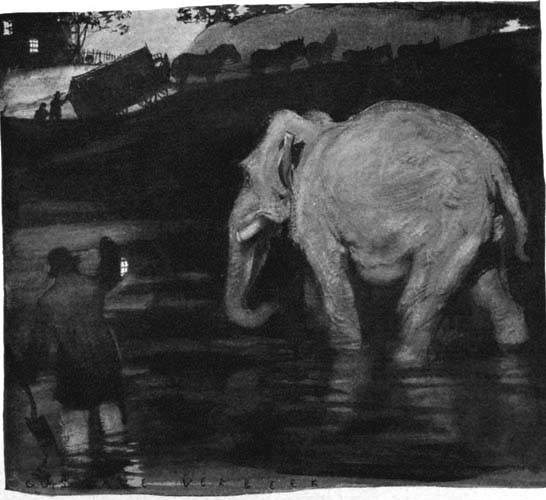
"THEN THE SHOUT WOULD GO DOWN THE LINE FOR ROMEO."
"All right! Easy, now!" came the order from Hickey, and the team was carefully started. Watching those horses strain on the rope made me hold my breath in expectation that the poor fellow would be actually drawn in two. But, finally, the grip of the mire loosened and he was hauled out to safety.
AN UNEXPECTED MIDNIGHT BATH
Perhaps the most disheartening of all bad-road experiences is that of losing the way—a thing which happened with perverse frequency. Just imagine yourself a member of such a caravan. You have slept four hours out of sixteen and are crawling along in the face of a drenching, blinding rainstorm—soaked, hungry and dazed. The caravan has halted a dozen times in the forepart of the night to pull out wagons and repair breakdowns. But it halts again, and the word "lost" is passed back along the line of wagons. This means retracing the route back to the forks of the road miles in the rear. Many an old circus man has wished himself dead on hearing the word "lost" under these conditions.
After one of these disheartening experiences, when we were obliged to "right about face" and drive the poor, jaded horses back over the same road along which they had made their useless but painful pilgrimage, I clambered up to the top of the tent wagon, stretched out on the jolting, shaking heap of canvas, and was soon oblivious to fatigue and discouragement. My next conscious impression was that of a sudden crashing of timbers, the squealing of frightened horses and the sensation of falling. Then I felt myself plunging into the icy waters of a little stream into which the heavy show wagon and all its contents had been precipitated by the breaking of a bridge. It seems almost miraculous that I should have escaped falling under the mass of tents on which I had been sleeping, but in some way I was thrown to one side and contrived to reach the shore in safety.
It is usual, in arranging the season's route, for a circus to make all the "big jumps" on Sundays; and it not infrequently happens that from three hundred to five hundred miles are covered between Saturday and Monday. This arrangement is very convenient in many ways. It may take you out of a country that is overrun with opposition shows into one where you may have the whole field to yourself, or it may take you to a part of the country where the climate has forced the harvests and therefore placed more money in circulation than usual.
As a general thing circus employés are not in love with Sunday runs for, commodious as their cars are, they are not exactly fitted up to enable all occupants to loll lazily around and enjoy a luxurious ride. If the day happens to be rainy, most of them lie in their beds and content themselves with reading, with an occasional chat, argument or light lunch, and in this way endeavor to pass the time as best they can. If, however, the day happens to be a fine one, then at daybreak comes a mighty exodus from the sleeping cars. Cozy nooks are singled out and made comfortable by pressing into service all available shawls, rugs, etc. Those physically strong enough to brave the exposure make for the tops of stock and box cars where, lolling at ease, they discuss sundry topics of interest and revel in the ride through the country. Others select places underneath the chariots and cages which are loaded on the flat cars, and thus, sheltered from the sun, spend a delightful time. Once, at least, during the day, a stop of a couple of hours is made to enable the horses and animals to be fed and watered, and advantage is taken of this interval by the performers and other attachés to stretch themselves and also to cater to their own personal wants. Both comic and serious accidents are frequently the result of carelessness during these runs, as the following examples prove:
In one long run between Springfield, Mo., and Mattoon, Ill., one of our men was standing erect on the top of a car, when a telegraph wire caught him under his chin and cut his head completely off, as though done by the surgeon's knife. On that same trip my watchman, Nelse, had the misfortune to have his straw hat blow off his head. The hat rolled gently along the top of the flat car and finally rolled off and fell on the side track. Immediately the watchman jumped to the ground, snatched up the hat, and leaped unhurt on the last car, although the train was making nearly twenty miles an hour. Probably the hat cost him originally fifty cents.
Of all the Sunday runs I ever took, however, I recall one that was especially pleasant. It took place back in the seventies, and was a run of some three hundred miles across an Indian reservation between a town in Kansas and another in southern Texas. The day was beautiful, and as we bowled along the prairie I felt that the "stillness"—comparatively speaking—(so seldom enjoyed by circus people) was most refreshing. I don't suppose there ever was a country-bred boy who lived long enough to forget how, in his younger days, the Sabbath seemed, always, a day of stillness and quiet. The cessation of all business and the chiming of church bells produced an effect that could not fail of indelible impression; and that Sunday morning ride over the reservation brought back the scenes of childhood to many a rough and rugged circus man. Towards noon we halted and erected cooking tents and stables. The horses and animals were looked after and a dinner was cooked by the attachés. After dinner they formed congenial knots and strolled around while the "hash slingers" washed the dishes and the men once more loaded up. We carried at that time an excellent troupe of Jubilee singers, and with the light heart and impressionable feelings of their race, they burst into song, alternating their quaint camp meeting songs with others in which the majority of the attachés could join. The band, too, caught the infection and produced their instruments and we enjoyed a vocal and instrumental feast. Just at dusk, when the stars were beginning to appear, before starting for the night's run, the "Jubes" sang "Nearer, My God, to Thee" to the full accompaniment of the band and with a refrain swelled by every one able to sing. I have, in the course of my travels, visited many grand concerts and operas, but their most solemn and sacred effects are dwarfed into absolute insignificance compared with that of this impromptu performance. The rolling prairie, the beautiful trees, the perfect weather, the joyous spirits of every one present, the melodious voices of the Jubilee singers, and the grand strains produced by thirty skilled musicians, combined to produce music such as man seldom hears—that, on account of its spontaneity, thrilled the hearts of all present, then seemed to go right up to heaven, and "die amid the stars."
"All aboard!" is shouted, and every one climbs into the car. The whistle sounds and off you go, past miles of beautiful scenery and occasional Indian villages. Everything is quiet and every one seems to be "drinking in" the beauty of the scene or sits lost in thought. No more singing or playing. All seem to be so solemnly impressed with that last grand hymn that the silence is unbroken. That Sunday run will always stay in my memory! With quiet "good-nights" one after another slipped off to bed to awake to another day's hurry and bustle.
V
THE PRAIRIE FIRE
One of the most terrible and impressive experiences of my entire career came to me very shortly after I had become well settled in the circus harness. Sleep was the dragon which pursued me then with a relentless and irresistible power. There was scarcely a moment when I was not under its spell, at least to some degree. It was like a vampire that took the zest and vitality out of my very life sources and I went about almost as one walking in a dream. This condition arose from the fact that under the best of weather luck, a showman's hours are very long. But when roads were bad and journeys long, the poor wretch attached to the old wagon show had practically no sleep at all. After a stretch of hard traveling I was for weeks like a person drugged. My mind seemed in a state of miserable torpor, while my body went about in a mechanical way and did its work. The change from a regular life, which saw me snugly in the same bed at nearly the same hour every night of the year, to the painful excesses of a circus man's hours told on me very severely and I was long in becoming acclimated.
At the painful period of which I speak my main object in life was to sleep. For this I lived, and my idea of Paradise then was a consciousness that I was in the act of falling asleep in bed with clean sheets, and that I would not be awakened until the end of eternity unless I should chance to get my sleep out before then—and this possibility seemed deliciously remote.
While I suffered more keenly than the others from the tortures of longing for sleep, all the men who had anything whatever to do with the moving of the show were under the spell of this dragon. They, however, rallied more quickly than I, when dry roads and good weather fell to our lot for any length of time.
Well, weeks of terrible traveling, of getting lost, of fighting our way through the mire and floods, was followed by a fortnight of fair weather. My associates had "caught up" in the matter of sleep, but I was still in a half torpid state and thought only of the blessed privilege of closing my eyes for an hour or two at a stretch.
But, one morning as we started north from the small Missouri town in which we had given a very successful performance, the scene was so novel and impressive that I held out for a few minutes against the demon that was pulling my eyelids together, and really aroused to the picturesque features of the scene.
We were winding our way to the northward, our caravan being fully a mile in length and stretched out like a long serpent. The elaborate and gilded chariots, the piebald Arabian horses, the drove of shambling camels and the huge swaying elephants gave a touch of genuine oriental picturesqueness to the scene strangely out of keeping with the wild western landscape and surroundings.
On every hand the prairies were carpeted with wild flowers in the greatest variety and profusion. Their fragrance even reached me as I stretched out at full length on the top of a lumbering chariot. The almost endless vista of prairie, the serpent caravan, the gay colors and the fragrance of the flowers all combined to refresh and impress me, and to give me more cheer and courage than hours of sleep. The pleasant picture haunted me after I closed my eyes and mixed in my dreams after I dozed off into a half conscious slumber.
Later the lurch of the wagon aroused me, and I started up with a sense of unaccountable alarm. The first object which met my eyes was a jackrabbit, sitting on his haunches not more than two rods from the trail we were following. Knowing the habitual timidity of these creatures the boldness of this one surprised me greatly. He sat there with his ears cocked straight up, his nose working nervously and his heart pounding so heavily that its pulsations shook his gray sides. Not until the wagon had passed did the rabbit stir. Then he dropped upon all fours and vanished in a gray streak traveling in a line parallel with the course of the caravan and keeping only a few rods from our trail. While I was still pondering over the strange conduct of the animal I saw a "rattler" emerge from the grass into the beaten trail only a few feet in front of the "off leader" of our four-horse team. Naturally I expected to see the snake coil and strike the horse, but he did nothing of the kind—simply avoided the horse's hoofs and then slipped away into the grass beyond. What was the meaning of the strange spell which seemed suddenly to have taken possession of the wild animals and reptiles of the plain through which we were traveling? There was no escape from the conclusion that some peculiar influence had seized upon them, blunting their ordinary sense of fear and precaution. Had I been more accustomed to prairie life I would probably have realized at once the nature of the trouble; like all of the men on the wagon with me I was a rank tenderfoot.
In the course of the next ten minutes several flocks of birds passed over us, flying low but very rapidly. The grass on both sides of the trail seemed suddenly to swarm with animal life.
Before I had arrived at any conclusions regarding the peculiar actions of the prairie creatures the captive animals in the darkened cages began to show signs of unusual restlessness. The lions and tigers began a strange moaning unlike their ordinary roars and growls. From the monkey cages came plaintive, half-human cries. These sounds were taken up by all the animals big and little. The elephants trumpeted, the camels screamed, and every animal took part in the weird chorus, which rapidly increased in volume. Then the air seemed to take on a hazy appearance, particularly in the direction from which we had come.
Finally the truth dawned upon me—the prairie was on fire! By turning backward and straining my eyes I fancied I could make out a cloud of smoke far in the rear of the caravan. In a few moments this dim vision became clear and tangible. I told my fears to the driver, who laughed at me for my pains. Then I caught sight of a man on horseback on the crest of rise in the prairie. He was riding towards us as fast as his horse could carry him. Passing us like a whirlwind, he shouted: "Whip up, man! The prairie's on fire! Move for the river straight ahead!" In a second he was gone, shouting the same word to every startled driver he passed. His approach had been noted by the boss, who was at the head of the entire procession. That grand marshal of the day, for that was substantially his position, came riding back to meet the courier. Instantly, on learning the tidings, he wheeled about and rode like the wind for the chariot in the lead, drawn by six splendid horses white as milk.
Sharp orders emphasized by a liberal sprinkling of profanity were sufficient to impress the driver of the magnificent leaders with the awful gravity of the situation and with the fact that he must set the pace for the remainder of the caravan. It might be thought that the greatest drag on the speed of the terrified procession would have been the camels and elephants. So thought the boss, but no sooner did the driver of the elephants get into position on the back of old Romeo and give that knowing creature an idea of what was expected, than he saw his mistake.
The way in which both the elephants and camels swung themselves over the ground was a revelation to all who saw them. Which was the more pitiful and terrifying, the trumpeting of the elephants or the squealing of the camels, was difficult to tell.
As the awful scroll of the fire rolled closer upon us the ungainly bodies of the camels and elephants swayed from one side to the other until they seemed fairly to vibrate.
"Where is the river? Are we nearing the stream? Can we make the water?" These were the questions in the mind of every person in that long wagon train. Sometimes they were yelled from one driver to another, but the only answer was to lay the lash harder on the backs of the poor horses pulling the heavy wagons and chariots—leaping and straining like so many modern fire department animals responding to an alarm. It was a genuine chariot race—in which the stake was life and the fine death by flames. Nearly every vehicle was drawn by either four or six horses, and the scene was one of the grandest and most terrible that human eye ever looked upon.
Suddenly I saw the boss put his horse into its highest speed, leading on ahead of the six whites. Then he leaped from the saddle, struck a match to the grass, remounted and rode back a short distance. As each team approached he ordered: "Wait till the flames spread a little and then break through the line of the back fire I've started and form a circle."
The grass which he had fired was considerably shorter than the general growth of the prairies; then, the fire it made had not acquired the volume, intensity and sweep of that hurricane of flame from which we were fleeing. One after another of the teams reared, pitched and plunged, only to find that the back fire had gone under their feet leaving them inside a charred, blackened circle fringed with flame.
No sound I have ever heard approached in abject terror the awful symphony of roars, growls, screams, wails and screeches that went up from the maddened beasts in that caravan as the great sky-reaching cylinder of flame and smoke rolled down upon us and was met barely forty rods away by the rapidly spreading line of our own back fire.
Just as we were wondering if our next breath would be flame or air, the leaders of the white chariot horses leaped into the air like rockets. Instantly the whole six stallions became absolutely crazed with fear and made a plunge directly for the oncoming storm of fire and smoke. On toward the furnace of fire they ran, the driver tugging with might and main on the reins.
"Jump!" yelled the boss. And jump the driver did. He was not a second too soon, for an instant later the white charioteers had disappeared under the great red and black barrel that was rolling upon us. Then came a moment which was a dizzy blank to most of us, I guess. The fearful strain of the long race, the moments of awful suspense after the charred ground had been reached—it was enough to have dethroned the reason of every man and woman in the charmed circle! Small wonder that a few fainted dead away and the rest of us were stunned into momentary confusion.
But we had scarcely recovered the use of our faculties when the wag of the circus broke the long strain of the flight and escape by the remark: "I reckon there's been more genuine praying done in circus circles in the last hour than since Noah let the elephants out of the Ark!" The truthfulness of the remark hit home to every one in the whole group. Probably there was not a choicer collection of "unbelievers" on the face of the civilized earth than our company contained—yet only a few moments before every man, woman and child had been praying for dear life—some fairly shouting their supplications, others kneeling quietly in the wagons, and still others mumbling their petitions as they helped to hold the horses in check or performed some other imperative duty. But there was not a single individual in the whole wagon train who had not, under the awful pressure of the trial through which we passed, put up some kind of a petition to the Almighty for deliverance from the devouring flames.
One of the first things we did, when the burning ground became cool enough, after the tornado of fire had swept around our little oasis of burned ground and passed on towards the river, was to go out and look for the remains of the chariot and the six white stallions. We had not far to go before we came to a heap of wheel tires and other ironwork from the big vehicle. A little beyond it were the blackened remains of the splendid horses which had dashed into an unnecessary death. These animals had been the pride of the show, and there was scarcely a man connected with the equestrian department of the circus who did not deeply lament the loss of the noble creatures. As for myself, I could hardly keep back the tears, for my fondness for the beautiful, intelligent horses amounted to a passion.
Slowly we made our way to the river. On the other bank were gathered the inhabitants of the prairies who had been fortunate enough to reach this refuge. They had immediately extinguished the fires started on the far side of the river by the sparks which the wind carried across the stream. Some of them were almost raving with grief over the fate which they firmly believed had overtaken their relatives and friends, while others put their whole energies into caring for all who needed help—thus forgetting their own distress and afflictions in ministering to others.
A CHANCE MEETING WITH A GREAT MAN
After relating one of the most stirring and tragic episodes of my life as a showman, my thought turns instinctively to the other extreme—to an experience quite as typical of the wandering existence of the pioneer showman of the old wagon days. I refer to a chance meeting with one of the greatest men who helped to make the history of the United States, a splendid, picturesque giant of the pioneer type whose life was an unbroken romance. It may be asked, What has this kind of thing to do with circus life? I answer: Everything! Much of the success which I have achieved in this peculiar field of effort I owe to the contact with men of large capacity with whom I chanced to "fall in," as it were, while on the road. These meetings were as bread to my mind. They made the bright spots in my life, and, from the very beginning of my career, gave me the inspiration which helped me to see things in a larger way, to persevere in the face of all obstacles and to take advantage of every opportunity. Of the hundreds of experiences in this line, no other approached in romantic interest that which came to me very early in my southwestern tour.
I was then a young man and was traveling in Louisiana. I put up at a hotel in a rather small town, where hotels were as rare as other evidences of civilization. I had just gone to my room on the night succeeding my arrival when I was honored with a call from the landlord.
"Mr. Coup," he said, "there'll be another feller up to bunk with you in a few minutes. You'd better wait up and arrange with him about the side of the bed you are to sleep on. If he walks in and finds you sleepin' on his side, there might be a coolness spring up between you."
At that time I was a stranger to southern customs, and their manner of doing things struck me as being a trifle irregular. However, I offered no objection. It has always been a rule with me to maintain the silence which is said to be golden when I am among strangers in a strange land. I afterwards discovered that it was customary for this landlord to put as many as three in one bed when he happened to be cramped for room. In about ten minutes my bedfellow came up. He was an elderly man with eyes which seemed to pierce one.
His bedroom candle lighted up a face which I have never since been able to eradicate from my memory. It was one of the most interesting faces it has ever been my good fortune to gaze upon. When he smiled, I was somehow irresistibly drawn towards him. It was the saddest, tenderest, sweetest smile that I have ever seen upon a man's face. He spoke to me kindly as he placed his candle upon the little table, then drew his chair up close beside me in front of the open, wood fire. Twenty minutes afterward I could have sworn that I had known the man all my life. He was a brilliant talker; and his stock of knowledge regarding men and affairs of that day seemed to be inexhaustible.
"By the way," I said, after we had talked well into the night, "I see Gen. Sam Houston is billed to speak here to-morrow night. I shall certainly go to hear him." He glanced up at me quickly.
"Are you an admirer of him?" he asked.
"I will answer that question by saying both yes and no," I replied. "I greatly admire him for his sturdy independence, his political ability, and his apparent hatred for all shams. But there seems to be another side to his character which I do not admire. The manner in which he deserted his Cherokee wife after he had left the nation and returned to civilization, I regard as wholly contemptible. Do you know him?"
"I have seen him," he replied, quietly, smiling the sad smile which had before struck me so forcibly.
"Well, don't you agree with me?" I asked.
"Before I reply to that question I would like to tell you a little story," my roommate replied, and it seemed to me that his voice trembled a little.
"I once knew a man who held a prominent office in the State of Tennessee. He was a young man then—not older than yourself, and with just as quick a tongue when it came to condemning all sorts of wrong and injustice. His position gave him admission to the best social circles, and he wooed and married a beautiful girl. On his part it was wholly a love match. He worshiped her as he had never before worshiped anything on earth. For a time he was happy—after the manner of men who place their entire lives in the hands of one woman. By and by he noticed that his beautiful young wife was growing dejected and unhappy. Often, when he spoke to her in terms of endearment when they were alone, she would burst into tears, tear herself out of his arms and escape from the room. On one of these occasions he followed her to her room and insisted upon an explanation. At first she refused, but finally yielded, telling him a story which crushed him to the very dust. She said she had never loved him, but had been persuaded by friends to marry him on account of his position. She told him more than that. She told him that long before the marriage occurred she had loved another man.
"That night the husband left his home and his high official position and disappeared. Shaving the hair from his head and tearing the broadcloth garments into shreds, he donned the scanty apparel of the savage and became a member of the Cherokee nation. The members of the tribe treated him with the greatest consideration and respect, and he became a sort of oracle among them. In time he married an Indian maiden, thereby widening the breach between himself and the past. After a number of years had passed, however, he grew weary of savagery and his mind often reverted to the life which had been his before his great trouble came upon him. Finally he bade his wife and her untutored friends a temporary farewell and drifted into Texas. Here he soon rose to recognition, and in a comparatively brief space of time once more held an important official position. But he had not deserted his Indian wife. On several occasions he returned to the tribe to see her and tried to induce her to return with him to civilization. But the poor, untutored Indian squaw was a thousand times nobler than the beautiful society woman who had ruined his life in early manhood. She loved him passionately, but positively refused to accede to his requests. 'I would only disgrace you,' she said. 'I am not fit to go out into your world.' Finally the husband returned without her—very much against his wishes, remember—and a few months later word reached him that his Indian wife was dead. She had loved him too well to accompany him into his changed life for fear of disgracing him, and had loved him too well to wish to live without him. She was found, said the messenger, at the bottom of a cliff, and the manner of her death was only too apparent. The white wife represented what is popularly called the highest type of civilization and social culture—the poor Indian girl what is best known by the name of savagery. That, young man, is how General Houston came to desert his Indian bride."
I had been deeply interested in the old man's story, and when he had finished I thought that his keen eyes were filled with tears as he sat gazing into the dying embers of our fire. I hastened to assure him that I was glad to be set right regarding General Houston's character. "I shall listen to his speech with renewed interest to-morrow night," I said. "You must have known him well?"
"Yes," was the reply, "I have seen a good deal of him. But, my young friend, don't let your enthusiasm run away with your discretion. General Houston has his faults like the rest of the world—plenty of them."
"By the way," I said, as we pushed back our chairs and prepared for bed, "I believe you have omitted telling me your name. I have spent such a pleasant evening that I would really like to know to whom I am indebted for it."
"Ah," he said, with the same smile, "I believe I did omit that little formality. My name is Sam Houston."
We did not quarrel regarding the side of the bed he was to occupy. General Houston could have had both sides had he expressed a wish for them.
VI
BOOMING THE BIG SHOW
It may not be generally known to the public, but it is a fact, that nearly one-half of the entire expenditure of a circus is incurred in the work of the advance brigades. The advertising material, its distribution, express, freight and cartage, together with the salaries, transportation and living expenses of seventy-five to one hundred men, amount to vast sums of money. The largest number of men I ever used in advance of my show was seventy-five, and for this people called me crazy.
Though, of course, there is a limit to possible receipts, there is no doubt that the business secured is in proportion to the sum used in advertising, and it is almost impossible to draw the line at which judicious advertising should stop. This is demonstrated by the fact that the dressing-room tents of the present day are larger than were the entire old-time circus canvases, when the advertising was done by one man on horseback and all the paper used was carried in his saddle-bags, and the salary of any star advertiser now is as much as was required to run the entire show of years ago.
NOVEL ADVERTISING FEATURES
I early learned, by experience, that big receipts at the ticket wagon followed big advertising expenditures. In 1880, in order to boom the "Newly United Monster Shows," I arranged some very peculiar and novel advertising features in the way of three cars especially fitted out for the use of my advance agents. The first brigade was accompanied by an enormous organ, for which a car was built, the latter being drawn through the streets by an elephant. This organ was a masterpiece of mechanism and was specially built by Professor Jukes. Its tones resembled the music of a brass band and could be heard at a great distance. This, of course, attracted the people, and the brigade would then advertise the show by a lavish distribution of hand-bills.
Unfortunately the elephant and the music combined to frighten many horses, and I soon found myself defendant in numerous damage suits. Indeed, that single elephant seemed to frighten more horses than did the entire herd with the show.
At one place temporary quarters for the elephant were secured in a stable which could be reached only through a private alley. When we came to take possession of the barn, the owner of the alley, with several policemen, stood on guard and undertook to stop the progress of the huge animal. Their efforts, however, met with no success, for, with the most sublime indifference, the beast moved quietly forward. For this I was sued for "trespass" and "injured feelings." As the elephant was the offender, my lawyer proposed to bring him into court as the principal witness, a proposition which caused considerable amusement. As no damage had been done, the "laugh" was decidedly on the owner of the alley.
THE "DEVIL'S WHISTLE"
My second advertising car was fitted up with another enormous organ of far-reaching power, and attracted much attention, while my third and last advertising brigade rejoiced in the possession of an engine to which was attached a steam whistle of such power and discordant tone that it could be heard for miles. This the men would blow while going through the country. Professor Jukes had christened this diabolical invention the "Devil's Whistle," and so well did its sound fit the name that the people must have frequently thought His Satanic Majesty was near by.
As that car with its whistle would steam into a town, the inhabitants would flock as one man to see what it was that had so disturbed their peace, and thus we were enabled to advertise more thoroughly than any show before or since. I have often thought that I really deserved punishment for thus outraging the public ear.
Between these three advertising brigades I had smaller companies, accompanied by a colored brass band, which discoursed pleasant music while my bill posters decorated the dead walls and boards. The band also gave concerts at night upon the public square and, between pieces, a good speaker would draw attention to the excellences of the coming show.
A uniformed brigade of trumpeters was also sent through the country on horseback, and a band of Jubilee singers marched through the streets singing the praises of the "Newly United Shows." Added to these attractions were two stereopticons that pictured, from some house-top or window, the main features of the show. This, together with perhaps the most liberal newspaper advertising that ever had been done, made the whole advance work as near absolute perfection in show advertising as possible.
One of the picturesque features with the advance show was Gilmore's "Jubilee Anvil Chorus." The anvils were made of wood with a piece of toned steel fastened at the top in a manner which secured a volume and resonance of tone that could be heard much further than that of an ordinary anvil. At intervals, to strengthen the chorus, cannon were fired off. This, though a great novelty, caused some dissatisfaction, especially amid crowded surroundings. My excuse was that the chorus was a free feature furnished by my friend Gilmore, and that, as it cost the public nothing, the latter should be satisfied. Never before nor since was a country so startled and excited over the coming of a show.
"SPOTTERS"
A great circus uses large quantities of advertising paper—so much, in fact, that it is difficult to keep track of it. True, the superintendent of the advertising car gives each man so many "sheets" in the morning and the man at night hands in a statement which is supposed to show where and how he has placed the paper. These brigades are followed by "watchers," or, as the railroad men term them, "spotters," who look carefully over the ground. But the impossibility of detecting all crooked work may be readily understood when I say that from eight to twelve wagons containing bill-posters and paper start out on country routes in as many different directions, so the "spotter," not being ubiquitous, cannot follow every trail. One of my "spotters," however, did once ascertain that a party of my men had driven into the country and dozed comfortably in the shade all day, had not put up any paper and had not fed the hired horses, although they did not forget to charge for the "feeds." The horses were thus made to suffer and the men pocketed the money which should have gone for oats. Of course my superintendent discharged the entire brigade, although, when the season is well under way, it is very difficult to obtain skilled bill-posters, for it is quite a difficult craft and experts are in good demand.
The reader, however, can easily see what a great loss such doings entail on a show, considering the cost of the paper at the printer's, the freight or expressage, the cartage, and the money paid the men for putting up the sheets. The printing bills of a first-class show are enormous. My lithograph bill alone, the last successful season of my show, amounted to $40,000, and this was before the days of extensive lithographing. I believe I ordered the first three-sheet lithograph ever made, and also the first ten-sheet lithograph. This was considered a piece of foolishness; but when I ordered a hundred-sheet bill and first used it in Brooklyn it was considered such a curiosity that show people visited the City of Churches for the express purpose of looking at this advertising marvel. How things have changed! The Barnum and one or two other shows now use nothing but lithographs, and many of their bills are beautiful works of art, some of them being copies of really great pictures.
I can remember when one-sheet lithographs cost one dollar each, and for several years later they could not be bought for less than fifty to seventy-five cents apiece. They can be had now in large quantities for about five cents or less the sheet. As shows nowadays frequently use hundreds of sheets in a day, imagine what would be their cost at the price paid in the pioneer show period.
The circus of the present day is judged by the quality of its paper. One season I arranged with a publisher to use a folded quarter sheet, three sides of which advertised our show and the fourth side contained the first chapter of a story about to be published in his magazine. These were furnished to us in enormous quantities and our agents distributed them. In Boston we had four four-horse wagons full and these followed our parade. The men tossed the folders high in the air and the wind carried them in all directions. While this style of advertising surprised the people, it was soon stopped, and properly, too, by city ordinance. I think circus people would be better off if ordinances were passed wholly prohibiting bill posting; but unfortunately such a movement would go far toward breaking up a profitable industry, since many of the bill posters are rich men, some making as much as $25,000 a year and a few fully $50,000. I believe Mr. Seth B. Howes, the veteran circus manager, was the first one to order a billboard made or paste paper on the outside. Previous to this all bills were hung or fastened up with tacks.
RIVALRY IN EXPLOITING OPPOSITION SHOWS
There was always a sharp rivalry between the advance brigades of opposition shows, and many are the tricks which they play upon each other. Perhaps the most serious and daring trick played on me was when the agent of an opposition show actually went to the railroad office and ordered a carload of my paper, which was on the sidetrack there waiting for our man, to be shipped to California. Believing him to be representing me, the freight agent did as requested, and my advance brigade was delayed until a fresh carload could be sent on from New York, which could be done in less time than it would have taken to have brought the original carload back from San Francisco. After accomplishing this contemptible trick the fellow escaped, and, although I had Pinkerton men closely on his trail, I was never able to get service on him. Of course the scamp's employers were legally responsible; but in those days we never thought of bringing suit in cases of that kind, although I was strongly tempted to do so in one place, where an opposition show had covered my dates with their own and had greatly damaged us by misleading the people.
Of the many other sharp tricks played on me by opposition shows, one of the best, or worst, was that of equipping men with sample cases, and sending them in advance of my show in the rôle of commercial salesmen. These men would step into prominent stores and, after a short business talk, incidentally mention my name and then impart the information that my show had disbanded and gone to pieces. This, of course, would set the whole town talking, and the news would soon spread over the entire country, thus doing me irreparable harm.
COSTLY RIVALRY
The general public has very little idea of the extent to which opposition tactics are carried by the representatives of circuses and menageries. The rivalry between two shows often costs thousands of dollars and is sometimes kept up by the agents long after the proprietors have become reconciled. Once we became involved in one of these contests, and the opposition, in order to harass us, actually had four of our men arrested in different States on a charge of libel. The Indiana libel laws were very severe, and in each instance we were compelled to give a heavy bond for the release of our man.
That year the train of a rival outfit ran off the track, and one of the proprietors, in the course of time, became my agent. One day, in a confidential chat, he alluded to the mishap, and told me that at the time it occurred he fully intended accusing us of having had the switches turned, thus causing the disaster. To that end he had even gone to the length of swearing out warrants for our arrest. They knew that we were perfectly innocent, but their object was to gain notoriety and sympathy. At the last moment, it is to be presumed, their better natures asserted themselves; at all events, they weakened.
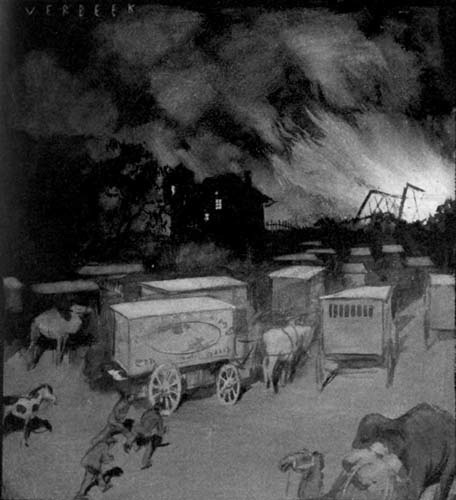
"WHEN RIVAL SHOWMEN BURNED A BRIDGE TO PREVENT THEIR KEEPING A DATE."
Another party in opposition warfare copied our money orders. Orders of this kind were given by our agents and paid by our treasurer on arrival of the show. They were given for services rendered or goods bought, and covered the expenses of livery teams, distributing bills, flour, feed, advance brigade supplies, newspaper advertising, etc. They were made out something after this style:
"On presentation of this order and ten issues of —— Newspaper, containing advertisements of the Coup Show to exhibit at —— on the —— day of —— pay Mr. —— $——, amount due him.
"(Signed) —— ——, Agent."
These orders were extensively used by the opposition for some time before we discovered it. Its object, of course, was to make the newspaper proprietors and the public think they were advertising the Coup show, while of course their own dates would be inserted instead of ours.
At a certain place in Ohio a bridge was burned in advance of us and entailed the loss of our next "stand," or date. We could not safely accuse any of our competitors of this contemptible and incendiary trick; but we knew they were driven to desperation and were capable of resorting to any such outrage.
There were agents so utterly unscrupulous as to receive pay from opposition shows for disclosing to them information that should have been jealously guarded, even betraying the advance route. I knew one agent who was an expert telegraph operator and able to take messages by sound. He would scrape acquaintance with the regular operator and pass his spare time in the telegraph office secretly taking our messages as the latter were being sent over the wire, the local operator being ignorant of the loafer's telegraphic skill.
IDLE BILL POSTERS
These opposition fights greatly benefited the local bill posters and were frequently urged on by them. Sometimes a show would send a brigade over the country at night, placing its own dates on the paper of its rival, thus getting all the advantages of the first show's paper. Sometimes the indolence and laziness of my own men have annoyed me greatly. I am reminded that, while my advance brigade was billing Texas, one of my agents became utterly disgusted with the sleepiness of his men. They were mainly of corpulent build, and their captain actually sent me this message:
"Waco, Texas, July, 1881.
"W. C. Coup,
"Sturtevant House, New York City:
"There is one more shade tree in Texas; send another fat man to sit under it."
On numerous occasions I have had to pay dearly as a result of the sharp practices of unscrupulous people, and it is a well-known fact that a circus man has to deal with a great many of this class. Our advance agent always engaged the lots on which we were to exhibit, and he did so at Austin, Texas, renting the necessary ground at a most exorbitant figure. As usual, he gave an order on the company which was to be paid immediately on our arrival. But the owner, or pretended owner, inserted a clause in the agreement that the lots were to be used if still in the possession of the signer. Immediately on our arrival the bill was presented, and as promptly paid. Imagine my surprise when, as the show opened at night, another bill was presented for $150. It seems that this sharper had made a fraudulent sale of one of the center lots on purpose to swindle me. Of course I paid it, under protest, in order to enable the performance to proceed, as, anticipating a refusal on my part, they had illegally attached some valuable ring stock.
Some years ago when George Peck was struggling with Peck's Sun, long before it had been recognized as a "leading comic paper," I visited Milwaukee with my show. My invariable instructions to my agents were to advertise in every paper, but especially to place an extra advertisement in all young papers struggling for recognition, provided, of course, that they had merit. For some reason, or through oversight, George Peck's Sun had been entirely forgotten. Nevertheless, I found on reaching Milwaukee that Peck had, on several occasions, good-humoredly alluded in his columns to my coming, and had not "roasted" me, as many other editors so slighted would have done. Accordingly I sent him a check which would have more than paid for the advertising he should have had but did not get. To my surprise he returned the check, saying I owed him nothing. I declined to receive it, and once more sent it to him, telling him not to come any of his "funny business over me," and to reserve his jokes for his paper. This brought him around to my hotel, and I was delighted to become acquainted with one of the cleverest men I have ever met. Later he became Governor of his State.
COURTESY OF EDITORS
As an example of the courteous treatment I have invariably received at the hands of the newspaper editors I cannot refrain from giving the following incident which occurred when the show was in North Carolina. In a town in that State one paper, through an oversight, had been skipped altogether in the distribution of the advertising. When the second brigade of the advertising army arrived in town, it found that the issue of this paper had already been mailed to its subscribers. Nothing daunted, however, this agent arranged with the publishers for a special issue which, teeming with praises of the Coup show, was issued and mailed to all subscribers. As a result excellent houses greeted us when we exhibited in the place.
The rivalry between the great shows extended to the newspaper advertising as well as bill-posting department. I remember that once, at Pittsburg, the opposition was very strong, and I had as press agent a brother of the man who held the same position in the employ of my rival. They were both excellent newspaper men and thoroughly understood their business. We would take whole columns in the newspapers, and my men with the show would telegraph to the papers at Pittsburg after this manner:
"Wilkesbarre, Pa.
"The W. C. Coup show did a tremendous business here to-day; the largest and best show ever seen here."
These telegrams would be used to head our other notices in the Pittsburg papers, and whole columns would follow, setting forth the merits of the show. With more solid indorsements these telegrams so worried my agent's brother that he was at a loss to know how to overcome them. He finally hit upon a novel and dashing plan. After our columns had been set up in the various papers, he would then engage the adjoining columns. In this space, in display type, he denounced our telegrams as bogus, stating that he had seen his own brother write them at the hotel. This announcement completely took the wind out of our sails.
JUMBO'S FREE ADVERTISING
Many amusing things of this sort occurred in the war of opposition, but others of a more serious nature would, of course, come up.
The greatest amount of free advertising ever received by a big show, within my knowledge, for any one thing, was that which was incident upon the purchase of "Jumbo." The elephant was bought by Barnum, Bailey & Hutchinson from the Zoological Gardens in London. When the day arrived for his removal, the elephant lay down and refused to leave his old home. This created a sympathy for the dumb creature, and the children became so interested that petitions were signed by hundreds—yes, thousands—of children and adults of Great Britain, protesting against the delivery of the animal to its new owners. Jumbo's stubbornness proved a fortune to his new owners. Taking advantage of the opportunity they began to work upon the sympathies of the Humane Society, which made every effort to prevent Jumbo from being sent to this country. The news was cabled to America by the column. I happened to be in the editor's room of a daily paper in New York when one of these cables came into the office. The editor laughingly called my attention to it and threw it into the waste basket. I said: "What, are you not going to use this?" He said: "No, of course not."
"Well," said I, "you will use Jumbo matter before the excitement is over."
I saw how the excitement could, and surely would, in such able hands, be kept up. I left that night for St. Louis, where my educated horses were being exhibited, and made a call on my old friend Col. John A. Cockrill, then editor of the Post Dispatch—when another associated press Jumbo dispatch came in, with which they were delighted. I then related my experience with the New York editor who had refused to use the cable that came into the office while I was sitting there. The colonel and Mr. Pulitzer said: "Well, we are glad to use it—this and future dispatches."
The next day the colonel handed me a New York paper, which proved to be the same that I had mentioned, and in it appeared a double leaded account on the Jumbo excitement. Their show agents in London did wonderful work in keeping the associated press filled with new matter, and the free advertising they secured would have cost at regular rates a half million of dollars and even then would not have been as effective.
The agents succeeded in working up this opposition to Jumbo's removal until they induced the editor of the London Telegraph to cable Barnum, asking what price he would take to leave Jumbo in his own home, explaining the feeling of the people, especially the children. This editor had no idea then and perhaps does not even now know that he was made an innocent agent in the big advertising scheme. The children of Great Britain had ridden on Jumbo's back, fed and fondled him for years, so that it was easy to arouse this feeling of indignation and sympathy. The multitude even threatened violence if he was removed. The excitement had purposely been kept up to such a pitch by these people that it became international.
There was also much excitement about Jumbo's wife, Alice. Elaborately written articles were cabled over, expressing the sorrow of Alice at the enforced departure of Jumbo and her consequent separation from her husband. The feelings of the people were so worked upon that sympathy for Alice and Jumbo almost equaled that aroused for the slave by the description of Uncle Tom in "Uncle Tom's Cabin." The advertising matter for Jumbo—the lithographs, etc.—had already been printed, and in them he was called "Mastodon." When he refused to be moved his right name, Jumbo, was used, as the dispatches had gone out in that name. The strategy used by these managers and their agents to get all this notoriety did no one any harm and made good sensational reading for the newspapers.
VII
PARADES AND BAND WAGONS
Shows thrive best on bluster and buncombe. Years of experience have taught me that the traveling show business handled by capitalists who have been trained in other lines of enterprise can never succeed. I have often been reproved by business men who were astounded at the lavish and apparently wasteful expenditures of the circus for "show and blow," and who have insisted that these expenses should be cut in half. It is true that such reckless expenditures in any ordinary commercial undertaking would be disastrous, but it is the life of a big show. When it is possible thoroughly to arouse the curiosity of the public, expense should be a secondary consideration.
THE FIFTY-CENT RIVALS OF THE $10,000 HIPPOS
I recall an incident, however, which goes to show that the most expensive attractions do not necessarily prove the greatest drawing cards. Among the rare animals which I had one season were some Memiponias, or tiny deerlets—"hell benders," as they were commonly called. One of the opposition shows was making a great feature of a pair of hippopotami, or river horses, from the Nile. I had made arrangements to receive, at stated intervals, regular numbers of "hell benders," and I would wire my agents ahead, "Another living hell bender arrived to-day." This he would advertise with great gusto, getting out special bills and keeping up the excitement.
One day, while one of my agents, who happened to be back with the show, was sitting in my office, a bill to the amount of six dollars was presented for "One dozen hell benders." Seeing this he inquired what it meant.
"Don't you see?" said I. "'One dozen hell benders, six dollars.'"
"Do you mean to say," my agent exclaimed, "that I have been advertising fifty-cent hell benders?"
"You have," I laughingly replied.
"Well," said he, "if that doesn't beat the deuce! These fifty-cent hell benders have knocked $10,000 worth of hippos higher than a kite!" It certainly was a fact that our fifty-cent articles had been so judiciously advertised as to create more excitement than the costly "hippos" of the opposition.
In the course of the same season I made a discovery which proved to be a valuable drawing card. I owned some young elephants which I had lent to a showman on the Bowery. On going to see them one day I noticed a man holding his finger in the mouth of one of the smaller ones. I placed my finger in the mouth of another and found that the creatures seemed to derive pleasure from the action of sucking. Immediately I sent out for an ordinary infant's nursing bottle. The young elephant drained the bottle as if to the manner born. It was passed from one to another of the infant class. Finally they fought in the most indescribably comical manner for possession of the bottle.
A SKILLFUL APPEAL TO PUBLIC SYMPATHY
Then I fitted a large glass jar, holding a gallon, with rubber tubes, so that all could use it at the same time. Invariably they would empty this bottle before loosening their hold on the nipples. They had doubtless been taken from their mother when too young, or perhaps she had been killed at the time the young were captured. So effectively did they appeal to public interest and sentiment that by dint of skillful advertising the celebrated "sucking baby elephants" made quite a fortune in a single season. They would be led into the ring, where they would take their nourishment like human babies, their over-grown size making this infantile operation very comical and absurd. The sight captivated the heart of every woman who attended the show.
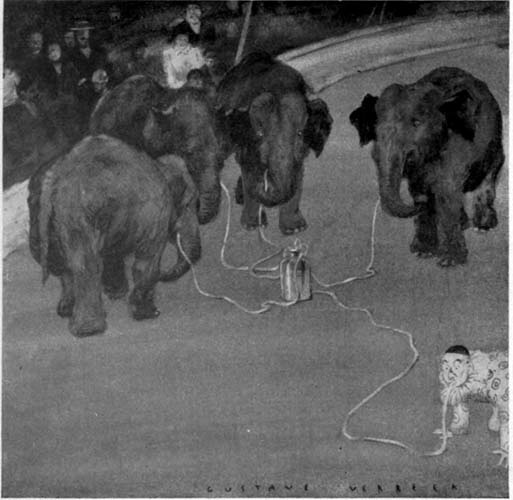
THE HERD OF YOUNG ELEPHANTS.
The eagerness of circus proprietors to procure animal monstrosities for exhibition purposes has called forth many laughable communications from persons who have curiosities of this kind to sell. I remember going one morning into the office and reading a telegram which came to Mr. Barnum. It was as follows:
"Baltimore, Md.
"To P. T. Barnum: I have a four-legged chicken. Come quick."
The circus of the present day is not complete without the side shows and the after concerts. For my own part I can honestly say that I never in my life heard a concert announcement made in my show without feeling like getting up and leaving in disgust; but all classes of show-goers must be pleased, and there is one class which demands the concert and another class that wants the side shows.
A SILENT PARADE FROM ALBANY TO THE STATE LINE
I am glad to know that the circus man who speaks of his patrons as "gillies," and who endeavors to obtain his wealth by fair or foul means, is becoming more and more rare. I recall an illiterate circus man of this description who employed every "privilege" known to the circus world. For example: when traveling by wagon the whole caravan would pass through a toll-gate, stating that the "boss" was behind and would pay the toll. The last vehicle to go through would contain this dignitary and his treasurer, who, when confronted with the long list of vehicles on which he ought to pay toll, would declare that the toll-keeper had been imposed upon, and that half of those vehicles belonged to a gang of gypsies having no connection whatever with the show. He would then cut the bill down according to the easy or hard nature of the custodian of the toll-gate, and in this manner evade payment of what, in a whole season, would aggregate a large sum of money.
On one occasion, when about to exhibit in Albany, and knowing that his whole outfit would that day be attached for debt, he ordered the parade to start early, as he intended to give them a "long ride." The procession accordingly started on what has passed into circus history as the "silent parade," for, leaving the city in all the glory of spangle and tinsel, the showmen never rested until they had reached the State line, while the sheriffs, waiting at the tents in Albany for the parade to return, had the poor satisfaction of attaching the almost worn-out and quite worthless canvas.
I have often been asked what it costs to start a circus and menagerie. This is a most difficult question to answer, since it depends entirely upon the size and pretensions of the enterprise in question. Shows vary in size from cheap affairs, capable of being carried in three railroad cars, to the elaborate institutions which require two long special trains for their transportation. The expense of running a large show is enormous, although in advertising this expense is usually exaggerated. There are a great many traveling tented exhibitions which "bill," or advertise, like a circus, and in the eyes of the general public pass for circuses, but which, in reality, are variety exhibitions given under canvas.
THE FLUCTUATING LEVELS OF CIRCUS VALUES
In the eye of the law a circus must have feats of horsemanship in its program, and such shows have to pay a "circus" license, which in some States and cities is very high. If, however, the shows do not give any riding, their performance simply consisting of leaping, tumbling, and athletic feats, then a license may be taken out at a greatly reduced price; and this accounts for the almost numberless small shows which annually tour the country. Of the circus and menagerie show proper I do not think there are more than twenty in America; but of tented exhibitions, billed as "railroad shows," there are several hundred. The tented exhibitions employ from fifty to six hundred men each, and the capital invested in them runs from $5,000 to $250,000.
Many of the smaller shows are fitted out economically by purchasing from the larger ones paraphernalia that has been used a season or two. For example: the canvases used an entire season by a large show may be purchased cheaply, because it is essential to the attractiveness of a really great amusement institution to have each season a new, white "spread." The old canvas, if not sold to the smaller showmen, is disposed of to the paper manufacturers at about one and one-half cents the pound.
The same rule of enforced replenishment applies to wardrobe and general paraphernalia. In this way a beginner in the circus business may, by judicious investment in second-hand bargains, start out with a very fair outfit secured at a much smaller cost than if he were compelled to purchase everything new. And, in this connection, let me say that I know of no other business enterprise in which new material costs so much, and when sold at second-hand realizes so little. One of the largest shows ever organized in this country, and which was reputed to be worth more than half a million dollars, was inventoried on the death of one of the proprietors, with a view to selling the estate of the deceased, and, to the great surprise of the executors, was found to reach in value only about $200,000.
Twenty years ago a show with a daily expenditure of $250 was thought extravagant, while fifty years ago a circus whose receipts averaged sixty dollars a day was considered to be doing a good business. To-day there is one show the expenses of which are undoubtedly more than $3,500 a day, although it is surprising what wonderful displays are made by others at a cost of less than $1,000 a day. The reason for this is that, above a certain amount, the expenses depend largely upon the amount of advertising done. It is amusing, however, to note the manner in which all of them, big and little, claim to be the largest and most expensive attractions in the country. Many smaller showmen use the same billing matter as the largest ones, and scores of lines can be read in the circus advertisements of to-day that have done duty for many years.
WHAT IT COSTS TO RIDE WITH THE BAND WAGON
It is almost impossible to give an intelligent idea of the cost of wild animals, since this depends entirely upon the operation of the law of supply and demand. The cost of cages varies, of course, according to size and decorations, and the same observation applies to the railroad cars. The most expensive of the latter are the highly ornamental cars used for advance advertising. These are comfortably, and even elaborately, fitted, and are provided with a huge paste boiler and other conveniences. They cost anywhere from $3,000 to $7,000. The flat and stock cars used by circuses are much more substantially constructed than the ordinary ones used in the railroad freight business, and are considerably larger, most of them being sixty feet in length and fitted with springs similar to those of passenger coaches. Cars of this description cost from $500 to $800 each; passenger coaches from $1,500 upward, according to the quality of interior, fittings and decorations.
Some circus proprietors also have their own private cars, fitted with every imaginable convenience and luxury, and such a car costs high in the thousands. The expense of the wardrobe depends, of course, on the amount used and its quality, and whether the costumes are intended for a spectacular show or for an ordinary circus. The wardrobe and papier mâché chariots used in the production of our "Congress of Nations" cost Mr. Barnum and myself more than $40,000, and I am told that Mr. Bailey expended a like amount on his "Columbian" display.
The price of the canvas has been wonderfully reduced within the last few years. We paid $10,000 for our first hippodrome tent alone, and this did not include dressing-room tents, horse tents and camp tents. Afterward, however, we had a larger one made for very much less money. The small circuses that hover around Chicago and the larger cities of the West in summer usually use a tent about eighty feet across, with two thirty-foot middle pieces. This, equipped with poles, seats and lights, costs about $800. These tents are made of light material. The larger canvases have to be made of stouter stuff, and a tent suitable for hippodrome or spectacular shows, which must be about 225 feet in width and 425 or 450 feet in length, would cost about $7,000.
REQUIREMENTS AND COST OF THE CIRCUS HORSE
As an evidence of how circuses have increased in size, I will say that the seventy or eighty quarter poles which hold up the main tent of the Barnum & Bailey shows are each larger than the main pole used years ago. The present system of lighting, which, by the way, I was the first to use, is the patent of an Englishman, improved by an American named Gale. It first took the place of kerosene lights, so far as circus illumination is concerned, in 1870. In experimenting with these lights, when I first introduced them, I several times met with accidents which threatened to terminate my career. Once I purchased an electric light plant with the intention of doing away with all gasoline illumination, but was compelled to abandon the attempt after expending $8,000 for a portable electric plant.
The item of tent stakes is quite a formidable one. Fitted with iron rings, they cost about fifty cents each, and hundreds of them are required by every circus. Harnesses require an outlay of from ten to twenty-five dollars each, according to decoration and material.
The draught horses used by circuses vary in price, some of them being purchased cheap from horse markets; but I have always found that the best I could get were the most economical. Those bought by me averaged $200 each; the usual circus horse, however, costs much less, and so long as it does its work all right the main purpose is answered, for, in passing through the streets, its faults do not attract the attention of the ordinary observer, but only that of the typical horseman. Ring horses, whether for a "pad" or a "bare-back" act, must have a regular gait, as without it the rider is liable to be thrown. They are frequently and generally owned by the performers themselves, and I have known a crack rider to pay as high as $2,000 for one whose gait exactly suited him. The performing "trakene" stallions brought from Germany by Mr. Barnum cost $10,000, and my first troupe of educated horses, ten in number, were purchased at the same figure. These, however, were unquestionably the best and most valuable ever seen in a circus.
A PAGE FROM THE INVOICE BOOK OF A BIG SHOW
Though it would be comparatively easy to start a circus and menagerie equipped almost entirely with second-hand paraphernalia, the reader will see from the following figures that the cost of starting a new first-class circus and menagerie is another proposition. Here are a few official figures on the cost of a first-class circus and menagerie which have never before been made public. They are taken from my private record, or invoice book:
20 Cages at $350, $7,000.00
2 Band wagons at $1,500 each, 3,000.00
3 Chariots at $3,000 each, 9,000.00
1 Wardrobe wagon, 800.00
1 Ticket wagon, 400.00
The above for the parade.
Animals to fill these cages will average about:
2 Lions, $2,000.00
2 Royal Tigers, 2,000.00
2 Leopards, 400.00
1 Yak, 150.00
1 Horned Horse, 500.00
2 Camels, 300.00
2 Elephants, 3,000.00
(As small elephants have been delivered here for $1,000 each, this is probably a fair average.)
1 Hippopotamus, $5,000.00
1 Rhinoceros, 5,000.00
2 Cages of monkeys, 1,000.00
1 Kangaroo, 200.00
1 Cassowary, 200.00
1 Ostrich, 500.00
1 Giraffe, 1,500.00
Other small animals including hyenas, bears, ichneumon, birds, etc., $2,000.00
12 Baggage wagons at $200, $ 2,400.00
4 Roman chariots, 1,000.00
125 Horses at $125 each, 15,625.00
This price is above the average.
125 Harnesses at $15, $ 1,875.00
2 Advertising cars, 5,000.00
Wardrobe, 3,000.00
2 Sleepers, 5,000.00
10 Flat cars at $400, 4,000.00
6 Horse cars at $400, 2,400.00
Elephant car, 500.00
Tents, 4,000.00
$88,750.00
This could be reduced by eliminating the rhinoceros, hippopotamus, giraffe and other very expensive animals, but to this must be added considerable money for stakes, shovels, picks, stake pullers, extra ropes, tickets, blank contracts and all necessary printing, which would bring the cost of the usual "million dollar" circus and menagerie up to about $86,000.
On all this property there is not one dollar of insurance. Once, when on the road, a live stock insurance company came to me to insure our horses, but at the rate at which they wanted to insure them I soon convinced them that we could not make any money.
I might add that a circus and menagerie at the figures I have given would be far better and larger than the average "million dollar show" now on the road, there being certainly not more than three aggregations that cost more than the amount I have given. No man should attempt the show business who has not a fortune, and also plenty of that other kind of capital quite as essential to his success—long experience on the road.
VIII
ANECDOTES OF MEN AND ANIMALS
ORIGIN OF THE AMERICAN CIRCUS
The first circus in America was started by Nathan A. Howes and Aaron Turner under a top canvas in 1826. Previous to that time others had shows in frame buildings and some simply with side canvas in hotel yards, and in theaters in New York City. The full tent circus originated in the towns of Somers and North Salem, Westchester County, New York, and Southeast and Carmel, Putnam County, New York. The original showmen were Raymond, Titus, June, Quick, Angevine, Crane, Smith and Nathans, and so far as I have been able to ascertain, June, Titus and Angevine were the first to import wild animals on their own account.
Previous to this the Raymond and Titus companies were in the habit of purchasing wild animals from sea captains who, in a spirit of speculation, would bring them to our shores. There existed a great rivalry between these companies and they soon became possessed of more animals than they needed. They toured the East during the period from about 1826 to 1834, with but indifferent success, and then Titus & Company took their show to England, where John June had preceded them.
The circus and menagerie in those days were separate and distinct attractions and, while the menagerie had the greater drawing power, it was only exhibited in the daytime. In the case of an opposition circus the attendance would generally split up, but would result in a benefit to each attraction, for the same crowd which gazed at the menagerie during the day would also be able to enjoy the circus which exhibited at night. It was not until 1851 that a circus and a menagerie were exhibited together, at one price of admission and owned by the same proprietors.
At that time George F. Bailey induced Turner, who was his father-in-law, to purchase an elephant and some other animals from Titus & Company, and others from incoming vessels at New York, Boston and Charleston. Mr. Bailey had six cages built, and these, together with the elephants, he added to the circus in order to reach the church-going element which would go to see the "menagerie only," but invariably remained, when the band commenced to play, "because the children wanted to see the circus."
To Mr. George F. Bailey must also be given the credit of devising a tank on wheels in which could be exhibited the hippopotamus. This animal proved a wonderful drawing card, and was then advertised as it sometimes is to-day as "the blood-sweating Behemoth of Holy Writ." This animal made several men wealthy. L. B. Lent, the well-known circus man, afterwards hired it and paid for its use no less than twenty-five per cent of the gross receipts of his show. From the death of this hippopotamus until 1873 there was none in the country; but in that year Mr. Barnum and I secured one from Reiche Brothers, whose men had captured it from a school on the river Nile. It cost us $10,000, and we had previously spent several thousand dollars in sending our own men to Egypt on a similar errand that proved fruitless.
THE FIRST ELEPHANT BROUGHT TO AMERICA
I am informed by the best living authority that the first elephant brought to this country was imported by Hackaliah Bailey, an uncle of George F. Bailey, the retired circus manager. It was exhibited in barns in the eastern country and was considered a great curiosity and sufficient in itself to constitute a whole show and satisfy the people. It traveled altogether at night—principally that the country people should not get a free glimpse of the wonderful animal, and also because, in Connecticut, there was a law prohibiting the driving of elephants through that State during the daytime without a license, the neglect to obtain which entailed a fine of $100, half of that going to the informer and half to the State. The law was passed in 1828, and, so far as I know, has never been repealed. This piece of information will doubtless astonish a good many showmen.
At some place in Rhode Island this elephant was fatally shot by some malicious person, and no one at the present day seems able to explain the wanton outrage. It may be that it was done out of curiosity, to see whether a bullet would penetrate the skin, but I think it is more likely to have been the spite of some countryman who was disappointed at not being able to obtain a free glimpse of the animal. I am encouraged in this opinion because it is a matter of record that the farmers would gather on the road over which the elephant was to pass at night and build huge stacks of faggots, straw and brushwood which they would ignite on the approach of the beast in order to secure a distinct view of the wonder; but the showmen would blanket a horse and send him ahead, shouting "Mile up! Mile up!" when approaching a party of nocturnal spectators. This command has been used in handling elephants as long as these creatures have served the white race. On hearing this call the farmers would light their bonfires only to discover, on the approach of the draped horse, that they had been fooled. And bitter would be their disappointment when, after the last flickering ember of their fire had died out, the huge object of their curiosity would pass unseen in the darkness. At the death of this elephant Hackaliah Bailey went into the hotel business at Somers, N.Y., and erected, outside of his tavern, the cast of an elephant in bronze, mounted on a stone pedestal more than twelve feet in height. The elephant monument may to this day be seen in perfect condition, although placed there nearly seventy years ago. The first drove of elephants seen in this country were brought from Ceylon to America by Mr. S. B. Howes and P. T. Barnum in 1850. The exhibition was in charge of George Nutter, and the expedition was about six months en voyage. After losing one or two on the way they finally landed in New York, about 1850, with ten elephants, and they proved a very great attraction.
THE FIRST DROVE OF CAMELS
The first drove of camels was, likewise, brought into this country by S. B. Howes, and, being broken to drive in harness, they also proved a powerful drawing card. This first drove he imported in 1847 from Cairo, Egypt. Mr. Howes then sent Augustus Crane to the Canary Islands, in 1848, in search of camels, and in 1849 he landed in Baltimore with a drove of eleven. No more camels were brought in after this for several years, until a lady in Texas, the owner of a "slaver" or slave ship, brought some over as a subterfuge. Her excuse was that she wanted them to use as beasts of burden on her plantation; but, although the camels were on deck, she had a lower deck on which were huddled together, after the inhuman fashion of the time, many poor blacks, who were really the "beasts of burden" of greatest value to this feminine slave trader.
The government also imported a lot of camels and made the experiment of carrying the mails from Texas to California by "Camel Post"; but, this proving unsuccessful, the animals were turned loose to shift for themselves until showmen created a demand for them and bought most of them for very little money, in some cases paying only $80 apiece for them. It is said that even now there are a few camels running wild in Western Texas and Mexico.
THE FIGHT OF THE OSTRICHES
For the opening of the Hippodrome we had imported a drove of nearly forty ostriches and had quartered them at the American Institute. The birds attracted a great deal of attention, not only on account of their rarity, but also on account of their magnificent plumage, some of them being marvels of natural splendor. They would walk around their enclosure with the most majestic gait imaginable. Among the professional spectators one morning was Mr. J. J. Nathans, a retired circus proprietor. Mr. Nathans wore in his scarf a very valuable diamond stud, and the stone evidently attracted a great deal of the attention of the birds. They would turn their heads around and the gleam in their small eyes would rival that of the stone. Suddenly one of the ostriches made a vicious peck at Mr. Nathans. That gentleman immediately drew back, but too late to save the precious stone. The bird had swallowed a $400 solitaire! Mr. Nathans ever afterwards admired ostriches from a distance.
At the American Institute we had placed the ostriches in charge of an old employé named Delaney. This man had noticed that for some time two of the male birds had been pecking at each other and, to use his own expression, were "spoiling for a fight." This increasing viciousness one day culminated in a battle royal.
The morning of that day both seemed to be in a particularly ugly mood, and the rest of the drove gave them a wide berth. Every now and then one of them would stretch out his long neck and, with head uplifted, give vent to a sharp hissing sound. This was evidently a challenge, for it would be immediately taken up and answered by the other. They would follow each other around the wooden enclosure, striking viciously at each other. As by concerted action all the female birds huddled themselves together at one end of the enclosure and eight or ten males took up positions just in front as if to protect them. This left the enclosure almost clear for the two belligerents, and they went at it in fearful earnest.
Word was immediately sent me, but neither I nor any of my employés were on terms of sufficient intimacy with them to justify a personal attempt at arbitration. Delaney, however, armed himself with a stout club, deliberately threw himself into the breech and attempted to separate them. In doing so he only exposed himself to the risk of sustaining severe bodily injuries. The birds took no notice of him whatever, but continued to fight, uttering at times a series of piercing screams and hisses, They would swing around each other and land fearful blows.
Their mouths were wide open, their eyes red and hideous, and their magnificent plumage ruffled, until the spectators, while deploring the fight, could not help admiring the splendid appearance of the birds in their rage. The smaller of the two was the more cautious. After a severe blow he would with some difficulty recover his equilibrium and, running off a little distance would suddenly wheel about and deal the big fellow two or three blows in rapid succession.
Delaney jumped between them and used his club on their long necks, but without any effect, for the birds seemed tireless. Their cries grew harsher and louder and the resounding blows fell like the beats of an automatic sledgehammer. Suddenly a most peculiar cry was heard. The others of the herd seemed to manifest more attention; and the two principals spread their wings, like the dragons of old, and made the final onslaught. Screaming with frightful shrillness and with their little bloodshot eyes gleaming hideously they made the crucial rush. Just as they were within a few feet of each other, Delaney managed to strike the larger bird a severe blow on the neck. The creature wavered for a moment and then fell prostrate. Another peculiar cry came from the smaller bird and both principals receded from each other. They were about to resume hostilities when a second blow brought the larger bird to the floor and the other one seeing this, evidently adjudged himself the victor, for he walked proudly away, followed by many of the admiring female birds. We immediately took steps to prevent a repetition of this remarkable fight by keeping the combatants in separate pens.
The fight, however, was most stirring and splendid, and the birds themselves seemed to be the very embodiment of knightly pride, so manifestly aggressive did they look in their ruffled plumage. Alas for vanity! Scarcely twelve hours had passed when a message was brought me from Delaney to come at once to the ostrich pen. I did so, expecting to hear of another combat of feathered gladiators. Instead a sorry sight met my eyes. During the night some vandal had plucked the brilliant plumage from the birds and left them miserable and dejected specimens of despoiled pride. I would cheerfully have given $1,000 to have discovered the miscreant. As for the birds, the life seemed to have left them. They would gaze sadly at each other, peer at their own denuded bodies, and with an indescribably piteous expression, slink away into corners as if inexpressibly ashamed of their appearance.
Every possible inquiry was made in the hope of finding out the vandals who had plucked their feathers, but in vain. I dare say, if the truth were known, some of our own men secured the plumes. The birds did not regain their beauty for many moons, and all we got that season for our big outlay was the thrilling spectacle of the ostrich fight.