FOOTNOTES: (continued 3)
Reading edition
"Gone!" he gasped. "This morning! Did she leave no message?"
"None that I knows of. The servants didn't say nothink about it; leastways, not to me."
"But she's coming back?"
"Not likely! The maid did suppose as they was a-going for good and all. It's no business of mine. I'm not Miss Douglas's servant. I'm a-taking care of the 'ouse for the landlord, I am. It's time I was a-tidying of it up now."
With this broad hint, she proceeded to shut the door in his face, when the General, recovering his presence of mind, made use of the only argument his experience had taught him was universal and conclusive.
Her frown relaxed with the touch of money on her palm. "You're a gentleman, you are," she observed approvingly. "Won't ye step in, sir? It's bad talking with the door in your 'and."
He complied, and sat down on one of the bare hall-chairs, feeling as he had felt once before, when badly hit, in the Punjaub.
She went on with her dusting, talking all the time. "You see they sent round for me first thing in the morning; and I says to Mrs. Jones—that's my landlady, sir,"—(dropping a curtsey), "'Mrs. Jones,' says I, 'whatever can they be up to,' says I, 'making such an early flitting?' says I—"
"But do you mean they've left no letter?" he interrupted, starting from his seat; "no directions—no address? Are all the servants gone? Has Miss Douglas taken much luggage with her? Did she go away in a cab? Oh, woman! woman! tell me all you know! It's a matter of life and death!"
She looked at him askance, privately opining that, early as it was, the gentleman had been drinking, and sympathising with him none the less for that impression.
"They're off," said she stubbornly; "and they've took everythink along with them—bags and boxes, and what not. There was a man round after the keys—not half an hour gone. I should say as they wasn't coming back, none of 'em, no more."
This redundancy of negatives forcibly expressed her hopelessness of their return, and the General's good sense told him it was time wasted to cross-question his informant any further. Summoning his energies, he reflected that the post-office would be the best place whereat to prosecute inquiries, so he bade the old woman farewell, with all the fortitude he could muster, leaving her much impressed by his manners, bearing, and profuse liberality.
At the post-office, however (an Italian warehouse round the corner), they knew nothing. The General, at his wits' end, bethought him of those livery-stables where Satanella kept her namesake, the redoubtable black mare.
Here his plight excited the utmost interest and commiseration. "Certainly. The General should have all the assistance in their power. Of course, the lady had forgotten to leave her address, no doubt. Ladies was careless, sometimes, in such matters. A beautiful 'orse-woman," the livery-stable keeper understood, "an' kep' two remarkably clever ones for her own riding. Had an idea they went away this very morning. Might be mistaken. John could tell. John was the head-ostler. It was John's business to know." So a bell rang, and John, in a long-sleeved waistcoat, sleeking a close-cropped head, appeared forthwith.
"Black mare and chestnut 'oss," said John decidedly. "Gone this morning; groom took with him saddles, clothing, and everything. Paid up to the end of their week. Looked like travelling—had their knee-caps on. Groom a close chap; wouldn't say where. Wish he (John) could find out. Left a setting-muzzle behind, and would like to send it after him."
There seemed nothing to be done here, and the General was fain to retrace his steps, hurt, anxious, angry, and more puzzled when he reached home than he had ever been in his life.
For an hour or two, the whole thing seemed so impossible, and the absurdity of the situation struck him as so ridiculous, that he sat idly in his chair to wait for tidings. In this nineteenth century, he told himself, people could not disappear from the surface of society, and leave no sign. Rather, like the sea-bird diving in the waves, if they go down in one place, they must come up in another. There were no kidnappings now, no sendings off to the Plantations, no forcible abductions of ladies young or old. Then his heart turned sick, and his blood ran cold, while he recalled more than one instance in his own experience, where individuals had suddenly vanished from their homes and never been heard of again.
Stung to action by such thoughts, he collected his ideas to organise a comprehensive system of pursuit, that should embrace enquiries at all the railway-stations, cab-stands, and turnpikes in and about the metropolis, with the assistance of Scotland Yard in the background. Then he remembered how an old brother-officer had told him, only the other day, of a similar search made by himself, and attended with success. So he resolved to consult that comrade without delay. It was now two o'clock. He would find him eating luncheon at his club. In five minutes, the General was in a hansom cab, and in less than ten, leaped out on the steps of that military resort.
Had he gone there an hour ago, it would have spared him a good deal of mental agitation, though perhaps any amount of anxiety would have been preferable to the dull, sickening resignation which succeeded a blow that could no longer be modified, parried, nor escaped. In after-times, the General looked back to those ten minutes in the hansom cab as the close of an era in his life. Henceforth, every object in nature seemed to have lost something of its colouring, and the sun never shone so bright again.
In the hall an obsequious porter handed him a letter. He staggered when he recognised the familiar handwriting on the envelope, and drew his breath hard for the effort before he tore it open.
There were several pages, some of them crossed. He retired to the strangers'-room, and sat down to peruse the death-warrant of his happiness.
"You will forgive me," it began, "because you are the kindest, the best, the most generous of men; but I should never forgive myself the blow I feel I am now inflicting, were it not that I regard your pride, your character, your high sense of honour, before your happiness. General, I am unfit to be your wife; not because my antecedents are somewhat obscure—you know my history, and that I have no reason to be ashamed of it; not because I undervalue the happiness of so high and enviable a lot—any woman, as I have told you more than once, would be proud of your choice; but because you deserve, and could so well appreciate, the unalloyed affection, the utter devotion, that are not mine to give. Your wife should have no thought but for you, no hopes independent of you, no memories in which you do not form a part. She should be wrapped up in your existence, identified with you, body and soul. All this I am not. I never have been—I never can be now. Had I entertained a lower opinion of your merits, admired and cared for you less, I would have kept my promise faithfully, and we might have jogged on like many another couple, comfortably enough. But you ought to win more than mere comfort in married life. You merit, and would expect, happiness. How could I bear to see my hero disappointed? For you are my hero—my beau-idéal of a gentleman—and my standard is a very high one, or you and I had never been so unhappy as I firmly believe we both are at this moment. It is in vain to regret, and murmur, and speculate on what might have been, if everything, including one's own identity, were different. There is but one line to take now, even at the eleventh hour. Some day you will acknowledge that I was right. We must never meet again. I have taken such precautions as can baffle, I do believe, even your energy and resource. You have often said nobody was so determined when I had made up my mind. I am resolved that you shall never find out what has become of me; and I entreat you—I adjure you—if you love me—nay, as you love me—not to try! So now, farewell—a long farewell, that it pains me sore to say. I shall never forget you. In all my conflict of feelings, in all my self-reproach and bitter sorrow, when I think of your pain, I cannot bring myself to wish we had never met. I am proud of your notice and your regard—proud to remain under obligations to you—proud to have loved you so far as my false, wicked nature had the power. Even now I can say, though you put me out of your heart, do not let me pass entirely from your memory. Think sometimes, and not unkindly, of your wilful, wayward—
"Blanche."
So it was all over.
"It's a good letter," murmured the General; "but I prefer the one Julia wrote to Juan." Then he read it through again, and found, as is usually the case, that the second perusal reversed his impression of the first. Did she really mean he was to abstain from all attempt to follow her? He examined the envelope; it bore the stamp of the General Post Office; the contents certainly afforded him no clue, yet, judging by analogy, he argued that no woman would lay such stress on the precautions she had taken if she did not wish their efficacy to be proved. When he found, however, that nothing short of police-detectives and newspaper advertisements would avail him, he took a juster view of her intentions, and in the chivalry of his nature resolved that under this great affliction, as in every other condition of their acquaintance, he would yield implicitly to her wish.
So he went back into the world, grave, kindly, and courteous as before. There were a few more grey hairs in his whiskers, and he avoided ladies' society altogether; otherwise, to the unobservant eye, he was little altered; but a dear old friend whom he had nursed through cholera at Varna, and dragged from under a dead horse at Lucknow, took him into a bay-window of the club-library, and thus addressed him—
"My good fellow, you're looking shamefully seedy. Idleness never suited you. Nothing like work to keep old horses sound. Why don't you apply for employment? There's always something to do in the East."
CHAPTER XXVIII
"SEEKING REST AND FINDING NONE"
But great nations do not plunge recklessly into war, nor even do mountain tribes rise suddenly in rebellion because an elderly gentleman is suffering like some sentimental school-girl from a disappointment of the heart. General St. Josephs extorted, indeed, from a great personage the promise that if anything turned up he would not be forgotten, and was fain to content himself, for the time, with a pledge in which he knew he could place implicit trust. So the weary, hot months dragged on, and he remained in London, solitary, silent, preoccupied, wandering about the scenes of his former happiness, like a ghost. He went yachting, indeed, with one friend, and agreed on a pedestrian excursion through Switzerland with another; but the "sad sea waves" were too sad for him to endure, and the energy that should have taken him over a mountain, or up a glacier, seemed to fail with the purchase of a knapsack and the perusal of a foreign Bradshaw, so the walking tour was abandoned, and the friend rather congratulated himself on escaping such a mournful companion.
When autumn came round with its many temptations to Scotland, where the muir-fowl were crowing about their heathery knolls, and the red-deer sunning their fat backs on the leeward side of the corrie, he did indeed avail himself of certain invitations to the hospitable North; and the General, who could level rifle or fowling-piece, breast a hill, or plunge through a moss with his juniors by twenty years, strove hard in fatigue of body to earn repose for the mind. But he did not stay long; the grand, grave beauty of those silent hills oppressed and tortured him. He pitied the wild old cock, flapping its life out on its own purple heather, fifty yards off, mowed down by his deadly barrel, even as it rose. When he had stalked the "muckle red hart" with antlered front of royalty, and three inches of fat on those portly sides, up the burn, and under the waterfall, and through the huge grey boulders of eternal rock, to sight the noble beast fairly from a leeward ambush, and bring it down, pierced through the heart with a long and "kittle" shot, his triumph was all merged in sorrow for the dead monarch lying so calm and stately in the quiet glen, not perhaps without a something of envy, for a creature thus insensible, and at rest for evermore.
The foresters wondered to see him in no way triumphant, and when they heard next morning he was gone, shook their heads, opining that "It was a peety! She was a pratty shot, and a fery tight shentlemans on a hill."
It was work the General required, not amusement; so he journeyed sadly back, to await in London the command he hoped would ere long recall him to a profession he had always loved, that seemed now to offer the sympathy and solace of a home.
Sometimes, but this only in moments of which he was ashamed, he would speculate on the possibility of meeting Miss Douglas by accident in the great city, and it soothed him to fancy the explanations that would ensue. He never dreamed of their resuming their old footing; for the General's forbearance hitherto had sprung from the strength, not the weakness of his character, and the same stubborn gallantry that held his position was available to cover his defeat; but it would be a keen pleasure, he thought, though a sad one, to look in her face just once more. After that he might turn contentedly Eastward, go back into harness, and never come to England again.
In the meantime, the days that dragged so wearily with St. Josephs, danced like waves in the sunshine through many of those other lives with which he had been associated in his late history. Amongst all gregarious animals, it is the custom for a sick or wounded beast to withdraw from the herd, who in no way concern themselves about its fate, but continue their browsings, baskings, croppings, waterings, and friskings, with a well-bred resignation to another's plight worthy of the human race. If the General's friends and acquaintance asked each other what had become of him, and waited for an answer, they were satisfied with the conventional surmise—
"Gone to Scotland, I fancy. They tell me it's a wonderful year for grouse!"
Mrs. Lushington, yachting at Cowes, and remaining a good deal at anchor, because it was "blowing fresh outside," thought of him perhaps more than anybody else. Not that she felt the least remorseful for the break-up she believed to have originated solely in her own manœuvres. She was persuaded that her information conveyed through the anonymous letter had aroused suspicions which, becoming certainties on inquiry, detached him from Satanella, and, completely mistaking his character, considered it impossible, but that their dissolution of partnership originated with the gentleman. How the lady fared interested her but little, and in conversation with other dearest friends, she usually summed up the fate of this one by explaining—
"It was impossible to keep poor Blanche straight. Always excitable, and unlike other people, you know. Latterly, I am afraid, more than flighty, my dear, and more than odd."
Besides, Mrs. Lushington, as usual, had a great deal of business on hand. For herself and her set Cowes was nothing in the world but London gone down to the sea. Shorter petticoats, and hats instead of bonnets, made the whole difference. There were the same attractions, the same interests, the same intrigues. Even the same bores went to and fro, and bored, as they breathed, more freely in the soft, Channel air. Altogether, it was fresher and quieter, but, if possible, stupider than Pall Mall.
Nevertheless, Mrs. Lushington, being in her natural element, exercised her natural functions. She was hard at work, trying to mate Bessie Gordon, nothing loth, with a crafty widower, who seemed as shy of the bait as an old gudgeon under Kew Bridge. She had undertaken, in conspiracy with other frisky matrons, to spoil poor Rosie Barton's game with young Wideacres, the catch of the season; and they liked each other so well that this job alone kept her in constant employment. She had picnics to organise, yachting parties to arrange, and Frank to keep in good humour; the latter no easy task, for Cowes bored him extremely, and, to use his own words, "he wished the whole place at the devil!" She felt also vexed and disappointed that the General had withdrawn himself so entirely from the sphere of her attractions, reflecting that she saw a great deal more of him before he was free. Added to her other troubles was the unpardonable defection of Soldier Bill. That volatile light dragoon had never been near her since Daisy's marriage—a ceremony in which he took the most lively interest, comporting himself as "best man" with an unparalleled audacity, and a joyous flow of spirits, that possessed, for a gathering composed of Hibernians, the greatest attractions. People said, indeed, that Bill had shown himself not entirely unaffected by the charms of a lovely bridesmaid, the eldest of Lady Mary's daughters; and it was impossible to over-estimate the danger of his position under such suggestive circumstances as must arise from a wedding in the house.
Then a grey hair or two had lately shown themselves in her abundant brown locks; while of the people she chose to flirt with, some neglected her society for a cruise, others afforded her more of the excitement produced by rivalry than she relished, none paid her the devoted attention she had learned to consider her due. Altogether, Mrs. Lushington began to find life less couleur de rose than she could wish, and to suspect the career she had adopted was not conducive to happiness, or even comfort. Many people make the same discovery when it is too late to abandon the groove in which they have elected to run.
Daisy, in the meantime, true to his expressed intention of turning over a new leaf, found no reason to be dissatisfied with his lot. You might search Ireland through, and it is saying a good deal, without finding a more joyous couple than Captain and Mrs. Walters. The looked-for promotion arrived at last, and the bridegroom had the satisfaction of seeing himself gazetted to a troop on the very morning that provided him with a wife. Old Macormac was pleased, Lady Mary was pleased, everybody was pleased. The Castle blazed with light and revelry, the tenants drank, danced, and shouted. The "boys" burnt the mountain with a score of bonfires, consuming whisky, and breaking each other's heads to their own unbounded satisfaction. In short, to use the words of Peter Corrigan, the oldest solvent tenant on the estate, "The masther's wedding was a fool to't! May I never see glory av' it wasn't betther divarsion than a wake!"
But Norah's gentle heart, even in her own new-found happiness, had a thought for the beautiful and stately Englishwoman, whom, if she somewhat feared her as a rival, she yet loved dearly as a friend.
"What's gone with her, Daisy?" she asked her young husband, before they had been married a fortnight. "Sure she would never take up with the nice old gentleman, a general he was, that marked the race-cards for us at Punchestown. Oh, Daisy! how I cried that night, because you didn't win!"
They were walking by the river-side, where they landed the big fish at an early period of their acquaintance, and Norah brought the gaff to bear in more ways than she suspected; where they parted so hopelessly, when, because of his very desolation, the true and generous girl had consented to plight him her troth; and where they had hardly dared to hope they would meet again in such a glow of happiness as shone round them to-day. It was bright spring weather when they wished each other that sorrowful good-bye. Now, the dead leaves were falling thick and fast in the grey autumn gloom. Nevertheless, this was the real vernal season of joy and promise for both those loving hearts.
"What a goose you were to back me!" observed Daisy, with a pressure of the arm that clung so tight round his own. "It served you right, and I hope cured you of betting once for all!"
"That's no answer to my question," persisted Mrs. Walters. "I'm asking you to tell me about my beautiful Blanche Douglas, and why wouldn't the old General marry her if she'd have him."
"That's it, dear!" replied her husband. "She wouldn't have him! She—she accepted him, I know, and then she threw him over."
"What a shame!" exclaimed Norah. "Though, to be sure, he might have been her father." Then a shadow passed over her fair young brow, and she added wistfully, "Ah, Daisy! I'm thinking I know who she wanted all the time."
"Meaning me?" said Daisy, with a frank, saucy smile, that brought the mirth back to her face, and the sunshine to her heart.
"Meaning you, sir!" she repeated playfully. "But it's very conceited of you to think it, and very wrong to let it out. It's not so wonderful, after all," she added, looking proudly in his handsome young face. "I suppose I'm not the only girl that's liked you, dear, by a many. I oughtn't to expect it!"
"The only one that's landed the fish," laughed Daisy, stopping in the most effectual manner a little sigh with which she was about to conclude her peroration. "You're mistaken about Miss Douglas, though," he added, "I give you my word. She hadn't your good taste, my dear, and didn't see it! Look, Norah, there's the very place I left Sullivan's fishing-rod. He'll never get it again, so it's lucky I bought his little brown horse. I wonder who found it? What a day that was! Norah, do you remember?"
"Remember!"
So the conversation turned on that most interesting of topics—themselves, and did not revert to Satanella nor her doings. If Norah was satisfied, Daisy felt no wish to pursue the subject. However indiscreet concerning his successes, I think when a man has been refused by another lady, he says nothing about it to his wife.
CHAPTER XXIX
UNDIVIDED
The late autumn was merging into early winter, that pleasantest of all seasons for those sportsmen who exult in the stride of a good horse, and the stirring music of the hound. Even in Pall Mall true lovers of the chase felt stealing over them the annual epidemic, which winter after winter rages with unabated virulence, incurable by any known remedy. A sufferer—it would be a misnomer to call him a patient—from this November malady was gaping at a print-shop window, near the bottom of St. James's Street, wholly engrossed in the performances of a very bright bay horse, with a high-coloured rider, flying an impossible fence, surrounded by happy hunting-grounds, where perspective seemed unknown.
"D'ye think he'll get over, Bill?" said a familiar voice, that could only belong to Daisy Walters, who had stolen unperceived behind his friend.
"Not if the fool on his back can pull him into it," answered the other indignantly. And these comrades, linking arms, turned eastward, in the direction of their club.
"How's the Missis?" said Bill, whose boast it was that he never forgot his manners.
"Fit as a fiddle," replied the happy husband. "Had a long letter from Molly this morning. Sent her best love—no, scratched that out, and desired to be kindly remembered to you."
Molly, called after Lady Mary, was the eldest and, in Bill's opinion, the handsomest daughter, so he changed the subject with rather a red face.
"About to-morrow now," said Bill. "I've got Martingale to do my orderly. Are you game for a day with the stag?"
"Will a duck swim!" was the answer. "Norah is coming too. I shall mount her on Boneen; he's own brother to the little horse that beat our mare at Punchestown."
"Couldn't do better in that country," asserted his friend. "He'll carry her like a bird, if she'll wake him up a bit, and it's simply impossible to get him down. By Jove, Daisy, there's St. Josephs going into the Club. How seedy he looks, and how old! Hang me, if I won't offer him a mount to-morrow. I wonder if he'll come?"
So this kind-hearted young sportsman, in whose opinion a day's hunting was the panacea for all ills, mental or bodily, followed his senior into the morning-room, and proffered his best horse, with the winning frankness of manner that his friends found it impossible to resist.
"He's good enough to carry the Commander-in-Chief," said Bill. "I've more than I can ride till I get my long leave. I should be so proud if you'd have a day on him; and if he makes a mistake, I'll give him to you. There!"
St. Josephs was now on the eve of departure for the employment he had solicited. While his outfit was preparing, the time hung heavy on his hands, and he had done so many kindnesses by this young subaltern that he felt it would be only graceful and friendly to accept a favour in return, so he assented willingly, and Bill's face glowed with pleasure.
"Don't be late," said he. "Nine o'clock train from Euston. Mind you get into the drop-carriage, or they'll take you on to the Shires. I'll join you at Willesden. And if we don't have a real clinker, I'll make a vow never to go hunting again."
Then he departed on certain errands of his own connected with the pugilistic art, and the General reflected sadly how it was a quarter of a century since he used to feel as keen as that reckless light-hearted boy.
He waited on high authorities at the War-office, dined with the field-marshal, and, through a restless night, dreamed of Satanella, for the first time since her disappearance.
A foggy November morning, and a lame horse in the cab that took him to Euston Station did not serve to raise his spirits. But for Bill's anticipations of "a clinker," and the disappointment he knew it would cause that enthusiast, the General might have turned back to spend one more day in vain brooding and regret. Arrived on the platform, however he got into a large saloon-carriage, according to directions, and found himself at once in the midst of so cheerful a party that he felt it impossible to resist the fun and merriment of the hour.
St. Josephs was too well known in general society not to find acquaintances even here, though he was hardly prepared to meet representatives of so many pursuits and professions, booted and spurred for the chase, and judging by the ceaseless banter they interchanged,
"All determined to ride, each resolved to be first."
Soldiers, sailors, diplomatists, bankers, lawyers, artists, authors, men of pleasure, and men of business, holding daily papers they never looked at, were all talking across each other, and laughing incessantly, while enthroned at one end of the carriage sat the best sportsman and most popular member of the assemblage, whose opinions, like his horses, carried great weight, and were of as unflinching a nature as his riding, so that he was esteemed a sort of president in jack-boots. Opposite him was placed pretty Irish Norah, now Mrs. Walters, intensely excited by her first appearance at what she called "an English hunt," while she imparted to Daisy, in a mellower brogue than usual, very original ideas on things in general, and especially on the country through which they were now flying at the rate of forty miles an hour.
"It's like a garden where it's in tillage, and a croquet-lawn where it's in pasture," said Norah, after a gracious recognition of the General, and cordial greeting to Bill, who was bundled in at Willesden, panting, with his spurs in his hand. "Ah! now, Daisy, it's little of the whip poor Boneen will be wanting for easy leaps like them."
"Wait till you get into the vale," said Daisy; "and whatever you do let his head alone. Follow me close, and if I'm down, ride over me. It's the custom of the country."
The General smiled.
"I haven't been there for twenty years," said he; "but I can remember in my time we were not very particular. I shall follow my old friend," he added, nodding to the president, whose nether garments were of the strongest and most workmanlike materials; "when a man has no regular hunting things, he wants a leader to turn the thorns, and from all I hear, if I can only stick to mine, I shall be in a very good place."
Everybody agreed to this, scanning the speaker with approving glances, the while, St. Josephs, though wearing trousers and a common morning coat, had something in his appearance that denoted the practised horseman; and when he talked of "twenty years ago," his listeners gave him credit for those successes which in all times, are attributed to the men of the past.
"Mrs. Walters must be a little careful at the doubles," hazarded a quiet good-looking man who had not yet spoken, but whose nature it was to be exceedingly courteous, where ladies were concerned. "A wise horse that knows its rider is everything in the vale."
Norah looked into the speaker's dark eyes with a quaint smile.
"Ah, then! if the horse wasn't wiser than the rider," said she, "it's not many leaps any of us would take without a fall!" and in the laughter provoked by this incontestable assertion, a slight jerk announced that their carriage was detached from the train, and they had arrived.
Though it requires a long time to settle a lady in the saddle for hunting, even when in the regular swing of twice or thrice a week, and though Norah was about to enjoy her first gallop of the season in a new habit, on a new horse, she and Daisy had ample leisure for a sober ride to the place of meeting, arriving cool and calm, pleased with the weather, the scenery, the company, and, above all, delighted with Boneen.
They were accompanied by the General on a first-class hunter belonging to Bill, and soon overtaken by its owner, who, having lingered behind to jump a four-year-old over a tempting stile for educational purposes, had crushed a new hat, besides daubing his coat in the process.
"Down already?" said St. Josephs. "What happened to him? What did he do?"
"Rapped very hard," answered Bill; "found his friend at home, and went in without waiting to be announced;" but he patted the young pupil on its neck, and promised to teach it the trade before Christmas, nevertheless. Certainly, if practice makes perfect, no man should have possessed a stud of cleverer fencers than Soldier Bill.
And now, as she reached the summit of a grassy ascent, there broke on Norah's vision so extensive and beautiful a landscape as elicited an exclamation of amazement and delight.
Mile after mile, to the dim grey horizon, stretched a sweep of smooth wide pastures, intersected by massive hedges, not yet bare of their summer luxuriance, dotted by lofty standard trees, rich in the gaudy hues of autumn, lit up by flashes of a winding stream that gleamed here and there under the willows with which its banks were fringed. Enclosures varying from fifty to a hundred acres, gave promise of as much galloping as the heart of man, or even woman, could desire. And scanning those fences the Irish lady admitted to herself, though not to her companions, that from a distance they looked as formidable obstacles as any she had confronted in Kildare.
"It's beautiful," said Norah. "It's made on purpose for a hunt. Look, Daisy, there's the hounds! Oh, the darlings! And little Boneen, he sees them, too!"
Gathered round their huntsman, a wiry, sporting-looking man on a thorough-bred bay horse, they were moving into sight from behind a hay-stack that stood in a corner of the neighbouring field. Rich in colour, beautiful in shape, and with a family likeness pervading the lot as if they were all one litter, a fox-hunter would have grudged them for the game they were about to pursue—a noble red deer, in so far tame, that he was fed in the paddock, and brought to a condition that could tax the speed and endurance even of this famous pack. The animal had already arrived in a large van on wheels, drawn by a pair of horses, and surrounded by a levee of gaping rustics, whose eagerness and love for the sport reminded Norah of her countrymen on the other side of the Channel.
"Will they let him out here, Daisy?" said she, in accents of trembling excitement. "I wish they'd begin. What are we waiting for?"
"Your patience will not be tried much longer," said the General, lighting a cigar. "Here comes the master, at a pace as if the mare that landed him the Thousand Guineas, the Oaks, and the St. Leger, had been made a cover-hack for the occasion!"
"With the Derby-winner of the same year for second horse!" added her husband. "If you want a pilot, Norah, you couldn't do better than stick to him, heavy as he is!"
"I mean to follow you, sir," was the rejoinder. "If you don't mind, Daisy, maybe I'll be before ye."
Even while she spoke a stir throughout the whole cavalcade, and a smothered shout from the foot-people, announced that the deer had been enlarged.
With a wild leap in the air, as though rejoicing in its recovered liberty, the animal started off at speed, but in the least favourable direction it could have taken, heading towards the ascent on the side of which the horsemen and a few carriages were drawn up. Then slackened its pace to a jerking, springing trot—paused—changed its mind—lowered its head—dashed wildly down the hill to disappear through a high bull-finch, and after a few seconds came again into view, travelling swift and straight across the vale.
The General smoked quietly, but his eye brightened, and he seemed ten years younger for the sight.
"It's all right now," said he; "the sooner they lay them on the better."
Soldier Bill, drawing his girths, looked up with a beaming smile.
"They say there's a lady, a mysterious unknown, in a thick veil, who beats everybody with these hounds," he observed. "I wonder why she's not out to-day."
"I think she is," replied Daisy, shooting a mischievous glance at his wife. "I fancied I caught the flutter of a habit just now behind the hay-stack. I suppose she's determined to get a good start and cut Norah down!"
Ere the latter could reply, the hounds dashed across the line of the deer. Throwing the tongues in full musical notes, they spread like a fan, with noses in the air; then, stooping to the scent, converged, in one melodious crash and chorus, ere they took to running with a grim, silent determination that denoted the extremity of pace. Every man set his horse going at speed. Nearly a dozen selected their places in the first fence—a formidable bull-finch. The rest, turning rather away from the hounds, thundered wildly down to an open gate.
Amongst those who meant riding straight, it is needless to say, were Mrs. Walters and her three cavaliers. These landed in the second field almost together. Daisy, closely pursued by his wife, stealing through a weak place under a tree, the General sailing fairly over all, and Bill, unable to resist the temptation of a gap, made up with four strong rails, getting to the right side with a scramble, that wanted very little of a nasty fall.
The hounds were already a quarter of a mile ahead with nobody near them but a lady on a black hunter, who was well alongside, going, to all appearance, perfectly at her ease; while her groom, on a chestnut horse, left hopelessly behind, rode in the wake of the General, and wished he was at home.
Daisy, whose steeple-chasing experience had taught him never to lose his head, was the only one of our party who did not feel a little bewildered by the pace. Taking in everything at a glance, he observed the black hunter in front sail easily over a fence that few horses would have looked at. There was no mistaking the style and form of the animal. "Of course it is!" he muttered. "Satanella, by all that's inexplicable! We shall not catch them at this pace, however!" Then, pulling his horse to let his wife come up, he shouted in her ear, "Norah, that's Miss Douglas!"
Whether she heard him or not, the only answer Mrs. Walters vouchsafed was to lean back in her saddle and give Boneen a refresher with the whip.
Unlike a fox, whose reasons are logical and well-considered, a deer will sometimes turn at right angles for no conceivable cause, pursuing the new line with as much speed and decision as the old.
In the present instance the animal, after leaping a high thorn fence with two ditches, broke short off in a lateral direction, under the very shadow of the hedge it had just cleared, and, at the pace they were going, the hounds, as a natural consequence, over-ran the scent.
Miss Douglas pulled up her horse, and did not interfere. There being, fortunately, no one to assist them, they flung themselves beautifully, swinging back to the line and taking it up again with scarcely the loss of a minute. The President, two fields off, struggling hard to get nearer, was perhaps the only man out who sufficiently appreciated their steadiness. Like Coleridge's Ancient Mariner, "he blessed them unawares." Bill, I fear, did the other thing, for the fence was so high he never saw them turn, and jumped well into their midst, happily without doing any damage.
This slight delay, however, had the effect of bringing Daisy, his wife, Soldier Bill, and the General into the same field with Miss Douglas. She heard the footfall of their horses, looked round, and set the black mare going faster than before. If, as indeed seemed probable, she was resolved not to be overtaken, the pack, streaming away at speed once more, served her purpose admirable. No horse alive could catch them; and Satanella herself seemed doing her best to keep on tolerable terms at that terrific pace. The majority of the field had already been hopelessly distanced. The General found even the superior animal he rode fail somewhat in the deep-holding meadows. Bill was in difficulties, although he had religiously adhered to the shortest way. Even Daisy began to wish for a pull, and only little Boneen, quite thorough-bred and as good as he was sluggish, seemed to keep galloping on, strong and full of running as at the start. For more than a mile our friends proceeded with but a slight alteration in their relative positions—Satanella, perhaps, gradually leaving her followers, and the hounds drawing away from all five. In this order two or three flying fences were negotiated, and a fair brook cleared. Daisy, looking back in some anxiety, could not but admire the form in which Norah roused and handled Boneen. That good little horse, bred and trained in Ireland, seemed to combine the activity of a cat with the sagacious instincts of a dog. Like all of his blood, he only left off being lazy when his companions began to feel tired; and Mrs. Walters, coming up with her husband, as they rose the hill from the waterside, declared, though he did not hear her, "I could lead the hunt now, Daisy, if you'd let me. Little Boneen's as pleased as Punch! He'd like to pull hard, only he's such a good boy he doesn't know how!"
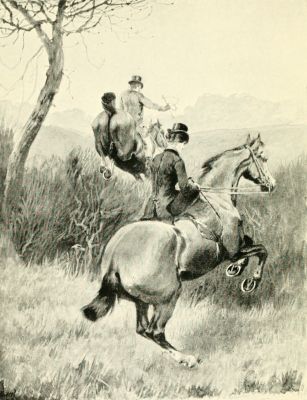
"Taking fast hold of his horse's head, he got over with a scramble." Satanella. Page 301
Bill's horse dropped its hind legs in the brook, and fell, but was soon up again with its rider. The General got over successfully; nevertheless, his weight was beginning to tell, and the ground being now on the ascent, he found himself the last of the five people with the hounds.
At the crest of the hill frowned a black, forbidding-looking bull-finch: on this side a strong rail; on the other, if a horse ever got there, the uncertainty, which might or might not, culminate in a rattling fall. Daisy glanced anxiously to right and left, on his wife's behalf, but there was no forgiveness. They must have it, or go home! Then he watched how the famous black mare would acquit herself a hundred yards ahead of him, and felt little reassured to detect such a struggle in the air while she topped the fence, as by no means inferred a pleasant landing where she disappeared on its far side.
He wavered, he hesitated, and pulled his horse off for a stride; but Norah's impatient—"Ah, Daisy! go on now!" urged him to the attempt, and he chanced it, with his heart in his mouth, for her sake, not his own.
Taking fast hold of his horse's head, he got over with a scramble, turning afterwards in the saddle to watch how it fared with his wife and little Boneen. Her subsequent account described the performance better than could any words of mine.
"When I loosed him off at it," said she, "I just touched him on the shoulder with the whip, to let him know he wasn't in Kildare. He understood well enough, the little darling! for he pricked his ears, and came back to a slow canter; but I'd like ye to have felt the bound he made when he rose to it! Such a place beyond! 'Twas as thick as a cabbage-garden—dog-roses, honeysuckles, I'm not sure there wasn't cauliflowers, and all twisted up together to conceal a deep, wide, black-looking hole, like a boreen.[6] Well, I just felt him give a sort of a little kick, while he left the entire perplexity ten feet behind him, and when he landed, as light as a fairy, Daisy, I'm sure I heard him laugh!"
Mrs. Walters, like most of her nation, abounded in enthusiasm. She could not forbear a little cry of delight at the panorama that opened before her, when she had effected the above-mentioned-feat. To the very horizon lay stretched a magnificent vale of pasture, brightened by the slanting rays of a November sun. Far ahead, fleeting across the level below, sped a dark object, she recognised for the deer; a field nearer were the hounds, running their hardest, in a string that showed they too had caught sight of their game. Half-way down the hill she was herself descending, the other lady was urging the black mare to head-long speed, very dangerous on such a steep incline. Fifty yards behind Satanella, came Daisy, and close on his heels, Norah, wild with delight, feeling a strong inclination to give Boneen his head, and go by them all. The little horse, however, watched his stable-companion narrowly, while his rider's eyes were riveted on the hounds. Suddenly she felt him shorten his stride and stop, with a jerk, that nearly shot her out of the saddle. Glancing at Daisy, for an explanation, she screamed aloud, and covered her face with her hands.
When she looked again, she was aware of her husband's horse staring wildly about with the bridle over its head; of Daisy himself on foot, and, a few yards off, the good black mare prostrate, motionless, rolled up in a confused and hideous mass with her hapless rider.
Down hill, at racing pace, Satanella had put her fore-feet through a covered drain, with the inevitable result—the surface gave way, letting her in to the shoulders, and a few yards farther on, she lay across her mistress, with her neck broken, never to stir those strong, fleet limbs again.
"Oh! Daisy, they're both killed!" whispered Norah, with a drawn, white face, while her husband, busying himself to undo the girths, and thus extricate that limp helpless figure from beneath the weight that crushed it so sorely, shouted for assistance to Soldier Bill and the General, who at that moment entered the field together.
"I trust in heaven, not!" he replied aloud; and, below his breath, even while his heart smote him for the thought, "It might have been worse. My darling, it might have been you!"