FOOTNOTES: (continued 2)
Reading edition
Ere he had clasped the farmer's hand, at his own gate, and heard his cheery hospitable greeting, he wondered how he could feel so happy.
"I'm proud to see ye, Captain!" said Denis, flourishing his hat round his head, as if it was a slip of blackthorn. "Proud am I an' pleased to see ye back again—an' that's the truth! Ye're welcome, I tell ye! Step in, now, an' take something at wanst. See, Captain, there's a two-year-old in that stable; the very moral of your black mare. Ye never seen her likes for leppin'! Ye'll try the baste this very afternoon, with the blessin'. I've had th' ould saddle mended, an' the stirrups altered to your length."
CHAPTER XX
TAKING THE COLLAR
The General thought he had never been so happy in his life. His voice, his bearing, his very dress seemed to partake of the delusion that gilded existence. Springing down the steps of his club, with more waist in his coat, more pretension in his hat, more agility in his gait, than was considered usual, or even decorous, amongst its frequenters, no wonder they passed their comments freely enough on their old comrade, ridiculing or deploring his fate, according to the various opinions and temper of the conclave.
"What's up with St. Josephs now?" asked a white-whiskered veteran of his neighbour, whose bluff, weather-beaten face proclaimed him an Admiral of the Red. "He's turned quite flighty and queer of late. Nothing wrong here, is there?" and the speaker pointed a shaking finger to the apex of his own bald head.
"Not there, but here," answered the sailor, laying his remaining arm across his breast. "Going to be spliced, they tell me. Sorry for it. He's not a bad sort; and a smartish officer, as I've heard, in your service."
"Pretty well—so, so. Nothing extraordinary for that," answered the first speaker, commonly called by irreverent juniors "Old Straps." "He hadn't much to do in India, I fancy; but he's been lucky, sir, lucky, and luck's the thing! Luck against the world, Admiral, by sea or land!"
"Well, his luck's over now, it seems," grunted the Admiral, whose views on matrimony appeared to differ from those of his profession in general. "I'm told he's been fairly hooked by that Miss Douglas. Black-eyed girl, with black hair—black, and all black, d— me!—and rides a black mare in the park. Hey! Why she might be his daughter. How d'ye mean?"
"More fool he," replied Straps, with a leer and a grin that disclosed his yellow tusks. "A fellow like St. Josephs ought to know better."
"I'm not so sure of that," growled the Admiral. "Gad, sir, if I was idiot enough to do the same thing, d'ye think I'd take a d—d old catamaran, that knew every move in the game? No, no, sir; youth and innocence, hey? A clean bill of health, a fair wind, and a pleasant voyage, you know!"
"In my opinion, there's devilish little youth left, and no innocence," answered "Straps." "If that's the girl, she's been hawked about, to my certain knowledge, for the last three seasons; and I suppose our friend is the only chance left—what we used to call a 'forlorn hope' when I was an ensign. He's got a little money, and they might give him a command. You never know what this Government will do. It's my belief they'd give that crossing-sweeper a command if they were only sure he was quite unfit for it."
"Command be d—d!" swore the Admiral. "He'll have enough to do to command his young wife. What? She's a lively craft, I'll be bound, with her black eyes. Carries a weather-helm, and steers as wild as you please in a sea-way. I'll tell you what it is—Here, waiter! bring me the Globe. Why the —- are the evening papers so late?"
In the rush for those welcome journals, so long expected, so eagerly seized, all other topics were instantaneously submerged. Long before he could reach the end of the street, General St. Josephs was utterly forgotten by his brother officers and friends.
Still he thought he had never been so happy in his life. The word is used advisedly, for surely experience teaches us that real happiness consists in tranquillity and repose, in the slumber rather than the dream, in the lassitude that soothes the patient, not the fever-fit of which it is the result. Can a man be considered happy who is not comfortable? and how is comfort compatible with anxiety, loss of appetite, nervous tremors, giddiness, involuntary blushing, and the many symptoms of disorder, who could be cured heretofore by advertisement, and which are the invariable accompaniments of an epidemic, invincible by pill or potion, and yielding only to the homœopathic treatment of marriage.
In this desperate remedy St. Josephs was anxious to experimentalise, and without delay. Yet his tact was supreme. Since the memorable walk in Kensington Gardens, when he laid her under such heavy obligations, his demeanour had been more that of a friend than a lover—more, perhaps, that of a loyal and devoted subject to his sovereign mistress, than either. She wondered why he never asked her, what she had done with all that money? Why, when she alluded to the subject, he winced and started, as from a touch on a raw wound. Once she very nearly told him all. They were in a box at the Opera, so far unobserved that the couple who had accompanied them seemed wholly engrossed with each other. Satanella longed to make her confession—ease her conscience of its burden, perhaps, though such a thought was cruel and unjust—shake the yoke from off his neck. She had even got as far as, "I've never half thanked you, General—" when there came a tap at the box-door. Enter an irreproachable dandy, then a confusion of tongues, a laugh, a solo, injunctions to silence, and the opportunity was gone. Could she ever find courage to seek for it again?
Nevertheless, day by day she dwelt more on her admirer's forbearance, his care, his tenderness, his chivalrous devotion. Though he never pressed the point, it seemed an understood thing that they were engaged. She had forbidden him to visit her before luncheon, but he spent his afternoons in her drawing-room; and, on rare occasions, was admitted in the evening, when an elderly lady, supposed to be Blanche's cousin, came to act chaperone. The walks in Kensington Gardens had been discontinued. Her heart could not but smite her sometimes, to think that she never gave him but one, when she wanted him to do her a favour.
Had he been more exacting, she would have felt less self-reproach, but his patience and good humour cut her to the quick.
"You brute!" she would say, pushing her hair back, and frowning at her own handsome face in the glass. "You worse than brute! Unfeeling, unfeminine, I wish you were dead!—I wish you were dead!"
She had lost her rich colour now, and the hollow eyes were beginning to look very large and sad, under their black arching brows.
Perhaps it was the General's greatest delight to hear her sing. This indulgence she accorded him only of an evening, when the cousin invariably went to sleep, and her admirer sat in an armchair with the daily paper before his face. She insisted on this screen, and this attitude, never permitting him to stand by the pianoforte, nor turn over the leaves, nor undergo any exertion of mind or body that should break the charm. Who knows what golden visions gladdened the war-worn soldier's heart while he leaned back and listened, spellbound by the tones he loved? Dreams of domestic happiness and peaceful joys, and a calm untroubled future, when doubts and fears should be over, and he could make this glorious creature wholly and exclusively his own.
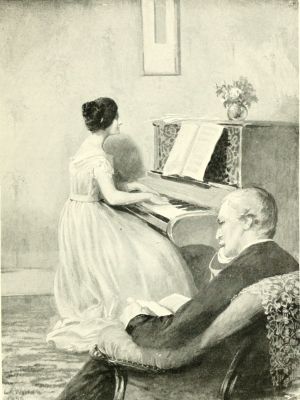
"Perhaps it was the General's greatest delight to hear her sing." Satanella. Page 208
Did he ever wonder why in certain songs the dear voice thrilled with a sweetness almost akin to pain ere it was drowned in a loud and brilliant accompaniment, that foiled the possibility of remonstrance, while the ditty was thrown aside to be replaced by another, less fraught, perhaps, with painful memories and associations? If so, he hazarded no remark nor conjecture, satisfied, as it seemed, to wait her pleasure, and in all things bow his will to hers, sacrificing his desires, his pride, his very self-respect to the woman he adored.
For a time nothing occurred to disturb the General's enforced tranquillity, and he pursued the course he seemed to have marked out for himself with a calm perseverance that deserved success. In public, people glanced and whispered when they saw Miss Douglas on his arm; in private, he called daily at her house, talked much small-talk and drank a great deal of weak tea; while in solitude he asked himself how long this probation was to last, resolving nevertheless to curb his impatience, control his temper, and if the prize was only to be won by waiting, wait for it to the end!
Leaving his club, then, unconscious of the Admiral's pity and the sarcasms of "Old Straps," St. Josephs walked jauntily through Mayfair, till he came to the well-known street, which seemed to him now even as a glade in Paradise. The crossing-sweeper blessed him with considerable emphasis, brushing energetically in his path; for when going the General was invariably good for sixpence, and on propitious days would add thereto a shilling as he returned.
On the present occasion, though his hand was in his pocket, it remained there with the coin in its finger and thumb; for the wayfarer stopped petrified in the middle of the street; the sweeper held his tattered hat at arm's-length, motionless as a statue; and a bare-headed butcher's-boy, standing erect in a light cart, pulled his horse on its haunches, and called out—
"Now then, stoopid! D'ye want all the road to yerself?" grazing the old officer's coat-tails as he drove by with a brutal laugh.
But neither irreverence nor outrage served to divert the General's attention from the sight that so disturbed his equanimity.
"There's that d—d black mare again!" he muttered, while he clenched his teeth, and his cheek turned pale. "I'll put a stop to this one way or the other. Steady, steady! No; my game is to be won by pluck and patience. It's very near the end now. Shall I lose it by failing in both?"
The black mare, looking but little the worse for training, was indeed in the act of leaving Blanche's door. Miss Douglas had evidently ridden her that morning in the Park. She might have told the General, he thought. She might have asked him to accompany her as he used. She ought to have no secrets from him now; but was he in truth any nearer her inner life, any more familiar with her dearest thoughts and wishes than he had been months ago? Surely she was not treating him well! Surely he deserved more confidence than this. The General felt very sore and angry; but summoning all his self-command, walked upstairs,—and for this he deserves no little credit,—with an assured step, and a calm, unruffled brow.
"Miss Douglas was dressing," the servant said. "Miss Douglas had been out for a ride. Would the General take a seat, and look at to-day's paper? Miss Douglas had said 'partic'lar' she would be at home."
It was irritating to wait, but it was soothing to know she was at home "partic'lar" when he called. The General sat down to peruse the advertisement sheet of the paper, reading absently a long and laudatory description of the trousseaux and other articles for family use supplied by a certain house in the city at less than cost price!
CHAPTER XXI
A SNAKE IN THE GRASS
His studies were soon interrupted by the rustle of a dress on the staircase. With difficulty he forbore rushing out to meet its wearer, but managed to preserve the composure of an ordinary morning visitor, when the door opened, and—enter Mrs. Lushington! She must have read his disappointment in his face; for she looked half-amused, half-provoked, and there was no less malice than mirth in her eyes while she observed—
"Blanche will be down directly, General, and don't be afraid I shall interrupt your tête-à-tête, for I am going away as soon as I've written a note. You can rehearse all the charming things you have got to say in the meantime."
He had recovered his savoir-faire.
"Rehearse them to you?" he asked, laughing. "It would be pretty practice, no doubt. Shall I begin?"
"Not now," she answered, in the same tone. "There is hardly time; though Blanche wouldn't be very cross about it, I dare say. She is liberal enough, and knows she can trust me."
"I am sure you are a true friend," he returned gravely. "Miss Douglas—Blanche—has not too many. I hope you will always remain one of her staunchest and best."
She smiled sadly.
"Do you really mean it?" said she, taking his hand. "You can't imagine how happy it makes me to hear you say so. I thought you considered me a vain, ignorant, frivolous little woman, like the rest."
Perhaps he did, but this was not the moment to confess it.
"What a strange world it would be," he answered, "if we knew the real opinions of our friends. In this case, Mrs. Lushington, you see how wrong you were about mine."
"I believe you, General!" she exclaimed. "I feel that you are truth itself. I am sure you never deceived a woman in your life, and I cannot understand how any woman could find it in her heart to deceive you. One ought never to forgive such an offence, and I can believe that you never would."
He thought her earnestness unaccountable, and wholly uncalled for; but his senses were on the alert to catch the first symptoms of Blanche's approach, and he answered rather absently—
"Quite right! Of course not. Double-dealing is the thing I hate. You may cheat me once; that is your fault. It is my own if you ever take me in again."
"No wonder Blanche values your good opinion," said Mrs. Lushington meaningly. "She has not spent her life amongst people whose standard is so high. Hush! here she comes. Ah! General, you won't care about talking to me now!"
She gave him one reproachful glance in which there was a little merriment, a little pique, and a great deal of tender interest, ere she departed to write her note in the back drawing-room.
It was impossible not to contrast her kind and deferential manner with the cold, collected bearing of Miss Douglas, who entered the room, like a queen about to hold her court, rather than a loving maiden, hurrying to meet her lord.
She had always been remarkable for quiet dignity in motion or repose.
It was one of the many charms on which the General lavished his admiration, but he could have dispensed with this royal composure now. It seemed a little out of place in their relative positions. Also he would have liked to see the colour deepen in her proud impassive face, though his honest heart ached while he reflected how the bright tints had faded of late, how the glory of her beauty had departed, leaving her always pale and saddened now.
He would have asked a leading question, hazarded a gentle reproach, or in some way made allusion to the arrival of his bête noir, but her altered looks disarmed him; and it was Satanella herself who broached the subject, by quietly informing her visitor she had just returned from riding the black mare in the Park. "Do you mind?" she added, rising in some confusion to pull a blind down, while she spoke.
Here would have been an opportunity for a confession of jealousy, an appeal to her feelings, pleadings, promises, protestations,—to use the General's own metaphor,—"an attack along the whole line;" but how was he thus to offer decisive battle, with his flank exposed and threatened, with Mrs. Lushington's ears wide open and attentive, while her pen went scribble, scribble, almost in the same room?
"I mind everything you do," said he gallantly, "and object to nothing! If I did want to get up a grievance, I should quarrel with you for not ordering me to parade in attendance on you in the Park. My time, as you know, is always yours, and I am never so happy as with you. Blanche (dropping his voice), I am never really happy when you are out of my sight."
She glanced towards the writing-table, and though the folding-doors, half-shut, concealed that lady's person, seemed glad to observe, by the continual scratching of a pen, that Mrs. Lushington had not yet finished her note.
"You are always good and kind," said Blanche, forcing a smile. "Far more than I deserve. Will you ride another day, early? Thanks; I knew you would. I should have asked you this morning but I had a headache, and thought I should only be a bore. Besides, I expected you in the afternoon. Then Clara came to luncheon, and we went upstairs, and now the carriage will be round in five minutes. That is the way the day goes by; yet it seems very long too, only not so bad as the night."
Again his face fell. It was uphill work, he thought. Surely women were not usually so difficult to woo, or his own memory played him false, and his friends romanced unpardonably in their narratives. But, nevertheless, in all the prizes of life that which seemed fairest and best hung highest out of reach, and he would persevere to the end. Aye! even if he should fail at last!
Miss Douglas seemed to possess some intuitive knowledge of his intention; and conscious of his determination to overcome them, was perhaps the more disposed to throw difficulties in his path. He should have remembered that in love as in war, a rapid flank movement and complete change of tactics will often prevail, when vigilance, endurance, and honest courage have been tried in vain.
Satanella could not but appreciate a delicacy that forbade further inquiry about the black mare. No sooner had she given vent to her feelings, in the little explosion recorded above, than she bitterly regretted their expression, comparing her wayward petulant disposition with the temper and constancy displayed by her admirer. Sorrowful, softened, filled with self-reproach, she gave him one of her winning smiles, and bade him forgive her display of ill-humour, or bear with it, as one of many evil qualities, the result of her morbid temperament and isolated lot.
"Then I slept badly, and went out tired. The Ride was crowded, the sun broiling, the mare disagreeable. Altogether, I came back as cross as two sticks. General, are you never out of humour? And how do you get rid of your ill-tempers? You certainly don't visit them on me!"
"How could I?" he asked in return. "How can I ever be anything but your servant, your slave? Oh! Blanche, you must believe me now. How much longer is my probation to last? Is the time to be always put off from day to day, and must I——"
"Clara! Clara!" exclaimed Miss Douglas to her friend in the back drawing-room, "shall you never have done with those tiresome letters? Have you any idea what o'clock it is? And the carriage was ordered at five!"
The General smothered a curse. It was invariably so. No sooner did he think he had gained a secure footing, wrested a position of advantage, than she cut the ground from under him, pushed him down the hill, and his labour was lost, his task all to begin again! It seemed as if she could not bear to face her real position, glancing off at a tangent, without the slightest compunction, from the one important topic he was constantly watching an opportunity to broach.
"Just done! and a good day's work too!" replied Mrs. Lushington's silver tones from the writing-table, and it must have been a quicker ear than either Satanella's or the General's to detect in that playful sentence the spirit of mischievous triumph it conveyed.
Mrs. Lushington was delighted. She felt sure she had fathomed a secret, discovered the clue to an intrigue, and by such means as seemed perfectly fair and justifiable to her warped sense of right and wrong.
Finding herself a third person in a small party that should have been limited to two, she made urgent correspondence her excuse for withdrawing to such a distance as might admit of overhearing their conversation, while the lovers, if lovers indeed they were, should think themselves unobserved.
So she opened Satanella's blotting-book, and spread a sheet of note-paper on its folds.
Mrs. Lushington had a quick eye, no less than a ready wit. Blanche's blotting-paper was of the best quality, soft, thin, and absorbent. Where the writing-book opened, so shrewd an observer did not fail to detect the words "Roscommon, Ireland," traced clear and distinct as a lithograph, though reversed. Looking through the page, against the light, she read Daisy's address in his hiding-place with his humble friend Denis plainly enough, and the one word "Registered" underlined at the corner.
"Enfin je te pince!" she muttered below her breath. It was evident Satanella was in Daisy's confidence, that she knew his address,—which had been extorted indeed with infinite trouble from a lad whom he had sent to England in charge of the precious mare,—and had written to him within the last day or two. It was a great discovery! Her hand shook from sheer excitement, while she considered how best it could be turned to account, how it might serve to wean the General of his infatuation, to detach him from her friend, perhaps at last to secure him for herself. But she must proceed cautiously; make every step good, as she went on; prove each link of the chain, while she forged it; and when Blanche was fairly in the toils, show her the usual mercy extended by one woman to another.
Of course, she wrote her notes on a fresh page of the blotting-book. Of course, she rose from her employment frank, smiling, unsuspicious. Of course, she was more than usually affectionate to Blanche, and that young lady, well-skilled in the wiles of her own sex, wondering what had happened, watched her friend's conduct with some anxiety and yet more contempt.
"Good-bye, Blanche."
"Good-bye, Clara."
"Come again soon, dear!"
"You may depend upon me, love!"
And they kissed each other with a warmth of affection in no way damped or modified because Blanche suspected, and Clara resolved, henceforth it must be war to the knife!
In taking her leave of the General, however, Mrs. Lushington could not resist an allusion to their previous conversation, putting into her manner so much of tender regard and respectful interest as was pleasing enough to him and inexpressibly galling to her friend.
"Have you said your say?" she asked, looking very pretty and good-humoured as she gave him both hands. "I'm sure you had lots of time, and the best of opportunities. Don't you think I'm very considerate?"
"More—very generous!"
"Come and see me soon. Whenever you like. With or without dear Blanche. She won't mind; I'm always at home, to either of you—or both."
Then she made a funny little curtsey, gave him one more smile, one sidelong sorrowful glance, with her hand on the door, and was gone.
Blanche's spirit rose to arms; every instinct of her sex urged her to resist this unconscionable freebooter, this lawless professor of piracy and annexation. After all, whether she cared for him or not, the General was her own property. And what right had this woman to come between mistress and servant, with her becks and leers, her smiles and wiles, and meretricious ways? She had never valued her lover higher than at the moment Mrs. Lushington left the room; but he destroyed his advantage, kicked down all his good fortune, by looking in Miss Douglas's face with an expression of slavish devotion, while he exclaimed—
"How different that woman is from you, Blanche. Surely, my queen, there is nobody like you in the world!"
CHAPTER XXII
AN EXPERT
Returning from morning stables to his barrack-room, Soldier Bill found on his table a document that puzzled him exceedingly. He read it a dozen times, turned it up-side down, smoothed it out with his riding-whip, all in vain. He could make nothing of it; then he summoned Barney.
"When did this thing come, and who brought it?"
"Five minutes back," answered the batman. "Left by a young man on fatigue duty."
So Barney, with military exactitude, described a government official, in the costume of its telegraphic department.
"Did the man leave no message?" continued Bill.
"Said as there was nothing to pay," answered Barney, standing at "attention" and obviously considering this part of his communication satisfactory in the extreme.
"Said there was nothing to pay!" mused his master, "and I would have given him a guinea to explain any two words of it." Then he took his coat off, and sat doggedly down to read the mysterious sentences again and again.
The soldier, as he expressed it, was "up a tree!" That the message must be of importance, he argued from its mode of transmission. The sender's name was legible enough, and his own address perfectly correct. He felt sure Daisy would not have telegraphed from the wilds of Roscommon but on a matter of urgency; and it did seem provoking that the only sense to be got out of the whole composition, was in the sentence with which it concluded—"Do not lose a moment." In his perplexity, he could think of no one so likely to help him as Mrs. Lushington.
"She has more 'nous' in that pretty little head of hers," thought Bill, as he plunged into a suit of plain clothes, "than the Horse Guards and the War Office put together. She'll knock the marrow out of this, if anybody can! I've heard her guess riddles right off, the first time she heard them; and there isn't her equal in London for acting charades and games of that kind, where you must be down to it, before they can say 'knife.' By Jove, I shouldn't wonder if this was a double acrostic after all? Only Daisy wouldn't be such a flat as to telegraph it all the way from Ireland to me. I hope she'll see me. It's awfully early. I wonder if she'll blow me up for coming so soon."
These reflections, and Catamount's thorough-bred canter, soon brought him to Mrs. Lushington's door. She was at home, and sufficiently well prepared for exercises of ingenuity, having been engaged, after breakfast,—though it is but fair to say, such skirmishes were of unusual occurrence,—in a passage-of-arms with Frank.
The latter was a good-natured man, with a bad temper. His wife's temper was excellent; but her enemies, and indeed her friends, said she was ill-natured. Though scarcely to be called an attached couple, these two seldom found it worth while to quarrel, and so long as the selfishness of each did not clash with the other, they jogged on quietly enough. It was only when domestic affairs threw them together more than common, that the contact elicited certain sparks, such as crackled on occasion into what observers below-stairs called a "flare-up."
To-day they happened to breakfast together. After a few "backhanders," and some rapid exchanges, in which the husband came by the worst, their conversation turned on money-matters—always a sore subject, as each considered that the other spent more than a due share of their joint income. Complaints led to recriminations, until at length, goaded by the sharpness of his wife's tongue, Mr. Lushington exclaimed: "Narrow-minded, indeed! Paltry economy! I can tell you, if I didn't keep a precious tight hand, and deny myself—well—lots of things. I say if I didn't deny myself lots of things, I should be in the Bench—that's all."
"Then you are a very bad financier," she retorted, "worse than the Chancellor of the Exchequer even. But I don't believe it. I believe you're saving money every day."
He rose from his chair in a transport of irritation, the skirts of his dressing-gown floating round him, like the rags of a whirling dervish.
"Saving money!" he repeated, in a sort of suppressed scream. "I can only tell you I had to borrow five hundred last week, and from little Sharon too. That doesn't mean getting it at three per cent.!"
"Then you ought to be ashamed of yourself!" said she. "No gentleman borrows money from Sharon."
"No gentleman!" he vociferated. "Upon my life, Mrs. Lushington, I wish you would try to be more temperate in your language. No Gentleman, indeed! I should like to know what you call General St. Josephs? I fancy he is rather a favourite of yours. All I can tell you is, he borrows money of Sharon. Lumps of money, at exorbitant interest."
"It's very easy to say these things," she replied. "But you can't prove them!"
"Can't I?" was his rejoinder. "Well, I suppose you won't doubt my word, when I give you my honour, that he consulted me himself about a loan from this very man. Three thousand pounds, Mrs. Lushington—three thousand pounds sterling, and at two days' notice. Didn't care what he paid for it, and wanted it; well, I didn't ask him why he wanted it; I don't pry into other people's money-matters. I don't always think the worst of my neighbours. But you'll allow I'm right, I hope! You'll admit so much at any rate!"
"That has nothing to do with it," replied his wife; and in this highly satisfactory manner their matrimonial bicker terminated.
Mrs. Lushington, while remaining, in a modified sense, mistress of the position—for Frank retired to his own den, when the servants came to take away breakfast—found her curiosity keenly stimulated by the little piece of gossip thus let fall under the excitement of a conjugal wrangle. What on earth could St. Josephs want with three thousand pounds? She had never heard he was a gambler. On a race-course, she knew, from personal observation, that beyond a few half-crowns with the ladies, he would not venture a shilling. He had told her repeatedly how he abhorred foreign loans, joint-stock companies, lucrative investments of all sorts, and money speculations of any kind whatever; yet here, if she believed her husband, was this wise and cautious veteran plunging overhead in a transaction wholly out of keeping with his character and habits. "There must be a woman at the bottom of it!" thought Mrs. Lushington, not unreasonably, resolving at the same time never to rest till she had sifted the whole mystery from beginning to end.
She felt so keen on her quest, that she could even have found it in her heart to seek Frank in his own snuggery, and, sinking her dignity, there endeavoured to worm out of him further particulars, when Catamount was pulled up with some difficulty at her door, and his master's card sent in, accompanied by a humble petition that the early visitor might be admitted. Having darkened her eyelashes just before breakfast, and being, moreover, dressed in an unusually becoming morning toilet, she returned a favourable answer, so that Soldier Bill, glowing from his ride, was ushered into her boudoir without delay.
Her womanly tact observed his fussed and anxious looks. She assumed, therefore, an air of interest and gravity in her own.
"There's some bother," said she kindly; "I see it in your face. How can I help you, and what can I do?"
"You're a conjuror, by Jove!" gasped Bill, in a paroxysm of admiration at her omniscience.
"You're not, at any rate!" she replied, smiling. "But, come, tell me all about it. You're in a scrape? You've been a naughty boy. What have you been doing? Out with it!"
"It's nothing of my own; I give you my honour," replied Bill. "It's Daisy's turn now. Look here, Mrs. Lushington. I'm completely puzzled—regularly knocked out of time. Read that. I can't make head or tail of it."
He handed her the telegram, which she perused in silence, then burst out laughing, and read it again aloud for his edification:—
"Very strong Honey just arrived—bulls a-light on Bank of Ireland—Sent by an unknown Fiend—fail immediately—Sell Chief—consult a Gent, and strip Aaron at once—Do not lose a moment."
"Mr. Walters must be gone raving mad, or is this a practical joke, and why do you bring it here?"
"I don't think it's a joke," answered Bill ruefully. "I brought it because you know everything. If you can't help me, I'm done!"
"Quite right," said she. "Always consult a woman in a tangle. Now this thing is just like a skein of silk. If we can't unravel it at one end, we begin at the other. In the first place, who is Aaron? and how would you proceed to strip him?"
"Aaron," repeated Bill thoughtfully. "Aaron—I never heard of such a person. There's Sharon, you know; but stripping him would be out of the question. It's generally the other way!"
"Sharon's a money-lender, isn't he?" she asked. "What business have you to know anything about him, you wicked young man?"
"Never borrowed a sixpence in my life," protested Bill, which was perfectly true. "But I've been to him often enough lately about this business of Daisy's. We've arranged to get fifteen hundred from him alone. Perhaps that is what is meant by stripping him. But it was all to be in hard money; and though I know Sharon sometimes makes you take goods, I never heard of his sending a fellow bulls, or strong honey, or indeed, anything but dry sherry and cigars."
She knit her brows and read the message again. "I think I have it," said she. "'Strip Aaron.' That must mean 'Stop Sharon.' 'Sell the Chief',—that's 'Tell the Colonel.' Then 'fail immediately' signifies that the writer means to cross by the first boat. Where does it come from—Dublin or Roscommon?"
"Roscommon," answered Bill. "They're not much in the habit of telegraphing up there."
"Depend upon it Daisy has dropped into a good thing. Somebody must have left, or lent, or given him a lot of money. I have it! I have it! This is how you must read it," she exclaimed, and following the lines with her taper finger, she put them into sense with no little exultation, for the benefit of her admiring listener. "'Very strange! Money just arrived. Bill at sight, on Bank of Ireland. Sent by an unknown Friend. Sail immediately. Tell Chief. Consult Agent, and stop Sharon at once. Do not lose a moment.' There, sir, should I, or should I not, make a good expert at the Bank."
"You're a witch—simply a witch," returned the delighted Bill. "It's regular, downright magic. Of course, that's what he means. Of course, he's come into a fortune. Hurrah! hurrah! Mrs. Lushington, have you any objection? I should like to throw my hat in the street, please, and put my head out of window to shout!"
"I beg you'll put out nothing of the kind!" she answered, laughing. "If you must be a boy, at least be a good boy, and do what I tell you."
"I should think I would just!" he protested, still in his paroxysm of admiration. "You know more than the examiners at Sandhurst! You could give pounds to the senior department! If you weren't so—I mean if you were old and ugly—I should really believe what I said at first, that you're a witch!"
She smiled on him in a very bewitching manner; but her brains were hard at work the while recapitulating all she had learned in the last twenty-four hours, with a pleasant conviction that she had put her puzzle together at last. Yes, she saw it clearly now. The registered envelope of which she found the address, in reverse, on Blanche's blotting-paper, must have contained those very bills, mentioned in Daisy's telegram. It had struck her at the time that the handwriting was stiff and formal, as if disguised; but this served to account for the mysterious announcement of an "unknown fiend!" She was satisfied that Miss Douglas had sent anonymously the sum he wanted to the man she loved. And that sum Bill had already told her was three thousand pounds—exactly the amount, according to her husband's version, lately borrowed by the General from a notorious money-lender. Was it possible Satanella could thus have stripped one admirer to benefit another? It must be so. Such treachery deserved no mercy, and Mrs. Lushington determined to show none.
She considered how far her visitor might be trusted with this startling discovery. It was as well, she thought, that he should be at least partially enlightened, particularly as the transaction was but little to the credit of any one concerned, and could not, therefore, be made public too soon. So she laid her hand on Bill's coat-sleeve, and observed impressively—
"Never mind about my being old and ugly, but attend to what I say. Daisy, as you call him, has evidently found a good friend. Now I know who that friend is. Don't ask me how I found it out. I never speak without being sure. That money came from Miss Douglas."
Bill opened his eyes and mouth. "Miss Douglas!" he repeated. "Not the black girl with the black mare?"
"The black girl with the black mare, and no other," she answered. "Miss Douglas has paid his debts, and saved him from ruin. What return can a man make for such generosity as that?"
"She's a trump, and he ought to marry her!" exclaimed the young officer. "No great sacrifice either. Only," he added, on reflection, "she looks a bit of a Tartar—wants her head let quite alone at her fences, I should think. She'd be rather a handful; but Daisy wouldn't mind that. Yes; he's bound to marry her no doubt; and I'll see him through it."
"I quite agree with you," responded Mrs. Lushington, "but I won't have you talk about ladies as if they were hunters. It's bad style, young gentleman, so don't do it again. Now, attend to what I tell you. Jump on that poor horse of yours; it must be very tired of staring into my dining-room windows. Go to your agent, and send him to Sharon. Let your Colonel know at once. When Daisy arrives, impress on him all that he is bound in honour to do, and you may come and see me again, whenever you like, to report progress."
So Bill leapt into the saddle in exceedingly good spirits, while Mrs. Lushington sat down to her writing-table, with the self-satisfied sensations of one who has performed an action of provident kindness and good-will.
CHAPTER XXIII
THE DEBT OF HONOUR
Daisy's astonishment, on receiving by post those documents that restored him to the world from his vegetation in Roscommon, was no less unbounded than his joy. When he opened the registered letter, and bills for the whole amount of his liabilities fluttered out, he could scarcely believe his eyes. Then he puzzled himself to no purpose, in wild speculations as to the friend who had thus dropped from the skies at his utmost need. He had an uncle prosperous enough in worldly matters, but this uncle hated parting with his money, and was, moreover, abroad, whereas the welcome letter bore a London post-mark. He could think of no other relative nor friend rich enough, even if willing, to assist him in so serious a difficulty. The more he considered his good luck, the more inexplicable it appeared; nor, taking his host into consultation, did that worthy's suggestions tend to elucidate the mystery.
In the first place, recalling many similar instances under his own observation, Denis opined that the money must have been hidden up for his guest, long ago, by his great grandmother, in a stocking, and forgotten! Next, that the Prussian Government, having heard of the mare's performances at Punchestown, had bought her for breeding purposes, at such a sum as they considered her marketable value. And, lastly (standing the more stoutly by this theory, for the failure of its predecessors), that the whole amount had been subscribed under a general vote of the Kildare Street Club, in testimony of their admiration for Daisy's bold riding and straightforward conduct as a sportsman!
Leaving him perfectly satisfied with this explanation, Daisy bade his host an affectionate farewell, and started without delay for London, previously telegraphing to his comrade at Kensington certain information and instructions for his guidance. Warped in its transmission by an imaginative clerk in a hurry, we have seen how this message confused and distracted the honest perceptions of its recipient.
That young officer was sitting down to breakfast, with Venus under his chair, while Benjamin, the badger, poked a cautious nose out of his stronghold in the wardrobe, when the hasty retreat of one animal, and formidable growlings of the other, announced a strange step on the stairs. Immediately Daisy rushed into the room, vociferated for Barney to look after his "traps" and pay the cab, seized a hot plate, wagged his head at his host, and began breakfast without further ceremony.
"Seem peckish, young man," observed Bill, contemplating his friend with extreme satisfaction. "Sick as a fool last night, no doubt, and sharp-set this morning in consequence. Go in for a cutlet, my boy. Another kidney, then. That's right. Have a suck of the lemon, and at him again!"
Munching steadily, Daisy repudiated the imputation of sea-sickness, with the scorn of a practised mariner. "It seems to me that I live on that Channel," said he, "like a ship's-steward, Bill, or a horse-marine! Well, I've done with it now, I hope, for some time. How jolly it is to feel straight again! It's like your horse getting up, when he's been on his head, without giving the crowner you deserve. It was touch-and-go this time, old chap. I say, you got my telegram?"
Bill laughed. "I did, indeed!" he answered; "and a nice mull they made. Read it for yourself."
Thus speaking, he tossed across the breakfast-table that singular communication which his unassisted ingenuity had so failed to comprehend.
Daisy perused it with no little astonishment. "The fools!" he exclaimed. "Why, Bill, you must have thought I'd gone mad."
"We did," replied Bill gravely. "Stark staring, my boy. We said we always had considered you 'a hatter,' but not so bad as this."
"We!" repeated his friend. "What d'ye mean by we? You didn't go jawing about it in the regiment, Bill?"
"When I say we," answered the other, with something of a blush, "I mean me and Mrs. Lushington."
"What had she to do with it?" asked Daisy, pushing his plate away, and lighting a cigar. "She didn't send the stuff, I'll take my oath!"
"But she knows who did," said Bill, filling a meerschaum pipe of liberal dimensions, with profound gravity.
Then they smoked in silence for several minutes.
"It's a very rum go," observed Daisy, after a prolonged and thoughtful puff. "I don't know when I've been so completely at fault. Tell me what you've heard, Bill, for you have heard something, I'm sure. In the first place, how came you to take counsel with Mrs. Lushington?"
"Because she is up to every move in the game," was the answer. "Because she's the cleverest woman in London, and the nicest. Because I was regularly beat, and could think of nobody else to help me at short notice. The telegram said, 'Do not lose a moment.'"
"And what did she make of it?" asked Daisy.
"Tumbled to the whole plant in three minutes," answered Bill. "Put the telegram straight—bulls, honey, and all—as easy as wheeling into line. I tell you, we know as much as you do now, and more. You've got three 'thou,' Daisy, ready-money down, to do what you like with. Isn't that right?"
Daisy nodded assent.
"The Chief's delighted, and I've sent the agent to Sharon. Luckily, the little beggar's not so unreasonable as we thought he'd be. That reckons up the telegram, doesn't it?"
Again Daisy nodded, smoking serenely.
"Then there's nothing more for you to bother about," continued his host; "and I'm glad of it. Only, next time, Daisy, you won't pull for an old woman, I fancy, in a winning race."
"Nor a young one either," said his friend. "But you haven't told me now who the money came from."
"Can't you guess? Have you no idea?"
"Not the faintest."
"What should you say to Miss Douglas?"
"Miss Douglas!"
By the tone in which Daisy repeated her name, that young lady was obviously the last person in the world from whom he expected to receive pecuniary assistance.
Though no longer peaceful, his meditations seemed deeper than ever. At length he threw away the end of his cigar with a gesture of impatience and vexation.
"This is a very disagreeable business," said he. "Hang it, Bill, I almost wish the money had never come. I can't send it back, for a thousand's gone already to our kind old major, who promised to settle my book at Tattersall's. I wonder where she got such a sum. By Jove, it's the handsomest thing I ever heard of! What would you do, Bill, if you were in my place?"
"Do," repeated his friend; "I've no doubt what I should do. I should order Catamount round at once; then I think I'd have a brandy-and-soda; in ten minutes I'd be at Miss Douglas's door, and in fifteen I'd have—what d'ye call it?—proposed to her. Proposed to her, my boy, all according to regulation. I'm not sure how you set about these things. I fancy you go down on your knees; I know you ought to put your arm round their waists; but lots of fellows could coach you for all that part, and even if you did anything that's not in the book, this is a case of emergency, and, in my opinion, you might chance it!"
Having thus delivered himself, the speaker assumed a judicial air, smoking severely.
"In plain English, a woman buys one for three thousand pounds!" said Daisy, laughing rather bitterly. "And only three thousand bid for him. Going! Going!!"
"Gone!!!" added Bill, bringing his fist down on the table with a bang that startled the badger, and elicited an angry bark from Venus. "A deuced good price, too; I only hope I shall fetch half as much when I'm brought to the hammer. Why you ought to be delighted, my good fellow. She's as handsome as paint, and the best horse-woman that ever wore a habit!"
"I don't deny her riding, nor her beauty, nor her merit in every way," said Daisy, somewhat ruefully. "In fact, she's much too good for a fellow like me. But do you mean, seriously, Bill, that I must marry her because she has paid my debts?"
"I do, indeed," answered his friend; "and Mrs. Lushington thinks so too."
Before Daisy's eyes rose the vision of an Irish river glancing in the sunshine, with banks of tender green and ripples of molten gold, and a fishing-rod lying neglected on its margin, while a fair, fond face looked loving and trustful in his own.
There are certain hopes akin to the child's soap-bubble which we cherish insensibly, admiring their airy grace and radiant colouring, almost persuading ourselves of their reality, till we apply to them some practical test—then behold! at a touch, the bubble bursts, the dream vanishes, to leave us only a vague sense of injustice, an uncomfortable consciousness of disappointment and disgust.
"I conclude Mrs. Lushington understands these things, and knows exactly what a fellow ought to do," said Daisy, after another pause that denoted he was in no indiscreet hurry to act on that lady's decision.
"Of course she does!" answered Bill. "She's a regular authority, you know, or I wouldn't have gone to her. You couldn't be in safer hands."
Both young men seemed to look on the whole transaction in the light of a duel, or some such affair of honour, requiring caution no less than courage, and in the conduct of which the opinion of a celebrated practitioner like Mrs. Lushington was invaluable and unimpeachable.
"But if I—if I don't like her well enough," said poor Daisy, looking very uncomfortable. "Hang it, Bill, when one marries a woman, you know, one's obliged to be always with her. Early breakfast, home to luncheon, family dinner, smoke out of doors, and in by ten o'clock. I shouldn't like it at all; and then perhaps she'd take me to morning visits and croquet parties. Think of that, Bill! Like poor Martingale, whose only holiday is when he gets the belt on, and can't stir out of barracks for four-and-twenty hours. To be sure, Miss Douglas is a good many cuts above Mrs. Martingale!"
"To be sure she is!" echoed his adviser. "And I dare say, after all, Daisy, it is not quite so bad as we think. Wet days and that you'd have to yourself, you know, and she wouldn't want you when she had a headache. Mrs. Martingale often has headaches, and so should I if I liquored up as freely!"
"But supposing," argued Daisy, "I say only supposing, Bill, one liked another girl better; oughtn't that to make a difference?"
"I'm afraid not," replied Bill, shaking his head. "I didn't think of putting the case in that way to Mrs. Lushington, but I don't imagine she'd admit the objection. No, no, my boy, it's no use being shifty about it. You've got to jump, and the longer you look, the less you'll like it! If it was a mere matter of business, I wouldn't say a word, but see how the case stands. There are no receipts, no vouchers; she has kept everything dark, that you might feel under no obligation. Hang it, old fellow, it's a regular debt of honour; and there's no way of paying up, that I can see, but this."
Such an argument was felt to be unanswerable.
"A debt of honour," repeated Daisy. "I suppose it is. Very well; I'll set about it at once. I can't begin to-day though."
"Why not?" asked his friend.
"No time," answered the other, who in many respects was a true Englishman. "I've got lots of things to do. In the first place, I must have my hair cut, of course!"
CHAPTER XXIV
A PERTINENT QUESTION
A letter, without date or signature, written in an upright, clerkly hand, correctly spelt, sufficiently well-expressed, and stamped at the General Post Office! St. Josephs had no clue to his correspondent, and could but read the following production over and over again with feelings of irritation and annoyance that increased at each perusal:—
"You have been grossly ill-treated and deceived. A sense of justice compels the writer of these lines to warn you before it is too late. You are the victim of a conspiracy to plunder and defraud. One cannot bear to see a man of honour robbed by the grossest foul play. General St. Josephs is not asked to believe a bare and unsupported statement. Let him recapitulate certain facts, and judge for himself. He best knows whether he did not lately borrow a large sum of money. He can easily discover if that amount corresponds, to a fraction, with the losses of a young officer celebrated for his horsemanship. Let him ascertain why that person's debts have stood over till now; also, how and when they have been settled. Will he have courage to ask himself, or somebody he trusts as himself, whence came these funds that have placed his rival in a position to return to England? Will he weigh the answer in the balance of common-sense; or is he so infatuated by a certain dark lady that he can be fooled with his eyes open, in full light of day? There is no time to lose, or this caution would never have been given. If neglected, the General will regret his incredulity as long as he lives. Most women would appreciate his admiration; many would be more than proud of his regard. There is but one, perhaps, in the world who could thus repay it by injury and deceit. He is entreated to act at once on this communication, and to believe that of all his well-wishers it comes from the sincerest and the most reliable."
Everybody affects to despise anonymous letters. No doubt it is a wise maxim that such communications should be put in the fire at once, and ignored as if they did not exist. Nevertheless, on the majority of mankind they inflict unreasonable anxiety and distress. The sting rankles, though the insect be infinitesimal and contemptible; the blow falls none the less severely that it has been delivered in the dark.
On a nature like the General's such an epistle as the above was calculated to produce the utmost amount of impatience and discomfort. To use a familiar expression, it worried him beyond measure. Straightforward in all his dealings, he felt utterly at a loss when he came in contact with mystery or deceit. Nothing could furnish plainer proof of the General's sincere attachment to Miss Douglas than the fortitude with which he confronted certain petty vexations and annoyances inseparable from the love affairs of young and old.
"Ah me! what perils do environ, The man who meddles with cold iron,"
quoth Hudibras, but surely his risk is yet greater, who elects to heat the metal from hilt to point in the furnace of his own affections, and burns his fingers every time he draws the sword, even in self-defence. To St. Josephs who, after a manhood of hardship, excitement, and some military renown, had arrived at a time of life when comfort and repose are more appreciated, and more desirable every day, nothing could have been so distasteful as the character he now chose to enact, but for her charms, who had cast the part for him, and with whom, by dint of perseverance and fidelity, he hoped to play out the play.
Though he often sighed to remember how heavily he was weighted with his extra burden of years, he never dreamed of retiring from the contest, nor relaxed for one moment in his efforts to attain the goal.
Twenty times was he on the point of destroying a letter that so annoyed him, and twenty times he checked himself, with the reflection, that even the treacherous weapon might be wrested from the enemy, and turned to his own advantage by sincerity and truth. After much cogitation, he ordered his horse, dressed himself carefully, and rode to Miss Douglas's door.
That lady was at home. Luncheon, coming out of the dining-room untouched, met him as he crossed the hall, and the tones of her pianoforte rang in his ears, while he went upstairs. When the door opened she rose from the instrument and turned to greet him with a pale face, showing traces of recent tears.
All his self-command vanished at these tokens of her distress.
"You've been crying, my darling," said he, and taking her hand in both his own, he pressed it fondly to his lips.
It was not a bad beginning. Hitherto he had always been so formal, so respectful, so unlike a lover; now, when he saw she was unhappy, the man's real nature broke out, and she liked him none the worse.
Withdrawing her hand, but looking very kindly, and speaking in a softer tone than usual, she bade him take no notice of her agitation.
"I'm nervous," said she. "I often am. You men can't understand these things, but it's better than being cross at any rate."
"Cross!" he repeated. "Be as cross and as nervous as you like, only make me the prop when you require support, and the scapegoat when you want to scold."
"You're too good," said she, her dark eyes filling again, whereat he placed himself very close and took her hand once more. "Far too good for me! I've told you so a hundred times. General, shall I confess why I was—was making such a fool of myself, and what I was thinking of when you came in?"
"If it's painful to you, I'd rather not hear it," was his answer. "I want to be associated with the sunshine of your life, Blanche, not its shade."
She shook her head.
"Whoever takes that part in my life," she replied, "must remain a good deal in the dark. That's what I was coming to. General, it is time you and I should understand each other. I feel I could tell you things I would not breathe to any other living being. You're so safe, so honourable, so punctiliously, so ridiculously honourable, and I like you for it."
He looked grateful.
"I want you to like me," said he. "Better and better every day. I'll try to deserve it."
"They say time works wonders," she answered wistfully, "and I feel I shall. I know I shall. But there are some things I must tell you now, while I have the courage. Mind, I am prepared to take all consequences. I have deceived you, General. Deceived you in a way you could never imagine nor forgive."
"So people seem to think," he observed coolly, producing, at the same time, the anonymous letter from his pocket. "I should not have troubled you with such trash, but as you have chosen to make me your father-confessor, perhaps I ought to say your grand-father confessor, this morning, you may as well look through it, before we put that precious production in the fire."
He walked to the window, so as not to see her face while she read it, nor was this little act of delicacy and forbearance lost on such a woman as Blanche Douglas.
Her temper, nevertheless, became thoroughly roused before she got to the end of the letter, causing her to place herself once more in the position of an adversary. Her eyes shone, her brows lowered, and her words came in the tight concentrated accents of bitter anger while she bade him turn round, and look her in the face.
"This has only anticipated me," said she, pale and quivering. "I stand here, arraigned like any prisoner in the dock, but with no excuses to offer, no defence to make. It is a fine position, truly; but having been fool enough to accept it, I do not mean to shrink from its disgrace. Ask me what questions you will, I am not afraid to answer them."
"Honestly?" said he, "without quibbles or after-thought, and once for all?"
She looked very stern and haughty.
"I am not in the habit of shuffling," she replied. "I never yet feared results from word or action of mine. And what I say, you may depend upon it, I mean."
On the General's face came an expression of confidence and resolution she had never noticed before. Meeting his regard firmly, it occurred to her that so he must have looked when he rode through that Sepoy column, and charged those Russian guns. He was a gallant fellow, no doubt, bold and kind-hearted too.
If he had only been twenty years younger, or even ten!
He spoke rather lower than usual; but every syllable rang clear and true, while his eyes looked frankly and fearlessly into her own.
"Then answer my question once for all. Blanche, will you be my wife? Without farther hesitation or delay?"
"Let me explain first."
"I ask for no explanation, and will listen to none. Suppose me to repose implicit confidence in the vague accusations of an anonymous slander. Suppose me to believe you false and fickle, a shameless coquette, and myself an infatuated old fool. Suppose anything and everything you please; but first answer the question I ask you from the bottom of my heart, with this anonymous statement, false or true, I care not a jot which, in my hand."
He held it as if about to tear it across and fling it in the grate. She laid a gentle touch on his arm and whispered softly—
"Don't destroy it till I've answered your question. Yes. There is nobody like you in the world!"
We need not stop to repeat a proverb touching the irreverent persistency of Folly in travelling hand-in-hand with Age; and of what extravagances the General might have been guilty, in his exceeding joy, it is impossible to guess, had she not stopped him at the outset.
"Sit down there," she said, pointing to a corner of the sofa, while establishing herself in an armchair on the other side of the fire-place. "Now that you have had your say, perhaps you will let me have mine! Hush! I know what you mean. I take all that for granted. Stay where you are, hold your tongue, and listen to me."
"The first duty of a soldier is obedience," he answered in great glee. "I'll be as steady as I can."
"It is my right now to explain," she continued gravely. "Believe me. I most fully appreciate; I never can forget. Whatever happened I never could forget the confidence you have shown in me to-day. Depend upon it, when you trust people so unreservedly, you make it impossible for them to deceive. I have always honoured and admired you. During the last hour I have learned to—to—well—to think you deserve more than honour and esteem. Any woman might be proud and happy—yes—happy to belong to you. But now, if I am to be your wife—don't interrupt. Well, as I am to be your wife, you must let me tell you everything—everything—or I recall my promise."
"Don't do that," he answered playfully. "But mind, I'm quite satisfied with you as you are, and ask to know nothing."
She hesitated, and the colour came to her brow while she completed her confession. "You—you lent me some money, you know; gave it me, I ought to say, for I'm quite sure you never expected to see it back again. It was a good deal. Don't contradict. It was a good deal, and I wonder how I could have the face to ask for it. But I didn't want it for myself. It was to save from utter ruin a very old and dear friend."
"I know all about it," said he cheerfully. "At least, I can guess. Very glad it should be so well employed. But all that was your business, not mine."
"And you never even asked who got it!" she continued, while again there gathered a mist to veil her large dark eyes.
"My dear Blanche," he answered, "I was only too happy to be of service to you. Surely it was your own, to employ as you liked. I don't want to know any more about it, even now."
"But you must know," she urged. "I've been going to tell you ever so often, but something always interrupted us; and once, when I had almost got it out, the words seemed to die away on my lips. Listen. You know I'm not very young."
He bowed in silence. The reflection naturally presented itself that if she was not very young, he must be very old.
Miss Douglas proceeded, with her eyes fixed on her listener, as if she was looking at something a long way off.
"Of course I've seen and known lots of people in my life, and had some great friends—I mean real friends—that I would have made any sacrifice to serve. Amongst these was Mr. Walters. I used to call him Daisy. General, I—I liked him better than all the rest. Better than anybody in the world—"
"And now?" asked the General anxiously, but carrying a bold front notwithstanding.
"Now, I know I was mistaken," she replied. "Though that's not the question. Well, after that horrid race—when my beautiful mare ought to have won, and didn't—I knew Daisy—Mr. Walters, I mean—had lost more than he could afford to pay—in plain English, he was ruined; and worse, wouldn't be able to show, unless somebody came to the rescue. I hadn't got the money myself. Not a hundredth part of it! So I asked you, and—and—sent it all to him. Now you know the whole business."
"I knew it long ago," said he gently. "At least, I might have known it, had I ever allowed the subject to enter my head. Does he know it too, do you think, Blanche?"
"Good heavens! No!" she exclaimed. "That would be a complication. You don't think there's a chance of it! I took every care—every precaution. What should I do? General, what would you advise?"
He smiled to mark how she was beginning to depend on him, drawing a good augury from this alteration in her character, and would no doubt have replied in exceedingly affectionate terms, but that he was interrupted by the opening of the drawing-room door, and entrance of a servant, who, in a matter-of-fact voice, announced a visitor—"Mr. Walters!"
Blanche turned white to her lips, and muttered rapidly, "Won't you stay, General? Do!"
But the General had already possessed himself of his hat, and, with an air of good-humoured confidence, that she felt did honour both to herself and him, took a courteous leave of his hostess, and gave a hearty greeting to the newcomer as they passed each other on the threshold.
"I think I've won the battle," muttered the old soldier, mounting his horse briskly in the street; "though I've left the enemy in possession of the ground!"
CHAPTER XXV
A SATISFACTORY ANSWER
Daisy, with his hair cut exceedingly short, as denoting that he was on the eve of some great crisis in life, entered the apartment in the sheepish manner of a visitor who is not quite sure about his reception. Though usually of cheerful and confident bearing, denoting no want of a certain self-assertion, which the present generation call "cheek," all his audacity seemed to have deserted him, and he planted himself in the centre of the carpet, with his hat in his hand like the poor, spiritless bridegroom at Netherby, who stood "dangling his bonnet and plume" while his affianced and her bridesmaids were making eyes at young Lochinvar.
Miss Douglas, too, required a breathing-space to restore her self-command. When they had shaken hands, it was at least a minute before either could find anything to say.
The absurdity of the situation struck them both, but the lady was the first to recover her presence of mind; and, with a laugh not the least genuine, welcomed him back to England, demanding the latest news from Paddy-land.
"You've been at Cormac's-town, of course," said she. "You can tell us all about dear Lady Mary, and your pretty friend Norah. I hope she asked to be remembered to me."
He blushed up to his eyes, turning his hat in his hands, as if he would fain creep into it bodily and hide himself from notice in the crown.
She saw her advantage, and gained courage every minute, so as to stifle and keep down the gnawing pain that made her so sick at heart.
"I wonder Norah trusts you in London," she continued, with another of those forced smiles. "I suppose you're only on short leave, as you call it, and mean to go back directly. Will you have the black mare to ride while you are in town? I've taken great care of her, and she's looking beautiful!"
To her own ear, if not to his, there was a catch in her breath while she spoke the last words, that warned her she would need all her self-command before the play was played out.
He thanked her kindly enough, while he declined the offer; but his tone was so grave, so sorrowful, that she could keep up the affectation of levity no longer.
"What is it?" she asked, in an altered voice. "Daisy!—Mr. Walters! What is the matter? Are you offended? I was only joking about Norah."
"Offended!" he repeated. "How could I ever be offended with you? But I didn't come here to talk about Miss Macormac, nor even Satanella, except in so far as the mare is connected with your generosity and kindness."
"What do you mean?" she asked, in considerable trepidation. "You were the generous one, for you gave me the best hunter in your stable, without being asked."
"As if you had not bought her over and over again!" he exclaimed, finding voice and words and courage now that he was approaching the important topic. "Miss Douglas, it's no use denying your good deeds, nor pretending to ignore their magnificence. It was only yesterday I learned the real name of my unknown friend! I tell you that money of yours saved me from utter ruin—worse than ruin, from such disgrace as if I had committed a felony, and been sent to prison!"
"I'm sure you look as if you had just come out of one," she interposed, "with that cropped head. Why do you let them cut your hair so short? It makes you hideous!"
"Never mind my cropped head," he continued, somewhat baffled by the interruption. "I hurried here at once, to thank you with all my heart, as the best friend I ever had in the world."
"Well, you've done it," said she. "That's quite enough. Now let us talk of something else."
"But I haven't done it," protested Daisy, gathering, from the obstacles in his way, a certain inclination to his task or at least a determination to go through with it. "I haven't said half what I've got to say, nor a quarter of what I feel. You have shown that you consider me a near and dear friend. You have given me the plainest possible proof of your confidence and esteem. All this instigates me—or rather induces me, or, shall I say, encourages me—to hope, or perhaps persuade myself of some probability. In short, Miss Douglas—can't you help a fellow out with what he's got to say?"
Floundering about in search of the right expressions, she would have liked him to go on for an hour. It was delightful to be even on the brink of that paradise from which she must presently exclude herself for ever with her own hands, and she forbore to interrupt him till he came to a dead stop for want of words.
"Nonsense!" she said. "Any friend would have done as much who had the power. It's nothing to make a fuss about. I'm glad you're out of the scrape, and there's an end to it."
"You were always generous," he exclaimed. "You ought to have been a man; I've said so a hundred times—only it's lucky you're not, or I couldn't ask you a question that I don't know how to put in the right form."
She turned pale as death. It was come, then, at last—that moment to which she had once looked forward as a glimpse of happiness too exquisite for mortal senses. Here was the enchanted cup pressed to her very lip, and she must not taste it—must even withdraw her eyes from the insidious drink. And yet even now she felt a certain sense of disappointment in her empty triumph, a vague misgiving that the proffered draught was flatter than it should be, as if the bottle had been already opened to slake another's thirst.
"Better not ask," she said, "if the words don't come naturally,—if the answer is sure to be no."
In his intense relief he never marked the piteous tone of her voice, nor the tremble of agony passing over her face, like the flicker of a fire on a marble bust, to leave its features more fixed and rigid than before.
Even in her keen suffering she wished to spare him. Already she was beginning to long for the dull insensibility that must succeed this hour of mental conflict, as bodily numbness is the merciful result of pain. She dreaded the possibility that his disappointment should be anything like her own, and would fain have modified the blow she had no choice but to inflict.
Daisy, however, with good reason no doubt, was resolved to rush on his fate the more obstinately, as it seemed, because of the endeavours to spare both him and herself.
"I am a plain-spoken fellow," said he, "and—and—tolerably straightforward, as times go. I'm not much used to this kind of thing—at least, I've never regularly asked such a question before. You mustn't be offended, Miss Douglas, if I don't go the right way to work. But—but—it seems so odd that you should have come in and paid my debts for me! Don't you think I ought—or don't you think you ought—in short, I've come here on purpose to ask you to marry me. I'm not half good enough, I know, and lots of fellows would make you better husbands, I'm afraid. But, really now—without joking—won't you try?"
He had got into the spirit of the thing, and went on more swimmingly than he could have hoped. There was almost a ring of truth in his appeal, for Daisy's was a temperament that flung itself keenly into the excitement of the moment, gathering ardour from the very sense of pursuit. As he said himself, "He never could help riding, if he got a start."
And Miss Douglas shook in every limb while she listened with a wan, weary face and white lips, parted in a rigid smile. It was not that she was unaccustomed to solicitations of a like nature; whatever might be her previous experience, scarcely an hour had passed since she sustained a similar attack—and surely to accept an offer of marriage ought to be more subversive of the nervous system than to refuse; yet she could hardly have betrayed deeper emotions had she been trembling in the balance between life and death.
That was a brave heart of hers, or it must have failed to keep its own rebellion down so firmly, and gather strength to answer in a calm, collected voice—
"There are some things it is better not to think about, for they can never be, and this is one of them."
How little she knew what was passing in his mind! How little she suspected that her sentence was his reprieve! And yet his self-love was galled. He had made a narrow escape, and was thankful, no doubt, but felt somewhat disappointed, too, that his danger had not been greater still.
"Do you mean it?" said he. "Well, you'll forgive my presumption, and—and—you won't forget I asked you."
"Forget!——"
It was all she said; but a man must have been both blind and deaf not to have marked the tone in which those syllables were uttered, the look which accompanied them. Daisy brandished his hat, thinking it high time to go, lest his sentence should be commuted, and his doom revoked.
She put her hand to her throat, as if she must choke; but mastered her feelings with an effort, forcing herself to speak calmly and distinctly now, on a subject that must never be approached again.
"Do not think I undervalue your offer," she said, gathering fortitude with every word; "do not think me hard, or changeable, or unfeeling. If you must not make me happy, at least you have made me very proud; and if everything had turned out differently, I do hope I might have proved worthy to be your wife. You're not angry with me, are you? And you won't hate me because it's impossible?"
"Not the least!" exclaimed Daisy, eagerly. "Don't think it for a moment! Please not to make yourself unhappy about me."
"I am worthy to be your friend," she continued saddened, and it may be a little vexed, by this remarkable exhibition of self-denial; "and as a friend I feel I owe you some explanation, beyond a bare 'No, I won't.' It ought rather to be 'No, I can't;' because—because, to tell you the honest truth, I have promised somebody else!"
"I wish you joy with all my heart!" he exclaimed, gaily, and not the least like an unsuccessful suitor. "I hope you'll be as happy as the day is long! When is it to be? You'll send me an invitation to the wedding, won't you?"
Her heart was very sore. He did not even ask the name of his fortunate rival, and he could hardly have looked more pleased, she thought, if he had been going to marry her himself.
"I don't know about that," she answered, shaking her head sadly. "At any rate, I shall not see you again for a long time. Good-bye, Daisy," and she held out a cold hand that trembled very much.
"Good-bye," said he, pressing it cordially. "I shall never forget your kindness. Good-bye."
Then the door shut, and he was gone.
Blanche Douglas sank into a sofa, and sat there looking at the opposite wall, without moving hand or foot, till the long summer's day waned into darkness and her servant came with lights. She neither wept, nor moaned, nor muttered broken sentences, but remained perfectly motionless, like a statue, and in all those hours she asked herself but one question—"Do I love this man? and, if so, how can I ever bear to marry the other?"
CHAPTER XXVI
AFTERNOON TEA
"I wish you'd come, Daisy. You've no idea what it is, facing all those swells by oneself!"
"I have not the cheek," was Daisy's reply. "They would chaff one so awfully, if they knew. No, Bill, I'll see you through anything but that."
"Then I must show the best front I can without a support," said the other ruefully. "Why can't she let me off these tea-fights? They're cruelly slow. I don't see the good of them."
"She does," replied Daisy. "Not a woman in London knows what she is about better than Mrs. Lushington."
"How d'ye mean?" asked his less worldly-minded friend.
"Why, you see," explained Daisy, "one great advantage of living in this wicked town is, that you've no duty towards your neighbour. People don't care two straws what you do, or how you do it, so long as you keep your own line, without crossing theirs. They'll give you the best of everything, and ask for no return, if only you'll pretend to be glad to see them when you meet, and not forget them when you go away. That's the secret of morning visits, card-leaving, wedding-presents, and the whole of the sham. Now Mrs. Lushington goes everywhere, and never has a ball, nor a drum, nor even a large dinner-party of her own, but she says to her friends, 'I love you dearly, I can't exist without you. Come and see me every Wednesday, except the Derby Day, all the London season through, from five to seven P.M. I'll swear to be at home, and I'll give you a cup of tea!' So, for nine pen'orth of milk, and some hot water, she repays the hospitalities of a nation. She's pleased, the world is gratified, and nobody's bored but you. It's all humbug, that's the truth, and I'm very glad I'm so soon to be out of it!"
"But you won't leave the Regiment?" said his brother officer kindly.
"Not if I know it!" was the hearty response. "Norah likes soldiering, and old Macormac doesn't care what we do, if we only visit him in the hunting season. Besides, my uncle put that in the conditions when he 'parted,' which he did freely enough, I am bound to admit, considering all things."
"You've not been long about it," observed Soldier Bill in a tone of admiration. "It's little more than a month since you pulled through after that 'facer' at Punchestown; and now, here you are booked to one lady, after proposing to another, provided with settlements, trousseau, bridesmaids, and very likely a bishop to marry you. Hang it, Daisy, I've got an uncle smothered in lawn; I'll give him the straight tip, and ask him to tie you up fast."
"You'll have to leave the Park at once," was Daisy's reply, "or you'll be returned absent when the parade is formed. You know, Bill, you daren't be late, for your life."
The two young men were by this time at Albert Gate, having spent a pleasant half-hour together on a couple of penny chairs, while the strange medley passed before them that throngs Hyde Park on every summer's afternoon. Daisy was far happier than he either hoped or deserved. After Satanella's refusal, he had felt at liberty to follow the dictates of his own heart, and lost no time in prosecuting his suit with Norah Macormac. The objections that might have arisen from want of means were anticipated by his uncle's unlooked-for liberality, and he was to be married as soon as the necessary arrangements could be made, though, in consideration of his late doings, the engagement was at present to be kept a profound secret.
Notwithstanding some worldly wisdom, Daisy could believe that such secrets divided amongst half-a-dozen people, would not become the property of half-a-hundred.
In mood like his, a man requires no companion but his own thoughts. We will rather accompany Soldier Bill, as he picks his way into Belgravia, stepping daintily over the muddy crossings, cursing the water-carts, and trying to preserve the polish of his boots, up to Mrs. Lushington's door.
Yet into those shining boots his heart seemed almost sinking, when he marked a long line of carriages in the streets, a crowd of footmen on the steps and pavement. No man alive had better nerve than Bill, to ride, or fight, or swim, or face any physical danger; but his hands turned cold, and his face hot, when about to confront strange ladies, either singly or in masses; and for him, the rustling of muslin was as the shaking of a standard to the inexperienced charger, a signal of unknown danger, a flutter of terror and dismay.
Nevertheless, he mastered his weakness, following his own name resolutely upstairs, in a white heat, no doubt, yet supported by the calmness of despair. Fortunately, he found his hostess at her drawing-room door. The favourable greeting she accorded him would have reassured the most diffident of men.
"You're a good boy," she whispered, with a squeeze of his hand. "I was almost afraid you wouldn't come. Stay near the door, while I do the civil to the arch-duchess. I'll be back directly. I've got something very particular to ask you."
So, while Mrs. Lushington did homage (in French) to the arch-duchess, who was old, fat, good-humoured, and very sleepy, Bill took up a position from which he could pass the inmates of the apartment in review. Observing his welcome by their hostess, and knowing who he was, two or three magnificent ladies thought it not derogatory to afford him a gracious bow; and as they forbore to engage him in discourse, a visitation of which Bill had fearful misgivings, he soon felt sufficiently at ease to inspect unconcernedly, and in detail, the several individuals who constituted the crush.
It was a regular London gathering, in the full-tide of the season, consisting of the best-dressed, best-looking, and idlest people in town. There seemed an excess of ladies, as usual; but who would complain of a summer market that it was over stocked with flowers? While of the uglier sex, the specimens were either very young or very mature. There was scarcely a man to be seen between thirty and forty, but a glut of young gentlemen, some too much and some too little at their ease, with a liberal sprinkling of ancient dandies, irreproachable in manners, and worthier members of society, we may be permitted to hope, than society believed. A few notabilities were thrown in, of course: the arch-duchess aforesaid; a missionary, who had been tortured by the Chinese, dark, sallow, and of a physiognomy that went far to extenuate the cruelty of the Celestials; a lady who had spent two years at Thebes, and, perhaps for that reason, dressed almost as low as the Egyptian Sphinx; a statesman out of office; a celebrated preacher at issue with his bishop; a foreign minister; a London banker; and a man everybody knew, who wrote books nobody read. Besides these, there was the usual complement of ladies who gave, and ladies who went to, balls; married women addicted to flirting; single ladies not averse to it; stout mammas in gorgeous apparel; tall girls with baby faces promising future beauty; a powdered footman winding, like an eel, through the throng; Frank Lushington himself, looking at his watch to see how soon it would be over; and Pretty Bessie Gordon, fresh and smiling, superintending the tea.
All this Bill took in, wondering. It seemed such a strange way of spending a bright summer's afternoon, in weather that had come on purpose for cricket, boating, yachting, all sorts of out-of-door pursuits. Putting himself beside the question, for he felt as much on duty as if he had the belt on in a barrack-yard, it puzzled him to discover the spell that brought all these people together, in a hot room, at six o'clock in the day. Was it sheer idleness, or the love of talking, or only the follow-my-leader instinct of pigs and sheep? Catching sight of General St. Josephs and Miss Douglas conversing apart in a corner, he determined that it must be a motive stronger than any of these, and looking down on her broad deep shoulders, marvelled how such motive might affect his next neighbour, a lady of sixty years, weighing some sixteen stone.
It is fair to suppose, therefore, that Bill was as yet himself untouched. His intimacy with Mrs. Lushington, while sharpening his wits and polishing his manners, served, no doubt, to dispel those illusions of romance that all young men are prone to cherish, more or less; and Soldier Bill, with his fresh cheeks and simple heart, believed he was becoming a thorough philosopher, an experienced man-of-the-world, rating human weaknesses at their real value, and walking about the battle of life sheathed in armour-of-proof. Honest Bill! How little he dreamt that his immunity was only a question of time. The hour had not yet come—nor the woman.
Far different was St. Josephs. If ever man exulted in bondage and seemed proud to rattle his chains, that man was the captive General. He never missed an opportunity of attending his conqueror: riding in the Park—"walking the Zoo"—waiting about at balls, drums, crush-rooms, and play-houses,—he never left her side.
Miss Douglas, loathing her own ingratitude, was weary of her life. Even Bill could not help remarking the pale cheeks, the heavy eyes, the dull lassitude of gait and bearing, that denoted the feverish unrest of one who is sick at heart.
He trod on a chaperone's skirt, and omitted to beg pardon; he stumbled against his uncle, the bishop, and forgot to ask after his aunt. So taken up was he with the faded looks of Miss Douglas, that he neither remembered where he was, nor why he came, and only recovered consciousness with the rustle of Mrs. Lushington's dress and her pleasant voice in his ear.
"Give me your arm," said she, pushing on through her guests, with many winning smiles, "and take me into the little room for some tea."
Though a short distance, it was a long passage. She had something pleasant to say to everybody, as she threaded the crowd; but it could be no difficult task for so experienced a campaigner, on her own ground, to take up any position she required. And Bill found himself established at last by her side, in a corner, where they were neither overlooked nor overheard.
"Now I want to know if it's true?" said she, dashing into the subject at once. "You can tell, if anybody can, and I'm sure you have no secrets from me."
"If what's true?" asked Bill, gulping tea that made him hotter than ever.
"Don't be stupid!" was her reply. "Why, about Daisy of course. Is he going to marry that Irish girl? I want to find out at once."
"Well, it's no use denying it," stammered Bill, somewhat unwillingly. "But it's a dead secret, Mrs. Lushington, and of course it goes no farther."
"Oh, of course!" she repeated. "Don't you know how safe I am? But you're quite sure of it? You have it from himself?"
"I've got to be his best man," returned Bill, by no means triumphantly. "You'll coach me up a little, won't you, before the day? I haven't an idea what to do."
She laughed merrily.
"Make love to the bridesmaids, of course," she answered. "Irish, no doubt, every one of them. I'm not quite sure I shall give you leave."
"I can't get out of it!" exclaimed Bill. "He's such a 'pal,' you know, and a brother-officer, and all."
She was amused at his simplicity.
"I don't want you to get out of it," she answered, still laughing. "I can't tell you what sort of a best man you'll make, but you're not half a bad boy. You deserve something for coming to-day. Dine with us to-morrow—nobody but the Gordon girls and a stray man. I must go and see the great lady off. That's the worst of royalty. Good-bye," and she sailed away, leaving Bill somewhat disconcerted by misgivings that he had been guilty of a breach of trust.
The party was thinning visibly upstairs, while people transferred themselves with one accord to the hall and staircase, many appearing to consider this the pleasantest part of the entertainment. Mrs. Lushington had scarcely yet found time to speak three words to Blanche Douglas, but she caught her dear friend now, on the eve of departure, and held her fast. The General had gone to look for his lady-love's carriage. They were alone in Mr. Lushington's snuggery, converted (though not innocent of tobacco-smoke) into a cloak-room for the occasion.
"So good of you to come, dear Blanche, and to bring him," (with a meaning smile). "I waited to pounce on you here. I've got such a piece of news for you!"
Miss Douglas looked as if nothing above, upon, or under the earth could afford her the slightest interest, but she was obliged to profess a polite curiosity.
"Who do you think is going to be married? Immediately! next week, I believe. Who but our friend Daisy!"
The shot told. Though Miss Douglas received it with the self-command of a practised duellist, so keen an observer as her friend did not fail to mark a quiver of the eye-lids, a tightening of the lips, and a grey hue creeping gradually over the whole face.
"Our fickle friend Daisy, of all people in the world!" continued Mrs. Lushington. "It only shows how we poor women can be deceived. I sometimes fancied he admired me, and I never doubted but he cared for you, whereas he has gone and fallen a victim to that wild Irish girl of Lady Mary Macormac's—the pretty one—that was such a friend of yours."
"I always thought he admired her," answered Miss Douglas in a very feeble voice. "I ought to write and wish Norah joy. Are you quite sure it's true?"
"Quite!" was the reply. "My authority is his own best man."
Fortunately the General appeared at this juncture, with tidings of the carriage, while through a vista of footmen might be seen at the open door a brougham-horse on his hind legs, impatient of delay.
"Good-bye, dear Blanche! You look so tired. I hope you haven't done too much."
"Good-bye, dear Clara! I've had such a pleasant afternoon."
Putting her into the carriage, the General's kind heart melted within him. She looked so pale and worn. She clung so confidingly, so dejectedly to his arm. She pressed his hand so affectionately when he bade her good-bye, and seemed so loth to let it go that, but for the eyes of all England, which every man believes are fixed on himself alone, he would have sprung in too, and driven off with her then and there.
But he consoled himself with the certainty of seeing her next day. That comfort accompanied him to his bachelor lodgings, where he dressed, and lasted all through a regimental dinner at the London Tavern.
While a distinguished leader proposed his health, alluding in flattering terms to the services he had rendered, and the dangers he had faced, General St. Josephs was thinking far less of his short soldier-like reply than of the pale face and the dark eyes that would so surely greet him on the morrow; of the future about to open before him at last, that should make amends for a life of war and turmoil, with its gentle solace of love, and confidence, and repose.
CHAPTER XXVII
A HARD MORSEL
Like the feasts of Apicius, that dinner at the London Tavern was protracted to an unconscionable length. Its dishes were rich, various, and indigestible, nothing being served au naturel and without "garnish" but the brave simplicity of the guests.
"Wines too there were, that would have slain young Ammon,"
and old comrades seldom part under such conditions without the consumption of much tobacco in the small hours. Nevertheless, St. Josephs rose next morning fresh and hopeful as a boy. He ordered his horse for an early canter in the Park, and shared the Row with divers young ladies of tender years but dauntless courage, who crammed their ponies along at a pace that caused manes, and tails, and golden hair to float horizontal on the breeze, defiant even of that mounted inspector, whose heart though professionally intolerant of "furious riding," softened to a pigmy with snub nose and rosy cheeks, on a tiny quadruped as round, as fat, and as saucy-looking as itself.
St. Josephs felt in charity with all mankind, and returned to breakfast so light of heart that he ought to have known, under the invariable law of compensation, some great misfortune was in store.
He had little appetite; happiness, like sorrow, when excessive, never wants to eat; but he dressed himself again with the utmost care, and after exhausting every expedient to while away the dragging hours, started at half-past eleven for the abode of his ladye-love.
Do what he would, it was scarcely twelve when he arrived at her door, where his summons remained so long unanswered, that he had leisure to speculate on the possibility of Miss Douglas being indisposed and not yet awake. So he rang next time stealthily, and, as it were, under protest, but in vain.
The General then applied himself to the area bell. "They'll come directly, now," he argued; "they'll think it's the beer!" And sure enough the street-door was quickly unfastened, with more turning of keys, clanking of chains, and withdrawal of bolts than is usual during the middle of the season, in the middle of the day.
A very grimy old woman met him on the threshold, and peering suspiciously out of her keen, deep-set eyes, demanded his business in a hoarse voice, suggestive of gin.
"Miss Douglas b'aint here," was the startling answer to his inquiries. "She be gone away for good. Hoff this morning, I shouldn't wonder, afore you was out of bed."