Front matter (continued 3)
Reading edition
"Don't bother to finish the sentence. When I turn beggar I won't hold out my cap to you. Don't let us quarrel. I went to Madrid to please you and help your plans, and I'm going back to please myself. And you'll be interested to know that the most powerful Minister in Spain at this moment wishes to be a close friend of mine, and his house always stands open to me. I mean Sebastian Quesada."
"I'm unfeignedly glad to hear it, Ferdinand," cried my brother, instantly appeased. "And if I can do anything to push your fortunes over there, of course my influence is at your command."
"It's very good of you, and I'm sure of it," said I, laughing in my sleeve at the notion of a man like Quesada being influenced by my fussy, pompous, little brother.
When Mercy heard of my resolve to return to Spain she was loud with her protests; and I found that she knew of Lascelles' abandonment of his matrimonial project—and knew the reason too. He had proposed three times to Mrs. Curwen in the short interval of my absence and had been refused; the last time finally, and with a distinct assurance that nothing would induce Mrs. Curwen to marry him.
When Mrs. Curwen herself heard of my return, she met it very differently.
"I am so glad, Mr. Ferdinand. It would have been so tiresome if you hadn't been returning. I don't believe I could possibly have ventured out there alone, and you can be of such use to me. And, of course, now that poor Lord Glisfoyle is dead, Mercy can go with me."
"You are really going to venture out there?" I asked, not over pleased by the news.
"Venture? Of course I am. I'm going on business, you know. My lawyer has put before me a most tempting speculation—a Spanish silver mine; and I'm going out to look into it myself. A poor lone widow must have something to occupy her, you see. Now, you will be nice, won't you, and give me all the help you can?"
"I really think you'd better not go," said I; and I meant it very heartily.
"You know, that's real sweet of you. It's the first nice thing you've said since you came back. It shows you take sufficient interest in me to wish me to keep out of danger."
"If you persist in going I can help you a good deal, I think," I said, gravely.
"Of course we're going."
"Then I can introduce to you just the best fellow in the world—my old friend, Silas Mayhew, and he'll do everything you want."
"I do think you're horrid, and that's a fact," she cried, turning away with a pout of annoyance. But nothing would stop her going, and such was her resolution that she did not rest content until she had arranged to make the journey with Mercy under my escort.
I fixed a date about a fortnight ahead, as I wished certain business matters arising out of my father's death to be settled before I left; but I had a note from Mayhew a week before then with news which I regarded as very serious; and it caused a change in my plans. After giving me some Embassy gossip, he wrote—
"I am writing this mainly because I think you will care to know that some very disquieting rumours are afloat about Sarita Castelar. The Carlists have been unpleasantly active in certain districts, and I hear the Government—Quesada, that is—is meditating a number of arrests. Amongst those listed for this is, I have every reason to believe, the Senorita Castelar.
"By the way, a letter came for you to the Embassy to-day, and I forward it with one or two more I found waiting at your rooms."
The letter filled me with apprehension on Sarita's account, and fired me with eagerness to be back in Madrid. I sat chewing gloomily the thought of her danger; I knew how urgent it might be if Quesada once decided to strike, and I resolved to return to Madrid at once. Then I glanced hurriedly at the enclosed letters. Two or three were small bills, but one bore the Saragossa post mark, and the writing, a man's hand, was unknown to me. But a glimpse of its contents showed me its importance.
It was from Vidal de Pelayo, and spoke of the plot which he himself had mentioned, and showed me that all was now ripe.
"I have obeyed your injunctions to the letter. I have never breathed a word to a soul of what passed when, on the greatest day of my life, I saw and spoke with you and held your hand. I have also done everything since that you have directed, and until this minute all was as I reported. But at the last moment those I trusted have failed me. The little guest must not come this way. Someone has betrayed us. You have never told me how to communicate with you under the altered circumstances; and I take this desperate step of writing to the British Embassy to you. If I am wrong, forgive and punish me; but I know not what to do. Only, if the little guest comes here on the 17th, all will be lost."
I knew only too well much of what it meant, and could easily guess the remainder. The Carlists had been pushing forward their mad scheme of kidnapping the young King, and now everything was in readiness. Sarita's absences from Madrid were explained—she had taken alarm at my declared intention to thwart the scheme, and had herself been hurrying things on in the necessary quarters. It was clear that she or someone had communicated with Vidal de Pelayo, and had given him some fresh instructions in the name of Ferdinand Carbonnell—this was how I read his phrase: "I have done everything since that you have directed," and "You have never told me how to communicate with you under the altered circumstances." He had pushed his preparations to the verge of completion, and then had come some hitch; and being at his wit's end, and not knowing how to communicate with anyone, he had taken the step of writing to the Embassy, feeling sure, no doubt, that the authorities would not tamper with a letter addressed there.
The date named was the 17th—the day on which I had fixed to start with Mrs. Curwen and Mercy. I had, indeed, been living in a fool's paradise, but there was, happily, ample time yet for me to interfere and do something. By starting that night I could be in Madrid by the 14th; and I went at once in search of Mercy to tell her of my change of plan.
Mrs. Curwen was with her, as it chanced, and I told them both I was sorry, but that I was compelled, by news from Madrid, to hurry out at once, and must start that night. The widow was a practical little body, and having satisfied herself by a sharp scrutiny of my face that there really had been news which had upset me, she said—
"I thought you were spoofing, you know, but I can see by your face there is something up. Can't you put it off till to-morrow?"
"No, I cannot waste a minute."
"Waste," she cried, with a shrug. "If this thing's bad enough to shake you out of your manners, it must be bad. But I don't think you need be quite so frank in calling it waste of time to wait for us."
"I beg your pardon; I didn't mean that. I mustn't delay."
"That's better; and we won't delay you. But, say, I'll make a bargain with you. It'll be just an awful rush for me to catch any train to-night, and if you'll give me till to-morrow morning, we'll go by the day boat and travel special right through from Paris to Madrid. When a lone widow woman's going silver mine hunting, I suppose it will run to a special train anyhow. And I just love the fuss it makes."
I demurred on the ground of the expense, the trouble, and the possible difficulties of making the arrangements; but she laughed them airily away.
"My dear Mr. Ferdinand, I can fix it up in an hour. One thing I did learn from poor A.B.C., and that was the power of dollars. You can have anything on a railway if you'll only pay for it; and a member of the Madrid Embassy travelling hot-foot to Madrid with his sister and her friend could have twenty specials in twenty minutes, for a due consideration. It's a bargain then? I must be off, Mercy, dearest. Whoop, but we'll scoop some fun in—I beg your pardon, I forgot. But it'll do you good to get out of this gloomy old house, dear, and there is no sin in a laugh or two. And if we don't enjoy our jaunt, may I never have another. Look here, to-morrow ten o'clock at Charing Cross, special to Dover. Good-bye," and she was gone.
"You'll have to marry her, Nand," said Mercy. "And she really is a dear, honest-hearted thing; as good as she is indefatigable and energetic."
"I can do better than marry her, I can find her a husband who can give her what she wants—some love in return." And I was thinking of Silas Mayhew. But the other matters were clamouring for my thoughts just then. Sarita, and the troubles and dangers she was coiling round herself; the plot against the young King; the part I meant to play in it all; and in the background the grim, stern, menacing face of Sebastian Quesada—the thoughtful face of the master at the chess board, moving each piece with deliberate intent, working steadily with set plan as he lured his opponents forward till the moment came to show his hand and strike.
The idea took such possession of me that in the short hours of tossing slumber that night I dreamed of it; and in the dream came a revelation which clung to me even when I woke—that in some way, at present inscrutable, unguessable, Quesada knew all that these Carlists were planning, that it was a part of some infinitely subtle scheme which had emanated by devious, untraceable, and secret ways from his own wily brain, and was duly calculated for the furtherance of his limitless, daring ambition.
I was full of the thought when we reached the station at the time appointed and found the indefatigable widow before us. She had made all the arrangements, and was lording it over the officials and impressing upon everyone the critical affairs of State business which impelled the important member of the Madrid Embassy to travel in such hot haste to the Spanish capital.
I was a little abashed at my reception by them, and disposed to rebuke her excess of zeal; but she only laughed and said:—
"You ought to thank me for my moderation, indeed, for I was sorely tempted to say you were the Ambassador himself. But we shall get through all right as it is."
CHAPTER XI
"THE WAYS OF THE CARLISTS WILL BE HARD."
There is no necessity to dwell upon the incidents of that memorable journey to Madrid. As Mrs. Curwen had said, "we got through all right." We were, indeed, treated with as much consideration during the whole journey as if we had been personages of the most illustrious distinction, and I found that her agents had contrived in some way to have telegrams despatched to all points, advising the officials everywhere on the route to pay particular heed to our special, and to forward it by all available means.
That we were a very distinguished party no one doubted, and Mercy was so excited by the results at different places and so exhilarated by the change of scene and by her friend's vivacity and high spirits, that the roses began to come back to her pale cheeks, her nerves toughened with every mile, and before we left Paris she was laughing with something of her usual lightheartedness.
During the journey, Mrs. Curwen declared that as she was going out on business and I was going to help her, we had better discuss the matter fully. As I had looked upon the story of the silver mine as an ingenious fable, designed only to be a cover for her visit to Madrid, I was surprised when she put into my hands a quantity of papers having reference to the subject, and begged me to study them.
"Shall we leave them until you think seriously of the thing?" I asked, with a smile, having, in truth, little taste for the business.
"Seriously? Why, I was never more serious in my life. If what I'm told is true, there's a big fortune in it. What do you think I'm going there for?"
"To see Madrid and give Mercy a treat."
Mercy laughed and glanced at her friend, who coloured very slightly.
"Partly that, and partly, too, to be there when there's someone I know there—and that's you. But I am also in earnest about this."
"Then I'll read the papers with pleasure," said I, and without more ado I plunged into them, and almost at the outset made a discovery which caused deep surprise and excited my keenest interest. The land on which the silver mine was said to exist was being offered by Sebastian Quesada, and it formed a part of the property which had belonged to Sarita Quesada—my Sarita's mother. In other words it belonged by right to Sarita and Ramon Castelar, and formed a portion of the estate the very existence of which Quesada had denied to me.
I need not say how earnestly I studied the papers until I had mastered every detail of the case. I was, in fact, so absorbed in the work, and gave so many hours to it, that Mrs. Curwen at length protested her regret at having handed me the documents at all.
I assured her, however, that it was fortunate I had read them as I was able of my own private knowledge to say there was a flaw in the title, but that I might be able to make arrangements when we reached Madrid by which matters could be put right. My idea was that the work of developing the mine might after all be done by means of her money, but that the advantage should be reaped, not by Quesada, but by Sarita and her brother; and I resolved to tackle the Minister as soon as practicable after my arrival in Madrid.
As we drew nearer to our destination, the possible embarrassments of Mrs. Curwen's and Mercy's presence in Madrid began to bulk more largely in my thoughts. The first few days after my return were sure to find me deeply engrossed by the work I had to do, and I did not care to explain this to either of them. As soon as I knew for certain the time of our arrival, therefore, I wired to Mayhew to meet us. I was glad to find him on the platform when our special drew up, and we all went off together to the hotel, where rooms had been reserved by Mrs. Curwen. A few words explained the situation to Mayhew, who was glad enough to take charge of my companions.
"If anyone knows his Madrid, it's Mayhew," said I. "And he's a first-class pilot. My duties to the Embassy will be rather heavy for a few days, so you won't see much of me."
I was glad that Mrs. Curwen was very favourably impressed by my friend, and as he was keen for London news, and she and Mercy were eager for Madrid gossip, the evening passed very brightly.
As Mayhew and I walked to my rooms later, he was rather enthusiastic in the widow's praises.
"She's a good sort, Silas, a real good sort—bright, cheery, and chippy," I said, "But keep off spoons; or, at least, don't show 'em. She's beastly rich, and, like all rich folks, thinks everybody's after the dollars. Treat her like any other unimportant woman, show her a bit of a cold shoulder now and then, contradict her, and make her go your way and not her own, put her in the wrong occasionally and make her feel it, don't keep all the appointments you make, and pay more attention to Mercy sometimes than you do to her—in fact, be natural and don't make yourself cheap, and—well, you'll save me a lot of trouble and be always sure of a welcome from her."
"You seem to know a lot about her," he said, drily.
"She's my sister's chum, Si, and I don't want to be on duty for some days at any rate;" and I plumed myself on having given him some excellent advice and started a pretty little scheme for the mutual advantage of them both.
Then I turned to matters that had much more importance for me, and questioned him as to the rumour he had sent me about Sarita's possible arrest. It was no more than a rumour, and he had had it from a man pretty high up at the Embassy, who in turn had heard it whispered by a member of the Government.
"The most I can make of it, Ferdinand, is that there is some kind of coup projected by the Carlists—I believe they are organising one or two simultaneous risings—and the Government are alarmed and will strike, and strike hard. In fact, at the Embassy we are looking for lively times, and I thought you'd like to know it. By the way, there was a queer-looking provincial came asking for you at the Embassy yesterday, and I found he'd been to your rooms."
"He left no name or word?"
"No name, but said he had written you, and that his business was perfectly private and personal, but important."
I jumped to the conclusion at once that it was Vidal de Pelayo, and that, having had no reply to his letter, he had risked another visit to me; and I had no sooner reached my rooms, late though the hour was, than he arrived. He was looking haggard, weary, and anxious.
"Senor, I have been waiting and watching for you three days here in Madrid. When no reply came to my letter and your further instructions reached me four days ago, I knew something must be wrong, and in my desperation I came here."
"What further instructions do you mean? Give them me."
"Confirming the arrangements, giving me the time for the little guest's arrival at Huesca, and directing me to receive him. What was I to do, Senor? I saw ruin to us all and to everything in this false step; I could communicate with no one—what could I do but come here to you?" He spoke wildly, and with patent signs of distress and agitation.
"I have your letter, and have made the necessary arrangements. The little guest will not go to Huesca. Have no further care. You might have known I should not blunder in this way." I spoke with studied sharpness.
"The blessed Virgin be thanked for this," he cried, fervently. "The fear has weighed on me like a blessed martyr's curse."
"You need fear no more," I said, and was dismissing him when the possibility occurred to me that I might still make some use of him in the last resort. "You will go back to Saragossa, and on the 17th you will proceed to Huesca. I may be there and have need of you. Meanwhile, silence like that of the grave;" and with some more words of earnest caution I sent him away. If the worst came to the worst and the young King was carried to Huesca on the 17th, I could yet use this man to get possession of His majesty.
I had still to learn how the actual abduction was to take place, and I had two days only in which to find this out. It was already the 14th; and cast about in my thoughts as I would, I could see no way of discovering a secret which meant life or death to those who knew it and would be guarded with sacred jealousy and closeness.
To me it seemed that any attempt of the kind must certainly fail. The young King was protected and watched with the utmost vigilance; his movements were not even premeditated and were scarcely ever known long in advance even to those in the immediate circle of the Palace; he was never left alone; and the whole arrangements for his safe keeping might have been framed with an eye to the prevention of just such an attempt as was now planned.
Yet here were these Carlists fixing a day well ahead for the enterprise, making all calculations and arrangements, and taking it for certain that they would have the opportunity which to an onlooker seemed an absolute impossibility. It baffled me completely that night.
In the course of the next morning I sent a note to Sebastian Quesada announcing my return and saying I wished to see him; and a note came back by my messenger asking me to call on him at once at his office.
His greeting could not have been warmer and more cordial had I been his oldest friend returned after a long absence. At the moment of my arrival he was engaged, but by his express orders I was shown instantly to him; he dismissed the officials closeted with him with the remark that even that business must wait upon his welcome of me; and had I not discouraged him I am sure he would have kissed me after the Spanish demonstrative style.
"I have missed you, Ferdinand," he said, using my Christian name for the first time, and speaking with the effusiveness of a girl. "I have missed you more than I could have believed possible. Our little chats, our rides and drives together, have become necessary to me—that is a selfish view to take of a friend, is it not?—but they have been delightful breaks in my too strenuous life. When I got your little note an hour ago I felt almost like a schoolboy whose chief companion has just come back to school. I was grieved to hear of Lord Glisfoyle's death."
We chatted some time and then he surprised me.
"I suppose you know the world's opinion of me, Ferdinand—a hard, scheming, ambitious, grasping, avaricious item of human machinery, all my movements controlled by judgment, and conceived and regulated to advance only along the path of my own self-interest. What a liar the world can be—and I am going to show you this. I have been thinking it out while you have been away. You remember in the first hours of our friendship you spoke of the Castelars and their property, and you seemed surprised at my declaration that they had none. Well, I resolved for the sake of this new thing in my life, our friendship, to have the matter more closely looked into. I have done this, and I find I have been wrong all these years. Certain property that I have looked upon as mine, is theirs, and I am getting ready to make them full restitution. It will mean great riches to them; for amongst it is a district, at present barren and profitless, which I believe has most valuable deposits of silver. I shall restore it to them as soon as the formalities can be concluded; and you, my dear friend, shall, if you desire, be the bearer of the news to them; for it is to you, to our friendship, that in fact they will owe it."
"I am unfeignedly glad to hear this," I exclaimed. I was in truth lost in sheer amazement alike at the intention and at the motive to which he ascribed it. But so deep was my distrust of him that I could not stifle the doubts of his candour, even while he was speaking, and my thoughts went flying hither and thither in search of his real motive. Could he in any way have guessed that the facts were in my possession? Did he know that his agents in London had put the matter to Mrs. Curwen, and that she had travelled with me to Madrid?
"It has been a genuine pleasure to me to think of this little act of justice as the outcome of our friendship, Ferdinand—sincere, genuine pleasure. And now let us speak of another matter. Have you ever heard of your name having been used here in Spain?" The question came with such sharp suddenness that I was unprepared with a fencing reply.
"Yes, I have heard something of it," I answered, meeting the keen glance he bent on me.
"It is a curious business. Don't tell me what you have heard; I should not be surprised if I know it already. But if you have played with this thing at all, I beg you be cautious. If I were to tell you the nature of some of the reports my agents bring me, you would be intensely surprised. Happily our friendship enables me to distinguish accurately between my dear friend Ferdinand Carbonnell, and—the other. All do not hold the key to the mystery, however, and—well, perhaps it is fortunate in many ways that I do possess it. I tell you this now, because, while you have been absent from Madrid, strange things have occurred, and we are in the midst of much danger. Even as I sit here talking to you, it is scarcely an exaggeration to say the very existence of the Government, aye, and of the Monarchy itself may be trembling in the balance."
"You mean this?" I cried.
"My dear Ferdinand, on some things I never make mistakes. You know I have opposed this clamour for war with all my power, putting all I have of value to the hazard in that opposition. I have done that because I see as plainly as if the events had already occurred how hopeless would be a war for Spain. We can scarcely hold Cuba as it is, and Manila is but another name for menace. Can we dream then of winning when all the wealth and power of America is thrown into the scale against us? Alas, my poor, infatuated country!"
He leant back in his chair, lost for a moment in deep meditation.
"They prate to me, these fools, of European intervention and help. Who can intervene? Or if intervening, can do aught but dash themselves fruitlessly against the naval might of your country? If only England would speak the word! Then we might hope indeed; and then in all truth I would cry for war. But as it is, what else do we resemble so much as the swine of the Gadarenes inspired by the devils of our empty pride to rush down the precipice of war to sure and certain ruin? Ah, Ferdinand, my friend, pray to God—or whatever you hold for a God, that it may never be your lot to sit in the high places of your people and watch them rushing to ruin; seeing the ruin clearly and yet powerless to avert it. It is a cursed heritage!" he cried bitterly.
"The war could still be averted," I said.
He smiled and shook his head.
"At what cost? Good God, at what cost? At the cost of a revolution, the overthrow of the monarchy, the outbreak of Civil War! And to do what—to overset one feeble family, and prop up another. Was ever a country cleft by such a sharp and cruel sword?"
That he should have spoken to me in this strain surprised me; for though we had frequently discussed Spanish politics, he had never spoken with such freedom—and he seemed to read the thought in my face.
"You wonder why I speak so frankly. I have reasons. The hour is striking when all men will know the truth as I see it now. Then it is a relief to speak: I believe even the highest mountains and tallest trees grow weary at times of their solitude. And lastly, we are on the eve of stirring events, and I must warn you to be doubly circumspect in regard to this coincidence of your name. In the hour of her agony, Spain may prove as unjust as in the days of the Inquisition. Therefore, be careful. I know you English can keep secrets."
"Will you tell me one thing? Is Sarita Castelar in danger and likely to be arrested?"
"She has been foolish, wild and reckless even in her Carlism. And if the outbreak comes and any rising, the 'ways of the Carlists will be hard.' But of this be sure—she may always reckon now that I will try to save her; although any hour may see my power broken. If war comes, Ferdinand, it will be largely to divert the dangers of Carlism. And then, no man can say what will follow." He spoke with apparently deep earnestness of manner; and as he finished, a clerk came with a paper which caused him to end the interview and send me away, urging me to see him again shortly.
I had scarcely been more impressed by any event in my life than by that interview, and for all he had said in explanation, the reason for his conduct was a mystery; and a mystery which after events were to render infinitely deeper, until the hour when the clue came into my hands. I could not shake off the disturbing thought that throughout all he was misleading me and using me for some presently unfathomable purpose.
But one result was clear—he had given me good news to carry to Sarita; and when the time came for me to go to Madame Chansette's house, the thought of Sarita's pleasure at my news, and the hope that I might use it to induce her to leave this atmosphere of intrigue and danger, found my heart beating high.
Friendship ripens as fast as fruit in that sunny land; would she be as glad to see me again as I to see her? Had she been counting the minutes to the time of our meeting as eagerly as I? I asked myself the questions as I stood on the doorstep waiting impatiently to be shown to her.
CHAPTER XII
SARITA'S WELCOME
If brightening eyes, rising colour in the cheek, radiant looks, smiling lips and the cordial clasp of outstretched, eager hands spell pleasure, then assuredly was Sarita glad to see me.
"We got your message and I have been so impatient," she said, holding both my hands in hers. "And yet so anxious."
It was good to look on her again; to feel the subtle sweetness of her presence; to listen to her voice; to watch the play of feelings as each left its mark on her expressive features; to touch her hand and have it left all trustfully in mine; to have the sunlight of her smiling eyes warming my heart; to revel in the thousand essences of delight which spread around her. Ah me. Life is good, and youth and beauty are good, also; but love is best of all. And my heart told me as I gazed at her how intensely and deeply I loved her, and what a charm there was in the mere loving. But these thoughts do not help the tongue to frame common-places.
"It is good to be with you again, Sarita;" was all I said for some moments; and we just laughed and made believe that this was as good as the most sparkling and brilliant conversation that ever wisdom conceived and wit clothed in phrase.
And for all our silence I believe we understood one another better than ever before. To me I know that the moments of inarticulate nothingism were more eloquent in meaning than any words; for somehow by that subtle instinct or affinity, that strange other sense that has no physical attribute and is all alert and powerful at times in the best as in the worst of us, I felt I did not love in vain, but that this woman, peerless to me among women, who held my hands and smiled to me with all the witchery of loveliness, was swayed by some of the same weird, delightful, thrilling, tantalising emotions which bewildered me.
What stayed me I know not; but the swift, sudden, rushing temptation seized me to draw her to my heart and whisper some of the love thoughts that were whirling with mad ecstacy in my brain; and when I paused as though greatly daring and yet not daring enough, I think my heart must have spoken straight to hers, for with a vivid blush, she shrank, cried "No, no," tore her hands from mine and, breaking away, ran swiftly to the end of the room, and stood, her flashing pride laid by, palpitating, trembling and glancing at me like a timid child.
A long hush fell upon us, and when it had passed, I had retaken control of my emotions and was myself again. But in that instant I know that our hearts spoke and were laid bare each to the other.
"I bring you some very strange news, Sarita. Perhaps the last you would expect."
"From England?"
"No, it was waiting here in Madrid, though I brought out from London something that might have influenced it."
"That is very clear," she laughed.
"Sebastian Quesada has decided to make restitution of your fortune," I said looking for some sign of surprise. But she gave none, and after reflecting an instant said:
"You have seen him before coming here?"
"I went to him to try and force the act of restitution on the strength of some news I had learned, and he forestalled me by announcing his intention to make it."
"He is very shrewd; but how did he know that you had this news?"
"That occurred to me; but I don't see how he could have known it."
"You are no match for him, Ferdinand. But there is no merit in his act even if sincere. He did not say the matter was already completed and the papers executed, did he?"
"It will be made as soon as the formalities can be complied with."
She laughed again and shook her head sceptically.
"It is a safe promise—for he knows."
"Knows what?"
"What will happen—before the formalities will be complied with." Her tone was thoughtful, and very serious; and she sighed.
"I think I know what you mean, and I am glad to be in time." She was leaning her face on her hand, and lifted it to look up in surprise. "I want to warn you, too, Sarita—I know you are in danger—and to urge you to abandon this."
"You think I am in danger? Ah, Ferdinand, you do not know the under-currents. What do you think my real danger is?"
"I know you are in danger of arrest; and I urge you to come to England and be free."
"Would that be serving my country and my cause?"
"It would be serving your family." She laughed, and the music of her laughter was indescribably sweet.
"Family," she repeated, half-mischievously, half-earnestly. "I believe you are very much in earnest, Ferdinand, and I forgive you. I am not quite sure you are not foolish. But if anyone else said that, do you think I could hear another syllable from them? It is a counsel of treachery; and such counsel comes ill from the lips of a friend."
"You allow now that I am a friend then?"
"How solemn you English are, when—when you are solemn!" she cried, smiling again. "Do I think you are a friend? Yes, I do, in all truth. I know it. We shall not quarrel again. I believe you are so much my friend that, if I would let you, you would ruin yourself for me. That is how you would read friendship and how I read you. But I will not let my family do that."
"And how may I read you?" I said, quickly.
"How do you read me?" she retorted, with unwonted eagerness.
"How would you have me read you?"
"How would I have you read me?" She paused, glanced away, and then, looking me straight in the eyes, answered seriously and meaningly. "As what I am, not as what I might have been. You of all the world must not make the mistake of confusing the two."
"I do not mistake. What you might have been is what you shall be, Sarita," I said, earnestly—so earnestly that the expression in her eyes changed slightly, and she turned them away and started, and I thought she trembled. She knew my meaning; and after a moment or two, in which she had forced under the feelings that seemed to have surprised herself, she said calmly and almost formally—
"I will tell you what I think you do not know. I am in no real danger, for I am all but pledged to marry—Sebastian Quesada!" Her firmness scarcely lasted to the end of the sentence, and she uttered the last words as if looking for some expostulation from me; but I made none. Instead, I laughed and shook my head. I would not take it seriously.
"There is much virtue in that 'all but.'" She seemed surprised and in a sense disappointed at my reception of the news.
"It is true. I have three days left to give my answer. He gave me a week."
"He might as well have given you an hour—or a year. It's all the same. It will never be more than 'all but.' There are those who will never allow it."
"Allow?" she cried with a start, the glance of surprise ending in a smile.
"For one thing your family would bring pressure upon you," I answered, gravely.
"Family, again," and the smile deepened, and then died away, as she added, "But do you know what the marriage would mean to me?"
"I know what it would mean to Quesada. He would never live to lead you to the altar, Sarita."
"You would not do anything so mad?"
"I am not the only man in Madrid who would stop such a marriage. You have sown passion, the harvest may be death." For a moment she looked troubled, then her face cleared and grew very serious.
"You mean Juan Livenza. Yes, he is dangerous; but he is only a man; and after all Sebastian Quesada's man."
"Is Quesada more than a man, and proof against revenge?"
"I cannot tell you all there is in this; nor all that the marriage would mean to me." This perplexed me. Her face was almost stern as she spoke, and after a moment's pause, she exclaimed with a gesture of impatience and irresolution: "Don't question me. It must be."
"You have seen Quesada while I have been away." It was really a question, but I said it as though stating a fact.
"I told you he had given me a week for my reply."
"And you would marry him—loving another?" The colour that rushed to her cheeks was as much a flush of pain as of surprise. For an instant her burning eyes met mine in indignant protest and repudiation, but they fell before my steady gaze. I think she read the resolve that ruled me now, and feared it.
"You have no right to speak like this to me," she said; but there was neither life nor force in her words, and her voice faltered.
"On the contrary, I have the best of all rights. And you know this." She made an effort to assert herself then. Drawing herself up, she met my gaze steadily, and said in a tone she sought to make indignant:
"What right do you mean?"
For the space of a dozen quickened heart-beats we faced each other thus, and then I said, in a tone that thrilled with the passion in me:
"I love you, and I am the man you love, Sarita, and by the God that made us both, I swear no other man shall call you wife."
The masterfulness of my love conquered her, and with a low cry she broke away, sank into a seat near, and sat trembling, her face hidden in her hands. Love's instinct prompted me then to act, while my passion mastered her. I placed my arms about her, lifted her to her feet, took her hands from her face and kissed her.
"Do you think I will lose you, Sarita, in the very moment our love has spoken." At the touch of my lips she trembled violently, and with a cry of love, she wound her arms round my neck. As her head found love's shelter on my shoulder, my passion burst all control and found expression in a lava of words, hot, burning, incoherent, tumultuous and vehement, poured forth in the delirious madness of the moment of love's triumph.
We were standing there, still passion-locked, when a most unwelcome interruption came. The door was opened, and Colonel Juan Livenza was shown into the room.
He stopped on the threshold, his face livid with the rage that blazed up in his eyes at what he saw, and struggling for an instant to regain sufficient self-control to trust himself to speak, he said in a voice husky and hoarse with rage:
"Your pardon; my arrival is inopportune;" and with a bow and a look of deadly hate and menace at me, he went out and closed the door behind him.
Sarita, who had drawn herself hurriedly from my arms, turned pale and gazed at the shut door, trembling with agitation and distress.
"I have sown passion, and the harvest will be death," she murmured, repeating my words. "Heaven have mercy upon us."
"Or upon him," I answered. "But we need not take it quite so seriously. Come, sweetheart," and I held out my arms to her.
"No, no, no. It can never be, Ferdinand. I was mad," she cried distractedly.
"It was a very sweet madness, and shall last our lifetime," I answered, but she would not let me place my arm round her again. "As you will," I said, gently. "The knowledge of your love is all in all to me. The rest I can trustfully leave to time."
"You must go, Ferdinand. I forgot that he was coming this afternoon. You have made me forget everything. Oh, I am mad. Now, all may be lost." The words jarred.
"Lost," I cried; and then a sudden divination of her meaning and of Livenza's visit flashed into my mind. "He was coming, of course, for this business of the day after to-morrow—but you will abandon that now, Sarita?"
"How did you know? Is it guess or knowledge?" and her startled eyes and parted lips told of her surprise.
"I was with Quesada this morning," I answered, the words coming in obedience to an impulse that I could neither account for nor resist.
"I am afraid of you, Ferdinand. How do you learn these things? How much do you know?"
"My dear one, you are playing with weapons of death, and with men who will but use and then fool you. Your one chance of safety and of happiness lies in trusting me. Leave all this seething maelstrom of intrigue, and come with me away from it all." I pleaded with all the force at command and with all the power of love to back the appeal.
But my note was a wrong one. Sarita, my love, would have yielded, but Sarita, the Carlist, was still the stronger; and my appeal fell on ears deadened by the calls of her patriotism and the cause she loved so fanatically. She grew less and less in sympathy as I pleaded.
"You must not tempt me to treachery, Ferdinand, and I cannot, I dare not, I will not listen. I should despise myself. Remember what I told you when first we met. You came too late."
"I will not hear that. I will not let you be sacrificed. You are mine, Sarita, bound to me by the bonds of our love! and, come what may, I will save you from this, despite yourself."
"Do you think I heed myself in such a cause? Then you little know me. What you ask is impossible—the one thing in all the world you should ever ask of me in vain, Ferdinand. But this I cannot grant."
"I will not take that answer. I know you to be in far deeper peril than you dream. If this scheme for abducting the King were to succeed, how would you profit? Can't you see the master-craft that is directing all: the wires that make you all no more than the puppets of the man who does nothing without a purpose, and everything for the one purpose of his own good. If Spain were kingless to-morrow, who would gain? You Carlists? To the winds with such a dream. When has Quesada lent himself to a cause which was not for his own advantage? Have you asked yourself this? How would he stand to gain by any such change? What were his words to me to-day? By heaven, I begin to see his master-stroke now. You are his dupe, Sarita, nothing but his dupe. You told me once you knew his heart—aye, but you have not yet measured the height of his ambition? To 'overset one feeble family in order to set up another'—that was his phrase. Where, then, is his profit in this? He lets you think you have won him over through his love for you; that you know his heart; that he will help you for this coup if you in return will be his wife. Sarita, are you blind? What think you is the meaning of the careful network of preparations to strike at all you Carlists? What are those copious lists of names already in the hands of his agents? To help you Carlists, or to crush you? By God," I cried, passionately, as a great light burst in on me—"I see the object. He would have the young King out of his path; and yours are the hands by which it shall be done. And when you have done it, do you dream that he will help to set up another King? What would be his chance? Picture it. Once the young King were away, who would be supreme in this Spain of yours? Who is the most powerful man to-day? To whom would the eyes of the people turn in the hour of kingless crisis? To him or to Don Carlos? No, no, I tell you his power in that moment would be all but supreme, and he would use it to crush relentlessly you very Carlists whom he had used to clear the way for him. Surely, surely, you can see now that you would be the dupe and naught else, and that he aims at securing power that shall be nothing less than supreme."
Sarita listened to my rapid, excited speech with gradually paling cheek, and when I finished, her breath was coming fast and her eyes shining brightly.
"If I thought that, I'd—— But no, Ferdinand, he dare not, he dare not," she exclaimed, in quick, bated tones.
"Dare not—Sebastian Quesada?" I cried, incredulously.
"Dare not. A hundred daggers would flash at his heart."
"Aye, but the hundred hands that could thrust them would be rotting in his prisons."
"It is impossible, impossible, impossible. I won't believe it; but I must have time to think. You madden me. I am fevered and frozen in turns by the thoughts you kindle, I must have time."
"Let me make a last appeal, Sarita. Marry me and come away. Leave all——"
"No, no," she broke in, passionately. "I cannot. I cannot. This is no problem that a coward's flight can solve."
"Well then, postpone this attempt on the young King until you have had time to inquire and search and think."
"I cannot think now. I will see you to-morrow—or better, will think over all and write you."
"No, I will come to-morrow," I said. "Promise you will see me."
"If I am in Madrid, I promise," she said; and with that, seeing how deeply she was agitated, I thought it best to leave.
"One word, not from counsellor this, but from your lover, Sarita. The knowledge we have gained of each other to-day, is knowledge for all our time. My love can never change; neither will yours, that I know. To-morrow, it will be the lover who will come to you, sweetheart. I shall have all in readiness for our departure. Till to-morrow, good-bye." I took her hand and tried to kiss her, but she would not suffer me, and when I looked in her eyes, I saw, to my consternation, they were full of tears. Knowing how intensely she must be excited and agitated to shed tears, and that it would distress her still more for me to remain and see her weakness, I turned away and went out.
I was scarcely less excited than Sarita, and, driving at once to my rooms, sent a messenger with a note to Silas Mayhew, asking him to come to me without fail in two hours' time, and sat down to try and clear the tangle of my thoughts. I had guessed much of the desperate intrigue that lay behind the abduction plot, and felt that I had guessed rightly the part which Sebastian Quesada was playing. But there was more that I did not know, and I had to learn it if the project was yet to be thwarted and his scheme exposed.
More instantly pressing than all, too, was the grave question of Juan Livenza's intentions. The look he had cast at me had murder in it, and I must find him and let him do what he would at once. It was for this I needed my friend Mayhew's help. I dined in my rooms, and sat pondering the puzzle and piecing together the ends until I began to see the meaning of it all.
While I was thus engaged, a note came from Quesada, couched in the usual informal, friendly terms, and pressing me, in his and his sister's name, to go and see them that evening, and adding that he had something particular to tell me. I scribbled a reply that I had an engagement, and had just despatched it when Mayhew arrived.
He came in, smiling and whistling, with a light question on his lips; but, seeing the look on my face, he stopped abruptly, and his face grew serious as mine.
"What's the matter? What has happened?"
"I can't tell you everything, Silas, but I'm in the thick of a quarrel, I fancy, and may want you to see me through with it. The man is that Colonel Juan Livenza I have spoken to you about, and I want you to come with me this evening when I put myself in his way to see what follows."
"I'll come, of course; but I hope it's not really serious."
"I don't know how serious; but I shall know within an hour or two. He goes a good deal to the Café de l'Europe, and I am going there now in the hope of meeting him."
I was too sensible of the gravity of the matter in hand to have any mind for mere commonplace conversation, and Mayhew, seeing this, fell in with my mood. We walked in silence most of the way to the Café de l'Europe, but when the place came in sight I took my friend's arm, and began to chat much in my usual manner. It occurred to me that Livenza might see us, and I was unwilling to let anything in my conduct display a marked difference from my usual demeanour.
We pushed up the broad steps and into the magnificent room that all Madrid knows and admires, but there was no sign of Livenza; and, having assured ourselves of that, we went on into the smaller saloon used by certain of the constant frequenters of the place. He was there, sitting at a table with a couple of friends, away to the right of the door.
I did not appear to notice him, but led Mayhew to a table at some distance from him, and called a waiter. It was not my cue to force any quarrel. I designed merely to give Livenza an opportunity of doing so if he wished. Acting on a hint from me, Mayhew placed his chair so that he could keep the three at the other table under observation, and, having given an order, we lighted our cigars and began to chat quietly.
"He has seen you," said Mayhew, after a minute or two, "and is speaking of us to the men with him. They are getting up, and, I think, are coming over to us. His face is livid, Ferdinand, and his eyes are burning like those of a man with a fever. What's he going to do? Yes, they are moving this way."
I pulled myself together, continued to smoke calmly, and, leaning forward, went on chatting unconcernedly as I waited for the approach of the man whose heart, I knew, was a very furnace of rage and jealous hate of me. And I will confess it was a tense, exciting moment.
CHAPTER XIII
THE FIGHT
The Red Saloon at the Café de l'Europe, as the room they were in was termed, was a well-frequented resort, and at that hour in the evening was generally full of visitors. But that night there were more empty tables than usual, and at one of these, quite close to us, Livenza and his two companions stopped and sat down. They were well within earshot, and Mayhew, after a warning glance to me, began to speak on indifferent subjects.
I did not for a moment understand Livenza's intention, but it was soon made unmistakably clear. When the three had ordered some fresh drinks, they began to speak on the topic which was in all Spaniards' thoughts at the moment—the strain with the United States and the probable action of England. The conversation began quietly, and Livenza himself took no part in it for some minutes. The references to England grew gradually more bitter, however, until Mayhew was getting restive.
"There'll be a row if we stop here," he leant forward and whispered. "And you know how urgent the chief is about not getting into a mess."
"Wait," I whispered back. "This is only a blind."
"Well, they're talking at us right enough, and I don't like it."
"I don't want to drag you into it. If there's anyone here you know, go and chat with him for ten minutes; but don't leave the room."
"Hullo, there's Pezzia," he exclaimed aloud a moment later. "I haven't seen him for an age. Excuse me, Carbonnell;" and he got up and went to a table at a distance.
I heard one of the three snigger, and mutter something about discretion and that kind of courage which saves the skin by prudent flight. But fortunately Mayhew heard nothing, and I took no notice. There was a paper lying near, and I picked it up and began to read.
Without any conscious intention, I turned to the paragraph of Court gossip for any news of the young King's movements, and my attention was instantly caught and held by the following:—
"We have reason to state that His Majesty and the Queen Regent have been much touched and gratified by the evidences of devoted and affectionate loyalty displayed by the Madrid populace during the recent unattended drives in the streets and suburbs of the capital. These drives are taken with no more ostentation than those of any private citizen, and their unceremonious character affords eloquent proof of the mutual trust and affection which exist between the Royal Family and the people. They are quite unceremonious. The route is frequently decided only at the last moment, and the statement of a contemporary that, although seemingly no precautions are taken, the whole route is under close police supervision, has no foundation. Yesterday, for instance, the route as first planned was changed almost at the instant of starting, and thus no such precautions could have been taken even had they been necessary. But the Royal Family rely upon the loyalty of their subjects, and, thank God, do not rely in vain. Wherever the young King is seen, the populace hail him with delight, cheer him from the heart, and would protect him with their lives. Every day sees his hold upon the affections of his subjects strengthen, and nothing could more clearly prove this than the spontaneous evidence of Madrid's loyalty which these unceremonious incidents evoke. It is well known, too, that the trust in the people thus displayed had its origin in the suggestion of a powerful minister who, better than any of our countrymen, can gauge the stalwart, gallant loyalty of the Spain of to-day to the Monarchy, even in the midst of a national crisis such as the present."
I was so engrossed by this, and by the thoughts it stirred—for I saw intuitively what it might mean to the scheme for the young King's abduction, and I read between the lines the cunning work of Quesada—that for the moment I lost touch with the proceedings of Livenza and his companions; but a remark from him brought me back in a trice.
"Ugh, they make me sick, these English, with their lying hypocrisy and their insolent cant about God and their everlasting bibles. I can stand an American—he is at least an honest man and an open enemy; but your Englishman is all frothy godliness on the top, and rottenness, lies, and cowardice beneath."
One of his companions laughed, and the other said—
"That's pretty strong, colonel, and sounds almost personal."
"It is personal, too, for there is just such a fellow in Madrid at the present moment. A sneaking, lying, treacherous cur, ready to yap at you from a safe distance, but, when faced, all in a quiver, sticks his tail between his legs and runs yelping behind a woman's skirts, or some such safe shelter. Like the rest of the cowards, he has kept out of my way for fear of getting his ears boxed; but all Madrid shall know of his currishness. His name is——"
I pushed my chair back and stood up, and at the same instant the three men sprang to their feet, while the conversation at the tables near us died away and all faces were turned in our direction.
Livenza was still livid with his passion, save that a hectic spot flushed each cheek, the surrounding pallor throwing up the crimson into strong relief. His eyes burned like coals as he faced me, his nostrils dilated, and the corners of his mouth were drawn down in an ugly sneer. Less than an arm's length separated us.
"Oh, are you there?" he cried, insolently.
"I think you knew that," I answered, coolly. It was generally my good fortune to be able to keep my head in a crisis. My coolness exasperated him.
"You heard what I said, gentlemen," he cried, furiously. "This is the Englishman himself. I will show you how to deal with a cur of an Englishman."
He was beside himself with fury, and he raised his hand to box my ears. But the blow never reached me. As he raised his hand—and the whole room could see his intention—I clenched my fist and struck him in the face. His head was turned slightly on one side, and the blow caught him just under the jaw on the left side, and so hard did I hit him that he was knocked off his feet and fell a-sprawl over the table, scattering the glasses in all directions with a noisy clatter.
In an instant the place was in a buzzing uproar, and men from all parts of the room came crowding round, while Mayhew, white and anxious, rushed to my side.
"It's all right, Silas," I said, still perfectly calm. "The brute insulted me grossly, and was going to strike me when I saved him the trouble. Some of these gentlemen must have heard him."
At that a tall, soldierly-looking man pressed forward, and said—
"I heard it all, senor. It was disgraceful. If my testimony can be of any use to you, here is my name;" and he handed me his card. He was a Captain José Pescada.
"Thank you. I am glad to have your word," I replied.
Meanwhile, Livenza's friends picked him up and gave him some brandy, for the blow had shaken him pretty considerably; and after a hurried whisper together one of them left the room with him and the other turned to me.
"This matter cannot end here, of course," he said. "Who will act for you?"
"You mean you are the bearer of a challenge from Colonel Livenza?" He bowed formally. "If you will come to my rooms in a quarter of an hour—I am going there direct—I will have matters arranged." I gave him the address, and with a bow he left me.
"As you witnessed the insult, Captain Pescada, can you come with me now?" He assented readily, and we three drove to my house, the captain loud and angry in his condemnation of Livenza's conduct.
"There is more in this than lies on the surface, gentlemen," I said, "There is a very bitter quarrel underneath it, and Colonel Livenza has chosen this ground for bringing it to a head. You will understand, therefore, that the fight will be no ordinary one, and no doubt when his seconds come they will bring an intimation that the duel must be à entrance. I am prepared for that, but as I am the challenged party I shall make my own conditions. The fight must take place to-night."
"By the Cross, that's quick work," muttered the captain.
"Do you really mean this, Carbonnell?" asked Mayhew, nervously.
"I never meant anything more seriously in my life. It is a very ugly business, and the sooner it is put through the better. My conditions are equally stringent. I am no great hand with either sword or pistol, and have no intention to be a target for a man whose skill is probably twenty times greater than mine. It is his profession. We will settle this thing by luck. We will face one another across a table; of the two pistols, one only is to be loaded; we toss for choice, and the winner of the toss to fire first; the loser, if he draw the loaded pistol, to fire when and how he pleases."
They both protested vigorously.
"I will fight on those and no other conditions. He has called me a coward, and heaped every foul insult on me he could think of. I believe he did it, relying upon his greater skill. If he is now afraid to face the chance of certain death, let him do it. I am not. I will fight on no other conditions. If he refuses, I will brand him as a coward publicly."
They were still endeavouring to dissuade me when Livenza's two seconds arrived, and I left all four together. For an hour they wrangled, and then the two went away to consult their principal, and another hour passed before they returned and announced that their principal had consented, but under the strongest protest.
Then came the question where the duel should be fought, and, when Mayhew asked me, I said at once that the fittest place would be Colonel Livenza's own house, 150, Calle de Villanueva; and in making this choice I had in my thoughts the incidents which had occurred there on the night of my arrival in Madrid. To this Captain Pescada objected on the ground that it was most irregular for a duel to take place at the house of one of the principals, and that it might be to my disadvantage. But this did not turn me a hair's breadth from my resolve.
"I am glad you put it on that ground, for then my opponent can raise no objection. If I am to fall, I care not a jot where it happens. If my opponent, he can ask no more than to die near his own bed," I answered, grimly. "We are wasting time; let us drive there at once;" and in a few minutes we were in the carriage.
On the way scarce a word was said by anyone. I sat wrapped in my thoughts, brooding over my purpose and nursing with jealous care the plans I had formed. I was semi-conscious of the strange sensation that I was acting in obedience to some subtle outside force which was impelling me to pursue my present line of conduct. I was saturated with the conviction that I should come unharmed through the fight; and that great consequences to me were to follow from that night's proceedings.
The result was an indescribable and indeed half-weird sense of comparative detachment from my surroundings. I was moving forward toward an end of tragic importance; and the scene at the Café de l'Europe, the insult, the blow, the strange preliminaries of the duel, the very fight itself, were but so many necessary steps in the due achievement of the far greater end. Once, something of this found expression. I was conscious that my good friend Mayhew was completely baffled by a mood totally unlike any he had ever seen me in before, and I remember thinking that when the strain was over I would reassure him. I caught him looking wonderingly at me, and at length he asked, solicitously and almost wistfully—
"Have you any private arrangements you wish me to make?"
"There will be none to make, Silas. There will be no need. Nothing will happen to me to make them necessary." He received the answer gravely, with a nod of the head and a whispered, "I thought I'd ask;" and looked at me strangely and compassionately, as a man might look at a friend suddenly bereft of his senses. The look made me conscious for a second that my words of conviction must have sounded oddly; but the next instant the feeling passed and I was again considering how to use the victory which I felt I was going to win.
In my manner I was perfectly cool and self-possessed, and when we reached the house I led the way up the staircase to the rooms I had been in before; and finding the first room I looked in empty, I said I would wait there while the preparations were completed.
The task occupied nearly an hour, I was told afterwards, but to me it passed like half a dozen minutes. I was reviewing all I knew of my opponent's character and temper, searching for the key which at present I could not find, and still animated by the irresistible conviction that I was on the eve of a discovery of vital import. I had not solved the problem when Captain Pescada came to fetch me.
"Everything has been done as you wished, Senor Carbonnell," he said, calmly, yet not without some nervousness; for the unusual and apparently deadly character of the arrangements had affected him. "The room beyond has been selected; two pistols, one loaded with a blank cartridge, lie on the table covered by a cloth. You and Colonel Livenza will take your places at either side of the table, with the pistols between you. A toss will decide the choice and will carry the right to fire first. In the choice, the pistols must not be touched, but indicated merely by a pointed finger."
"Good; I am warmly obliged to you," I said; and without even a conscious tremor or the faintest misgiving, I went with him.
I wish to disclaim entirely any credit for courage on this occasion. For the moment I was a fatalist, nothing more. I went into the room possessed by the irresistible conviction that I should leave it quite safe and unhurt; and had no more concern for the issue than if I had been going to keep a mere social or business engagement. My thoughts were not of my safety, but how I was to achieve that other object, the very nature of which I did not then know. I had no need of courage. I was in no sort of danger; and by some subtle instinct I knew this.
But it was very different with my opponent. A glance at his face told me that he was vastly disturbed. The rage and hate of me still flashed from his eyes and turned his cheeks livid; but there was another emotion besides these; and what it was, and all that it meant to me, I was very soon to see. I was surprised to notice, too, that the sight of him no longer filled me with any anger or bitterness. He had become merely a subject for close and minute observation. I was scarcely conscious of the presence of anyone else in the room.
We took our places at the table opposite one another in silence. The fateful pistols, covered by a thick green cloth, lay between us; and two little bulges in the cloth, one to the right of me and one to the left, denoted where they lay. I saw him look swiftly from one to the other of them, and then catch his breath slightly. That gesture was the first indication.
Then his chief second broke the tense silence.
"We have decided that Senor Mayhew shall spin the coin and Colonel Livenza shall call. It is an old Ferdinand dollar with the King's head; and you will please call "Head" or "Value." If you are correct in your guess, you will point to which pistol you choose, and will then fire. If you select the blank cartridge, Senor Carbonnell will have the other pistol and will exercise the right to fire when he pleases. If you lose the toss, Senor Carbonnell will select the pistol and fire, and you will exercise the right to fire when you please. Are you both agreeable, gentlemen?"
We murmured our assent simultaneously; and I saw Livenza catch his breath again, wince slightly, and clutch his left hand nervously—his second indication.
It was now Mayhew's turn, and my friend was so agitated that his hands trembled and he fumbled clumsily with the coin, and for a moment could not toss it up. But he sent it flying up at the second attempt, and while it was in the air Livenza should have called. But the word stuck in his mouth too long, and the coin fell with a dull thud on the thick cloth without his call.
"Something caught my throat," he said, in a low apologetic tone and a shamefaced manner. "I must trouble you again," he added to Mayhew.
I needed no more. I had the clue I sought, and the little incident quickened my interest.
Mayhew spun it again, this time with no faulty preface.
"Head," called Livenza, while it was still high in air, and when it came down he could not restrain the impulse to stoop forward eagerly to see the coin as it fell. That action brought his face in a different angle of the light, and on his brow I saw some beads of sweat.
"It is head," said Mayhew. "Colonel Livenza fires first."
A gleam of satisfaction lighted my opponent's face, followed instantly, however, by an expression of such fateful, almost agonising indecision as I have never seen on a man's face, and hope never to see again. It was beyond his control to hide it. He glanced from one to the other of the spots where the pistols showed, then closed his eyes; his brow drew into deep furrows, and he bit his lips and clenched his hands as every muscle and nerve in his body seemed to grow suddenly rigid with the strain. Then, drawing a deep breath through his dilated nostrils, he flung out his hand and pointed toward the pistol on my right and his left; while the deep breath he had drawn escaped in a rush through the trembling lips with a sound that could be heard all over the room.
Captain Pescada threw back the covering cloth, handed Livenza the pistol he had chosen, and pushed the other to me. I left it lying on the table, and the next instant was looking into Livenza's eyes along the barrel of his pistol, held none too steadily within a few feet of my head.
I was conscious for a moment of the four white anxious faces of the men who were watching us with staring eyes and bated breath, and was kept at the tension long enough to feel a wish that Livenza would fire, when the report rang out and I felt the hot blast of the powder in my face, and was dazzled by the flash as I realised that I was unhurt. I heard an oath and a groan of despair from my opponent, and the first object I could see clearly was Livenza, now salt-white, trembling like a man with an ague, and swaying as he clung to the table for support.
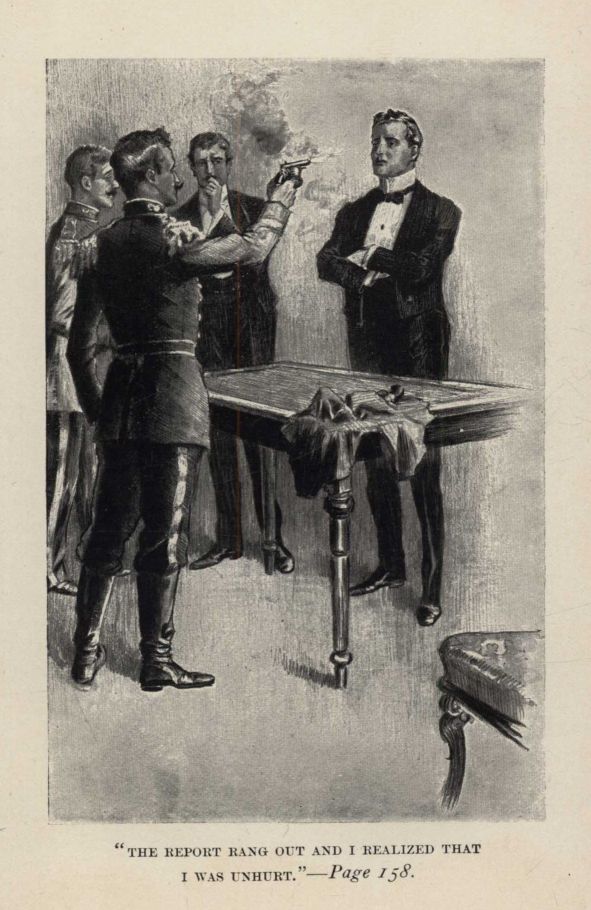
"THE REPORT RANG OUT AND I REALIZED THAT I WAS UNHURT."—Page 158.
So strong had been my conviction of safety that I had passed through the trying ordeal without even a change of colour, so Mayhew told me afterwards; and was certainly in complete command of my nerves as I entered upon the second stage of the grim drama.
I saw my way as clearly as though written instructions were actually in my hands. He was a coward. Brave enough for the ordinary routine matters of life and of his profession as a soldier, he yet lacked the courage to face the certain death that was waiting for him in the barrel of the pistol lying to my hand; and throughout the whole scene he had been oppressed and overborne by the fear of what such a minute as this must mean for him. It was through his cowardice, his readiness to sacrifice honour for life, that I was to win my way to the knowledge I needed and achieve my purpose.
I began the task with studied cruelty. I bent on him such a look of stern hate and menace as I could assume, and dallied deliberately with his terror before I even laid finger on the pistol stock. Then I smiled as in grim triumph, and picking up the pistol looked carefully at it, and from it across the space between us to him.
His fight for strength was literally repulsive to witness. Terror possessed him so completely that both nerves and muscles refused to obey the direction of the brain, and the pause I made proved the breaking point in his endurance.
"I can't stand; give me a chair," he gasped, piteously.
"Stand back, gentlemen, if you please," I thundered, when his seconds were going to him; and the sound of my voice increased his already crushing fear, so that he swayed and fell forward on the table, like a man collapsed in drink, his arms extended and his hands clenched in a veritable agony of despair and terror.
I allowed a full thirty seconds to pass in a silence that must have been awesome for him, and then let drop the first hint of hope.
"It is my right to fire when I please. I have not said I shall exercise it to-night."
At that I saw the strength begin to move in him again. His fingers relaxed, he drew his arms back and then gradually his body, and at length raised himself slowly and looked at me—question, doubt, fright, appeal, hope, all struggling for expression—a look that, had I been as full of rage and yearning for revenge as he had been and as he believed me to be, would have sufficed to stay my finger on the trigger or have driven me to fire in the air. I have never seen such haggard misery.
There was another pause, in which I looked at him, my face set apparently upon the execution of an implacable resolve to kill him. When it had had its effect and I saw the grey shades of renewed despair falling upon him, I said—
"Gentlemen, I will ask you to withdraw a while. It may be that a way can be found out of this business which may lead to my waiving or indefinitely postponing my right. If Colonel Livenza is willing, I will speak with him privately."
A hurried whispered conference between him and his seconds followed, and then we two were left alone.
CHAPTER XIV
A COWARD'S STORY
After a very short pause Livenza's very shame at his own panic began to give him a sort of firmness of bravado. The worst about him had been made clear; he had shown that he was afraid and was willing to purchase his life; and it was a matter in which he must make the best terms he could. The pressure of imminent death once removed, he could breathe again. In the future he was to be my creature, and he recognised it. That was how I read the sullen, scowling look he gave me as he drew himself up slowly and crossed his arms.
"You can sit down if you wish," I said, curtly, in the tone of a master, to make him feel my authority and to recall to him his former craven appeal.
"I have no wish: I can stand."
"You know your life is forfeit," and I glanced at the pistol in my hand, "and that I have the right to send the bullet crashing into your brain, if I please?"
He winced, and the light of fear glanced again in his eyes. I couldn't have shot him in cold blood, of course, and the thrust was a cruel one. But I knew that he could have shot me under the circumstances, and that he would read my disposition by his own. He was a brute, and must be treated as a brute.
"If you mean to shoot me, do it," he cried.
"I am willing to let you purchase your life, but the terms will be heavy."
"I am in your power and must pay them," he answered, sullenly, but with unmistakable relief.
"First, then, understand this: What has passed here to-night shall never be breathed by either my friends or myself. So far as we are concerned your reputation outside shall stand just where it did when you entered the room. On that I give you my word of honour—if you deal straightly with me. A sign of treachery or a single lie from you, and the truth shall be told."
"I agree to that, of course."
"Moreover, my right to fire this shot is merely postponed, not waived. You will put down in writing what will justify me should your treachery ever make it necessary for me to shoot you."
"I will do that." He was beginning to speak fluently and readily now.
"You will now answer my questions. Are you in Sebastian Quesada's pay or in his power?"
"In his power. He concocted a false charge against me some time ago, confronted me with the proofs, and threatened to have me prosecuted. I dare not face the charge, and from that moment he has used me for various tasks."
"Amongst them this business of the young King's abduction?"
He started violently as I made this rather bold shot.
"What do you know?"
"Everything—except the details." The reply was perhaps a little exaggeration; but I was guessing everything very fast.
"If he knows I have spoken of it to you, he will ruin me. I might as well be dead."
"He will never know, unless you are fool enough to tell him. He sent you to Senorita Castelar's house this afternoon?"
"Yes. He said you would be there." He was sufficiently recovered now for his private feelings to reassert themselves somewhat, and there was a gleam of the old hate of me in his eyes as he gave the answer which let in such a flood of additional light upon my knowledge of Quesada's treachery. I made another long shot.
"He has promised to help your suit with the senorita?"
"You are the devil. You do know everything, indeed," he cried. "Who are you?"
"You are to answer, not question," I returned, sternly. It was now as clear as the sun at noonday that Quesada had planned this quarrel of ours, sending Livenza to catch me with Sarita, with the certain assurance that his jealousy would lead to a duel in which one of us would be certain either to fall or to be laid by during the completion of his plans. He stood to gain almost equally by the death of either. "You took with you some final instructions about this plot; what were they?" I asked, after a moment's pause.
For the first time he hesitated, and I saw the beads of sweat standing thick on his forehead, as he looked at me, trembling like a blade of grass.
"You are asking me for more than my life," he murmured, his very teeth chattering in his irresolution.
"Answer me, or——" I thundered, lifting the pistol a few inches.
"You will never breathe a word of this?" he implored.
"Answer me," I cried again, with implacable sternness.
"He gave me the privately agreed upon route of His Majesty's drive for to-morrow afternoon." He spoke in a voice low and hoarse, and the sentence was broken by three or four pauses, as if the effort to utter it was almost beyond his strength.
"Give it me," I said, instantly.
"I—I dare not," he answered, his voice no louder than a whisper.
"Give it me," I repeated.
"I—I can tell it you," he said, after a long pause.
"Give it me," I cried, sternly. "I shall not ask again."
He plunged a trembling hand into an inner pocket, and without withdrawing it gave me a glance of piteous entreaty.
"Anything but this!" he pleaded. "God have mercy on me; anything but this, senor, I beg you. I was to have destroyed it."
"As you will. Then our conference fails. I will call in our seconds and——"
But he did not let me finish, for with a groan of despair he brought the paper out and laid it on the table.
I picked it up, and a glance showed me what a prize it was. The writing was Quesada's, and it gave the route of the drive and actually suggested the place where the abduction could be made—a spot on the road to Buenavista, close to where the bridge crossed the Manzanares on the way to Aravaca, and specified the time, five o'clock; adding the significant note—"Only one aide in carriage, no escort; coachman and footman."
When I had read it he held out his hand for it, dreaming apparently that I should return it; and when I put it in my pocket he threw up his hands with a deep sigh of despair.
"Why was to-morrow chosen instead of the following day?"
"I don't know. There have been several changes."
I stopped to think. I had indeed made a splendid haul, and there was little else Livenza was likely to be able to tell me. There was one question I had yet to answer; but it was certain that he would not know any more than I. What was Sebastian's object in all this? I had thought of the probable solution when I was with Sarita—that he was playing for his own hand and meant to get rid of the young King and to crush the Carlists by one and the same stroke; and to pit myself against a man shrewd enough to conceive such a policy and daring enough to put it to the actual test, seemed like madness. But I had made up my mind to attempt it; and the document I now had in my pocket would be a powerful weapon if only I could see the means to use it shrewdly.
As I stood a minute or two revolving these matters, Livenza was staring at me with the fascinated gaze with which a hunted animal will watch the beast of prey that threatens its life, and at length said—
"Is there anything more. I am not well, senor."
"No, you have saved your life; but you will remain close in your rooms until I send you word. To all but Sebastian Quesada you will be ill in bed. Any message he sends you, you will immediately forward to me; and he must not know that you are not acting just as usual. I will find someone who will nurse you day and night and watch you."
"I cannot serve both you and Sebastian Quesada. I cannot do it. I must have either your protection or his," he cried, feebly.
"You will have mine," I answered, in a tone I might have used had I been the master of countless legions. "Serve me in this matter, and you will have your reward. Fail me, and I swear I will take your life."
Without giving him time to answer, I called in the other men, and found that Captain Pescada had gone away, leaving many apologies. I apologised for having kept the others waiting.
"Colonel Livenza is ill, gentlemen," I added. "He has given me proofs of his desire to make ample amends for the insult of this evening, offered under what he declares to have been a complete misunderstanding. While he is arranging matters I have consented to withhold my right under the duel. He will put this in writing with an acknowledgment that I shall be entitled to exercise that right should he fail in what he has undertaken to do, and I wish you to put your names to the document."
He was so broken that he could scarcely keep a steady enough hand to write what was necessary; and while he was so engaged, I drew Mayhew on one side.
"You know many people in Madrid: do you know of any young doctor who would undertake to stay here with Livenza for a couple of days at most, but certainly until after to-morrow night, never losing sight of him and seeing that he does not commit suicide?"
"He won't commit suicide," said Mayhew, contemptuously.
"I know that; but it will make a good excuse for us to give to the doctor who is to watch him," I returned, drily. "It must be a man who won't talk either. And you'll give me your word to say nothing of that distressing scene of his cowardice. There's a good deal in this thing—a good deal. And will you look up Captain Pescada in the morning and get a pledge of secrecy from him?"
"Certainly I will; and I think I know the man you want."
"Can you rouse him up to-night? Of course, I'll see he's well paid. I don't want to be here any longer than necessary; and as soon as this thing's done," nodding to where Livenza was writing, "perhaps you could fetch him."
The arrangements as I planned them were carried out without much further loss of time, and as soon as the paper had been read over and signed, and Livenza's seconds had left, Mayhew started in search of his friend. Livenza went to bed, and when the young doctor came and I had given him my instructions, Mayhew and I left the house together.
"It's all very mysterious, Ferdinand," he said, fishing.
"Very, Silas; but I hope things will come right in the end."
"You're well out of an ugly business."
"Or deeper in—it remains to be seen which," I answered, cryptically, and smiled. "But whichever it is, our friendship will have to stand the strain of silence about it. I'm sorry, for I should much like to have you in it with me. But it can't be—at any rate yet. All the better for you, perhaps."
"That brute meant to kill you," he said, after a pause.
"Not the only good intention that's missed fire to-night, probably."
"I couldn't understand you a bit. You were as cool and certain as if you knew you'd come out on top."
"I think I did know it, too, in a way. Anyhow, I felt dead certain, and that was just as good. But I know a lot more than I did, I'm glad to say."
"What do you mean?" he asked, with quick curiosity.
"I know what it means to stand fire at close range."
"All right; I won't question you. But you're a strange beggar;" and he laughed. I thought I could afford to laugh, too, so I joined him. I might not have many more occasions for much laughter, at any rate for a while; and soon after that we parted at the door of his house.
It was very late, but I sat for an hour smoking, studying the route of the young King's drive for the next day, and making my plans; and when I turned in my nerves were still in good enough trim for me to get to sleep at once. I had had a very full and very exciting day, but unless I was mistaken the morrow would prove much more critical for me, and probably a no less fateful one for Spain.
I sent a letter first thing in the morning to the Embassy, excusing myself from attendance there on the plea of sudden business; and, hiring a horse, rode out to the spot where the attempt on the young King was to be made that afternoon.
It was cleverly chosen, indeed. A very quiet, lonely place, where the road dipped and then ran in a cutting between high banks up a sharp incline—such a place, indeed, as was exactly suited to the work. Fortunately I knew the district well, and where the various roads about there led; and I could form a pretty good idea of how the thing would be done.
I picked out a good spot where I could keep concealed, watch what transpired, and then follow in pursuit. My plan was a very simple one: To let the affair take place and the abductors get away with the King; then to follow, and just when they were confident all had gone well, strike in and act according to circumstances. My danger lay in the fact that I must be alone; but the personal risks of that were less than any attempt to get others to join me.
Of course, a mere word of warning sent to the palace would be sufficient to cause a change in the route for the King's drive, and so check the plot for that afternoon. But that was by no means my sole object. I was bent on making a bold stroke for my own gain; and for this I was as anxious as any Carlist could be for the momentary success of the scheme. I must not only call check, but checkmate, to the desperate man I was fighting.
The knowledge I had gained from Vidal de Pelayo, that the Carlists would attempt to carry the King to Huesca, gave me a clue as to the line across country they were sure to take, and a gallop of a few miles refreshed my knowledge of it, and also showed me where in my turn I could make my rescue.
I returned to Madrid about noon, confident and in high spirits as the result of my ride, and my next task was to secure the fleetest and strongest horse that could be hired; and I had scarcely reached my rooms after arranging this when a very singular incident occurred.
A letter was brought me from Sebastian Quesada, and my servant told me the messenger was waiting for a reply. I opened and read it with great astonishment.
"Time changed. Six o'clock—not five; return route. Same spot. Communicate instantly."
I had had no message from him, or invitation for a drive or ride that day. The letter was just in the brief style of twenty others he had sent me, and it seemed that some former invitation must have miscarried. I was on the point of penning a line to him to this effect when a light suddenly broke upon me.
The letter was not for me at all. It had been put by mistake in the wrong envelope. I saw the address was in Quesada's own hand, and in his hurry he had apparently committed the blunder of mixing the two notes.
This referred without a doubt to the great event of the day, and my pulses tingled at the thought. I sent for the messenger.
"Did Senor Quesada give you this with his own hand?" I asked the man, whom I knew as a confidential servant of the Minister's.
"Yes, senor. I took it first to the British Embassy, but they told me you had not been there to-day, and as my instructions were to await your answer, I came here."
"Quite right," I answered, casually. "I'm sorry I shall not be able to do what your master wishes. I have hurt my hand and cannot write," and I lifted my right hand, round which I had bound my handkerchief. I could not send a written reply, as I did not know what I had to answer, and could afterwards blame his servant if my verbal message suggested any discrepancy.
As soon as his back was turned I was in a carriage driving fast to Livenza's. I guessed that as this letter was for him, mine might have been enclosed to him, thus forming the counterpart of the mistake.
My guess was right, and I found him puzzling over a letter asking me in most pressing terms to join Quesada that afternoon in a long ride, and to dine with him quietly afterwards. I saw the object—to make it impossible for me to interfere in the business of that day, supposing by any chance I had got wind of it.
That being his purpose, how would he act when he got my reply? The story of the injured hand would seem to him to be the result of the trouble with Livenza; but it was almost certain that he would come himself to see me. If he did so, and found me absent, he might suspect, and perhaps even at the eleventh hour postpone the coup.
A question to Livenza showed me how he would communicate the change of time to those whom it concerned, and the moment I had arranged that I rushed back to my rooms, swathed my hand in bandages, improvised a sling under my coat, and sat down to wait. It was then three o'clock, and I must be away in two hours—by five, that was—if I was not to run a risk of being late, or perhaps of being observed.