Front matter (continued 2)
Reading edition
"You hate this man deeply?"
"Should a daughter love the man who killed her mother, or a sister him who ruined her brother?"
"You cannot fight against him. It is impossible. This time I am but a few hours in Madrid, but I have already learnt the facts of his immense influence and power."
"I don't ask your help," she said, wilfully.
"That is not generous. What I can do to help I am ready to do. But it is a mad chase." I shook my head, as if discouragingly; but, in fact, the very difficulties of the matter appealed to me and attracted me. I recalled Mayhew's caution against crossing swords with Quesada, and the danger of it was anything but displeasing. I did not speak of this to Sarita, however.
"You will not frighten me from my purpose," she said, with a smile of self-confidence; "and I will tell you what no one else dreams—I am certain to succeed. There will always be one door to success open to me if I have the courage to use it—and it will need courage—the courage of a foiled, desperate woman. When all else has failed, that will succeed."
I looked the question, which she answered in her next words.
"He has a secret which I alone possess. The world is full of his greatness, his influence, his power, his wealth, his judgment, his ambition, his fame, and his magnificent future—but only one soul on this dull earth knows his heart."
"You mean——" I asked, slowly.
"That to-morrow, if I would, I could be his wife. That door of revenge will never shut, for he is that rare thing among us Spaniards, a man of stable purpose. And why should I not?" she cried, with a swift turn, as though I had put her on her defence; and her eyes shone and her cheeks glowed. "Between him and me, as he himself has declared, it is a duel to the death. If I will not be his wife he will crush me: he has said it, and never has he failed to carry out a threat. It is true that I hate him: I feed my rage on the wrongs he has done to us. But what then? If we women may be sold for money, traded to swell the pride of a millionaire's triumph, may we not sell ourselves for a stronger motive? What think you of a marriage of hate? A marriage where the woman, with the cunning we all have, hides under the soft laughter of her voice, the caressing sweetness of her glances, the smooth witchery of her looks and simulated love, the intent to ruin, to drag down the man that has bought her, to sear his mind with the iron of her own callousness, to watch, wait, mask, win, lure, cheat and scheme, until the moment comes when the truth can be told and the hour of her revenge strikes."
"It is a duel in which even then you would be worsted; and if you ask my opinion of the scheme, I think it loathsome." There was no lack of energy in my tone now. I spoke hotly, for the idea of her marriage with Quesada was hateful. She changed in an instant, dropped the curt vehemence of manner and smiled at my quick protest.
"Yet the world would see in it a dramatically apt ending to a serious family feud."
"The world will see right in whatever he chooses to do at present. But while you hold that project in contemplation, I cannot help you," I said, and rose as if to go.
"As you will," she answered coldly, and turned away to look out of the window. For a full minute she remained silent, and then, turning back quickly, keeping my face to the light, she placed her hands upon my shoulders and searched my face with a look that seemed to kindle fire in the very recesses of my soul, as she asked in a tone that thrilled me: "And if to gain your help I abandon it, will you help me?"
"Yes, with every power I possess," I cried earnestly, gazing down into her eyes. "On my honour as an Englishman."
She did not take her hands away, and let her eyes linger on my face till I could feel the colour of delight creeping up to my cheeks, and could scarce hold myself steady under the magnetism of her touch and glance. It was not in human nature to bear unmoved such an ordeal; and I think she divined something of the struggle within me.
"You give me your word of honour voluntarily. I know what that means to an Englishman."
"I give you my word of honour, cousin Sarita," I answered firmly and earnestly, feeling at the moment I could have laid down my life for her. But the next moment with a slight push she seemed as if to thrust me and my offer away from her. She moved back and shook her head.
"No. I will not take your word," she cried. "You would go away and would grow cool and reflect, and say—'I am sorry. I was rash. My English prudence was smothered. I am sorry.' I do not want this. I would have your help—Heaven knows how sadly and how sorely I need help; true, sincere, honest, manly, and unselfish, such as I know yours would be; and how I would cherish it. But no, no, no, a hundred noes. There shall be one man at least able to say—'Sarita has always been candid to me.' If you came to me, I should whelm you surely in the flood of my Carlism; and I should drag you down and ruin you. I meant to do it—I told you so; and to you I will be candid. I needed you, not for yourself—I did not know you then; I had not seen you, and it was for the cause that to me is the breath of life. But I release you. Go now. I have seen you—I know you. You are true—aye, cousin, as true a man, I believe, as a friendless, often desperate woman might long to have for a comrade; but no, no, I cannot, I cannot!" she cried wildly and half incoherently, her arms moving with gestures of uncertainty. She covered her face and as quickly uncovered it and smiled.
"You will think me a strange rhapsodist. But when you offered to help me—ah, you can't think how tempted I was. I have resisted it, however;" and she smiled again and almost instantly sighed deeply. "You have come too soon—or too late."
"Too soon or too late? I would do anything in the world for you, Sarita," I exclaimed, scarcely less deeply moved than she herself.
"You are too soon for me to be callous enough to make use of you; I am not yet desperate enough. And too late to save me from myself. But I shall see you again when the hour of temptation is not so sweetly near;" and with that, showing many signs of feeling, she hurried from the room.
CHAPTER VI
"COUNTING ALL RENEGADES LOVERS OF SATAN"
The interview with Sarita excited me greatly, and I was too much engrossed by the thoughts of it to be able to bear with equanimity a second edition of Madame Chansette; so that when that dear and most amiable of women came to me, I pleaded an engagement and left the house.
As I passed through the hall there was a trifling incident, to which at the moment I paid very little heed. A couple of men were standing in whispered conference by the door and did not notice my approach until the servant made them aware of it. Then they drew aside, one with the deference of a superior servant, the other with a quite different air. He looked at me very keenly and apparently with profound interest, then drew aside with a very elaborate bow and exclaimed:
"Senor, it is an honour."
This drew my attention to him, and I set him down for an eccentric and gave him a salute as well as a pretty sharp look. He was a long-visaged, sharp-eyed, high-strung individual, moderately well-dressed, the most noticeable feature in my eyes being the exaggerated courtesy, not to say obsequiousness, of his manner toward me. I dismissed the matter with a smile, however, and went back to my thoughts of Sarita and her affairs.
I walked back slowly to my hotel revolving them, and while I was standing in the hall a few moments, was surprised to see the man I had noticed at Madame Chansette's house walk past the hotel on the opposite side of the street. For a moment this annoyed me. It looked uncommonly as if he had followed me, and although I tried to laugh at the incident as a mere absurdity, or coincidence, or at worst a result of the fellow's eccentricity, I was not entirely successful; and now and again during the rest of the day it recurred to me, to start always an unpleasant series of conjectures.
The truth was, Sarita's involvement with these confounded Carlists, the extraordinary connection between her and the man who had prepared that welcome for me to Madrid, and the conviction fast settling down upon me that she was rushing full steam and all sails set on the rocks, had got on my nerves; and I was quite disposed to believe the fellow had followed me intentionally, and that the episode was a part of that spyism she had declared so prevalent.
In the evening Mayhew dined with me, and after dinner I took possession of some rooms he had found for me in the Calle Mayor; and the bustle of getting my things in order and the chatter with him served to relieve the strain of my thoughts. But he was quick enough to see something was amiss with me and would have questioned me had I given him the slightest encouragement.
The next morning brought another disquieting incident. I walked to the Embassy, and Mayhew joined me on the Plaza Mutor and we went on together. As we stood in the doorway the spy—as in my thoughts I had begun to term him—passed the end of the building, paused a moment to look in my direction, and then went on.
"What is it, Carbonnell?" asked Mayhew, seeing me start.
"Nothing, old man; at least nothing yet; if it turns into something, I'll speak to you about it," and not wishing him to have any clue I wheeled about and went in.
Then I found something else to think about. There was a letter from my father with very grave news about his health. After a preamble on general matters, he wrote:—
"And now, my dear son, there is something you must know. I have for some time past had serious apprehensions about my health, and some months ago consulted the great heart specialist, Dr. Calvert, about it. He put me off with vague assurances at the time, saying he must study the case; but I have succeeded to-day in getting him to tell me the truth. As I explained to him, a man in my position is not like ordinary folk; he must know things and be prepared. The great responsibility of a peerage requires that its affairs should not be jeopardised or involved by any surprise such as sudden death; and I should be a coward if I could be so untrue to my order as to leave matters unsettled out of a paltry fear of facing the truth. I hope none of us Carbonnells will ever be such poltroons. The truth is, it seems, that my death may happen at any moment. For myself I hope I should never share so vulgar a sentiment as the fear of death, and I let Dr. Calvert see I was really astonished that he should have thought a man of my order and position would be so untrue to the instincts of his breeding—to say nothing of religion.
"Well, that is the verdict; and now for its effect upon you. I am chiefly concerned for you and Mercy; because Lascelles must have every pound that can be spared to maintain the position which the title imposes. Mercy has from her mother about three hundred pounds a year, and this will maintain her should she be so unfortunate as not to marry. For her I can do no more, and for you can, unfortunately, do nothing. The utmost that I dare leave away from the title is one thousand pounds; and this I have left you in the fresh will I have made to-day. I have no doubt that Lascelles, if he marries well, as I hope he will, will always assist you; but you have now the chance of helping yourself—your foot is upon the ladder—and I am very glad that our recent exertions, though prompted by no thought of what we know now about my health, have resulted in your getting such a start. You have abilities of your own, and I urge you to use them to the best advantage in your present sphere, and I pray God to bless you. While I live of course your present allowance will continue.
"Then, lastly, as to the Castelars. Tell Madame Chansette what I have told you about my health, and say that I can do positively and absolutely nothing for them. But if you yourself can do anything, do it by all means. If you can spare me any particulars, however, do so. I do not shirk my duties as head of my house; I hope I never shall shirk them; but the fewer anxieties I have now the better—so, at least, says Dr. Calvert.
"Ours has been a life of many and long periods of separation, Ferdinand, but you have been a dear son to me, and one of my few sorrows is, that I cannot better provide for you."
The letter moved me considerably. My father and I had never been very closely associated, but there was a genuine affection between us; and the courage with which he faced the inevitable, though so characteristically expressed, appealed to me strongly. I did not resent my virtual disinheritance. The lot of the younger son had never galled me much, and I was enough of a Carbonnell to admit the reasoning and to recognise that such money as there was must go to keep up the peerage. But I did not delude myself with any sparkling visions of what Lascelles would do for me if he married well; and I perceived quite plainly that now, indeed, my future lay in my own hands only, and that it would be only and solely such as I could make it.
In one respect solely did this thought sting me. It was a barrier between Sarita and me. I must marry for money or not at all, for the plain bed rock reason that I had not, and probably never should have, money to support a wife.
More than that, the letter doomed me to a continuance of my present career. I should be dependent upon it always for mere existence money; and this meant that I must make it the serious purpose of life, and not merely a means for extracting as much pleasure as possible out of the place where I might chance to be posted. This made me grave enough for a time, for I knew of a dozen men with more brains than I possessed, as qualified for the work as I was ignorant, and as painstaking as I was the reverse, who had toiled hard and religiously for many years to acquire just enough income to enable them to know how many of the good things of life they had to do without.
But Nature had kindly left out the worry lobe from my brain, and I soon held lightly enough the news as it affected my own pecuniary prospects. I took more interest in my work that day than I should otherwise have taken, I think, and found it very irksome. I wrote to my father, and then went off to my rooms with a complete present irresponsibility and a feeling of thankfulness that I had always been a comparatively poor man, and that I should be a big fool if I were to add the wretchedness of worry to the sufficient burden of comparative poverty.
I was whistling vigorously as I opened my door and stopped, with the handle in my fingers, in sheer surprise, at seeing in possession of my rooms the man whom I believed to be a spy. He was sitting reading as he waited, and on seeing me he rose and made me one of his ceremonious bows.
"Who are you, and what do you want here?" I asked in none too gracious a tone, as I frowned at him.
"Senor Ferdinand Carbonnell—you are Ferdinand Carbonnell?"—he repeated the name with a kind of relish—"I could not resist coming. I could not resist the desire to speak to you, to stand face to face with you, to take your hand. I have done wrong, I know; but I shall throw myself on your mercy. I am leaving again to-night; but I could not go without seeing you."
My former impression of him seemed to be confirmed. The man was a lunatic, or at least an eccentric; and a word or two to humour him would do no harm.
"You have been following me; may I ask why?" I asked, in a less abrupt tone.
"I heard your name mentioned at the house where I saw you yesterday. The friend who mentioned it knew nothing; but I knew; and when I heard you were in the house, Senor, do you think I could leave without a sight of you? Ah, Mother of God!"
I was rolling myself a cigarette with a half smile of amusement at the man's eccentricity when a thought occurred to me. I stopped in the act, and looked at him sharply and questioningly. The thought had changed my point of view suddenly, and instead of amusement my feeling was now one of some uneasiness.
"Just be good enough to tell me exactly what you mean; and be very explicit, if you please," I said.
"I am from Saragossa, Senor Ferdinand Carbonnell, and my name is Vidal de Pelayo," he answered, in a tone and manner of intense significance. There was purpose, meaning, and pregnant earnestness in the answer, but no eccentricity.
"I don't care if you are from Timbuctoo and your name is the Archangel Gabriel. What do you mean?" I cried, testily.
The manner of his answer was a further surprise. He plunged his hand somewhere into the deepest recesses of his clothes and brought out a small, folded paper, from which he took a slip of parchment, and handed it to me without a word.
"Vidal de Pelayo. No. 25. 1st Section. Saragossa.
"Counting all renegades lovers of Satan. By the grace of God.
(Signed) FERDINAND CARBONNELL."
The signature was written in a fine free hand utterly unlike my own, of course; but there it was confronting me, and signed to a couple of lines that read to me like so much gibberish. I turned it over and handed it back with a laugh; and my thoughts went back again to my first opinion of the man.
"Very interesting, no doubt; and very important, probably, but it does not enlighten me."
"You mean you do not wish to know me? As you will. Then I suppose I must not open my lips to you? But I have seen you; and it is a great day for me!"
"You are right; I wish you to say nothing," I replied, assuming a very grave look and speaking very severely. "You have done wrong to come here at all," I added, seeing the effect of my previous words. "You must not come again."
"You will wish to know that all is going well?" he said, in a tone of remonstrance and surprise.
"I have other means of learning everything," I answered, with a suggestion of mystery, and rose as a hint to him to go.
"You are at the British Embassy here. It is wonderful," he cried, lifting his hands as if in profound admiration.
"Where I am and what I do concerns no one," I returned, cryptically. "We all have our work. Return to yours."
"I have seen you. You will give me your hand—the hand that has put such life into the cause. God's blessing on you. 'Counting all renegades lovers of Satan. By the grace of God.'" He uttered the formula with all the air of a devout enthusiast; and I gazed at him, keeping a stern set expression on my face the while, and wondering what on earth he meant by the jargon. "And you are indeed Ferdinand Carbonnell?" he said again, fixing his glowing eyes on me as he held my hand.
"I am Ferdinand Carbonnell," I assented, nodding my head and wishing he would go.
"I have made the arrangements required of me. When the little guest arrives he will be in safe and absolutely secret keeping."
"What little guest?" I asked.
"Yes, indeed, what little guest? For what is he now but a guest and a usurper, like a pilfering cuckoo in the eagle's eyrie? Why has it never been done before? Why left to you to propose? But it will change everything—a magnificent stroke," and his voice trembled with earnestness and, as it struck me now, with deep sincerity.
Was he after all no more than a madman? In a moment I ran rapidly over the facts as I knew them, and a suspicion darted into my mind. I resolved to probe further.
"Sit down again, senor. I have thought of something," I said, and placed wine and tobacco before him. We rolled our cigarettes and lighted them; and all the time I was casting about for the best method of pumping him without betraying myself. "It may, after all, be more convenient for you to tell me how matters stand. What precisely have you done in that matter? Assume that I know nothing," I said, with a wave of the hand.
He was seemingly flattered by the request, and answered readily.
"I have done my utmost to organise my district. Of the lists of names given me there is not one I have not sounded, and about whom I cannot say precisely, 'He is for us,' or, 'He is against us.' I know to a peseta what funds would be forthcoming on demand, and what reserve there would be for emergencies. There is not a rifle, sword, or revolver that is not scheduled and listed carefully."
"Good. These things are in your reports," I said, making a shot.
"So far as desired of me," he answered. "The totals."
"Exactly! Well?"
"When the great coup was devised, I was sounded only as to whether there was in my district a place so safe and secret that a little guest, a boy, could be hidden there indefinitely; and I know of just such a spot in the mountains to the north of Huesca, where a guest, little or big, boy or man, can be hidden in absolute secrecy. And so I reported. I know no more; but I have guessed."
"It is dangerous to guess, Senor Pelayo," I said, with an air of mystery.
"If I am wrong, so much the worse for Spain. But if the guest were indeed the usurper"—and here he paused and searched my face as if for confirmation of his hazard, but he might as well have counted the stones in a wall—"if, I say, then the mountain spot I mean would hold him as fast as his officers would hold us in his strongest prison had they wind of this scheme. Do you wonder that my blood burns with excitement for the day to dawn?"
"You have done your task thoroughly," I said, with the same air of reserve; and his face flushed with pleasure at the praise. Then I added with great sternness, "But now I have a word for you. You have done wrong, very wrong, to breathe a word of this even to me. You have been untrue to your duty. For all you could tell I might be a traitor worming this knowledge out of you for evil purposes. You heard my name by chance, you followed me and found me out, and with scarce a word of question from me you have tumbled pell-mell into my lap secrets that should have been kept with the closeness of the charnel house. Shame upon your gossiping tongue and your falseness to your oath. You would have shown yourself worthier of the trust we place in you had you set me at defiance, and, when I questioned, refused even at the dagger's point to breathe a word of answer. From now I shall watch you. I will give you another chance. Go back to your work, breathe no syllable of what has happened here: that you have even seen or spoken to me: look on the very walls of your house and the very stones of the street as listeners, watchers, spies, ready to catch your words and bring them to me; and if you value your life, pluck out your tongue rather than let it ever again betray you."
I have seldom seen a man more thunderstruck and bewildered. He turned white to the lips and trembled violently, and his hands clasped the arms of his chair for support, while his eyes, terror-wide, appealed to me with the prayer for forgiveness his quivering lips refused to utter.
I feared I had overstrung the bow indeed, and filling a tumbler of wine, I handed it to him and said, relaxing the sternness of my looks:
"Do as I bid you, and I will at no distant date send you a sign that you have regained my confidence;" and with this hope to counterbalance his abject fear, I dismissed him.
Then—shall I confess it?—I did a very boyish thing. Full of a curiosity to know how I had looked when frightening the Carlist so successfully, I postured and mouthed and frowned at and rated myself before a mirror much as I had with Pelayo, and laughed with much satisfaction at what I considered an excellent impersonation.
"By Gad, old chap," I exclaimed, with a nod to myself in the mirror, "if diplomacy fails, you'll do something on the stage, and what's more, I'll be hanged if I didn't feel that I meant it all the while I was giving it him."
And then I became serious again.
CHAPTER VII
SARITA, THE CARLIST
There was indeed plenty of food for serious thought in the interview with Vidal de Pelayo. If the man was really one of the provincial leaders of the Carlists, I had stumbled across the track of an intended attempt to abduct the young King, and such knowledge could scarcely fail to place me in a particularly awkward position in regard to my cousin Sarita.
She would as a matter of course be cognisant of the scheme, while it was more than probable that it had sprung from her own nimble and daring wits. My visitor had described it as the proposal of Ferdinand Carbonnell; Sarita herself had said that Ferdinand Carbonnell was the compound of her brother's and her own Carlism; and there was an imagination, a daring, and a reckless disregard of risks in the scheme which all pointed to Sarita as its originator.
But there was also my position as a member of the British Embassy staff to consider. If the thing were done, even if it were attempted and failed, there would be frantic excitement everywhere; Carlists known and suspected would be flung into prison, and questioned with that suggestive and forceful ingenuity which was generally successful in extracting information from the unfortunate prisoners; the name of Ferdinand Carbonnell was sure to come out; and if this Pelayo himself should chance to be among the questioned—not at all an improbable contingency—he would go a step further than anyone else and point me out to the authorities as the actual head and front of the conspiracy.
That was a very awkward position to face. Apart from the decidedly unpleasant results to myself personally, it was very certain that the consequences to the British interests in Spain at such a moment might be gravely embarrassing. It would be argued with much plausibility that the staff of the Embassy could scarcely have failed to know what was going on; and a charge of connivance in an abduction plot might fire a mine that would blow up Heaven only knew what.
All these things I saw as I smoked a pipe of meditation in my room that night; but I saw also something more. I was a soldier of fortune with my way to make. My father's letter had shown me that too plainly for me to misread. What, then, would be my position if I could use this plot, the knowledge of which had been thrust upon me, to my own advantage, while at the same moment saving Sarita from the results of her own wild scheming?
What would be the standing of the Englishman in Madrid who should cut in at the critical moment when the young King had been carried off, and rescue him and restore him to the Queen-mother at the instant of her agonised bereavement? It was a dizzying thought, and I am free to confess the prospect fascinated me. I sat turning it over and over as I smoked pipe after pipe, and the longer I thought the brighter glowed the one picture—the position of the man who saved King—and the colder grew the other—the duty of informing the Embassy of what I had learned.
When I knocked the ashes out of my last pipe in the hour of dawn—for I sat thinking all through the night—I had made my decision. I would fight for my own hand. So far as Sarita was concerned, I would warn her of what I knew, and that the project must be abandoned from her side. If she persisted, then I would take my own measures to save her.
In pursuance of this, I went to Madame Chansette's on the following afternoon to see Sarita. She was frankly pleased to see me, and after a few minutes gave me herself the opening I wished.
"I have made up my mind in regard to you, Ferdinand." She used my Christian name with the unconstrained freedom of relationship. "I will not have your help. You shall not be involved through me in any of these matters. If you can prevail in your way upon Sebastian Quesada to give up what he has taken from us, do so; but you shall not have him for an enemy on my account."
"That is very nice and commonplace of you, Sarita," said I, with a smile.
"I was not quite myself when you were here yesterday. You surprised me out of myself. I was excited, and talked wildly, and you must forget it all."
"What a very charming day it is. Did you notice how blue the sky was at about ten o'clock?"
"What do you mean?" she cried, looking at me in quick surprise.
"Are you going to the Opera to-morrow? I hear that Vestacchia's ballet is wonderfully good," I continued, in a dull, everyday tone. "By the way, I hear that the young Duke of Sempelona is likely to make a mesalliance."
"What is all this rubbish?"
"I thought we were to be commonplace, that's all. I hear, too——" but she interrupted me now with a burst of laughter.
"Ridiculous!" she cried. "As if you and I need talk of such things. I tell you I will not have your help."
"Very well. I'll pack it up and put it away in my trunks against the day it is needed. That is settled."
"So you can be provoking, can you? I thought you were a serious Englishman, with a good deal of the man in you."
"But you don't want the man; and as I can play many parts, I brought with me the society dude in case he should be handy."
"You are angry because I won't let you interfere with my affairs, eh? So you have your pet little weaknesses, too."
"Why don't you care to speak of fashionable marriages? You mentioned one that was in the making when I was here last."
"You think it a pleasant subject for a jest?" she cried, resentfully.
"Scarcely a fair hit. You have just told me you were not yourself then—and I thought and hoped it had been abandoned, and was to be forgotten like the rest of what you said."
To this she made no immediate reply, but after a pause, asked slowly and earnestly—
"And do you take enough interest in my future to feel serious about such a project?"
"There would not be much of the man in me and far less of the cousin, and none of the friend, if I did not," I returned.
"You have seen me once and known me three days."
"You forget the first time I saw you, Sarita. I do not. I never shall—and never wish to. There are some wounds that are long in the making; others that are made in a flash: and the latter may endure longer than the former." She threw a penetrating glance at me, sighed, and turned away again.
"I wonder if you will ever understand me," she said, half wistfully. "I will not have your help. I have told you."
"It is already packed away—waiting," I returned, lightly. But the light tone jarred, and she tapped her foot and frowned in impatient protest. I smiled. "Why play at this game of pretences?" I asked. "I am going to help you, whether you will or no; and you are going to take my help, whether you will or no. And you are going to give up that—well, the need for us to talk about projected marriages, fashionable or otherwise. You know quite well that I am just as much in earnest as you are; and already you have read me well enough to be perfectly aware that having made that use of my name, you have given me the opportunity to help you which I shall not fail to use. Why then pretend? Let us be frank. I'll set the example. I have come to tell you of something that you must abandon—a plan that originated with you: the part of you, that is, that goes to make up half of the mythical Ferdinand Carbonnell. A plan that the real Ferdinand Carbonnell will not sanction."
"You have come to dictate to me, you say? You to me?" she cried, at first half indignantly, but then laughing. "But what is it?" she asked, with a change to curiosity.
"Tell me first the answer to this puzzle phrase, or charade: 'Counting all renegades lovers of Satan.'" I put the question with a smile, but the sudden, intense dismay on her face startled me.
"Where did you hear that?" she asked. "How could it come to you? You must tell me. I must know."
"Tell me first what it means; that is, if it means anything more than a jingle."
"You don't know?" and her eyes lighted quickly.
"No, I don't know—but I suspect. Tell me, however."
"What do you suspect?"
"To question is scarcely to trust, Sarita. I suspect that it is some secret password among you Carlists."
"But how could it come to your ears?" she cried, anxiously.
"Should not Ferdinand Carbonnell be trusted by his followers?"
"Someone has heard your name, has seen you and has mistaken you—oh, Ferdinand, I might have expected it, but scarcely yet. Wait; yes, I know. It will have been Vidal de Pelayo. He has been here from Saragossa: he may have heard your name—ah, I see it was he. And did he come to you—where? Tell me everything." Her speech was as rapid as her deductions were quick and shrewd.
"Yes, it was Vidal de Pelayo;" and I told her generally what had passed at the interview, keeping back for the moment that part of it which referred to the abduction plot. She listened with rapt attention, viewing it much more seriously than I did; as was not, perhaps, unreasonable. "And now, what does that absurdly-sounding phrase mean?"
"You have only half of it."
"You mean, 'By the grace of God;' but that only makes it all the odder."
"If you take the initials of the first sentence you will see the meaning of the second."
"Of course, Carlos, by the grace of God," I exclaimed.
"It is a phrase that Spain will learn to know one day," she said. "It will be the watchword of the New Liberty," and her face lighted with enthusiasm.
"The 'New Liberty,' Sarita; what do you mean by that?"
"The liberty, the greatness that our rightful King will bring back to us. Where do we stand now, but at the very bottom of the scale of contempt? What is Spain, but the doormat on which every upstart country, even this America, wipes her feet? And what were we once—the leaders of the world; the possessors of half the earth, rulers holding sway on sea as well as land? Are we not the same Spaniards to-day as then? What we did once can we not do again? Aye, and Don Carlos will lift from us the shame of our sloth, put blood and fire once more into the veins of apathy, restore us to our ancient standing, and once again give us the strength to show the face of pride to our enemies. Is not that a day for Spaniards to pray for; and to work, scheme, plot, and toil unceasingly; to shed our blood for, if the need demands it? I will give mine freely and without stint;" and her face glowed like the face of a martyr.
"It is a dream, no more. Look at your countrymen, Sarita, and ask yourself where is to be found the power to work this miracle; where the men, the resources, the brains, the energy, everything that is of the very essence of success?"
"Do you think we do not know that? But it is just all that which Don Carlos will alter? What are we now but a people in whose lives the very salt and marrow are withering? I know it; but I know also what will stop the decay; and Don Carlos will give it us. We must free ourselves from the corroding blight of the misgovernment which those who have usurped the throne have forced on us that they might buttress up their own wrongful claims. While we are weak, divided, torn by dissension and undone by mistrust, they can continue to force on us the oppression which they miscall government. They sap the nation's very life that they may pluck for themselves the ever-dwindling fruits from such branches as have not yet been destroyed. But do we not know the cure? Can you yourself not see it? If the forceful blood of true liberty was once again set flowing in the veins of our nation, the change would soon tell. You know, for you are an Englishman. You have the liberty denied to us, and craved by us. You and these Americans, who would now put this last dire shame upon us. You are increasing, we are dwindling. You enjoy the splendours of the achievements of liberty; we are pining on the undigested meal of past greatness. You are what we were once, the very opposite of what we are now; and what you are, Don Carlos would make us—aye, and by the grace of God, he shall yet do it; and if my little life can help him, I shall not have lived it in vain."
So absorbing, so thrilling was her enthusiasm, that I did not wonder at others yielding to her whirlwind influence. I sought to argue with her, to show her the fallacy of her dreams, to convince her that Don Carlos at best was merely struggling to get back the throne from anything but self-less motives, that the destiny of a nation lay not with the leadership of one man, but in the nature of the people themselves—but argument broke itself in vain against her passion and enthusiasm.
"There is nothing before you but disillusion, Sarita," I said at length; "whether it comes in the form of failure to rouse your countrymen—for men more easily fit themselves with a new skin than with a new nature; or in the more tragic form of passing success in the Carlist movement, to be followed by a knowledge that after all your Don Carlos is no more than a man, and a Spaniard."
"I do not expect you to see things with my eyes," she said; then, after a long pause, "If I dream, well, I dream. But I would rather live a dreamer of dreams, and die in striving to realise them, than live and die a drone among drones. But I have told you I will not have your help."
"And I have shown you that you cannot avoid it. For good or ill, the use of my name before I arrived has made it inevitable. You are doing things in my name, and whether you wish it or not, that fact brings us together in close association. What has happened with Vidal de Pelayo may happen at any moment with another; and how can we escape the consequences? But I must make terms, even with you. For instance, you have in the making a plan to carry off the young King——"
"What?" she cried, in a tone of profound astonishment.
"Is it not so?"
"Did Pelayo tell you anything of the kind?"
"Can the followers of Ferdinand Carbonnell have any secrets from him—when they find him in the flesh? He told me no more than he knew—that he was to procure a safe place for a little guest; the rest is surmise; but surmise made easy. And I have come to tell you that the project must be stopped."
"Must?" she cried, angrily.
"Must," I answered, firmly. "Stopped either by you or else go on to be checkmated by me."
"That is a word I have never yet heard from anyone," she exclaimed.
"Then it is quite time somebody used it," said I, as firmly and masterfully as I could make my manner. "I mean it."
"I will not listen to you. I won't bear it," and she got up and stared at me with resentment, surprise and rebellion in every feature of her face.
"I am not going because you are angry, Sarita. I care for you far too much to let a passing mood like that ruffle my purpose. I will not let you commit this crime."
"This is ridiculous—monstrous;" and she tossed her head disdainfully. "You are presuming on what passed when you were here yesterday."
"I am doing nothing of the kind, and only your anger would lead you to make so unjust an accusation. What I am doing is to use some of the privileges which you have given to Ferdinand Carbonnell. I have been within an ace of losing my life through the use of the name; I have been recognised by one of your chief agents as the leader himself—and now I intend to use that leadership to save you from the consequences of your own blindness. A moment's reflection will convince you that I am not speaking at random."
"You would make me your enemy?" she asked.
"It would not be the first time that enmity has followed acts which should have generated sincere friendship. Would the Ferdinand Carbonnell of your making be deterred from doing what he deemed right by such a motive? No; and neither will the real man."
"It is the very key-note of our plans," she cried.
"Then you must arrange a different harmony."
"You shall not interfere with it. You shall not, I say," she exclaimed, tempestuously.
"I am absolutely resolved. You shall either abandon the mad project, or I myself will thwart it."
"Would you quarrel with me?"
"If you force a quarrel on me because of it; yes." This reply seemed to amaze her more than anything I had said, and her gaze was full of reproach and consternation.
"And you said just now you cared for me," she said, softly.
"How deeply it may never be in my power to tell you, for all said and done, I am only a poor devil with all his way in the world yet to make. But for this you have made me rich in power, and I will use the power you have given me to the uttermost—to save you."
Then she came and stood close before me and putting her hands on my shoulders, as she had done once before, looked pleadingly into my eyes.
"Will nothing move you, Ferdinand?"
"Nothing," I returned, meeting her eyes firmly.
"Not if I tell you——" she hesitated and bit her lip in disconcerting agitation. My heart gave a wild leap at the thought of how the broken sentence might have been finished. I loved her, Heaven knows how deeply, and for an instant I cheated myself with the wild fancy that a confession of answering love was halting on her trembling lips. "Not if I do what I have never yet done to any man—beg and implore you to leave this thing alone?"
Moved though I was I would not let her see anything of my feeling; I changed no muscle of my face, and met her eyes with the same calm, resolute look as I answered slowly and earnestly—
"Sarita, if such a thing were possible as that you love me and that the words which faltered on your lips just now had been a confession of that love, I should still answer you that nothing would move me from my purpose."
She started violently, listened to me at first with such a look as one might give whose heart has suddenly been bared, and then with an expression of dismay which changed at last to almost passionate reproach her hands slipped from my shoulders and she fell into a chair and covered her face to hide her emotion.
But the weakness passed in an instant and she rose and faced me, once again calm, confident, and self-reliant.
"It shall not be abandoned. You have no right to do this. It shall go on, do what you will. You shall not come between me and my duty; between me and my country. I have urged and entreated you, and you have scorned me. It is not in your power to bend me—cold and hard and strong as you may think yourself. I can be cold and hard and strong, too, as you will find. What if I tell you, as I do, that you shall never set eyes on me again if you do not give way?" and she drew herself to her full height, splendid in her flashing, gleaming anger. But I did not yield a jot from my purpose.
"That must be as you will, Sarita," I said, calmly. "Nothing can change my resolve. Because I will not see or say that all you do is right, you are angry. Well, leave it there. Believe me, I will stop this and save you from yourself."
"I do not want your help; and I will not have it. An enemy of Spain can be no friend of mine," she cried, passionately, and was going from the room with all the signs of her anger and emotion flaming in her face when the door was opened and a servant ushered in Colonel Livenza.
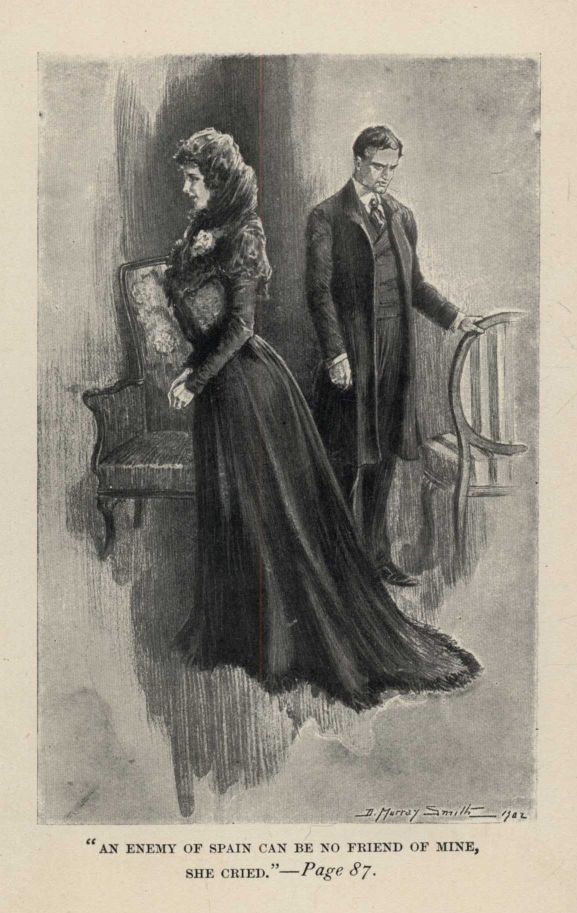
"AN ENEMY OF SPAIN CAN BE NO FRIEND OF MINE, SHE CRIED."—Page 87.
As soon as he saw me, his face lowered ominously and the anger deepened and darkened when he perceived by Sarita's face that our interview had been no mere conventional one.
Sarita was for the moment too agitated to stay and speak with him, and with a hasty word of greeting and excuse she hurried past him and left us alone.
He looked after her in surprise and deep annoyance, and then turned with a scowl to me as if for an explanation; looking on me as an intruder.
"I did not expect to meet you here, senor," he said, angrily; but the scene with Sarita had left me in no pleasant mood, and I was glad enough to have someone on whom to vent the temper which I had been keeping under such restraint.
"I am not aware that I am in any way called upon either to anticipate or consider your expectations," I returned, pretty curtly.
"That's a very strange reply."
"To a very impertinent remark," I retorted. I hated the fellow, and was not in the least concerned to conceal the feeling. In my then mood, guessing the object of his visit, nothing would have given me greater pleasure than to have kicked him downstairs and out of the house. I believe he guessed something of this, for he turned aside, pretended not to hear my answer, and made way for me to pass.
As I reached the door, going very slowly and keeping my eyes upon him in that melodramatic manner into which a bad temper will lead the mildest of us, Sarita came hurrying back, and her glance of alarm at us both showed she feared some sort of a quarrel.
"I will see you again, Sarita," I said, with a warmth in my manner which was intended more to displease Livenza than to please her. But she was still very angry, and drawing back, said—
"After what has passed that will scarcely be necessary or desirable." At which the man smiled and shrugged his shoulders contemptuously and with a suggestion of triumph which galled me. And, smarting under the sense of my defeat, I left the house.
CHAPTER VIII
SEBASTIAN QUESADA
The interview with Sarita both distressed and perplexed me, and my uneasiness was considerably aggravated by the fact that she went away from the city leaving Madame Chansette in ignorance of her movements and in much anxiety.
I could not doubt that in some way this absence was connected with the plot which I had declared my intention to thwart, and Madame Chansette and I had more than one consultation concerning her, in which that good soul's fears were largely shared by me.
I was, moreover, doubtful whether to take any further steps in Sarita's affairs until I had seen her again, and, in particular, whether to approach Sebastian Quesada on the subject of his giving up some of the Castelar property.
"He will not do it, Ferdinand; I am convinced he will never do it," said Madame Chansette; "but I wish you to convince yourself also, and then we can together try to bring Sarita to reason."
I was considering the questionable policy of doing something of the kind when a somewhat odd adventure occurred to change this aspect of affairs, and relieve me from the trouble of coming to any decision on the point.
Madrid was growing very uneasy over the Cuban question, and the populace were getting quite out of hand in the mad demand for war. Quesada was far too clear-headed not to understand the infinite danger to Spain of a war with America. He knew, probably, how hopelessly rotten was the state of the army and navy, and he threw the whole of his powerful influence into the scale against war. But the Madrid people went mad, and several riots occurred in which ugly results were with difficulty avoided; and one of these disturbances, directed against Quesada himself, was destined to have weighty consequences for me.
I was in my rooms one afternoon when I heard the sounds of a disturbance in the street, and, looking out, I saw a big crowd hurrying with shouts, and cries, and gesticulations, and with alternate huzzaing and hooting, in the direction of the Puerta del Sol, where Quesada's office, the Ministry of the Interior, stood. I turned out to see what would happen, and soon I found myself in the midst of a mob bent on making a very rowdy demonstration against Quesada and his counsels of peace and prudence.
I hung on the skirts of the crowd, listening to the fierce groans and hisses of those who had reached the Ministry, and wondering curiously what would be the upshot. Then, just as matters were beginning to get very lively indeed, a carriage with a dashing pair of greys came rattling down the Calle de Arenal, and the coachman, being unable to get through the crowd, was idiot enough to lay his whip on the backs of some of the men who stood thronging the roadway.
This fool's act maddened the mob, and with a roar like beasts some of them swarmed on to the box and dragged him off, while others unharnessed the horses, hauled them from the carriage, and with shouts and oaths turned their heads and sent them galloping back along the road they had come.
Meanwhile I had seen that the only occupant of the carriage was a girl, who was almost fainting with fright. I slipped across the road on the chance of being able to help her, and found some of the crowd quite disposed to punish the young mistress for the act of the coachman. One or two of them were already fumbling at the carriage door, and matters had begun to wear an ugly look. The girl was shrinking back in the farthest corner of the carriage, gazing in terror at the rough brutes, who were yelling and shouting in mob temper, as they clustered round the door; and on seeing me she gave a look which I read as a dumb, piteous appeal for help.
By a fortunate chance the carriage had stopped close to the pathway at a point where the pavement was very narrow, and, the crowd being in the road and only a couple of men on the other side, I slipped round to that side, shouldered the men out of the way, opened the door, and said, in a tone of command—
"Quick, senorita. Trust to me; I will protect you. You cannot stay here." A glance at me seemed to assure her that I meant well and not evil; and just as the clumsy louts succeeded in opening the other door, she got up, put her hand in mine, and jumped from the carriage.
Without a word I put her next the wall, and, getting between her and the balked and angry crowd, I hurried with her as fast as I could to the corner where two or three streets open into the Puerta del Sol, the crowd pressing upon our heels and growing more vehement every minute. Most luckily there was a cab standing at the corner of the Calle de la Montera, and I made straight for this. The driver was away seeing the fun, no doubt, and I shoved and shouldered my way toward it, and laid about me so lustily with my stick, getting a fair share of blows in return, that I won the way through and put the girl inside. As soon as that was done I turned at bay for a minute and let drive with my stick and fist in all directions, clearing a path till I could mount the box, when I lashed the horse into so much of a gallop as its weary, weedy legs were capable of achieving. In this way, hatless, breathless, and with my clothes torn and my muscles aching, I succeeded in getting the girl out of the clutch of the mob, who greeted my departure with yells of disappointment.
When I was well out of all danger of interference and the shouts of the people were no more than a distant hum, I pulled up and went to look after my charge. She was lolling against the cushions of the fly in a half-faint condition, and at first did not understand me when I asked where I should drive her. But at length she told me who she was, and I could understand the reason of the crowd's anger. She was Sebastian Quesada's sister, Dolores Quesada, and asked me to drive her to his house in the Puerta de Alcala.
I must have cut a queer-looking figure, but as there was no one else to act coachman I clambered back on to the box and hustled the aged animal in the shafts into as good a pace as I could, choosing the quietest streets for the route. By the time we reached the house my "fare" was better, but asked me to give her my arm, sent one servant to mind the horse, another in search of a Senora Torella, and insisted upon my entering and helping to give an account of what had occurred.
When the colour began to come back to her face I was rather surprised to find she was a really pretty girl. She was disposed to make much of the incident, and thanked me very graciously, although too profusely.
"Do you know to whom you are beholden, Dolores?" asked the duenna, Senora Torella. "May I ask your name, senor?" And when I told her she said—"It is not for us to thank you. Senor Quesada will do that; but now, can we not help you? You will, of course, allow us to place a carriage at your disposal for your return home, or would you rather that we sent some message to your friends? You have suffered at the hands of the mob."
"If you will send a servant with the fly which I borrowed to the police, with some explanation, it will, perhaps, save trouble; and if you will let someone fetch me another fly I can get home all right. But as for thanks, it is sufficient recompense to have been of some service to the senorita. Stay, there is one other matter—give that coachman of yours a severe reprimand. It was his violence in lashing at the crowd which provoked them and led to all this trouble. You are feeling better now, senorita?"
She had been lying back in a low chair, gazing at me with an open-eyed stare which I found somewhat embarrassing, and she now roused herself, sat up, smiled, and coloured.
"Thanks to you, senor, I am better. But for your help and courage what might not have happened to me? What an escape! And what do I not owe you? I shall never cease to thank the Holy Virgin for having sent you to rescue me." She was clearly an emotional creature, but this kind of exaggerated gratitude was not at all to my liking.
"Pray don't make too much of it. I just happened to be on the spot at the moment, but I did nothing more than anyone else would have done under the same circumstances. Besides, it's pretty certain that the crowd only meant to frighten you, and nothing serious would have happened even had I not been there."
"It is clear that the hand of Heaven guided you," said the duenna, with a solemn earnestness which quite disconcerted me. I did not regard myself as exactly the sort of person Heaven would choose for an instrument; and not caring for the turn of the conversation, I rose to leave. They were loth for me to go, however, and urged me to wait until the brother came home; but I had had enough of it, and went away, not sorry to have succeeded in getting a propitious introduction to Sebastian Quesada.
The next day brought Quesada himself to the Embassy; and I met him with deep and genuine interest, heightened considerably by my knowledge of that little secret which Sarita had told me.
"Senor Carbonnell, you have laid my family under an obligation that will end only with death," he said, with Spanish exaggeration, "and the measure of my gratitude is the limitless measure of my love for my dear sister. You must render me another service by giving me your friendship; and though that will add to my obligation, it may afford me an opportunity of showing you something of my gratitude." And all the time he was saying this with exaggerated gesture and elaboration of courtesy, his piercing dark eyes were fixed on my face, seeking to read me, as it seemed, to judge the manner of man I was, to calculate the kind of reward I should appreciate, to gauge whether I made much or little of the service I had rendered; and, in a word, to drag out my inner man to the light so that he might see it and appraise it shrewdly.
"I trust your sister is well after her alarm—it was an awkward two minutes for her; but, believe me, if she tells you that there was anything heroic about the rescue or any real danger for me, it is only because her frightened eyes could not judge calmly."
"Spoken like an Englishman, Senor Carbonnell; but, pardon me, I know what a Madrid crowd can do in less than two minutes when excited. My fool of a coachman was very nearly mauled to death by the roughs, and lies now with a broken leg, a couple of fractured ribs, and a cracked pate. It serves him right, perhaps; but it shows you—or, at any rate, it shows me—that Dolores' danger was no mere imagination. And now I bring you a request—to dine with us to-morrow—and I have come with it in person lest you should be engaged then, in which case you must choose your own day; for we can take no refusal—unless you can name any other way in which our friendship may begin more auspiciously."
"I shall be very glad," said I, cordially. "Indeed, I have wanted to see you on some private matters." A gleam of lightning questioning flashed from his remarkable eyes, until he threw up the mantling veil of as pleasant a smile as ever brightened a human face.
"That will be charming. Myself, all that I have, or know, will be at your disposal, senor. By the way, do you know your very name has interested me immensely, for reasons you could never guess, but I may some day tell you, to your infinite surprise, I am sure. And there are other reasons, too. Are you not the son of Lord Glisfoyle?"
"Yes, the younger son."
"Then do you know that in a somewhat roundabout way you and I are connections? Dolores and I are fascinated by the thought; and we will discuss all this to-morrow, for I intend ours to be really a little family gathering—just ourselves, Senor Carbonnell. And now, as I am a very busy man, will you pardon me if I run away?"
"No mischief was done by the crowd last night at the Ministry of Interior, I trust?"
He smiled at the sheer impossibility of anyone harming him.
"None whatever. My carriage was a little scratched—the rascals recognised it, of course, for mine; a few straps of the harness were lost, and my silly, hot-headed, faithful fool of a Pedro has been laid by the heels for a while. That is all. Ah, would God, senor, that these wild Madrid mobs could always be as lightly turned from the mad purpose on which they are bent!" And as we shook hands his face was very dark with thought.
I went with him to his carriage, not perhaps quite without a feeling of gratification to be seen on terms of friendship with the most powerful man in Spain; nor could I resist the strangely magnetic influence of his personality. I believed him to be one of the most dangerous and treacherous of men; and yet he had so wrought upon me in the course of a few minutes' conversation, that I could not resist the temptation to believe that, whatever he might be to others, to me at least he was sincere in this desire for my friendship.
Mayhew and I dined together, and, as my adventure was now common property and very generally discussed, our talk fell naturally upon Sebastian Quesada's visit.
"You'll have to be careful you don't get your head turned, Carbonnell," he said. "You'll remember he's a man who never does anything without a purpose."
"What wise chaps they were of old, to have Death's head always handy," I returned, with a laugh. "You're prettier than a Death's head, however, Silas." He was, in fact, a remarkably good-looking fellow.
"Well, a skull has one point over us, after all—it can't affect to hide its expression with any forced laughs. You can see the worst of it at any moment."
"Which means?"
"That A may not always be right, for instance, when he thinks that whatever B may be with other folk, he's sincere with him."
"You've hit it, by Jove, Silas. That's exactly what I did think."
"My dear fellow, it's exactly what everybody thinks with Quesada. I sometimes think he's a bit of a hypnotist. You know the trick. Old Madame Blavatsky, when she had a good subject in tow, could chuck a bit of cord on the floor and make him believe it was a snake. After all, it's only diplomacy a little developed."
"You think I'm a good subject, as you call it, then?"
"We're all more or less good subjects for Quesada; but I do mean that if you believe in him he'll make you see snakes—aye, and feel the sting of 'em, too."
"But I did get the girl out of a fix. Hang it, he can't have any motive in my case."
Mayhew laughed.
"Hasn't a girl ever given you a thing you didn't want at the moment, and haven't you wrapped it up very carefully and put it away somewhere, appreciating the act, and thinking it would be sure to come in handy some day? That's Quesada's policy; and I can think of plenty of things a devoted young friend on the staff of the Embassy here might be useful for."
It wasn't exactly a pleasant view to take of the incident, but I could not help seeing it might be a very true one.
"What an ass a fellow's self-conceit can make of him, Si," I exclaimed, after a pause. "But I shan't forget what you've said."
"Don't, old fellow. I know the man, and I know he's to be labelled dangerous. I don't believe there's any villainy—aye, any villainy of any kind, that he'd stick at to get his way. And he gets it to a degree that astounds those who don't know him. With all my heart, I warn you," he said, more earnestly than I had ever known him speak.
The warning took effect; it pricked the bubble of my fatuous self-conceit, and was in my thoughts all the next day as I was turning over the problem of broaching Sarita's affairs to Quesada. It must mean crossing swords with him, indeed; and the result of such an encounter must at best be doubtful.
I was fully conscious of this; but at the time I had not a thought or suspicion of the infinite hazard and trouble that lay in wait to overwhelm me, and to which I was advancing with the precocious self-confidence of conceited inexperience.
CHAPTER IX
THE QUESADA VERSION
At the Minister's house the cordiality of my reception by both brother and sister was almost embarrassing in its warmth. The Minister was effusive, elaborate, and demonstrative; the sister gentle, solicitous, and intensely earnest in her gratitude. She pressed my hands, thanked me in simple, sincere phrases, but left her gratitude to be expressed chiefly through her eloquent eyes, which were constantly upon me. She had taken a quite exaggerated view of my act, was bent upon setting me up for a hero, and appeared to be resolved to act up to her ideal view of the case.
The Minister was an excellent talker, and, taking the burden of the conversation upon himself, proved himself a most entertaining companion. The one personal touch during dinner was in regard to his previous hint at our relationship.
"Did you understand that hint I dropped yesterday about there being some connection between our families?" he asked.
"Well, yes and no," I replied. "I have had some kind of hint from my father, but I don't know exactly the details."
"It is in some respects a painful story, and one we rarely, if ever, speak of; indeed, it is known to but very few people. But this is a family conclave, and if we may not open the cupboard of the skeleton—as you English very grimly say—who may? By the way, how excellently you speak Spanish. I should not know you for any but a Spaniard."
"I was many years as a youth in Spain."
"You have a wonderful idiom; eh, Dolores?"
"I thought Senor Carbonnell was a countryman at first," she said, her eyes and face lighting as if that were a rare virtue of mine.
"No, Dolores, you were wrong there. What he did for you was English work. Had he been our countryman he would have been talking, gesticulating, and scolding the rabble. But, instead, he acted. There was one thing possible to do, and with British practicality he saw it and did it instantly. No one but an Englishman would have thought of it. A Frenchman would have rushed to the door and defied the crowd; but that wouldn't have saved you. A German might have thought of what Carbonnell did; but he'd have been only half-way round the carriage by the time Carbonnell had the door open and had whisked you out. One of these confounded Americans might have done it—but he'd have tried to dash through the crowd, in at the wrong door and out at the right—too much in a hurry to go round the carriage first. He'd have done it, however. But it was the English character to see just what to do, and how to do it most easily, and then to do it in the same moment."
"You are still resolved to make too much of it," I cried, with a laugh at his comparisons.
"Can we make too much of a cause that brings us a new friend, and, indeed, a new relative of such mettle? What think you, Dolores?"
"I think too much for mere words. Senor Carbonnell will feel, I am afraid, that I am very clumsy with my thanks."
"You were speaking about relationship?" I put in, as a diversion.
"It makes a sorry page in our family history; for in truth we committed a series of blunders. Your grandfather had three sons, Carbonnell; and the youngest of them—I fear something of a scapegrace—settled here in Madrid under the name of Castelar, fell in love with my father's youngest sister, Sarita, and married her against the wishes of all our family. You see we regarded him as an adventurer, knowing nothing of his being an Englishman and the son of an English peer. Besides, there was the religious difficulty, I was a lad at the time, about ten or twelve—it's five-and-twenty years ago now—and remember the thing only vaguely; but I know I was as indignant as the rest of us;" and he laughed, frankly and openly.
"The marriage was a very disastrous one, I have heard," said I.
"Very. Could not have been worse; and we did not learn who your uncle really was until after his wife's death. She died professing herself bitterly sorry for her disobedience to the family wishes, and was reconciled to us; but the children——" and he tossed up a hand as though the trouble were too great for words.
"I have seen Sarita Castelar," I said; and the remark brought one of those lightning gleams from his eyes which I had seen before.
"Have you seen the brother, Ramon?" he asked, changing instantly to a smile. "He should prove interesting to you, if you knew all. But they both harbour the worst opinion of me; and Ramon's opinions have taken the pointed and substantial shape of a dagger thrust uncomfortably close to my heart, and a bullet that proved him, fortunately for me, a very poor shot. But I could not endure that, and when we catch him he will have his opportunities of pistol practice cut short." He made light of the matter in his speech, but there was that in his looks which told plainly how bitterly and intensely he hated.
"Don't speak of it, Sebastian," cried Dolores, shuddering.
"I'm afraid our relationship is a little indefinite," I said. "My uncle married your aunt, and we are therefore—what?"
"Staunch friends, I hope, Carbonnell; closer friends, I trust, than many relatives are."
"With all my heart I hope that too, senor," declared Dolores, and soon after she and Senora Torella, who had scarcely said a word in Quesada's presence, left us. As soon as we were alone and had lighted our cigars, my host returned to the subject of the Castelars, and his open, unembarrassed manner of dealing with it surprised me.
"You have seen Sarita Castelar, you say, Carbonnell? She is a very beautiful girl, don't you think?" and his keen eyes were watching my face as I answered.
"Unquestionably. One of the most beautiful I have ever seen."
"It is a coincidence, too, is it not?—she is the image of her mother in looks; you are not at all unlike your uncle in looks, and you speak Spanish like a—as well as he did; you are here in Madrid. It would be a strange coincidence if the parallel was to be carried a stage farther."
"And I were to fall in love with her and marry her, you mean?" If he could bluff, so could I; and in neither my laugh nor my face was there a trace of anything but apparent enjoyment of a rich absurdity. But it required no lynx eye to see that he did not enjoy my completion of his suggested parallel. "I'm afraid she'd have a poor sort of future. We younger sons of poor peers are not as a rule millionaires. But she is a very beautiful girl."
"She is a very extraordinary one, and her brother has had far too much influence with her. I fear sometimes——" he left the sentence unfinished, pursed his lips, and shook his head dubiously.
"By the way, she and Madame Chansette—who is, I believe, your late father's sister—are hopeful that the family will restore the property which I understand belongs to Sarita's mother and should have gone to her children."
"Say rather you don't understand, Carbonnell," he cried, laughing and shaking his head. "The good and amiable Chansette has what you English call a bee in her bonnet on that subject; and unfortunately the two children share the delusion. Why, if there was such property I should surely know of it; do you think I should not positively hail the chance of providing adequately for Sarita? Not for Ramon, perhaps. That I grant you. The young dog deserves the whip and worse. My very life is not safe while he is at liberty. But Sarita—why, I like the child. I call her child, although she is four-and-twenty; but as I am seven-and-thirty, and she has always been a child in my thoughts, she seems so now. Wonderfully pretty, wilful, disobedient, resentful, always irresistibly charming, but still a child. Don't take her seriously, Carbonnell; for she is just the type of woman, when taken seriously, for whom men rush even to the gates of hell."
"Then there is no such property?" I asked, quietly.
"How like the practical, pertinacious, dogged Englishman!" he exclaimed, laughing airily. "No, there is no such property, Carbonnell; and anyone who married Sarita Castelar must be content with her beauty as her sole dower." It was impossible to resist the impression that under the words, lightly spoken and with an easy laugh, there lay a sneer and a caution for me. It was the first note of his voice that had not rung true in my ears.
"I am glad to have had that assurance, Senor Quesada," I answered, gravely. "My father charged me to see into the matter and I will report to him exactly what you say." We spoke no more then on the subject, and soon after we had joined Dolores and her duenna, her brother excused himself on the plea of State papers to read.
After an hour or so of music and chatter, in which Dolores showed herself not only a beautiful singer but a most charming little hostess, the Minister came back to us, and did everything that lay in his power to make me feel that in him I had found a sincere friend. But Mayhew's warning, my previous knowledge of Quesada's acts and character, and more than all the sentence of his which had sounded false in my ears, had completely changed my thoughts toward him, and I caught myself more than once listening for the proofs of his falseness even when he was making his loudest professions of good-will and friendship. And I went home saturated with the belief that he was, as Mayhew had declared, a most dangerous man.
As a consequence, I did not believe a word of his version of the story about the Castelars and their property, but rather that he was concealing the facts for his own purposes; and it gave me more than one twinge of uneasiness during the three or four weeks which followed that, despite my feeling toward him, I should have encouraged his persistently maintained efforts to make friend and even close associate of me.
These efforts were indeed a source of constant surprise to me. I was an obscure nobody in Madrid; and yet his overtures could not have been more cordial and earnest had I been the heir to a dukedom or a throne. He invited me constantly to his house, would send me messages to go riding or driving with him, and indeed overwhelmed me with attentions. In truth it seemed to me he was so overdoing his part, supposing it to be mere playacting, that I was almost persuaded he must have some genuine personal interest in me. Certainly he did his utmost to make the time a pleasant one for me, and if I could only have had better news of Sarita, I could not have failed to enjoy myself.
But all the time I did not once get sight of her. When I called on Madame Chansette, Sarita would never see me. She was away from Madrid often, that good lady told me, and would not even hear my name spoken.
"I thought you would be such friends," she wailed dismally more than once; "but Sarita is so wilful. I suppose you quarrelled; why, I can't imagine. I am sure you like her, and in the first day or two when you came, your praises were never out of her mouth. But I can't understand her."
"Couldn't we arrange somehow for me to meet her?" I suggested, presuming on the old lady's good nature; for my heart had warmed at the unexpected avowal.
"She would never forgive me," was her instant and timid reply.
"She need never know," said I. "I will manage that. Let me know where I am likely to see her, say at eight o'clock this evening, and I'll take the risk of walking straight to her. I will come as if with news for you, and will take my chance."
"Why are you so anxious?" she asked, sharply.
"Because I love her, Madame Chansette, and her safety is more to me than my own life. Now that we know Sebastian Quesada will give up nothing"—I had told her of my talk with him—"it is more than ever necessary for her to leave Madrid and abandon this wild business of intrigue."
"You will never persuade her."
"I can at least try;" and after a very little more persuasion she agreed and we arranged a surprise visit for that evening. I went home with pulses beating high in anticipation, and found news awaiting which would make one part of the plan genuine at least.
I should have news for Madame Chansette, and for Sarita. My father was dead. He had died suddenly, a telegram from Lascelles told me, and I was summoned home with all speed.
I rushed at once to the Embassy, obtained leave of absence, and made my preparations to leave for London that night; scribbled a note to Quesada putting off an engagement with him for the following day and set off for Madame Chansette's house, with an overwhelming desire to see Sarita before leaving Spain.
The simple device effected its purpose well. The front door was open and with a word to the servant I hurried past to the room where I thought I should find Sarita. I paused just a moment before opening the door, caught my breath hurriedly, and turned the handle and entered.
She was there and alone, reading with her back to the door, and thinking probably that it was Madame Chansette she took no notice of my entrance. Then I perpetrated a very thin trick.
"Ah, dear Madame Chansette, I come with grave news;" I got thus far when Sarita jumped to her feet and faced me with eyes flashing and cheeks a-flush.
"How dare you come here?" she cried; speaking in English to emphasise more distinctly the gulf between us.
"Sarita!" I exclaimed, as though in deep surprise; but I kept by the door intending to prevent her escape; and I feasted my hungry eyes upon her glowing beauty.
"My aunt is not here, sir. You must have seen that for yourself the instant you entered. Why then this absurd pretence?"
"Because I would ten thousand times rather see you than Madame Chansette; because I must see you; because—any reason you like. I am too delighted at having at last caught you to care for reasons. You have been avoiding me for many days. Why?" I replied in Spanish, but she kept to English, which she spoke with great fluency.
"Because I do not wish to see you, Mr. Carbonnell. You will please be good enough now to go away." She spoke in her coldest and loftiest tone. "I desire to be alone."
"No, I shall not go away without an explanation. Why have you avoided me purposely for all this time?"
"I have given you the reason. I have had no wish to see you."
"Thank you for your bluntness; but you must carry it a stage further and tell me why."
"Certainly. Because on a former occasion you rendered your presence objectionable to me," she returned in the same cold, level tone.
"I am going to be very rude and objectionable again, Sarita, and ask you not to tell half a truth and then plume yourself on having said something particularly disagreeable;" and I laughed. "I decline to accept that explanation. The truth is that you have been very angry with me, and I think your anger has lasted long enough—far too long, indeed, for relatives and such friends as you and I must be."
"Insult is scarcely the badge which friendship wears," she exclaimed, changing to Spanish in her impetuosity.
"Good. That's a distinct improvement on your cold assumption of callous indifference. Whatever may be your real feeling for me, at least I am sure it is not indifference."
"No, I have told you; you have made yourself objectionable to me," she flashed with spirit.
"Because I told you I would thwart your wrongful intention in regard to the young King. I am still of the same mind."
"I told you you were no friend of mine from that minute, and should never set eyes on me again," she cried, vehemently.
"And here I am, nevertheless, looking at you with eyes of regret that you have treated me in this way."
"I could not prevent your forcing yourself upon me. I meant never with my consent; and I presumed you would observe the common decencies of conduct sufficiently not to force yourself upon me in this way."
"I am sure you never thought that if the chance came my way of seeing and speaking to you, I should be such a traitor to my own wishes as not to use it. But I am here, and have not come to quarrel. I have come with news that may interest even you—for it is bad news for me, and of much trouble."
She glanced at me, and seemed as if to repudiate the intentional ungenerosity of my words; but said nothing, and, shrugging her shoulders, turned away; and, after a moment's pause, substituted a retort, keeping her face averted.
"Why not carry your news where you will find sympathy?"
"You mean?"
"To my enemies, but your new friends. The Quesadas, brother and sister, will surely bind up your wounds best. What their friends suffer can scarcely concern me." I heard this with a tingling sense of pleasure, for it told me much more than Sarita intended.
"I have been to Sebastian Quesada largely on your business."
"You have at least had ample opportunities, and have made the most of them. I should congratulate you upon your successful knight-errantry, too." She said this with a scornful shrug of the shoulders, and a delightful curl of the lip. Was it really possible she had disliked my visits to the Quesadas because I had helped Dolores out of the crowd that day?
"At any rate, my news will have the result you have wished for, Sarita. My father is dead, and I am leaving Madrid to-night." I watched her closely as I spoke, and saw her start slightly, bite her lip, and draw herself together. It did touch her, it seemed, although she was unwilling to show it. After a moment she turned and said, with an effort to be very formal:
"I am very sorry for your personal sorrow."
"Will you shake hands now, Sarita?" I said, going towards her.
"We are not children," she returned quickly.
"I am going away"—and I held out my hand.
"Good-bye." She put hers into mine, and I captured it and held it firmly.
"I am going away—but I shall come back again." She tried to snatch her hand from mine at this, but I held it, and, looking into her face, said firmly, "I will not part in anything but good-will, Sarita. And when I come back to Madrid it must be to find you still my friend. Don't let any cloud come between us. There is no need. God knows I would rather have your good-will than that of anyone else on earth. Don't you believe this?"
"You had better not come back. It can do no good," she said. "You have taken sides against me; you set yourself to thwart me in my chiefest wishes; your closest friends are my bitterest enemies. You know this. You know the wrongs they have done me and mine, and yet you make them your friends. It is nothing to me, of course, whom you choose for your friends, but—you choose them." She looked up and tried to smile as though I had convicted myself.
"Do you really think these people, brother or sister, are anything to me? That their acquaintance or friendship, or whatever you term it, would weigh a hair's weight with me against your good-will, Sarita?"
"There are very few in Madrid who would think slightingly of the friendship of such a man as Sebastian Quesada."
"There is one man in Madrid who would give it up without a thought to secure the friendship of Sarita Castelar."
"Yes; but you make my friendship impossible; you kill it with your violent hostility to my work."
"I shall be away I don't know how long—a week, two weeks, a month may be—but I'll make a suggestion. Let us both use the time to try and think out a solution of that difficulty—how to be friends even while enemies of that kind. We are not children, as you said just now."
She shook her head, still declaring that it was impossible; but she smiled as she said it, and the hardness and anger were gone from her voice, so that when I pressed the point, as I did with all the earnestness at command, she yielded; and when Madame Chansette came into the room some minutes later, she was as intensely surprised as she was pleased to find us both shaking hands over the bargain.
The thought that a complete reconciliation was in the making sent me off on my journey with a much lighter heart than I should otherwise have carried, and I set myself diligently to work to try and think of some means of saving Sarita in spite of herself.
CHAPTER X
IN LONDON
Matters in London were pretty much of the kind customary when so gloomy an event has called together the members of a family; varied, of course, by touches of individuality.
My dear sister Mercy was quite unstrung by my father's death. She was the only one of us who had not been led to anticipate it, and the suddenness of it had roused that sense of awe which, perhaps, the sudden death of a loved one can alone produce. She was as frightened and nervously apprehensive as if she had known that Death had a second arrow fitted to launch at another of us. My arrival did something to cheer her, and Mrs. Curwen, who was with her constantly at the house, joined with her in declaring that Mercy and I must not be separated again.
It was not the melancholy side of the event which appealed to Lascelles. He was now head of the family, and the importance of that position filled his thoughts to the comparative exclusion of any mere personal grief. A peer of the realm was not as other men. The King was dead, long live the King—and the King in the hour of coming to his own had no time for vulgar indulgence in mere emotion.
Three days after the funeral, he explained his wishes in regard to myself.
"Ferdinand, I wish to go into things with you," he said, with quite gracious condescension, having carried me to the study.
"I am afraid I haven't many things worth going into at all, Lascelles," said I. "The father had prepared me for his will. There is a thousand pounds for me, three hundred a year for Mercy—her own fortune, of course—and the rest for the title. I don't complain in the least, and my worst wish is that you may make that good marriage as soon as decency permits. How go matters with Mrs. Curwen?" But this carrying the war into his own country did not accord at all with his point of view. He wished to dictate to me about my affairs, not to listen to me about his; and after fidgetting uneasily, he replied—
"You go very fast, Ferdinand, and I'm sure that in diplomacy you will not find it advantageous to do that. Things are a great deal changed since you left London."
"Alas, yes. It's a way that death has."
"I hope you don't mean that for flippancy, but it sounds like it."
"My dear Lascelles, a long face, a chronic groan, and the white of one's eyes are not essential to real grief."
"Well, it sounded flippant, and it jarred—jarred very much. I have felt very keenly the father's death, although, of course, the duties of my new position have compelled me to face the world with—with a due rigidity of demeanour."
"What was it you were going to say about change?"
"Well, in point of fact I—er—I was referring to—to a match that concerned you as much as myself. Of course I can't do more for you than—than the will provides, and I am glad you recognise that; but there is one thing I can do—and perhaps I ought to do it now—and it will be of great, indeed of the greatest consequence to you."
It was so unlike him to beat nervously about a subject in this way, that I watched him in speculative surprise.
"I think, you know, that you might—that in point of fact you ought to make a wealthy marriage; and I believe that such a thing is quite open to you." What was he driving at?
"Isn't it a bit early to talk of this?" I suggested.
"Under other circumstances, perhaps, it might be," he said, speaking without hesitation now that he was well under weigh; "but as it must affect your plans and movements a good deal, I have thought it desirable to broach the matter at once. I think you ought not to return to Madrid, but to remain here in London in pursuance of this object."
"And who is the object I am to pursue? What's her name?" I could not resist this little play on his awkward phrase.
"I wish, Ferdinand, you wouldn't catch up my words in that way and distort them. I meant project, of course. As a matter of fact, I am disposed to abandon in your favour the project I once had in regard to—Mrs. Curwen." There was a last hesitation in mentioning the name, and a little flush of colour gave further evidence of his momentary awkwardness; but having got it out, he went on rapidly and talked himself out of his embarrassment, giving me a variety of reasons for his decision, and plenty more for my adopting the suggestion.
"Have you somebody else in your eye, then, Lascelles?" I asked, quietly, when he had exhausted himself.
"I think that's a very coarse remark, Ferdinand—quite vulgar; and I am surprised at it." Perhaps he was right to be shocked, but he reddened so nervously that I could see I had hit the target; and for the life of me I couldn't help smiling.
"I can't say that Madrid has improved you," he cried, angrily, seeing the smile. "I am inspired by no feeling but a sincere desire for the welfare of one of the family; but you must do as you please."
"It's all right, Lascelles, and no doubt you mean well. But I'm not going to marry Mrs. Curwen or any one else for her money; and I am going back to Madrid. Is there anything more?" and I got up to show I had had enough.
"No, there's nothing more, as you put it. But, of course, if you place yourself at once in opposition to my wishes, you can't expect me to——"