Front matter
Reading edition
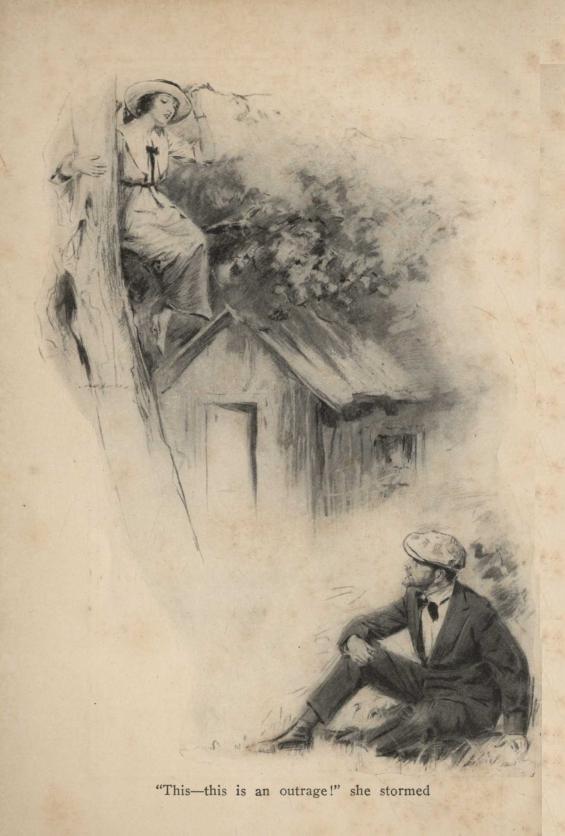
"This—this is an outrage!" she stormed
SAM
BY
E. J. RATH
ILLUSTRATIONS BY WILL GREFÉ
NEW YORK GROSSET & DUNLAP PUBLISHERS
COPYRIGHT, 1915, BY W. J. WATT & COMPANY
CONTENTS
CHAPTER
I Sam, the Boat Person II Pajamaed Vulgarians III Miss Accessory—After—the—Fact IV Questions—and a Clue V The Plot Curdles VI "Pals!" VII New Slants VIII Who Copped the Buzz-Stuff? IX The Ascending Scale X What Reggy Drew XI Treed! XII Turning the Tables XIII Ringing In XIV What the Paul Jones Did XV When Sam Came In Handy XVI Rough Stuff XVII Thickening Mystery XVIII Who? What? Why? Where? XIX Stung! XX "Good Work Pal!" XXI New Lights on Sam XXII Footsteps Above XXIII Unscrambling the Mystery XXIV Curtain!
SAM
CHAPTER I
SAM, THE BOAT PERSON
Miss Chalmers stood on the wharf at Clayton, poised upon one foot, while she employed the other in executing alternate tap-taps, denoting impatience, and vigorous stamping, by which she registered rage. Even the half-grown boy who had volunteered to find her a boatman knew that she was angry.
Her free foot beat upon the rough flooring of the wharf with increasing vigor. The wharf did not care; it was old and stout, and did not pretend to be ornamental.
Miss Chalmers's shoe might have protested, had it possessed a voice, for it was new and spotless, and of delicate constitution. With its mate, it had cost Miss Chalmers twenty dollars, a fact which is set down to obviate the necessity of describing what else the lady wore. Her whole costume was in complete financial and artistic harmony with its twenty-dollar-shoe foundation.
It was dark and clear and warm—somewhat after nine o'clock of an August night. There were gleams of light upon the St. Lawrence, some in motion, some merely shimmering restlessly as they lay fixed upon the rippling surface. It was an evening for poetry and romance and beauty—if only the last steamer had not departed.
The boy came back and confirmed his previous impression that no other boat would stop that night at Witherbee's Island.
"It's absurd—inexcusable!" exclaimed Miss Chalmers sharply.
"Yes, ma'am," said the boy.
"How am I to get there, then? Well? Answer!"
"I got a man who'll take you."
"Where is he?"
"Down that way," replied the boy, nodding his head toward the end of the wharf.
"A reliable man?"
"Yes, ma'am."
"You know him?"
"No, ma'am."
Miss Chalmers stamped her foot again.
"How can you say he's reliable if you don't know him?" she demanded so imperatively that the boy winced and shuffled his feet.
"Well, he's got a power-boat, and his name's Sam," said the boy defensively. "He ain't ever been wrecked 's fur as I know."
Miss Chalmers made an eloquent and helpless gesture with both arms, then surveyed her light field-equipment—six trunks and a grip.
"Show me the man," she spoke abruptly.
The boy made off in haste, with Miss Chalmers at his heels. He led the way among bales and boxes and barrels, stopping presently under a dim oil lantern set upon a post.
On the string-piece of the wharf sat a man, smoking a pipe. He looked up at Miss Chalmers casually, yet speculatively, then arose and nodded amicably.
"Looking for me?" he asked.
Miss Chalmers was annoyed at the phrasing; never yet had she "looked for" a man. But she swallowed her annoyance.
"I must go to Mr. Stephen Witherbee's island—to-night," she said.
"Yes, ma'am."
"You know where it is?"
"Oh, yes!"
"How far is it?"
"Something like fifteen miles."
"Can you take me there at once?"
"Well," said the man, removing his pipe from his mouth and regarding Miss Chalmers with solemn interest, "it all depends on what you call 'at once.' I can take you there, but I'm no speed-king."
"Take me, then!" exclaimed Miss Chalmers. "And get my trunks."
The man went up the wharf at a leisurely gait, accompanied by the boy. Almost immediately the boy came back.
"He says he can't take all them trunks, and for you to pick out two."
Miss Chalmers strode back to her trunks with no improvement of temper. She found the boatman surveying them placidly.
"Which is the emergency-kit?" he asked pleasantly. "I'm not running a freighter, ma'am."
"They've all got to go—every one!"
The man shook his head doubtfully.
"Swim?" he asked presently, looking Miss Chalmers evenly in the eye.
"Why, cer— Oh, how ridiculous! Will you or will you not take those trunks?"
"Oh, I'll take them—only maybe the boat won't. Anyhow, we'll make a stab," he said cheerfully, shouldering the nearest trunk.
The boat took them, but not without wabbles of warning and an ominous loss of freeboard. The boatman dumped them aboard with easy nonchalance, while Miss Chalmers shivered in solicitude. But she made no comment; she was in a hurry, and she did not purpose to descend to argument with a 'longshore person.
"Well, I guess we're ready," said the boatman as he gave the last trunk a final kick into place and reached a hand up for his passenger. Ignoring the hand, Miss Chalmers stepped swiftly aboard, unaided.
"Here, boy!" she called, tossing a quarter back upon the wharf.
The boy fell upon the coin and was off.
The six trunks of Miss Chalmers occupied three-fourths of the cock-pit, so that she found herself crowded far aft, in close and unpleasant proximity to the bearded and greasy-shirted master of the launch. She wrapped her skirt close about her knees—not a very difficult task as skirts go—compressed her lips tightly, and stared out upon the river.
There was an interval of several minutes, during which the launch coughed, gasped, and volley-fired, while the boatman panted and heaved at the flywheel. Five times the engine started, and five times it stopped with a sob. The man arose from his knees, fumbled about for a candle, lighted it, and examined the gasoline contraption curiously. Then he spun the fly-wheel again, which produced more coughing and another wailing sob of despair.
Miss Chalmers turned abruptly from her survey of the river.
"For Heaven's sake, prime it!" she snapped.
The boatman twisted his head and regarded her with undisguised astonishment. He not only looked at Miss Chalmers, but he studied her hat, her gown, and her twenty-dollar shoes. He also resurveyed the six trunks. But Miss Chalmers had again turned her attention to the lights upon the river, and was unconscious of his scrutiny.
"That's a good tip," he observed, after satisfying his eyes.
Whereupon he primed the engine, and the boat buzzed away from the wharf.
Miss Chalmers was but partially relieved in mind when she found herself being borne out upon the St. Lawrence.
The day on the railroad had been hot and cindery, and the train was hours late at Clayton. To cap that misfortune, she had loitered to purchase some stamps and write some telegrams, and arrived at the wharf in time to get an excellent view of the disappearing stern-light of the last regular boat that would stop at Witherbee's Island that night. It seemed easier to get to Europe, she reflected.
Well out into the American channel, the boatman shifted his helm and headed the launch down-stream. He was smoking again, leaning back comfortably against the coaming, his long legs stretched out so that his feet were braced against the nearest trunk.
Occasionally he glanced at the lights that shone cordially from the islands and the mainland, and now and then paid brief attention to some passing craft; but most of the time he appeared to be studying the back of Miss Chalmers's head. Several times he smiled, and once his silent reflections brought forth a soft chuckle.
An hour passed. The launch still voyaged in mid-stream, making irregular detours where islands loomed out of the channel. Miss Chalmers extended her hand close to a flickering lantern that stood on the floor of the cock-pit and examined the dial of her wrist-watch.
"How far have we gone?" she demanded.
The boatman studied the shore for a few seconds.
"Oh, seven or eight miles," he answered.
"And you say it's fifteen?"
"To Witherbee's? Oh, all of that."
"You mean to tell me this boat cannot do better than seven or eight miles an hour?"
"She has done better," sighed the boatman. "She did eleven once. But she was new then, and her bottom was clean, and her cylinder wasn't full of carbon, and she didn't leak, and her carbureter didn't have asthma, and she didn't have six trunks on board, and—"
Miss Chalmers interrupted the apology with an angry exclamation.
"It's nearly eleven o'clock," she said. "It's beyond endurance! I wish I hadn't started."
"Well, we can turn around any time," remarked the boatman mildly. "But she won't do better than eight miles an hour at the outside. You can play that bet to win."
Miss Chalmers devoted to the boatman a swift and stormy glance. He irritated her even more than his atrocious boat. The easy, almost familiar style of his speech was something to which she was unaccustomed—from the lips of common persons. It seemed to her that he assumed a position of equality.
A boatman—a grimy-handed, hatless, whiskered boatman! A person who hired out!
She set her jaws tightly and resumed her unsatisfying study of the river. Her dignity checked upon her lips a withering rebuke.
More islands were passed and the channel widened somewhat. The passenger observed with growing annoyance that there were fewer lights ashore. The summer folks were going to bed. High time, she thought; she was tired herself.
Nearly half an hour more elapsed, enlivened only by an astonishingly swift movement on the part of the steersman, who uncoiled himself like a spring, flung himself forward, and rescued, with a long and lean arm, the grip that belonged to his passenger just as it was about to slide quietly from the narrow deck into the hospitable St. Lawrence. Unceremoniously he jammed it into a safer place under the gunwale. Then he resumed his lolling posture at the tiller. Miss Chalmers made no comment.
Then, after a little, the rhythmical wheeze of the engine was supplanted by a series of irregular choking gasps, then a sharp popping at broken intervals, and then—silence.
The boatman sat up lazily, reached for the lantern, and held it close to the machinery. The launch carried her momentum for a minute, then swung broadside to the current and drifted contentedly. Miss Chalmers bit her lip.
Very deliberately the boatman studied the engine, poking the lantern about and, when it failed to illuminate dark recesses, lighting the stump of candle. Then he spun the fly-wheel.
There was no answer. Again and again he spun it, but the engine remained inert. After a while he resumed his placid and apparently purposeless examination of the gasoline monster.
"Well, what is the matter now?" demanded a cutting voice.
"Engine stopped," said the boatman, putting down the lantern and beginning to refill his pipe.
"Thank you for the information," said Miss Chalmers icily. "Why has it stopped?"
"I couldn't begin to tell you—ma'am."
There was something about the "ma'am," drawled out at the end, that peculiarly exasperated her; it seemed to lack the servility that was familiar to her from the lips of servants.
"Do you know anything about engines?"
"Not much that's good."
Miss Chalmers's temper was rising rapidly. She looked at her watch, then at the dark shores and islands.
"How dared you bring me out here if you didn't—Oh, it's—it's—perfectly outrageous! It's—"
She left the sentence unfinished, seized the lantern, brushed her way past the boatman without so much as a scornful glance, and dropped to her knees in the bottom of the cock-pit.
The floor was oily and dirty, but Miss Chalmers paid no attention to that. She devoted the next five minutes wholly to an examination of the engine. The boatman watched and smoked.
Item by item, she inventoried the one-cylinder pest. She peered into the oil-cups; she smeared her gloves on the cam that operated the timing-lever; she fussed with the tickler on the carbureter; she did a score of other things, while her audience watched in silence. After she got through with the engine she turned her attention to the batteries, tightening a wire connection here and there.
"Now, where's your socket-wrench?" she demanded.
"Socket-wrench?" repeated the boatman. "That's a new one on me. I don't remember—"
"Haven't you ever taken out the spark-plug?"
"Oh, you mean that funny thing that screws it out. Sure! I've got one somewhere."
He fumbled under a seat and drew out a box that contained a disorderly array of tools. Miss Chalmers dived a daintily gloved hand into it and brought forth what she sought.
"If you want me to do that—"
He did not finish the sentence, because she already had the spark-plug in her hand and was holding the points close to the light.
"Dirty, of course," she commented disgustedly. "Have you any sand-paper?"
He found a bit after more fumbling, and watched her while she scrubbed the metal points until they were bright. Then she replaced the plug and screwed it into position with a vigorous twist of the wrench.
The boatman had settled back in his place. After that she found a screw-driver and removed the cover from the float-chamber in the carbureter. A brief inspection of this mysterious compartment satisfied her.
"Now spin that fly-wheel," she said abruptly, rising from her knees and moving aside to make room for him.
The boatman spun the fly-wheel, not once, but many times. Twice the engine started, only to stop after a few revolutions.
"It's abominable!" exclaimed the passenger. "What do you propose to do?"
"Nothing, I guess," replied the boatman. "You've done more things now than I ever knew could be done. Don't suppose you damaged anything, do you?"
She glared at him, then turned her scorching glance out upon the river.
"Here comes a boat!" she said suddenly.
The boatman followed the line of her pointing finger and discerned the lights of a craft that was bearing rather closely toward them.
"Do you think they will help us?" she asked.
"Might," he admitted.
"They must! I can't stay here all night. Hail them!"
He put two fingers between his lips and sent forth a shrill whistle.
"Do you call that a hail?" she exclaimed, rising to her feet. She made a miniature megaphone of her hands and flung a vigorous "Ahoy!" across the water.
The boat was closer now. Presently there was an answering voice.
"Any trouble?" said the voice.
The question affected the boatman like a shock of electricity. He started from his seat, leaned over the gunwale, and squinted through the gloom.
"Breakdown," called Miss Chalmers. "What boat is that?"
"Yacht Elizabeth. Want any help?"
Before Miss Chalmers could answer a voice at her ear boomed out:
"No-o-o, thanks! All right in a minute."
She turned in amazement upon the boatman, who was now on his knees in front of the engine, his face hidden from her.
"Why—you—you—"
The jingling of a bell from across the water interrupted her. Then she heard the churning of a propeller, and the dark outline of the yacht began to move again.
"Ahoy!" screamed Miss Chalmers.
"Never mind!" roared her boatman.
She whirled upon him furiously.
"How could you! How dare you! Are you mad? Do you think—"
She broke off and sent another hail in the direction of the yacht. But that craft had disappeared in the night, and there was no answering call.
She looked down upon the kneeling figure, a tempest of wrath upon her lips. The boatman was fussing aimlessly with a wrench.
Miss Chalmers fought for self-control. She had a passionate desire to slay, but she lacked a convenient means. Besides, she could not see that homicide would speed her way to Witherbee's Island. And even in her stormiest moments, Miss Chalmers never quite abandoned her grip on things as they were and problems that had to be met.
But she was bewildered, even alarmed. She did not fear the consequences, however unpleasant, of an all-night drift on the river. It was the boatman who furnished cause for dismay. She wondered if he was insane.
"I would like to know," she said, struggling to quiet her voice, "why you did that."
"Did what?"
"Sent that yacht away."
"Reasons," he responded briefly.
"Reasons! What reasons?"
His only answer was a shrug.
"I demand to be told why you sent those people away."
There was another hunch of his shoulders.
"Dou you mean deliberately to keep me out here in this boat all night?"
"Oh, not at all!" he said easily.
"Then why did you—"
"Sorry. Can't explain."
Miss Chalmers sat down with a gasp and tried to consider the situation.
It was past midnight. The launch was slowly drifting down-stream in a steadily broadening channel. The boatman was unable to operate his engine, and had refused an offer of help. He was probably mad. She wondered if he was dangerous.
For several minutes she sat in silence, watching him as he fussed about the machinery in an amateurish fashion. Then she gritted her teeth and aroused herself to action.
"Get out of the way!" she commanded.
He moved to make a place for her, and once more she knelt on the greasy flooring. Very patiently, considering the state of her emotions, Miss Chalmers went over the engine again.
She shook her head, puzzled. Nothing seemed to be wrong with it. Suddenly she turned to him.
"Where's your gas-tank?" she demanded.
"Forward. But you needn't look there. There's plenty. I filled it—"
She seized the lantern and began climbing over the trunks; she was not going to take the word of an incompetent. Her white gown suffered dismally as she scrambled in the direction of the gasoline-tank, and she had a sinking sensation that the spectacle afforded to the boatman was lacking in dignity. But she was determined, and tried to comfort herself with the thought that it was quite dark.
She located the tank and unscrewed the cap. The aperture was large enough to admit her hand and arm; in she plunged them resolutely. The tank was nearly full. She replaced the cap and crawled aft again.
Then the boatman did a strangely considerate thing. He turned his back and pretended to be doing something to the engine, while Miss Chalmers slipped down from the trunks and shook her skirt about her ankles. She made a mental note of it.
"Where does your gas-line run?" she asked briskly.
"Gas-line?"
"Oh, the pipe that connects the tank with the engine!" she cried in exasperation. "Don't you know anything?"
The boatman grinned cheerfully.
"I'm learning," he said. "It runs along under the gunwale on the port side, I think. I never paid much attention, but—"
"Hold the lantern here," she ordered, now on her hands and knees, with her head poked under the gunwale.
The boatman obeyed.
"Now move forward," she directed.
He moved the lantern as she directed, while Miss Chalmers explored the gas-line, beginning at the carbureter.
Presently they arrived at an obstacle in the shape of the passenger's baggage.
"Move that grip," was her next order.
He yanked the rescued bag from its place of safety, and she craned her head into the opening. A few seconds later she withdrew it and bestowed upon the boatman a look of unutterable contempt.
"Get down here," she said.
He knelt beside her.
"Poke your head in there."
He obeyed. Miss Chalmers also poked her head in, so that wisps of her brown hair brushed his unshaven cheeks.
"Now, do you see that little handle there?" she inquired.
"Yes, ma'am."
The boatman's voice was meek.
"Do you know what it is?"
"No, ma'am."
"Well, it's the cut-off in the gas-line."
"Never noticed it before," he commented blandly.
"And it's cut off now," continued Miss Chalmers.
A gentle swell rocked the boat, and their heads bobbed together. She paid no attention.
"You cut it off when you jammed my grip under there," she said tersely.
"There! Now I've turned it on again. The idea is that a gasoline-engine always runs better when supplied with gas. Now spin that fly-wheel!"
The boatman went aft and obeyed. The engine started joyfully. The launch moved. Miss Chalmers resumed her seat and surveyed her costume by the yellow light of the lantern.
"Now you take me to Witherbee's Island as quickly as you know how—if you do know," she observed.
The boatman made no answer. When the launch had obtained headway he altered the course, and presently they were passing through a series of narrow channels, between darkened islands. He seemed to know where he was going, but Miss Chalmers had no confidence in him. She was merely relieved to observe that they were going somewhere. Presently they headed in toward a wooded island that was dark, save for a tiny light that flickered at the water's edge. As they neared the shore the boatman made his first remark since the engine had resumed wheezing.
"If you don't mind, I'd like to know—"
"I haven't run a six-cylinder car for nothing," interrupted Miss Chalmers sharply. "Is this the dock?"
For answer he stopped the engine and guided the boat alongside a low wharf, at the end of which burned the lantern they had seen.
"Witherbee's Island," he said as he reached to help her ashore.
Miss Chalmers sprang upon the wharf without aid and demanded her trunks. The boatman heaved them out methodically. He paused for an instant to study an inscription on the end of a particularly bulky and heavy one, and, when he had difficulty in deciphering it, reached for the lantern. He read:
ROSALIND CHALMERS, N.Y.
Then the trunk followed its mates.
"Anything more I can do?" he asked pleasantly.
"I should say not! I owe you something, I suppose?"
"Well, rather."
"How much?"
"Ten dollars."
"Ten dollars!" cried Miss Chalmers. "For what happened? After all that— Why, it's—"
She snapped her purse open and handed him a bill with an angry gesture. In fact she flung it at him. Anything to be rid of him, she thought. He pocketed the money with a chuckle.
"My name is Sam," he remarked as he stepped back into the boat. "Any time you need a launch, why—"
"I'll know whom not to engage," said Miss Chalmers, finishing the sentence.
The boatman laughed, started the engine, and headed across an open space in the river. Miss Chalmers glanced about her with a sigh of weary satisfaction. It was one o'clock, but she had arrived!
CHAPTER II
PAJAMAED VULGARIANS
That particular insular possession owned by Mr. Stephen Witherbee was, indeed, a dark corner of the earth. It was also insistently quiet and lifeless. Just which one of the insufficiently enumerated Thousand Islands it was did not concern Miss Chalmers in the least, any more than it concerns the reader. All she sought was shelter and a couch.
She walked the length of the little wharf and stared in among the trees that came down to meet it. Somewhere beyond was a house she knew—a house that contained Mr. and Mrs. Witherbee, Miss Gertrude Witherbee, perhaps Mr. Tom Witherbee, and various other persons who constituted a Witherbee house-party.
There was not the least doubt that they were all asleep. Miss Chalmers could not hear a sound save the ever-diminishing thump-thump of the one-cylinder launch.
"Asleep they are, certainly," she observed aloud. "I've done a ridiculous thing, of course. It serves me right for coming a day ahead of time. That boatman—ugh!
"Where the house is I haven't the least idea. But I can't stay here. I must find a place to sleep. Perhaps—just perhaps—somebody is up, after all."
She returned to the end of the wharf and surveyed her six trunks. "They'll do until morning," said Miss Chalmers as she picked up her grip and started in search of the Witherbee house.
There was a gravel path, beginning where the wharf met the shore, and Miss Chalmers followed it. Even in the gloom of the trees this was not difficult, for the gravel was white, and lay before her like a ghostly streak. Besides, it crunched under the twenty-dollar shoes.
Miss Chalmers was displeased with herself. She felt foolish. Something had gone wrong with her poise; something seemed to have been subtracted from the considerable sum of her dignity. The world was not playing flunky as usual. Her old austerity was there, perhaps, but it lacked confidence and authority.
The path forked, and Miss Chalmers paused to consider. The house was still invisible.
"Why does a strange path always fork when one is alone and in a hurry, and particularly at night?" asked Miss Chalmers aloud.
There was no answer; so, after an instant of indecision, she took the fork that led to the right. Naturally it was the wrong fork. It simply had to be, under the circumstances. It brought her back to the shore of the island, where a summer pavilion was erected on a rocky point.
She retraced her steps back to the fork and took the left branch of the gravel path. In not more than two minutes it guided her to the edge of a lawn. Beyond this she could see the house—a large, solid, black mass against a background of trees.
"Not a single light!" she exclaimed impatiently. "It's positively—uncouth!"
She crossed the lawn and paused again at the foot of a flight of steps that led to a broad piazza.
"It's almost as if the place was closed," she commented as her glance roved upward toward the windows. "But of course it's not. Oh, well!"
She ascended the steps, crossed the piazza, and found a push-button in the framing of a closed door. She pushed and waited—but not long; she was too impatient for dalliance.
Several times she pushed the button in rapid succession, holding her thumb upon it for extended periods. Nobody came to the door, which angered her anew. Then she realized that she herself could hear no ringing of a bell.
"Out of order, of course," she said bitterly.
She rapped smartly with her gloved knuckles upon the paneling of the door time after time until they ached. Then she dropped her grip, went back to the lawn, and looked up at the house again. It slept calmly.
Miss Chalmers made a circuit of the Witherbee dwelling. Not a ray of light filtered out of it from any side, not a sound—not even a snore. She returned to the front door and rapped again. Then, she seated herself in a porch-rocker and frowned.
"I absolutely will not shout," she told herself. "I am sufficiently absurd as it is. I will not be laughed at!"
She placed particular emphasis upon the last thought, as if somebody, somewhere, was displaying amusement at her plight. If there was one thing Rosalind Chalmers would not for an instant endure it was mirth of her own unintentional provoking. She was not a lady to be laughed at.
In the first place, she was too dignified, even to the point of a certain severity in manner. Where she lacked severity she substituted condescension. In the second place, she was too coldly handsome, too tall, too slimly erect. In the third place, she was too old—twenty-five. In the fourth place, she was a Vassar graduate. In the fifth place, she was too rich. In the sixth place—
Oh, why continue? It is already plain that under no circumstances was Miss Chalmers a lady to be laughed at, even by equals—to say nothing of a common river-man.
Yet she knew exactly what would happen when she succeeded in arousing the sleepers on Witherbee's Island. First, they would grumble and stumble and rub their eyes. Then they would shuffle to a window or a door and discover her. Then there would be surprise and hurry and a scene. And then—then, when everybody was thoroughly awake—would come the laughter. She reasoned it very logically and found no flaw in her conclusions.
"I will not wake them," she decided. "I will get into that house somehow, find myself a couch downstairs, and get my sleep. It's not that I mind waking them up; not a bit. But I won't be—"
She left the murmured sentence unfinished, arose from her chair, and walked briskly to the nearest window. The sash was either securely locked or thoroughly jammed, like a parlor-car window. She could not move it.
She tried the next window; the result was the same. A third window gave her no access to the dark interior of Witherbee House. She vented her annoyance in a sharp exclamation and turned the corner of the porch. The next window rattled encouragingly in its frame. It moved half an inch. She slipped the tips of her fingers under the sash, drew a deep breath, and heaved valiantly. The window ascended abruptly and with a clatter. And then—
A great bell clanged!
No decent, friendly, hospitable bell, but a raucous, brazen, mocking gong, pounded upon at the rate of a hundred or so strokes to the minute by a fiendish electric hammer.
The sound of the bell echoed in the gloom of the house and flung itself boisterously through the open window into the astonished and dismayed ears of Miss Chalmers. She fell back a step and raised her hands protectingly in front of her.
"A burglar-alarm!" she cried.
The din was appalling. It seemed to grow steadily in volume. Miss Chalmers was not truly frightened, but she was thoroughly amazed and startled. She was incontinently hurled from her pedestal of calm assurance.
For five seconds she hesitated. The bell boomed on. She stepped close to the window, placed her hands upon the sill, and leaned inward. From somewhere above she heard a heavy footstep, then a medley of sleepy voices.
She turned and ran.
She was dimly conscious in her precipitate retreat that, mingled with the clanging of the gong, there was another sound—a rattling of something on the porch floor. But it was not a propitious moment for investigation.
Around the corner of the porch she fled, upsetting a wicker table and scattering its burden of magazines. From its resting-place at the front door she scooped up her satchel. Down the steps to the lawn she leaped recklessly and then across the space of level sward.
Her skirt was not fashioned for running. With one hand she swept it up to her knees, a maneuver which added perhaps a knot to her speed. Give her a fair chance and Miss Chalmers was an excellent runner. She could even invest running with a certain stateliness and dignity—but not on this occasion.
Somebody had left a rocking-chair on the Witherbee lawn. She had not observed it when she approached the house, but now she fell over it. It bumped her knee cruelly, in addition to depositing her at full length upon the grass.
Within a second she was on her feet again, flaming with anger. She groped for her fallen satchel, recovered it, and ran on toward the shelter of the trees At the edge of the trees she paused and looked back. Lights were moving in the windows of Witherbee House. She heard voices, some shrill with alarm. Again she turned and fled.
Just why Miss Chalmers ran away from the haven of refuge she had been so long in reaching she could not clearly have explained. She was flurried in mind, yet not to such an extent as to dim the fact that her conduct was quite illogical. For fifteen minutes she had been trying to rouse the house; now that she had succeeded, she was in flight.
In among the trees she hesitated again. The simple and obvious thing to do was to walk straight back and announce herself. After that she would be in bed in ten minutes. But they might laugh. In fact, it was a certainty they would laugh. The alarm, the silly panic of a resolute lady, the chair on the lawn, her gown—oh, it was impossible. She ran once more, dodging among the trees and praying that she might find a path.
Presently she felt the gravel under her feet and followed the trail until it brought her back to the wharf, where her trunks crouched like black monsters in the faint light of the lantern. Here she paused to recover breath while she listened.
Through the little wood that had once seemed so dense she saw a glimmering of lanterns passing to and fro.
"I am not frightened!" panted Miss Chalmers hotly. "I am merely a fool! Yes—a complete fool! But they'll not find me—not now! Not for anything in the world! I'll go back; I'll find some way. I won't stay on this island. The whole thing is perfectly beastly and absurd!"
The moving lanterns among the trees seemed to be coming nearer. Men were calling to each other. She could hear footsteps on the gravel path.
There was no concealment on the wharf, yet Miss Chalmers was determined to be concealed. There could be no backing out now. She looked quickly about her.
Close to the wharf, at the very edge of the water, she now observed what looked like a boat-house. She sprang toward it and stepped out upon a small float that was anchored in front of it to find herself barred from refuge by padlocked doors.
The lanterns were now close to the wharf. Miss Chalmers had no time to waste picking a lock, even if she knew how. She slipped around the corner of the boat-house and flattened herself close against it, trying desperately to breathe noiselessly.
A moment later there was a shuffling of feet on the wharf, then an exclamation of surprise in a man's voice. Her curiosity urged her to risk a peep. Very cautiously she advanced her head beyond the corner of the building that screened her.
What Miss Chalmers saw shocked her. Three men in pajamas, each carrying a lantern, were standing upon the wharf. Their feet were shod in bedroom slippers. Two of them carried walking-sticks gripped tightly at the wrong end, evidently intended to perform service as clubs. The third had a revolver.
She was shocked, not because she regarded pajamas and bedroom slippers as improper, but because they seemed so utterly common, so plebeian, so lacking in anything that approached character or smartness or form—in short, to the eyes of Miss Chalmers they were sheer vulgarity, even though of possible utility. She shuddered a little.
One of the men she recognized; it was Mr. Witherbee. She was well aware that Mr. Witherbee was stout, but not until now did she realize that he actually bulged. It was the first time she had ever seen a fat man in pajamas, and she was impressed with the fact that the effect was more robust than artistic.
One of the other men was tall and blond, with a drooping mustache. His pajamas were far too short in the legs and his bare ankles were inelegant.
The other man had his back toward her. She thought he might be Tom Witherbee. He looked more fashionable than the others. It was also he who held the pistol, which, perhaps, gave him just a suggestion of devil-may-care.
The three men were gravely regarding the six trunks. Miss Chalmers caught her breath.
Too late now! She could never disappear from Witherbee's Island and explain those trunks. Yet she knew this, too; she never, though the heavens might fall upon her otherwise, would step forth and proclaim herself to three men in pajamas.
Mr. Witherbee advanced to the nearest trunk and inspected it by the light of his lantern.
"Well, what do you know about that!" he exclaimed.
"'Pon my word, I know nothing whatever about it, my dear fellow," said the tall one.
"These are Miss Chalmers's trunks," declared Mr. Witherbee in a voice of wonder as he examined another.
The young man with the revolver made an inspection of his own and avowed that Mr. Witherbee was right. The tall one stroked his mustache and said nothing.
"But she's not expected till to-morrow!" cried Mr. Witherbee. "How the deuce did her trunks get here?"
"Must have sent them on ahead," observed the armed one.
"But who brought 'em? When? The boat didn't stop here to-night."
Mr. Witherbee stared at the trunks in succession and juggled one of them as if to assure himself that it was real. All the time he was muttering.
"Well, this isn't finding the burglar," remarked the man with the pistol. "He's probably gone by now, anyhow. Ah-h-h—I'm sleepy."
Mr. Witherbee pondered the trunks again.
"I've got a theory," he said presently.
"Shoot."
Miss Chalmers winced, divining that this was slang.
"Why, it's like this," said Mr. Witherbee, putting down his lantern and diagraming his remarks with his cane. "There's a prowler about these islands—you know of that, of course.
"Well, Miss Chalmers sends her trunks on in advance. Some boat brings 'em down, probably after we're all in bed.
"This chap cruises around and spots the trunks. Then he comes ashore. He finds the house dark. He makes up his mind that everybody has gone away and that the trunks are waiting to be taken aboard the morning boat. So he makes a try at the house. Burglar-alarm goes off—he gets scared—runs like the Old Harry—hops into his boat—an revoir. How's that?"
"By Jove, it's wonderful!" said the tall man. "By the way, old man, are your ankles cold? Mine are."
"Accepting your theory, then," remarked the man with the pistol, "whoever rang the burglar-alarm has already escaped, so we can all go to bed."
"Clever as the deuce!" said the tall man.
"I don't suppose there is much more use in looking," admitted Mr. Witherbee reluctantly.
(His ankles were not cold.)
"You don't guess he could have hid in the boathouse, do you?"
Miss Chalmers shivered.
"It's locked," said the armed one. "He wouldn't bother with the boat-house. You can bet he's not on the island now. What'll we do with the trunks?"
"Leave 'em until morning. It's not going to rain," Mr. Witherbee observed. "But, by jingo! I'd like to get that fellow!"
"So would I. But what's the use now? Listen! The folks are calling. I guess we'd better go back and tell them it's all over."
"All right," sighed Mr. Witherbee, picking up his lantern.
The trio in pajamas turned back toward the path. Miss Chalmers put her head forward cautiously for another glance. She was just in time to see the figure of the tall man disappear, his pajamas flapping disconsolately about his ankles, his lantern swinging listlessly.
"They're worse than the boatman," she commented.
Not until the last sign of a light had disappeared, and only when she could no longer hear sounds from the direction of the house, did Miss Chalmers venture from her seclusion. She went back to the dock and sat down on the string-piece.
"This is a fine state of affairs," she reflected. "Now I've got to say. I never thought about the trunks.
"But how will I ever explain? I'll die before I admit I set off that burglar-alarm. I'll not only die, but I'll lie. I'll die lying. Some time to-morrow morning I've got to announce myself.
"But how? I'm an idiot—but I won't admit that either.
"Why did I run? That's what I should like to know—why? I've been behaving like a child."
Presently she shuddered, but it was not because there was a chill in the air. She was thinking of pajamas.
"I shall never wear them again," she murmured. "Thank Heaven, I brought—"
At this point her thoughts very naturally drifted to a consideration of some place to sleep. She had no liking for camping out under the stars if she could help it. She wanted a roof over her head.
Sneaking back to the open window in the Witherbee House was out of the question; anyhow, it was probably shut and fastened by this time. She wondered if there was a way to get into the boat-house.
Back she went, armed with the dock lantern, and began an inspection of the lock. It was a solid-looking padlock, but Miss Chalmers thought the staple through which it was passed showed signs of weakness. She looked about for an instrument and finally found a stick that seemed as if it might do.
The stick broke several times during the process of prying the staple loose, yet she made headway. Under most conditions an impatient and somewhat imperious young lady, Miss Chalmers was curiously persistent when she set her hand to any mechanical task. She labored uncomplainingly at the staple for fifteen minutes, and gave a satisfied little nod when it fell loose from the woodwork.
The interior of the boat-house was not inviting. A rowboat and two canoes were piled along one side, with a lot of loose gear, a collection of ill-smelling paint-pots and some oars and paddles.
At the farther end was a pile of canvas. She tilted her nose slightly, but did not retreat.
"It's a roof at any rate," she observed. "I'll sleep on the canvas. Nothing can hurt this gown now. It's gone."
She put down the lantern, sat on the canvas, and slipped off her twenty-dollar shoes. Then she lay down and attempted to convince herself that the bed was comfortable.
It was an entirely laudable effort at self deception, but quite useless. The bed was anything but comfortable. It had some pulley-blocks under it, for one thing.
Nevertheless she became drowsy. This ordinarily delicious sensation crept upon her with unwelcome quickness. She wanted time to think about to-morrow morning. It might require considerable planning, she feared.
"Oh, well," she murmured in a resigned tone, "I guess it will come to me better after I sleep a little."
Then she almost slept. The reason she did not quite sleep was an abrupt volley of shots. She sprang to her feet with an angry exclamation.
"Haven't they stopped hunting me yet?" she snapped.
CHAPTER III
MISS ACCESSORY-AFTER-THE-FACT
Her initial impulse was to dash out of the boat-house, confront her pursuers, and visit them with a merited rebuke for having disturbed her rest. Not for an instant did it occur to Miss Chalmers that anybody else's rest had been disturbed by her.
But she remembered that she was not yet announced upon Witherbee's Island; that she would not, in fact, arrive until morning, so far as the official statement was concerned. So she checked her rush and occupied a wise half-minute in putting on her shoes.
Tiptoeing across squeaking boards to the open doorway, she looked out and turned her head in either direction. Silence had followed the shots. She could see no lights on the island. Everything was as restful and somnolent as a lecture on metaphysics.
She stepped out on the little float, from which she could obtain a better view of the wharf and the beginning of the gravel path. There was neither sign nor sound of the pajama squad, facts that contributed greatly to her satisfaction. Not a glimmer came from the direction of the house.
The shots puzzled her. She was wide-awake now, and she was quite sure she had not dreamed a volley. Pausing for a couple of minutes on the float, she made her way noiselessly to the dock, where she stopped to listen again.
"I know perfectly well I heard shooting," she remarked. "I'm not given to imagining things. There!"
Four shots there were this time; she had not counted the first group. Instantly she ran to the end of the dock and looked out across the water. As she stared into the darkness there was another shot, preceded some three or four seconds by a yellow flash.
"It's on another island," she told herself rapidly. "Can it be possible that there are burglars about? Heavens! Suppose they really did come here!"
She listened for more shots and watched for more flashes. Presently a light showed again, but it did not come from the muzzle of a gun.
She knew it to be the white, steady beam of an electric torch. A moment later another showed. Then they began moving in opposite directions. A little after that she heard the faint bark of a dog. She glanced behind her into the woods of Witherbee's Island. Nobody else seemed to be paying the least attention to what was going on across the water.
Miss Chalmers's curiosity was unleashed and stalking from its lair. It was possessed with a consuming desire. She found it dragging her along, with little or no effort on her part to hold it back. Its enthusiasm infected her. She, too—all the rest of her—wanted to know what was going on out there in the river.
Curiosity is a subtly cunning creature. Almost before she knew it, it guided Miss Chalmers to a St. Lawrence skiff, the existence of which she had not noticed before. The skiff was moored to the wharf; it did not take her more than two seconds to lower herself into it, cast off the line, and pick up the two light oars that lay in the bottom.
"I might just as well," she remarked in extenuation. "It's out of the question to sleep. Nobody will know anything about it. And—well, it cannot be much more than half a mile."
She fitted the oars to the swivel-locks, swung the skiff around, took her bearings from one of the electric torches, and fell into a long, steady stroke. The boat moved lightly and easily. She found something exhilarating in the exercise. She could not remember having touched a pair of oars since she rowed with her class-crew at Vassar.
She rowed well. That, of course, was characteristic of Miss Chalmers. Things that she could not do well, she did not do at all. For instance, holding her temper; almost invariably she bungled that, so she had given up trying. Besides, there is no particular reason why a rich, handsome, and imperious lady should hold her temper if she happens not to want to.
For a quarter of a mile she rowed without pausing, then made another observation over her shoulder. She was holding her course admirably, for the lights on the land ahead of her were much nearer. Now she could hear voices, particularly that of a man, who cursed a barking dog and then did something to it to make it yelp.
"It's another island," commented Miss Chalmers as she rested a second time, now not more than a hundred yards from the shore. "It's another burglar-hunt, too. Oh, dear! I suppose it means pajamas."
It did. Somebody struck a match to light a cigar, and the brief illumination revealed two men who were most palpably dressed for bed. She allowed the boat to drift quietly while she listened. The match burned out and the figures were hidden again, but she could hear their voices distinctly.
"The dogs aren't worth a hoot," growled one of the voices.
"Seems like they ain't quite as noticin' as they used to be, sir," admitted the other.
"I gave them the scent, right where we found the footprints in the flower-bed, but they didn't even seem excited."
"No, sir."
"Did you see him at all?"
"Not a sign, sir; nor heard him either."
"It's a deuce of a note," complained the first speaker. "I've got watch-dogs and servants and locks on my doors and windows, and yet I can't keep thieves out of my house."
"If only Mr. William was here, sir, we might—"
"Confound Mr. William! He's not here and he won't be here, so we've got to do without him— Listen! What was that?"
"I think that's James and Eliza hunting along the other side of the island, sir."
"Eliza! Is she at it, too?"
"She stopped to dress, sir," explained the voice apologetically and hastily. "She's awful particular about James, sir. She don't want nothing to happen to him unless she's—"
"Never mind that. If she wants to make a fool out of herself, she may, so long as she continues to get the washing done. We'll go on up the shore until we meet them. But I suppose it won't be any use."
"Probably not, sir."
"Here, Duke! Where's that blooming dog now? Oh, well; let him go. I suppose he's eating out of the burglar's hand."
The torch carried by one of the speakers began moving along the edge of the island. Miss Chalmers was slightly bored. Being a watcher was not nearly so exciting as playing the quarry. But she decided to follow.
One of the oars rattled in its swivel, and she heard the two searchers halt.
"He's in a boat!" exclaimed the one in authority.
"I don't think it was that, sir. It sounded more like—"
"I tell you I heard it perfectly. Don't stand arguing. Come on! It's too late; but we'll finish the round, or at least until we meet Tames. Ouch! Great—"
The remainder of the sentence was blurred, yet high-pitched. A minute later Miss Chalmers heard:
"If it was Patrick who left that lawn-mower standing out I'll ship him off to-morrow. Why in blazes didn't you throw a light on it?"
"Sorry, sir. But you've got the torch, sir."
"Shut up! Come on!"
The men began moving again. Miss Chalmers calmly reached down and tore a large piece of expensive goods from the bottom of her skirt. This in turn she tore in halves. Then she carefully swathed the swivels.
When the oars were replaced they made a sound so soft that it could not have been heard a dozen feet. Keeping her distance from the shore-line, she followed the searchers.
The man who seemed to own the island began to talk again:
"He'd have had the silverware and the whole works if it hadn't been for me. It's a pity I have to do all the hearing for this house. I don't see why my servants can't have insomnia once in a while. What are they paid for? I have it, so I suppose everybody else thinks it's all right to imitate the Seven Sleepers. You're quite sure he didn't take any of the silverware?"
"Almost certain, sir. But I'll look again when we get back. Nothing on top of the sideboard had even been touched."
"Well, it's mighty queer; that's all I've got to say. Except that I've a good mind to shoot a couple of dogs to-morrow morning."
"Oh, sir—please—I wouldn't, sir. They'll probably do better next time, sir."
"Next time! How many times do you expect this is going to happen, I'd like to know? I tell you I'll shoot 'em!"
"But they're not mad, sir; and I think—"
"Mad! I know they're not mad, you idiot! But they'll be darn-well provoked if I plump a couple of bullets into 'em."
Miss Chalmers rowed on slowly, her lip curled slightly to indicate her contempt for the conversation. It seemed to her that the evening had furnished nothing save a series of revelations of the incompetence of man. Not a thing that any man had done within her ken that night but she could have performed more efficiently herself, she reflected.
This was the stronger, the dominant sex, was it? With her shoulders she made an eloquent gesture, which was lost upon the night.
Almost at the point of returning to Witherbee's Island was she, when a yell from the shore caused her to turn her head swiftly.
"There he is now, by George! He's got a boat. Run! Head him off, before he gets away!"
A dog began to yelp excitedly.
"Sick him, Duke! Sick him! Stop that yawping and grab hold!"
She heard a soft patter of footsteps along the shore, then the staccato note of a gasoline engine.
"Lord! It's a motor-boat! There he goes! Hang that dog, he missed him!"
A fresh volley of shots came from the island.
"Get the launch! Quick! We're almost at the boat-house now! We'll get him yet!"
"Yes, sir, I'm after it."
The motor-boat that Miss Chalmers heard was exploding gasoline in boisterous fashion. She leaned as far as she dared across the gunwale of the skiff and tried to discern objects in the gloom.
It was difficult to distinguish anything save the dark bulk of the island. But the gasoline motor was whirling furiously. Then there were voices again.
"Got her cast off?"
"N-no, sir; not yet."
"For the love of Mike, hurry! He's underway now."
"There! All right, sir."
"Get forward and keep a lookout. Tell me which way to steer."
A second engine burst into action with a defiant roar. Miss Chalmers, resting upon her oars, knew that a chase had begun.
It was rather exciting now. A burglar was being pursued, but she could see neither the burglar nor the pursuers. Two engines were trying to smother each other's din, with the result that their voices mingled in a discordant bedlam.
Then a dark object passed within fifty feet of her skiff, ran on for a hundred feet more, suddenly slowed down, and ceased firing. In closer to the island, but still beyond her vision, the second boat was clattering truculently, and the voices rose even higher.
"He's stopped! He's stopped! Spot him now! It's our chance!"
"Can't see him yet, sir."
"You've got to see him! If you miss him you're fired! Why the blazes do I have to be near-sighted?"
Miss Chalmers edged her skiff closer to the boat that had abruptly paused in flight. She had a suspicion. A moment later she knew. A half-suppressed exclamation reached her ears. The voice was one of recent memory.
For several seconds she was irresolute. Far be it from her to interfere with the long arm of justice or retribution, or whatever it might chance to be. It was no business of hers to trip Nemesis. And yet—
Well, perhaps she would not have acknowledged that it was sporting blood, but it was something singularly resembling it. She cared not a whit for the burglar; he deserved his fate. Contrariwise, she cared nothing whatever about the pursuers. They were entitled to no better than they could achieve. But she did care about something else.
A stalled engine was a perpetual challenge to her.
To some persons the joy of battle lies in overcoming fellow men, to others in conquering the forces of nature, to still others in achieving hard-won triumphs over poverty or riches or other forms of adversity or perversity.
To Rosalind Chalmers, by some queer twist of her brain, it lay in starting a balky engine.
She hesitated no longer. What she did was without reason; but she was past that. Her fighting mood was uppermost. She laid to her oars and put herself alongside the motionless launch with such violence that the skiff rocked threateningly. Another instant and she was aboard.
The crouching figure of Sam, the boat person, arose from the cock-pit. Simultaneously a long arm whipped out with all his weight behind it. Miss Chalmers dodged.
"You fool!" she exclaimed wrathfully. "Here—hold the painter of this skiff."
The boatman whistled shrilly, then chuckled.
"Well, if it isn't the master mechanic!" he said.
Not far distant in the darkness, the second launch was plunging furiously onward, the man in the stern anathematizing his lookout.
"Thief!" hissed Miss Chalmers. "Strike a light here."
She was already bending over the silent engine.
"They'll see me if I do," said the boatman. "Best lie quiet for the present."
"A light!" she commanded.
He obeyed, holding the match low in the boat as he lighted the candle-stub and shielded the flame with his hand.
"You burglar!" she muttered contemptuously. "Where's your wrench?"
He reached under a seat and handed it to her.
"Hold that light closer—thief! Give me a hammer, too."
Fresh shouting reached their ears. The light in the cock-pit had been seen by their pursuers.
"Starboard! Starboard, sir!" beseeched an anxious voice.
"I see him. Shut up! You ought to have spotted him before. Stand ready now to make fast to him."
The boatman turned a glance in the direction of the voices and whistled again.
"I guess I'd better swim for it," he observed complacently.
"You quitter!" cried Miss Chalmers. "Get that light closer. There—hold it so! Oh, how helpless you are!"
The boatman's ears told him that pursuit was steadily drawing closer.
Miss Chalmers was doing something swiftly and mysteriously—just what, Sam had no idea. She gripped and twisted something with the wrench, then struck something else two smart blows with the hammer. A second later she seized the rim of the fly-wheel in both hands and gave it a vigorous turn. The engine buzzed noisily.
"There—you house-breaker!" she cried triumphantly.
The boatman took the tiller and blew out the candle.
"Much obliged," he remarked.
She dropped, panting, to a seat, and began to wonder what irresponsible act she would next commit.
There were cries of dismay from the stern boat when the quarry was off again, but there was no abandonment of the pursuit. In fact it was enlivened by a pair of bullets, which struck the water not far from the rejuvenated launch.
"Better get down on the floor," advised the boatman.
Miss Chalmers held her place.
Very calmly the boatman reached out, laid a hand upon her shoulder, and twisted her off the seat with a single motion, so that she landed with a bump on the floor.
"How—"
"Dared I?" he inquired. "Oh, I don't see any sense in running a chance of getting plugged. That fool back there just might hit something."
She was in a white rage from the touch of his hand and for the moment speechless. But she did not climb back on the seat.
Another shot sounded, but it went wide. The boatman took a knife from his pocket and cut the rope from which the skiff trailed in their wake. Miss Chalmers uttered a cry of despair at his action.
"We can't tow dead wood and expect to get away—not in this tub," explained the boatman.
"I—I don't want to get away!" she exclaimed.
"You don't?" There was genuine astonishment in his voice. "Then why in Sam Hill did you start that engine?"
She felt there was no fitting reply, so said nothing.
Soon there was a new sound from the rear, or rather a jumble of sounds—a shout of warning, a crash, a splintering of wood.
"There goes one of Mr. Witherbee's skiffs," commented the boatman. "They ran it down."
The lady who sat on the floor made no comment. She had no compunctions concerning the skiff, but she was suddenly alarmed over her own plight.
How would she get back now?
"He's gaining some," observed the boatman after a short interval. "I told you I wasn't a speed-king."
Miss Chalmers's mind once more detached itself from her predicament. She rose to her knees and stared out over the stern.
What the boatman said was true. The launch behind was now clearly visible.
"At this rate he'll get us in about five minutes," added the boatman after another inspection.
She made a dive for the engine and began tinkering with the spark. They must escape! It would be too humiliating, too utterly beyond explanation to be caught now. She coaxed a few more revolutions out of the engine.
It did not trouble her that she was trying to cheat the law of its prey. She was wholly solicitous for the reputation and the dignity of Rosalind Chalmers.
"We're doing better than eight, now," she said defiantly.
"We haven't got the trunks," he explained. "But I'll bet she can't go nine."
Couldn't she? Miss Chalmers purposed to see. She mothered the engine again, touching it here and there deftly and tenderly, adjusting a screw, listening, adjusting again, doing a dozen things that the boatman would not have thought of doing. The engine responded gallantly.
"That's the first time I ever heard it purr," he said, in admiration. "You don't happen to be the inventor of that engine, do you?"
She ignored the question. She was too busy trying for that nine miles.
But still the stern boat gained—not so rapidly as before, yet consistently.
"I can't do any more," she said desperately. "You've got to do the rest. Do you understand? You've got to!"
"Yes, ma'am," answered the boatman. "Will you take a chance in a mean channel?"
"Anything!" she cried.
"That's funny," he chuckled, "for a lady who doesn't want to get away. I was going to take the chance anyhow. Sometimes I make it and sometimes I miss it. I've been aground there six times. This is the first time I ever tackled it at night."
Miss Chalmers looked over her shoulder and saw that they were rapidly approaching land.
"You're running straight ashore!"
"Maybe—if I don't hit it."
By hitting "it" he meant a channel, into which they plunged a moment later. It was very narrow and very dark, and it served to make two islands where the casual observer thought there was only one.
"If we don't pile ourselves up this is going to be about as clever a thing as I ever did," remarked the steersman genially. "If we do hit anything you'll find a life-preserver under the starboard seat. In any event I'll lay you three to one they don't follow us."
She did not take the bet; she was too intent upon watching the rocks that rushed by almost within reach of her arm.
"I said it would be a pretty clever stunt," observed the boatman a moment later. "Here we are in open water again. No fear; they won't try it."
He swung the tiller sharply. The launch swerved and began to follow a new course.
"Is that Mr. Witherbee's Island?" demanded Miss Chalmers, pointing.
"That? No, indeed. We've been going away from Witherbee's."
"Take me there at once."
"You mean to say you really want to go back?"
"Take me there! Do you hear?"
"Why—yes, if you say so. Only, I took you there once and you wouldn't stay put. What brought you out, anyhow?"
"My own affair," answered Miss Chalmers shortly.
"Meaning I'm not to ask questions. All right. I'll take you back. You needn't worry about that—ma'am."
"Worry!" she flashed. "Do you think I'm worrying? Do you think I'm afraid—just because you are a burglar?"
"Well, to tell you the truth," answered the boatman slowly, "I've got an idea you're afraid I'm not a burglar."
"But you are!"
He shrugged his shoulders and devoted his attention to the course. It was a roundabout way to Witherbee's Island. The voyage was finished in silence. She did not know whether she was sorry or pleased when she set foot upon the lonely dock for a second time.
"No charge this time," observed the boatman. "It's on me."
She turned upon him fiercely.
"Let me warn you," she said, "that if you are caught—"
The boat was under way again.
"Well, good night—or rather good morning—Miss Accessory-after-the-fact," he called back.
CHAPTER IV
QUESTIONS—AND A CLUE
Dawn gently touched the eyes of Miss Chalmers and awakened her. She sat up briskly and surveyed the interior of the boat-house, at first with bewilderment, then with quick understanding.
"I remember," she nodded.
Then, glancing at her gown, she added:
"It's not likely I could forget. This is the day I arrive. I must hurry."
She reached for her grip, opened it, took out a ring full of keys, and arose from her canvas couch. A brief reconnaissance from the doorway of the boat-house assured her that Witherbee's Island was probably sleeping late, making up a lost hour.
She ran swiftly to the wharf, selected without hesitation one of her six trunks, unlocked it, and spent two minutes with its contents. Then she retreated to the boat-house.
Fifteen minutes later she reappeared with a bundle under her arm, returned to the trunk, stowed her burden away, shut down the lid and locked it again.
Miss Chalmers was a different lady. Her gown, her gloves, her hat, her shoes were all spotless. She carried a sunshade. Her hair was smoothly gathered in a low and luxuriant coil. If a Fifth Avenue shop had suddenly appeared in the background you would have wagered she had just stepped out of it.
"I think I'll take a little walk," she said.
She did not seek the path, but chose to follow the line of the shore in a direction opposite from that of the house. The morning air was virile. She breathed slowly, deeply, purposefully. She was a very healthy young woman.
"I have just arrived," she told herself. "I came down on a very early boat. I wonder if there are any early boats—regular ones. If not, I hired one.
"And it's all perfectly true, too. I did get here this morning; it was past midnight. My trunks came ahead of me. How they came to be sent down last night I don't know; I'm not supposed to know.
"H-m! That's not quite so truthful. However, it will have to do. Of course, I know nothing about anything else—if they mention it. Particularly the pa-pajamas. I never saw them; I never heard anything; I never went anywhere.
"I don't think it's lying—exactly. If it is, so much the worse for the truth. It's necessary."
She followed the shore for several minutes and then, when the walking became difficult, retraced her steps. Out across the river she could see the island where the second burglar-hunt took place. Occasionally she scanned the water in other directions, half expecting to see her boatman engaged in futile fumbling at his engine. But there was no sign of him.
"To think—a thief!" she exclaimed. "I employed a thief! I might have known he was a thief when he charged me ten dollars! And twice I started the engine for him! I can't imagine why I did it—except the first time. I wouldn't be here now if I hadn't done that. It cost me a new gown, but— Oh, well! What's a gown?
"Such a brazen thief, too—he accepted what I did as a matter of course! Bah! A dirty spark-plug! The thing is without excuse."
Miss Chalmers had reached the wharf again. Now she paused hastily and stood rigid, watching a figure that stood on the end of it. The man, who was tall and rather square in the shoulders, was dressed in white flannels. He was standing on the string-piece, his back toward her, his eyes searching the river through a pair of field-glasses. From right to left his vision ranged, while he stood with the military erectness of a bronze statue.
Once, as his head turned, she glimpsed the end of a tawny mustache. Then she knew him for one of the pajama trio. Involuntarily she looked at his ankles, and breathed a soft sigh of comfort when she saw that they were well covered.
Eventually, becoming tired of watching the watcher, she stepped quietly out upon the wharf, advancing to the nearest of her trunks and seating herself upon it. She was still studying the observer, wondering whether to speak first or to wait for him to turn, when there came a swift change in the tableau.
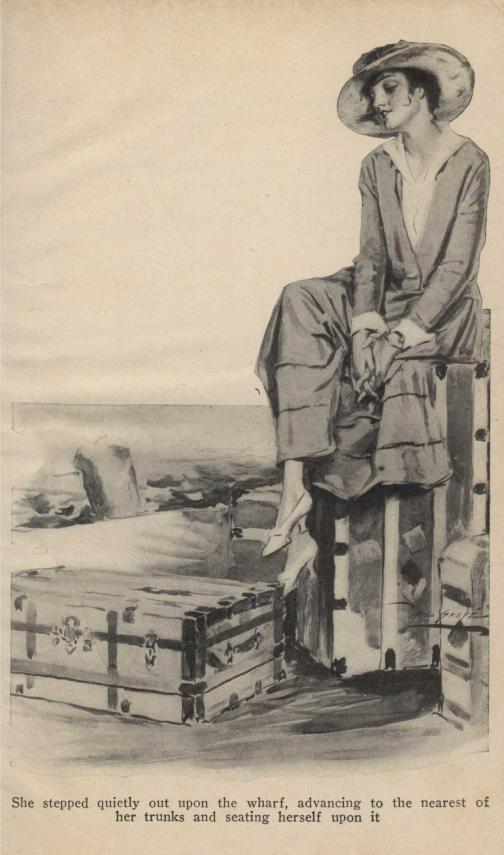
She stepped quietly out upon the wharf, advancing to the nearest of her trunks and seating herself upon it
A bell rang loudly.
The tall man on the string-piece dropped his glasses into the river and whirled about. Then, remembering the glasses, he reached for them, a full second after they disappeared.
He reached too far for the purpose of equilibrium—not far enough to retrieve his loss. His body swayed outward. He clutched at the air; it slipped easily through his fingers. Then, folding up like a jack-knife, he disappeared from Miss Chalmers's vision.
The last thing she noted was a pair of surprised blue eyes, looking at her with unblinking steadiness. She was not at all astonished that the splash was a loud one, considering the manner in which he made his plunge.
The bell still rang blithely.
Miss Chalmers sprang down from her trunk and seized her grip, which lay almost at her feet. She had had enough of bells. Snatching it open, she turned back the alarm lever on a nickeled clock, then snapped the grip shut again. After that she resumed her seat and waited.
Over the string-piece a head appeared. Its owner observed her solemnly.
"I—er—I beg pardon, you know," said the head. "But—er—by Heaven! did you hear a bell, madam?"
Miss Chalmers shook her head.
"Odd as the deuce!"
His shoulders came into view and his arms gripped the string-piece.
"Odd as anything in the world," he added, as he continued to stare at her. "I could swear there was a bell, you know."
"I don't hear it," she said.
"Nor I, madam. It—er—seems to have stopped, you know. But there was one—oh, I'm sure! Unless, of course, you say there wasn't. I may have been mistaken. But—oh, it's frightfully odd!"
Miss Chalmers chewed her under lip until the pain made her wince. She had never before seen a long, yellow mustache drip water at both ends, and she was amazed at the quantity.
"If you've finished tubbing, why not come completely ashore?" she inquired presently.
"Why—er—thank you. I believe I will."
The rest of him appeared above the string-piece.
"Did you get your glasses?"
He stared at her for half a minute longer.
"I supposed, of course, you were going after them," she added gravely.
"So I was, by Jove! I quite forgot."
The tall man in the wet flannels turned around, stepped upon the string-piece again, poised himself, and then shot head downward into the water, cleaving it as cleanly as an arrow. Miss Chalmers was too surprised to move. She merely waited.
A quarter of a minute, then half a minute elapsed. Then, just as she was minded to run to the end of the wharf and look for him, a hand containing a pair of field-glasses appeared, followed immediately by its owner.
"Awfully good of you to remind me, don't you know."
Miss Chalmers was thinking swiftly.
"I don't know whether he is a fool or not," she told herself. "I'll be careful."
The tall man stroked his wet mustache and looked down at his flannels.
"Hope I didn't frighten you, I'm sure," he observed.
"Not in the least. You—interested me."
"Awfully kind of you to say that—awfully kind, Miss—er—er—"
"Chalmers."
"Ah—Miss Chalmers! We were expecting you—but not so early."
"I took an early boat."
"Why—er—the first boat down doesn't get here before ten, I believe," he said, staring again. "And it's not more than—"
"Not more than three minutes after six," interrupted Miss Chalmers. Then she flushed and frowned.
The man took out his watch and held it to his ear. He looked at the dial.
"Still going and— By Jove, you're right, Miss Chalmers. What amazing guesses you Americans make!"
It was not a guess, however. Miss Chalmers's alarm clock, now ticking softly in her grip, had been set for six exactly. But she could not explain.
"We came so early," she said hastily, "that I decided to wait until somebody was up. I've been walking around the island, Mr.—Mr.—"
"I beg your pardon. Morton is the name."
He bowed deeply.
"As I was saying, Mr. Morton, I took a short walk after the boatman put me ashore, and—"
"Boatman, you said?"
"Why, yes; certainly."
"A chap with his own boat, was it?"
"It seemed to be his own boat," answered Miss Chalmers. "It's not very much to own, however."
Mr. Morton appeared to be interested.
"Now—if I'm not too inquisitive, you know—would he be a man with a beard?"
"He would; in fact, he was."
"Hum!"
Morton fell silent for a little, then turned to the river, raised his glasses, and made another survey. Miss Chalmers was becoming curious. Mr. Morton faced her.
"If you'll pardon me again, Miss Chalmers, would his name be Sam?" he inquired.
"He said it was. But why?"
Mr. Morton was silent again. Once more he scanned the St. Lawrence, now shining under the risen sun.
"Um—er—" said the dripping one as he abandoned his scrutiny. "Why? Did you ask why, Miss Chalmers? Why—er—really, no reason at all, you know. I've seen him—that's all. Just occasionally, you know. Really no reason at all, I assure you."
Miss Chalmers was assured there was a reason. She did not, however, pursue the inquiry. She told herself that it would be unseemly; what she meant was that it might be embarrassing.
Mr. Morton seated himself on the string-piece and allowed his glance to encompass her baggage.
"We saw your boxes last night," he remarked after a study.
"Indeed?"
Miss Chalmers spoke cautiously.
"Quite a surprise, you know, to Mr. Witherbee and all of us. We were looking for a rascal—a scoundrelly thief, by Jove—and all we found were your boxes. They're tremendously prompt with luggage in this country, aren't they? Why, they get it there ahead of you!"
"Sometimes," she admitted. "Did I understand you to say something about a burglar?"
"A burglar," he confirmed. "He rang the alarm, you know. Woke us all up. Rotten nuisance. Hunted all over the island. Found nothing—except your boxes. The bally bell woke the whole house."
He looked rather fixedly at Miss Chalmers.
"Awfully odd about that other bell, wasn't it?" he observed. "Quite startled me, you know. Made me drop my glasses. Must have been thinking of burglar-alarms."
"It was probably an echo of the alarm," she suggested.
"Really now, could it have been? Odd idea that. And you might be right, you know. You might be terrifically right, Miss Chalmers. They say your echoes travel tremendous distances in this country."
Miss Chalmers was vaguely uneasy. She felt that she was suspected as to the six-o'clock bell. She could not be sure, but he stared rather hard. Nor was she reassured when Mr. Morton coupled it in his memory with the ringing of the midnight chime in Witherbee House.
Perhaps it was natural enough to make the association; they were both bells, and both were abrupt and startling. But—well, she wondered if the man in the wet flannels was really a clever person.
"Are there many burglaries here?" she asked.
"I can't speak for the other islands, of course," he replied. "But this was the first for Mr. Witherbee. Fine chap, Mr. Witherbee. I'm just a guest, you know."
"Was anything stolen?"
Miss Chalmers asked the question perfunctorily.
"Upon my word, not a thing! Rather a joke, you know, too, because he left a clue."
"A clue?"
She sat up straight on her trunk.
"Seems like a clue, at any rate. You see—"
There was a heavy crunching on the gravel path, and the voice of Mr. Witherbee called:
"Well, Rosalind Chalmers! And at this hour of the morning. You and your trunks seem to make a specialty of mysterious arrivals."
Mr. Witherbee greeted her effusively and surveyed her from head to foot.
"Same girl, same girl," he commented admiringly. "Style—class—eh, eh, Morton? Oh, I beg your pardon! Have you met Mr. Morton?"
Miss Chalmers indicated that an introduction was unnecessary.
"I was so early, I thought I'd better wait down here for a while," she explained.
"Nonsense! Why didn't you come up at once? Ring the bell—bang on the door—do anything. We don't mind. Do we, Morton? Why, man alive, what's happened to you?"
Mr. Witherbee was regarding the white flannels with wide eyes.
"Mr. Morton dropped his glasses overboard and went to recover them," said Miss Chalmers.
The man on the string-piece shot a swift glance at her, then nodded confirmation.
"Huh!" said Mr. Witherbee, as he marveled at the wetness of his guest. "Just for a pair of glasses, eh? You're a queer cuss, Morton. By the way, Rosalind, did he tell you about the burglar?"
"He's just finished telling me."
"Fine note! Tell you all about it by and by. This is your grip, is it? You must come straight up to the house. Mrs. Witherbee'll be delighted."
He lifted the grip, grasped Miss Chalmers cordially by the arm, and started up the wharf. Then he stopped suddenly. A perplexed expression came into his face. Suddenly he cocked his head on one side and listened.
"Hear anything?" he asked Miss Chalmers.
She shook her head.
"I do," he affirmed. "Something clicking."
He listened again, then raised the grip and applied his ear to it. Miss Chalmers flushed.
"Please let's hurry," she said, urging him on.
Mr. Witherbee laughed.
"Clock, eh? I couldn't make it out at all."
She did not venture a glance at the guest, who remained behind, even when Mr. Witherbee called back:
"Better change those clothes, old man. Early breakfast to-day."
Mr. Morton remained sitting on the string-piece, looking after them with expressionless eyes.
Mrs. Witherbee was a sunup riser, like her husband, and she greeted her new guest with open arms.
"Everybody will be down presently," she said. "My, how wonderfully fine you look! How do you manage it—at such an hour? I suppose I'm a fright. Well, no wonder—this morning. Did Stephen tell you—the burglar? Oh, it was a terrible scare! I'm so glad, my dear, you were not here. It would have upset you frightfully."
Miss Chalmers, standing on the porch, glanced across the lawn and saw an overturned chair.
"Things like that do upset one," she murmured.
"I should say they did!" exclaimed Mrs. Witherbee. "I'm afraid I'll never feel safe on this island again. I'll always be lying awake, waiting for that alarm to go off. Really, I'd feel safer with it taken out, Stephen."
"Nonsense," said Mr. Witherbee. "Why, it scared him away, didn't it?"
"And scared the rest of us almost to death. I can't see any economy in that, I must say. I suppose, though, we should be thankful we're alive. Shall I show you your room now, Rosalind, or will you wait until after breakfast?"
"I'll wait," said Miss Chalmers.
Mrs. Witherbee stepped into the hall and called:
"Gertrude!"
"Yes, mother," answered a voice from above.
"Rosalind is here."
"I'll be down in a jiffy."
"And, Gertrude!"
"Well, mother?"
"Bring down what we found after the burglar left, dear."
"All right."
Mrs. Witherbee returned to the porch to find Miss Chalmers staring at her apprehensively.
"We've got a clue," she bubbled. "It's the strangest thing in the world. I suppose if you simply have to have a burglar, the next best thing is to have a clue. Stephen thinks it may lead to a capture. Do you still think you'll send for detectives, Stephen?"
"We'll see; we'll see, my dear."
Miss Chalmers walked to the porch-rail and steadied herself.
A clue!
It seemed she had never heard a word that sounded so sinister. A clue to the burglar! She shivered a little.
"Rosalind, you're positively chilly!" exclaimed Mrs. Witherbee, slipping an arm around her. "Run, Stephen, and tell Mary to hurry the coffee. It's this morning air, my dear. You'll get used to it in no time."
There was a quick step in the hallway, and Gertrude Witherbee rushed out upon the porch. Miss Chalmers returned the embrace, rather perfunctorily. She was thinking of clues.
"Here it is, mother," and Gertrude tossed an object to Mrs. Witherbee.
"Our clue!" said the lady of the island, holding it up for inspection.
Miss Chalmers was looking at her own bracelet.
CHAPTER V
THE PLOT CURDLES
"Why—why—"
She checked herself and reflected swiftly. She must not—she could not—claim it.
"Why," faltered Miss Chalmers weakly, "what a curious bracelet!"
"Isn't it, though?" exclaimed Mrs. Witherbee, holding it up so that the light played upon the dull gold. "That's what all of us said. We're having a time trying to decide who will keep it—that is, of course, if nobody claims it. Gertrude is crazy about it; Polly Dawson wants it; I fancy it tremendously myself."
"May I see it?" asked Miss Chalmers.
She gazed more sadly than curiously at the bauble Mrs. Witherbee dropped into her palm.
"Notice the carving," urged Mrs. Witherbee. "Did you ever see anything so odd?"
"It's very odd," assented the owner dully.
"And not a jewel in it!"
"Not a jewel," echoed Miss Chalmers, shaking her head.
"Gertrude and I have been wondering where in the world it was purchased. We both want one. But there isn't the sign of a maker's mark; it doesn't even say how many carats."
The artistic soul of Miss Chalmers was in revolt. Maker! Carats! There was something shockingly coarse in the suggestion. How little they understood! Nobody in the whole world knew the name of the artisan who fashioned it, nor ever would know. He went to his peace five thousand years ago. There were no carats in those days; not for this workman. For he made the thing for a princess, and he made it of pure gold.
Nowhere, unless in some undiscovered tomb in Egypt, was there anywhere its mate. Weighed in the scales of trade, it might have brought fifty dollars as metal. To Miss Chalmers it was a thing beyond price.
She knew little of its history save this: Only two women in the world had worn it. One was a princess, daughter of some forgotten Pharaoh. It was upon her wrist when they opened the tomb. The other woman was Rosalind Chalmers.
Just how Reginald Williams came into possession of it Miss Chalmers never knew, but he had brought it to America for her. And she had worn it with a pleasant sense of satisfaction in the fact that the bracelet had merely been transferred from the arm of a dead princess to a living one. Miss Chalmers, rightly enough, had an excellent opinion of herself.
Reggy Williams thought she wore it for him. It was neither kind nor worth while to tell him his mistake. The reason she wore it had partly to do with the Egyptian princess and partly with the fact that it was unique and beautiful.
Now, as it lay in her hand, she experienced a sense of dismay. She could snap it about her arm, of course, and then explain—explain that— Of course she could not! No; that was out of the question. Not after all she had told them that morning.
Into Miss Chalmers's mind flashed the memory of a sound that had reached her ears, even in the tremendous din of the Witherbee burglar-alarm. She recalled it as a rattling noise, but had given it no second thought in her panic. The discovery of her bracelet in the possession of her hosts supplied an exasperating explanation. She asked absently:
"You say the burglar dropped it?"
"Right on the porch where he had opened the window," said Mrs. Witherbee.
"Tom says it was quite a little distance from the window, mother," interrupted Gertrude.
"It was on the porch, at any rate," continued the hostess. "We think he had just stolen it from some other island. It's not likely a man would be carrying a thing like that around for any length of time.
"Tom found it while they were hunting with the lantern last night. We're going to make inquiries, of course; but, to tell you the truth, dear, we're just hoping a little that the owner won't be found. In that case we'll keep it."
"You mean I'll keep it, mother," said Gertrude.
"Well, Polly wants it, too, my dear. Probably the best way will be to send it to the city and have copies made. Then we can each have one."
Miss Chalmers shuddered.
"We've all tried it on, but I think it fits me best," asserted Gertrude.
The owner felt dizzy. It had been tried on—defiled!
"You can wear it for a while, if you like, Rosalind," said Gertrude generously.
"No, thank you," answered Miss Chalmers as she returned the bracelet to Mrs. Witherbee.
Her voice was flat and faint.
After that Tom Witherbee joined the group and the tale of the midnight alarm was spun again. Then came Polly Dawson, short, plump, and light-headed—both ways, for she was blonde—and Polly told it all over, but in such different fashion, and with such a completely new set of facts that it became quite a new story.
Afterward a few others came straggling down—the two Winter girls, Fortescue Jones, and a dull-looking youth named Perkins, of whom Miss Chalmers had never heard. And presently Mr. Morton, rearrayed, made his second appearance that morning. He bowed again very formally to the new guest.
It was a dull breakfast for Miss Chalmers. Everybody except herself babbled incessantly about the burglar, the bracelet, and the hunt by lantern-light.
The trinket of a princess was now upon Polly Dawson's arm, she having beseeched Gertrude to let her wear it during the forenoon at least. The owner eyed it gloomily and made plans. Even though it had been desecrated, she did not propose to abandon it to utter vandalism. She did not even intend that any vulgar modern craftsman should make copies of it.
When the moment was opportune, Miss Chalmers proposed to steal it. Of course she could never wear it again in the presence of the Witherbees or any of their guests; but she would possess it at any rate.
Breakfast was served on a broad porch at the rear of the house, which was the Witherbees' dining-room for all meals when the weather was fine. It was not yet finished when Miss Chalmers saw something as she glanced beyond the railing that fascinated her.
She stared fixedly, then brought her glance suddenly back to the table and furtively examined the faces of her hosts and fellow guests. After that she looked over the railing again. If she grew a shade paler, nobody appeared to observe the fact; nor did any one notice she had become restless.
After a minute or two she rose and walked toward the steps. They descended to a lawn that was broken with shrubs and flower-beds and paths.
"Where away, Rosalind?" called Gertrude.
"I want to see the garden," she called back.
But instead of making directly for the garden she followed a course closely parallel to the porch, which brought her to a pathway that led from a rear door of the house to a small outbuilding that served as a summer kitchen.
"Wait! Stop, Rosalind!"
She did not seem to hear, but stepped upon the path.
"You'll ruin your shoes!" cried Mrs. Witherbee.
"That concrete was just laid yesterday. It's soft." Miss Chalmers looked down at the path, then took a step forward as if to verify. Still unsatisfied, she tested the path once, twice, thrice, with her immaculate shoes. Then she turned and looked up at Mrs. Witherbee.
"Why, how stupid of me!" she exclaimed. "It is soft, isn't it?"
She moved toward the porch, treading again upon the slightly yielding surface. Then she stepped back upon the grass.
"I'm so sorry," she murmured. "I'm afraid I've marked your path."
She paused to study the footprints. There were nine distinct impressions in the concrete. One was slightly deeper than its mates.
"They won't notice that little difference," she reflected. "But I hope to Heaven nobody took the trouble to observe that I stepped on the path only eight times."
Then she wandered off into the garden, with a remark upon the unexplained magnetism that wet paint, particularly when so labeled, exercises upon meddlesome fingers.
(Moral: In order to cover your trail be the first to discover it—and then multiply.)
"It's rather exacting work," thought Miss Chal—
Wait a minute! This eternal "Miss Chalmers" is tiresome. We've known her for at least twelve hours; we're going to know her much better. Nearly everybody else is calling her "Rosalind." Why stand aloof?
"It's rather exacting work," thought Rosalind, "this business of arriving at unconventional hours and then making believe that everything was thoroughly conventional. If they don't stop talking about clues I shall go mad."
If there was one thing that particularly bored Rosalind it was discussion of a topic plunged into with undisguised relish by Mrs. Witherbee, when that good lady joined her in the garden and deftly maneuvered her beyond the hearing of the others.
"Is it seventeen now, my dear, or eighteen?" asked Mrs. Witherbee with a knowing little chuckle.
"Seventeen—or eighteen?" puzzled Rosalind. "I don't understand."
She did, however, because Mrs. Witherbee always approached the subject from the numerical angle.
"You know very well, my dear. Do not pretend. I thought the last one was the seventeenth, but Gertrude is sure he was the eighteenth. It was Mr. Williams, wasn't it?"
"Oh, please!" protested Rosalind.
"Oh, please?" echoed Mrs. Witherbee, hugging Rosalind's arm. "Oh, shucks, you mean! Why shouldn't we talk about it? Everybody else who knows you talks about it. Why shouldn't I?"
"But—but it's so intimately my own affair," said Rosalind, annoyed.
"It's more than your affair, dear. It's the affair of seventeen or eighteen perfectly nice young men—I wish to goodness I could remember the exact count! Seventeen or eighteen eligible men—all ready to marry you if you say the word."
"All!" exclaimed Rosalind in a shocked tone. "Why, Mrs. Witherbee!"
"Well, you know what I mean," declared Mrs. Witherbee. "Of course you wouldn't marry them all. But it could be any one of the seventeen or eighteen. Now, couldn't it, Rosalind?"
Rosalind sighed, not because she was either romantic or pensive, but out of sheer despair.
"I presume it could be," she admitted.
"Oh, you heart-breaker!" chided Mrs. Witherbee confidentially.
"I'm not!" declared Rosalind stoutly. "There isn't a broken heart among them. Their hearts are all perfectly sound and serviceable. They're not only air-cooled, but water-jacketed, and not one of them ever had a misfire on my account."
"Rosalind! What in the world are you talking about?"
"Oh, well, please let's not talk about it any more. I can't stop them from asking me, can I?"
"No, but— Why, some of us wonder if you ever will be married!"
Rosalind shook her head wearily.
"Oh, I suppose I'll be married some day; most women are. Meantime, what's the use of considering and plotting and planning, or even bothering about it? When a girl wants to get married she can do it—any time. There's nothing mysterious or unprecedented about it. It's been done several times, I believe."
"You're so cynical, Rosalind."
"I'm not—not in the least. I'm merely sane. Listen, now! Whose voice is that? You seem to have callers."
"It sounds like Mr. Davidson," said Mrs. Witherbee, listening. "He's one of our neighbors. Shall we go and see?"
They walked to the front of the house, where a group of persons stood in a circle around an elderly man who talked volubly.
"Come and listen to this," advised Mr. Witherbee, beckoning. "Davidson had a thief last night, too. Same one, probably. Miss Chalmers, let me present Mr. Davidson—one of our island neighbors."
Mr. Davidson bowed briefly, then resumed his recital in a voice that Rosalind remembered quite well.
"We thought he was all alone at first. He started up his launch, and then he had a breakdown. Thought I had him sure then. But, by jingo! Do you know there was another fellow lying out there in a rowboat? He was keeping watch, I suppose. The second chap climbed into the launch, and they managed to get things started again.
"Even then we'd have had 'em in a fair race. He cut loose his rowboat after a while, and we smashed into that; we didn't stop to pick up the splinters. That delayed us a little, of course.
"But he put one over on us by slipping through that channel that splits Houghton's Island. I wouldn't take a chance on it. By the time we went around the island he wasn't in sight."
"A pair of them, you said?" asked Mr. Witherbee.
"A whole gang, likely enough; but we saw only two. Don't know whether I hit any of 'em or not."
"Anything stolen?"
"Now, there's the queer part," affirmed Mr. Davidson. "Not a blessed thing, so far as we can discover, unless it was something out of the library that we haven't been able to locate as yet.
"He seemed to have spent all his time in the library, as nearly as I can find out. He had a lot of books out on the floor. Perhaps he thought we hid things behind them. We can't find that he did anything except mess with the books."
If Rosalind was afire with curiosity she did not betray the fact. Outwardly she maintained the frigid poise that had been the despair of the seventeen or eighteen.
"Well, from your story," commented Mr. Witherbee, "he got to your place after he visited us. He had hard luck here; he lost something. Who's got the bracelet? Here, Polly! Show it to Mr. Davidson."
Polly held out her arm.
"If he hadn't visited us first I would have thought probably he stole it from your place," said Witherbee.
Mr. Davidson glanced at the bracelet and shook his head.
"Haven't got any junk like that in our house," he declared. "Never saw it before."
Rosalind flamed with resentment, but remained silent. Junk!
"We've got to organize; that's all," declared Witherbee.
"It's a cinch something's got to be done," growled Davidson. "I tell you, there's funny goings-on around this place. Earlier last night, for instance. We were coming down the river in the yacht when somebody hailed us from a small boat. One of 'em—sounded like a woman, too—wanted help. The other one—a man—didn't want any help. Seemed to be having a row among themselves, so I didn't butt in."
Rosalind was too bewildered to analyze the relation of this episode to what happened later. She merely made a mental note of the facts for future consideration.
A man in overalls approached Mr. Witherbee and touched his cap.
"One of the skiffs is gone, sir—the new one," he said.
"Then he did steal something, after all!" exclaimed Witherbee. "Isn't that the devil now? I suppose that was the skiff you ran down, Davidson."
"I suppose so," said Davidson gloomily. "Sorry."
"Oh, that's all right. Don't bother. But, say, Davidson, you ought to do something for your own protection. Put in a burglar-alarm like ours, for instance."
"Burglar-alarm!" snorted Davidson. "What do I keep dogs for? And what good are the dogs, either? I threatened to shoot 'em last night. I'm not sure but I will, even yet. That rascally nephew of mine spoiled those dogs. They've been mooning around the place ever since I shipped him off to New York. By Judas! I'd bring him back if it wasn't for the fact that I'm getting good reports about him. Witherbee, he's actually making good! Had a letter from Hastings & Hatch only this morning. He'll be a regular banker some day, they tell me. Would you have ever thought that?"
"I never would," admitted Witherbee.
Rosalind wanted to slip away and think. She wanted to be undisturbed, so she might put together the pieces of the puzzle, which seemed to have been jigsawed into hopeless confusion.