Front matter (continued 4)
Reading edition
"Oh, yes—yes! But my uncle didn't give any details. He's—he's gone, I suppose?"
There was anxiety in his voice that did not escape her. Rosalind concluded that Billy Kellogg was very much afraid of his uncle.
"He's well on his way to Denver by this time," she assured him. "He has been speaking very well of you, Mr. Kellogg."
"Yes?"
"Indeed, yes! He has told us frequently about your success in New York."
"Has he? Good of him, I'm sure."
"He was reluctant to take you from your work," she continued, determined, if it were possible, to put this young man at his ease. "He felt that, perhaps, you would not want to come."
"I didn't!" he answered explosively.
Rosalind studied him in silence.
"You find banking—interesting?"
"Tremendously!"
"That's odd!" she said before she thought.
"How's that? What?"
"I beg your pardon," said Rosalind. "I didn't mean it exactly that way. Only—Well, you know, we've heard about you, Mr. Kellogg, and we rather pictured a young man who wouldn't be particularly absorbed by anything so serious and important as running a bank."
He blushed vividly.
"I hope I haven't been clumsy in alluding to anything unpleasant," she went on quickly. "I didn't intend—"
"Oh, not at all; it's all right, I assure you. I don't mind. Only—I've changed; that's all."
"Were you very wicked?"
She asked the question gravely; the mischief lay only in her eyes.
"Oh—I—hum! Why, I don't know that I was actually wicked."
He was squirming most unaccountably for a young man with a Billy Kellogg past, and Rosalind was speedily becoming more mystified. She felt that she was looking upon a miracle—and was not entirely sure that she approved of it.
Wickedness, or what passed for it in the average youth of her world, was infinitely more entertaining than the goodness of a young man who patterned his life after the hero of the Rollo books.
"You were simply thoughtless, I presume," she remarked.
"Thoughtless? Indeed I was—very."
"Tell me about it."
Rosalind was not wholly averse to the practise of a woman's wiles. Here was a young man, she decided, who was vulnerable to the most ancient wile of all—flattery of feminine sympathy and curiosity.
Yet the curiosity on her own part was genuine enough. Billy Kellogg had been sent away because of an episode which included H. Evelyn Morton as one of its actors, and Rosalind was still unsatisfied in her quest for information about the Englishman.
"There isn't much to tell," he answered diffidently.
"You may light that cigar," she informed him.
He was still chewing upon it abstractedly. He availed himself of the permission, but without any advance toward ease of manner.
"They said that you gambled—rather heavily," she suggested.
"Oh—that!" he exclaimed.
"But did you?"
"I suppose so. There—there wasn't much else to do."
"I'm sure there wasn't," she said sympathetically. "It must have been quite dull so early in the season."
"That was it—dull," he assented. "You see—er—I wasn't working then, and I had to have something to fill in my time."
"And you lost—"
"Ten thousand dollars."
She arched her eyebrows slightly. It was a sum that did not impress Rosalind as stupendous, but the tone in which he mentioned it was one of awe.
"You are a more desperate person than I imagined," she said chidingly.
He looked at her, startled; then flushed again.
"You see, it was a year's income—a whole year!"
"Was it? I hadn't heard. How interesting!"
"I don't know whether you are familiar with the circumstances, Miss Chalmers," he went on slowly.
"Not a single one—but I'd like to know awfully. That is, if you don't mind. One is so apt to get false impressions when one does not understand."
"Why—er—yes," he sighed. "You see, I have an income—ten thousand dollars a year. The estate itself is in the hands of a guardian—my uncle."
"Mr. Davidson?"
"Yes; Uncle Henry. He manages things until I'm thirty. All I get—or did get—was the income."
Rosalind nodded.
"Well, I used to play cards a good bit. I was always losing, somehow. I was always drawing in advance on Uncle Henry. I suppose you can understand how that was."
"Oh, thoroughly!"
"Of course, he didn't fancy that much. He said I was getting into disastrous habits, and—I guess he was right. He wanted me to stop playing cards for money."
"Was it bridge?"
"That was it—bridge."
"It's rather fascinating," she commented.
"I thought so—once," he said gloomily. "Well, Uncle Henry had some friends up from the city, and we had a pretty heavy game one night. There was a Mr. Morton there."
"I know. Go ahead; it's becoming exciting."
"Well, Morton cleaned me; that's all. Cleaned me for a year's income. Of course, I hadn't saved anything before that; in fact, I was overdrawn. So that settled it."
He stared disconsolately at the river.
"And Mr. Davidson?" she suggested.
"Uncle Henry? Well, he hit the ceiling, if you know what that means."
"I have a notion. He was very angry?"
"He said he wouldn't stand for any more of it. He wouldn't advance me another cent until it was due. That meant a year, you see. I couldn't live on nothing for a year."
"I should say not!"
"So when I saw I had to go to work, he offered to get me a job. He—he wrote a letter to Hastings & Hatch, in New York, and they took me in. I've been there ever since."
"Wasn't it very hard—at first?"
"Why, it was luck—I mean, I liked it!"
"How fortunate!"
"Yes," he went on; "I got to like it right away. I really didn't want to come back at all, only Uncle Henry insisted. He telegraphed the firm. I tried to get out of it, but they made me come."
"I'm sure you've earned a rest," declared Rosalind, nodding positively. "Your uncle thinks you are doing so splendidly. I know that he will be very glad to see you."
"You don't mean to say—he's here!"
There was something very much like terror in his wide eyes.
"Oh, no; he's on his way West. What I meant was, he'll return before you go back to the city. You are to stay in charge until he gets here."
"I don't see how I can. Honestly, I don't see how. I've got to get back to work—soon."
"You are a very unaccountable person, Mr. Kellogg," commented Rosalind. "I never knew anybody who underwent such a change of heart in such a short time. Do you mean to tell me that it doesn't make you glad just to be here?"
He surveyed the river, the islands, and the passing craft. Then he shook his head.
"Perhaps I know the reason," she suggested.
He looked at her suspiciously.
"Perhaps it is that you are not anxious to meet Mr. Morton again."
"Is he here?"
"He is one of the guests at our island."
Kellogg lifted his ungraceful bulk abruptly from his chair and walked to the rail, where he stood for a moment gazing down at the water.
"I beg your pardon," he said, turning. "I—I didn't intend to be rude. But it was a sort of surprise, you know."
"I didn't know there had been a quarrel."
"Oh, no; not a quarrel exactly. But—"
"You are afraid it may be embarrassing."
"That's it—embarrassing."
"But your uncle seems to have no feeling against him, Mr. Kellogg."
"I know; I understand. But that's different. He didn't lose a year's income."
"Of course, we could have the yacht leave you at your own place," went on Rosalind, "if you positively insist on avoiding Mr. Morton. But, as I said, there are only the servants there."
"I wouldn't go there for the world!" he exclaimed hastily. "That is—not now."
"Then, of course, you will stay with us."
"I might go to a hotel; yes, I think I'd better."
"But there is none within several miles of your island. How could you look after things so far away?"
"That's so; I'd forgotten."
His old uneasiness had returned. Rosalind was again in perplexity. She considered Billy Kellogg as not only unaccountable, but colorless.
She was rather glad he had lost a year's income, if this was his spiritless type. An hour before she had been anticipating a welcome accession to the Witherbee house-party—welcome because she felt quite sure that no young man could fail to be an improvement upon Mr. Morton, Reggy, Fortescue Jones, and the Perkins boy. Now she was rapidly reaching the conclusion that Billy Kellogg was even worse than any of them, and it was peculiarly a shock because it so wholly reversed her anticipations.
"You won't be paired off with Mr. Morton, at any rate," she told him consolingly. "There are lots of others. Polly Dawson, for instance; she knows you, I understand."
"Er—she is there?"
"Yes, indeed," and then Rosalind enumerated the other guests.
He shook his head as she named each person, and then returned to Polly Dawson.
"That's another surprise," he confessed.
"Not unpleasant, I hope?"
"Oh, no; not at all. I assure you I didn't mean that. Only—well, it's a surprise."
"Polly is really a very nice girl. And I've heard her speak of you so often."
"Er—have you? That's good of her, I'm sure."
After this he fell into a period of silence, from which all the arts of Rosalind Chalmers were unable to extricate him, save for fitful and brief intervals. Ordinarily, she would not have wasted her time upon such a dull and diffident young man; she would have taken his manner as an affront to her natural claims upon masculine attention.
But in this instance Rosalind's curiosity was piqued. She could not reconcile him with his reputation. If ever a devil-may-care spirit lurked in this beefy youth, something supernatural had exorcised it.
"Your island," she said, pointing.
"Looks all right," he commented, after a moment of staring.
"You don't seem particularly glad to see it."
He merely shrugged.
"Your uncle's yacht went to Kingston, I believe, to obtain some supplies."
"That's good."
"That's why Mr. Witherbee sent his own boat."
"Mighty kind of him, I'm sure."
Rosalind sighed. By all odds, this was the most difficult young man of her experience. She was glad that the voyage would terminate speedily.
A knot of persons was standing on the Witherbee wharf, awaiting the arrival of the big power-launch.
"There are Mrs. Witherbee and Gertrude and some of the others," said Rosalind, her eyes busy. "I don't see Mr. Morton; I imagine you won't mind that, however. But—yes, Polly's there."
"I—I don't see her," declared Kellogg. "Where?"
"In blue, the third from the left."
"Oh, yes; now I see."
He studied the short, plump figure of Polly Dawson with absorbed interest as the boat neared the wharf. There was a hunted expression in his eyes; his fingers twitched.
Mrs. Witherbee welcomed the new guest effusively.
"We've heard so much about you, Mr. Kellogg, that it really seems as if we knew you. But you left before we came up for the season. We're going to try to make up for it."
"That's awfully good of you," stammered the prodigal.
"My daughter, Gertrude."
He shook hands and bowed.
"Miss Winter."
He repeated the same perfunctory ceremony, but his glance was wandering restlessly.
"Mr. Jones, Mr. Perkins, and my son, Tom."
Kellogg responded mechanically to the greetings. Rosalind, following the line of his glance, saw that it encompassed the figure of Polly Dawson. And in Polly's eyes, which were staring at the new guest, was an expression that completely baffled her.
"Oh, Polly, where are you?" called Mrs. Witherbee. "I believe you've met Mr. Kellogg, haven't you?"
Polly stepped forward and extended her hand. Rosalind watched the meeting narrowly. She sensed a situation that she did not understand—but she proposed to find out.
"Hello—Billy," said Polly in a queer voice.
"How do do—Polly?"
There was the same hesitation in Kellogg's tone.
"You're looking very well," she murmured.
"Feeling fine, thanks," he returned awkwardly.
Rosalind believed she was beginning to see a light. Here were the surface indications of heart-trouble, either on one side or the other, possibly on both. Yet on the many occasions that Polly had spoken of Kellogg, never once, either in word or manner, had she betrayed the existence of an affair of sentiment.
"Polly is deeper than she seems," Rosalind told herself.
It was Mrs. Witherbee who broke the tension.
"You must come straight up to the house and meet the others," she commanded. "We've all been expecting you, and we're delighted to have you. I told your uncle that we'd probably keep you here most of the time, unless it's absolutely necessary for you to stay at your own place."
"It isn't," he said quickly.
"I knew it wasn't," declared the hostess with emphasis. "I told Mr. Davidson the servants could do without you. So you may as well have a good time with us. Come along."
She linked an arm within that of the stammering guest and led him toward the house. Some of the others followed.
Polly lingered on the wharf, watching. So did Rosalind. When the procession had passed from ear-shot, the two women looked at each other.
"I had no idea, of course," said Rosalind, "that there had been—well, that anything had happened between you two."
Polly stared and was silent for half a minute.
"Nothing ever did happen between Billy and me," she answered slowly.
"But—"
"Where did you find him?" demanded Polly.
"At Clayton, of course. He came aboard while I was shopping. One of the men met him at the train and brought down his grips."
Polly's brow was furrowed deeply.
"I cannot understand it," she muttered. "It's—it's beyond belief."
"What?"
"His coming here."
Polly pointed at the retreating figures.
"Mr. Kellogg?"
"Kellogg? That's not Billy Kellogg!"
"Not Billy Kellogg?" echoed Rosalind. "Why, Polly!"
"That man is not Billy Kellogg," repeated Polly, shaking her head.
"Then—then who is he?"
"I haven't the slightest idea."
CHAPTER XVIII
WHO? WHAT? WHY? WHERE?
"But, Polly, it's inconceivable!"
Rosalind was preyed upon by confused emotions. She was mystified, shocked, startled, apprehensive, even angry. Dominant was the sensation that this chunky, colorless young man had played a hoax upon her.
"It's true," affirmed Polly stubbornly. "I surely know Billy Kellogg when I see him."
"Of course! But what does it mean?"
Polly made a helpless gesture.
"He came aboard as Mr. Kellogg," said Rosalind, talking as if in self-justification. "He pretended to be Mr. Kellogg. He knew all about having been sent for by his uncle. Of course, he did act strangely. But he knew Mr. Morton; he even knew you!"
"You're sure?"
"Well," admitted Rosalind, on reflecting, "now that I think of it, in your case, I had to point you out on the wharf. But he said he recognized you. And you called him Billy!"
"I didn't want to make a scene," said Polly. "I knew there was something wrong, of course. So I just pretended—thought I'd wait till I got my bearings."
"But who can he be?"
"I tell you, Rosalind, I don't know, I never saw the man before."
"But he's pretending to be Mr. Kellogg—if he isn't!"
"Evidently. Oh, dear! It's beyond me."
"It has something to do with these burglaries," declared Rosalind.
"I suppose so. It's awful!"
"He's probably a thief."
"Very likely."
"Yet you've recognized him—or pretended to! Do you realize what you've done, Polly Dawson?"
"He called me Polly," she answered defensively.
"And just because a stranger calls you Polly, is he to be turned loose upon your friends?"
"I didn't bring him here. I hope you're not blaming me, Rosalind!"
"No-o; of course I didn't mean that. But how was I to know he wasn't Billy Kellogg?"
"I don't suppose you could tell," admitted Polly. "Is—is he nice?"
"He is the stupidest and most hopeless creature I ever talked to!"
Polly sighed.
"You must go to him and demand an explanation," added Rosalind.
"I? Why, Rosalind, that's impossible! I don't even know the man!"
Rosalind regarded the plump, young person with severity.
"But you have given him the very last word in introductions!" she exclaimed. "You pretended you knew him. Mrs. Witherbee and everybody else have taken him at face value. You passed him without even a challenge. Are you going to allow this stranger to live here and call you Polly? Why—why, it may make you particeps criminis!"
Polly's lower lip quivered.
"I—I couldn't think of anything else to do," she faltered. "Oh, Rosalind, you must help me!"
"It looks as if we must help each other," declared Rosalind. "We simply cannot allow this man to impose upon the Witherbees."
Polly was on the brink of tears. She was thoroughly frightened. Not until Rosalind, in self-defense, had placed the burden upon her did she realize the enormity involved in her recognition of the stranger. It was a mere procrastination, of course, due to bewilderment; but it had served as an authoritative introduction for the impostor.
"Mr. Morton!" exclaimed Polly suddenly.
"Well?"
"But they'll meet—don't you see? And they're supposed to know each other!"
"True," murmured Rosalind. "I'd forgotten that. Well, we've got to face it. Let's go and see what has happened."
Polly shrank back.
"You go," she begged.
"We'll go together," said Rosalind firmly. "We must see it through."
"But—"
"And listen! Not a word of explanation, unless something has already happened. Understand? No! Not a word! Go on calling him Billy. Keep it up until we find out something."
"I—I can't," wailed Polly.
"Nonsense!" Rosalind was losing patience. "Didn't I travel all the way down from Clayton with him, talking to him just as if he were really Mr. Kellogg? It's a pity if you can't help a little—after deliberately turning him loose on this island."
"Why not ex—expose him?"
"Not yet! We must find out some things first. We must know what it all means. Come now! For Heaven's sake, brace up, Polly! Nobody has been murdered yet."
"I'm afraid!"
"Then let me take the responsibility," declared Rosalind in a disgusted tone. "Only you've simply got to play your part—now that you've started it."
She seized the trembling Polly by the arm and started her at a rapid pace toward the house. Rosalind was bewildered not less than her companion, but she betrayed the fact by no outward sign. Even in the face of possible disaster, resolution did not desert her. Besides, her anger was still hot at the deception practised by the pudgy young man who was now so inadvertently a guest of the island.
Polly's efforts to hang back were ineffectual. There was grim energy in Rosalind's grip, so that the unwilling young woman found herself propelled forward, despite her vanished courage.
The Kellogg impostor was the center of a group on the porch. As they joined it, Mr. Morton approached from the other direction. The stout visitor was mopping his brow assiduously and answering questions in monosyllables. He seemed unable decide between his feet, for he stood first upon one, then upon the other, but never upon both at the same time.
Rosalind and Polly appeared, he observed them with an alarmed and imploring glance. Polly's eyes did not meet his, but the cool stare of her companion never winced.
"Here's Mr. Morton now!" exclaimed Mrs. Witherbee. "Of course, you know each other. Oh, Mr. Morton! Mr. Kellogg is here!"
Morton glanced casually over the head of the Perkins boy and studied the newcomer for a brief instant.
"By Jove, Kellogg, but I'm glad to see you!" he drawled.
The words were accompanied by the thrusting forth of a long arm, the hand attached to which seized the limp fingers of Kellogg. That young man permitted his jaw to drop an inch, where it hung, irresolute.
"Why—hello, Morton," he murmured.
"Glad you've joined us, I'm sure," said the Englishman unemotionally. "Awfully glad. How's New York?"
"F-fine!"
"And business?"
"Oh—er—excellent."
Rosalind was too deeply engrossed in the exchange of greetings to notice that Polly's hand was clasping her own with desperate energy. The haughty lady whom everybody wished to marry was dumfounded.
Morton had accepted the stranger! Morton—who knew as well as Polly that this was not the Billy Kellogg from whom he had won a year's income!
What did it mean?
"Mr. Kellogg is up to take charge of his uncle's place while Mr. Davidson is away," explained Mrs. Witherbee, breathing a soft sigh of gratification at the absence of animosity between these knights of the gaming-table.
Perspiration streamed down the cheeks of the stout young man. He stared at Morton with the fascination of a bird looking upon the mythically hypnotic serpent. His glance finally wavered and met that of Rosalind. She saw the muscles of his jaw tighten, and watched him while he breathed deeply.
"Oh, I say," he began. "Something's wrong. I—"
Rosalind's head was moving slowly from side to side, and her glare was truly ferocious. The young man stopped. Then all traces of resolution wilted.
"Wrong?" asked Mrs. Witherbee anxiously.
"Why—er—you see—"
He gulped and looked again at Rosalind. Her head was still moving, and her lips were grim.
"What I meant was, Uncle Henry said there was something wrong at the island, and—well, you see, he wanted me to look out for it."
"What's wrong?" demanded the voice of Reginald Williams.
Unanimous dismay overspread the faces of the group. They remembered Reggy's heart!
"Nothing at all," said Rosalind coolly, as she stabbed the stout young man with a warning glance. "What Mr. Kellogg meant was that his uncle is engaged in some agricultural experiments, and that when he was called away it was necessary to have somebody there to look after them. So Mr. Kellogg came up."
It was a shot in the air, but Rosalind felt that agriculture was safe and non-exciting. The members of the group breathed again and looked at her in admiration. The stranger was also staring at her without comprehension.
"Agricultural experiments!" snorted Reggy.
"Certainly," said Rosalind freezingly. "Exactly that. He is experimenting with a new kind of cauliflower. It's very delicate, and it has to be looked after whenever there is the least danger of frost. That's why he wanted—burlap. Isn't it, Mr. Kellogg?"
"Why—yes," the fat youth assented faintly.
Once more Rosalind received a tribute from grateful eyes, but this time they contained astonishment as well as gratitude. She accepted the homage complacently. The role for which she had cast Reggy Williams was still his.
"After tea," suggested Mrs. Witherbee, "if it's really necessary, you can have the launch and go over to look after the cauliflower."
"It's not necessary!" exclaimed Kellogg hastily. "It's not a bit chilly this afternoon—not a bit."
Rosalind gently detached Polly from the circle and led her along the porch.
"Get that man aside," she ordered, "and pump him."
Polly quailed.
"You must! We've simply got to find out something about him. And you're the only one to do it; you're supposed to know him."
"But—did you see Mr. Morton? He recognized him."
"He pretended to," declared Rosalind. "And that's one of the things I want to know something about. That makes two people who have pretended to know him. Are you quite sure, Polly, that you're not mistaken?"
"Rosalind!"
"Oh, well, I suppose you're not. At any rate, it's your business to do some investigating."
"But I don't know what to ask."
"Heavens, Polly! There are a lot of things to find out. Who is he? What is he here for? Why did he pretend to know you? Why did Mr. Morton pretend to know him? Where is Billy Kellogg? How did a telegram to Kellogg fall into his hands? Why, he may have murdered Kellogg!"
Polly shrieked faintly.
"Of course, I don't believe he did," added Rosalind contemptuously. "That man, whoever he is, wouldn't murder a rabbit. But there's something exceedingly strange about the whole affair, and it is our business to find out what it means. Go and get him!"
"But what shall I say?" wailed Polly.
Rosalind sighed hopelessly.
"Go and ask him anything," she said. "Take him down to the summer-house to see the river—anything, I tell you! And then pump—pump—pump!"
Polly Dawson shivered, but obeyed. When it amounted to a clash of wills, Rosalind was irresistible.
The latter lady watched the couple depart in the direction of the summer-house and smiled resignedly. Polly was so literal! Had it been her own task, Rosalind would have taken him to the first available place—anywhere that was beyond ear-shot of the others. But Polly needed a sailing-chart and a compass.
Rosalind managed a meeting with Mr. Morton, but it resulted in no information, because she did not choose to acquaint that gentleman with the fact that she knew the Kellogg to be spurious. And Morton volunteered nothing. So far as the surface of him went, the meeting had not occasioned even a ripple.
it was half an hour later when Polly reappeared and beckoned Rosalind to a corner of the porch.
"He's—he's not Billy Kellogg!" whispered Polly triumphantly.
Rosalind regarded her with a minute of patience and pity.
"Is that all you learned?" she asked.
"He admitted it!"
"Of course he did. What of that? You knew it, anyhow, didn't you?"
"Ye-es—but he confessed."
"And what else did he confess?"
"Nothing."
An exasperated gasp was Rosalind's only comment.
"He—he said he couldn't explain," added Polly in an agitated voice. "And he seemed so nervous about it that I felt sorry for him. Truly I did, Rosalind."
"I haven't the least doubt," icily. "Tell me exactly what you said."
"He said it first. He said that he knew that I knew that he wasn't Billy Kellogg, and I admitted that I did know it, and that I thought that he knew I knew it. And then before I could say anything, he said that he couldn't explain, and he hoped I would not say anything—particularly to you. He—he seemed to be afraid of you, Rosalind. And, of course, after he said he couldn't explain, I couldn't very well ask him. Now, could I?"
"Of course not," said Rosalind in a withering voice.
"And he doesn't look like a murderer either, Rosalind; so I didn't ask him about that. He said he'd explain as soon as he could, and he wanted to know what Mr. Morton thought about him. I told him I thought Mr. Morton probably thought what you did. Was that right?"
"I am not accountable for Mr. Morton's thoughts."
"At any rate, I'm sure he won't do any harm, Rosalind—he seems so dreadfully embarrassed."
"And after talking to him for half an hour, you haven't the least idea who he is or why he came here?" Rosalind demanded.
"I—I'm afraid not."
Rosalind threw her hands wide in a gesture of hopelessness.
"What do you propose to do about this—impostor?" she demanded. "You are the person chiefly responsible. You permitted Mrs. Witherbee to receive him."
"Why don't you expose him?" asked Polly meekly.
Rosalind ignored the inquiry.
"Besides," added Polly, "he says he will go away to-morrow."
"He will not!" exclaimed Rosalind.
"You mean—"
"I mean that he will not leave this island until we know something about him if I have to sit up by myself and watch him."
Polly uttered an exclamation of awe.
"The man's an impostor—probably a thief," added Rosalind. "Do you suppose I shall permit him to go as he came? I think not!"
"You think we ought to tell the others?"
"Not yet. There is only one thing to do for the present—watch. That will be your business and mine. We must see to it that this man is not allowed to go away until everything is explained. Meanwhile, we will send for the person who is evidently the principal one to be concerned—Mr. Davidson."
"And wait?"
"Certainly. It cannot be very long. I shall telegraph to Mr. Davidson this evening; right away, in fact. It will not be difficult to reach him on the train. And we will keep this man here until Mr. Davidson returns."
"Suppose he will not stay, Rosalind?" ventured Polly timidly.
"Leave that to me. He'll stay!"
CHAPTER XIX
STUNG!
Rosalind not only wired to Mr. Davidson but, as an afterthought, she sent a message to Hastings & Hatch. The answer to the latter came promptly the following forenoon.
It did not serve to restore her equanimity. It described William Kissam Kellogg minutely, as Rosalind had requested, and the description was a photographic likeness of the young man who had confessed to Polly that he was no such person.
"Nothing to do but wait for Mr. Davidson," said Rosalind.
She spent some of the time, when it was not devoted to standing watch upon the stranger, in writing. After the call of the customs agents at Witherbee's Island, Rosalind had begun the preparation of a memorandum. It had already reached a length of several pages; there were daily additions. Also, there were classifications, thus:
What I Really Did. What They Think I Did. What I Know about Certain Things and Persons. What I Must Find Out About Them. What Must Never Be Found Out About Me. Things That I Have Said (for reference in connection with other things I may have to say before this is over) Suspicions That I Have.
Under the last head there was much writing, for Rosalind's mind was as crowded with suspicions as that of a crowned head is thronged with troubles. It was not strange, of course, that a large part of the memorandum dealt with the boatman. At every turn and corner of it his name and his deeds intruded.
But there were some things that Rosalind, even in the privacy of her diary, would not suffer herself to commit to plain English. These were represented by a cipher code, the key to which lay only in her memory.
For instance, a Maltese cross represented her experience in the tree; a star the shower-bath that came from the boatman's bucket, an asterisk the dance at the hotel where she found herself in the arms of Sam. All this was by way of mitigating the disaster that would befall if her memorandum chanced to come to the eyes of another.
The task of keeping watch upon the strange young man was more tedious than difficult. Most of the time he sat on the porch, staring at the lawn with inconsolable eyes. He made not the slightest attempt to escape; rather, he appeared to be in a sort of stupor. Polly felt sorry for him; Rosalind had only contempt.
A day passed thus and a second began with the young man still sitting and staring. Even Mrs. Witherbee granted that he was an unhappy acquisition, while everybody was unanimous in agreeing that work had produced an appalling effect upon Kellogg.
It was mid-morning when Rosalind, unable longer to endure the sight—she classified him as a vegetable—left Polly on guard and betook herself to the river. One thing she wanted was her bracelet. Of the boatman she had seen nothing; he had made no effort to restore her property.
With an intent that was really subconscious, she rowed one of the light skiffs in the direction of his island. There was also something mechanical rather than deliberate in the act of her landing there, making fast her boat, and ascending the path that led to his shack. Only the sound of voices awakened her from a day-dream.
She halted and listened. One of the voices was unmistakably that of Sam. The other, subdued and indifferent in tone, she finally identified as that of Mr. Morton.
Now all of her senses were alert and tingling. Perhaps it was a chance meeting; perhaps a plot; perhaps—
But it might be any one of so many things that it was not worth while to speculate. It was entirely a matter for observation.
Rosalind advanced cautiously, taking care that no stick snapped or stone rolled underfoot, and keeping herself screened behind the small trees and bushes that sheltered the path. Presently she sighted them. The spectacle was one that surprised her.
Sam and the Englishman were seated on the ground, facing each other. Between them lay a folded blanket. The boatman was shuffling a pack of cards.
"What I can't make out," Sam was saying, "is the luck of it—you walking right into my parlor, just as the fly went calling on the spider, and without an invitation at that. I'd been trying to think up a scheme to get you here, and, by jingo! you save me the trouble."
"Um—ah—just rowing about a bit, you know. Exercise and that sort of thing. Saw your island, and came ashore to have a look."
"And you didn't know it was my hangout, eh?"
The boatman was watching the Englishman closely.
"'Pon my word, no! Awfully sorry I've intruded."
"Intruded! Man alive, you're as welcome as good news! Sit still; you positively mustn't be going yet. I insist. I hear you're something of a card-player. That's why— Confound that pack! My fingers are like thumbs lately."
The boatman gathered up the scattered pack and resumed his shuffling.
"You are about to make the acquaintance," he said, "of that certain branch of the great American sport known as freeze-out. You have ten chips; I have ten. Your chips are worth a thousand each; you'll have to take my word for it that mine are worth the same. The limit is anything you have in sight."
Morton yawned.
"Really," he drawled, "I'm not interested, you know."
"You will be," the boatman reassured him. "It's going to be highly interesting. Will you cut?"
"Rather, I think I'll say good day," and Morton made as if to rise.
Then Rosalind noticed that a pistol lay at the boatman's side and that his hand sought it. Morton observed the movement, too, for with a bored sigh he settled back on his crossed legs.
"I'll cut," he said.
The boatman dealt and picked up his hand. For a few seconds his antagonist seemed not to know the purpose of the five cards that lay, face downward, before him; then he lifted them languidly.
"I say," he yawned, "is a pair any good in this game?"
"Not too good," answered the boatman cheerfully. "How many?"
Morton took three, while Sam contented himself with one.
The Englishman tossed a chip into the center of the blanket, the boatman two.
"Er—what should I do now?" inquired the prisoner listlessly.
"Quit, call, or raise—anything you please."
"To call is—er—to equal the amount of your stake?"
"You've got the idea."
Morton added a chip to the pot and laid a pair of eights on the blanket. The boatman displayed tens up and nonchalantly raked four chips toward himself.
"Your deal," he said, tossing the cards across.
Rosalind frowned as she stared at the Englishman.
"I am afraid he is a fool, after all," she thought. "Why didn't he—"
The Englishman was dealing abstractedly. He had to be reminded to look at his own hand.
Sam drew three cards, Morton three. This time three of the Englishman's chips crossed the blanket to the other side. He showed not even a pair.
"It's plain robbery," whispered Rosalind to herself. "The man doesn't know the first thing about poker. Can they really be serious?"
A second look at the boatman's pistol reminded her that they probably were.
For five minutes the game progressed. Twice, by an accident of fate, the Englishman gathered the pot, but for the most part his own pile was receding chip by chip. Even in his winning moments he seemed bored almost to the point of somnolence. The boatman alternately grinned and whistled.
"I'll just tap you for what you've got," Sam said after examining his final draw. "Two checks, I believe."
"This is a deuced stupid game, you know," remarked Morton as he pushed the last of his stack to the center.
"Doesn't strike you quite so favorably as bridge, eh?"
"Rather—not."
"Do you happen to have anything as good as three of a kind?"
Morton looked down at his cards as if he had just discovered them.
"Er—what would you make of them?" he asked, displaying them.
Rosalind gasped. She could see the hand from where she stood. It contained not even a pair!
"I'd make a resolution to quit," advised the boatman as he took the last of the chips. "This freezes you."
"Can't say I think much of your American game," and Morton yawned again prodigiously. "Ah—how much?"
"You've lost ten thousand, my friend."
"Really, now?"
"Honest and truly."
The boatman's hand crept toward his revolver. With a listless shrug Morton began feeling in an inner pocket. Presently he drew forth a wallet.
"The idiot!" fumed Rosalind. "He's been swindled!"
A moment's search within the folds of the leather resulted in the appearance of an oblong slip of paper. Glancing casually at it, Morton handed it to the boatman. The latter examined it closely, then looked up with a smile.
"I—er—think you'll find it good," drawled Morton.
"I'll take a chance," said Sam as he thrust the paper into the pocket of his shirt. "Mighty nice of you to carry this around with you. But let me give you a chunk of advice. Next time you trim a guy at bridge, either keep your mouth shut about it or don't carry the stuff around with you. You are liable to tempt some of us poker kings."
"Ah—thanks, by Jove! Not a bad idea, that. You'll not be wanting me now, I take it?"
"School's out."
The boatman rose to his feet.
The placidity of Morton was undisturbed as he stood and flecked a few patches of dust from his trousers.
"I'll be going, if you don't mind," he remarked. "My boat's at the other end of the island."
Although the affair was none of hers, Rosalind found herself angry. If there was one thing that annoyed her beyond endurance, it was sheer stupidity. She believed she had just witnessed the apotheosis of it.
Yet something struck her oddly as the Englishman turned and walked away. She was quite sure that she heard him chuckle. The boatman must have heard the same thing, for he stared after Morton curiously.
"A bad check, I'll wager," whispered Rosalind to herself. "But where was the sense in the whole affair, anyhow? Never mind; it's not my business. But I want my bracelet."
She stepped from her concealment, and an instant later the boatman turned at the sound of her footsteps.
"Hello!" he said cordially. "You just missed the performance."
"My bracelet, please," was Rosalind's only remark.
"Why, I'd clean forgotten it, ma'am."
"You haven't—lost it?"
"No fear; it's safe."
He turned and entered the cabin, appearing a moment later with the golden circlet lying in his palm. Rosalind seized it with more joy than dignity. The touch of it, as she snapped it about her arm, was exhilarating. Her eyes shone with the light of triumph.
The boatman watched the expressive pantomime with evident approval.
"You're rather lucky to get it, in a way," he said. "I've just been taking a chance at freeze-out, and if I'd lost I guess it would have been up to me to fork over the bracelet as part payment."
Rosalind made no pretense of being startled at the idea. She knew he was capable of no such infamy, no matter what he might be.
"I saw what happened," she remarked.
"Oh, did you?"
"I saw you steal ten thousand dollars."
The boatman studied her quizzically.
"And never made a move to stop me," he commented.
She winced, but decided to ignore the implication.
"I didn't steal it, ma'am," he added. "Poker's a perfectly fair game. I didn't stack the cards; I didn't shove a cold deck at him."
"Fair! When he didn't know the first principles of it?"
"He certainly didn't play as if he did," admitted Sam. "But if he didn't know poker, he had no business to sit in the game."
"Not with a gun at his head?"
"Hum! I'd forgotten the gun. I suppose that did have something to do with it. It wasn't loaded, though."
"It was no better than stealing. It was stealing."
"Funny thing about it," mused the boatman, as if he did not hear her, "but he didn't seem to care much, one way or the other. Why, he yawned in my face, ma'am."
The creature baffled her completely.
"Have you no compunctions whatever about the manner in which you took his money?" she asked curiously.
"Compunctions—about him? I'm afraid not. He stole it in the first place, didn't he?"
"He won it—fairly!" exclaimed Rosalind. "You knew he had it, and you've been plotting and planning to get it for days and days."
"Maybe," he admitted.
"I hope the check he gave you is bad," she added viciously.
"That would be a horse on me; wouldn't it, ma'am? But that's a chance that folks like you and me have to run. Still, I heard he stole it, or what amounts to the same thing."
"I tell you he didn't!"
"You seem mighty sure about that. How do you know, ma'am?"
"Because Mr. Kellogg told me so."
"Kellogg?"
"Yes; he's here."
The boatman eyed her for several seconds.
"He is staying at Mr. Witherbee's," she added.
Of course, Rosalind knew that this was a fib; but somebody who called himself Kellogg was staying there, at any rate, and she saw no need of explaining to Sam.
"So Kellogg's here, is he?" he remarked. "I suppose he came back to have another try at the Englishman. That'll be hard luck for Kellogg, because I think his lordship is about cleaned, ma'am."
"He came for no such purpose," declared Rosalind, half wondering why she was hastening to the defense of an impostor. "Mr. Kellogg has—reformed."
"Reformed? Was he— Hum! Well—was he one of us?"
Rosalind's cheeks flamed.
"He was a good-for-nothing idle gambler!" she explained.
"Oh!" said the boatman in a relieved tone. "He's turned over a new leaf, eh?"
"He's very much engrossed in his new work.
"What's he doing here, then?"
"His uncle sent for him."
Again the boatman appeared to reflect.
"What for?" he asked.
"To look after his island while he is away. Mr. Davidson has gone to Denver. And Mr. Kellogg is going to try to put an end to all these burglaries. So there's a warning for you."
He pondered the warning and wrinkled his forehead.
"Customs officers still hanging around?" he asked.
"I am told they are."
"And that Canadian spy-chaser—is he still on the job?"
"I saw the launch again yesterday."
"Is Davidson's police patrol cruising, too?"
"Of course. And they've put on another boat."
Rosalind noted with satisfaction that he was showing traces of worriment.
"I expect that's going to make things pretty warm," he observed.
"Dangerous!" she supplemented.
"You'd advise flitting, then, ma'am?"
"Beyond all question. And—well, it's only because of the bracelet that I give you this warning."
"It's certainly kind of you—mighty kind."
Rosalind felt that the sword no longer dangled over her head by a single hair.
"You're a good, square pal to tip me off," he went on. "I guess you're dead right about it. The jig's up for us.
"Yes, ma'am. We'd better blow."
"We!"
"We'll be starting in a few minutes. It never pays to stick around after the last hand's played."
Rosalind was tongue-tied with astonishment.
CHAPTER XX
"GOOD WORK, PAL!"
"You see," Sam went on, seemingly unaware of her consternation, "it's foolish to take any more chances than are absolutely necessary. Now that we've got a fairly good stake, it would be silly to wait. We'll run over to the American side somewhere, and once we get ashore there's small chance of getting pinched."
"Are you utterly mad?" asked Rosalind, abruptly finding her voice.
"Mad? I should say not, ma'am. Just cautious—that's all. I'd be mad if I stayed."
"But you are saying that I—"
"That you are going with me. Certainly. Why not?"
Rosalind was not frightened, yet something in his tone chilled her. She examined his face with searching eyes. He seemed to be quite composed; there was no trace of wildness in his eyes, no betrayal of mental agitation in his speech. Were it not for his astounding words, she would have considered him entirely normal. She decided to laugh, but the attempt was poor. His was infinitely more successful.
"It may be a little sudden, ma'am," he admitted; "but it seems a case for quick action. I'm sorry we won't even be able to stop at Witherbee's for your trunks."
She decided to try a reasonable tone.
"Think what you are saying," she advised, controlling her voice. "It is quite impossible—this thing you propose. But, of course, you're not serious."
"Never more serious in my life."
The look in his eyes gave her a twinge of alarm.
"But don't you see—Sam—"
"That's the first time you've called me by name," he interrupted with a bow. "Thanks, partner."
"But don't you see there is no reason whatever for me to go."
Rosalind was trying to talk to him as if he were a petulant child to be placated, or a lunatic to be argued with until help arrived.
"There's every reason," he answered. "Pals should stick together."
"But you know—seriously—that I am not your—pal!"
The vulgar word passed her lips reluctantly.
"But you are, ma'am; the best I ever had. I guess I could name a dozen instances of it. Want me to go over them? First, there's—"
"You need not. It's too absurd. I shall go at once."
"Not till I go," he told her firmly. "As I was going to say when you interrupted me, ma'am, we'll make a break for the American shore, and as soon as we can get a license and a justice of the peace or minister, why—"
"Stop!"
"We'll get married."
Rosalind turned pale. Truly she was dealing with a madman on this lonely little island!
"Married!"
"Why, certainly! What else? You don't suppose I'm going to lose a pal like you?"
The boatman was so calm that his manner utterly disconcerted her. A rational exterior, she reflected, often cloaked the most dangerous forms of insanity.
"But I have no intention of marrying—anybody."
"That's been the trouble all along," he assured her. "You've had so many offers that you don't take them seriously any longer. But this is different. This isn't an offer, ma'am; it's just a plain announcement of what's going to happen. We're going to be married."
She glanced swiftly through the trees in the direction of the river. There was not a boat within hailing distance.
"It's this way," he went on easily. "You've helped me out of a few tight places. I've helped you once, at least. We're a great team, and there's nothing like teamwork in our business. I don't mind saying I'm strong for you. You have got good nerve; when you make up your mind to anything, you're apt to get it.
"You and I can go a long way together. I'll admit we may quarrel some, but that'll be your fault. You've got a hair-trigger tongue, ma'am. But I won't mind that; I'm getting used to it. The point is, when we get working together we're able to deliver the goods.
"You wouldn't expect me to lose a good pal, would you? Of course not. And I can't see myself doing it, either. It's true that the jig is up here. But it's a wide, wide world, pal. Shall we be going?"
"Do you suppose for one instant," said Rosalind, trying to hide the real terror in her voice, "that I am going to marry—you?"
"I'm sure of it," he said confidently. "Why not, ma'am? We won't starve—and I say that without the least idea of tapping your bank-roll. You can keep it soaked away, if you want to. I've got a nice little stake now." He touched the pocket where Morton's check reposed.
"That'll last us a good while," he continued, "and it's a sure thing we'll turn off some kind of a job before that's gone. Why, just think! With my experience and your social drag—"
"Stop!"
There was absolute desperation in her voice.
"Not much time to lose," he advised, glancing at a nickeled watch. "No telling but that Englishman'll be stirring up some sort of trouble for us."
Wrath triumphed at last despite Rosalind's efforts to be self-contained.
"You common thief!" she cried, stamping her foot and glaring. "How dare you insult me so? You burglar! You blackmailer! You—"
"Spy and smuggler," he supplied. "May as well get the whole list out of your system, ma'am. I don't mind; I keep my temper better than you do.
"But don't forget that I'm talking facts, while you're just barking at the moon. I hate to disappoint you, in one way; but your scalping days are over, ma'am. You've had your last proposal. I don't doubt you've turned down a lot of pretty good scouts, but you won't turn down any more. That's a cinch, as far as I can see now.
"You had your last proposal—unless there's been one since—when the Englishman got so enthusiastic over you. I heard it, you know. You threw him rather hard. You did the same for Reggy, less than half an hour before. And I understand there's been a long string of them. Well, you're at the end of the string."
He grinned complacently.
"You needn't shout," he added. "You're not getting a chance to turn me down. This is no proposal, ma'am. This is what you might call an order, if I have to speak plain. It don't require any answer. It's not up to you to say yes or no; all you have to do is to come along like a good pal."
Rosalind shrank backward a step. At last she was genuinely frightened, for Sam possessed all the calm of a terrible madness.
"What a fool I'd be to let you go!" he added reflectively. "And—not to flatter myself—what a fool you'd be to miss a chance like this! We've just got to know each other's ways; we're like wheels in the same clock. I need you; you need me.
"I'll admit you don't have to earn your living. But think of the fun you miss when you don't! It gets mighty tiresome, standing on the outside and looking in. What you and I need, ma'am, is excitement—plenty of action—something to keep us on edge.
"You're what I call an emergency pal. You don't really begin to get good until you're in a scrape. It takes trouble to start you going. But when you do get started—if you don't mind my saying it, ma'am—you go to it like the cat to the canary."
She scarcely heard his last words; her mind was intent on seeking some avenue of escape. Tentatively, she edged toward the path that led to the boat-landing. But the boatman understood and shook his head.
"When we go, we go together," he assured her. "That dress you're wearing looks all right. Whatever you need in the line of clothes we can get when we hit the mainland.
"As far as I'm concerned, all I have to do is to put on my hat. And that's down in the boat, I think; if it isn't, it doesn't matter. We'll start, I guess."
He turned toward the path and beckoned.
"I refuse to stir a foot!" exclaimed Rosalind.
She compressed her lips.
"That means carrying you, then, ma'am."
"You dare not touch me!"
"I hate to, but I'll have to, if you're not willing to walk."
"I will not go! It's—it's insanity!"
The boatman shrugged and advanced toward her.
She retreated a pace.
"If you dare—"
"Will you walk, then?"
"I'll find someway—"
"Once and for all, will you walk?"
She searched his eyes for some trace of insincerity or weakness, but found none. A shudder of fear shook her. Then she rallied herself angrily.
"I shall walk," she said coldly.
He nodded contentedly and led the way toward the landing. Rosalind followed mechanically, but her brain was afire with activity. Beyond doubt, the boatman had become insane; if, indeed, he had not been so from the first.
But she realized that at times it was needful to humor an unbalanced mind. For the present, she would accompany him; but surely there would be an opportunity to escape. If she could obtain no aid from a passing boat, at least there would be ample help when they reached the mainland.
"We'll take the old Fifty-Fifty," he remarked as he loosed the painter. "It's better than rowing. And if anything goes wrong, why, you're here to fix it. By the way, what do you want me to call you, ma'am, Rosie?"
She glared at him.
"No? Rosalind, maybe? It's a little long; but it'll do, I suppose. It's shorter than saying Miss Chalmers, anyhow. But it's not as short as pal. I rather like that, myself. But you seem to be touchy about it."
Rosalind stepped aboard the launch without answering.
She prayed that the engine might not start; but the prayer was unanswered, for it purred happily at the first turn of the fly-wheel. The launch backed out into the stream. An instant later it described a half-circle, then started eastward.
"We'll hit the trail for Ogdensburg," said the boatman. "Plenty of preachers there."
"Are you aware of the fact," remarked Rosalind, with a sudden smile of triumph, "that before you drag me to a preacher you must drag me to some town clerk or other person and obtain a license?"
To her annoyance, he appeared neither surprised nor dismayed.
"It's just another step in the journey," he said carelessly. "I'll admit that this license game is sometimes a spoil-sport on romance. But you haven't got me there. You'll agree! You'll step right up to the captain's office and take your little oath without saying a word. A good pal never welches."
"I shall most certainly turn you over to the police at the first opportunity."
"No," he said confidently, with a shake of his head; "you won't do anything of the kind. Why, ma'am, you're the pal who keeps me out of the hands of the police! You're an expert at it. I'm proud of you.
"You see, if one of us got pinched, the other would have to go along, too; I'm strong for sticking together. You understand—for better or for worse, ma'am. I think that's the way they say it.
"And if they should happen to pinch you, it would be real embarrassing, I expect. They'd start finding things out, maybe; all about lots of things that have happened to you and me. My, but that would be a piece for the papers! Head-lines and pictures and artists drawing little sketches of Rosalind, the 'Regal Lady,' sitting in a tree and burgling a house and bossing a gas-engine and—"
"Stop!"
"Oh, all right; I'll stop! I expected you to get the idea. You're not much of a hand for getting laughed at, I notice. And folks might laugh if they read the papers. You've got a kind of a long name for a big-type head-line, too; some printer-chap might chop it down to Rosie in order to make it fit."
The boatman grinned and reached over to advance the spark.
Rosalind turned her back upon him—this One-Cylinder Sam who meant to marry her—and gazed despairingly across the water. By sheer perversity of fate, there was not a boat within half a mile. Ogdensburg meant a run of several hours, even at the best gait of the Fifty-Fifty. It might be dark when they arrived. She imagined the panic on Witherbee's Island when nightfall came without her.
Sam lighted his pipe and sat hunched over the tiller, smoking thoughtfully. For a quarter of an hour he appeared to pay no attention to anything save the back of Rosalind's head. Then something caused him to glance upward at the sky, then at the horizon that lay behind them. He wrinkled his forehead and put aside his pipe.
It was scarcely mid-afternoon, but daylight was failing rapidly. Rosalind herself, although wholly concerned with her absurd and perhaps dangerous plight, presently noticed the change in the sky. A swift survey of a great bank of black and lead-colored clouds ended with a glance at the boatman.
"Squall coming," he admitted, with a nod.
She experienced a feeling of elation. A squall might mean anything but a license and a parson. It was a storm that saved Britain from the Armada.
Sam, however, made no alteration in his course. Frequently he glanced over his shoulder, but soon this maneuver became unnecessary, for the battle-front of the squall had advanced with such appalling rapidity that it now overhung them, like some monster destroyer of the air. As yet, however, there was no breath of wind.
"You'll make an island?" Rosalind suggested.
"She'll ride it out," he said confidently. "I've been out in 'em before."
Rosalind measured the low free-board of the launch with a doubtful eye. She was still triumphant in what she felt would abruptly shatter the mad plans of the boatman, yet she was sensibly uneasy at the fairly ferocious aspect of the storm.
"Better make a landing," she warned.
"Afraid?"
She turned her back upon him.
Half a mile astern a long, white line extended itself across the river. Beyond it the boatman could not see, for all was murk and grayness and ominous opacity. Then the white line seemed to leap forward at a furious pace. The speed of the launch was as nothing to it.
Suddenly the steersman seemed to awake. He chewed his under lip anxiously as he watched the onrush of the line of foam.
"Worse than I thought," he muttered. "I'm a fool."
A quarter of a mile to his left lay an island, but he knew there was not a chance in a thousand of making the lee of it. Besides, to alter the course meant taking the squall abeam, with a swift ending of the voyage in mid-river.
"Come aft here!" he commanded.
Rosalind turned and studied the white line. It was not more than a hundred yards distant. Without a word she obeyed him.
He motioned her to a seat beside him, and as she sat down passed an arm around her shoulders.
"Sit tight, pal," he said. "And if it gets too bad, there's a life-preserver under your feet."
The change is his tone impressed her for the moment far more than threatened perils. All the banter and sarcasm had vanished from his voice. He spoke gravely, almost grimly.
"I shall not need it," she answered. "I swim."
"We may be in a bad fix," he said, his lips close to her ear. "If it was anybody but you I wouldn't admit it. But you're game. It'll blow hard and get rough. I'm sorry—"
The remainder of the sentence she could not near, for the white line had overtaken them. The storm-front delivered a blow like a battering-ram, a blow in which wind, hail, sea, and a stifling smother of froth seemed welded into one sinister and mighty weapon. The launch staggered, then leaped forward.
Rosalind felt a cruel beating of ice-shrapnel upon her face, her arms, her thinly clad shoulders. In an effort to give her shelter the boatman drew her head down against his flannel shirt. One hand was needed for the tiller, for the clumsy power-boat was yawing and swaying, and at every lurch struggled, as if with deliberate purpose, to offer her beam to the storm.
He steered wholly by instinct. Every landmark and island had been blotted out as if swept from the surface of the river. Even the bow of the launch was no longer visible.
The boatman sat with his feet braced against a cleat, his body swaying with the roll of the seas. He squinted through half-closed eyes, but saw nothing save a fury of white water and driving hail. Indeed, river and air seemed to have merged into a whirling, stinging, vapory mass, in the grip of which the launch was flung onward, so that at times she seemed to fly, rather than float.
Rosalind was glad to hide her face, not because she feared to look upon the fury that encompassed them, but to shield it from the bitter volleying of the hail. It seemed not to descend from sky to earth, but to travel horizontally, with the velocity and flat trajectory of a rifle-bullet.
Flying water smote her when the wind sliced the crests from waves and flung them aboard across the stern of the wallowing launch. The boatman's grip tightened. Even in the din and ferocity of the storm she found herself marveling at the power that lay in his slender but sinewy arm.
His lips were against her ear.
"All right?" he shouted. "Just nod; don't try to talk!"
She nodded.
Another minute passed. There was no slackening in the onslaught. Once the tiller was almost wrenched from Sam's hand by the impact of a sea that caught the launch a quartering blow. It was nearly disaster, but he managed to swing the stern to the wind again. Yet the blow had left its mark. There was water now above the flooring.
As it swirled about Rosalind's feet she reached forward to where a tin bucket lay. The boatman drew her back.
"No use!" he roared. "You can't bail!"
She accepted his decision without question, and again hid her face against his breast.
"Get the life-preserver!"
She heard the command but dimly, though it was shouted directly into her ear.
Rosalind shook her head. Of what use was a thing of cork and canvas out there in the white fury?
"Get it!"
Again she shook her head. It was not merely the uselessness of the thing that caused her stubborn refusal. It was the fact—and she was calmly conscious of it, too—that there was only one life-preserver in the boat.
Just why this influenced her was not clear in her mind, but she realized with faint surprise that it did. She even found herself pondering over it, telling herself that it was unethical to seize this lone chance that offered itself only to her. Yet she was doubtful, too, that ethics had anything to do with the matter.
The water in the cock-pit was deeper, and there was a growing sluggishness in the movements of the launch that she noted as quickly as the boatman himself.
"Rosalind!"
She lifted her head slightly.
"For Heaven's sake, put it on!"
"No!" she cried almost fiercely.
She felt the grip of his arm tighten convulsively. Something that sounded like a sob came from his throat.
"It's your one chance!" he shouted.
She shook her head.
Then for a brief instant some freak of the gale tore a great rent in the curtain of hail that shrouded them. The boatman's straining eyes had a vision of black rocks fairly in the path of his storm-harried craft. The murk closed in again.
"We're going ashore!" he roared.
Rosalind nodded.
"In half a minute—not more!"
Again she signed that she understood.
"Listen!" His lips were bellowing the words into her ear. "I'll steer until we're ready to hit. Then I'll rush you forward and get you ashore somehow. Understand?"
She nodded.
"Be ready!"
Now he prayed for another glimpse of the goal that lay ahead, but it was denied him. He could only calculate its nearness; nay, could do little more than guess. Second by second they were closing upon it, yet he dared not release the tiller, for if the launch yawed before she struck she might never strike at all. Safety or disaster lay in the barrier toward which they were sweeping, he knew not which.
But his plans were swiftly made. The woman at his side would have the best chance he could give her.
He tried counting the seconds, but this was useless. If he could but see again for a single instant! It was death to start too soon; death to wait too long. And he could only guess at the moment!
The tension snapped. Why—how—he did not know; the hail still half blinded him. Yet he staggered to his feet, dragging her with him, and rushed forward, knee-deep in the water that filled the rapidly settling launch.
As he neared the bow a black wall sprang out of the gray mist. To Rosalind it seemed to rear itself to an impossible height. The launch lunged heavily toward it.
"Don't cling to me!" he shouted.
At the same instant she was lifted in his arms. As the boatman stepped out upon the slippery, staggering deck the black wall hung over her.
Rosalind felt herself tossed into the air. For what seemed an interminable period she hung suspended in space. Then something rose to meet her feet with a jarring shock. She was standing on a ledge.
Below her, even above the roar of the wind, came the sound of a heavy, crashing blow. The launch had struck. She knew what that meant. The boatman had given her the one chance!
With a gasping sob she whirled about and stepped to the edge of the rock.
"Sam!"
The hail beat upon her cheeks, but she did not feel it as she stared downward at the frothing water. There was no sign of the launch.
"Sam!"
Her voice had risen to a shriek.
Something touched her foot—a hand!
She dropped to her knees and seized it in both hers. He was hanging in mid air, the river lashing hungrily at his feet as his body swayed in the gale.
Afterward he assured her it had been a matter of less than ten seconds. To Rosalind it seemed an eternity. Some of it she achieved herself, although she had no clear recollection as to how.
But he stood at last with the ledge under his feet.
And then, white-faced and laboring for breath, he grinned:
"Good work, pal!"
CHAPTER XXI
NEW LIGHTS ON SAM
For a little they stood upon the ledge, the storm beating into their faces. Rosalind scarcely sensed the pounding of the hail. She and the boatman had almost clasped hands with death, and the memory of it drove other thoughts from her mind.
The trivial parts of the affair occupied a curiously exaggerated importance in her reflections. She realized that it was absurdly insignificant, yet she found herself considering chiefly, not the fact that by any effort truly astonishing he had flung her to a refuge far above the boiling river, but the mere incident that while she lay in his arms his scrawny beard, cold and wet, had brushed her cheek—yes, even his mustache. She wondered if he had really kissed her; she was not sure. Nor—and this was another curiosity—did she seem to care.
She remembered, too, the stertorous whistling of his breath as he flung her from him—the queer, Buddhalike appearance of his head, with the hailstones matted among the hair—the way that his eyes blinked as the water streamed down his forehead—the rough and sure clasp of his arms—the fact that one of his feet slid several inches along the rolling deck as he gathered himself for the last effort. All the little things were photographed with microscopic fineness upon her mind.
"There must be better places than this," he suggested. "Come on."
He seized her by the arm, turning her toward a rocky slope that led upward from the ledge. She shook herself free with an impatient energy, resolved that she would do something for herself.
They scrambled up the slope and found themselves at the edge of a grove of trees. Here at last was a partial shelter; they went in under the branches.
Rosalind stumbled ahead, her soaked garments clinging to her legs with a persistence that endeavored to trip her. Now and then a branch snapped ominously above their heads, but they paid no attention to these warnings of a new danger. It seemed like luxury to be shielded even imperfectly from the relentless stabbing of the hail.
"Is it an island?" she asked.
"That's sure," said the boatman as they plunged forward through the shrieking gloom.
"The—the boat is gone?"
She knew it without asking, yet the question rose mechanically to her lips.
"Gone for good," he nodded. "That'll save you a whole lot of trouble, I guess. I hated to see her go; you had that old carbureter adjusted to a hair."
Rosalind smiled in spite of herself.
"The trouble was in the air-intake," she said as her foot struck sharply against a root, almost upsetting her. "The mixture was too thin."
"I didn't know what it was. Ouch! Caught that branch right in the eye. But it was the new batteries that did the trick most of all."
"And a clean spark-plug," she added as a sudden gust flung her roughly against a tree. "A dirty one is a crime."
"If I get another launch—I'll get a two-cylinder, and— But then I won't be One-Cylinder Sam, will I?"
"Get a four if you can afford it," she advised, pausing for an instant to free her wet skirt from her ankles. "It'll burn a little more gas, but you'll get more speed and less vibration— Heavens!"
The latter exclamation came as she went headlong over a jutting stone.
He picked her up and steadied her on her feet; then, linking his arm in hers, he urged her forward. The storm roared overhead, but they paid no heed to it.
"Where are we going?" she asked after a little.
"Just going," he replied. "It's better than standing still."
They came to an open space, hesitated for an instant, then plunged out from the shelter of the trees and crossed it. As they neared the farther side a large, dim object barred their way.
"A house!" he exclaimed.
They broke into a run and stumbled up the steps that led to a porch. Rosalind staggered to a willow rocking-chair that was swaying furiously in the wind and sank into it. The boatman looked around him; then grinned broadly.
"Well?" she demanded.
"It's Davidson's!"
The freak of fate that brought her and the boatman to the scene of his escapades impressed her lightly at the time.
"We can get out of the storm then."
"You can, at any rate. Let's see."
He tried a door that stood back of her chair, but found it locked.
"This is the side of the house," he said. "Let's go around front."
She rose wearily and followed him along the porch. The front door was locked also. He bade her wait while he went to the rear, but when he returned it was with the news that all the entrances were fastened. They tried ringing the bell, but it brought no response save the clanging of a gong.
"Servants must be out," he commented. "Joy-riding in the yacht, I suppose. Let's have a look at the windows."
They were fastened.
Rosalind began to shiver. The hail had changed into a downpour of rain, but the wind showed no sign of slackening.
"I guess a locked house won't bother you and me," said the boatman, with a laugh.
He walked to the nearest window, lifted his foot, and sent it crashing through the glass. Through the opening he thrust an arm, slipped back the fastening, and raised the sash.
"Welcome!" he called, beckoning to her.
Without hesitation Rosalind entered the house by way of the window. The boatman followed her.
"So long as there's nobody home I'll come in myself," he said.
They were standing in the dining-room; even in the gloom of the interior Rosalind could discern a shining of glass and silverware that stood on a sideboard. Sam groped along the wall for an electric switch and, finding it, turned on the lights.
"Let's try the library; there's a fireplace there," he said.
Rosalind remembered how he knew, but she felt it was not a time for dwelling upon previous house-breakings. She followed him readily, crossing a broad hall and entering a room where the floor was cushioned with thick rugs.
The chimney-place had been set for a fire, but no match had been applied to the kindlings. He found one on the center table, and Rosalind, sighing contentedly, watched the red flames grow and spread.
Next he pushed a heavy leather chair across the floor close to the hearth, and motioned her into it. She sat obediently and stretched her feet close to the blaze. Without a word, he dropped to his knees and began taking off her shoes.
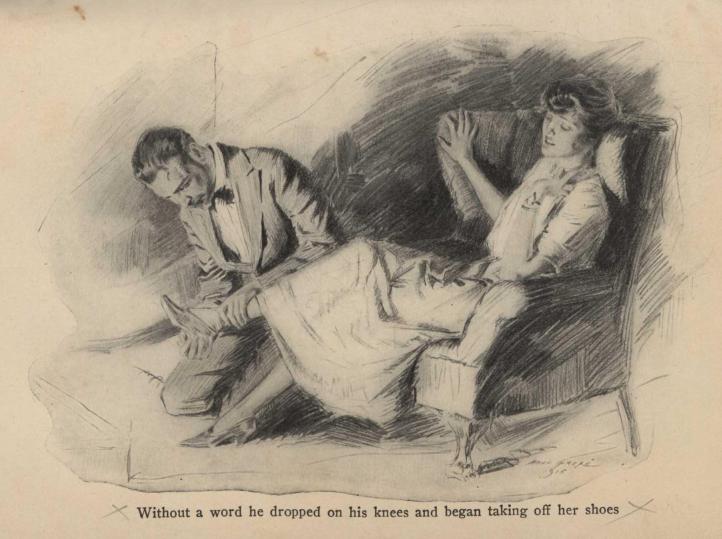
Without a word he dropped on his knees and began taking off her shoes
She felt too comfortable to protest. Besides, he did it with the wholly impersonal manner of a salesman; also, Rosalind reflected, it was a sensible thing to do.
After he had placed her damp shoes close to the fire, at one side of the hearth, he brought her a foot-stool. Then he disappeared in the direction of the dining-room. When he returned he was carrying a tray, upon which were a decanter and two glasses.
"Sherry?" he asked.
"Thank you."
She took the glass that he filled and sipped its contents. The boatman helped himself.
"Still blowing," he commented as he watched the sparks sucked up the chimney.
Rosalind gave little thought to the tumult without. She was too thoroughly luxurious. Even though her gown was wet, she felt that she had been thrust into a wholly sybaritic environment. Lazily she watched two little, ascending volumes of steam as her stockings began to dry before the fire.
"How about eating?" he asked.
"We might," she admitted. "That is, if you know—"
"Been here before," he answered, smiling. "You remember, I guess."
She watched him as he went back to the dining-room, and a minute after that from another apartment she heard sounds, which she judged to indicate the pantry or the kitchen.
It was rather curious to be in a house with a burglar, she reflected. She did not think of it as hazardous, or unlawful, or even improper—merely as curious. Ethics had been knocked out of her adventure long ago. She was thankful for the wine he brought her; she would be glad when the food came. These were material comforts, very real and needful; and her mind for the present was dwelling only upon material things.
It did not seem to her that it was even unusual to break Mr. Davidson's window, to enter his house, to light his fire, to drink his sherry, to eat his food; these were but mere incidents in a necessary proceeding.
Nor did she waste much thought upon the ringleader and companion in the affair. Who or what he was did not matter much—just then; it was what he did that counted. And Rosalind knew, if she had been alone, that she would have done precisely the same thing. She found it rather pleasant to have somebody else performing the drudgery. He came back with a loaf of bread, some butter, and a can of potted tongue.
"I'm making some tea," he said. "It'll be ready as soon as the water boils."
He carved a slice of bread, buttered it for her, and offered it. She accepted with a nod of thanks, and mentally noted the fact that he knew how to cut thin slices.
The food and wine warmed her; they even thawed her wonted austerity. When he had finished eating, the boatman rummaged some cigarettes. He offered her one; she declined, but with a smile. Had she been alone—well, she might.
Under past circumstances, such an assumption on his part would have roused her to rebuke. But she was in an oddly comfortable mood.
As he settled down in a chair and stretched his long legs toward the fire, she studied him furtively. Particularly she studied his head. So far as shape went, it seemed quite unlike any of the pictures that represented the heads of typical criminals. It was rather well constructed, along conventional and respectable lines.
The beard he wore baffled her somewhat in an attempt to read his face; but that also, she decided, represented a normal average. Rosalind was in no sense a criminologist; yet in outward aspects the boatman had a law-abiding appearance.
He even revealed some traits that she admired. He had courage, for one thing; and resource for another. He had strength, too, which counted for something. In certain things he was rather ingenious, if frankly unprincipled.
Strangely enough, the thing for which she would have marked him "Excellent," had she been making out his report-card, was the very one that had so frequently lashed her to anger—his absolute lack of servility.
From most persons, and always from her inferiors, servility was something that Rosalind expected—and detested. She took it as her due; yes, even demanded it. But she despised the thing itself.
The boatman had offered her none. This was presumptuous, of course; yet secretly she set it down to his credit. He never groveled; he was rarely deferential. More often, in fact, he was rude and given to mocking. But he inspired in her a sort of wondering and unaccountable respect.
He stared lazily into the fire, as if oblivious of her presence. Without, the storm still ruled, although it had palpably slackened in fury. Sam seemed to be concerned about nothing save his cigarette.
Abruptly Rosalind rallied from her musings concerning him. She had completely forgotten the reason for her presence on Davidson's Island—that she was being kidnaped into matrimony! Her lips tightened, and she glanced at him sharply.
Had he really meant it? He appeared to have forgotten it completely. And if he had meant it, was it a sign of madness?
Try as she would, she could not reconcile the boatman with presumptive insanity. For that matter, she could not reconcile him with much of anything. She never realized until this moment how little she actually knew about him.
He looked up; their eyes met. Rosalind colored faintly. Something shot her thoughts back to the last instant aboard the launch when his wet beard brushed her cheek. She wondered if he really had—there was so much confusion.
"Sam!"
"Yes, ma'am."
"Please don't say 'ma'am' to me."
"Why not?"
"It's a word you are not accustomed to employing," she answered.
His study of her face was brief yet comprehensive.
"You think so?"
"I know it. It took you a long while to say it without hesitating. And it does not—well, harmonize with other things that you say."
"All right; I'll quit it, Miss Chalmers."
"You helped me out of a rather bad situation a little while ago," she said slowly.
She wanted to thank him, yet felt instinctively that he did not wish to be thanked.
"Well, I got you into it; that was why."
"Yet if I had left your island alone I would undoubtedly have been caught in the same storm."
"Oh, perhaps!"
"I think it was—splendid!"
"Why, thanks, ma—I mean, Miss Chalmers. Only you did the same for me after you were up on the rock. So that makes it a stand-off."
Something in his manner and his speech perplexed her. Always before there was raillery, derision; now he seemed to cloak himself in a grave reserve.
"Sam!"
He waited for her to continue:
"You are not really a—common boatman," she said very positively.
"Sure of that?"
"Quite. But who are you?"
"You know enough, I guess."
"I'm afraid you are a burglar."
"It looks like it, doesn't it?"
"Are you a spy?"
"I'm not on the witness-stand."
"Or a smuggler? And before you answer that I don't mind saying that all smuggling is not—wicked."
He laughed outright.
"You certainly want me to confess something, so you made that one easy. Well, if I'm a smuggler I'm not a very good one, I'm afraid. I haven't been able to smuggle you to the American side yet."
Rosalind stiffened in her chair. Automatically she drew her stockinged feet beneath her skirt. If there was to be another battle she felt that there was a lack of militancy about her feet. A lady without her shoes is scarcely girded for combat.
"That of course was an utterly absurd idea," she said firmly. "But I am willing to consider it as a joke, in view—of all that has happened."
"Much obliged. But it wasn't a joke."
"You couldn't have meant it seriously?"
"Absolutely, Miss Chalmers."
"But why? Whatever put such a wild idea into your head?"
"I told you at the time. No use to go all over it again."
"But you must have had some reason."
"Sure. I wanted to marry you. I should say—'want.'"
"You still—"
"Want to? Oh, yes!"
"And you expect to go on with this impossible—affair?"
This time he merely made a gesture. It might have meant anything.
"Would you marry a woman who hated you?"
He considered this for some time, then looked her evenly in the eyes and answered:
"You don't hate me."
Rosalind flushed, and did some considering on her own account.
"Possibly not," she admitted. "They say it is wicked to hate, so I try not to. But, even if I do not hate you, why should you have the least reason to think I would marry you?"
"Oh, what's the use of speculating?" he said wearily. "Maybe it was because I wanted to put over a stunt nobody else had been able to do—like finding the north pole."
Rosalind rose suddenly and walked toward a window. Her first impulse was to fly into a temper.
A stunt! The task of winning her had become a—stunt! And he had supplemented the insult of comparing her to the north pole!
Yet even in her anger she felt the urging of a desire to smile. Rosalind was a severe and conscientious self-analyst; she harbored few illusions. There was something in the frigid comparison that struck her as rather clever—possibly true.
Perhaps, after all, she mused, it was a rough compliment. To be classed among things practically unattainable implies a certain distinction.
"And you know," drawled a voice from the fireplace, "the north pole was discovered."
She bit her lip and stared out of the window.
The rain had stopped and the wind was flattening. Overhead the racing clouds were being sundered into groups and patches. She could see intervals of blue.
"A boat!" she called sharply. "Mr. Davidson's yacht!"
Sam sprang from his chair and joined her at the window. The yacht was making the wharf.
"Well, I guess this polar expedition has failed," he observed whimsically. "Better luck next time."
Rosalind was thinking rapidly. The arrival of the yacht meant safety—for her. But what of the boatman?
As they watched together a small procession of persons filed out upon the dock and began to march to the house.
"Mr. Davidson!" she exclaimed. "He's back!"
The boatman nodded.
"Mr. Witherbee, Mr. Morton, Mr. Williams—oh, everybody! And they have got—Billy Kellogg!"
She could easily discern the short, stout figure of the young man who had admitted to Polly that he was an impostor. He was walking between Mr. Davidson and one of the men servants, his head bent, his attitude that of complete dejection.
The boatman inspected the group with interest, particularly the stout young man.
"Run!" exclaimed Rosalind, turning swiftly upon him.
"And what are you going to do?"
"I'm all right; I can stay. I'll explain—somehow. But you must go. Take the back door, quick!"
"But why should I go?"
"A thousand reasons!"
"So as not to embarrass you," he suggested, watching the oncoming procession.
"I—I didn't mean that. Go, while there's a chance."
"So you don't want me caught?"
"No!"
Still he hesitated. Rosalind gripped him by the arm and pushed him back from the window.
"Hurry!" she commanded. "You have time to get out the back way. Sam—please!"
The boatman smiled.
"All right; I'll disappear," he said. "Maybe I'll see you again, Miss—No; I'm going to say it just once—Rosalind!"
"You said it back in the boat," she reminded him briskly.
"Then I really got away with it—because you heard."
"Yes; you really—'got away with it,' if that satisfies you. Now run! They're on the porch."
He stepped swiftly across the library and into the hall. The sound of Mr. Davidson's key in the lock was heard. With a laughing nod at Rosalind, the boatman turned and ran—up-stairs!
"Sam!"
"S-sh!"
Rosalind faced the door desperately.
"Now I must manage to keep them down-stairs," she muttered.
CHAPTER XXII
FOOTSTEPS ABOVE
As the door was flung open Rosalind stood with her back against the newel-post of the staircase, braced for defense against an army. Her brain was in a tumult of activity.
"Rosalind!"
It was Polly's shriek. With it she sprang forward. The lady at the foot of the staircase waved her back with a gesture.
"I'm quite all right, thanks," she said coolly.
"You're half drowned!"
"Not in the least; merely a little wet. Don't bother, Polly."
The men were staring as if at an apparition.
"Well, I'll be—"
Mr. Davidson left the sentence unfinished and resumed his incredulous scrutiny.
It was Reggy Williams's turn to make a rush; but, as in the case of Polly, Rosalind wafted him away with a motion of her hand.
"Please don't make a fuss," she said. "No damage has been done whatever—except to a window. I broke it to get in."
"But how? Where did you come from? What brought you—"
The chorus of voices brought a frown of annoyance to her brow.
"I was rowing when the squall came," she observed quietly. "This was the nearest place to land, so I came here. Apparently nobody was at home, so I had to force my way in in order to get out of the storm."
"We—we didn't know what had happened!" exclaimed Polly, her voice trembling. "We thought you might be—lost."
"I took care of myself quite nicely, thank you. I've had tea and bread and butter, and I lighted a fire."
Rosalind's glance scanned the group and rested upon the stout young man. He stood limp and unresisting in the grasp of Mr. Davidson's butler. In the surprise of the meeting he had been forgotten. He seemed quite contented to have it so.
"Well, thank the Lord, you're safe!" said Mr. Davidson heartily. "Glad you made yourself at home; the house is yours. I got your telegram, you see."
He turned to glare at the prisoner, who was bestowing upon Rosalind a look of gloomy reproach. She eyed the young man coldly.
"I thought it was best to send for you," she said.
"Best! I should say it was! You—you impostor!"
The master of the house shook his fist under the nose of the prisoner, who retreated a pace.
"Of course he isn't your nephew?"
"That! My nephew? I should say not!"
The stout young man shifted his feet.
"Once more I'll give you a chance to tell who you are," said Mr. Davidson as he whirled upon the fellow.
The captive remained dumb.
"See that!" exclaimed Mr. Davidson. "He won't say a word. Hasn't said a word since I got here. We've searched him. And, by George, he's got letters on him addressed to my nephew, Billy Kellogg! And letterheads with the name of 'Hastings & Hatch'! I tell you there's something bad here."
"You think—"
"That maybe it's—murder!"
Polly suppressed a little shriek, while the stout and speechless young man shook his head miserably.
"Yes—murder! Why not?" demanded Mr. Davidson. "He's probably done away with my nephew, taken his place in New York, and all that sort of thing. I'm wiring for more news now. The scoundrel—"
"But if that's the case," broke in Reggy Williams, "I don't see why he'd want to come up here."
"Perhaps to finish his bloody work—to kill me!"
The prisoner sagged into the arms of the butler.
"That seems rather incredible," mused Rosalind.
Her observation of the captive had long ago driven her to the conclusion that he was quite harmless.
"Incredible!" echoed Mr. Davidson. "Everything's incredible here lately. If it's not murder, what is it? Where's my nephew? This man won't tell. He knows; he's simply got to know! He hears I'm away and he comes up here posing as Billy. If it hadn't been for Polly here or Morton he'd have fooled you all."
"But Mr. Morton—"
Rosalind checked herself and glanced at the Englishman. He chewed one end of his mustache, but remained silent. Morton had taken no part in the exposure; on the contrary, he had accepted the impostor.
"Oh, Morton pretended to know him, just so as to be able to watch him better," said Mr. Davidson. "I understand all about that. But what I want to know is, who is this scoundrel? Are you going to tell, sir? Who are you?"
The young man remained steadfastly silent.
"Maybe I can make him talk," said Reggy Williams grimly, advancing his huge bulk toward the captive.
It was Mr. Witherbee who remembered first Reggy's heart! Everybody had forgotten it in the turmoil.
"Never mind, old man," he said anxiously, with a restraining hand on Reggy's arm. "Take a chair. Sit down."
Reggy looked at him disgustedly.
"Will somebody kindly explain to me what this take-a-chair game is?" he demanded. "Everybody seems to be crazy on the subject of chairs; everybody wants me to sit down. I don't want to be disobliging; but, great Scott! a man can't sit down all his life!"
Rosalind, still on guard at the newel-post, was chewing her lips.
Polly's eyes were distended with apprehension.
"Well, never mind trying to make him talk now," said Mr. Witherbee soothingly. "Just leave it to Davidson."
"I'm going to leave it to the police," said that gentleman. "I've sent for them. We're going to have a few things explained before I get through. First, there's my nephew's murder."
"But you're not sure about that," Rosalind reminded him. "Perhaps he'll turn up all right."
"Perhaps." But Mr. Davidson's tone was pessimistic. "We'll know before long, at any rate. Then there's that boatman who's been hanging around here. I've got men out after him now."
Rosalind breathed softly. She was eagerly yet fearfully listening for some sound from up-stairs.
"What is he wanted for?" she asked.
"Burglary—almost everything! He is in on this; we feel sure of it. Morton tipped me to get him."
Rosalind studied the Englishman swiftly, but his face was impassive. So Morton had turned on the boatman at last! She wondered why.
"Don't forget the smuggling either," said Mr. Witherbee.
"I haven't," answered the master of the house. "I've sent for the customs men. I want them to look this chap over, and also that boatman—when we get him."
"Some of them think the boatman is a spy," Polly reminded him.
"Likely enough. But that's none of my affair. He can spy till he's blind so far as I'm concerned. I want him for housebreaking."
Rosalind experienced a qualm, not of conscience but of anxiety. She felt that her house of cards was about to topple. If they did get the boatman, what of her?
"Well, no use standing here," said Mr. Davidson. "We can't do anything more, I suppose, until the police come. Let's go into the library."
"And what'll I do with him, sir?" asked the butler, indicating his prisoner.
"Take him up-stairs and lock him in the attic."
Rosalind's hand went to her throat. Instinctively she moved to bar the stairway.
"I wouldn't," she advised hastily. "He might escape."
"Can't," declared Mr. Davidson emphatically. "He's too big to get through an attic window, and if he did manage it he'd drop about forty feet to the ground. Take him up-stairs, James."
"No," said Rosalind firmly.
Mr. Davidson looked at her in surprise.
"I've a better plan," she continued quickly. "Keep him with us. Watch him. Study him. Sometimes they—they betray themselves."
The prisoner regarded her with appealing eyes.
"All right; watch him if you like," assented Mr. Davidson. "Bring him into the library, James."
Not until the last of them had left the hall did Rosalind desert her post at the foot of the staircase. As she moved to follow she gazed swiftly upward, but the boatman was not in sight.
Her mood was a mixture of alarm and irritation. For the life of her she could not understand why Sam committed the folly of seeking a refuge upstairs, when there were easy avenues of escape by the rear of the house. True, he might make his exit by an upper window and across the porch-roof; but it was an extra and a useless hazard. Most amazing was the fact that she did not know whether he was still in the house. She prayed he was not, but feared otherwise. Nobody must go up-stairs until she could be sure.
It did not add to her peace of mind to discover as she followed the prisoner and his captors into the library that she was shoeless. Over by the fire her slippers were still drying. Mr. Morton was staring solemnly at them.
With icy dignity she glided past him and picked them up.
"Ah—allow me," he said, dropping to one knee.
"Thank you, but I always put on my own shoes," said Rosalind.
Damp as they were, she contrived to squeeze into them. They gave her a sense of security.
"You must have been good and hungry, Rosalind," remarked Reggy Williams.
He was examining the tea-tray with its two cups and saucers. She did not at first understand.
"Certainly I was hungry."
"As hungry as two people, evidently."
She colored faintly, but answered readily enough. "Oh! you mean the two cups and saucers. I did it absent-mindedly. I'm not accustomed to lunching alone."
Reggy's finger touched a cigarette-butt that lay on the tray; his glance was accusing.
"I admit it," said Rosalind coldly. "Is there any reason why I should not?"
Reggy made a disapproving gesture, but answered not.
"There are two more on the hearth," she added, pointing.
"But, Rosalind—"
"I am exceedingly fond of them. That is sufficient."
She spoke with a finality that discouraged him, which was exactly what she intended. Mentally she added another mark to the score against the boatman.
The stout young man had been placed in a stiff-backed chair near a window. The butler stood vigilantly at his side, ready to descend upon him if he made a suspicious move. But the prisoner was inert. All volition as well as speech had deserted him.
Mr. Davidson paced the library, talking volubly. Now and then he halted in front of his victim and glowered at him belligerently. That young man was too impassive even to think. He seemed utterly uninterested in his fate.
Mr. Witherbee tried to insinuate a chair under the legs of Reggy Williams, which brought an outraged snort from that gentleman. Rosalind was beginning to feel the tension. Would the boatman never go? Or had he gone?
They pressed her for the story of her own adventures and she supplied it rapidly as she could invent. It was not easy to eliminate Sam from the recital; more than once she checked his name on her lips. Yet she managed a very fair yarn. It filled Polly with thrills of awe and admiration. She could not take her eyes from the narrator.