"Salt Water" (continued 6)
Reading edition
Just before we reached that place, he called me to him.
“D’Arcy,” he said, “I have remarked your steadiness and discretion above your years; and as I have a difficult and—I will not conceal it from you—a hazardous expedition to make, in which a companion to assist me would be very valuable, I wish to know whether, if the captain will allow you, you would be willing to accompany me?”
Where is the midshipman who would not have answered as I did, and say that I should be delighted, and that the more danger the better fun? In fact, my heart almost came into my mouth at the proposal; and my only fear was that the captain might put his veto on it.
“Oh! just tell him, sir,” said I, “that I have neither father nor mother, nor brother nor sister; and I don’t think that the great Counsellor D’Arcy would break his heart if anything happened to me, nor bring an action against him for expending a midshipman uselessly. My other uncle is a naval officer, and he would never dream of objecting.”
I do not know if these reasons had any weight with the captain, but he granted his consent to my accompanying Mr Vernon, who forthwith gave me a sketch of his proposed plan of proceeding.
“You must know, D’Arcy,” said he, “that the young Reefian informs me that the Ariadne was driven inshore by a heavy gale; and that before she had time to haul off, a calm came on, when several boats, manned by his people, pulled off to her. The master, who seems to have been a brave fellow, had no notion of yielding without a blow, and, arming his crew, gave them a warm reception. Several of the Reefians were killed and wounded before they could make good their footing on board. The gallant master was killed, and so were more than half his crew. Major Norman and the rest of the people escaped without a wound, though they expected to be cut to pieces; but their defence had so excited the admiration of their captors, that they were, instead, treated with considerable kindness, though ultimately marched off as prisoners. Miss Norman was discovered in the cabin; but when it was known who was her father, he was allowed to accompany her. The people who captured the brig belong to a tribe ruled over by a powerful chief, who resides some miles along the coast. He seems to have claimed the brig as his own perquisite; and this youth, who is a relation of his, was living on board to take care of her. Miss Norman and her father likewise became his property, but I cannot speak my gratitude to Heaven, on finding that she is treated with the most perfect respect, while her father is employed in the gardens of the Kaid. His young nephew describes him as a fierce, despotic old fellow, not at all likely to give up his captives, unless compelled by force. He says that he is so very wealthy, that no temptation of a high ransom will influence him. This, however, I am resolved, without delay, to ascertain, and to employ every means in my power to liberate my friends. He seems to owe no allegiance to the Emperor of Morocco, or to any other acknowledged potentate; so that I will not attempt the long business of negotiation, which would, too probably, end in disappointment. At first I thought of taking the lad with me, but then I considered that he would be of more service as a hostage on board; and I have promised him that, if his information be correct, and I succeed in recovering my friends, I will give him an unerring rifle and a silver-mounted dagger, so that I have won him over completely to our interest. As I speak Arabic as well as any Turk, I have resolved to assume the character of a Turkish jewel-merchant on a journey to buy precious stones for the Sultan. I feel that I can act the part very well. How does the plan strike you?”
“Very good; capital, sir,” I answered, the romance of the thing taking my fancy immensely. “But, as I do not speak a word of Arabic, or any Eastern language, I do not see how I am to help you.”
“I have thought of that,” said Mr Vernon. “You must pretend to be dumb; I hope that you will not have to hold your tongue long. I wish you also to take your violin. I do not know that the Turks ever play it; but you must be my slave, you know—a Christian slave, not long captured,—and that will account for your knowledge of so Nazarene-like an instrument. Miss Norman heard you play once on board, and you will thus certainly attract her notice, and be able to hold communication with her.”
“Oh! excellent—excellent,” I exclaimed, enchanted at finding the very event I had once dreamed of about to be realised. “When are we to commence our adventure?”
“As soon as I can arrange our costumes, and make other necessary preparations. Captain Poynder, after he has landed us, intends to watch off the coast, and to stand in at night, to be ready to render us any assistance we may require.”
Two days after this conversation, a party of travellers were seen issuing from the ancient gates of the city of Tangiers,—in days long gone by, when Charles the Second ruled the land, held by a British garrison, till delivered over to the Portuguese. He who seemed to be the leader of the party rode a strong, active horse, and was habited in long, dark, flowing robes, a turban of many folds of muslin, long yellow boots, and spurs of great size. A large moustache, and a beard bushy and long, almost concealed his month. The ink-horn at his waist, and his want of weapons of defence, showed that he was a peaceable character. A lad also, in an Eastern dress, though of simple and somewhat coarse materials, followed him on a stout mule, which likewise carried a pair of saddle-bags, and a small square chest secured in front. Slung over the back of the youth was a long case, of curious form. A dagger at his side was the only arm he wore. A tall man, well-armed with matchlock and scimitar, rode ahead on a stout nag. On his head was the high red Moorish cap, with many folds of muslin twisted round it. The flowing hair fell over his shoulders, above which he wore a soolham of red cloth, while gaily-worked yellow boots, and a pair of spurs of cruel length and sharpness, adorned his feet. He evidently felt his importance, as the protector and fighting-man of the party. Another personage followed, of inferior rank, with a mule, which carried the chief part of the baggage. The country through which they travelled was of an undulating character, but parched by the suns of summer, the beds of the winter torrents being now stony ravines, and the only green visible being furze and palmetto, and here and there patches of Indian corn not quite ripe, though the stubble of fine wheat and barley extended over a considerable portion of the ground.
“D’Arcy, my boy, how do you like being turned into a young Turk?” said Mr Vernon, calling me up to him, after we had proceeded some way.
I touched my mouth, and pointed to out escort.
“Never mind them,” he replied; “they are, I am assured, faithful to the backbone, and know how matters stand. There is little use of giving such men half-confidences.”
“Then,” said I, “I’ll make play with my tongue while I can. I like the fun amazingly. What do you propose to do, sir, next?”
“In the first place, when we get up to the territory of the old chief, Mulai Mohamed, we must leave our escort and proceed alone to his village. We must present ourselves at his residence, and, inquiring whether he has jewels to sell or wishes to buy others, must endeavour to gain access to the inmates of his harem; or, at all events, we must try to meet with Major Norman, or some of the crew of the Ariadne. However, we must be guided entirely by circumstances.”
It was a great satisfaction to me to be able to talk, for I fancied that I should have had to hold my tongue from the moment I set foot on shore. I wish that my space would allow me to describe my journey, for it lasted a considerable number of days, and was very amusing. We pushed on as rapidly as the strength of our steeds would allow, though that was far from fast enough to suit Mr Vernon’s impatience. We met with a variety of adventures also. At night we used to halt, and pitch our tent, and fetch water, and cook our supper; while our followers would sit before the fire, recounting their adventures, or boasting of the deeds of their ancestors or friends, or telling tales of genii or ghouls, and a variety of other beings, in whose existence they firmly believe. As we journeyed on, we killed a quantity of game, chiefly partridges, which crossed our path in great numbers; and now and then we got a shot at a wild boar, and knocked him over. At night, watch was always kept with a good fire, or we should have had the jackals, who were always howling round us, paying us a visit. These beasts the Moors do not object to eat, though they will not touch pig. We one day fell in with an encampment of a powerful tribe, the Sheikh of which insisted on my master, Taleb Moostafa, otherwise Lieutenant Vernon, dining with him. I accompanied him for the pleasure of looking on, though, of course, I was not expected to eat likewise. On arriving at the tent of the Sheikh, we found him seated within it, on a cushion, covered with thick skin, another being placed for the Taleb, or scribe, for to that learned profession Mr Vernon thought he might venture to belong. A variety of compliments having passed, a table was brought in and placed between them. It was circular, about two feet in diameter, and scarcely more than six inches from the ground, richly inlaid and painted in arabesque. A large bowl, full of a highly-seasoned soup, with some sort of macaroni in it, was first placed on the table. The bowl contained spoons, with which the guests were to help themselves at the same time. Next came a plate of beef, much stewed, and garnished with melons; and lastly a huge dish of kesksoo,—a thick porridge, made of wheaten flour piled up, which the Sheikh attacked most vigorously, while my master attempted to follow his example. When dinner was over, some of the tribe assembled on horseback, and played all sorts of pranks. Some stood on their heads while their horses went; they charged each other at a rapid speed; they changed places with their companions at full gallop; then they would dash up to where we stood, and, discharging their muskets, wheel about and give place to others, who followed at their heels. Some would dash their haicks or turbans on the ground, and leaning from their horses, would pick them up, without for an instant slackening their speed. Next they shot at a mark, a flower on a pile of stones being their target; and certainly they managed to hit it in a wonderful way. The same men, however, would probably have but a poor bag of game to show after a day’s walk over the moors in Scotland. Our friendly Sheikh accompanied us some way on our journey on the following day, with many good wishes for our welfare. I must leave out the rest of our adventures, till one evening, Hamed, our chief guide, pointing to a line of lofty mountains which fringed the coast, exclaimed—
“There, most learned Taleb, at the foot of yonder mountains, you will find the residence of the fierce Sheikh you seek. Further we dare not go, as we have no wish to feel our throats being cut. Here we will remain till you return, if you ever do return, which Allah grant may soon be, though I am doubtful of it. If you do not come back, we will report your loss to your friends, and trust they may find means to avenge you.”
Taleb Mohammed laughed at this speech, though he saw the difficulties in our way; and next morning, leaving our tents and heavy baggage, we entered the district of the Reefian chief. It was towards evening that we approached his dwelling, which we discovered from its superior size to the rest of the neighbouring sun-dried brick cottages, thatched with reeds. It was surrounded by a garden, full of melon plants and vines, and many other fruits, delicious in a hot climate; and backed by fields of Indian corn. Before entering the village, we ascended a height, whence Mr Vernon took a long anxious glance over the blue sea with his telescope, which he had brought with him.
“There she is, D’Arcy,” he exclaimed at length, in an animated tone, pointing to a white speck just seen above the horizon, which I made out to be a ship’s royal. “I knew that Captain Poynder would be up to his time. Now we can depend on help from without, if we can but find our friends.”
It was near the time that the voice of the Mueddin, from the summit of the village mosque, announced that the hour of evening prayer had arrived, and called on the faithful to worship Allah, when we entered the village. Without halting, we rode at once up to the entrance-gate of the great man’s abode. Cool confidence afforded us the best chance of success. We were brought up at a porch, with a closed gate, in a high wall which ran round the mansion. We knocked loudly, and after a time the gate was opened by a slave, who salaamed low as he demanded our business.
“To see your great, powerful, and most illustrious master, etcetera, etcetera, etcetera,” said Mr Vernon, in Arabic. “Tell him that I have come to treat with him about a matter of great importance.”
The slave on this disappeared, keeping us outside, though he shortly returned, with two or three more slaves and a couple of armed men. Two of the slaves taking our steeds, the first signed us to advance, and led the way through a garden full of sweet-scented plants, the verbena, the jessamine, and rose, and shaded by luxuriant vines, trailed on bamboo trellice-work over head, the fruit hanging down in tempting bunches within our reach. In front of an alcove, or summer-house, on a rich carpet, sat a stout old man, in flowing robes, and long white beard, which hung down over his breast. We bowed low, and then stood still before him, for he did not offer us cushions to sit on; while Mr Vernon, paying the fullest compliments his knowledge of the language could command, opened his business.
“I do not understand clearly what all this is about,” said the old Sheikh, in reply. “Jewels to sell and jewels to buy. Perhaps to-morrow I may understand better. Come again in the forenoon, and show me your wares, and we will see what is to be done.”
Taking this remark as a signal that we were dismissed, we salaamed as before, and retired down the garden. We had reached the entrance, when a slave overtook us, and informed us that his master would allow us to sleep in a guest-room, opening into an outer court-yard, on one side of the main entrance. Mr Vernon told me afterwards, that not having any definite plan, he thought it would be wise to accept the Sheikh’s offer with a good grace, as more likely not to excite suspicion. The room to which we were shown was a small one, without windows or furniture, some little apertures over the entrance alone admitting light and air when the door was shut. It had the advantage, however, of enabling us to get out without being observed. Still a great difficulty remained—how we were to obtain any information about Miss Norman in the first place, and how we were to gain access to her in the second. In my character of a slave, I assisted the Sheikh’s slaves in bringing in the box of jewels, the saddle-bags, and saddles, and horse-cloths, as well as our blankets, which we had brought to form our beds at night. Our room being arranged, Mr Vernon told me to remain within, while he went out to try and obtain some information in the village, advising me in the meantime to amuse myself with my fiddle, which had already delighted the ears of many of the believers of the Prophet of Mecca during our long journey. I had some misgivings about his going, for I was afraid that the villagers might suspect his character, and might ill-treat him. For myself I had no fear as long as I could continue to feign dumbness, as my character was easily kept up. He had told the Sheikh’s people that I was a Nazarene lad, who was ignorant of their language. Being dumb, they considered me under the peculiar care of Providence.
After a little time, having recovered my spirits and cast all forebodings from me—which are, after all, but the result of a morbid imagination, or of a want of trust in God’s providence,—I sat myself down on the chest, and pulling my fiddle out of its case, began playing away most vigorously some of the old tunes Hanks had taught me. I had gone through some five or six of them, when a voice, which I felt sure I had often heard, hailed—
“Hillo! shipmate, what part of the world do you come from?” The faint light which came through the door was obscured by the figure of a seaman.
“Why!” I exclaimed, forgetting that I was dumb, as he stepped into the room,—“why, if I can believe my senses, there is Jack Stretcher himself.”
“What! is that you, Mr D’Arcy?” he answered; coming up to me, and taking my hand. “I should not have known you in that rum rig, sir, if it hadn’t been for your voice, I declare.”
Our errand was soon explained; and he then told me that, having been offered a berth as second mate of the Ariadne, he had obtained his discharge from the cutter. To my great satisfaction, he told me that Major Norman was really a slave in the Sheikh’s house, and that his daughter was in the harem. What had become of the rest of the crew he could not tell.
While I had been speaking, I had been scraping away to drown my voice, in case anybody came near. I now urged Jack to go and find the major, to let him know that help was at hand.
“Time enough by-and-by, when he comes in from the fields, where they’ve sent the poor gentleman to work. They put me to field labour at first, but they found out that I was handy as a rigger, so they’ve put me to refitting some of their craft. They’ve given me to understand that if I’ll consent to turn Moor or Turk, or somewhat of that sort, and worship their Prophet, they’ll make me a captain, or admiral for what I know, and will give me one of their black-eyed young women for a wife; but I’ll see them all triced up at their own yard-arms before I changes my religion, or forgets my own faithful rosy-cheeked Poll at home.”
I applauded his resolution, and charged him to adhere to it in ease he should not escape.
“No fear of me, sir, I hope,” he answered. “But, I say, sir,” he added, in a serious tone, “I hope Mr Vernon, who used to be a very nice young gentleman when I knew him in the Turtle, ain’t turned Turk in earnest.”
I assured him that he was only acting the part for a short time, which, I believed, was lawful.
“Well, I’m glad of that, sir,” he replied. “But, I say, sir, what do you think?” He looked out of the door, and then came back, and continued,—“I see a number of these Moorish fellows coming here, drawn, it’s pretty clear, by your music. Now I’ll just see if we can’t astonish the natives. Do you strike up a right jolly hornpipe, and I’ll toe and heel it till all’s blue, and see if I don’t make them understand what a real sailor can do with his feet when he’s inclined.”
The idea pleased me amazingly; so I came to the door, and began to scrape away right merrily, while Jack commenced one of the wildest hornpipes I ever saw danced. How he cut and shuffled,—how he crossed his feet and sprang up in the air, and kicked and capered,—it is almost impossible to describe. I could scarcely forbear laughing myself, especially when I saw a number of grave long-bearded Moors assembled round him, with looks of mute astonishment and admiration at his agility.
Mr Vernon soon joined them, and was as much astonished, evidently, as the rest. At last even Jack’s physical powers could hold out no longer, and, exhausted, he threw himself down on one of our horse-rugs near the door. He had, however, not remained there long, when one of the Sheikh’s slaves made his appearance, and, salaaming Mr Vernon, said that his master had been informed that his young follower possessed a wonderful instrument, and a wonderful talent for playing on it, and that he wished to hear him. He intimated also to Jack that he must get up and go through his hornpipe again. Jack, nothing loth, sprang to his feet, and, as he passed Mr Vernon he whispered, “Now’s your time, sir; look about you.”
We and several of the spectators were now forthwith ushered into the presence of the great chief. We found him seated in the garden-porch of his house, a number of lamps hanging from the trees around him. It was a picturesque and romantic scene. Four or five persons—mostly grave old gentlemen with long white beards—sat on cushions on either side of him; while others, in rich dresses, which betokened some rank, stood behind him. He had evidently been having a dinner party, and now wanted an evening entertainment. Mr Vernon salaamed before him, and asked what was the pleasure of so generous, magnificent, and grand a chief.
“Why, this: Understanding your young slave can play in a wondrous manner, I wish to hear him,” said the Sheikh. “But tell me, O merchant! how is it that he can communicate with my captive, as I am told he does. They must have been acquainted before.”
This question at first puzzled the pretended Turk, but he promptly replied, “O most wise and sagacious chief, worthy of being monarch of the faithful, know that these Nazarenes are in their youth instructed in many arts and sciences. Some play on instruments, some dance, others sing, or paint likenesses of men and beasts, strange abomination as that may appear. Now my slave is one who has learned to play on an instrument, and he who has the happiness to be owned by your highness, is one who has learned to dance.”
“I see, I see,” exclaimed the chief; “and it is a sin that two such accomplished slaves should belong to different masters; therefore, merchant, what price do you fix on yours? for, if he answers my expectations, I intend to become his purchaser.”
This announcement puzzled Mr Vernon somewhat; but, of course, he could not refuse at once.
“He is unworthy of being possessed by your highness,” he replied; “for nature has not allowed him the power of speech. But, rather than speak of that matter, let him show you a specimen of his art.”
He then made a sign to me, and I struck up Jack’s favourite hornpipe; the Moors, old and young, black beards and grey, short and long, forming a circle round him. Up he jumped, and, with arms akimbo, commenced his dance. If he had before shuffled, and kicked, and capered, he now redoubled his efforts, snapping his fingers, clapping his hands, turning and twisting in every conceivable way. Scarcely ever before was such a hornpipe danced. It drew forth rounds of applause from even the gravest of the spectators. The chief was delighted. Turning to one of his attendants, he gave an order, which I did not then comprehend. Mr Vernon had kept outside the circle, to be ready for any emergency which, as Jack hinted, might occur. I, meantime, played away a variety of other tunes, till Jack, jumping up from the spot where he had thrown himself, made a sign to me to begin another hornpipe. This time he even outdid either of his former attempts; indeed, before, I believe that he was only shamming being tired; for my fingers and elbows began to ache before his legs or breath gave any signs of his wish to end the dance.
“Change the tune, Mr D’Arcy. Wallop-ahoo-aboo! I’ll just give them an Irish jig to keep them staring.”
A jig I played, and a jig he danced, with agility enough to win the heart of any Nora Creina in old Ireland. Then I tried a Scotch reel, and he almost outdid the jig: nor did he cease till he saw Mr Vernon rejoin the circle.
“Now if we haven’t bamboozled the old gentleman famously, my name’s not Jack Stretcher!” he exclaimed with a loud laugh, slapping his thigh; an action which was naturally supposed by his audience to mark the finale of his barbaric dances.
Exclamations of wonder broke from the lips of all around; and I, having played a few more airs, we were dismissed, graciously, to our dormitory.
Mr Vernon then told me that, while Jack was dancing, he had managed to speak both to Major Norman and his daughter, the chief having sent for the inmates of his harem to witness the strange seaman’s dancing.
It was arranged that we should the following night try to communicate with the frigate’s boats; and if they could manage to send a party on shore, that we should scale the walls of the harem, and carry off Miss Norman—they being ready to support us. She, at at all events, would be prepared for the emergency.
Mr Vernon told me that, from what he heard, there would be no use negotiating, as the old chief boasted that he never had given up a slave he had taken, and never would. He was also subject to fits of fury, so that no time was to be lost in carrying out our plans. The great difficulty was to communicate with the boats, but Jack undertook the task. While employed in the harbour he had observed where some small skiffs lay, and he declared that he could easily steal off with one of them, and should without difficulty fall in with the boats. The next day was to be spent in marking out our line of retreat, and in settling the spot at which the boats were to land.
In the afternoon Mr Vernon was sent for to exhibit his jewels, and I went with him. The Sheikh laughed at the idea of he himself having any to sell, but he had no objection to buy some; and that the ladies of the harem might select for themselves, we were ushered to the entrance of its sacred precincts. I kept my eyes very sharp about me, and I saw that, by scaling a not very high wall, we could easily get up to the very door of the harem, which was separated from the main building. I at once recognised Miss Norman, though she was veiled like the rest of the ladies. She came forward to examine the jewels, and looked at several which the Sheikh offered her. One after the other she put them back into the box, till at last Mr Vernon contrived, unobserved, to slip a paper into her hand.
“It’s all right,” thought I. “Miss Norman will now be prepared when we are ready to help her to escape.”
A few jewels were bought; but Mr Vernon signifying that he would be happy to return on the following day, should any of the ladies desire to change their mind, they unanimously declared that he must certainly come.
Several times during the day Jack made excuses for coming up from the harbour, and each tune brought his ample pockets full of rope. As soon as it was dark he came cautiously into our chamber, where we all set to work, and in a short time had manufactured a rope-ladder quite long enough to go over the garden wall.
“Now,” said he, “I must be off, and try and fall in with the frigate’s boats. I have a skiff all ready, but I may have some way to pull; so don’t, sir, make a start till I come back and let you know all’s right.”
Several very anxious hours passed away after Jack’s departure, and Mr Vernon and I at last began to fear that some accident had occurred to him, or that he had missed the boats, and that we should have to risk another day within the old Sheikh’s power. Major Norman and his daughter must have been still more anxious, for they were separated from each other, and less able to account for the delay than we were. At length our anxious ears caught the sound of a light footstep, and Jack poked his head in at the door.
“All right,” he whispered. “The boats are ready to pull in when I signalise them. While you, gentlemen, go and get the young lady, I’ll be off and call the major.”
Eagerly Mr Vernon and I hurried out, carrying the ladder between us. It was a wonder some of the numerous dogs, found in every Moorish village, did not give tongue at us. We reached the part of the wall nearest the harem. Mr Vernon soon clambered up it, and, hoisting up the ladder, secured one end on the garden side, by pegs in the ground, which we had before prepared; while I held down the outer side. I heard him give a low whistle, as he had arranged. While I was anxiously waiting his return, I felt a hand placed on my shoulder. I started with horror, and almost let go the ladder, for I thought it was a Moor come to capture me, and that our enterprise had failed; but, looking up, I saw Jack’s honest face, and Major Norman behind him.
“I think, sir,” said Jack, “if you were to go over the wall, and help the lady up, it would make quicker work, and it won’t take you long to follow.”
His advice seemed so good that I did as he recommended. Fortunately I did so, for I do not think otherwise the ladder would have kept in its place. I found Mr Vernon waiting at the door of the harem, in despair almost at the non-appearance of Miss Norman. At length the bars within were gently removed, and, the door opening, she stepped forth into the garden. There was no time for greeting. Closing the door, Mr Vernon took her hand, and hurried on to the ladder. Climbing up, he had lifted her over the wall, and placed her in safety in her father’s arms, and I was following, when a door in another part of the building flew open, and a bright light streaming forth, I saw the old chief and a number of his attendants, with arms in their hands, rush out into the garden. I was over the wall in an instant, pulling the ladder after me, and not waiting to see which way they came.
“Fly, sir, fly!” I exclaimed. “The old tiger is after us.”
No second warning was necessary, and Mr Vernon and her father, lifting Miss Norman between them, hurried along the road towards the beach, Jack and I bringing up the rear, to keep our pursuers at bay. Lights now appeared in different parts of the village, and just as we turned a corner we saw the old Sheikh and his people in hot pursuit of us.
“Run, sir! run as fast as your legs can carry you, and bring up the people from the boats,” cried Jack, as he saw our enemies coming after us, and drawing a cutlass with which he had provided himself from the boats, and buckled to his side. “I’ll keep these chaps off from the young lady till help comes to us, I’ll warrant.”
I darted forward as fast as my legs could carry me. I was afraid every instant of being stopped by some Moor who might dart out from his house; but happily at that time the inhabitants of the village were fast asleep, and as yet there had been no noise to awaken them. Fortunately the old Sheikh was too fat to move fast; and his slaves, probably, had no fancy to encounter the formidable Englishman, whose agility of heel had made them fancy him little short of a Gin, or evil spirit of some sort. At last I reached the little creek where the boats were lying, the men resting on their oars, ready to shove off at a moment’s warning.
“Help! help!” I exclaimed, panting for breath. “Help! or Mr Vernon will be retaken.”
In a moment Adam Stallman, and a dozen men from the different boats, were by my side. All had been arranged for the emergency which had occurred. On we ran, in close order, at a double-quick step. Scarcely were we in time. The Moors were up to our friends, but Jack was laying about him in such gallant style, that no one could manage to lay hold upon them. His sword flew round his head like a flash of lightning; and though his opponents cut and thrust at him from all sides, he remained unhurt, while he had drawn blood from several of their sides. He shouted, and shrieked, and leaped about, springing now on one side, now on the other, yet back again in the middle of the road, if they attempted to press too much forward. Stallman, seeing at a glance how affairs stood, divided his people, so that they could encircle Mr Vernon and his friends; and then, coming up to Jack’s assistance, for a moment entirely drove back his assailants. By this time the whole village was aroused, and the Moors, collecting in numbers from the houses, attacked us furiously on all sides. Our brave fellows, however, kept them at bay, and retreated in good order towards the boats. We had no time to lose, in truth, for they were making for the boats themselves, and, if they got in our rear, might cut us off, and overpower also the party left in the boats. It was with no small satisfaction that I heard the voice of Dicky Sharpe shouting out to us to come on; and then a brisk fire from the men with him cleared the intervening space of Reefians, who had got ahead of us. The old chief and his slaves had hitherto not fired, either for fear of hurting Miss Norman, or because they had no powder or firearms. Now, however, the blood of all parties was up, and pistols began to flash, and sabres to clash, and a hot fight was going on, as we made a dash for the boats, and Miss Norman was lifted safely in. The Reefians now rushed furiously down on us. Adam Stallman and Jack Stretcher were the last men in, they keeping a whole host of Moors at bay, while the boats were being shoved off; then, by a desperate leap, Jack, by Stallman’s order, got into one of the boats, while he himself sprang into another. Alas! at that moment a volley came rattling down among us, and before Stallman could take his seat he fell into the bottom of the boat. It was the one I had reached. I stooped down.
“Where are you hurt, Stallman? Oh! tell me, tell me,” I exclaimed, taking his hand.
“In my side; lend me a handkerchief, pray,” he answered, faintly. “But give way, my lads—give way; never mind me.”
The men had stopped in their exertions for a moment, and were leaning forward to discover if he was much hurt. They needed not, however, a second order, for volley after volley came rattling over us; while the foremost and more daring Reefians in their rage rushed into the water, in the hope of seizing us. Some who grasped the gunnel had reason to repent their temerity; for we dealt them such blows with our cutlasses, that they were compelled to let go, every wound they received increasing their fury. Others waded after us up to their arm-pits, firing their pistols, and cutting at us with their scimitars, shouting fiercely at us all the time, and grinding their teeth with rage and disappointment. It was no child’s play; for, had they caught us, they would have destroyed every one of the party. By dint of great exertion the boats were at length got clear and into deep water. By the flashes of the firearms I could see the old Sheikh standing on the beach, and trying to urge his followers to pursue us still further. When they found that all hope of preventing our embarkation had gone, they hurried of to the harbour to launch their own boats for the pursuit. We had a long way to pull, several of our people were hurt, and the boats were likewise full of men; so that we felt we were far from certain of escaping after all. Mr Vernon ordered the gun in the bow of his boat to be fired, to draw the attention of the frigate, should she not have heard the sound of the musketry; and I followed his example. By this time we were a couple of miles or more away from the shore, but the frigate was still some five or six miles from us. Before long, by the light of the dawn just breaking, we could see the Reefian boats stealing out from the land; but we had now no great fear of being caught. Still our enemies pulled very fast, and were animated with every feeling of rage and revenge to excite them to exertion. Hitherto there had been a dead calm, which much facilitated our progress; and as the gloom of night cleared away, we could see, in the grey of the morning, the frigate’s topsails hanging uselessly in the brails. I kept anxiously looking back at our pursuers.
“Do they gain on us?” asked Stallman, who sat propped up in the stern-sheets.
“I fear so,” I replied; “but the frigate is still not so very far off.”
“If they overtake us, I will ask you, D’Arcy, to drop astern a little, and try and keep them at bay, so as to afford the first gig a better chance of escaping,” he said, faintly.
This was the boat Miss Norman was in.
“Of course, Stallman,” I answered, “every one here will do their best to defend the young lady. Won’t you, my lads?”
“Ay, ay, sir; never fear,” replied the men, with one voice, at the same time giving a cheer. “Hurra! hurra!”
The enemy’s boats were now drawing uncomfortably near, and the headmost ones had begun to fire, though their shot did not reach us. Still it was too evident that they would be up to us before the frigate could come to our assistance. There she still lay, like a log on the water. I did not much fear the enemy; but I knew if they overtook us, even if we escaped, it would be the cause of much more bloodshed. Presently, as I was thinking of this, I saw a light ripple curling over the smooth, shining surface of the leaden-coloured sea. Another and another cat’s-paw followed; the frigate let fall her topsails—they were sheeted home; sail after sail was set; and just then, as the sun rose in a blaze of glory, our gallant ship was seen standing towards us—a magnificent and welcome sight—under a press of canvas, lighted up by the bright rays of the warmth-giving luminary. A simultaneous cheer rose from the boats’ crews as they beheld the spectacle; and, with redoubled efforts, they gave way to meet the ship. The Reefians saw that their prospect of catching us was gone; and giving us a parting, though happily harmless volley, they pulled round, and made all haste to the shore, to avoid being themselves in their turn pursued and captured. We were, soon after this, on board, and heartily welcomed. The poor fellows—there were four or five of them who had been badly wounded—were carried to their hammocks, and tended carefully by the surgeon. Adam Stallman was conveyed to Mr Vernon’s berth in the gun-room. He was evidently more hurt than anybody else. The doctor gave a very unfavourable report of his case to the captain from the first. Every one on board grieved much to hear of his danger, for he was much beloved; but he seemed calm and contented. When I saw him his looks were cheerful—a smile was on his lips. Few would have believed that he was a person about shortly to die, and that he full well knew it. It was not a stoical indifference to death; not the courage of a man endowed with physical hardihood; but true Christian fortitude and resignation to the will of God, trust in his Maker’s promises, hope in the future, which supported him. We were now returning to Malta; for Captain Poynder saw that there would be no use of attempting to punish the Reefians for their late acts, and that we should certainly only be the chief sufferers if we attacked them.
One day Adam Stallman sent for Dicky Sharpe and me.
“My dear boys,” he said, “I have sometimes given you good advice, and I much regret that I have not given you more, as you always took it well. I may never have an opportunity of speaking to you again.”
“Oh! don’t say so, Stallman,” sobbed my young messmate. “Don’t die! You must recover, and stay with us.”
“Life and death are in God’s hands alone,” replied Adam Stallman. “As you have a regard for me, promise me that you will try not to forget what I say to you. Remember always that you were sent into this world as a place of trial—that you have numberless bad propensities existing in you, and many temptations constantly offered to you—that your trial consists in the way you conquer the one and resist the other; but also recollect that you have no power whatever of yourselves to do this—that of yourselves you would not even know how to resist—you would not know that it was necessary to resist. But then you must know that God is just, merciful, and kind; that He has given mankind a guide, not only to tell them that they must resist, but to show them how to resist temptation—how to conquer evil propensities; that if they will pray to Him, He will give them knowledge and grace, and strength sufficient for all their wants. In that guide—that Book of books—He tells them that He sent His only Son, that His sufferings and death might be accepted instead of their eternal suffering and death, to which their sins would most justly have consigned them. Therefore, my dear boys, I want you to study, that book, day after day—never give it up. But, at the same time, do not fancy that you are doing a meritorious act by merely reading it. You must examine it, and treasure it, as you would a precious gift. You should read it with thankfulness and joy that God has given you that precious gift. You are not doing him any service by reading it. The acts alone which result from reading it do him any service; and, after all, those acts are only your bounden duty. Common gratitude demands them from you. Never forget. You must pray daily—pray for grace, and faith, and strength, and knowledge; and be assured that God will give them to you at last. Never cease praying. What I have said may seem hard to you, my dear boys; but it is the truth; and I could not have died happy without saying it, as I felt that it was my duty to say it. Be religious, and never be ashamed of your religion. Hoist your colours in sight of the enemy, and fight bravely under them wherever you go.”
Much more our friend said, but the above was the pith of his discourse. I believe that neither my young messmate nor I ever forgot what he said. By following his advice, we have found a comfort, a joy, a strength, which we should never otherwise have known. Our kind friend’s forebodings were speedily fulfilled; and before we reached Malta he had, in perfect peace, yielded up his life to the God who gave it.
“What! did the good Adam Stallman really die?” some of my young readers may ask. Yes; good and bad, rich and poor, of all ranks and stations in society, are often summoned in their joyous youth, their flowering manhood, by a just God, to render up an account of their mode of life. Oh! my young friends, remember that you, too, may be summoned away from this bright world, and all you hold dear, in an hour, a day, a year—at a moment you think not of; and that you, too, must render up an account of how you have lived on earth before the great, the just, the All-seeing Judge; that every thought of your heart, every action you have performed, will then be laid bare; and that, unless you can say, I did my duty to the best of my power and knowledge, and I trusted to Christ to save me, it were better, far better, that you had never been born. I shall be glad to find that my adventures amuse you, but I should also deeply blame myself if I did not try and make you understand these things; and I should feel that it were also far better that my book had not been written.
Chapter Nineteen.
Return to England—Appointed to the Opossum—The Commander’s Oath—How he Kept it—The Gale—Loss of Masts—Old Popples—Death of Commander—The Pirate—End of Myers.
I forgot to say in the last chapter, that before shaping our course for Malta, we ran a little way down the coast, and landed our young Reefian prisoner. It might have been better had Captain Poynder endeavoured, through his means, to treat with the old Sheikh for the liberation of his captives; but, probably, the success of such a plan was considered too doubtful to be attempted. What became of Mr Vernon’s jewel-box I do not know: I fancy the contents were of very little intrinsic value. We carried Major Norman and his daughter to Gibraltar, whence they went to England. Mr Vernon did not marry for upwards of a year after this. He and his wife are among my most intimate friends. We met with no more adventures worth recording in the old Harold. At length we returned to Portsmouth, and being paid off, I was once more a gentleman at large. I did not long remain so, for my kind uncle took care to get me another ship as soon as possible. In the meantime, I accompanied Dicky Sharpe to the home of his father and mother, Sir John and Lady Sharpe. They were excessively kind, and made a great deal of me; and so did the Misses Sharpe, who, being a good deal older than Dicky, treated us somewhat like little children, petting and humouring our fancies, which did not altogether please me. It made me much more inclined to act like a child, and to join Dicky in any pranks he proposed. I was very sorry, however, to have to go away. It was, at the same time, no little satisfaction to both of us, that we found ourselves appointed to the same ship—a fine sixteen-gun brig, just fitting out—the Opossum, Captain Cranley. Dicky, however, got leave for two or three weeks, while I had to join at once. His friends got him the appointment because it was considered better that he should see some service in a small craft, with a smart officer, which our commander was said to be; while I joined because I was not likely to get a better. I had gone to see Larry as soon as I reached England, and found him and his wife flourishing. When I got back to Portsmouth, while the brig was fitting out, I paid him frequent visits, to the old man’s great delight; and he used to tell everybody he met what a first-rate sailor I had become, winding up invariably, with a look of no little pride, “Ay, sir, and ’twas I taught him—didn’t I, Master Neil?”
I must not forget to mention my kind uncle and aunt, and Daisy Cottage, where I was always a welcome guest. He had paid the cutter off, but expected soon to obtain another appointment. Of the Marlows I could only hear that they had gone abroad; but as Miss Alice had promised to write to my aunt as soon as they had settled, I was in hopes of hearing about them. But I must get on with my story. The Opossum was at sea, running down Channel, with orders to wait at Falmouth for despatches and mails for Halifax, Nova Scotia. With the exception of Dicky Sharpe, all my brother officers were strangers to me, and mostly to each other, so it took a little time before we became acquainted and shook into our places. Captain Cranley, I found, was somewhat of the old school—very kind-hearted and simple-minded, and not less strict towards himself than towards others—with a nice sense of honour, and very sensitive of rebuke. I was very glad to find that my old friend Jack Stretcher had volunteered, with the hope of one day becoming a warrant-officer. I must also mention the boatswain, who, though an oldish man, had not long taken out his warrant. He was a prime seaman, with nothing very remarkable in his appearance, except that he was tall and thin, and had a long bushy beard, now somewhat grizzled. The aforesaid individual, Mr Popples, was neat and clean, and had really good manners; his great ambition being to rise in the world, though he had begun to ascend rather late in life. We youngsters had a great respect for him, notwithstanding some of his peculiarities, and should never have dreamed of playing him the tricks we did old Chissel and Trundle in the Harold. Two days after we left Falmouth, the wind, which had been from the eastward and moderate, chopped round to the westward and north-west, and began to blow very heavily. Our commander, however, was not a man to be frightened by a capful of wind; so we close-reefed the topsails, and lay upon our course as near as we could. The gallant little brig headed the seas bravely, and gave us every reason to hope that we might weather out the gale without damage. Towards the evening of the third day, however, it came on to blow harder than ever; the clouds came gathering up in thick masses, as if hurried one on the other, without the means of escaping, and the sea rose higher and higher. Mr Pullen, the master, kept glancing to windward in a significant manner.
“What do you think of it, master?” asked Captain Cranley.
“Why, sir, the sooner that we up-helm, and run into port, the better for the ship and ourselves,” replied Mr Pullen. “There’s no use straining a vessel till every timber in her creaks and groans with pain,—that’s my opinion.”
“A very just one, master, and I’ll follow your advice,” said the captain. “All hands wear ship.”
The delicate, operation was successfully performed. The helm was put up—the aftersails were brailed up and furled—more headsail was got on her. For an instant she rolled heavily in the trough of the sea; then her headsail, feeling the full force of the wind, carried her head away from it, and, like a sea-bird released from imprisonment, off she flew on rapid wings before it. A number of vessels, driven in by stress of weather, were collected in Falmouth Harbour as we entered. We ran by them, past the flag-ship, for the purpose of bringing up, when we were hailed with—
“What! Captain Cranley, are you afraid of a capful of wind? There’s nothing to hurt you now outside; so go to sea again without bringing up.”
These words stung our old captain to the quick.
“It’s the first time James Cranley was ever taunted for being afraid of anything, much less a gale of wind; and it shall be the last time, too, whatever comes of it, so help me Heaven!”
Fearfully did the old man keep his vow. Accordingly, we forthwith stood out again to sea. When we were clear of the land, we found the gale completely abated, and we had a very fine passage, till within about a hundred miles of our port, when it fell calm. Never do I recollect a more perfect calm. The sea was like lead in colour, but as smooth as glass, though every now and then there came a long, slow, gently-moving undulation, as if there were some unseen power beneath the water. There was something, I thought, very ominous in the whole appearance of the atmosphere. The barometer, the seaman’s warning friend, began also to sink, and each hour the quicksilver got lower and lower. Thus passed two days, but not a breath of wind came. Captain Cranley paced his deck with uneasy steps. The master likewise looked far from satisfied, I thought, with the appearance of the weather, and kept continually glancing round the horizon, in search of the expected sign of a change. The sails hung idly down against the masts, every now and then flapping loudly, as the vessel rolled slowly in the swell. It would have been more seamanlike had they been furled; but, to tell the truth, our commander appeared seized with a fit of infatuation, which deprived him of his usual clear judgment on professional matters. He had not got over his late unjust reprimand. With a morbid feeling of injured honour, he allowed it to rankle in his bosom. People are apt to have a foreboding of evil; but on the present occasion there were ample reasons for dreading mischief.
“To my mind, if we were to furl every stitch of canvas, and send down our topmasts, we should be acting like seamen,” said old Popples, as I was forward, attending to some duty.
“Why do you say that?” I asked. “The sea is like glass, and there’s no wind, nor chance of any, as far as I can judge.”
“Because I haven’t sailed round the world for the last forty years with my eyes shut, Mr D’Arcy,” he replied. “Be sure, when the weather’s like this, there’s no slight gale coming on; but the commander is a good seaman, and I suppose he’ll give the order soon.”
The commander, however, did not seem to apprehend any immediate change of weather. Not so Mr Pullen. Whenever he went into the cabin, he found that the silver in the barometer had sunk lower than ever; and each time he came on deck, looking more anxious than before. After some time spent in watching the sky to the northward, he walked up to the commander.
“Captain Cranley, sir,” said he, “it’s my duty to tell you that, in my opinion, this weather won’t last many hours longer—not to say minutes, perhaps; and if the squall I look for catches us with all this canvas set, it will carry the masts over the side to a certainty.”
“It’s the custom in the service generally for officers to wait till their opinion is asked,” replied the commander, turning on his heel, and taking a few more turns on the quarter-deck. At last he stopped, and looked out towards the northward and westward, where a thick mass of clouds was banking up, each instant rising higher and higher.
“Mr Fairman,” he said, to the first-lieutenant, “call all hands to shorten sail; put the brig under double-reefed topsails. Whichever way the squall comes, we mustn’t be frightened at it this time, eh?”
The command was quickly obeyed, but the air remained as stagnant as ever. Still old Popples was not satisfied.
“We are better so than we were before, I’ll allow,” he remarked; “but the gale, when it does begin to blow, will, to my mind, be a regular hurricane, and we shall be glad to run before it under bare poles. Mark my words, Mr D’Arcy!”
Boatswains do not always deliver their opinion thus freely about their captain; but old Popples was privileged, at all events with us midshipmen. Mr Pullen shrugged his shoulders and said nothing, though he evidently held the same opinion as the boatswain. The commander had just retired to his cabin, while the master continued his walk, turning his eye every now and then towards the quarter whence he expected the wind to come. Suddenly he stopped.
“Here it is!” he exclaimed. “Up with the helm—square away the afteryards.”
Scarcely had he spoken, than a terrific roar was heard, and down came the gale upon us with unbridled fury, driving before it vast masses of spoondrift, and tearing up the water into huge waves, which every instant rose higher and higher. Off flew the brig’s head, however, before it, and it seemed like a race between her and the dense sheets of spray which careered over the seas, and the clouds of scud which chased each other across the sky. Her course, however, was to be suddenly arrested. The commander made his appearance hurriedly on deck.
“What means this?” he exclaimed. “There’s our port, sirs,” pointing to the north-west. “Bring the ship on a wind—down with the helm—brace up the yards!”
The officers stood aghast, but the order was not to be disputed.
No sooner did the brig feel the full force of the wind, than she heeled over, till her lee guns were buried in the waves, and the spray came flying over us, fore and aft. Still we looked up to it, and, had the wind not increased, we might have weathered it very well; but it was evident that the gale had not yet come to its height. Magnificently the brave little brig dashed through it; but it was fearful work,—the timbers groaned, and the masts bent, every instant threatening to go by the board. Once more Mr Pullen urged the commander to bear up.
“No, no, master,” he answered, shaking his head; “I’ve sworn that no power shall ever again turn me away from the port to which I am bound; and James Cranley is not a man you would ask to break his oath, I hope.”
“Well, sir, but the brig will hold her own better under closer canvas, you’ll allow,” urged the master.
After some time the commander permitted the topsails to be close-reefed, but not another stitch would he take off her. Still the brig had too much sail set; and wearily and heavily she laboured through the yet fast rising seas.
I had been on deck for some hours, and, drenched to the skin, was shivering with cold, when Mr Pullen, with whom I was a favourite, told me to go and lie down in his berth, our own not being tenable, from the water which the straining of the ship allowed to run into it. All the officers and the watch were on deck. In spite of the heavy pitching of the ship, I soon fell asleep. How long I remained so I know not, when a terrific noise awoke me. I felt the suffocation of drowning, and for a moment saw the water in dark green masses rushing into the cabin. In another instant it was all dark. I uttered a prayer for mercy, for I felt that the brig was on her side and sinking. Still the love of life did not desert me. Through the darkness I discerned one bright spot overhead. I made for it, and as I found my hands grasping the combings of the gun-room skylight, the brig, with a sudden jerk, righted again. I thought it was only preparatory to going down. Still I held on. The water rolled away, and disappeared from above and beneath me, and I was able to obtain a clear view along the deck. What a scene of destruction and horror met my view! Of all those living men who lately peopled her decks, not a soul was there—not a mast was standing—not a boat remained—as if the destroying sword of the Archangel had swept over them. The decks were swept clear of everything; while the green foam-topped seas, in mountain masses, rose above them, threatening every instant to overwhelm my hapless vessel. A glance showed me all this. Looking forward, I saw another head rising from the fore-hatchway; it was that of old Popples, the boatswain.
“What! are they all gone?” he shouted; “then I’m captain. Lend a hand, Mr D’Arcy, and we’ll try and get the ship before the wind.”
“Captain of a sinking ship you may be, Mr Popples,” I answered, amused, even in that moment of horror, at the old man’s extraordinary ambition.
But there was no time for talking. I sprang on deck, as he had done, and at the same instant a cry reached our ears, and looking to leeward, we saw the faces of several of our shipmates, clinging to the spars and rigging, which still hung on to the ship.
At first, surrounded as they were with the seething foam, their countenances convulsed with terror or agony, as they clung with their death-grasp to the rigging, it was difficult to recognise them; while, one by one, they were torn from their uncertain hold, and borne far away to leeward. Still some clung on. I trusted my friend Dicky Sharpe might be of the number; for even then, strange as it may seem, I pictured to myself the grief and misery his loss would cause at that home where I had lately seen him the hope and joy of a loving mother and affectionate sisters. These thoughts occupied scarcely a second. In a few moments I recovered from the sensation of almost overwhelming horror which the scene had caused; and, as I gazed more attentively, I recognised Dicky himself, with Captain Cranley, and the master, yet clinging to the rigging.
The watch below, whom the boatswain had summoned, joined us without delay; and I must do him the justice to say, that no one could more nobly have exerted himself than he did in trying to save those who would speedily deprive him of his new-fledged honours. The foremast and its rigging, in falling, had torn away the chain-plates and everything which secured it forward; and the whole tangled mass of spars and ropes now hung on by the after-shrouds, and had both served to put the brig before the wind, by holding back her stern, while it allowed her head to pay off, and acted also as a sort of breakwater, which saved us from being pooped. The poor fellows in the water were crying loudly for help as they caught sight of us on deck. One of the nearest was Dicky Sharpe. Calling Jack Stretcher to my aid, I got him to heave a rope with a bight at the end which I had made. It fell close to Dicky’s head. He grasped it with one hand, and slipped it over his shoulders. We hauled on it till we got him near the side. Just then the foreyard came surging up, and I thought would strike him.
“Give me your hand!” I shrieked out.
I caught it barely in time. Stretcher leaned through a port, and we got Dicky in at the moment that the yard came thundering against the side, almost grazing his foot. All this was but the work of a second. Popples had in the meantime, by great exertions, managed to get the master on board; and his next attempt was to save Captain Cranley. He, however, was much further out, hanging on to one of the topmasts. None of the ropes near him which we could reach would come home. There appeared to be no means of saving him. Two other men were, however, got in.
“Come, I can’t bear to see our old skipper washed away before our eyes. What will his wife and children do?” exclaimed Jack Stretcher. “I’ve no one at home to care for me; so some on you clap on here, while I just make a fly out, and see if I can’t get hold of him.”
The gallant fellow had made a rope fast to his waist, and was on the point of making his perilous attempt by springing into the raging sea, when a terrific wave came rolling up astern. Its curling crest lifted high the spar to which the commander clung. I fancied that I could see his starting eyes take one last earnest glance at the ship, and his lips moved as if imploring us to save him. Then down came the wave; and as the ship was hurried on before it, its broken waters tore away his already failing grasp, and in a moment he was buried from our sight. We had no time to mourn for him then. Mr Pullen instantly took command, and Popples was fain to act as his first-lieutenant; while Sharpe and I did our utmost to make ourselves useful.
The wreck of the masts, as I have said, kept the brig before the wind. While some hands set to work to rig the pumps, others got up a bit of a jury-mast, secured to the stump of the foremast. On this we managed to spread a topgallant-sail, which helped her along famously. All hands who could possibly be spared were required to work the pumps, spell and spell; and the wonder was, when we found the immense quantity of water she had taken on board, that she had not gone down. As it was, her deck and upper works leaked in every direction; and we all felt that such, even now, might be our fate. I shall never forget the anxiety of that first night, as, amid the raging seas, with the gale howling round us, our near sinking ship, battered and dismasted, ran through the darkness, every sea, as, foam-crested, it came rolling up astern, threatening to overwhelm us. Who but fools would not, on such occasions, feel the utter helplessness of their own arm to help them, or would fail to put their trust alone in Him who is all-powerful to save. Yes; it is amid the raging storm and on the battered wreck that the seaman, if his mind be but directed aright, gains a practical knowledge of the value of religion. But alas! how few—how very few—are taught religious truths; and the very men who wander round the globe, and might act as important pioneers of civilisation and Christianity among the heathen, are allowed, for the most part, to remain ignorant and profane—a disgrace, instead of an honour, to the Christian nation to which they belong. Such a state of things ought not to exist; and I ask you, my young friends, to aid in conveying the blessings of the gospel to our gallant seamen, and, through their means, to the far distant nations of the earth. But to return to the brig. For two days we ran to the southward, without any change in the weather. At length it began to moderate, and in three days more we had run into comparatively a smooth sea.
No one would willingly have blamed our late unfortunate commander; but we all felt that, had he bore up in time, as a seaman should have done, instead of obstinately persisting in holding his ground, he would have saved his own and many valuable lives, and the brig would have escaped the disaster she had suffered.
Mr Pullen had shaped a course for the Bermudas; but, low as they are, it was necessary to keep a very sharp look-out, to prevent running past them, or on to the coral reefs by which they are surrounded. Our landfall, however, was better than we expected; and one of the fine pilot-boats, for which the islands are so deservedly noted, coming off to us, we were safely towed into harbour. The brig was some months in the hands of the dockyard people before we were ready for sea, our despatches, after some weeks’ detention, being sent on to their destination.
During the period of our stay, the merchants, as well as the military officers, were very kind to Dicky and me. The Bermudas are also called Somers’ Islands, because Sir George Somers was cast away on them in 1609, since when they have been inhabited by English settlers. Their productions are very similar to those of the West Indies. There are a number of blacks on them, who at the time I speak of were slaves, but are now, of course, free. They consist of four principal islands, the chief of which is called Saint George, and other smaller ones. They take their name from Juan Bermudez, who discovered them in 1522. I have no time to say more about the place.
Before we were ready for sea, a new commander was sent out from England—Captain Idle. His name was very far from appropriate to his character. He brought us the pleasing information that we were destined for the coast of Africa, where some fast cruisers were much wanted to put down the slave-trade.
Captain Idle had seen some service. He had been thirty years at sea, out of which time he had not probably spent two on shore. He had been in the North Seas and West Indies, in the Antarctic Ocean, and on the coast of Africa, in the Indian seas, and in every part of the Pacific. There was not an unhealthy station in which he had not served. He had served for ten years as a first-lieutenant. He had been three times wounded, and had obtained his rank, both as lieutenant and commander, for two remarkable deeds of gallantry; and now, as a special reward for his services, I suppose, he was sent out to the coast of Africa.
A first-lieutenant also joined us—Reuben Spry by name,—and two mates, the senior of whom did duty as second lieutenant—Holland and Waller. The very day we were ready for sea we went out of harbour, and made the best of our way towards the coast of Africa. A succession of easterly winds had kept the Opossum more to the west than she would otherwise have been. We were about the latitude of Barbadoes, when, having run on during most of the night with a fair breeze, towards morning it dropped altogether, and we found ourselves rolling away in a tropical calm. As we were already in the seas where slavers are to be found, a bright look-out was kept, in the hopes of our falling in with a prize, though as yet not a sail had been seen to which it was thought worth while giving chase. As morning broke, of a day I shall not easily forget, there appeared to the southward, not four miles from us, two vessels becalmed like ourselves. One, a large barque, somewhat the nearest to us, was clearly an English merchantman; the other, a low, black schooner, had the wicked, rakish appearance of a Spanish slaver. The look-out from the foretopmast-head gave notice at the same time that he could see two boats pulling from one vessel to the other. The captain and all the officers were speedily on deck.
“There’s some mischief going on there,” exclaimed Captain Idle, after a look at the vessels. “Mr Spry, call the boats away; we must send and overhaul these fellows.”
Three boats, under the command of the first-lieutenant, were speedily in the water, and manned, all hands being well-armed. Waller had charge of one boat, I of the third,—and not a little proud did I feel of the honour. A cup of cocoa and some biscuit being first served out to each of us, to give us strength for the work to be accomplished, away we pulled towards the barque. It was hot enough when we started, but as the sun rose higher it grew hotter still, and the glare on the smooth water became so bright as almost to blind us; but nothing relaxed our exertions, all hands feeling that there was some work before us. The other boats had reached the barque when we were yet three miles off, and very probably had not observed us, although the people from the rigging of the merchantman must have done so. The report of firearms was now heard, and this made us redouble our efforts to get up.
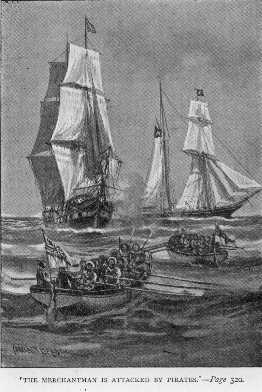
“The merchantman is attacked by pirates; there is not a doubt of it,” shouted Mr Spry. “Fire off your muskets, my lads; it will give both parties notice that we are coming to put a stop to their fun.”
Those not pulling blazed away right merrily for a few minutes, and then watched for the result. It seemed to have encouraged one party and to have disheartened the other, for the boats we had before seen were observed pulling back to the schooner.
“Follow me, Waller. After the boats, my lads!” shouted Mr Spry. “D’Arcy, do you board the barque. See if any assistance is required, and if not, pull for the schooner.”
It took me but a short time to find myself alongside the barque, while the rest of our party were in chase of the strange boats. So eagerly were those on board looking out at the chase, that they did not observe me step on board. Alas! the appearance of the deck showed too plainly that mischief had already been done. One man lay dead, and two more sat on the deck, supported by their shipmates. But there were two persons in a group standing aft, whom I thought I recognised. I looked again. I was sure I could not be mistaken, and running up to them, I found myself shaking hands most warmly with Mr Marlow and his daughter. He did not recognise me; but she did in a moment, and told him who I was.
“Again you have helped to save our lives, Mr D’Arcy,” he exclaimed; “for, thanks to our brave captain here, we were able to resist a band of villainous pirates who attacked us, till your appearance frightened them off.”
I of course told them how happy I was to be of service, and then, finding that my presence on board the barque was not required, I tumbled into my boat, and gave way after my shipmates. The pirates’ boats had gained the schooner about ten minutes before they had. I was not long behind them, and the aid of my boat’s crew was very welcome. The deck of the schooner was crowded with men, who were making a desperate resistance. The most prominent of them fought more like a demon than a human creature. With desperate energy he wielded a huge cutlass, with which he kept the deck clear around him. His men, however, a mixture of Spanish, Portuguese, blacks, and a few English or Americans, were falling thick on either side, and several had actually been driven overboard. My gallant fellows gave a loud shout as we scrambled on deck, and, led by Jack Stretcher, they cleared everything before them. Some of the pirates were forced down the hold, others overboard, and several sunk on the deck to rise no more. Still the captain stood at bay. I now had a better opportunity of observing him, and at once I recognised my old enemy, the villain Myers.
“Your time is come at last, Bill Myers,” I shouted.
The words seemed to have a paralysing effect. What thoughts they called up, I know not. Perhaps he had not for long been known by that name. He made a few steps backward, and then, with one bound, cleared the side of the vessel and leaped overboard. There was no land to swim to—no boat to pick him up—but ravenous sharks surrounded the scene of strife, already collected by the taste of blood. In another instant the long-sought-for smuggler, murderer, and pirate was their prey. The remainder of the pirates yielded without another blow. We found that they had shipped for a slave voyage only; but had been induced by Myers, who had lately got command, to commence a course of piracy, which, by our appearance, had happily been cut short. After some hours, a breeze springing up, we brought the vessels together. Waller and I were ordered to take the prize into Barbadoes, where the barque also was bound; while the Opossum cruised outside to look out for slavers.
Mr Marlow was going to spend some time at Bridgetown, where he had a house of business. He received Waller and me most kindly, and nothing could exceed the hospitality of the inhabitants generally when they heard of our exploit. Captain Curtis, also, the master of the barque, got great credit for the way he had defended his vessel till we came to his assistance. Miss Alice Marlow had grown somewhat, but still she was very little for her age. She was, however, as kind as ever, and I, for one, was very sorry when the Opossum came in with another prize. The survivors of the men who had boarded the barque were hung, and the schooner herself was condemned. This business being accomplished, the Opossum once more made sail for the coast of Africa.
Chapter Twenty.
Look out for Slavers in a Boat—Weary of Waiting—A Sail in Sight—Capture her—Attacked by a Larger Slaver—Desperate Fight—Beat her off.
We had been some weeks on the coast without having taken a prize, although we had chased several suspicious-looking craft, which had contrived to get away from us. At Sierra Leone we had shipped a dozen Kroomen, to get wood and water for the ship, a work which Europeans in that climate are unable to perform without great risk. At length Captain Idle began to grow impatient. One day he sent for Waller, who had been on the coast before with him, and was a very clever, active fellow.
“Waller,” said he, “I want you to go away in the pinnace, and while some of these slaving gentlemen are running away from us, perhaps you may be able to render a good account of them. You will require a companion. Will you like to take D’Arcy with you?”
Waller expressed his readiness to go, and to have my society; and so it was settled. Among his other accomplishments, he was a first-rate shot with a rifle, and it was reported, when he was before on the coast, that he used to pick off the men at the helm, and any of the crew who went aloft or appeared above the bulwarks, and had thus caused the capture of several slavers. I was to see this talent exerted. Jack Stretcher, who was a capital companion, went with us as coxswain. We were all dressed in thick flannel shirts, and had blankets in which to wrap ourselves at night. We had water and provisions for ten days, and a small stove, with which to warm up our cocoa and tea, and to make a stew or a broil on occasion. I do not remember that we had any other luxuries. Towards the end of the afternoon watch we shoved off from the brig’s side, having wished our shipmates “Good-bye!” with a sort of feeling that we might not meet again. While the Opossum stood away on a bowline to the northward, we shaped a course for the mouth of the Gaboon river. We arrived at our cruising ground before daybreak. Waller then ordering the men to lay in their oars, which had hitherto been kept going, and lowering the sail, told them to wrap themselves in their blankets, and to lie down under the thwarts. I kept watch while he also slept. The night was bright and beautiful, and the sea, smooth as a mirror, reflected the glittering stars which shone forth from the dark blue heavens, while our boat lay floating idly on its slumbering bosom. So deep was the silence which reigned around, that the breathing of the sleepers sounded strangely loud, and I fancied that I could hear vessels, even though out of sight, passing by, or fish rising to the surface to breathe, or cleaving the water with their fins. At other times my imagination made me fancy that I could hear beings of another world calling to each other as they flew through the air or floated on the ocean; and I almost expected to see their shadowy forms glide by me. About an hour before dawn, Waller got up and told me to take some rest. I was not sorry to lie down, albeit my rest was far from refreshing. I soon began to dream, and dreamed that I was a plum-pudding, and that Betty, the cook at Daisy Cottage, had fastened me up in a flannel pudding-bag, and put me into a pot to boil. The water soon began to simmer, and I to swell and swell away, till the string got tighter and tighter round my throat, while a thick black smoke arose from some coals which she had just put on. I was looking out of the pot, and meditating on the proverb, “Out of the frying-pan into the fire,” when, being unable to stand it any longer, I jumped out of the pudding-bag, and found myself rolling at the bottom of the boat.
“Why, D’Arcy, I thought you were going to spring overboard,” said Waller. When I told him my dream, he laughed heartily, and agreed there was ample cause for it.
Our blankets were wet through and through, and a dense black fog hung over us, through which it was impossible to discover the position of the sun, which had some time been up, or of any object ten fathoms off; while the sea was as smooth as a sheet of glass, and as dull-coloured as lead. As I awoke I found my throat sore from the unwholesome moisture I had inhaled. We had nothing, therefore, to do but cook and eat our breakfast, and practise patience. There was little use exhausting the men’s strength by pulling, as we were as likely to pull from, as towards, a vessel. Hour after hour thus passed away, till at length the sun conquered the mist, and gradually drew it off from the face of the deep, discovering a wide expanse of shining water, unbroken by a single dot or speck which was likely to prove a sail; while to the eastward arose a long dark line of mangrove-trees, at the mouth of the Gaboon river. The land-breeze came off to us, smelling of the hot parched earth; and we turned our eyes anxiously whence it blew, in the hope of seeing some white sail dancing before it over the bar of the river; but we were doomed to disappointment. The hot sun struck down on our heads, and tanned and scorched our cheeks, and the upper works of the boat cracked with the heat, till a beefsteak might have been broiled on the gunwale. At last the land-wind died away; there was again a dead calm, in which we roasted still faster, till the sea-breeze set in and somewhat cooled our parched tongues. Now we looked out seaward, in the hopes of finding some slaver, unsuspectingly standing in, either to ship the whole or the portion of a cargo, having already, perhaps, taken some on board at another part of the coast. Nothing is more trying to the temper than to have to sit quiet and do nothing; yet such was our fate from day to day, as we lay like a snake ready to spring on its prey. The sun rose, and roasted us, and set, leaving us to be parboiled, and rose again, without a sail appearing. We ate our breakfasts, and dinners, and suppers, and smoked our pipes, and sat up, and went to sleep again, in the same regular manner for several successive days.
At length, one morning, a light breeze sprang up; and, as the fog was blown off in dense wreaths, the topsails of a schooner were seen rising above them.
“Out oars, my men, and give way with a will!” exclaimed Waller, in an animated voice. “We are not yet seen, and may get alongside before they find us out.”
The men, in their delight at the prospect of having something to do, would have cheered, but he silenced them. We hoped that she was a slaver; but she might, after all, be only an honest Liverpool trader. When first seen, she was little more than a mile off, to the south-west of us, running in for the land with the wind, which was from the northward abeam.
“What do you think of her, Jack?” asked Waller, after Stretcher had been eyeing her narrowly.
“Why, sir, to my mind, those topsails have only been cut by Spanish fingers; so I make pretty sure she’s nothing else than a nigger passage-vessel.”
This announcement made the men give way still more heartily, for, though the wind was fair, we did not make sail, as we should thereby have been more quickly seen. Away we pulled, the water bubbling and hissing under our bows as we cut through it. When we got within a quarter of a mile of the chase, she saw us, we judged, by hearing a musket fired and seeing a bullet strike the water near us.
“That proves he has got no guns on board. Give way, my lads!” shouted Waller.
The men cheered, and bent to their oars with greater vigour. We then hoisted the British ensign, and fired a musket to make the fellow heave-to; but, taking no notice of the signal, he held on his course. The wind continued so light, however, that we were overhauling him fast; but there were signs, both on the sky and water, that it might again get up, and afford him a better chance of escaping. At all events, he was evidently not inclined to give in.
“I must teach the fellow that the British flag is not to be trifled with,” said Waller, taking up his rifle. “I have no compassion on these slaving villains.”
Scarcely had he spoken, when a man, whom we both took to be the captain, jumped into the netting abaft the main-rigging, and made some very significant gestures to us to be off; and directly afterwards, seeing that we continued our course, several of his crew let fly their muskets at us.
“You’ve brought it on your own head,” exclaimed Waller, loading his rifle. He fired. The next moment we saw the man fall back upon his deck. There was then a great deal of shouting on board the schooner; her helm was put up, and, the breeze freshening, she began to pay off before the wind. She had not got round, though, before we were under her quarter.
“Hook on to her main-chains, my lad,—hook on fast!” cried Waller.
Unfortunately the bowman missed his aim; and the schooner, falling off, brought the stern of our boat in contact with her counter. Without a moment’s thought, Waller had sprung over her low bulwarks, followed by Stretcher and me. In an instant we were attacked by the whole of the slaver’s crew, who, with loud shouts and ferocious gestures, rushed aft, fully hoping, as they saw that the pinnace had dropped astern, to make us an easy prey.
The mainsheet of the schooner had been eased off, the foreyards had been squared, and, with the now strengthening breeze, the schooner was running fast through the water. Waller took one glance over his shoulder, and that showed him that there was scarcely a chance of the boat overtaking us. Our fate was sealed: no mercy could we expect from the slaver’s crew. One hope only remained,—Waller had thought of it.
“Knock down the man at the helm, and jam the tiller down hard!” he sung out to Stretcher. “We will keep the other fellows at bay in the meantime.”
“Ay, ay, sir,” answered Jack, as coolly as if he had been merely ordered to give a pull at the main-brace.
There was a cry, and the next moment the body of the helmsman dropped on the deck. Jack had literally cut his head off with a sweep of his cutlass. The sight had the effect of making the Spaniards hang back for a moment, when Jack, putting the helm hard down, made the sails all shiver, and finally got her fore-topsail aback. Seeing what had occurred, the crew of the pinnace cheered, and, giving way, were soon clambering over the counter, while we made a dash at the Spaniards, few of whom attempted to oppose us even for a moment; most of them, indeed, throwing away their arms, made their escape to the forecastle. The rest followed their example; and in two minutes the schooner Zerlina, with a hundred and fifty slaves on board, was ours. Besides the captain, and the other man who was killed, there were twenty stout fellows, two or three only being out of fighting order with their wounds. We had difficulty enough to keep the rest quiet. They were, in truth, very sulky, and inclined to revolt, when they had recovered from their fright, and saw to how few they had succumbed. Curses, loud and many, escaped their lips, and showed that, if they had an opportunity, they would murder us, and retake their vessel, without scruple. We therefore kept four of our men as a watch over them, with loaded muskets, with orders to shoot the first who showed signs of proving mutinous. Having made these arrangements, we turned our attention to the living cargo crowded between her decks. It was a sickening sight, as we got the hatches off and looked down upon the mass of black faces which, with their white eyeballs rolling and mouths agape, gazed up at us, wondering what was next to happen. There sat a hundred and fifty human beings chained down to iron bars running across the deck—men and women of all ages, their chins resting on their knees, without space to stretch out their limbs, or to alter their position in any way; a rag round their loins being their only covering. They were in good health, not having been out many days; and there was a good supply of water and farina on board. We did our best to make them understand that we were friends, and would set them on shore again, and make them free, as soon as we could.
During our examination of the schooner, we had discovered a number of spare handcuffs. Jack Stretcher brought them from below, and threw them on the deck, with a significant look at the Spaniards, who, in defiance of orders, had made several attempts to come out on deck.
“I think if we was to clap ’em on to them Spanish lubbers, it wouldn’t be amiss, sir,” said he to me, holding up a pair before me.
I mentioned the suggestion to Waller, who at length agreed that it would be safe to follow it, taking one-half at a time, while the rest remained in their berth under the forecastle. Jack received the necessary orders.
“Ay, ay, sir,” he answered. “Senhor Dons, understando, move forewardo instanto, or I’ll drive the pointo of my cutlasho into vostros sternosos.”
The prisoners understood his actions more than his words, for he fully suited the one to the other, and they showed no inclination to dispute them, he having evidently made them respect him, from his strength, and the daring he had displayed on boarding. Some we confined forward—some in the after-cabin; and most fortunate it was that we did so.
It was some time before all our arrangements were made. About an hour before dark we tacked, to stand inshore again, Waller intending, should we not fall in with the brig, to shape a course for Sierra Leone. We tacked again about midnight; but when daylight came, not a sign was there of the Opossum; and, accordingly, towards the above-mentioned place we steered. We had the pinnace in tow; but we had taken the gun out of her, and placed it amidships on the deck of the schooner. Overcome with fatigue, Waller had thrown himself down aft, wrapped up in his blanket, while I stood near him, with my eyes winking, and trying in vain to be wide awake, when I was startled by the cry of “A sail on the weather-bow!”
“Which way is she standing?” asked Waller, springing to his feet.
“Right down for us,” answered Jack, who had gone aloft. “I was hoping she might be the brig, at first; but she’s a large square-topsail schooner, and, by the cut of her canvas, she looks like a Spanish or a Portuguese slaver.”
As the stranger drew near, no doubt as to what she was remained on our minds. Waller took his measures accordingly, with perfect coolness. Seeing that the prisoners were thoroughly secured, we got ready all our arms, and supplied ourselves with ammunition. The gun amidships was also loaded to the muzzle, and covered with a tarpaulin. With the calm courage which British seamen on all occasion display, our men waited the approach of the stranger. As she drew near, we made out that she had three guns on each side, and that her decks were crowded with men. Notwithstanding this overpowering disparity of force, our men looked at her in no way daunted; and I felt sure that what men could do they would for our defence. Waller, however, judged that it would be as well to animate their courage with a few words.
“Now, my men,” said he, “we are but ten of us on board this craft, but we are true and honest; and though there are probably fifty or sixty Spaniards in yonder schooner, they are a set of slaving scoundrels, who cannot stand up a moment before British seamen. They will not attempt to hull us with their shot, because they will wish to get back the schooner uninjured; so they will try to take us by boarding. I hope they may, that we may show them that they have caught a Tartar. All we have to do is to blaze away with our muskets till we can give them a taste of our cutlasses. Our big gun we’ll keep for a last dose; so now, my boys, trust in a righteous cause, and huzza for Old England and victory.”