"Salt Water" (continued 4)
Reading edition
“I am afraid you’ve been an eavesdropper, Dicky, to hear all this,” I observed; “and that, you know, is not a very creditable character.”
“I know that as well as you do,” he answered; “but I could not help myself, for I was jammed up in the refreshment room between two fat Maltese ladies and the supper-table, and I couldn’t have moved without the risk of staving in their sides with my elbows. Old Nip and the medico were on the other side of them, sipping their negus, and didn’t see me.”
“That’s all right; and small blame to you, Dicky,” said I. “Well, I heartily wish Mr Vernon joy; and if his love don’t run smooth, and he ever wants a helping hand, I only hope he’ll let me give it him.”
“There’s nothing I should like better too, independent of my regard for Mr Vernon,” observed Dicky, pompously.
I remember that we long discussed the probabilities of Mr Vernon’s requiring our services; and we came to the conclusion that, though we should be delighted to help him to obtain the lady’s hand in any way he might require, in principle the running away with a lady was decidedly wrong.
The subject was changed by our seeing the purser lead out one of the fat ladies, behind whom Dicky had been hid, to attempt a waltz. Never was there a more extraordinary performance. Neither of them had a notion of the dance. They floundered and flolloped, and twisted and turned, and tumbled against all the other couples, till they spread consternation around; and at last found themselves the sole performers in the room. As poor Nip went twirling round, much in the way that a child’s humming-top does when it begins to stagger preparatory to stopping, he perceived a suppressed laugh on the lips and in the eyes of the surrounding spectators; and suspecting that he might be the cause of it, gave a convulsive gripe at his partner’s waist, or at the part where her waist should be, in order to bring himself to an anchor. The effort was too great for his powers, and both he and she came with a run to the floor, close to where Dicky and I were standing. There they kicked and struggled in vain efforts to rise. At this Dicky could no longer contain himself, but, regardless of the purser’s anger, burst into a loud fit of laughter. However, we ran forward to do our best to get the hero and heroine on their legs again, though we were too much convulsed to be of much assistance.
“I’ll pay you off for this, Master Sharpe,” whispered the purser, looking up fiercely.
“I couldn’t help it, indeed I could not,” answered Dicky in an apologetic tone; “you did look so funny.”
“I’ll wring your ears off, you young puppy,” cried poor Nip, rising and shaking himself, in his rage forgetting the fair sharer of his misfortune.
“Look to your partner, Mr Cheesnip,” said Captain Poynder, coming up, and guessing the cause of the purser’s anger. “Here, Sharpe, help me to put the lady on her legs.”
By some pulling and hauling, and by others shoving behind, we got Madame Cheesnip, as we ever after called her, into a perpendicular position; but she was too much shaken to dance again, especially with the cause of her misfortune. Indeed, for the rest of the evening the ladies fought very shy of poor Nip, and we took good care to keep out of his way. Dicky and I stayed to the last, spending our time very satisfactorily between our two partners and the refreshment and supper rooms; and I am afraid to mention the vast amount of sandwiches, cakes, and bonbons which Dicky consumed, washed down by cups of coffee, lemonade, and negus. At length, when nearly everybody was gone, with the exception of a few other midshipmen, and the musicians could no longer wag their bows, we deemed it time also to retire. We had got leave to stay on shore, but it just then occurred to us that we had forgot to order our beds.
“Never mind,” said Dicky; “we are certain to find them at some hotel or other.”
As we were putting on our cloaks, we found that there were five or six more midshipmen belonging to other ships in the same predicament as ourselves. To get beds at that hour of the morning, we discovered was not so easy, as all the Hotels, from some cause or other, were full. We hunted about for some time, and were proposing trying to get on board our ships,—though Dicky Sharpe declared he should take up his berth inside one of the casks generally found down on the shore of the harbour, with their heads off; but we advised him not, as they are the usual abode of the beggar boys who infest Nix Mangiare stairs, and would be apt to have more inhabitants than one,—when some of the party who were on ahead, shouted out that they had found as cozy a place of shelter as they could wish. We were in the upper part of the town, which, as most of my readers probably know, is at a considerable elevation above the water. As it had lately begun to rain hard, and we had no desire to wander farther, there was a general rush made to the front. The cozy place to which we were invited, turned out to be an old family coach, which was standing at the top of a narrow lane intended to be used only by foot passengers. However, it was a place where some midshipmen had lately amused themselves by galloping up and down; but, to prevent such an exhibition of horsemanship, a guard had been stationed at the bottom, to prevent any similar attempt for the future. But to return to the coach. The first comers had taken possession, and one after the other the rest scrambled in, till by the time Dicky and I, who were rather behind, got up, it could hold no more: at all events those inside decided that such was the case. This was not what we had bargained for, and neither of us was inclined to yield his right to a share and shelter without a struggle. The doors had not been shut; and while Dicky boarded on one side, I tried to get in on the other. Wet caps and fists were dashed in our faces, but, undaunted, we strove on. I had actually forced my way in, and was stretching over my hand to my chum, who had got his feet on the step, when some one exclaimed, “By Jupiter! she is under way.” And, sure enough, our struggles had set the lumbering old vehicle moving. On it went, rolling and rattling down the steep pathway, which we had totally forgotten. To get out was impossible, without the certainty almost of knocking our heads against the walls of the houses on either side, of being jammed between them and the wheels, or of being run over. We hauled Dicky in to save his life, and away we all went together, the vehicle every moment increasing its velocity. The path, from sloping from each side to the centre, kept her on a straight course, or we should have brought up against some steps, or a kerbstone, and been saved from the approaching catastrophe. But no such good fortune was in store for us. Rolling and rattling, and screeching and creaking, and bumping and thumping, downward went the carriage, we inside keeping up a chorus of shouts and shrieks. Most of us laughed; but one or two, who were strangers to the place, were in a mortal fright, not knowing whether we might find a precipice at the bottom, and be shot over, perhaps into the sea. Very soon, too, we reached some steps, down which we went, of course faster than ever, with terrific bounds, till the cranky old vehicle could no longer stand the unusual movement.
“Who goes there?” shouted the sentry at the bottom of the steps.
“Turn out the guard,” echoed the sergeant, not able to make out the cause of the unusual commotion. Just then the carriage split asunder, and sent us flying, with swords, dirks, and hats, in different directions.
“Arrah, was ever such an egg hatched before?” exclaimed the sergeant, who was an Irishman, running up and seizing hold of the first he could lay hands on. “Come, young gentlemen, I must march you off to the guard-house.”
“March the coach off, if you please, sergeant; but we are innocent, like the new-hatched babes which we are,” cried Dicky Sharpe, who was one of those in custody. “The order is against people on horseback coming this way: we hadn’t even horses to our egg-shell.”
The sergeant, amused by the way Dicky took up his joke, and seeing there was no use detaining us, consented not to molest us. We then invited ourselves to go to the guard-house, where we passed the remainder of the night, with our cigars to comfort us. I am sorry to say that we did not go back to try and find the owners of the coach, that we might apologise to them for having inflicted so much injury on their property, which we ought certainly to have done. We none of us thought anything more would come of it.
“Oh!” said Dicky Sharpe, rubbing his hands, “the owners will think that the old coach grew tired of waiting all by itself, so ran down the hill to get warm.”
We resolved therefore to say nothing about the matter. The next day, while it was my watch on deck, we were ordered to send a boat to bring off a party of ladies from the shore. Dicky, who belonged to the boat, went in her. As they reached the ship, and the sides were manned to receive them, I saw that Mr Vernon was in the boat, accompanied by Major and Miss Norman, and several other ladies and gentlemen. The care with which he handed her up the side, and the attention he paid her, as he showed the party round the decks, convinced me still further that what I had heard last night was the truth. Adam Stallman accompanied them; he was grave, but kind and courteous as usual, and seemed to take great pains to answer all the questions, some of them not a little ridiculous, which were put to him. Mr Vernon invited him to join the luncheon-party in the ward-room, so I did not see what followed.
As soon as the boat was hoisted in, Dicky came up to me.
“I say, D’Arcy,” said he, “it’s all blown, and we are in for it, I guess.”
“What’s blown?” I asked.
“Why, the coach affair, of course,” he replied. “As we were coming off they were all talking of it, and Mr Vernon said he was very sure I was one of the chickens, so there was no use denying it. If it gets to the captain’s ears we shall have our leave stopped, and I shan’t have a chance of seeing little Miss Smaitch again.”
We consulted long what was to be done, but could come to no decision on the subject. After the guests were gone, Adam Stallman came down into the berth.
“Youngsters,” said he, “I suspect both of you were engaged in the destruction of the coach last night. Is it not so?”
We confessed the truth, and told him exactly how it happened.
“Did you endeavour to find out the owners, and to make them all the amends in your power for the mischief you had committed?”
We owned that we had not.
“You neglected your bounden duty, then,” he observed. “You should recollect that every act of meanness committed by a British officer brings discredit on the cloth. When a man is guilty of a fault, he but increases it if he neglects to make reparation for it. Now, if I get leave for you to accompany me on shore, will you follow my directions?” We promised we would. “Well then, we will find out the owners of the coach, and you must go and tell them that you are very sorry for the mischief you committed, explain how it happened, and beg their pardon. I do not think you can exactly offer to give them a new coach; nor would they expect it, probably.”
At this Dicky looked very blue; but he could not escape from his promise, and he soon mustered a sufficiency of moral courage to carry him through the work. I was, I own, very glad in being thus supported in doing what I felt was right.
In the afternoon we went on shore, and set off at once to the scene of our adventure: The fragments of the coach had been removed. Climbing up the lane, we made inquiries at the top—at least Adam, who spoke Italian, did—for any family from the country who might be stopping at a house near at hand.
“Oh, you want Signora Faranelli, whose coach was run away with last night by some ragamuffins!” said the master of a small shop where we inquired.
“The same,” answered Adam.
“She and her daughters are staying with Signor Bianconi at the big house, there.”
Adam led us to the house indicated.
“I feel in a great funk,” whispered Dicky; “don’t you, D’Arcy? What shall we say?”
“The truth,” said I. “It’s the only thing we can say. Tell our tale from beginning to end.”
We sent in our cards, with a message to say that two naval officers wished to speak to Signora Faranelli. Adam said he should wait outside for us, and told us to make haste. We were speedily requested to walk upstairs, and were ushered into a room full of company, when a very pleasing, kind-looking lady came forward and inquired to what cause she was indebted for the honour of our visit. As I knew Sharpe would make some mistake, I had offered to act as spokesman, and at once told the whole of our tale.
“Oh, it was very naughty in the carriage to run away with you,” she replied, in a good-natured tone, in somewhat broken English; “and it was very stupid in my servants to leave it standing on the top of the hill, though but natural that you, on a rainy night, should take shelter within it. I had been told that it was purposely sent rolling down the hill by a party of tipsy naval officers, and I was resolved to complain of them; but the frank way in which you have come forward to explain the matter removes all disagreeable feeling on the subject, and I am very happy to make your acquaintance.”
Dicky Sharpe drew a deep breath, as if some dire forebodings were removed. I don’t know what he thought was going to happen to us.
“I must now introduce you to Signor Bianconi, and I am sure he will have great pleasure if you can remain and spend the evening with us,” continued the lady. “I shall hope also to see you shortly at my house in the country.”
We thanked Signora Faranelli very much for her kindness, but explained that we had a friend waiting outside for us, who had, however, nothing to do with the carriage affair. Of course Adam Stallman was requested to come in, and, to my surprise, he consented.
“I like what you tell me of the people, D’Arcy, and their acquaintance must be worth making,” he observed.
We spent a very pleasant evening, got on board in good time, and the next day, meeting some of our companions in the carriage adventure, were able to relieve their minds from certain apprehensions of the consequences, and to tell them of the satisfactory results; nor did we fail to give Stallman credit, which was his due. They, the rogues, were now in a great hurry to go and apologise also; but their impudence, for a wonder, would not carry them up to the point for action.
Whenever we put into Malta, Dicky and I did not fail to call on Signora Faranelli and Signor Bianconi: and many a happy day we spent at their houses. Often and often I have since seen that, by acting with truthfulness and candour, very much inconvenience, and even misery and suffering, might have been saved, and much good obtained. There is a golden rule I must urge on my young friends ever to follow: Do right, and leave the result to God.
Chapter Thirteen.
Sailing of the Ariadne—Chissel’s Cruelty—Loss of Bobby Smudge—A Heavy Squall—Bobby Smudge’s Ghost—Reflections thereon.
Shortly after this we were ordered to get ready for sea, though our destination was not known. Before we sailed, Major and Miss Norman again came on board, and we heard that, his health being re-established, they had taken their passage in a brig bound for England. We were very sorry for this, as we feared that Mr Vernon would be wishing to go home to marry, and that we should thus lose him. The next morning the Ariadne, the brig in question, a remarkably fine vessel for an English merchantman of those days (for a more detestable fleet of tubs were never sent afloat), was seen to be getting up her anchor and loosing topsails. Mr Vernon had gone away in the second gig at an early hour; and she was now alongside, while he, with his boat’s crew, were on board. We could see him standing with Miss Blanche Norman on deck.
“More gallant knight or fairer lady never trod this mortal world,” quoth our poetical Third, as he took a sight at his brother officer through his spy-glass.
I heard a deep sigh, and looking round, I saw Adam Stallman standing near me; but his countenance was unmoved, and turning on his heel, he continued pacing the deck as if he had been an unconcerned spectator of what was going on. The anchor of the brig was run up to the bows and catted; sail after sail was dropped from its brails and quickly sheeted home; and under a wide spread of canvas the gallant craft came standing out of the harbour.
“A prosperous voyage to you,” shouted Mr Du Pre through his speaking-trumpet, as she passed us.
He and all the officers took off their caps. Major Norman and the master of the Ariadne did the same, and Miss Norman bowed. It was a trying moment for her, poor girl; for in a few minutes he whom she had so lately learned to love must quit her for an indefinite period, to buffet the rude winds and waves of the ocean, or, perchance, to endure the dangers of the fight,—so said our third lieutenant, or something to that effect. We watched the Ariadne, as long as her topsails appeared above the horizon, with no little interest, for Mr Vernon’s sake. He at length came back, after a long pull, and was for several days somewhat grave and abstracted at times; but that mood wore off by degrees, and there was a buoyancy in his step, and a light in his eye, which showed that he loved, and was conscious of being beloved in return.
It would be impossible to give an account of all the minor adventures I met with in the Mediterranean; but such as I can I will narrate. Captain Poynder was very anxious to make his midshipmen gentlemen, and to give us a knowledge of polite literature, as well as to instruct us in navigation and seamanship. Accordingly he got a Maltese on board to teach us Italian. Poor Signor Mezzi had never, I believe, been at sea before; and though we tried to make him comfortable, and Dicky Sharpe generally resisted the temptation to play him tricks—for he was certain to be cobbed by the oldsters if he did,—I fear that his life was far from a pleasant one. When we had completed our refit, and had stowed away a supply of provisions, despatches were sent on board, and we were ordered to proceed to Tripoli and Tunis. We made a very quick passage to Tripoli, which is the capital of the most easterly of the Barbary States. It boasts of a castle and port, and has a large harbour, defended by a moat and batteries, capable of containing a considerable fleet of merchantmen. We remained there a very short time, so I do not remember much about the place, nor exactly for what purpose we went there. There is another town of the same name in Syria, and they are often confounded. Leaving Tripoli, we made sail for Tunis. It was on this trip, if I remember rightly, that a circumstance occurred, which for some time appeared wrapped in mystery. The adventure of the rib-bone, in which Dicky Sharpe played so prominent a part, will be remembered. Since that time, Ichabod Chissel, the carpenter, had led his unfortunate boy, Bobby Smudge, a very dog’s life. I fully believe, however, that Master Smudge richly deserved every rope’s-ending he got. He was always dirty: he loved dirt, and nothing could keep him clean. His honesty also was doubtful. While in Malta harbour, some of our plate had disappeared. Our boy accused Bobby of taking it, though he denied this, and, to our surprise, confessed that he knew where it was.
“Why, do you see, sir,” he said to Stallman, who sat as judge on his trial, “it somehow or other got into my tub of hot water, and I never knowed it; and when I went to heave the water overboard, I then see’d the glitter of it in the sea, as it sunk to the bottom.”
The defence was ingenious, and as there was no witness to prove to the contrary, Bobby escaped punishment on that occasion; though, as he had been seen in deep confabulation with an ill-looking Jew a short time afterwards, suspicion went much against him. From bad, things grew to worse with Bobby Smudge. Not a day passed, scarcely an hour, that he did not taste the flavour of a rope’s-end—most frequently bestowed by his master, the carpenter.
“You will be the death of me, I know you will, Master Chissel,” he groaned out one day, when his castigator was even severer than usual. “I’ll go and drown myself, that I will, if this goes on much longer—you’ll see if I don’t. I won’t stand it, that I won’t;” and he blubbered as few have blubbered before.
“You will, will you, you young scamp?” exclaimed the carpenter, seizing a rope’s-end. “Take that, then, and remember, when you come back from the drowning of yourself, I’ll give you six times as much.” And poor Bobby got it worse than ever.
I think Chissel was very wrong in the way he treated the poor wretch. Had he been tolerably kind and considerate, he might, I am certain, have worked on his good feelings, and certainly have improved him; but the unhappy lad had from his earliest days been so constantly knocked about, and so accustomed to receive more kicks than halfpence, that all his better feelings had been pretty well beaten out of him.
It so happened that one evening, as the ship was running pretty fast through the water, and as darkness was coming rapidly on, a loud splash was heard alongside, and that cry, so startling to a seaman’s heart, was raised—“A man overboard!”
“Silence, fore and aft,” sang out Captain Poynder, who at the same moment appeared on deck. “Does anybody see him?”
There was no answer.
“Does anybody hear him?”
There was an ominous silence. A pin might have been heard to drop on deck. The life-buoy had been let go at the first by the officer of the watch. Its signal fire now burned bright astern, but no one was seen clinging to it. There could be little doubt that the poor fellow, whoever he was, had sunk at once. The ship had been running at the time a few points off the wind. She was now brought close on a wind, and then the helm was put down, and she was hove about with her head towards the life-buoy. While she was in stays, the two quarter-boats were manned and lowered. Mr Vernon jumped into one of them, and the master into another; and as the frigate lost her way, they shoved off and pulled in the direction of the spot where the man was supposed to have fallen.
“Who can it be? Who is missing?” was asked by all hands, while we were anxiously looking out towards the boats, to see if they were picking up anybody.
When the ship reached the same locality, she was hove-to, and there we remained till the boats, having picked up the life-buoy, returned on board. They brought, however, too probable a sign of some one having been lost—a boy’s hat. It had been picked up exactly at the spot where the ship was supposed to have been when the alarm was first given. The ship’s muster-roll was now called over, to ascertain who of the ship’s company was missing. One after the other had answered to their names, and it had so nearly reached the end, that we began to hope there might be some mistake after all, when that of Bobby Smudge was called. There was no answer. Poor Bobby! There could be but little doubt that the unfortunate wretch had put his threat of making away with himself into execution, rather than longer endure the tyranny of Mr Chissel. I hoped that the carpenter’s accusing conscience would make him repent of his cruelty. This surmise as to the poor boy’s fate was confirmed the next morning, when some of his clothes were discovered under the forechains. The next day the chief conversation among the men was about Bobby Smudge’s suicide, and of the threats he had uttered of haunting the ship. This led to the recounting of similar circumstances; and many a forecastle yarn was spun that evening, abounding in horrors sufficient to make the hairs of a less stout-hearted auditory stand on end. From the extraordinary remarks I heard as I passed about the decks, I declared, when I went to the berth, that I believed that some of the men fully expected to see poor Bobby Smudge come in at one of the ports and drive all hands out of the ship. A seaman will encounter anything living and tangible with a hearty good-will; but he has a mortal antipathy to meet any spirit, black, blue, white, or green, from the nether world.
“I say, D’Arcy, it would be great fun if we could just manage to give some of these fellows a fright,” whispered Dicky Sharpe. “A white sheet and a howl would do it. I could manage to imitate Bobby Smudge’s voice, and I should just like to look in on old Chissel when he is taking his first snooze. I’d just mutter, ‘Bobby Smudge’s ghost come to fetch you away, you old sinner,’ and his villainous conscience would do the rest.”
“Don’t play any such foolish trick, Dicky,” said I. “You would certainly be found out in the first place, and get severely punished into the bargain. Besides, the matter is too serious to be turned into a joke. Think of that poor unfortunate wretch, driven to despair, and plunged suddenly into another world, through the cruelty and tyranny of one who ought to have protected him, and tried to make him better!”
“But he was plunged into the sea,” said Dicky, interrupting me; “and as for the cruelty he received, I don’t think he was so very much worse off than numbers of other fellows in his position.”
“I tell you, it is not a subject for joking on. Perhaps poor Bobby Smudge had a mother and sisters who will mourn bitterly when the ship returns home, and they find he is not in her.”
“Dirty drabs, in all probability, who won’t care a rap what has become of him,” persisted the incorrigible Dicky.
“For shame, Sharpe—for shame,” said I; thinking how my cousins would grieve for me if I were to be lost overboard. I began to feel a strange sort of satisfaction at the idea. Sentiment, or whatever it might be called, was very quickly put to flight by the shrill sound of the boatswain’s whistle, and the hoarse cry of “All hands—shorten sail!”
We were hurrying to our stations aloft as fast as our legs could carry us—for the tones in which the order was issued showed us that there was not a moment to be lost,—when, just as we were springing into the rigging, a squall, which had but the moment before been perceived by the officers of the watch, struck the ship. As ill-luck would have it, it was the third lieutenant who had the first watch, and he happened to be in a poetical mood, and deeply absorbed in composing an ode to Queen Dido, or the Dodo—I don’t remember which it was reported was the case—one or the other, I know. The squall was a very heavy one: if not a white squall, not inferior to it in strength and suddenness. The ship rushed through the water, which was lashed in an instant into a sheet of foam; the masts bent like wands, and looked as if they would instantly go by the board. The helm was ordered to be put up; but before she could answer it—stiff as she generally was—over she went, as if she had been a mere skiff, till her yard-arms almost touched the water. It appeared as if she would never right herself again. Then many a stout heart quailed, and many a brave man gave himself up for lost; but, dreadful as was the scene, discipline triumphed speedily over all unworthy fears. Some of the ports were open, and the water rushed through them in torrents. Such was the case with the one in our berth. Poor Signor Mezzi, our Italian master, was sitting there. Never was a poor wretch more completely horrified. He gave up all for lost, and fancied that every moment the ship, and all in her, were going to the bottom. The assistant-surgeon and captain’s clerk, who were at the time in the berth, each seized a pillow from the hammocks, which had just before been piped down, and cramming them into the port with tolerable effect, stopped the gush of water; but terror had too completely mastered the poor dominie to allow him to observe what was going forward. He shrieked out for mercy from every saint in the calendar, and entreated one or all of them to carry him on shore, even if it was but to the sandy coast of Africa. “Ah! misericordia, misericordia, misericordia!” was the burden of his plaint.
“E impossible, signor. If you do go to the bottom, heretics though we are, you will be in very goodly company,” exclaimed Tourniquet. “And then think of the magnificent feast we shall make for the fishes. Let that be your consolation.”
But poor Signor Mezzi refused to be comforted even by such a prospect; and even our medico himself, when he found the ship still remaining in her unusual position, and heard the uproar going on overhead, began to entertain some very disagreeable doubts as to the possibility of the event to which he was alluding actually occurring, and looked very blue about the gills; whereat little Scribble, the clerk, laughed heartily at him, and seated himself on the table, with his feet on the side of the ship, affirming that he was not afraid, and was as contented and happy as ever—the truth being, not that the young donkey was a bit more brave than the other two, but that he had not the sense to know the danger he was in, and that not a seaman on board but saw that the next moment might be his last. Tourniquet had not the heart to move and give Scribble a thrashing, or he would have done so. But to return on deck. The instant the squall struck the ship, Captain Poynder hastened from his cabin, and, seizing his speaking-trumpet, in a calm tone issued the necessary orders.
“Down, every youngster, from the rigging. Clue up—haul down—let fly of all!”
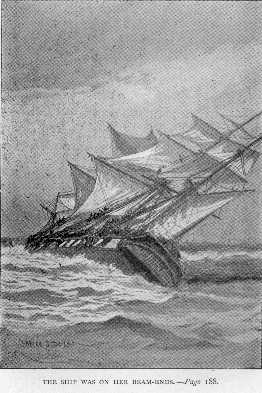
It was too late. Before the words were out of his mouth, the ship was over on her beam-ends, and lay like a log, neither sails nor rudder having longer power over her. To describe the wild horror of the scene would be almost impossible. The rent sails flashing and flapping in the gale; the ropes lashing furiously, as if in an attempt to seize some one within their deadly coils; every timber quivering and groaning; the wind roaring; and the foam in thick sheets flying over us. Though the helm, as I have said, was hard up, still she lay in the trough of the sea, without a hope of once more rising.
“Send the carpenter and his crew aft, with their axes,” shouted the captain.
Chissel and his mates quickly obeyed the summons, for he had seen from the first that his services would too probably be required.
“Stand by, to cut away the masts,” added Captain Poynder.
It was a melancholy alternative, but the only one to save the ship from foundering. Afterwards we must trust to our anchors; and if they failed to hold with the wind as it then was, we could not fail of being driven on the inhospitable coast of Africa. And who could tell how many might reach the shore alive!—perhaps none. The uplifted axes gleamed in the hands of Chissel and his mates, as they stood round the mizen-mast; others were sent to cut away the shrouds, and clear the wreck of the mast as it fell. Once more Captain Poynder raised his trumpet to his lips. It was to give the dire orders to cut, when, at that moment, the ship with a violent jerk righted herself, and, speedily answering to the helm, away she flew before the wind. As such a course would very quickly have brought us up, sail was taken off her; and then, merely under her spanker and fore-staysail, she was brought to the wind, for it was discovered that the bowsprit was badly sprung, and that the topsail sheets were carried away. Happily the squall, having vented its fury on our heads, quickly passed over, and we were left with much less wind than before.
“This is all that young beggar Bobby Smudge’s doing, I’ll warrant,” I heard Ned Grummit, a topman, exclaim, as he came down from aloft. “I never knowed a chap of that sort who went for to go for to drown hisself, if he threatened to do mischief, but found means to do it. I knowed it would be so from the first, and we shall be lucky if worse doesn’t come of it.”
I tried to expostulate with the man, for whom I had a liking, for he was an honest fellow; but to no purpose. He still persisted in the belief that poor Bobby, who, while alive, had never done anybody harm, was destined to work us all sorts of mischief.
Everything had been made as snug as circumstances would allow. The watch below had been piped down, and had turned in; and silence reigned on board, and on the face of the ocean around us. It had been my watch on deck, and I was just about being relieved, when the silence was broken by a loud, unearthly cry; and the carpenter rushed on deck in his shirt, his hair standing on end, and his eyeballs starting from their sockets. Had not several men laid hold of him, I believe he would have thrown himself overboard. He was carried back to his cabin, and the doctor was summoned. All Chissel could say was, “Bobby Smudge! Bobby Smudge! you young villain, be off with you!” The doctor gave him some stuff or other, and the carpenter went off into a sound sleep; but a man was ordered to sit up by his side, and watch him.
“Now,” thought I, “this has been one of Dicky Sharpe’s tricks, and all my good advice has been thrown away.” But when I looked into Dicky’s hammock, he was sleeping away with such unfeigned soundness that I could scarcely fancy that he had played any trick; and the next morning he assured me, on his word of honour, that he knew nothing whatever about the matter. I had never known Dicky to tell an untruth, and I felt very sure that he would not conceal anything he had done from me; indeed, the great pleasure he had in playing any mischievous prank was, to tell me of it afterwards, if I happened not to be a partaker of it,—a very rare occurrence, by-the-bye.
“Suppose you had played your trick on old Chissel, and what he has seen was really an evil spirit, how very dreadful it would have been for you to have met the unnameable thing at his bedside!” said I.
“Oh! don’t talk of such a thing,” exclaimed Dicky, shuddering. “I am sure I will never again think of carrying out such a joke as I contemplated. The idea is too frightful.”
I advised him not; and, after talking the subject over, and turning it in every way, we came to the conclusion that, as no one else was likely to have tried to frighten old Chissel, if he had not really seen a ghost, his terror had been the result of his own evil conscience.
“Yes, it is a dreadful thing to have a bad conscience,” said Dicky, with a sigh. “Do you know, D’Arcy, I sometimes wish that I had not played so many wild pranks in my life. I know that they will some time or other bring me into trouble; and yet, when the fit seizes me, I cannot help it. I wish that you would remind me of my good resolutions when I next propose anything of the sort.”
I promised that I would, but suggested that unless he had some higher motive than the fear of being brought into trouble, he would in all probability continue as great a pickle as ever, if he did not go on from bad to worse. Indeed I read my chum a very severe lecture, which he took with perfect composure, feeling at the time that he fully deserved it; though I fear that he was not in the end very much the better for my sage advice.
We were busy all day repairing damages as well as we could at sea; but it was found that they were so considerable that the captain resolved to return to Malta, instead of pursuing our course to Tunis. While the work was going forward, a man in the forechains discovered a jacket and waistcoat, which were known to have belonged to Bobby Smudge. This was considered still stronger proof that the poor lad had destroyed himself, as no doubt he had hung them there before jumping into the sea. Seamen are certainly the most superstitious beings alive, for this trifling matter made them talk the whole evening after they had knocked off work about Bobby and his ways; and scarcely one but believed that his spirit would haunt the ship as long as she remained in commission. The crippled state of the ship prevented our making much sail on her, and as we had frequently baffling winds, our voyage to Malta was considerably prolonged.
Dirty Bob, as poor Bobby Smudge was generally called, excited far more interest after his death than he had done during his lifetime, as is not unfrequently the case with much greater men. The night succeeding the squall passed off, as far as I know, quietly enough; but the next morning I saw several groups of men talking together, as if something mysterious had occurred.
“I knowed it would be so,” said Ned Trunnion, as I passed by. “He was as bold a topman as ever stepped. I knowed the little chap wouldn’t let us alone, after he’d given Mr Chissel a taste of his quality. No, no; depend on’t he’ll haunt the ship for many a long day, if he don’t manage to run her ashore, or to send her to Davy Jones’ locker outright.”
“What’s that about?” I asked, for I suspected the observation was intended for my ears.
“Why, sir,” said Tom Barlow, another topman, “Dirty Bob (saving your presence) has been aboard again, a playing off his pranks, and many of us see’d him as clear as we see you.”
“Nonsense, man,” said I. “If you mean Bobby Smudge, he’s snug enough at the bottom of the sea, fifty miles astern of us, by this time; besides, if any of you saw him, why did you not catch him?”
“It wasn’t ’xactly him we saw, sir,” blurted out Ned. “It was his spirit or ghost like; and a chap might just as well try to catch one of them things as to grip an eel with greased fingers.”
“How do you know it was his spirit, though?” I asked; for I suspected that the men had been working on each other’s imagination till all fancied they had seen what perhaps only one had dreamed of.
“Why, sir,” replied Tom Barlow, with a hitch to his waistband, “we knowed it was him, because it was as like him as he could stare, only a good deal blacker and dirtier even than he was in his lifetime. It had just gone two bells in the middle watch, when three or four of us who was awake saw him as plainly as we do you, sir, now—creeping about for all the world like a serpent, in and out among the hammocks. It was more, just then, than any one of us wished to do, to speak to him; but, thinks I, there can’t be any harm telling him to cut his stick, just civilly like; so I lifts up my head, and sings out, ‘Be off, you dirty son of a sea cook!’ But scarcely was the words out of my mouth, than he was away like a shot up the main-hatchway, and through one of the ports, or right through the bottom of the ship, for what I knowed; for I couldn’t see, you may suppose. All the others who saw him said, too, there was a strong smell of sulphur, wherever he’d been, and that he vanished away in a flame of fire; but I can’t ’xactly swear to that myself.”
I laughed outright at the absurdity of the story, and was more convinced than ever that the men had allowed their imaginations to be worked up to a pitch which would make them believe anything.
Dicky Sharpe and I talked the matter over, and agreed not to say anything about it, as were the circumstances to get to the ears of the captain, it would certainly make him very angry.
I thought we should hear no more about the matter; but two days after this I found the people more busy than ever talking about Bobby Smudge’s ghost. Numbers declared they had seen it. Some described it as having one shape, some another. Not a few gave it a tail, and horns, and fiery eyes. All described it as black; and several were ready to affirm on oath that it smelt strongly of sulphur and other horrible odours. At length many of the men showed a great unwillingness to go below, and to turn into their hammocks.
Old Chissel had become a completely altered character. His conscience told him that he was the cause of poor Bobby’s death. He grew thin and pale; his voice was no longer heard in loud dispute with his brother officer, the boatswain; and even his manner was softened towards his inferiors. The men remarked the change; and all argued that the ghost had done him some good at all events, though it certainly confirmed them in their belief of its existence. Night after night, no sooner was it dark, and the watch below turned in, than Dirty Bob’s ghost was sure to appear to some one or other; till at length the gun-room officers heard of the matter, and ultimately the captain himself was informed of it.
At the same time a curious circumstance occurred. Every morning one or other of the messes had to complain that their bread-bags had been rifled, and different sorts of eatables had disappeared in a most unaccountable manner. None of the men suggested for a moment that the ghost had anything to do with the matter—for what could a ghost want with biscuit, bacon, or cheese; but Captain Poynder, who at length heard of this also, had, it appeared, formed a different notion on the subject.
Two of the marines—steady old hands—who were ready to believe or disbelieve in ghosts or spirits, and to fight carnal or spiritual enemies in any shape or of any colour, as their superior officers might command them, were sent for into the cabin. What their orders were I do not know; but one of them, Jabez Cartridge, was placed that night as sentry on the lower deck.
The first watch had nearly run out, and Jabez, who had his eyes about him in every direction, had seen nothing of the ghost, when, as it had just gone seven bells, he fancied that he observed a dark object gliding about under the hammocks. He stood as upright and stiff as his own ramrod. So immovable was he, that any one might have supposed him asleep on his post; but his little black eyes were not the less vigilant. The dark object moved slowly and cautiously on till it reached the lockers, where the men’s mess things were kept.
Jabez saw that it had hands, and, by the peculiar movement of those hands, he came to the conclusion that it had pockets. Still a ghost might have hands, and trousers too, for what he knew to the contrary. To convince himself, he sprang forward, and the ghost, with an unearthly shriek, took to flight; but Jabez was too quick for the phantom, and grasping him tight, he sung out, “I don’t care if you be a ghost or not, but I’ve got you, at all events.”
“Oh, let me go, let me go! and I’ll lie snug and quiet till we get into harbour, and then I’ll leave the ship and never come back—that I won’t,” answered the ghost, in piteous accents.
But Jabez was inexorable, and dragging him to the sentry’s lantern, by its sickly light discovered features which belonged to no other than Bobby Smudge.
“Why, where have you been, you young scoundrel, all the time?” asked Jabez.
“In the coal-hole,” blubbered out poor Bobby. “I never thought of doing harm to no one; but I can’t live without eating. Oh! let me go back,—oh! do, now.”
“My order is to take you to the captain,” replied Jabez, unmoved; and forthwith to the captain’s cabin the unhappy Smudge was led captive.
He was soon, however, sent out again under charge of the sentry, and kept in durance vile till the next morning.
After breakfast the men were called aft; and the captain appeared on the quarter-deck with Bobby, in the same garb and condition in which he had been captured. He was truly a wretched object, as he stood trembling, and blubbering, and covered with coal dust and dirt, before all the crew.
“I have called you aft, my men, to show you how foolish you have been to allow yourselves to be frightened by the equally foolish trick of this miserable lad,” said Captain Poynder. “I am not angry with you; but I wish you to learn, from this event, that all the ghosts you are ever likely to see will turn out to be no more ghosts than is this poor fellow at the present moment. He confesses that to avoid punishment, and in the hopes of ultimately escaping from the ship, he devised the scheme for making it appear that he had destroyed himself. He managed, it seems, to get a lump of coal in the forechains, and after heaving it into the water, and crying out that a man was overboard, to get in at a port, and to stow himself away in the coal-hole. Trusting to the superstition and folly which the people have exhibited, he thought he might venture out at night to supply himself with food. His plan succeeded; and had the story not come to my ears, I conclude he would have kept up the farce till the ship got into port. I ask, my men, do you think it possible that God, who made this mighty universe, and governs it by just and wise laws, would allow a mischievous imp, who could do no harm while alive, to return to earth, merely for the sake of wreaking his own petty malice, or for troubling and frightening a number of grown men such as you are. To believe such a thing is both wicked and absurd, for it is mistrusting God’s wisdom and providence; and I hope, when you come calmly to consider the matter over, you will think as I do. I have another word to say, both to petty-officers and men. The lad must have received much cruel treatment to make him attempt to escape from it by the expedient he followed. Remember, for the future, I will have no bullying. The discipline of the ship will be kept up far better by strict justice. Had it not been for this, I should have punished the lad severely for the prank he has played. As it is, he has pretty well suffered already. But beware. If anybody attempts to imitate his example, he will find I do not overlook the matter so easily. Now pipe down.”
The captain’s speech did much good in several ways. It put a stop to any outrageous bullying for some time; for the men knew perfectly well that what he threatened he would effectually carry out. It also tended to cure some of them of their superstitious belief in ghosts and goblins.
“Well, I never heard the like afore,” said Tom Barlow, as he and his messmate, Ned Trunnion, were talking over the affair of the previous day. “The skipper says as how there is no such thing as ghosts; and I suppose, seeing as how he has as much larning as a parson, he knows all about it. It don’t come within my category, though.”
“What he says is all shipshape,” replied Ned. “I never yet met the man who really did see a ghost, though I’ve met scores who’ve heard of some one who’s seen them, and for that matter come to fisticuffs with them; and certain sure I never see’d one myself till that young cheese-nibble made himself into one. Then, if he hadn’t been found out, I’d have staked my davy that he was one in reality.”
“That is what the captain says,” I remarked, as I stopped a moment. “All the ghosts which have been seen will turn out to be only shams after all.”
But enough of Bobby Smudge and his ghost.
Chapter Fourteen.
Letter from my Uncle—Chase of Myers—Supposed Loss in Portland Race—Good Advice—The Ariadne Missing—Mr Vernon’s Anxiety.
Two days after this, much shorn of the pride and beauty with which we left it, we entered Malta harbour. As may be supposed, Mr Vernon hastened to the post-office as soon as he could get on shore. I accompanied him, with a note Captain Poynder had to send to the governor. His eye brightened as it glanced at the superscription of a letter which was handed to him. He read it over eagerly.
“I hope, sir, that you have good accounts from your friends,” I said.
“They have had most provoking light winds and calms; and, when this letter was written, had not made good half the distance. Heaven grant that the Ariadne may have escaped any squall such as crippled us.”
“Indeed, sir, I trust so,” I replied; but as he again turned to his letter, I made no further remark. I found a letter also for myself, to my no little surprise, for I thought no one would take the trouble of writing to me. I did not deserve a letter, I felt, for I had not written a line to any one since I left England. It was from my uncle. I put it in my pocket, to read at my leisure when I returned on board. It ran as follows:—
“My Dear Nephew,—As a word or two now and then from those who are deeply interested in your welfare, will but tend to keep them in your remembrance, and to cheer your spirits, should you find yourself surrounded by troubles or hardships, your aunt and I hope occasionally to send you a sheet of paper, with an account of what is going on at home; and I must beg you in return to let us know how the world speeds with you. Your aunt and cousins are well, and one day passes with them so like another, that I have little to tell of them. Terence grows apace, and seems resolved to go to sea. I will not baulk the lad of his wish when he is big enough; and I hope better times will come in the navy, both for you and him, than I have seen for some time past. I have given the cutter plenty of work, and have made several captures; but the prize I most covet, that villain Myers, has again slipped through my fingers. I must tell you all about it. It is supposed, indeed, that he has at length gone to render up his final account in another world; but even now I can scarcely believe but that he will yet turn up somewhere or another in this. I had received notice that he had been again seen in England, and that he had got command of a cutter of about sixty tons,—a very fast craft, which nothing could come up to; so, of course, I resolved to try and catch him. I soon found that he was visiting his old haunts. I conclude that he fancied no one would believe he would have the audacity to go there after all the crimes he had committed, and that therefore no one would be on the watch for him. He had succeeded in running two cargoes, and all the goods were got up to London. He had gone away for a third, and I learned that preparations were made to receive it in West Bay, not far from Beere. For two days and nights we had been cruising about, just far enough out not to be seen from the shore, in the best spot for cutting him off, when it came on to blow very hard from the north-west. It had blown long enough to kick up a heavy sea, when, just as it had gone three bells, in the middle watch, we caught sight of a cutter standing in for the shore, and going along at a tremendous rate, not the eighth of a mile to the eastward of us. We were on the larboard tack; but we were instantly about, and in chase of her. We could just make her out through the darkness; but I do not think many eyes could have seen her, but those long accustomed to such work as ours. It was some time before she perceived us; for, from the way we were standing, we were end on to her. As soon, however, as she saw us, she kept away, and off she went like a shot before the wind. We packed everything on the cutter she could carry, and rather more canvas, as you may suppose, than under ordinary circumstances I should like to set; but the stranger, at all events, seemed resolved not to be outdone; and though by this time it was blowing half a gale of wind, had not only his whole mainsail, but his square-sail and gaff-topsail all set. This circumstance made me pretty certain that Myers was on board, for he knew well that a halter would be his lot if he was caught. I think he would have done better by keeping on a wind, for before the wind her larger size gave the Serpent a decided advantage over him. After an hour’s chase, if we had not overhauled him, he certainly had not increased his distance from us; and we had great hopes, should the wind increase, or the sea get up any more, that we should at last catch him. It was a trial of the strength of our sticks, and the goodness of our rigging. I had every confidence in ours; but I also knew that the smuggler would not fail to have got a tough stick for a mast, and sound rigging also. Another half-hour passed, and Hanks agreed with me that we were certainly gaining on the chase. To give us a chance of winging him, we now ran a gun forward; but with the heavy sea there was, and the way both vessels were pitching into it, there was very little probability that we should do so. We, however, fired several times; but with no effect. Only think! the fellow had the audacity to run out a couple of guns, and to return the fire. To be sure, it was his only chance of escaping; for if he could manage to knock away any of our spars, he would, he thought, show us a clean pair of heels. His practice was not a bit better than ours; indeed, it would only have been by chance that a shot could have hit its mark. However, we both of us kept blazing away at each other with hearty good-will. In the meantime the wind and sea, already high, were getting up very much. At any other time I should have hove the cutter to; but now, follow I must; and I hoped, from our greater power, we should be able to hold out the longest, and that at last the smuggler must give in. We were now nearing Portland Race, and never in my life had I observed the sea running higher on it than it now did. ‘The fellows will never attempt to cross it,’ observed Hanks: ‘they’ll be swamped if they do; and if they haul up to round it, we shall catch them to a certainty.’ ‘Cross it they will try, at all events,’ I replied; ‘they can never carry canvas on a wind, in a breeze and with a sea like this. See, they are standing into the very thickest of the breakers.’ Sure enough, there was the cutter approaching the most dangerous part of the Race. The spring-tide was making down, and the wind, meeting it, threw the foaming breakers higher up than usual. Still it was possible, if everything was battened down, that the cutter might shove through them. We all held our breath. If she got through, we also must follow. We had everything secured, and were better prepared than she was. On she went—her white sails appearing against the dark sky—her whole hull enveloped in foam. For some seconds she pushed on bravely. I never took my eye off her. Suddenly the white canvas seemed to bend low down—the breakers danced on as before. I rubbed my eyes, but without avail: the sail had disappeared. There was a cry of horror on board the cutter, but no shout of triumph, though our long-sought-for foe was no more. He and everybody on board must have been swallowed up in those foaming billows. We had barely time to shorten sail and to haul off, to avoid sharing the same fate; for I scarcely think, on that day, that even we could have run through the race. Some days after this I was on shore on Portland Bill, and the lighthouse-keeper told me that he had witnessed the catastrophe. He told me, also, that several planks and spars had shortly after come on shore, and with these the body of a man. When, however, he went down to the beach to look for the body, he could nowhere find it; so he concluded that it had been swept away by the tide. Such is the fate of the smuggler Myers, and certainly no one ever deserved it more richly. I have no other events to narrate.
“I should like to give you some good advice, Neil; but I am so little accustomed to lecture others, I cannot find words to do it. I will try, however. Never forget that you were sent into this world to do your duty to Heaven and to man; not to amuse yourself, but to obey God’s laws,—to prepare for another world, which will last for ever. Remember always that this world is only a place of trial—of probation. Trials of all sorts are sent on purpose to prove us. When man, through disobedience, fell, and sin entered the world, the devil was allowed to have power over him. He would have gained entire power, and man in his fallen state would have been inextricably lost for ever; but Christ in his mercy interfered, and by His obedience, His sufferings on earth,—by His death on the cross,—was accepted by God as a recompense for all sinners who believe in Him. By His resurrection, He became a mediator for us, showing us also that we too shall rise, like Him, from the dead, in the bodies in which we died. Thus a pure and just God, who cannot otherwise than hate sin, was able at the same time to show forth his justice and his mercy,—to punish those who go on in their wickedness, but to pardon those who believe in their great Mediator, and repent of their sins. I remind you of these important truths, Neil, because I know all men are too apt to forget them. Endeavour always to remember them, and I am sure that they will keep you from evil more than any other safeguards which I can offer you. I do not tell you, my boy, not to do this, or not to do that; but I remind you that Christ came down on earth, on account of the sins of mankind, to teach men His laws; that He suffered pain, toil, and disgrace, and a dreadful death; and that, in gratitude to Him, we are bound to do our utmost to obey Him. Read your Bible constantly—not now and then, but every day; learn what His will is, and do your best to follow it. Remember, also, that the devil is ever at your elbow, endeavouring to persuade you not to follow it,—telling you that sin is sweet and pleasant; that God will not be angry with you if you sin a little; that hell is far off; that God would not be so cruel as to send you there; and that it is cowardly to be afraid. Oh, my boy, let me entreat you to pray to God for grace to enable you to resist those temptations. Come they will, assuredly; and never trust in your own strength to resist them. Christ will give you strength. Fly to Him in prayer. Go to your Bible,—read that, and you will be strong to resist all temptations. Of course, never mind what your companions may say or think on the subject. I ask, are you to be biassed by the opinions of poor, weak, sinful mortals; or to obey the laws of the great all-powerful God, who made the whole universe—the innumerable globes you see in the sky—the world we inhabit, with all its wonders—man, with his proud intellect—the animals of the forest, the birds of the air, the creeping things innumerable, scarcely the nature of one of which you can comprehend,—of the merciful Saviour, who died for you, and who is eager to preserve you and all who believe on him? Still I know that, with a full consciousness of God’s greatness and goodness—of Christ’s mercy—man is so weak that nothing but constant prayer for grace will enable him to keep in the right way. I feel, my dear nephew, that I could not write too much on this all-important subject; but still I must conclude. Keep my letter by you, and look at it at times when you are inclined to forget its advice. Your aunt joins me in earnest prayer for your welfare.
“Your affectionate uncle,—
“Terence O’Flaherty.”
I am most grateful to my kind uncle for having sent this letter to me. It had a very beneficial effect on my mind. I do not mean to say that at the time I received it I thought as seriously of its contents as I did afterwards; yet I tried somewhat to follow its advice,—not as I might have done; but I read my Bible more frequently, and prayed more earnestly than I had ever done before. I do not mean to say that I knelt down by the side of my hammock to pray, as those on shore are able to do by the side of their beds; but I found many an opportunity to offer up my prayers during a watch on deck at night, and on those occasions I felt more freedom and earnestness. Also I often would do so after I had turned into my hammock, and before I turned out in a morning. I own that when I was first observed to read my Bible I was frequently called by my messmates a Methodist and a saint, and Dicky Sharpe was especially liberal in his application of such epithets to me; but Adam Stallman soon silenced him as well as others.
“Let me ask you, Master Dicky, what you mean by a Methodist?” he inquired. “If it is applied to a man who acts the part of a consistent Christian, and does his duty methodically—with system, and not by fits and starts,—it is a very high compliment you pay him; and as for the term saint, let me assure you that those who do not become saints have their souls in a very perilous condition.”
These remarks of Stallman’s, though my young messmate tried to look unconcerned and indifferent to them at the time, had, I believe, a very beneficial effect on him. I will not, however, dwell longer on this subject, important though it is, or my readers may declare that, instead of writing my adventures for their amusement, I am giving them a book of sermons. I will not do that; but still I must urge them to pay attention to what I have said—never to be ashamed of their religion; far, far rather to be proud of it, and ever to make God’s word the rule of their conduct.—To return to my narrative. The repairs of the frigate having been completed, we once more put to sea, and made sail for Tripoli and Tunis. Our poor Italian master, Signor Mezzi, had declared most positively that nothing would ever again tempt him to venture on the treacherous ocean; but a few weeks on the smooth water of Malta harbour had wonderfully reassured him, and he continued therefore with us, to our somewhat problematical benefit. Nothing occurred on our passage to and from those places.
We were once more entering Malta harbour. Mr Vernon at once went on shore, and I again accompanied him. He repaired to the post-office, but there were, to his evident disappointment, no letters for him. He considered for a moment. “We’ll go to the agents of the Ariadne; she must have arrived at Gibraltar long before the last mails left.”
The agent’s office was close to the harbour. We threaded our way to it among bales, and casks, and packages.
The senior partner, Mr Dunnage, received us very politely; and when Mr Vernon inquired for the brig, his countenance assumed a grave look.
“We must hope for the best,” he replied; “but she is, I own, very long overdue, and we have had no tidings whatever of her. She may have put into some little-frequented port, with the loss of her spars or masts, and the master may not have been able to communicate with us.”
“Nay, I am sure it must be so,” he continued, seeing the agitation into which the information had thrown my lieutenant.
“Was the master a steady and good seaman?” asked Mr Vernon, in a voice husky with emotion.
“Not a steadier man nor a better seaman comes to this port,” replied Mr Dunnage. “If his craft was caught by a squall, or got into any other difficulty, I am sure he would have done all that could be done for her.”
“We fell in with a terrific squall soon after she was at sea,” mused Mr Vernon. “Heaven grant that she was not exposed to it.”
“It is impossible to say,” answered the merchant in a kind tone. “I feel more than usually anxious, on account of her passengers, I own. Sailors are accustomed to hardships; they expect to meet them in their career; and they are aware, when they go afloat, that they must be prepared to lose their lives in the gale or the battle.”
Mr Vernon shuddered. He began to realise the possibility of the loss—the dreadful death of her he loved. Still he was a right-minded, brave man, and what is more, a sincere Christian; and he resolved not to give way to despair.
Mr Dunnage perceived, at length, the effect his information had produced, and he now did his best to mitigate the anxiety of my lieutenant, entering warmly into all his plans for gaining information as to the fate of the brig.
It was agreed that he should write round to all the ports on the shores of the Mediterranean, near which it was possible the Ariadne could have been driven; and that his correspondents there should send boats along the coast from port to port, so that no part should remain unexplored.
“I should advise you also to see the Admiral; he will, I am sure, take a warm interest in the matter.”
No sooner said than done. When sensible men are in earnest about an affair, they do not lose time by talking, the plan of action being at once decided on.
Mr Dunnage having penned the draft of a circular letter to be sent to the ports, left it to be copied by his clerks, while we set forth to see the Admiral, who was, fortunately, at Malta.
The worthy old man at once entered into all the proposed plans for searching for the brig, and suggested others.
“We’ll send the Harold to sea at once; and I’ll despatch all the small craft I can spare on the search. Stay,—you shall take an order to Captain Poynder to sail forthwith. I suppose he’s ready to go?” said he to Mr Vernon.
“We are well supplied with provisions, and can soon fill up with water; we can be off this evening, I know,” replied Mr Vernon.
“Away with you! and may your search be prosperous,” said the Admiral, with much feeling.
The order to go to sea again was at first received with no little surprise on board; but the fact that the Ariadne was missing being generally known on shore, and the blue-peter being hoisted, the officers who had gone on leave came hurrying back.
That night, with a fine breeze we had run Malta out of sight.
Chapter Fifteen.
Sail in Search of the Ariadne—Fall in with a Boat and Crew—The Master of the Helen—His Narrative—Attack of Pirates—Captain Delano—Can he have seized the Ariadne?
“Something black and low over the starboard bow,” sung out the man stationed on the main-topgallant-masthead.
“How far off is it?” hailed the first-lieutenant.
“Two miles or thereabout, sir,” was the reply.
“What does it look like?” was again asked.
“A boat, I think, sir, as much as anything,” answered the look-out.
Scarcely had the seaman aloft hailed the deck, than Mr Vernon, his countenance paler than usual, showing the agitation within, had slung his glass over his shoulder, and was on his way up the rigging. At the topgallant-masthead he now sat, eagerly looking out towards the point indicated. The ship’s course was instantly directed towards it. It was an exciting moment. It might prove to be a boat, keel uppermost, and have no tale to tell, except to let us surmise that she had proved no ark of safety to those who had trusted to her; or she might have living beings on board, whom our discovery of her might rescue from starvation and death. Other officers followed Mr Vernon aloft.
“She is a boat afloat, and pulling towards us,” sung out one of them.
Everybody on board was looking over the sides or out of the ports at the boat, which we neared rapidly. We soon made out that there were several people in her besides those who were pulling; but whether there was a lady or not, we could not discover. I pitied poor Mr Vernon’s feelings all the time very much. He came down on deck again, and stood at the gangway pale as death, but manfully suppressing his emotion. The boat drew near us. She was evidently belonging to a merchantman, and, from her build, and the appearance of the people, they were English; but there was no female form among them. Mr Vernon scrutinised the countenances of those in the boat as she came alongside; but he soon, apparently, recognised none as those he had seen on board the Ariadne, for he drew a deep breath, and, I thought, seemed more composed.
The people from the boat now came up the side, and she was hoisted up. She was in a very battered condition, and had evidently been lately repaired in a hurried manner.
They were received at the capstern by Captain Poynder. An honest, sturdy-looking gentleman stepped forward as spokesman.
“I see that I am fortunate enough to have got on board a British man-of-war,” he began. “Well, sir, I have a pretty account of piracy and attempted wholesale murder to give.”
“Let me hear it at once, sir, that I may judge what is to be done,” said Captain Poynder.
“Yes, sir, certainly. My name is Hudson, sir. You must know that I am, or rather was, master of the Helen brig. We sailed from Liverpool, where we took in a valuable cargo of manufactured goods, chiefly silks and fine cottons. We were bound for Leghorn. While we were taking in our cargo, there lay alongside of us a fine new brig, the William, owned by some very respectable merchants of our port. Her master was a certain Captain Delano, a very well-spoken, fine-looking man. I cannot say that I ever liked him. There was something in his eye, and way of talking, which made me doubt him. Not but that he said many things that were very good and right, but there was nothing hearty in them; and now and then he let out opinions which made me sure he was a bad man, notwithstanding the way he had managed to come over his owners. There were several suspicious things which I had heard of him from time to time. He was an American, hailing from New York; yet he fought very shy of all masters coming from thence, and had refused, on some excuse or other, to take charge of a vessel going there. He, two years ago, had command of a barque, the Brunswick, trading up the Straits. Some queer things were said to have taken place in her; and I’m very much mistaken if the black flag did not fly aboard her more than once. At last this Mr Delano was caught attempting to carry out a large smuggling transaction in Malta harbour, as, perhaps, you may have heard, sir, when you have been there. He was convicted, and thrown into prison. After having been shut up for a year, he was liberated, ruined in character, and without a penny in his pocket. Any other man, almost, would never again have been able to lift up his head; but his tongue served him in good stead, and finding his way to Liverpool, he had the impudence to present himself before his owners, and the wit to persuade them that he was a much-injured individual, and innocent as the new-born babe of all the charges brought against him. They gave him in consequence, as I said, the command of the William, a new brig just off the stocks. On some pretext or other, he was constantly aboard us as we were taking in our cargo; and, with the thoughts I had of him, I cannot say that I quite liked it. I understood also, from my people, that four of the Brunswick’s crew had found him out, and shipped with him; and the night before he sailed another very suspicious-looking character shipped aboard, and, as the vessel went out of harbour, was seen doing duty as mate. I mention these things, sir, that you may judge whether I am likely to be right in my conjectures as to what afterwards occurred. I will not now keep you longer than I can help. We had a fine passage to the Gut, though with three or four days of light and baffling winds. We had got through the Straits; and about a couple of days after we had passed them, we made out on our weather-bow, a brig, under easy canvas, standing across our course.
“‘Where can she be bound to?’ says I to my mate, here.
“‘Only to the coast of Africa,’ says he; ‘for you see, sir, she had a fair wind up or down the Mediterranean.’
“‘She is in no hurry, at all events,’ says I, ‘with that sail she has set.’
“‘I can’t make it out,’ says he. ‘See, sir, she looks as if she intended to speak us. She has altered her course a couple of points. Ay, I see how it is—she is short-handed, by the way those sails are set, and the ropes, too, are all hanging slack about her. Perhaps she has lost some of her people by fever, or maybe they have been washed overboard in a squall.’
“As I looked at the brig more attentively, there was a strange foreign look about the paint on her sides and figure-head which puzzled me, and still the cut of her sails and the rake of her masts was English. Presently, however, an ensign, with the stars and stripes of the United States, flew out at her peak. That seemed to set the matter at rest. The stranger soon bore down on us, and I hailed her to know who she was, and what she wanted.
“‘The Crescent, from New York, bound for the Levant,’ was the answer. ‘We’ve lost more than half our ship’s company in trying to save some people off a wreck, and have ourselves sprung a leak. Can you send any of your people aboard to help us to try and stop it?’
“‘Ay, ay,’ I answered; for you see, sir, I am always glad to lend a hand to any other ship’s company requiring assistance. To show that what he stated was true, three or four hands were working at the pumps, though I did not see that they were forcing much water over the sides. We lowered a boat accordingly, and I jumped in, with four hands, and pulled aboard the stranger. As the bowman caught hold of the main-chains—
“‘Why, she has canvas over her sides,’ he remarked.
“‘Shove off, my lads; it’s not all right,’ I sung out.
“But before the bowman could clear his boat-hook, a couple of cold shot were hove into the boat, and she began to fill rapidly. We had no choice but to scramble on board, or to go down with her. As soon as we were on the deck of the stranger, we found ourselves knocked over; and before we could get on our legs, we were bound hand and foot. The men who acted as officers, as well as the crew of the vessel, were rigged out in so odd a fashion, and their faces so covered up with hair and black patches, that I could not have recognised them had I known them ever so well; but still, at the time, it struck me that the fellow who seemed to be the captain, had a figure very like that of Delano. Of course I did not say anything, as I knew that to do so would be a sure way of getting knocked on the head, and made food for fishes. Leaving my people and me on the deck to think what we might, the villains, who had now got a boat in very good condition, lowered her, and, with pistols hid under their shirts, and cutlasses and muskets stowed away underneath the thwarts, went aboard my brig. In a few minutes they hailed, which showed me that they had made quick work in taking possession. The two vessels were now brought alongside each other, and lashed together, and my men and I were then handed on board our own craft, and carried below—I into my cabin, and the rest into the forepeak, where others of the crew had been already conveyed. I won’t attempt to tell you how I felt, as I saw the villains rifling my boxes and lockers, and carrying off everything worth having. They made quick work of it, being hurried on by their captain; and then they set-to to take possession of our cargo. They left me in my own sleeping-berth, on my back, so that I could see nothing; but, from the sounds I heard, I judged that they were handing bale after bale of our cargo into their own craft. Their cargo, if they had one, I suppose they hove overboard, to make room for ours. How long they continued at this work, I don’t know. It seemed to me an age, you may be sure, sir. At last they knocked off, and there was silence for some time. I thought they were going to leave us, when I heard them return on board; and there was a sound which I could not mistake. The murderous villains were boring holes in the ship’s bottom. I felt it was all up with us. They intended to let the brig founder, with all her crew, so that there should be no witnesses to their robbery. In vain I tried to get my hands loose. They were too well secured, and I had, therefore, nothing to do but to resign myself to my fate. It was not the first time that I had faced death; and, sirs, I knew in whom to trust. He had before preserved my life. Gentlemen, I should be an ungrateful wretch if I did not thus at once acknowledge God’s great mercy to us. He has preserved our lives, and we are here.”
The reverential way in which the worthy master spoke made a deep impression on me. There was no ostentation, no hypocrisy, no cant; but heartfelt gratitude, and humble reliance on God’s protecting hand.
“No excuse necessary. What you say is right—perfectly right. You speak as a Christian should, and I honour you for it; but go on,” replied Captain Poynder, who was evidently anxious to arrive at the conclusion of the master’s somewhat prolix narrative.
“Well, sir,” he continued, “of one thing I felt pretty certain, that Delano was the perpetrator of this horrible outrage. It was the very trick he was reported to have played before, and which, from what I had seen of him, I judged he would be ready to play again. I could hear the water begin to rush into the ship, but it did not reach the deck of the cabin so soon as I expected. There was a good deal of noise on deck, as if the pirates were knocking things to pieces; and then I judged that the vessels had separated, and that the pirate had sheered off to leave us to our fate. All was silent, and I could not tell whether my poor fellows had been carried off or been left to share my fate with the brig. Some twenty minutes or half an hour had passed in this state of uncertainty, when I heard a noise, as if bulkheads were being knocked in, and my own name was called by a voice which I recognised as that of my mate. I shouted joyfully in return, and in a few seconds he and some of the crew rushed into the cabin and released me. ‘The brig seems in no way inclined to go down, captain,’ they exclaimed. ‘If we could but get the pumps rigged, we might save her as well as our lives; but the pirate has only sheered off to a short distance, and if the villains on board were to catch sight of our faces on deck, they would soon return and put a finishing stroke to us.’ ‘Let’s see if we can do anything to keep the water out,’ said I, though I had little hope of success. On going into the hold, which was pretty well free of cargo, on examination I discovered that the holes had been bored through the timbers, instead of through the planks. ‘Either a friend or a lubber has done this,’ exclaimed my mate. ‘I think the former,’ I observed. ‘Get some plugs as fast as you can, my lads, and we’ll soon stop these leaks, and yet keep the old barkie afloat.’ The holes were bored mostly high up, so that they were easily got at, and we thus had the greater number of them quickly plugged. There is no doubt in my mind that the man who bored the holes hoped by that means to save our lives. One of the crew, who had all been shut up in the forepeak, told me that the man who had lashed his hands took occasion to pass him, when he whispered, ‘Don’t move till we’re clear off. Things are not so bad for you as they look.’ When I heard this, I was sure that all on board the pirate were not as great villains as their leaders. As soon as this man had got his hands free—which he did without difficulty, for they were purposely ill secured—he loosed the rest; and then, afraid to show themselves on deck, lest the pirates should see them, they worked their way aft to my cabin. A strong confirmation to my suspicions that the pirate brig is no other than the William, commanded by Delano, is, that as one of my people lay bound on her deck, when we were knocked down on boarding her, he observed the name of the sailmaker on her fore-topsail—John Reynolds, of Liverpool. He remarked the name particularly, because he was the maker who had furnished the sails of the last vessel he had sailed in; and he remembered that he had observed the same name on the William’s sails. We remained below for some little time after we had plugged the holes, and then we managed to wrench off the hatches of the forepeak. When we had done this, I crept cautiously out, and looking over the bulwarks, I saw the pirate about a quarter of a mile off, laying by us apparently to watch till we should go down. This made our position very perilous, for any moment the pirates might return and knock us all on the head, though, for that matter, I resolved that if they attempted it, we would sell our lives at no cheap rate. As I glanced my eyes along our deck and up aloft, a sad scene of havoc and destruction met them. Our running rigging was un-rove and carried off, our standing rigging was cut through, and what sails remained on the yards were hanging in shreds. On deck, our boats were stove in, the caboose knocked to pieces, and the cooking things gone. Indeed I could scarcely have supposed that so much mischief could have been committed by a few people in so short a time. Having made these observations, I again went below to hold a consultation with my mates as to what was best to be done. We made up our minds that as long as the water did not gain on us, and the pirate lay near us, all we could do was to remain quiet below; but we agreed to arm ourselves in the best way we could, and, if the pirates returned, to rush out on them in a body, and to attempt to take them by surprise. The arms from my cabin had been carried off; but there were three brace of pistols and a couple of fowling-pieces in a chest in the after-hold, which had escaped their notice; as also some ammunition. We had also among us a couple of axes, and some thick ends of crowbars; so that we were likely to prove pretty formidable in a close scuffle. When we were ready, we almost wished that the fellows would come back, that we might punish them for what they had done, and I believe that we should have rendered a good account of them. But at the same time, as bloodshed must have followed—and that in any case is bad,—and we could not have regained our property, I cannot say but what I am glad they did not make the attempt. If we had had the brig under control, we might have done something; but without sails, and almost sinking, we were helpless. I now returned on deck, to watch the movements of the pirate. All this time the water kept coming in, and I began to fear that our brig would not keep afloat till the pirate had sheered off, when suddenly I saw her sheet home her topsails, let fall her courses, and make sail away to the eastward. After watching her for a quarter of an hour—which seemed four times as long a period,—to make sure that the pirates could no longer see us, I called the people up from below to rig the pumps. The pirates had, however, done their utmost to render them useless, and we soon found that we must give up all hopes of clearing the ship of water. We then turned-to to examine the boats. One was so completely stove in that she was perfectly useless; and we made up our minds that we should have to take to a raft, when the carpenter reported that he could in a very short time render the other boat seaworthy. We accordingly did our best to make her fit to float, though darkness came down upon us before we had finished. We could only find one lantern, which enabled us to continue our work, but very slowly. We made a rough sort of a raft to keep us afloat, in case the brig should go down suddenly; but I never passed a more anxious night. It was noon the next day before the boat was ready. Scarcely had we got clear of the brig before she went down; and certainly it was from no mercy of Delano’s that we did not sink in her. I at once shaped a course for Malta, as the wind had shifted round to the westward, and it was the British port we could most easily reach, and where we could at the same time get aid to go in search of the pirate. What with baffling winds, we have been a long time knocking about, and might have been still longer, had we not fallen in with you, sir. All I can say more is, that the sooner a stop is put to the career of those villains, the better. It is impossible to tell what other atrocities they may have committed.”
While the master of the Helen was giving his narrative, I saw Mr Vernon turn very pale; and as he made this last observation, I thought he would have fallen. It had evidently occurred to him that the Ariadne might have been seized by Delano. By a mighty effort of self-command, however, he recovered himself.
“I am much pleased with your clear statement, Mr Hudson,” said Captain Poynder. “We will return to Malta immediately, and take steps to discover what has become of the William, or rather the pirate which plundered you. I cannot doubt that they are one and the same craft.”
“Thank you, sir; that’s what I think should be done,” said the worthy master. “I’ve no doubt the pirate will be found before long.”
“Captain Poynder, is it possible that the pirate could have fallen in with the Ariadne?” said Mr Vernon in a hollow voice, trembling with agitation.
“I trust not—I trust not,” replied the captain. “We’ll hope for the best: at the same time we will do our utmost to ascertain the truth.”
Chapter Sixteen.
Return to Malta—Sail in a Schooner—Search for the William—The Ionian Islands—Reach Smyrna—Surprise the Pirates—I Preserve the Ship from being Blown Up—Myers and his Tricks.
We had a foul wind, and it took us three days to beat back into Malta harbour. Our return caused much surprise, for it was deemed prudent to keep Captain Hudson’s narrative a secret till we had ascertained what had become of Delano, lest any of his friends should hear of it, and, by giving him notice, might enable him to escape. I was again Mr Vernon’s companion on shore, where we went as soon as we had dropped our anchor. We first bent our steps to the office of Mr Dunnage, as he seemed to take a warmer and more active interest than anybody else in the mysterious disappearance of the Ariadne. We were shown into the worthy merchant’s private room, where he sat surrounded by piles of tin boxes, with long bygone dates marked on their sides, and heaps of old ledgers and journals; with pictures of ships on the walls, and a model of one of antique build, fully rigged, over an old dark oak press at his back. Mr Dunnage had a full fresh, Anglo-Saxon countenance, which, though I at first thought rather grave and cold, after a few minutes’ conversation seemed to beam with kindness and good nature. He looked grave as we entered, and having motioned us to be seated, shook his head as he remarked, “I have no news, lieutenant, of the brig, I am grieved to say. Have you anything to report.”
“The worst surmises only, sir,” said Mr Vernon; and he then gave him an account of our having picked up the master and crew of the Helen, and of the outrage they had suffered.
Mr Dunnage listened with deep interest.