Part 3 — CHAPTER IV THE SCHOLAR OF THE REFORMATION (continued 2)
Reading edition
His old age thus passed, in a certain learned leisure which it is very difficult to imagine as existing in so tumultuous a period and amid so many violent changes and vicissitudes. He had many learned correspondents throughout the world, almost all the great scholars of the time being numbered among his friends; and the letters which he received from all quarters implied a considerable amount of letter-writing on his side. He sent copies of his books to his friends as if he had been the most modern of novelists, and it is curious to think of the big laborious volume of solemn Latin dramas, or that thin but weighty tome, instinct with another and more living kind of interest, which set forth the rights of nations—sent by some trusty messenger, a young scholar finding in the packet entrusted to his charge the best introduction to one of the lights of learning on the Continent, or some adventurer making his way to a commission in the Scottish Archers or other service of arms more profitable for a younger son than the frays and feuds of Scotland. The learned doctors of the Sorbonne, the scholars of Geneva, and the printers of Holland, replied on their side not only with elaborate thanks and eulogies, but with responsive presents, treatises or translations of their own, some of them dedicated to the royal boy who was the pupil of their friend, and of whom he gave so wonderful a description. "I have been guilty of trifling with a sacred subject," wrote Berger with his volume of poems, "and I have dedicated my trifles to a king." Another learned correspondent sends a Plato which he has edited, one volume of which he had also inscribed to James, begging that his friend would present it to his Majesty. They would seem to have shared Buchanan's satisfaction in his princely pupil, and it is chiefly by way of reflection, through these responses, that we perceive what his opinion of the young King was, and how much proud delight, expressed no doubt in the most classical language, he took in the boy's aptitude and promise. The following letter, however, which is not classical at all, but written in choice Scots and addressed to Queen Elizabeth's envoy, Sir Thomas Randolph, gives a less dignified but very graphic description of his own circumstances and occupations. It is written from Stirling during Morton's Regency, when peace prevailed and even prosperity had returned in some measure to the distracted kingdom.
"To Maister Randolph, Squiar, Maister of Postes to the Queen's Grace of England.
"Maister, I haif rescevit diverse letters frome you, and yit I haif answerit to nane of them—of the quhilk albeit I haif mony excuses such as age, forgetfulness, business, and disease, yet I will use nane as now, except my sweirness (reluctance) and your gentleness: and gif ye think nane of them sufficient, content you with ane confession of the falt without fear of punition to follow on my onkindness. As for the present I am occupied in writyng of our historie, being assured to content few, and to displease many therethrow. As to the end of it if ye gett it not or (before) this winter bepassit lippen (trust) not for it, no nane other writyngs from me. The rest of my occupation is with the gout quhilk halds me busy both day and night. And quhair ye say ye have not lang to lyif I trust to God to go before you, albeit I be on foot, and ye ryd the post: praying you also not to dispost my hoste at Newark, Jone of Kelsterne. This I pray you partly for his awyn sake quhame I tho't ane gude fellow, and partly at request of such as I dare not refuse. And thus I take my lief shortly at you now, and my lang lief when God pleases, committing you to the protection of the Almighty. At Stirling, xxv. day of August, 1577.—Yours to command with service,
G. Buchanan."
The mild, aged jest about preceding his friend out of life though he must go on foot and Randolph had the advantage of commanding the Post, and his recommendation of the erring postmaster at Newark, who was a good fellow, throw a pleasant light of kindly humour into this letter. And we thus hear for the first time of the History, the greatest work of his life, which he seems to have begun in the tranquillity of the palace-castle, notwithstanding the hostile influence of gout and years—hostile above all to so great a piece of work. He was now over seventy, and the end of his career seemed near at hand, although he had but recently taken in hand so great an enterprise. Buchanan's History is not, more than other great histories which have succeeded it, an absolutely impartial work; but it is, throughout all his own stirring and momentous age, the record of a bystander with abundant means of knowledge and a keen apprehension of all the controversies and struggles of his time. If he may perhaps glorify too much the character of his patron and friend the Regent Murray, and take the darkest view of Mary, we can only say that he would have been more angel than man had he kept himself absolutely without bias in that hot and still unexhausted debate. And there was nothing angelical about the old scholar who had taken a part in so many historical events, from the siege of Wark Castle, where he was present as a boy, to the Conferences at York and Westminster, which were matters of yesterday. The science of history has so much developed since his time that it may almost be said to have made a new beginning; and much that was considered authoritative and convincing then has fallen into the limbo of uncertainty, when not rejected altogether. The many differing motives and agencies which can only be fully estimated when the period of discussion is past, have come to occupy a far greater space in the mind of the historian than had been dreamed of in Buchanan's days; and the careful examination of evidence with which we are now familiar was unknown either in the study of the writer or the courts of law during a time which has left endless questions from both to be debated and re-debated by succeeding generations. But yet Buchanan's History remains the most important and dignified record of the national existence up to his time; and no one would now venture to treat the story of ancient Scotland, the chronicles of her kings, or even the still undecided questions of Mary Stewart's life and reign, without the guidance more or less of this great authority. It was a bold step to dedicate to King James a record in which his mother's life was denounced and condemned with such unsparing freedom; but the astonishing absence of sympathy or human understanding shown in this was shared by the greater part of Buchanan's contemporaries, who evidently felt the facts of the mother's guilt to be too abundantly demonstrated and universally consented to, to demand any delicacy of statement as addressed to her son. No one, we think, can entertain any doubt of the historian's own strong conviction on this subject. Among the many fables current about Buchanan, there was one circumstantial and oft-repeated, of his repentance on his deathbed of his judgment of the Queen; but this is entirely set at rest by the affecting record which we shall quote farther on of a last visit paid to him by certain of his friends who had taken fright at the boldness of his statements, and feared that the King, now grown up and developing his own individual sentiments, might stop the issue of the book when he saw these uncompromising records.
We must add one pretty story of Buchanan's kindness to his brethren in scholarship and literature which shows the sharp and cautious scholar in a very pleasant light. A certain Thomas Jack, a schoolmaster in Glasgow, had composed in Latin verse a little book upon the ancient poets, called the Onomasticon Poeticum, and encouraged by the friendship already, as he says, shown to him by Buchanan, carried the book to him for revision.
"I found him in the royal palace of Stirling, diligently engaged in writing his History of Scotland. He was so far from being displeased by the interruption that he cheerfully took my work from my hands, and after reading two or three pages of it, collected together his own papers which were scattered on the table, and said, 'I will desist from my work till I have done what you wish.' This promise he accurately fulfilled; and within a few days gave me a paper written with his own hand, and containing such corrections as he thought necessary."
One can imagine the old scholar seated with his documents before him in the light of a broad window, perhaps arrived at some knotty point which wanted consideration, and turning from the crabbed papers, which would not fit themselves in, with that delight in a lawful interruption and temptation to idleness which only hard-working students know. Much has been said about the misery of such interruptions to the absorbed writer, but no one has pointed out the occasional relief and comfort which they bring. Buchanan must have hailed this occasion of evading for a moment his legitimate work with all the pleasure of an old critic and connoisseur suddenly appealed to with such a congenial demand. Even in our ashes live their wonted fires, and where is the scholar who does not turn with delight from his history or his sermon to criticise a copy of verses, to savourer a fine latinism or dig his pen through a false quantity as if he were cutting down an enemy? Thomas Jack has departed into oblivion along with his Onomasticon: but this record of the friendly reception he and his book met with affords a delightful gleam of light upon the historian's waning days.
It is more remarkable when we find another witness describing our somewhat irascible and sharp philosopher as growing young again in the boys who surrounded him, and adapting his mind to all ages and classes of men. Probably by the time he came to be the King's preceptor Buchanan had ceased to be so compliant, or very probably conceived it appropriate, on principle, to be less indulgent to a pupil whose danger it would be to have too many flatteries and caresses.
We have no very clear record when it was that the tutelage of James was supposed to be over, or if Buchanan was ever formally freed from his office. Informally the King would have seemed to be more or less his own master at the end of Morton's Regency, when, though subject to "raids" like that of Gowrie and the contending influence of one party after another, there was no longer any Regent thought of, and the business of the country was conducted formally in the King's name. It would seem, however, from the dedication of the History, that Buchanan had ceased for some time before its publication to take an active part in James's education. He speaks in this of "the incurable illness" which made him incapable of "discharging the office entrusted to me of cultivating the genius" of the young King; and presents the book as making up in some degree for that personal failure. The History ends with the death of the Regent Lennox, he who was killed in Stirling almost under the historian's eyes, and when Scotland was still distracted between two parties, and in a state of civil warfare. It has been made a subject of reproach to Buchanan that he stopped his chronicle before the beginning of the Regency of Morton, because of his personal hatred to that brave and able personage—a singular charge, seeing that Buchanan lived only a few months after the last Regent of Scotland; and he has expressly mentioned in one of his dedications the increased tranquillity which was the result of Morton's government.
It is in Edinburgh we find the old man of letters in the last scene of his long and laborious life. In September 1581 he was visited by three gentlemen from St. Andrews, one of whom gives us the most lifelike and interesting account of this last interview. It would have been still more interesting had they afforded some indication where they found him, whether he had some pleasant room granted to him in Holyrood, after so many years with the King, a suitable retreat for his old age; or if he had retired to some private lodging in the Canongate to end his days. His visitors make no mention of such unimportant circumstances, but they leave us a most touching and faithful picture of the end of his life. These visitors were the famous Andrew Melville, Principal of the New College at St. Andrews, a scholar almost as distinguished as himself, who had at an earlier period been Buchanan's pupil, and who had acquired his great knowledge in the same way, in the famous schools of the continent; James Melville, his nephew, minister of Kilrenny on the shores of Fife; and Thomas Buchanan, the cousin of the dying historian. James Melville relates this last visit as follows:—
"That September in time of vacans, my uncle Mr. Andrew, Mr. Thomas Buchanan and I, hearing that Mr. George Buchanan was weak, and his Historie under the press, past over to Edinbruck annes errand (expressly) to visit him and see the work. When we came to his chalmer we found him sitting in his chair, teaching his young man that servit him in his chalmer, to spell a, b, ab, and e, b, eb, etc. Efter salutation Mr. Andro says, 'I see, sir, ye are not idle.'—'Better this,' quoth he, 'nor stealing sheep—or sitting idle which is as ill.' Thereafter he shew us the Epistle Dedicatorie to the King, the which when Mr. Andro had read he told him that it was obscure in some places, and wanted certain words to perfeyt the sentence. Sayes he, 'I may do na mair for thinking on another matter.'—'What is that?' sayes Mr. Andro. 'To die,' quoth he; 'but I leave that and manie more things for you to help.'
"We went from him to the printer's workhouse, whom we found at the end of the 17 book of his Cornicle at a place which we thought verie hard for the tyme, which might be an occasion for staying the haill work, anent the burial of Davie. Therefore staying the printer from proceeding, we came to Mr. George again, and fand him bedfast by his custom, and asking him how he did, 'Ever going the way of weilfare,' says he. Mr. Thomas, his cousin, shawes him of the hardness of that part of his Storie, that the King would be offendit with it, and it might stay all the work. 'Tell me, man,' says he, 'gif I have told the truth?'—'Yes,' says Mr. Thomas, 'Sir, I think so.'—'I will bide his feud and all his kin's then;' quoth he. 'Pray, pray to God for me, and let Him direct all.' So by the printing of his Cornicle was endit, that maist learned, wyse, and godly man endit this mortal life."
He was a pedagogue, perhaps something of a pedant, a hot partisan, a special pleader; but few lives can show a more dignified and noble end. If it was the truth he had written this old man cared for nothing else, not even for that fame which is the last infirmity of noble minds. The King might keep back the great work of his life, but he could not silence the lips in which no fear of man was. Whatever might happen afterwards, Buchanan's record was clear; to have told the truth was all with which he had anything to do.
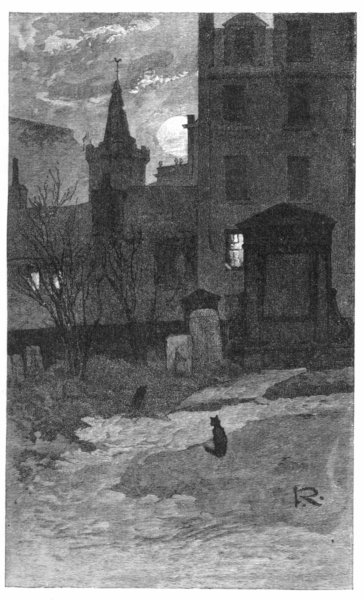
There is a touch of what for want of a better word we must call cynicism in the humorous indifference with which the old philosopher is said to have discussed his own burial. Finding, as the story goes, that there was not money enough in the house for the last expenses, he ordered what there was to be given to the poor, declaring that he was not concerned as to what was to become of his remains. If they did not choose to bury him they might let him lie, he said in grim jest. He was, however, reverently buried by the authorities of Edinburgh, in the historical churchyard of the Greyfriars, attended by "a great company of the faithful," though no stone seems ever to have been placed to indicate the spot where he was laid. Thus in some unknown corner he rests, like so many other illustrious persons—a man who never rested in his life, and carried down his labours to the very verge of the grave. It is a curious satire upon human justice that his name should have been kept green in Scotland by the rough jests of an imaginary Geordie Buchanan, commonly supposed to have been the King's fool, as extraordinary a travesty as it is possible to conceive. It is almost as strange a twist of all the facts and meaning of life that the only money of which he could be supposed to be possessed at his death should have been one hundred pounds (Scots, no doubt), arrears of the pension due to him from the Abbey of Crossraguel, given by Queen Mary to that learned pupil of the Sorbonne and lover of Lutetia with whom she read Latin at Holyrood in the early days before trouble came.
GREYFRIARS CHURCHYARD