Part 3 — CHAPTER I UNDER THE QUEEN REGENT (continued 2)
Reading edition
Within little more than a month after her death peace was signed; the French forces departed, and the English army, not much more loved in its help than the others in their hostility, was escorted back to the Border and safely got rid of. On the 19th of July, all being thus happily settled, St. Giles's was once more filled with a crowd of eager worshippers, "the haill nobilitie and the greatest part of the Congregation,"—a number which must have tried the capacity of the great church, large as it is. Knox does not give his sermon on the occasion, but we have a very noble and devout prayer, or rather thanksgiving, which was used at this service, and in which, though there is one reference to "proud tyrants overthrown," the spirit of devout thankfulness is predominant. He tells us, however, that the subject of his discourses, delivered daily, were the prophecies of Haggai, which he found to be "proper for the time." Some of his hearers, he informs us, spoke jestingly of having now to "bear the barrow to build the house of God." "God be merciful to the speaker," cries the stern prophet, "for we fear he shall have experience that the building of his ain house, the house of God being despised, shall not be so prosperous or of such firmity as we desire it were"—so dangerous was it to jest in the presence of one so tremendously in earnest. The speaker referred to, of this, as of most of the other caustic sayings of the time, is said to have been Lethington.
The first thing done by the Parliament was the distribution of the handful of ministers then existing among the districts which most needed them; the second, the verification and establishment of the Confession of Faith. No more curious scene could have been than this momentous ceremony. The Parliament consisted of all the nobility of Scotland, including among them the bishops and peers of the Church, and the delegates from the boroughs. The Confession was read article by article, and a vote taken upon each. Three only of the lords voted against it. The bishops said nothing. What their feelings must have been, as they sat in their places looking on, while the long array of the Congregation voted, it is vain to attempt to imagine. There was nothing the Reformers would have liked better than that discussion to which Knox had vainly bidden his opponents, throwing down his glove as to mortal combat. "Some of our ministers were present," he says, "standing upon their feet ready to have answered in case any would have defended the Papistrie and impugned our affirmations." But no one of all the ecclesiastics present said a word. The Earl Marischal, when he rose in his turn to vote, commented upon this remarkable abstinence with the straightforwardness of a practical man. "It is long since I have had some favour to the truth," he said, "and since I have had a suspicion of the Papistical religion; but I praise my God this day has fully resolved me in the one and the other. For, seeing that my Lord Bishops here present, who for their learning can, and for the zeal they should bear to the veritie would, I suppose, gainsay anything that directly repugns to the veritie of God, speaks nothing in the contraire of the doctrine proposed, I cannot but hold it to be the very truth of God." Even this speech moved the bishops to no reply. They sat silent, perhaps too much astonished at such an extraordinary revolution to say anything; perhaps alarmed at the strength of the party against them. It might be that there was little learning among them, though they had the credit of it; certainly the arguments which Knox reports on several occasions are inconceivably feeble on the side of the old faith. But whatever was the meaning there they sat dumb, and looked on bewildered, confounded, while the new Confession was voted paragraph by paragraph, and the whole scope of the Scottish constitution changed.
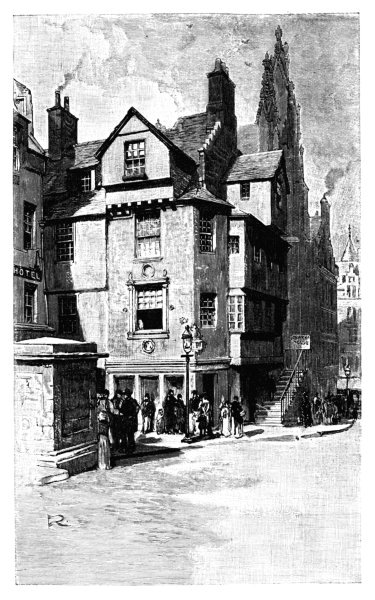
KNOX'S HOUSE, HIGH STREET
The next step was the abolition of the mass, an act by which it was forbidden that any should either hear or say that office "or be present thereat, under the pain of confiscation of all their goods movable and immovable, and punishing of their bodies at the discretion of the Magistrates." Another edict followed abolishing the jurisdiction of the Pope under pain of "proscription, banishment, and never to brook honour, office, or dignity within this realm." "These and other things," says the Reformer, "were orderly done in lawful and free Parliament," with the bishops and all spiritual lords in their places sitting dumb and making no sign. The Queen was at liberty to say afterwards, as was done, that a Parliament where she was not represented in any way, either by viceroy or regent, where there was no exhibition of sceptre, sword, or crown, and in short where the monarch was left out altogether, was not a lawful Parliament. But the most remarkable feature of this strange assembly amid all the voting and "bruit" is the dramatic silence of the State ecclesiastical. It is curious that no fervent brother should have been found to maintain the cause of his faith. But probably it was better policy to refrain. The extraordinary absence of logic as well as toleration which made the Reformers unable to see what a lame conclusion this was after their own struggle for freedom, and that they were exactly following the example of their adversaries, need not be remarked. John Knox thought it a quite sufficient answer to say that the mass was idolatry and his own ways of thinking absolutely and certainly true; but so of course has the Roman Catholic Church done when the impulse of persecution was strongest in her. There is one only thing to be said in favour of the Reformers, and that is, that while a number of good men had been sacrificed at the stake for the Reformed doctrines, no one was burned for saying mass; the worst that happened, notwithstanding their fierce enactments, being the exposure in the pillory of a priest. Rotten eggs and stones are bad arguments either in religion or metaphysics, but not so violently bad as fire and flame.
Thus the Reformed religion was established in Scotland, and Knox settled in St. Giles's for the remainder of his life. Whether he was at once placed in the picturesque house with its panelled rooms and old-fashioned comfort and gracefulness which still bears his name, standing out in a far-seeing angle from which he could contemplate the abounding life of the High Street, the great parish in which half his life was spent, is not certain; but it was a most fit and natural lodging for the minister of St. Giles's. And for the rest of his life, with very few intervals, all the stream of public life in Scotland flowed about this dwelling. His importance in every national question, the continual references made to him, the appeals addressed to him by monarch and noble, as well as by burghers and retainers, show better than any statement the unique position he held. He was at this time a man of fifty-five. His Marjory Bowes, never I think mentioned but by this name, the "weill belovit sister" who is associated with so much of his life without one trace of human identity ever stealing through the mist that envelops her, was dead; disappearing noiseless into the grave, where it would seem her mother, Mrs. Bowes, the religious hypochondriac who had required so many solemn treatises in the shape of letters to comfort her, had preceded her daughter. Two boys, the sons of Marjory, were with their father in these panelled rooms. They both grew up, but not to any distinction; he did not spare the rod as appears in an after statement, but loved not to see them in tears, and probably was a fond father enough. All these things, however, are too petty to find any record in what he says of himself.