1799.
Reading edition
January 1, 1799. Cries of London. No. 1. Buy a Trap, a Rat-Trap, buy my Trap. Published by R. Ackermann, 101 Strand.—The vendor of rat-traps is pausing before a shop decorated with such live stock as a rabbit in a hutch, and a jackdaw in a cage; he is offering his traps to a spectacled old gentleman, who is considering his ware with curiosity. The rats in a trap, carried on the trap-seller's arm, are exciting the interest of a dog.
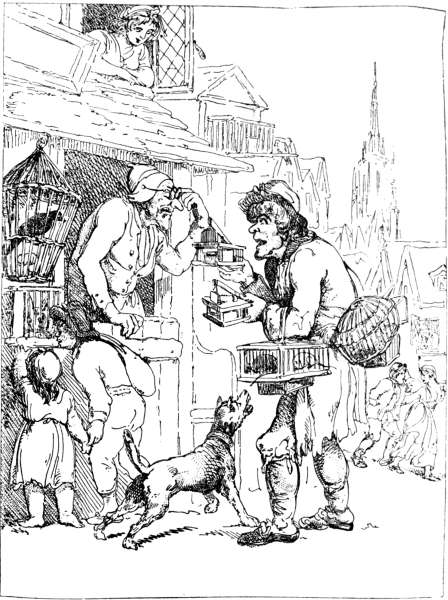
CRIES OF LONDON. NO. 1, 'BUY A TRAP, A RAT TRAP, BUY MY TRAP.'
January 1, 1799. Cries of London. No. 2. Buy my Goose, my Fat Goose. Published by R. Ackermann, 101 Strand.—A fat countrified-looking dealer is offering some fine fat geese for sale at the door of an apothecary, who, with his wife, is examining the birds with unnecessary closeness.
February 20, 1799. Cries of London. No. 3. Last Dying Speech and Confession. Published by R. Ackermann, 101 Strand.—A street ballad singer, of the St. Giles' order, is crying the last speech of 'the unfortunate malefactors who were executed this morning:' a common enough announcement when the extreme punishment of hanging visited small offences, and executions were of more frequent occurrence. That the fear of capital punishment did not act as a corrective to theft is illustrated in the background of the print, where a mere infant is drawn in the act of picking the pocket of a passing pedestrian.
February 20, 1799. Cries of London. No. 4. Do you want any brick-dust? Published by R. Ackermann, 101 Strand.—From this plate it seems that brick-dust, in the artist's days, was sold like sand. A patient donkey is saddled with an enormous pannier of brick-dust, and the vendor is pouring the contents of a measure into a bowl, held at the door of a highly respectable residence, by a pretty maid, to whose personal captivations the attentions of the brick-dust dealer are most particularly addressed.
March 1, 1799. Cries of London. No. 5. Water-cresses, come buy my Water-cresses. An old shylock-like person is knocking at a door in Portland Street (Mrs. Burke's), and is solicited to buy water-cresses by a neat maiden with a pretty face and a tall shapely form; the old reprobate is leering at the water-cress girl, and is disregarding a further offer of cresses from a more ragged and juvenile seller. A pair of highly-coloured damsels, redundant in charms and florid finery, are peering out of an upper window at the aged visitor.
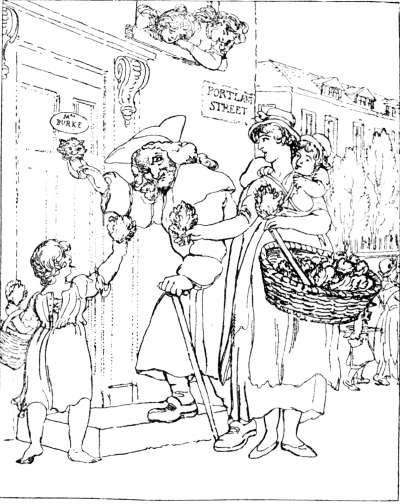
CRIES OF LONDON. NO. 5, 'WATER-CRESSES, COME BUY MY WATER-CRESSES.'
1799. Cries of London. No. 6. All a-growing, a-growing; here's flowers for your gardens.—A smart young gardener, with a substantial cart, drawn by a donkey, has a handsome selection of various evergreens and flowers for sale; he is standing at the door of a mansion, where a lady and little girl are choosing from his stock of geraniums in pots.
May 4, 1799. Cries of London. No. 8. Hot cross buns, two a penny buns.—A decent woman, wearing a white apron, and with a cloth over her basket, is supplying a patroness with a plateful of hot cross buns. A pretty woman, in a neat morning dress, is buying buns, and her children by her side are tasting the same without any loss of time. Outside a church, in the background, is a stout dignitary, with flowing gown, sleeves, and full wig, who is sweeping away from an appeal for charity addressed to him by a beggar woman and her offspring.
February 1, 1799. A Charm for a Democracy, Reviewed, Analysed, and Destroyed, January 1, 1799, to the confusion of its Affiliated Friends. Published for the Anti-Jacobin Review, by T. Whittle, Peterborough Court, Fleet Street.—The Tory party at the beginning of 1799 (the parliamentary session had opened at the end of November 1788) endeavoured to stifle the Opposition by raising outcries against sedition, and by denouncing publications of a revolutionary tendency, with which they pretended to implicate the Whigs. On the strength of certain alarmist tracts, extraordinary measures were taken to restrain the liberty of the press, and a few months later, in July, the Ministry went so far as to put into effect the extreme measure of subjecting printing presses to a licence. The organs of the Tories, exulting in the discomfiture of their opponents, were continually urging increased and severer political persecutions, while they pretended that the members of the Opposition were, in despair of succeeding in preserving their party by fair means, identifying themselves with the more treasonable writers, and were laying secret trains for the destruction of the Constitution. The King's Bench, Newgate, and Coldbath Fields began to be crowded with political prisoners, the last-mentioned receiving the popular nickname of the Bastille. The Anti-Jacobin Review was, as usual, peculiarly smart at the expense of the malcontents, and Rowlandson's assistance was enlisted to prepare a cartoon which, it was supposed, would expose the Whigs in their true colours, and hold up the abettors of sedition to the execration of all loyal subjects.
There are four elements displayed in this general view of the fancied emergency: the supernatural department, headed by the arch-fiend in person; the Radical pamphleteers and so-called workers of treason; the prominent members of the disconcerted Opposition and their followers; and the King and his ministers displayed, as Olympians, in the clouds. The Infernal Influence is superintending the preparation of the charm, which Horne Tooke and his friends, as the witches in Macbeth, are working at a boiling cauldron; the nature of the component parts of the conjuration are thus set forth:—
Eye of Straw and toe of Cade, Tyler's bow, Kosciusko's blade, Russell's liver, tongue of cur, Norfolk's boldness, Fox's fur; Add thereto a tiger's cauldron, For the ingredients of our cauldron!
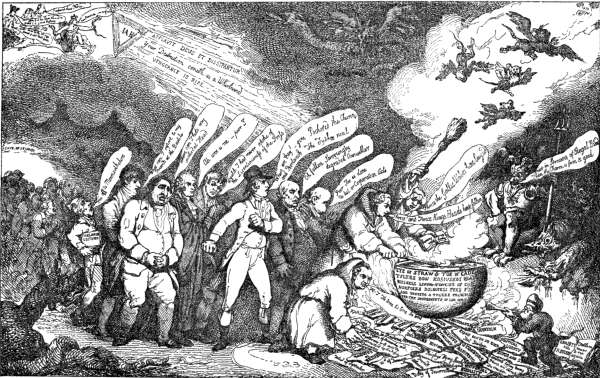
A CHARM FOR A DEMOCRACY, REVIEWED, ANALYSED, AND DESTROYED, JANUARY 1ST, 1799, TO THE CONFUSION OF ITS AFFILIATED FRIENDS.
One of Horne Tooke's colleagues is working the incantation from a breviary of his own, 'Lying, False Swearing, &c.,' and is flourishing a witch's besom, 'Thrice the Gallic wolves have bayed!' Another of the weird sisterhood is stirring the unholy mixture, crying: 'Thrice! and twice King's Heads have fallen!' Horne Tooke is attending to the fuel department; he is muttering: ''Tis time, 'tis time, 'tis time!' The witches' familiars are whirling above their heads, and in the midst of the flames from the cauldron, in the shape of wild cats, with wings; a flying monkey, with 'Voltaire' on his collar; a tiger with vulture wings, marked Robespierre; and Dr. Price's little dog, which is even more remarkable than the animal associated with the early magicians, are the ministering imps. The fiend, with his pitch-fork, and attended by dragons, serpents, Cerberus, and other terrific monsters of an imaginative construction, suggestive of Callot's grotesques, is directing as head cook the Democratic philter-workers to
Pour in streams of Regal Blood, Then the charm is firm and good.
The inflammable materials, which are piled up to make the pot boil, and fanned into flames by a diabolical news-boy, from the Courier, consist of such combustibles as O'Connor's Manifesto; Oakley's Pyrology; Belsham's History; Rights of Nature; Quigley's Dying Speech; Freud's Atheism; Whig Club; Universal Equality; Darwin's topsey-turvey Plants and Animals' Destruction; Sedition; French Freedom; Political Liberty; Duty of Insurrection; Equality; Fraud; Sophisms; Blasphemy; Heresy; Deism, together with such fiery sentiments as Kings can do no good; Joel Barlow; Resistance is Prudence; The Vipers of Monarchy and Aristocracy will soon be strangled by the infant Democracy; Kings are Servants, &c.; with the Analytical Review, a rival publication, thrown in as Fallen never to rise again.
The Duke of Bedford is at the head of the Opposition; the members seem to fare badly between the two extremes of Pittites and Radicals, the leader is demanding: 'Where are they! Gone. Pocketed the Church and Poorlands! The Tythes next!' The Duke of Norfolk is deploring the 'Fallen Sovereignty (of the People). Degraded Counsellor!' having been deprived of some of his offices as a punishment for the famous toast. Lord Derby is equally hopeless: 'Poor Joe is done. No Test, no Corporation Acts.' Fox, who had kept his word and absented himself from the debates, is reduced to a tattered state, and enquires: 'Where can I hide my secluded head?' Erskine, in legal trim, as 'Counsellor Ego,' is deploring: 'Ah, woe is me—poor I!' Tierney is regretting his past activity: 'Would I had never spoke of the licentiousness of the press!' Sir Francis Burdett, who had brought an investigation into the abuses practised on the unfortunates in the New State prison, before the House, a motion founded on his own observations, is enquiring: 'What can I report to my friends at the Bastille?' Thelwall, with his lectures under his arm, is 'Off to Monmouthshire;' and the followers of the dispirited 'party' are wandering blindly, lost in the 'Cave of Despair.'
Above the clouds is the King as Jupiter, with his supporters; light is being poured down in streams, upon the machinations of the disaffected patriots, from a symbolical source: Afflavit Deus et Dissipantur. 'Your Destruction cometh as a whirlwind!' 'Vengeance is ripe!' The monarch is strangling a brace of serpents, and asserting, 'Our enemies are confounded!' One minister is offering congratulations on a 'Great Victory!' while Pitt, behind the Crown, is insinuating an expeditious method of disposing of his adversaries: 'Suspend their bodies.' The Lord Chancellor, careful of the forms of law, is suggesting a more formal mode of procedure: 'Take them to the King's Bench and Coldbath Fields!'
February 10, 1799. An Artist Travelling in Wales. Rowlandson delin., Mercke sculp. Published by R. Ackermann, 101 Strand.—The caricaturist—in company with his friend, Henry Wigstead, himself a bit of an artist, further given to sportive flirtation with the Muses—visited North and South Wales in August 1797, for the purpose of carrying out a picturesque tour, to which the two travellers furnished the accompaniments of descriptive sketches and sketchy descriptions. The journey was undertaken solely as a pleasure trip, and not carried out with the intention of 'making a book.' It seems, however, that the interest which partial friends took in the notes of scenery, as found in Rowlandson's sketch-books, and in the minutes of travel, as jotted down in Wigstead's journal, finally prevailed over the travellers' reluctance to make much of a little; and accordingly, some two years later, the Remarks on a Tour to North and South Wales were submitted to the public, in the form of an octavo book, with some additional views by the hands of Pugh, Howitt, &c. (See 1800.)
Rowlandson appears both to have enjoyed this excursion, and to have been able to turn his opportunities to good account. He made several characteristic landscape sketches, and the present writer possesses a few drawings, in various stages of progress, which were evidently commenced on the spot.
A more Rowlandsonian relic of the tour is preserved in the plate, An Artist Travelling in Wales, first published soon after the traveller's return to town. Who the artist so represented may be the writer is not prepared to assert; but, as caricaturists have a well-recognised habit of turning not only the figures of their friends, but their own persons, to satiric usages on occasions, it is suggested that the large and gaunt limner, with his strongly-outlined features, and with his long legs slung across a Welch pony, may offer some points of resemblance to the designer; it is evident that more than once (See The Chamber of Genius, April 2, 1812) Rowlandson has burlesqued his own figure, or made himself the hero of equivocal situations, much as artists who have lived in our times have, now and again, delighted to introduce their own features amidst the fictitious personages they have thought proper or have been called upon to introduce. Notably in the cases of Thackeray and Cruickshank, this whimsical penchant is of such frequent occurrence, that the student, curious in tracing out such eccentricities of genius, will be able to discover at least a dozen characteristic and intentional resemblances of those admirable masters scattered over their illustrations, and relating to various periods of their careers.
It may be that remembrances of his old master at the Academy, Richard Wilson, who held the office of Librarian when the waggish youth, Rowlandson, was a student at the Academy, floated through the artist's mind in the course of his Welsh peregrinations, and tempted him to combine points of personality peculiar to both. It was not the first time Rowley's pencil had taken liberties with the marked traits of 'Red-nosed Dick,' who died, it must be conceded, some fifteen years before the tour in question. At all events, Peter Pindar, the witty and vituperative, was one of Rowlandson's intimates, and his advice to landscape-painters in general and to his friend and chum, Richard Wilson, in particular, whose talents he had the daring to lavishly acknowledge in the face of a generation which treated the artist with cold neglect because, forsooth, his works were 'not fashionable,' should appropriately be engraved below Rowlandson's unflattering presentation:—
Claude painted in the open air. Therefore to Wales at once repair, Where scenes of true magnificence you'll find; Besides this great advantage—if in debt, You'll have with creditors no tête-à-tête; So leave the bull-dog bailiffs all behind, Who hunt you with what noise they may, Must hunt for needles in a stack of hay.
A view in Wales is faithfully pictured; the unsophisticated natives are struck with astonishment at the figure of the travelling artist, whose profession they are far from comprehending, and whose paraphernalia excite their wonder. Rain, which is not unknown in the Principality, is wrapping landscape and figures in a moist embrace. The artist's very remarkable umbrella is a poor protection; his hat is limp; for safety his long clay pipe, a luxury difficult to replace, is thrust through a slit in the flap; his lank locks are dripping; the moisture is concentrating, and dropping down his well-defined proboscis. Of course it was necessary, in such an expedition, to bear the baggage and incidental impedimenta. A box contains the artist's larder and wardrobe; his saddle-bags hold the provisions of the hour; beside him swing his tea-kettle and coffee-pot; his goodly sketch-book is slung across his back, much as the observant traveller may have seen canvasses strapped across the shoulders of pedestrian artists during the season, and in the vicinity of Bettews, Conway and the Lluwy in our day. The easel is folded up—and a vastly unwieldy affair it is—on the back of the stumpy pony; brushes, a palette, knife, flasks of oil of goodly proportions, and a palette of extensive dimensions, are attached to the animal's neck; and thus equipped, the man of paint and his rough steed are picking a devious way through the saturating moisture, up and down the steep mountains of the country: a pleasant souvenir of past hardships and discomforts by the way.
February 18, 1799. Nautical Characters.
1. Cabin boy.
2. Sailor.
3. Marine.
4. Cook.
5. Midshipman.
6. Purser.
7. Lieutenant.
8. Captain.
9. Admiral.
10. Captain of Marines.
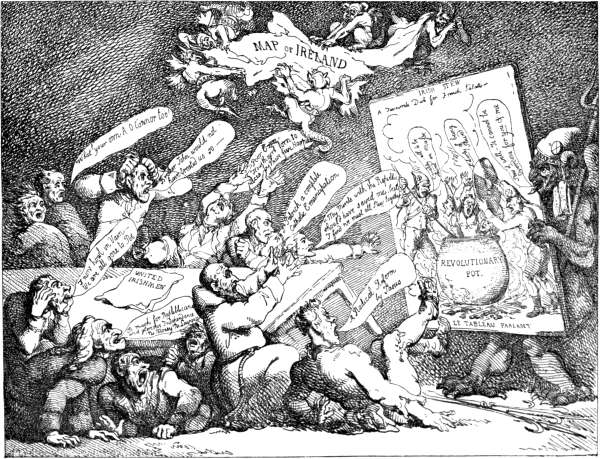
AN IRISH HOWL.
March 1, 1799. An Irish Howl. Published for the Anti-Jacobin Review by T. Whittle, Peterborough Court, Fleet Street.—The month following, the Irish patriots, and rebels alike, were favoured with a view of their position, which was hardly more encouraging than the pictorial prospect held out for the enlightenment of the Democrats at home. A National Convention is supposed to have been assembled; the members are thrown into consternation; and the table, round which they have been deliberating over the concoction of their organ the United Irishmen, is upset. A diabolical visitation is sufficient to account for this confusion. A monstrous representative of the Fiend of Evil, with formidable horns and claws, bearing a pitchfork over his shoulder, and with the French cap of Liberty, labelled Anarchy, on his brow, is intruding on the scene, with a masterpiece of his own preparation, setting forth the tender fate which the Irish patriots were likely to meet at the hands of their allies the Jacobins. Le Tableau Parlant affects to portray an 'Irish Stew, a favourite dish for French Palates.' The sons of Erin are, according to the canvas, thrust into a 'Revolutionary Pot,' which is boiling over a fierce fire; certain Jacobin French cooks, wearing the caps of Liberty, are thrusting their betrayed disciples into the seething cauldron, 'Equality, all to be stewed en masse,' while another apostle of Freedom is clapping on the lid: 'Liberty of being stewed!' The Arch-Deceiver, thrusting out a forked tongue, is imparting his instructions: 'Stew it well; it cannot be overdone for you and me!'
The United Irishmen are variously affected with despair at the probable end of their plottings. One patriot, intended for Grattan, or O'Connor, is exclaiming, 'My merits with the Republic should have saved me; but I find we must all stew together!' A ragged Reformer is thrown on his back; a bundle of pikes are at his feet; a case of Radical Reform. A papist friar is crying: 'By St. Patrick, a complete Catholic emancipation.' Others of the party are crushed. A legal gentleman is moaning in despair: 'So much for Republicanism and glorious independence! No money! No lawyer!' His neighbour cries: 'I now howl in vain; we are all gone to pot!' Another patriot is thinking regretfully of Ireland's proper and natural ally: 'Brother John would not have treated us so! What your own O'Connor, too!' The Map of Ireland is dragged to pieces, and dismantled by flying devils and imps of mischief christened 'Tallien, Barras, Lepaux,' &c. One of the united brethren is turning his eyes on the pitiful end of the Green Isle: 'Poor Erin, how thou'rt torn to pieces by these five harpies!'
1799. An Etching after Raphael Urbinas. An example of Rowlandson's powerful renderings of studies after the old masters, executed in a bold and flowing manner.—The nude figure of a man, who has probably been sleeping at the foot of a tree, has suddenly unfolded his cloak and found himself confronted by a hissing serpent, which has raised itself on its tail in readiness to attack the unprepared victim, whose face is made to wear an expression of statuesque horror. A club is on the ground at the feet of the man.
Apollo, Lyra and Daphne. Frontispiece probably to a book of music.—Apollo, with his crook and shepherd's dog by his side, and with sheep at his feet, is seated at the entrance to a wood. Several musical instruments, bound together with ribands, are hung on the branch of a tree over his head. On the other side of the picture is a nymph in classic guise, evidently captivated with his harmonies; she is resting her hand on the shoulder of a second listening maiden, dressed as a shepherdess.
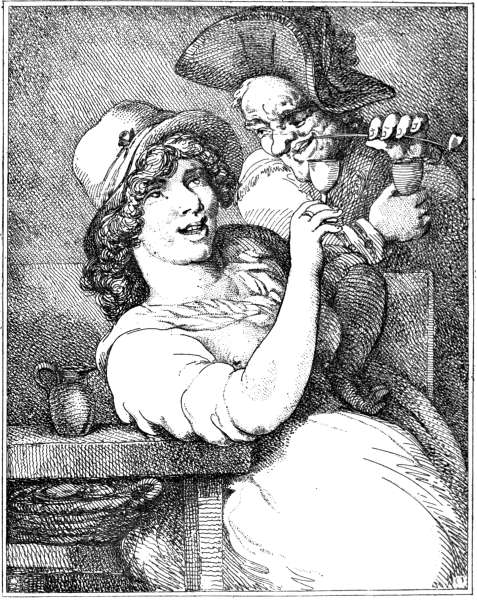
ST. GILES'S COURTSHIP.
April 10, 1799. St. Giles's Courtship. Published by R. Ackermann, 101 Strand.
Here vulgar Nature plays her coarser part, And eyes speak out the language of the heart, While health and vigour swell the youthful vein, To die with rapture, but to live again.
April 10, 1799. St. James's Courtship. Published by R. Ackermann, 101 Strand.
1799. View of a Cathedral Town on Market Day (Great Yarmouth), Rowlandson del. and sculp.
May 10, 1799. Borders for Rooms and Screens. Published by R. Ackermann, 101 Strand. Woodward delin. Etched by Rowlandson. In twenty-four sheets. Republished May 20 and August 1.
June 20, 1799. Connoisseurs. Published by T. Rowlandson, 1 James Street, Adelphi.—The interior of a cabinet of choice works of art. On an easel is displayed a florid and somewhat suggestive picture of Venus and Cupid richly framed. An old connoisseur, with a glass to his eye, and his three-cornered hat under his arm, is seated in an easy elbow chair, critically examining the work in question. Three other distinguished dilettanti are peering over his back, and stretching their noses as near as contrivable to the object of their gloating admiration. All these amateurs have evidently called in to view the collection, which includes an example after 'Susanna and the Elders,' and kindred subjects.
August 1, 1799. Horse Accomplishments. Sketch 1. A Paviour. Woodward del., Rowlandson sculp. Published by R. Ackermann.
August 1, 1799. Horse Accomplishments. Sketch 2. An Astronomer. Woodward del., Rowlandson sculp. Published by R. Ackermann.
August 1, 1799. Horse Accomplishments. Sketch 3. A Civilian. Woodward del., Rowlandson sculp. Published by R. Ackermann.
August 1, 1799. Horse Accomplishments. Sketch 4. A Devotee. Woodward del., Rowlandson sculp. Published by R. Ackermann.—The rider is somewhat inconvenienced by the eccentricities of his steed. The horse is travelling in a somnolent condition, of which the equestrian seems unconscious, as he is thus soliloquising over the unusual proclivities of his Rosinante:—'This is certainly a very devout animal; always on his knees; five times in a mile; constantly worshipping something or other. What is he at now?'
August 1, 1799. Waddling Out. Woodward del., Rowlandson sculp. Published by R. Ackermann.
August 10, 1799. Comforts of the City: A Good Speculation. No. 5. Woodward del., Rowlandson sculp. Published by R. Ackermann, August 10, 1799.—A stout citizen is rejoicing over a fortunate investment.
August 10, 1799. Comforts of the City: A Bad Speculation. No. 6. Woodward del., Rowlandson sculp. Published by R. Ackermann, August 10, 1799.—In this case the dabbler in novel ventures is looking very blank and disconcerted, on the receipt of the information that his very latest and most ingenious 'spec' does not promise to turn out favourably, according to a communication he holds in his hand:—'I am sorry to inform you that your scheme for manuring London with old wigs will not do.'
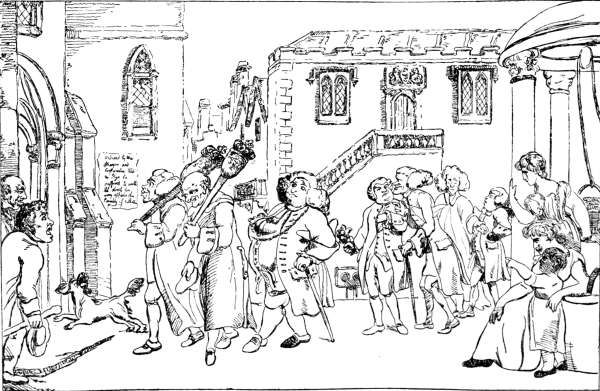
PROCESSION OF A COUNTRY CORPORATION.
August 12, 1799. Procession of a Country Corporation. H. Bunbury del. Etched by Rowlandson. Published August 12, 1799, by T. Rowlandson, James's Street, Adelphi.—Bunbury's pencil was never more happily employed than when engaged in perpetuating the comicalities which he noticed in the country; rustic simplicity, the pretensions of inflated noodles, bumptious nobodies, and kindred absurdities, such as are displayed in 'The procession of a Country Corporation,' wherein the Aldermen and Mace-bearers, his worship the Mayor, with his chain, and his dignified deportment, and his following of puffed-up provincial big-wigs are shown filing in solemn state past the pump, the Town-hall, and the stocks, to the Church vestry; the country clodhoppers and honest children of the soil are gazing open-mouthed, over-awed by the impressive nature of the ceremony, and the solemn airs of the performers. Bathos is arrived at in a notice on the wall, past which these 'hogs in harness' are strutting—'Ordered by the Mayor and Corporation that no pigs be suffered to walk the streets. For every offence the penalty of five shillings!'
August 1799. A Game of Put in a Country Ale House. G. M. Woodward invt. Etched by T. Rowlandson. Published by R. Ackermann.
1799. Bay of Biscay. (See 1789.)
September 3, 1799. Forget and Forgive, or Honest Jack shaking hands with an old acquaintance. Published September 3, 1799, by R. Ackermann, 101 Strand.—The troops forming the British Expedition which restored the Prince of Orange to his states are represented landing in the Texel, and delivering the Dutch from the hands of their friends the Sansculottes. Mynheer has become wretched and ragged under the French régime; he is shaking a British tar by the hand, heartily delighted to see a chance of recovering his freedom:—'Ah, Mynheer Bull, these cursed French rats have gnawed us to the backbone; they have barely left us a pipe, a drop of Hollands, or a red herring; oh, what a pretty pickle have we brought ourselves into!' 'Well, Mynheer,' responds Jack Tar, 'you seem heartily sick of fraternity: had you stuck to your old friends instead of embracing your ragged relations, you might have kept your gilders, saved your breeches, and preserved both states and stadtholder.' A Dutch vrow is trampling her foot upon an order of the French Convention:—'If any Dutch woman be detected in concealing any part of her husband's private property, she shall be guillotined.' She has secured a trifling comfort, a bottle of 'Hollands gin.' 'I have had great trouble, Mynheer, to smuggle this bottle for you, those French ragamuffins search me so close!' The troops forming the English contingent are landing from their ships, and driving the French legions before them at the point of the bayonet; the apostles of Liberty are losing their requisitions, 'Ducats and gilders for the use of the municipality;' they despair of converting their invaders: 'Here be dese English Bull dog, dey be such stupid brute dat we cannot make them comprehend the joys of Fraternisation!'
September 20, 1799. The Irish Baronet and his Nurse. ('Changed at his Birth.') Woodward del. Etched by Rowlandson.
October 1, 1799. The Gull and the Rook. Published by Hixon, 155 Strand.
October 1, 1799. The Crow and the Pigeon. Published by Hixon, 155 Strand.
October, 1799. Twopenny Whist. Designed by G. M. Woodward. Etched by T. Rowlandson. Published by R. Ackermann, 101 Strand.
October 28, 1799. A Note of Hand. Designed by G. M. Woodward. Etched by Rowlandson. Published by R. Ackermann.—From Bunbury to Woodward the change is easy. In all these renderings of the designs of less skilful amateurs it must be remembered that Rowlandson's part was not limited to that of a mere copyist of their ideas; he had to put crude conceptions into a presentable shape, and in most instances he has added points which originated in his own invention, and, as far as execution is concerned, he has made the works mainly his own.
In the present caricature there is actually no indication of Woodward's handiwork; a smart sailor of the period, returning to shore with prize money galore, and a watch, chain, and seals in either fob, neat silver shoe-buckles, and a spic-span rig-out, is calling to cash a twenty-pound note on a banker, who is negligently looking at the ceiling. The honest tar, who probably thinks the amount of the draft he has to draw a veritable fortune, is evincing his consideration for the man of finance—'I say, my tight little fellow, I've brought you a Tickler! A draught for twenty pounds, that's all! But don't be downhearted, you shan't stop on my account! I'll give you two days to consider of it.'
1799 (?). Legerdemain.—The subject owes its invention to the observant humour of Henry Bunbury, the caricaturist of gentle birth, who was ever a friendly ally of Rowlandson; while the latter has lent his more trained skill to work out the conceptions of the flattered amateur, further regarded, according to the views of his contemporaries, as his distinguished patron. We are introduced in 'Legerdemain,' to the consulting room and operating surgery of certain rustic practitioners, who combine the twin professions of dentists and pedicures; teeth and corns being extracted promiscuously, as the requirements of their patients might necessitate. Strength, rather than skill, is the chief requisition, if we may trust the whimsicalities of 'Legerdemain,' where main force directs the operations of the performers. One sturdy tooth drawer is bringing his knee and all the brute power at his command to bear in the way of leverage on the refractory grinder of an unfortunate and distracted client; a hammer and a pair of coarse pincers do not argue well for the painless dentistry of the establishment. A squire, judging from the liveried servant in attendance, is submitting his foot to another professor, for the removal of an obstinate corn; the victim is thrown into paroxysms of agony by the forcible mode of procedure adopted: the rude chiropedist has seized the sufferer's foot securely under his arm, and is dragging away with such vigour that, if the corn will not be persuaded to come off decently, the toe will be dragged out by the roots—the latter a most undeniable method of permanent cure so far as corns are concerned.
November 1, 1799. March to the Camp. Published by T. Rowlandson, 1 James Street, Adelphi.
November 1, 1799. Good Night. Woodward del. Etched by Rowlandson. Published by R. Ackermann, 101 Strand.—A gentleman in the last stage of sleepiness with his nightcap on his head, and his chamber-candlestick flaring away—he is yawning like a cavern, and stretching his arms as if heavy with slumber. The expression is realistically conveyed.
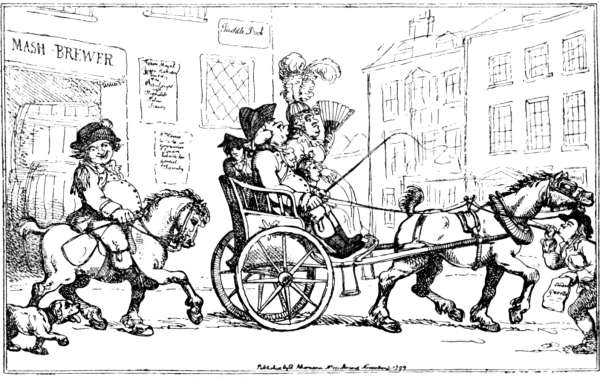
A BANKRUPT CART, OR THE ROAD TO RUIN IN THE EAST.
November 5, 1799. A Bankrupt Cart, or the Road to Ruin in the East. Woodward del. Etched by Rowlandson. Published by R. Ackermann, 101 Strand.—The fortunate possessor of that dubious vehicle, 'a Bankrupt cart,' is proceeding in state past his own premises with his chin in the air; the showy wife of his bosom in feathers and finery is riding by his side, and their children are packed in sandwich fashion. A follower, who is probably a drayman, put into livery for the occasion, and mounted on one of the horses used in the business, is grinning at the high and mighty dignity assumed by his employers. A news boy is blowing his horn in the averted faces of the party, offering the London Gazette, which contains the objectionable black list of bankruptcies, wherein, it is hinted, the name of 'Mash, Brewer,' figures conspicuously. Puddle Dock is the scene of this exposure, and the brewery is posted with advertisements, which indicate the sudden downfall of fashionable ambition: 'A house to be let in Grosvenor Square, suitable for a genteel family,' and 'Theatre Royal, Covent Garden, The Comedy of the Bankrupt, with High Life Below Stairs.'
November 5, 1799. A Dasher, or the Road to Ruin in the West. G. M. Woodward del. Etched by T. Rowlandson. Published by R. Ackermann.
1799 (?). Loose Thoughts.—A reclining female figure, lightly attired, and gracefully posed, buried in romantic creations of the imagination.
The Bookbinder's Wife.—Somewhat similar to the taste of the preceding. The nude figure of a lady toying with her infant: these subjects, which are avowedly of a slightly suggestive character, are handled with a grace and refinement which goes a long way to redeem the free nature of the subjects.
1799 (?). The Nursery.—A domestic subject; a gracefully posed female figure and two infants.
1799 (?). A Freshwater Salute.—The occupants of two waterside crafts are exchanging courtesies on the river, a more frequent occurrence at the beginning of the century, when figures of speech, especially among 'waterside loafers,' were more forcible than refined. The boatmen in the respective wherries are bawling at one another, and a stout damsel is extending, in expressive pantomime, an invitation which has shocked the proprieties of the occupants of the other craft, a lady of ton in a gay hat and feathers, and a very prim old gentleman, who is looking perfectly rigid with horror and indignation.
1799 (?). Ride to Rumford.—'Let the gall'd jade wince.' A stout equestrienne has put up her steed at the shop of an apothecary, who combines the profession of veterinary surgeon: the venerable practitioner, with spectacles on nose, is preparing a diaculum plaister for the scarified horsewoman.
1799 (?). City Fowlers—mark. H. Bunbury del., Rowlandson sculp.
Against the wind he takes his prudent way, Whilst the strong gale directs him to the prey; Now the warm scent assures the covey near, He treads with caution and he points with fear.—Gay.
1799 (?). The City Hunt. H. Bunbury del., Rowlandson sculp.—This scene of cockney horsemanship is suggestive of the learned lectures of Geoffrey Gambado, Esq., Riding Master to that authority on equestrianism, the Doge of Venice. It is a question which are the more extraordinary animals, the mounted citizens or their horses; all is grotesque and burlesque. Of course fat men are shown tumbling off and over their steeds; and with equal propriety, a brook is introduced, in which to deposit the unfortunate leapers. Various curs have come out to share the run, and among the most spirited riders may be distinguished a brace of black chimney-sweeps, fraternally perched astride the single donkey possessed by the firm.
1799 (?). Une Bonne Bouche.—A stout gourmand impaling an entire sucking-pig on a fork.
1799 (?). Cits airing themselves on Sunday. H. Bunbury del., Rowlandson sculp.—A lady and gentleman are enjoying an equestrian promenade, too busily engaged in flirting to notice that their horses are riding over some wandering pigs. A Jew is in a chaise, taking his pleasure in the air; the fair Jewess, his wife, is driving, the rest of their family are by their side. A stout elderly volunteer in his uniform is out for exercise and relaxation, mounted on a heavy horse from the cart, ridden with blinkers.
1799 (?). A Militia Meeting.—The original suggestion for this subject, which bears Rowlandson's name, is, with several other small etchings, belonging to the same series, due to Henry Bunbury; it represents a 'justice's parlour,' filled with local magnates, who are seated in council on the momentous militia question. The characteristics of the various personages are individualised with the sense of humour and that power of hitting off quaint expressions with which both Bunbury and Rowlandson were gifted in the highest degree.
1799 (?). A Grinning Match.—The companion print to A Militia Meeting, executed under the same auspices. A party of rustics, whose rude features are more rudely burlesqued, are grouped around a barrel to assist at a competitive exhibition of 'face-making.' The challenge runs thus: 'A gold ring to be grinned for; the frightfullest grinner to be the winner.' Mounted on a tub is one of the champions, round his head is the traditional setting of a horse collar, and he is succeeding in making the most fearful grimaces, to the consequent delight of the spectators.
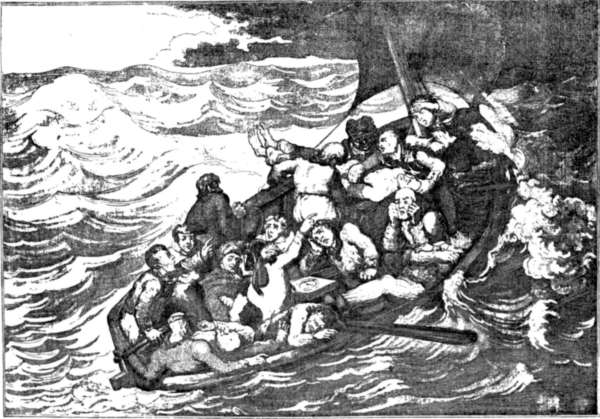
DISTRESS.
1799 (?). Distress, (18 inches by 125⁄8,) from an Original Drawing by Thomas Rowlandson.—Published by Thomas Palser, Surrey side, Westminster Bridge.—That Rowlandson possessed a remarkable power of grasping the humorous side of life was generally acknowledged in his own day, and is now well established, time having confirmed the justness of his title to a lasting reputation; indeed, his works in this order have long received a recognition which is more assured than has been accorded to those of his contemporaries. It may, however, be pointed out, with equal sincerity, that his conception of the terrible is even more remarkable than his facility for expressing the whimsical frivolities of society. It would be difficult to find a more realistic representation of the horrors of shipwreck than the appalling scene pictured under the title of 'Distress.' The fearful sufferings of the survivors, exposed without sustenance to the dangers of the deep, and the hopelessness of any chance of rescue, are all simply set forth with intense feeling, and a faithful perception of the horrors of the situation which is harrowing to examine, although it is evident that the terrors of the subject must have exercised a certain fascination over the mind of the delineator. It seems clear that portions of a crew have escaped the loss of their vessel only to become the powerless victims of more insupportable sufferings. A solitary officer and several of the crew are crowded into a boat, which they have no means of properly navigating. Provisions and water are evidently wanting; the horizon is a blank, the sea is still running high, and the sky threatens further tempests. Hunger, thirst, and exposure, are reducing the ocean waifs to madmen; while some are in paroxysms, others are stiffening corpses, and the body of one sufferer is about to be cast into the waters to lighten the freight; some are sunk in blank indifference or imbecile despair; others are furious, one or two are looking for help from above, and a few, among them the young officer and the boatswain, are doing their best to steer the open and over-laden boat towards a likely course. The cabin boy's distress is rendered with peculiar pathos.
1799. Hungarian and Highland Broadsword Exercise. Twenty-four plates, designed and etched by Thomas Rowlandson, under the direction of Messrs. H. Angelo and Son, Fencing-masters to the Light Horse Volunteers of London and Westminster. Dedicated to Colonel Herries. Oblong folio. London. Published, as the Act directs, February 12, 1799, by H. Angelo, Curzon Street, Mayfair.—Engraved Title and Frontispiece. A tablet topped by the figure of Fame and supported by a relievo representing Guards on the march; below it a trophy, and the escutcheon of the corps. On either side an archway or portico, with relievo tablets above, representing military scenes. On guard and saluting, on the left, is a Light Horse Volunteer of London and Westminster; on the right is one of the same corps dismounted, presenting arms. The etchings are dated September 1, 1798. The subjects are executed with considerable dash and spirit. The major part of the plates represent movements of cavalry, depicted with knowledge and power; instead of being, as the titles of the illustrations would indicate, mere definitions of the positions assumed in the exercises, the artist has, with superior ingenuity and ability, managed to produce a lively series of military tableaux filled with appropriate actions, in which bodies of troops, reviews, incidents of war, engagements of large parties, assaults, repulses, and other military demonstrations, make up the backgrounds, and convert a set of plates of mere broadsword exercises into an animated and interesting collection of warlike pictures. Judging from the lengthy subscription list appended to the folio, these plates must have enjoyed a wide popularity, secured under the auspices of the Angelos, whose acquaintances amongst the fashionable world enabled them to obtain a satisfactory array of patrons and subscribers.
The subjects are as follows:—
Prepare to guard.
Guard.
Horse's head, near side, protect.
Offside protect, new guard.
Left protect.
Right protect.
Bridle arm protect.
Sword arm protect.
St. George's guard.
Thigh protect, new guard.
Give point, and left parry.
Cut one, and bridle arm protect.
Cut two, and right protect.
Cut one, and horse's head, near side, protect.
Cut six, and sword arm protect.
Cut two, and horse's off side protect, new guard.
Cut one, and thigh protect, new guard.
On the right to the front, parry against infantry.
Infantry.
Outside guard; St. George's guard. Inside guard.
Outside half hanger. Hanging guard. Inside half hanger.
Half-circle guard. Medium guard.
The consequence of not shifting the leg.
The advantage of shifting the leg.
1799. Loyal Volunteers of London and Environs.—Infantry and cavalry in their respective uniforms. Representing the whole of the Manual, Platoon, and Funeral exercises in eighty-seven plates. Designed and etched by Thomas Rowlandson. Dedicated by permission to His Royal Highness the Duke of Gloucester. Engraved title-page; inscription in a lozenge; head of Mars above; Mercury's caduceus and branches of laurel; Cupid-warrior, and Cupid-justice with scales and sword, supported by a trophy of arms, accoutrements, &c. Dedicatory title.—This illuminated School of Mars, or review of the Light Volunteer corps of London and its vicinity, is dedicated by permission to His Royal Highness the Duke of Gloucester by his most obliged and very humble servant, R. Ackermann, 101 Strand. August 12, 1799.
List of Subjects.
Infantry.
PLATE.POSITION.
1. St. James's VolunteersStand at ease.
2. The Royal Westminster VolunteersAttention.
3. Broad Street Ward VolunteersFix bayonets, 1st motion.
4. St. Mary, Islington, VolunteersFix bayonets, 2nd motion.
5. St. Mary-le-Strand and Somerset House VolunteersFix bayonets, 3rd motion.
6. London and Westminster Light Horse Volunteers (Dismounted)Shoulder arms, 1st motion.
7. St. Clement Danes VolunteersShoulder arms, 2nd motion.
8. Bloomsbury and Inns of Court VolunteersRecover arms.
9. St. George's, Hanover Square, Light InfantryShoulder arms (from recover), 1st motion.
10. St. George's, Hanover Square, VolunteersCharge bayonet, 2nd motion.
11. St. Martin's in the Fields VolunteersCharge bayonet, 1st motion.
12. Temple Bar and St. Paul's Volunteers (Loyal London Volunteers)Present arms, 1st motion.
13. Cornhill Association VolunteersPresent arms, 2nd motion.
14. Temple Association VolunteersPresent arms, 3rd motion.
15. Bethnal Green Volunteers, Light Infantry (Mile End Volunteers)Support arms, 1st motion.
16. Bethnal Green Battalion VolunteersSupport arms, 2nd motion.
17. Hans Town Association VolunteersStand at ease, supporting arms.
18. Deptford Volunteer InfantrySlope arms.
19. Loyal Westminster Light InfantryOrder arms, 1st motion.
20. The Hon. Artillery Company of LondonOrder arms, 2nd motion.
21. Pimlico Volunteer AssociationUnfix bayonets, 1st motion.
22. Richmond VolunteersUnfix bayonets, 2nd motion.
23. Covent Garden VolunteersUnfix bayonets, 3rd motion.
24. Three Regiments of Royal East India VolunteersAn officer saluting.
25. Bishopsgate VolunteersHandle arms.
26. Brentford AssociationGround arms, 1st motion.
27. Fulham AssociationGround arms, 2nd motion.
28. St. Andrew, Holborn, and St. George the Martyr Military AssociationGround arms, 3rd motion.
29. Castle Baynard Ward Association VolunteersSecure arms, 1st motion.
30. Finsbury VolunteersSecure arms, 2nd motion.
31. Newington, Surrey, Volunteer AssociationSecure arms, 3rd motion.
32. Knight Marshal's VolunteersPrime and load, 1st priming motion, front rank.
33. Guildhall Volunteer Association, Light InfantryPrime and load, 2nd priming motion, front rank.
34. Cheap Ward AssociationPrime and load, 3rd priming motion, front rank.
35. Armed Association of St. Luke, ChelseaPrime and load, 4th priming motion, front rank.
36. Marylebone VolunteersPrime and load, 5th priming motion, front rank.
37. Coleman Street Ward Military AssociationPrime and load, 6th priming motion, front rank.
38. St. Pancras VolunteersPrime and load, 7th priming motion, front rank.
39. Cordwainers' Ward VolunteersPrime and load, 1st loading motion.
40. St. Margaret and St. John, Westminster, Volunteer AssociationsPrime and load, 2nd loading motion.
41. Lambeth Loyal Volunteers.Prime and load, 3rd loading motion.
42. St. George's, Southwark, Loyal VolunteersPrime and load, 4th loading motion.
43. St. Saviour's, Southwark, AssociationPrime and load, 5th loading motion.
44. St. Olave's, Southwark, VolunteersPrime and load, 6th loading motion.
45. Poplar and Blackwall VolunteersPrime and load, last motion.
46. Sadler's SharpshootersA Light Infantry Man defending himself with Sadler's patent gun and long, cutting bayonet.
47. Radcliff VolunteersMake ready, front rank.
48. Union, Wapping, VolunteersPresent front rank.
49. Loyal Hackney VolunteersFire front rank.
50. Bermondsey VolunteersFront rank kneeling, make ready.
51. Loyal Volunteers, St. John's, SouthwarkPresent (as front rank kneeling).
52. Langbourn Ward VolunteersPrime and load (as a centre rank).
53. St. George's, Hanover Square, Armed AssociationMake ready (as a centre rank).
54. St. Sepulchre (Middlesex) VolunteersPresent (as a centre rank).
55. Farringdon Ward Within VolunteersPrime and load (as a rear rank).
56. Aldgate Ward AssociationMake ready (as a rear rank).
57. Walbrook Ward AssociationPresent (as a rear rank).
58. Clerkenwell AssociationAdvance arms.
59. Royal Westminster GrenadiersAdvance arms 4th motion.
60. Bread Street Ward VolunteersShoulder arms, from advance 1st motion.
61. Vintry Ward VolunteersClub arms, 1st motion.
62. Portsoken Ward VolunteersClub arms, 2nd motion.
63. St. Catherine's AssociationClub arms, 3rd motion.
64. Farringdon Ward (Without) VolunteersClub arms, 4th motion.
65. Bridge Ward AssociationMourn arms, 1st motion.
66. Tower Ward AssociationMourn arms, 2nd motion.
67. Christ Church (Surrey) AssociationMourn arms, 3rd motion.
68. Loyal Bermondsey VolunteersPresent arms, 1st motion from mourn arms.
69. Billingsgate AssociationPresent arms, 2nd motion from mourn arms.
70. Highland Armed AssociationAn officer.
71. The Armed Association of St. Mary, WhitechapelPresent arms, 2nd flugel motion.
72. Bank of England Volunteers, Light InfantryOrder arms, 2nd flugel motion.
73. Candlewick Ward AssociationSupport arms, 1st flugel motion.
74. Queenhythe Ward VolunteersA sergeant with arms advanced.
75. Ward of Cripplegate (Without) Volunteers.Order arms.
76. Dowgate Ward VolunteersOrder arms.
77. Mile End VolunteersPile arms.
78. St. Leonard, Shoreditch, VolunteersPile arms.
79. Trinity, Minories, AssociationPile arms.
Cavalry.
1. London and Westminster Light Horse Volunteers.
2. Surrey Yeomanry.
3. Deptford Cavalry.
4. Westminster Cavalry.
5. Middlesex Cavalry.
6. Southwark Cavalry.
7. Clerkenwell Cavalry.
8. Lambeth Loyal Cavalry.
9. Loyal Islington Volunteer Cavalry.
END OF THE FIRST VOLUME.
LONDON: PRINTED BY SPOTTISWOODE AND CO., NEW-STREET SQUARE AND PARLIAMENT STREET
FOOTNOTES:
INDICES
(As Printed in Volume 2)
INDEX OF NAMES, PERSONS, &c.
A B C D E F G H J K L M N O P Q R S T V W Y
Ackermann, Rudolph (Rowlandson's publisher), i. 85, 89–93
Ackermann's Poetical Magazine, i. 33
Addington, Hon. H., 'The Doctor,' i. 246
Alexander, Emperor of Russia, ii. 281, 294
Angelo, Henry, 'Reminiscences,' i. 55, 64–6, 68, 70–2, 78–9, 85, 87–8, 287, 298–300, 374; ii. 5
Angelo's Fencing Rooms, i. 241
Angelo and Rowlandson at Vauxhall, i. 62–3, 156
— and Son, Hungarian and Highland Broadsword Exercise, i. 374
— Henry, his sketch of Simmons, the Murderer, ii. 81
Anstey, Christopher, 'Comforts of Bath,' i. 333–49
Arnold, General, i. 173
Atkinson, Christopher, i. 143–4
Auckland, Lord Eden, i. 173
Austria, Emperor of, ii. 281
Austria, Crown Prince of, ii. 281
Banco to the Knave (Gillray), i. 106
Banks, Sir Joseph, i. 192
Bannister, the Comedian, a Collector, i. 70; ii. 248
— John, the Comedian, an Art Student, i. 53–4
Barrymore, Lord, i. 58, 161–2, 303
Bate, Dudley, of the Morning Post, i. 159
Bates, William, B.A., 'Sketch of Rowlandson's Works,' 'Essay on George Cruikshank,' ii. 379
Bedford, Duke of, i. 359
Bell, Dr., ii. 216
Beresford, James, ii. 178
Billington, Mrs., i. 158
'Black Dick' (Lord Howe), i. 199
'Blackmantle,' Bernard (pseudo), i. 43; ii. 375, 378–9
Blair, Doctor Hugh, i. 198
Blucher, Prince von, ii. 278–9, 280–1, 293–5
'Book for a Rainy Day,' J. T. Smith, i. 70
Borowloski, Count, 'The Polish Dwarf,' i. 186
Bossy, Doctor, ii. 5
Boswell, James, i. 193–8
Boswell's 'Tour to the Hebrides,' i. 84, 193–8
Buonaparte, the Emperor Napoleon, ii. 42–3, 45, 47, 52, 54, 61, 82–3, 93–102, 130, 159, 162–3, 187, 203–4, 255, 258–64, 271–2, 276–82, 289, 291–3
— Joseph, King of Spain, ii. 95–6, 98–101
— Louis, King of Holland, ii. 97, 258–9
Buonaparte's Generals, ii. 291
Brightelmstone in 1789, i. 277
Britannia, 117, 136, 141–2, 247; ii. 6
Buckingham, Marquis of, i. 243
Bullock, Proprietor of 'Bullock's London Museum,' ii. 309
Bunbury, Henry, the Caricaturist, i. 61, 78–80, 369
— the Caricaturist (illustrated biographical sketch of his life by Joseph Grego), i. 3
— Henry, Caricaturist (Gambado's 'Annals of Horsemanship and Academy for Grown Horsemen'), i. 352–3; ii. 101–15, 217, 221–3
Burdett, Sir Francis, i. 359; ii. 74, 181–2, 184, 365
Burke, Hon. Edmund, i. 112, 118–19, 220, 245, 248, 274, 289; ii. 13
Burton, Alfred, 'Adventures of Johnny Newcome in the Navy,' ii. 363–4
Bute, Lord, i. 141
Butler, S., ii. 174, 198
Camden, Lord, i. 244
Canning, George, verses on 'All the Talents,' ii. 69
Canning, George, ii. 166
Carmarthen, Marquis of, i. 244, 248
Cartright, Major John, i. 121
Castlereagh, Lord, ii. 166
Catalini, Madame, ii. 165
Catharine, Empress of Russia, i. 290
Chambers, Sir William (architect of Somerset House), ii. 217
Charles the Fourth, King of Spain, i. 290, 292; ii. 94
Charlotte, Queen, i. 110, 199–210, 220, 228, 230, 252, 290
Chatham, Lord, i. 244
— General, ii. 164, 166
Chattelier, Miss (Rowlandson's aunt), i. 52, 63–4
Chiffney (jockey to the Prince of Wales), i. 207
Clarke, Mrs. Mary Anne, ii. 135–64, 166, 181
— Scandal, The, i. 28; ii. 135–64, 181
Clavering, General, ii. 143
Coleraine, Lord, i. 180, 220, 229. (See Hanger)
Collections of Rowlandson's drawings, i. 5. Appendix
Collings, the Caricaturist, i. 82–4, 191, 193
Combe, William, ii. 247, 268, 317–55, 359–62, 271–2 — — (author): 'The Three Tours of Doctor Syntax,' ii. 176, 247–52, 266–7, 269–70, 367, 373, 375 'The Dance of Death,' ii. 317–15 'The Dance of Life,' ii. 359–62 'The History of Johnny Quæ Genus,' ii. 371–2
Corbett, Thomas, High Bailiff for Westminster, ii. 140, 153–4
Cornwall, Views in, ii. 56
Cross Reading (Whiteford's), i. 84
Cruikshank, George, caricaturist, i. 16–19
Cumberland, Duke of, ii. 225
Curtis, Commodore, ii. 163–4
Davy, Sir Humphrey, ii. 366
Derby, Lord, i. 359
Devonshire, Duchess of, i. 124, 126–9, 131–2, 135, 141–2, 152, 158; ii. 59
Didelot, dancer, i. 283
Don Carlos, ii. 94
Duncannon, Lady, i. 135, 141, 158
Dundas (Lord Melville), i. 121, 134, 243–4, 246; ii. 49–51, 60, 136
Dundas, Sir David, ii. 137
Dunthorne, James, i. 226–7, 314
Elliot, Right Hon. Hugh, English Minister at Dresden, ii. 311
Engelbach, Lewis, 'Letters from Italy, or Naples and the Campagna Felice,' ii. 267, 301–8
English Caricaturists, i. 2
'English Spy, The,' by 'Bernard Blackmantle,' i. 43
Erskine, Lord, i. 112, 359
'Farquhar,' Ferdinand (pseudo), 'Relics of a Saint,' ii. 317
Ferdinand of Spain, ii. 93
Fielding's 'Tom Jones,' ii. 55–6
Fitzgerald, Mr., i. 161
Fitzherbert, Mrs., i. 170, 220, 226, 248, 276
Fox, Hon. Charles James, ii. 49, 58–61, 109, 112–13, 116–17, 119, 123–7, 129, 131–5, 138–43, 154, 221, 231–2, 245, 248, 270, 359
Fox, General, i. 117
Frederick the Great, i. 182–3
French Ambassador, The, i. 147
Gambado, Geoffrey (pseudo Henry Bunbury), 'Academy for Grown Horsemen,' i. 352–3
— — 'Annals of Horsemanship,' i. 352; ii. 102–15
George the Third, i. 115, 119, 140–1, 182–3, 199–210, 220, 228–9, 248, 251–2, 290, 360; ii. 6, 59, 82, 196
Gillray, the Caricaturist (his life, works, and times, by Joseph Grego), i. 3–4, 54, 106, 143, 229, 242, 328; ii. 197, 223
Gloucester, Duke of, i. 328
Goldsmith, Oliver, 'The Vicar of Wakefield,' ii. 356–9, 375
Gordon, Duchess of, i. 126, 152
Grafton, Duke of, i. 244, 246–8
Grattan, i. 250, 362
Grego, Joseph: 'An Illustrated Biographical Sketch of Bunbury, the Caricaturist,' i. 3 'The Works of James Gillray, with the Story of his Life and Times,' i. 3–4 'A Collection of Drawings by Rowlandson.' Appendix
Grenville, i. 244
— Lord, ii. 59
Guise, General, his collection of pictures at Oxford, ii. 66
Hadfield. Attempted the life of the King, ii. 6
Hamilton, Sir William, Ambassador at Naples, ii. 311–13
— Lady, ii. 311–13
Hanger, George, i. 180, 220, 229. (See Coleraine.)
Harrison, W. H., 'The Humourist,' ii. 380–6
Hartley, Mrs. (actress), i. 160
Hastings, Warren, i. 226, 230
— Marquis of, ii. 299
Haydon, B. R., ii. 378–9
Heath, James, i. 85
— — letter to, written by the Caricaturist, ii. 48
Hebrides, Boswell's Journal of a Tour in the, i. 193–8
Heywood ('Old Iron Wig'), i. 70
'Historical Sketch of the Art of Caricaturing,' by J. P. Malcolm, F.S.A., i. 73–6
'History of Caricature and the Grotesque in Literature and Art,' i. 3, 76
Hobart, Hon. Mrs. (Lady Buckinghamshire), i. 127, 129–30, 134
Holland, Lord, i. 289
Holman, the actor, i. 165, 190
Hood, Admiral Lord, i. 121, 124, 127, 133, 228
Hook, Theodore, 'Chacun à son Goût,' i. 67
Hooper, the boxer, i. 162
Horne-Tooke, John, i. 327, 359; ii. 74
House, Sam, i. 98–9, 108, 129, 131, 138–9
Howe, Lord, i. 67–8, 199
Howitt, the artist, Rowlandson's brother-in-law, i. 50
John Bull, ii. 42, 43, 47, 50–1, 58, 60–1, 75, 82–3, 93, 101, 130, 159
Johnson, Samuel, LL.D., i. 193–8
Junot, General, ii. 101, 204
Kemble, John Philip, ii. 46, 165
Kent, Duke of, ii. 141–4
King of Prussia, The, i. 182–3
Kingsbury, Caricaturist, i. 242, 290
Knight (Miss Cornelia), authoress, ii. 311–12
Lambert, Daniel, ii. 59–60
Leicestershire Giant, ii. 59–60
Leinster, Duke of, i. 249, 251
Life of Henry Bunbury, the Caricaturist, i. 4, 75–9
Lonsdale (Earl of), i. 136–7
Lord Howe's Action, i. 67–8
Lothian, Marquis of, i. 249, 251
Louis XVI. of France, i. 274, 290
— XVIII. of France, ii. 292, 295
Lowther, Sir James, i. 136
Loyal Volunteers of London and Environs, i. 375
Lunardi, Vincent, i. 163–4
Malcolm, J. P., F.S.A., 'Historical Sketch of the Art of Caricaturing,' i. 75–6; ii. 184
Manners, Lord Charles, ii. 215–16
Melville, Lord (see Henry Dundas), ii. 49–51, 60–1, 75
Memoirs of John Bannister, Comedian, i. 47
Mitchell, the Banker, i. 68, 71, 85
Moira, Lord, embarkation for La Vendée, i. 68
Morland, George, the Artist, i. 86–7, 239
— — Portrait of, by Rowlandson, i. 86; ii. 229, 330
Moser, Michael, Keeper at Somerset House, i. 53
Mulgrave, Lord, ii. 166
Munro, Doctor, i. 124
National Collections of Caricatures, i. 5; ii. Appendix.
Nelson, Admiral Lord, i. 350; ii. 52, 54, 311–13
'Newcome, Johnny' (pseudo), Military Adventures of, ii. 298
Ney, Marshal, ii. 291, 293
Nicols, John, Editor of the Gentleman's Magazine, i. 282
Night Auctions, i. 70
Nixon, Henry, the Facetious, i. 82–3; ii. 26, 66
Nollekens, J., Artist, ii. 16, 19
Norfolk, Duke of, i. 359
North, Lord, i. 105–6, 108, 112–13, 116, 119, 124–5, 142, 220
O'Connor, i. 364
O'Kelly, Colonel, i. 259–60
O'Meara, Dr., 146, 155
Orleans, Duke of, i. 252–3, 248, 274
Pacchierolti, i. 98
Paoli, General, i. 193
Papworth, J. B., ii. 268
Parsons, the Comedian, i. 70
Paul, Emperor of Russia, ii. 28–9
Perdita, i. 159
Perry, James, of the Morning Chronicle, i. 159
Petersham, Lord, ii. 225
Petty, Lord Henry, ii. 58–60
Picturesque Beauties of Boswell, i. 193–8
'Pindar, Peter,' Trick played off on, i. 71–2
— — i. 97, 143, 187–8, 192, 200, 210, 361; ii. 13, 217
Pitt, Hon. William, i. 115, 117, 119, 121, 123, 221, 226, 230, 231–2, 243–8, 360; ii. 22, 28, 49, 50
Pomfret, Lord, ii. 225
Pope Pius the Sixth, i. 290
— — the (Pius VII.), ii. 44, 51, 163, 204
Portland, Duchess of, i. 124
— Duke of, i. 289
Potemkin, i. 292
Priestly, Dr., i. 272
Prince of Wales, i. 110, 132, 140, 152, 159, 170, 220, 226, 229–31, 243, 246–7, 248, 251, 274, 290, 298, 303
— Regent, ii. 294
Prussia, King of, i. 292
Pugin's 'Microcosm, or London in Miniature,' ii. 125–8
Pyne, W. H. (Ephraim Hardcastle), 'Wine and Walnuts,' i. 55–6
— — — Somerset House Gazette, i. 55, 57–8, 69
Queen Charlotte, i. 110, 199–200, 220, 228
Queen of Spain, ii. 93
Quirk (Boxer), ii. 226
'Quiz' (pseudo), 'The Grand Master, or Qui Hi in Hindostan,' ii. 299–301
Ramberg, Caricaturist, i. 223, 225
'Remarks on a Tour to North and South Wales in the Year 1797,' ii. 19–21
Richmond, Duke of, i. 183, 231, 243–4, 246–8
Robinson, Jack, i. 117–18
— Mrs., i. 159
Romney (the Painter), ii. 311
Ron, Baron (Quack Dentist), i. 211
Roscius, the Infant, ii. 46
Rosedale, John (Mariner), exhibitor of the pictures at Greenwich Hospital, ii. 71
Rowlandson, Thomas (the Caricaturist), i. 239, 360
— a student at the Royal Academy, i. 53
— Academy drawings, i. 22–3
— and Napoleon, i. 27–8
— as a landscape artist, i. 14
— as a marine artist, i. 18
— as a portrait painter, i. 13
— at Portsmouth, i. 67
— biographical references to, i. 54–5
— book illustrations, i. 35–45
— chronological summary of his caricatures, ii. 389. (See 4)
— Continental tours, i. 59, 68–9; ii. 330–1
— contributions to the Royal Academy, i. 50–65
— collections of drawings by, ii. Appendix
— Department of Prints and Drawings, British Museum, ii. Appendix
— South Kensington Museum, ii. Appendix
Rowlandson, Dyce Collection, South Kensington Museum, ii. Appendix
— — at Windsor Castle, ii. Appendix
— early caricatures, i. 22
— engraved works, i. 23–30
— family, the, i. 49–51
— fortune bequeathed the Caricaturist, A, i. 64
— gambling proclivities, i. 64
— Gentleman's Magazine, the, obituary notice, i. 55, 94–5
— George Cruikshank on Rowlandson, i. 16–19
— his first visit to Paris, i. 52
— his friends, i. 60–2
— his publishers, i. 6
— his schoolfellows, i. 51
— Illustrations to 'The Tour of Dr. Syntax in Search of the Picturesque,' ii. 176, 247–52, 266–7, 269–70, 367, 373, 375
— — 'The World in Miniature,' ii. 312–17, 362
— — 'The English Dance of Death,' ii. 317–55
— imitations of the drawings of contemporary artists, i. 151
— in France, Flanders, and Holland, i. 58, 68–9; ii. 330–1
— in Paris, i. 58–9
— journeys in England, i. 75, 276–9, 360; ii. 6, 19–21, 56, 169, 181, 239–246, 373
— letter from, 1804, ii. 48
— lists of public and private collections. Appendix
— mode of working at Ackermann's 'Repository of Arts,' i. 31
— on the Westminster Election, i. 22, 121–43, 153–4
— portraits of the artist, i. 45–8, 360; ii. 228–30
— portraits exhibited by, i. 59
— robbed, i. 65–6
— successive exhibits at the Royal Academy. Figure subjects, i. 59, 64–5
— views of the Colleges, Oxford and Cambridge, ii. 186
Rowlandson's 'Sketches from Nature,' ii. 373
— illustrations to 'The Vicar of Wakefield,' ii. 356–9
— — 'The Dance of Life,' ii. 359, 362
— — 'An Excursion made to Brighthelmstone in the Year 1782,' i. 276–9
— illustrations to Smollett's works, i. 320; ii. 56, 181
— — 'A Narrative of the War, 1793–5,' i. 328–9
— — 'Academy for Grown Horsemen,' i. 353; ii. 102–15, 181
— — Fielding's 'Tom Jones,' i. 304; ii. 55–6
— illustrations to 'The Annals of Horsemanship,' i. 352–3; ii. 102–15, 181
— — 'Les Délices de la Grande-Bretagne,' i. 305
— — 'The Comforts of Bath,' i. 333–49
— Views of London, i. 349
— 'Sheets of Picturesque Etchings,' i. 280, 289
— — 'Cupid's Magic Lantern,' i. 332
— — 'Love in Caricature,' i. 353
— — 'Cries of London,' i. 354–6
— — Anti-Jacobin Review, i. 357–60
Rowlandson, 'Loyal Volunteers of London,' i. 375–7
— 'Hungarian and Highland Broadside Exercise,' i. 374
— 'Nautical Characters,' i. 362
— 'Hogarthian Novelist,' ii. 6
— illustrations to Sterne's 'Sentimental Journey,' ii. 10, 169–74
— — 'The Beauties of Sterne,' ii. 10, 169–75
— — 'Remarks on a Tour to North and South Wales,' ii. 19–21
— — 'Bardic Museum of Primitive British Literature,' ii. 41
— — 'A Compendious Treatise on Modern Education,' ii. 41
— — 'Views in Cornwall, &c.,' ii. 56, 169, 181, 239–46
— — 'The Sorrows of Werter,' i. 190; ii. 57
— — Boswell's 'Journal of a Tour to the Hebrides,' i. 193–8
— — 'The Poems of "Peter Pindar,"' i. 192, 201–9
— — 'The Pleasures of Human Life,' ii. 83, 180, 362
— — 'The Microcosm of London, or London in Miniature,' ii. 125–8
— — 'The Miseries of Human Life,' ii. 119–24
— — 'Chesterfield Travestie,' ii. 115–17, 224
— — 'The Art of Ingeniously Tormenting,' ii. 115, 129, 178
— — The Caricature Magazine, ii. 115–16
— — G. A. Stevens' 'Lecture on Heads,' ii. 117–18
— — 'Beauties of Tom Brown,' ii. 115, 181
— — 'The Clarke Scandal,' ii. 135–62
— — The Poetical Magazine, ii. 175–78
— — 'The Surprising Adventures of Baron Munchausen,' ii. 176
— — J. Beresford's 'Antidote to the Miseries of Human Life,' ii. 178
— — Butler's 'Hudibras,' ii. 174, 198
— 'Sketches from Nature,' ii. 169
— illustrations to 'Annals of Sporting,' by Caleb Quizzem, ii. 178–9
— — 'Petticoat Loose: a Fragmentary Poem,' ii. 238
— — 'Poetical Beauties of Scarborough,' ii. 268–9
— — Engelbach's 'Letters from Italy and the Campagna Felice,' ii. 267, 301–8
— — 'The Military Adventures of Johnny Newcome,' ii. 298–9, 312
— — 'Qui Hi, the Grand Master in Hindostan,' ii. 299–301
— — Ferdinand Farquhar's 'Relics of a Saint,' ii. 312, 317
— — 'New Sentimental Journal, or Travels in the Southern Provinces of France,' ii. 362, 368–70
— — 'The Adventures of Johnny Newcome in the Navy' (Burton), ii. 363
— — 'Characteristic Sketches of the Lower Orders,' ii. 366–7
— — 'The History of Johnny Quæ Genus,' ii. 371–3
— — 'Crimes of the Clergy,' ii. 373
— — Chap Books, ii. 363
Rowlandson, 'The Spirit of the Public Journals for the Years 1823–4–5,' ii. 375
— — 'The English Spy,' by Bernard Blackmantle, ii. 378–9
— — 'The Humourist' (posthumous), ii. 380–6
— — 'Grotesque Drawing Book,' ii. 362
Rutland, Duchess of, i. 152
Salisbury (Lord Chamberlain), i. 327
Sandon, Captain, ii. 143
Sheridan, R. B., i. 229, 245, 248, 274, 289, 330; ii. 46, 58–60, 220.
Sherwin, J. K., engraver, i. 45
Showell, Mrs., ii. 66
Siddons, Mrs., ii. 46
Sièyes, Abbé, ii. 47
Simmons, Thomas (murderer), ii. 81
Skeffington, Sir Lumley, i. 180
Smith, John Raffaelle, engraver, i. 47
Smith, John Thomas, portrait of Rowlandson, i. 48; ii. 17 'Nollekens and his Times,' ii. 55; ii. 16–19 'Book for a Rainy Day,' i. 70
Smollett's 'Peregrine Pickle,' ii. 56 Miscellaneous Works, ii. 181
Somerset House Gazette, i. 54, 88
Sorrows of Werter, ii. 57
Southcott, Joanna (the 'Prophetess'), ii. 287
Spain, Queen of, ii. 93
Spain, Infants of, ii. 94
Stanislaus the Second, King of Poland, i. 290
Sterne, Laurence, ii. 10, 169–75.
Stevens, G. A., 'A Lecture on Heads,' ii. 117
Sydney, Lord, i. 246
Talleyrand, Prince, ii. 45, 187, 280
Tegg's Caricatures, i. 34
Temple, Lord, i. 119, 140, 141
Thelwall (political lecturer), i. 327, 359
Thicknesse, Philip, i. 275–6
Thurlow, Lord, i. 121–2, 140–1, 220, 243–4, 248, 290
Tierney, Mr., i. 359
Topham, Major (World newspaper), at Vauxhall, i. 63
Topham, Captain, i. 158, 165–7, 183, 190
Townshend, Lord John, i. 228
Towzer, Rev. Roger, ii. 287
Trotter, 51, 61
Vauxhall Gardens, Characters at, i. 156–62
Rowlandson at, i. 62–3
— Singers at, 63
— Mrs. Weichsel, i. 63
Wales, Prince of (afterwards George IV.), i. 110, 132, 140, 152, 159, 170, 220, 226, 229–31, 243, 246–8, 251, 274, 290, 298, 303
Walpole, Horace, i. 128
Ward (Boxer), ii. 226
Wardle, Colonel, ii. 135–64, 166, 181
Watson, Brook, i. 244
Weichsel, Mrs., i. 158
Well-bred Man, The (H. Nixon), i. 83
Wellington, Duke of, ii. 281, 293–5
Wells, Mrs., 166–7
Weltjé, Cook to the Prince of Wales, i. 71, 248, 251
His house at Hammersmith, i. 73–4
'Werter, Sorrows of,' i. 191; ii. 57
Westmacott, Charles Molloy, i. 43 'The Spirit of the Public Journals for the Years 1823–5,' ii. 375, 378 'The English Spy,' ii. 378–9
Whitbread, ii. 49, 60–1, 136
Whiteford, Caleb, i. 84–5
Wigstead, Henry, Bow Street Magistrate, i. 60, 81–2, 276–9, 360
Wigstead, Henry, 'An Excursion to Brighthelmstone made in the year 1872,' i. 276–9 'Remarks on a Tour to North and South Wales,' i. 360; ii. 19–21
Wilberforce, ii. 50, 136
Wilkes, Alderman, i. 244
Wilson, Richard, Librarian at the Royal Academy, i. 53, 361
'Wine and Walnuts,' i. 54, 83
Woodward, George Moutard, the Caricaturist, i. 80; ii. 115, 128
'Works of James Gillray, the Caricaturist, with the Story of his Life and Times,' i. 3–4
Wray, Sir Cecil, 111, 122, 124, 127, 133–4, 136–9, 154
Wright, Thomas, 'History of the Grotesque in Literature and Art,' i. 3
— 'Caricature History of the Three Georges,' i. 3, 76–7
Würtemburg, King of, i. 327
York, Duke of, and Mrs. Clarke, i. 28; ii. 135–64, 178, 181
INDEX OF TITLES, SUBJECTS, PUBLISHED CARICATURES, ILLUSTRATIONS, &c.
A B C D E F G H I J K L M N O P Q R S T U V W Y
Abroad and at Home, ii. 66
Academy, The, for Grown Horsemen, i. 353
Accidents will Happen, ii. 297
Accommodation, or Lodgings to let, at Portsmouth, ii. 89
Accommodation Ladder, ii. 210
Accurate, An, and Impartial Narrative of the War (1793, 1794, 1795, &c.), i. 328, 329
Ackermann's Transparency on the Victory of Waterloo, ii. 293
Acquittal, The, or Upsetting the Porter Pot (Lord Melville), ii. 60, 61
Actress's Prayer, The, ii. 31
Acute Pain, ii. 2
Admiral Nelson Recruiting with his Brave Tars after the Glorious Battle of the Nile, i. 350–1
Admiration with Astonishment, ii. 1
Admiring Jew, The, i. 153
Advantage, The, of Shifting the Leg, i. 349, 351
Adventures of Johnny Newcome in the Navy, The, ii. 363–4
Adventures of Joseph Andrews and his Friend Mr. A. Adams, i. 312
Adventures of Peregrine Pickle, ii. 56
Advice to Sportsmen; selected from the notes of Marmaduke Markwell, ii. 179–80
Aerostation out at Elbows. Vincent Lunardi, i. 163–4
Affectionate Farewell, The, or Kick for Kick, ii. 280
After Dinner, i. 279
After Sweet Meat comes Sour Sauce, or Corporal Casey got into the Wrong Box, ii. 194
Ague and Fever, i. 226
'Ah! let me, Sire, refuse it, I implore.' ('Peter Pindar'), i. 207
Alehouse Door, ii. 314
All-a-growing, i. 356
Allegoria, ii. 11
All for Love: a Scene at Weymouth, ii. 147
All the Talents, ii. 67–9
Ambassador of Morocco on a Special Mission, The, ii. 146–7
Amorous Turk, An, i. 352
Amputation, i. 107, 320
Amsterdam, i. 331
Amusement for the Recess; or the Devil to Pay amongst the Furniture, ii. 161–2
Anatomist, The, ii. 202
Anatomy of Melancholy, The, ii. 86
'And now his lifted eyes the ceiling sought.' 'Peter Pindar,' i. 205.
Angelo's Fencing Room, i. 297–300
Anger, i. 18; ii. 2
Anglers (1611), ii. 220, 222
Anglers (1811), ii. 222
Annals of Horsemanship, i. 352
Annals of Sporting by Caleb Quizem, ii. 178–9
Anonymous Letter, ii. 14
Anticipation (Chr. Atkinson, Contractor, in the Pillory), i. 143
Antidote to the Miseries of Human Life, ii. 178
Anti-Jacobin Review, i. 357–60, 362
Antiquarian, i. 252
Antiquarians à la Grecque, ii. 51
Anything will do for an Officer, ii. 62
Apollo and Daphne, i. 150
Apollo, Lyra, and Daphne, i. 364
Apostate, The, Jack Robinson, Political Ratcatcher, i. 117–9
Apothecaries' Prayer, The, ii. 31
Artist, An, Travelling in Wales, i. 360–2
Art of Ingeniously Tormenting, The, ii. 115, 129, 178
Art of Scaling, i. 219, 221
Astronomer, An, i. 366
At Dinner, i. 278–9
At Home and Abroad! Abroad and at Home! ii. 66
Attack, The, i. 289
Attempt to Wash the Blackamoor White, The, in the White Hall, City of Laputa, ii. 309–10
Attention, i. 2; ii. 1
Attorney, ii. 14
Attributes, ii. 10–13
Awkward Squads Studying the Graces, ii. 220
Bachelor's Fare: Bread and Cheese and Kisses, ii. 253–4
Bacon-faced Fellows of Brazen-Nose Broke Loose, ii. 201
Bad News on the Stock Exchange, i. 325
Bad Speculation, A, i. 366
Bait for the Kiddies on the North Road, A, or 'That's your sort, prime bang up to the mark,' ii. 184, 186
Ballooning Scene, A, i. 323
Banditti, ii. 297
Bank, The, i. 306
Bankrupt Cart, or the Road to Ruin in the East, i. 370
Barber, A, ii. 13
Barberorum, ii. 12
Barber's Shop, A, ii. 223
Bath, Comforts of (in 12 plates), i. 333–49
Bardic Museum of Primitive British Literature, ii. 41
Bardolph Badgered, or the Portland Hunt, i. 289–90
Bartholomew Fair, ii. 92
Bassoon, The, with a French Horn accompaniment, ii. 206, 208
Bath Races, ii. 194
Battleorum, ii. 12
Bay of Biscay, i. 262, 368
Beast, The, as described in Revelation, chap. xiii. Resembling Napoleon Buonaparte, ii. 95
Beauties, i. 317–18
'Beauties of Sterne,' ii. 10, 169–75
'Beauties of Tom Brown,' ii. 115–181
Bed-warmer, A, i. 167
Beef à la Mode, ii. 3
Behaviour at Table (four subjects), ii. 117–18
Bel and the Dragon, ii. 216
Belle Limonadière au Café des Mille Colonnes, Palais Royal, Paris, ii. 272, 274
Benevolence, i. 316–17
'Benevolent Epistle to Sylvanus Urban' (vide), i. 282
Billiards, ii. 43
Billingsgatina, ii. 11
Billingsgate, i. 150
Billingsgate at Bayonne, or the Imperial Dinner, ii. 93–4
Bills of Exchange, ii. 6
Bill of Fare for Bond Street Epicures, A, ii. 90, 166–7
Bill of Wright's, The, or the Patriot Alarmed, ii. 162
Billy Lackbeard and Charley Blackbeard Playing at Football, i. 118
Bishop and his Clarke, The, or a Peep into Paradise, ii. 148
Bitter Fare, or Sweeps Regaling, ii. 233
Black, Brown, and Fair, ii. 71
Blackleg Detected Secreting Cards, &c., ii. 84
Blacksmith's Shop, i. 212
Black and White, i. 66
Bloody Boney, the Carcase Butcher, left off Trade, retiring to Scarecrow Island, ii. 279
Blucher the Brave Extracting the Groan of Abdication from the Corsican Bloodhound, ii. 278
Blue and Buff Loyalty, i. 233
Boarding and Finishing School, A, ii. 54–5
Bob Derry of Newmarket, i. 105–6
Boney's Broken Bridge, ii. 159
Boney the Second, or the Little Baboon Created to Devour French Monkeys, ii. 203–4
Boney's Trial, Sentence, and Dying Speech, or Europe's Injuries Avenged, ii. 294
Boney Turned Moralist: 'What I was, what I am, what I ought to be,' ii. 282
Bonne Bouche, Une, i. 371
Bonnet Shop, A, ii. 187
Bookbinder's Wife, The, i. 371
Bookseller and Author, i. 148
Boot-Polishing, ii. 33
Borders for Halls, i. 364
Borders for Rooms and Screens, slips, i. 364
Boroughmongers Strangled in the Tower, The, ii. 182–4
Bostonian Electors of Lancashire, ii. 310
Boswell, J., the Elder. Twenty caricatures by T. R. in illustration of B.'s 'Journal of a Tour in the Hebrides,' i. 193–8
Botheration. Dedicated to the Gentlemen of the Bar, i. 173, 317
Boxes! The, ii. 167
Box-Lobby Hero, The; the Branded Bully, or the Ass Stripped of the Lion's Skin, i. 190–1
Box-Lobby Loungers, i. 180–1
Boxing Match for 800 guineas between Dutch Sam and Medley, fought May 31, 1810, on Moulsey Hurst, near Hampton, ii. 189–90
Bozzy and Piozzi, i. 97
Brace of Blackguards, ii. 229–30
Brace of Public Guardians, A, i. 328
Brain-Sucker, The, or the Miseries of Authorship, i. 212
Breaking Cover, ii. 90
Breaking up of the Blue Stocking Club, ii. 289
Brewers' Drays, i. 183
Brewer's Dray; Country Inn, i. 213
Brilliants, The, ii. 22–6
Briskly Starting to pick up a Lady's Fan, &c., ii. 84–5
Britannia's Protection, or Loyalty Triumphant, ii. 6
Britannia Roused, or the Coalition Monsters Destroyed, i. 117
Britannia's Support, or the Conspirators Defeated, i. 247
British Sailor, Frenchman, Spaniard, Dutchman, ii. 119
Broad Grins, or a Black Joke, ii. 230
Brothers of the Whip, i. 103
Brown, Tom, Beauties of, ii. 115, 181
Bull and Mouth, The, ii. 168
Bullock's Museum, ii. 309
Burning Shame, The, ii. 152
Burning the Books. Memoirs of Mrs. Clarke, ii. 158
Business and Pleasure, ii. 265
Butcher, A, 269–70
Butler, S. 'Hudibras,' ii. 198
Butterfly Catcher and the Bed of Tulips, ii. 62
Butterfly Hunting, ii. 61
Buy a Trap—a Rat-trap, i. 354–5
Buy my Fat Goose, i. 354
Buy my Moss Roses, or Dainty Sweet Briar, ii. 34
Cabriolet, A, i. 150
Cake in Danger, A, ii. 58
Calf's Pluck, A, ii. 80
Cambridge, Emmanuel College Garden, ii. 184
— Inside View of the Public Library, ii. 184
Captain's Account Current of Charge and Discharge, The, ii. 64
Captain Bowling Introduced to Narcissa. 'Hogarthian Novelist,' ii. 6
Captain Epilogue (Capt. Topham) to the Wells (Mrs. Wells), i. 165, 183
Careless Attention, i. 256
Caricature Magazine, The, or Hudibrastic Mirror, ii. 115–16
Caricature Medallions for Screens, ii. 6
Carter and the Gipsies, The, ii. 293
Cart Race, A, i. 260
Case is Altered, The, i. 132–3
Cash, ii. 6
Cat in Pattens, A, ii. 237–8
Catamaran, A, or an Old Maid's Nursery, ii. 42
Catching an Elephant, ii. 226
Cattle not Insurable, ii. 167
Chairmen's Terror, The, i. 308
Chamber of Genius, The, ii. 227
Champion of Oakhampton Attacking the Hydra of Gloucester Place, The, ii. 153–4
Champion of the People, The, i. 120
Chance-Seller of the Exchequer putting an Extinguisher on Lotteries, The, ii. 374–5
Chaos is come again, i. 283, 287–8
Characteristic Sketches of the Lower Orders (54 coloured plates), ii. 366–7
Charity Covereth a Multitude of Sins, i. 104–5
Charm, A, for a Democracy, Anti-Jacobin, i. 357–60
Chelsea Parade, or a Croaking Member Surveying the Inside and Outside of Mrs. Clarke's Premises, ii. 149
Chelsea Reach, i. 262
Chemical Lectures (Sir H. Davy), ii. 366
Chesterfield Burlesqued, ii. 224
Chesterfield Travestie, or School for Modern Manners, ii. 115, 117
Christening, A, i. 282
Christmas Gambols, ii. 235
Chronological Summary of Rowlandson's Caricatures, ii. 389. (See pages 387–408.)
Cits Airing themselves on Sunday, i. 372
City Courtship, i. 171
City Fowlers—mark, i. 371
City Hunt, The, i. 371
Civilian, A, i. 366
Civility, i. 222
Clarke's, Mrs., Farewell to her Audience, ii. 156
Clarke's, Mrs., Last Effort, ii. 155
— Levée, ii. 146
Clarke Scandal, The, ii. 135–62
Clearing a Wreck on the North Coast of Cornwall, ii. 56
Coalition Wedding, i. 112
Coast Scene, A: Rising Gale, i. 221
Coat of Arms, A. Dedicated to the newly-created Earl of Lonsdale, i. 136
Cobbler's Cure for a Scolding Wife, The, ii. 267–8
Cracking a Joke, ii. 267
Cockney Hunt, ii. 208, 295
Cold Broth and Calamity, i. 293, 313–14
Cole, Mother, i. 125
Collar'd Pork, ii. 6
Collections of Drawings by Rowlandson, ii. Appendix
College Pranks, or Crabbed Fellows Taught to Caper on the Slack Rope, ii. 199
College Scene, A, or a Fruitless Attempt on the Purse of Old Square Toes, i. 216–19
Colonel Topham endeavouring with his Squirt to Extinguish the Genius of Holman, i. 165
Comedy in the Country: Tragedy in London, ii. 74
Comedy Spectators, i. 219
Comforts, The, of Bath (12 plates), i. 333–49
Comforts of the City, i. 366
Comfort in the Gout, i. 156–7; ii. 37
Comforts of High Living, i. 324
Comforts of Matrimony: a Good Toast, ii. 134
Comfortable Nap in a Post Chaise, A, i. 239
Compassion, 14; ii. 2
Compendious Treatise of Modern Education, ii. 41–2
Coming in at the Death of the Corsican Fox: Scene the Last, ii. 278–9
Connoisseurs, i. 364, 366
Consequence, The, of not Shifting the Leg, i. 349–50
Consultation, The, or Last Hope, ii. 84
Contrast, The, 1792. Which is Best (British Liberty, French do.)? i. 317–18
Conversazione, ii. 214
Convocation, i. 312
Cook's Prayer, The, ii. 33
'Cooks, scullions, hear me, every mother's son!' 'Peter Pindar,' i. 204.
Copperplate Printers at Work, i. 167
Cornwall, Series of Views in, ii. 239–46
Corporal in Good Quarters, The, ii. 39–40
Corsican and his Bloodhounds at the Window of the Tuileries looking over Paris, The, ii. 292–3
Corsican Munchausen Humming the Lads of Paris, The, ii. 261
Corsican Nurse Soothing the Infants of Spain, The, ii. 94
Corsican Spider in his Web, The, ii. 94
Corsican Tiger at Bay, The, ii. 93
Corsican Toad under a Harrow, The, ii. 259
Council of War Interrupted, A ('Narrative of the War'), i. 320
Counsellor, A, ii. 22–3
Counsellor and Client, i. 145
Country Cart Horses, i. 150
Country Characters: a series, ii. 13
Country Club, ii. 58, 214
Country Inn, i. 213
Country Simplicity, i. 199
Couple of Antiquities, A, ii. 83
Court Canvass of Madame Blubber, i. 130
Courtship in High Life, i. 170
Courtship in Low Life, i. 170
Covent Garden Nightmare, The, i. 129
Covent Garden Theatre, i. 192
Cribbage Players, i. 222
Cries of London, i. 354; ii. 198
Crimes of the Clergy, ii. 373
Crimping a Quaker, ii. 276–7
Crow, The, and the Pigeon, i. 368
Cully pillaged, A, i. 167
Cumberland, Duke of, ii. 225
Cupid's Magic Lantern, i. 332
Curtain Lecture, A, ii. 16
Cure for Lying and a bad Memory, A, ii. 75, 77
Damp Sheets, i. 293–5
Dance of Death, ii. 317, 355
Dance of Life, The (with 28 coloured engravings by T. Rowlandson), ii. 359–61
Daniel Lambert, the Wonderful Great Pumpkin of Little Britain, ii. 59–60
Dasher, A, or the Road to Ruin in the West, i. 371
Days of Prosperity in Gloucester Place, or a Kept Mistress in High Feather, ii. 147
Deadly-Lively, ii. 298
Death and Buonaparte, ii. 272
Death of Madame République, The, ii. 47
Deer Hunting: a landscape scene, i. 222
Defeat of the High and Mighty Balissimo and his Cecilian Forces on the Plains of St. Martin's, i. 153
Defrauding the Customs, or Shipping Goods not fairly entered, ii. 289–90
Delicate Finish to a French (Corsican) Usurper, A, ii. 281
Délices de la Grande Bretagne, Les, i. 305
Delicate Investigation, The, ii. 135–62
Delineations of Nautical Characters, i. 362
Departure, The, i. 140
Departure from the Coast, or the End of the Farce of Invasion, ii. 52
Departure of La Fleur, The, ii. 217
Description of a Boxing Match, June 9, 1806, ii. 84
Description of a Boxing Match for 100 guineas a side between Ward and Quirk, ii. 226
Design for a Monument to be Erected in Commemoration of the Great, Glorious, and Never-to-be-Forgotten Grand Expedition, so ably Planned and Executed in the year 1809. (Gen. Chatham's Expedition.) ii. 164
Desire (No. 1), ii. 1
Desire (No. 2), ii. 1–2
Despair, i. 20; ii. 2–3
Despatch, or Jack Preparing for Sea, ii. 298
Detection, The, i. 328
Devil's Darling, The, ii. 278
Devonshire, The, or Most Approved Method of Securing Votes, i. 126
Devotee, A, i. 366
Diana in the Straw, or a Treat for Quornites, ii. 44
Die Reise des Doktor Syntax, um das Malerische aufzusuchen. Ein Gedicht frei aus dem Englischen ins Deutsche übertragen, ii. 373
Dinner, The, i. 223
Dinners Dressed in the Neatest Manner, ii. 215
Dinner Hunt, The, i. 333
Dinner Spoiled, The, ii. 14
Directions to Footmen, ii. 82
Disappointed Epicures, ii. 131
Discovery, The, i. 352; ii. 84, 130
Dissolution of Partnership, or the Industrious Mrs. Clarke Winding up her Accounts, ii. 145–6
Distillers Looking into their own Business, ii. 214
Distress, i. 372–4
Diver, A, ii. 43
Diving Machine on a New Construction, A, ii. 60
Doctor, ii. 14
Doctor Botherum, the Mountebank, ii. 3–5
Doctor Convex and Lady Concave, ii. 41
Doctors Differ, i. 170
Doctor Drainbarrel Conveyed Home in a Wheelbarrow in order to take his Trial for Neglect of Family Duty, ii. 194–5
Doctor Gallipot placing his Fortune at the Feet of his Mistress, ii. 91, 193
Doctor O'Meara's Return to his Family after Preaching before Royalty, ii. 155
Doctor Syntax in Search of the Picturesque (with 31 illustrations by T. Rowlandson), ii. 176, 247–52
Doctor Syntax in the middle of a smoking hot political squabble wishes to wet his whistle, ii. 266–7
Dog Days, The, ii. 228
Dog Fight, A, ii. 206–7
Dog and the Devil, The, ii. 33
Doleful Disaster, A; or Miss Tubby Tatarmin's Wig Caught Fire, ii. 255
Domestic Shaving, i. 258
Doncaster Fair, or the Industrious Yorkshire Bites, ii. 368
Don Luigi's Ball, ii. 305
Don Quichotte Romantique, Le, ou Voyage du Docteur Syntaxe à la Recherche du Pittoresque et du Romantique, ii. 368
Don't he Deserve it? i. 261
Double Disaster, or New Cure for Love, The, ii. 77
Double Humbug, The, or the Devil's Imp Praying for Peace, ii. 271
Do you want any Brick-dust? i. 354
Dramatic Demireps at their Morning Rehearsal, ii. 191
Draught Horse, The, ii. 214
Dray Horses, Draymen, and Maltsters, i. 150
Dressing for a Birthday (Ladies), i. 272
Dressing for a Masquerade (Cyprians), i. 272
Dressing Room at Brighton, A, i. 280
Dropsy Courting Consumption, ii. 193
Drum-Major of Sedition, The, i. 121
Ducking a Scold, ii. 43
Ducking Stool, The, ii. 229
Duenna and Little Isaac, The, i. 282
Dull Husband, A, i. 267
Dutch Academy, A, i. 306–7
Dutch Merchants, sketched at Amsterdam, i. 331
Dutch Nightmare, or the Fraternal Hug Returned with a Dutch Squeeze, ii. 260–1
Dying Patient, The, or Doctor's Last Fee, i. 183
Early, An, Lesson in Marching, i. 325
Easter Hunt—Clearing a Fence, ii. 78
Easterly Winds, or Scudding under Bare Poles, ii. 186
Easter Monday, or the Cockney Hunt, ii. 208, 295
Eating House, An, ii. 296
Edward the Black Prince Receiving Homage, i. 249
Effects of Harmony, i. 326
Effects of the Ninth Day's Express from Covent Garden just Arrived at Cheltenham, i. 229
Election, the Westminster, i. 128–43
Elegance, ii. 33
Embarking from Brighthelmstone to Dieppe, i. 221
Emmanuel College, Cambridge. A Nobleman presenting a collection of Busts, ii. 184
Emmanuel College Garden, Cambridge, ii. 184
Engelbach, 'Naples and the Campagna Felice,' ii. 257, 301–8
English Address, The, i. 231
English Barracks, i. 294
English Curiosity, or the Foreigner Stared out of Countenance, i. 145, 322–3
English Dance of Death, ii. 317–55
English Exhibitions in Paris, or French People Astonished at our Improvement in the Breed of Fat Cattle, ii. 237
Englishman in Paris, ii. 78–9
English Manner and French Prudence, or French Dragoons brought to a Check by a Belvoir Leap. A Scene after Nature near Ciudad Rodrigo, ii. 215–16
English Review, i. 10
English Spy, ii. 378–9
English Travelling, or the First Stage from Dover, i. 179, 312
Enraged Son of Mars and the Timid Tonson, The, ii. 205
Enraged Vicar, ii. 66–7
E O, or the Fashionable Vowels, i. 101–2
Epicure, An, i. 238–9; ii. 22
Epicure's Prayer, The, ii. 30
Epicurium, ii. 11.
Epilogue, Captain (Topham), i. 158, 165–7, 183, 190
Essay on the Sublime and Beautiful, An, i. 165
Etching, An, after Raphael Urbina, i. 364
Evening, i. 280–1
Evening. A Drive on the Sands, ii. 6
Evening, or the Man of Feeling, ii. 214
Evergreen, An, ii. 58
Every Man has his Hobby-Horse, i. 135
Exciseman, ii. 14
Excursion, An, to Brighthelmstone made in the year 1782 by Henry Wigstead and Thomas Rowlandson, i. 276–9
Execution of two Celebrated Enemies of Old England and their Dying Speeches, ii. 260
Exhibition at Bullock's Museum of Buonaparte's Carriage, taken at Waterloo, ii. 309
Exhibition 'Stare Case,' Somerset House, ii. 217–8
Expedition of Humphrey Clinker, i. 320
Experiments at Dover, or Master Charley's Magic Lantern, ii. 61
Extraordinary Scene on the Road from London to Portsmouth, An, i. 349
Fall of Achilles, The, i. 152
Fall of Dagon, The, or Rare News for Leadenhall Street, i. 112
Falstaff and his Followers Vindicating the Property Tax, ii. 58
Family Picture ('Vicar of Wakefield'), ii. 358
Family Piece, A, ii. 222
Famous Coalheaver, The, Black Charley Looking into the Mouth of the Wonderful Coal Pit, ii. 49
Fancy, ii. 33
Fancyana, ii. 10
Fashion, ii. 33
Fashions of the Day, or 1784, i. 147
Fashionable Suit, A, ii. 15
Fast Day, ii. 226
Female Gambler's Prayer, The, ii. 31
Female Intrepidity, or the Heroic Maiden, ii. 365
Female Politicians, ii. 289
Fencing Match, A, i. 239
Feyge Dam, with part of the Fish Market, at Amsterdam, i. 330–1
Fielding's 'Tom Jones,' i. 304
Fifth Clause, The, or Effect of Example, ii. 50
Figure Subjects for Landscapes, Groups, and Views, ii. 312
Filial Affection, or a Trip to Gretna Green, i. 171
Filial Piety (P. W. and George III.), i. 229
Fille mal Gardé, or Jack in the Box, ii. 36, 37
Finishing School, A, ii. 54, 55
First Stage from Calais, i. 179, 312
First Stage from Dover, i. 179, 312
Fisherman's Family, The, i. 215, 217
Flags of Truth and Lies, ii. 43
Flight of Buonaparte from Hell Bay, The, ii. 291
Flora, ii. 12
Flower of the City, The, ii. 157
Flowers for your Garden, i. 356
Flying Waggon, ii. 315
Foote's 'Minor,' i. 125
Footman, ii. 14
Foreigner, The, Stared out of Countenance, i. 145, 322–3
Forget and Forgive, or Honest Jack Shaking Hands with an old Acquaintance, i. 368
For the Benefit of the Champion, i. 142
Fort, The, ii. 298
Four in Hand, A, i. 300
Four o'clock in the Country, i. 281–2
Four o'clock in Town, i. 280–1
Four Seasons of Love, The: Spring, Summer, Autumn, Winter, ii. 286
Fox and the Grapes, The, ii. 97
Fox-Hunters Relaxing, i. 280
Fox-Hunting, i. 222
Free and Easy, i. 59
French Barracks, i. 294
French Dentist Showing a Specimen of his Artificial Teeth and False Palates, A, ii. 201
French Family, A; (see An Italian Family), i. 58, 170, 272–3
French Inn, ii. 214
French Ordinary, A, ii. 1, 44, 45
French Review, i. 11
French Travelling, or the First Stage from Calais, i. 179, 312
Fresh Breeze, A, i. 258–9.
Freshwater Salute, A, i. 371
Friendly Accommodation, ii. 35
Friends and Foes, up he Goes: Sending the Corsican Munchausen to St. Cloud, ii. 262–3
Frog-Hunting, i. 269–70
From the Desk to the Throne. A New Quick Step, by Joseph Buonaparte. The Bass by Messrs. Nappy and Talley, ii. 95
Frontispiece to Tegg's 'Complete Collection of Caricatures relative to Mrs. Clarke, and the Circumstances arising from the Investigation of the Conduct of H.R.H. the Duke of York before the House of Commons,' 1809, ii. 145
Front View of Christ Church, Oxford, ii. 184–5
Funking the Corsican, ii. 262
Funeralorum, ii. 11
Fuseli's 'Nightmare' (parody on), i. 129
Gambado. An Academy for Grown Horsemen, ii. 102–15, 181
Gambling Tables, i. 101–3
Game, A, at Put in a Country Alehouse, i. 368
Gamester going to Bed, The, ii. 208, 210
Gardiner, Sir Alan, 327
General Chatham's marvellous Return from his Expedition of Fireworks, ii. 164–5
General Discharge, A, or the Darling Angel's Finishing Stroke, ii. 153
German Waltz, The (see 'The Sorrows of Werter'), ii. 57
Get Money, &c., ii. 90
Gig-hauling, or Gentlemanly Amusement for the Nineteenth Century, ii. 34
Gig-Shop, The, or Kicking up a Breeze at Nell Hamilton's Hop, ii. 199–200
Gilpin's Return to London, i. 174
Giving up the Ghost, or one too many, ii. 267
'Ghost of my Departed Husband, whither art thou gone?' ii. 267
Ghost, A, in the Wine-Cellar, ii. 6
Glee, A: 'How shall we Mortals pass our Hours? In Love, in War, in Drinking?' ii. 168
Glorious Victory, The, obtained over the French Fleet off the Nile, August 1, 1798, by the gallant Admiral Lord Nelson of the Nile, i. 350
Glow-Worms, ii. 55, 231
Glutton, The, ii. 265
'Going! Going!' i. 164; ii. 267
Going to Ride St. George. A Pantomime lately performed at Kensington before their Majesties, i. 226
Going in State to the House of Peers, or a Piece of English Magnificence, i. 247
Golden Apple, The, or the Modern Paris, i. 152
Gone, i. 164
Good Night, i. 370
Good Speculation, A, i. 366
Grand Battle, The, between the famous English Cock and Russian Hen, i. 290–1
Grand Master, The, or Adventures of Qui Hi in Hindostan, by Quiz, ii. 299–301
Grand Monarque Discovered, or the Royal Fugitives Turning Tail, ii. 393
Grandpapa, The, i. 313, 320
Grand Procession to St. Paul's, The, on St. George's Day, 1789, i. 252
Gratification of the Senses à la mode Française (Seeing, Tasting, Hearing, Smelling, Feeling), ii. 10
Great Cry and Little Wool, i. 109
Green Dragon, The, ii. 84
Grinning Match, i. 372
Grog on Board, i. 168, 253–4, 323
Grotesque Border for Rooms and Halls, ii. 10
Grotesque Drawing Book (40 illustrations), ii. 362
Gull, The, and the Rook, i. 368
Hackney Assembly. 'The Graces, the Graces, remember the Graces!' ii. 235–6
Halt at a Cottage Door, i. 349
Hanoverian Horse and the British Lion, The, i. 123
Hard Passage, A, or Boney Playing Bass on the Continent, ii. 98
Harmonic Society, The, ii. 195, 217
Harmony: Effects of Harmony, i. 174–5, 326
Hatred or Jealousy, ii. 1
Hawks and a Pigeon, i. 47
Haymakers, i. 214
Hazardorum, ii. 112
Head of the Family in Good Humour, The, ii. 130
Head Runner of Runaways from Leipzic Fair, ii. 276–7
Hearts for the Year 1800, ii. 6
Hell Broke Loose; or the Devil to Pay among the Darling Angels, ii. 160
Hell Hounds Rallying round the Idol of France, ii. 291
'Here's your Potatoes, four full pound for Two-pence,' ii. 34
He won't be a Soldier, i. 349
Higglers' Carts, i. 150
High Bailiff for Westminster, The, i. 140, 153–4
High Fun for John Bull, or the Republicans, i. 352
High-Mettled Racer, The, i. 261
Highness the Protector, His, i. 114
Hindoo Incantations—A View in Elephanta, ii. 300
Hiring a Servant, ii. 220
Historian Animating the Mind of a Young Painter, The, i. 150
History of Johnny Quæ Genus, The. The Little Foundling of the late Doctor Syntax, ii. 371–3
'History of Tom Jones, a Foundling,' ii. 55–6
Hit at Backgammon, A, ii. 193
Hocus Pocus, or Searching for the Philosopher's Stone, ii. 5
Hodge's Explanation of a Hundred Magistrates, ii. 290
Holy Friar, The, ii. 72–3
Hopes of the Family, or Miss Marrowfat at Home for the Holidays, ii. 167, 267
Horror, i. 16; ii. 2
Horse Accomplishments, i. 366
Hospital for Lunatics, i. 247
Hot Cross Buns—Two a Penny—Buns, i. 356
Hot Goose, Cabbage, and Cucumbers, ii. 374
Housebreakers, i. 233–4, 293
How to Escape Losing, i. 297
How to Escape Winning, i. 297
How to Pluck a Goose, ii. 36
How to Vault into the Saddle, or a new-invented Patent Crane for the Accommodation of Rheumatic Rectors, ii. 265
'Hudibras.' 5 Illus. by Wm. Hogarth, ii. 174
Human Life, Miseries of, ii. 71, 119–24, 166
Humbugging, or Raising the Devil, ii. 5
Humourist, The, with 50 engravings, &c., after designs by the late Thomas Rowlandson, ii. 380–6
Humours of Houndsditch, or Mrs. Shevi in a Longing Condition, ii. 254–5
Humours of St. Giles's, The, i. 223, 225
Hungarian and Highland Broadsword Exercise, i. 374
Hunting Series, i. 223
Huntsman Rising, The, ii. 208–9
Hunt the Slipper: Picnic Revels, ii. 41
Hypochondriac, The, i. 314, 316
Illustrations to Poems of Peter Pindar (Dr. Wolcot), i. 192
Imitations of Modern Drawings, i. 151
Imperial Coronation, The, ii. 44–6
Imperial Stride, An, i. 290
In at the Death, i. 223
Incurable, The: 'My Lodging is on the Cold Ground,' i. 124
Infant Hercules, The, i. 115
Inn Yard on Fire, i. 300–2
Inside View of the Public Library, Cambridge, ii. 184
Interior of a Clockmaker's Shop, i. 109
Interior of Simon Ward, alias St. Brewer's Church, Cornwall, ii. 63.
Interruption, or Inconveniences of a Lodging House, i. 256
Introduction, i. 162
Intrusion on Study, or the Painter Disturbed, i. 169, ii. 38.
Irish Ambassadors Extraordinary, i. 249
Do. do. do. Return, or Bulls without Horns, i. 251
Irish Ambassadors Extraordinary, The, a Galantee Show, i. 248–9
Irish Baronet, The, and his Nurse, i. 368
Irish Giant, The, i. 154–5
Irish Howl, An, Anti-Jacobin Review, i. 362–3
Irish Jaunting Car, ii. 282
'I Smell a Rat,' or a Rogue in Grain, ii. 73
'Is this your Louse?' ('Peter Pindar'), i. 201
Italian Affectation. Real Characters, i. 98
Italian Family, An. (See A French Family), i. 58, 170, 314–5
Italian Picture-Dealers Humbugging Milord Anglaise, ii. 228–30
Jack Tar Admiring the Fair Sex, ii. 297
Jew Broker, A, ii. 22, 24
Jews at Luncheon, i. 324–5
Jockey Club, The, or Newmarket Meeting, ii. 214
Jockey's Prayer, The, ii. 32
Jockeyship, i. 170; ii. 39
Johanna Southcott, the Prophetess, Excommunicating the Bishops, ii. 217
John Bull and the Genius of Corruption, ii. 159
John Bull at the Italian Opera, ii. 52–3, 212
John Bull Listening to the Quarrels of State Affairs, ii. 43
John Bull making Observations on the Comet, ii. 83
John Bull Arming the Spaniards, ii. 101
John Bull's Turnpike Gate, ii. 50–1
Joint Stock Street, ii. 168
Journal of Sentimental Travels in the Southern Provinces of France, ii. 368–70
Journeyman Tailor, A, ii. 296
Jovial Crew, The, i. 192
Joy with Tranquillity, i. 81–2
Junot Disgorging his Booty, ii. 101
Justice, A, ii. 13
Kick-up at a Hazard Table, A, i. 273–4
Kicking up a Breeze, or Barrow Women Basting a Beadle, ii. 274
Killing with Kindness, ii. 15
King Joe and Co. making the most of their time previous to quitting Madrid, ii. 99
King Joe's Retreat from Madrid, ii. 96
King Joe on his Spanish Donkey, ii. 96
King's Place, or a View of Mr. Fox's Best Friends, i. 132
Kissing for Love, or Captain Careless Shot Flying, ii. 186
Kitchen-Stuff, ii. 193
Kitty Careless in Quod, or Waiting for Jew Bail, ii. 202–3
La Fleur and the Dead Ass, ii. 173
Lady Hamilton at Home, or a Neapolitan Ambassador, ii. 310–12
Lady in Limbo, A, or Jew Bail Rejected, ii. 37
Lamentable Case of a Juryman, A, ii. 290
Landing Place, A, ii. 315
Land Stores, ii. 226
Last Drop, The, ii. 203
Last Dying Speech and Confession, i. 354
Last Gasp, The, or Toadstools Mistaken for Mushrooms, ii. 254
Last Jig, The, or Adieu to Old England, ii. 363
Last Shift, The, ii. 90
Late Hours, ii. 14
Laughter, ii. 2
Launching a Frigate, ii. 130–1
Lawyerorum, ii. 12, 13
Learned Scotchman, The, or Magistrate's Mistake, ii. 236
Lecture on Heads, by Geo. Alex. Stevens, ii. 117–18
Legerdemain, i. 369
'Letters from Naples and the Campagna Felice,' ii. 267, 301–8
Letter-Writer, The, ii. 303
Libel Hunters on the Look-out, or Daily Examiners of the Liberty of the Press, ii. 182
Liberty and Fame Introducing Female Patriotism (Duchess of Devonshire) to Britannia, i. 141
Life and Death of the Race Horse, ii. 211–12
Light Horse Volunteers of London and Westminster, Reviewed by His Majesty on Wimbledon Common, July 5, 1798, i. 349
Light Infantry Volunteers on a March, ii. 44
Light Summer Hat and Fashionable Walking Stick, ii. 33
Light Volunteers on a March, ii. 44
'Light, your Honour. Coach unhired,' ii. 34
Little Bigger, A, i. 293
Little Tighter, A, i. 292–3
London in Miniature, ii. 125, 128
London Outrider, or Brother Saddlebag, ii. 14
Long Pull, a Strong Pull, and a Pull All together, A, ii. 258–9
London Refinement, i. 199
Long Sermons and Long Stories are apt to lull the Senses, i. 107
Looking at the Comet till you get a Crick in the Neck, ii. 210–11
Loose Principles, i. 245
Loose Thoughts, i. 371
Lords of the Bedchamber, i. 128
Loss of Eden and Eden Lost, The. Gen. Arnold and Eden Lord Auckland, i. 173
Lottery Office Keeper's Prayer, The, ii. 33
Lousiad, The, i. 200
Love, i. 328
Love in Caricature, i. 353
Love and Dust, i. 234–7; ii. 189
Love in the East, i. 218, 220
Loves of the Fox and the Badger, or the Coalition Wedding, i. 112
Love and Learning, or the Oxford Scholar, i. 182
Love Laughs at Locksmiths, ii. 209
Loyal, The, Volunteers of London, i. 375–7
Lump of Impertinence, A, ii. 166
Lump of Innocence, A, ii. 166
Lunardi, Vincent, i. 163–4
Lust and Avarice, i. 236–7
Luxury and Desire, i. 237
Luxury and Misery, i. 106, 185, 325
Lying-in Visit, A, i. 307; ii. 313
Macassar Oil, or an Oily Puff for Soft Heads, ii. 284
Madame Blubber, i. 127, 129–30, 134
Madame Blubber on her Canvass, i. 129
Madame Blubber's Last Shift, or the Aerostatic Dilly, i. 134
Mad Dog in a Coffee House, A, ii. 131–2
Mad Dog in a Dining Room, A, ii. 131, 133
Mahomedan Paradise, A, i. 352
Maid of all Work's Prayer, The, ii. 30
Maiden Aunt Smelling Fire, A, ii. 58
Maiden Speech, The, i. 165
Maiden's Prayer, The, ii. 30
Major Topham (of the World) and the rising genius of Holman, i. 320
Man of Fashion's Journal, A, ii. 35
Man of Feeling, The, ii. 83, 216
Manager (Garrick) and Spouter, ii. 390
Manager's Last Kick, The, or a New Way to Pay Old Debts, ii. 219
Mansion House Monitor (Poetical Magazine), ii. 176
March to the Camp, i. 370
Margate, ii. 6
Masquerading, ii. 209–11
Master Billy's Procession to Grocers' Hall, i. 119
Master of the Ceremonies, A, Introducing a Partner, i. 326
Matrimonial Comforts (a series), ii. 14
Measuring Substitutes for the Army of Reserve, ii. 295–6
Medical Despatch, or Doctor Double-Dose Killing two Birds with one Stone, ii. 194
Meet, The: Hunting Morning, i. 223–4
Melopoyn Haranguing the Prisoners in the Fleet. 'Hogarthian Novelist,' ii. 6
— (a distressed poet) and the Manager, i. 320
Melpomene in the Dumps, ii. 46–7
Mercury and his Advocates Defeated, or Vegetable Intrenchment, i. 267
Microcosm of London, or London in Miniature, ii. 125–8
Midwife going to a Labour, A, ii. 199
Military Adventures of Johnny Newcome, ii. 312
Militia Meeting, A, i. 372
Milksop, A, ii. 216
Miller's Waggon, i. 150
Minister's Ass, The, i. 143
Miseries of Bathing, ii. 83
Miseries of the Country, ii. 78
— of Human Life (50 illustrations), ii. 71, 119–24, 166
— of London: 'Going out to Dinner,' &c., ii. 64–5
— — or a Surly Hackney Coachman, ii. 284
— — 'Watermen,' ii. 231–2
— Personal: 'After Dinner, when the Ladies Retire,' ii. 75–6
— of Travelling—A Hailstorm, ii. 217
— — an Overloaded Coach, ii. 66
Miser's Prayer, The, ii. 30
Misery, i. 185, 325
Mistake, The, ii. 162
— at Newmarket, or Sport and Piety, A, ii. 78
Mistress Bundle in a Rage, or too late for the Stage, ii. 130
Mock Auction, or Boney Selling Stolen Goods, ii. 264
Mock Phœnix, The, or a Vain Attempt to Rise again, ii. 262
Mock Turtle, i. 152; ii. 237
Modern Antiques, ii. 223
Modern Babel, or Giants Crushed by a Weight of Evidence, ii. 157–8
Modern Education, ii. 41, 47
Modern Egbert, The, or the King of Kings, i. 243
Modern Hercules Clearing the Augean Stables, The, ii. 49
Modish, i. 220