COMPILED BY JUDITH CLADEL (continued 4)
S. K. Star translation
It may be that this slackening of taste and knowledge is necessary. Perhaps it is a period of transition, a fallow period required by the intelligence like that required by a soil that has been productive for too long. If ignorance is prolonged it will mean that the history of France is ended; it will mean the annihilation of the Celtic genius which has fertilized Europe for two thousand years. We shall become like Asia. Roman art declined for four or five centuries after Augustus. With us the decadence has only been going on for a hundred years. During the present war marvels have been destroyed. Formerly, even during the religious wars, the monuments were spared; it is for this reason that France is still so rich. When stone is no longer respected, it means decadence. The cannon turn up the earth like a plow, leveling everything. This war appears therefore like an explosion of barbarism; at bottom it indicates a latent state of soul which has been shaping itself since the beginning of the nineteenth century. During this period the world has ceased to obey the law of beauty and love; it has lived for nothing but business. What is the leading idea that has precipitated the nations against one another? Trade: the desire, the longing to make more money than one's neighbor. Trade is the anxious care of people who think of nothing but their own petty welfare; it is not the basis on which is founded the grandeur of peoples. It alone regulates at present the relations between things. The war is nothing but the consequence of such habits and their natural conclusion.
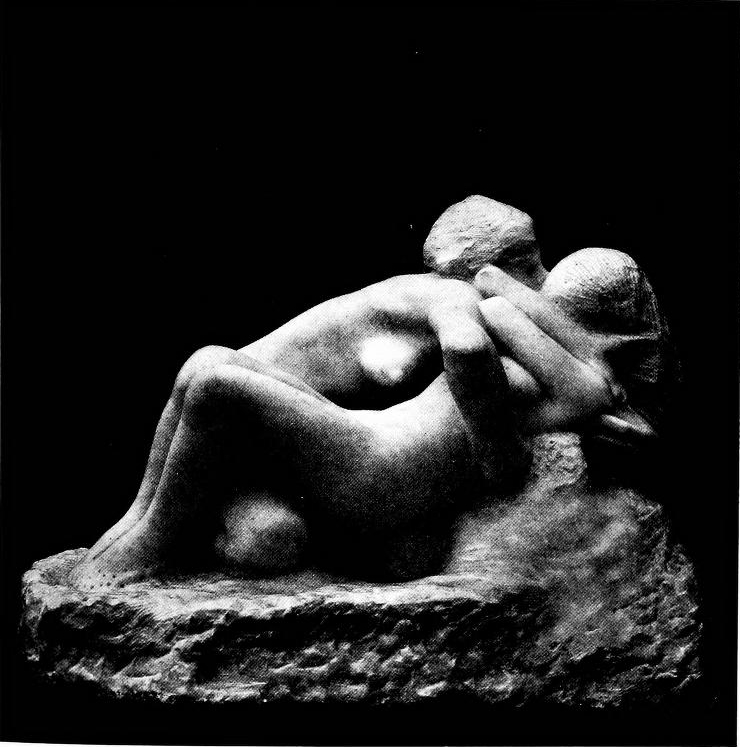
METAMORPHOSIS ACCORDING TO OVID.
Do you ask me what will spring out of the conflict? I am not a prophet. I know only that without religion, without art, without the love of nature—these three words are for me synonymous—men will die of ennui. But nothing easily resigns itself to death. An outburst of courage has just transfigured the world. Can we preserve this courage during peace? The patience of the soldier, the patience of the trenches surpasses in sublimity the virtue of the ancients. Will it produce a rebirth of intelligence? Shall we have, in study, the force of soul that we have had in the great struggle? That is the question. Of course the stupid, the ignorant will not suffer any transformation through the war; but men of character will be reinvigorated by the hardships of the military life; we have recaptured patience and we have yet to learn what we can expect from this virtue. Genius is as much character as talent. If we have men of force in this country where taste is a natural gift, it seems to me impossible that this force will not quicken the gift and develop it and that we shall not have once more an era of beauty.
AUGUSTE RODIN.
THE WORK OF RODIN
I
THE STUDY OF THE CATHEDRALS—INFLUENCE OF THE GOTHIC ON THE ART OF RODIN—"SAINT JOHN THE BAPTIST" (1880)—"THE GATE OF HELL"
In 1877 Rodin visited our most illustrious cathedrals, Rheims, Amiens, Chartres, Soissons, Noyon. During his youth, the choir of Beauvais and Notre Dame de Paris appealed more to his imagination than to his taste, and it required many years of travel and comparison to enable him to grasp the splendors of that Gothic art which he was to admire thenceforth at least as much as the antique. As a splendidly gifted, but inexperienced young man, he shared the error of his epoch: the eighteenth and the first half of the nineteenth century had despised the Roman and the Gothic; they had ridiculed them and called them barbaric; the nineteenth century, while flattering itself that it appreciated them, did still worse—it restored them.
The romantic writers of the Schools of Chateaubriand and Victor Hugo had exalted the art of the Middle Ages, but chiefly because of their hatred of the classic and without understanding its true worth. What struck them, especially, was the immensity and the picturesqueness of the buildings, the luxuriousness of this stone vegetation, but not the unique character of their architecture and sculpture.
Victor Hugo was perhaps one of the few to discover the precise explanation of this beauty: relief and modeling. This all-powerful writer, this architect of words who constructed poems like cathedrals, understood the plastic intelligence of the master masons because he himself possessed the sense of mass. One is convinced of this not only in reading his descriptions of cities and monuments, but in studying those astonishing pen-and-ink drawings which he multiplied in idle moments.
If the romanticists have failed fully to explain medieval art to us, let us still be grateful to them: they gave our cathedrals back to us, they denounced ignorance and scourged the stupidity that would have ended by tearing down those sublime piles. Finally if the writers and art critics of this epoch have not given them superlative praise, if on their behalf they have not burned with apostolic zeal, it is because it was necessary for this prophecy of art to come from a man of the craft, a man dominated, captivated, himself, by the craft, a man who understood stone and adored it because he had married it in spirit with all its difficulties and its dazzling possibilities.
That man was to be Rodin. Although he has been listened to by the ignorant and superficial multitude, it has not been chiefly because of the authority of his genius, of the general renown that he has enjoyed. He has truly thrown a new light over the mystery of Gothic construction. Thanks to him, we understand in a measure, for tangible reasons, the reasons of an actual carver, this "world in little" that constitutes the Gothic cathedrals. What study, what researches are necessary in order to comprehend the art of stonework! Does any one suppose that Rodin himself has attained this in a day? By no means. That lover of perfection in detail does not possess the instantly penetrating glance that is often the property of genius: to the task of deciphering our monuments he brought that slow-minded, customary patience of his, together with his energy. He had first of all to rid himself of the false current ideas. After that thirty years of observation were necessary for him to reach conclusions that satisfied his artistic conscience. Even to-day he is far from affirming that he has understood everything, that he has grasped the full significance of the Gothics. Read his book, "The Cathedrals of France," published in 1914; observe the carefullness of his judgments, the gropings of his thought, the constant retracing of his steps. He makes attempts, ventures; he never proclaims his opinion in the peremptory tone dear to specialists in criticism, but endeavors to approach respectfully, as closely as possible, to the spirit of the masters. Sometimes a flash of genius springs from his brain and illumines to the depths of its mysteries the Gothic universe; but nothing is suggested that does not spring from a prolonged observation, and when at last he speaks it is in the tone of a man who mistrusts himself. It must be confessed that in this work, "The Cathedrals of France," something is lacking, even though it is prefaced by a long and very learned introduction by one of our good writers, Charles Morice. It lacks the magnificent lesson that the reader will find in these pages, signed with Rodin's name. This lesson constitutes really a vital page that is, as it were, the key and the summary of the whole work; but the master, having given me the first rights in it, had scruples, as had Charles Morice, about including it in his own book.
Before obtaining this page, with what insistence did I have to question Rodin not once, not twice, but twenty times, during the course of a number of years. Every time he came back from one of his pilgrimages to some old city of the provinces, to our churches, our town halls, I renewed my questions without receiving any satisfactory answer. In my heart I could not but honor this rigorous honesty which was unwilling to venture anything lightly on so vast, so noble a subject.
In 1877, after having accomplished his first tour of France, he came back filled with wonder. But the impression that he carried with him was still confused; he did not know at what point to begin the analytical study of French architecture, for in what concerned sculpture he had immediately been struck with amazement and adoration before the essential beauty of the status of Chartres, Amiens, and Rheims. He had returned from Italy haunted by the antique and Michelangelo, and now here he was haunted by the modeling and the rhythm of the Gothic figures.
But in order to understand them entirely he had to rediscover this modeling and these movements in nature, he had to verify them in the living model. Fortune favors those who seek greatly. When one is the victim of an idea unexpected elements arise to nourish and develop it. One day two Italians knocked at the door of his studio. One of them, a professional model, had already posed for Rodin and he introduced the other, his comrade. He was a peasant from the Abruzzi who had come to seek his fortune in Paris. He was fresh from his native province. His robust body, his fierce head, his bristling beard and hair, and above all his expression of indomitable force charmed the artist. He undressed, climbed upon the model's stand, planted himself firmly on his legs, which were spread like a compass, the head well raised, and, continuing to talk, advanced with a gesture full of ardor.
Rodin, struck by this wild energy, immediately set to work. He made the man such as he saw him; he desired to capture this movement of the legs, this brusk forward movement that complemented the movement of the arms, the shining eyes, the open mouth. He surrendered himself to a great study, without any preconceived idea, without any intention of treating a subject. What he made was a man walking. The name has stuck to the figure. The first study remains incomplete; Rodin has sculptured neither the head nor the arms; what he sought eagerly, passionately, was the equilibrium of the torso and of the legs cast forward into space. He succeeded; he made a superb fragment, "The Man Walking." Thirty years later it occurred to a group of his admirers to ask the state to acquire this study and erect it in the court of the French embassy at Rome, in the Farnese Palace; but the official architects up to the present time have objected to the erection of this statue, and for the last seven or eight years it has awaited, in some obscure shed, the good pleasure of these gentlemen.
Rodin, in the presence of his Italian peasant, had rediscovered, to his great joy as a seeker, the peculiar equipoise of the Gothic figures. In the antique statues the plumb-line falls through one of the legs, while the other, lightly raised, impresses on the different planes of the body the graceful effect that has become classic. In Gothic statues, on the contrary, the line of equilibrium passes through the middle of the body and falls right between the two legs as they are planted on the earth.
In "The Age of Bronze" Rodin has adopted the balanced rhythm of Greek sculpture; in his new figure he passed to the Gothic equipoise, with a harmony that is less gracious, but with a reality stronger and more living. What he did not abandon was the rigorous construction and the strength of modeling which his study of the antique had given him. "The Man Walking," as well as the greater part of his subsequent works, thus exhibits the union of the two great principles of sculpture that have governed the Occidental genius.
Rodin, strengthened by study, now made a complete statue with head and arms. While he was working he discovered that his model was half a savage, still close to the animal and its ferocious instincts. Sometimes his eyes burned, his jaws, armed with powerful teeth, were thrust forward as if to bite something; he resembled a wolf. At other times a kind of strange passion inflamed him. His face radiated faith and will; he spoke with such energy that he seemed to be haranguing a crowd; one would have thought him a prophet of the primitive ages, a visionary bursting forth from the desert to preach and to convert the people. Rodin regarded him in amazement. It was no longer his model, but a man from the Bible; surely it was a prophet that stood before him: it was Saint John the Baptist brought back to life. The sculptor bowed before the command of nature: his statue should bear the name of the forerunner.
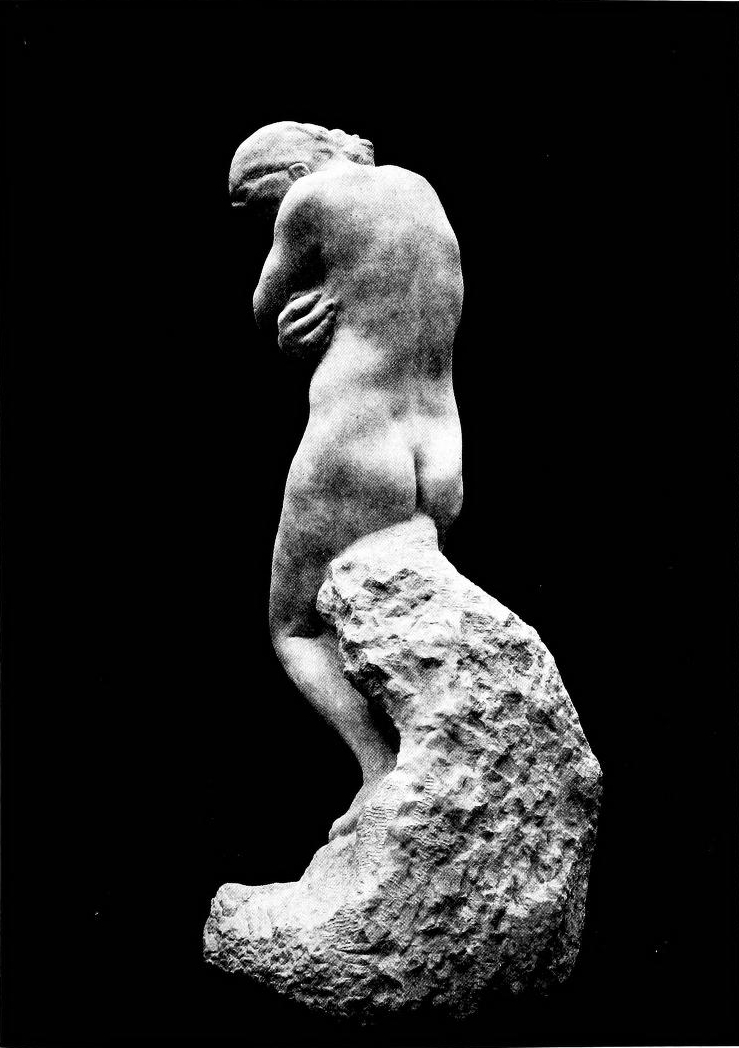
EVE.
He thought at first of emphasizing the disturbing impression: he placed on the shoulders of Saint John a simple cross. But here was revealed the all-powerful instinct of the sculptor, making the subject, the anecdote, the literary connotation a matter of secondary importance. The cross, the sublime symbol, would be here only an accessory, not really needed. It would complicate the simplicity of line dictated by the laws of sculpture, destroying the appositions of equilibrium of the great body and distracting the attention from that speaking head.
So Rodin gave it up. He came at last to the decision that his work should remain free from what was not of the very essence of art. He sent it off in the form in which it appeared in the Salon of 1880, adding also "The Age of Bronze."
The artists, the true artists, those whose enthusiasm was not poisoned by envy and jealousy, applauded these two superb figures artistically so different, but so similar in their sincerity; they acclaimed them with the grave joy of generous souls who perceive the dawn of a great talent. The name of Rodin became fixed forever in their memory.
As for the jury of this Salon, it considered it sufficient to award the "Saint John the Baptist" and "The Age of Bronze" a medal of the third class. Let us, in turn, give it our reward—the reward for its insensitiveness—by not disclosing the names of the sages who composed it.
"THE GATE OF HELL"
While finishing these works, which he was not even certain of being able to sell, Rodin was still compelled to provide for his own subsistence and that of his family; he had also to meet the expenses of his trade. A costly trade! It requires a studio, models, large fires to keep them warm, clay, tools of every kind. It was luck enough if the sculptor, still unknown, was able to have plaster casts made of his work. But this did not satisfy him; he dreamed of seeing them take on a new aspect in the richness of marble and bronze. Alas! in many cases he had to wait until middle age to have this dream realized. Rodin has never complained of the slowness of fortune. He knows that in order to attain the fullness of his productive power it is well for the artist to be thwarted, exalted by difficulties, the desire to conquer. After a five-years' stay in Belgium he had returned to Paris to take part in the work of the World Exposition of 1878, and he had taken a position with the ornament-worker Legrain, in whose workshop he met Jules Desbois, the future great sculptor, to whom he became attached for life. What innumerable decorations he executed at that time—decorations which disappeared like the leaves and flowers of the season when the stucco palaces of the exposition vanished! Only the masks ornamenting the Palais du Trocadéro remained.
At the same time he accumulated busts, studies, large figures with a fury of work which from then on was to resemble that of the most powerfully productive minds, the fecundity of a Rubens, of a Balzac, of a Michelet, of a Hugo. In the studios which he rented in the Faubourg St. Jacques, from 1877 to 1883, besides the "Saint John the Baptist," he executed the admirable little tough model of the "Monument Commemorating the National Defense"; after his wife, whose characterful features and naturally tragic countenance he had often reproduced, he made a helmeted bust, a "Bellona." He exhibited three life-sized figures: "The Creation of Man"; "Adam," since destroyed; and "Eve," the bronze of which did not appear until the Salon of 1899. He did the busts of W.E. Henley; the painter Jean-Paul Laurens (to mention some of the most beautiful), Carrier-Belleuse, the etcher Alphonse Legros, all in the midst of difficulties and injustices which did not in any way disturb the depths of his serenity, the noble tranquillity of the artisan sure of attaining his end by labor. Is it possible to-day to believe that the model of the "Monument of the Defense" was not only refused, but was not even classed among the thirty designs that were retained by the jury of 1880 after the first choice had been made? This same jury, the composition of which is also worthy of passing into history, decided on a solemn confection by M. Barrias for the prix de Rome, the result of which was that four years later its creator was elected a member of the Academy of Fine Arts.
I do not know whether many collectors contend for reproductions of M. Barrias's monstrous design for a clock; but Rodin's group, a wounded soldier entirely enveloped by the wings of a prodigious figure of a warrior goddess crying out for aid, which was later renamed "The Genius of the Defense" or "The Appeal to Arms," and which has acquired to-day so pathetic a character of actuality, is coveted by most of the museums and art collectors of Europe and America.
As if these works, which have since acquired such glory, were nothing but fragments of secondary importance, Rodin attacked a great piece of work, like those that used to be executed in the great ages of art: he undertook the famous "Gate of Hell."
At the time of the affair of "The Age of Bronze" there was at the head of the ministry of fine arts, an under-secretary of state named Edmond Turquet. To him fell the task of deciding in the last resort the case of Rodin. M. Edmond Turquet was a brilliant lawyer who had become procureur under the empire, which did not altogether qualify him for the part of director of fine arts under the republic. In the field of art he knew no more than any one else, Rodin says; but he was a very fair-minded man, and his honesty had the effect of quickly straightening out the affair of the sculptor. In his genuine desire to atone for the wrong done to Rodin in the eyes of public opinion he not only offered to obtain for him a position in the porcelain factory at Sèvres, in order to assure him a regular livelihood, but ordered from him a great ornamental piece, a door destined for the Palais des Arts Décoratifs. In addition, by a special privilege created in favor of artists under Louis XIV,—a privilege the traditions of which the French Government has happily perpetuated,—M. Turquet granted Rodin a good studio in the Dépôt des Marbres, so that he could execute his order.
"And what will you represent on that door?" enquired the under-secretary of state.
"I am sure I don't know," replied the artist. "But I shall make a quantity of little figures; then no one will say that they are casts taken from the life."
Thus we find him at Sèvres, a ceramist; he has carried on so many different trades that he succeeds marvelously with this one. It was his task to decorate vases of delicate clay; he modeled light bas-reliefs, representations of mythological scenes, idylls. Nymphs, cupids, fauns, evoked by his miraculously delicate fingers, were born out of the milky, transparent material, bringing back to life the flowery graces of the drawing-room art of the eighteenth century, the dainty elegances of the wax figures of Clodion, but with a graver sense of the mystery of nature and of love.
Unfortunately, when these vases left the hand of the master they were overladen with hideous ornaments in the style of Louis-Philippe. Moreover, the officials at the head of the factory did not like them. They were carried up to the attics, they were left lying about on the floor, in the secret hope of seeing them broken by the feet of some careless or ill-willed workman.
The feeling of being isolated and misunderstood at times threw a shadow over the soul of the sculptor; but on the other hand he felt himself so strong, so solidly based in his will, in his self-confidence, and in the virtue of labor that these moments of depression passed away quickly. Besides, he knew the secret of the poor, the secret of creating happiness for oneself out of everything that the rich and powerful despise: a simple life, health, regular work, the contemplation of nature, and a few real friendships. Rodin earned at Sèvres only two or three francs an hour and lost a great deal of time on the railroad. What did it matter? He found pleasure and rest in these little journeys. Every day he set out from Paris by train, and, the day over, winter and summer, his wife came to meet him. They returned together on foot either along the banks of the Seine, charming in their profusion of little hills and islands, covered with meadows or fine trees, or through the woods of Meudon and Clamart, with their vistas of Paris, its heights, its buildings, its changing sky full of light and spirit.
At the end of four years of opposition and annoyance Rodin gave up pottery in order to consecrate himself wholly to his own work. The museum of the factory preserves a vase signed by him, and the future Musée de l'Hôtel Biron can show a second example. What has become of the others? What price would not be paid for them to-day by admirers of the master?
These supplementary works did not turn him away from his essential task; whatever were the technical means employed, his efforts tended toward one unique end, the plastic quality, and he gave himself up desperately to this search in executing his new order, the "Gate."
Rising at four in the morning, as he had done in his youth, he studied the plans and the details of this great work. He had announced a series of little figures. How was he to group them? What visions surged in the sculptor's imagination? Of what legendary theme, what theme of history or poetry, should he make use in order to realize his program? He had never ceased to be a passionate reader. He read especially the Greek poets and dramatists, the Roman historians, the old French chronicles, Dante, Shakspere, Victor Hugo, and Baudelaire. He did not wish to draw the subject of his future work from Homer, Æschylus or Sophocles; the School of the Beaux-Arts had so abused the theme of the antique, already immortalized by Greek sculptors, that it had entirely lost its freshness. The moderns attracted him less, but he was obsessed by the work of the great poet of the Renaissance, by the "Divine Comedy" of Dante. He had read and reread it and made a sort of commentary in the form of innumerable sketches which he jotted down mornings and evenings at table, while walking, stopping by the wayside to dash off attitudes and gestures on the leaves of his note-book. He rediscovered in the poem of Dante the fateful grandeur of the Greek dramas, but with an atmosphere more modern, closer to ourselves, more mournfully familiar to our anguishes and our torments. The idea took shape in his imagination, "that imagination ceaselessly rumbling and groaning like a forge"; it exalted his bold spirit. Genius joins to the richness of the intellect the simplicity of heart that creates faith. Genius believes ever more than it thinks. It has the strength which succeeds in anything, and it possesses also that supreme gift, the ingenuousness of the child who doubts nothing. Rodin believed the poem of Dante as if he had lived it, as Dante himself believed in Vergil. What a magnificent homage great men render to one another in this credulity of genius toward genius!
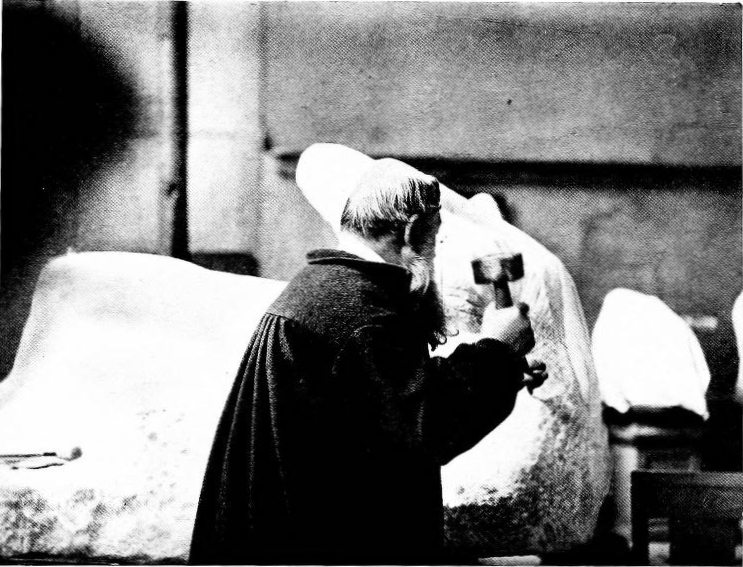
RODIN AT WORK ON THE MARBLE.
The subject chosen by Rodin for his decorative panels, then, was hell—hell as Dante conceived it in a vision that lends itself, for that matter, marvelously to a plastic realization. The "Gate" would be a poem, an immense sculptured poem; that is to say, a résumé of the attitudes and gestures of life called forth by the release of the passions, a strange catalogue of the expressions of the human body under the shock of sorrow and of joy. If the imagination of Rodin caught fire like that of a visionary, he remained beyond everything and above everything the sculptor, and he plunged immediately into the search for the general scheme of the work.
The truth of the movements, the poetry of the evocations, his models would give him; he could feel at ease as to that: the resources that nature would offer him were inexhaustible. But the plan, that he must find himself; he must do the work of the builder, almost of the geometrician. There could be no self-deception as to that. The fuller the ornamentation was to be of figures and movements, the more solid must be the frame of the immense picture, the more vigorous and compact must be the general plan of the work.
Rodin's mind wavered between two great schools, that of the Renaissance and that of the Middle Ages, that which had produced the doors of the baptistry at Florence and that to which we owe the portals of the Gothic cathedrals.
The celebrated gates of Florence are a series of bas-reliefs arranged symmetrically in a regular framework; they present a series of separate pictures having no common bond except their subject. The execution is admirable, and it is perhaps impossible to surpass it. Lorenzo Ghiberti has done there the work of an incomparable modeler, actually a goldsmith; but he has in no way troubled himself with regard to architecture. Now, architecture is the great French point of view. The Roman and the Gothic have placed in their monument (the church) that other monument (the portal). The portal is complete in itself; the art of the sculptor and that of the architect have united and become indistinguishable here in order to realize an absolute beauty.
Rodin, profoundly French, inheriting the instinct and taste of his ancestors the master-masons, having to compose a door, was fated to conceive a portal. On the other hand, he could not escape the influence of the antique, the result of his early studies. This was the entirely different element which in the course of the work he had undertaken was to mingle with the Gothic element.
It was not the first time that the mingling of these two great conceptions of art had occurred in France. From it had sprung our Renaissance sculpture; in that epoch the sculpture of the Greeks united itself with the Gothic architecture, the Hellenic sunlight brought to blossom the majesty of our monuments. Does not Rodin himself, with his vast outlook over the whole field of art, call this period of national art, the sixteenth century, the French Gothic?
"The Gate of Hell," then, took on in its general structure a Renaissance aspect. It preserves the graceful line of the Gothic portal and has the luminous whiteness inspired by Greek sculpture. This singular work has touched all contemporary artists. Most of our writers have described it, and, after them, the critics of other countries. This living multitude, this suffering, groaning multitude that covers the two panels with a thousand passionate movements, has drawn into its magic whirlpool the world of literature, which has been able to liberate itself only by means of innumerable printed pages. The poem of Dante has come forth as it were revivified from the hands of Rodin. Fresh tears, one would say, have bathed the most poignant passages; the pity of a man of to-day, of one like ourselves, our brother, has enveloped the terrible work of the Florentine poet, that man of the Middle Ages, with an atmosphere of tenderness and compassion which seems the emotion of Christianity at its purest, its original source. In order to become our own, it has passed through the great soul of Rodin. It is not surprising, then, that the sensibility of our artists, reanimated by this new spectacle, should be touched to so voluminous an expression by this haunting work.
But what has not been sufficiently remarked is that the "Gate" is, above everything, a piece of architecture of the highest order.
When we see it we are at once struck with an impression of majesty, of calm strength and plenitude. It seems even longer than it actually is. It is a rectangle six meters high and two and a half meters wide, but the source of the illusion is the justness of the proportions and the value of the masses.
The powerful frame is furrowed with deep depressions. It rests on the ground upon a strong base from which rise the two door-posts, as robust as pillars and mounting together toward the summit. A pediment in the shape of an entablature overhangs the entire monument, casting over it a deep shadow full of nuances; and it is this shadow, skilfully graduated, that gives to the work its rich, soft color. The body of the portal is divided into two panels; a vast tympanum surmounts them transversally. This tympanum, surmounted by a large cornice, dominates the work. Without weighing it down, it gives it its mass, it attracts, it obsesses, the eye; it is the soul of the edifice, its intellect. No word can more justly describe it than the word brow, for it is magnetic, haunting, mysterious, like the forehead of a man of genius.
The panels sink deep into a shadow that is heavy, but not harsh, while in the foreground the pillars advance into the light; the delicate bas-reliefs that cover them keep them in a silvery atmosphere, the source of the great softness which envelopes this work, otherwise severe and tragic, the source of the fugitive lightness of the lines, which strike up from the earth toward the somber and tormented upper regions.
Carried away by this marvelous technic, the spirit of the visitor succumbs; it follows this ascending movement of the door-posts, to lose itself in the sorrowful dream sculptured on the tympanum.
On the panel writhe the clusters of human figures, the eddies of the multitude of damned souls pursued by the rage of the elements, by the devouring tongues of the infernal fire, by the frozen waters, by the wind that tears them and stings them. "It is," says the eminent art critic Gustave Jeffroy, in the most beautiful pages that have been consecrated to a description of this work, "the dizzy whirl, the falling through space, the groveling on the face of the earth of a whole wretched humanity obstinately persisting in living and suffering, bruised and wounded in its flesh, saddened in its soul, crying aloud its griefs, harshly laughing through its tears, chanting its breathless fears, its sickly joys, its ecstatic sorrows."
The genius of Rodin became intoxicated with all the resources of his art. Master of a technic of the first order, he delighted in every kind of effect, arranging them as a great symphonist arranges the instruments of an immense orchestra. Low-relief, half-relief, high-relief, and sculpture in the round, he omitted none. He did not yield to the literary temptation. At the height of his fever of invention he was circumspect, measured, guided by his knowledge as a modeler. The poet thinks, but the carver speaks; he speaks justly, he speaks admirably, because he uses only his own true and personal language, which he knows from the ground up. That is the whole secret of the way in which this man inflames our soul and subjugates our imagination.
Two principal notes, two motives form, above the whirlwind of the infernal fires, a resting-place for the eye troubled by so much vehemence: one, in the midst of the tympanum, is the figure of Dante. It is Dante, but it is even more the eternal poet. Seated, leaning over the abyss of suffering, thrilled with anguish, he seems to seek in the very depths of the pit itself the word of infinite pity that will deliver this sorrowful humanity.
Higher yet, above his bowed head, rising suddenly from the frame and splayed in a large protuberance, a group of three entwined figures crowns and completes the brow. With the same despairing gesture they point to the multitude of the damned. One does not know what these shuddering beings are, but they have the sweetness of angels; at once we seem to hear their lips murmur the words of the grand Florentine, "Lasciate ogni speranza"; but across their forms, their compassionate forms, their fraternal forms, one feels passing a tremor of love and pity. Far from condemning, their clasped hands offer to the sad wreckage of fatality that writhes at their feet a sign, a unique sign, the sign of good-will of pity.
"The Gate of Hell" was shown only once to the public. This was at the Universal Exposition of 1900. Although it was nearly finished, it was seen then only in an incomplete state.
The day of the opening arrived before the master had been able to have placed on the fronton and on the panels of his monument the hundreds of great and small figures destined for their ornamentation. People saw the "Gate," then in the nudity of its construction, grandiose assuredly, but despoiled of its extraordinary raiment of sculpture.
That day was a sad one for the true friends of art and of Rodin. A band of snobs, full of their own importance, crowded about the great man. Having considered the work with the hasty and casual glance of men of the world of the sort that are concerned above all to get themselves noticed, they remarked to Rodin, in a tone of augury, "Your doorway is much more beautiful like that; in no circumstances do anything more to it."
This absurd advice befell at an evil moment: the artist felt worn out from overwork and anxieties of all kinds and, moreover, was troubled over the fate of his exhibit the failure of which might in truth have ruined him completely. In these circumstances he did not have the freedom of spirit necessary to judge correctly the value of his own work. And besides he had seen it too much during the twenty years in which it had been before his eyes. He was tired of it, weary of it.
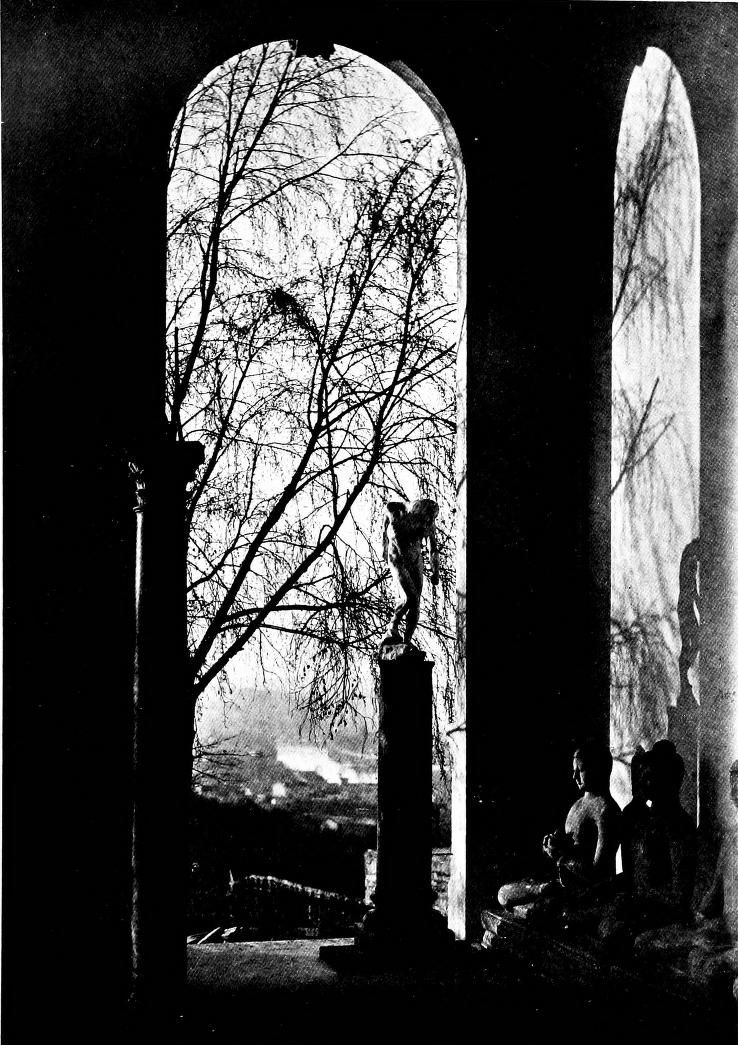
PERISTYLE OP THE STUDIO AT MEUDON.
Thus everything combined to make him lend an ear to the unfavorable opinions of the Parisian aviary. Had he been in better health, more the master of himself physically and morally, he would have replied to the prattling of these excited paroquets and guinea-hens:
"Take more room, examine my 'Gate' from a little farther off, and you will see once more the effect of the whole—the effect of unity which charms you when it is deprived of its ornamentation. You must understand that my sculpture is so calculated as to melt into the principal masses. For that matter, it completes them by modeling them into the light. The essential designs are there: it is possible that in the course of the final work I may find it necessary to diminish such or such a projection, to fill out such or such a pool of shadow; nevertheless, leave this difficulty to my fifty years of artisanship and experience, and you may be sure that quite by myself I shall find the best way of finishing my work."
But the master was silent. Later, carried away by the abundance of his conceptions, by his ever-deepening researches, he lost all interest in the "Gate" and has never taken the trouble to have it entirely mounted.
Fortunately, casts of it have been carefully preserved. It would be only an affair of a few months to reconstruct the work in its original integrity. Since the Universal Exposition time has rolled forward, and events also. Auguste Rodin has entered into the great serenity which age brings with it. He composes less, he corrects his work, he judges himself, and he does not deny his "Gate," one of the most exceptional of his works.
At last the creation of the Musée Rodin has been decided upon by the state. "The Gate of Hell" will be one of its important pieces; we shall be able to contemplate it then in all its majesty; it will not then simply be molded in plaster, but cast in bronze and cut in marble. It will offer a noble example of what work can accomplish when it is served by that supreme gift, will; for it will testify as much to resistance against the powerful enemies of the life of thought as to the intelligence of the man who created it. It forces upon us not only a formidable impression of strength, labor, talent, but also an impression no less lofty of method, order, and inner harmony. The multitude, who through their profound instincts approach much closer than one might suppose to the man of genius, will exclaim in contemplating this work, this true monument which undoubtedly the sculptor has raised through his own force of character, "Whoever erected this beautiful thing with his indefatigable hands was truly a man."
II
"THE BURGHERS OF CALAIS" (1889)—RODIN AND VICTOR HUGO—THE STATUE OF BALZAC (1898)
At the time the plaster model of "The Burghers of Calais" was first offered to the judgment of the public, in 1889, nearly seven years had gone by since Rodin had originally undertaken the group.
This is the period of my own childish memories of the master. He was a frequent visitor at the home of my father, who lived in Sèvres, on the outskirts of Paris.
Rodin, with his silent nature, apparently so full of calm and meditation, delighted in the ardor, the patriotic enthusiasm, the ferment of character, the brilliant conversation of that powerful, original writer, my father; he loved his books, too, spirited and passionate like himself, and possessing a vigor of expression that was new to French letters.
Léon Cladel received his friends on Sundays. In winter they gathered in the drawing-room, in summer on a terrace shaded by great chestnuts and limes, where thousands of birds twittered and chattered so energetically that at dusk they ended by drowning the voices of the visitors. Among the latter were writers, painters, and sculptors, several of whom have since become famous. Among them were Auguste Rodin and his colleague, his dear comrade, Jules Dalou, creator of many fine works, notably the monument to Eugène Delacroix which stands in the Luxembourg Gardens.
The sculptor of "The Burghers of Calais" was then barely fifty. He was far from possessing the immense fame that is his to-day, but artists already regarded him as a master. Of medium height, robust, with large shoulders and heavy limbs, placid and deliberate in appearance, never gesticulating, he himself resembled a block of stone; but above this heavy base his countenance, with its broadly designed features and its gray-blue eyes, expressed an extraordinarily keen intelligence and finesse. Despite my youth I was struck by this physiognomy, so singular and so penetrating, and also by the remarkable shyness that made the sculptor blush whenever he was addressed. Since then innumerable portraits have familiarized people with these features, which with age have settled into an expression of authority and firm will; his strange timidity has disappeared with time, with the consciousness of his strength, with his having become accustomed to glory. Moreover, Rodin has become a ready talker. Of old he listened intently, but always held his peace; at most a few words, spoken in a soft, clear voice, escaped from the waves of his long beard. He would at once relapse into silence, while with a slow movement giving his beard an instinctive caress with his large, square, irresistible hand, the true hand of a builder. But when he raised his eyelids, almost always lowered, the transparent eye, that limpid gray-blue eye, betrayed a perspicacity that was almost malicious, almost cunning: one felt that he penetrated through the forms of people to their very souls; and this he fixed so skilfully in the clay of his busts that his models were not always pleased with it. Many of Rodin's portraits have been refused by sitters offended by their pitiless realism.
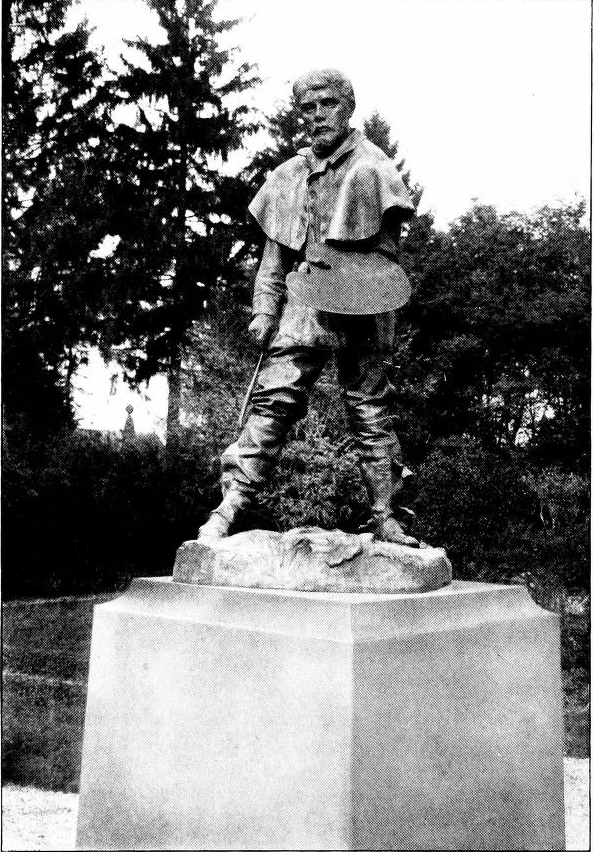
STATUE OF BASTIEN-LEPAGE.
Sometimes my father kept Rodin and Jules Dalou to dinner. The two sculptors were devoted to each other. They were comrades from of old who had traveled together the hard road of beginners; since their student days at the Petite Ecole they had many times reëncountered each other in the same workshops, where they had received the same contemptuous wages for their long days of labor. They felt a profound esteem for each other's talent, different as these talents were, altogether opposed, in fact, as were their natures; and it was a fine, a lovely thing to see them bring forward each other's respective merits. Alas! I shall have to tell later how an artistic rivalry came one day to destroy this noble friendship.
The appearance of "The Burghers of Calais" aroused a flood of enthusiasm in the world of art. I remember it well. At that time I was only a young school-girl, and my father was unwilling to allow me to "miss my classes" in order to accompany him to the opening of the Rodin Exhibition. After all, the lessons I received that day, following them quite absent-mindedly, were they worth the lesson I should have received from the contemplation of that masterpiece, even if my age would have prevented me from quite understanding it? Beauty is always the most fertilizing teacher.
A rich art-lover, acting with the municipal authorities of Calais, had ordered from Rodin the statue of Eustache de Saint-Pierre, the Calais hero whose devotion had in the fourteenth century, during the Hundred Years' War, saved the city when it was besieged by King Edward III of England.
Rodin, true to his principles, sought as ever to approach his subject from the quick of reality. He consulted history. He read the old chronicles of France, above all those of Jean Froissart, who was contemporaneous with the event and almost a witness of it. Froissart was a man of the fourteenth century, a man of the age of the cathedrals, and therefore himself a Gothic. His narrative has the force, the savor, the naïveté, the simple and profound art of the masters of that marvelous epoch. What a source of emotion for Rodin, a Gothic likewise in his faith and his artistic rectitude! He caught fire at the recital of the old master as at the voice of a brother-in-arms. He read, he learned that Edward III would not consent to spare the city of Calais from pillage and destruction unless six of her richest citizens would come out to him dressed only in their shirts, barefoot, with ropes about their necks, bringing him the keys of the city and their own heads to be cut off. In response to this terrible message, Eustache de Saint-Pierre and five of his fellow-citizens, taking counsel with the notables of the place, at once rose to go to the king's camp. They set forth immediately, escorted on their way by the hunger-stricken multitude, weeping and groaning over their sacrifice and "adoring them with pity."
This was the vision which from that time on took possession of Rodin, dominating him and never leaving him. But it was not an isolated person detached from his environment that he saw: it was the six martyrs just as they appeared in history, just as they were in life. In his thought he followed this band of heroes marching to the sacrifice in the midst of the weeping city. He could not bring himself to separate them either from their whole number or from their tragic surroundings. Therefore, in accordance with the genius of his theme, that is to say, with historic truth, he would make all six of them, and he would insist that they should be set up in the midst of the city, among the old houses, where they would continue to live their sublime life in the heart of the very town that they had saved.
For the price of one statue, therefore, Rodin set out to execute six. He rented a vast atelier in the rue des Fourneaux, in the Vaugirard Quarter. He worked unceasingly. To keep this enormous group in good condition, to maintain the proper temperature, he moistened the clay morning and evening, having as his garçon d'atelier no one but his devoted wife, who had become thoroughly experienced in these matters. Despite all, accidents would happen: the clay would give way, an arm, modeled with his habitual exactitude, would fall and have to be laboriously repaired; but the fervent modeler never hesitated in his work, and on the day when he exhibited "The Burghers of Calais" at the house of Georges Petit the praise and the homage that sprang forth from the soul of all true artists recompensed him magnificently, bringing him the intoxicating caress of dawning glory. They spoke, in connection with the "Burghers," of the image-makers of our cathedrals; they spoke of the statues of Claus Sluters, of the famous statues of the "Well of Moses" at Dijon. Really, in the Calais monument Rodin is more than ever under the Gothic influence in subject, in thought, and in execution. The equilibrium of the figures composing the group is the same as that of the "Saint John the Baptist." The long shifts that cover the naked bodies of his heroes recall those draperies in vertical folds dear to the Middle Ages. The very modeling of the figures and of the faces increases this effect of elongation caused by the fall of the fabric; the modeling in large planes, the vigorous accents, the simple and pathetic movements are certainly those of the sort that out-of-door sculpture calls for. In twenty years Rodin had made innumerable visits to the Gothic monuments. Here was the result of his tours of France. He had made them in order to recapture the traditions of art from the hands of our wonderful old stone-cutters, and his heart must have throbbed with joy when he was told that in his own hands that tradition had suffered no loss.
Naturally, the appearance of "The Burghers of Calais," even that, could not fail to have its share of comic anecdote, that bitter and painful humor that marks the adventures of genius in its struggle with vulgarity. Let us not complain too much. The contrast between these adventures and the proud way of life of a great man, the regularity of his hours of toil—it is this that creates opposition, movement, life. The elect soul feels a savage joy in these blows which shake it like a tree tormented by brutal hands, a tree aware of the vigor of its resistance and its ever-increasing tenacity.
The municipality of Calais, hearing that there were to be six statues instead of the one that had been ordered, took umbrage, and deliberated for two years. The heroic group waited, and, as it encumbered Rodin's atelier, where other works were going forward, it was placed in a stable. At last the worthy town authorities decided to assign it a site. Naturally, the site in question was exactly opposed to the ideas of the master—ideas that had been thought out and that were perfectly logical, based on the laws of decorative art and still more determined by that infallible criterion, taste. Rodin desired that his monument should be in the center of the town; they placed it on the edge of the sea. He counted on emphasizing the tall stature of his figures by enshrining it in the narrow frame of the houses; they placed it against a horizon without limits. He requested that the group should be placed very low, almost on the ground, or else very high on an elevated pedestal, like the "Colleoni" at Venice or the "Gattamelata" at Padua; they placed it at a middle height, thus diminishing the effect of its imposing proportions. The lesson had to come from foreign lands. The city of Antwerp has erected, in front of its museum of fine arts, two of the statues of the celebrated group, and England, which does things splendidly when it is a question of embellishing its cities or of rendering homage to the valor of its adversaries, has erected the effigies of the six heroes of Calais on one of the most beautiful sites in London, before the Palace of Westminster.
By this time the reader is sufficiently familiar with the technic of Rodin for it to be unnecessary to analyze here in detail this well-known work. What must not be forgotten is that the sculptor had first modeled these six powerful bodies entirely in the nude. This is his invariable method when he executes draped figures. One realizes this, even without knowing it, before these arms, these hands, these legs, and these feet constructed with that rigorous conscience which, with the true artist, is at once a necessity and a delight; one divines the slope of the torsos bent with grief or rigid in the pride of sacrifice.
"Yes, they are beautiful," the master said to me one day when I was talking with him. "The shirt, the blouse are garments the folds of which yield simple planes and effects that, rightly rendered, are those of true sculpture. But there is something better still, and that is sackcloth. If I had clothed my 'Burghers of Calais' in sackcloth, they would certainly be more beautiful. I did not dare to. Some one else will do this and will succeed. It is sufficient to express an idea and leave it to its destiny."
We ought to love in Rodin this intellectual vigor that skirts the borders of the impossible. In our age, consumed with indecision, it is a priceless aid, a resting-place, a point d'appui from which one starts forth afresh, fortified, one's nerves recharged with vitality, to the conquest of one's share of knowledge or of talent. This accounts in part for the irresistible influence which for thirty years the illustrious sculptor has exercised over the minds of artists. One feels that this fount of strength condensed in his virile soul comes from something deeper than his personality alone; it comes from the very depths of the national reserves. The conviction, the energy of Rodin are those of the workman who knows his trade, of the laborer impassioned by the culture of his own soil. This endurance is the foundation of the French temperament; the events happening now have proved it. When a country possesses such individualities through the course of history, the roads of the future open out before it brilliant with hope despite passing shadows, and promise the highest surprises.
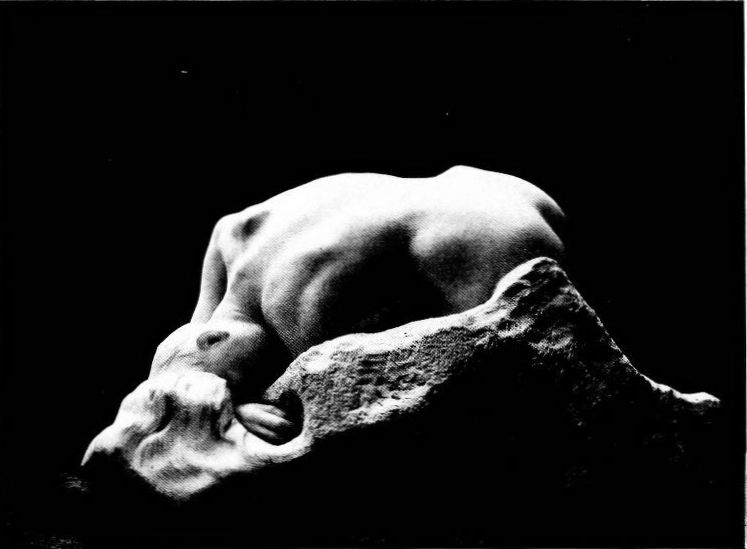
DANAIADE.
RODIN AND VICTOR HUGO
The creation of "The Burghers of Calais" marks the middle of a period of truly prodigious fecundity. From 1889 to 1896, monuments, busts, statues, and groups of every kind issue without interruption from the ateliers of Rodin, and the more numerous the works his hand models, the more it grasps the contexture of the work, the more it refines the execution. Orders for portraits pour in; collectors hold it an honor to possess a marble, a bronze, signed with a name which every day increases in celebrity. In 1888 comes that jewel of marble, the bust of Madame Morla Vicuñha, and the monument to Claude Vicuñha, president of the Republic of Chile; in 1889, the bronze portrait of Dalou, the statue of Bastien-Lepage, that admirable head "La Pensée," acquired by the Musée du Luxembourg.
In 1890 comes the portrait of Mme. Russell, a bust in silver, of noble simplicity, which one would say was the head of a Roman matron, with the luminous veil upon her thoughtful forehead and the flower of good-will blossoming upon her delicately swelling mouth. Then there is "The Danaïd," "La vielle Heaulmière," and a great study, a long woman's torso, "La Terre."
In 1892, not to mention delightful minor works like "The Young Mother" and "Brother and Sister," appear two masterpieces: the bust of Puvis de Chavannes and that of Henri Rochefort, magnificent contrasts in construction and execution. The painter-gentleman carries his haughty head like an old leaguer chief, and the pamphleteer bends over the destinies of France, which for fifty years he has defended day in, day out, with his flaming pen, an enormous brow—a brow like a spherical vault that seems to contain a world.
"You have made it grander, you have made it more beautiful than nature," some one said to Rodin one day.
"One can never do anything so beautiful as nature," he replied.
In this same year, 1892, he exhibited the charming monument to Claude Lorrain, in which he recaptured the spirit of the eighteenth century. It was the town of Nancy that ordered this figure of its painter and has placed it in its vast park.
One cannot mention everything. Forms and attitudes renew themselves, but not the terms that express them. To measure the abundance of this work one should read the catalogue, till now incomplete,—for it has been impossible to compile one that was not so,—of the master's works; only so can we realize how almost dizzily his productiveness became accelerated with the epoch of his maturity. Mythological subjects dominate it, but are always treated with a profoundly human understanding of the poetry and the grace of the form in which they achieve an aspect delightfully new.
Such titles as "Venus and Adonis," "The Education of Achilles," "The Death of Alcestis," "Cupid and Psyche," "The Faun and the Fountain," "Pygmalion and Galatea," Rodin inscribed only as an afterthought on the pedestals of his groups. They are not the result of a necessary preliminary conception; it is his figures themselves that breathe them, his models unconsciously repeated the combinations of movement and gesture through which are translated the eternal sentiments immortalized by the legends of paganism. So true is this that Rodin obtained his charming groups by assembling in harmony with his researches the animated little figures that encumbered the windows of his ateliers. He amused himself by uniting them, by marrying their attitudes; with these little figures, these puppets of genius, he composed actual little intimate dramas or idylls revived from the antique. In the hollow of a Greek bowl he places a little nude body, and one would say that it is the soul of the wave that conceals itself against the side of the vase. He enlaces three feminine figures, upright, beside the body of a recumbent youth: they are the Graces, who come to bend over the dying poet. Thus he perpetuates the fantasy of things through that of his own taste; he eternalizes the most delicious caprices of nature.
We come now to the year 1896 and the appearance of the "Monument to Victor Hugo."
This monument had been ordered for the Panthéon. Rodin, who had modeled in 1885 the bust of the singer of the "Légende des Siècles," was doubly, on this account, entitled to the order. In the midst of what difficulties had he achieved that bust! It required all his patience, all the tenacity of a Lorrainese peasant, to accomplish it. When he had begged the honor of reproducing those illustrious features, the poet, already nearing his end, tired out with having posed for mediocre plaster-daubers and unaware of the superiority of his new sculptor, consented to pose only for two hours. All the same, he authorized Rodin to come as often as necessary and make as many sketches as he needed while he, Hugo, worked or received his friends.
Rodin accepted these difficult conditions. Was it not Victor Hugo with whom he was dealing, the father of modern poetry? And then what a spectacle for his artist's eyes, that of the great man bending over his papers that Jupiter-like head of his in which thought, in gestation, swelled the sublime brow with a tumult of ideas! When he talked, what majesty in "this face of a lion in repose"!
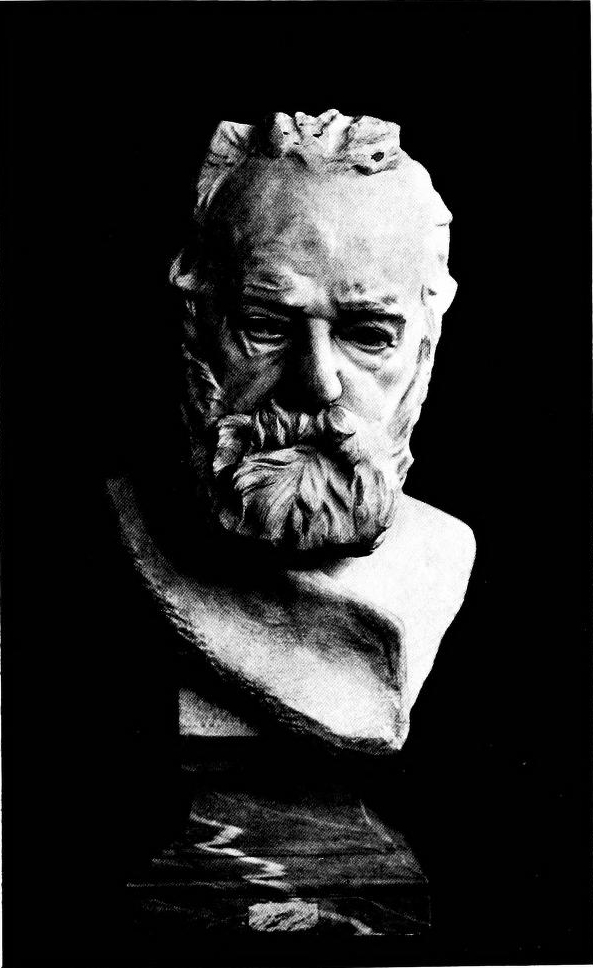
PORTRAIT BUST OF VICTOR HUGO.
The sculptor placed a stool, some clay, some tools in the corner of a gallery; it was there that he worked out the general form of the bust. Then, studying his wonderful model for months, he made hundreds of sketches of him, under every aspect; at times, having used up the pages of his note-books, he even covered entire blocks of cigarette paper with rapid notes and jottings. Then he transferred this record of observations to his clay. Working in this manner, it took him three months to finish his bust. He exhibited it, in bronze, at the Salon of 1884. One cannot fail to admire the volumes, the beautiful mass of the whole, even though it does not show that brilliant touch of genius which strikes us before the bust of Jean-Paul Laurens or that of Rochefort; but later, relying upon this document and upon his own special memory of forms in action, Rodin was to restore for us this moving head in his monument of the poet, which was to be one of his very loftiest works. This same bust of Victor Hugo was to rupture the friendship between Rodin and Jules Dalou—Dalou of whom he sent to the same Salon of 1884, by a curious coincidence, an incomparable bust that puts one in mind of those of Donatello.
The family of Victor Hugo did not like Rodin's portrait of the master. When the poet died (1885), it was Dalou whom they called to execute a death-mask of the features of the great poet. Filled with ambition and eager for official glory, Dalou had the weakness to accept, forgetting what he owed to Rodin, not even informing him, in fact. Deeply hurt, the latter withdrew his affection for his old friend. My father, saddened by this occurrence, which destroyed so rare and noble a friendship, brought the two friends together at his table in the hope of reconciling them; but nothing could melt the wall of ice that had fallen between these dissevered hearts.
Ten years afterward a magnificent compensation was offered to Rodin. From him was ordered the monument of the poet for the Panthéon. He represented him nude, under the folds of a vast cloak, and seated on a rock, as if by the seashore, with his wonderful head bowed in an attitude of meditation, just as Rodin had often contemplated it in priceless hours.
This manner of representing a great man, quite simply revived from the Renaissance and the eighteenth century, shocked to the last degree the administrative staff of the department of fine arts. Why this nude personage, instead of a quite respectable Victor Hugo in the frock-coat of an academician? Why not one of those statues that peacefully occupy some corner of a public square without attracting any one's attention, one of those statues that are not made to be looked at? As for this poet, who resembled a Homer, a hero or a demigod, this grand body, outrageously beautiful and simple, is it not scandalous in the midst of the conformity of bourgeois civilization, enslaved by the ugliness of fashion, whose perverted taste can no longer recognize the beauty of the nude? The painter David used to say of his epoch, in which, however, the mode of dress was less displeasing than it is to-day, "What misery to be obliged to spend one's life in fashioning coats and shoes!" Rodin, like David, and like Phidias, preferred the trade of the sculptor to that of the tailor.
Such an uproar arose that he had to withdraw the model of his monument and promise another. But everything comes with time, even the best: the fortunes of politics brought to the ministry of fine arts an intelligent and cultivated director, the dramatic critic Gustave Larroumet. Delighted with Rodin's scheme, the magnificent symbolization of French poetry, he confirmed the order for the audacious monument, no longer for the Panthéon, but for the Luxembourg Gardens; and, not satisfied with this reparation, charged the master with the additional execution of another monument destined for the Panthéon. One can imagine the anger in certain circles—two orders on the same subject to the same sculptor! What an aberration! What madness! But the decision was made and well made.
Rodin took six years to perfect his first "Victor Hugo"; the marble was not exhibited until 1901. The vigor of the work and the sovereign gesture by which the bard of contemplation seems to impose silence upon the voice of nature in order that the voices struggling within himself, in the depths of his genius, may be the better heard, the suppleness of the material, of this Carrara marble, with its warm reflections, as if melted under the pressure of a fiery hand, obstinately make one think of Michelangelo; one has the disturbing sensation, not of an imitation, but of a resurrection of the plastic power reincarnated out of nature, of a new spring of sap from the same vein of genius.
The original plan allowed, in addition, for two allegorical figures, "The Inner Voice" and "The Tragic Muse," which, placed beside the poet, should breathe into him thought and inspiration. But, very beautiful in themselves, they gave to the monument, once they were executed and placed, an anecdotal quality that diminished its force; they weakened the grandeur of the Olympian gesture and destroyed that feeling of solitude inseparable from such a personality as that of the great man: an island in the midst of the flood of the human multitude, genius itself is aware of its own splendid isolation.
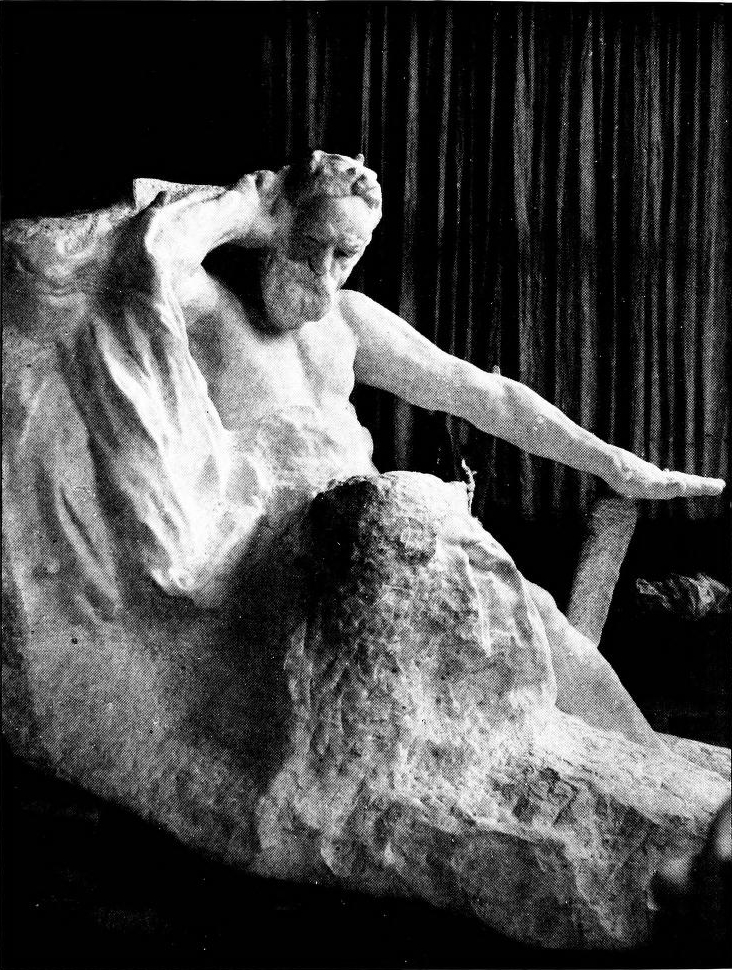
MONUMENT TO VICTOR HUGO.
This is what I ventured to express one day to the master, not without hesitation. Nothing equals the simplicity of Rodin face to face with what he knows is sincere and animated by a true love of art. He listened, gazed at his work, and, turning toward me, gave me a joyous glance.
"You are right," he replied, with a spontaneity that put my sense of responsibility on its mettle. "I sacrificed to the mania of the age, which is to overload things. My modeling is there, the eloquence of the gesture also. The rest would only spoil the essential things. It is a stroke of genius. I am going to write to the under-secretary of state that my monument is ready."
In lieu of the two figures that were to have accompanied the statue of Victor Hugo, to indemnify the Government Rodin gave to the Musée du Luxembourg a series of his most beautiful busts in bronze, including the head of the poet.
As for the marble, it was in the garden of the Palais Royal that it was finally erected; but this site is not of the happiest: a large lawn separates the spectator from the monument; one sees it from the wrong angle, and this destroys the equilibrium of its planes. Moreover, in our damp climate marble quickly loses the charm of its purity and transparency; streaks of brown already stain and deface that of the "Victor Hugo." Let us hope that the organizers of the Musée Rodin will find it possible to place it in one of the rooms of the future museum, substituting for it a bronze upon which the inclemencies of the atmosphere will serve to produce a beautiful patina.
THE STATUE OF BALZAC (1898)
This is the most famous and the least known of Rodin's works. Newspaper controversies have made it famous throughout the whole world; but it has, nevertheless, made only one brief appearance in public, in 1898, at the Salon of the Société Nationale des Beaux Arts. It marks at the same time a vital stage in the career of the master and the most poignant period of his life as a fighter. It is the point of equilibrium in the perpetual balancing of the art of Rodin between the several great traditions. It was the object of a famous quarrel, in which the glory of the sculptor, momentarily all but eclipsed by ridicule, recovered itself, nevertheless, and rose higher than ever.
What strikes one in this statue, at first sight, is its strange block-like aspect, its monolithic simplicity. People say quite rightly that it looks like a stone lovée, a druidic monument. Ever since "The Burghers of Calais," one of the figures of which at least, that of the man with the key, already suggests the idea of a monolith, Rodin had been going further and further in his stubborn search for the simplification of planes, and here he finally achieved his object. In order to obtain it, he went back all the way to the primitive Gothic and even to the archaic Greek, which likewise preserves in the general outline of its statues the rigid aspect of those statues of wood that had preceded it. In all these early epochs of art one finds the form of the tree trunk in which their sculpture was cut. One of the examples of this art that had most forcibly impressed Rodin was the statue of Hera of Samothrace in the Louvre. The beauty of this figure, denuded of all foreign artifice in the exact research for masses, the public little comprehends; but the sculptor perceives its justness, the power of its relief and its modeling, disconcerting in these primitive artists, qualities that are concealed under the extreme simplicity of its appearance. In this magnificent Hera it is as if one saw the rotundities of woman coming to birth and undergoing in the tree, the vegetal column, one of those metamorphoses familiar in the fables of paganism. The "Balzac," with its athletic body, veiled in a spread robe that envelopes it, does not it also resemble a powerful tree trunk from the summit of which looks down, like a solitary, monstrous flower, the head of the inspired writer?
This statue had been ordered by the Société des Gens de Lettres, and was intended for one of the public squares of Paris. After Victor Hugo, Balzac. After the giant of modern poetry, the giant of the novel. What a redoutable honor, but also what a homage to the talent of the great sculptor! What joy for artists in the association of these two names, Balzac and Rodin! On the other hand, how many adversaries rejoiced in the hope of seeing Rodin come to grief with this task, fraught not less with peril than with glory! He did not conceal from himself that the statue of Balzac would be a severe problem to solve. We possess no authentic bust of the creator of the "Comédie Humaine," not even a death-mask giving the exact measure of the cranial bones and hence the actual planes. We know through his contemporaries that the author was fat and short. Fat and short—that is far from facilitating the composition of a work of decorative art. But, more precious than mediocre portraits, there is a famous page about him by Lamartine, another great genius. "Balzac," he says, "was the figure of an element ... stout, thick-set, square at the base and at the shoulders, ample, much as Mirabeau was; but not heavy in any way; he had so much soul that it carried him lightly."
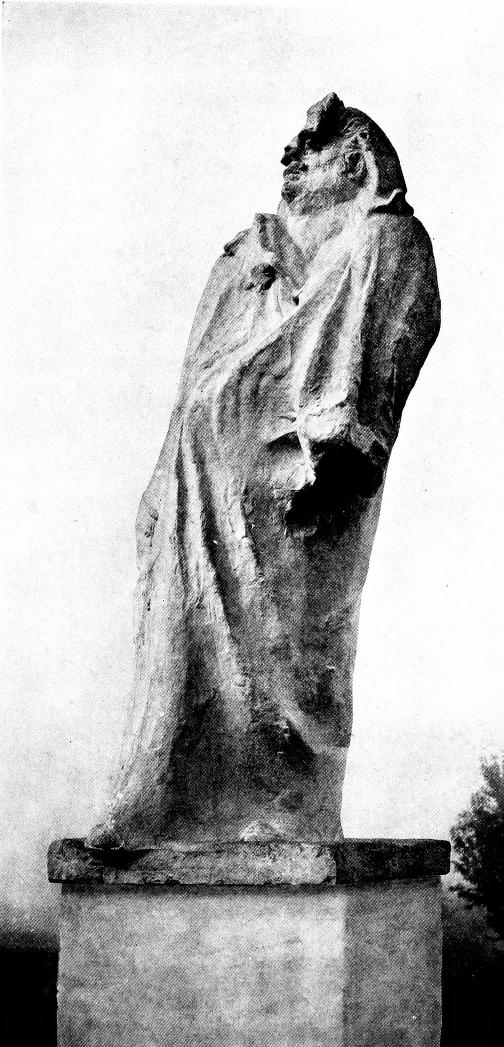
STATUE OF BALZAC.
It was this essence that he set out to render. A frank artist takes no liberties with reality. It alone gives him force; the "majesty of the true" is alone durable. Nature, which dowered Balzac with one of the most prodigious intellects known to us, dowered him at the same time, to support this intellect, with the physical breadth of a colossus. To have altered anything that went to make up the harmony of the structure would have been to commit a grave error; it would have been to denaturalize the divine work. On the other hand, above this mass of flesh it was necessary to make that marvelous spirit hover, that sparkling spirit, that myriad-faceted spirit of the greatest of novelists.
Rodin knows by experience that nature repeats herself. Has not a humorist said: "It is useless to make a bust of you; it exists already. You have only to look for it in the museums"?
He set out to find a man who resembled Balzac, going all the way to Touraine, the writer's native province, a hundred times depicted by him in his books. The family of Balzac was originally from Languedoc, but that made no difference; the intuition of a great artist is always rewarded. Rodin found at Tours the model he desired; he was a young countryman, a carter, who resembled his hero to an almost miraculous degree. Of him he made a very animated bust, in which one sees the full face, the nose, concave and large at the end, but voluptuous and full of spirit, the rounded chin, the vast shoulders of the master of the "Comédie Humaine." There was lacking, however, the flame of thought that spiritualized and rendered buoyant this mass of human substance. Rodin modified the expression, illuminating the physiognomy with delicacy and frank gaiety. It is Balzac at twenty-five, a peasant Balzac, breathing at every pore youth, self-confidence, and the love of life. Not yet is it the man tormented by fate, the tragic visionary of the "Comédie Humaine," the slave of his work who in twenty years wrote fifty novels, staged a thousand characters, and gave life to an entire society. It is not the man who has suffered, thought, meditated, with all the power of one of the most extraordinary organisms known to us; it has not the appearance of a phenomenon.
After this Rodin skilfully altered these features; he gave them the scars of the interior effort, he made them soft and hollowed them, he made them old and grave. In a few weeks he did the work that nature had taken years to accomplish. He finished by creating that Titan's mask which we know, that head as round as a bullet and, like a bullet, terrible in its concentrated force. Later he augmented this; that is to say, he doubled its proportions: and this head, almost frightening in its expression, recalls the masks which the Greek tragedians wore when they played in the open air. Finally he modeled the body of the colossus, making it entirely nude, with arms crossed, braced against the earth with the tension of the whole will, evoking the idea of some prodigious birth. Then he draped this heavy body in the monk's robe in which the writer used to envelope himself for work and the straight folds of which enwrapped him like the sheath of a mummy, offering to the sight nothing but the tumultuous head—the head ravaged by intelligence and savage energy.
Rodin felt almost frightened by his own work.
He kept it a long time before turning it over to the cast-makers. He had worked it out in his atelier, but it was destined for the open air. How would it appear in broad daylight?
The gestation of this work was accompanied by a thousand miseries. The committee of the Société des Gens de Lettres incessantly demanded the "Balzac"; they were dumfounded before the extraordinary figure that was shown to them, before this white phantom the conception of which was so utterly the reverse of all current ideas. Not knowing what to say, they insisted that it should be modified and urged haste upon Rodin, whose extraordinary dexterity became slowness itself when it was a question of putting the final touches upon a great work. The press began to take note of the affair. He himself became troubled and nervous. With what transports would he have left it, fled, gone away to rest and to dream of something else for a few weeks! The time of the Salon was approaching. Quite suddenly he made his decision, gave the clay to be cast, and ordered an enlargement. The statue was brought back to him at the Dépôt des Marbres, in the rue de l'Université; it was twice as large as the original model. It was placed in the garden that stretched out in front of the studio. He examined it as it rose against the depths of the open sky and the bright spring light. It was as if he had never seen it, and suddenly his mind was illuminated. The work was grand, simple, strong; the essential modeling was there, and the details they had exhorted him to add would only have diminished its unsurpassable unity.
Rodin had made up his mind. He sent his "Balzac" to the Salon.
Immediately there was war. The press, worked upon by the committee of the Société des Gens de Lettres, was unfavorable in advance. On the day of the opening of the Salon the word was passed around, and the official art world s'esclaffe. There was a crowd at the foot of the lofty image, near which Rodin took up his position, calm according to his wont, and talked quietly with his friends. Some, a very few, told him how they admired this work so proudly offered, so strange in its banal surroundings.
The next day the press broke forth. What an uproar! Everything went off at once: the heavy artillery of the great newspapers scolded solemnly, the light artillery crackled in the political sheets, and the grape-shot of the minor papers spat their rage, only too happy for so rich a prey to cut to pieces. The Institute, as might have been foreseen, fanned the conflagration. The public, excited, in turn broke loose, in the fury of ignorance stirred up against knowledge.
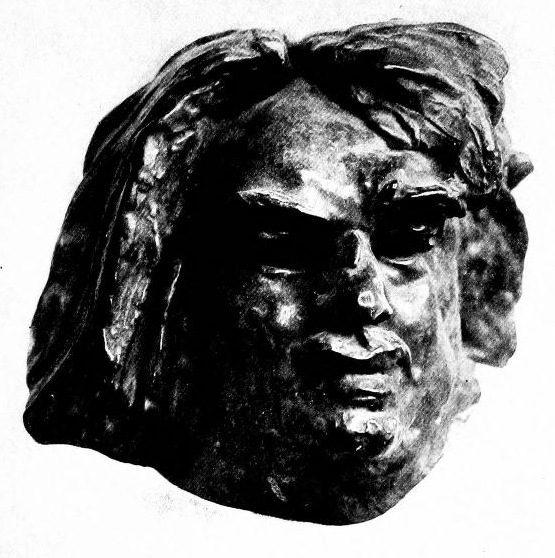
THE HEAD OF BALZAC.
It became a "case," an affair, the affaire de Balzac. The committee of the Société des Gens de Lettres mobilized; by a vote of eleven to four it declared that it "did not recognize the writer in the statue of M. Rodin." The president of the same society, the poet Jean Aicard, refused the chance of immortality which this stupidity was to confer upon his colleagues and flung his resignation in their faces. A group of members of the municipal council of Paris decreed that it would be ridiculous to accord "this block" a place in one of the squares of the city. For two months music-halls and café-concerts vented every evening the wit of the gutter on the scandalous statue and its sculptor; peddlers sold caricatures of it in plaster, Balzac being represented as a heap of snow or as a seal. In short, such was the event that it required nothing but the pen of Aristophanes to note down the harmonies of this chorus of frogs. The health of Rodin suffered a reaction from his long effort and from this battle. Then, too, there are hours when the strongest are seized with nausea before the bad faith and the stupidity of people. Nervous, his mind aching, a prey to insomnia, the master offered a melancholy spectacle, that beautiful serenity of his destroyed and his working strength put in jeopardy.
"For all that," says M. Léon Riotor, who tells the story with eloquence, "Rodin had a wonderful awakening. All the young world of letters rose up to declare its sympathy with the vanquished in this new skirmish. A number of painters and sculptors joined in. And the protest that was circulated came back covered with signatures."
No, Rodin was not vanquished. He retired for a moment from the mêlée to recover and to meditate in peace, but without deviating by a single step from his line of conduct. A collector offered to buy the "Balzac." A group of intellectuals started a public subscription; funds flowed in. Although he was not yet wealthy, Rodin courteously declined these offers, and, declaring that "an artist, like a woman, has to guard his honor," decided to withdraw his monument from the Salon and not have it erected anywhere.
The epic statue was transported to Meudon, and placed in the garden of the villa. In its loftiness it imposes itself against the sky, against the hills, against the trees that surround it, with the quality of nature herself. Like a gigantic pole it triumphs in the open air. It is specially on clear nights that its disturbing authority strikes the soul. The great phantom appears then formidable in the extreme simplicity of its planes, which, as in strong architecture, distribute over large spaces the masses of shadow and light. The American painter Steichen has passed nights in this enchanted garden in order to take of the "Balzac" photographs that are more beautiful than engravings. Haughty, with a ferocious majesty in the moonlight, the master of the "Comédie Humaine" brings his soul face to face with nature; he listens to its silence, he sounds its mysteries, he questions it in mute dialogue, the like of which has not been heard since the colloquy of Hamlet with the shade of his father. For it is of Hamlet, of the most profound symbolization of the human spirit wrestling with the unknown, that one dreams before this meditating Balzac, alone, under the nocturnal light. This is what Rodin has known how to make out of that short, thick-set man who was the author of the "Etudes Philosophiques"; this is how he has lighted the fires of the intelligence on the mask of genius.
It is at the Musée Rodin that we shall rediscover this statue. Time will have progressed, and ideas also. When they see it anew, how many people will be astounded at having formerly scoffed at the work and offended the master, struck dumb and secretly humiliated at having thus contributed to the writing of the hundred thousandth chapter of that endless book, the book of human stupidity.
THE EXPOSITION OF 1900—THE BAS-RELIEFS OF EVIAN—RODIN AND THE WAR
In 1899, Rodin exhibited a large part of his work at Brussels and in Holland. The effect produced upon artists and upon the cultivated portion of the public was such that he resolved to repeat this experiment at the Universal Exposition of Paris.
It was foreordained that nothing should be easy for the great toiler, that it would be necessary for him to conquer everything through effort and struggle.
The administration of the Exposition, which had granted innumerable requests for space addressed to it by the industrialists and business men of the whole world, by bar-keepers, itinerant booth-holders, and managers of café-concerts, raised a thousand difficulties when it was a question of according a few feet of ground to the greatest of living sculptors. It required all the insistence of his most devoted and powerful friends to gain his point. Rodin finally received the authorization to construct a pavilion not in the Exposition itself, but outside the grounds in the place de l'Alma.
Once again, so much the better. How much finer for a man of the élite to stand aside from the rout!
According to the master's plan, there was erected a hall simple in appearance, elegant, reservedly in the Louis XVI style, a veritable repose for the eye strained by the strident architecture of the great fair of 1900. There were assembled the people of his sculpture.
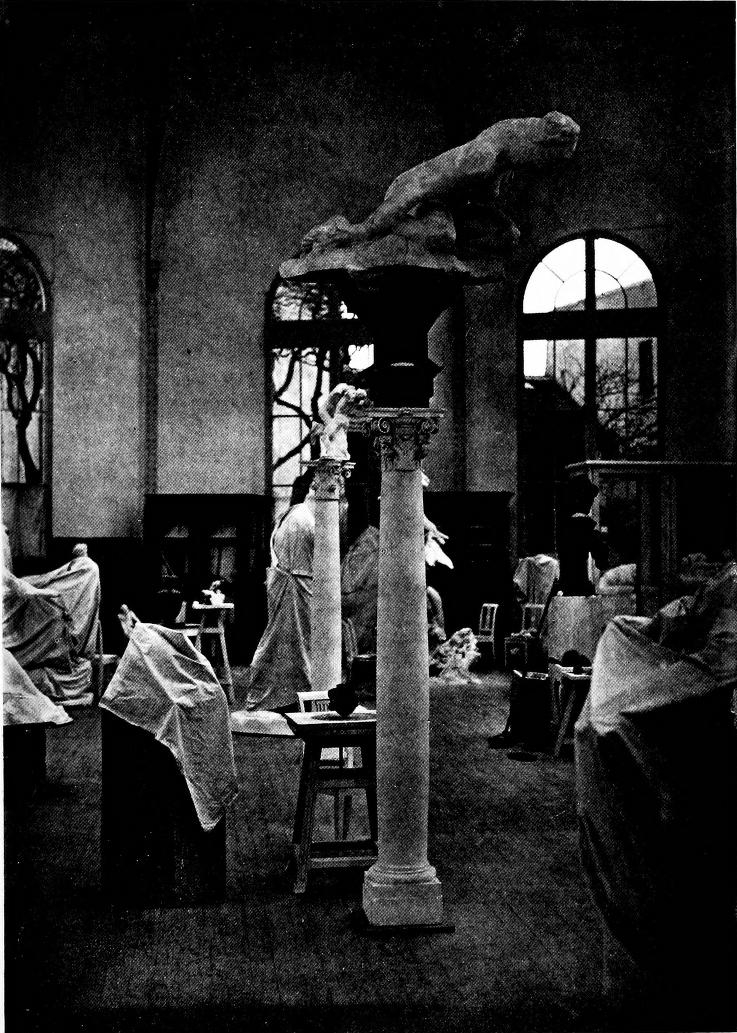
THE STUDIO AT MEUDON.
Once more Rodin experienced an hour of trial, a formidable hour. If for the last dozen years he had left poverty behind, he had not yet achieved wealth, and it was a great risk to assume the expenses of his exhibition. If these expenses were not covered by the entrance-fees and the sale of his sculpture, how would he come out? He would be forced to a kind of transaction that he had always spurned, he would have to turn over all or part of his work to the art dealers. These groups, these busts, so painstakingly cast, or cut in the most beautiful marble by excellent workmen, and often by renowned sculptors, once the dealers had acquired rights in them, would they not be duplicated in a quantity of replicas of mediocre workmanship or, worse, reproduced by undiscriminating stone-cutters, who would disfigure the modeling and the character? The idea was odious to the scrupulous sculptor. He had reached the age of sixty, and if he did not show it, thanks to the vigor of his temperament and the persistent youth that goes with great minds, it was not less painful for him to put his apprehensions to the test. Too dignified, too proud, to give way to vain lamentations, he made only the most reserved references to his ordeal.
The success of the exhibition remained uncertain during the first weeks: many people hoped it would be a failure. At the end of a month or two, visitors from abroad, to whom thanks be given, began to pour in; the principal museums of Europe wished to possess some important figure of Rodin's. Soon the number of purchasers increased day by day, and I do not have to mention here how many art-lovers from the United States decided to enrich their collections with some rare piece signed by the master. In short, during the latter months Rodin had the joy of perceiving that he could remain the sole possessor of his work, that nothing could now separate him from his dear family of bronze and marble. It was happiness for him; it signalized also the great glory that comes with outstretched wing, bringing fortune with it.
The pretty pavilion in the place de l'Alma was transported and reërected in the garden at Meudon, and he filled it with masterpieces. Since then the whole world of art and literature and that portion of the political world that esteems art has passed through it. The French aristocracy and that of England, the most eminent personages of the two Americas, have been eager to visit it. One receives in it an impression at once grand and touching, giving one the highest idea of the supremacy of intellectual valor above the other goods of this world when one perceives the contrast of these artistic treasures with the altogether modest little house, almost bare, attended by a single servant, where Rodin continues, in the midst of the luxury of an epoch intoxicated with pleasures, to maintain the simplicity of his life in the sober company of his old single-spirited, faithful-hearted wife. This impression I never felt more vividly than on the occasion of the visit of the late King of England. Edward VII, like others, had conceived the desire to render this homage to French art. The day before, when I encountered the master in Paris, he said to me, without further explanation, "Come and have a look at the studio."
It was a beautiful afternoon in May. When I entered the pavilion, I could not restrain a cry of admiration. Marbles, nothing but marbles, of a dazzling whiteness! He had brought together all that he possessed, all those that his friends and the purchasers of his work had consented to lend him for the occasion, and one would have said that it was these groups of young, enlaced bodies, these busts of women, with their transparent, rosy flesh, that gave forth the light with which the apartment was filled. It was a unique vision, a vision which, in its purity and its unity, surpassed in delicate splendor that of the most celebrated collections, with all their accumulation of pictures, tapestries, bronze, and jewels. I wondered in silence; I wondered at the sure taste of the artist, but I wondered also at his will: everything of him was there. Who can deny that it was necessary for him to put pressure on himself to decide on such a choice, to sacrifice the bronzes, the sketches, the terra cottas, and many charming pieces? Nothing but marble, the kingdom of marble, but also that of life; for the sumptuous material trembled and palpitated under the play of the light that entered through the bay-windows of the atelier, bringing with it the soft brilliance of the season.
Since the Exposition of 1900, Rodin's reputation has increased steadily in France and abroad. England and Italy have organized triumphal receptions for him of a sort reserved hitherto for the most illustrious men of state. The artists of London have acclaimed him, and have charged him, on the death of Whistler, with the presidency of the International Society of Painters, Sculptors, and Engravers. Oxford University has given him a doctorate. The municipality of Rome has greeted him with special homage at the capitol; the court of Greece, having invited him, awaits his visit; at Prague, where he was received by the Society of Young Czech Artists, they accorded him royal honors, the public unharnessing the horses from his carriage and applauding at the same time the personal genius of this great Frenchman and the free ideas of his country.
Without altering in any way his life of labor, which these tributes have at times slightly interfered with, he has permitted himself only one luxury as the result of his fortune—a collection of antiques. This he has formed with passion. It is, once more, for purposes of study, and what a study, to possess a few of these sublime fragments, to feel them and handle them under all aspects of light! Rodin has placed a certain number of them in his garden, arranging them among the trees, among the shrubs; he has placed them on the fresh grass, where they seem to live in another and a happier way than in the rooms of museums. At a stroke the little garden at Meudon, with its pedestals, its statues, with its grove where a charming little marble, the "Sleeping Cupid," reposes, has become like the villa of a Roman citizen of the time of Augustus.
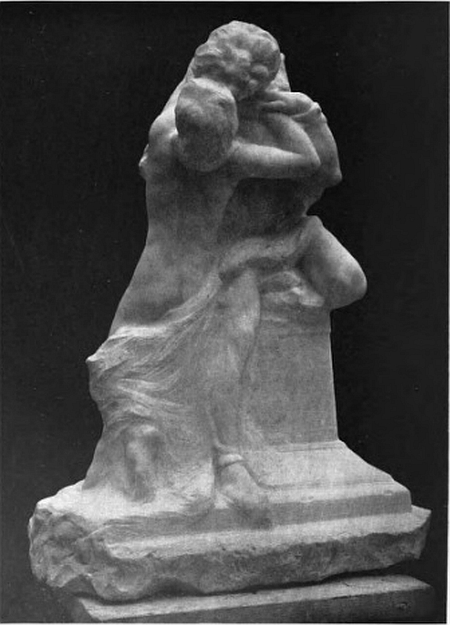
ROMEO AND JULIET
The art of Rodin has in a certain measure shown the effect of these happy events. During these latter years he has grown calm; he displays a serenity of spirit and a self-possession that increases day by day. But if the struggle in his composition has been tranquilized, his workmanship has grown freer. The sculptor's effort concentrates itself now in the search for a modeling ever more ample and suppler, which with him constitutes a new and decisive manner. It is to this that we owe those exquisite marbles, "Psyche Bearing the Lamp," "Benedictions," "The Young Girl and the Two Genii," "Romeo and Juliet," "The Fall of Icarus." This has been the epoch also of the busts of Mrs. Simpson and the proud and handsome George Wyndham, the English statesman. It is the epoch, finally, of the "Monument to President Sarmiento," which offers at the same time, in happy opposition, the two most recent and most characteristic methods of Rodin. The bronze statue of the great Argentine statesman has an aspect at once romantic and realistic that recalls that of "The Burghers of Calais," and the marble pedestal that supports it, a vanquishing Apollo emerging from the clouds all luminous with youth and glory, belongs to the latest period. Of this monument, ordered by the city of Buenos Aires, France does not possess a replica, though the model has been preserved. The Musée Rodin will soon contain a duplicate.
From 1901 to 1906 there was an uninterrupted creation of figures and of portraits, among them the busts of Sir Howard Walden, Berthelot, Gustave Geffroy, Mme. Hunter, and Bernard Shaw.
One must add the myriad drawings that Rodin has never ceased to execute. The will to sustain his eye and his hand instead of permitting them to become weakened with age has become a passion with him. He draws as a writer thinks. He thinks pencil in hand; his drawings are aphorisms. Line-sketches, stump-drawings, water-colors in strange tints multiply themselves like the leaves of a tree and quite constitute alone a complete work. The master has sold and given away quantities of them, yet; nevertheless, the Musée will contain more than three thousand. I have been honored with the charge of counting them over and classifying them. After days of this work one has a sensation of dazzlement, as I have discovered, before this accumulation of toil and beauty.
The most precious of these drawings are the most recent. The study of light has been carried in these to the supreme nuances. More and more Rodin detests what is black, what is hard, what is dry. He adores, on the other hand, that which is supple, enveloped, drowned in the light mist of the atmosphere. He conceives everything through an almost imperceptible veil which softens the contours, and which he discerns with an eye that grows every day more sensitive. His sculpture has followed the same path. In the greater part of his marbles he has pursued the effects of mass and of the ensemble in what concerns the volumes and the effects of gradation, the study of the diminutions of light in what concerns the coloring. The color that obtains uniquely in the art of shadow and light is the charm of beautiful sculpture. Rodin thus captures the variations with a competence that ravishes our eyes, accustomed to the dryness of limits that are too distinct. It is in the reliefs entitled "The Seasons" that Rodin has attained the apogee of this science of luminous modeling.
These works, executed for La Sapinière, the estate of Baron Vitta at Evian, comprise three high-reliefs fashioned on a gate and two fountain basins, or monumental garden urns. They are cut in the stone of the Estaillade, a white stone the richness of grain and delicate golden tone of which make it unsurpassable for the interpretation of the human body. They were exhibited for a short time in February, 1905, at the Musée du Luxembourg, on the initiative of M. Léon Bénédite, the very accomplished curator and critic of art, who arranged them with perfect taste. But far from being embraced and vindicated, as he would be now by the present administration of fine arts, Rodin was still regarded as a revolutionist whose example could neither be followed nor trusted.
This was made quite plain to the audacious curator who decided quite by himself to exhibit the latest works of the master before their departure for Evian. After this coup d'état he was for several years the victim of attacks from academic circles, and underwent, on the part of the Government, a sort of disgrace. Since then he has been brilliantly compensated, and to-day he has been placed in charge of the installation of the Musée Rodin at the Hôtel Biron, a great work in which I have the happiness to be his collaborator.
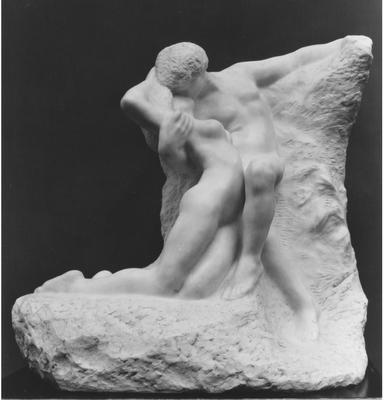
SPRING
The decorative designs of the villa of Evian adorn the vestibule of the home of Baron Vitta. "Their subject," says M. Bénédite, in an excellent notice which served as a catalogue for the Exhibition of 1905, "if one wishes to speak of the motive that serves as their pretext, is the most banal in the world. One would find it difficult to count the number of times that it has served artists since antiquity. So true it is that the commonest, the most general, the most seemingly worn-out themes are those in which the great artists find themselves the most at home. Without difficulty they renew them, and stamp them unforgettably with their own peculiar mark. Rodin has calmly returned to the four seasons, confident that they would bear without effort the impress of his personality and his time and that they would suffice to express his whole conception of beauty and of life."
Rodin has figured "The Seasons" under the aspect of four sleeping women. Their beautiful forms model themselves in the warm-tinted stone, which itself seems animated with the reflections of the living flesh. Their mysterious sleep evokes the successive phases of the year. Now it marks the quietude of the earth, full of the joy of yielding up her flowers and her fruits under the caresses of the sun, now it is death revealing itself through a nature tormented with the heavy travail of generation. In the "Spring" it is a young body that lies voluptuously under a rose-bush the fragrant petals of which are mingled with her own flesh, enveloping her in the dream of their perfume. In the "Autumn," the sleeper crouches close to the ground under the fruits and the vine-leaves, oppressed by the intoxicating aroma. The "Winter" presses her chilled limbs closely against the cavities of the denuded earth, while above her the roots of the trees enlace themselves intricately, like sacred serpents charged with protecting her slumber. The "Summer" is a siesta upon the bosom of a Nature en fête, lulled by the golden sounds of harvest balanced on the breeze and the murmur of a spring that pours forth freshness and quietude.
But in what, you ask, resides the originality of these decorative commonplaces, their brilliant, unquestionable originality? In the deliberate simplicity, in the spirit of sobriety that has presided over their composition, and, above all, in their execution. It is through their execution that the sculptures of Evian occupy a place apart in the work of Rodin. Since the beautiful Greek epoch, stone has perhaps never assumed such a living sweetness under any human hand. One might believe that it had not been touched by the steel of the chisel, but caressed by a touch as delicate as it is firm, molded like wax under the warmth of that hand. These mellow figures do not detach themselves from the living framework in which they are set; they stand out, thanks to an insensible transition which leaves them enveloped, in the reflections of the fair material; they mass themselves under a sifted light, among the flowers and the clusters of grapes. With all this there is no insipidity. Under the skin one feels the plenitude of bodies rich with health, harmonious organisms: it is a force that has found its equilibrium, a force relaxing in sweetness. Strangely enough, when one seeks for antecedents to which it is possible to relate the reliefs of Evian, it is not in the domain of sculpture, but in that of painting, that one finds the terms of comparison. The intense power, carefully measured as it is, of this vibrant modeling and this color drenched in sunlight we find again among the tenderest creations of Correggio, of Rubens, and, closer to ourselves, of Renoir.
The two jardinières which complete this unique series represent groups of children mad with joy and with liberty; in the one case playing and jostling one another in a field of wheat, in the midst of the moving sea of spears, and in the other, spread out on the green summer grass, rapturously holding up in their little arms, already robust, the grapes heavy with wine. They are exquisite fantasies of movement, of grace, of mad life just beginning. Here, too, the flesh of these little laughing gods, melting in the mass of ripe corn and tottering vines, seems bathed in the clearness of a beautiful day, full of air and of light.