COMPILED BY JUDITH CLADEL (continued 2)
S. K. Star translation
Auguste Rodin was at this time thirty-five years old. In the career of the artist, this admirable figure has a special significance, that of something symbolic. It marks one of the happiest phases of the sculptor's life, the period of revelation through which he had just been living during his sojourn by the forest of Groenendael. He, too, had awakened to Nature in the heart of the sacred wood; he, too, had come to know the somewhat dazzling torment of a being fully awake to the beauty of the world. This beauty he had at last penetrated; he felt it with all the strength of a ripened heart, he adored it; he made it his religion.
Such is the inner history of this statue. There is another, a history of the anecdotal sort, which is well known to-day, but which it is proper to recall in a complete biography of the master.
The adventure of "The Age of Bronze" was the first resounding battle that Rodin fought in his struggle for the cause of art. It was a victory, but only after great combats.
The plaster model appeared in the Salon of 1877. Before this proud and spirited figure a number of visitors paused, ravished by a sensation that was absolutely new. In itself there was nothing clamorous, no attempt to attract attention by extravagance of gesture or exaggerated expression—quite the contrary; the fragrance of a shy beauty, an idyllic freshness, mingled with the passionate poetry of a virile, artistic conscience, an exquisite sense of measure, a delightful elegance characteristically French, of the north of France, grave and restrained, and with a something hitherto unseen, a vigor till then unknown diffused through this adolescent flesh, irradiating it with tenderness, with a noble charm, a caressing sadness.
Immediately the rumor began to circulate, welcomed here, spurned there, by the world of professionals, amateurs, and journalists: the anatomy of the new work was too exact, its modeling too precise for it to be an interpretation of the model; it was a cast from nature, and the sculptor who gave out as the result of his own labor this mechanical copy of a human body was nothing but an impostor.
What does it matter? thought the public in its up-and-down common sense. There are plenty of fine casts from nature; so much the better for the name of Rodin if he has been particularly successful in this line.
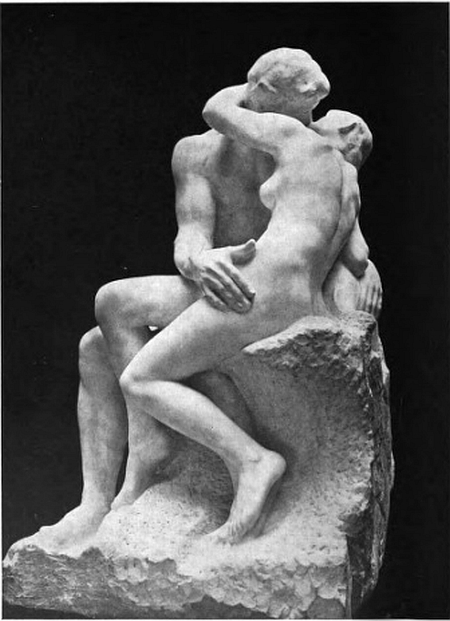
THE KISS
But Rodin was indignant. This nude, so obstinately worked over, a cast! That he should have committed such a deception, he the scrupulous molder of clay! Oh, he knew well enough that most of the great modern sculptors do not burden themselves with so many scruples and lend themselves too often to the hasty method of taking casts; he condemned it with all the force of his own probity. He knew well that in this very Salon of 1877 more than fifty pieces of sculpture about which nothing was said owed their existence to this malpractice of which he was accused and of which he would never be guilty, because he considered it the very negation of art. For of course taking casts is nothing but the reproduction of nature in its immobility. By means of it one is able to take the impression of forms, but one cannot grasp movement or expression. It is possible to take the mold of an arm, a leg, an inert body; one can take a good cast of the stiffened mask of the dead; one cannot calculate through the medium of the plaster the attitude and the modifications of form of a man walking or falling or the eloquence of a face lighted up by the reflection of the inner mind. This transcription of the whole is the exclusive privilege of the artist. He alone seizes and fixes the general impression; for it is made up not only of the immediate movement, but of that which precedes and that which follows. His eye alone registers the rapid succession, and his skill reproduces it. While the cast, like the photograph, only constitutes a unity detached from the whole, sculpture from nature reëstablishes the whole itself and represents the uninterrupted vibration which is life.
That explains how there happen to be, on the one hand, so many hard figures, weak and cold images, turned out hastily by lazy and conscienceless sculptors, and, on the other, those works that possess a charm that is mysterious to those who know nothing of its source, who are unaware of this method of observation and labor which a supreme effort veils in the easy grace and the apparent facility that enchants us in the things of nature.
The accusation brought against Rodin became more definite. There was a veritable upheaval of opinion in the world of the Salons. He protested, with the firmness of an artist resolved to suffer no blot upon his honor. He insisted upon receiving justice. Unknown, without means of support, without fortune, he might well have waited a long time for it. He turned toward Belgium, seeking defenders in the country where he had made "The Age of Bronze"; but the academic virus did not spare him; the official sculptors remained deaf to the appeal of their confrère. For that matter, where did he come from, this ambitious stone-cutter who claimed the title of sculptor without waiting on the good pleasure of the pontiffs?
Rodin's model alone, the young soldier of Brussels, became indignant at the affront to his sculptor. He wanted to hasten to Paris and exhibit himself naked before the eye of the jury of honor which had just been constituted and cry out to them that he had posed nearly two years for the artist who had been so unjustly attacked. But nothing is simple. He had posed, thanks to the special good will of the captain commanding the company to which he belonged, and in defiance of military regulations. To reveal this fact would be to compromise the officer, and so he had to remain silent.
Rodin had photographs and casts taken from his model and sent them to the experts. All this was costly and uncertain. It was only after months of waiting that they were examined. On the jury were several art critics, including Charles Iriarte, a learned writer and distinguished mind, and Paul de Saint-Victor, author of the "Deux-Masques," the sumptuous writer of so much brilliant prose. Alas! the most insignificant sculptor, provided he had only been sincere, could have settled Rodin's case a hundred times better. A man of his own trade, possessing the elements of justice, would have immediately decided the question according to the facts, while the critics and writers relied wholly upon personal impressions, and, to the great bitterness of the sculptor, when they delivered an opinion they did not altogether reject the accusation that he had taken casts, allowing doubt to rest upon the honesty of Rodin. He himself did not know what to do next. Chance was more favorable to him than men.
At that time he was executing for a great decorator some ornamental motives destined for one of the buildings of the Universal Exposition of 1878. The sculptor, Alfred Boucher, a pupil of Paul Dubois, came one day on a business errand to see the decorator. In the studios he noticed Rodin at work on the model of a group of children intended for a cartouche. Boucher, who knew about the accusation that hung over him, observed him with the liveliest interest. He witnessed the rapid, skilful, amazingly dexterous execution producing under his very eye a tender efflorescence of childish flesh on the firm and perfectly constructed little bodies. And Rodin was working without models! Alfred Boucher was a product of the Ecole; he had taken the grand prix de Rome; he was ten years younger than Rodin; but he was an honest man; he hastened to relate to his master, Paul Dubois, what he had seen. The creator of the "Florentine Singer" and "Charity" in his turn wished to see things for himself. With Claude Chapu he went to the decorator's and both of them decided then and there that the hand that molded so skilfully from memory the figures of the cherubs was certainly capable, in its extraordinary knowledge of human anatomy, of having executed that of "The Age of Bronze." Thereupon they convinced their confrères and decided to write the under-secretary of state a solemn letter in which all of them, answering for the good faith of Rodin, declared that he had made a beautiful statue and that he would become a great sculptor. The letter was signed by Carrier-Belleuse, Paul Dubois, Chapu, Thomas Delaplanche, Chaplin Falguière.
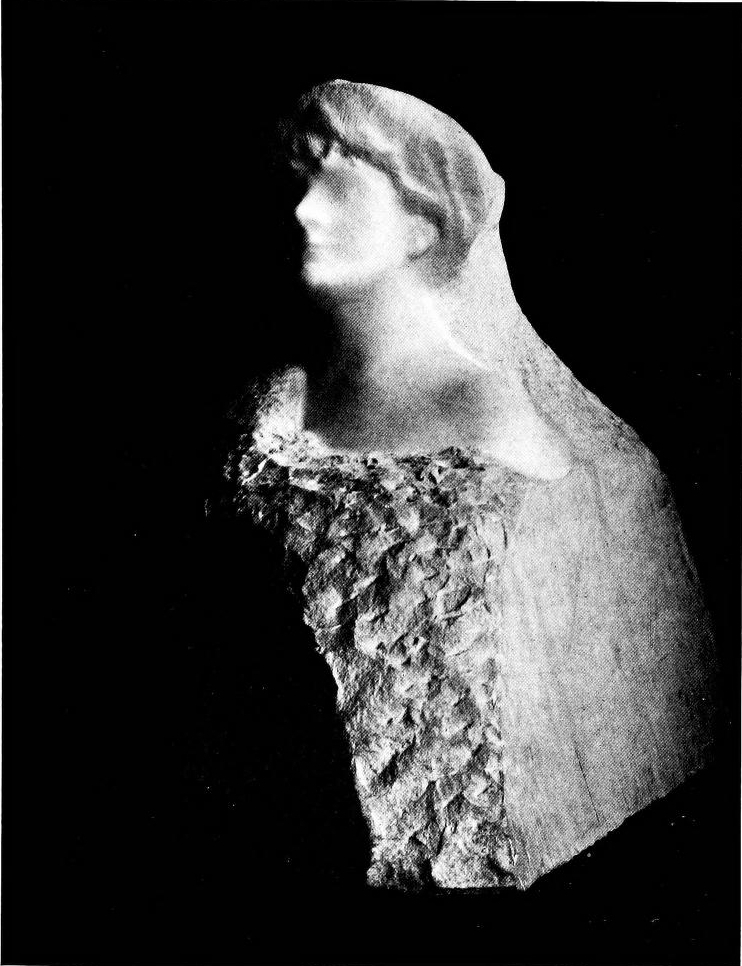
BUST OF THE COUNTESS OF W——.
This tempered considerably the rancor of the artist.
It is a strange fact that for years he underrated this statue. In 1899 he gave his first great exhibition of all his work. It was to the Maison d'Art of Brussels that the honor of this project was due, and it was carried out in a style and with a good taste which no later exhibition of the master has surpassed, or even attained.
As he had charged me with the supervision of the sending off of his works, to the number of fifty, I begged him to include among them "The Age of Bronze." I hoped that the public, and especially the artists of Belgium, might be able to study the evolution of his technique through his typical works, executed at different periods of his career. Nothing could induce him to consent to it. He declared that in twenty years his modeling had undergone a complete transformation, that it had become more spacious and more supple, and that the exhibition of this statue could serve no purpose and be of good to nobody. I urged him to go and look at it again. The bronze, sent to the Salon of 1880, with the plaster figure of "St. John the Baptist in Prayer," awarded, oh splendor of official miserliness! a medal of the third class, had been bought by the state a few years later and set up in a corner of the Luxembourg Gardens, an out-of-the-way corner, but one that the light shadows of the young trees made charming. The master refused. Two or three years afterward, one morning while we were talking, I led him unsuspecting toward this little grove. Thinking of something else he lifted his Head, casting an indifferent glance at the solitary bronze. Surprised, he examined it, while a happy emotion lighted up his face; then he walked slowly around it. Finally he admitted quietly that he had been mistaken, that the statue seemed to him really beautiful, well constructed, and carefully sculptured. In order to comprehend it he had had to forget it, to see it again suddenly, and to judge it as if it had been the work of another hand.
After this readoption, his affection for it was restored; he had several copies cast in bronze and cut in stone, and it has become perhaps one of his most popular and most sought-after works. Museums of Europe and America, lovers of art in both hemispheres, consider it an honor to possess replicas.
It was the first of Rodin's great statues, or, rather, the first that has been preserved. Several other works of capital importance serve as landmarks in the progress of his talent. Around them are grouped fragments, busts, innumerable delightful little compositions, all treated with the same care and equally reflecting the result of his studies; but, as ever, it is the major works that mark most visibly the points of departure and arrival of the different periods of his artistic development. These works are: "The Age of Bronze" (1877); "Saint John the Baptist" (1880); "The Gate of Hell" (1880-19—, not finished); "The Creation of Man" (1881); "The Burghers of Calais" (1889); "Victor Hugo" (1896); "Balzac" (1898); "The Seasons" (pediments of stone, 1905); "Ariadne" (in course of execution).
These works will be described and characterized, in the course of this book, at the dates of their appearance.
FLEMISH PAINTING—JOURNEYS IN ITALY AND FRANCE
During his stay in Belgium, Rodin studied the Flemish painters. Free from the prejudices of the schools, unaware of the theories of the critics, sensitive to the beautiful in every form, following only his personal taste supported by the study of the masters, he ranged over the vast domain of art through regions the most dissimilar and superficially the most opposed. Of course he had his preferences; he returned unceasingly to the antique and the Gothic; but his preferences did not blind him. His admiration passed rapidly from the splendors of Greek and Roman architecture to the voluptuous graces of the seventeenth century. His love for Donatello and Michelangelo did not prevent him from appreciating Bernini.
Attracted first by the marvelous Flemish Gothic artists, Memling, Massys, the Van Eycks, he was later delighted with the homely scenes of Jan Steen, of Brueghel, of Teniers; he enjoyed them as an artist and as a simple man who knew the value of domestic joys. Then he was haunted by the sensual pomp of Jordaens and above all Rubens.
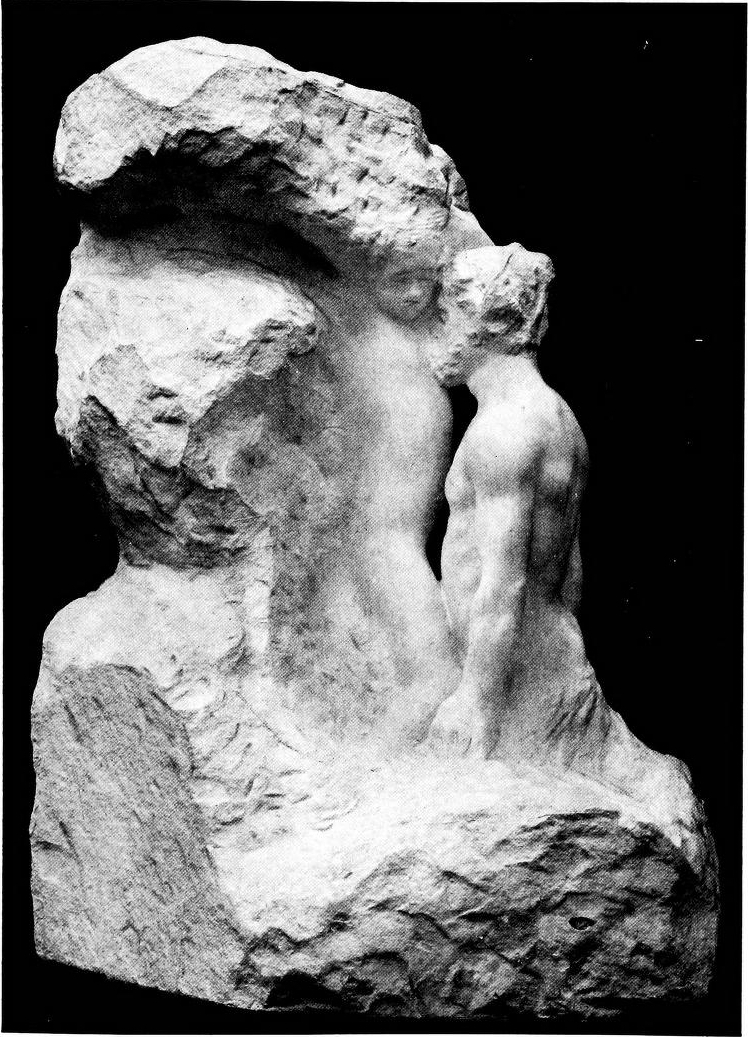
THE POET AND THE MUSE.
The triumphant brush of Rubens sculptured as much as it painted. The science of foreshortening and that of ceiling painting, his way of modeling forms in the light and by means of light—all this brought his art into the realm of sculpture; and when Rodin came to seek effects of light and shadow that were new to sculpture, he remembered the lessons of the Antwerp master. From that time on Rubens was for him a splendid subject for study and would have fortified him, had that been necessary, in the love of drawing; for beautiful drawing leads, to everything, to color, in sculpture as well as in painting.
Flemish art was not enough to satisfy this thirst for understanding that devoured the soul of the artist now in the full swing of the fermenting force of his faculties. He wished to see Italy or at least to catch a glimpse of it. His resources were so slender indeed that his journey could not have been long. It did not matter. He would form an idea of the immensity of its treasure and confirm in himself the desire to return. He wished also to see France, as alluring to him as Greece, and whose cathedrals are perhaps not less beautiful than the Parthenon.
He started for Italy in 1875, and he accomplished his first tour of France in 1877. He set forth. He was young and strong; he made the pass of Mont Cenis on foot. He was unknown and without connections. What did it matter? In the midst of these scenes so radiant with memories of history and art, did he not feel an intoxication such as the soldiers of Bonaparte alone must have experienced, catching sight of the plains of Lombardy, where they were to forget the hardships of the campaign?
For Rodin, Italy meant the antique; it meant Donatello and Michelangelo. The antique he had already to a considerable extent studied in the Louvre. Donatello and Michelangelo conquered him at the first glance—a tumultuous conquest. The severity of Donatello's style impassioned him; the rigid honesty of his realism, the desire of this younger brother of Dante to see things grandly, the equal desire to see things simply, this Gothic genius deeply moved "in the mid-way of this our mortal life" by pagan beauty and touched by the breath of the Renaissance, impressed the French artist and became a dominating memory. From that time on in the most beautiful of his busts, those of Jean-Paul Laurens, Puvis de Chavannes, Lord Wyndham, Lord Horace Walden, Mr. Ryan, he was to appear as a disciple of the Florentine master, not by a literal imitation of his methods, which he thoroughly grasped, but by similar qualities of observation and synthesis. Still, this was not until after he had made other studies, while Michelangelo took hold upon him immediately and completely and became an actual obsession that might have proved dangerous to a sculptor less severe with himself, less determined to discover his own path.
The dazzling richness of modeling, the majesty of the great figures of the prodigious Florentine, and their fullness of movement—for their immobility is charged with movement—the somber melancholy of his thought, his flaming and shadowy soul, his literary romanticism, a romanticism like that of Shakspere, overwhelmed Rodin with that formidable sense of an almost sorrowful admiration that all experience who visit the Medici tombs in the new sacristy.
He studied also the later marbles of Michelangelo, which stood at that time in the gardens of the Pitti Palace and have since been removed to the Municipal Museum of Florence.
Every one knows these powerful blocks, these vast human forms, only half disengaged from the marble, from which they seem to be endeavoring to escape in order to give birth to themselves by a rending effort that is characteristic with all the force of a symbol of the tragic genius of Buonarroti. "Unfinished works"; it is thus the catalogues designate them. Unfinished works, indeed, but why? Was it age that stilled, before the end, the hand of the giant of sculpture? Or was it not rather that he judged them too strangely beautiful in their incompleteness, that they seemed to him more powerful thus, still captive to the material that bound them groaning, as it were, in their tremulous flesh?
The public pays little attention to these sublime masses because it is told that they are not finished. Not finished? Or infinite? That is the question. Far from weighing them down, the marble that envelops them throws about them the charm of the indeterminate and by means of this unites them with the atmosphere. The parts that are wholly disengaged enable one to divine those that remain hidden; they are veiled without being obliterated, like mountain-tops among the clouds; and this half-mystery, instead of diminishing, increases the harmony of the bodies trembling with life under their mantle of stone. In the presence of an effect so marvelous, so calculated, one cannot cease from asking if it was really death or if it was not rather the sovereign taste of the workman that arrested the chisel. While he was fashioning his statues out of the marble itself, with that fury that has passed into legend, did he not find himself, face to face with these unexpected effects which the material offered him of itself, in the midst of one of those happy situations by which the talent of the masters alone enables them to profit?
However that may be, Rodin was struck as if by a revelation. What the progress of his work had tardily disclosed to Michelangelo was soon to become for his disciple a principle of decorative art. Instead of disengaging his figures entirely, he was to leave them half submerged in the transparent marble. This method, which has become famous to-day, seemed an unheard-of thing to those who were unfamiliar with the Florentine blocks; but Rodin has never failed to acknowledge the paternity of the sculptor of "The Thinker." Following in his steps, many artists have employed this method at random, without possessing the essential qualities that enable one to control these effects, and under their powerless chisels the enchanting device no longer possesses any meaning.
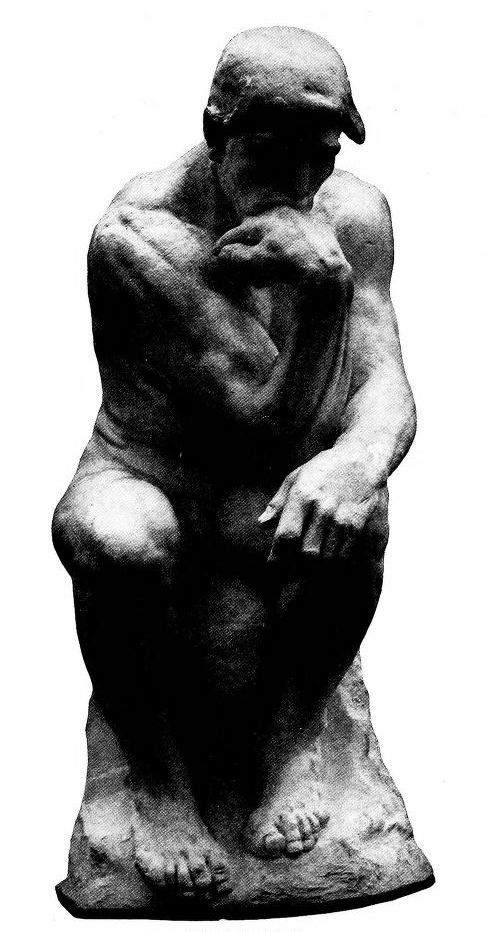
THE THINKER.
Rodin himself waited until he possessed a thorough knowledge of marble and the manner of treating it; it was a stroke of fate by which he rediscovered the phenomena of envelopment that had so transported him in the Municipal Museum. He had by that time the wisdom to guard himself from doing anything inconsistent with his material. He followed out the suggestions it gave him, and developed an infinite variety in the methods of handling it.
On his return from Italy he continued to be haunted by the unsurpassable vigor of Michelangelo's workmanship. He sought to discover what was the outstanding gift that conferred upon him this power and this mysterious empire over the spirit. Until then, with the majority of artists of the modern school, he had believed that the chief quality of sculpture lay in seizing the character of the model; but he came to see how many works concerned only with expressing character fail of real significance. Since 1830 how many romanticists have sacrificed to character without leaving any works that are lasting!
After his journey Rodin decided that the strength of Michelangelo lay undoubtedly in his movement. Returning to his studio, he executed a quantity of sketches and even large figures like "The Creation of Man," the title of which, although he had not been to Rome, is a souvenir of the frescos of the Sistine Chapel; he made busts like that of Bellona, after having directed his models to assume Michelangelesque poses. For all this, he did not attain to the grandeur, the soul-disturbing authority of the Florentine master.
Without becoming discouraged, he went on observing ceaselessly. Far from imposing upon his model positions thought out in advance, he left him free to wander about the studio at the pleasure of his own caprice, ready to arrest him at a word when a beautiful movement passed before his eyes. Then, six months after his return from Italy, he found that the model assumed of his own accord the very poses of which Michelangelo alone had seemed to him to possess the secret; he realized that the sublime sculptor had taken them direct from nature, from the rhythm of the human body in action, and that he had done nothing but seize and immortalize them.
"Michelangelo," he says, "revealed me to myself, revealed to me the truth of forms. I went to Florence to find what I possessed in Paris and elsewhere, but it is he who taught me this."
This does not prevent certain critics from asserting out of the depth of their incompetence that he has never felt the influence of this master and that he has never even given his work serious consideration. Those who know Rodin well know that, on the contrary, he never fails to give serious consideration to anything which is worth considering at all and that his power of observation is the basis of his genius. Always seeking a final method, he came back to the idea with which his earliest education had already inspired him and which his self-communings had only confirmed: that the value of sculpture lies entirely in the modeling. This is the secret of Michelangelo; it is also that of the ancients and of all the great artists of the past and of modern times. For the rest, through his spacious movements, his balancing of equal masses, the sculptor of the tombs taught him that the supreme quality consists in seeking in the modeling the living, determining line of the scheme, the supple axis of the human body.
He himself held this principle of the ancients, of whom he was a disciple, as far as modeling is concerned, while in his composition and his handling of light he is a Gothic.
Soon after his return from Italy, Rodin executed the great study entitled "The Creation of Man." In it he exaggerated the rhythm so characteristic of the Florentine, the balancing of masses, the melancholy contraction of the body under the weight of an inexpressible inner suffering. When one examines the figure, this exaggeration certainly suggests something overworked, something forced, which Michelangelo knew how to avoid and which here creates a somewhat painful impression. But later, when Rodin conceived the idea of placing his statue at the summit of "The Gate of Hell," this strained appearance disappeared. Seen thus, a lofty shape lighted up from below, it takes on true beauty; it is in its right place; it dominates the work and, as it were, blesses it. It has the affecting gesture of Christian charity.
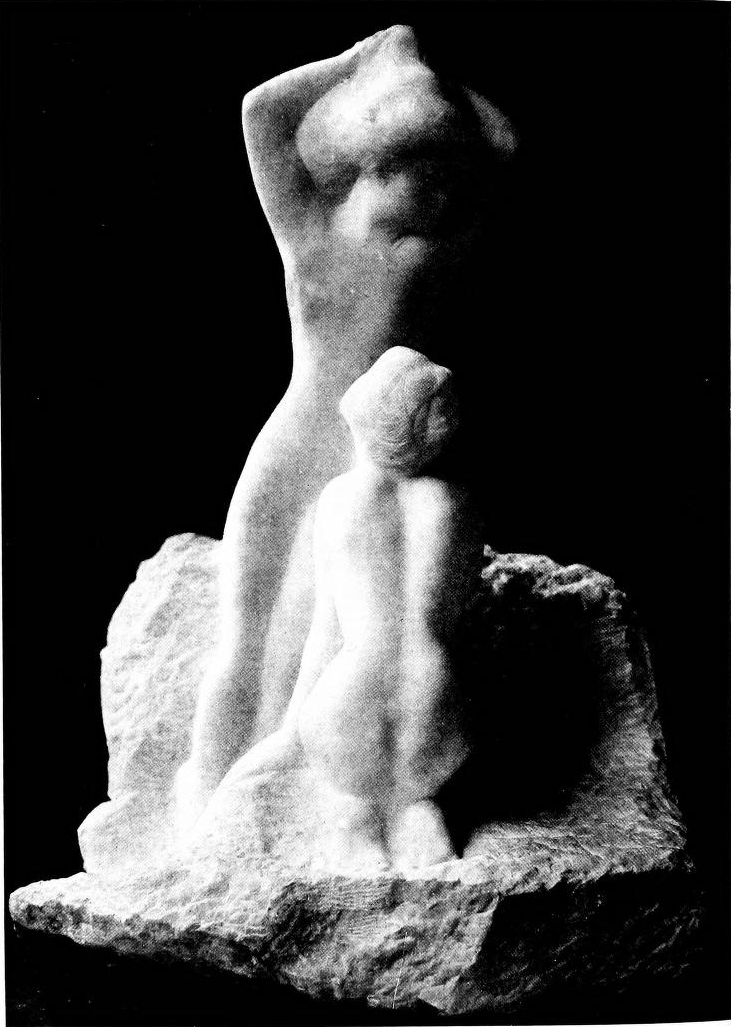
ADOLESCENCE.
RODIN'S NOTE-BOOK
INTRODUCTIONS BY JUDITH CLADEL
I
ANCIENT WORKSHOPS AND MODERN SCHOOLS
At a period in which, among the many manifestations of intellectual activity in the nations, art is placed in the background, the advent of a great artist invariably calls forth the same phenomena: a few men of taste become enthusiasts, the majority become indignant, and the public, not being possessed of sufficient esthetic education, and intolerant because of their lack of understanding, ridicule the intruder who has overthrown the accepted standards of the century. Friends and foes alike consider him a revolutionist; as a matter of fact, he is in open revolt against ignorance and general incompetence.
Little by little the great truth embodied in such a man is revealed. Comprehension, like a contagion, seems to take hold of the minds of people, and impels them to study his art at first hand. A study not only of his own significance, but of the principles which he represents, quickly reveals that the work of this innovator, this revolutionist, is, in fact, deeply allied to tradition, and, far from being a mysterious, isolated manifestation, is, on the contrary, closely linked to general artistic ideals.
Our aim is to penetrate the doctrines of this master, his method, his manner of working—all that which at other times would have been called his secrets.
Auguste Rodin's career has passed through the inevitable phases. He, who has been so generally discussed and attacked, is to-day the most regarded of all artists. He likes to talk of his art; for he knows that his observations have a priceless value, that of experience—the experience of sixty years of uninterrupted work—and of a conscience perhaps even more exacting to-day than at the time of his impetuous youth. He says, "My principles are the laws of experience." The combination of these principles embodies his greatest precept; namely, that of thinking and executing a thing simultaneously. We must listen to Rodin as we would listen to Michelangelo or Rembrandt if they were living. For his method may be the starting-point of an artistic renaissance in Europe, perhaps throughout the whole world. Definite signs of a decided resurrection in taste are already manifesting themselves, and it is a splendid satisfaction for the illustrious sculptor to receive such acknowledgment in his glorious old age. For, like every great genius, he has a profound love for the race from which he springs, and feels a strong instinctive confidence in it. Indeed, how should this be otherwise? In the course of centuries, has not this wonderful Celtic race on various occasions reconstructed its understanding and interpretation of beauty?
Auguste Rodin expresses himself by preference on subjects from which he can draw an actual lesson. He is no theorist; he has an eminently positive mind, one might even say a practical mind. His teachings, unlike the abstract teachings of books, can be characterized by two words, observation and deduction. His are not more or less arbitrary meditations in which personal imagination plays the principal part; they are rather the account of a sagacious, truthful traveler, of a soldier who relates the story of his campaigns, or of a scholar who records the result of an analysis. Reality is his only basis, and with justice to himself he can say, "I am not a rhetorician, but a man of action."
We hear him chat, it may be in his atelier about some piece of antique sculpture which has just come into his possession or about a work he has in hand, or during his rambles through his garden, which is situated in the most delightful country in the suburbs of the capital, or on a walk through the museums, or through the old quarter of Paris. For in his opinion "the streets of Paris, with their shops of old furniture, etchings, and works of art, are a veritable museum, far less tiring than official museums, and from which one imbibes just as much as one can."
I use the words of the people, of the man in the street; for thoughts should be clear and easily comprehended. I desire to be understood by the great majority, and I leave scholarly words and unusual phrasing to specialists in estheticism. Moreover, what I say is very simple. It is within the grasp of ordinary intelligence. Up to now it has been of hardly any value. It is something quite new, and will remain so as long as the ideas which I stand for are not actively carried out.
If these ideas were understood and applied, the destruction of ancient works of art would cease immediately. By bad restoration we are ruining our most beautiful works of art, our marvelous architecture, our Gothic cathedrals, Renaissance city halls, all those old houses that transformed France into a garden of beauty of which it was impossible to grow weary, for everything was a delight to the eye and intelligence. Our workmen would have to be as capable as those of former times to restore those works of art without changing them, they would have to possess the same wonderfully trained eye and hand. But to-day we have lost that conception and execution. We live in a period of ignorance, and when we put our hand to a masterpiece, we spoil it. Restoring, in our way, is almost like jewelers replacing pearls with false diamonds, which the ignorant accept with complacency.
The Americans who buy our paintings, our antique furniture, our old engravings, our materials, pay very dearly for them. At least we think so. As a matter of fact they buy them very cheaply, for they obtain originals which can never be duplicated. We mock at the American collectors; in reality we ought to laugh at ourselves. For we permit our most precious treasures to be taken out of the country, and it is they who have the intelligence to acquire them.
My ideas, once understood and applied, would immediately revive art, all arts, not only sculpture, painting, and architecture, but also those arts which are called minor, such as decoration, tapestry, furniture, the designing of jewelry and medals, etc. The artisan would revert to fundamental truth, to the principles of the ancients—principles which are the eternal basis of all art, regardless of differences of race and temperament.
CONSTRUCTION AND MODELING
In the first place, art is only a close study of nature. Without that we can have no salvation and no artists. Those who pretend that they can improve on the living model, that glorious creation of which we know so little, of which we in our ignorance barely grasp the admirable proportions, are insignificant persons, and they will never produce anything but mediocre work.
We must strive to understand nature not only with our heart, but above all with our intellect. He who is impressionable, but not intelligent, is incapable of expressing his emotion. The world is full of men who worship the beauty of women; but how many can make beautiful portraits or beautiful busts of the woman they adore? Intelligence alone, after lengthy research, has discovered the general principles without which there can be no real art.
In sculpture the first of these principles is that of construction. Construction is the first problem that faces an artist studying his model, whether that model be a human being, animal, tree, or flower. The question arises regarding the model as a whole, and regarding it in its separate parts. All form that is to be reproduced ought to be reproduced in its true dimensions, in its complete volume. And what is this volume?
It is the space that an object occupies in the atmosphere. The essential basis of art is to determine that exact space; this is the alpha and omega, this is the general law. To model these volumes in depth is to model in the round, while modeling on the surface is bas-relief. In a reproduction of nature such as a work of art attempts, sculpture in the round approaches reality more closely than does bas-relief.
To-day we are constantly working in bas-relief, and that is why our products are so cold and meager. Sculpture in the round alone produces the qualities of life. For instance, to make a bust does not consist in executing the different surfaces and their details one after another, successively making the forehead, the cheeks, the chin, and then the eyes, nose, and mouth. On the contrary, from the first sitting the whole mass must be conceived and constructed in its varying circumferences; that is to say, in each of its profiles.
A head may appear ovoid, or like a sphere in its variations. If we slowly encircle this sphere, we shall see it in its successive profiles. As it presents itself, each profile differs from the one preceding. It is this succession of profiles that must be reproduced, and that is the means of establishing the true volume of a head.
Each profile is actually the outer evidence of the interior mass; each is the perceptible surface of a deep section, like the slices of a melon, so that if one is faithful to the accuracy of these profiles, the reality of the model, instead of being a superficial reproduction, seems to emanate from within. The solidity of the whole, the accuracy of plan, and the veritable life of a work of art, proceed therefrom.
The same method applies to details which must all be modeled in conformity with the whole. Deference to plan necessitates accuracy of modeling. The one is derived from the other. The first engenders the second.
These are the main principles of construction and modeling—principles to which we owe the force and charm of works of art. They are the key not only to the handicraft of sculpture, but to all the handicrafts of art. For that which is true of a bust applies equally to the human form, to a tree, to a flower, or to an ornament.
This is neither mysterious nor hard to understand. It is thoroughly commonplace, very prosaic. Others may say that art is emotion, inspiration. Those are only phrases, tales with which to amuse the ignorant. Sculpture is quite simply the art of depression and protuberance. There is no getting away from that. Without a doubt the sensibility of an artist and his particular temperament play a part in the creation of a work of art, but the essential thing is to command that science which can be acquired only by work and daily experience. The essential thing is to respect the law, and the characteristic of that fruitful law is to be the same for all things.
Moreover, such was the method employed by the ancients, the method which we ourselves employed till the end of the eighteenth century, and by which the spirit of the Gothic genius and that of the Renaissance and of the periods of culture and elegance of the seventeenth and eighteenth centuries were transmitted to us. Only in our day have we completely lost that technic.
These rules do not constitute a system peculiar to myself. They are general principles which govern the world of art, just as other immutable laws govern the celestial world. They are mathematical principles which I found again because my work inevitably led me to follow in the footsteps of the great masters, my ancestors.
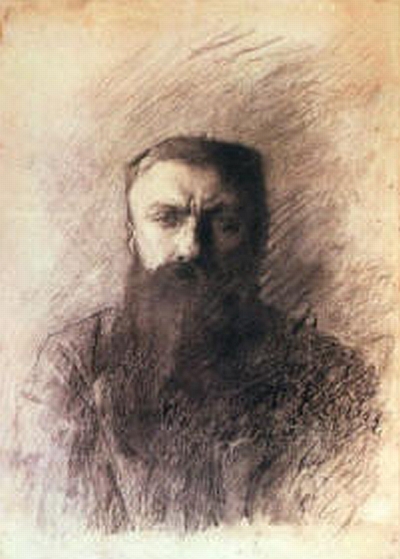
AUGUSTE RODIN—A PORTRAIT BY HIMSELF
THE TRADITIONAL LAWS OF ANCIENT ART
In days of old, precise laws were handed down from generation to generation, from master to student, in all the workshops of the workers in art—sculptors, painters, decorators, cabinet-makers, jewelers. But at that time workshops existed where one actually taught, where the master worked in view of the pupil. In our day by what have we replaced that marvelously productive school, the workshop? By academies in which one learns nothing, because one sets out from such a contrary point of view.
These principles of art were first pointed out to me not by a celebrated sculptor, or by an authorized teacher, but by a comrade in the workshop, a humble artisan, a little plasterer from the neighborhood of Blois called Constant Simon. We worked together at a decorator's. I was quite at the beginning of my career, earning six francs a day. Our models were leaves and flowers, which we picked in the garden. I was carving a capital when Constant Simon said to me: "You don't go about that correctly. You make all your leaves flatwise. Turn them, on the contrary, with the point facing you. Execute them in depth and not in relief. Always work in that manner, so that a surface will never seem other than the termination of a mass. Only thus can you achieve success in sculpture."
I understood at once. Since then I have discovered many other things, but that rule has remained my absolute basis. Constant Simon was only an obscure workman, but he possessed the principles and a little of the genius of the great ornamentists who worked at the châteaux of the Loire. On the St. Michel fountain in Paris there are very beautifully carved decorations, rich and at the same time graceful, which were made by the hand of this little modeler, who knew far more than all the professors of esthetics.
Such was the purpose the workshops of old served. The apprentice passed successively through all the stages and became acquainted with all the secrets of his handicraft. He began by sweeping the studio, and that first taught him care and patience, which are the essential virtues of a workman. He posed, he served as model for his comrades. The master in turn worked before him among his students. He heard his companions discuss their art, he benefited by the discoveries that they communicated to one another. He found himself faced every day by those unforeseen difficulties which go to make an artist till the moment when the artist is sufficiently capable to master his difficulties. Alternately, they were both teacher and companion, and they conveyed to one another the science of the ancients.
What have we to-day in place of those splendid institutions which developed character and intelligence simultaneously? Schools at which the students think only of obtaining a prize, not attained by close study, but by flattering the professors. The professors themselves, without any deep attachment for their academies, come hurriedly, overburdened by official duties and all sorts of work; weighed down by perfunctory obligations, they correct the students' papers hastily, and hurriedly return to their regular occupation.
As to the students, twenty or thirty work from a single model, which is some distance from them and around which they can hardly turn. They ignore all those inevitable laws which are learned in the course of work, and which escape the attention of an artist working alone. They attend courses, or read books on esthetics written in technical language with obscure, abstract terms, lacking all connection with concrete reality—books in which the same mistakes are repeated because frequently they are copied from one another. What sort of students can develop under such disastrous conditions? If one among them is seriously desirous of learning, he breaks loose from his destructive surroundings, is obliged to lose several years first in ridding himself of a poor method, and then in searching for a method which formerly one had mastered on leaving the atelier.
That is the method that I preach to-day as emphatically as I can, calling attention to the numerous benefits and advantages of taking up a variety of handicrafts. Aside from sculpture and drawing, I have worked at all sorts of things—ornamentation, ceramics, jewelry. I have learned my lesson from matter itself and have adapted myself accordingly. Only in being faithful to this principle can one understand and know how to work. I am an artisan.
Will my experience be of benefit to others? I hope so. At all events, we have a bit to relearn. It will take years of patience and application to rise from the abyss of ignorance into which we have fallen. However, I believe in a renaissance. A number of our artists have already seen the light—the light of intellectual truth. Acts of barbarism against masterpieces cannot be committed any more without arousing the indignation of cultivated people. That in itself is an inestimable gain, for those works of art are the relics of our traditions, and if we have the strength to become an artistic people again, to reincarnate an era of beauty, then those are the works of art that will serve as our models, expressions of a national conscience that will be the milestones on our path.
Judged by his work, Auguste Rodin is the most modern of artists; judged by his life and character, he is unquestionably a man of bygone days. As a sculptor, he is such as were Phidias, Praxiteles, and the master architects of the Middle Ages; that is to say, he is of all times. One single idea guides his thoughts, one single aim arouses his energies—art, art through the study of nature.
It is by the concentration of his unusual mind on a single purpose that he attains his remarkable understanding of man, physical and moral, his contemporary, and of the spirit of our age. In the lifelike features of his statues he inscribes the history of the day. They seem to live, and the potency of their life enters into us and dominates us. For the moment we are only a silent spring, merely reflecting their authority.
Through this secret of genius, his statues and groups have an individual charm. They have taken their place in the history of sculpture. There is the charm of the antique, the charm of the Gothic, and the charm of Michelangelo. There is also the charm of Rodin.
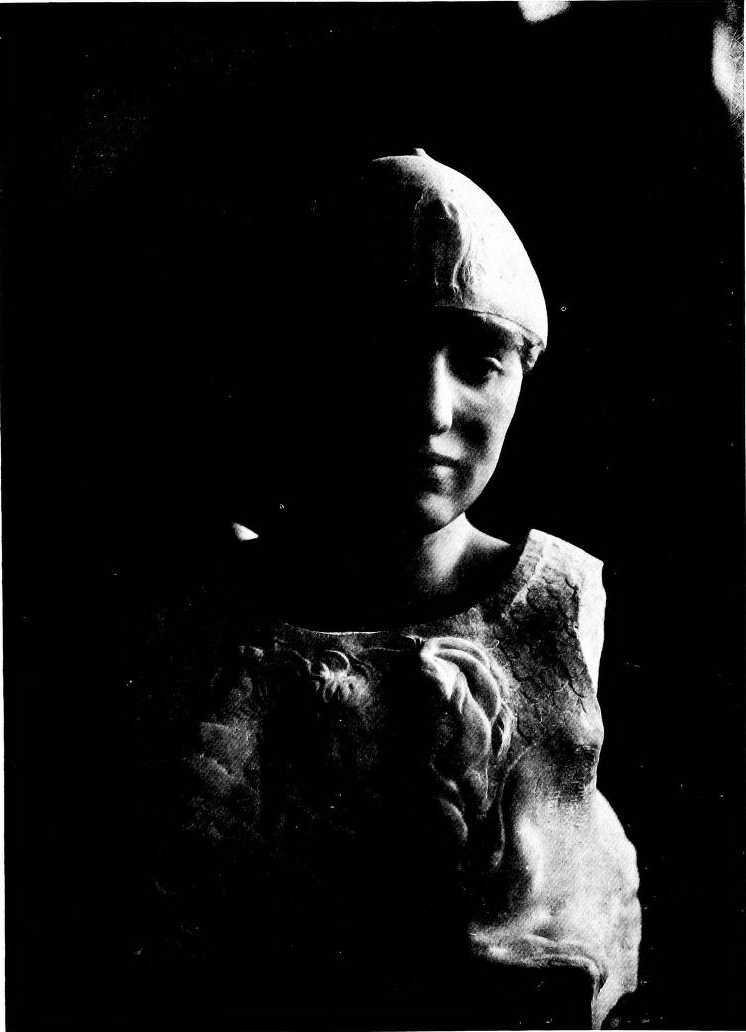
HEAD OF MINERVA.
II
SCATTERED THOUGHTS ON FLOWERS
In Rodin's statues we find his conception of eternal man—man as he really is. They are molded on modern thought, with all its variations. One might suppose that these beautiful beings of marble and bronze had been named by the characteristic poets of the century, Victor Hugo, Musset, Baudelaire.
Beginning with the Renaissance and particularly during the seventeenth century, the royal courts were the great salons in which the taste of the day was developed. Necessity made courtiers of the artists, for to obtain orders, they had to win the good-will of the sovereigns, the great lords, and the financiers.
Art then lost its collective character, the artist his independence and strength. There was no longer the united effort of artists, inspired by love of beauty, to create great masterpieces such as cathedrals, city halls, and castles. The artist wasted his abilities in fragmentary bits, his time in worldly duties. To-day it is even worse. Keeping house, traveling, receiving, exhibiting in a hundred different places, living in great style, carrying on his life-work—all these crowd out the first, and formerly the essential, object of the artist, his work. It is these that lower art to the last degree of decadence.
Rodin has kept aloof from this manner of living, has avoided these innumerable occasions for wasting time, or, rather, has never allowed them to take possession of him. Modest, unpretentious, traveling little or within a limited radius, the unremitting study of the divine model and of the masterpiece, man, forms his whole ambition, while it is also the source of endless delight to him. "Admiration," he says, "is a joy daily kindled afresh," and again, "I talk out of the fullness of life; it belongs to me in a sense larger than that of ownership."
In his villa at Meudon, in the midst of his collections of antiques, he pursues this study incessantly. He who is admitted to the modest garden of the great master first beholds with delight a Greek marble in an arbor. At the turn of a path there is the torso of a goddess resting on an antique column; in a niche in the wall, a Roman bust. Beneath the high arch of the peristyle of the studio, the architecture of which blends into the surrounding background as in the paintings of Claude Lorrain, there is a magnificent torso. Finally dominating the garden and the valley it overlooks, standing on a knoll and projected against the clear sky, there is an isolated façade from a castle of the seventeenth century, its delicate balustrades and casements outlined against the blue sky as in the decorative paintings of Paul Veronese.
These ruins are the remains of the Château d'Issy, the work of Mansart. Rodin saved them at the moment when their destruction at the hands of ignorant workmen was imminent, and at great expense reconstructed them near his residence. These fragments, this noble portico, seem as though placed by chance, but the keen observer quickly perceives the correctness of taste that has determined their disposition. Each fragment forms part of an ensemble with the trees, the grass, the light, and the shadows, and to change any of these in the slightest degree would sacrifice some of its beauty. Sculpture at its finest is architecture, and architecture is perhaps the greatest art, because it collaborates directly with nature. Architecture lives through the life of things, and every hour of the day lends it a new expression.
Innumerable reflections were aroused in the mind of the master Rodin when he essayed to place his treasures: the effect of the changing light on the object, the balancing of values, the relation of proper proportions, the appearance of the object in full light. All these he examined and studied, and he searched into the depths of the language of forms, to him as clear and as mysterious as beautiful music. This remarkable gift for determining the value of the object in its setting—a gift the secret of which is beyond the knowledge of the ignorant—has brought forth that peculiar poetic charm which permeates this little garden in a suburb of Paris, a refuge of persecuted beauty. Here the master confers with the artists of Greece and France of other days. These are his Elysian Fields.
In Paris, where he is daily and where he works every afternoon, he lives in an exquisite, but ruinous, mansion of the eighteenth century, situated in a rustic, neglected park. There he finds his delight in the study of flowers and applies himself to it with his intense, never-dormant desire for understanding. His antique pottery is filled with anemones, carnations, and tulips. During his frugal meals they are before him, and his reverent love of them arouses his desire to understand them as completely as he does human beings. He analyzes and searches out their details without becoming insensible to the beauty of the whole. He jots down his discoveries, his words picture them; like La Rochefoucauld, he searches into their character; but watching over their life admiringly and tenderly until they wither, he does not dissect them, does not destroy them.
Is not the flower the queen of ornaments, the inspiration of all races and ages, the very soul of artistic decoration? Have not the hands of genius contrived to employ the most durable as well as the most fragile material to express this delicate beauty in Greek and Gothic capitals, in the stone lacework of cathedrals, the fabrics of gold and silk, brocades, tapestries, wrought iron-work, old bindings? Is the splendor of stained-glass windows aught else than the splendor of a mass of beautiful flowers?
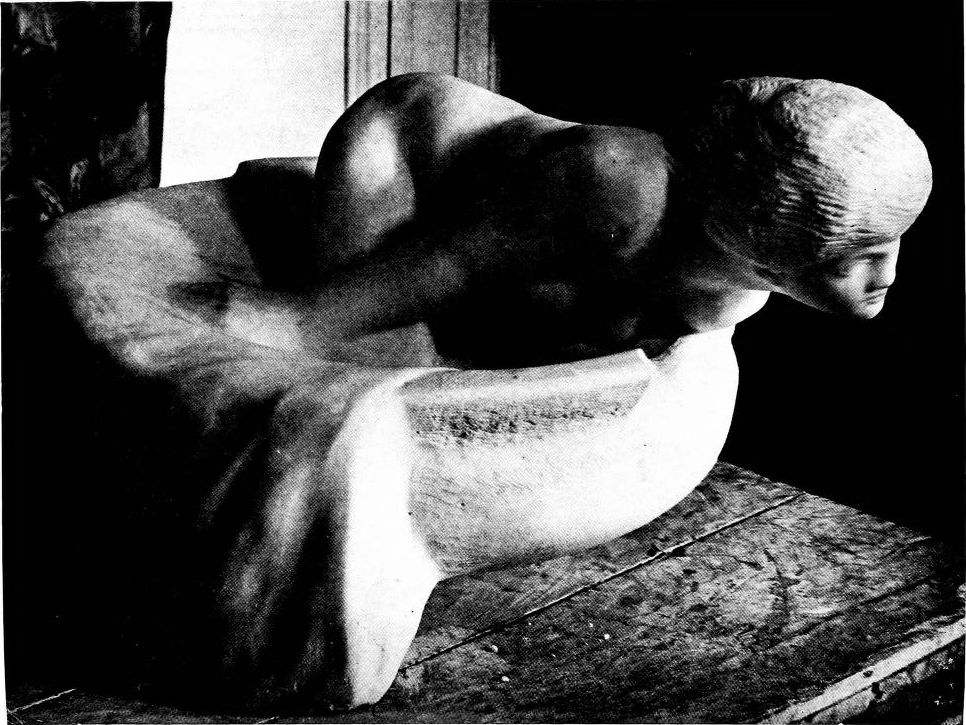
THE BATH.
"Were this thoroughly understood," says Rodin, "industrial art would be entirely revolutionized—industrial art, that barbarous term, an art which concerns itself with commerce and profit.
"The young artists of to-day understand nothing; they copy to satiety the classic ornaments and designs, and reproduce them in so cold a manner that they lose all meaning. The ancients obtained their designs from nature. They found their models in the garden, even in the vegetable garden. They drew their inspiration from its source. The cabbage-leaf, the oak-leaf, the clover, the thistle, and the brier are the motives of the Gothic capital. It is not photographic truth, but living truth, that we must seek in art."
Rodin writes his observations. He notes them down at the moment as they occur to him in all their freshness, and in this form they will be given here. At first glance, the reader may be surprised at their apparently fragmentary form. They may seem devoid of general continuity, but when one comprehends the great master's method, one sees that a bond much firmer than that of the mere word binds them together. They seem disjointed because here, as in his sculpture, the artist accepts only the essential, and rejects all superfluous detail. In reality they have the continuity of life, which is felt, but not seen, and which renders arbitrary transition unnecessary. This is the prerogative of genius, while all else is within the grasp of any one. His authority strikes us dumb; it puts to rout mere commonplace cleverness.
I have had primroses put in this little flower-pot. They are a bit crowded, and their poor little stems are prisoners; they are no longer in their garden.
I look at them on my table like a vivisector. I admire their beautiful leaves, round-headed, vigorous, like peasants. They point toward me, and between them is the flower. The one on this side is resigned, and as beautiful as a caryatid. In profile it seems to hold up the leaf against which it leans and which gives it shade.
These little flowers are not beautiful, nor are they radiant. They live peaceably, gently contented in their misery; and yet they offer something to one who is ill, as I am to-day, and cause him to write to ward off weariness.
I always have flowers in the morning, and make no distinction between them and my models.
Many flowers together are like women with heads bowed down.
There is no longer the sap of life in flowers in a vase.
The lace work of the flower of the elder-tree—Venice.
The anemone is only an eye, cruelly melancholy. It is the eye of a woman who has been badly used.
These anemones are flowers that have stayed up too late at night; flowers that are resplendent, with their colors as though spread over them superficially and wiped away. Even in the spring, in the hour of anticipation, they are already in the fullness of enjoyment.
Like the flower of seduction, the anemones slowly change their form outlined in various ways, always restrained, however, and inclosed within their sphere. Their petals have not a common destiny: some curl up, others are like a becoming collaret, still others seem to be running away. The delicate droop of the petals, standing out in relief, is like the eyelid of a child.
Although old, that one does not shed its petals. Poor little flower with bent head, you are not ridiculous; you are pensive now that you are dying. You suffer from the cruelty of the stem which holds you back.
Flowers give their lives to us; they should be placed in Persian vases. Near them, gold and silver seem of no value.
Ah, dear friends, we must love you if we would have you speak to us! We must watch you or you fall from the vase, despairing, your leaves withered.
The flowers and the vase harmonize by contrast.
In this bouquet there are some with flexible stems which seem to leap up gracefully. The flower, surrounded by its frail, straight leaves, is as if suspended from the ledge of a wrought-iron balcony.
Ah, the adorable heart of Adonis is incased within these flowers!
The hyacinth is like a balustrade placed upside down. A bed of hyacinths resembles a mass of balusters. Thus that great invention of the Renaissance, the balustrade, allows us to gain through it a glimpse of nature. This ray of art, the flower, this delicate inspiration, unknowingly requires the intelligence of man to develop its possibilities.
Superb is this little rose-like flower among its spreading leaves. It is like an assumption.
The double narcissus is a bird's-nest viewed from above. Strange flowers, like so many throats! What a frail marvel they are!
These three little narcissi group themselves like a cluster of electric lights.
The dignity of nature impresses us on every hand. It is greatly apparent in flowers; and yet so small are they that some look on them merely as the decoration at a banquet.
I will cast a narcissus in bronze; it shall serve as my seal.
A maiden on a lake, that is the narcissus.
Little red marguerite, not yet open, sister to the strawberry, huddled in the shade which caresses you.
The full-blown marguerite seems to play at pigeon-vole.
It has rained for four hours; this is the hour when flowers quench their thirst.
A marguerite in profile, a serpent's head with open jaws, stretching out its tongues! Petals, white, like a little collar.
Seen in full face, its yellow-tinted heart is a little sun; its long petals are like fingers playing the piano.
These white flowers are gulls with wings outstretched. They fly one after the other; this one, in adoration, has its petals thrown backward, like wings.
Whoever understands life loves flowers and their innocent caresses.
These marguerites seem to retreat like a spider that finds itself discovered in the road. Their buds stretch out their serpent-heads at the end of long stems, divided by intercepting leaves and entangling knots. Does not love travel in a similar path rather than straight as an arrow?
There is so much regularity in these dark-green leaves, extending at fixed intervals to right and left, and in the eternal dryness of the bouquet, that it calls to mind a Persian miniature.
No man has a heart pure enough to interpret the freshness of flowers. We cannot give expression to this freshness; it is beyond us.
When it sheds its petals, the flower seems to disrobe and go to sleep on the earth. This is its last act of grace, showing its submission to God.
What spirit possesses these flowers that die in silence! We should listen to them and give thanks.
This red and black ranunculus proclaims the carnival; it is the carnival itself. The carnival is the very emblem of flowers. Like them it, also, wears masks and costumes. It wears their colors, bright yellow, red—an imitation of the flowers of the sun.
Delightful carnival! Delightful interpretation of flowers! For a long time in my youth I undervalued them. I am happy now to see them under another aspect, as the splendor of Rome and the lavish intelligence of a bygone time.
Some one gave me tulips. They fascinate me variously. How great an artist is chance, knowing the last secret by which to win us!
These yellow tulips, dipped in blood! What a treat to see true colors—reds, blues, greens, the art of stained glass!
One is quite taken aback before these flowers, in which nature has expressed more than one can comprehend. It imparts that great mystery which is beyond us and signifies the presence of God.
How magnificent the flower becomes as its youth passes!
Even the flowers have their setting sun.
My bouquet is always the same, yet I never cease to look at it.
A whirlwind, a very cyclone, this tulip has perished in the storm. Like the wife of Lot, it is possessed of fear.
This one is open, all aflame like a burning bush. That one, all disheveled, comes toward me. Full of ardor, it springs up, its petals strong and expanding, like a mouth curling forward.
The violence of passion in flowers is pronounced. Ah, the softness of love is found only in women!
Great artists, curb your curiosity, neglect the pleasures which offer themselves to you, so that you may better understand the secrets of God.
III
PORTRAITS OF WOMEN
Rodin's busts of women are perhaps the most charming part of his work. But to say this is almost a sacrilege, an affront to the grace of the small groups that, in this giant's work, swarm about the superior figures. But we need not search too far into this or yield to the pedantic mania for classifying to death. Let us rather look at them without transforming the joy of admiration into the labor of cataloguing, and give ourselves up wholly to the pleasure of seeing and understanding.
Yes, these portraits of women are the graceful aspect of this work of power. They are the achievements of a force which knows its own strength, and here relaxes in caresses. If some among them disturb the spirit, most of them shed upon us a calm enjoyment, the delightful security that one breathes among all-powerful beings that wish to be gracious. They allay the sense of unrest aroused in us by those dramas in marble and bronze which a powerful intellect has conceived—that mind from which sprang "The Burghers of Calais," the two monuments to Victor Hugo, "The Tower of Labor," that imagination, glowing like a forge, which produced "The Gate of Hell," the Sarmiento monument, the statue of Balzac.
Here Rodin's art extends to the utmost confines of grace. He has contrived to discover the most delicate secrets of nature. He models the petals of the lips just as nature curls the frail substance of the rose-leaf. By imperceptible gradations he attaches the delicate membranes of the eyelids to the angle of the temples just as nature in springtime attaches the leaves to the rough bark of trees.
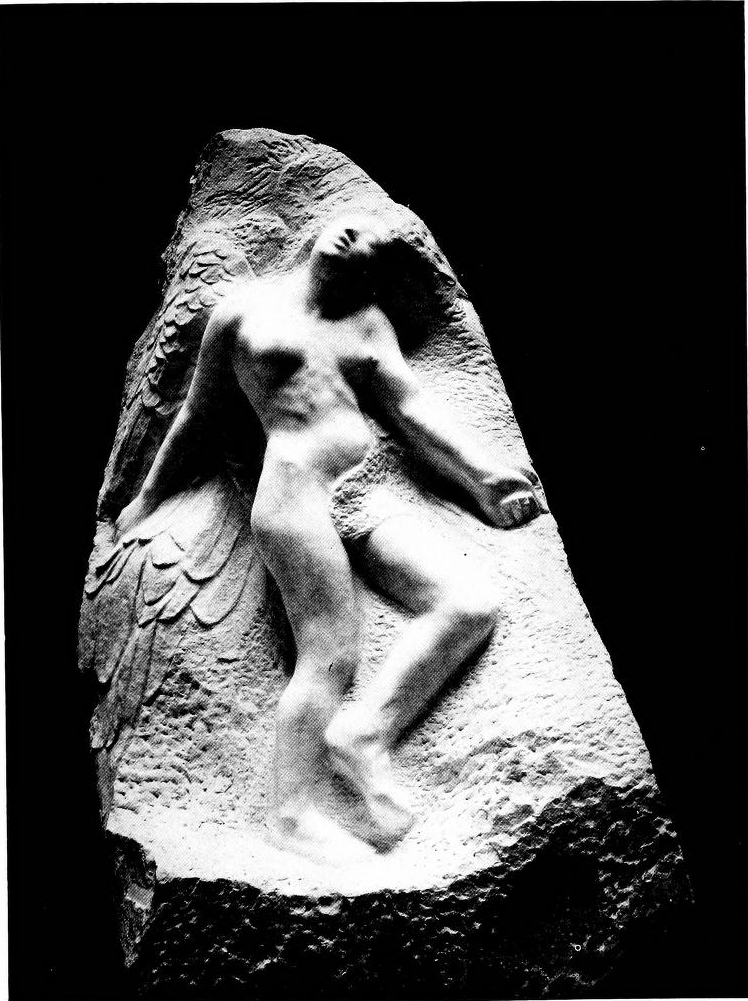
THE BROKEN LILY.
Great thinkers never cease to be moved by the charm of weakness. The "eternal feminine" is just that, the power of grace over the manly soul. The strongest feel this attraction most, are most possessed with the desire of expressing it. I am thinking of Homer, Leonardo da Vinci, Shakspere, Balzac, Wagner, and Rodin in saying this. They have created a feminine world, the figures of which, lovingly copied from living models, become models in turn. They haunt thousands of souls, fashion them in their image. In her complicated ways, Nature avails herself of the artist to modify the human type.
We have some terra-cotta figures of Rodin, modeled when he was between twenty-five and thirty, while working at the manufactory at Sèvres, in the studio of Carrier-Belleuse, that accomplished sculptor. They are charming little busts, with the perfume of the eighteenth century breathing from them, treated a little in the manner of Carpeaux, with the velvety shadow of their black eyes on their sparkling faces. One of them, now in a private gallery in New York, has a hat on its head, coquettish, tender, innocently provocative; it is full of Parisian allurement because it is characteristically French. One can find its kindred among certain Renaissance figures, and even among the mischievous faces of Gothic angels. With all this there is that ephemeral prettiness which is called "fashion," that caprice of styles which does for the adornment of cities what the flowers of the field do for the country.
If Rodin had pursued his path in this direction, he would have been a portrait-sculptor of great taste, and would doubtless have attained celebrity sooner, but a celebrity which is not glory. At that time he was chiefly concerned with copying the features of his models with all the sensitiveness of his admiration; he did not yet attempt those large effects of light and shade which were to become the object of his whole career, and are so still. He has made the religion of progress his own by reflective study. Progress is for him the chief condition of happiness. Present-day philosophies commonly put it in doubt; but if happiness exists, it is surely in the soul of the artist. But it is recognized with difficulty because it is called by an equivocal name, the ideal.
Let us look at the "Portrait of the Artist's Wife." Here, in this noble effigy, this severe image with its lowered eyelids, the artist passes beyond the promise of his first period. The face, rather wide at the cheek-bones, lengthens toward the chin, where the sorrowful mouth reigns. It expresses melancholy, gravity, dignity, Christian charity. It is rather masculine, and seems less youthful than the original was at the time. It is as if the artist had sought to bring out the character by conscientious modeling, without any softening; all the features are underlined, as on a face that has attained a ripe age. He had not yet discovered the art of softening his surfaces, of blending them in a general tonality, and of obtaining that softness, that flesh quality, with all the shades of youth, which touches the heart in his more recent busts.
Even then he did know, however, how to gather under the boldly molded superciliary arch of the brows the diffused shadows which, in the future, were to lend mystery and distance to most of his portraits. This mask is all that remains of a standing figure dressed in the manner of Gothic figures. Rodin was then living in Brussels, still young, poor, and unknown, but happy. He tasted the perfect happiness of long days of absorbing labor, of that enthusiasm for work which nothing disturbs. To-day he sometimes yearns for those years free from the never-ceasing bustle of a celebrated man's existence, a giant assailed by a thousand pin-pricks. Yet his poverty was excessive, for the beautiful statue, modeled during successive months with much love, fell to pieces. For want of money, the sculptor had not been able to have it cast.
Among his women's busts, one of the most famous and one which remains among the most beautiful is that of Madame Morla Vicuñha. It dates back about twenty-five years, but it is resplendent in eternal youth. Since then Rodin has added to his knowledge and experience. He has made personal discoveries in the plastic art. He has become the master of color in sculpture. Nevertheless, this portrait, as it stands, remains an adorable masterpiece. Who that has looked at its softly gleaming marble in the Luxembourg has not been overcome by a long dream of tenderness, of uneasy curiosity? Who has not hoped to make this woman speak, to press her heart in order to draw from her a confession of her desires, the secret of her happiness and her melancholy?
It is more than a bust, it is woman herself. Because the beautiful shoulder slips tremulously from the heavy mouth, which lies against the smooth, polished flesh; because this shoulder rises again toward the head, slightly bent and inclined, as if to draw toward it some loved one; because the neck swells like that of a dove, and the head is stretched forward to offer a kiss, we seem to catch a glimpse of the whole body and its delicate curves. It is a beautiful bust. I should like to see it alone in a room hung with dim tapestries, drawing forth its charm like a long sigh, which nothing should disturb. This masterpiece demands the distinction of solitude.
How beautifully modeled the head is in its firm delicacy! The framework of the narrow skull appears under the texture of hair fastened over it like a rich handkerchief. We can almost see the impatient hand, trembling with feeling, that has twisted the firm knot under the nape of the neck. Everywhere, level with the temples, at the bridge of the nose,—the aquiline nose marking the Spaniard of race,—this bony framework stands out. The face catches a feverish character from it, tortured by the longing for intimate expression, and reveals a being with whom happiness borders closely upon sorrow. The nostrils tremble as if to the perfume of the flowers pressed voluptuously against the warm bosom. The mouth is at once mobile and firm, and all the curves of the features converge toward it—toward the kiss which causes it to swell softly.
The light steals gently into every line and fold of the face. It borders the eyelids, glides under the brows, outlines the bridge of the nose and the nostrils, emphasizes the opposed arches of the lips. It spreads like a spring, separating into a thousand streams. It is a network, like the tracery of the woman's nerves made visible. It is as if the sculptor and the light had begun a dialogue—a dialogue kept up with endless graces and coquetries. He contradicts it, refutes it; it escapes, returns. He gathers it up, as if to force it into the sinuous folds of the figure. Again it flees, and then, summoned back, it returns cautiously, and at last bathes the statue in generous caresses.
This bust will live. In its enigmatic grace it will become more and more the expression of the woman who loves, just as "La Gioconda" ("Mona Lisa") is the expression of the woman who is loved. The one is all instinct, the other all spirit. The one offers herself; the other promises herself. The one is tenderness directed toward the past; the other smiles toward the future.
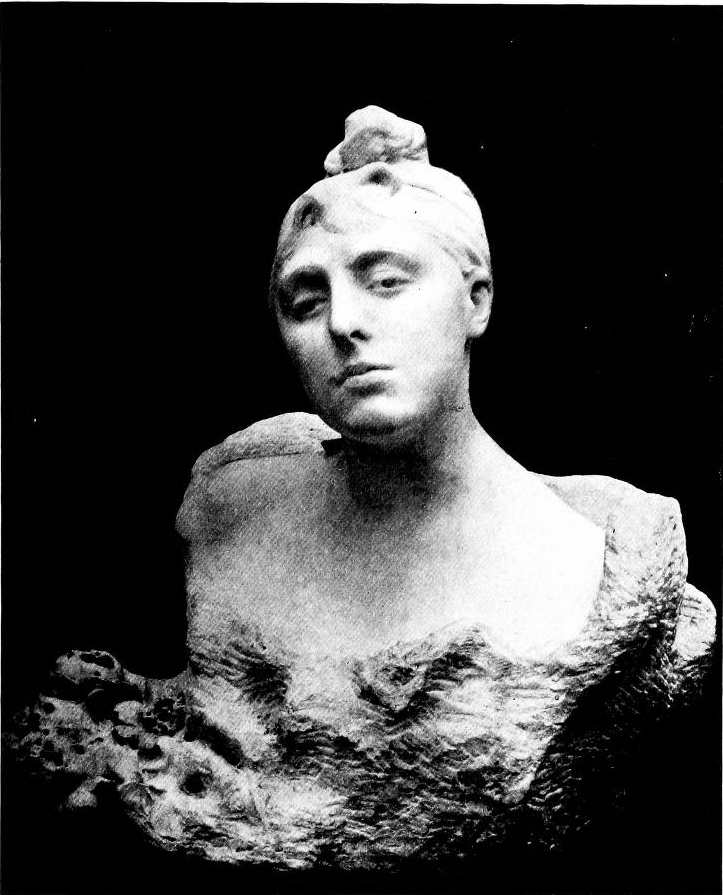
PORTRAIT OF MADAME MORIA VICUÑHA.
In the same gallery of the Luxembourg, there is that other famous head called "La Pensée." What a contrast! It is strangely bound within a block of marble, placed like a living head on a block. And yet it tells only of the slightly resigned calm of meditation, or of melancholy, without bitterness, of long autumn days, with their diffused brilliancy. The outlines are firm, regular, placid, of remarkable moderation in their distinction. The head leans forward, because thought is a weighty matter. The brow and the eyes are the dominant features. On them the sculptor has focused all the light not only in the high lights, but in the still surface as well.
The caprice of the artist has covered this head with a light peasant-cap. This hides the details of the hair, and concentrates the glance on the face. "Caprice" expresses the idea badly, for it is taste and the will of the artist that have directed all. These dreamy features express the practical mysticism of women, the effort of intelligent devotion. It makes one think of St. Geneviève, of Jeanne d'Arc, of the overwhelming courage of a weak being carried beyond and out of herself by a great purpose.
"La Pensée" has the striking character that almost all the busts of Rodin assume in the future, and which they owe on the one hand to their intense lifelikeness, and on the other to the atmosphere with which the sculptor surrounds them. There are no hard-and-fast limits which separate them from the circumambient air; on the contrary, they are bathed in it. The "blacks," which give a hard, dry look when used to excess, are handled marvelously. The women's busts, especially, almost start up before us with this slightly fantastic look of life increased tenfold, with the charm of phantoms of marble, monumental, and yet as light as beautiful mists.
These effects of light and shadow perhaps harmonize best with the softness and delicacy of the feminine flesh. They convey to us naturally the mystery of an inner life more secret, more intimate than that of man.
Even with works that are similar, the public does not recognize their common origin. It sees the result of an extraordinary amount of observation and intelligence, yet it does not reflect more than a child. For the public the sculptor, whoever he may be, is a creature of instinct, with a trained eye and hand, but without mind and culture. He is a sculptor, that is all. A common proverb strengthens the belief in this lasting folly. It may be told, then, that the master with whom we are here dealing studies his models not only as a sculptor, but as a writer studies; that often his hand drops the chisel for the pencil, in order to set down his observation more exactly, to search even further into nature.
Perhaps the public will at last grasp the fact that the true artist, under penalty of ceasing to be one, must, above all, expend an amount of attention of which other men are incapable, and that it is by this power of attention that the strength of intelligence is measured. For example, Rodin is facing his model, a young woman stretched out in an attitude of repose. He writes, and in his style we find all the power of the great draftsman. He marks the outlines, he specifies the details, slowly, patiently, with pertinacity. He never confuses the impression, always so ready to elude one—the impression, the divine reward of the artist.
The dazzling splendor revealed to the artist by the model that divests herself of her clothes has the effect of the sun piercing the clouds. Venus, Eve, these are feeble terms to express the beauty of women.
The head leans to one side, the torso to the other, both inclining indolently, gracefully. This body has been glorified. The contours flow, descend, repose, like immortality personified. The breasts follow the same curve. The flowing lines are all in the same direction. Unchangeable, heaving above the half-opened screen of the dress, the breath scarcely lifts them. It does not stir or agitate them.
The beautiful human monument is balanced in repose. It is unassailable. It is the gradation of contours.
I do not draw them, but I see them in place, and my spirit is content, accustoms itself to the impression. In memory I still make drawings of this model, and these moving lines are repetitions, done over again a hundred times; for I repeat the drawing constantly, like a caress.
This torso resigns itself, like an Ariadne whose contours melt away in the evening, in the dark. But the lightning of day has flashed there. It is there always. It is now the pale gleam of flesh. My mind, carried along, takes this form as its model.
The hand, the arm, support the head, the sidelong glance from which is so full of sweetness. One might call it a "Mona Lisa" reposing. This head feels the need of resting on the supporting hand, a delicate support like the handle of a vase. Like an urn about to pour out its water, its thought, it inclines.
Lying back on the cushion, the head is in high relief. The features are placed according to their due regard, which is the very soul of balance. It has made the eyes symmetrical; the eyebrows straight; the nose, where beauty and symmetry meet, expressive of a wholesome conformity.
When a woman is very beautiful, she has the head of a lion. From the lion is copied that splendid regularity of the eyes, which the oval of the face accentuates. The tawny mane is also lion-like in its regularity and majesty, without any other expression.
Arches are formed without effort of all the parts of the eye. The hinges of the eyes open and close. The open mouth keeps back neither the thoughts nor the words that have been spoken. There is no need for her to speak. Her age, her thoughts, all is a confession here—the features, the arch of the frank, noble mouth, as well as the form of the nose and the sensitive nostrils.
And this infantile glance under a woman's eyelid! Our soul demands that, by an agreement with the heavens, the feminine glance should be celestial.
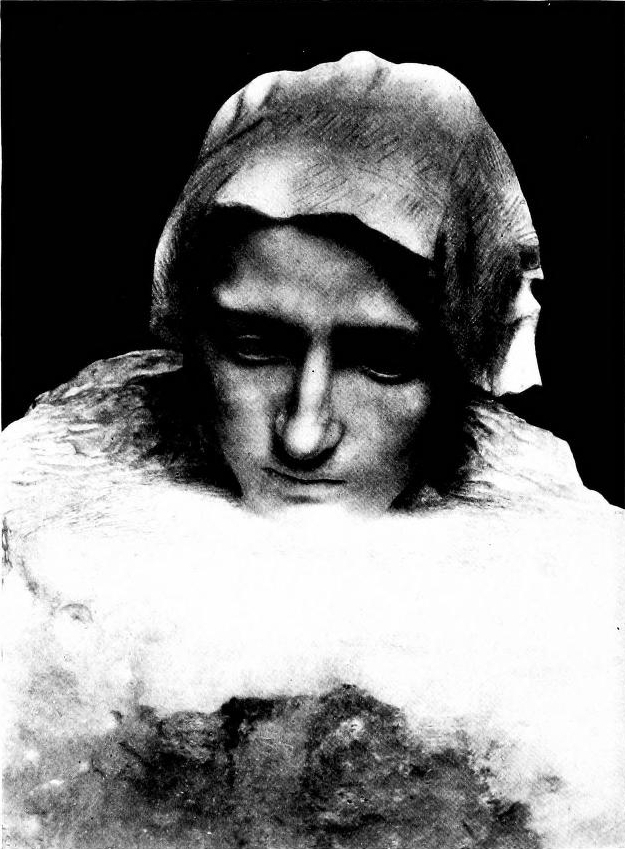
LA PENSÉE.
How I bathe in the calm beauty of these eyes, with their regular drawing! How they themselves declare their tranquil joy! Sometimes eyes like these seem to be inhabited by spirits. They close, and I see the horizontal lashes, the lower lid, which just rests against the upper. I see as a whole the soft oval of these long eyes, the double circle of the lids themselves, and the circle beneath, so modest now, but which one calls the circle of love.
The eyeball in moving shows the clear pupil, and all about it press the circles of the delicate lids. The soul finds a refuge in these secret hiding-places, and throws out its circles of attraction like a lasso. This sensuous soul is the soul of beautiful portraits.
The cheeks curve against the socket of the eye; the double arch of the brows prolongs itself behind them. The surface of the cheeks extends to the extremity of the nose, forms a double depression by the sinking of the cheek, which grows hollow toward the convex lip, and surrounds the mouth and the two lips. These facial lines and surfaces all stop at the chin, toward which all the curves converge.
The facial expressions proceed from, spread, and move in another circle. They all disappear in the cheeks, just as do the movements of the mouth. One curve passes down from the ear to the mouth; a small curve draws back the mouth and also the nose a little. A circle passes under the nose, the chin, to the cheekbones; a deep curve, which starts back to the cheekbone, cuts in a small hollow to the eyebrow. The features are distinct; but when they move, they merge into one another. The smile passes over the face by a circle defining the mouth. The edge of the mouth is defined by a mezzotint at the point of union.
The loose hair surrounds the cheek, and the head seems like a golden fleece on a distaff. It hangs like loosened garlands. How beautifully these garlands of hair are arranged, with the profile in a three-quarter view, standing out against the fine, tawny hair! The impressive harmony between the flesh and the hair! They seem altogether in accord; they lend each other languor and charm; they are united and separated at the same time. These drooping clusters of chestnut-blond hair are a frame. One might call them long flowers hanging from the edge of a vase.
The neck no longer holds erect the head, which moves in ecstasy. It drowns itself in the wavy flow of hair, which becomes undone at the moment. This inundation of hair, so to speak, what a generalized expression of opulence it is! Before its beauty I feel imbued with love. I am seized with enthusiasm, aflame with it. This gold, this dull copper, is like a field of grain, a field of corn, where the sheaves are of gold bound together. These sheaves, slightly disordered in their lengthening curves, turning in all directions, imitate the tone of subdued flesh tints.
In this veil, transparent and colored like a dead leaf, the ear is hidden in shadow, where the hair flies back at random in strands, twists about, and returns.
O head, beautiful ornament, drooping against the edge of the couch like a lovely motive in architecture at the edge of a console, you express the prolonged weakness of a lovely languor! The shoulder extends its beautiful curve before the face, resting on its side; the line rises, passes near the nose, descends, and shows the red line of the mouth, just as the bees continually enter and go out of the opening of the hive. The face turns, but the eye returns to me, passes by me, and again gazes upon me.
In it there is the softness of the dog's eye, a spirit which becomes motionless when the tyranny of passion has disappeared. When passion is in control, she sucks like a vampire that delicate flesh, which is the model of calm, the exquisite remainder of calm.
This crown of beauty is not made for one woman alone, but for all women. They do not know it, and yet all in turn attain this beauty, as a fruit ripens. This calm is more potent in them than in the most beautiful statues. They are unaware of it, and the men who are near them are unaware of it also. They have not been taught to admire. They have not been educated in the science of admiration.
When, in the galleries of the Louvre, magnificent rooms where are gathered the collections of antiques, day enters through the windows and lightly touches these beautiful sculptures which are the adornment of great palaces, do they understand any better? Do they realize the collaboration between the sculptor and the light?
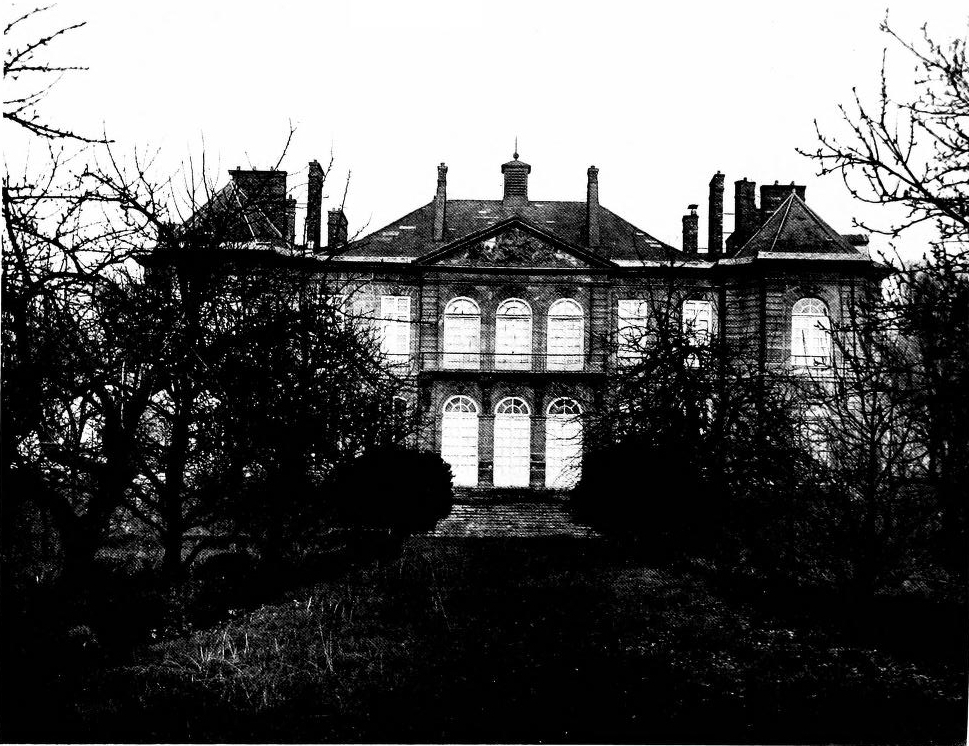
HOTEL BIRON. VIEW FROM THE GARDEN.
IV
AN ARTIST'S DAY
The residence of Rodin, the Hôtel Biron, is situated at the extreme end of the rue de Varenne, in the Faubourg St. Germain. The long straight street is lined on both sides with old mansions that lend a distinctive nobility to this district of Paris. The street is solemn, the quiet austere. Only rarely a carriage rumbles by. Like the tide of a river, the air sweeps down this street from the Boulevard des Invalides, which at its other end opens upon the Esplanade des Invalides, like a great lake.
Now and then one catches glimpses of the spacious courts, the steps, the peristyles, and the ornate, but at the same time simple, pediments. Most of these mansions were, and many of them still are, inhabited by families associated with the history of France.
The northern façade of the Hôtel Biron and the courtyard through which one enters are hidden behind a high convent wall, for in the nineteenth century the old residence of the Duc de Biron was transformed into a religious school of the Sacred Heart. There the daughters of the aristocracy were educated. In consequence of the law of 1904 relating to the religious orders, the mansion was vacated, and taken possession of by the state, which rented it in apartments. Rodin, ever in search of old buildings, in which alone he can think and work in comfort, soon became the main tenant.
To ring the bell one must reach high. With difficulty one turns the handle of the door, which swings slowly. It is a portal made for coaches to pass through. Under its monumental arch one seems as insignificant as an insect. To the right of the court is the old chapel of the religious community. Its somber character stands out against the neighboring secular buildings. The cold style of Charles X, in which it is built, forms a strange contrast to the charming structure of Jacques Gabriel, the celebrated artist who in the eighteenth century endowed Paris with many works of art, among others this pavilion of the rue de Varenne, the Hôtel Biron. Nevertheless, had it not been for Rodin, this building would have been torn down.
It is a vast mansion, extremely simple, and built on the lines of an elongated square. Its great charm is due wholly to its correct proportions and to the grace and variety of its beautiful, tall windows, some straight, others rounded, and surmounted by an inconspicuous ornament, the signature of the artist. All of them are enlivened by little squares of glass, which are to a window what the facets are to a diamond.
The spacious vestibule is paved with black and white marble, its ceiling supported by six strong columns. A charming stone staircase rises here. All is in the style of Louis XV, a style that is dignified when it is not delightfully elegant and coquettish.
The house was to be torn down, and sold as junk; but Rodin was on guard. Ever since he had learned that this masterpiece was condemned his heart had bled, and for the first and only time in the course of his long existence an outside interest took him from his work. He wrote letters, took legal steps, called to his assistance artists, people of culture, and men in politics. M. Clémenceau, then president of the cabinet; M. Briand, who succeeded him; M. Gabriel Hanotaux, one of his great friends; M. Dujardin-Beaumetz, under-secretary of state of fine arts, all listened to his indefatigable pleading. Finally his plea was heard, and the Hôtel Biron was classified as a historical monument, henceforth inviolate. Then the speculators had to abandon their idea of filling the park with hideous modern structures, and of disfiguring in six months this unique Quartier des Invalides, to construct which the architects had given years of work and all their intelligence.
Rodin's admirers soon conceived the idea of converting the Hôtel Biron into a museum for the master's works, which they pledged themselves to defend with a tenacity equal to that which Rodin had just displayed.
I knock at the door of the studio and rapidly pass through two large rooms containing no furniture, only busts of bronze and groups of marble. When I enter the study, Rodin is not here; I glance about. All the details of this room are familiar to me, but they always seem new, because everything is in harmony here, with a harmony which varies according to the day and the hour.
It is a morning in spring. The bright light sheds its rays on the various antiquities that the master has assembled here: Empire chairs, with faded velvet coverings; a Louis XIV arm-chair of gilded wood and cherry-colored silk, in which one might fancy Molière seating himself to chat with Rodin, who, ever ready as he is with a bit of raillery, would surely not have failed in repartee.
On a round table there is a Persian material, and some Japanese vases filled with tulips and anemones. On the mantelpiece are bronzes from the far East and a statuette of porcelain in marvelous blues that Rodin calls his "Chinese Virgin." On the walls, close together like the stones in a mosaic, are many of the master's water-colors. Their well-chosen tones harmonize with and intensify those of the flowers, the fabrics, and the ceramics of bygone days.
Scattered pedestals support huge bronze busts, which call to mind warriors of the Middle Ages, and some unfinished pieces. They consist of small groups that, under the eye of the master, seem to grow out of the white marble, and in the golden sunlight look as soft as snow.
On this table, where Rodin takes his meals and writes, is a Greek marble, a little torso without arms or legs; I know it well, for he showed it to me while murmuring words of admiration. This is his latest passion.
I enter the garden, where he is enjoying a moment of rest, for he has been working a long while. Owing to his habits as a good workman, he rises at five every morning.
I pass through one of the big doors which open upon the park. The beautiful view always captivates me anew. The light, the air, the expanse of sky, the magnificent groups of trees, this rustic solitude in the heart of Paris, take one by surprise, inspire and elevate the spirit. Rodin is here, smiling and in good humor.
We are on the terrace that overlooks the expanse of green and forms a sort of slanting pedestal for the pavilion. Below stretches a broad alley, almost an avenue, overgrown with a rich carpet of grass and moss, which loses itself in the distant wood. Fruit-trees, growing wild, form impenetrable screens on both sides of this alley.
The grandeur of this park is largely due to the age of the trees. Stepping to the edge of the balustrade, I can see toward the right the dome of the Invalides, standing alone, outlined against the sky, like a burgrave on guard under a helmet of gold.
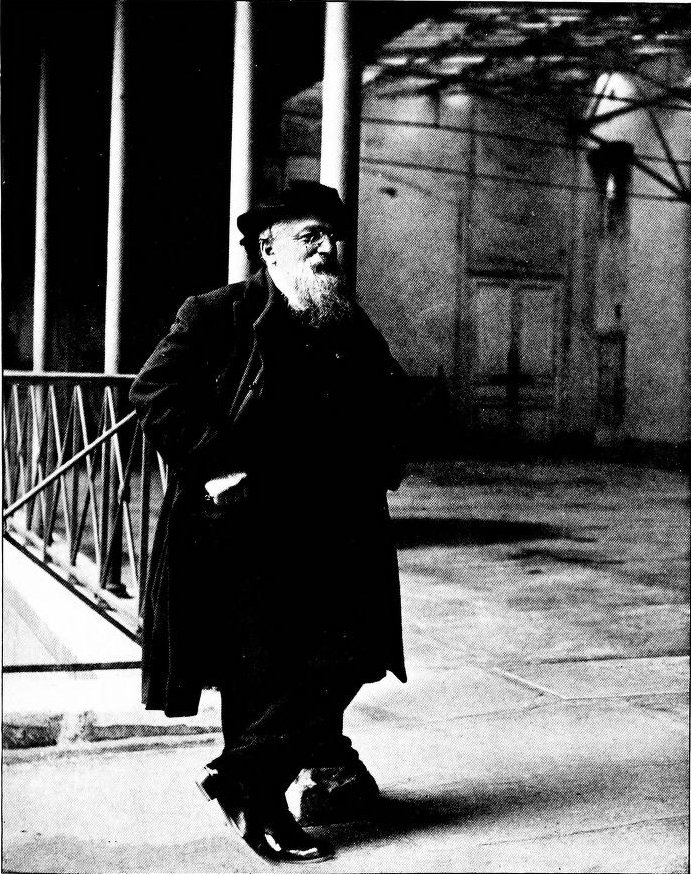
RODIN PHOTOGRAPHED IN THE COURT OF THE HOTEL BIRON.
The northern façade of the pavilion has a severe character. It is the façade which visitors and passers-by see, and for this an elegant simplicity suffices. But this other side, bathed in the midday sun, is meant for friends. All the delicate splendor that the architect conceived is expressed in these stones. This sculptured pediment, this balcony with its console of flowers, and the graceful windows, with their semicircular transoms, are models of elegance. The Hôtel Biron is not large, but it is imposing. The blockheads who inhabited it during the last century, blind to its beauty, deaf to its appeal, demolished and sold the wrought-iron balustrades of the windows, balconies, and staircases, but they were not able, thank Heaven! to destroy its innate beauty.
"Let us go to work," said Rodin. I go back to the statues; Rodin begins to draw. In a little while he will model. During his hasty luncheon he has the little Greek torso placed before him, and he makes notes all the while.
True genius is as changeable as nature. It finds as many ways of expressing its ideals as it finds subjects. But what always remains the same is the desire to be sincere. Yet the artist, with the best of intentions, is often the victim of his own sincerity. Rodin is no exception to this rule, for even he has had his portraits rejected. "There is no resemblance!" people declare, while, on the contrary, the resemblance is too true. With his keen insight he penetrates too far beyond the mere flesh of the model. People are frightened at seeing their hidden personality brought to the light of day, are taken aback at being compelled to know themselves. They consider the sculptor indiscreet and dangerous.
If, in his portraits of men, he pries to their very souls, if he reveals without pity those of his own sex, his equals, his companions in life's struggle, in his portraits of women he is discreet and respectful. With delicacy he unfolds their delicate mystery. He does not say anything which is not true, but frequently he does not express the whole truth. Genius is ever in quiet complicity with womanhood, and leaves it in that half-obscurity which is its greatest power.
In the bust before us of Mrs. X—— , one wonders what he refrained from expressing. Surely neither the unusual beauty of the woman nor her air as of an archduchess.
I remember the day when I saw this bust for the first time. It was in the Salon, placed at the head of a high staircase. The marble was brilliant. Something regal and also lovable attracted those who came toward it. Resplendent in beauty, the shoulders emerge from the folds of a wrap with the proud grace of one who is to the manor born. The small, well-shaped head, supported by the plump, though delicate, neck, is half turned to the slightly raised left shoulder. The hair is drawn up high to form a crown, throwing forward some light strands that shed their soft shadows over the forehead, like a thatching of moss. The beautiful eyebrows, too, lend mystery to the glance of the eyes, so full of sweetness and understanding. The small ear is partly hidden under the waves of the well-groomed hair. The lines of delicate symmetry which run from the chin to the ear, and from the ear to the shoulder, and the coronet of hair, give the bust its distinguished look of race.
Here we see, too, the firmness of beautiful flesh, hardened by exercise, radiating that spirit of joyous life that springs from a thoroughly healthy body, as we feel it in some of the Tanagra figurines. The quiet reserve which stamps the refined Anglo-Saxon is revealed, but not overaccentuated. The nose is straight and slightly raised at the tip, the mouth frank and regular. Those same changing shadows which beautify flowers, when the sun strikes them through the leaves of a tree, play over this countenance, and bathe it in a variety of delicate tones from the eyes to the chin. But beneath this placid beauty there is a restless soul eager to act, to express its goodness. The chin and the throat retain their look of youth, even of something childlike for those whom she loves; but the thoughtful brow is slightly wrinkled, as if from the intelligent search for happiness.
This bust, almost Greek in its simplicity, is one of the most purely beautiful that has come from Rodin's hands.
When we note the facility with which these works are produced, seemingly a natural growth, like vintage and harvest; when we contemplate these fruits of knowledge, we are too apt to overlook the laborious efforts involved, and to forget that a life has been given, drop by drop, to achieve this result in small steps of progress. Even when we know all this, we often prefer to give the credit to external causes, which appeal more strongly to our superficial minds, rather than to that endless patience that is, and always will be, the secret of genius.
I watched Rodin model the head of Hanako, the Japanese actress. He rapidly modeled the whole in the rough, as he does all his busts. His keen eye and his experienced thumb enable him to establish the exact dimensions at the first sitting. Then the detailed work of modeling begins. The sculptor is not satisfied to mold the mass in its apparent outlines only. With absolute accuracy he slices off some clay, cuts off the head of the bust, and lays it upside down on a cushion. He then makes his model lie on a couch.
Bent like a vivisector over his subject, he studies the structure of the skull seen from above, the jaws viewed from below, and the lines which join the head to the throat, and the nape of the neck to the spine. Then he chisels the features with the point of a pen-knife, bringing out the recesses of the eyelids, the nostrils, the curves of the mouth. Yet for forty years Rodin was accused of not knowing how to "finish"!
With great joy he said one day, "I achieved a thing to-day which I had not previously attained so perfectly—the commissure of the lips."
In making a bust Rodin takes numerous clay impressions, according to the rate of progress. In this way he can revert to the impression of the previous day, if the last pose was not good, or if, in the language of the trade, "he has overworked his material." Thus one may see five, six, or even eight similar heads in his studio, each with a different expression.
Hanako did not pose like other people. Her features were contracted in an expression of cold, terrible rage. She had the look of a tiger, an expression thoroughly foreign to our Occidental countenances. With the force of will which the Japanese display in the face of death, Hanako was enabled to hold this look for hours.
Little by little, under the sculptor's fingers, the mask of clay reflected all this. It cried out revenge without mercy, the thirst, for blood. A baffling contrast this—the spirit of a wild beast appearing on the human countenance.
I have one of these studies before me now. It has been cast in a composition of colored glass, and the vivid flesh coloring lends reality to the work. This mask is not disfigured by rage. The bloodless head, with its fixed stare, lies on a white cushion, and no one escapes its disquieting influence. Some people shudder when they see it. "One might think it the head of a dead person," they say.
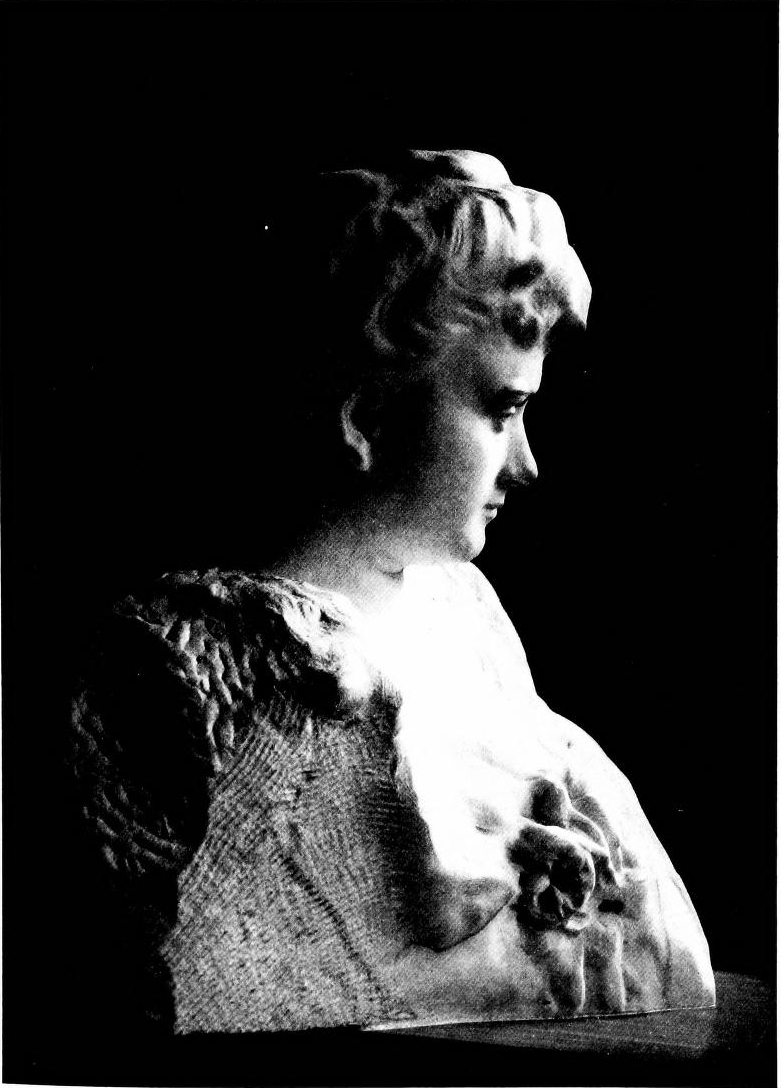
PORTRAIT OF MRS. X——.
Whenever I enter the spacious room I am irresistibly drawn toward it. My feelings are different every time, but always there is a feeling of uneasiness. I cannot say that it resembles death; on the contrary, it is so lifelike that it is almost supernatural. One might call it a condemned person, a being so terrified by the approach of death that all the blood has rushed to the heart. It is a spirit frozen with fear, the eyes looking toward the unknown, the large nostrils scenting death. The bulging forehead, the high, Mongolian cheek-bones, and the flat nose make the face still more singular. All the lines of the face run toward the mouth, with its remarkable expression. Obstinate, although conquered, it will draw its last breath without a cry.
Meanwhile life seems to throb in every cell. This head, so like a being that has been put to death, has the soft, pliant flesh of a ripe fruit.
At night I return to look at it by the light of a candle. It looks entirely different. The shadows vary as I move the candle, and the features grow mobile. How gentle and touching it seems now! It is no longer bloodthirsty and savage; that exotic expression which repelled me has quite disappeared. These features, expressing the innermost self under a stress of emotions, reveal a poor creature that has loved and suffered. It is a pitiable face that has been molded by life. I have seen that same sad, tired expression of anguish in one whose whole strength is gone, but who still makes an effort to understand misfortune in order to strive against it. I have seen it on my mother's face when one of us was ill.
A MORNING IN THE GARDEN
It is still night; the dawn is just breaking. I open my window to let the refreshing air drive away my drowsiness. From the end of the garden, in the underbrush, and now all about me, I hear much lively chirping. It tells of the blessing of love, of springtime.
It is almost day. The blackbird has ended his scene of love; no one was about when he sang his song of spring and harmony. The flowers listened, and blossomed at the call of this unseen Orpheus. The air is laden with misty melodies. These songs do not disturb the silence; they are part of it. Later we shall still hear the happy call of birds, but no longer these songs of love that proclaim the eternal reign of our mother earth.
Now is the time for sighs of happiness; the flowers consecrate themselves to the beautifying of Demeter, goddess of the under-world. Orpheus searches for Eurydice; he calls her, and his notes break the harmonious silence.
I must bathe my brows in the vague mist, in the fragrance of the earth, in the light of the dawning day. Spacious room, I leave you. I shall return to you to work, for here only have I known complete silence.
I hurry into the garden, where I find inspiring freshness. I had looked forward to it; my whole body was awaiting it. A sprouting twig proclaims the fullness of life. I am freed from the memory of yesterday, born anew for all the seasons to come. In the palais thoughts are more subdued and modest, content to be bounded by the splendid proportions of the apartments—proportions that are correct, but nothing more.
The flight of time is marked by the song of the blackbird, and, as in Mozart's music, one cannot quite define whence its charm springs. It is everywhere, to the right, to the left. That voice seems to pierce through the gaps and hollows of the wood, for now one hears it as an echo, now as a solo, at the farthest end of the wood.
My flight of steps is my place for reflection, my salle de pas perdus.[1] At the foot of the steps the verdant carpet, sown with little stars of green, stretches out. It might be an old Arabian material or a rich marble. Bits of earth are to be seen in delicate gray patches. The shadow of night still enshrouds the garden in a cloudy veil. In the distance, outlined against the horizon, are the bleak walls of houses, like huge stones. About me stretches that enormous Babylon, that Paris where my tired nerves relax, where the substance of my life is woven, where my heart has found appreciation and no reproach, and where my mind, imbued with the true knowledge of life, has taught my soul the gracious lesson of submission.