Chapter V · How the People on the Island and Elsewhere Learned Wisdom.
Reading edition
But while any commodity possessed of acknowledged purchasing power or value may be used as money, the experience of the islanders and every other people must have soon taught them that some commodities are much better adapted to this purpose than others; or, rather, that the use of certain commodities as money, while they may answer the purpose, nevertheless entail very serious disadvantages. And the details of the manner in which this information has been acquired by experience constitute one of the most interesting chapters in the world’s history. The experience of the islanders was somewhat as follows:
At the outset they agreed to use cowries—a pretty shell picked up on the beach, and which the women all desired to have and use as an ornament. These shells were not, however, plentiful; and, in fact, it was found that it required about as much time and labor for a man to collect a hundred of them as it did to grow a bushel of wheat. Consequently, wheat regularly exchanged for cowries (as money) at the rate of one hundred cowries for one bushel, while the farmer with two thousand cowries could readily buy a plow, which was considered equivalent in value to twenty bushels. By-and-by, some idle fellows that were in the habit of sailing made a long excursion, and, for the first time, visited a little island on the remote horizon. When they landed, they found, to their surprise, that instead of cowries being very scarce on the beach, they were very abundant. They winked at one another, and said little; but each man proceeded to gather all the cowries he could, and, returning to the main island, kept their discovery a profound secret.
The first thing of note that next happened among the Robinson Crusoe people was a great and unexpected revival in business. Money began to grow abundant. Societary circulation was never so active. Every thing that was offered for sale speedily found a purchaser, and, demand increasing, prices rapidly increased also. It was also noticed that a few persons who never did any regular work, but speculated and gambled all the morning, and took pleasant sailing excursions every afternoon, had, especially, plenty of money, which, as patriotic citizens, desirous of making trade lively, they were always most ready to part with for other commodities. The shop-keepers, the farmers, and the mechanics, all also finding that they had more money than usual, all also felt impelled to buy something, and prices took a fresh start upward, so that a bushel of wheat that could previously have been sold for one hundred cowries easily brought one hundred and fifty, and even two hundred. But, on the other hand, the farmer, instead of being able to buy, as before, a plow for two thousand cowries, now found that he had to pay double, or four thousand; or, in other words, the cowries had only about one-half the purchasing power they possessed before.
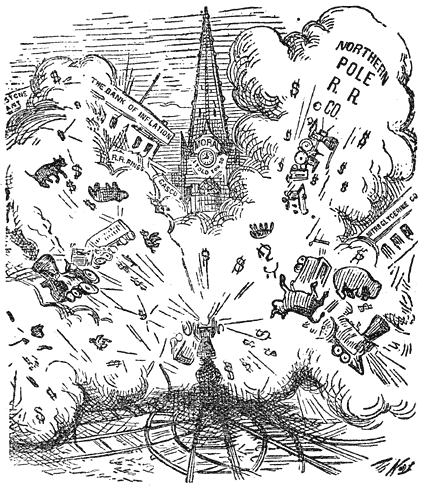
Then the bubble burst; stock companies all failed.
But this experience of the islanders in reference to the originating and using of money, although curious, has not been exceptional; for the records of history show that men almost everywhere, in going through the process of civilization, have had a greater or less measure of the same experience. One particularly noteworthy illustration of this is recorded in the “History of New York,” by Diedrich Knickerbocker, and in the manuscript records of the New York Historical Society. It was in the days of Dutch rule—1659—in New Amsterdam (afterward New York), when the common money in use was the so-called Indian money, or “wampum;” which consisted “of strings of beads wrought of clams, periwinkles, and other shell-fish. These had formed a simple currency among the savages, who were content to take them of the Dutch in exchange for peltries.”
William Kieft was at that time governor, and being desirous of increasing the wealth of New Amsterdam, and withal, as the historian relates, somewhat emulous of Solomon (who made gold and silver as plenty as stones in the streets of Jerusalem), he (the governor) determined to accomplish his desire, and at the same time rival Solomon by making this money of easy production the current coin of the province. “It is true, it had an intrinsic value among the Indians, who used it to ornament their robes and moccasins; but among the honest burghers it had no more intrinsic value” than bits of bone, rag, paper, or any other worthless material. “This consideration, however, had no weight with Governor Kieft. He began by paying all the servants of the company, and all the debts of the Government, in strings of wampum. He sent emissaries to sweep the shores of Long Island, which was the Ophir of this modern Solomon, and abounded in shell-fish. These were transported in loads to New Amsterdam, coined into Indian money, and launched into circulation.”
“And now for a time affairs went on swimmingly. Money became as plentiful as in the modern days of paper currency, and, to use a popular phrase, ‘a wonderful impulse was given to public prosperity.’”
The result of all this was, that in a little time the Dutchmen and the Indians got all the wampum, and the Yankees all the beaver-skins, Dutch herrings, Dutch cheeses, and all the silver and gold of the province. Then, as might naturally have been expected, confidence became impaired. Trade also came to a stand-still, and, to quote from the old manuscript records, “the company is defrauded of her revenues, and the merchants disappointed in making returns with which they might wish to meet their engagements.” It is safe to conclude that, after this, the commodity made use of by the Dutchmen as money was something less liable to have its value impaired than wampum.
The early settlers in East Tennessee also came to a similar conclusion, after a somewhat similar experience. Raccoon-skins were in demand for various purposes, and consequently were valuable. They accordingly selected them for use as money. Opossum-skins, on the other hand, were not in demand, and therefore had little value. Those of the settlers who desired to discharge their obligations without giving a full equivalent paid their taxes in opossum-skins to which coons’ tails were attached. The counterfeits having once got into the treasury, could not be exported out of the treasury to meet the payments of the State, and the use of coon-skins as currency came to an end.
How fast the people on the island, by reason of their varied experience, educated themselves up to a knowledge of what constitutes good money may be inferred from the following incident:
A portion of the inhabitants on the island were heathen, and, to defray the expense of efforts to civilize and Christianize them, it was the habit of certain good men to take advantage of the assembling of the people from time to time to solicit and receive contributions for such objects. It was observed, however, on such occasions that some persons, either through ignorance of what constitutes money, or by reason of great poverty, were in the habit of depositing commodities in the hat which were not money; and the practice having been brought to the attention of Robinson Crusoe (who generally presided at such meetings), he is reported to have administered rebuke and instruction in the following impressive manner:
“Before proceeding to take up our regular contribution for the heathen,” he said, “I would suggest to the congregation—and more especially to those who sit in the gallery—that the practice of putting into the hat commodities which are not money, more especially buttons, shows a degree of ignorance respecting the uses of money on the part of some in this community which I had not supposed possible, after all our recent and varied experience on this subject. But if, through ignorance or impecuniosity, any should feel obliged to continue to contribute buttons in the place of money, I would request that they do not stamp down or break off the eyes; inasmuch, as while by so doing they utterly destroy the utility of these commodities as buttons, and do not increase their desirability as money, they also utterly fail to deceive the heathen; who, although ignorant of the Gospel, and not using buttons for any purpose, are nevertheless, as a general thing, good judges of currency.”