Chapter XI · The New Millennium.
Reading edition
At last there arose a sect of philosophers (calling themselves Friends of Humanity) who felt confident of settling all difficulties, and who also aspired to the government of the island.
Their chief had the reputation of being an ogre. He had served in the war against the cannibals, looked exceedingly fierce, and therefore was accounted brave; he talked loud and with great assurance, and therefore he was accounted wise; he had acquired great riches without ever doing any thing useful, and therefore he was accounted skilled in business.
His principal associates and counselors were two. The first was a great orator, who had spent most of his life as a missionary among an uneducated people who never had any property, and, of course, made no exchanges; and in this most excellent and practical school had learned all that could be acquired on this complicated subject. The second was a great athlete, who had performed for many years in the national circus, and had acquired great reputation by carrying weighty packages on both shoulders, labeled “domestic industry,” but which in reality contained only pig-iron. About these two “every one that was in distress, every one that was in debt, and every one that was discontented gathered themselves,” so that they soon had a large body of disciples.
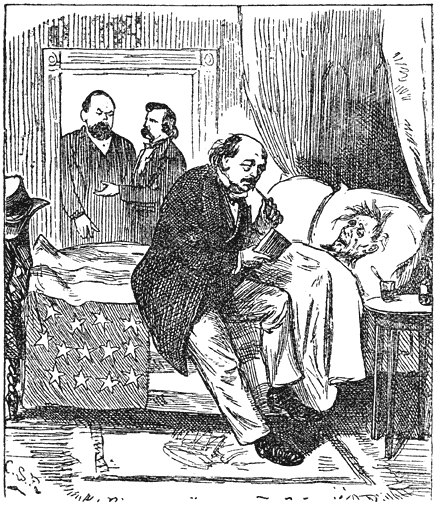
The doctors prescribe continued low (fiscal) diet.
All also agreed that the word “money” was a bad name, and that the public would obtain a much clearer idea of the great problems at issue if more intelligible and scientific terms embodying definitions were used. One philosopher accordingly proposed that, as they intended to sprout it everywhere, they should go back to the Biblical designation, and call it the “root,” at the same time remarking that “the Lord showed what he thought of money by the kind of people he gave it to.” Another proposed to call it “the instrument of association” (Carey); a third, the “sign of transmission, of which the material shall be of native growth” (John Law, 1705); a fourth, “a sense of value as compared with commodities” (“British Tracts on Money,” 1795–1810); a fifth, “a standard neither gold nor silver, but something set up in the imagination to be regulated by public opinion” (ibid.).
Moreover, although the philosophers did not exactly say so, the inference was also legitimate, that in a community using merely “token” or “remembrance” money, the surest way to get rich would be to get in debt, and the best way of carrying on an enlightened system of trade and commerce, to exchange commodities, the results of time and labor, for evidences of debt without interest. It is needless to say that these teachings and inferences tended to greatly strengthen the people on the island in the opinion they before entertained, that the currency they already had—namely, evidences of destruction—was the “best currency the world ever saw.”
The three leaders among the philosophers were not, however, men who were going to be contented with any half-way measures. Had they not put their hands to the plow of reform? and were they, after so doing, to allow the plow to stick fast in the furrow? They accordingly appealed first to authority, and then to untutored reason.
The following are some of the authorities to which great weight was given:
“Commerce and population, which are the riches and power of the state, depend on the quantity and management of money.”—John Law, Memoir to the Duke of Orleans, 1705.
“Does, or does not, our duty to ourselves and the world at large demand that we maintain permanently a non-exportable circulation? Such is the question which now agitates the nation, and must at no distant day absorb all others. The affirmative of this question is also in perfect harmony with the practice and experience of leading nations, and in harmony with the teachings of sound economic science.”—Letter of Henry C. Carey to Congressman Moses W. Field, of Detroit, September, 1875. Consult also Governor William Kieft, “On the Use of Wampum Money in New Amsterdam” (large folio, scarce and rare), 1659.
“Long familiarity with the practice of giving security for loans, and of paying them back at a fixed date, has blinded us to the national advantages of loans without security and payable at any date.”—Karl Marx, Secrétaire, Organisation de l’Internationale.
[Note.—This last remark of the learned court embodied a great discovery; for how can there be a representative without something to represent? In the case of Peter Schlemihl, there was a man without a shadow; but here we have a shadow without any substance to make it. A gold dollar is not a specific and mechanically formed coin; but 25.8 grains of standard gold is a dollar. Did the court mean that these grains of gold may never have existed, and yet have representatives?—Author.]
The moment this decision was received, all the philosophers got down their dictionaries, and searched for the meaning of the word “ideal.” As was anticipated, its definition was found to be “visionary;” “existing in fancy or imagination only” (Webster); and from this time forth there was no longer any doubt in the minds of the reformers of the truth and strength of the position they occupied. For, to descend to reasoning, were not two intricate questions definitely settled by the highest of human tribunals? 1st. That the representative of a thing may be (and if those in authority say so, shall be) equivalent to the thing itself. 2d. That value is an ideal thing, and therefore imagination, which creates all ideal things, can create value.
It followed, of course, that to have and enjoy any thing and every thing, it is only necessary to create and use its symbol or representative; and to pay for value received, it is only necessary to imagine a corresponding and equivalent value, and pass it over in exchange and settlement. On these conclusions of law and reason, then, it was decided by the three leaders of the philosophers and their friends, who had control of the Government, that the future money of the state should be based. The former inscription on the currency in use, “promise to pay,” they were clear, was entirely unnecessary; for why promise money when the store on hand of money was to be made practically unlimited, or, at least, always equal to the wants of every body who desired to have it, whether he traded or not? Mathematical calculations were also made by a scientist, which proved that the amount of labor which would be actually saved to the community, and made available for other purposes, by using something as money which cost little or no labor to produce, in place of gold or commodities which represented much labor, would be so great as to require the immediate enactment of a law prohibiting any one from working over six hours per day, in order to guard against the evil of too great abundance. The same scientist had previously been so carried away by his demonstrations of the utility of a new stove which saved half the fuel, that he had recommended the purchase of two stoves in order to save the whole.
With few exceptions, to be hereafter noted, the whole population of the island were jubilant, and proceeded as rapidly as circumstances would permit to adjust all their commercial transactions to the new basis. But joy at the prospect of the coming millennium did not extinguish feelings of gratitude in the hearts of the people, and they resolved to send ample testimonials to all, in foreign lands, to whom they had been indebted for wisdom.
To each of the judges who had so intelligently defined value they accordingly voted an ideal castle and estate, possession of the same conferring nobility upon their owner, with the title of “Baron Ideality,” to which, by special patent, the recipient was authorized to use (if he pleased) the prefix of “damn.”
To the most notable advocate, in foreign lands, of the idea of non-exportable money a gift of one million of “instruments of association,” represented by ideal currency, was voted. But as this currency, both by law and the fitness of things, could not be exported from the island, it became impossible to pay this gift, and in its place a letter was written explaining the circumstances, and requesting that the resolution to pay might be accepted as a “sign of transmission.”
To the eminent financier who defined money, “as a sense of value in reference to currency as compared with commodities,” there was sent a plaster image of the “What Is It;” while to his colleague, who had given the opinion that “the less costly the material out of which money was made, the better for the community which uses it,” was sent a large box, containing contributions of the most worthless things every body could think of, with a polite note requesting the recipient to make his choice out of the collection of what seemed to him best adapted as a token, and forward a detailed report of his experience in attempting to use it as a representative of unrequited service.
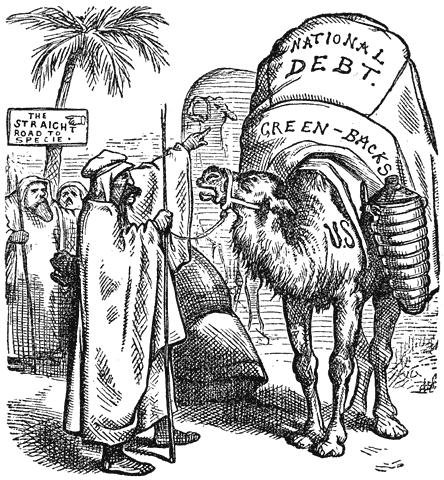
The Arab and the camel.
An Arab asked the loaded camel whether he preferred to go up or down hill. “Pray, master,” said the camel, dryly, “is the straight way across the plain shut up?”—Æsop.
Pending the slow preparations of the Government of the island to provide the requisite laws for the issue and use of the new money, various enlightened individuals attempted to anticipate official legislative action by putting into practical operation, on their own account, the principles involved in the new fiscal system. The first of these who thus acted was a secretary for the interior part of the island, whose chief business was to supply the heathen—for whom, it will be remembered, Robinson Crusoe took up contributions—with beef. There had been a suspicion for some time past hanging over this official that the heathen did not get all the beef that they were entitled to; but the suspicion probably had no further foundation than the inability of the heathen to make the sense of completion harmonize with the sign of transmission. To satisfy the heathen, and at the same time effectually clear up his character, the official in question now hastened to have prepared a large number of pictures of fine, fat cattle, which he dispatched by a Quaker to the heathen, with a request that they would kill and eat, and be satisfied, adding in a postscript that they would do well to begin to learn economy by saving the skins. As the Quaker never came back, it was deemed reasonably certain that, at least, the first part of the request had been complied with.
Again, two shrewd fellows, Peter von Scrapehem and Israel Double, owned each a farm worth ten thousand dollars. Peter sold his farm for its full value to Israel, and took a mortgage for the total purchase-money; and Israel, in turn, sold his to Peter, and took a mortgage also for its full value. By so doing, each of these worthy persons clearly doubled the property in his possession, inasmuch as while each had at the outset only ten thousand dollars’ worth of real estate, each now had ten thousand of real estate and ten thousand of personal property; or an aggregate of forty thousand between them, in the place of twenty thousand originally. This method of multiplying property by multiplying titles was so easy, and the result so apparent, that the example was very generally followed; and when the census came to be taken, a few months afterward, all were amazed at the enormous increase of wealth that had followed the discovery and simple recognition of the true nature and value of titles.
Up to this time the supply of milk on the island had been mainly controlled by a single corporation, which, under the name of the “Lacteal Fluid Association,” owned all the cows, and, for the purpose of facilitating supply, had long been in the habit of issuing tickets, each good for a pint or a quart of milk, and disposing of milk to those only who had tickets. These tickets revolved perfectly in the closed circle of exchange between the milk-men and their customers, satisfying all demands, and being accepted as the same thing as milk; for the more tickets, the more milk; and no tickets, no milk.
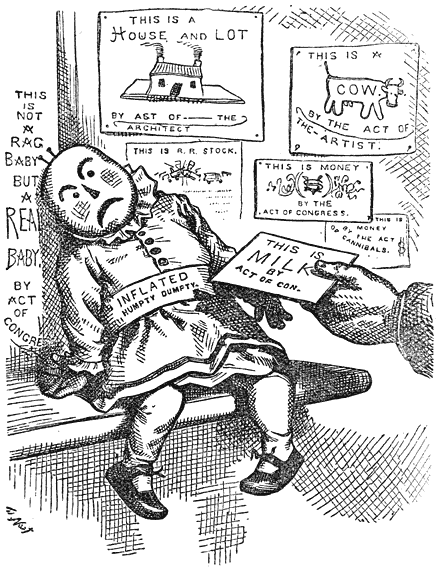
Milk-tickets for babies, in place of milk.
During the war the cannibals, in lack of any other meat, had eaten a large number of the cows belonging to the “Lacteal Association.” Many had been also taken by the Government for the soldiers; so that after the war was over there were really no more cows than the island absolutely needed. All at once, the “foot-and-mouth disease” invaded the island, and, attacking every cow belonging to the association, rendered her unable to give milk. Then arose such a piteous cry from every household where there were babies as carried a pang to the stoutest hearts. There was no need of any concerted action, for the people assembled spontaneously and demanded action. An immense public meeting was at once organized. A highly popular and humane man, a special friend of children, familiarly known as Uncle Dick, was called to the chair. He was supported by a long list of leading citizens as vice-presidents and secretaries, none of whom, however, had had any practical acquaintance with milk since their childhood, except in the form of punch. The chairman made an eloquent speech. He did not know whether he was most agitated by pity or indignation—pity for the poor babies, whose sufferings had become intolerable; indignation at the cruelty of the chartered monopolists, who had wantonly refused to issue more tickets at the very time when the demand for milk was most imperative. The assembly was of one mind with the chairman, and unanimously resolved that the Lacteal Association should immediately increase their supply of tickets, and that, in default thereof, their charter should be altered and amended. Unable to resist the storm of popular indignation, the association at once complied, and every patriotic citizen went home to the bosom of his afflicted family, carrying an abundant supply of milk-tickets, and feeling conscious that for once at least he had risen to the level of the occasion.
That night the babies were all supplied with milk-tickets in the place of milk. Milk-tickets hot, milk-tickets cold, milk-tickets sweetened, milk-tickets plain, milk-tickets with their backs printed green, and interchangeable with milk-tickets drawing cream skimmed from other milk-tickets. But, strange to say, the babies, one and all, with that same sort of instinctive perversity which induces children of a larger growth to refuse to accept shams for reality, and be grateful in addition, refused to take to milk-tickets. The uproar of the night preceding was as nothing to the disturbances of the night following, and morning dawned upon an unrefreshed and troubled population.
As soon as the necessary arrangements could be made, another meeting assembled. But the meeting this time was composed of babies, backed by their mammas and nurses. There was no theory in their sentiments; and though young in years, one and all felt that they had lived long enough to know what their fathers apparently did not know—namely, the difference between milk and paper. The resolutions voted were brief, but to the point, and were, substantially, as follows:
First, that the exigencies of the times demanded more milk, and not more milk-tickets; second, that the way to get more milk was to have more cows; third, that the way to get more cows was to go to work and raise them, or raise something else equally valuable, and then with this something else buy cows; fourth, that there are certain eternal verities against which it is useless for either babies or men to contend. A committee was appointed to procure a mill of the gods, to grind up those who disbelieved in the last resolution, and the meeting then adjourned.
This was the first indication of any thing like popular dissent from the views of the Friends of Humanity. Others, however, soon followed. Value having been declared to be an ideal thing, and ideal measures of value having been substituted in the place of the real and tangible measures formerly in use, it had been deemed proper to substitute ideal measures of length, weight, and capacity in the place of the foot-rules, yard-sticks, pound-weights, and bushel-measures formerly employed. Shop-keepers, plumbers, charcoal-men, gas corporators, and all others who had any thing to sell accordingly provided themselves with slips of paper, upon which were printed, respectively, “This is a foot,” “This is a bushel,” “This is a pint,” “This is a pound;” and the services of the arithmetic-man were again called for, to prove how much more cloth, beer, charcoal, gas, and all other measurable things the community would certainly have by the saving of labor and capital contingent on the avoidance of the necessity of further manufacturing, purchasing, and using the old measures.
News also came, about this time, that the heathen, not being able to stay their stomachs with the pictures of fat cattle that had been so abundantly sent them, and considering themselves humbugged, were preparing to declare war. To meet a threatened increased expenditure on this account, the Government, therefore, levied new taxes; and as the valuation of the property of the island, under the influence of the new fiscal system, had, as before stated, enormously increased, it was anticipated that a small rate would yield a large revenue. But as soon as Scrapehem, Double, and their friends, who had been multiplying their property by multiplying titles, found out that the titles were to be valued and assessed as wealth, equally with the property which the titles represented, they hasted to swap back, and cancel their mortgages; and immediately half the reputed wealth of the island disappeared.
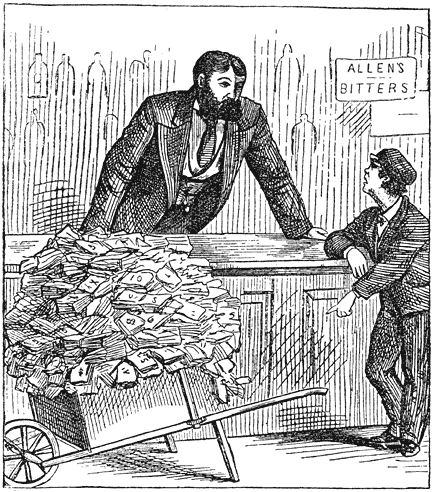
An inflation look ahead.
There were some people, it will be remembered, who did not share in the general jubilation which welcomed the discovery and adoption of the new monetary system. These were the stony-hearted capitalists, meaning thereby persons who had produced by industry and frugality more than they had consumed, and had lent out this surplus in the form of ships, houses, horses and carts, wheelbarrows, coal, iron, and the like, on condition that they should be repaid the value of the several articles as expressed in money, with a portion of the profit that might have accrued to the borrower from their using.
There was a popular feeling that all these lenders were “bloated,” the degrees of bloat being, of course, different all the way from the man who owned and lent a ship down to the man who owned and lent a cart, or their equivalents in money; and that the best remedy for this frightful disease was tapping, and tapping by tendering in payment the ideal money, which was something very different in value from the money understood at the time the loans were effected. Natives of heathen lands, who had never enjoyed the light of the Gospel, called this robbing; but many on the island who had always been Christians regarded the matter with indifference, and treated it as a purely sanitary measure; and Christian ministers who never preached against such practices, but always did preach against the sins of that ancient people, the Jews, wondered at the low tone of morality that seemed to generally characterize society. As it appears, however, from an examination of the ancient records of the island, that strenuous exertions were made about this time to interest the Government and the people in the momentous question of the reading of the Bible in the public schools, and thus prevent public attention from being diverted to the consideration of any such unimportant and side issues as the nature and obligations of promises, it may be that the low tone of morality thus referred to was more apparent than real; no province devolving upon the historian being more difficult than that of attempting to reconcile, after a long lapse of years, what appears to be a series of contemporaneous but utterly incongruous circumstances.
But, be this as it may, all who had loaned valuable commodities desired to avoid tapping, and consequently hastened to demand repayment before the ideal money could be extensively issued and put into circulation; and, having once obtained payment, were very cautious how they lent again. All this contributed, in the language of the day, to make money very tight; but this language had, to a great extent, no meaning. The only money that was tight was good money, and this had been gone so long that the younger part of the population didn’t even know how it looked; while of the bad money there was a continually increasing quantity.
Besides good money, all real capital, timber for building ships, factories, and houses, iron for the construction of machinery, cloth for clothes, and grain for food, were tight; not because there was any lack of all these useful things, but because the owners had all become afraid that if they once loaned or parted with them they should never receive back an equivalent. So the island, instead of being lifted up to great prosperity, was plunged into the depths of adversity. There was a general lack of confidence. Societary activity was abated; production was arrested; and men desirous of being industrious had no opportunity of following any industry.
At last, the long-expected day arrived, and Congress assembled. All the special and immediate Friends of “More Money,” of “Ideal Money,” and of “Humanity,” were members; and hardly had the presiding officer taken his seat before fifty men sprung for the floor, each with a resolution demanding immediate fiscal legislation. The first resolution adopted was, that the Government should at once supply all the money which the wants of every body, and every trade and industry, might, could, would, or should require; and that the money thus issued should be a legal tender for the payment of all debts, past, present, and prospective.
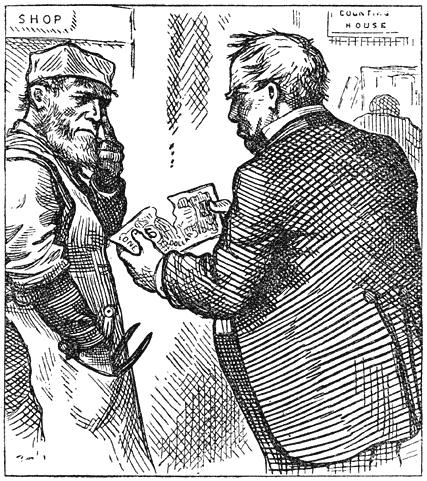
Increasing the volume of the currency.
Capital. “By dividing this one dollar it becomes two, which makes more money. I pay you these ‘two dollars’ for wages, you see.”
Labor. “But when I go to buy bread I find them only worth one; so I don’t see it.”
The next important question was, In what manner should the new and unlimited supply of money be distributed? All saw at once that it would never do to commence on a system of giving unlimited something for unlimited nothing; and yet, if this was not done, how was it possible for the wants of those who had nothing, and who, of course, wanted money for this reason most imperatively, to be supplied? Besides, to create an unlimited supply of the new money, it would be necessary to have a good many hundreds of thousands of slips of paper with the words, “This is a dollar,” “This is ten dollars,” or “This is—” (some other amount), properly and artistically printed on them; all of which, in turn, would require a great expenditure, not only of ink and paper, but also of time; while the necessity of the hour was for immediate relief, especially to trade. It was therefore decided to leave the troublesome question of equal distribution for a time unsettled, and endeavor to first relieve trade by doubling the volume of the currency. And in order to do this at once, and without cost to the Government for engraving, printing, paper, and ink, it was therefore enacted that every one having legal-tender currency might cut or divide the same into two equal halves or pieces, and that each of these halves or pieces so resulting should be a legal tender to the full amount that the whole had previously been. At first thought, this proposition to exclude all those who had no money from participation in the new supply seemed most palpably unfair and unjust, but a little consideration satisfied to the contrary; for unless it was proposed to give away the new money, it was obvious that those only would get it who had money, and that the proportion which all such would obtain would be in proportion to what money they already had. It was, therefore, deemed wise to anticipate what was certain to be the ultimate result, and distribute it in the manner indicated.