Chapter V
Reading edition
A Student in Manila
As I had hoped, I was taken to the Jesuit priest at that time in charge of the Ateneo Municipal. He was Father Magin Fernando. At first he was unwilling to admit me. One reason was I had come late. Other reasons were that I did not seem strong and was very small for my age. I was then eleven. But later, Doctor Manuel Xeres Burgos, a nephew of the ill-fated Padre Burgos, spoke in my favor; and Father Fernando admitted me.
I dressed myself in the uniform like the other students, wearing a white coat, or americana, and a necktie, and entered the chapel of the Jesuit Fathers to hear mass. What fervent prayers did I address to God!
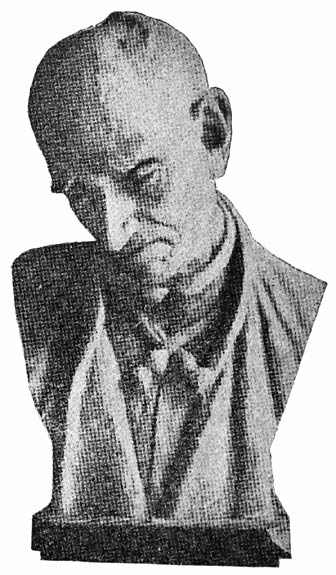
An Ateneo Professor modeled by Rizal in Dapitan from memory. This bust won a gold medal at the St. Louis Exposition, in 1904
After mass, I went to the classroom. There I saw a number of boys, Spanish, mestizos and natives, and a Jesuit teacher. Father José Bech, the teacher, was a tall man, thin and somewhat stooping, but quick in his movements. His face was thin and pale, yet lively. His eyes were small and sunken, his nose sharp and Grecian. His thin lips curved downwards. He was a little eccentric, sometimes being out of humor and intolerant; at other times amusing himself by playing like a child.
Some of my schoolmates were interesting enough to warrant mentioning them by name. Florencio Gavino Oliva, a young man from my own province, had great talent but he did not work steadily. The same thing was true of Moisés Santiago, a mathematician and a penman. It was also true of Gonzalo Manzano, who then held the position of “Roman Emperor.”
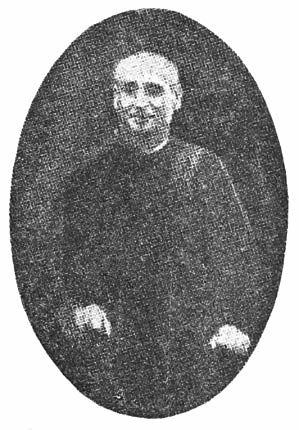
Rizal’s favorite teacher in the Ateneo. Father Sanchez visited Rizal in his exile in Dapitan, and helped him start a school for the Dapitan boys
In Jesuit colleges they divide the boys into two groups or “empires,”—one Roman and the other Greek. These two “empires” are always at war. The boys of one “empire” always want to outdo those of the other empire in all kinds of contests. Each group has a leader who is called “Emperor.” The “Emperor” wins his place by doing the best work and standing the highest of anyone in his group. I was put at the end of the line. I could scarcely speak Spanish, but I already understood it.
After the religious exercises, I went out and found my brother waiting to take me to my lodgings, which were about twenty-five minutes’ walk from the college. My brother did not wish to leave me in the Walled City, which seemed very gloomy to me.
I lodged in a small house on Calle Caraballo, near an estero. The house consisted of a dining room, a sala, a bedroom and a kitchen. An awning covered the small space between the door and the steps. My landlady was a maiden lady called Titay, who owed our family three hundred pesos. Her mother, a good old woman, lived with her. There were besides a crazy woman, quite harmless, and some Spanish mestizos in the house.
I must not speak of my sufferings, or of my troubles and pleasures. I shall record only what happened in school during that year. By the end of the first week, I was going up in the class. Then I began to spend the siesta-time studying at Santa Isabel College. For this, I paid three pesos a month. I went there with Pastor Millena, a boy of my own age. A month later, I was “Emperor”.
How pleased I was when I won my first prize, a religious picture! In the first quarter I gained another prize, with the grade “Excellent.” After that I did not care to apply myself. I had foolishly become dissatisfied because of something my teacher said. Unfortunately, this continued until the end of the year and I gained only second place in all my subjects. This gave me the grade of “Excellent” but without any prize.
I spent the vacation at home and went with my eldest sister, Nening, to Tanawan, for the town festival. This was in 1873. But our pleasure was marred by the fact that our mother was not with us. I had gone alone to see my mother without first sending word either to her or to my father. This was at the close of the term in which I held second place. I thought with what joy I would surprise her. Instead, we wept in each other’s arms. We had not seen each other for more than a year.
After vacation was over, I returned to Manila and enrolled in the second year. Then I hunted lodgings in the Walled City. It was too tiring to live so far away. I found a place at 6 Calle Magallanes in the house of an elderly widow, Doña Pepay. Her daughter, also a widow, lived with her. The name of the daughter was Doña Encarnación, and her four sons were José, Rafael, Ignacio, and Ramón.
Nothing worth telling happened that year. My professor was the same as in the previous year; but I had different schoolmates. Among them I found three who had been with me in Biñan. At the end of this year, I won a medal and returned to my town.
I again went alone to visit my mother in prison. Like another Joseph, I prophesied to her from a dream that her release would take place within three months. This prediction happened to come true.
At this time, I began to devote my leisure to reading novels. Years before, I had read one, but it was not with any great interest. Imagine how a romantic youngster of twelve would delight in the Count of Monte Cristo! Under the pretext that I should have to study general history, I persuaded my father to buy me a set of Cesar Cantu y Diós’ histories.
I gained much by reading them. In spite of my only half applying myself and of my indifferent Spanish, I was able to win prizes in the quarterly examinations. I should have gained the medal if I had not made some slips in Spanish, which I spoke very poorly. This gave the place to a Spanish lad who spoke his mother tongue better than I could. Thus, then, I finished my third year.
When I next returned to Manila, I found my former landlady’s house full. I had to take a room in the house with my brother, Paciano Mercado, in company with a boy from my town named Quintero. My life was not so free as formerly, for I was under close supervision. The regular hours, however, were better for me. I prayed and played with my landlord’s children.
A portrait of General Paciano Rizal-Mercado should appear here, but he has never had his picture taken. In September, 1896, he was cruelly tortured in an unsuccessful endeavor to get him to sign a statement that his brother was the leader of the rebellion. Rizal’s last letter, from the Fort Santiago death-cell, tells how much the younger brother owed to the elder:
“My dear brother: Now that I am about to die, it is to you that I write my last letter. I am thinking of how you worked to give me my career....
... I believe that I have tried not to lose my time ... I know how much you have suffered for my sake. ... I assure you, brother, that I die innocent of this crime of rebellion.”
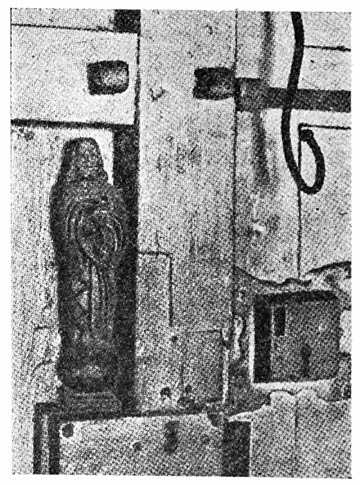
Carving of the Sacred Heart of Jesus, made by Rizal while in the Ateneo. Even then he was the hero of his schoolmates and the little image was long kept, as here shown, on the door of the students’ dormitory. In 1896 his former teachers removed it and took it to him in the death cell at Fort Santiago
A little later my mother was proved innocent and she was set free. She came to embrace me as soon as she was free. After the vacation, in that memorable year of my mother’s release, I again had my lodgings in the Walled City. The house was in Calle Solana and belonged to a priest. My mother had not wanted me to return to Manila, saying that I already had sufficient education. Did she have a presentiment of what was going to happen to me? Can it be that a mother’s heart gives her double vision?
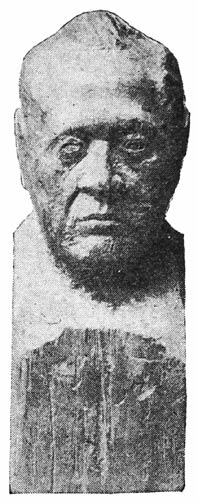
Bust of his father, made by Rizal when 14
My future profession was still unsettled. My father wanted me to study metaphysics, so I enrolled in that course. But my interest was so slight that I did not even buy a copy of the textbook. A former schoolmate, who had finished his course three months before, was my only intimate friend. He lived in the same street as I did. My companions in the house were from Batangas and had only recently arrived in Manila.
On Sundays and other holidays, this friend used to call for me and we would spend the day at my great-aunt’s house in Trozo. My aunt knew his father. When my youngest sister entered La Concordia College, I used to visit her, too, on the holidays. Another friend had a sister in the same school, so we could go together. I made a pencil sketch of his sister from a photograph which she lent me. On December 8th, the festival of La Concordia, some other students and I went to the college. It was a fine day and the building was gay with decorations of banners, lanterns and flowers.
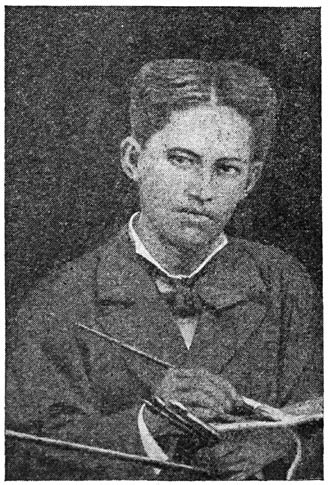
Rizal as a painter. This portrait is from a group picture of students who lived in the house of Rizal’s cousin, Antonio Rivera. Rizal was then eighteen years old.
Shortly after that, I went home for the Christmas holidays. On the same steamer, was a Kalamba girl who had been a pupil in Santa Catalina College for nearly five years. Her father was with her. We were well acquainted but her schooling had made her bashful. She kept her back to me while we talked. To help her pass the time, I asked about her school and studies but I got hardly more than “yes” and “no” in answer. She seemed to have almost, if not entirely, forgotten her Tagalog. When I walked into our house in Kalamba, my mother at first did not recognize me. The sad cause was that she had almost lost her sight. My sisters greeted me joyfully and I could read their welcome in their smiling faces. But my father, who seemed to be the most pleased of all, said least.
The next day we were expecting friends from Manila to arrive, on their way to Lipa. But the steamer landed its passengers at Biñan because of a storm. So I saddled a pony and rode over there to meet them. My horse proved to be a good traveler and when I got back to Kalamba I rode on, by the Los Baños road, to our sugar mill. There I tied the horse by the roadside and for a time watched the water flowing through the irrigation ditch. Its swiftness reminded me of how rapidly my days were going by. I am now twenty years old and have the satisfaction of remembering that in the crises of my life I have not followed my own pleasure. I have always tried to live by my principles and to do the heavy duties which I have undertaken.