Part 1 — Malvern Hill
Reading edition
McClellan had already selected another naturally strong position, this time on Malvern Hill, for the last stand before reaching the James River. On the morning of July 1, Morell and Sykes’ divisions of Porter’s corps were drawn up on the crest of the hill west of the Quaker road. East of the road Couch’s division of Keyes’ corps held the front, with Kearney and Hooker of Heintzelman’s corps flanked to the right and rear. Sumner’s troops were in the rear in reserve. The position was flanked on either side by creeks in deep ravines less than a mile apart, and across this narrow front, Porter placed his batteries with the guns almost hub to hub. In front, the ground was open, sloping down to woods, marshes, and swamps, through which the Confederate forces had to form for attack within range of the Federal artillery.
Lee had Jackson on his left facing Kearney, Hooker, and Couch’s right. D. H. Hill was in the center opposite Couch’s left and Morell’s right. Lee then ordered Magruder to the right of Hill, but Magruder was delayed by taking the wrong road; so instead two brigades of Huger’s were placed on Hill’s right. Longstreet and A. P. Hill, their ranks decimated from the actions at Gaines’ Mill and Glendale, were held in reserve. The terrain rendered it almost impossible for effective use of Confederate artillery, and the few batteries that did get into position were quickly cut to pieces by the massed Union guns.
23
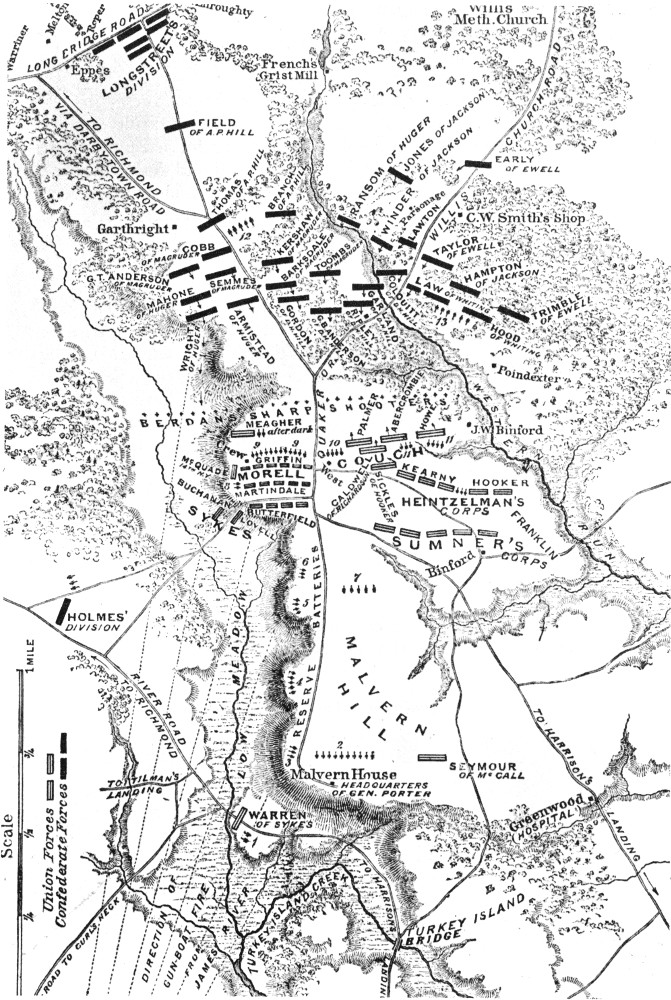
Battle of Malvern Hill. From Battles and Leaders of the Civil War.
Confederate Forces
LONGSTREET’S DIVISIONS
FIELD OF A. P. HILL
THOMAS OF A. P. HILL
BRANCH OF A. P. HILL
COBB OF MAGRUDER
G. T. ANDERSON OF MAGRUDER
RANSOM OF HUGER
JONES OF JACKSON
WINDER OF JACKSON
LAWTON
EARLY OF EWELL
MAHONE OF HUGER
SEMMES OF MAGRUDER
KERSHAW OF MAGRUDER
BARKDALE OF MAGRUDER
TOOMBS OF MAGRUDER
TAYLOR OF EWELL
HAMPTON OF JACKSON
LAW OF WHITING
TRIMBLE OF EWELL
WRIGHT OF HUGER
ARMISTEAD OF HUGER
GORDON OF HUGER
OF D. H. HILL:
E. B. ANDERSON
RIPLEY
GARLAND
COLQUITT
HOOD OF WHITING
HOLMES’ DIVISION
Union Forces
BERDAN’S SHARPSHOOTERS
MEAGHER after dark
QUAKER
PALMER
ABERCROMBIE
HOWE
J. W. Binford
GRIFFIN
McQUADE
MORELL
Crew
West
CALDWELL
NICKLES OF HOOKER
KEARNY
HOOKER
HEINTZELMAN’S CORPS
FRANKLIN
SUMNER’S CORPS
Binford
BUCHANAN
MARTINDALE
BUTTERFIELD
LOVELL
SYKES
HOLMES’ DIVISION
RESERVE BATTERIES
WARREN OF SYKES
Malvern House HEADQUARTERS OF GEN. PORTER
SEYMOUR OF McCALL
Greenwood (HOSPITAL)
GUN-BOAT FIRE FROM JAMES RIVER
24
“Owing to ignorance of the country, the dense forests impeding necessary communications, and the extreme difficulty of the ground,” Lee reported, “the whole line was not formed until a late hour in the afternoon.” The first real assault did not take place until after 5, and then it was uncoordinated and confused. The signal for the attack was to be a yell from one of Huger’s brigades, after the Confederate artillery had blasted a hole in the Union lines. This put the responsibility of where and when to begin the attack on a mere brigade commander.
The artillery was unable to put concentrated fire in any one spot, but Huger attacked regardless and was beaten back with heavy losses. Then D. H. Hill attacked, only to suffer the same fate. Magruder finally sent his troops in a gallant charge across the open fields right up to the cannons’ muzzles, only to be mowed down like wheat at harvest time. Late in the battle Jackson sent his own division to Magruder’s and Hill’s support, but in the heavily wooded and swampy ground they got lost and did not arrive in time to help. Darkness finally put an end to these hopeless attacks. As D. H. Hill declared bitterly, “It was not war—it was murder.”