Part 1 — Beaver Dam Creek (Ellerson’s Mill)
Reading edition
According to Lee’s plan, Jackson was to march from Ashland on June 25 and encamp that night just west of the Central Railroad. At 3 a.m. on the 26th he was to advance and envelop Porter’s right flank at Beaver Dam Creek. Then, wrote Lee, “A. P. Hill was to cross the Chickahominy at Meadow Bridge when Jackson’s 14 advance beyond that point should be known and move directly upon Mechanicsville.”
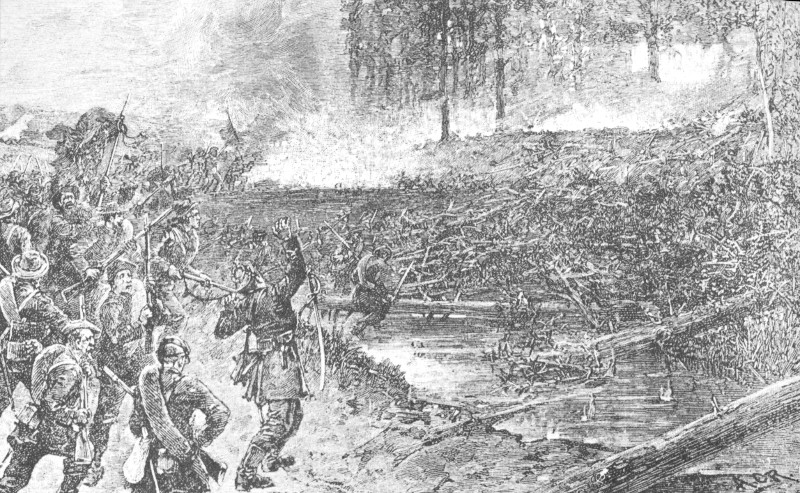
Confederate attack at Beaver Dam Creek. From a contemporary sketch.
But from the beginning, unforeseen circumstances upset the operation and timing of this plan. McClellan suspected Jackson’s approach, so the element of surprise was lacking. And when the action of the Union pickets in destroying bridges and felling trees in Jackson’s path, as well as the fatigue of his weary troops, combined to delay him, the all-important time element was lost.
As the day wore on with no word from Jackson, A. P. Hill became impatient and fearful for the success of Lee’s plan. He decided to attack regardless. At 3 that afternoon he crossed the Chickahominy and swept the Union outposts from Mechanicsville, thus clearing the way for D. H. Hill and Longstreet’s troops to cross. Porter withdrew to a prepared position behind Beaver Dam Creek, a mile east of Mechanicsville. This naturally strong position was further fortified by felled trees and the banks of a millrace. Here, atop the high banks of the stream, he placed Gen. George McCall’s division, extending from near the Chickahominy on the south, across Old Church road (now U.S. 360) on the north. Gen. Truman Seymour’s brigade held the left and Gen. John Reynold’s the right, with Gen. George G. Meade’s brigade in reserve. The only approaches to the position were across open fields, commanded by the Federal artillery, and down the steep banks of the stream, covered by the soldiers’ muskets.
15
Hill recklessly hurled his brigades forward in a hopeless frontal assault. The gray-clad infantry charged bravely down the steep banks and up to the stream before the murderous fire of artillery and musketry from the surrounding slopes forced a bloody withdrawal. Casualties in killed and wounded were: Confederate 1,485; Union, 258.
Despite the successful defense, when Jackson’s forces finally appeared on his right flank later that night, Porter’s position became untenable and McClellan ordered him to withdraw to a previously prepared position behind Boatswain Swamp, near Gaines’ Mill. At the same time he ordered his quartermaster general at White House to reship all the supplies he possibly could to Harrison’s Landing on the James, and send all the beef cattle to the vicinity of Savage Station. Early next morning, June 27, the herd of 2,500 head of cattle started on its drive from White House.
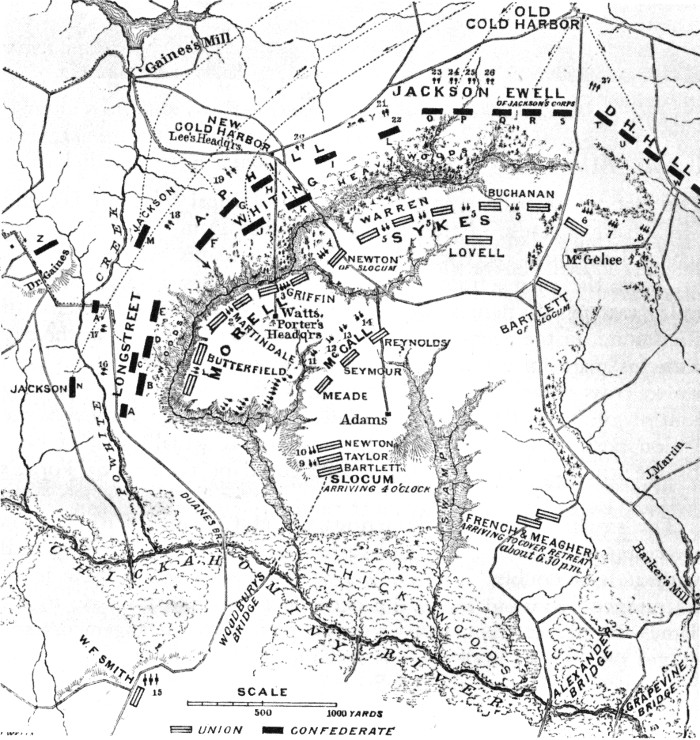
Battle of Gaines’ Mill. From Battles and Leaders of the Civil War.
OLD COLD HARBOR
Gaines’s MILL
NEW COLD HARBOR
CONFEDERATE
Lee’s Headq’rs
D. H. HILL
JACKSON
EWELL
A. P. HILL
WHITING
LONGSTREET
UNION
SYKES
McGehee
BUCHANAN
WARREN
LOVELL
MORELL
Porter’s Headq’rs
GRIFFIN
MARTINDALE
BUTTERFIELD
McCALL
REYNOLDS
SEYMOUR
MEADE
J. Martin
W. F. SMITH
SLOCUM ARRIVING 4 O’CLOCK
NEWTON
TAYLOR
BARTLETT
FRENCH & MEACHER ARRIVING TO COVER RETREAT about 6.30 p.m.
16
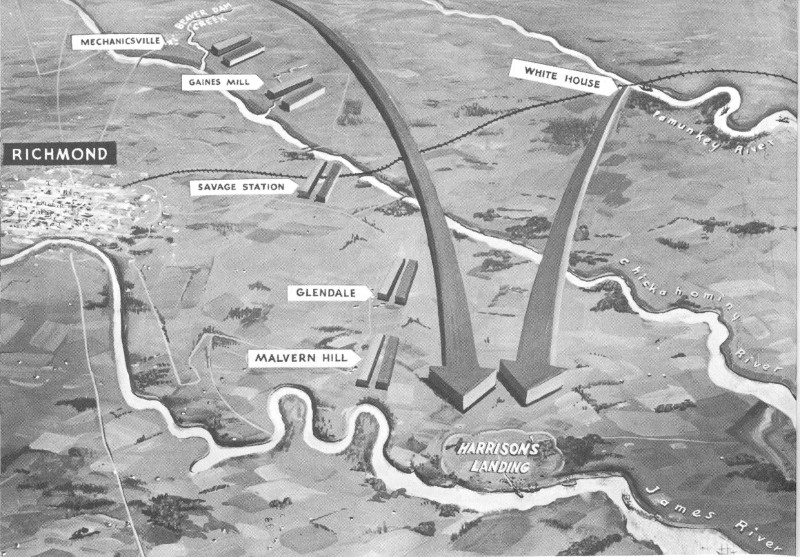
McClellan’s change of base. Painting by Sidney King.
WHITE HOUSE
MECHANICSVILLE
GAINES MILL
Pomunkey
SAVAGE STATION
Chickahominy
GLENDALE
MALVERN HILL
HARRISON’S LANDING